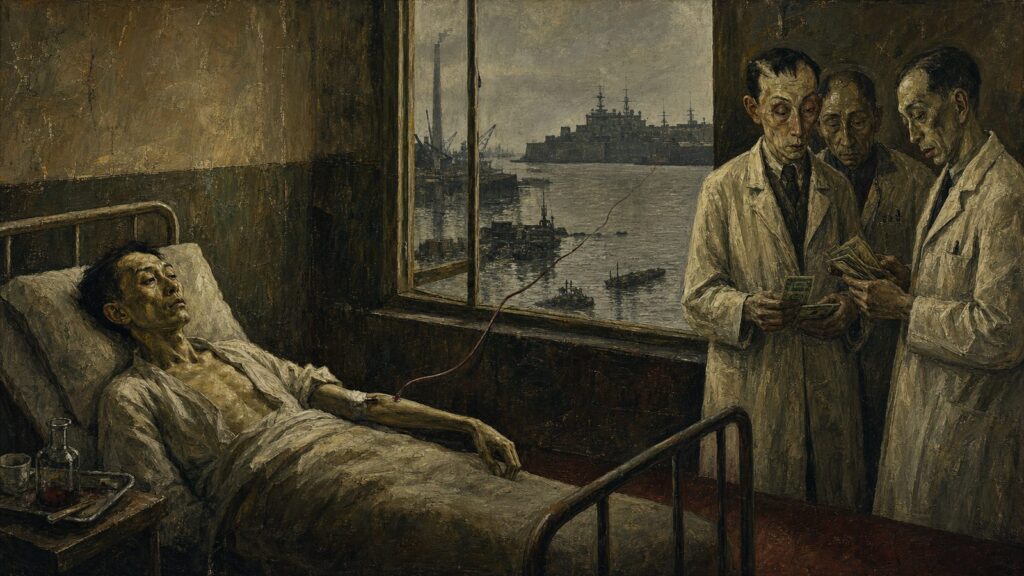
South Korea, get on the phone with Canada, Japan, China, India, Brazil, and the Middle East to discuss your diagnosis and fate. You have identical symptoms; maybe you can help each other.
APR 14, 2026
By Scott Ortkiese | so@throughlinesynthesis.com | www.throughlinesynthesis.com
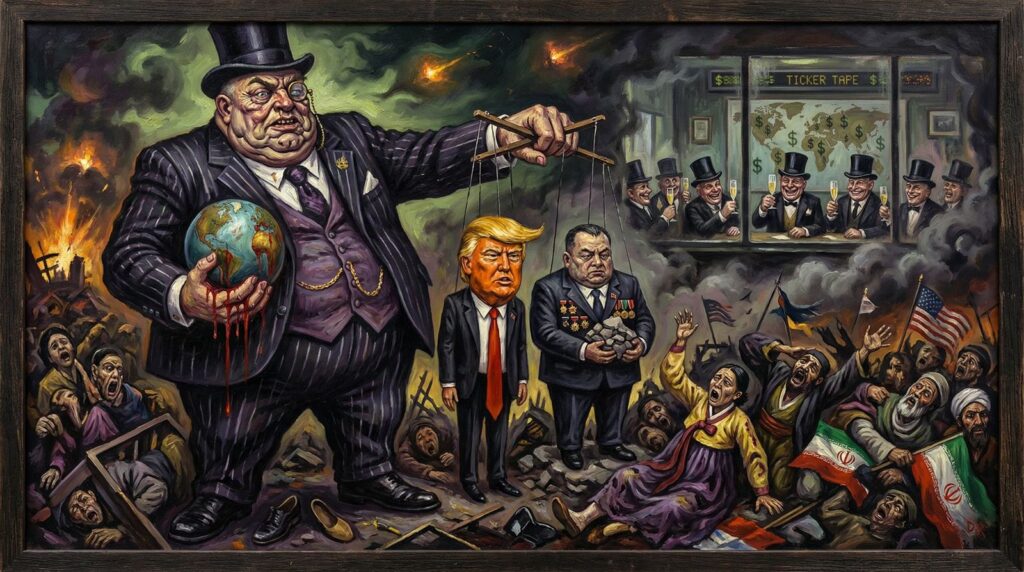
South Korea is among the first U.S. allies to openly question the American military umbrella, and may well be the first to pivot toward the New World Majority Order. They thought military security was their primary existential consideration, only to realize the U.S. could despoil them economically in a “madman” scenario they never modeled: one in which the U.S. plays an incompetently poor hand and sacrifices a lesser vassal for a higher-priority gambit, a mistake of ego, anger, or manipulation by another.
That is the diagnosis. Here is the pathology report.
The cancer is not North Korea. North Korea is the pre-existing condition, the chronic illness Seoul has managed for seven decades through deterrence, diplomacy, and the occasional theatrical missile exchange. The cancer is the dependency itself: the belief, cultivated through decades of Pentagon briefings, State Department reassurances, and joint military exercises conducted with the choreographed reassurance of a pharmaceutical advertisement, that the United States of America would be there, when it mattered, for you. Cancers do not announce themselves. They colonize quietly, replicating their destructive logic into the body of the host institution until the host cannot distinguish its own cells from the malignant ones. South Korea’s dependency on the American security umbrella colonized its strategic imagination so thoroughly that in October 2025, when South Korean President Lee Jae Myung stood before his nation on Armed Forces Day and announced an 8.2 percent increase in the defense budget, earmarked for AI combat robots, autonomous drones, and precision-guided missiles, the entire Korean commentariat treated it as shocking. It was not shocking. It was overdue. It was the first breath of a patient who had been on a ventilator, realizing the ventilator was attached to a machine operated by a man who regards you primarily as a billing opportunity.
As a result of this unplanned and non-tragic mistake by its presumed ally, South Korea is facing a life-or-death moment, where its Big Daddy with the biggest stick is tied up in the Middle East and dedicating its resources to its favorite ally, Israel, saving nothing for the others further down the food chain. This is not metaphor. It is ledger. From October 2023 through September 2025, the United States spent a minimum of $38 billion arming Israel’s campaigns in Gaza and across the broader Middle East, an average of $52 million per day, $2 million per hour, around the clock, without pause. By early 2026, Washington launched its largest military buildup in the Middle East since the 2003 invasion of Iraq, ultimately co-executing joint airstrikes on Iran alongside Israel, the first time in Israel’s history it fought shoulder-to-shoulder with an ally through a full military campaign. Hundreds of American troops were stationed inside Israel itself, operating air defenses, managing logistics, and flying air tankers out of Ben Gurion Airport. Every carrier, every destroyer, every sortie pointed south and west, toward Tel Aviv, away from Seoul.
The economic ambush arrived with the same clinical indifference as a Stage IV diagnosis delivered by a doctor who is already checking his watch. In July 2025, Seoul agreed to a staggering $350 billion investment package in American strategic sectors in exchange for tariff relief, an extraction of capital from Asia’s fourth-largest economy so severe that analysts warned it would hollow out South Korean domestic competitiveness at the very moment it needed industrial resilience. Then, in January 2026, Trump threatened to raise tariffs on South Korean automobiles, pharmaceuticals, and lumber from 15 percent back to 25 percent anyway, not because the deal had failed, but because South Korea’s legislature had not moved fast enough to ratify it. The Korean won fell. Auto stocks cratered. South Korean exports to the United States had already declined 3.8 percent in 2025, with auto shipments down more than 13 percent year-on-year. Washington rewarded a compliant ally with a noose and called it a partnership. This is what metastasis looks like in geopolitical terms: the tumor spreads from the security relationship into the trade relationship, from the trade relationship into the currency, from the currency into the domestic political calculus, until every organ of national sovereignty is compromised.
Yes, the Donald is so starved for validation these days that he openly courts its only reliable source, North Korea, lavishing admiration on Kim Jong Un from the Oval Office, in front of South Korea’s own president, calling Kim “very good” and full of “great potential.” On August 25, 2025, in the Oval Office, with South Korean President Lee Jae Myung seated inches away, Trump repeatedly praised the North Korean dictator, declared he had a “very good” relationship with Kim, that North Korea had “great potential,” and that he looked forward to meeting Kim again. Lee sat silent. He smiled. He said nothing to object. The man Trump was auditioning as his pen pal governs a state that, just weeks earlier, had dismissed every single peace overture Lee had made, with North Korea’s spokesperson stating flatly that Seoul’s proposals were beneath consideration. Trump, undeterred by this irrelevance, chose the moment of a formal bilateral summit with a treaty ally to perform as Kim’s publicist and fan club president. There is no diplomatic language adequate to describe what this was. It was a head of state publicly fellating the existential enemy of the nation sitting across from him and calling it diplomacy. Trump has simultaneously demanded Seoul pay $10 billion annually for the privilege of hosting American troops, nearly ten times the $1.1 billion agreed upon in the 12th Special Measures Agreement, while dangling the prospect of withdrawing those same troops to reposition them against China. Washington pressed for “strategic flexibility”: the right to redeploy Korean-based forces to Taiwan or the South China Sea without Seoul’s consent, entangling a nation of 51 million in conflicts it has no stake in, while stripping it of the deterrence it paid for. This is not an alliance. This is a protection racket administered by people who failed every course in the curriculum of strategic statecraft and leveraged their donors’ money into the seats where those courses would have been taught.
Thus, South Korea’s 51 million souls are placed at imminent risk by an irrational attachment to a declining American Empire exercising catastrophically bad judgment. They need to pursue a multi-vector, multipolar, and non-hegemonic strategy in which they align with select Eastern neighbors, such as Japan and, carefully, China, to position themselves relative to North Korea’s concentrated and immediate threat, ideally through a mutual economic and security support framework. That realignment is already quietly underway. In January 2026, South Korean President Lee and Japanese Prime Minister Takaichi met in Nara to deepen bilateral security and economic ties, addressing supply chains, artificial intelligence, and the denuclearization of the Korean Peninsula, building a framework that no longer waits for Washington’s instruction. In March 2025, the 11th Trilateral Foreign Ministers’ Meeting between China, South Korea, and Japan convened in Tokyo, a table that would have been unimaginable a decade ago, with Seoul and Tokyo quietly signaling to Beijing that regional stability is worth more than American patronage.
In essence, the U.S., their former protector, has become their economic adversary, a wolf that wore sheep’s clothing long enough to be trusted, and is now baring teeth.
The Tumor Has a Name, and It Is Not Trump
Before the world body can marshal its defenses, it must correctly identify the malignant organism. This is where most analyses fail, and where most patients die: by treating the symptom as the disease. Donald Trump is a symptom. Benjamin Netanyahu is a symptom. The governments and supposed leaders parading across the world stage as sovereign decision-makers are, with very few exceptions, puppets, their strings held not by voters, not by constitutions, not by the national interest, but by the rentier class that finances their campaigns, owns their media environment, staffs their regulatory agencies, and determines the boundaries of what is politically possible before a single ballot is cast or a single policy is drafted.
The rentier class is the tumor. Trump does not set the agenda. He performs it. He is the licensed id of the rentier network, the howling, needy, impulsive front man who gives their extraction a face that the public can either worship or despise while the actual decisions, who gets protected, who gets bombed, who gets tariffed, and who gets the reconstruction contract, are made several floors above his attention span by people whose names do not appear on ballots. Netanyahu is the same phenomenon in a different costume, a politician who has survived indictment, corruption charges, and coalition collapse by making himself so indispensable to the defense industry’s revenue model and the regional destabilization logic that serves it, that the network keeps him alive and in power through each successive catastrophe he generates. These men are not leaders. They are products. Merchandise developed and maintained by the rentier network to occupy the space where accountability would otherwise have to live. When Trump does something that appears inexplicably self-defeating, praising Kim Jong Un in front of Seoul’s president, slapping tariffs on a treaty ally who just handed over $350 billion, abandoning the Gulf states who hosted his forward bases to Iranian retaliation, the question to ask is not “why is he so stupid?” The question is: “whose interests does this stupidity serve?” The answer, reliably and without exception, traces back to the network.
The Tumor Has a Name, and Its Name Is Rentier
A rentier is someone who makes money without making anything. Not a businessperson who takes risk and creates a product. Not an engineer who builds a factory or a farmer who works soil. A rentier is a person, or more precisely a class of persons and institutions, who collect income from the mere ownership of assets: real estate rents, financial interest, stock dividends, monopoly pricing power, patent tolls, and the endlessly creative financial instruments designed to extract value from productive economic activity without contributing a molecule to it. John Stuart Mill called it making money “in their sleep.” The United Nations Conference on Trade and Development put it clinically: the rentier class derives income “solely from the ownership and control of an asset, rather than from innovative, entrepreneurial deployments of economic resources.”
Think of it this way. Imagine a town with a river running through it. The town’s farmers, craftsmen, and merchants built their livelihoods on the water, using it to irrigate crops, power mills, and transport goods. Then one family figured out they could build a dam, charge everyone for access to water they did not create, and do nothing else. They hire lawyers to defend the dam in court. They hire lobbyists to pass laws making alternative water sources illegal. They hire politicians to give speeches about the sanctity of property rights and the danger of regulation. They do not farm. They do not build. They do not create. They collect. Generation after generation, their children inherit the dam, the lawyers, the lobbyists, and the politicians, and the town’s farmers and craftsmen and merchants grow progressively poorer, progressively more indebted, and progressively more dependent on the dam owners’ goodwill for something as fundamental as water. That is rentier capitalism. That is the tumor. And in the United States, the dam owners now control the dam, the river, the town hall, the courthouse, the newspaper, the university endowment, the defense budget, and the foreign policy apparatus that decides which countries get protected and which get sacrificed.
The rentier class does not show up in your life wearing a sign that says “parasite.” The rentier shows up wearing a name carved into marble, a typeface designed to communicate permanence and authority, a logo that implies the Rock of Gibraltar rather than the tapeworm. BlackRock. The very name announces geological permanence, immovability, the weight of stone. As of January 2026, BlackRock oversees $14.042 trillion in assets under management, a figure that dwarfs the GDP of every sovereign nation on earth except the United States, China, Germany, Japan, and India, and it grew 22 percent year-over-year in 2025 alone. It is acquiring infrastructure, private credit, and financial data systems, meaning it increasingly owns the pipes, the loans, and the information through which the global economy runs, while producing none of the goods, services, or labor that flow through those pipes. Vanguard manages approximately $11 trillion. Together, BlackRock, Vanguard, and Fidelity alone account for roughly 50 percent of all U.S. fund assets under management, with the top 20 asset managers globally now controlling 47 percent of the $140 trillion held by the world’s 500 largest managers. This is not a market. This is a monopoly wearing a market’s clothing.
Goldman Sachs whispers of old money and continental sophistication. What Goldman Sachs actually is was most accurately described as “a great vampire squid wrapped around the face of humanity, relentlessly jamming its blood funnel into anything that smells like money.” During the 2008 financial crisis, Goldman sold its clients mortgage-backed securities it privately described in internal communications as “crap,” while simultaneously betting against those same securities, profiting from the collapse it helped engineer. It paid a $550 million settlement without admitting wrongdoing, which in rentier arithmetic means it paid a modest fraction of its profits as the license fee for continuing to operate. The revolving door between Goldman and the U.S. government rotates so constantly that analysts have termed it “Government Sachs”: at least four dozen Goldman executives, lobbyists, and advisers have moved between the firm and the highest reaches of American power across administrations of both parties. McKinsey and Company earns $23.5 billion annually, approximately $1 billion of it in federal government contracts over the past decade, more than half from the Department of Defense. It was implicated in South Africa’s state-capture scandal and refunded fees confirming it helped loot one of Africa’s largest power utilities for paying clients. It produced the consulting framework that helped Purdue Pharma market OxyContin into underserved communities, contributing to an epidemic that killed over 500,000 Americans. Lloyds of London conjures centuries of nautical authority. What it actually built, in the second half of the 18th century, was an insurance market whose premium income was derived between one-third and 40 percent from slavery-related business, underwriting the ships that transported human beings as cargo. In the late 1980s and early 1990s, Lloyd’s insiders quietly withdrew from syndicates they knew to be catastrophically exposed to asbestos and pollution liabilities, while recruiting thousands of new outside investors onto those same syndicates without adequate disclosure, transferring catastrophic losses from informed insiders to uninformed newcomers. The marble names and Gothic typefaces and reassuring thickness of the annual report are not incidental to the extraction. They are essential to it. The camouflage is the product.
The Biology of Exploitation: Why the Parasite Calls Itself a Partner
Since we are operating under a cancer diagnosis, the life sciences offer a precision that political language tends to obscure. In ecology, relationships between organisms are classified along a spectrum defined by who benefits and who is harmed. Mutualism describes a relationship in which both organisms benefit, the clownfish sheltering in the sea anemone’s tentacles while protecting the anemone from parasitic fish. Both gain. Neither is diminished. This is the relationship the rentier class claims to have with the economy it inhabits. Goldman Sachs “creates liquidity.” BlackRock “democratizes investing.” McKinsey “improves organizational efficiency.” Lloyds “distributes risk.” In every case, the claim is mutualism: we are here for you, and you benefit from our presence, and the arrangement is not just tolerable but necessary.
Commensalism describes a relationship in which one organism benefits and the other is unaffected, neither helped nor harmed. The remora fish clings to the shark, feeding on scraps without contributing to or detracting from the shark’s life. This is the softer claim the rentier class makes when the mutualism argument becomes too obviously false: we are not hurting you, we are merely profiting from proximity to your productivity.
Both claims are lies. The relationship is parasitism, in which one organism benefits at the direct and measurable expense of the other. Parasites increase their own fitness by exploiting hosts for food, habitat, and resources. A tapeworm does not simply live in your digestive system without consequence; it consumes the nutrients you ingested, leaving you malnourished in direct proportion to its appetite. A tick does not merely ride on the dog’s back; it introduces pathogens while extracting blood, and in sufficient numbers, ticks kill dogs. The critical distinction is that the biotrophic parasite must maintain the host in functional enough condition to continue being exploited. This is why the rentier class has, in past eras, tolerated labor unions, progressive taxation, the New Deal, and the welfare state: not out of ideological generosity, but because a completely immiserated working class cannot pay rent, service debt, or provide the consumer base against which financial extraction can be denominated. What we are witnessing now is evidence that this biotrophic constraint is being abandoned in favor of accelerated extraction, the parasite having concluded that the host is large enough to drain past the threshold of host sustainability before it must move on to the next organism. By Q3 2025, the bottom 50 percent of Americans collectively held 2.5 percent of the nation’s total wealth, while the top 1 percent held 31.7 percent. The CEO-to-worker pay ratio, which stood at 31 to 1 in 1978, had reached 281 to 1 by 2024. The Gini coefficient is at a 60-year high. These are not statistics. They are the imaging results from the oncologist’s scan, showing the tumor’s size, density, and metastatic spread into every organ of the political and economic body.
The commensal and symbiotic branding is not merely dishonest. It is an instrument of the parasitic strategy. Because if the host understands the nature of the relationship, the host develops an immune response. The entire project of building iconic names, institutional architecture, marble lobbies, and charitable foundations is the rentier equivalent of a parasitic organism producing proteins that suppress the host’s immune response, molecules that make the host’s body treat the invader as a friend rather than a threat. The tick injects an anticoagulant so the blood flows freely and the wound does not clot. Goldman Sachs names a foundation after itself and endows university chairs. BlackRock invites you to put your pension into its index funds and calls it financial inclusion. McKinsey publishes thought leadership papers on inequality. The anticoagulant is administered in the language of uplift and progress, and the blood flows freely, and the host does not clot.
The revolving door is the rentier class’s circulatory system. A 2025 Cambridge study examining the work histories of 420,153 individuals in top corporate positions across 12,869 firms found that firms were measurably more likely to receive lucrative procurement contracts following the appointment of a former regulator to a corporate position. The Goldman partner who becomes Treasury Secretary, the McKinsey consultant who becomes HHS deputy, the defense contractor executive who becomes Under Secretary of Defense for Acquisition: these are not conflicts of interest. They are the intended architecture. The revolving door colonizes the regulatory apparatus itself, replacing the institutional mission of protecting the public with the institutional logic of protecting the network. The think tank is its intellectual immune system, generating the consensus positions that determine which policy options are considered serious and which are dismissed as radical, ensuring that arguments for taxing economic rent at confiscatory rates die of institutional suffocation rather than intellectual refutation. The media conglomerate is its larynx, structurally incentivized not to produce journalism that threatens the network, combined with a structural incentive to produce journalism that normalizes it. The masses do not see the parasite because the organism that owns their information environment has evolved, over generations, to make the parasite invisible.
Why the World Does Not Yet Resist: The Immunosuppression Explained
People always ask the wrong question. They ask why the masses tolerate the rentiers’ wealth extraction as if the masses have simply chosen to look away, as if the answer is laziness, or ignorance, or some cultural deficiency in the capacity for outrage. That is the wrong question because it assumes that the masses have been permitted to see the thing they are being asked to tolerate. They have not.
The rentier class solved this problem two centuries ago, and the solution is so elegant and so total that most of the people living inside it do not know they are inside it. The solution has three components, and they operate simultaneously, reinforcing each other, each one making the others harder to escape.
The first component is what Antonio Gramsci, writing from a fascist prison cell in the 1930s, called hegemony: the process by which the ruling class does not merely dominate through force but achieves predominance by consent, making its values, its assumptions, and its definitions of reality the common sense of the entire society, including the class being dominated. You do not need to threaten people with a gun if you can make them believe, genuinely believe, that the dam owner’s right to charge for water is natural, just, and necessary for the prosperity of the town. Hegemony is the condition in which the slave defends the master’s property rights because the slave has been successfully persuaded that property rights are the foundation of his own freedom. In the United States, this manifests as the durable political mystery of tens of millions of working-class people voting for candidates whose explicit policy agenda is to cut the programs that keep those voters alive, because the hegemonic framing has made “freedom” synonymous with the freedom of capital to operate without restraint, and made any challenge to that freedom feel like an attack on the voter’s own identity and dignity.
The second component is what Noam Chomsky and Edward Herman called manufacturing consent: the systematic use of mass media to define the boundaries of acceptable thought, not through censorship, which would be visible and therefore resistible, but through the far more effective mechanism of structuring the information environment so that certain questions are never asked, certain connections are never made, and certain conclusions are never reached, not because anyone is forbidden from reaching them, but because the architecture of the information space makes them invisible. The Gilens and Page study examined over 1,700 U.S. policy decisions and found that average citizens have “little independent influence on policy outcomes” compared to elites and business groups, effectively proving with academic rigor that the United States functions as an oligarchy rather than a democracy. The study exists. It was published. It received no sustained prime-time coverage. The dam owners own the newspaper, and the newspaper reports on the river.
The third component is participatory inequality: the structural fact that democratic participation requires resources, and resources are controlled by the rentier class, making democracy systematically self-defeating as a tool for challenging oligarchic power. Running for office costs money. Organizing a movement costs money. In 2025, over 900 American billionaires attended a billionaire president’s inauguration. Eleven of them, collectively worth $1.35 trillion, attended the ceremonies themselves. Mark Zuckerberg’s Meta committed $65 million toward political campaigns favoring deregulation of the AI sector. This is not corruption in the sense of an aberration from normal system function. This is the system functioning normally.
These three components, hegemony, manufactured consent, and participatory inequality, do not merely suppress rebellion. They make rebellion feel unnecessary to those who are living comfortably enough, feel hopeless to those who are not, and feel dangerous to those in between. The rentier class built its cage from the inside of our minds, using our own values as the bars. And because the American state has for eighty years been the global enforcement mechanism for the rentier order, every nation that accepted the American alliance accepted, along with it, the penetration of this immunosuppressive logic into its own political institutions, its own media environment, its own educational system, and its own ruling class. The infection is not merely American. It is the operating system of the entire Western institutional order, and it has been actively exported, through trade agreements, debt instruments, IMF conditionalities, and diplomatic pressure, to every nation that came within range.
The Diagnosis Extends Beyond Korea: A Global Pathology Report
Seoul’s predicament is not unique. It is the template. Every nation that placed its existential bet beneath the American security umbrella should read South Korea’s ordeal as a prospectus, not a cautionary tale, but a working model of what Washington does to its most compliant and strategically significant clients when the rentier class driving American foreign policy calculates that their interests lie elsewhere.
Consider the Gulf. Saudi Arabia, the UAE, Qatar, Kuwait, Bahrain: these are states that spent decades paying tribute to the American security architecture, purchasing hundreds of billions in American weapons systems, hosting massive forward deployments, basing the largest U.S. Air Force installation in the Middle East at Al-Udeid, normalizing Washington’s wars as the price of protection. Then, in June 2025, the Trump administration joined Israel in striking Iran’s nuclear facilities at Fordow, Natanz, and Isfahan, and Iran executed more drone and missile assaults on its Gulf neighbors in the first two weeks of combat than it had directed at Israel itself, targeting not only U.S. military installations but civilian infrastructure across the entire GCC. The Gulf states had not chosen this war, had not endorsed it, had urged restraint, had restricted the use of their own bases for offensive strikes against Iran, and still found themselves in Tehran’s crosshairs as collateral to a conflict Washington initiated without their consent and without, apparently, any modeling of the regional cascade. When Trump escalated further and demanded allied naval forces reopen the Strait of Hormuz, Saudi Arabia refused U.S. airspace access. The UAE hedged. Oman mediated. Not one Gulf state sent ships. The Gulf analyst community summarized it plainly: U.S. allies in the region now understand their alignment with Washington “comes with inherent risks,” that they may be “left vulnerable to attacks, whether due to negligence or incompetence,” and that this message “may do more to erode U.S. credibility than any of Trump’s transactional pressure, harsh rhetoric, or outright disregard for America’s alliances.” Saudi Arabia, drawing its own conclusions, signed a mutual defense pact with Pakistan in September 2025 and joined Islamabad and Ankara in drafting a trilateral defense framework, a post-American security architecture assembled quietly, in the wreckage of the old one.
Japan, Indonesia, India, Malaysia, Singapore, Taiwan, Vietnam, Thailand, and even Australia are contemplating the inevitable realignment and the new polarized architecture that will emerge. Taiwan watched in 2025 as Trump declined to state whether the United States would prevent China from taking the island by force, preferring to remain, in his words, “non-committal,” then turned around and slapped Taiwan with 32 percent tariffs on its exports, later negotiated down to 20 percent, a penalty levied on a partner that Washington simultaneously insisted was a “trusted strategic ally.” America’s own 2025 National Security Strategy acknowledged, in a passage of breathtaking candor, that “the American military cannot” maintain deterrence in the first island chain without allied help, and that China could, in some scenarios, “achieve a balance of forces so unfavorable to the United States as to make defending Taiwan impossible.” Washington drafted a national security document confessing it may not be able to defend the very territory its foreign policy establishment has used for years as a pretext for trillion-dollar procurement budgets, carrier deployments, and congressional posturing. Singapore, Vietnam, India, and Indonesia have been quietly threading a needle, expanding trade with China, deepening security dialogues among themselves, and responding to every American demand for clarity about their role in a Taiwan contingency with carefully constructed silence. Australia, which has fought alongside America in every war for the past century, watched its Defense Minister state plainly in mid-2025 that Canberra would not participate in the U.S.-Israeli war on Iran: “We are not a part of this conflict,” a sentence that, from an Australian official, constitutes a civilizational shift. ANZUS is not dead. It is simply no longer automatic.
As for the UK and EU, they are attempting to preserve their trade relationship with Washington through conditional deals, tariff negotiations, and protective clauses, calling it a partnership, while quietly hedging toward each other and the Indo-Pacific. They are not so much hunkering down with the U.S. as clinging to the wreckage of Western institutional order, still calling it Western Tradition and the Rule of Law, even as Washington shreds both; their educational systems so denuded of national identity, harboring notions of grand democracies ignorant of the ever more concentrated wealth that destroys their producers and feeds only the rentier caste. The Turnberry Agreement of July 2025 formalized the humiliation: the EU accepted a structurally asymmetric trade deal in which European exports face a 15 percent tariff while certain American exports enter duty-free, all to preserve NATO commitments and avoid a full rupture. Carnegie Endowment analysts described the process with clinical brutality: Europeans offered “an embarrassing level of flattery and sycophancy” to satisfy the “enormous ego of the present occupant of the Oval Office.” By February 2026, Brussels had frozen even that lopsided ratification after Trump threatened additional tariffs anyway, rendering the entire exercise a monument to futility. Meanwhile, British Prime Minister Starmer made the first UK trip to China since 2018. The EU inked a landmark trade deal with India and moved to finalize the EU-Mercosur agreement. These are not the maneuvers of allies. These are the maneuvers of patients quietly researching second opinions.
The Spiderweb Dooms Us All
The pattern that emerges from Seoul to Riyadh to Taipei to Canberra is identical in its architecture: an ally is cultivated, burdened with arms purchases and basing agreements and political alignment costs, milked for strategic access and domestic political legitimacy, and then, when the bill comes due, discovered to rank lower in the hierarchy of interests than the rentier network’s actual priorities. The alien logic governing these decisions is not strategic incompetence in the traditional sense. It is the perfectly rational pursuit of irrational ends, the foreign policy of a state that has been captured, at its core, by a class of people whose interests form a spiderweb with other rentiers, a global architecture of extraction connecting defense contractors, financial institutions, think tanks, lobbyists, and the political proxies who do their bidding in the halls of power. These rentiers do not produce. They do not build. They do not deter. They financialize, they extract, they lawyer up, and they legislate the conditions of their own perpetuation. Their interest is not American security. Their interest is not the security of Seoul or Riyadh or Taipei. Their interest is the preservation of the arrangements, military contracts, petrodollar recycling, debt instruments, weapons sales, reconstruction finance, through which their class reproduces itself across generations.
The things that the rentiers, who have taken control of the underlying American democracy, do to promote their interests are diametrically opposite to their public’s interests and all other publics’ interests. Sixty-nine percent of the tax cuts in Trump’s “Big Beautiful Bill” flow to the richest 20 percent of Americans. Six percent go to the poorest 40 percent. The same defense contractors who lobby for perpetual war in the Middle East are the institutional investors buying up working-class neighborhoods in Cleveland and Memphis, on track to control 40 percent of U.S. single-family rental homes by 2030. The same financial architecture that recycled petrodollars into Treasury instruments and kept the Gulf monarchies dependent on Washington is the one that stripped American manufacturers of their supply chains, hollowed out their towns, and then sold them the narrative that their poverty was caused by foreigners rather than by the class that designed the entire system from the top down. This is the spiderweb. Their interest is a spiderweb with other rentiers. They doom us all.
Rentiers equal evil. That is the unequivocal, irrefutable, and axiomatic truth; they destroy everything that is good. They ruin every innocence and destroy every notion of freedom. The innocence of the Korean soldier’s family who believed the American alliance meant protection. The innocence of the Gulf state that believed the umbrella would distinguish between its territory and the enemy’s. The innocence of the American worker who believed that rising GDP meant rising wages. The innocence of the pension beneficiary who believed that retirement savings were being invested rather than extracted. The innocence of the democratic citizen who believed that elections produced governance rather than the legitimation of a predetermined order. Michael Hudson said it plainly: the rentiers “fought back” against the industrial-capitalist reforms that built the Western middle class, and they won, and now, with Wall Street institutional investors on track to own 40 percent of American single-family rental homes by 2030, the conquest of productive America by parasitic America is nearly complete.
The First Step to a Cure: Alerting the T-Cells
In the human body, the T-cell is the immune system’s assassin. It does not negotiate with the malignant cell. It does not propose incremental reform. It identifies the foreign organism by its surface proteins, the markers that distinguish it from healthy tissue, locks onto it, and destroys it. The T-cell’s entire function is recognition and elimination. When a tumor grows unchecked, it is because the tumor has learned to suppress the T-cell response, producing proteins that make the cancer look like normal tissue, exhausting the immune cells before they can act, or overwhelming them with sheer volume. The cure begins not with a drug, not with a surgery, but with waking the T-cells up and showing them what to look for.
The world body’s T-cells are us. They are the 80 percent of Americans who told YouGov in January 2026 that the rich have too much political power. They are the workers in the streets of Seoul. They are the students in the squares of Tbilisi. They are the 142 significant anti-government protests documented across 68 countries in 2025 alone. They are the Gulf ministers who refused to send ships. They are the Australian defense minister who said “we are not a part of this conflict.” They are every journalist, economist, teacher, union organizer, community leader, and ordinary citizen who looks at the world and says, with the clarity of someone who has finally read the imaging report: the thing that is killing us has a name, and it is not a foreign enemy, and it is not a rival civilization, and it is not the immigrants at the border or the protestors in the street. It is the dam owners. It is the tapeworm. It is the parasite that convinced us it was our partner.
The first step to a cure is this article. It is the conversation that South Korea must have with Canada, Japan, China, India, Brazil, and the Middle East. The conversation begins: we have the same diagnosis. The tumor in our body politic is the same tumor in yours. It arrived wearing different names in different countries, different marble facades, different national flags, different client politicians, but the biological logic is identical: extract, suppress, replicate, capture. The cure is also the same: structural rupture of the conditions that make capture possible, the abolition of money in politics, the permanent closure of the revolving door, the taxation of economic rent at rates high enough to make extraction less profitable than production, the restructuring of the international financial architecture through which the rentier class extracts tribute from sovereign nations and converts their dependency into compliance. And, critically, the construction of genuine multilateral security and economic frameworks that do not route through Washington and do not depend on the goodwill of a man who lavishes praise on your existential enemy in your presence and then sends you the tariff bill for the privilege of witnessing it.
The Surgery: What Radical Removal Looks Like
The rentiers must be destroyed for us to survive. Not managed. Not regulated with incremental reforms that they will spend two election cycles reversing. Not lobbied against with carefully worded white papers. Destroyed, as a political class, as a policy-making force, as the hidden hand behind every international institution they have captured and every domestic democracy they have drained. Electoral politics within a rentier-captured democracy is the equivalent of treating Stage IV cancer with a vitamin supplement. It produces the sensation of agency without the fact of it.
The emerging multipolar order, the very disorder that Washington’s financial press decries as instability and revisionism, is in fact the world’s immune response to this infection. When Saudi Arabia signs defense pacts with Pakistan instead of buying more Patriot batteries from Raytheon, when South Korea builds its own AI-guided drones rather than waiting for an American carrier that will never come, when the EU finalizes trade deals with India and Mercosur that route around the dollar’s reserve monopoly, when Australia declines to join yet another American war: these are not betrayals of the Western order. They are the first rational acts of nations beginning, however cautiously, to put their people’s interests above the rentier spiderweb that has posed, for eighty years, as an alliance system. The web is tearing. The question is whether it tears fast enough, and cleanly enough, to leave something worth building on, before the rentiers, in their terminal panic, burn the rest of us down with it.
South Korea, get on the phone. Canada, Japan, China, India, Brazil, and the Middle East are waiting. You all have the same diagnosis. You all need the same surgery. The T-cells are stirring. The question is whether they activate in time.
The alternative is to lie still while the oncologist praises the cancer and sends you the bill.
Fact-check notes: Trump Oval Office praise of Kim Jong Un with South Korean President Lee present, confirmed August 25, 2025. U.S. military outlays to Israel at $38B over two years, confirmed via Congressional research. South Korean tariff threats and $350B investment deal, confirmed Reuters, CNBC, CBTN. EU Turnberry asymmetric deal, confirmed White House, Carnegie, Time. South Korea defense self-reliance declaration, confirmed AP, Asia Times. Saudi-Pakistan mutual defense pact September 2025, confirmed. Iran strikes on GCC infrastructure confirmed. Saudi denial of U.S. airspace confirmed. Trump non-committal on Taiwan, 32% tariffs, confirmed. Brookings anti-corruption rollback confirmed April 2025. BlackRock AUM at $14.042 trillion confirmed January 2026. Vanguard at approximately $11 trillion confirmed. Top 1% owning 31.7% of U.S. wealth, Federal Reserve Q3 2025 data. CEO-to-worker pay ratio 281:1 confirmed. Goldman Sachs revolving door confirmed. McKinsey federal contracts confirmed. McKinsey/opioid connection confirmed. Lloyds slavery premium income at 33-40% confirmed by Lloyd’s own historical research. Revolving door study of 420,153 individuals, Cambridge, June 2025. 80% of Americans say the rich have too much political power, YouGov January 2026. 142 anti-government protests across 68 countries in 2025, Oxfam.
Related reading
- The G7’s Relevance Problem: How Russia, China, India, and South Korea See the Club They’re Not In
- The Bahrain Parable: A Cautionary Tale for South Korea, Japan, Singapore, Indonesia, Malaysia, Vietnam, and Thailand
- South Korea’s Donghak Ants in a Burning House
- Neocons, China, and the New Bipartisan Lunacy