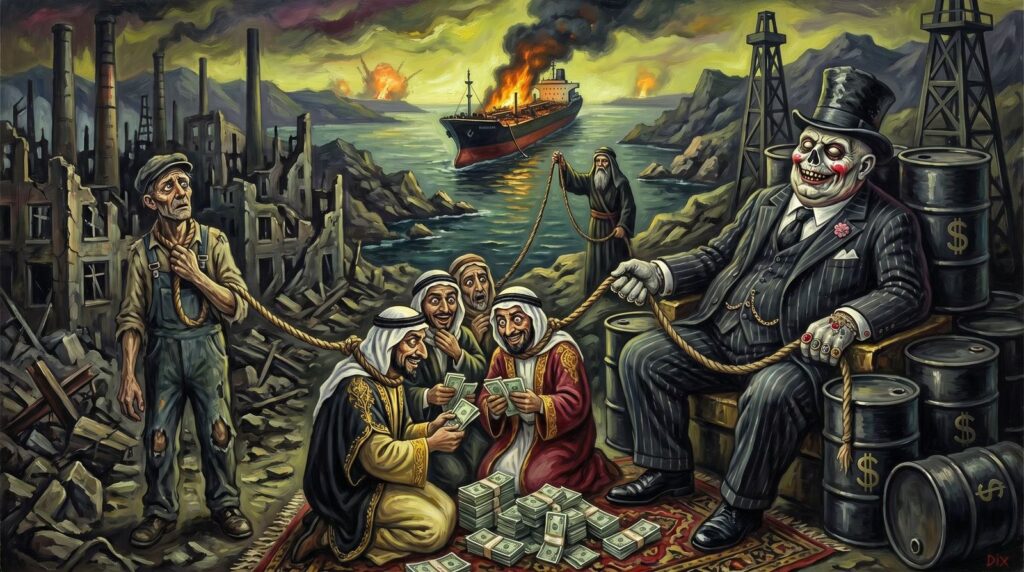
In 1974, one year after the oil embargo that shook the global economy to its foundations, Washington and Riyadh struck a deal kept secret for more than four decades. Saudi Arabia would price its oil exclusively in U.S. dollars and recycle its surplus revenues into American Treasury bonds and Wall Street investment houses. In return, the United States would arm and protect the Saudi monarchy. The deal was not presented as a protection racket. It was presented as a partnership. The distinction, over the fifty years that followed, proved to be entirely cosmetic.
What that arrangement set in motion was one of the most consequential and least examined structural dynamics in modern history: a system in which the Arab world’s oil wealth financed American military supremacy, that supremacy was then used to dominate and periodically devastate the Arab world, and the Arab states paid for all of it. The rope, the hanging, and the bill, settled by the same party.
The Money: How the Gulf Built the Machine That Would Be Used Against It
The mechanics were straightforward, almost elegant in their efficiency. Every country on earth that needed oil needed dollars to buy it, because the Gulf states, following the 1974 agreement, priced their oil exclusively in U.S. currency. This created a structural global demand for dollars entirely disconnected from American economic productivity. The dollars that flowed out of the United States to pay for oil flowed straight back in as Gulf sovereign investment, keeping American interest rates artificially low and financing Washington’s capacity to spend well beyond its means.
The Gulf states accumulated staggering wealth. Sovereign wealth funds across the GCC grew to oversee more than six trillion dollars in global assets, with enormous concentrations in U.S. Treasuries, Wall Street equities, and American real estate. OPEC governments alone accumulated approximately 300 billion dollars in U.S. Treasury securities between 1960 and 2015. By any measure of raw accumulation, the Gulf monarchies had become fabulously, historically rich.
But the price of that wealth was strategic dependence. The Gulf currencies were pegged to the dollar, requiring the maintenance of enormous dollar reserves estimated at around 800 billion dollars. Gulf defense establishments were structurally integrated with American training, logistics, arms procurement, and intelligence architecture, creating a dependency so deep it was nearly impossible to unwind. When Alastair Crooke, the former British diplomat who spent decades at the intersection of Middle Eastern intelligence and diplomacy, described the Gulf states as American “supplicants,” he was not being polemical. He was describing the institutional reality: states that had traded their sovereignty for a security guarantee and could not, when the moment came, tell the difference between protection and control.
The wealth also extracted a cultural price that is harder to quantify but no less real. Societies shaped over centuries by maritime trade, pearl fishing, desert caravan routes, and a harsh but coherent set of values were reorganized almost overnight around consumption, patronage, and state subsidy. The cradle-to-grave welfare model that petrodollar revenues made possible replaced civic institutions, productive labor, and the social contract that emerges from shared economic struggle with something far more fragile: a compact built entirely on the distribution of resource rents. The filthy lucre came with a cultural invoice that has never been fully settled. What was lost in the transaction, the values, the self-reliance, the sovereignty of judgment, did not survive intact.
The Racket: How Washington Spent the Money It Was Given
The petrodollar arrangement gave the United States something no empire in history had previously possessed: the ability to finance its own military dominance with other people’s money, denominated in its own currency, at interest rates subsidized by the very countries that dominance would be used to control. The practical consequence was that Washington could run permanent trade deficits, finance military operations through debt rather than taxation, and project force across the Middle East without ever presenting its own population with a bill large enough to provoke resistance.
That force projection began long before the formal petrodollar system was codified. In 1953, the CIA and British intelligence jointly orchestrated Operation Ajax, overthrowing Iran’s democratically elected Prime Minister Mohammad Mosaddegh after he nationalized the Anglo-Iranian Oil Company and attempted to return Iranian oil revenues to the Iranian state. It was the first successful U.S. covert operation to remove a foreign government during peacetime, and it established the template that would be applied repeatedly across the following seven decades: any government that attempted genuine resource sovereignty, that sought to price, sell, or control its own energy outside the framework Washington had constructed, would face consequences.
The U.S. military bases that subsequently spread across the Gulf were not, in any neutral sense, a security provision. They encircled Iran, anchored a regional order permanently tilted toward American strategic interests, and created what responsible statecraft analysts described as an enormous, largely indefensible military footprint that made the United States and its Gulf hosts simultaneously more assertive and more exposed. The Gulf states hosted these bases, paid for much of their maintenance through arms purchases and financial arrangements, and watched as Washington used the strategic platform they provided to pursue objectives that frequently conflicted with their own regional interests.
Iraq was invaded, destabilized, and left in a state of permanent dysfunction at a cost, by the most conservative Brown University estimates, of more than two trillion dollars and hundreds of thousands of civilian lives. Libya was dismantled. Syria was turned into a proxy battlefield. Iran was subjected to decades of sanctions, covert operations, and the continuous pressure of military encirclement. In each case, the intervention was funded by the recycled petrodollar surpluses that the region itself had generated. The countries being destabilized were financing their own destabilization. The Gulf states were paying the subscription fee for a security service that was simultaneously running a demolition operation next door.
The Blowback Nobody Discussed: What the Petrodollar Did to America
Here the structural argument reaches its most counterintuitive and damning proposition. The same mechanism that financed American military hegemony abroad was simultaneously destroying the American economy at home. This is the core of what Richard Wolff, the Marxian economist and founder of Democracy at Work, has documented across decades of analysis: that the petrodollar recycling mechanism, by massively capitalizing Wall Street and the American financial sector, accelerated the shift of the U.S. economy away from manufacturing and toward what economists call financialization.
Financialization is not a technical abstraction. It means, in plain terms, that an economy’s profits increasingly come from financial operations, lending, trading, fees, insurance, derivatives, currency speculation, rather than from making things. When petrodollar surpluses flooded into American financial markets after 1973, they massively rewarded financial activity relative to industrial activity. Capital went where returns were highest. Returns were highest in finance. Manufacturing, which required long time horizons, unionized labor, and patient capital, could not compete with the returns available in a financial sector swimming in recycled Gulf oil revenues.
The consequences were not abstract. Financial services, which represented roughly two to three percent of the U.S. economy in the early 1970s, had tripled their share to nearly eight or nine percent of GDP by the early 2000s, and by the eve of the 2008 financial crisis, approximately 40 percent of all corporate profits were generated by companies that produced nothing but financial instruments. Meanwhile, American manufacturing communities, from the steel towns of Pennsylvania to the auto corridors of Michigan and Ohio, were systematically hollowed out as capital moved first to cheaper domestic labor markets and then offshore entirely.
Real wages for American workers have not risen since the early 1970s, the precise moment the petrodollar system was formalized. Workers today command approximately the same purchasing power their parents did fifty years ago. Wolff’s research estimates that since 1975, approximately 73 trillion dollars of wealth has migrated from the American working and middle classes to the economic elite. The working class absorbed this dispossession by borrowing at a scale no working class in history had previously attempted, taking on consumer debt, mortgage debt, student debt, and medical debt to maintain a standard of living that wages alone could no longer support.
The political consequences were not mysterious. A working class stripped of productive employment, buried in debt, watching its communities decay while being told the economy had never been stronger, was an electorate primed for authoritarian populism. Donald Trump did not create that electorate. The petrodollar system, by financializing American capitalism and gutting its industrial base, created it over fifty years. The rope did not just hang the Middle East. It garrotted American manufacturing, civic life, and whatever remained of a shared sense of national purpose, and Americans have largely allowed it to happen, just as they are allowing the current prosecution of a ruinously expensive war whose costs fall almost entirely on working people and on the country’s global allies.
The Bill Arrives at Hormuz
The structural irony achieves its full expression in the present moment. The petrodollar system was designed, among other things, to ensure that Middle Eastern oil would flow through chokepoints controlled by American naval power and its regional clients. That assumption has now collapsed.
Iran controls the Strait of Hormuz, the narrow passage through which approximately 20 percent of the world’s oil and liquefied natural gas must pass, with a channel at its narrowest less than 21 nautical miles wide. Yemen’s Houthi forces have demonstrated the capacity to interdict the Bab al-Mandab, the chokepoint connecting the Red Sea to the Gulf of Aden, with low-cost drone and missile technology that has rendered the presence of U.S. carrier strike groups strategically indecisive. Crooke has stated plainly that Iran is “the indisputable master of the Strait,” that Iranian authorities have begun demanding payment for tanker transit, and that the currency being demanded is Chinese yuan, not dollars. “It is the end of the petrodollar,” he concluded.
The Gulf states are discovering the full cost of the bargain they struck in 1974. At least a dozen U.S. military installations across the region have been severely damaged by Iranian strikes, described in reporting as “all but uninhabitable.” The Saudi THAAD and Patriot missile defense systems, purchased from Washington at enormous cost, proved unable to stop low-cost Iranian drones. Saudi Arabia now sells four times as much oil to China as to the United States. The gradual de-dollarization of energy trade, the subject of think-tank speculation for two decades, is happening not as a diplomatic negotiation but as a military and economic fait accompli.
The countries that paid for the system are now being told by the country the system was designed to strangle what the new terms will be. Iran is not presenting this as revenge. It is presenting it as restructuring. The protection racket’s clients have finally been handed the invoice for everything the protection cost them, and the collection agent is standing at Hormuz with the keys.
What This Argument Actually Says
This is not a conspiracy theory. It does not require a hidden cabal, a secret plan, or the attribution of malice to any individual actor. Every step in the chain followed its own institutional logic. Washington rationally exploited a structural advantage. Gulf monarchies rationally traded sovereignty for wealth and security. American corporations rationally moved manufacturing to cheaper labor markets. Wall Street rationally financialized an economy flooded with recycled petrodollars. The military-industrial complex rationally expanded into the strategic space that dollar hegemony opened up.
The hangings, the coups, the hollowed-out American working class, the Gulf societies reorganized around consumption rather than production or civic purpose, the political extremism that fills the vacuum left by de-industrialization: these were not goals. They were consequences. And now the parties at the end of the rope are in a position, for the first time in fifty years, to restructure the terms of their own exploitation.
That is what makes this argument worth making, and worth reading. It locates the catastrophe not in evil but in architecture. It explains Mosaddegh and Trump, the Rust Belt and Dubai, the fall of Gaddafi and the rise of yuan-denominated oil pricing at Hormuz, as consequences of the same structural logic compounding across half a century. The system produced exactly what systems of this kind always produce: it enriched the architects, disciplined the participants, and eventually generated the conditions of its own unraveling.
They paid Washington to destroy them. Washington obliged. And now the bill has arrived.
Related reading
- The Molecules of War: How Washington's Persian Gulf Gamble Is Coming for Your Grocery Bill, Your Smartphone, and Your Economy
- America and Israel Just Bombed Their Own Gas Stations
- The Last Pretense: Kharg Island and the Architecture of Trump's Imperial Theft
- US-Israeli Attack on Iran Will Trigger Global Starvation