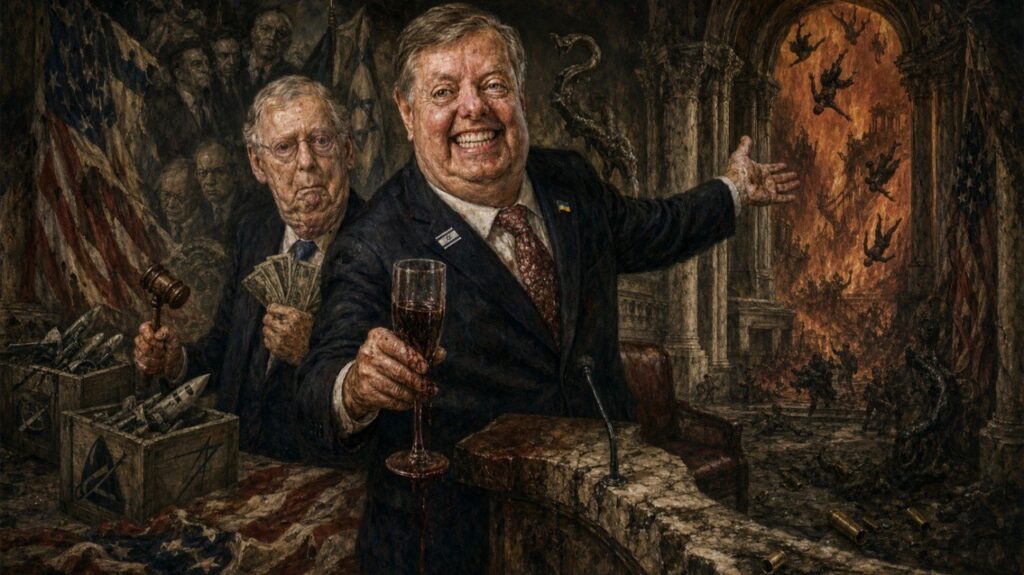
They Never Found A War They Wouldn’t Support, No Matter How Unjust
By Scott Ortkiese | July 12, 2026 |so@throughlinesynthesis.com
War Merchant. Foreign Asset. Colossal Fraud.
By request of history, which has waited long enough.
Lindsey Olin Graham, United States Senator from South Carolina, died on the evening of Saturday, July 11, 2026, from cardiac arrest at his Capitol Hill residence. He was 71. He had returned from his tenth trip to Kyiv the day before, his last act on this earth being a visit to ensure the weapons kept flowing to a war he had done as much as any living American to keep burning.
He was eulogized by Donald Trump, a man he once called “a race-baiting, xenophobic, religious bigot,” “the ISIL man of the year,” “a kook,” “a nut job,” “a complete idiot,” “a jackass,” “a wrecking ball,” and “one of the dumbest human beings I’ve ever seen,” as “one of the greatest people and Senators I have ever known” and “a true American Patriot.”
That Trump-Graham relationship, the complete obliteration of every stated principle the moment it became financially convenient, is the entire biography of Lindsey Graham summarized in a single arc. For 24 years, Graham sold enemies to America and sold America to its enemies, and called it foreign policy. Everything else is just details.
Here are the details.
He Died as He Lived: On His Way Home from Someone Else’s War
Graham arrived back in Washington on Friday, July 10, from Kyiv, where he had met Ukrainian President Zelensky for the last time. He had made ten such trips during Russia’s full-scale invasion. He died less than 24 hours after landing.
It is worth pausing here to observe what he was doing in those final hours of his life. Not visiting South Carolina, the state whose voters had sent him to Washington. Not meeting with constituents who ranked near the bottom of every quality-of-life metric in the United States. Not reviewing the Medicaid cuts he had just voted to pass, cuts that would strip coverage from millions of Americans, many of them in his own state. He was in Kyiv. Making sure the weapons kept flowing. Making sure the war kept burning. Making sure the defense contractors who funded his campaigns kept getting their contracts filled.
That is not an interpretation. That is the documented, FEC-filed, OpenSecrets-verified transaction that defined 24 years of Lindsey Graham’s Senate career. He did not represent South Carolina. He represented the weapons industry, the Israeli lobby, and whatever foreign head of state he had most recently visited. South Carolina was just the return address on his government paycheck.
The Obituary He Wrote With His Own Mouth
The finest epitaph for Lindsey Graham is not anything a critic ever said about him. It is his own words, delivered on Fox News on March 8, 2026, four months before his death, when asked about the $1 billion per day the United States was spending on the Iran war he had spent 15 years lobbying to start:
“Best money ever spent.”
“$1 billion a day? A really good investment.”
“When this regime goes down, we’re going to have a new Middle East, we are going to make a ton of money.”
“Iran is going down, and Cuba is next.”
“We are going to make a ton of money.” One sentence. The entire philosophy of Lindsey Graham’s foreign policy rendered in nine words. Not “America will be safer.” Not “the world will be more stable.” Not even the threadbare WMD pretexts of 2003 that at least gestured toward a security rationale. Just: we are going to make a ton of money.
Iran’s own Foreign Ministry spokesman called it “a very rare moment of honesty,” adding: “The issue is only oil.” When the Iranian government provides the most accurate description of American foreign policy, something has gone profoundly, catastrophically wrong.
By the time Graham died, the war he had personally coordinated with Mossad Director David Barnea and Benjamin Netanyahu to bring about, lobbying the American president from Tel Aviv, coaching Netanyahu on how to apply pressure, telling Politico “Mr. President, you want to have your fingerprints on this,” had killed over 1,255 people in Iran, with humanitarian sources documenting at least 1,205 civilians among the dead, including 194 children.
Graham called it “a really good investment.” He died four months later. History will decide whether the timing is ironic or merely just.
The Full Warmonger’s Ledger
Before Iran there was everything else. Graham’s career warmongering portfolio reads like a Pentagon wish list penned by a contractor’s lobbyist and rubber-stamped by a man who had not held a rifle since the Gulf War and would never hold one in any future conflict he cheerled from the comfort of Fox News green rooms.
Iraq, 2002.Graham voted for the AUMF that launched the war. Over 4,000 American servicemembers died. Between 150,000 and 600,000 Iraqis died, depending on who is counting and how committed they are to the full count. The region was destabilized for a generation. The cost to American taxpayers: between $2 and $6 trillion, with veterans’ care obligations still accruing, still bleeding, still unresolved. Graham never apologized. He never acknowledged a mistake. By 2015, he was calling for 20,000 American ground troops to go back in. Other people’s children. Always other people’s children.
Afghanistan.Graham supported every troop surge, every funding bill, every escalation of the 20-year occupation that ended in the humiliation of August 2021, with the Taliban recapturing Kabul in days. $2.3 trillion spent. 2,461 American military deaths. Over 20,000 American wounded. When it collapsed, he blamed Biden. He never acknowledged a single vote he would take back.
Syria.Regime change. More arms. More intervention. More funerals in countries Graham would fly over and never land in.
Libya.He supported the NATO intervention that turned a functioning state into a failed one and opened a human trafficking corridor that has since sent tens of thousands of people to drown in the Mediterranean. Graham never mentioned the drownings.
Yemen.He backed the Saudi campaign that produced one of the worst humanitarian catastrophes of the 21st century. Cholera. Famine. Children dying of preventable disease in numbers that qualified as a mass atrocity under any honest accounting. Graham voted to keep the weapons flowing and called it foreign policy.
Venezuela, 2025-2026.Graham publicly demanded regime change, called for sanctions at “the highest level possible,” endorsed military strikes, and said the U.S. should do in Venezuela “what we did in Panama,” a reference to a military invasion. As economist Jeffrey Sachs documented, Graham’s Venezuela advocacy was nakedly about oil: “Trump openly stated: ‘We would have taken it over, we would have gotten all that oil.’ His words reveal the underlying logic of U.S. foreign policy that has an utter disregard for sovereignty and instead favors the grabbing of other countries’ resources.” Graham was not the author of that logic. He was its most enthusiastic and well-compensated pitchman.
Gaza, 2024.On NBC’s Meet the Press, Graham urged Israel to “do whatever you have to do,” explicitly invoking Hiroshima and Nagasaki as his moral framework, and endorsing the use of nuclear weapons against a civilian population of two million people, over one million of whom were children. He said it on national television, on a Sunday morning, with no evident discomfort. Iran formally condemned the remarks. The international community was stunned. Graham faced zero consequences. No censure. No committee removal. No statement of rebuke from Senate leadership. Nothing. Because in the United States Senate that Lindsey Graham inhabited, endorsing nuclear war against children generated no accountability whatsoever. That tells you as much about the institution as it does about the man.
Not once in any of these conflicts did Lindsey Graham put on a uniform. He served as an Air Force lawyer, a JAG officer, for six and a half years. He was briefly called up during the Gulf War and returned to civilian politics. He was never anywhere near combat. Every war he cheerled was fought by other people’s children, men and women who came back broken, addicted, or not at all. The coffins came home draped in flags. The contracts were signed. The donors wrote checks. And Graham went on Fox News and called it “the best money ever spent.” He was 71 years old. He had never been shot at. He had simply spent 24 years making sure other people were.
The Business Model: Follow Every Dollar
The connection between Graham’s war advocacy and his donor base is not circumstantial. It is documented to the dollar, sourced to FEC filings, and forensically traceable in ways that leave no room for charitable interpretation.
A forensic financial analysis of Graham’s FEC filings, published in April 2026, produced findings that deserve to be read slowly and without the instinct to explain them away.
91.13%of Graham’s 2020 donor money came from outside South Carolina.91.31%of his 2026 cycle money was similarly out-of-state. His single top donor zip code in both cycles: 33480. Palm Beach, Florida. Not South Carolina. Not Columbia. Not Greenville. Palm Beach. The people funding Lindsey Graham’s Senate career were not the people of South Carolina. They were wealthy individuals and organizations in Palm Beach, Manhattan, and Tel Aviv who were purchasing a specific product: a United States Senator who would vote their interests, every time, without exception.
His largest organizational donor in both cycles: the Republican Jewish Coalition, which funneled over $1 million directly to his campaign, $900,000 of it arriving in a single burst after September 2020. The AIPAC Tracker placed Graham’s career total from pro-Israel organizations at $4.61 million. The forensic analyst who ran the numbers noted: “Based on the financial patterns, that documented figure is the floor.” Four point six million dollars is the floor.
Graham voted yes on every dollar of military aid to Israel in 22 years. Every appropriation. Every supplemental. Every Iron Dome replenishment. Total U.S. aid to Israel during his Senate tenure: over $100 billion. He never voted no. Not once. Not when hospitals were being bombed. Not when the International Court of Justice was examining genocide charges. Not when his own constituents called. Not once, in 22 years, did a single humanitarian consideration cause Lindsey Graham to vote no on a dollar of Israeli military aid. The money explained it completely.
His super PAC “Security is Strength” was funded by Miriam Adelson, Ron Perelman (who gave $500,000 and who owns AM General, the company that manufactures military Humvees), and two dark money nonprofits that never disclosed their donors. One 501(c)(4) gave $140,000 to this PAC while reporting $0 in election spending to the IRS. In any other context, that filing would be called fraud. In American campaign finance law, as McConnell designed it, it was called routine.
The defense contractors paid him openly and without embarrassment, because there was nothing to be embarrassed about in the system Graham and McConnell built together. $1.1 million from the defense sector per OpenSecrets over his career. Lockheed Martin, Boeing, Northrop Grumman, Raytheon, General Electric. The Intercept documented the loop in 2015: defense contractors who stood to gain from Graham’s advocacy for military intervention were literally funding his campaigns. Graham confirmed it himself, with the relaxed candor of a man who had long since stopped caring how it sounded: “If I were a defense contractor, I’d be big time for Lindsey Graham, because I’ve been forward-leaning on rebuilding our military. People come to you because of your positions.”
People come to you because of your positions. A Senator advertising himself as purchasable, describing his value proposition to potential buyers, on the record, with evident pride. And the market responded.
Between 2019 and 2024, Graham’s campaigns collected more than $117 million. A $40 million black hole in his 2020 fundraising, $12.4 million from donors who never disclosed their employer and $28 million from donors who listed only “Retired” with no traceable affiliation, was described as the largest undisclosed donor pool of any Senate candidate that cycle. One of his past donors was later indicted for making $31,000 in illegal campaign contributions. Nothing about this surprised anyone who had been paying attention.
Meanwhile, in South Carolina, residents were waiting to find out if they would “get over” losing Medicaid. Graham had supported the cuts.
The Hypocrisy Files: “Lady G” and the Votes He Cast Against Himself
It must be said, because two decades of gay journalists, political operatives, a former White House press secretary, and adult film actors have said it and the record would be dishonest without it, that Lindsey Graham was widely reported, alleged, and accepted in certain Washington circles as a closeted gay man who hired male escorts and was known among them as “Lady G.”
The allegations originated with gay adult-film actor Sean Harding, who stated in 2020 that a prominent Republican senator was well known among D.C.-based male escorts, referred to behind closed doors as “Lady G,” and that NDAs were required. The hashtag #LadyGraham went viral. The Washington Post covered it. White House Press Secretary Jen Psaki referenced the nickname in a tweet, apparently momentarily forgetting the audience. Former South Carolina Democratic Party chair Dick Harpootlian, radio host Michelangelo Signorile, Rosie O’Donnell, and Democratic Coalition PAC chair Jon Cooper all publicly raised the question over the years.
No hard evidence was ever produced. No photographs, no documents, no sworn statements. These are allegations and rumors. That is the honest accounting, and it should be stated plainly.
But here is what is not alleged. Here is what is documented beyond any dispute: Graham voted against the repeal of Don’t Ask Don’t Tell, calling it “truly not the way to make such a major change.” More than 13,000 service members were discharged under the policy he defended. He voted no on federal recognition of same-sex marriage. He voted no on the Respect for Marriage Act in 2022. His voting record on LGBT rights was, per the Human Rights Campaign, consistently and comprehensively hostile.
Whatever Lindsey Graham did in private, whatever he was, whatever name the people he allegedly paid for companionship called him when no one was watching, his public votes inflicted documented, measurable, and in some cases life-altering harm on gay Americans across decades. If the rumors are true, he voted against his own people to protect his own career and appease his own donors. If the rumors are false, he spent 24 years voting to diminish and exclude a community for no reason except that his financial backers expected it. Neither possibility redeems him. The hypocrisy is complete in either direction.
The Munich Incident: A Man Showing His True Face
Four months before his death, at the Munich Security Conference in February 2026, Lindsey Graham provided the world with what Denmark’s oldest newspaper, Berlingske, described as his definitive self-portrait.
In a private meeting with Danish Prime Minister Mette Frederiksen and Greenland’s Premier Jens-Frederik Nielsen, convened to address the Trump administration’s threats to annex the autonomous Danish territory, Graham allegedly called Frederiksen “little lady” while sneering directly into her face, yawned deliberately in Premier Nielsen’s face in what witnesses described as an unmistakably contemptuous gesture, deployed a reported torrent of profanity throughout the meeting, declared that Trump was the most powerful man in the world and that neither Denmark nor Greenland should think they “amount to anything,” and stated, apparently without irony: “Who the hell cares who owns Greenland?”
Democratic Senator Elissa Slotkin, who was present, reportedly stood up and walked out, returning visibly shaken. Witnesses described Graham’s behavior as shocking, disturbing, and completely out of line. Berlingske’s Washington correspondent wrote that attendees spent hours afterward asking whether Graham had lost his composure entirely, whether he was fully in control of himself.
Frederiksen, the Prime Minister of a NATO ally, a head of government who had navigated her country through multiple crises with remarkable composure, waited for him to finish, looked at him steadily, and said: “When you’re done with that, the meeting can continue.”
That is Lindsey Graham’s Munich moment. That is his permanent entry in the diplomatic record. A 71-year-old United States Senator calling the leader of a NATO ally “little lady” while yawning in her colleague’s face during a meeting about whether America had the right to absorb a sovereign territory by force. The man who spent 24 years presenting himself as the most serious, most experienced, most indispensable foreign policy voice in the United States Senate behaved in that room like a drunk at a bar at closing time. He was representing the United States of America. He chose that performance.
The biography is complete.
Mitch McConnell: The System That Made Graham Possible
No honest accounting of Lindsey Graham’s career can exclude the man who built the Senate he operated in: Mitch McConnell of Kentucky, who served as Senate Majority and Minority Leader longer than any figure in American history and who used every year of that tenure to dismantle, piece by piece, the mechanisms by which American citizens might have held men like Graham accountable.
As Glenn Greenwald observed in his July 12 broadcast, McConnell at 84 had reached the point where he had simply vanished from public view for weeks, with his family and office refusing to confirm even his basic medical status to the constituents he nominally served. “They start feeling like they’re part of a royal family, like they’re royalty, that they don’t have any obligations to the public,” Greenwald noted. “They don’t serve the public in any way.” That observation cuts to the core of what McConnell represents: a politician so insulated by gerrymandering, dark money, and institutional power that he operated with no accountability to anyone except his donors.
McConnell’s career relationship with campaign finance law is the story of a man who identified the levers of democratic accountability with the precision of a safecracker and spent 40 years removing them one at a time. He opposed McCain-Feingold in 1999. He submitted amicus briefs to help roll back campaign finance regulations in 2007. He applauded Citizens United in 2010, calling it “an important step in the direction of restoring the First Amendment rights” of corporations, by which he meant the right of billionaires to purchase senators in complete anonymity. He blocked the DISCLOSE Act. He blocked the For the People Act. Each time, he cited principle. Each time, the operational consequence was more anonymous corporate money flooding into elections, with McConnell’s own operation collecting the largest share.
His dark money network is a masterpiece of regulatory evasion. One Nation, the 501(c)(4) nonprofit run by his former aide Steven Law from the same office as his super PAC, raised $172 million in 2020 and $124 million in 2022, with donors largely undisclosed. Two contributions totaling $38.75 million in the 2022 cycle are completely unattributed to any disclosed source. Not partially unattributed. Completely. $10 million came from Sam Bankman-Fried, $5.5 million from his FTX colleague Ryan Salame, both later convicted of fraud on multiple counts. The cryptocurrency fraudsters got their private dinner with McConnell. America got McConnell’s Senate. The exchange was conducted at the going rate.
Only 8% of his campaign donations came from Kentucky, the state he purported to represent. That state ranks 46th in healthcare, 44th in education, and 44th in income. While McConnell was collecting $250,000 from 37 Fortune 500 CEOs in a single election cycle, Kentucky remained one of the most chronically distressed economies in the United States. That is not a contradiction. It is the intended outcome. A Kentucky that prospered and educated itself and built a functional healthcare system would not have needed Mitch McConnell. The poverty was part of the product.
The Supreme Court theft requires no elaboration beyond McConnell’s own words. When Justice Antonin Scalia died in February 2016, President Obama nominated D.C. Circuit Chief Judge Merrick Garland, a moderate with strong bipartisan credentials and a 1997 Senate confirmation. McConnell refused to hold a single hearing or a vote, citing the principle that the American people deserved a voice in a presidential election year. In 2019, asked on the record whether he would fill a Supreme Court vacancy in 2020, he said “Oh, we’d fill it” and smiled. When Justice Ruth Bader Ginsburg died six weeks before the 2020 election, far closer to election day than the Garland timeline he had invoked as his sacred principle, McConnell rushed Amy Coney Barrett’s confirmation through in 38 days. He then called blocking Garland “the most consequential thing I’ve ever done” and bragged: “What can’t be undone is a lifetime appointment.”
The Brookings Institution called his stated rationale “fabricated history.” McConnell called it his legacy. He was right about the legacy and a fraud about the principle. Three Trump-appointed justices now sit on the Supreme Court instead of one Obama appointee. Roe v. Wade is gone. The administrative state is under siege by a court assembled through procedural theft and bragged about afterward. McConnell did that. He knows he did it. He is proud he did it. Let the record reflect that he said so himself.
The China connection: McConnell spent 40 years performing concern about Chinese influence in American politics while his father-in-law gifted him and Elaine Chao between $5 million and $25 million in 2008, more than tripling McConnell’s net worth, from a shipping empire built in Chinese state shipyards, financed by Chinese government loans, routing 70% of its cargo to China, with a CEO who sat on the board of the state-owned Bank of China. House Oversight Committee Chairman Elijah Cummings formally charged that Chao had “used your official position to elevate Foremost Group’s influence and status with the Chinese government.” The man who warned about China was funded by China’s financial infrastructure. He built his career on that contradiction and called it statesmanship.
The Trump-Graham-McConnell Triangle: A Portrait in Spinelessness
The dynamics of this triumvirate deserve their own permanent exhibit in whatever museum eventually documents the terminal corruption of American democratic institutions, and the speed with which men who knew better chose complicity over consequence.
Graham spent the better part of 2015 and 2016 calling Trump everything from “a jackass” to “Lucifer’s running mate” to “a kook” to “a race-baiting, xenophobic, religious bigot” to “the most flawed nominee in the history of the Republican Party.” He called Trump’s campaign “a cancer on conservatism.” He said Trump was “unfit for office.” He said that if the Republican Party nominated Trump, “we will get destroyed and we will deserve it.” After January 6, 2021, Graham stood in the Senate chamber with what appeared to be genuine emotion and declared: “I’m out.”
He meant it for approximately two weeks.
McConnell said after January 6 that Trump bore “a practical and moral responsibility” for the attack on the Capitol, in the strongest public statement he had made about anything in years. He then declined to vote to convict in the impeachment trial, arguing that a former president could not be tried, a position legal scholars called a constitutional fiction crafted to provide procedural cover for a political decision McConnell had already made. Both men were back at Trump’s golf courses within months.
What Trump offered them was not ideology. Neither man has ideology. What Trump offered was transaction: the judicial appointments McConnell had spent 40 years engineering his career to secure, and the foreign policy blank checks Graham needed to keep his donor pipeline flowing. Trump needed senators who would provide institutional legitimacy and legislative cover. The three men found each other, recognized what each of them was, and built an arrangement accordingly.
“Tell Donald Trump to go to hell,” Graham had said in December 2015.
He died as one of Trump’s most loyal, most servile, most operationally useful enablers, eulogized as “one of the greatest people I’ve ever known” by the man he had publicly told to go to hell. The arc is complete. The transaction is documented. The epitaph writes itself.
The Establishment Democrats’ Complicity
Any honest obituary for the Graham-McConnell era must include the Democratic Party establishment’s role, not as opponents, but as architects of the structural conditions that made this era possible, sustainable, and essentially unreformable from within.
In Maine in 2026, the Democratic establishment was handed a clear opportunity to demonstrate that it stood for something different from the donor-class politics it had spent decades enabling. Graham Platner, an oyster farmer and combat veteran, self-funded, taking zero AIPAC money, zero defense contractor money, zero dark money, polling ahead of Susan Collins in a state Democrats needed to win, won the primary with nearly 75% of the vote after the Democratic Senatorial Campaign Committee and Schumer’s office worked actively to recruit an opponent, backed Governor Janet Mills, and invested institutional resources in the safe, controllable, consultant-approved option.
Glenn Greenwald, covering the Platner situation in detail on his July 10 broadcast, noted the essential issue with brutal clarity: the Democratic establishment had such contempt for its own primary voters that it would rather lose Maine to Susan Collins than hand power to someone who would not take their calls, would not accept their money, and would not subordinate the interests of his constituents to the demands of the donor class. “This is the playbook of the Democratic Party establishment to protect itself and its hegemony against any insurgent forces,” Greenwald observed. When Platner won anyway, Schumer’s endorsement was described by The Guardian as “primarily concentrated on the goal of defeating Collins” rather than on Platner himself. Third Way, the corporate-funded Democratic think tank that has functioned for two decades as the internal suppression mechanism for any candidate who might threaten the party’s donor relationships, issued warnings about “jeopardizing winnable races.” The message was clear: we prefer to lose Maine with someone we control than win it with someone we don’t.
This is the party that blocked Bernie Sanders twice, first in 2016 through documented DNC intervention that Elizabeth Warren and Donna Brazile described as rigged, and again in 2020 through the orchestrated consolidation of the establishment lane, with President Obama making backroom calls to get Pete Buttigieg and Amy Klobuchar to drop out and consolidate votes behind Biden. The party whose donor base in Wall Street, the defense industry, and the healthcare complex is not meaningfully distinguishable from the Republican donor base that owned Graham and McConnell.
That is not opposition. That is the other side of the same coin, operating from the other side of the same transaction, serving the same donors through different press releases.
What Is Rising to Replace Them
And yet, they are losing. Not quickly. Not cleanly. But unmistakably, the tide is turning against everything Graham and McConnell built, and the turning is being accomplished by people who are not asking the system’s permission.
In New York City in 2025, Zohran Mamdani, a DSA-affiliated democratic socialist running on universal childcare, free public transit, and community-owned grocery stores, won the mayor’s race in the largest city in the United States. His campaign strategists went directly to Maine to run Graham Platner’s Senate campaign. In Washington, D.C., Janeese Lewis George, a DSA member and former prosecutor whose volunteers knocked on doors in her district 90,000 times, won the mayoral Democratic primary. In Colorado’s 1st Congressional District, 29-year-old attorney Melat Kiros unseated Representative Diana DeGette, a 30-year incumbent with deep establishment backing. In New York’s 7th, Claire Valdez, a UAW labor organizer, won 58% to 33%. In Seattle. In Albuquerque. City by city. District by district. Primary by primary.
August 2025 polling found 49% of Americans aged 18-34 holding favorable views of socialism. A Washington Post-ABC-Ipsos survey found over 60% of Americans believe both Trump and the Democratic establishment are disconnected from ordinary people’s concerns. Support for capitalism has declined from 60% in 2021 to 54%.
These are the people who watched Lindsey Graham go on national television and call a billion dollars a day spent on a war that raised their gas prices 17% “the best money ever spent.” Who watched McConnell tell Senate colleagues that Americans about to lose Medicaid would “get over it.” Who watched 91% of Graham’s campaign money come from outside the state he represented. Who watched a Supreme Court seat get stolen and then bragged about, watched $38.75 million flow to a dark money nonprofit from sources that will never be disclosed, and watched two men call the resulting system “democracy” without flinching.
They stopped asking permission. They started winning. And the speed of that winning is accelerating precisely because men like Graham and McConnell were too arrogant, too entrenched, and too certain of their own permanence to take it seriously until it was too late.
The Final Indignity
There is one last thing worth recording. Graham spent 24 years in the Senate and died with a reported net worth of roughly $2 million, modest by the standards of the institution he served. He enriched not himself but his donors, which is arguably the more damning epitaph: he was not even a competent criminal. He was the instrument, not the beneficiary. He sold his Senate seat wholesale for campaign dollars and a place on Fox News, made Lockheed Martin and the Israeli lobby hundreds of billions richer, and died owning a townhouse in Washington and a piece of undeveloped land in Seneca, South Carolina, worth $15,000. The donors got the return on investment. South Carolina got the bill.
The Verdict
Lindsey Graham spent 24 years in the United States Senate representing Palm Beach, Florida; Tel Aviv, Israel; Kyiv, Ukraine; and the boardrooms of Lockheed Martin and Boeing, while drawing a government salary from the people of South Carolina and calling himself their servant.
He voted yes on every war available to him. He personally lobbied a foreign intelligence service to start the ones that weren’t yet officially started. He took over $4.6 million from the Israeli lobby. He called nuclear war against civilians “a really good investment.” He traveled to Munich and called the elected leader of a NATO ally “little lady.” He died on his way home from his tenth trip to a war he helped start, visiting the foreign leader whose weapons shipments he was there to guarantee.
He was anything but America First. He was the living, breathing, donor-funded, forensically documented proof of America Last: that the last Americans to benefit from the foreign policy of Lindsey Graham were the American people who paid for it.
Mitch McConnell built the system. Graham was its most enthusiastic, most profitable, most shameless product. Together they represent something that is dying, not of natural causes, but of exposure. The receipts are public. The FEC filings are searchable. The voting records are a matter of congressional record. The quotes are on tape. The bodies are in the ground in Iraq and Libya and Yemen and Iran and Gaza and every other theater where Lindsey Graham’s “positions” attracted the donations that funded the campaigns that produced the votes that sent the weapons that filled the contracts that wrote the checks that kept Lindsey Graham in the United States Senate for 24 years.
The generation inheriting that wreckage has read all of it. They are not confused about what happened. They are not waiting for permission to say it, or to replace it, or to build something in its place that doesn’t require 91% of its funding to come from Palm Beach.
The flags at the Capitol are at half-mast for Lindsey Graham today. In a few weeks, they will be raised again. The work of dismantling what he and McConnell built will resume. It will not be finished quickly. The dark money networks will not disband. The defense contractors will find new senators to fund. The Israeli lobby will identify new votes to purchase.
But the people doing the dismantling are not asking the system’s permission anymore. That, at least, is something Graham and McConnell inadvertently taught them, by making the system so visibly, so documentably, so brazenly corrupt that even the most carefully managed political ignorance could no longer be sustained.
The price of a foreign policy is not paid by the men who sell it. It is paid by the people who never got a vote on it.
Related reading
- AG Pam Bondi Takes What Little Remains of Her Self-Respect and Goes Home
- Mark Kelly's 95% Problem: A Senator With No Credibility Lecturing Elon Musk About Seriousness
- Генерал «Предай-США» (Betray-U.S.), он же Дэвид Петреус, идеально иллюстрирует оксюморон: военная разведка
- General Betray-Us, aka David Petraeus, Perfectly Illustrates the Oxymoron: Military Intelligence