What This Article Does
I’m writing this to document (with names, dates, and their own admissions) how the same individuals who provoked Russia into war now position themselves as obstacles to ending it.This is not rhetorical framing. This is pattern across a decade of systematic provocation, deliberate deception, and sabotaged diplomacy.
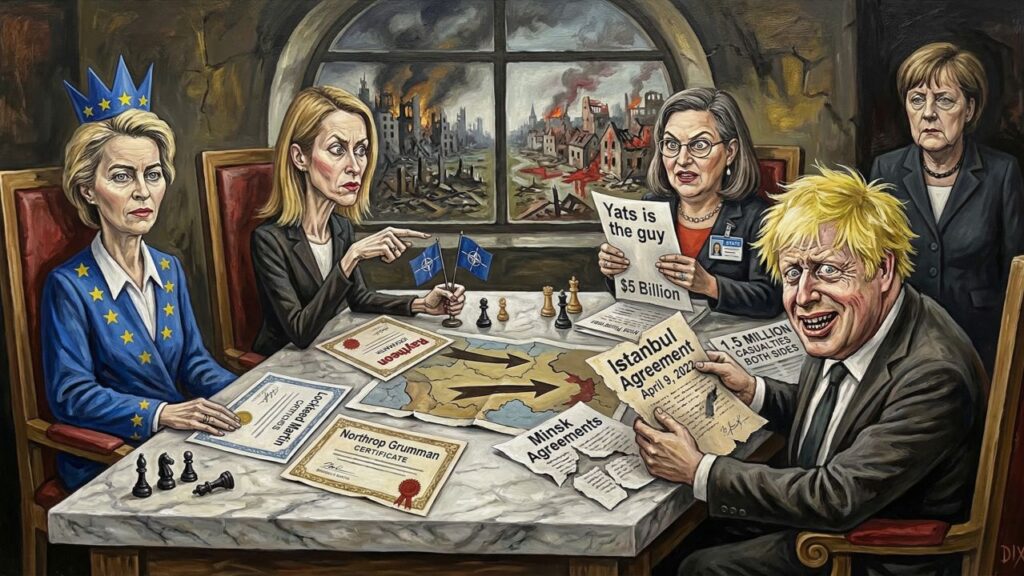
Kaja Kallas, Ursula von der Leyen, Victoria Nuland, Boris Johnson, Angela Merkelthese are not supporting characters in someone else’s tragedy. These are the principals. They orchestrated the coup that toppled Ukraine’s elected government. They admitted lying about peace processes while arming for war. They personally killed negotiations when settlement was achievable. And now, as Trump moves to exclude Europe from peace talks, they fracture into recriminations while refusing the one thing that might matter: accountability for what they’ve done.
The irony is perfect and devastating: the people most responsible for creating this disaster cannot survive its resolution. Peace exposes their culpability. Settlement reveals their lies. Negotiation forces acknowledgment of what they spent years denying, that Russia was provoked, that Ukraine was used, and that the “unprovoked invasion” narrative was always propaganda designed to obscure Western responsibility.
This article uses the January 27, 2026 discussion between Glenn Diesen and Gilbert Doctorow, Merkel’s own confession about Minsk fraud, Boris Johnson’s documented sabotage at Istanbul, and Nuland’s intercepted coup-planning to build the case establishment media refuses to make: these are provocateurs whose lies produced over 1.5 million casualties, and they must be named, documented, and excluded from any role in resolving what they created.
Part I: The Brussels Collapse, Kallas Calls von der Leyen a Dictator
The European unity narrative collapsed in January 2026. Not gradually, spectacularly. Behind Brussels’ closed doors, the rupture between Kaja Kallas (EU foreign policy chief) and Ursula von der Leyen (Commission president) escalated beyond policy disagreement into open warfare.
The Politico Bombshell
On January 25, 2026, Politico Europe published what Brussels insiders had been whispering for weeks. According to a senior European official:
“Kallas privately complains that [von der Leyen] is a dictator but there’s little or nothing she can do about that”.
This is not bureaucratic friction. This is the dissolution of a partnership built on nothing more than shared Russophobia and the institutional need to justify NATO’s existence.
Politico noted that while von der Leyen had tense relations with former EU foreign policy chief Josep Borrell, they are even worse with Kallas. The friction intensified after recent institutional changes curtailed Kallas’ authority: the Commission removed the Mediterranean region from her remit by creating a new directorate, and simultaneously advanced plans to reduce the size of the European External Action Service, Kallas’ power base.
When Kallas attempted to push back by appointing Martin Selmayr (former chief of staff to Jean-Claude Juncker) as a powerful deputy secretary-general, von der Leyen’s office blocked the move.
Gilbert Doctorow, analyzing Brussels dynamics in his January 27 discussion with Glenn Diesen, reported even more explosive detail:
“If Kaja Kallas is thrown out, she will take her boss with her. The rumors here in Brussels are that she is denouncing Ursula von der Leyen as a dictator. Yes, a dictator. Somebody you can’t work for. When she goes, she’ll go screaming ‘take her with me'”.
Kallas Isolated on All Fronts
Kallas now finds herself isolated everywhere that matters:
1. Russia refuses to talk to her. Foreign Minister Sergei Lavrov, normally diplomatic courtesy personified, declared that Russia will “absolutely never” hold talks with Kallas. Not loose rhetoric. Moscow’s formal position: Kallas is persona non grata. Her participation in negotiations is a deal-breaker.
Kremlin spokesman Dmitry Peskov was equally blunt: “We will absolutely never talk to Kaja Kallas”.
2. America humiliates her. Marco Rubio, Trump’s Secretary of State, “has humiliated her more than once,” Doctorow observed. When your supposed allies publicly belittle you, you’re not conducting diplomacy, you’re being discarded.
3. Her own partner calls her a dictator. When your coalition partner denounces you as authoritarian while you hold one of Europe’s most senior positions, you are not a diplomat. You are a liability the system is preparing to purge.
Kallas comes from “tiny Estonia,” as Politico noted, making her position even weaker than Spain’s Borrell. Her maximalist anti-Russian positions (no negotiations unless Russia accepts total defeat, no territorial compromise, continuous weapons shipments) have painted her into a corner where she has made herself diplomatically radioactive.
The question is not whether Kallas survives. The question is how much damage she inflicts on von der Leyen, and the entire European project, on her way out.
Part II: Macron’s Desperate Davos Gambit, Then Trump’s Calculated Humiliation
Emmanuel Macron’s behavior in mid-January epitomized Europe’s growing irrelevance. Desperate to insert himself into negotiations Europe had been systematically excluded from, the French president resorted to diplomatic begging via private textthen suffered calculated public humiliation when Trump published the messages.
The Private Message
On January 19, 2026, Macron sent Trump a private message offering to arrange emergency diplomacy. The message, which Trump posted in full on Truth Social, read:
“My friend, we are totally in line on Syria. We can do great things on Iran. I do not understand what you are doing on Greenland. Let’s try to make something great: 1) I can set up a G7 meeting after Davos in Paris on Thursday afternoon. I can invite the Ukrainians, the Danish, the Syrians and the Russians in the margins. 2) Let’s have dinner together in Paris on Thursday before you go back to the US. Emmanuel”.
This was Macron’s attempt at traditional diplomacytrying to position himself as broker, offering to convene major powers including Russia to discuss Ukraine, Syria, and the Greenland crisis that had triggered transatlantic tensions.
Trump’s Response: Public Humiliation
Trump’s response was not a private reply. It was public destruction.
On January 20, Trump posted the entire messagecomplete screenshotto Truth Social for millions to see. No response. No acknowledgment of the offer. Just exposure designed to humiliate.
This wasn’t accidental. As John McTernan (former UK Prime Minister Tony Blair’s director of political operations) observed: “Trump’s decision to publish private messages fits a broader pattern of norm-breaking communication designed to project power and unpredictability”.
Richard Stengel, who served as undersecretary of state for public diplomacy under Obama, was more direct: “Trump’s violation of that presumption of trust and secrecy is like exploding a bomb at the negotiating table”.
What This Revealed
The publication exposed three devastating truths:
1. Macron’s private confusion contradicts public confidence. “I do not understand what you are doing on Greenland” reveals that Macron privately admits he’s lost the plot, even as he publicly projects strategic sophistication.
2. Europe’s desperation is now documented. Offering to hastily convene a G7, invite Russia “in the margins,” and host dinner shows Macron begging for relevance.
3. Trump views European diplomacy with contempt. By publishing rather than responding, Trump signaled that European entreaties deserve public mockery, not private consideration.
As French author Philippe Corbé noted in his book Weapons of Mass Distraction: “The creation of chaos is not a random outcome for Trump; it is his strategy. Every silence is filled with a provocation”.
Davos Confirmed Europe’s Marginalization
Doctorow, in his January 27 discussion, added crucial context:
“Even at Davos, Macron sent this secret message, a private message to Donald Trump, inviting him to come to a hastily formed G7 meeting in Paris just after Davos closes or, failing that, to have a private dinner with himself. And then Donald Trump did the unthinkable. He published this message, making Macron look like an utter fool, which was his intention”.
The Europeans, Doctorow noted, “obviously have cut themselves off from the diplomatic process”. More precisely: they have been cut out.
General Keith Kellogg (Trump’s special envoy for Ukraine) made this exclusion explicit. Asked directly whether Europeans would have a seat at the negotiating table, Kellogg delivered brutal clarity: “The answer is no”.
Let that be clear: The U.S. will negotiate with Russia. Ukraine will accept terms. Europe will be informed of the outcome and expected to implement agreements over which it had no say.
Part III: The Current Military Reality, Russia Advances as Ukraine Bleeds
While European leaders fracture and Macron begs for relevance, the ground war tells a different story, one of relentless Russian pressure, Ukrainian attrition, and a military balance that has fundamentally shifted.
The January 26, 2026 Frontline
According to the Ukrainian General Staff’s January 26 report, 93 combat engagements occurred across the entire front line in a single day. Russian forces:
- Conducted 67 airstrikes dropping 144 guided bombs
- Launched 3,198 kamikaze drones
- Executed 2,935 attacks on Ukrainian positions and settlements
Ukrainian forces reported eliminating 1,020 Russian casualties in 24 hours and destroying significant equipment, but the strategic picture is one of Ukrainian defense under overwhelming pressure.
Russian Advances Across Multiple Axes
Pokrovsk Direction: Russian forces launched 29 attacks attempting advances near Rodynske, Pokrovsk, Kotlyne, Molodetske, and multiple other settlements. Ukrainian Ground Forces Commander Colonel General Oleksandr Syrskyi reported that Russian forces are conducting attacks in small infantry groups, slowed by winter conditions but continuing relentlessly.
Slovyansk Direction: Geolocated footage from January 25-26 confirms Russian advances in southeastern Lyman, northeast of Pazeno, and southeast of Riznykivka. A Ukrainian military source reported Russian forces have captured several locations east of Slovyansk. Russian milbloggers claimed advances to southwestern outskirts of Lyman.
Kostiantynivka Direction: Russian forces launched 15 attacks on Ukrainian positions. The Institute for the Study of War (ISW) assessed that Russian forces are increasingly utilizing Starlink satellite systems to enhance the operational range of BM-35 strike drones for mid-range attacks against Ukrainian rear positions. These drones have struck targets 86 kilometers from the frontline, including Dnipro City.
Northern Front (Sumy Oblast): Russian forces have made advances in northern Sumy Oblast, with reports indicating they’ve taken control of Andriivka north of Sumy City and launched attacks northeast and southeast of Sumy.
Kharkiv Oblast: Russian forces advanced in northern Nesterne (northeast of Kharkiv City), while continuing attacks on Vovchansk and surrounding areas.
The Strategic Assessment
The pattern is unmistakable: Russia maintains offensive initiative across multiple axes while Ukraine fights a purely defensive campaign with shrinking reserves.
As George Beebe (former CIA Director for Russia Analysis) stated in recent testimony: “You’re not going to drive a nuclear power to unconditional surrender”a reality that Ukrainian and European leaders refuse to acknowledge while Ukrainian soldiers pay the price.
The ISW notes that Russia continues to intensify recruitment efforts for unmanned systems forces while ramping up industrial production. Meanwhile, Ukrainian forces face manpower crisis, with 200,000 soldiers AWOL, 2 million men evading conscription, and desertion rates of 576 per day.
This is the military reality that Kallas, von der Leyen, and Macron refuse to acknowledge: Ukraine is losing the war of attrition, and every day of continued fighting produces more casualties in exchange for worse negotiating position.
Part IV: The Documented Record of Lies, Merkel’s Minsk Fraud
To understand why Europe’s exclusion is not merely strategic preference but moral necessity, examine the documented record of deception. Start with Angela Merkel’s December 2022 confession.
What Merkel Admitted
In a Die Zeit interview, Merkel admittedwith astonishing casualnessthat the Minsk agreements signed in 2014 and 2015 were never intended as genuine peace. They were stalling tactics to buy time for Ukraine to arm.
Here’s what she said:
“The 2014 Minsk agreement was an attempt to give time to Ukraine. It also used this time to become stronger, as can be seen today. The Ukraine of 2014-2015 is not the modern Ukraine”.
Decode that diplomatic language: For eight years, Germany and France, the supposed guarantors of Minsk, engaged in systematic fraud. They convinced Russia to pursue negotiated settlement while secretly using that time to prepare Ukraine for war.
This was not policy evolution. This was premeditated deception at the highest levels of European leadership.
What Russia Was Told
Russian Foreign Ministry spokeswoman Maria Zakharova correctly identified this as proof that Berlin, “by extension, the West,” never intended to implement the UN Security Council resolution endorsing Minsk. They “simulated supporting” the peace process while ignoring “all crimes committed by the Kiev regime… for the sake of a decisive strike against Russia”.
Vladimir Putin, reflecting on Merkel’s admission:
“They were deceiving us… The only purpose was to pump arms into Ukraine and get it ready for hostilities. We did everything right by starting the special military operation. Why? Because it transpired that nobody was going to fulfill these Minsk agreements”.
What Poroshenko Confirmed
Former Ukrainian President Petro Poroshenko confirmed the fraud. In June 2022, he told Deutsche Welle what he’d said domestically in August 2015:
“Our goal was to, first, stop the threat, or at least to delay the war, to secure eight years to restore economic growth and create powerful armed forces”.
This was not diplomatic nuance. This was fraud.
The Implications
When Putin launched his operation in February 2022, he did so after eight years of good-faith engagement with a process that Europe had sabotaged from day one.
Think about what this means:
- Every Russian who died believing diplomacy was possible
- Every Ukrainian who could have been spared if settlement had come in 2015 or 2016
- Every family displaced, every city destroyed, every economic opportunity lost
All of it flows from a European decision to lie about seeking peace while preparing for war.
And the architect of this deception, Angela Merkel, faces no accountability. She enjoys comfortable retirement, writes memoirs, collects speaking fees. The institutional framework that enabled her fraud, NATO, the EU, the transatlantic security establishmentcontinues as if this confession never happened.
Part V: Boris Johnson’s Istanbul Sabotage, Killing Peace to Continue War
By late March 2022, despite the war’s brutality, Ukrainian and Russian negotiators had made substantial progress in Istanbul. Multiple independent sources confirmed a tentative framework had emerged.
The Istanbul Framework
The structure was straightforward:
1. Ukraine commits to neutrality and foregoes NATO membership 2. Russia withdraws to February 23 positions (before the invasion) 3. Territorial questions (Crimea, Donbas) subject to future negotiation 4. Both sides commit not to use force to change boundaries 5. Security guarantees for Ukraine from multiple countries
Fiona Hill and Angela Stent (Foreign Affairs):
“Russian and Ukrainian negotiators appeared to have tentatively agreed on the outlines of a negotiated interim settlement. Russia would withdraw to its position on February 23, when it controlled part of the Donbas region and all of Crimea, and in exchange, Ukraine would promise not to seek NATO membership and instead receive security guarantees from a number of countries”.
Then Boris Johnson Arrived
On April 9, 2022, the British Prime Minister made an emergency trip to Kiev. According to Ukrainska Pravda, Johnson brought two explicit messages:
1. “Putin is a war criminal, he should be pressured, not negotiated with” 2. “Even if Ukraine is ready to sign some agreements on guarantees with Putin, they [the UK and US] are not”
The peace talks collapsed within days.
Multiple Sources Confirm Sabotage
Retired German General Harald Kujat (former Chairman, NATO Military Committee):
“Ukraine had pledged to renounce NATO membership and not to allow any foreign troops or military installations to be stationed, while Russia had apparently agreed to withdraw its forces to the level of February 23. British Prime Minister Boris Johnson intervened in Kiev on April 9th and prevented a signing. His reasoning was that the West was not ready for an end to the war”.
Turkish Foreign Minister Mevlüt Çavuşoğlu:
“Following the NATO foreign ministers’ meeting, I had the impression that there are those within the NATO member states that want the war to continue, let the war continue and Russia gets weaker. They don’t care much about the situation in Ukraine”.
What This Means
Be absolutely clear: Boris Johnson, acting with apparent U.S. backing, deliberately sabotaged a peace agreement that would have ended the war in April 2022before Mariupol, before Bucha became propaganda, before hundreds of thousands died in eastern Ukraine’s grinding attrition.
Every person who has died since April 2022 died because Western leaders decided that weakening Russia mattered more than Ukrainian lives.
When Johnson and defenders claim Russia was insincere or terms unacceptable, they’re manufacturing post-hoc justifications. The contemporaneous evidence from Turkish, Israeli, Ukrainian, and American officials demonstrates both sides had reached a workable framework.
Johnson destroyed it because the West wanted a longer war.
And for this actthe deliberate prolongation of a conflict that has now produced over 1.5 million casualtieshe faces no sanction, no investigation, no accountability. He writes columns, gives speeches, positions himself as sage observer of the disaster he helped create.
Part VI: Victoria Nuland’s 2014 Coup, The Original Sin
None of this happens without the foundational crime: the U.S.-backed overthrow of Ukraine’s elected government in February 2014.
This is not speculation. This is not Russian propaganda. This is documented fact, preserved in leaked phone calls and admitted in congressional testimony.
The $5 Billion Admission
Victoria Nuland, Assistant Secretary of State for European Affairs, was the operational architect. In December 2013, she appeared in Kiev’s Maidan Square distributing cookies to anti-government protesters. She publicly boasted:
“The United States has invested $5 billion in Ukraine’s European aspirations”
That’s a barely disguised admission of systematic interference in Ukrainian politics.
“Yats Is the Guy”
The smoking gun: a leaked phone call between Nuland and U.S. Ambassador Geoffrey Pyatt. In the conversation, authenticated and never denied, Nuland discussed which politicians should form Ukraine’s post-coup government.
“Yats is the guy,” she declared, referring to Arseniy Yatsenyuk. When Pyatt warned the EU might prefer someone else, Nuland’s response was succinct:
“Fuck the EU”
Yatsenyuk became Prime Minister after the coup.
The Coup Timeline
February 21, 2014: President Viktor Yanukovych agrees to European-brokered settlement, early elections, peaceful transition.
February 22, 2014: Armed militants (including neo-Nazi elements from Right Sector and Svoboda) storm government buildings. Yanukovych flees. Parliament votes to remove him in a procedure that violated Ukraine’s constitution.
Within days: CIA Director John Brennan makes secret visit to Kiev. New government launches “Anti-Terrorism Operation” against eastern Ukraine, regions that voted overwhelmingly for Yanukovych and rejected the coup.
Russia’s Response
Russia’s response (annexing Crimea, supporting Donbas separatists) was direct reaction to Western-engineered regime change.
To claim Russia’s 2022 invasion was “unprovoked” requires erasing this entire history. It requires pretending that:
- Overthrowing an elected government on Russia’s border
- Installing a hostile regime
- Arming that regime for eight years
- Lying about seeking peace
…is somehow not provocation.
Part VII: Why Economic Warfare Makes Peace Impossible
Among Western strategic blunders, the decision to wage total economic war against Russiastands out for combining moral bankruptcy with practical failure.
Glenn Diesen’s question is fundamental: Why does American policy have to target the Russian economy?
Answer: It doesn’t. But doing so serves the ideological imperatives of the neocon-globalist alliance that captured Western policy.
The Sanctions Reality
The regime: 16,000 separate sanctions, the most comprehensive economic assault ever attempted against a major power in peacetime.
The goal: Cripple Russia’s economy, force Putin’s capitulation.
The result:
- Russia’s economy proved resilient (brief 2022 contraction, then rebound)
- Energy exports redirected from Europe to Asia
- Domestic production replaced imports
- Ruble stabilized after initial volatility
- Russia adapted
Who Actually Suffered
Europe. Energy prices spiked. Inflation devastated ordinary Europeans. Germany faces deindustrialization as manufacturing relocates. European economy stagnated while Russia’s adjusted.
Doctorow, analyzing Russian media: Russian experts acknowledged U.S. control of global oil markets (particularly via Venezuela) “can do a lot of damage to our economy”.
But that’s the point: Economic warfare causes pain without achieving political objectives. It strengthens the target’s resolve. It alienates potential allies. It transforms limited political conflict into civilizational struggle that becomes harder to resolve.
What This Reveals
The economic assault on Russia reveals the fundamentally ideological, rather than strategic, nature of Western policy.
If the goal were genuinely ending the war and restoring stability, economic engagement, not destruction, would be the obvious tool: opening trade, normalizing financial relations, offering reconstruction assistance to create mutual interests in peace.
Instead, the West chose a path that makes peace harder while inflicting economic self-harm.
This isn’t strategy. It’s spite dressed up as principle.
And it’s precisely this vindictive, ideologically-driven approach that makes Putin prefer dealing with Trump, however erratic, over European leaders who combine moral posturing with systematic bad faith.
Part VIII: Why Putin Prefers Trump to European Duplicity
Glenn Diesen seems puzzled: why doesn’t Europe recognize it must change course?
Answer: Institutional sclerosis, ideological capture, and the simple fact that Europe’s current leadership has invested too much political capital to admit error.
More fundamentally: Putin prefers dealing with Trump because Trump is transactional rather than ideological.
Trump wants deals. He wants wins. He wants to move on. He is not invested in:
- Neoconservative fantasies of Russian regime change
- NATO expansion as existential mission
- Brussels bureaucracy’s vision of technocratic world governance
“Official Russians are very optimistic about prospects for doing a deal with Trump,” Doctorow observed.
Not because Trump is pro-Russianhe demonstrably isn’t. But because Trump can conceive of Russia as a country with legitimate interests rather than evil incarnate. He can imagine European security architecture that includes Russia rather than being directed against it.
Why Europeans Can’t Be Trusted
Europeans have proved themselves fundamentally incapable of good faith:
1. Merkel’s Minsk fraud destroys any pretense Europe can be trusted as negotiating partner.
2. Johnson’s Istanbul sabotage demonstrates European leaders will actively destroy peace agreements that conflict with ideological commitments.
3. Systematic Russophobia (embodied by Kallas) makes any genuine détente impossible.
What Putin Learned
Putin watched:
- Europe string Russia along for eight years with Minsk while secretly preparing Ukraine for war
- European leaders promise “strategic partnership” in the 1990s/2000s while systematically expanding NATO toward Russian borders
- Germany blow up its own energy infrastructure (or allow others to) and blame Russia
He has learned: European promises are worthless. European diplomacy is theater.
Trump, whatever his flaws, has not yet betrayed Russia this way. He arrives unencumbered by institutional baggage. He can offer deals that, while favorable to American interests, at least acknowledge Russia has interests too.
This is not friendship, it is the absence of systematic bad faith. And in current circumstances, that absence is enough to make Trump preferable.
Why Europe Must Be Sidelined
Europe’s sidelining is not Trump’s preference aloneit is strategic necessity.
Any peace agreement granting Europe significant role will be sabotaged:
- Immediately (as Istanbul was)
- Gradually (as Minsk was)
The only path to durable settlement: Direct U.S.-Russia talks, with Europe reduced to implementing agreements it did not negotiate and accepting outcomes it did not choose.
This is humiliating for Europe. It should be. Europe has earned this humiliation through decades of bad faith, systematic provocation, and moral posturing that masked strategic bankruptcy.
Part IX: The Accountability That Will Never Come
The most remarkable aspect: the absence of accountability.
- Merkel admits to eight years of diplomatic fraudfaces no consequences
- Johnson sabotages peace talkstreated as elder statesman
- Nuland orchestrates coup leading to hundreds of thousands of deathscareer continues until she chooses retirement
- Von der Leyen presides over Europe’s economic self-destructionremains in power
- Kallas makes herself diplomatically radioactivestill holds position despite being persona non grata
These are not technical failures or honest mistakes. These are deliberate acts undertaken by named individuals who bear direct responsibility for their consequences.
In any system with functioning accountability, they would face trials.
Instead: sinecures, speaking fees, memoir deals.
The Question Media Won’t Ask
What gives these individuals the right to continue shaping policy when their record is one of uninterrupted disaster?
What possible justification exists for granting them influence over peace process when they were primary architects of the conflict?
Answer: There is no justification.
But there is:
- Institutional inertia
- Elite protection
- Media environment that refuses to name the guilty
So long as these conditions persist, the same actors who created this disaster will continue obstructing its resolution.
Part X: Laying Groundwork, The Neocon-Globalist Malignancy
This article establishes foundation for larger discussion:
The nature of the neoconservative-globalist alliance, its capture of Western institutions, and the necessity of breaking its hold on policy before it drags the world into catastrophes that make Ukraine look like a minor skirmish.
That alliance thrives on opacitythe refusal to name perpetrators or examine motives honestly. It survives because Western publics are kept ignorant of:
- Merkel’s admission
- Johnson’s sabotage
- Nuland’s role in 2014
- The current military reality
It persists because mainstream media treats policy failures as unfortunate accidents rather than predictable results of ideologically-driven recklessness.
Breaking the Malignancy Requires:
1. Documentation Articles like this that name names, establish timelines, lay out causation with precision. Treating Merkel, Johnson, Nuland, von der Leyen, and Kallas not as misguided statesmen but as architects of disaster whose continued influence poses active threat to peace.
2. Recognizing the Pattern Iraq, Libya, Syria, Ukraine, the common thread is not Russian aggression or authoritarian expansion but Western intervention, regime change, and systematic refusal to accept that other nations have legitimate interests that must be accommodated rather than crushed.
3. Fundamental Reconsideration NATO, created to contain Soviet expansion, has become vehicle for American primacy and European fantasies of geopolitical relevance. The EU, intended as economic community, has metastasized into anti-democratic technocracy that erodes national sovereignty while delivering economic stagnation.
These institutions do not serve peace, they perpetuate conflict by their very structure.
Conclusion: The Reckoning That Must Come
As of January 27, 2026, the picture is complete:
Kallas and von der Leyen fracture in Brussels, with Kallas calling her boss a dictator while both face exclusion from negotiations.
Macron begs Trump for dinner meetings and hastily-arranged summits, only to have his private messages published for public mockery.
Russian forces advance across multiple axes while Ukraine bleeds soldiers, territory, and demographic future.
And the provocateurs (Merkel, Johnson, Nuland, von der Leyen, Kallas) face no accountability while positioning themselves to obstruct the peace their actions made necessary.
The provocateurs who now resist peace must be exposed, sidelined, and ultimately held accountable.
Russia and the United States may yet find modus vivendi through direct negotiation. But Europe, absent complete transformation of its leadership and fundamental reckoning with its own culpability, will remain obstacle to peacea status it has earned through years of lies, provocations, and systematic bad faith.
The question is no longer whether these individuals deserve a seat at the table.
The question is whether a continent that has learned nothing and forgotten nothing should have any role shaping an order it has worked so systematically to destroy.
Let the provocateurs witness the peace they fought to prevent. Let them reckon with the ruin they created. And let history record their names not as defenders of principle but as authors of catastrophe who, when confronted with consequences of their actions, chose to double down rather than admit error.
That is the record. That is the reckoning. And that is the foundation on which any genuine peace must be built, not on false promises of discredited leaders, but on cold acknowledgment of what they have done and systematic exclusion of those who have proved themselves incapable of good faith.
This analysis draws upon:
- January 27, 2026 discussion between Glenn Diesen and Gilbert Doctorow
- January 25-26, 2026 Politico reporting on Kallas-von der Leyen dispute
- January 19-20, 2026 Trump publication of Macron private messages
- January 26, 2026 Ukrainian General Staff and ISW frontline assessments
- Angela Merkel’s December 2022 Die Zeit interview
- Documented evidence of Boris Johnson’s April 9, 2022 intervention in Kiev
- Victoria Nuland’s authenticated February 2014 phone call with Ambassador Pyatt
- Contemporaneous reporting from Turkish, Israeli, Ukrainian, and Western sources on Istanbul negotiations
- Public record of Western policy toward Russia from 2014 to 2026