Introduction
For a decade, the anti-Trump establishment has insisted that Donald Trump is our Weimar moment, the “would‑be strongman poised to use elections and law to strangle the republic.” When in reality, history runs the other way. Weimar did not collapse because voters once chose the wrong man; it collapsed because an empowered establishment, invoking “defense of the republic,” hollowed out democratic institutions, normalized emergency rule, and finally handed a demagogue a loaded constitutional weapon.
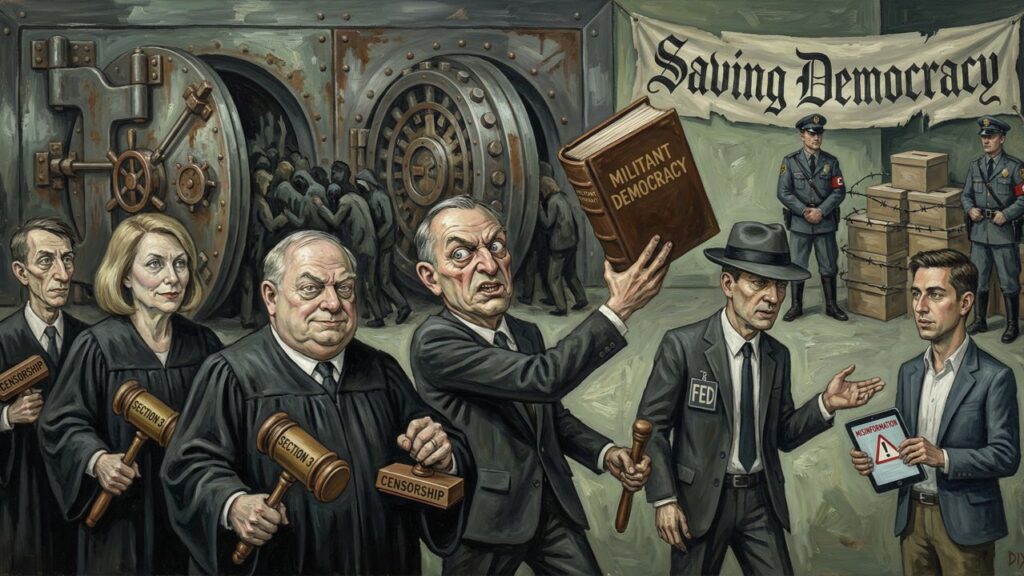
Today, it is the liberal, militant democratic, anti‑Trump front (judges, weaponized press, security bureaucrats, NGOs, platforms, and allied elites) who are reaching for that weapon in the name of “democracy protection.” From Section 3 disqualification schemes to censorship‑by‑proxy and financial deplatforming, they are reviving the very logic Weimar’s liberals theorized as “militant democracy”: pre‑emptively restricting parties, candidates, and speech they label “anti‑democratic,” ironically, even if that means curbing rights. Yes, the irony is brutal. The people most obsessed with calling Trump a Nazi are the ones wielding Nazi tools.
1. Weimar’s Real Lesson: Elites, Emergencies, and Legal Dictatorship
Weimar’s constitution contained a fatal fuse: Article 48, which let the president suspend rights and rule by decree whenever “public security and order” were threatened. In the final years, President Hindenburg and his “presidential cabinets” used that clause not as an exception but as a governing routine, re‑issuing rejected laws as emergency decrees and dissolving parliament when it resisted. The Reichstag became decorative; real power migrated to the executive and its network of generals, judges, and bureaucrats.
Anti‑republican elites in the Reichswehr, judiciary, and civil service claimed to defend the state while sabotaging the republic. They tolerated right‑wing coups and political murders, hammered the left, and slow‑rolled democratic governments they despised. When the Reichstag Fire erupted, the emergency machinery they had normalized was ready. The Reichstag Fire Decree suspended civil liberties “until further notice”; the Enabling Act let Hitler legislate without parliament. The transition from democracy to dictatorship came wrapped in legality, signed by presidents and passed in a cowed chamber.
Weimar’s core warning is not “never elect a loud man.” It is: never let an empowered establishment turn emergency into a way of life.
2. From Loewenstein toWehrhafte Demokratie: Militant Democracy as Doctrine
Karl Loewenstein, a German jurist driven into exile, looked back at Weimar and drew a stark lesson: liberal democracies were too tolerant. Fascists had used free speech, association, and elections to destroy the system from within, so democracies had to become “militant”, willing to revoke rights from actors labelled “anti‑democratic” before they seized power. His 1937 essays on “militant democracy” urged democracies to ban parties, gag propaganda, and wield emergency powers pre‑emptively in the name of self‑defense.
Postwar West Germany turned that theory into law. The Basic Law’s wehrhafte Demokratiearchitecture (party bans, rights forfeiture, unamendable “eternity” clauses, and a domestic intelligence service tasked with surveilling “extremists”) was explicitly justified as the antidote to a “too‑tolerant” Weimar. Democracy would henceforth defend itself by deciding who counted as a legitimate democrat.
That is the template many Trump opponents now want to import: a constitutional order in which a guardian caste reserves for itself the right to decide which movements are allowed on the field.
3. Trump as Pretext: Section 3, Lawfare, and Managed Competition
Since 2016, Trump has become the test case for leftist militant democracy. The most obvious example is their attempt to weaponize Section 3 of the 14th Amendment, the Civil War insurrection clause, to strike him from the ballot. Activist litigants working with allied legal academics argued that Trump’s post‑2020 conduct and the January 6 riot counted as “insurrection,” and that state officials and judges had not only the right but the duty to bar him from office without any criminal conviction.
The scope of this effort was breathtaking. By 2024, coordinated Section 3 litigation had been filed in more than two dozen states (Colorado, Maine, Alaska, Arizona, California, Michigan, Minnesota, New Hampshire, and others) seeking to remove Trump from primary and general‑election ballots on a civil “insurrection” theory and without any criminal insurrection conviction. Colorado’s supreme court, Maine’s secretary of state, and an Illinois judge all embraced that logic, briefly disqualifying the leading opposition candidate in a 50 to 50 country.
Only a unanimous Supreme Court pulled the emergency brake, holding that states cannot unilaterally deploy Section 3 against federal candidates. But the mentality remains: Trump is too dangerous for normal politics, so abnormal methods are justified. Even where courts ultimately balked at full disqualification, litigants and allied state officials repeatedly framed January 6 as a completed “insurrection” sufficient to trigger constitutional disabilities, pressing that interpretation in civil suits, bar complaints, and administrative hearings rather than waiting for a criminal adjudication.
Layered on top is lawfare: a barrage of overlapping criminal indictments and civil actions defended as necessary to “protect democracy,” though the underlying theories required novel legal contortions and abandoned established precedent. The pattern became unmistakable during the 2024 election cycle, multiple state and federal criminal prosecutions, civil fraud actions, and novel legal theories deployed in overlapping timeframes that coincided with primary and general election calendars, all coordinated with and amplified by elite media and democracy-protection NGOs as necessary to stop Trump. The pattern is clear: his opponents are trying to win not just at the ballot box, but by re‑defining the legal playing field so that his movement is permanently fenced off.
A coordinated network of well-funded NGOs, law‑school clinics, and “democracy protection” initiatives drove these efforts, framing Trump and associated movements as ongoing Weimar‑level threats and explicitly advocating pre‑emptive restrictions on ballot access as a form of wehrhafte Demokratie rather than contesting them under normal electoral competition. Prominent academics and commentators argued that using Section 3, coordinated platform moderation, and aggressive prosecutorial theories against Trump were not regrettable exceptions but necessary upgrades to a “too tolerant” liberal order, recasting Weimar’s post‑mortem as a brief for guardian‑class gatekeeping.
4. The New Censorship and Debanking Complex
Weimar had Article 48 and pliant courts. The twenty-first century has something more subtle: a public-private control system built around social media platforms, banks, and security bureaucracies.
Exposés and litigation over the past few years have documented extensive coordination between intelligence and security agencies and social‑media platforms. In the name of fighting “misinformation,” “extremism,” and “election interference,” officials systematically flagged Trump‑aligned narratives for suppression, directly shaped platform moderation policies, and laundered censorship demands through third‑party NGOs to create plausible deniability. The suppression of the Hunter Biden laptop story before the 2020 election, after months of official “warnings” about a possible hack‑and‑leak, was the most visible example of how “democracy protection” can shade into outright narrative management.
Major platforms throttled or blocked the New York Post’s Hunter Biden laptop reporting in October 2020, just before the election, citing fears of “hack‑and‑leak” operations and foreign interference. Former Twitter executives, under congressional questioning, were forced to admit the decision lacked factual basis, while House investigators highlighted coordination and pressure from security agencies warning of a possible Russian operation. Congressional oversight materials describe recurring meetings and liaison channels where federal agencies flagged content and narratives, frequently associated with Trump or his supporters, for moderation under the banners of “misinformation,” “election integrity,” and “extremism,” creating a standing, semi‑formalized speech‑management regime rather than a narrow, time‑bounded emergency.
The effect was not state censors ordering printers seized, but a fused security-platform complex that quietly decides which narratives citizens are allowed to see in the name of safeguarding the republic.
At the same time, federal regulators and activist shareholders have pressured banks and payment processors to cut off politically disfavored actors, from crypto firms to crowdfunding platforms associated with right‑leaning causes. Accounts can be closed or services withdrawn under opaque “risk” and “reputation” standards. No statute bans a movement; it simply finds itself unable to raise money, advertise, or transact. The result is functional exclusion without a single formal party ban, a twenty‑first‑century version of Weimar’s emergency logic, translated into infrastructure.
The House Oversight Committee has opened investigations into financial institutions debanking lawful businesses and individuals based on political affiliation or disfavored sectors, citing reports that dozens of tech founders and even members of Trump’s family were cut off from banking relationships. These investigations and press reports describe accounts closed or services withdrawn from individuals and firms aligned with right‑leaning or Trump‑adjacent causes under elastic “risk” and “reputation” criteria, often without clear, chargeable misconduct.
The message is clear: no one banned the party, but they made it impossible for the party’s ecosystem to raise funds, process payments, or maintain basic accounts, a modern echo of Weimar’s administrative and professional exclusions.
5. From “Defense of Democracy” to Permanent Exception
The rhetoric that justifies all this has quietly shifted. Yesterday’s language was “defense of democracy”, a response to a concrete threat. Today’s is “democracy protection” and “resilience”: a standing mandate for elites to manage risks, curate speech, and police candidates on a rolling basis. Trump and Trumpism are cast as a permanent Weimar‑level danger, something the system must forever be inoculated against.
This is exactly how constitutional orders drift into a permanent state of exception, yet the very theorists and advocates of militant democracy who designed these tools continue to push for their expansion, insisting each new restriction is a necessary guardrail rather than another step toward permanent emergency rule. Once you accept that democracy can only be saved by restricting its own openness, expanding the list of “anti‑democratic” actors becomes the system’s core function, not an aberration. Tools devised for Nazis end up repurposed against populists; then against anyone who questions the guardians themselves.
In that sense, the Weimar analogy finally lands, but not where MSNBC thinks. The closest thing in American politics to Weimar’s anti‑republican establishment is not Trump. It is the anti-Trump coalition masquerading as democracy’s defenders, convinced that its own virtue entitles it to bend rules “just this once” to keep him out.
6. The European Laboratory: Where Militant Democracy Never Stopped
If all this sounds foreign, that is because it is. The intellectual operating system behind America’s “save democracy” panic was developed in Europe after 1945, where militant democracy became the respectable way to keep the wrong people off the ballot, and it has never stopped operating.
Across postwar Europe, constitutional courts and commissions were empowered to ban parties or dissolve organizations deemed “anti‑system” or “enemies of the constitution,” from neo‑Nazi and fascist outfits to communist and separatist movements. Comparative studies cataloging party bans document dozens of such cases in Germany, Spain, Belgium, Turkey, Portugal, Ukraine, and elsewhere, all justified as necessary to prevent extremists from using elections to overthrow democracy. The underlying move is always the same: a clerisy of judges, security officials, and experts claims authority to decide which parties are safe enough to be allowed on the field at all.
Germany’s current treatment of the Alternative für Deutschland (AfD) shows the model in real time. The domestic intelligence service (Bundesverfassungsschutz) has officially labeled AfD, now Germany’s second‑largest party, a “right‑wing extremist” threat to the democratic order, unlocking surveillance powers against a major opposition party and fueling open calls among mainstream politicians to ban AfD entirely to protect the constitution. Courts have issued temporary stays against aspects of this classification, but the agency continues to surveil a major opposition party with constitutional imprimatur. Intelligence agencies thus move from neutral security organs to political gatekeepers, with the power to mark a mass‑party constituency as beyond the democratic pale.
Nor is Germany alone. In eastern and southern Europe, European elites have deployed similar tactics against far‑right and populist contenders. A recent policy brief advocates, in explicit terms, banning far‑right presidential candidates in France and Romania from running to protect democracy, treating disqualification of “extreme” candidates not as a last resort but as a routine tool when ordinary competition is deemed too risky. In Romania, the constitutional court and electoral commission used militant‑democracy language to justify disqualifying presidential candidates under laws against parties or actors who allegedly undermine public order, promote aggression, or stoke racial hatred, cases explicitly described in policy analysis as “militant democracy in action.”
The architects of militant democracy now argue openly that when actors seek to “abolish democracy wholesale,” pre‑emptive bans and disqualifications are not unfortunate exceptions but necessary upgrades to a liberal order that was “too tolerant” in the Weimar years, conveniently reserving for themselves the power to determine which movements qualify as existential threats. The intellectual enablers of militant democracy explicitly frame bans or exclusions of far‑right and populist parties as legitimate defenses of the democratic order, arguing that actors seeking to undermine democratic institutions may need to be pre‑emptively barred from running or dissolved even if they obey formal electoral rules, a circular logic that makes the guardians both judge and jury of which politics are permissible.
The structural patterns are now clear across Europe:
Party bans and illegalization. Surveys of party‑ban practice stress that militant democracy has become the prevailing model for dealing with anti‑system parties, granting courts and commissions wide discretion to dissolve or disqualify organizations that espouse certain ideologies, sometimes on thin or contested evidence of concrete threat.
Intelligence services as political gatekeepers. In several European democracies, domestic intelligence agencies now play a direct role in determining which parties are labeled “extremist” and thus subject to surveillance, ostracism, and potential banning, effectively giving security bureaucracies a veto over the electoral viability of disfavored movements in the name of constitutional defense.
Permanent “defensive democracy” posture. Rather than treating bans and exclusions as last‑resort emergency measures, European elites increasingly speak of “resilience,” “immunizing democracy,” and maintaining permanent guardrails against populist movements, converting exceptional mechanisms into ongoing instruments of competition management.
That is the worldview many American pseudo‑democracy/militant democracy activists have now imported: not a trust in voters to punish bad actors, but a faith that enlightened guardians must override voters for their own good. The more Trump is cast as a permanent Weimar‑level danger, the more the guardians reach for the same European toolkit (party bans in all but name, intelligence‑driven ostracism, and disqualification campaigns) in the belief that history will thank them for breaking the rules to save the system.
Conclusion
Donald Trump’s enemies insist they are preventing another 1933. They reach for disqualification clauses, censorship arrangements, emergency narratives, and financial choke points, confident that history will thank them for doing whatever it takes. But the Weimar story, properly told, is not a morality play about an electorate that chose the wrong man once. It is an institutional autopsy of a republic that allowed an empowered establishment to normalize exception, concentrate power, and hollow out its own legitimacy long before Hitler’s final push.
That is the real danger now. The gravest Weimar risk facing the United States is not that Americans might elect a strong‑willed president again. It is that a self‑anointed guardian class convinces itself that suspending equal rules is the only way to stop him, and in doing so, burns through the last reserves of trust in the system.
Weimar teaches that republics rarely die because voters choose the wrong man; they die when self-anointed elites, preaching “militant democracy,” decide that the only way to save the constitution is to put themselves above it.
Related reading
- A Bill of Indictment for Murder and Genocide Against the American Military and Trump, as its Commander and Chief
- Trump Blackmails Allies Abroad While Being Blackmailable at Home: The Irony of It All
- Susie Wiles Can’t Restrain Trump, So She Covers for the Malignant Orange Baby
- Holy Trump or Evangelical Scholar? Neither. Just a Nincompoop Babbling to Morons on the 4th of July