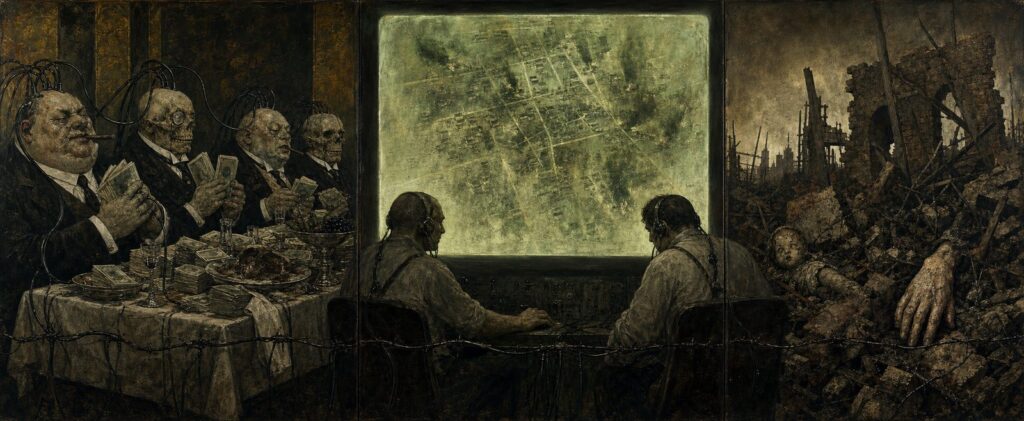
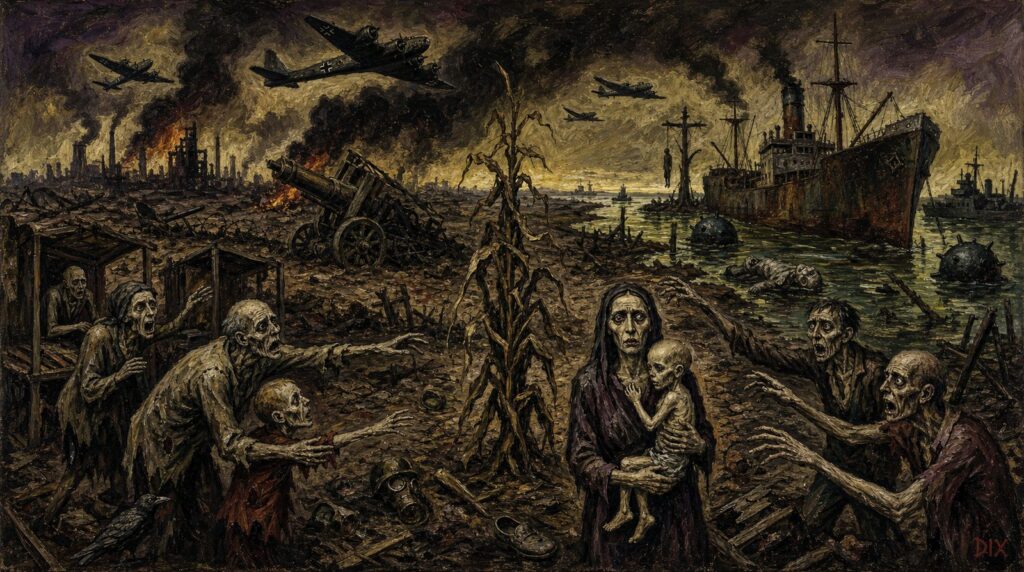
How networked technology closed the private gaps in American life, how a rentier class captured the government, and why American world power is ending anyway
By Scott Ortkiese
I. The Gaps In Time
News used to come by slow mail, with fingerprints on it and a stamp. Somebody had to find it, and there was always a place for them. You waited for letters, with expensive calls in between, the way they wait for rain in the Dust Bowl pictures, checking the mailbox, thinking the postman might have come while you went to the freezer for a popsicle, walking back empty handed, living with the ache of not knowing and setting that good ache of need on a shelf.
Phone calls were events. You dialed one number at a time and waited for the dial to circle back before you picked another. You could not hurry it. You stood in a hallway just beyond your parents’ ears, twirled the cord, listened to the faraway ring, and accepted that no answer meant “try again later,” not “you have been ignored.” Privacy was thin but human and roughly polite. Neighbors breathed on the party line to make sure you knew they were there, or they hid and listened. The milkman’s quiet clink was the census of who was home. The cab you flagged at the airport with your arm arrived only after a long walk through your own thoughts. You got to a hotel and decided: payphone first, or put off home and office until you had a room. Messages waited at the front desk in a stranger’s handwriting.
There was time between all these things. Time to be invisible. Time to think. Time to do what you wanted to do.
Those were the gaps. Gaps between question and answer, departure and arrival, impulse and action. In those gaps, character and imagination had room to live and to misbehave. You had to decide who you really were in silence, without a crowd, no performance until it was scheduled, nothing inflicted on you without a ring you could ignore, and nobody knew.
Then the machines closed the gaps, and something else moved into the space.
II. How the Closing Happened
The idea that a person should be reachable anywhere escaped its cage in stages, and each stage was sold as an advantage.
First came mobile phones with a conventional handset, a cord, and a battery the size of a shoebox, carried by men who wanted you to see them carrying it. Then sleeker handsets and pagers. You remember pagers, the buzz on your belt that said work had found a way into Saturday, back when there was no junk paging until there was. You negotiated with yourself: only in emergencies, only this once, only until things calm down. Finish walking the dog. Pick up the kid. Have a drink. Things never did calm down.
A BlackBerry slipped into your palm and finished the job. Messages followed you out of the office and into the taxi, the bar, the bed. The blinking light in the corner of that device was a small red eye that said you are never done. You told yourself you had bought an edge over other men. Desktops became laptops while you fought new software and general protection faults and watched the pinwheel of unsaved document death. The computer left the desk and colonized your lap and the tray table. The hotel room stopped being an elsewhere and became an annex of the same electronic life, the same inbox behind the same password. Your wife, your office, and your friends knew where you were.
A brief fog of “what is the Internet, exactly” drifted past, along with the hope that the thing might be too complicated to really disorder your life. Then the moment of crossing into “online” disappeared, and with it the sense that you were entering a different space at all. The network slid into the background. You stopped going to the internet and simply lived inside it before you understood what had happened. Then the glass slab arrived and fused phone, mail, camera, newsstand, confessional, casino, and public square into one object you were told to keep within reach while you slept.
Huxley described the mechanism before it existed. He imagined a world where nobody had to burn a book because nobody wanted to read one, where the state governed not with a boot but with pleasure, a pill called soma and a carousel of shallow sensation that made rebellion feel unnecessary. Bradbury ran the same thread further. In his world the firemen started the fires, but the real damage was done before the first match, because the population had already traded literature for wall-sized television and earpiece chatter and had drowned their interior lives in noise until a book became a threat to comfort rather than a window out of it. Neither man predicted that we would build both dystopias at once, the surveillance apparatus Orwell feared and the pleasure prison Huxley described, and fuse them into a single object that fits in a pocket and that you would pay for on a monthly plan.
Somewhere in that glow, the second change took hold, and it is the one that matters: the record. Calls, messages, purchases, movements, all the small evidence of a life that would once have evaporated, began to accumulate. Forgetting stopped being automatic. Anonymity became an error state. Everything you did left a faint permanent echo in systems you could not see and would never be permitted to audit.
Power noticed. Power always notices.
III. Two States, One Apparatus
Here is where the sentimental version of this story usually stops, with a complaint about phones. The complaint is not the point. The point is what the closing of those gaps was useful for, and to whom.
Colonel Lawrence Wilkerson, who served as chief of staff to Secretary of State Colin Powell, put it plainly in conversation with Glenn Diesen this month. Since 1945 the United States has been engaged in two simultaneous state-building projects, and they are not the same project. The first is the national security state, whose charter document is the National Security Act of 1947, the law that created the Central Intelligence Agency, the National Security Council, and the modern Department of Defense. Harry Truman did not like it, and he liked even less the people gathering around it. The second is what Wilkerson calls the predatory capitalist state, the machinery of extraction that has been latent in the American project for two hundred fifty years, and for three hundred if you count the British tuition.
What has happened since 1945, and what has accelerated violently since 1991, is that these two projects have crossed over into each other until they cannot be separated. Wilkerson’s example is exact and worth sitting with. ExxonMobil’s single largest customer on the face of the earth is the Department of Defense. Exxon is a member in good standing of the predatory capitalist state. The Pentagon is the premier institution of the national security state. The Pentagon is the largest single buyer of the product. Lockheed Martin, and most of the top six or seven prime contractors, have a foot planted firmly in both camps: they build the weapons for the security state and they sit among the most highly compensated members of the capitalist state.
That is not a metaphor and it is not a conspiracy. It is a procurement relationship, disclosed in public filings, appropriated by public law, and lobbied for in public buildings. Eisenhower named it in January 1961 and warned that the conjunction of an immense military establishment and a large arms industry was new in the American experience and that its total influence, economic, political, even spiritual, would be felt in every city and every statehouse. He asked the citizenry to guard against the acquisition of unwarranted influence. The citizenry did not.
The apparatus that resulted is, in Wilkerson’s assessment, no longer fully understood by the people operating it, and possibly no longer capable of being understood. That is the condition of a mature imperial bureaucracy: too many interlocking parts, too many private beneficiaries, too much classification, and no one with both the authority and the comprehension to stop it. Then hand it to an incompetent and see what happens.
IV. The Rentier Class
Sitting on top of both states is a one percent rentier class that owns and controls nearly everything worth owning.
A rentier class, for anyone who has not had the term defined honestly, is a layer of people who live not by building anything but by controlling what already exists. Money managers, fund barons, private equity chiefs, the whole clerisy of fee skimmers and influence brokers who extract unearned income from other people’s capital and other people’s labor. They do not create wealth. They position themselves between wealth and its owner and charge for the passage.
The scale is the part people miss. The three largest asset managers in the world sit on more than twenty trillion dollars in assets under management, which is other people’s money, pensions and index funds and endowments, and it purchases voting control across nearly every large public company in the United States simultaneously. Private equity now owns hospital systems, nursing homes, veterinary chains, dental practices, mobile home parks, and fire departments. Private credit, the least examined pile in the system, has grown well past one and a half trillion dollars in roughly a decade with almost none of the disclosure required of the banks it displaced. None of this was voted on.
Orwell wrote the manual in Animal Farm. The pigs did not build the farm. They seized it from the animals who did, rewrote the commandments on the barn wall while everyone slept, and ended up walking on two legs, indistinguishable from the men they had overthrown. “All animals are equal, but some animals are more equal than others.” That is the rentier class in one sentence.
They steer elections and the elected alike with a staggering concentration of other people’s money that they do not own and did not earn but absolutely control. Instead of citizens in a serious republic we have boards and managing directors operating inside an empire that presents itself as a constitutional order with a rule of law, an independent judiciary, a president of limited powers, and a legislature that is in practice bought and sold. Money that once built railroads and aircraft carriers now builds networks and financial contraptions in which state and private ownership are so intertwined that insiders cannot describe them without software.
That is the Uniparty. It is not an R or a D. It is a fusion of capital, rentiers, a Pax Silica built on platforms and chips, purchased politicians of both parties, corporate chiefs, placed directors, academics, media outlets, think tanks, and consultancies. Together they are the Blob, and the Blob divided the country with manufactured craziness and sold the craziness as progress. They cannot make the public accept the message, so they run the loud vulgarian against the empty laugh and tell us these are two serious candidates. Look at what that produced and then tell me it was a competitive market.
V. The Institutions of Explanation and Blessing
Between the money and the formal state hover the institutions whose function is to turn appetite into argument: universities, foundations, councils, respectable journals, glossy conferences with a sponsor’s logo on the lanyard. They distill profit, fear, and the will to dominate into doctrine and position papers about order, stability, and responsibility, then pump it out as continuous programming.
Bright young people learn to speak this language and many of them come to believe it, which is the point. Orwell would recognize the machinery instantly: Newspeak in a blazer, the Ministry of Truth with a nonprofit charter and a donor wall, language stripped of meaning until “rules-based international order” can license any crime and“strategic partnership” can paper over any atrocity.
Diesen makes the sharper version of this observation. The political culture itself has changed since the Cold War. Politicians, diplomats, journalists, and academics are now permitted to say only a narrow set of things: we are strong, we are winning, we are virtuous, our adversaries are weak, losing, belligerent, and possessed of no legitimate interests whatsoever. Say out loud that Russia has been winning in Ukraine, as an observable matter of territory and attrition, and you are not corrected on the facts. You are accused of loyalty to Russia. Say that Iran holds a strategic advantage in a particular theater and you are pro-Iranian. The category of neutral observation has been abolished. Wilkerson’s response is the correct one: that attitude is fatal to diplomacy, because diplomacy requires an accurate picture of what the other party actually wants and actually can do.
An empire that cannot see its opponents accurately cannot bargain with them. It can only escalate.
VI. Maritime Against Continental
Now to the part that the domestic quarrel keeps everyone from noticing.
British hegemony in the nineteenth century and American hegemony in the twentieth were both organized around the same strategy: maritime power. Control the sea lanes that physically connect the world, keep the land powers of Eurasia divided, and rule the continent from its periphery. Split the Germans from the Russians. Split China from the Soviet Union. Brzezinski wrote the post-1991 version of the doctrine without embarrassment in The Grand Chessboard: prevent collusion among the vassals, maintain their security dependence, keep the tributaries pliant, and keep the barbarians from coming together.
The barbarians have come together. That is the whole story of this decade, and it is the one thing Washington will not say in public.
Russia, China, and Iran are not an alliance in the treaty sense, and pretending otherwise is lazy. They are something more durable and harder to break: three large continental powers with converging interests in de-dollarized settlement, overland trade corridors, and the removal of American veto power over their neighborhoods. Together they are the largest country in the world by area, the largest manufacturing economy in the world, and a state holding some of the largest proven oil and gas reserves on earth, all of it in one contiguous landmass, increasingly connected by rail, pipeline, and payment systems that do not clear through New York. Paul Kennedy’s imperial overstretch, published in 1987 and dismissed as declinism for thirty years, describes the American position precisely: global commitments expanding at the exact moment the industrial base that once financed them contracted.
Charles Krauthammer coined “the unipolar moment” in Foreign Affairs in 1990. Read the actual essay. He said a moment. He said explicitly that other powers would rise and that the world would return to multipolarity, and that the United States should use the interval wisely. Washington took a word about a temporary window and built thirty-five years of ideology on it, complete with a theory that history had ended and that liberal democracy would be transmitted to the rest of the earth by force where persuasion failed. Once you have handed politicians a divine assignment, it is unreasonable to expect them to accept, calmly and on schedule, that the distribution of power has changed and they must now accommodate the Chinese, the Russians, and the Iranians. Realists who model states as rational actors underweight this. The hegemon in decline is not a rational actor. It is a wounded institution with nuclear weapons and an election calendar.
Wilkerson locates the moment of visible reckoning with unsettling specificity. The aircraft carrier is the capital ship of the maritime order and its central symbol. The reason the United States has not gone in against Iran the way it went into Afghanistan, Iraq, Syria, and Libya is that Iran is a country of roughly ninety million people on defensible terrain with layered anti-ship capability, and Washington is genuinely afraid of the day one of those carriers goes to the bottom. When it happens, and Wilkerson thinks it will happen, it takes a portion of the maritime regime down with it, because the entire architecture rests on the presumption that those ships cannot be touched.
Britain had its version of that day at Suez in 1956. The decline had begun long before, but Suez was the moment everyone could see it.
VII. War Without Cost to the People Who Order It
Once, if a ruler wanted a war, he had to imagine his own dead. He had to picture his own city burning and faces he recognized screaming in it. The king rode with his men. The senator’s son carried a rifle.
Now a minister signs a memo, an operator clicks, and a human being on the other side of the planet becomes a smear of light on a thermal screen. Remarque described the moral distance a century ago from inside the trenches, young Paul Bäumer watching his humanity drain out of him until he became, in his own words, a human animal, and that was with bayonets and gas, face to face, close enough to smell it. Consider what the distance does when the killer never sees the killed, never hears it, and goes home at the end of a shift.
Before the bombing there is the strangling. First we sanction, which is to say we impoverish a population and destroy its access to medicine and spare parts and correspondent banking, and then we cite the resulting desperation as evidence that we are dealing with a rogue, a dictatorship, or the current favorite label, a regime. Then we bomb, and the bombing is described as a response.
What was sold as precision, the promise that technology would make killing less barbaric, ripened into something worse than barbarism: cheap wars, fought at distance, managed like risk portfolios, presented as sterile options in a slide deck by people who will never be near the consequence. The twisted steel and the scattered flesh at the far end never appear in the spreadsheet. The dead exist as coordinates, metadata, probabilities, signatures. Sons and daughters reduced to patterns and eliminated as anomalies.
And now, without even the pretense of process, the United States is killing people on the high seas without charge, trial, or evidence made public, and a president talks openly about using the military to create terror. That is not a policy dispute. That is the abandonment of the one thing the American state claimed to be for.
The distance is not only physical, it is moral. The screen filters out the blood and the pleading. In that filtered space, conscience survives as theater: checklists, legal reviews, post-strike assessments drafted in the passive voice, props to wave at the ghosts who show up at three in the morning. Vonnegut understood this. “So it goes”was not flippancy. It was the sound a man makes after walking through the ruins of Dresden and grasping that the people who order the fire never stand in it.
VIII. The Home Front Portfolio
On the home front, war is no longer a rupture in normal life. It is one of the mechanisms by which normal life is financed.
Missiles are manufactured in districts that need the jobs, which is why the production lines are distributed across as many congressional districts as the engineering will tolerate. Surveillance and border technology are marketed to investors as growth sectors with attractive government revenue visibility. Security programs pour contracts into universities and startups, which then produce the researchers who staff the councils that write the position papers. And the returns flow into pension funds, index funds, university endowments, and campaign accounts, a trickle-down lattice of blood and dividends.
This is Huxley’s soma in its American form. You do not bite the hand that funds your retirement account, even when that hand is covered in someone else’s blood, and you do not have to be told not to. Your quarterly statement tells you.
The same hand that taps a screen to summon a ride can, in another context, tap a screen that ends a family line. The same firms that map your cravings for advertisers map patterns of life for targeting. The same cables and satellites that carry love notes carry kill orders and sanctions lists. It feels seamless and frictionless and inevitable, as though history had become a user interface with the consequences smoothed out of the design.
No one at the command end needs to see the other end. They see dashboards. Threats reduced. Exposures hedged. Volatility managed. The dead are not absent from those dashboards. They are background noise, collateral, a variable to be minimized in the next release.
IX. Is This Just What We Are
Underneath all of it the oldest question keeps scratching at the door.
Generations before us watched trenches fill, camps expand, cities vanish in fire, men pulled out of crowds and shot into pits. Some of them concluded that cruelty is the rule and kindness the exception, a brief glitch in the code. Golding put a group of schoolboys on an island and watched civilization peel off them like wet paint: the conch smashed, Piggy killed, the hunters howling with blood on their faces. When the naval officer finally arrived on the beach in his clean uniform with his big ship, he was not salvation. He was a larger and better-armed version of the same animal.
Others, standing at podiums with medals still warm, insisted that man would not merely endure but prevail, because he possesses something beyond the sum of his fears. Faulkner said it in Stockholm in 1950 and he meant it, and it was beautiful, and it may have been wrong. He worried that the great new weapons would frighten writers into silence, that they would forget the old truths of the heart, love and honor and pity and pride and compassion and sacrifice, and spend their days circling the bomb.
The bomb turned out not to be the only way to drain the heart. The network did its own slow work. It did not explode over cities, it seeped into bedrooms. It did not force anyone into silence, it trained them to talk constantly without ever saying anything that threatened the wiring. It did not ban hope, it smothered hope under a continuous low-grade avalanche of stimulation and managed outrage. Bradbury’s Captain Beatty explained the method half a century early: speed up the film, quicken the pace, pack in the fun, cram the pages with factoids until nobody has time to think, and then the firemen are barely necessary, because the people have done the burning themselves.
Shute wrote On the Beach to show the failure state. The radiation drifts south, Melbourne waits, and nobody riots and nobody storms the parliament. They garden and fish and take the government pills and die politely, because by then there is nothing left to do. That is the horror of the book. Not the war. The resignation afterward.
Into that resignation crawls one small sentence: it is what it is. A tautology, technically. In practice a verbal shrug. Not wisdom, just the sound a man makes when he understands that the steering wheel is nowhere near his hands.
X. What Comes After
Wilkerson’s conclusion is the one nobody in Washington will say into a microphone. We are not getting out of this. The world-spanning power is finished. That does not mean the United States ceases to exist; it is a country of three hundred forty million people that will go on trying to feed itself and get along. It means the imperial position is over, and the only question left is the transition.
That question is the whole ballgame, and it is worth stating precisely. How does a declining hegemon get from here to a flat plane, a settled position of reduced power that it can actually hold, without destroying itself and a good part of the world on the way down? Britain managed a version of it after Suez, badly and expensively, but it managed it. Britain also had a successor it trusted. The United States does not.
Wilkerson is not optimistic, and his reasons are institutional rather than partisan. The apparatus is not understood by the people running it. The legislature has surrendered its war powers and shows no interest in reclaiming them. The courts have discovered a great many reasons to defer. The party structures are captured by the same money. And the sequence of leaders since 1989, the men who arrived after the last cohort that had any visceral memory of what a general war actually is, have been progressively less experienced, less independent, and more thoroughly handled by the interests behind them.
Colin Powell told Diesen something in 1989 that reads better every year. Once the leaders who had been children during the war were gone, once Mitterrand and Kohl and Thatcher and Gorbachev and Shevardnadze and Baker and Bush had all left the stage, everything would change, because the people replacing them would have no bodily knowledge of what they were gambling with. That is exactly what happened. And it is now happening in Germany again, where the governing establishment is reportedly exploring how to constrain the eastern states in order to prevent them from obstructing a future confrontation with Russia. Kohl was warned in 1990 that reunification would cost eighty billion dollars. It cost roughly twice that. He was also warned about what a reunified Germany inside NATO would eventually look like from Moscow. Everyone at the table agreed there was no problem. They would answer differently today.
The old cliché holds that every generation has to learn to fear war for itself. Ours has not learned it yet. It is going to.
XI.
It is going to get ugly from here. The systems are too entrenched, the incentives too misaligned, the tools too potent, the brakes too weak. The empires of silicon and steel will drive forward until they hit the limits of physics, of biology, or of somebody else’s willingness to be killed. The people at the consoles will tell themselves they had no choice. The people under the flight paths will say, accurately, that they never had one.
That is where this piece lives: in the contradiction between not giving a damn and continuing to talk anyway. Between Faulkner’s faith that man would not merely endure but prevail, and the creeping suspicion that the voice may turn out to be puny after all, enduring only as a sound and not as a victory, still talking when the last worthless rock hangs tideless in the last red and dying evening.
Montag ran from the firemen with a book in his hands, not because he had a plan but because something in him refused to watch one more page burn. Winston Smith wrote in a diary knowing the Thought Police would find it, because the writing was itself the rebellion. The impulse is older than strategy. It is biological.
There may be no vindication in this, no last-minute turn, no chorus rising in the name of man. There may be only a few scattered voices on forgotten channels, saying as clearly as they can before the signal dies: this is what we built, this is what it did to us, and this is how it felt to be here while it happened.
You are one of those voices. This is one of those channels.
Scott Ortkiese is President and Chief Executive Officer of Faulkner Capital Holdings and writes on geopolitics, energy, and capital markets. Correspondence and the underlying long-form documentation: so@throughlinesynthesis.com
Sources
Lawrence Wilkerson, interview with Glenn Diesen, August 2026. Transcript. Wilkerson served as chief of staff to Secretary of State Colin Powell.
Charles Krauthammer, “The Unipolar Moment,” Foreign Affairs, vol. 70, no. 1 (America and the World 1990/91). https://www.foreignaffairs.com/articles/1991-02-01/unipolar-moment
Zbigniew Brzezinski, The Grand Chessboard: American Primacy and Its Geostrategic Imperatives (New York: Basic Books, 1997).
Paul Kennedy, The Rise and Fall of the Great Powers: Economic Change and Military Conflict from 1500 to 2000 (New York: Random House, 1987).
National Security Act of 1947, Pub. L. No. 80-253, 61 Stat. 495. https://www.govinfo.gov/content/pkg/STATUTE-61/pdf/STATUTE-61-Pg495.pdf
Dwight D. Eisenhower, Farewell Address to the Nation, January 17, 1961. https://www.archives.gov/milestone-documents/president-dwight-d-eisenhowers-farewell-address
William Faulkner, Banquet Speech, Nobel Prize in Literature, Stockholm, December 10, 1950. https://www.nobelprize.org/prizes/literature/1949/faulkner/speech/
George Orwell, Animal Farm (1945) and Nineteen Eighty-Four (1949). Aldous Huxley, Brave New World (1932). Ray Bradbury, Fahrenheit 451 (1953). William Golding, Lord of the Flies (1954). Nevil Shute, On the Beach (1957). Erich Maria Remarque, All Quiet on the Western Front (1929). Kurt Vonnegut, Slaughterhouse-Five (1969).