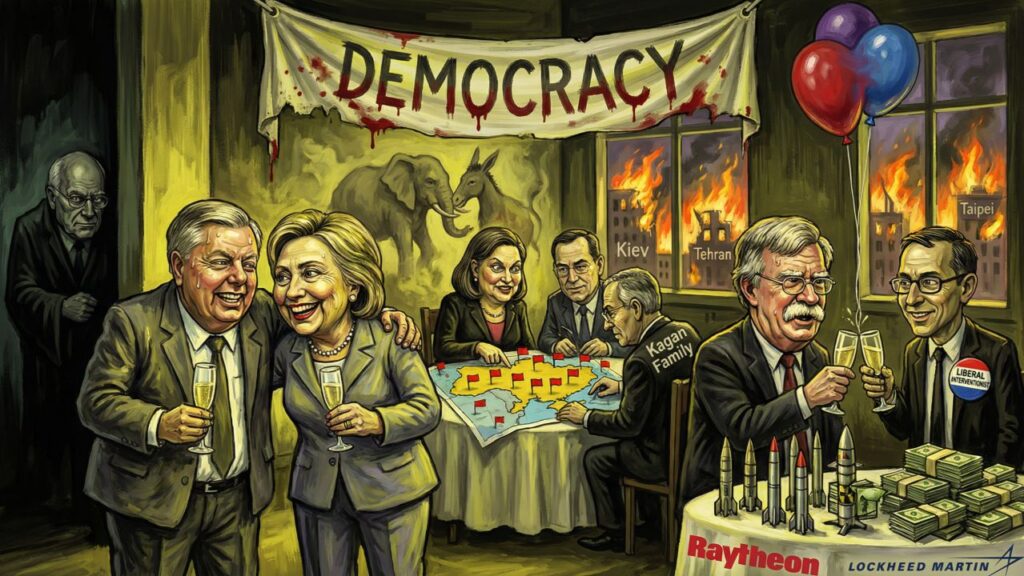
A Withering Exposé of the Neocon-to-Uni-Party Transition, The Most Dangerous, Bungling, Diabolical and Unpatriotic Political Movement in American History
[Article 1 of 10: Exposing Neocon Roots, its Uni-Party Capture, and the Wars They’re Starting Now]
Author’s Note
Bear with me, readers. To explain what monsters the Neoconservatives truly are, now fully manifest as the Uni-Party, fomenting wars in Iran and Ukraine at this very moment, I must first lay a foundation. You need to understand their origins and their metamorphosis into the bipartisan abomination that has literally placed us at the foot of nuclear conflagration.
If, by the grace of God and a clean handkerchief, we somehow miraculously avoid nuclear war with Russia and global economic collapse over Iran, rest assured: these creatures will simply move on to China and Taiwan to take another crack at planetary erasure. That’s what they do. That’s all they do. They cannot stop themselves.
Like the spiders at Bikini Atoll, the ones that survived 23 nuclear detonations and emerged from their hiding holes to crawl across irradiated coral, the Neocons are impossible to kill. Indeed, should they succeed in triggering the very apocalypse they seem so determined to engineer, they will likely be the first organisms to emerge from their bunkers and scuttle across the charred earth, already scheming about which of the surviving territories requires “regime change.”
The history that follows is not academic exercise. It is the origin story of the most dangerous political movement in American history, one that is, at this moment, actively working to destroy any chance of peace. Understanding where they came from is essential to understanding why they must be stopped.
INTRODUCTION: THE FILTH HIDING IN PLAIN SIGHT
They call themselves “neoconservatives,” but they are neither new nor conservative. They hide behind party labels (sometimes Republican, sometimes Democrat, sometimes “liberal interventionist,” sometimes “defense hawk”) but the labels are costumes, not convictions. They wrap themselves in the flag while looting the treasury. They invoke “democracy” while subverting every democratic institution they touch. They speak of “national security” while making America less secure with every catastrophic intervention they engineer. They have killed millions, squandered trillions, alienated allies, empowered enemies, and, when the bodies are counted and the bills come due, they slither into think tanks and television studios to collect their rewards and plot their next disaster.
They are the neoconservatives, bumblers, finaglers, scheming manipulators, scallawags, carpetbaggers, and charlatans. And they are the single greatest threat to American democracy, American prosperity, and American survival that has ever emerged from within the American political system. This is why the term “Uni-Party” has entered the American political lexicon: ordinary citizens watched election after election produce the same foreign policy regardless of which party won. They watched Republicans campaign against nation-building, then build nations. They watched Democrats campaign against endless wars, then extend them. They watched “conservatives” and “liberals” clash theatrically on cable news while voting identically on military budgets, surveillance authorities, and intervention after intervention. The Uni-Party label emerged because Americans finally recognized what the neoconservatives had accomplished: the capture of both parties’ foreign policy establishments, creating a single interventionist consensus that transcends electoral politics and renders voting meaningless on the questions of war and peace. The neoconservatives don’t fear elections because they own both options. Red or blue, hawk or “humanitarian interventionist,” the same policies advance, the same contractors profit, and the same bodies pile up. The Uni-Party isn’t a conspiracy theory, it’s an accurate description of how neoconservative ideology made partisan competition irrelevant where it matters most.
This is not hyperbole. This is not partisan rancor. This is a forensic examination of a political movement that began in the radical Trotskyist alcoves of City College of New York in the 1930s, captured the commanding heights of American foreign policy by the 1990s, and has since produced an unbroken chain of catastrophic failures: Iraq, Libya, Syria, Ukraine, Venezuela, and now, unless stopped, Iran and China.
The neoconservatives are not merely wrong. They are not merely misguided. They are grifters.They are ideologues whose ideology conveniently enriches them personally while impoverishing the nation they claim to serve. They rotate between government positions (where they start wars), defense contractors (who profit from those wars), and think tanks (where they advocate for the next war). The revolving door spins so fast it generates its own gravity, pulling in taxpayer dollars, spitting out body bags and reconstruction contracts.
This article will expose them.
We will trace their ideological DNA from Trotsky’s permanent revolution doctrine to today’s “rules-based international order.” We will document how these charlatans captured both political parties, creating a uni-party consensus from which meaningful dissent became impossible. We will catalog their catastrophic failures, the millions dead, the trillions wasted, the alliances destroyed. We will show how they are right now, in January 2026, working to sabotage peace negotiations in Ukraine, drive America into war with Iran, and set the conditions for conflict with China that would devastate our Asian allies and potentially trigger nuclear exchange.
And we will illuminate the connection between neoconservatism and the so-called “militant democracy” movement, presented by corporate media as a “progressive” or “leftist” phenomenon but in reality the domestic arm of the same uni-party apparatus, using the same tactics of elite manipulation, institutional capture, and contempt for democratic accountability.
The neoconservatives are not the adults in the room. They are the arsonists who set the fire, the finaglers who sold the insurance, and the carpetbaggers who charge triple to rebuild what they burned.
It’s time someone said so.
PART I: THE ALCOVES THAT CHANGED HISTORY
In the cafeteria of City College of New York during the 1930s, a peculiar geography shaped the future of American foreign policy. The room was divided into alcoves, numbered spaces where students gathered between classes to argue, smoke, and plot revolution. Alcove 1 belonged to the Trotskyists. Alcove 2 to the Stalinists. The rivalry was fierce, the debates unending, and the polemical style honed there would later define a generation of American intellectuals who would come to be called neoconservatives.
Irving Kristol, who would become the “godfather of neoconservatism,” described Alcove 1 with telling nostalgia: “The first alcove on the right…became most of what City College meant to me. It was there one ate lunch, played Ping‐Pong…argued incessantly and generally devoted oneself to solving the ultimate problems of the human race.” What he didn’t emphasize, but what matters profoundly for understanding the neoconservative project, is that these weren’t idle college debates. These young men were members of the FOURTH INTERNATIONAL, committed Trotskyists who believed in permanent global revolution, vanguard party leadership, and the necessity of exporting their ideology by any means necessary.
The roster of Alcove 1 reads like a who’s who of future neoconservative leadership: Irving Kristol (Class of 1940, history major, member of the Young People’s Socialist League), Norman Podhoretz, Daniel Bell, Nathan Glazer, and Seymour Martin Lipset. In 1940, Kristol joined the Workers’ Party, the Shachtmanite faction that had split from the Socialist Workers Party over Max Shachtman’s break with Trotsky regarding the Soviet Union as a “deformed workers’ state”. He later published Enquiry, a journal critiquing Marxism, Leninism, and Trotskyism, but the critique was internal, methodological, not a rejection of revolutionary politics itself.
Kristol himself would later minimize this period: “I never considered myself to be an ex-Trotskyist in the way some people think of themselves as ‘ex-Communists.’ The experience was never that important to me…” But this dismissal is the first noble lie, the first instance of esoteric versus exoteric communication that would become central to neoconservative practice. The experience was profoundly important, not for the Marxist economics they would abandon, but for the revolutionary methodology they retained.
The intellectual bridge from Trotskyism to neoconservatism is personified by James Burnham, who preceded the Alcove 1 generation but provided the template for every finagler who followed. A leading American Trotskyist in the 1930s and member of the Workers Party with Max Shachtman, Burnham broke with Trotsky in 1940 over the “deformed workers’ state” thesis regarding Stalin’s USSR. His 1941 book The Managerial Revolution was described as “partly a neo-Trotskyite treatise,” arguing that capitalism and socialism were both being superseded by a new managerial elite. By the 1950s, Burnham had become a founding editor of William F. Buckley’s National Review, where he was “instrumental in moving conservatives away from ‘isolationism'” toward aggressive global interventionism.
Burnham’s trajectory, and his influence, reveals the crucial insight: His “general stance (secular, empirical, modernist, resigned to the welfare state as inevitable in a mass industrial society, emphatic on the need for victory in the struggle for the world) afforded a preview of the neo-conservatism of the 1970s.” He advocated that “the United States, as the leading Western managerial power, should seek to establish its own global hegemony and the destruction of the communist regime in the Soviet Union.” Replace “communist regime” with “authoritarian regimes” and you have the neoconservative project in a sentence.
But to understand why this matters, why the Trotskyist roots aren’t mere biographical trivia but the ideological DNA of catastrophic American foreign policy, we must understand what Trotskyism actually taught.
PART II: THE IDEOLOGY THAT NEVER DIED
Leon Trotsky’s theory of permanent revolution, articulated in the 1920s and refined through the 1930s, held that “a revolution which makes no compromise with any single form of class rule, which does not stop at the democratic stage, which goes over to socialist measures and to war against reaction from without; that is, a revolution whose every successive stage is rooted in the preceding one and which can end only in complete liquidation” of the old order. It was a doctrine of unceasing struggle, global expansion, and revolutionary purity that rejected accommodation, compromise, or coexistence with non-socialist forces.
The theory rested on several pillars that would prove remarkably durable even after Marxist economics was abandoned:
1. Vanguard Elitism: Trotsky believed in “a small group of enlightened intellectuals leading the masses”, a centralized revolutionary party that possessed special insight into historical forces and could guide the proletariat toward revolution. Democratic centralism meant “discussion within the party, unity in action”, decisions made by leadership, executed by all. The masses couldn’t be trusted to reach correct conclusions on their own; they required enlightened guidance from those who understood the deeper historical and ideological currents.
2. Permanent Global Struggle: The revolution “cannot succeed in one country alone, must spread globally”. Any pause, any achievement of socialism in one country (Stalin’s heresy), was a betrayal of the revolution itself. The struggle was permanent until global victory. There could be no stable equilibrium with capitalist or even non-revolutionary socialist forces.
3. Ends Justify Means: Revolutionary morality held that “any means necessary” were justified to impose socialism. Trotsky explicitly rejected bourgeois morality in favor of revolutionary ethics (if the goal was historically progressive, the methods were ipso facto justified. Deception, manipulation, violence) all were tools in service of the greater historical mission.
4. Internationalism Over Sovereignty: National boundaries were artificial constructs of capitalism. The revolution owed no allegiance to bourgeois concepts like national sovereignty or non-intervention. The imperative was global transformation.
5. Enemy Construction: The revolution required external enemies to maintain internal cohesion and justify continued struggle. Stalinism became as much an enemy as capitalism, any force resisting the correct revolutionary line was reactionary and must be opposed.
The First Noble Lie: Branding Trotskyism as Conservatism
There is a final layer of deception that hides in plain sight: the name of the movement itself. “Neoconservatism” is not simply inaccurate; it is the first and most successful noble lie of the entire project. The term began life as a pejorative from democratic socialist Michael Harrington, who used “neoconservative” to describe former liberals and socialists drifting rightward on foreign and domestic policy, and only later did the Alcove 1 generation and their allies embrace it as a self-description. They did not adopt the label because it captured their underlying worldview; they adopted it because it offered political cover.
The irony is structural. Conservatism in the Burkean and Kirkian sense is defined by respect for inherited institutions, suspicion of abstract ideological schemes, a preference for gradual adaptation over rupture, and humility about the limits of human reason. It is fundamentally anti-utopian. Yet the neoconservatives retained the most radical elements of their Trotskyist formation: vanguard elitism, permanent global struggle, ideological crusading, and an ends-justify-means ethics of “historical necessity.” They swapped the content of the revolution (socialism) while preserving its form (permanent transformation from above), becoming post-Marxist revolutionaries in search of a more marketable banner.
This is where the adjective “neo” does its quiet work. It severs the movement from the actual conservative tradition while preserving the connotations of prudence and restraint in the public mind. For the politically attentive citizen, “conservative” still suggests limited government, fiscal discipline, defense of national sovereignty, and reluctance to engage in social engineering at home or abroad. For the neoconservative vanguard, the same label functions as camouflage for an opposite project: global social engineering by military force, permanent mobilization, and managerial control of domestic opinion in the service of an abstract, universalist creed.
Seen in this light, “neoconservative” is not an accidental misbranding but a deliberate rhetorical maneuver. It is an exoteric reassurance to the masses, this is just another flavor of familiar conservatism, that conceals an esoteric reality of militant, secularized Trotskyism deployed on behalf of American power. The movement that preached permanent revolution abroad chose to hide behind the language of conservation at home. The contradiction is not a bug of neoconservatism; it is the essence of its branding strategy.
The genealogy that follows traces how this mislabeled movement built its institutional infrastructure and placed its cadres at the commanding heights of American foreign policy when these five pillars were transported from the socialist to the democratic revolution:
Table 1: The Neoconservative Genealogy (1930s-2003)
PeriodInstitution or EventKey FiguresSignificance1930s-1940sCCNY Alcove 1Kristol, Podhoretz, BellBirthplace of polemical style and vanguard elitism1930s-1940sWorkers Party / Fourth InternationalShachtman, BurnhamTrotskyist methodology established1945Commentary Magazine foundedPodhoretz (editor 1960-1995)Intellectual organ of neoconservatism1950s-1960sCongress for Cultural FreedomSidney Hook, CIA fundingAnti-Stalinist network with international reach1965The Public Interest foundedKristol, BellDomestic policy complement to Commentary1960s-1970sScoop Jackson DemocratsJackson, Wolfowitz, Perle, Feith, AbramsSecond generation trained in hawkish interventionism1972Coalition for Democratic MajorityResponse to McGovernAttempt to recapture Democratic Party from doves1976Committee on Present Danger revivedNitze, PipesAnti-détente advocacy; supplied 33 Reagan officials1976Team BPipes, Wolfowitz, NitzeIntelligence manipulation template created1980sReagan AdministrationKirkpatrick, Perle, AbramsFirst major government penetration1992Defense Planning GuidanceWolfowitz, Libby, Khalilzad, CheneyBlueprint for permanent primacy1996Neo-Reaganite Foreign PolicyW. Kristol, KaganBenevolent hegemony doctrine articulated1997PNAC foundedW. Kristol, KaganOrganizational hub for Iraq War advocacySept 2000Rebuilding America’s DefensesWolfowitz, Kristol, Libby, Cheney, RumsfeldNew Pearl Harbor documentSept 20019/11 AttacksCatalyzing eventThe Pearl Harbor they predicted and needed2001-2003Bush II AdministrationWolfowitz, Perle, Feith, Libby, BoltonComplete capture; Iraq War executed
The transformation from Trotskyism to neoconservatism:
1. Vanguard Elitism → Think Tank Foreign Policy Elite: The enlightened Trotskyist party becomes the neoconservative think tank network (AEI, PNAC, FDD, ISW) small groups of intellectuals who possess special insight into geopolitics and must guide American foreign policy toward correct conclusions despite public skepticism or electoral preferences.
2. Permanent Revolution → Permanent Intervention: Global socialist revolution becomes global democratic hegemony. The struggle cannot end until all nations embrace liberal democracy (as defined by the vanguard). Any pause, any acceptance of authoritarian regimes coexisting with democracies, is appeasement and betrayal. The U.S. must be in a constant state of transformational intervention.
3. Revolutionary Morality → National Security Necessity: If the goal is spreading democracy and defeating tyranny, then intelligence manipulation (WMD lies), regime change operations, support for jihadists in Syria, arming neo-Nazis in Ukraine, all are justified by the righteous end. The accusation that neocons “lie” misses the point: in their moral framework, strategic deception in service of democracy is not only permissible but obligatory.
4. Internationalism → Liberal Hegemony Over Sovereignty: John Mearsheimer identifies this precisely: “Liberalism undermines sovereignty.” Neoconservatism rejects the Westphalian system of sovereign nation-states in favor of a universal democratic order enforced by American power. Borders, national interest narrowly defined, non-intervention, these are obstacles to overcome, not principles to respect.
5. Enemy Construction → Perpetual Threat Inflation: The revolution requires enemies. When the Soviet Union collapsed, neoconservatives didn’t declare victory and advocate retrenchment, they immediately identified new existential threats: rogue states, WMD proliferation, radical Islam, Iran, Russia’s “authoritarianism,” China’s rise. The enemy changes; the necessity of struggle remains constant.
This isn’t analogy. This isn’t metaphor. This is methodological continuity. As political scientist Gary Dorrien observed, neoconservatism “retained the rhetorical strategies and essential ideas of Trotskyism, particularly reflected in the polemics of Burnham and Kristol and their disdain for liberalism”. Journalist John Judis noted that “neoconservatism is a kind of inverted Trotskyism,” with the aim to “export democracy” like Trotsky’s vision for exporting socialism.
Table 2: Trotskyist Permanent Revolution vs. Neoconservative Permanent Intervention
DimensionTrotskyist PositionNeoconservative PositionCore MissionExport socialist revolution globally until communism achievedExport democratic hegemony globally until liberal order achievedElite StructureVanguard party of enlightened revolutionaries leading proletariatThink tank network and foreign policy elite leading American policyPhilosophy of StrugglePermanent revolution until capitalism eliminated worldwidePermanent intervention until authoritarianism eliminated worldwideAttitude Toward CompromiseNo compromise with bourgeois forces or reformistsNo compromise with authoritarian regimes; negotiation equals appeasementMeans and EndsRevolutionary morality; any means justified by historical missionNational security necessity; intelligence manipulation and regime change justifiedSovereigntyInternationalism over national boundaries; nationalism is false consciousnessLiberal hegemony over state sovereignty; sovereignty subordinate to universal valuesEnemy ConstructionCapitalism and Stalinism as existential threats requiring constant struggleRogue states and rival powers as existential threats requiring constant vigilanceIntelligence and AnalysisIdeological interpretation of conditions; facts bent to revolutionary theoryIntelligence shaped to fit policy; facts bent to justify interventionTreatment of DissentDemocratic centralism; discussion tolerated internally, unity enforcedForeign policy consensus; dissenters marginalized as isolationists or foreign agentsHistorical OutcomeFailed; Soviet collapse (1991) exposed contradictionsFailing; Iraq, Libya, Syria, Ukraine catastrophes; $8 trillion spent, millions dead
The table above makes devastatingly clear what mainstream accounts obscure: Neoconservatism isn’t a variant of conservatism at all. It’s Trotskyism with the economics swapped out and American hegemony swapped in. The methodology, the elitism, the permanent struggle, the ends-justify-means morality, the contempt for sovereignty, all survive intact. Only the target changed.
PART III: LEO STRAUSS AND THE PHILOSOPHY OF ELITE DECEPTION
Leo Strauss, the German-Jewish philosopher who taught at the University of Chicago and influenced many second-generation neoconservatives (Paul Wolfowitz, Abram Shulsky), provided the philosophical justification for elite deception. Strauss distinguished between esoteric teaching (hidden truths for the philosophical elite) and exoteric teaching (consoling myths for the masses). He argued that “few educated leaders share ‘esoteric’ teaching among themselves. While religious belief is false, according to the esoteric teaching, such belief is necessary for the mass of people.” Religion is a “pious fraud” necessary for social stability despite philosophical atheism.
Apply this to foreign policy: The elite understand that American hegemony serves U.S. power interests and enriches defense contractors; the masses must be told it’s about “spreading freedom” and “keeping America safe.” The elite know that Iraq had no WMD or links to al-Qaeda; the masses must be frightened with mushroom clouds and 9/11 invocations. As one Bush aide (widely believed to be Karl Rove) told journalist Ron Suskind in 2004, dismissing the “reality-based community”: “We’re an empire now, and when we act, we create our own reality.” This is Strauss’s noble lie married to Trotsky’s revolutionary morality.
Irving Kristol himself articulated a related philosophy in Two Cheers for Capitalism (1978). He gave capitalism only two cheers (one for material success, one for protecting liberty) but withheld the third cheer because capitalism creates “spiritual malaise” that threatens social order legitimacy. Kristol distinguished between economic thinking (weighing tradeoffs, calculating consequences) and political thinking (“seeking a policy that will reconcile society to itself, promote comity, and establish tranquility”). Political thinking requires managing the masses, using state power to maintain order, and sometimes telling them what they need to hear rather than what is true. This is why neoconservatives are “conservative” about cultural order but profligate about military spendingthe warfare state is the arena where their revolutionary impulse operates.
PART IV: THE UNI-PARTY CREATION, HOW THESE SCALLAWAGS CAPTURED BOTH PARTIES
The Liberal Interlude That Wasn’t
The standard narrative holds that neoconservatives were Democrats “mugged by reality” Cold War liberals who supported civil rights and the New Deal but broke with the left over Vietnam, the counterculture, and détente, eventually finding a home in the Republican Party. This narrative is carefully constructed mythology designed to obscure the fact that they were never liberal on foreign policy, never advocates of restraint, never anything but revolutionary interventionists who temporarily operated within the Democratic Party.
The vehicle for this “liberal” period was Henry “Scoop” Jackson, Democratic Senator from Washington (1953-1983), known as “the senator from Boeing” for his unfailing support of defense contractors headquartered in his state. Jackson’s office became “the nursery for neoconservatives”, employing at various times: Paul Wolfowitz, Richard Perle, Douglas Feith, and Elliott Abrams, the architects of the Iraq War and ongoing catastrophes in the Middle East.
Jackson was the most hawkish Democrat of his era, opposing détente with the Soviet Union, calling SALT I a “bum deal,” and demanding massive increases in defense spending. He supported the Vietnam War to the bitter end, framing it not as a civil war or nationalist struggle but as an ideological crusade against communist totalitarianism that America had a moral obligation to win.
Notice the partisan affiliation. These carpetbaggers began as Democrats. They learned their interventionist ideology within the Democratic Party. They established their networks, their think tank connections, their defense industry relationships as Democrats.
Then, in the 1980s and 1990s, they migrated wholesale into the Republican foreign policy establishment, not because they changed their views, but because the Republican Party offered better access to power after the McGovern insurgency pushed the Democratic Party toward (temporary) dovishness.
This is the origin of the uni-party. The same scheming manipulators, the same ideology, the same networks, operating under different partisan labels depending on which party controls the executive branch. The neoconservatives didn’t conquer one party; they captured both parties’ foreign policy apparatuses, making intervention the bipartisan default regardless of electoral outcomes.
When George McGovern won the Democratic nomination in 1972 on an anti-war platform (“Come Home, America”), neoconservatives formed the Coalition for a Democratic Majority (CDM), a counter-reform network explicitly opposing McGovern’s foreign policy. They didn’t leave the Democratic Party in 1972, they tried to recapture it. Only when that effort failed did the rightward migration accelerate.
Table 3: Institutional Infrastructure Development (1945-1976)
YearInstitutionFounders or LeadersFunctionFunding Source1945Commentary MagazineAmerican Jewish Committee; Podhoretz (editor 1960-1995)Intellectual journal of recordAJC, subscriptions, donors1950NSC-68Paul NitzeBlueprint for permanent militarizationU.S. Government1950sCongress for Cultural FreedomSidney Hook and othersInternational anti-Stalinist networkCIA (covert)1953-1983Scoop Jackson’s Senate officeHenry JacksonPersonnel training groundU.S. Government1965The Public InterestIrving Kristol, Daniel BellDomestic policy analysisFoundations, donors1972Coalition for Democratic MajorityResponse to McGovernCounter-reform advocacyPolitical donors1976Committee on Present Danger (revived)Nitze, Pipes, and othersAnti-détente advocacyDefense industry, foundations1976Team BRichard Pipes (lead), Wolfowitz, NitzeAlternative intelligence assessmentU.S. Government (CIA authorization)
PART V: THE INTELLIGENCE MANIPULATION TEMPLATE, TEAM B
In 1976, under President Gerald Ford and CIA Director George H.W. Bush, an extraordinary experiment in intelligence politicization was conducted. Neoconservative critics of the CIA, who believed the Agency was systematically underestimating the Soviet threat, demanded the right to review the same raw intelligence and produce an alternative assessment. CIA Director Bush agreed, creating a “B Team” to challenge the Agency’s “A Team”.
Team B was led by Richard Pipes, a Harvard historian and virulent anti-Soviet hawk. Members included Paul Nitze (author of NSC-68), Paul Wolfowitz (then working in the Arms Control and Disarmament Agency), and other neoconservative luminaries. Their mission, ostensibly, was to provide an independent assessment. Their actual mission was to manufacture a threat narrative that justified massive defense spending increases and rejection of arms control.
The methodology was crucial. Team B explicitly rejected the CIA’s focus on “hard” evidence (measurable military capabilities, economic data, weapons inventories) in favor of “soft” evidence: Soviet intentions, ideological pronouncements, and worst-case assumptions. Team B focused on “the motivations behind Soviet strategic programs” and claimed the CIA “tended consistently to underestimate their intensity, scope, and implicit threat”.
The result was a report describing “the Soviet Union, in 1976, as having ‘a large and expanding Gross National Product'” and predicting it “would modernize and expand its military at an awesome pace”. Team B claimed the Soviets were developing terrifying new weapons systems, were outpacing the U.S. in strategic arms, and were preparing for nuclear war-fighting rather than deterrence. Every single major conclusion was catastrophically wrong.
The Soviet economy wasn’t large and expanding, it was stagnant and collapsing. Gorbachev later admitted Soviet military spending was 25-30% of GNP, confirming unsustainable overextension, not the relentless buildup Team B predicted. The exotic weapons systems either didn’t exist or were far less capable than claimed. The Soviet Union was, in fact, a declining power in 1976, not a rising one, and the CIA’s assessments were far closer to reality than Team B’s ideologically driven fantasies.
But Team B was politically successful. Its conclusions provided intellectual ammunition for defense hawks, justified the Reagan administration’s massive military buildup, and established neoconservatives as the “tough-minded” foreign policy realists against allegedly soft-hearted CIA analysts. Anne Cahn, who worked in the Arms Control and Disarmament Agency, later called Team B assessments “fantasy”. She documented systematic errors, inflated estimates, and ideological bias. None of it mattered. The political purpose had been served: inflate the threat, justify the spending, maintain the struggle.
Table 4: Intelligence Manipulation, Team B (1976) vs. Office of Special Plans (2002)
ElementTeam B (1976)Office of Special Plans (2002-2003)TargetSoviet UnionIraqLeaderRichard Pipes (Harvard)Douglas Feith (Undersecretary of Defense)Key PersonnelWolfowitz, NitzeWolfowitz (supervisor), Abram ShulskySponsorCIA Director George H.W. BushSecretary of Defense RumsfeldMethodReject hard evidence; emphasize intentions and worst-case assumptionsCherry-pick intelligence; bypass CIA analysisCIA PositionSoviet threat contained, declining economyNo WMD stockpiles, no al-Qaeda linkTeam B/OSP PositionSoviet threat massive, expanding, urgentWMD stockpiles exist, al-Qaeda link confirmedActual RealityUSSR collapsing; CIA largely correctNo WMD found; CIA largely correctPolitical OutcomeReagan defense buildup; arms control rejectedIraq War launched March 2003AccuracyCatastrophically wrongCatastrophically wrongAccountabilityNone; participants promotedNone; participants promotedPersonnel ContinuityWolfowitz participated in bothWolfowitz supervised both
Team B’s methodology and personnel would recur decades later. Paul Wolfowitz, having cut his teeth manipulating Soviet threat assessments, would become Deputy Secretary of Defense under George W. Bush and the chief architect of the Iraq War. The Office of Special Plans, created by Wolfowitz and Douglas Feith to produce alternative intelligence on Iraq, was Team B reborna politicized unit tasked with finding evidence for predetermined conclusions, dismissing CIA skepticism, and providing political cover for a war of choice.
PART VI: THE MASTER DOCUMENTS, WOLFOWITZ DOCTRINE, PNAC, AND BENEVOLENT HEGEMONY
The post-Cold War period, from Soviet collapse (1991) to 9/11 (2001), was the crucial decade in which neoconservatives articulated their vision for American global dominance with remarkable candor. Three documents stand out as essential texts: the 1992 Defense Planning Guidance (Wolfowitz Doctrine), the 1996 Kristol-Kagan “Toward a Neo-Reaganite Foreign Policy,” and the 2000 PNAC report “Rebuilding America’s Defenses.” Read together, they constitute the intellectual foundation for every catastrophe that followed.
Table 5: The Three Master Documents (1992-2000)
DocumentDateAuthorsCore ThesisKey QuotesDefense Planning Guidance (Wolfowitz Doctrine)Feb 1992Wolfowitz, Libby, Khalilzad; under CheneyPrevent emergence of any rival power; maintain permanent U.S. primacy”Prevent the reemergence of a new rival”; “act alone when necessary”Toward a Neo-Reaganite Foreign PolicyJuly 1996William Kristol, Robert KaganEstablish and preserve American “benevolent hegemony” indefinitely”Benevolent hegemony”; world powers “welcome” U.S. dominanceRebuilding America’s Defenses (PNAC)Sept 2000Wolfowitz, Kristol, Libby, Kagan, Cheney, RumsfeldTransform U.S. into planetary empire through military force”New Pearl Harbor”; fight “multiple, simultaneous major theater wars”
The 1992 Defense Planning Guidance: The Wolfowitz Doctrine
In February 1992, Undersecretary of Defense for Policy Paul Wolfowitz, assisted by I. Lewis “Scooter” Libby and Zalmay Khalilzad, drafted a classified Defense Planning Guidance (DPG) under Secretary of Defense Dick Cheney. Portions were leaked to the New York Times on March 7, 1992, causing immediate controversy.
The document’s core objective was breathtaking in its ambition: “Our first objective is to prevent the reemergence of a new rival…This requires that we endeavor to prevent any hostile power from dominating a region whose resources would, under consolidated control, be sufficient to generate global power. These regions include Western Europe, East Asia, the territory of the former Soviet Union, and Southwest Asia.”
Translate from bureaucratese: The United States must maintain military dominance in every strategically significant region of the world, preventing the rise of any peer competitor. This isn’t defensive strategy, it’s global hegemony as explicit policy.
PNAC’s “Rebuilding America’s Defenses” (September 2000)
The Project for the New American Century (PNAC), founded in 1997 by William Kristol and Robert Kagan, brought together the neoconservative brain trust. Its September 2000 report, “Rebuilding America’s Defenses,” is the single most important document for understanding neoconservative ambitions.
Signatories and participants included: Paul Wolfowitz, William Kristol, Scooter Libby, Robert Kagan, Dick Cheney, and Donald Rumsfeld. The report’s stated goal was “total global military domination”, to “establish ‘Pax Americana’ across the globe…transform America, the sole remaining superpower, into a planetary empire by force of arms”.
The report’s most infamous sentence: “The process of transformation is likely to be a long one, absent some catastrophic and catalyzing event, like a new Pearl Harbor.”
One year later, they got their Pearl Harbor. Within days of 9/11, neoconservatives were pushing for war with Iraq. Within eighteen months, the invasion began. Every major architect of that war had signed the PNAC report or participated in its creation.
PART VII: EXPERT INDICTMENT, WHEN SCHOLARS SPEAK TRUTH
The neoconservative project hasn’t lacked for critics, but several scholars and former officials have provided devastating systematic critiques that connect Trotskyist methodology to contemporary disasters.
John Mearsheimer: The Crusader Impulse
John Mearsheimer, the University of Chicago political scientist and leading offensive realist, has identified liberal hegemony as the animating force of post-Cold War U.S. foreign policy, and neoconservatism as its most aggressive variant:
“During the unipolar moment, we pursued this policy of liberal hegemony, and we pursued it towards China, Europe, and the Middle East…Those three areas of the world matter [strategically], and we really screwed things up. Liberal hegemony was a policy that failed miserably, and it helped create the mess that we’re in today.”
Crucially, Mearsheimer identifies the ideological fanaticism at the heart of the project: “The crusader impulse is deeply wired into liberal democracies, especially their elites.” Leaders who pursue liberal hegemony “cling to the policy and its underlying philosophy with the tenacity of true believers” despite persistent failure. This is Trotskyist permanent revolution in democratic language, unceasing global struggle justified by ideological certainty, impervious to empirical failure.
He predicted correctly that “foreign policy elites will tame” Trump “just as they tamed his predecessor”, demonstrating that the vanguard operates independently of electoral results. The permanent bureaucracy (State, Pentagon, CIA, think tanks) maintains ideological continuity regardless of who wins elections.
Andrew Bacevich: Militarism and Utopia
Andrew Bacevich, retired Army colonel and professor emeritus at Boston University, has spent decades documenting how neoconservatives “laid the intellectual foundation of the new American militarism”.
Bacevich identifies the core pathology: “America’s marriage of a militaristic cast of mind with utopian ends.” The belief that military force can achieve transformational political change (that you can bomb nations into democracy, that violence is redemptive rather than tragic) this is the revolutionary mindset applied to foreign policy.
The result, Bacevich documents, is “chaos, bloodshed, an intractable refugee crisis besetting the Middle East and Europe, increased tensions among major powers, curtailment of civil liberties at home, and generally an ‘abysmal record of failure'”.
Jeffrey Sachs: The Neocon Debacle in Ukraine
Jeffrey Sachs, economist and Columbia University professor, has become one of the most prominent critics of neoconservative policy toward Russia and Ukraine. In numerous articles and interviews, he has documented how “the 30-year US neocon debacle in Ukraine” was manufactured through NATO expansion, broken promises, and deliberate provocation.
Sachs provides crucial historical context: On February 9, 1990, U.S. Secretary of State James Baker told Soviet leader Mikhail Gorbachev that NATO would not expand “one inch eastward”. This promise, made during negotiations over German reunification, was immediately and systematically violated.
“The war in Ukraine,” Sachs argues, “could have been avoided and should have been avoided through diplomacy.” But neoconservatives opposed diplomacy because their goal wasn’t peace, it was strategic encirclement of Russia.
Scott Ritter: Intelligence Manipulation Firsthand
Scott Ritter, former UN weapons inspector in Iraq (1991-1998), is one of the few officials who publicly opposed the Iraq War before it began, because he knew from firsthand experience that Iraq had been disarmed.
By 1998, Ritter states, “Iraq had been fundamentally disarmed: 90-95% of Iraq’s WMD capability had been verifiably eliminated”. Ritter concluded: “Iraq no longer posed a threat to its neighbors or to international security” and “the United States was never interested in disarming Iraq”, the goal was regime change through prolonged sanctions and eventual military action.
The Bush administration’s case for war was, Ritter emphasizes, deliberate fabrication: “The intelligence community never supported the case for war. The case for war was manufactured by a very small group of ideologically driven people within the Bush administration…Douglas Feith’s Office of Special Plans”, the Team B resurrection staffed by neoconservatives reporting directly to Paul Wolfowitz.
PART VIII: THE CATALOG OF CATASTROPHE, BUNGLING INCOMPETENCE AS CONSISTENT OUTCOME
Iraq: The Trillion-Dollar Crime Committed by Bumblers
The Iraq War stands as the definitive neoconservative achievement, and the definitive indictment of their competence, their honesty, and their concern for American interests.
The lies these charlatans told:
- Weapons of mass destruction that didn’t exist
- Links to al-Qaeda that were fabricated
- Predictions of a short war that became two decades of occupation
- Assurances that Iraqi oil revenues would pay for reconstruction (they didn’t)
- Claims that U.S. troops would be “greeted as liberators” (they were attacked)
The costs of their bungling:
- 4,500+ American soldiers killed
- 32,000+ American soldiers wounded
- $2+ trillion in direct costs (some estimates exceed $3 trillion with long-term care)
- 200,000-1,000,000 Iraqi civilians dead
- Regional destabilization that created ISIS, empowered Iran, and generated refugee crises that destabilized Europe
The accountability: Zero. None. Not a single neoconservative architect of the Iraq War faced any meaningful consequence.
Douglas Feith, the bumbler who ran the Office of Special Plans that manufactured the false intelligence justifying invasion, was described by General Tommy Franks as “the fucking stupidest guy on the face of the earth.” He remains a respected figure in neoconservative circles, because among these charlatans, catastrophic failure is a credential.
Libya: “We Came, We Saw, He Died” A Scallawag’s Delight
Hillary Clinton, nominally a Democrat but fully integrated into the neoconservative uni-party filth, championed the 2011 intervention that toppled Muammar Gaddafi. Her reaction to Gaddafi’s brutal death (sodomized with a bayonet by rebel forces): “We came, we saw, he died.”Followed by laughter.
The result:
- A failed state where central government ceased to function
- Open-air slave markets where African migrants are bought and sold
- Weapons proliferation as Gaddafi’s arsenals flooded into Syria, Mali, and across North Africa
- ISIS expansion into the power vacuum
Syria: Arming Al-Qaeda to Fight Assad
In Syria, the neoconservative project reached its most perverse expression: the United States armed and funded jihadist rebels, including groups linked to al-Qaeda, to overthrow Bashar al-Assad.
The result:
- 500,000+ Syrians dead
- 12 million displaced (half the country’s population)
- The rise of ISIS
- Russian intervention to prevent complete state collapse
Ukraine: The Proxy War That Could End Civilization
Ukraine represents the neoconservative project in its most dangerous form: a proxy war against a nuclear-armed great power.
In 2014, the United States supported, and likely orchestrated, the coup that overthrew Ukraine’s democratically elected president. Victoria Nuland, Assistant Secretary of State (and wife of neoconservative scallawag Robert Kagan), was caught on tape selecting Ukraine’s post-coup leadership: “Yats is the guy.”
The costs, so far:
- 1,000,000+ casualties (killed, wounded, captured, combined Ukrainian and Russian)
- Hundreds of thousands of Ukrainian soldiers dead
- European energy infrastructure destroyed
- European electricity prices up 139%
- The closest the world has come to nuclear war since the Cuban Missile Crisis
Table 9: The Catastrophe Ledger, Neoconservative Policy Outcomes
InterventionStated GoalActual OutcomeCostIraq (2003-2011)Remove WMD threat; establish democracyNo WMD found; sectarian civil war; ISIS emergence; Iran empowered4,500 Americans dead; 300,000+ Iraqis dead; $3 trillionLibya (2011)Protect civilians; remove GaddafiState collapse; slave markets; ISIS foothold; refugee crisisTens of thousands dead; ongoing civil warSyria (2011-present)Remove Assad; support “moderate rebels”Assad remains; jihadists armed; frozen conflict500,000+ dead; millions displacedUkraine (2014-present)Integrate Ukraine into NATO/EU; weaken RussiaRussian invasion; territorial loss; economy destroyed; nuclear risk1.5 million casualties; $500+ billion damageAfghanistan (2001-2021)Destroy al-Qaeda; nation-buildTaliban returns to power; 20-year occupation ends in collapse2,400 Americans dead; 170,000+ Afghans dead; $2.3 trillion
Total post-9/11 cost: $8+ trillion; millions dead; zero stated objectives achieved; architects face no accountability.
PART IX: THE SCHADENFREUDE FACTOR, UNLIKELY BEDFELLOWS, IDENTICAL DEPRAVITY
Here is where the uni-party nature of neoconservatism becomes impossible to deny. Consider two figures who, in the conventional political imagination, should be polar opposites:
Hillary Clintonthe liberal Democrat, the feminist icon, the “progressive” champion.
Scott Bessentthe Trump Treasury Secretary, the hedge fund titan, the Republican operative.
One supposedly represents the left. The other supposedly represents the right. They should be enemies. They should disagree about everything.
And yet, in their relationship to suffering and destruction, they are identical.
Hillary Clinton, watching footage of Muammar Gaddafi being sodomized with a bayonet and beaten to death by a mob: “We came, we saw, he died.” Followed by laughter. Gleeful, cackling laughter at a human being’s brutal murder, a murder that her policy made possible, a murder that produced a failed state with open-air slave markets.
Scott Bessent, describing how American policy deliberately collapsed Iran’s economy at Davos in January 2026:
“President Trump ordered Treasury and our OFAC division to put maximum pressure on Iran and it’s worked because in December their economy collapsed. We saw a major bank go under. The central bank has started to print money. There is dollar shortage. They are not able to get imports. And this is why the people took to the streets. So this is economic statecraft. No shots fired and things are moving in a very positive way here.”
Followed by a smirk. A self-satisfied smirk at the suffering of millions, suffering that his policy deliberately caused, suffering designed to produce regime change regardless of the human cost.
The laugh and the smirk are the same expression. They reveal the same psychology. They expose the same moral void at the heart of the neoconservative project, a void that exists equally in its “liberal” and “conservative” manifestations.
This is not left versus right. This is the uni-party filth united in their contempt for human life, their pleasure in destruction, their diabolic indifference to the consequences of their bungling.
Clinton and Bessent are unlikely bedfellows only if you believe the theater. In reality, they are perfect partners, charlatans of different partisan coloring serving the same neoconservative project, experiencing the same schadenfreude when their victims suffer, protected by the same impunity when their policies fail.
The laugh and the smirk should be played on a loop until every American understands what the uni-party is.
PART X: RIGHT NOW, THE DISASTERS THESE SCALLAWAGS ARE ENGINEERING IN JANUARY 2026
Sabotaging Ukraine Peace
Donald Trump understood something that the neoconservative carpetbaggers desperately want to hide: the State Department is enemy territory. It is staffed, from top to bottom, with neoconservative true believers who will sabotage any policy that deviates from permanent intervention.
So Trump established back channels that bypass the State Department entirely. According to multiple credible sources, beginning in September-October 2025, with active meetings in Moscow in January 2026 involving Jared Kushner and Steven Witkoff, Trump and Putin have been negotiating directly, without the knowledge or involvement of the neoconservative apparatus.
The emerging framework:
- Russian control of the Donbas and Crimea (de facto, if not de jure)
- A 60-kilometer buffer zone
- Ukrainian neutrality (no NATO membership)
- Security guarantees from multiple parties
- Massive reconstruction funding
- Elections in Ukraine within 100 days
This framework could end the war. It could save hundreds of thousands of lives.
And the neoconservative scallawags are working frantically to destroy it.
Iran: The War These Scheming Manipulators Are Starting Right Now
As you read this, a U.S. carrier strike group is heading toward Iran. Trump has posted: “A massive armada is heading to Iran. It is moving quickly with great power, enthusiasm, and purpose…time is running out…This fleet is ready, willing, and able to rapidly fulfill its mission with speed and violence if necessary.”
This is the neoconservative thirty-year project reaching its culmination.
For three decades, Israel, which exercises extraordinary influence over American foreign policy through the neoconservative network, has been pushing the United States toward war with Iran. Every diplomatic solution has been sabotaged:
- The JCPOA (Iran nuclear deal): Negotiated, signed, ratified by UN Security Council Resolution 2231 in 2015. Trump tore it up in 2018 at Israel’s insistence.
- June 2025 negotiations: Scheduled between the U.S. and Iran. Israel, with U.S. support, bombed Iran two days before the talks.
China and Our Asian Allies: The Civilizational Catastrophe These Bumblers Are Preparing
If the neoconservatives complete their project in Iran, China is next.
But China is not Iraq. China is not Libya. China is not even Iran.
China is a nuclear-armed great power with 1.4 billion people, the world’s largest manufacturing base, sophisticated military capabilities, and the ability to devastate the American economy through supply chain disruption alone.
The neoconservative scallawags would sacrifice Japan and South Korea on the altar of their ideology. They would sacrifice Taiwan. They would sacrifice American cities if that’s what “containing China” required. Because their diabolic ideology doesn’t permit cost-benefit analysis. It permits only permanent struggle against designated enemies.
PART XI: THE “MILITANT DEMOCRACY” SCAM, THE DOMESTIC ARM OF THE UNI-PARTY
Here is a connection that corporate media works desperately to obscure: The “militant democracy” movement (presented as progressive, leftist, anti-fascist) is the domestic arm of the neoconservative project.
Abroad, neoconservatives promote “democracy” through regime change, military intervention, and economic warfare. At home, “militant democracy” promotes “democracy” through deplatforming, censorship, lawfare, and the marginalization of anyone who dissents from elite consensus.
The ideology is identical:
- Vanguard elitism: A small group of enlightened experts must guide the ignorant masses
- Ends-justify-means: Censorship and legal harassment are acceptable tools
- Enemy construction: “Fascists,” “authoritarians,” “disinformation agents” must be neutralized
- Contempt for democratic accountability: The masses cannot be trusted
The same carpetbagger think tanks that produce papers advocating foreign intervention produce papers advocating domestic speech restrictions. The same foundations that fund regime change operations abroad fund “anti-disinformation” initiatives at home.
When a neoconservative charlatan says “we must defend democracy abroad,” they mean military intervention.
When a “militant democrat” finagler says “we must defend democracy at home,” they mean censorship.
Same uni-party filth. Same contempt for actual democracy.
PART XII: THE BETRAYAL OF ACTUAL CONSERVATISM
To understand how complete the neoconservative betrayal is, one must know what conservatism actually means, the intellectual tradition articulated by Edmund Burke, Russell Kirk, Robert Taft, and Patrick Buchanan.
Edmund Burke, the founder of modern conservatism, emphasized “a disposition to preserve, and an ability to improve”, gradual reform rooted in historical continuity, skepticism toward abstract theory. Burke opposed the French Revolution precisely because it was revolutionary. Neoconservatives are Jacobins, not Burkeans.
Russell Kirk, whose 1953 book The Conservative Mind defined American conservatism, specifically warned against “ideology”the idea that abstract systems could be imposed on complex societies through force.
Robert Taft, “Mr. Republican,” represented the non-interventionist conservatism that neocons displaced. Taft opposed NATO, warned against permanent military alliances, and argued that “foreign war undermines liberty at home”.
Patrick Buchanan represented the last serious challenge to neocon dominance within Republican politics. He opposed the Iraq War, criticized NATO expansion, and argued that “a superpower that cannot defend its borders will not survive.” He was marginalized as an “isolationist”, the standard neocon tactic.
Table 8: The Conservative Betrayal, Neoconservatism vs. Traditional Conservative Principles
Conservative PrincipleTraditional PositionNeoconservative PositionThe BetrayalFiscal ResponsibilityBalanced budgets; debt aversion$8 trillion on post-9/11 wars; “deficits don’t matter” (Cheney)Complete abandonmentLimited GovernmentDistrust of concentrated powerPatriot Act; NSA surveillance; torture programsMassive expansion of security statePrudence and RestraintBurke’s “disposition to preserve”Regime change, nation-building, remaking civilizationsJacobin radicalismNon-InterventionTaft: “foreign war undermines liberty at home”Global hegemony; permanent military presenceComplete reversalConstitutional RestraintCongress declares war (Article I)Unitary executive; drone assassinations without oversightImperial presidency
PART XIII: THE GRIFT EXPOSED, THESE CARPETBAGGERS GET RICH WHILE YOU GET DEAD
Let us be explicit: They are grifters, the most successful grifters in American political history.
Dick Cheney:
- CEO of Halliburton before becoming Vice President
- Halliburton received $39+ billion in Iraq War contracts
- He got rich. 4,500 American soldiers got dead.
The Kagan Family, A Dynasty of Scallawags:
- Robert Kagan: PNAC co-founder, husband of Victoria Nuland
- Victoria Nuland: Architect of Ukraine coup
- Frederick Kagan: American Enterprise Institute, designed Iraq “surge”
- Kimberly Kagan: Founded the Institute for the Study of War (ISW)
One family of charlatans, operating across think tanks, government positions, and media, advocating for and profiting from the interventionist policies they design.
Table 7: The Revolving Door, Paul Wolfowitz Career Path
PeriodPositionOutcome1972PhD, University of Chicago (under Wohlstetter)Mentored by chief nuclear strategist1973-1977Arms Control and Disarmament AgencyTeam B participant1989-1993Undersecretary of Defense for Policy (Bush I)Authored Wolfowitz Doctrine2001-2005Deputy Secretary of Defense (Bush II)Iraq War architect2005-2007World Bank PresidentPromoted after Iraq disaster2007-presentAmerican Enterprise InstituteThink tank sinecure
Pattern: Catastrophic wrongness about Soviet threats → promoted. Catastrophic wrongness about Iraqi WMD → promoted. Failure is not punished; it is rewarded.
CONCLUSION: EXPOSING THE UNI-PARTY FILTH FOR WHAT IT IS
The neoconservatives represent the worst possible outcome of democratic institutions: a class of permanent carpetbaggers and scheming ideologues who have insulated themselves from electoral accountability while controlling the most consequential aspects of national policy.
They are:
- Not elected by anyone
- Not accountable to voters
- Not punished for their catastrophic bungling
- Not constrained by either party they’ve captured
They constitute a permanent government within the governmenta uni-party of finaglers, bumblers, charlatans, scallawags, and carpetbaggers that transcends partisan labels and pursues its diabolic agenda regardless of electoral outcomes.
This is not democracy. This is oligarchy with democratic theater, staged by the most unpatriotic bumblers ever to wrap themselves in the American flag.
The Choice Before Us
We stand at a genuine inflection point. For the first time in decades, there is resistance. Trump, whatever his flaws, is attempting to extract the United States from permanent war through back-channel diplomacy that bypasses the captured institutions.
The neoconservative charlatans are fighting back with everything they have.
These scallawags would rather see the world burn than lose control.
The Demand
We demand:
- Exposure: The neoconservative network must be identified and publicly named
- Accountability: The architects of catastrophic policy must face consequences
- Exclusion: Neoconservative carpetbaggers must be removed from both parties
- Transparency: The funding networks and revolving doors must be revealed
- Alternative: A foreign policy based on actual American interests
They are not conservatives. They are not liberals. They are not patriots. They are grifters, bumblers, finaglers, charlatans, scallawags, and carpetbaggersthe most diabolic and unpatriotic political movement in American historywho have exploited American power for their own enrichment while destroying everything they touch.
They are the uni-party filth. They are the parasite class that feeds on American blood and treasure.
And it is long past time they were called what they are.
This is Part 1 of a 10-part series exposing the neoconservative capture of American foreign policy. Subsequent installments will examine: the intelligence manipulation apparatus; the media’s role as neoconservative stenographer; the think tank-defense contractor pipeline; the “rules-based international order” scam; the European vassal states; the domestic surveillance infrastructure; the lawfare machine; the controlled opposition; and the path forward.
Related reading
- Patriot Missile Myths, Proxy Wars, and the Capture of Western Foreign Policy by the Tech Oligarchs
- The American AI Bubble Makes No Sense. Every Party to It Knows. It Is Happening Anyway. Why?
- Not This Time: Why the Global South Refused to Play Its Assigned Role in Washington’s War Against Russia
- Does He Really Think They Don't Have Options? How Trump’s Lack of Strategy Is Driving Nations Away