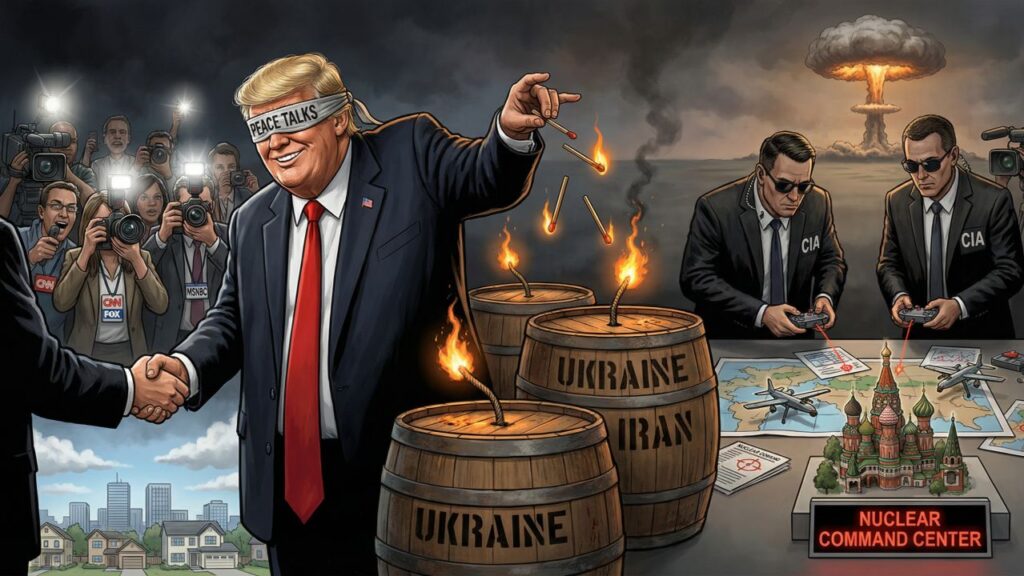
What you are about to read has not been reported by the American press. On December 28, 2025, the United States enabled a drone strike on Vladimir Putin’s official residence, a facility that houses nuclear command-and-control infrastructure confirmed by Ukrainian sources. This was not a battlefield operation. This was an attempt to degrade Russia’s ability to launch a retaliatory nuclear strike. It is part of a multi-year pattern of U.S.-backed attacks on Russian strategic bomber bases, early-warning radar systems, and nuclear deterrent capabilities, the exact preparatory work required for a nuclear first strike.
We are now closer to nuclear war than at any point since the Cuban Missile Crisis. Russia is building a 2-million-man army explicitly to prepare for war with NATO. The Trump administration has openly declared that international law is meaningless and that American power is limited only by the president’s personal “morality.” Russia has concluded, rationally, that the United States will not negotiate in good faith and that force is the only language Washington understands.
You were not told any of this because the American media, with rare exceptions, has decided you don’t need to know. They have chosen to cover the theater of “peace negotiations” while ignoring the CIA operations targeting Russian nuclear sites. They have framed this as a distant regional conflict when it is, in fact, an escalatory ladder with thermonuclear weapons at the top. They have kept you in the dark while your government climbs toward a war that will not stay confined to Ukraine.
The analysis that follows comes from a former CIA analyst and a Norwegian geopolitics professor who specialize in exactly these scenarios. They are sounding an alarm. The press won’t. So I will. What follows is what you were never meant to know, and what you must understand before it’s too late.
On December 28, while Donald Trump was meeting with Volodymyr Zelensky at Mar-a-Lago, CIA-backed operatives launched a failed drone attack on Vladimir Putin’s official residence, a site that houses a command center tied directly into Russia’s nuclear command-and-control architecture. The claim comes not just from Russian officials, but from Aleksei Aristovich, Volodymyr Zelensky’s former national security advisor, who confirmed that “the bunkers beneath the residence, they do have or nearby at least, they have the Russians have like nuclear command center.”
A Ukrainian insider is confirming that the United States enabled an attack on Russia’s nuclear deterrent infrastructure. This wasn’t a battlefield strike. This was an attempt to degrade Russia’s ability to respond to a nuclear first strike, launched while the American president was publicly embracing Ukraine’s leader.
What follows is based on a January 10 conversation between Glenn Diesen, a Norwegian political scientist who specializes in Russian foreign policy, and Larry C. Johnson, a former CIA analyst with decades of experience in intelligence and counterterrorism.
Who Is Telling You This
Glenn Diesen is a professor at the University of South-Eastern Norway who specializes in geopolitics, Russian foreign policy, and Eurasian integration. He has taught at Moscow’s Higher School of Economics and authored multiple books (published by Cambridge University Press, Bloomsbury, and Clarity Press) analyzing how NATO expansion and EU policy created the conditions for conflict with Russia.
Larry C. Johnson served as a CIA analyst and as a planner and adviser in the U.S. State Department’s Office of Counterterrorism. He trained U.S. special operations forces and worked on some of the most sensitive intelligence operations of the past four decades. Since leaving government, he has published extensively at his blog Sonar21, providing unvarnished analysis that often contradicts official narratives.
What Happened on December 28, And Why Russia’s Reaction Was Different
The drone strike on Putin’s residence targeted a facility that, according to both Russian officials and Ukrainian sources, contains infrastructure tied into Russia’s nuclear command system. Johnson states plainly: “I really believe that the CIA thought Putin would be at that address and that they’d be able to have a realistic shot of killing him.”
The drones were American-supplied, the targeting intelligence came from American satellites and intelligence agencies, and the operation was almost certainly coordinated by American personnel embedded in Ukraine’s security services. It happened while Trump was meeting Zelensky, a detail Russian planners are unlikely to interpret as coincidental.
Russia’s fury over this attack exceeds anything seen before. The Crocus City Center massacre that killed over 140 people, or reported attempts to shoot down Putin’s helicopter, did not provoke this level of rage.
Johnson explains: “Tied up with the attack on Putin was a target that involved a command center tied into Russia’s nuclear command structure.” From the Kremlin’s perspective, this wasn’t an assassination attempt on a political leader, it was an attack on the infrastructure that ensures Russia can retaliate if attacked with nuclear weapons.
The Pattern: Systematic Degradation of Russia’s Nuclear Deterrent
June 1, 2025: Ukraine launched “Operation Spider Web,” a coordinated drone assault on Russian strategic bomber bases deep inside Russian territory. The primary target was Engels Air Base, located 435 miles from the Ukrainian border, which hosts Russia’s fleet of Tu-160 and Tu-95 strategic bombers capable of delivering nuclear weapons. Johnson notes this strike was enabled by U.S. intelligence, and Russia’s FSB later stated that British MI6 was directly involved.
This was not the first attack on Engels. In January 2025, Ukrainian drones destroyed reserves of specialized high-density aviation fuel used exclusively by Tu-160 bombers. In March 2025, another strike caused massive explosions and severe damage to residential areas.
May 2024: Ukraine attacked a Voronezh-DM early warning radar system at the Armavir Radar Station. These radars are part of Russia’s strategic early-warning network, designed to detect incoming ballistic missiles and provide Russian leadership with time to decide whether to launch a retaliatory nuclear strike. They have nothing to do with the war in Ukraine. Their only purpose is to prevent a nuclear first strike by giving Moscow warning time. Hitting them sends one message: we want you to have less time to think.
December 28, 2025: Attack on Putin’s residence and nuclear command facility, confirmed by a Ukrainian source.
This is not a series of unrelated tactical strikes. This is systematic degradation of Russia’s nuclear command-and-control and early-warning infrastructure, exactly the preparatory work for positioning a first strike while limiting the adversary’s ability to retaliate.
Diesen asks: “What is the purpose here for the United States? Is it to prepare for nuclear first strike? Is it to signal escalation dominance… telling the Russians we can go up this ladder and we can go further than you so back down? Is it to pressure the Russians to accept some concessions or is it to provoke a response so the Russians will get further pulled into a direct war with the Europeans?”
Johnson’s assessment from his decades as an analyst: If he were briefing Putin right now, he would have to conclude that the United States is preparing for war and that negotiations are a dead end.
Russia’s “Cautious Escalation” And the Last Warning
Johnson describes Russia’s response as “cautious escalation.” Instead of striking NATO territory, Russia devastated Ukraine’s energy infrastructure, destroying approximately 50 percent of Ukraine’s stored natural gas reserves and crippling power generation and heating as winter deepens.
On January 8-9, Russia deployed its Oreshnik hypersonic intermediate-range ballistic missile, striking targets near Lviv in western Ukraine, just miles from the Polish border. The missile, which travels at Mach 10 and is effectively impossible to intercept, was fired without a live warheada demonstration, not an attack.
Russia warned the United States three hours before the launch, specifying that it was firing an intermediate-range system confined to Ukrainian territory, to ensure U.S. satellites monitoring for ICBM launches would not misinterpret the strike as a nuclear attack. This is a nuclear power desperately trying to signal restraint while making unmistakably clear that it has reached the end of its patience.
By January 9, Kyiv Mayor Vitali Klitschko was calling on residents to evacuate, warning that nearly 6,000 apartment buildings were without heat as temperatures plunged to -20°C. Zelensky admitted that Russia’s tactic is now to “shut down” Ukrainian cities: “If the cities are shut down… then the country shuts down and the war is over.”
Johnson emphasizes this is a warning to NATO: “If you don’t think we can reach out and touch you, we can. We prefer not to. But if this escalation, if you continue to escalate this war, we’ll have no alternative but to defend ourselves.”
Two to three days before the Oreshnik strike, Russia hit U.S.-owned factories and facilities in Zaporizhia, Dnipro, and Odessa. “Russia is not now trying to avoid attacking any targets affiliated with the United States and/or Europe,” Johnson warns. That is a fundamental shift.
The Next Escalations: What Johnson Predicts Will Happen Soon
Johnson lays out specific near-term escalation scenarios:
Armed Guards on Russian Ships: “I wouldn’t be surprised that Russia would start deploying a platoon, you know, 15 to 30 special forces on these ships to protect them so that any inbound helicopter would face the potential of lethal fire. And similarly any attempt by Navy Seals to try to board a ship underway would face gunfire from on board.”
After the U.S. seized the Russian-flagged tanker Bella 1/Marinera on January 7, an operation Russia’s Foreign Ministry condemned as “piracy” Johnson predicts Russia will arm its merchant vessels. The next time U.S. forces attempt a boarding, they will be fired upon. That means direct U.S.-Russia combat, likely with casualties on both sides.
Black Sea Shootdowns: “I would not be surprised to see them turn to the United States and say, We’re going to put you on notice going forward. Any US reconnaissance aircraft in the Black Sea or along our borders will be legitimate targets and we will shoot them down.”
U.S. reconnaissance platforms that provide targeting data for Ukrainian strikes would become fair game. The first shootdown of a U.S. aircraft with American crew would force an immediate decision: Does the U.S. retaliate against Russian territory, triggering direct NATO-Russia war?
The Tanker Crew: A Detail That Destroys the Narrative
The Russian-flagged tanker seized by U.S. Navy SEALs had a crew of 30: two Russians (including the captain), eight Georgians, and twenty Ukrainians. Russia and Ukraine are supposedly in an existential war, but a Russian captain and twenty Ukrainian crew members were working together peacefully on the high seas, apparently without any trouble.
Then the United States intervened.
Johnson reports: “I just learned this morning that the United States has released the two Russians, sent them back, but meanwhile, the eight Georgians and 20 Ukrainians are facing criminal charges in the United States.”
Russians and Ukrainians were getting along fine, until the U.S. intervened, seized the ship through what Russia calls piracy, released the Russians, and is now prosecuting the Ukrainians. “You can’t make this stuff up,” Johnson says.
The people actually involved (Russian captain, Ukrainian crew) had found a way to work together. The conflict is not between them. The conflict is driven by Washington.
The Complete Abandonment of International Law
Venezuela: Invasion, Abduction, and Open Piracy
In early January 2026, U.S. military forces assaulted Venezuelan territory, abducted sitting President Nicolás Maduro and his wife Cilia Flores, and flew them to New York to face drug-trafficking charges. At least 40 people were killed in the airstrikes. Trump stated openly: “The oil companies are going to go in. They’re going to spend money. We’re going to take back the oil that, frankly, we should have taken back a long time ago.”
Secretary of State Marco Rubio admitted there had been no congressional authorization and that involving Congress “could have compromised the mission.”
Greenland: Threatening a NATO Ally
Trump resumed threats to seize Greenland, prompting Danish Prime Minister Mette Frederiksen to warn publicly that an American attack on Greenland would mean the end of NATO.
The Open Declaration: “Might Makes Right”
White House Deputy Chief of Staff Stephen Miller appeared on CNN and stated: “We exist in a world that is dictated by strength, by force, and by power. These are the unyielding principles of existence since time immemorial.”
Trump himself declared: “I don’t require international law. I’m not aiming to harm anyone… my own morality, my own judgment. That is the only thing that can halt me.”
Johnson compares this to the climactic scene in A Few Good Men, when Jack Nicholson finally admits: “Goddamn right, I ordered a code red.” “They just admitted, Yes, we did it and we’re going to do it again. And the rest of the world is going, Whoa, wait a second… They just admitted the UN is a joke.”
Johnson offers another analogy: “These are the tactics of organized crime. You’re running a deli or a restaurant and the local mafia guys come in and tell you, Hey, nice restaurant here… you’re going to be paying us 25% of your profits every month going forward because we’ll help you keep the restaurant nice. And if you don’t, the restaurant’s not going to be so nice.”
The View from Moscow: Why Russia Must Prepare for War
Johnson walks through what this looks like from the Russian side. Imagine you are a Russian intelligence officer briefing Putin. Your president asks: “Mr. Johnson, can you give me one example where the United States put a priority on international law in terms of limiting its actions?”
Your answer would have to be: No.
- In 2002, the United States unilaterally withdrew from the Anti-Ballistic Missile (ABM) Treaty despite Russian warnings that doing so would force Russia to develop new weapons to circumvent U.S. missile defenses. Diesen explains: “The concern was it’s not as if the ballistic missile shield could ever prevent a Russian first strike because it would be too many missiles. It would be overwhelming. It’s more or less feared that it’s intended to enable a first strike… it only needs to be powerful enough to absorb the retaliatory capabilities of the Russian Federation.”
- In 2019, the Trump administration withdrew from the Intermediate-Range Nuclear Forces (INF) Treaty, which had banned ground-launched missiles with ranges between 500 and 5,500 kilometers, the very systems Russia has now deployed in response.
- The United States has refused to extend or renegotiate New START, the last remaining treaty limiting strategic nuclear weapons.
- The United States has systematically enabled or directly conducted strikes on Russian nuclear infrastructure: early-warning radars, strategic bomber bases, and nuclear command facilities.
- The United States has openly declared that international law is meaningless.
Johnson sums up what he would tell Putin: “You can no longer depend upon any promise or anything written, whatever the United States has agreed to in writing, they no longer respect it… From that standpoint then… you have to prepare for war. The United States is, the only thing the United States will understand is force and negotiations are a dead end.”
Johnson adds: “This cuts completely against Vladimir Putin’s approach because as a lawyer, he has been trained to actually respect the law… he’s made quite a point about dotting i’s, crossing t’s, and trying to proceed in a legal manner in accordance with international law. Now they’re being told in the course of the last 10 days that international law no longer matters and Russia should be prepared to act accordingly.”
The Iran Pattern: Why “Peace Talks” May Be a Trap
Diesen raises a chilling historical parallel. “I often think about the negotiations they had with Iran,” Diesen says, “and Trump was making the point how they’re making great headway right before they launched a surprise attack on Iran.”
“If you’re sitting in Moscow, you can’t help but [notice that] as Trump brands himself the peacemaker and how he’s got great relationship with Putin and they’re negotiating they will get an end to this war. They’re 90% done. You can’t help but ignore that the war planners behind this are mainly American generals sitting in Germany. It’s CIA operatives who are behind attacks on Russian refineries, on Russian ships. Its nuclear deterrent… It’s American weapons launched by American contractors guided by American satellites targets picked by again American intelligence.”
Trump talks peace while his intelligence agencies plan and enable attacks on Putin’s residence, nuclear command centers, and strategic bomber bases. Trump threatens India and other countries with sanctions if they continue trading with Russia, and then expresses surprise that Moscow won’t negotiate in good faith.
Johnson proposes a test. At the next meeting with Trump’s envoys, Putin should demand four concrete measures:
- Name a serious ambassador to Russia with direct Trump access
- Suspend all prohibitions on direct flights between Russia and the United States
- End all restrictions on Russian consulates in the U.S.
- Return seized Russian diplomatic property and lift travel restrictions on Russian diplomats
“Do those four things and then we’ll know that you’re serious about talking. Otherwise, you know, we’re not going to waste our time. See if the United States does that. I don’t think they would.”
Johnson’s conclusion: “The negotiations are a dead end. They’re not serious. The United States is not serious about actually concluding an agreement with Russia.”
Europe: Being Set Up as Cannon Fodder
Diesen reports: “In Paris, the Europeans, they seemed very confident that they thought the Americans were going to give them a backstop… on putting European troops in Ukraine. In other words, if they sent troops to Ukraine and not if, but when the Russians knocked them all out, that then the Americans would step in.”
But here’s the key: “This assumption didn’t come out of nowhere. It appears that the United States might have left them very deliberately with that impression before pulling back.”
The U.S. is encouraging Europeans to believe they’ll be protected if they send troops to Ukraine, knowing that when Russia destroys those forces, America will leave Europe to burn. Diesen asks: “Is this an effort to end the war or [do] they just want to get the Europeans to continue the war into the next stage?”
The United States is deliberately setting up its own allies to be sacrificed to prolong a war that cannot be won.
On Venezuelan oil, Johnson offers a telling analogy: China was buying Venezuelan oil as a favor, not out of need. “It’s like here in the United States every year we have this organization. It’s called the Girl Scouts… One of the things they do annually to raise money is they sell cookies. Well, this is like, think of China as they’ve got their own cookie manufacturing company, but their next door neighbor, there’s this little girl. They’re going to buy some cookies from her.”
That was China helping Venezuela. Europe is being told to buy America’s war, and will discover, too late, that there’s no backstop coming.
The Military Reality: Ukraine Collapsing, Russia Preparing for NATO
Russian forces are now approximately 20 kilometers from the major cities of Zaporizhia, Dnipro, and Sumy. Ukraine faces a severe manpower crisis while Russia has expanded its ground forces to 1.5 million personnel and is pushing recruitment to exceed 2 million.
Johnson is explicit about why: “This is not in order to defeat Ukraine. This is for the follow-on war with NATO that they are preparing for.”
The front lines are collapsing in Zaporizhia, Kharkiv, and Sumy. Over 1 million people in the Dnipropetrovsk region have been left without power, heating, or water.
Diesen: “The more holes there’s in the front line, the more the Ukrainians are… trying to plug those holes with the reserves. At some point there’s no more reserves left and then all the holes will start to leak at the same time.”
Johnson: “The military situation on the ground in Ukraine… is going to rapidly deteriorate. What we’re seeing now is going… to accelerate.”
NATO Fracturing, And Russia Watching
Trump’s threats against Greenland have prompted Denmark, a founding NATO member, to mobilize its military and warn that a U.S. attack would end the alliance. French President Emmanuel Macron and members of the French legislature have openly discussed withdrawing from NATO. Italian Prime Minister Giorgia Meloni has called for opening talks with Russia.
Johnson observes: “If you’re Russia watching this, you just… holler out, put another log on that fire because the more NATO disunites over this issue of US bullying, the better it is for Russia.”
One of Russia’s core security concerns has always been a unified NATO. Now, thanks to Trump’s bullying and lawlessness, that unity is cracking in real time. “Trump seems to be acting almost as an agent of Russia in that regard instead of promoting unity… he’s provoking confrontations with Denmark.”
Diesen quotes Napoleon: “Never interrupt your enemy when he’s making a mistake.” That is Russia’s current strategy. “The assumption is if Russia doesn’t [push back], the more it pushes back, the more it will unite the western countries. But if it just takes a step back, the whole thing will fall apart on its own.”
Johnson references Russian political scientist Sergey Karaganov, who has long argued that Russia’s future lies in Eurasia, not Europe. Johnson notes with irony: “This is providing more evidence to support our mutual friend Sergey Karaganov’s position of hey the future’s in the east not the west. I mean this is like Donald Trump’s making Sergey’s case for him.”
China, India, Brazil: The Diplomatic Pressure Is Gone
For months, Russia faced diplomatic pressure from China, India, and Brazil to “make a good faith effort to negotiate with the United States,” Johnson explains.
But “in the wake of the attack on Putin’s residence and the abduction of President Maduro,” Johnson says, “the pressure… has now abated and abated significantly. I think they now recognize that the United States is a lawless country and we see no reason whatsoever to abide by international conventions, international rules.”
Even Russia’s partners, who would prefer a negotiated settlement, now understand that the United States will not negotiate in good faith. That removes one of the last restraints on Russian action.
The Second Powder Keg: Iran
Johnson warns: “What happens when the United States and Israel attack Iran?… Russia is now in a closer military relationship to help Iran defend itself than ever before. So, we got… two big pots of gunpowder that are open and we’re walking around smoking cigarettes and flicking ashes.”
A U.S.-Israeli strike on Iran, which Trump administration officials have discussed openly, would bring Russia directly into the conflict through its defense commitments to Tehran. That means two simultaneous paths to World War III: one through Ukraine, one through Iran.
Why This Generation Will Learn the Hard Way
Johnson points out that Cold War leaders, the generation that negotiated arms control treaties, “were coming off of a terribly destructive war. They had lost friends and family. They had seen their countries devastated. They knew what the cost… was not some theoretical construct. It was real. It was tangible… they had a strong incentive to actually let’s get some rules to live by.”
Diesen responds: “Every generation kind of have to learn the horrors of war on their own. As the World War II generations died out, there’s no one anymore with the memory of the horrors of war. Again, over the past 30 years, war is something that happens to other people far away.”
Then he delivers the grim conclusion: “I think this generation will realize that yeah, war entails Oreshnik falling upon our cities.”
A generation of leaders who never experienced war, who treat it as an abstraction, who believe American power is so overwhelming that Russia will always blink first, are about to discover, along with the rest of us, that they were catastrophically wrong.
The Existential Question
The December 28 attack on Vladimir Putin’s residence, confirmed by Ukrainian sources as targeting nuclear command infrastructure, was not a clever pressure tactic. It was the kind of reckless, escalatory move that future historians, if there are any, will identify as the moment when leaders who never expected to pay the price themselves decided to play chicken with thermonuclear war.
Russia is not blinking. Russia is building a 2-million-man army, deploying hypersonic missiles that cannot be intercepted, systematically shutting down Ukraine, and preparing, explicitly and openly, for war with NATO. Moscow has concluded, rationally, that the United States respects only force and that negotiations are theater.
Johnson predicts Russia will soon arm its merchant ships with special forces troops who will fire on U.S. boarding parties. He predicts Russia will declare U.S. reconnaissance aircraft over the Black Sea legitimate targets and shoot them down. These are near-term escalations that will force immediate decisions about whether to trigger direct U.S.-Russia combat.
We are out of offramps. The diplomatic pressure from China, India, and Brazil that might have restrained Russia has evaporated because those countries now recognize the United States as a “lawless country.” NATO is fracturing. European leaders are being deceived into believing they’ll be protected if they send troops to Ukraine. And Trump’s “peace negotiations” follow the same pattern as his Iran talks: claim progress while preparing attack.
Diesen notes an observation from Marta Aishko, a Ukrainian woman critical of Ukraine’s far right: “Every time Russia is sending a signal to NATO, a warning, it’s always against Ukraine.” The question is “how far do you think the Russians can be pushed now?” Because eventually Russia will stop hitting Ukraine and start hitting NATO.
“One of these days NATO, the U.S. and/or NATO will cross the line and Russia will be compelled to strike outside of Ukraine,” Johnson says. “We’re closer now than we were a year ago.”
The generation that remembered World War II is dead. This generation, as Diesen warns, will learn “that war entails Oreshnik falling upon our cities.”
Unless we stop this, now, that education is coming soon.
Related reading
- The Atlanticists: How British Incompetence Brought the World to Nuclear Brink
- The Adults in the Room: How Trump and Putin Conspire for Peace While the Children Throw Tantrums
- The Three Stooges: CIA, MI6, and Palantir Would Be Funny, If Nuclear War Were
- Putin, Trump, and the EU's War: How the West Framed Putin and Sacrificed Ukraine