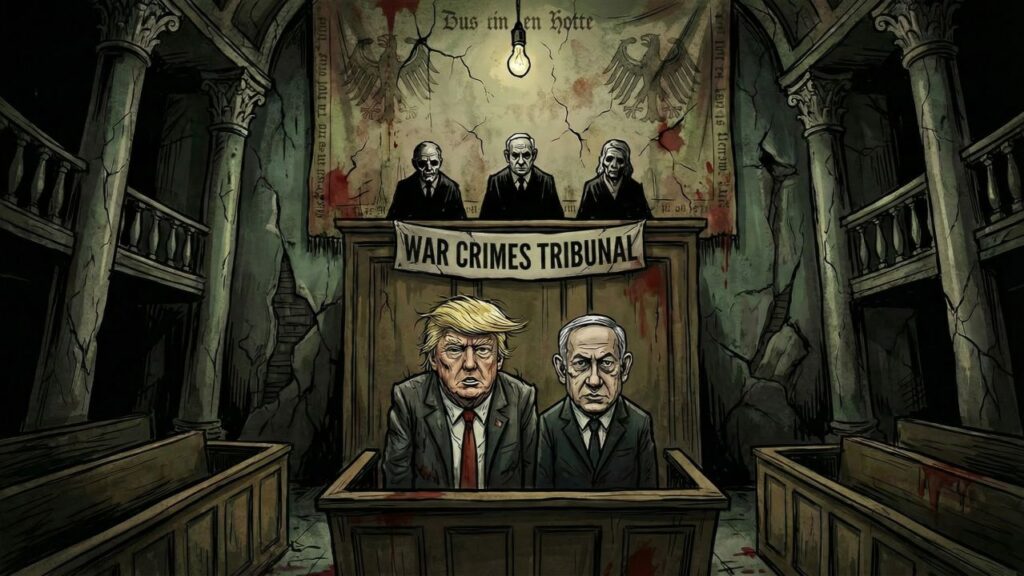
A Note on Purpose: Two Articles, One Mission
This is the first of two connected pieces. It is necessary to explain both at the outset so you understand what you are reading and why it was written this way.
The United States government, the Israeli government, and the media outlets that oh-so-faithfully amplify their talking points have been telling a story about this war. In that story, Operation Epic Fury was a necessary and brilliant strike against a regime on the verge of producing nuclear weapons. The Iranian government is in chaos. Its military is degraded. Its population is turning against it. The Strait of Hormuz will reopen when Iran accepts reality. The 15-point peace plan is a generous offer. Negotiations are progressing. The war is going well.
None of that is true.
This document exists to build a factual foundation against which that official narrative can be tested. It draws on the full arc of Trump’s Iran policy from 2017 through March 31, 2026, and incorporates the detailed analytical record assembled by nineteen expert guests on Glenn Diesen’s program across the last two weeks of March 2026, supplemented by independent scholars across economics, history, military strategy, and geopolitics. The guests whose analysis informs this document are not fringe commentators. They are a former UN weapons inspector and Marine Corps intelligence officer. A former Chief of Staff to the Secretary of State. A former CIA Director for Russia Analysis. A former senior British diplomat. The University of Chicago’s most prominent international relations theorist. A Columbia University economist who has advised the United Nations. MIT’s foremost nuclear weapons physicist. An Iranian nuclear negotiation adviser speaking from inside Tehran. Former U.S. Army officers. Former diplomats. Historians with decades of primary source research behind them. They are politically diverse, institutionally credentialed, and analytically incompatible with one another on many questions. On this war, they agree.
This document is the evidentiary record. It catalogs what happened, who said what, what the military and economic data show, and where the official narrative diverges from the facts. It does not speculate about the future. That is the job of the companion piece.
The companion piece is titled The Abyss Stares Back: A Forecast Companion to the Iran War Record. It does what this document deliberately avoids: it looks forward. Drawing on the same analytical community, extended by three additional voices, Adam Tooze (Columbia University historian, Foreign Policy, the single most data-rigorous economist covering the war’s financial consequences), Yanis Varoufakis (former Greek Finance Minister, author of Technofeudalism, the most prominent voice connecting this war to a global financial crisis trajectory), and Gary Sick (former NSC Director for Iran under Carter, Ford, and Reagan, the single most authoritative living American former official on fifty years of U.S.-Iran institutional history), the companion piece also maps the intellectual genealogy of the entire analyst community, tracing who reads whom and why their frameworks converge. Most importantly, it offers the most honest probabilistic forecast the available evidence supports: five scenarios, weighted by probability, for where this war ends and what it leaves behind.
Together, these two documents constitute a complete account. This one asks: what happened and what does it mean? The companion asks: where does it go from here?
Read both.
Executive Summary
What began as Trump’s “little excursion,” a surprise joint U.S.-Israeli attack on Iran on February 28, 2026, dubbed Operation Epic Fury, has devolved, five weeks later, into a grinding, escalating war of attrition that a broad and politically diverse chorus of scholars, military analysts, economists, historians, and insiders describe as a catastrophic strategic blunder.
The official narrative, amplified by a compliant press, rests on four claims: that Iran was weeks from a nuclear weapon; that the decapitation strike created a power vacuum that would produce regime collapse; that Iran’s military capacity is being systematically degraded; and that the United States holds escalation dominance. The evidentiary record assembled here contradicts all four claims on every significant point.
Part I: The Road to War, Trump’s Iran Policy, First Term Through June 2025
The JCPOA Withdrawal (2018)
Trump’s withdrawal from the Joint Comprehensive Plan of Action in May 2018 was the foundational rupture. As MIT professor and former Pentagon nuclear adviser Theodore Postal argued, Trump broke the agreement, and Biden, despite promises, failed to restore it, leaving IAEA monitoring severely degraded. This decision directly enabled Iran’s subsequent enrichment acceleration. The failure to reinstate the JCPOA was bipartisan: “Biden people are just as responsible for this disaster,” Postal stated flatly.
The JCPOA had been working. As Alexander Mercouris noted, “We had the joint comprehensive plan of action which was working with Iran… at the same time we had peace in the Gulf and the Straits of Hormuz was open.” By exiting it, the U.S. entered what Mercouris calls the “salami-slicing” cycle: constantly demanding more concessions, never giving ground, until no salami remained.
Maximum Pressure, Abraham Accords, and the Soleimani Assassination
Trump’s first-term “Maximum Pressure” campaign reimposed sanctions lifted under the JCPOA and squeezed Iran’s economy, but failed to produce capitulation. The January 2020 assassination of General Qasem Soleimani at Baghdad Airport was condemned internationally and, as Lawrence Wilkerson (former Chief of Staff to Secretary of State Colin Powell) observed, effectively ended any possibility of good-faith negotiations during Biden’s term. The Abraham Accords normalized Israel with Gulf states but deepened Iranian perceptions of encirclement.
Pepe Escobar placed this in a 25-year arc: “This war was planned since the late 90s… according to the Project for the New American Century, according to Clean Break.” Wesley Clark’s famous post-9/11 memo listing seven countries for regime change always ended with Iran as “the grand finale.”
Operation Midnight Hammer, June 2025
In June 2025, a U.S.-Israeli strike hit Iran’s nuclear sites at Fordow, Natanz, and Isfahan, an operation Trump later cited as “the single greatest strike in history.” Iran retaliated but accepted a temporary pause. As Trita Parsi noted at the time, this first war occurred in the middle of negotiations in which Iran had reportedly made substantial concessions, including agreeing to zero enrichment for Trump’s second presidential term. Trump’s decision to reject a clear “victory lap” deal and strike militarily was the key data point that shaped Iranian distrust going into 2026.
Theodore Postal was already warning after the June 2025 strikes that Iran had enough 60%-enriched uranium hexafluoride to build 11 nuclear weapons, that the centrifuges to enrich it to 90% were likely concealed in tunnels, and that once Tehran decided to act it could assemble a deployable device within weeks, without any testing.
Part II: The Second Term, NSPM-2 and the Slide to War
National Security Presidential Memorandum-2 (Early 2025)
Trump’s second term opened with a formal “Maximum Pressure 2.0” executive policy (NSPM-2), escalating sanctions across all sectors. His first letter to Supreme Leader Khamenei in February 2025, delivered via Oman, offered a deal; Iran’s non-response hardened the administration toward military options.
Throughout 2025, John Mearsheimer (University of Chicago) noted that Trump “started off looking like he has a winning strategy.” By the time war with Iran began on February 28, 2026, just 13 months into his second term, “he’s jumped into a huge quagmire that he can’t get out of.”
The Geneva negotiations of late 2025 and early 2026 had, according to multiple sources, produced substantial Iranian concessions. Alastair Crooke (former British diplomat, founder of Conflicts Forum) and Seyed Mohammad Marandi (Tehran University, former Iranian nuclear negotiation adviser) both confirmed that Iran was negotiating seriously. Then on February 28, 2026, the bombs fell during active negotiations. Marandi described it bluntly: “The war, same. We were negotiating. There was progress. But he was secretly plotting against the country.”
Part III: February 28, 2026, The Unprovoked Attack
Operation Epic Fury: The Decapitation Strike
At approximately 2:00 a.m. Tehran time on February 28, 2026, U.S. and Israeli forces launched simultaneous airstrikes. Israel conducted decapitation strikes targeting Supreme Leader Ali Khamenei, who was killed in strikes on his residence, along with much of Iran’s top military and civilian leadership. Iranian Defense Council Secretary Ali Shamkhani, IRGC Commander General Mohammad Pakpour, Defense Minister Brigadier General Aziz Nasirzadeh, and the intelligence chief were confirmed killed.
Trump announced the operation via video, calling it “the single greatest chance for the Iranian people to take back their Country.” He declared regime change the goal and suggested he would handpick Iran’s next government. As George Beebe (former CIA Director for Russia Analysis, Quincy Institute) noted: “The Trump administration erred spectacularly in starting this war.”
Strategic Rationale: A Bamboozlement?
Mearsheimer was unambiguous: “They thought they were going to do another Venezuela operation. Float like a butterfly, sting like a bee… That’s what he thought. But once that doesn’t happen and you’re in a war of attrition, you are in deep trouble.” The plan was shock-and-awe regime change via decapitation, a strategy that “anybody who has a basic understanding of international relations should have understood would fail from the get-go.”
Jeffrey Sachs (Columbia University economist, former UN Senior Adviser) framed it as a fundamental “collapse of institutionalized rational processes.” No Plan B existed once the 36-hour collapse scenario failed.
Alastair Crooke emphasized: “They had prepared for a very short, 3-day bombing exercise. Their logistics were for a short bombing process and those logistics are now expiring, running out very clearly. Iran, by contrast, has been planning this for 20 years against the possibility that at one time or another they would have to fight a war with the United States.”
Pepe Escobar identified the inner circle as driving the decision: “The main seller of this war face to face to Trump, or ear to ear to Trump” was Jared Kushner, who was simultaneously enriching himself through Gulf state investment funds. Escobar cited Kushner’s Affinity Partners receiving $5 billion from Saudi Arabia. Others named: Chris Wright (Energy Secretary), Howard Lutnick.
The Constitutional Problem
Trump launched the war without congressional authorization, no War Powers debate, and only a cursory public justification once the bombs started dropping. Brookings Institution experts immediately identified the constitutional crisis: “Trump’s decision to go it alone in Iran without a vote or even debate in Congress creates both constitutional problems and political challenges.” Senator Bernie Sanders declared it “illegal, premeditated and unconstitutional.”
Part IV: Iran’s Military Response, The War That Wasn’t Easy
Iran Reconstitutes and Strikes Back
Within hours of the attack, Iran launched mass volleys of missiles and drones at Israel, U.S. bases across the Gulf, and radar installations throughout the Middle East. The Iranian government rapidly reconstituted: the Council of Experts appointed Mujtaba Khamenei, the late Supreme Leader’s son, as the new Supreme Leader, a figure with deep IRGC credibility. Pepe Escobar reported from sources in Tehran that Mujtaba had worked closely with the IRGC leadership for over 15 years and was widely respected as a bridge between his father’s legacy and the Revolutionary Guards.
Trump declared the Iranian government in “chaos” and promised it would collapse within days. As Mercouris catalogued week by week, those predictions proved completely false.
The Missile and Drone Arithmetic
By the end of March, after more than 80 Iranian missile volleys, the picture was stark:
Reuters confirmed the U.S. can verify only about one-third of Iran’s missile arsenal destroyed; “the status of another third is less clear,” which Mercouris read as meaning it is “mostly still there.”
Haaretz (confirmed by Military Watch Magazine) reported an 80% penetration rate for Iranian missiles through Israeli and U.S. air defenses as of late March, with the rate improving as defenses falter.
Theodore Postal explained the systemic failure: Iran’s drones had first destroyed the radar network, including THAAD radars worth $500 million each, taken out by $30,000 drones, leaving ballistic missiles effectively unintercepted. His estimate of the ballistic missile intercept rate for Patriot and Arrow systems: no more than 5%, consistent with what video evidence confirms.
Postal’s technical analysis was precise: Iran’s drones use commercially available Starlink transceivers ($250 on Amazon), Chinese BeiDou satellite navigation providing meter-level precision, and fiber-optic guidance imported from Russia. The drone radar cross-section “is equivalent to the radar cross-section of a bird.”
Stanislav Krapivnik (former U.S. Army officer) had presciently warned before the war that Russia had rebuilt Iran’s integrated air defense network, delivered Su-35 fighters that outrange F-35s, trained pilots, and installed Chinese multi-phase radar systems. His February 2026 assessment: “There’s going to be a very big shock and surprise for U.S., Israeli, and NATO forces if they start initiating contact.”
The Strait of Hormuz as a Strategic Weapon
Iran closed the Strait of Hormuz almost immediately, rerouting oil only through a new supervised channel near Kishm Island, charging $2 million per passage and requiring payment in yuan, with cargo not traded in U.S. dollars. By late March:
20% of global oil transited the Strait before the war; Mearsheimer estimated current flow at roughly 5% of pre-war levels.
Qatar’s Ras Laffan LNG complex, supplying 20% of globally traded LNG, was struck by Iranian drones and declared force majeure on five-year contracts.
The UAE imports nearly all its food through Hormuz with only 10 days of reserves.
Warwick Powell (Queensland University of Technology, Smart Trade Networks) described Hormuz control as “the decisive turn… One-fifth of global oil transits this chokepoint; its closure is no longer theoretical.”
U.S. Military Losses and Evacuations
By late March, a New York Times investigation confirmed the U.S. had evacuated personnel from most of its bases in the Gulf. Additional confirmed losses:
All 10 U.S. radar stations in the Middle East destroyed, including a billion-dollar UHF radar in Qatar, causing “damage which might take years to repair.”
An AWACS (E-3 Sentry), the U.S.’s irreplaceable airborne radar, destroyed at a Saudi base.
Multiple KC-135 aerial refueling tankers destroyed.
The USS Gerald R. Ford carrier group reporting broken laundry systems, toilet failures, and a crew near mutiny after 10 months at sea.
Reports of an Iranian drone striking Kuwait’s main desalination plant supplying 35% of its fresh water.
Mercouris drew the historical lesson: “The United States has never engaged in ground operations in any theater of war in which it did not possess overwhelming air superiority since the fighting in North Africa in 1943.”
Part V: Why It Failed, Analytical Frameworks
Mearsheimer: Structural Realism
John Mearsheimer provided the clearest structural analysis. The U.S. entered the war expecting a quick decisive victory, failed, and now faces a war of attrition in which Iran “holds almost all the cards.” He enumerated them:
Iran can wreck the international economy via Hormuz. Iran can destroy Gulf state civilization through strikes on desalination plants and energy infrastructure. Iran can do “enormous damage to Israel.” There is no real ground forces option. Trump deployed “light infantry” with no mechanized armor, no heavy logistics, no air supremacy, and no plan. Iranian oil must be allowed to market. The U.S. cannot bomb Iranian energy without causing the same global catastrophe it is trying to prevent. The 15-point plan is “unconditional surrender.” Iran has zero incentive to accept it.
Mearsheimer invoked the Japanese Pearl Harbor decision as a parallel: when desperation reaches a certain threshold, states do catastrophically foolish things.
Mercouris: The Detailed Operational Picture
Alexander Mercouris’s near-daily analysis across March provided the most granular track of events. His key findings:
Frustration and bewilderment drove escalation: when regime change failed, Washington “struck out” with attacks on South Pars gas field and Busher nuclear plant, both massive escalations that were “delusional” pressure tactics that backfired. Trump’s countdown ultimatums (48 hours, 5 days, 10 days) were pure theater: “The president was simply spinning a story in order to avoid acting on his ultimatum.” Iran’s leadership is harder, not softer: “The new political order in Iran is more hardline, tougher-minded than the one which preceded it.” Russia is providing satellite intelligence, fiber-optic drone technology, and MANPADS. “When the full history of this conflict is written, we will discover that the Russians have been involved quite a lot.”
Crooke: The Planned Asymmetry
Alastair Crooke’s analysis centered on Iran’s long-term preparation versus the U.S.’s “logistics for a short bombing process”: “Iran has been planning this for 20 years… they have a plan, a sort of paradigm of how they will increase the pressure… judged to the depletion of the capacities of the West and of Israel and to reach a peak probably just after they judge those capacities are waning.”
Crooke also introduced the IRGC’s new selective shipping corridor through Hormuz, not a full closure but a tollbooth demanding yuan-denominated payment and vetting of cargo: “This is going to reset the whole global energy paradigm.”
Postal: The Nuclear Dimension
Theodore Postal delivered the most alarming analysis. In two consecutive appearances on March 30 and 31, he laid out:
Iran has 408 kg of 60%-enriched uranium hexafluoride, enough for 11 nuclear weapons when enriched to 90% using centrifuge cascades that can operate in tunnels in “a few hundred square meters of floor space.” Assembly requires no test. The Hiroshima bomb was never tested. Iran can build a uranium gun-type bomb with total confidence of function. A nuclear retaliation on Israel using three optimally placed warheads could incinerate central Tel Aviv through firestorm physics: “everything combustible burning… temperatures above the boiling point of water… hurricane-force winds… shelters converted into ovens.”
Lawrence Wilkerson confirmed his belief at “75-80%” that Iran either already has, or is weeks away from, deployable nuclear devices.
Part VI: The Economic Dimension
Richard Wolff: The Fiscal Cliff
Richard Wolff (University of Massachusetts, Marxist economist) traced the fiscal arithmetic with precision: Trump inherited a $1 trillion annual deficit, a U.S. credit rating already downgraded to AA by all three major agencies, and a government that has “long ago decided politically it could never fight the many wars it kept going by taxing the population.” The Iran war added:
A request to increase the defense budget from $900 billion to $1.5 trillion, plus an additional $200 billion for the war itself. The tariff revenue that was supposed to offset costs has been ruled unconstitutional by the Supreme Court, with importing companies demanding refunds. Net result: an $800 billion spending increase with zero new revenue, into credit markets already demanding higher rates.
Wolff noted the probability of Federal Reserve rate increases, not cuts, has risen to approximately 27%, killing the mortgage market and deepening recession. “This war may take us over a fiscal cliff” was a direct quote from a leading Wall Street business communications firm.
Jeffrey Sachs: Governance Collapse
Sachs compared China’s two-year, expert-driven 15th Five-Year Plan process to Trump’s “seat of the pants impulsivity.” He cited front-running of market announcements as possible evidence of corruption layered onto incompetence. His three-part framework for how the war could end: (1) U.S. crushes Iran, “almost never done by air, never done in a country as large and populous as Iran”; (2) Iran wins the missile war; (3) Russia, China, and India jointly tell the U.S. to stop. He judged only option 3 plausible as a near-term off-ramp.
Mearsheimer’s Titanic Metaphor
Mearsheimer repeatedly invoked the Titanic: “There is an iceberg out there in the water and we’re heading towards that iceberg. We are the Titanic. And I think President Trump basically understands that… and they’re trying to turn the ship.” The 10-year Treasury yield climbing toward 5% was his single most important warning indicator.
Warwick Powell: Asia’s Recalibration
Powell’s analysis traced how the war accelerates China’s strategic position rather than weakening it: Beijing’s pivot to electrification means oil disruption is “most impactful in the near term but ultimately will accelerate the transition China is already pursuing.” The war is exposing “the material boundaries of American military projection and the accelerating erosion of unipolar assumptions in energy security and regional alliances.”
De-dollarization
The IRGC’s Hormuz toll structure, yuan payments and no dollar-denominated cargo, represents a structural challenge to the petrodollar system. Crooke framed this as “resetting the whole global energy paradigm.” David Gibbs, in his March 28 transcript, provided the historical foundation: the entire petrodollar architecture, Kissinger, Simon, the 1974 deal with Saudi Arabia, the recycling of oil surpluses into U.S. Treasury bonds, is the institutional structure now under assault.
Part VII: The Escalation Ladder and Its Limits
Ground Forces: The Kharg Island Fantasy
By late March, Trump was publicly considering seizing Kharg Island, through which 90% of Iranian oil exports flow, and islands in the Strait of Hormuz. The military deployment included the 82nd Airborne Division, Marine Expeditionary Units from Okinawa, special operations forces, and forces transferred from Ramstein.
Joe Kent (former head of the National Counterterrorism Agency, resigned in protest) called any island operation equivalent to “giving the Iranians American hostages. They’ll be trapped.”
Mearsheimer’s Desert Storm comparison was devastating: to invade Iraq in 1991, the U.S. deployed 540,000 troops with 700,000 total coalition forces, all mechanized. To invade Iran, which is four times the size of Iraq with mountainous terrain, 90 million people, and 25 years of underground fortress construction, Trump has assembled “maybe 10,000 light infantry.”
Mercouris added the Dien Bien Phu warning: Kharg Island is within fiber-optic drone range of the Iranian coast, within shore-based artillery range, can be mined, and any relieving fleet would operate in a narrow body of water within range of hundreds of cruise missiles, fast boats, and submarine-launched anti-ship missiles.
Trump’s Ultimatum Theater
The pattern of deadlines is now documented:
March 23: Trump demands Iran open Hormuz within 48 hours or he will destroy Iran’s entire energy system. March 25: He “postpones” by 5 days, claiming “great progress in negotiations.” March 25 through 27: Iran’s Foreign Minister, Parliament Speaker, and multiple officials publicly state no negotiations occurred whatsoever. March 27: He extends 10 more days. March 27 through 30: Israel attacks Iranian steel mills; Iran destroys a Kuwaiti desalination plant and Emirati aluminum facilities.
Sachs offered three explanations for the “fake negotiations” claim: confabulation from frontotemporal dementia, a crude lie to escape an untenable ultimatum, and market front-running by insiders.
The Witkoff Problem
Multiple sources confirmed that Steve Witkoff has not met with a single Iranian official. He has been meeting with Pakistani, Omani, and Turkish intermediaries only. Iran refuses to meet with Witkoff or Kushner. Iran’s demand: a more senior U.S. counterpart, reportedly JD Vance, who was “deeply skeptical of this operation from the outset.”
Part VIII: Geopolitical Ripples
Russia: The Iran-Ukraine Nexus
George Beebe (Quincy Institute) identified the war’s impact on Russia: sanctions relief on Russian oil is now unavoidable, giving Russia an energy windfall that “reduces economic pressure to compromise on Ukraine.” The window for a Ukraine peace deal is “still open but closing, probably not extending much beyond early fall.”
Gilbert Doctorow found that the decapitation strike on Iran “sent shockwaves through Moscow” by confirming “there are no more rules.” Those in the Kremlin arguing for deterrence restoration have gained significant ground.
China: The Tollbooth Beneficiary
Crooke confirmed that Chinese vessels are passing through Iran’s new Hormuz channel “without problem, pass pass pass pass.” Doctorow’s analysis found Russia and China now fundamentally reconsidering U.S. relations following the Iran war, particularly the willingness to attack a country during active negotiations and the assassination of a head of state.
BRICS, SCO, and the Global South
Escobar delivered a stark assessment: “BRICS is in a coma.” The internal splits are severe: India’s behavior around the naval incident, UAE openly supporting U.S. operations, Brazil and South Africa marginal. The three essential nodes, Russia, China, Iran, are holding, but the wider architecture is fractured.
His broader thesis: “Iran is fighting for the whole Global South in this war… Support for Iran across the Global South is practically unanimous.” Marandi confirmed from inside Tehran throughout the war: “People are resilient. They understand this is a war for survival.”
NATO and Transatlantic Relations
Mercouris documented the deep European failure: no European leader went to Washington before the attack to question the plans or warn of consequences. The result is a “circular blame game.” Jeffrey Sachs singled out Pedro Sanchez (Spain) and German Federal President Walter Steinmeier as the only European figures willing to call it “a terrible war, a huge blunder.” The rest of Europe, he argued, has been “subservient to American foreign policy to the point of self-destruction.”
Part IX: Iran’s Strategy, Escalation Dominance
The Mosaic Doctrine
Escobar introduced the concept Iran’s strategists call the “decentralized mosaic strategy”: a flexible, phased, multi-axis approach designed to be fine-tuned week by week as adversary capabilities deplete. Key features:
Holding back most capable weapons (Khorramshahr-4, Fattah-2 hypersonics) for optimal deployment. Blending missile strikes with drone strikes in coordinated sequences. Underground missile cities in southeastern Iran (Sistan-Baluchestan near the Afghan border) that the U.S. “doesn’t even know the locations of.” Decoy launchers: Marandi confirmed Iran purchased “hundreds of thousands of decoys from China,” making U.S. bomb damage assessments meaningless.
The Resistance Axis
Marandi catalogued the expanded front:
Hezbollah (Lebanon): striking Israel more effectively than before the ceasefire, taking out IDF tank columns and killing 7 to 8 Merkava tanks in single engagements. Houthis/Ansar Allah (Yemen): entered the war with ballistic missiles on Israel; capable of closing the Red Sea simultaneously with Hormuz, cutting off the final 12% of global oil and gas trade. Iraqi resistance (Hashd al-Shaabi): 23 years after shock-and-awe, all U.S./NATO forces have been expelled from Iraq.
The Israeli Dimension
Wilkerson’s most dramatic claim: “Israel is going to disappear as a Jewish state in the Levant. Netanyahu is going to be the presider over that disappearance.” The IDF Chief of Staff has publicly warned the IDF “will collapse on itself” due to manpower shortage; Netanyahu announced calling up 400,000 more reservists on top of 300,000 already mobilized, 30% of whom didn’t report.
Postal concluded: “From the point of view of the Israelis and the Americans, this war has already been lost… that doesn’t mean Israel has to cease as a state. Israel can survive as a state, but it has to adopt a different attitude toward Iran.”
Part X: Peace Prospects and Why They Are Remote
The Unbridgeable Gap
The Iranian demands, as summarized by Escobar, Marandi, Mearsheimer, and Wilkerson:
No more U.S. military bases anywhere in West Asia. Payment of war reparations (figures cited: $500 billion). Continuation of Iran’s nuclear and missile programs. Security guarantees for Hezbollah, Yemen, Iraq, and Palestine. End to all sanctions (requires Congressional action, therefore nearly impossible).
The U.S. 15-point plan: “Unconditional surrender… I thought it was a joke,” said Mearsheimer.
Pakistan, Turkey, Egypt as Intermediaries
A Pakistan-Turkey-Egypt diplomatic triangle has emerged as intermediary, with Saudi Arabia pushing for Hormuz reopening. China’s support for Pakistani mediation was confirmed, though Mercouris noted the Chinese are “making it absolutely clear who bears ultimate responsibility,” the United States. Iran is refusing to negotiate until “the facts on the ground have changed.”
Russia as the Pivotal Wildcard
Both Mercouris and Escobar identified Russia as the only actor that might persuade Iran to accept negotiations, because Russia is “the people who are providing most of the military aid.” Yet no U.S. official has flown to Moscow.
Part XI: The Broader Scholarly Consensus
A study cited in late March 2026 found 125 presidential scholars ranked Trump’s Iran war as the greatest strategic blunder in modern American presidential history, worse than Iraq, worse than Vietnam in its first month, because it was launched against a far more capable adversary with more global economic leverage.
Military historian Bret Devereaux confirmed the administration’s own officials admitted the war decision was made partly because “Israel was about to launch decapitation strikes anyway, and U.S. assets would be blamed regardless.” He called it a “spectacular error.”
A Georgetown Journal of International Affairs analysis, “Tell Me How This Ends,” warned of “strategic overextension” with the additional risk that an extended Middle Eastern war creates a “window of opportunity for Beijing” vis-a-vis Taiwan.
The Brookings post-strike analysis confirmed the constitutional crisis (war without congressional authorization) and predicted Trump would “abandon earlier calls for regime change and attempt to strike a deal,” a prediction the 15-point plan has so far contradicted.
Part XII: The Big-Picture Verdict
The analytical consensus across this wide and politically diverse group, realist IR theorists, Marxist economists, Western diplomats, military scientists, area experts, Russia watchers, China strategists, is unusually unified:
The war was unprovoked and unnecessary. Iran was negotiating in good faith. A deal on Trump’s terms was achievable. The plan, decapitation leading to regime collapse, was delusional, based on Israeli intelligence assessments the U.S. deep state itself rejected. Iran holds escalation dominance in a war of attrition: cheap drones against million-dollar interceptors, Hormuz as a chokepoint lever, the Resistance Axis as a regional multiplier. The economic damage is severe and potentially irreversible in the near term: Hormuz closed to 95% of pre-war traffic, Qatar LNG suspended for 5 years, fertilizer and petrochemical shortages rippling globally, 10-year Treasury yields approaching danger territory, U.S. military spending escalating by $800 billion with zero new revenue. The nuclear risk is real: Iran is weeks from deployable weapons if it chooses, and Israel is the more likely initiator. No credible exit exists absent Iran achieving its core demands, which amount to a structural U.S. drawdown from the Middle East and formal recognition of Iranian sovereignty. The geopolitical damage, to the petrodollar, to NATO cohesion, to U.S. credibility in negotiations, to the nonproliferation regime, will outlast the war by decades.
As Mearsheimer put it most starkly: “He has no exit strategy. He can’t find the exit ramp… if he goes up the escalation ladder, the Iranians beat him at almost every step.”
As Mercouris noted on March 30, looking at Iran’s government five weeks into the war: “It looks as strong as ever. It probably has been hardened by the war. It is rejecting Donald Trump’s insistent calls for negotiations. It is making immense demands of the United States. It is pounding targets in the Middle East. It is showing no sign of relaxing its control of the Strait of Hormuz.”
Now read the companion piece.
Sources: Direct analysis from the following transcripts of Glenn Diesen’s YouTube channel: Alexander Mercouris (5 episodes, March 20 through 30, 2026); Alastair Crooke (March 20, 2026); John Mearsheimer (March 27, 2026); Pepe Escobar (March 23, 2026); George Beebe (March 27, 2026); Jeffrey Sachs (March 25, 2026); Richard Wolff (March 25, 2026); Lawrence Wilkerson (March 28, 2026); David Gibbs (March 28, 2026); Theodore Postal (March 30 and 31, 2026); Seyed Mohammad Marandi (March 29, 2026); Stanislav Krapivnik (March 26, 2026); Warwick Powell (March 30, 2026); Gilbert Doctorow (March 24, 2026); George Beebe (March 27, 2026). Supplementary sources: Brookings Institution, Trita Parsi / Democracy Now, Georgetown GJIA, ACOUP Blog, The Nation, China-US Focus / Warwick Powell, Gulf International Forum, ISW, and Foreign Policy.
Related reading
- The Foundation for War Crimes: A Factual Record of Trump’s Iran War and Where It’s Going Part 2
- Trump’s Iran War, China Trip and the Vanishing Empire
- American Empire in Ruins: The Unprovoked, Unconstitutional, and Catastrophic US-Israeli War on Iran
- What American Media Won’t Tell You About the Iran War and the End of the American Century in Asia