Opinion
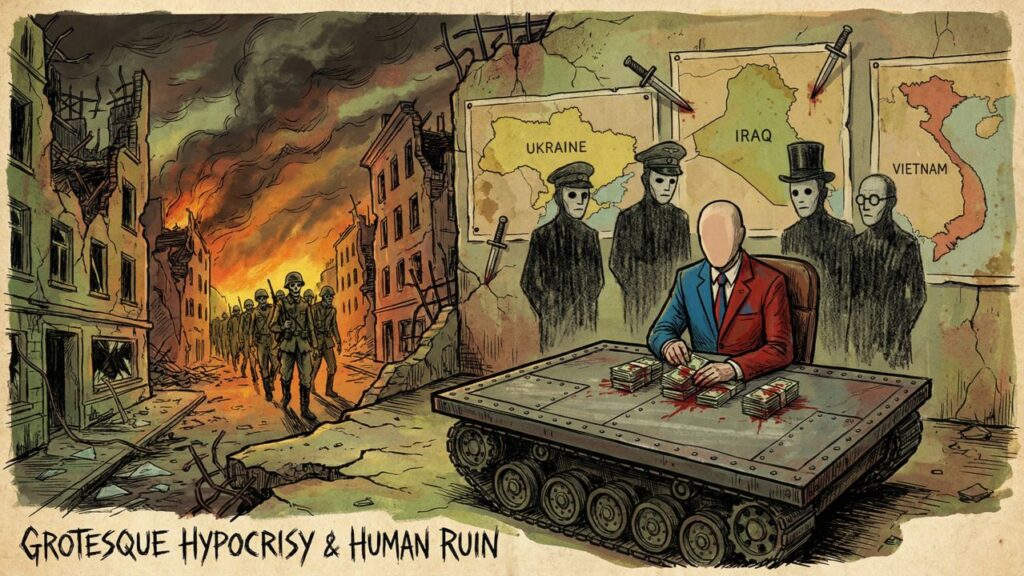
From Vietnam to Iraq to Kyiv, Democrats and Republicans Have Marched in Lockstep for the Military‑Industrial Uni‑Party That Really Rules
This is not complicated.
- In early 2022, Russia and Ukraine came close to a peace deal.
- Key Western leaders helped stop it.
- Those same people then bragged about using Ukraine to weaken Russia.
- Weapons makers and their political friends made a fortune.
- Democrats and Republicans both helped make this happen.
If you remember nothing else, remember those five points.
Step 1: How We Got Here, The Pattern
For sixty years, the same story keeps repeating.
In Vietnam, Democratic presidents (Kennedy, Johnson) and a Republican president (Nixon) kept escalating a war they knew could not be “won.” They drafted working‑class kids, dropped napalm, widened the war into Cambodia, and lied about progress. Defense contractors got rich. The men who lied retired to book tours and corporate boards.
In Iraq, Republicans (Bush, Cheney, Rumsfeld, Wolfowitz) pushed fake “weapons of mass destruction.” They were backed by Democrats like Joe Biden, Hillary Clinton, John Kerry, and Chuck Schumer, who voted for war and repeated the talking points. Iraq was shattered. Halliburton, Blackwater, Lockheed and others billed the U.S. Treasury. No major war booster went to prison. They got richer.
Now Ukraine. Different country. Same pattern:
- provoke,
- lie,
- escalate,
- profit,
- walk away.
Step 2: The People Who Set the Trap
After the Cold War, one idea dominated Washington: expand NATO right up to Russia’s borders.
People inside the system warned against this. George Kennan, the architect of Cold‑War containment, called NATO expansion “the most fateful error of American policy in the entire post‑Cold War era.” William Burns, now CIA director, wrote a cable in 2008 warning that pushing Ukraine into NATO could trigger civil war and Russian intervention. He titled it “Nyet Means Nyet.”
Those warnings were ignored. In 2008, the NATO summit in Bucharest declared that Ukraine and Georgia “will become members of NATO.” It was the worst of both worlds: threatening enough to enrage Moscow, vague enough to leave Ukraine exposed.
Behind this, there is a blueprint: Zbigniew Brzezinski’s idea that U.S. global power depends on controlling Eurasia and pulling Ukraine away from Russia. Clinton‑era Democrats and Bush‑era Republicans absorbed this. They treated Ukraine as a tool, not a country.
In 2014, that thinking turned into action. The U.S.‑backed Maidan uprising removed the elected president, Viktor Yanukovych.
On a leaked call, Assistant Secretary of State Victoria Nuland and U.S. ambassador Geoffrey Pyatt were caught picking Ukraine’s next government. Nuland said: “Yats is the guy,” meaning Arseniy Yatsenyuk should be prime minister. This was not “supporting democracy.” It was deciding who would run a foreign country.
Nuland is married to Robert Kagan, co‑founder of the neoconservative Project for the New American Century, which lobbied for the Iraq War. Robert’s brother Frederick Kagandesigns military strategies at the American Enterprise Institute. Frederick’s wife Kimberly Kagan runs the Institute for the Study of War (ISW), a think tank funded by defense contractors like General Dynamics and CACI. ISW’s daily “battlefield maps” and “assessments” were swallowed whole by CNN, the New York Times, and others.
One family:
- the husband helps write the ideology,
- the wife (Nuland) executes policy,
- the brother designs the war,
- the sister‑in‑law sells it to the media.
That is not an accident. That is a business model.
Step 3: Minsk Was Not Peace, It Was a Setup
After 2014, fighting in eastern Ukraine (Donbas) killed thousands. The Minsk I and IIagreements were sold as peace deals. The UN Security Council even endorsed Minsk II.
Years later, the truth came out.
Former German Chancellor Angela Merkel admitted in 2022 that Minsk was never meant to be implemented. It was “an attempt to give Ukraine time” to build up militarily. Former French President François Hollande agreed: the point of Minsk was to arm Ukraine, not to stop the war.
In simple language:
- they signed an international peace agreement,
- they never intended to respect it,
- they used it to stall while preparing for a larger war.
Russia thought it was negotiating a real settlement. Merkel and Hollande were running a shell game. When people wonder why Moscow does not trust Western guarantees, this is the answer.
Step 4: The Peace Deal They Don’t Want You to Remember
When Russia invaded on 24 February 2022, there was still a real chance to stop a long war.
Within days, President Volodymyr Zelensky said he was willing to discuss neutrality(meaning no NATO membership). Ukrainian and Russian delegations met in Belarus and then in Istanbul. They drafted a 17‑page agreement.
Key points of that draft:
- Ukraine would be permanently neutral (no NATO).
- No foreign bases or missiles on Ukrainian territory.
- Strong security guarantees from major powers.
- Russia would pull back to pre‑invasion lines.
- Crimea would be handled over many years, not by immediate force.
Multiple people involved (the Ukrainian negotiators, Russian officials, and mediators from Turkey and Israel) later said they were close.
Then the Western demolition crew moved in.
Ned Price, U.S. State Department spokesman and former CIA analyst, publicly dismissed the talks as “diplomacy at the barrel of a gun” on the same day Zelensky was proposing negotiations. His job was to make talking look illegitimate.
James Heappey, Britain’s Minister for the Armed Forces, wrote an article on 26 February calling for regime change in Moscow, before any serious diplomacy could take root. Later, after leaving office, Heappey took advisory roles with defense and tech firms and was found to have broken British rules by signing a contract with a defense‑technology company without the required approval. He helped sell the war, then went to work for the industry it enriched.
Most important of all: Boris Johnson.
On 9 April 2022, the British Prime Minister flew to Kyiv. He met Zelensky at a critical moment in the talks.
Soon after, the negotiations collapsed.
More than a year later, Davyd Arakhamia, the head of Zelensky’s own party and the chief negotiator in Istanbul, told Ukrainian television what happened. Johnson, he said, told them that the West was “not ready” for a deal and that they should stop negotiating and “just fight.” After Johnson’s visit, no Western leader pushed to revive the treaty.
Later reporting showed that Johnson’s private company received £1 million from Christopher Harborne, a major investor in a drone manufacturer supplying the Ukrainian military. Harborne traveled with Johnson to Kyiv on that trip.
So:
- Johnson helped kill the peace deal,
- the war continued,
- a man heavily invested in Ukraine‑linked arms traveled with him and later paid him a million pounds.
That is what “blood profits” look like.
Step 5: They Admitted It Was a Proxy War
Once diplomacy was dead, Western officials started saying the quiet part out loud.
U.S. Defense Secretary Lloyd Austin had sat on the board of Raytheon, a missile and weapons company, before joining the Biden cabinet. In April 2022, after a trip to Kyiv, he said publicly that America’s goal was to “see Russia weakened” so it couldn’t do this again. Not just “help Ukraine survive,” but use Ukraine to damage Russia’s military long‑term.
Former CIA Director and Defense Secretary Leon Panetta openly called it a “proxy war” with the aim of “killing Russians” to gain leverage.
Members of Congress dropped any pretense of seeing Ukrainians as anything but expendable tools.
- Senator Lindsey Graham traveled to Kyiv, sat next to Zelensky, and said: “As long as we help Ukraine with the weapons they need and the economic support, they will fight to the last person.”
- Senator Mitt Romney called the war “the best national defense spending I think we’ve ever done,” because “we’re losing no lives.” He meant no American lives.
- Senator Richard Blumenthal, who once falsely claimed he had served in Vietnam, called Ukraine “a great investment” that gave “our money’s worth” by weakening Russia.
Let’s put that plainly:
- Graham is fine with Ukrainians fighting until the last one is dead.
- Romney is thrilled because Americans are not dying and the spending is “efficient.”
- Blumenthal, who dodged Vietnam, is happy that someone else is doing the dying this time.
Trump’s former National Security Advisor Keith Kellogg called this proxy war “the acme of professionalism” because it kills a “strategic adversary” without risking U.S. troops. In other words: the perfect war is one where someone else’s kids die.
Zelensky himself saw it. In March 2022, he told The Economist that some Western leaders “don’t mind a long war because it would mean exhausting Russia, even if this means the demise of Ukraine.” The Western press ignored that warning.
Step 6: The Economists and Think Tanks Who Sold the Lies
This system also needs “experts” to reassure the public: “Don’t worry, sanctions will cripple Russia fast, this will be over soon.”
That’s where people like Jeffrey Sonnenfeld and Anders Åslund come in.
Sonnenfeld is a Yale professor whose institute hosts CEO gatherings. It receives millions of dollars from big corporations, including defense contractors. In November 2022, he told U.S. lawmakers that Russia’s economy was collapsing and headed for “economic oblivion.” Reality proved him wrong: Russia’s economy dipped slightly, then returned to growth, while rapidly increasing military production.
Did this hurt Sonnenfeld’s career? No. His testimony helped sell more sanctions and more aid packages. In 2023, he gave Northrop Grumman CEO Kathy Warden a “Legend in Leadership” award and praised “ongoing geopolitical unrest” as proof of her company’s importance. In a polite academic voice, he was saying: war is good for business.
Åslund, at the Atlantic Council, repeatedly predicted Russia would run out of money and reserves. It didn’t. Again, this did not lead to accountability. He did the job: tell officials and media that Russia is weak, victory is near, keep spending.
Meanwhile, major think tanks (Atlantic Council, CSIS, Brookings, CNAS, and others) take tens of millions of dollars from defense contractors and then send their analysts to testify in Congress. A huge majority of “independent experts” lawmakers hear from on Russia and Ukraine work at organizations funded by weapons makers. They rarely disclose this clearly to the public.
At the Pentagon, the revolving door spins. Hundreds of senior officials have taken jobs as lobbyists or executives for major defense companies after leaving government. The people who approve the wars and weapons often wind up on the payroll of the firms that profit from those wars.
This is what “Uni‑Party” means in practice:
- money flows from weapons companies to think tanks and universities,
- from there to Congress and the media,
- and then back again in the form of contracts and jobs.
Step 7: Europe’s Role, From Peace Talk to War Manager
European leaders are not innocent bystanders in this.
We already saw Merkel and Hollande admit they lied about Minsk. They also helped push EU policy toward war over negotiation.
Ursula von der Leyen, before becoming European Commission President, ran the German defense ministry. Under her, Germany spent huge sums on private consultants like McKinsey (where her own son worked). When the German parliament tried to investigate, key phone data was mysteriously wiped. She was then rewarded with the top job in Brussels.
As Commission President, von der Leyen has championed seizing Russian assets and effectively locking in a total‑victory stance, making any compromise much harder. Her foreign‑policy chiefs have been just as hard‑line.
- Josep Borrell said the war would be decided “on the battlefield,” not at the negotiating table.
- Kaja Kallas bragged about persuading European countries not to speak with Putin and insists the EU does not negotiate with “war criminals.” Her own family history of Soviet oppression is real, but it has been weaponized to produce a diplomat who refuses diplomacy.
Meanwhile, leaders like Robert Habeck in Germany shut down nuclear power, making Europe more dependent on expensive imported gas and more vulnerable to energy shocks. As ordinary Europeans pay soaring bills and industries struggle, arms manufacturers like Armin Papperger at Rheinmetall see their share prices skyrocket.
Once again, the pattern: citizens pay, soldiers die, and a handful of political and corporate elites move seamlessly through a crisis they helped create.
Step 8: The Press and “Fact‑Checkers” Who Protected It
None of this would be possible if big media did its job.
During 2022 and 2023, there were serious reports (from Ukrainian, Russian, Turkish, and Israeli voices) that the Istanbul talks had come close to a deal and that Western leaders helped derail it. Instead of aggressively investigating, most U.S. and European outlets either ignored or minimized this.
The New York Times eventually published documents showing the content of those draft agreements, but only in 2024, long after public attention had moved on, and without treating the sabotage of that process as the scandal it clearly was.
“Fact‑checking” outfits made things worse. When Victoria Nuland herself later described how people inside and outside Ukraine began “asking questions” about the deal until it “fell apart,” a U.S.‑funded group labeled claims about Western sabotage “false.” These organizations are often funded by Western governments and tech platforms. They act as narrative police: anything that challenges the official story is branded disinformation, even when it is based on public statements and leaked documents.
Journalists like Seymour Hersh, who spent decades exposing U.S. war crimes, were smeared and sidelined for questioning NATO narratives about incidents like the Nord Stream pipeline explosions. Academics who challenged the uniform line on the war were accused of being “pro‑Russian” or worse.
Instead of being a check on power, major media in this war mostly became an amplifier for it.
Step 9: What “Uni‑Party” Really Means
“Uni‑Party” is not a conspiracy slogan. It’s a description of how power works.
On paper, Democrats and Republicans fight over many things. In practice, on foreign policy and war, they usually agree:
- Both support NATO expansion.
- Both support massive Pentagon budgets.
- Both voted repeatedly to fund the Ukraine war with little debate.
- Both rely on donors and lobbyists connected to the same military‑industrial networks.
- Both use the same think‑tank experts and media channels to sell their decisions.
Personnel cross the aisle too. The same officials serve in different administrations. The same experts brief congressional committees regardless of which party is “in charge.” They change jerseys, not playbooks.
So when you see Lindsey Graham and Richard Blumenthal (one Republican, one Democrat) sitting together praising the war as a good “investment,” you are not watching rivals. You are watching business partners.
Step 10: What We Can Do
We cannot fix this overnight. But we are not powerless.
First, we can refuse to forget the timeline:
- A serious peace framework was on the table in spring 2022.
- Boris Johnson and others helped shut it down.
- U.S. officials then openly said they wanted to “weaken Russia.”
- Senators described the war as a cheap “investment.”
- Think‑tank experts funded by defense money provided the “analysis.”
- The media mostly protected this system.
Second, we can demand transparency and accountability:
- Require full disclosure of corporate and government funding for all think tanks and academic centers whose staff testify in Congress or appear as “experts” on major networks.
- Demand public hearings on the early peace talks and why they failed.
- Push for strict cooling‑off periods before Pentagon officials can take jobs with defense contractors.
- Ask our own representatives, Democrat or Republican, to publish their meetings with arms‑industry lobbyists and their votes on war‑related bills in one place.
Third, we can break the information chokehold:
- Share primary sources (transcripts, draft agreements, on‑camera quotes) so people can see and hear what was actually said.
- Support independent journalists and analysts who are willing to challenge the standard line, even when it is uncomfortable.
- Push back whenever someone tries to shut down debate with “you must be paid by Russia.”
Finally, we can stop pretending this is normal.
It is not normal for politicians to call another country’s dead children an “investment.” It is not normal for a peace deal to be buried while weapons stocks soar. It is not normal for two parties that supposedly hate each other to unite so quickly when it’s time to fund another war.
We may not choose the wars they start. But we can choose whether to accept their story about why those wars never end.