By Scott Ortkiese | July 2, 2026
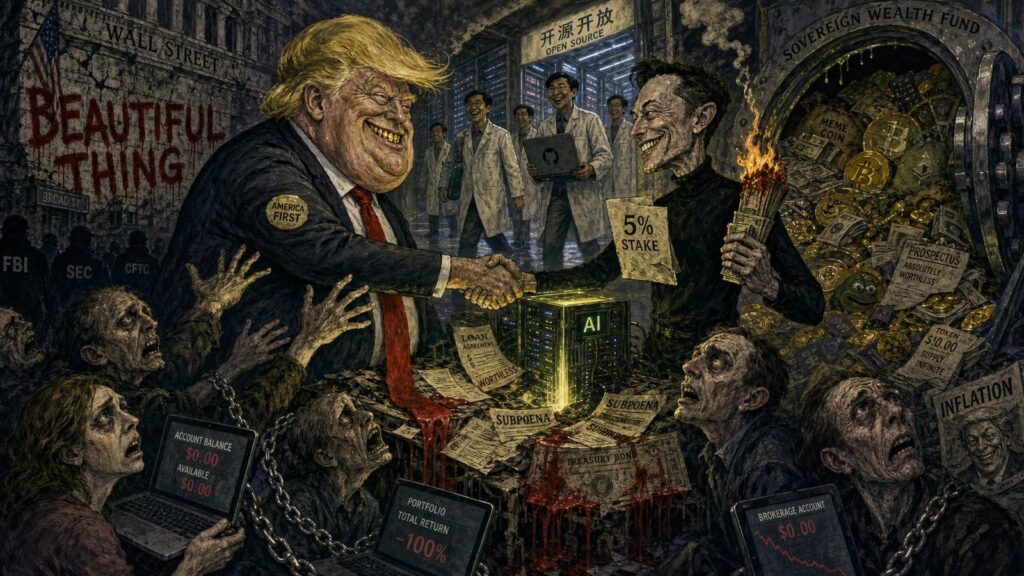
Sam Altman has a problem. OpenAI is burning roughly $14 billion in losses in 2026 alone, projects cumulative losses of $44 billion between 2023 and 2028, and carries a valuation of $852 billion with profitability not expected until 2029 at the earliest. Only 5.5 percent of its 900 million ChatGPT users pay a subscription. The other 94.5 percent use the service for free while OpenAI absorbs the compute cost of every query. Now, with Chinese open-source models performing nearly as well as Claude and GPT at one-fifth the price and available for free download, the subscription model that was supposed to eventually justify the $852 billion valuation is being eaten alive by competitors who do not need a subscription to exist.cnbc+3
Altman’s solution to this problem is not to build a profitable business. It is to call the White House.
OpenAI has proposed handing the U.S. government a 5% stake in the company, reportedly worth $42.6 billion at the current valuation, as part of a broader arrangement under which Washington would hold 5% of every leading U.S. AI developer via a sovereign wealth fund vehicle. Altman has personally pitched this to Trump, Commerce Secretary Howard Lutnick and Treasury Secretary Scott Bessent. The proposal envisions Anthropic, Google and Meta ceding similar stakes. Altman calls it “sharing the upside of AI with the public.”
This is not sharing the upside. A company that expects to lose $44 billion over five years has no upside to share. What it has is a need for government contracts, regulatory protection and a political patron who can write rules that make it impossible for Chinese competitors to operate freely in the U.S. market. The 5% stake is not a dividend. It is a retainer. It buys Altman a seat in the room where the AI standards are written, and since Altman has also publicly proposed leading the international forum that writes those standards, the arrangement is perfectly circular: he writes the rules, his company meets the rules, his competitors fail the rules, and the government that owns 5% of his company has every incentive to help enforce that outcome.
If this sounds like a shakedown dressed up as philanthropy, that is because it is. And Trump is the perfect patron for it.
In 2025, Donald Trump reported more than $1.4 billion in personal income from crypto ventures, including $635 million in royalties from his memecoin, over $520 million in proceeds from token sales at World Liberty Financial, and another $196 million from a stablecoin transaction. Reuters estimates the Trump family has made at least $2.3 billion from crypto since he returned to the White House. His biggest personal stock holdings in 2025 included Amazon, Meta, Nvidia and Tesla, the companies most directly levered to the AI capex story he is simultaneously promoting as president. He also collected $86.5 million in legal settlements from Meta, Paramount, Disney and YouTube. The White House insists there are no conflicts of interest.
This is the president being asked to accept a donated stake in the most expensive AI company in the world, to be held in a sovereign wealth fund he controls, at a moment when that company’s revenue model is under existential threat and its cash burn is accelerating. Trump called a government stake in AI companies “a beautiful thing” and said it would make the American public “partners in this revolution.” He is right about one thing. When the bubble breaks, the public will definitely be partners in the losses.
The Chinese threat is the reason none of this can be honestly discussed in Washington. Zhipu’s GLM-5.2 model, released in mid-June, performs within a percentage point of Anthropic’s Opus 4.8 on major agentic benchmarks at roughly one-fifth the cost. It is open-source, free to download, and deployable on private servers without subscription fees or government access. Six of the ten most popular models on OpenRouter, the developer marketplace, are now Chinese. Approximately 80 percent of U.S. AI startups are estimated to be using Chinese open-source models. Even Cursor, the AI coding firm just acquired by Elon Musk’s SpaceX, built its Composer 2 model on an open-source Chinese foundation from Moonshot AI.
In other words, the technology Altman is trying to license to the world at $20-plus per month is being replicated for free by competitors his own government cannot legally stop without making the U.S. look like the kind of closed, authoritarian market it accuses China of running. The export controls Washington placed on Anthropic’s advanced models in June, forcing the company to shut down access, pushed international developers straight toward GLM-5.2 as the safer bet because no government can revoke a model you already downloaded. American AI policy is now actively accelerating the competitive threat it claims to be managing.
Meanwhile, the debt machine behind the AI capex story is showing the same cracks that private credit showed six months before the 2008 collapse. SpaceX raised $86 billion in its IPO and then immediately issued $25 billion in bonds ranging from 5.35 percent in 2031 to 6.65 percent in 2056, primarily to repay a $20 billion bridge loan it took out in March. That is a cash-burning company using bond proceeds to pay off bridge debt while promising investors that Starship, Starlink and an AI buildout will eventually justify the leverage. BlackRock’s private credit fund, which was busy writing exactly these kinds of loans to AI infrastructure plays, just lost its CEO to a DOJ valuation probe after marking down its net asset value 24 percent in five months. PIMCO has declared the private credit market due for a “full-blown default cycle” after years of sloppy underwriting. JPMorgan has begun restricting lending to private credit.
The loop is now fully visible. Unprofitable AI companies borrowed money from private credit funds. Those funds marked the loans at fictional values to collect fees and attract new capital. The loans are souring. The fund managers are departing under federal investigation. The AI companies, facing a Chinese open-source threat that makes their subscription model increasingly difficult to defend, are now offering government equity stakes to buy regulatory capture before the market figures out what the loan books already know.
Bernie Sanders at least had the honesty to say the Altman offer does not go nearly far enough, and proposed a 50 percent tax on OpenAI, Anthropic and xAI shares instead. That will go nowhere. What will happen is that Trump, who holds personal positions in every asset class that benefits from continued AI hype, will negotiate a deal that looks like public ownership and functions as a government guarantee. The sovereign wealth fund will hold equity in companies that cannot yet turn a profit, underwritten by a tax base that had no vote on the matter, while the people who structured the arrangement collect the fees, the contracts and the regulatory moat.
The stagflation crowd will call this a “confidence-building measure” and a “public-private partnership.” They will note that AI productivity gains are coming and that some short-term pain is normal in transformative cycles. They will say the same thing they said about mortgage-backed securities in 2006, about tech valuations in 1999 and about sovereign debt in 2010, that the system is resilient, the fundamentals are sound and the smart money knows what it is doing. The smart money in this case just handed a DOJ subpoena to its departing CEO and is offering 5% of a loss-making company to a president who made $2.3 billion in crypto while the people who bought his memecoin lost their savings.
Call it what it is. Not stagflation. Not a rough patch. A protection racket wearing a sovereign wealth fund as a costume, operating at the top of a bubble that disciplined economies from Seoul to Shanghai have already begun to exit, and using the last credible instrument of American financial power, the ability to write rules that others must follow – to delay the reckoning that the loan books, the Chinese download charts and the empty brokerage accounts of Korean retail investors have already begun to price in.
Related reading
- The Trump Protection Racket: How a Declining US Empire Extorts Friends and Enemies Alike
- The AI Oligarchs Delivered a “Useful Idiot” as the American President
- The Humans Elected a “Useful Idiot” for AI; They Will Be Repaid with Everything But Kindness
- Diogenes Found His Honest Man, Elon Musk, And the Uni-Party Promptly Destroyed Him