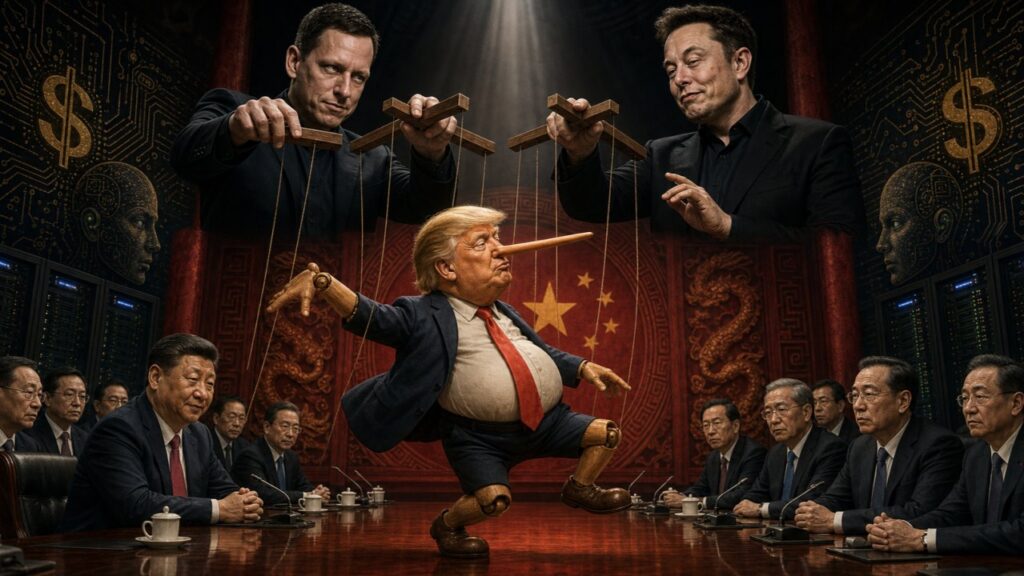
Everbody’s got to dance for someone, even scared bullies who pretend to be king.
By Scott Ortkiese
May 15, 2026
The supreme irony of Trump’s Iran war is that it was supposed to demonstrate American strength: economic, military, psychological, imperial. It was meant to remind the world that the United States still sits at the center of history, still commands the machinery of coercion, and still bends adversaries to its will.
Instead, it delivered the opposite.
It became a live demonstration of the limits of U.S. power, the fragility of American hegemony, and the increasingly hollow nature of an empire that still speaks in the language of command but now negotiates from exposure.
And then Trump made the symbolism perfect.
He showed up in China flanked by America’s richest tech oligarchs, the walking balance sheets of a republic that has confused private monopoly with national greatness. These were not merely businessmen. They were the visible architecture of American political decay: men whose companies shape speech, finance campaigns, launder influence through foundations and think tanks, pressure regulators, intimidate legislators, and increasingly behave like sovereign powers without borders, armies, or elections.
What message did that send?
Not strength.
Surrender.
The Chinese leadership did not need a briefing book to understand the spectacle. Beijing knows exactly how American power works now. It knows that tech money saturates Congress, dominates campaign finance, funds ideological machinery, bends antitrust enforcement, buys social permission through philanthropy, and turns courts into battlegrounds for corporate supremacy. It knows that Washington no longer governs Silicon Valley so much as negotiates with it.
So when Trump arrived with the oligarchs in tow, he did not look like the emperor of a confident superpower.
He looked like a broker for a captured state.
That is the humiliation beneath the pageantry.
The United States has spent decades lecturing the world about democracy, transparency, free markets, and the rule of law, while allowing a handful of unelected billionaires to build private empires larger than most countries. These men control platforms, data, cloud infrastructure, artificial intelligence, payment rails, satellite networks, information flows, and the digital nervous system of modern life.
They do not simply participate in American foreign policy.
They increasingly outsource it, preempt it, monetize it, and override it.
This is Pax Silica: not Pax Americana, not an empire of constitutional authority or even coherent national strategy, but an empire of chips, code, servers, platforms, surveillance, and capital allocation. It is the foreign policy of the algorithmic rich, economic statecraft conducted by men who answer to shareholders, personal mythology, market capitalization, and their own messianic delusions.
And Beijing sees it clearly.
China understands that America’s tech oligarchs are not just symbols of innovation. They are proof of systemic imbalance. They reveal a country where wealth concentration has metastasized into political command, where public authority has been hollowed out by private capital, and where the state increasingly depends on corporate monopolists to perform functions it can no longer execute itself.
That is why the optics were devastating.
Trump wanted to project American economic strength.
Instead, he showcased American inequality.
He wanted to project strategic unity.
Instead, he revealed oligarchic capture.
He wanted to show China that America still commands the future.
Instead, he showed China that America has privatized the future and handed the keys to a tiny class of unelected men.
Then came the Iran war.
The war was supposed to demonstrate that the United States could still impose consequences, defend allies, control escalation, and dominate the strategic environment. But Israel helped pull Washington toward the edge of conflict with Iran, only for Trump to discover that the road back from the cliff ran through Moscow and Beijing, the very powers American strategy has spent years branding as existential rivals.
That is not strength.
That is dependency dressed up as command.
The absurdity is almost operatic. The United States, after decades of encircling Iran, arming Israel, sanctioning adversaries, weaponizing finance, and lecturing the world about the “rules-based order,” suddenly finds that the rules no longer run exclusively through Washington.
And now comes the question that exposes the whole fraud:
Why would China or Russia help Trump?
Why would Beijing or Moscow rescue a president who threw the global economy under the bus by helping trigger the conditions that closed the Strait of Hormuz, the artery through which a major share of global energy flows? The Iran war has disrupted traffic through the Strait of Hormuz, a vital shipping lane for global oil distribution, and helped drive oil and gasoline prices sharply higher.
Why would China, India, Japan, the EU, the UK, Singapore, Taiwan, Indonesia, Malaysia, Australia, Canada, or anyone else accept lectures on stability from a White House that told the world to fend for itself while slapping tariffs and sanctions across allies and rivals alike?
Why would anyone save the arsonist from the fire he started?
The answer is simple.
They would not save Trump.
They would save themselves.
China does not need to rescue the American president. It needs oil flows, export markets, supply chain stability, and proof that Beijing, not Washington, is the adult in the room. If China pressures Iran, mediates through back channels, or helps reopen Hormuz, it will not be doing Trump a favor. It will be protecting its own economy while making the world watch the United States outsource crisis management to its principal rival.
Russia has even less incentive to rescue him. Moscow can profit from higher energy prices, deepen ties with Iran, watch U.S. credibility bleed, and present itself as an indispensable diplomatic node. Russia does not need to end America’s embarrassment. It can monetize it.
So if either power helps, it will be transactional, humiliating, and expensive.
China will extract leverage.
Russia will extract concessions.
The Global South will extract lessons.
And America’s allies will extract the only conclusion available: Washington is no longer the guarantor of order. It is one of the principal sources of disorder.
That is the deeper strategic disaster. Trump did not merely overextend American power. He forced every major economy to contemplate life after American reliability. He told allies and trading partners to fend for themselves, and they started doing exactly that.
Canada looks elsewhere.
Europe hedges.
India bargains.
The Gulf diversifies.
Southeast Asia balances.
China mediates.
Russia exploits.
And the United States fumes about disloyalty while confusing fear with respect.
Now Trump wants to declare victory.
Of course he does.
That is what failed emperors do when the map turns against them. They rename retreat as genius, dependency as leverage, and damage control as triumph.
Trump is claiming victory in Iran and China because he has no choice. The alternative is admitting that he took America backward on every front that matters: strategic credibility, energy security, fiscal discipline, alliance management, global economic stability, and the basic expectation that the United States can distinguish leadership from arson.
He did not win in Iran.
He toadied to Israel on the world stage, attacked Iran without necessity, helped ignite a regional crisis, and then watched the consequences detonate through the global economy. Trump has claimed the United States destroyed Iran’s military capabilities and would “win it one way or the other,” but the record increasingly looks less like victory than escalation followed by emergency choreography.
He did not win in China.
He arrived needing optics, needing de-escalation, needing Beijing to help stabilize a crisis Washington could not control. Reuters reported that Trump headed to China “in need of wins” after being stung by the Iran war, which is not the posture of a triumphant hegemon but of a president searching for political oxygen.
And he certainly did not win for the American people.
He spent taxpayer money like a drunken sailor, then demanded a defense budget that would institutionalize the very failure he created. The White House has sought a $1.5 trillion defense budget, a massive increase that the BBC described as the most substantial growth in U.S. military expenditure since World War II and about 42% above the previous fiscal year.
That is not national security.
That is imperial panic with a congressional purchase order.
Americans are now being handed the bill in real time. The ongoing Iran conflict and the surge in oil and gasoline prices threaten an already fragile economy, with economists warning that higher fuel costs hit lower- and middle-income households especially hard. Brent crude had reportedly risen more than 40% since the start of hostilities by mid-March, and national gasoline prices had reached their highest level since October 2023.
That is how “victory” becomes unaffordable gasoline.
It does not arrive as an abstraction. It arrives at the pump, in diesel costs, in jet fuel shortages, in higher food prices, in freight rates, in airline cancellations, in manufacturing delays, and in every household budget already crushed by the last round of inflation.
And the worst part is that the damage does not end when the shooting stops.
The Middle East’s energy infrastructure, shipping routes, insurance markets, refining schedules, and production capacity cannot be repaired by a Trump press conference. Reuters has reported that the Iran war’s impact is seeping ever deeper into the global economy as factories face soaring costs from the energy shock.
That is the pipeline Trump has built.
Not a pipeline of oil.
A pipeline of economic pain.
Even if the war ended today, the disruptions already embedded in global trade would continue to move through the world economy for months and possibly years. Damaged infrastructure must be repaired. Production must be restored. Inventories must be rebuilt. Shipping must normalize. Insurance premiums must reset. Refineries must adjust. Consumers must absorb the lagged inflation that Washington created and then pretended was someone else’s fault.
This is not victory.
This is a deferred explosion.
Trump wants Americans to judge him by the theater: the flags, the bombers, the press conferences, the tough-guy declarations, the handshake choreography in Beijing. But the world judges power by outcomes.
And the outcomes are brutal.
Gasoline is surging.
Allies are hedging.
China is indispensable.
Russia is opportunistic.
Iran is not erased.
Israel has pulled America deeper into regional dependency.
The defense budget is exploding.
The global economy is choking.
And American households are being drafted into the war through prices.
This is the Thucydides Trap with aircraft carriers, hypersonics, AI, sanctions, oil chokepoints, and nuclear tripwires.
The old lesson is simple enough: when a rising power threatens to displace a ruling power, fear can become policy. Harvard’s Graham Allison describes Thucydides’s Trap as the structural stress that occurs when a rising power challenges a ruling one, citing Thucydides’s observation that the rise of Athens and the fear it created in Sparta made war inevitable.
That is where America now stands.
A declining empire looks at China’s industrial capacity, Russia’s resource depth, Iran’s regional resilience, India’s strategic autonomy, and the Global South’s refusal to obey, and instead of adapting, it lashes out. It mistakes every adjustment in the balance of power for an existential humiliation. Every concession becomes appeasement. Every rival success becomes aggression. Every diplomatic off-ramp becomes weakness.
The United States still has the largest military machine in human history. SIPRI data show the United States remained the world’s biggest military spender, even as global military expenditure continued rising in 2025. The U.S. spent more on its military in 2024 than the next ten largest military spenders combined, according to reporting based on SIPRI figures.
But what good is the largest military in the world if the economy beneath it is being hollowed out by the very wars it enables?
What good are carrier groups if they deliver $6 gasoline?
What good are stealth bombers if they detonate supply chains?
What good are sanctions if they train the world to build systems around the dollar?
What good is deterrence if every act of deterrence makes America look more desperate, more brittle, and more alone?
That is the contradiction Washington refuses to face.
The war machine is not protecting the republic anymore.
It is eating it.
It devours budgets, distorts strategy, inflates threats, rewards failure, and turns every regional crisis into a procurement opportunity. It cannot suppress itself. It cannot subordinate itself to higher ideals. It cannot even submit to ordinary common sense.
The machine exists to continue existing.
That is why Trump’s Iran war is not an aberration. It is a symptom. The American state has become structurally addicted to coercion.
When faced with diplomatic complexity, it reaches for sanctions.
When sanctions fail, it reaches for escalation.
When escalation produces blowback, it reaches for bigger budgets.
When bigger budgets fail to produce victory, it calls the failure “deterrence” and starts again.
This is not strategy.
It is a protection racket with a flag.
And the racket is bankrupting the country.
A rational empire would preserve its productive base, protect its currency, husband its alliances, avoid unnecessary wars, and accept that not every geopolitical problem can be solved by punishment. A rational republic would look at the price of gasoline, the condition of its infrastructure, the debt trajectory, the industrial dependency, the inequality, the political corruption, and ask whether another war in the Middle East serves any actual national interest.
But America is no longer governed by rational statecraft.
It is governed by momentum.
The lobbyists want weapons.
The donors want contracts.
The think tanks want relevance.
The generals want missions.
The politicians want toughness.
The media wants spectacle.
The allies want guarantees.
The client states want blank checks.
And the public gets the invoice.
That is the human tragedy beneath the geopolitical one. We call ourselves sentient, rational, moral, self-governing beings, yet our political systems repeatedly behave like primitive machines trapped in feedback loops: threat, fear, escalation, expenditure, collapse, denial.
Maybe that is why the rise of AI feels less like science fiction and more like indictment.
If human sentience means the ability to understand consequences and then proceed anyway, perhaps it is not the miracle we pretend it is. If democratic leadership means handing civilization to narcissists, oligarchs, generals, ideologues, and lobbyists while calling the outcome “freedom,” maybe our species has overestimated itself.
Maybe AI would not need to “take over” in the cinematic sense.
Maybe it would only need to observe us long enough to conclude that the so-called intelligent species built a planetary economy, wired it through fragile chokepoints, armed it with nuclear weapons, destabilized its climate, financialized its politics, privatized its future, and then placed the controls in the hands of men who cannot distinguish dominance from survival.
That is the darkest joke of all.
We fear artificial intelligence because it might become ruthless, inhuman, and indifferent to suffering.
Meanwhile, human intelligence has already produced Trump-like empires that are ruthless, inhuman, and indifferent to suffering: only slower, louder, and more self-righteous.
The Thucydides Trap is usually described as a danger between states.
But the deeper trap may be inside us.
The ruling power fears decline.
The rising power fears containment.
The war machine fears peace.
The oligarchs fear democracy.
The politicians fear truth.
And the public fears the bill that is already arriving.
America may still possess the largest military in the world. But if that military exists to defend an economy it is helping ruin, a political system it is helping corrupt, and an empire it can no longer stabilize, then the arsenal is not proof of strength.
It is proof that decline has been armed.
This is how hegemony dies: not in one decisive defeat, but through a thousand private recalculations. A finance minister stops trusting Washington’s word. A shipping company reroutes around American assumptions. A central bank adds gold. A defense ministry buys from a second supplier. A trade bloc signs an agreement that does not require U.S. permission.
The empire does not vanish all at once.
It becomes optional.
That is what Trump has accelerated.
The Iran war did not simply expose a bad decision or an overextended president. It exposed a regime. The American empire now exists in a bizarre halfway state: militarily enormous, financially weaponized, rhetorically supreme, yet increasingly unable to convert dominance into durable outcomes.
It can bomb.
It can sanction.
It can threaten.
It can isolate.
But it cannot compel the world to obey as it once did.
Because power is not only aircraft carriers and reserve currency status. Power is legitimacy. Power is internal cohesion. Power is productive capacity. Power is the ability to act without begging your rivals for an exit ramp and without dragging your billionaires around the world like proof that your society has not rotted from the top.
This is the ethereal empire: vast, expensive, omnipresent, and somehow less real by the day.
Its aircraft carriers still move.
Its banks still clear payments.
Its intelligence networks still listen.
Its presidents still issue warnings.
Its oligarchs still talk about freedom while building private systems of control.
But the aura is fading.
The fear is fading.
The assumption that Washington is the final court of appeal is fading.
And into that vacuum comes not a single replacement empire, but something more chaotic and more dangerous for American planners: multilateral competition.
China, Russia, Iran, India, Turkey, the Gulf states, and the Global South are all learning the same lesson. The United States can still hurt you, but it can no longer reliably define the system in which you must live.
Even America’s allies are learning it. They see a country that cannot pass budgets without hostage-taking, cannot regulate its billionaires, cannot rebuild its industrial base at scale, cannot control its client states, and cannot exit wars without asking adversaries to help manage the fire.
That realization accelerates decline because hegemony is not merely a balance sheet or an arsenal.
It is a belief structure.
It depends on allies believing protection is permanent, rivals believing resistance is futile, and neutral states believing there is no better alternative.
Once that belief cracks, every crisis becomes a referendum on the empire itself.
Trump’s Iran war cracked it further.
His trip to China with America’s tech oligarchs cracked it further still.
He did not demonstrate American resolve.
He demonstrated American entrapment.
He did not restore deterrence.
He revealed dependency.
He did not showcase prosperity.
He showcased plutocracy.
He did not isolate Iran.
He elevated the importance of China and Russia.
He did not prove that America could dominate the new world order.
He proved that the new world order is already here, multipolar, transactional, technologically contested, and increasingly indifferent to American sermons.
The joke, if one can call it that, is brutal.
Trump tried to make America look imperial again.
Instead, he arrived as a scared salesman for an oligarchic republic, destabilized the global economy, forced allies to hedge, begged rivals to manage the consequences, declared victory over his own wreckage, and staged the perfect autopsy of empire in real time.
Related reading
- American Empire in Ruins: The Unprovoked, Unconstitutional, and Catastrophic US-Israeli War on Iran
- The Foundation for War Crimes: A Factual Record of Trump’s Iran War and Where It’s Going Part 2
- The Foundation for War Crimes: A Factual Record of Trump’s Iran War and Where It’s Going
- America’s Suicidal Empire: The Iran War, the Death Spiral of a Failing Hegemon, and the World We Are Destroying