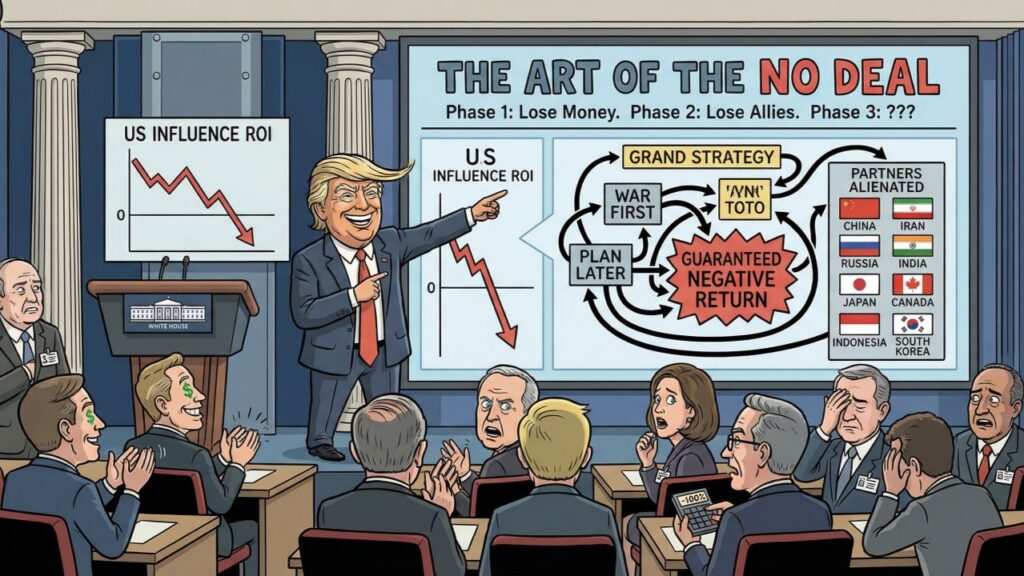
Imagine this as a pitch meeting.
A shaky, overleveraged company shows up asking for a $200 billion capital injection. The firm is already $39 ($40 trillion in debt, pays close to a trillion a year in interest, and its last big project ran 100 times over budget. The market it depends on is melting down) partly because of its own decisions. The board calls in the “leadership team” to justify the request.
Who walks into the room?
- Donald Trump, CEO and Chief Arsonist He opens with a familiar line: “It’ll be great. We’ll win so much you’ll get tired of winning.” This is the same man who was told by his own military that there was no viable strategy for a war with Iran, bombed anyway, and is now back asking for 200 billion more to “finish the job.” The last time a leadership team this cavalier guaranteed a cheap war, Iraq cost multiple trillions and blew a hole in the balance sheet that still hasn’t closed. In any real boardroom, this is the guy you thank for his past service while security walks him to the door.
- Pete Hegseth, Chief Operating Officer of Carnage Asked to explain how the 200 billion will be used, Hegseth offers his entire five‑word elevator pitch: “It takes money to kill bad guys.” That’s it. No milestones, no P&L, no risk register. If a COO tried that in front of an actual investment committee, the chair would ask if he’d mistakenly brought the T‑shirt department instead of a plan. Hegseth’s “operations” slide is just a burn rate: $1.3, $1.4 billion per day, first 12 days at $16.5 billion, $200 billion buying maybe 4 to 5 more months of the same. This is not operations management. It’s a bonfire with PowerPoint.
- Scott Bessent, Chief Financial Officer of the Apocalypse The money guy beams in to assure the room that the United States has “plenty of funds” for the Iran war and that interest costs exploding past $1 trillion a year are nothing to worry about. This is a man whose career was built on betting against sovereigns that lied to themselves about risk, now standing at the podium as the sovereign and preaching the same denial. In this pitch, the CFO’s “financial strategy” is:
- Lindsey Graham, Chief Risk Officer (in Theory) In a sane firm, the CRO is the person who walks into the room and says, “No, this blows up the company.” Graham instead says, in essence: We have to approve this. We put troops in harm’s way and now we can’t say no. That’s not risk management. That’s using your own reckless decisions as a cudgel to force more funding. He spent years lobbying for confrontation, helped kill off the one framework that constrained Iran’s nuclear program, got the war he wanted, and now uses the damage as leverage to demand more cash. This is like a CRO who greenlit arson, then insists the board must now “protect the firefighters” by buying more gasoline.
- Ted Cruz, Chief Strategy Officer of the Dead End Cruz’s contribution as “strategist” was to spend a decade dynamiting every off‑ramp. He led letters promising to torpedo any Iran deal, locked in maximal sanctions, and turned “no diplomacy” into a loyalty test. In business terms, he systematically eliminated every low‑cost exit the company had, then declares that continuing the most expensive, highest‑risk option is now inevitable. That isn’t strategy. That is the guy who burned down all but one bridge and now insists you have to pay his toll to cross it.
- Marco Rubio, Vice President for Brand and Talking Points Rubio’s job in this circus is to recite the slogans: “credibility,” “deterrence,” “we can’t let Iran win,” “America must lead.” In a real plan review, this is the slide that gets torn in half. Credibility with whom? Deterring what? Leading where, exactly? The brand officer’s entire value proposition boils down to: if we don’t spend $200 billion on this unwinnable campaign, someone might accuse us of weakness on cable news. He is pitching reputation management for the political class, funded by your grocery bill.
- The Senate “Audit Committee” In theory, this is the group that should be shredding the deck. Instead, people like Graham and Cruz sit on the audit side of the table and pretend they didn’t help design the project. They wrap themselves in “support the troops”, their favorite emotional derivatives product, to shut down questions about costs and returns. In any real firm, the audit committee that rubber‑stamped a fiasco like Iraq would be fired, not promoted to approve the Iran sequel.
Key Findings from the “Review”
If you treat this like an actual business plan review, the findings write themselves.
- Use of funds: vague. “Kill bad guys,” “replenish stockpiles,” “send a message.” No concrete milestones other than more bombing and more procurement.
- Time horizon: undefined. At current burn, $200 billion buys maybe 145 more days; the adversary has publicly said it can go at least that long and likely longer.
- Metrics of success: absent. There is no clear end‑state beyond “Iran doesn’t win,” which has already failed on every operational metric that matters.
- Risk assessment: upside is political ego and contractor profit; downside is multi‑trillion‑dollar economic damage, reputational collapse, de‑dollarization, and a broken global energy and fertilizer system.
This is not a plan. It is a pitch from a management team that has already driven the firm into crisis and now demands another round of financing to keep doing the same thing.
Verdict
If this were a real company, every serious investor would walk.
The CEO lies, ignores his own operations people, and confuses bravado with strategy. The COO cannot describe his project in terms more sophisticated than a bumper sticker. The CFO waves away a debt spiral and treats exploding input costs as an afterthought. The “risk officer” sets the fire and then uses the flames to extort more money. The strategist destroyed the off‑ramps and calls the dead end destiny. The brand guy cares only about the optics of saying no, never the consequences of saying yes. And the audit committee has skin in the game, in the defense and energy stocks, not in your future.
In any functioning system, this is the moment the board says: request denied, team fired, project wound down.
In Washington, this is called “bipartisan support for our national security.”
Give them hell by doing what no one in that room wants you to do: look at this like a business plan, ask what you’re actually buying for $200 billion, and then say what any sane investor would say to this management team.
No.
Related reading
- The Aluminum Pearl Harbor: Trump and Netanyahu Sank America’s Industrial Fleet
- THE BILL COMES DUE: What Every American Will Pay for Washington's War on Iran
- Wagering Without Risk: How Washington and Tel Aviv Insiders Bombed Iran on the American Taxpayer's Dime
- The Inflation Reckoning: How an Unlawful War on Iran Is Detonating Every US Price Indicator