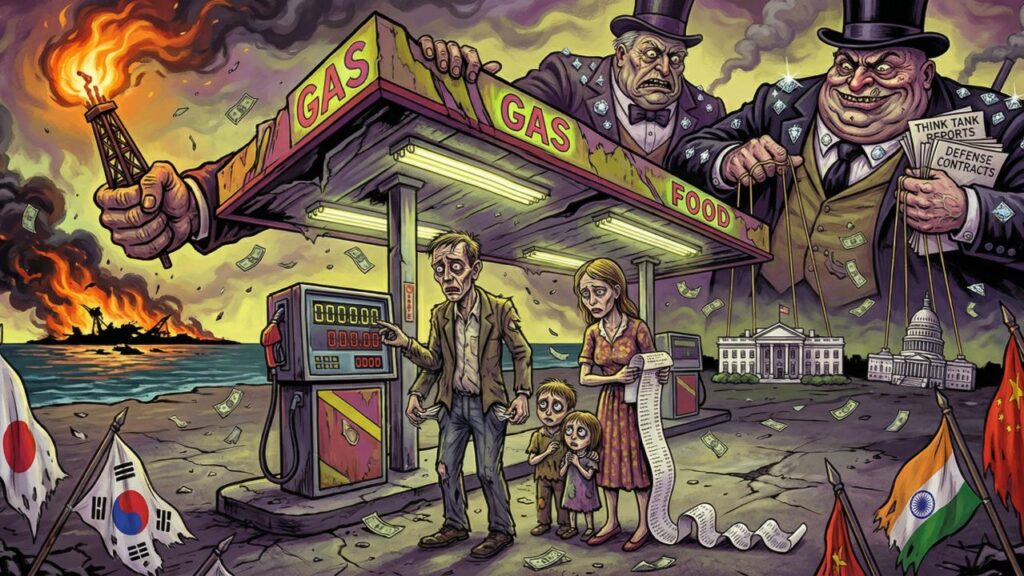
Most Americans do not know what the Strait of Hormuz is or why it matters. This article is written for them.
March 16, 2026
By Scott Ortkiese | so@throughlinesynthesis.com | www.throughlinesynthesis.com
The Invisible Empire, and the World They’re Destroying
An American family fills up the tank. A small network of oligarchs, ideologues, and asset managers starts a war. The connection between those two facts is the most important story of our time, and no one is telling it.
Part One: At the Pump
You felt it this week. Maybe you noticed it Friday, when you pulled into the station and the number on the pump was wrong, not wrong like a typo, wrong like a bad dream. You reached for your wallet and did the arithmetic and you thought: that can’t be right.But it was right. And by the time you finish reading this article, it will probably be higher.
Gasoline in America has risen nearly 80 cents per gallon in just over a week. Diesel, the fuel that moves every truck carrying every product to every store in America, has climbed more than $1.50 per gallon and is still climbing. That diesel number matters more than the gasoline number, because diesel does not merely fill tanks. It prices everything. The eggs, the milk, the bread, the medicine, the replacement parts for the furnace, everything that moves by truck in this country absorbs the diesel surcharge before it reaches the shelf. Those surcharges are being calculated right now, by logistics managers at every distribution center in the country, and they will appear on price tags within days.
Sixty percent of Americans live paycheck to paycheck. For them, this is not an inconvenience. It is a destabilizing shock to a household budget that was already strained. And unlike most of the economic pressures Americans have absorbed in recent years (inflation from supply chain disruption, inflation from fiscal stimulus, inflation from tariff escalation) this one has a specific, identifiable cause. American warplanes struck Kharg Island, Iran, on the night of March 14, 2026. Iran closed the Strait of Hormuz. The price at your pump is the direct consequence.
Most Americans cannot find Kharg Island on a map. Most Americans do not know what the Strait of Hormuz is or why it matters. This article is written for them, and for every American who senses, in the rising number on the pump and the vaguely uneasy feeling that something large and consequential is happening that nobody is quite explaining, that they deserve the truth about what was done, by whom, for whose benefit, and at whose expense.
Part Two: The Island Nobody Told You About
Kharg Island sits in the northern Persian Gulf, about 25 kilometers off the Iranian coast. It is approximately five miles long. It has a runway, a port, and a terminal complex that processes and loads the crude oil flowing from Iran’s southwestern fields onto tankers bound for the global market. Through that terminal passes more than 90% of all Iranian crude oil exports, roughly seven million barrels per day.
On the night of March 14, American warplanes destroyed the military facilities on the island, the air defense systems, the radar installations, the naval infrastructure. President Trump announced, with characteristic enthusiasm, that the facilities had been “totally obliterated.” He did not touch the oil terminal itself, he was careful to note, but he threatened to do so if Iran did not reopen the Strait of Hormuz. Iran has made its position equally clear: if the oil installations are struck, every energy facility across the Gulf (Saudi Arabia, Kuwait, Qatar, the UAE) will be targeted in response. There are at least 13 identified retaliatory targets.
Former CIA analyst Larry Johnson, who has tracked these developments in real time, assessed the military situation with biting precision: the attack “makes zero sense no matter how you look at it.” Iran has prepared its coastal defenses for thirty years, tunneled positions, layered missile batteries, drone swarms that have already destroyed American radar systems and obliterated five KC-135 aerial refueling tankers at Prince Sultan Air Base in Saudi Arabia. The Pentagon called those tankers a “crash.” They were shot down. The U.S. Army stands at 445,000 soldiers and the Marines at 180,000, nowhere near the force that would be required to occupy a nation of 90 million people with a million-man military. The Chairman of the Joint Chiefs told Trump this war would not go as planned. The National Intelligence Council delivered a formal written assessment one week before the bombs fell, concluding that no military action would produce regime change in Iran. Both were ignored.
The Strait of Hormuz is now closed. Through that 33-kilometer-wide chokepoint passes 20% of the world’s daily oil supply, 25% of all seaborne oil trade, 20% of global liquefied natural gas, and 35% of the world’s urea, the fertilizer that sustains global agriculture during planting season, which, across the 75% of arable land that lies above the equator, is happening right now. We are not discussing a regional energy market. We are discussing the circulatory system of the global economy, and it has been ligated.
Part Three: What This Means for You, and for the World
The historical record on oil shocks is unambiguous: every major oil price spike in the modern era has produced a recession. We have never, in all of recorded economic history, faced the simultaneous closure of the entire Persian Gulf, not just Iran, but the cascading shutdown of the storage and shipping capacity of Saudi Arabia, Iraq, Kuwait, Qatar, and the UAE, all of whose facilities have been filling toward capacity because there is nowhere to ship their oil. We are, in the words of Larry Johnson, “in uncharted territory as far as history goes.” The potential to create a global economic catastrophe is high. Not a recession. A depression.
Brent crude has already surged past $103 per barrel, up more than 50% from $69 just weeks ago. Goldman Sachs projects prices could reach $114 or higher if the Strait closure persists. The International Energy Agency has announced the largest emergency reserve release in its history, 400 million barrels, which will, at current disruption levels, last weeks.
Now extend this map beyond your gas tank to the rest of the world, because the Americans paying 80 cents more per gallon are, in the global accounting of this catastrophe, among the most insulated people affected.
Japan imports 95% of its crude oil from the Gulf. Its stock market fell more than 5% in a single trading day. Japan is the world’s second-largest LNG importer, and LNG prices are spiking alongside oil. The government is scrambling to explain to Japanese citizens why the country’s American ally has triggered the worst energy crisis Japan has faced in fifty years, and its Prime Minister is flying to Washington to appeal for relief from the consequences of a war she was never consulted on.
South Korea draws 70% of its crude from the Middle East, runs its electricity grid on LNG from Qatar and the UAE, and depends on energy-intensive export manufacturing for its economic model. Petrol prices surged 200 won per litre in a week, the government imposed fuel price caps for the first time in thirty years.
China imports 30 to 40% of its total oil supply from Gulf producers, and an estimated billion barrels of strategic reserve buys time, not solutions. China’s short-term pain is real. Its long-term strategic trajectory, as we will explain, has been materially strengthened by the very crisis the United States has created.
India depends on the Middle East for a large portion of its crude oil, LNG, and LPG imports, is already redirecting LPG supplies to domestic use as industries face potential shortage, and is navigating the extraordinary situation of being a near-victim of a war its largest security guarantor started, while Iran, displaying a diplomatic maturity that should shame its adversaries, has cleared Indian-flagged vessels for passage through the Strait.
Europe is not at war with Iran. It is paying for this war regardless. Oil prices have risen more than 12% in the first week alone; European gas prices have followed. Central banks that had finally begun cautiously loosening monetary policy after years of post-pandemic inflation now face the prospect of a second energy shock, created not by the adversaries Europe has been arming against, but by the ally Europe has been depending on.
And then there is the dimension that most commentators are not discussing: food.Thirty-five percent of the world’s urea, the nitrogen-based fertilizer on which global crop yields depend, transits the Strait of Hormuz. It is planting season in the Northern Hemisphere. When the fertilizer does not arrive, some crops do not get planted. Those that are planted produce lower yields. When harvest comes in autumn, food will not be there. The gap between a disrupted Strait and a food crisis is measured in months, not years, and the billions of people most vulnerable to that crisis live in the Global South, in places that had no vote in what America and Israel decided to do on the night of March 14.
Part Four: The Enigma, Why?
Here is the question that every American deserves to be asked and to have answered: why?
If the consequences described above were foreseeable (and they were, explicitly and formally, by the National Intelligence Council one week before the attack) why did the United States and Israel initiate what they call a war, and what the overwhelming weight of international law calls an unprovoked aggression against a sovereign nation? Iran has not attacked the United States. In forty-six years of existence as an Islamic Republic, Iran has not conducted a single documented terrorist attack on American soil. Every action attributed to Iran or Iranian proxies against American interests has been demonstrably retaliatory, the Marine barracks in 1983 came after American battleships shelled Lebanese Shia civilians; the hostility of the past decade came after American sanctions choked Iranian civilians for years. The actual terrorist attacks on American soil (September 11, the Boston bombing, the recent New York City ISIS attempt) were all executed by Sunni extremists with ties to Saudi Arabia and its Wahhabi ideological export, not to Shia Iran.
Iran is not a military threat to the United States. So why the war?
To answer that, you have to understand something that the Uniparty, the bipartisan Washington political establishment that has endorsed every military adventure of the past thirty years regardless of party label, does not want you to understand. You have to follow the money. Not to a single corrupt official, not to one bad actor in a parking garage with a briefcase. You have to follow it to the systemthe invisible architecture of concentrated private power that has, over the past three decades, quietly and methodically purchased every institution of American governance, hollowed out every democratic check on its authority, and now uses the military of the United States as an instrument of its own strategic and financial interests, with the elected government as a willing, thoroughly compensated middleman.
Part Five: Dr. Strangelove Reads Fail-Safe, The System That Gave the Order
Imagine, if you are old enough to remember those films, a mashup of two Cold War classics: Dr. Strangelove, in which a deranged general launches a nuclear first strike based on his own ideological obsessions and a president who cannot stop him; and Fail-Safe, in which a bureaucratic error sends bombers past the point of no return and there is no mechanism left to call them back. Now understand that what you are watching in March 2026 is not fiction. The general has been replaced by a network of think-tank intellectuals and their billionaire backers. The bureaucratic error has been replaced by a thirty-year plan. And the president who cannot call the bombers back is one who has fired everyone willing to tell him the truth.
The Foundation: A Foreign Government’s Blueprint
The intellectual architecture of the current war with Iran was built not in Washington, but in Jerusalem, in 1996, by a group of American neoconservative strategists who traveled to Israel and handed incoming Prime Minister Benjamin Netanyahu a policy paper called A Clean Break: A New Strategy for Securing the Realm. Its authors (Richard Perle, Douglas Feith, David Wurmser) were Americans. Its client was a foreign head of state. Its prescription: abandon diplomacy, pursue military dominance throughout the Middle East, overthrow Saddam Hussein, destabilize Syria and Lebanon, and ultimately target Iran, all backed by the full military and financial power of the United States.
Five years later, after September 11 provided the pretext, the same network (now operating as the Project for the New American Century, whose founding signatories included Dick Cheney, Donald Rumsfeld, Paul Wolfowitz, and Elliott Abrams) published a demand that Bush attack Iraq “even if evidence does not link Iraq directly to the attack,” threatening Iran and Syria with “appropriate measures of retaliation.” Iraq was invaded. Over 4,400 American soldiers died. The final target, Iran, remained on the list.
The Mechanism: Vandenberg Coalition
When Trump left office in 2021, Elliott Abrams (Special Envoy for Iran under Trump 1.0, Iran strategist for every Republican administration since Reagan) founded the Vandenberg Coalition. In January 2025, precisely timed with Trump’s inauguration, the Coalition published Deals of the Century, calling for the use of “all elements of national power” against Iran and recommending a posture that made any negotiated settlement structurally impossible. Its policy recommendations appeared, with remarkable fidelity, in the executive orders signed in Trump’s opening weeks.
The Vandenberg Coalition’s advisory board today is interlocked with the Trump Cabinet and National Security Council. Advisory members include Trump’s Trade Representative, Pentagon General Counsel, and Deputy Special Presidential Envoy for the Middle East. David Feith, son of Douglas Feith, one of Clean Break‘s primary authors, was appointed Senior NSC Director in January 2025. The network that wrote the plan is staffing the government that executes it. This is not lobbying. It is occupation.
Byline Times calls this “one of the most sustained and successful foreign policy influence operations in modern American history.” What it is, more precisely, is a foreign government’s strategic interests, drafted by Americans for an Israeli prime minister in 1996, that have been patiently laundered through every Republican administration for three decades and finally delivered, on the night of March 14, 2026, as American ordnance over Kharg Island.
The Factory: Think Tanks and the Manufacture of Consent
The Vandenberg Coalition could not operate without the broader intellectual infrastructure that gives its prescriptions the appearance of independent, credentialed, bipartisan analysis. That infrastructure is the American think tank complex, and it is not independent, not disinterested, and not bipartisan in any meaningful sense.
The top 50 American think tanks receive over $1 billion per year from government agencies and defense contractors. RAND Corporation has received more than $1.4 billion from the federal government since 2019 alone. The Atlantic Council, which has spent years advocating confrontation with Iran and Russia, has received at least $10 million from Boeing, Lockheed Martin, General Dynamics, Northrop Grumman, and Raytheon. The Center for a New American Security received $9 million from those same companies while advocating policies that directly enriched them. The Heritage Foundation takes weapons industry money and produces weapons industry policy.
The think tanks feed Congress. Congress members need intellectual cover (peer-reviewed, bipartisan-branded, media-amplified rationale) to vote for what the money wants without appearing to simply be doing what the money wants. The think tanks provide it. The defense contractors fund the think tanks. Congress funds the defense contractors. The loop closes. Eisenhower named it in 1961: the military-industrial complex. It has simply gotten better at concealing itself since then.
The Purchase: Congress Belongs to the Money
The most important sentence in American political life is this one, and almost no one in mainstream media will say it plainly: the United States Congress has been purchased. Not metaphorically. Not “in a sense.” Purchased, with documented transactions, traceable through Federal Election Commission filings that are public record.
In the 2024 election cycle, AIPAC and its affiliated organizations spent more than $100 million on congressional races, the most ever spent by any single-issue lobbying organization in American electoral history. A Guardian analysis found that 65% of the entire U.S. Congress received money from AIPAC or its affiliated super PACs. Both party leaders received it: House Speaker Mike Johnson received at least $654,000; House Minority Leader Hakeem Jeffries received at least $933,000. When members of Congress dissented, as Representatives Andy Levin, Marie Newman, and Jamaal Bowman did, AIPAC deployed multi-million-dollar primary campaigns to remove them from office. The message to every remaining member is unmistakable. This is not influence. This is control.
Former President Barack Obama wrote in his own memoir that critics of Israeli policy risk being labeled “anti-Israel” and facing “well-funded opposition in future elections.” The forty-fourth President of the United States described, in his own words, the capture of American Middle East policy by a private lobbying apparatus. Political scientist John Mearsheimer stated plainly that “without the active lobbying effort, the stance of the U.S. Congress on the Gaza conflict would be markedly different.”
The politicians are not villains in this story. They are something more depressing: they are products. They were selected, funded, installed, and maintained by the money. They need the money to run their campaigns, to staff their offices, to finance the permanent electoral apparatus that modern American politics demands. The think tanks give them the vocabulary. The media, substantially owned by the same institutional investment structures, amplifies the consensus and marginalizes the heretics. The politicians deliver the votes. They now belong to the money.
The New Praetorians: When Silicon Valley Became the Arms Dealer
Above the familiar architecture of neoconservatives and defense contractors sits a newer, more radical formation: the technology oligarchs who have, in the span of a decade, moved from being beneficiaries of the system to being its proprietors.
Peter Thiel co-founded Palantir, which provides AI-driven targeting systems to Western militaries and signed a formal strategic partnership with Israel’s Ministry of Defense in 2024 to support “war-related missions.” Palantir’s AI systems generated the targeting kill lists used in Israeli airstrikes. Thiel, asked about this, responded: “I defer to Israel.” In August 2025, the U.S. Army awarded Palantir a single contract worth up to $10 billion, consolidating 75 procurement agreements and giving Palantir effective structural control over the Army’s data and AI decision-making infrastructure.
JD Vance, the Vice President of the United States, was employed, mentored, and financially launched by Thiel before entering politics. The DOGE operation, granted sweeping access to the databases of virtually every federal agency, includes a former Palantir intern and a Thiel Fellow. Elon Musk invested $277 million to elect Trump and Republican congressional majorities in 2024. Marc Andreessen interviewed candidates for senior Pentagon positions.
A peer-reviewed Cambridge University study published in January 2026 formally named this “oligarchic sovereignty”, the capacity of technology firms to conduct foreign and military policy as principals pursuing their own geopolitical and commercial objectives. It is not, as the study notes, that these men have corrupted democratic institutions. It is that they have concluded those institutions are inefficient vehicles for their purposes, and have built around them. Government is the inefficiency the money will not bear.
The Hidden Owners: Asset Managers and the Geometry of War Profit
No description of the system that launched this war is complete without naming the financial layer that sits above all the others, the one that profits from the war regardless of who wins, what strategy is employed, or which elected official’s name appears on the orders.
BlackRock and Vanguard together manage roughly $20 trillion in assets. They are simultaneously the largest institutional shareholders in the American defense industry and the beneficial owners, through their index funds and ETFs, of the retirement savings and pension funds of ordinary Americans. A formal United Nations Human Rights Council report by Special Rapporteur Francesca Albanese found that BlackRock purchased $68 million in Israeli war bonds, Vanguard purchased $546 million, and PIMCO purchased $960 million, making the pension funds of American teachers, nurses, and public servants direct financiers of the military campaign whose consequences American consumers are now absorbing at the gas pump. The UN concluded that BlackRock and Vanguard “rank among the largest investors in arms companies pivotal to the genocidal arsenal of Israel.”
Your 401(k) financed this war. You were not asked.
Part Six: The Petrodollar, The Secret the System Is Defending
None of the preceding explains the urgency. Think tanks have been running for decades. AIPAC has been buying Congress for decades. Neoconservatives have been planning the Iran war for decades. Why now? Why with such recklessness, such contempt for consequences, such willingness to risk a global depression?
Because the monetary architecture that makes all of it possible, that allows the United States to carry $40 trillion in debt without a sovereign debt crisis, that allows the defense contractors to collect nearly $1 trillion per year, that allows the asset managers to grow their portfolios on dollar-denominated global transactions, is visibly, measurably, irreversibly eroding. And the window during which it might be defended is closing.
In 1974, in a deal kept secret from the American public for forty years, the United States and Saudi Arabia agreed that Saudi Arabia would price its oil exclusively in U.S. dollars and invest its surplus revenues in U.S. Treasury bonds. Most OPEC producers followed. The petrodollar system was born, and with it, the American republic’s capacity to borrow without limit, spend without discipline, and run deficits that would collapse any other nation’s currency. The dollar’s reserve currency status increases the sustainable level of U.S. government debt by approximately 22% of GDP and reduces U.S. borrowing costs by 60 to 160 basis points. That is the “exorbitant privilege”, and it has been the secret subsidy underwriting American military spending, social programs, and the entire apparatus of the private network described in this article for fifty years.
Today, the United States carries $40 trillion in debt and accelerating. Annual interest payments, $1.1 trillion, now exceed the entire defense budget of $980 billion. The dollar’s share of global reserves has fallen to 54 to 57%, its lowest level since modern tracking began, down 15 to 17 percentage points from its peak in twenty-five years. The dollar’s share of SWIFT-processed international payments fell below 50% for the first time in January 2026. Saudi Arabia is “reassessing” the 1974 arrangement. China has stopped recycling its dollar surpluses into U.S. Treasuries with the old regularity.
Iran, an independent, oil-exporting sovereign that has been building non-dollar energy trade architecture for years, that sits at the geographic crossroads of China’s Belt and Road Initiative and Russia’s North-South Economic Corridor, is not a military threat to the United States. It is a structural threat to the petrodollar. Its survival as an independent state is incompatible with the monetary system that funds the machine. The machine attacked.
Part Seven: The Hollow Republic, What Was Done to America First
To fully understand how a small private network could launch a war without meaningful democratic consultation, one must understand what was done to the American republic over the fifty years before the bombs fell on Kharg Island.
The deindustrialization of America was not an accident of market forces. It was the deliberate result of a shift in economic ideology, from a productive capitalism in which broadly shared prosperity was rooted in making things, to a financialized capitalism in which wealth is generated primarily by owning assets rather than building them. The shift was driven by the free-market economists of the Chicago School, institutionalized through legislation and regulatory capture across both parties, and executed by a corporate class that discovered it was more profitable to manage income streams than to run factories.
Between 2003 and 2012, S&P 500 companies distributed 91% of their earnings to shareholders through stock buybacks and dividends, leaving almost nothing for investment in productive capacity, research, or wages. The labor share of American income, which held at roughly 65% of total income for the entire postwar generation, has fallen to its lowest level since World War II. Financialization contributed to more than half of that decline. The jobs went overseas. The factories went overseas. The communities that had been organized around those factories dissolved into the social wreckage that the same political class then exploited for electoral purposes while doing nothing to reverse the underlying conditions.
What replaced the productive economy was a financialized one, an economy in which the primary economic activity is the extraction of returns from assets: real estate, financial instruments, intellectual property, platform monopolies. An economy in which the top 1% own more wealth than the bottom 90% combined. An economy in which sixty percent of the population lives paycheck to paycheck and cannot absorb an 80-cent spike in gasoline prices without genuine household distress. The rentier class took the cream. The American individual was harnessed, productive enough to generate the returns the rentiers require, insecure enough not to demand anything in return.
This insecurity is not incidental to the political capture described in this article. It is essential to it. A population that is economically secure, productively employed, and civically engaged is harder to manipulate with manufactured enemies and permanent fear. A population that is anxious, financially precarious, and socially atomized is susceptible to the narrative management that the think-tank and media complex provides as a service to the money. The hollowing of the American industrial base and the hollowing of American democracy proceeded together, from the same source, for the same reasons.
Part Eight: The World They Have Now Built
Here is the final, devastating irony of the system’s thirty-year project: it has produced the outcome it was designed to prevent.
It set out to preserve the petrodollar. BRICS Pay (the decentralized payment platform that will allow 185 nations to settle trade in national currencies, bypassing SWIFT and the U.S. dollar) is scheduled for launch at the 2026 BRICS summit in India. Iran has proposed allowing Hormuz passage for ships paying in Chinese yuan.
It set out to contain Russia. Russia is now earning $4.5 billion per month in additional oil revenue, has been diplomatically rehabilitated as a necessary partner in crisis management, and is fast-tracking new energy corridors to Asia that will insulate it from Western financial leverage forever.
It set out to weaken China. China is accelerating the Power of Siberia 2 pipeline that will sever its maritime energy dependency. Chinese Foreign Minister Wang Yi is openly calling for enhanced BRICS unity. Chinese academic institutions have formally concluded that the collapse of the American-led order is “inevitable” and are preparing the architecture of what comes next.
It set out to keep Europe in the American camp. A “seemingly unbridgeable gap now exists between the US and Europe on matters of security and politics,” according to a February 2026 UK academic assessment, with European strategic thinkers openly asking “when does maintaining the Alliance at any cost become more damaging than distancing oneself from it?” European arms imports have tripled since 2021 as the continent builds a military capability independent of Washington.
It set out to isolate Iran. Iran is now a demonstration case for the entire Global South of what resistance to the petrodollar order looks like, and that it is survivable.
The machine launched this war from fear. Fear of petrodollar erosion. Fear of Chinese ascent. Fear that the thirty-year window was closing. And because it launched from fear rather than strategy, because it acted through a captured government whose actual defense and intelligence professionals had been pushed aside in favor of flatterers, it has built, in the span of weeks, more of the multipolar, post-American, post-petrodollar world than China and Russia managed in a decade of patient construction.
Epilogue: You Are Not a Bystander
The price at the pump is not an abstraction. The global food crisis building in the fertilizer disruption is not an abstraction. The $40 trillion debt whose interest payments now exceed the defense budget is not an abstraction. The thirty-year plan written by Americans for an Israeli prime minister that has now been executed by captured American institutions at incalculable cost to the American public, that is not an abstraction either.
You paid for this at the pump on Friday. The workers of Japan and South Korea whose export industries are grinding to a halt are paying for it in layoffs. The farmers of India and sub-Saharan Africa who cannot source fertilizer during planting season will pay for it in failed harvests. The soldiers deployed to a theater where the military situation is, by the assessment of the Chairman of the Joint Chiefs himself, not going to go as planned, they will pay in a currency that no think tank report accounts for.
The system that produced this outcome is not a conspiracy in the dramatic sense. It is not a secret. Every funding relationship, every revolving door appointment, every lobbying disclosure, every FEC filing, every UN report, every peer-reviewed academic study cited in this article is public record, available to any citizen willing to look. The system’s greatest protection is not concealment. It is the normalized conviction that this is simply how things work, that the think tanks are independent, that the Congress is representative, that the president makes the decisions, that the market sets the prices.
None of that is true. And the price you paid at the pump this week is the evidence.
The question, the only question that matters after you have absorbed what this article documents, is what a democratic republic does with that knowledge.
This article draws on: the March 15, 2026 analysis of former CIA officer Larry Johnson and international relations scholar Glenn Diesen; reporting from Reuters, Al Jazeera, CNBC, the New York Times, The Guardian, Byline Times, Jacobin, Fortune, the Strait Times, Le Monde, Carbon Brief, Social Europe, and the Japan Times; the July 2025 UN Special Rapporteur report (A/HRC/59/23) by Francesca Albanese; Federal Election Commission public records; OpenSecrets donor databases; the Project on Government Oversight Brass Parachutes report; the Revolving Door Project; research from the Quincy Institute for Responsible Statecraft, Equitable Growth, the Institute for New Economic Thinking, the Democracy Collaborative, and Applied Geopolitics; and peer-reviewed research from Cambridge University’s Review of International Studies (January 2026), Boston University, and the East Asia Institute.
Related reading
- The Inflation Reckoning: How an Unlawful War on Iran Is Detonating Every US Price Indicator
- Генерал «Предай-США» (Betray-U.S.), он же Дэвид Петреус, идеально иллюстрирует оксюморон: военная разведка
- General Betray-Us, aka David Petraeus, Perfectly Illustrates the Oxymoron: Military Intelligence
- AI Revenue Was Always the Lie, and the Time Bomb Is T-Minus 18 Months and Counting, Not Four Years