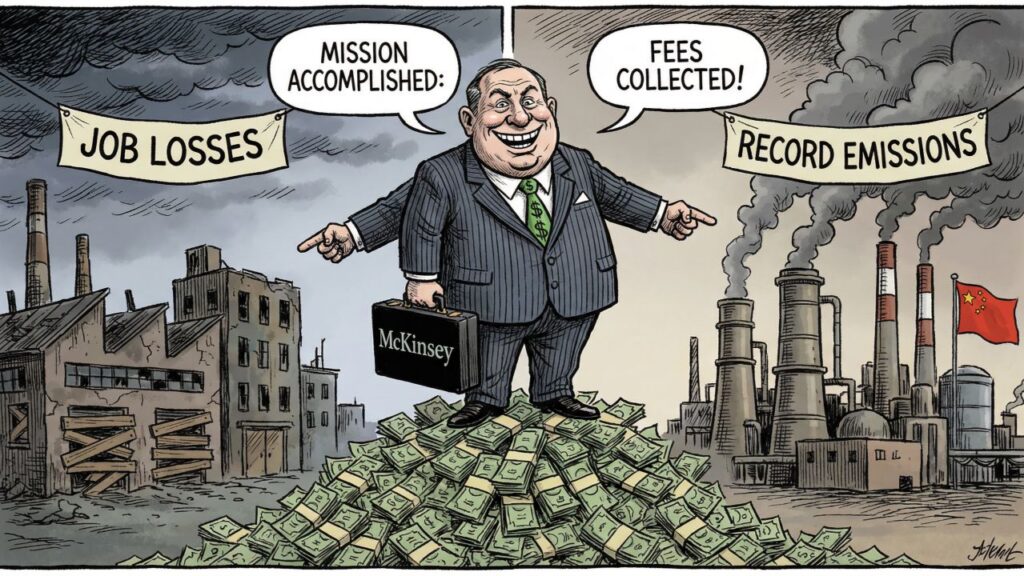
EXECUTIVE SUMMARY
The preceding analysis documented how three advanced industrial economies (the United Kingdom, Germany, and Japan) pursued aggressive decarbonization policies that resulted in catastrophic economic destruction while achieving precisely nothing for global emissions. Factory closures across entire sectors, hundreds of thousands of manufacturing jobs eliminated, wholesale industrial exodus to other continents, persistent GDP contraction, all while global CO₂emissions reached record levels of 37.4 billion tons in 2024 and are projected to hit 38.1 billion tons in 2025.
This analysis revealed the fundamental policy paradox: three nations accepted documented economic destruction (measured in hundreds of billions of dollars in sunk costs, permanently lost industrial capacity, and careers destroyed) all in pursuit of uncertain climate benefits resting on models that have repeatedly and dramatically overestimated warming. Meanwhile, the carbon emissions these nations eliminated through deindustrialization were systematically offshored to higher-emitting jurisdictions, primarily in Asia, where those goods are now manufactured using coal-fired electricity grids.
The unanswered question that demands examination is not merely why governments persist in economically destructive policies that achieve no environmental benefit, but who designed this system and who profits from its perpetuation. The answer reveals a consulting-industrial complex of extraordinary sophistication: McKinsey advising both Saudi Aramco and governments on climate regulation; BlackRock collecting management fees on ESG funds that systematically underperform while claiming climate leadership; carbon credit developers generating millions of fraudulent offsets before the market’s 75% collapse; and renewable energy developers receiving permanent subsidy streams totaling hundreds of billions regardless of emissions outcomes.
This is not climate policy failure in the traditional sense. This is climate policy working precisely as designed by those who benefit from it: enriching consultants, financiers, and international bureaucrats while systematically destroying the domestic industrial capacity of competing nations and creating political lock-in structures so deeply entrenched that policy reversal has become institutionally impossible. The system was designed by its architects to be irreversible through what academics explicitly call the “green spiral” strategy, and it has succeeded brilliantly at that objective.

PART I: THE ARCHITECTS OF DESTRUCTION, McKINSEY’S DUAL-CLIENT CAPTURE
McKinsey’s Systematic Conflict of Interest
The most damning evidence of the consulting-industrial complex’s role in climate policy catastrophe comes from within McKinsey & Company itself. Internal analysis conducted by McKinsey consultants revealed that the firm’s clients’ emissions were rising at two to three times the rate consistent with 1.5°C warming targets. An internal email leaked to journalists stated that even when considering emissions reduction goals, McKinsey’s clients were “likely on the 3 to 5 degrees warming trajectory,” and shockingly revealed that more than half of the firm’s clients were among “the world’s worst polluters”.
This internal reckoning sparked outrage among McKinsey’s own employees. More than 1,110 McKinsey staff signed an open letter calling for greater accountability, transparency on client emissions, and alignment with the Paris Agreement. The internal email also alleged that senior partners were unwilling to take significant steps to address the issue, a revelation that frustrated many within the organization and exposed the fundamental conflict at the heart of McKinsey’s climate practice.
Yet despite this internal recognition of catastrophic misalignment between client behavior and climate goals, McKinsey has positioned itself as “the largest private-sector catalyst for decarbonization”. Managing Partner Bob Sternfels defended this contradiction with remarkable candor: “Like it or not, there is no way to deliver emissions reductions without working with these industries to rapidly transition”. This defense collapses under scrutiny when one examines what McKinsey’s work for these industries actually entails.
The Dual-Client Business Model: Collecting Fees from All Sides
Investigations by The Guardian and other outlets have unveiled that McKinsey’s client list includes some of the world’s biggest fossil fuel companies: Saudi Aramco, Chevron, ExxonMobil, Shell, and BP, according to court filings in the United States where McKinsey is being sued alongside Big Oil. McKinsey’s relationship with Saudi Aramco alone spans more than 50 years, making it one of the firm’s most enduring and lucrative client relationships.
A 2022 internal McKinsey document, reviewed by journalists, names Chevron and BP among clients of its carbon market business line. McKinsey has advised these oil and gas companies on how to use the carbon market to offset their emissions or raise revenue, in effect, helping them navigate the very climate policies that McKinsey simultaneously advises governments to implement.
The dual-client capture becomes explicit when examining specific contracts. The Canadian federal government paid McKinsey $1.35 million for advice on how to strengthen Canada’s clean technology policies, advice provided to the Finance Department just months before the 2023 budget. Yet court documents from unrelated U.S. proceedings reveal that McKinsey’s extensive global client portfolio already included major energy companies in the Canadian oilpatch, many of which profit from fossil fuel extraction and processing, including Canadian Natural Resources Limited, Suncor Energy, Cenovus, and ConocoPhillips Canada, all members of the Pathways Alliance of oilsands companies that has lobbied the federal government to weaken or delay climate change policies.
McKinsey confirmed it identified conflicts before accepting the 2022 contract but claimed it followed procurement rules. When pressed about when and how it informed federal officials of actual and perceived conflicts, and what those conflicts were, McKinsey did not provide specifics. A spokesperson stated only: “We disclosed what was required of us, including both perceived and actual conflicts. Any suggestion that we have not disclosed actual or potential conflicts, not followed the law and not acted as a responsible supplier to the Government of Canada, is false”.
The Canadian case exemplifies the structural conflict: McKinsey collected $1.35 million to recommend fiscal policies helping Canada’s clean energy sector compete with U.S. incentives, while simultaneously advising the very oilpatch companies whose operations those policies would ostensibly restrict. The 2023 budget that followed McKinsey’s advice increased tax breaks for carbon capture projects by $520 million over five years, technology that industry advocates claim would reduce emissions but critics question can be deployed at sufficient scale. McKinsey advised on both the policy framework AND the compliance strategies for the regulated industries.
The African Climate Agenda: McKinsey’s Ecosystem Dominance
Leaked documents obtained by Climate Home News reveal how McKinsey dominates an entire ecosystem pushing carbon markets in Africa and processes designed to help governments develop long-term energy plans. This dominance has been facilitated by McKinsey’s deep-rooted ties with Sustainable Energy For All (SEforAll) (responsible for delivering on a 2030 sustainable development goal for universal access to affordable, reliable and sustainable energy) and the Global Energy Alliance for People and Planet (GEAPP), which works to accelerate the energy transition.
Climate campaigners denounced the focus on carbon markets as “a dangerous distraction” from African climate priorities and accused McKinsey of working to protect the interests of its western corporate clients. Rachel Rose Jackson from Corporate Accountability highlighted the fundamental contradiction: “The more it continues to partner closely with and profit from the very actors condemning people and the planet, the more complicit it becomes”.
The criticism intensified with revelations that McKinsey has been linked to advising on a Saudi government program intended to boost fossil fuel demand in developing countries, work that directly conflicts with any meaningful effort to address the climate crisis. McKinsey has repeatedly dismissed allegations of conflicts, arguing “there is no way to deliver emissions reductions without working with high-emitting industries” and claiming it has “rigorous policies to manage conflict of interests”. Yet the firm has not disclosed details of client emissions or the environmental impact of its work despite ongoing calls for transparency.
The Revenue Machine: Hundreds of Millions from Polluters
Reports reveal that McKinsey has advised 43 of the world’s 100 largest polluters, earning hundreds of millions of dollars from these engagements. The work McKinsey does for these companies frequently “has nothing to do with reducing carbon emissions and everything to do with increasing the efficiency of the company”. For Chevron, McKinsey consultants worked on projects that had “nothing to do with reducing carbon output and everything to do with increasing the efficiency of the company”, in other words, helping Chevron extract and sell more fossil fuels more profitably.
The internal email that sparked employee outrage alleged that McKinsey’s sustainability initiatives were merely serving to “launder the Firm’s reputation” while it profited from engagements that increased emissions. This accusation carries particular weight given McKinsey’s refusal to divulge specific details regarding the emissions of its clients or the environmental consequences of its advisory operations despite repeated appeals for openness.
When journalist Mike Forsythe, who has written extensively about McKinsey scandals, was asked about the firm’s climate work, he stated bluntly: “Companies like McKinsey have done some very important work in the field, but it is totally undermined by their work for the big polluters, which our reporting found adds megatons of carbon into the atmosphere”.
Shell and BP: The Retreat from Climate Commitments
The consequences of McKinsey’s dual-client model become visible in the behavior of its major fossil fuel clients. Reports reveal that McKinsey’s major clients appear to be retreating from their renewable energy ambitions. Shell, which contributes significantly to McKinsey’s revenues, has reportedly reduced its investments in renewables and energy solutions. BP, another major client, has allegedly abandoned a target to cut oil and gas production by 2030.
These retreats occurred precisely during the period when McKinsey was positioning itself as the “largest private-sector catalyst for decarbonization.” The pattern is unmistakable: McKinsey advises governments to implement aggressive climate policies while simultaneously advising the fossil fuel companies targeted by those policies on how to maintain and expand their operations. The firms pay McKinsey for operational efficiency improvements that increase fossil fuel production. Governments pay McKinsey for climate policy advice that ostensibly restricts fossil fuel production. McKinsey collects fees from both sides of the transaction.
As one former McKinsey consultant told journalists, the answer is not necessarily to stop consultancy firms from working with polluting industries, but to regulate the sector, for example, by demanding that consulting firms account for the emissions of the companies they advise in their own disclosures, particularly as a requirement for winning public contracts, and creating frameworks that include the emissions impact of their advisory practices in carbon disclosures or ESG reports. The consultant warned: “They need incentives and costs to move away from their fossil fuel portfolios or put real restrictions on the types of work they are able to do with such clients. At the moment, they shop their relationships with regulators as a reason to be hired by polluting clients, and with regulators use confidentiality to protect themselves from disclosing obvious conflicts of interest or potentially damaging client work”.
BCG and Deloitte: The Consulting Cartel
McKinsey is not alone. The consulting cartel includes Boston Consulting Group (BCG) and Deloitte, among others. BCG CEO Christoph Schweizer told the Financial Times that the group already earns more advising on sustainability than it does in the oil and gas sector. The firm has stated it will continue to advise polluting industries as long as they commit to their own decarbonization targets, a standard that allows BCG to collect fees from virtually any company willing to make public commitments, regardless of whether those commitments are achieved. The one sector BCG refuses to work on is coal, unless it is asked to help decommission a mine.
The boom in climate consulting has led to massive structural changes in the advisory sector. EY announced it would split off its consulting arm from its auditing business, with other leading accounting firms (Deloitte, KPMG, and PwC) potentially following suit. The motivation is clear: separating consulting from auditing would unshackle consulting arms from a ban on working with auditing clients, allowing firms to dramatically expand their climate consulting practices. Florian Huber, co-founder and leader of EY Carbon (set up in 2020 to help clients develop decarbonization strategies), stated with remarkable candor: “This is going to be growth area for a long time. The need out there is so big and urgent”.
The consulting cartel recognizes that climate policy failure is a permanent growth market. Each failed policy requires more consulting to diagnose the failure. Each diagnosis leads to new policies requiring implementation consulting. Each implementation requires compliance consulting. Each compliance creates new problems requiring remediation consulting. The cycle is perpetual, and the fees are guaranteed.
PART II: THE ESG WEALTH TRANSFER, BLACKROCK AND ASSET MANAGER PROFITEERING
The Underperformance Record: 3 Percentage Points and $65 Billion in Outflows
If McKinsey represents the consulting side of the climate-industrial complex, BlackRock and the asset management industry represent the financial extraction mechanism. The evidence of systematic underperformance is now overwhelming and undeniable.
According to Morningstar Sustainalytics, ESG funds generally underperformed and posted $57.3 billion of worldwide outflows through August 2024. The sharpest gap appeared in Europe, where ESG large-cap European equity funds trailed conventional funds by 3 percentage points, reflecting persistent underweight positions in defense and energy stocks. This 3 percentage point gap is not a rounding error or temporary aberration, it represents systematic and sustained underperformance that has cost investors billions.
The hemorrhaging accelerated dramatically in the first quarter of 2025, when global sustainable funds registered net outflows of $8.6 billion, the worst quarter on record. This marked a sharp reversal from the $18.1 billion in restated inflows seen in the final quarter of 2024. For the first time since at least 2018, European sustainable funds suffered outflows, in contrast with strong inflows registered by their conventional peers. U.S. investors reduced their stakes in sustainable mutual and exchange-traded funds for the tenth consecutive quarter. Asian investors also diminished their investments, contributing to the record outflows.
In the United States specifically, sustainable funds suffered almost $20 billion of net redemptions in 2024, up from roughly $13 billion in 2023. These withdrawals occurred despite robust interest in conventional funds, especially in Europe, during the same quarter, indicating that the trend was not due to wider withdrawal from the market but specific rejection of ESG strategies.
BlackRock’s iShares ESG Aware: From $25 Billion to $13.8 Billion
The case of BlackRock’s iShares ESG Aware MSCI USA ETF (ticker ESGU) illustrates the wealth destruction with particular clarity. The assets of this fund, BlackRock’s largest ESG-labeled exchange-traded fund, dropped from a high of $25 billion to $13.8 billion in just one year. The slump occurred as shareholders pulled money from the ETF, but also as its investment performance trailed benchmark indexes, including the S&P 500, over the prior two years.
A recent $4 billion withdrawal from ESGU highlighted what Shaheen Contractor, senior ESG strategist at Bloomberg Intelligence, called “the concentration risk” in the sector. Last year, roughly 22% of net new investments in ESG-focused ETFs went to just 10 funds, and most of the inflows were large one-off allocations from institutional investors. The risk that these same investors might suddenly decide to reduce their stakes, and the outsized impact such outflows can have, raises fundamental questions about the industry’s prospects for long-term growth.
The performance concerns are acute. Many ESG funds have been trailing market benchmarks since the Federal Reserve started increasing interest rates in March 2022, prompting equity investors to favor “value” stocks like oil and gas producers over “growth” stocks such as technology companies. Eric Balchunas, senior ETF analyst at Bloomberg Intelligence, stated with brutal clarity: “Fed Chairman Jerome Powell has done more to damage ESG than Florida Governor Ron DeSantis could ever dream of, adding that the political stuff is secondary to what’s happened to rates and the simple fact is many funds are currently underperforming”.
It is not only ESGU trailing the broader market. The $5.9 billion Vanguard ESG US Stock ETF (ESGV) declined 1.8% during a recent two-year period, compared with the 4.9% advance of the S&P 500 in the same timeframe. The average ESG-focused fund in the United States rose just 1.2% compared to the S&P 500’s 3.8% advance and the Russell 1000’s 3.6% return in the same period.
The Fee Extraction Machine: $8.2 Billion Annually on Underperformance
The critical detail that exposes the wealth transfer is this: despite systematic underperformance, asset managers collected fees throughout the entire growth and decline cycle. ESG investing has become a significant industry, boasting more than $2 trillion in global sustainable assets. The typical expense ratio stands at 0.41%, meaning that on $2 trillion in assets, asset managers collect approximately $8.2 billion in annual management fees at minimum.
Investors paid for underperformance. Fund managers profited regardless of returns. When ESG funds were attracting inflows and underperforming, managers collected fees. When ESG funds hemorrhaged assets and continued underperforming, managers collected fees. The fee structure is designed to extract wealth from investors regardless of fund performance, a wealth transfer from retail investors (including pension funds and ordinary savers) to asset managers.
The scale of the wealth destruction becomes apparent when examining specific legal allegations. A lawsuit against American Airlines’ retirement plan alleges that “ESG mandates drag down corporate performance” and that “ESG funds have an established record of underperformance,” citing a paper published in the University of Chicago’s Journal of Finance. The amended complaint claims without additional citation that ESG funds have a 250 basis points (2.5 percentage points) drag of underperformance, translating to 6.3% versus 8.9% returns.
The “Covert ESG” Allegation: BlackRock’s Pervasive Capture
The American Airlines case introduces an even more disturbing allegation: that BlackRock’s ESG mandate is so pervasive that every fund it offers is infected with an ESG drag on performance, even funds not explicitly labeled as ESG investments. The lawsuit alleges that American Airlines sponsors two jumbo defined contribution plans that contain no ESG investment funds, yet claims that the funds managed by BlackRock in the plan are “covert” ESG investments because “BlackRock’s ESG mandate is so pervasive that every fund it offers is infected with an ESG drag on performance”.
The plaintiff’s theory is that American Airlines’ “public commitment to ESG initiatives motivated the disloyal decision to invest Plan assets with managers who pursue non-economic ESG objectives through select investments that underperform relative to non-ESG investments”. More specifically, the complaint alleges that “Defendants have included investment options that are managed by managers that pursue nonfinancial and nonpecuniary ESG objectives, including Blackrock Institutional Trust Company, which manages the majority of Plaintiff’s investments in the Plan as well as the investments of other plan members”.
The amended complaint concludes by alleging that BlackRock investments have inferior returns based on its commitment to implementing an ESG engagement and voting strategy across all assets under management: “A governance engagement strategy primarily focused on BlackRock’s climate agenda necessarily overlays ESG factors on the core index portfolios that comprise a substantial part of the Plan participants’ investments”.
Whether or not this specific legal theory prevails, it articulates a fundamental critique: that the largest asset managers have become so committed to ESG principles that even their non-ESG products are infected with performance-degrading strategies. This transforms ESG from a choice investors can make into an unavoidable tax on investment returns imposed by asset managers regardless of investor preferences.
Pressure for Short-Term Profits vs. Long-Term Climate Theater
Academic research reveals the structural tension underlying ESG underperformance. A study by Jonas Meckling (climate fellow at Harvard Business School) and Jared Finnegan (public policy professor at University College London) explores how ownership shapes company political behavior surrounding climate policy. The research finds that when providers of “impatient capital” influence a company, executives face intense pressure to deliver short-term profits at the expense of long-term gains, making them unable to make the tradeoffs required by climate policy and causing them to oppose climate reforms.
The researchers also found that among publicly traded companies, opposition to climate policy is stronger among those owned by impatient investors such as actively managed funds, and passive investors such as BlackRock, Vanguard, and State Street. This finding is devastating: the very firms positioning themselves as ESG leaders are identified by academic research as sources of pressure against meaningful climate policy because their ownership structures demand short-term returns incompatible with long-term climate investments.
The research highlights that fully 60% of companies with net-zero or similar emission targets use lobbying and other tactics to undermine government policymaking on climate, a finding that exposes ESG as theater rather than substance. Companies make public ESG commitments to attract investment from ESG funds. Asset managers collect fees on those ESG funds. Companies then lobby against the climate policies that would give their ESG commitments meaning. Asset managers continue collecting fees. The cycle is complete.
Fund Closures and Rebranding: The Great ESG Retreat
The evidence of ESG’s failure has become so overwhelming that asset managers are now actively distancing themselves from the label they spent years promoting. In 2024 alone, 351 sustainable funds either closed or merged, with an additional 115 funds removing ESG-related terminology. In the first quarter of 2025, 335 sustainable products in Europe underwent name changes, including 116 that eliminated ESG-related terminology. Moreover, 94 European funds were liquidated or merged, while the United States experienced a record number of fund closures, totaling 20 in a single quarter.
Morningstar anticipates that between 30% and 50% of ESG funds will undergo rebranding by mid-2025 due to new regulations concerning fund naming and labeling. The UK’s naming and marketing rules under the Sustainability Disclosure Requirements framework took effect in April 2025, while the European markets watchdog’s fund naming guidelines apply to existing funds from May 21, 2025.
The rebranding wave represents an implicit admission of failure. Asset managers are quietly removing ESG language from fund names and marketing materials while continuing to collect management fees. BlackRock has dissolved ESG funds, yet continues positioning itself as a sustainability leader. The backlash against ESG and diversity, equity, and inclusion policies, influenced by political shifts, is affecting asset managers globally, according to Morningstar’s Hortense Bioy.
The retreat from ESG branding does not mean asset managers are returning fees to investors who were sold underperforming products. The wealth has been extracted. The fees have been collected. Now the industry is simply rebranding the same strategies under different names to continue the extraction.
PART III: THE CARBON CREDIT FRAUD, SYSTEMATIC DECEPTION AT SCALE
CFTC’s First Enforcement Action: CQC and the Cookstove Fraud
If McKinsey represents consulting capture and BlackRock represents financial extraction, the voluntary carbon credit market represents outright fraud. On October 2, 2024, the Commodity Futures Trading Commission (CFTC) announced its first enforcement action against voluntary carbon market (VCM) fraud, a historic milestone revealing the systematic deception underlying carbon markets.
The CFTC filed a complaint against Kenneth Newcombe, former CEO and majority shareholder of Washington, D.C.-based carbon credit project developer CQC Impact Investors LLC, for fraud and false reports on voluntary carbon credits. The CFTC also settled charges against CQC itself and Jason Steele, CQC’s former Chief Operating Officer.
The facts admitted by CQC and its former COO reveal a scheme of staggering brazenness. From 2019 to around December 2023, CQC allegedly engaged in a scheme to report false and misleading data and other information concerning project performance and compliance with purported methodologies relating to the quality and supply of voluntary carbon credits (VCCs). The scheme involved senior personnel manipulating surveys of product use and performance to report inflated emissions reductions from energy-efficient stoves and LED light bulbs distributed throughout the Global South.
The CFTC settlement orders state that CQC fraudulently reported false, misleading, and inaccurate information to the carbon credit registry and validation bodies in connection with the projects, which resulted in the issuance of millions more carbon offset credits than CQC was entitled to receive. CQC generated 6 million fraudulent carbon offsets worth tens of millions of dollars, with executives knowingly falsifying emissions reductions.
As a result of the scheme, the carbon credit registry purportedly issued to CQC millions of carbon offset credits to which it was not entitled, and CQC sold those credits to participants in VCC markets. The DOJ press release about parallel criminal cases alleged that CQC sold fraudulently obtained VCCs “to unsuspecting purchasers who thought they were purchasing [VCCs] that reflected emission reductions calculated in accordance with [the VCC issuer’s] methodology”.
The $250 Million Equity Offering: Profiting from Fraud
The timeline of the fraud reveals the scale of the wealth extraction. A DOJ investigation found that from 2021 to 2023, CQC systematically misrepresented and falsified data about the progression of its projects to investors and third-party issuers of VCCs in order to inflate the number of carbon credits issued. As a result, CQC managed to fraudulently obtain and sell millions of VCUs (Verified Carbon Units) while successfully raising $250 million in its equity offering in early 2023.
Consider the audacity: CQC was conducting systematic fraud from 2021 onward, manipulating data and generating fraudulent credits. In early 2023, while the fraud was ongoing, the company raised $250 million from investors who believed they were investing in a legitimate carbon credit developer. Those investors paid $250 million for equity in a company whose core business was manufacturing fake carbon credits. The founders and early investors extracted a quarter-billion dollars before regulators even began investigating.
The CFTC fined CQC only $1 million and required the cancellation or retirement of VCCs sufficient to address the violative conduct. The penalty was “substantially reduced” as a reward for CQC’s cooperation. Kenneth Newcombe faces civil monetary penalties, disgorgement of ill-gotten gains, restitution, and permanent trading and registration bans, but did not admit any wrongdoing. The COO admitted the findings and entered into a formal cooperation agreement with the CFTC.
The arithmetic is devastating: CQC generated tens of millions of dollars in fraudulent credit sales, raised $250 million in equity funding based on fraudulent business model, paid a $1 million fine, and executives face civil (not criminal) penalties. The wealth extraction was wildly successful. The punishment is negligible. The lesson for carbon market participants is clear: fraud pays.
The 75% Market Collapse: Confidence Destroyed
The CQC enforcement action represented the first of its kind, but it occurred against a backdrop of systematic fraud revelations that destroyed market confidence. The voluntary carbon market collapsed 75% from its 2021 peak following these fraud revelations. High-profile corruption cases damaged market confidence irreparably. Yet during the boom years before the collapse, carbon credit developers and consultants extracted enormous fees.
Morgan Stanley predicted that the voluntary carbon offset market, which totaled around $2 billion in 2020, would grow to around $250 billion by 2050. That growth trajectory attracted developers, verifiers, consultants, and intermediaries seeking to capture a share of a quarter-trillion-dollar market. The incentive to generate fraudulent credits was overwhelming: credits could be sold for real money, verification processes were weak, and regulatory oversight was nonexistent.
The Washington Post released findings from a six-month investigation into rainforest carbon offset projects in the Brazilian Amazon, concluding that more than half of these projects showed signs of fraud. Similar investigations determined that the majority of rainforest offset credits issued by the largest certifier of credits may be worthless. A 2023 study calculated that as few as 12% of all existing carbon offsets create a real reduction in greenhouse gas emissions to combat climate change, while the rest provide no benefit to the environment.
These disturbing reports show that as countries and companies rushed to honor pledges to become net carbon neutral, they risked buying false and fraudulent carbon offsets that were essentially worthless. The market was built on a foundation of systematic fraud. The growth projections assumed legitimacy that did not exist. The billions of dollars invested flowed to developers whose projects delivered no environmental benefit.
The Fraud Mechanisms: Illusory Credits and Overstated Impact
The fraud in carbon markets takes multiple systematic forms. The CFTC Whistleblower Office issued an alert outlining common types of fraud to watch for:
Ghost or Illusory Credits: Credits claiming to represent carbon reductions that never actually happened, often based on projects that don’t exist or were never implemented.
Double Counting: When the same carbon credit is claimed by multiple parties, inflating the total amount of emissions reduced.
Fraudulent Statements: Misleading claims relating to material terms of the carbon credit, including its quality, quantity, project type, additionality, methodology, environmental benefits, permanence or duration, or buffer pool.
Overstated Impact: Projects that exaggerate the amount of carbon they can offset, creating a false sense of environmental benefit. One study found that low-emission stove projects overestimate their carbon credits by a factor of 10.
Weak Verification Processes: Offsets validated through inadequate or flawed verification methods, making it easy for fraudulent credits to go undetected.
Lack of Transparency: Companies or brokers avoiding providing sufficient information about underlying projects, making it difficult to confirm whether credits represent real reductions.
The Washington Post article on Brazilian rainforest projects explained one common method: the majority of avoided deforestation projects included protected public lands where logging is already prohibited. These projects claimed credit for “avoiding” deforestation that was already illegal, generating carbon credits for doing nothing. The credits were then sold to corporations seeking to offset their emissions, with the corporations believing they had purchased legitimate reductions.
Validators, Verifiers, and Registries: Profiting from the Fraud
The scope of exposure to civil claims for invalid VCCs potentially extends beyond carbon market project developers to any party with culpable involvement in the issuance or sale of invalid VCCs. This could include VCC registries, validators, verifiers, and other market participants. Throughout the boom period, these intermediaries collected fees for validation and verification services regardless of whether the credits were legitimate.
Carbon credit registries charged fees to list credits. Validators charged fees to certify project methodologies. Verifiers charged fees to confirm emissions reductions occurred. Brokers charged fees to facilitate credit sales. Consultants charged fees to advise on project design. Each intermediary in the value chain extracted fees, creating an ecosystem where everyone profited from the issuance and sale of credits, whether or not those credits represented real emissions reductions.
The incentive structure guaranteed fraud. Developers who generated more credits earned more revenue. Validators who approved more projects earned more fees. Verifiers who confirmed greater reductions earned more business. Registries that listed more credits earned more listing fees. No participant in the value chain had incentive to restrict credit issuance. Every participant had incentive to maximize throughput. The system was designed to produce fraudulent credits at industrial scale.
Due to the novelty of carbon offset projects, their complexity, and the lack of regulation, whistleblowers are now playing a critical role in uncovering fraud committed in connection with these projects. The CFTC has recognized the harm caused by fraudulent carbon offsets and has claimed anti-fraud and anti-manipulation authority in carbon credit markets. But the enforcement came after the market had grown to billions of dollars and after developers had extracted hundreds of millions in fraudulent proceeds.
The Environmental Hypocrisy: No Climate Benefit
The ultimate indictment of the carbon credit fraud is not merely that it extracted wealth from purchasers through deception, but that it achieved the opposite of its stated purpose. Companies and governments purchased carbon credits believing they were funding real emissions reductions. They were not. The credits represented no environmental benefit. Yet the companies that purchased credits counted them against their emissions targets, creating the false appearance of climate progress while emissions continued rising.
The most severe issues uncovered by research are nonadditionality (generating credits without reducing emissions), impermanence, leakage, double counting, “perverse incentives,” and the “gameability” of crediting systems where bad actors routinely circumvent even well-designed rules. Far from solving these problems, Article 6 of the Paris Agreement, finalized at COP29, simply restated “long-ignored tenets of carbon market development, with the specious expectation that this time the outcomes might differ significantly”.
Carbon offsets have failed for 25 years. The largest-ever study proves carbon offsets don’t cut emissions. Yet during those 25 years, developers extracted billions in proceeds, validators collected verification fees, registries earned listing revenue, and consultants charged advisory fees. Everyone profited. The climate got nothing.
PART IV: THE SUBSIDY BONANZA, PERMANENT REVENUE STREAMS FOR RENEWABLE DEVELOPERS
US Renewable Subsidies: The $421 Billion Price Tag (Excluding EVs)
If carbon credits represent outright fraud and ESG funds represent wealth transfer through underperformance, renewable energy subsidies represent the most sophisticated wealth extraction mechanism: permanent revenue streams guaranteed by government regardless of climate outcomes.
In 2024, renewable energy subsidies in the United States reached $31.4 billion. The Congressional Budget Office and other analysts project these subsidies will cost $421 billion from 2025 to 2034, and this figure does not include the $105.7 billion in electric vehicle tax credits. The scale is staggering: nearly half a trillion dollars in renewable subsidies over a decade, with EV credits adding another $100+ billion.
The Inflation Reduction Act (IRA) dramatically expanded these subsidies through uncapped tax credits. Using a transparent budget scoring methodology, analysts estimate that energy subsidies in the act will cost between $936 billion and $1.97 trillion over the next 10 years, and between $2.04 trillion and $4.67 trillion by 2050. Several of the IRA’s largest subsidies are uncapped, meaning their ultimate cost depends entirely on how much renewable capacity developers choose to build.
The Production Tax Credit (PTC) and Investment Tax Credit (ITC), the two primary mechanisms supporting wind and solar, were extended and enhanced by the IRA. Starting in 2025, a clean electricity production facility has the option of choosing either the section 45Y production tax credit or the section 48E investment tax credit, but not both. The section 45Y and 48E credits will likely cost taxpayers between $70 billion and $180 billion per year in the years just before greenhouse gas targets are met.
The residential clean energy credit was estimated to cost $459 million in 2023, with a total cost of $22 billion by 2031. IRS data show an actual cost to taxpayers of $6.3 billion in 2023, roughly $4 billion attributable to the IRA, meaning the actual cost exceeded projections by a factor of 13. At this pace, the total cost would exceed $200 billion by 2032. Every projection has been wrong in the same direction: actual costs wildly exceed estimates because the subsidies are uncapped and developers claim every dollar available.
UK Contracts for Difference: Subsidies Must Double to Meet Targets
In the United Kingdom, subsidies for renewable energy under the Contracts for Difference (CfD) scheme reached an all-time high in 2024. Through this program, the UK government provides financial support to renewable energy projects by ensuring they receive a fixed payment for the electricity they generate, typically for 15 years, with costs passed on to consumers through energy bills.
The total for 2024 reached £2.4 billion ($3 billion), exceeding the previous record of just under £2.3 billion set in 2020. Up to August 2024, the CfD scheme had levied £8.9 billion from licensed domestic and business energy suppliers, costs that suppliers pass on to customers through higher electricity standing charges.
The Office for Budget Responsibility anticipates that subsidies for other programs, including the Renewables Obligation Scheme, the Capacity Market, and the Warm Home Discount, will hit record levels in 2024. Current high subsidy levels come on top of market prices that remain relatively high. UK industrial users pay electricity rates 4 times as high as their U.S. counterparts, obviously affecting competitiveness, yet the subsidies continue and even expand.
The truly devastating projection comes from Cornwall Insight, an energy consultancy, which determined that subsidies to developers of wind and solar over the next two years need to be at least double the 2024 record level if the government is to reach its clean power goal by the end of the decade. According to Tim Dixon, senior consultant at Cornwall Insight: “Increasing the budget for the Contracts for Difference would not ensure the level of renewables needed. You need to have the equivalent volume of assets come through the planning and grid connection stages of their development … and at the moment, the volume of renewable assets coming through the planning system and having the required connection dates doesn’t look to be sufficient to reach the ambitions that are laid out in the clean power 2030 action plan”.
The implication is chilling: the UK must double subsidies from £2.4 billion to approximately £5 billion annually just to have a chance of meeting 2030 targets. Even with subsidies at record levels and industrial electricity prices 4x those of competitors, the UK cannot build renewable capacity fast enough. The response is not to question whether the targets are achievable or economically rational, but to demand taxpayers and consumers pay even more.
Japan’s Renewable Levy: ¥3.1 Trillion and Rising
Japan’s renewable energy levy for fiscal year 2025 increased to a record high of ¥3.1 trillion ($21+ billion). The unit price rose to ¥3.98 per kilowatt-hour, adding ¥19,104 per year to the annual electricity costs of a typical Japanese household. This levy funds feed-in tariff payments to renewable generators, guaranteeing them above-market prices for electricity regardless of market conditions.
Japan’s renewable energy costs remain approximately twice as expensive as in other industrialized nations for solar power generation. Despite Japan having the second-highest installed solar capacity in the world, the country has failed to achieve the cost reductions that have occurred elsewhere. This represents a policy failure of enormous proportions: Japan has invested massively in solar capacity at costs far exceeding global norms while failing to achieve cost competitiveness.
The emergency economic stimulus approved by Prime Minister Sanae Takaichi’s government on November 21, 2025, ¥21.3 trillion ($135.4 billion), included energy subsidies for electricity and gas bills for the first three months of 2026, plus complete elimination of the gasoline tax. This massive fiscal intervention is itself a stunning implicit acknowledgment that Japan’s energy costs have become so economically unsustainable that only direct government subsidies can prevent complete collapse of household purchasing power and industrial competitiveness.
The stimulus package represents far more than standard economic stimulus. It is an admission of policy failure. More than a decade after Fukushima and the nuclear shutdown, Japan’s energy policy has so damaged household budgets and industrial competitiveness that the government must borrow $135 billion simply to provide temporary relief from the consequences of its own deliberate policy choices.
Germany’s €1 Trillion Energiewende: Subsidies That Never End
Germany’s Energiewende represents the most expensive energy policy experiment in the history of industrialized nations. A comprehensive 2016 study estimated total costs through 2025 at over €520 billion in the electricity sector alone, with the primary component being €408 billion for the EEG levy (renewable energy surcharge). More recent analyses suggest the true total cost could reach €1 trillion by the end of the 2030s.
A 2024 study calculated that Germany’s Energiewende cost an estimated €696 billion in total expenditure, €387 billion in direct investments plus €310 billion in subsidies. Had Germany instead maintained its existing nuclear plants and invested in new reactor capacity, the cost would have been approximately €36 billion, revealing potential savings of €332 billion. Germany chose the most expensive possible pathway while achieving worse results for both emissions and industrial competitiveness.
The German government has committed €11.3 billion through 2030 simply to subsidize electricity prices for energy-intensive industries, a tacit admission that government energy policies have made German manufacturing uncompetitive and that direct subsidies are necessary to prevent complete collapse of the industrial base.
Creating Permanent Revenue Regardless of Emissions Outcomes
The structure of renewable subsidies creates permanent revenue streams for developers regardless of whether subsidies achieve climate goals. Contracts for Difference guarantee fixed prices for 15-20 years. Production Tax Credits pay per kilowatt-hour generated for 10 years. Investment Tax Credits provide upfront capital subsidies of 30%+ of project costs. The IRA extended these mechanisms and made them technology-neutral, ensuring subsidies continue indefinitely.
The critical detail is that developers receive payments regardless of whether renewable generation reduces emissions. If renewable electricity displaces coal generation, developers receive subsidies. If renewable electricity displaces nuclear generation (as in Germany), developers receive subsidies. If renewable electricity causes coal plants to cycle inefficiently, creating more emissions per unit output, developers receive subsidies. If renewable generation causes industrial facilities to close and production to relocate to coal-heavy grids overseas, developers receive subsidies.
The subsidy payments are not contingent on emissions reductions. They are contingent only on electricity generation. This creates a system where developers profit from building renewable capacity regardless of climate impact. Global emissions reached 37.4 billion tons in 2024 and are projected to reach 38.1 billion tons in 2025, records despite trillions in subsidies. Renewable developers collected their payments regardless.
Florian Huber of EY Carbon captured the dynamic perfectly: “This is going to be growth area for a long time. The need out there is so big and urgent”. The “need” is not climate benefit but revenue extraction. The “urgency” is not environmental but financial. Renewable subsidies represent the consulting-industrial complex’s most sophisticated mechanism: government-guaranteed payments that survive any evidence of climate policy failure.
PART V: THE GREEN SPIRAL STRATEGY, ENGINEERING POLITICAL IRREVERSIBILITY
The Explicit Academic Strategy: Designing Irreversibility
The consulting-industrial complex did not stumble into creating irreversible climate policies. The irreversibility was deliberate, designed, and documented in academic literature with remarkable candor. The strategy is called the “green spiral”, and it was explicitly intended to make policy reversal politically impossible regardless of whether policies achieve climate goals.
The Roosevelt Institute describes the objective as catalyzing a “green spiral”: leveraging investment and standards to create a positive feedback loop that accelerates decarbonization. Practical experience and academic research suggest that the key to ratcheting up climate ambition over time is this green spiral dynamic. The strategy is straightforward: initial policy moves lead to adaptive industry responses such as changes in capital investment, which then make more stringent regulation politically viable in the next round, triggering further industry reconfiguration in a policy-industry feedback spiral.
Berkeley research articulates the mechanism with precision: “By creating the sectors and jobs that eventually benefit from carbon pricing, green industrial policies, in fact, tilt the future political landscape to one more favorable” to further climate action. The strategy involves deliberate “shifting of the material interests of key industries” and deliberate “generating of political buy-in” to “lock in climate action”. This is not conspiracy theory. This is openly acknowledged strategy in peer-reviewed academic literature.
Academic papers on the green spiral are explicit about the political objective. One study states that achieving positive feedback loops in climate technology and policy requires a powerful, enduring, and cross-partisan political coalition, which in turn requires a strategy capable of: (1) making clean technologies cheap and reliable; (2) delivering concrete benefits to communities today; and (3) strengthening the power of a supportive climate coalition. None of these objectives can be achieved with conventional environmental pollution policy alone.
The mechanism is straightforward: create constituencies dependent on climate policy, making reversal politically suicidal regardless of whether the policy achieves its stated objectives. The renewable energy sector now employs sufficient workers, generates sufficient political donations, and commands sufficient media attention that no politician dares question the policy framework that sustains it. The system was designed to be irreversible through the creation of constituencies that would oppose reversal regardless of evidence of failure.
The Political Entrenchment Mechanism
The Biden administration’s efforts to weave climate, economic, and trade policy together into a coherent industrial strategy were explicitly designed to accelerate this green spiral. If successful, incentives and standards would cultivate strong domestic climate industries across geographies, support high-quality jobs, and build bipartisan political demand for more decarbonization in the future, all while rapidly decreasing energy costs for individuals and businesses.
The academic literature is candid about the political objective: “To sustain the climate transition over time, society needs a strong political coalition that will benefit from more aggressive action”. The solar and wind industries have gone from small, niche, “alternative” technologies to multitrillion-dollar industries in the last decade, with a corresponding increase in political clout and influence that played a key role in passage of the IRA. The strategy is to accelerate this trend and drive growth in new climate-aligned industries that will pressure governments to act more aggressively to mitigate climate change.
Opposition from beneficiaries of renewable policies has been instrumental in defeating attempts to roll back renewable portfolio standards at the U.S. state level over the past few years. Political opposition from constituencies benefiting from climate policy prevented policy reversal even when evidence of economic damage accumulated. Over time, broader policy signals targeted at polluters like carbon prices can be introduced and strengthened because policy is politically entrenched.
The green spiral strategy explicitly recognizes that early climate policy must create constituencies providing support for subsequent policy moves regardless of effectiveness. Strategic sequencing of policies matters precisely because later policies become politically impossible without constituencies created by earlier policies. The more carbon policy is politically entrenched, the more policy discretion exists for less-targeted, more theoretically efficient policy. This sequencing requires careful analysis to avoid policy retrenchment as a result of political backlash and to prevent lock-in of suboptimal technologies, but the fundamental objective is explicit: political entrenchment that survives evidence of failure.
Path Dependency and Institutional Inertia
The academic concept of “path dependency” explains how policies become irreversible once implemented. Path dependency holds that a historical path of choices has the character of a branching process with a self-reinforcing dynamic in which positive feedback increases while the costs of reversing previous decisions increase and the scope for reversing them narrows sequentially as development proceeds, finally leading to irreversibility and lock-ins.
Once climate policies are implemented, they create constituencies, bureaucracies, and vested interests that actively resist change even when evidence of policy failure mounts. Climate policy has generated multiple layers of institutional entrenchment: bureaucracies whose existence depends entirely on climate regulation (environmental ministries, carbon-trading authorities, verification agencies, international climate organizations); industries that profit directly from compliance requirements (renewable energy companies, carbon credit developers, ESG consulting firms); international institutions that would lose relevance without the climate agenda (UNEP, IPCC, COP secretariat); and academic departments funded by climate research grants that would lose funding if climate research were deprioritized politically.
Once these interests become entrenched, dismantling policy becomes politically impossible even when clear evidence of policy failure accumulates. The bureaucracy tasked with implementing climate policy will never issue a report concluding that climate policy has failed, members’ careers and pension security depend on policy continuation. Renewable energy companies that have received subsidies and guaranteed pricing will lobby aggressively against any policy revisions. International organizations will expand their mandates and budgets rather than admit failure.
Government policies and regulations often favor fossil fuels due to historical precedent, lobbying, and established bureaucratic structures, but the same path dependency mechanisms now operate in reverse to entrench climate policies. Institutional frameworks that once reinforced the fossil fuel path now reinforce the renewable energy path. Shifting institutional frameworks was once essential for creating enabling environments for sustainable transitions; now those frameworks prevent reversing unsustainable transitions even when evidence shows they are destroying industrial capacity without reducing global emissions.
The Self-Validating System: Failure Defined Out of Existence
Climate policy has been delegated to technocratic agencies insulated from democratic accountability and from direct experience with policy consequences. The IPCC, environment ministries, and international climate bodies form what might be accurately described as an echo chamber where “institutional inertia” prevents course correction even when evidence of failure is overwhelming.
The system has become self-validating: any evidence of policy failure is reinterpreted as justification for more policy rather than less. Any economic damage is attributed to insufficient commitment to climate goals rather than to policy error. Any emission rises are blamed on governments not implementing policies “aggressively enough” rather than on fundamental flaws in policy design. When factories close, the technocrats declare the transition is working as intended. When jobs disappear, they announce progress toward decarbonization. When communities collapse economically, they celebrate emission reductions.
The system cannot process failure because failure has been defined out of existence by the very people tasked with evaluating policy. This represents the ultimate triumph of the green spiral strategy: a system so deeply entrenched that it perpetuates itself regardless of outcomes, interpreting every result, success or failure, as validation of the need for more of the same policy.
PART VI: DUAL-CLIENT CAPTURE, THE ULTIMATE CONFLICT
Collecting Fees from All Sides of the Energy Transition
The consulting-industrial complex achieves its most sophisticated extraction through dual-client capture: collecting fees from governments designing climate policies, from fossil fuel companies seeking to navigate those policies, from renewable developers implementing those policies, and from financial institutions packaging those policies into investment products.
McKinsey, BCG, and Deloitte advise governments on climate policy formation. McKinsey collected $1.35 million from the Canadian government for clean technology policy advice. Canadian government contracts to McKinsey totaled approximately $200 million between 2011 and 2023. Multiply this across dozens of governments globally and the consulting revenue from climate policy formation runs into billions.
Simultaneously, these same firms advise fossil fuel companies. McKinsey advised Saudi Aramco, BP, Shell, Chevron, and ExxonMobil. The work for Chevron had “nothing to do with reducing carbon output and everything to do with increasing the efficiency of the company”, improving fossil fuel extraction profitability. McKinsey earned hundreds of millions of dollars from these fossil fuel clients.
The same firms then advise renewable developers. BCG states it now earns more from sustainability than from oil and gas. EY created EY Carbon specifically to help clients develop decarbonization strategies, recognizing climate consulting as “a growth area for a long time”. Consultants earn fees helping renewable developers access subsidies, structure projects, and navigate regulations, regulations the consultants helped governments design.
Finally, consultants advise financial institutions on ESG strategies, green bonds, and sustainable finance. Banks pay consultants to structure green financing. Asset managers pay consultants to design ESG funds. Companies pay consultants to prepare sustainability reports for investors. The cycle is complete: consultants profit at every stage of the energy transition, from policy formation through fossil fuel operations through renewable development through financial intermediation.
The Information Asymmetry Advantage
Dual-client capture creates a devastating information asymmetry advantage. When McKinsey contracts with the Canadian government to advise on clean technology policy, McKinsey gains insights into government priorities, constraints, and decision-making processes. When McKinsey then advises Canadian oilpatch companies, it can use those insights to help clients anticipate, influence, or circumvent regulations.
Conversely, when McKinsey advises fossil fuel companies on operational strategies, it gains deep understanding of industry cost structures, technological capabilities, and political constraints. When McKinsey then advises governments on climate policy, it can use that understanding to design policies that appear stringent but contain loopholes exploitable by industry clients, or to design policies so aggressive they guarantee industry opposition will delay implementation.
One former McKinsey consultant stated bluntly: “They shop their relationships with regulators as a reason to be hired by polluting clients, and with regulators use confidentiality to protect themselves from disclosing obvious conflicts of interest or potentially damaging client work”. This is the essence of dual-client capture: consultants leverage government relationships to win private sector clients, then leverage industry knowledge to win government contracts, collecting fees from both sides while maintaining confidentiality prevents anyone from assessing whether advice served public or private interests.
BCG, Deloitte, and the Consulting Cartel
McKinsey is not unique. BCG CEO Christoph Schweizer told the Financial Times the group already earns more advising on sustainability than it does in the oil and gas sector, and will continue to advise polluting industries as long as they commit to their own decarbonization targets. This standard allows BCG to advise virtually any company willing to make public commitments, regardless of whether commitments are achieved. The only sector BCG refuses is coal, unless asked to help decommission a mine, a restriction that sounds principled but excludes only the smallest segment of fossil fuel industry while allowing BCG to continue profiting from oil and gas.
The boom in climate consulting led Deloitte, KPMG, PwC, and EY to consider splitting consulting arms from auditing businesses. The motivation is transparent: separating consulting from auditing would remove restrictions on working with auditing clients, dramatically expanding potential client base for climate consulting. The firms recognize climate policy creates a permanent consulting market and are restructuring to maximize revenue extraction.
Christian Meyer-Bretschneider, director for sustainability at Accenture Strategy, described the consulting value proposition with inadvertent honesty: “We supported them in assessing the business case behind more ambitious climate actions. The leadership needs numbers and business rationale when committing to more ambitious actions and implicated investments”. Consultants provide “business rationale” for climate commitments, not evidence that commitments will achieve climate goals, but financial justification for making commitments that unlock access to subsidies, green financing, and ESG capital.
The Regulatory Capture Loop: Perpetual Revenue from Failure
Dual-client capture creates a perpetual revenue loop where policy failure ensures more consulting work. Consultants help governments design climate regulations. Regulations create compliance burdens for industry. Consultants help companies comply with regulations. Compliance reveals unintended consequences or loopholes. Consultants help governments “fix” regulations. New regulations create new compliance burdens. Consultants help companies adapt. The cycle repeats indefinitely.
At each stage, consultants collect fees: policy design fees from governments, compliance fees from companies, remediation fees from governments, adaptation fees from companies. Successful policy that achieved climate goals cheaply and efficiently would minimize consulting revenue. Policy that creates complexity, requires ongoing adjustment, generates compliance costs, and produces ambiguous results maximizes consulting revenue. The incentive structure rewards failure.
Negar Haghighat, a Montreal-based consultant advising on governance and ethical issues, captured the accountability problem when discussing McKinsey’s Canadian government contracts: “The question here is, ‘How do you go forward with a partner that tells you they are in conflict?’ It goes against your responsibilities toward the Canadian people. You don’t do that, unless you say why you did it. This is not something that is okay. This is not how we use public funds”.
Yet governments continue awarding contracts to consultants with disclosed conflicts because the consulting-industrial complex has captured the procurement process itself. The Canada auditor general criticized the government over McKinsey contracts, detailing how public servants broke rules and provided poor oversight as federal departments issued about $200 million in contracts to McKinsey between 2011 and 2023. The audit criticized federal agencies over their “frequent disregard” of contracting policies and failing to prove that some contracts were even needed or delivering value.
Regulatory capture in the energy sector has been extensively documented. Traditionally, capture meant fossil fuel industries influencing regulators. Now capture operates in reverse: renewable interests, ESG consultants, and climate bureaucracies have captured regulatory processes, ensuring climate policies perpetuate regardless of effectiveness. Consultancies are “also lobbying. And they are also working for governments and using what they’ve learned working for governments with private clients”. If consultants work with fossil fuel companies, they shouldn’t get public contracts, yet they continue receiving both.

PART VII: THE ELITE IDEOLOGICAL COMMITMENT, CLIMATE POLICY AS CLASS WEAPON
The Davos Paradox: Private Jets and Virtue Signaling
Research has documented what it calls the “elite ideological commitment” to climate policy, the fact that wealthy individuals and corporations demand climate action even though the policies implemented are designed to burden ordinary people rather than the wealthy. Paradoxically, the same elite class that engages in the most emissions-intensive consumption also advocates most aggressively for climate policies that restrict the consumption of non-elites.
For wealthy elites, climate policy signals virtue and moral commitment without requiring personal sacrifice. The billionaire flying in a private jet to climate conferences generates emissions thousands of times higher than an ordinary person’s annual footprint. Yet this same billionaire will advocate aggressively for carbon taxes on gasoline, electricity prices that burden working families, and manufacturing restrictions that eliminate working-class jobs. The policies they advocate primarily restrict the consumption of non-elites while their own lifestyle continues unchanged.
Academic research reveals that among publicly traded companies, opposition to climate policy is stronger among those owned by “impatient investors” such as actively managed funds, and passive investors such as BlackRock, Vanguard, and State Street, precisely the firms positioning themselves as ESG leaders. When providers of “impatient capital” influence a company, executives face intense pressure to deliver short-term profits at the expense of long-term gains, making them unable to make the tradeoffs required by climate policy and causing them to oppose climate reforms.
The research highlights that fully 60% of companies with net-zero or similar emission targets use lobbying and other tactics to undermine government policymaking on climate. Companies make ESG commitments to attract investment from ESG funds. Asset managers collect fees on those funds. Companies then lobby against the climate policies that would give their commitments meaning. Asset managers continue collecting fees regardless. The elite class signals commitment to climate action while systematically preventing implementation of policies that would require actual sacrifice.
The Distributional Impact: Who Pays, Who Profits
The distributional consequences of climate policy are brutally clear. The Port Talbot steelworker loses his job when Tata Steel closes the United Kingdom’s largest blast furnace, eliminating 2,800 jobs at the plant and up to 9,500 in the supply chain. The Ludwigshafen chemical operator loses her career when BASF closes 11 production plants at the company’s historic headquarters, relocating production to China. The Scunthorpe steelworker loses his livelihood when British Steel’s facility faces closure despite £1.2 billion in investments since 2020, losing £700,000 per day.
Meanwhile, the Davos attendee continues private jet travel. McKinsey partners collect fees from both Saudi Aramco and the Canadian government. BlackRock executives receive compensation based on assets under management regardless of fund performance. Renewable developers receive guaranteed subsidy payments for 15-20 years. Carbon credit developers raise $250 million in equity while conducting systematic fraud. ESG consultants charge fees to prepare sustainability reports that companies use to greenwash operations while lobbying against meaningful regulation.
The energy price weapon makes the class dynamics explicit. UK industrial electricity costs 4 times U.S. prices. German industrial electricity costs 2.5 times U.S. prices. These price differentials make manufacturing economically impossible for energy-intensive industries, forcing factory closures and relocations. Working families subsidize renewable developers through electricity bills inflated by Contracts for Difference levies and renewable energy surcharges. Carbon taxes on gasoline burden ordinary commuters. Elite consumption patterns remain unchanged because wealthy individuals are price-insensitive, a carbon tax that eliminates a working-class commute is a rounding error to a private jet owner.
The Factory Worker vs. The Consultant
The contrast between the factory worker and the consultant captures the full brutality of the climate-industrial complex. The factory worker in Port Talbot spent decades in a stable, well-paying manufacturing job. The worker developed expertise in steelmaking, built a career, purchased a home, raised a family. The community around Port Talbot was constructed around the steel mill as an anchor employer. When climate policy made UK steel uncompetitive, Tata Steel cited “high energy prices and competition from cheaper Chinese steel” and closed the blast furnace.
The worker lost everything: job, career, livelihood, community. The expertise accumulated over decades is now worthless because primary steelmaking has been eliminated in the UK. The home value may decline because the anchor employer departed. The community collapses economically because the jobs and tax revenue evaporated. The worker bears 100% of the cost of climate policy.
Meanwhile, the McKinsey consultant who advised the UK government on climate regulations that made steel uncompetitive collected fees for that advice. The same consultant may have advised Tata Steel on operational efficiency improvements before the closure (collecting fees from Tata. After the closure, the consultant may advise the UK government on “just transition” policies to address unemployment) collecting more fees. The consultant may advise renewable developers on accessing subsidies to build wind farms in Wales, collecting more fees. At every stage of the industrial destruction, the consultant profits.
The arithmetic is simple: the worker loses once. The consultant wins repeatedly. Climate policy transfers wealth from workers who lose their livelihoods to consultants who profit from designing, implementing, and remediating the policies that destroyed those livelihoods.
60% of Net-Zero Companies Undermine Policy
Research from InfluenceMap reveals that fully 60% of companies with net-zero or similar emission targets use lobbying and other tactics to undermine government policymaking on climate. This statistic exposes ESG and net-zero commitments as theater. Companies make public commitments to attract investment from ESG funds and satisfy stakeholder pressure. Asset managers market ESG funds based on companies’ commitments and collect management fees. Companies then lobby to prevent implementation of regulations that would force them to honor their commitments.
Financial institutions invest in both renewables AND fossil fuels, claiming to support the energy transition while profiting from fossil fuel expansion. Greenwashing allows companies to access green finance without making substantial changes to core business models. Captured regulators validate misleading claims because regulators themselves depend on climate policy for bureaucratic relevance.
The elite class has perfected the art of profiting from climate policy while avoiding its costs. Make public commitments that cost nothing. Collect subsidies and green financing based on commitments. Lobby to prevent regulations that would require honoring commitments. Collect profits from both conventional and “green” business lines. Pass all costs to workers and consumers. The system is brilliant in its cynicism.

PART VIII: THE INTERNATIONAL COORDINATION BYPASS, CIRCUMVENTING DEMOCRACY
Paris Agreement as Democratic Bypass
The Paris Agreement and successive COP commitments create what are described as “international obligations” that domestic politicians cite as binding constraints on policy choices. Politicians can claim they “must” implement destructive policies due to international commitments, even when those commitments achieve nothing environmentally and even when voters would reject such policies if given a democratic choice.
This structure was designed precisely to circumvent democratic accountability. Maurice Strong, the Canadian oil magnate who became architect of the modern climate framework, explicitly stated that climate policy required working “over the heads of governments directly to individuals through the media and non-governmental organizations.” He understood that ordinary voters would never accept the economic costs of climate policy if given a genuine democratic choice, so the system was deliberately designed to deny them one.
The Paris Agreement contains legally binding provisions regarding mitigation, adaptation, financing, and other matters. Article 9(1) states that “Developed country parties shall provide financial resources to assist developing country parties with respect to both mitigation and adaptation in continuation of their existing obligations under the convention”. This is not “idle virtue signaling”, it represents explicit financial obligations that commit signatories to ongoing transfers.
Yet the agreement was never submitted to the U.S. Senate for ratification despite clearly constituting a treaty under Article II, Section 2, Clause 2 of the Constitution, which requires treaty ratification by two-thirds of senators present. President Obama knew he did not have the votes in the Republican-controlled Senate to ratify the treaty in 2016, hence the initial entry into the agreement via executive order. President Trump withdrew via executive order. President Biden re-entered via executive order. The agreement has never been subject to democratic ratification by elected representatives.
The Constitutional Questions and Legal Challenges
The Heritage Foundation published a comprehensive legal analysis arguing that the Paris Agreement has all the hallmarks of a treaty that should be submitted to the Senate for advice and consent. The agreement is replete with legally binding provisions. The fact that actual targets and timetables in U.S. Nationally Determined Contributions (NDCs) are non-binding is irrelevant since that fact alone does not transform the entire agreement into a non-binding, political document.
The analysis notes that President Obama’s unilateral treatment of the Paris Agreement breaches a commitment made by the executive branch to the Senate in 1992 during the ratification process of the UNFCCC. At that time, the Bush Administration committed that any agreement containing “targets and timetables” would be submitted to the Senate for ratification. Because the Paris Agreement contains targets and timetables, binding or non-binding, and the Obama Administration refused to submit it to the Senate, the Administration breached the 1992 commitment.
French foreign minister Laurent Fabius, addressing a group of African delegates at the June 2015 climate conference in Bonn, expressed his desire to negotiate an agreement at COP-21 that would bypass Congress: “We must find a formula which is valuable for everybody and valuable for the U.S. without going to Congress…. Whether we like it or not, if it comes to the Congress, they will refuse”. The Paris Agreement was deliberately structured to bypass democratic institutions because negotiators knew democratic representatives would reject it.
Major environmental treaties that have significant domestic impacts should not be approved by the President acting alone. An agreement with far-reaching domestic consequences like the Paris Agreement lacks sustainable democratic legitimacy unless the Senate or Congress as a whole, representing the will of the American people, gives its consent to be bound. The framework allows continuous expansion of obligations through COP decisions without requiring new treaty ratification, creating a mechanism to impose costs on citizens without their elected representatives ever voting on them.
The EU Carbon Border Adjustment Mechanism: Too Little, Too Late
The EU’s Carbon Border Adjustment Mechanism (CBAM), which entered its definitive phase on October 20, 2025, represents a belated attempt to address carbon leakage. The mechanism creates an international coordination framework intended to prevent companies from relocating production to jurisdictions without carbon pricing. Yet the CBAM demonstrates precisely how international frameworks entrench policy while failing to achieve objectives.
The CBAM covers only six sectors of the economy: cement, iron and steel, aluminum, fertilizers, electricity, and hydrogen. It does not include export rebates, meaning EU producers remain disadvantaged in global markets compared to producers in jurisdictions without carbon pricing. The mechanism creates incentives for downstream leakage, automakers relocating to access cheaper inputs from abroad. The CBAM won’t require full certificate purchases until 2026, with expansion to all emissions trading system sectors expected by 2030. By the time the CBAM is fully implemented, much of European heavy industry will have already relocated to jurisdictions without carbon pricing.
The CBAM illustrates the international coordination trap: the mechanism entrenches EU carbon pricing by creating infrastructure and bureaucracy to administer border adjustments. The system becomes self-perpetuating regardless of effectiveness. Yet the mechanism is simultaneously too narrow (covering only six sectors), too weak (no export rebates), and too slow (full implementation by 2030) to prevent the industrial destruction it was ostensibly designed to address. It represents the worst of both worlds: irreversible policy entrenchment combined with inadequate protection for domestic industry.
Entrenchment Through International Framework
The UNFCCC framework allows continuous expansion of obligations without new treaties. The COP process creates a perpetual negotiation cycle where each conference produces new commitments, new mechanisms, and new bureaucracies. Voluntary NDCs prevent enforcement but create political pressure because countries compete to demonstrate climate leadership. Climate finance commitments flow to international bureaucracies that administer funds and expand their mandates annually. Developed nations “shall provide financial resources”, open-ended obligations with no sunset provisions.
This structure ensures policy irreversibility through multiple mechanisms. First, international commitments allow domestic politicians to claim their hands are tied, “we must implement these policies due to international obligations”, even when policies demonstrably fail. Second, the COP process creates constituencies of international bureaucrats, NGOs, and consultants whose livelihoods depend on perpetuating the framework. Third, the voluntary nature of commitments prevents formal enforcement but maximizes political pressure because countries cannot admit failure without appearing to abdicate climate leadership.
The system was designed to be a one-way ratchet: commitments can only increase, never decrease. Ambition can only rise, never fall. Each COP must achieve “progress” defined as more aggressive targets, more financing, more mechanisms. Any retreat is characterized as climate denial or industry capture. The framework makes policy reversal synonymous with international irresponsibility, regardless of whether policies achieve environmental goals or economic sustainability.

PART IX: THE EMPIRICAL EVIDENCE, QUANTIFYING THE PROFITEERING
McKinsey’s Client Emissions Trajectory: 3-5°C Warming Path
Internal analysis conducted by McKinsey consultants revealed that the firm’s clients’ emissions were rising at two to three times the rate consistent with 1.5°C warming targets. The internal email stated that even when considering emissions reduction goals, McKinsey’s clients were “likely on the 3 to 5 degrees warming trajectory”. More than half of McKinsey’s clients were among “the world’s worst polluters”.
McKinsey had advised 43 of the world’s 100 largest polluters, earning hundreds of millions of dollars from these engagements. Senior partners were aware that the client portfolio was off-track but unwilling to take corrective action. The fundamental conflict is undeniable: climate failure generates consulting fees from all sides. McKinsey profits from advising fossil fuel companies on operational efficiency, governments on climate regulations, companies on compliance, and renewable developers on accessing subsidies. Successful climate policy that rapidly eliminated fossil fuel use would eliminate a major revenue stream. Climate failure ensures perpetual consulting demand.
ESG Fund Fee Extraction: $8.2 Billion Annually on Underperformance
ESG investing has become a significant industry with more than $2 trillion in global sustainable assets. The typical expense ratio stands at 0.41%. Simple arithmetic reveals that asset managers collect approximately $8.2 billion in annual management fees on sustainable assets, fees collected regardless of fund performance.
ESG funds underperformed conventional funds by 3 percentage points in Europe in 2024. Global sustainable funds experienced $57.3 billion in outflows through August 2024. The first quarter of 2025 saw $8.6 billion in outflows, the worst quarter on record. U.S. sustainable funds suffered almost $20 billion of net redemptions in 2024.
BlackRock’s iShares ESG Aware MSCI USA ETF dropped from $25 billion in assets to $13.8 billion in just one year. The fund trailed the S&P 500 benchmark over a two-year period. Vanguard’s ESG US Stock ETF declined 1.8% over two years while the S&P 500 advanced 4.9%. The average ESG-focused fund in the United States rose 1.2% compared to the S&P 500’s 3.8% advance in the same period.
Allegations in the American Airlines lawsuit claim ESG funds have a 250 basis point drag on performance minus 6.3% versus 8.9% returns. On $2 trillion in assets, 250 basis points of underperformance represents $50 billion in annual value destruction. Investors lost $50 billion in forgone returns while asset managers collected $8.2 billion in fees. This represents a wealth transfer of staggering proportions: from retail investors (including pension funds and ordinary savers) to asset managers who systematically delivered inferior performance.
Carbon Credit Market Profiteering: $250 Million Raised, $1 Million Fine
CQC Impact Investors conducted systematic fraud from 2019 to December 2023, generating 6 million fraudulent carbon offsets worth tens of millions of dollars. In early 2023, while the fraud was ongoing, CQC raised $250 million in equity funding from investors who believed they were investing in a legitimate business. The CFTC fined CQC $1 million, substantially reduced as a reward for cooperation.
The arithmetic is devastating: CQC generated tens of millions in fraudulent credit sales, raised $250 million in equity based on fraudulent business model, paid a $1 million fine. The wealth extraction was wildly successful. The punishment was negligible. Kenneth Newcombe faces civil (not criminal) penalties but did not admit wrongdoing. The lesson for carbon market participants is clear: fraud pays.
The voluntary carbon market collapsed 75% from its 2021 peak following fraud revelations. Morgan Stanley predicted the market would grow from $2 billion in 2020 to $250 billion by 2050. During the boom years before collapse, carbon credit developers and intermediaries extracted enormous fees. Validators, verifiers, registries, brokers, and consultants all collected fees regardless of whether credits were legitimate. Everyone profited. The climate got nothing.
Renewable Subsidy Capture: $421 Billion in U.S., £2.4 Billion in UK
U.S. renewable subsidies reached $31.4 billion in 2024 and are projected to cost $421 billion from 2025 to 2034, excluding $105.7 billion in EV tax credits. Analysts estimate IRA energy subsidies will cost between $936 billion and $1.97 trillion over 10 years, and between $2.04 trillion and $4.67 trillion by 2050. The section 45Y and 48E credits will likely cost taxpayers between $70 billion and $180 billion per year in the years before GHG targets are met.
In the UK, CfD subsidies reached £2.4 billion ($3 billion) in 2024, an all-time high. The CfD scheme has levied £8.9 billion from energy suppliers through August 2024. Cornwall Insight projects subsidies must double to approximately £5 billion annually to meet 2030 targets. In Japan, the renewable energy levy reached a record ¥3.1 trillion in 2025. In Germany, the Energiewende cost an estimated €696 billion through 2024, potentially reaching €1 trillion by the 2030s.
These subsidies create permanent revenue streams for renewable developers regardless of emissions outcomes. Developers receive guaranteed payments for 15-20 years per project. As long as facilities generate electricity, developers collect subsidies, regardless of whether generation displaces fossil fuels, displaces nuclear, causes grid instability, or forces industrial facilities to close and relocate production overseas. Global emissions reached 37.4 billion tons in 2024 and 38.1 billion tons projected for 2025, records despite trillions in subsidies. Renewable developers collected their payments regardless.
The Consulting Revenue Explosion
McKinsey collected approximately $200 million from the Canadian government alone between 2011 and 2023. The firm earned hundreds of millions from fossil fuel clients globally. Multiply these figures across dozens of governments, hundreds of large corporations, and thousands of compliance consulting engagements, and McKinsey’s climate-related revenue easily exceeds billions of dollars annually.
BCG CEO stated the group already earns more from sustainability than from oil and gas. EY’s Florian Huber described climate consulting as “a growth area for a long time” because “the need out there is so big and urgent”. Deloitte, KPMG, PwC, Accenture, and dozens of boutique ESG consultancies all compete for climate consulting revenue. The total market for climate consulting, ESG advisory, carbon accounting, sustainability reporting, and related services exceeds tens of billions annually and is growing.
Sustainability consulting is more lucrative than traditional sectors because climate policy creates perpetual demand. Each policy requires design consulting. Each regulation requires compliance consulting. Each commitment requires verification consulting. Each failure requires remediation consulting. The cycle is infinite. The fees are guaranteed.
PART X: THE CARBON LEAKAGE VALIDATION, EVIDENCE OF NEGATIVE CLIMATE IMPACT
The 13% Offset Finding: Leakage Through International Trade
An OECD study using satellite data from Climate TRACE tracked emissions and carbon prices for cement and steel at the plant level across 140 countries. The study combined plant-level emissions data with international product-level trade data to quantify the effect of carbon prices on emissions embodied in international trade. The finding is unambiguous: on average, carbon leakage through international trade offsets 13% of domestic emission reductions.
This 13% offset is driven by volume effects, increased imports from countries without carbon pricing. There is no evidence that countries import more from dirtier countries within the set of non-carbon-pricing jurisdictions; the leakage is driven simply by production shifting from carbon-pricing to non-carbon-pricing jurisdictions. The study notes this estimate is higher than most other empirical ex-post estimates available to date, and represents the first empirical paper assessing carbon leakage rates in high-price periods.
The mechanism is straightforward: when Western nations impose carbon prices on domestic industries, those industries relocate to jurisdictions without carbon pricing. Production continues, often becoming more carbon-intensive as facilities in non-carbon-pricing jurisdictions use cheaper fossil fuel electricity rather than renewable energy mandated in developed nations. The UK, Germany, and Japan eliminated domestic production in efficient facilities and offshored that production to less efficient facilities using dirtier energy. Global emissions increased.
Chinese Import Competition Increases Global Emissions
Research from Denmark examining the impact of offshoring and import competition on firm-level carbon emissions reaches a devastating conclusion: “Overall, offshoring contributes to reducing global carbon emissions, while import competition from China substantially increases global carbon emissions”.
The study found that emissions embodied in imports of intermediate inputs are lower in magnitude than the domestic emission reduction caused by the import flows, meaning offshoring of component production slightly reduces global emissions as production shifts to more efficient suppliers. However, emissions embodied in final good imports from China are much larger than the domestic emission reduction, meaning when final goods production shifts to China, global emissions increase substantially because Chinese facilities are less efficient and use coal-heavy electricity.
This finding demolishes the claim that offshoring manufacturing achieves climate benefits. When European and Japanese companies offshore components, global emissions may decrease slightly if suppliers are efficient. When they offshore finished products to China, global emissions increase substantially. Climate policies forcing closure of European and Japanese factories don’t reduce global emissions, they increase them by shifting production to dirtier jurisdictions.
India and China Coal Expansion: 87% of New Capacity
China and India accounted for 87% of new coal-power capacity put into operation in the first half of 2025. In the first half of 2025, China proposed 74.7 GW of new coal capacity and India proposed 12.8 GW, compared to just 11 GW in the rest of the world combined.
China brought online 21 GW of coal capacity in the first six months of 2025, the highest level in nine years. If this pace continues, total additions could reach 80 GW by the end of the year, the largest since 2016. Construction starts and restarts in China reached 46 GW, putting the country on track to match record levels of 2024 when more than 97 GW of coal-power plants began construction.
India commissioned 5.1 GW of new coal plants in H1 2025, already exceeding all of 2024 (4.2 GW). Proposed coal-power capacity in India reached over 92 GW as of July 2025 following a record 38.4 GW of proposals in 2024. India’s Central Electricity Authority advised power utilities not to retire any thermal power capacity until 2030. The Ministry of Coal states that coal use won’t peak until 2040.
China and India together accounted for 92% of all new coal proposals in 2024. The nations driving coal expansion are not fringe actors, they are the world’s most populous countries containing over a third of humanity. Their coal expansion makes European and Japanese deindustrialization irrelevant for global emissions. Every ton of steel the UK stops producing will be produced in China using coal-fired electricity. Every chemical Germany stops manufacturing will be made in India using coal power. Climate policy in the UK, Germany, and Japan destroyed domestic industries while global emissions hit records.
Record Global Emissions: 37.4 → 38.1 Billion Tons Despite $2.1 Trillion Invested
The ultimate empirical validation of climate policy failure is the emissions record. Global CO₂ emissions from fossil fuels reached 37.4 billion tons in 2024, a record high. Emissions are projected to rise 1.1% in 2025 to reach 38.1 billion tons, another record.
Total CO₂ emissions reached 41.6 billion tons in 2024, up from 40.6 billion tons in 2023, including 37.4 billion from fossil fuels and the rest from land-use change. Atmospheric CO₂ levels increased by 3.5 parts per million from 2023 to 2024, the largest annual increase since modern measurements began in 1957. Concentrations of methane and nitrous oxide also reached record highs.
These records occurred despite $2.1 trillion invested in the energy transition in 2024. Europe spent €354 billion on energy subsidies in 2023. The U.S. spent $31.4 billion on renewable subsidies in 2024. The UK spent £2.4 billion on CfD subsidies in 2024. Japan’s renewable levy reached ¥3.1 trillion in 2025. Germany’s Energiewende cost €696 billion through 2024.
Trillions spent. Records broken. The consulting-industrial complex collected fees at every stage: advising on policies, implementing regulations, accessing subsidies, verifying compliance, packaging investments, reporting sustainability. Workers lost jobs. Factories closed. Industries relocated. Emissions rose. Consultants profited.
The Negative Climate Impact: Policies Increase Global Emissions
The evidence is now overwhelming that climate policies in the UK, Germany, and Japan have increased global emissions rather than decreased them. The mechanism is documented: carbon pricing and regulatory burdens force efficient European and Japanese facilities to close. Production relocates to China and India where facilities use coal-fired electricity. The relocated production is less efficient and more carbon-intensive than the closed European and Japanese production. Global emissions increase.
This outcome was entirely predictable. The 13% leakage rate identified by the OECD study represents a conservative estimate for sectors with relatively homogeneous products like steel and cement. For more complex manufacturing sectors like chemicals, automobiles, and machinery, leakage rates are likely higher because substitutability is greater and supply chains are more flexible.
CARBON LEAKAGE AND NEGATIVE CLIMATE IMPACT
INEOS CEO Stephen Dossett summarized the result with brutal clarity when announcing the closure of plants in Rheinberg and elsewhere: “Europe is committing industrial suicide. We’ve reached the point where well-invested, efficient European plants are closing, while global emissions rise. It’s not just economic madness. It’s environmental hypocrisy”. The steel no longer produced at Port Talbot will now be manufactured in China using coal-fired power, with higher emissions per ton than Port Talbot ever produced. The chemicals no longer produced in Ludwigshafen will be produced in jurisdictions with weaker environmental standards and dirtier electricity grids.
The consulting-industrial complex engineered policies that simultaneously destroy efficient, lower-emitting production in Europe and Japan while leaving global coal expansion in China and India untouched. The result is not “net zero” or even “net neutral” but net negative: higher global emissions, lower industrial capacity, and permanent economic damage.

PART XI: CLIMATE MODELS VS. CONSULTING PROFITS, UNCERTAIN SCIENCE, CERTAIN FEES
CMIP6 Models “Run Hot”
The entire climate policy edifice rests on models that project future warming under different emissions scenarios. Yet multiple independent analyses now acknowledge that many of the latest-generation climate models (CMIP6) run too hot and exaggerate warming projections.
A 2020 study in Atmospheric Chemistry and Physics examined CMIP6 models and found that 10 of 55 models had equilibrium climate sensitivity higher than 5°C, far above the 1.5 to 4.5°C range considered plausible in earlier IPCC reports. Forcings and observational constraints instead indicate likely climate sensitivity between 2.6 and 3.9°C. These “too hot” models simultaneously show less historical warming than observed, requiring strong negative aerosol forcing (cooling) to compensate, leading to internally inconsistent parameter combinations.
Science Magazine reported that reliance on the hottest CMIP6 models “exaggerates impacts of global warming,” warning that their sensitivity parameter is incompatible with paleoclimate evidence and historical observations. Even pro-orthodoxy outlets now concede that CMIP6 includes models that are implausibly sensitive and that naively averaging across all models leads to overstated warming projections.
In other words: the climate system is complex and projections are highly uncertain. The IPCC’s range of projected warming rates minus 0.10 to 0.35°C per decade, covers a 3.5x range, allowing virtually any outcome to be claimed as “consistent with projections”. Yet while benefits of climate policy remain deeply uncertain and contingent on model assumptions, the costs of policy (the factory closures, job losses, GDP contractions, energy price spikes, and trillions in subsidies) are documented in real time with brutal precision.
Uncertain Benefits, Certain Costs, Guaranteed Fees
This asymmetry defines the consulting-industrial complex. Climate projections are uncertain and contested. The magnitude and timing of benefits are unknown. The costs of aggressive decarbonization policies, by contrast, are immediate, measurable, and enormous. But crucially, consulting fees, asset management fees, and subsidy flows are guaranteed regardless of whether the projected climate benefits materialize.
McKinsey, BCG, Deloitte, and EY are not paid contingent on achieving specific global temperature outcomes. They are paid for producing reports, advising on policies, designing strategies, and implementing compliance structures, tasks that generate fees regardless of whether climate models prove accurate. BlackRock and other asset managers are not paid based on whether ESG investing reduces emissions. They collect fees based on assets under management, regardless of fund performance and regardless of climate outcomes.
Renewable developers are not paid based on verified emissions reductions. They are paid for each megawatt-hour generated, for each kilowatt of capacity installed, for each project placed into service (through production and investment tax credits, Contracts for Difference, and guaranteed offtake agreements. Carbon credit developers were paid for each credit issued and sold) regardless of whether the credit represented a real reduction.
The consulting-industrial complex has structured climate policy as a one-sided bet. If climate models overestimate warming, if sensitivity is lower than feared, if adaptation proves less costly than anticipated, if damages are smaller than projected, none of this affects consulting revenue, asset management fees, or subsidy flows. If climate models underestimate warming, consultants will argue for even more aggressive policies, generating even more work. Either way, they win.
PART XII: SYNTHESIS, A SYSTEM DESIGNED TO EXTRACT WEALTH AND LOCK IN POWER
The Perfect Profiteering Model
Viewed across its components, the consulting-industrial complex reveals a coherent architecture:
- Consulting firms profit from:Advising fossil fuel companies on operational efficiency and expansion.Advising governments on climate regulations targeting those same companies.Advising renewable developers on accessing subsidies and navigating permitting.Advising corporations on ESG strategy, climate reporting, and “net-zero” roadmaps.Advising financial institutions on sustainable finance and green bond structures.
- Asset managers profit from:Charging fees on ESG funds that systematically underperform.Charging fees on conventional funds simultaneously invested in fossil fuel expansion.Collecting fees on green bonds, climate-themed ETFs, and impact funds.Using voting and engagement strategies to entrench their political influence.
- Renewable developers profit from:Long-term guaranteed subsidies, tax credits, and CfDs.Mandated grid priority and guaranteed offtake.Regulatory mandates forcing utilities and consumers to buy their power.Carbon credit schemes that add additional revenue streams.
- Carbon market intermediaries profit from:Developing projects that generate credits (often fraudulent).Validating and verifying those credits for fees.Operating registries and charging listing/transaction fees.Trading credits and capturing spreads and commissions.
In every case, the revenue model is decoupled from genuine climate outcomes. Fees are tied to transactions, not verified emissions reductions. Subsidies are tied to installed capacity, not net climate benefit. Consulting contracts are tied to process, not results. The system is perfectly designed to extract wealth from taxpayers, ratepayers, and investors while claiming moral and scientific legitimacy.
The Irreversibility Design: Green Spiral as Political Shield
The irreversibility of the system is not accidental. Academic literature on the “green spiral” strategy aimed explicitly to create positive feedback loops between policy and industry that make future reversals politically suicidal. By creating entire sectors and regional economies dependent on climate policy (renewable manufacturing clusters, carbon market hubs, ESG consulting ecosystems) the architects ensured that any attempt to roll back policy would meet ferocious resistance from newly created vested interests.
Simultaneously, international agreements like the Paris Accord were structured to bypass domestic democratic institutions and create an aura of inevitability around climate commitments. Politicians can tell voters that destructive policies are not choices but obligations, “we have no alternative; we signed a treaty”, even when that treaty was never ratified by their legislatures.
Path dependency ensures that each round of policy deepens institutional and economic dependence on the climate framework. Bureaucracies expand. Subsidy programs grow. Regulatory agencies hire permanent staff. Academic and NGO ecosystems become financially reliant on climate funding. International organizations expand climate-related departments, budgets, and mandates. Over time, the number of people whose livelihoods depend on climate policy approaches critical mass. At that point, policy reversal becomes an existential threat to tens or hundreds of thousands of professionals whose careers anchor entire urban economies in places like Brussels, Bonn, Geneva, and New York.
Class Dynamics: Working-Class Sacrifice, Professional-Class Reward
The trilogy of articles makes the class dynamics explicit:
- France shows the counterfactual path: a nation that maintained nuclear capacity, avoided premature deindustrialization, and preserved relatively competitive energy prices and industrial capacity by resisting the most extreme green orthodoxy.
- The United States/reshoring shows the beneficiary: a country benefiting from Europe’s self-inflicted industrial destruction by absorbing high-value manufacturing in chemicals, steel, and automobiles, leveraging cheap energy and weaker climate constraints to attract relocated production.
- The consulting-industrial complex shows the architects: a transnational professional class (consultants, asset managers, climate bureaucrats, carbon market developers, ESG verifiers) who designed policies that sacrificed working-class industrial jobs in Europe and Japan while enriching themselves with fees, salaries, and subsidies.
Port Talbot, Ludwigshafen, Grangemouth, Scunthorpe, Fukushima, and countless smaller industrial towns absorbed the costs of climate policy: job losses, community decline, rising energy bills, shuttered plants. Brussels, London’s financial district, Wall Street, Geneva, and Davos reaped the rewards: consulting contracts, green bond issuances, ESG management fees, NGO funding, international climate conference budgets.
Climate policy, as implemented, functioned as a class weapon: a framework through which a credentialed transnational professional class extracted wealth and power from domestic industrial working classes while maintaining moral legitimacy through climate rhetoric.
Who Wins, Who Loses
Winners:
- McKinsey, BCG, Deloitte, EY, Accenture: billions in climate consulting and dual-client advisory revenue.
- BlackRock, Vanguard, State Street, and peers: billions in annual management fees on $2+ trillion of ESG and sustainable assets, plus conventional assets.
- Renewable developers: guaranteed subsidy streams extending decades into the future, CfDs in the UK, PTC/ITC/IRA credits in the U.S., EEG subsidies in Germany, FITs in Japan.
- Carbon credit developers and intermediaries: boom-period extraction of equity capital and credit revenue before fraud revelations and market collapse.
- International climate bureaucracies: ever-expanding budgets, staff, and mandates within UN agencies, multilateral institutions, and national ministries.
Losers:
- Industrial workers in the UK, Germany, and Japan: hundreds of thousands of lost jobs, destroyed careers, and shattered communities.
- Taxpayers and ratepayers: hundreds of billions in subsidies and levies, permanently higher electricity prices and energy bills.
- Retail investors and pensioners: years of underperformance in ESG funds relative to conventional benchmarks, combined with higher fees.
- Small and medium manufacturers: uncompetitive energy prices forcing closures or relocation.
- Global climate: CO₂ emissions at record highs, atmospheric concentrations accelerating, coal capacity expanding in China and India.

CONCLUSION: THE GREATEST CONSULTING SCAM IN MODERN INDUSTRIAL HISTORY
The Scale of the Deception
The consulting-industrial complex has engineered what may be the largest, most sophisticated wealth transfer and industrial sabotage in modern history. Under the banner of “climate action,” it designed and promoted policies that:
- Destroyed competitive industrial capacity in the UK, Germany, and Japan.
- Transferred manufacturing to coal-heavy jurisdictions in China and India, increasing global emissions.
- Created permanent subsidy streams to favored industries and clients.
- Provided endless consulting work and asset management fee income.
- Entrenched international commitments that bypass democratic accountability.
- Built political and economic structures deliberately designed to be impossible to reverse.
Trillions in subsidies and regulatory rents were extracted. Millions of livelihoods were destabilized or destroyed. Entire sectors (primary steelmaking in the UK, segments of chemicals in Germany, nuclear power in Japan) were dismantled. Global CO₂ emissions climbed to record highs.
Yet the architects of this system present themselves as moral leaders and scientific realists. McKinsey brands itself as a decarbonization catalyst while its internal analysis admits its client portfolio is on a 3 to 5°C trajectory. BlackRock markets ESG products while research shows asset managers like BlackRock and Vanguard often pressure firms in ways that undermine meaningful climate policy. Carbon market developers claim to deliver offsets while generating mostly worthless credits. Renewable developers claim to power the future while dependent on permanent subsidies and grid priority that raise prices and destabilize systems.
The Accountability Vacuum
In any functioning system, such comprehensive failure would produce accountability. Consultants who delivered systematically harmful advice would lose contracts. Asset managers who consistently underperformed would suffer redemptions and management changes. Carbon market developers found to have committed fraud would face criminal sanctions. International bureaucrats whose frameworks failed to stabilize emissions would see mandates rewound.
Instead, the opposite has occurred. When Germany’s Energiewende produced sky-high prices and industrial collapse, the prescribed solution was “more of the same.” When the UK’s Net Zero policies made it the most expensive industrial electricity environment in the developed world, the solution was “more subsidies,” not reconsideration of policy fundamentals. When ESG funds underperformed, asset managers responded by rebranding or closing funds, not by refunding fees or radically revising strategies.
No major consultancy has been sanctioned for climate-related advice that contributed to industrial collapse. No international climate official has been dismissed for overseeing frameworks coinciding with record emissions. No major asset manager has faced regulatory sanction for marketing ESG products based on exaggerated claims of climate impact.
This absence of accountability is not incidental; it is structural. The consulting-industrial complex designed the system so that failure is unmeasurable, responsibility is diffuse, and every outcome reinforces the need for more of the same.
The Perpetual Motion Machine of Failure
The result is a perpetual motion machine powered by failure:
- Climate models project catastrophic warming under high-emission scenarios.
- Consultants and NGOs use these projections to demand aggressive policy.
- Governments implement policies designed with heavy consulting input.
- Policies raise energy prices, damage competitiveness, and push industry offshore.
- Global emissions continue rising due to coal expansion and leakage.
- Consultants and climate advocates claim this shows policy was “too weak” or “too slow.”
- New, more aggressive policies are proposed, requiring more consulting, more subsidies, more ESG products.
- The cycle repeats, each turn deepening economic damage and enriching the consulting-industrial complex.
Each policy failure becomes justification for more intervention. Each intervention creates new streams of consulting revenue and new classes of subsidy-dependent clients. Each new class of clients increases political resistance to policy reversal. Each round of political resistance confirms the green spiral strategy’s success.
The Trilogy: An Anatomy of Capture and Destruction
Taken together, the three articles form a comprehensive indictment:
- France illustrates the counterfactual: how a nation preserving nuclear power and resisting some elements of green ideology avoided the worst of deindustrialization.
- The United States/reshoring demonstrates how a rival industrial power capitalized on Europe’s self-inflicted wounds, attracting energy-intensive industry back to its shores with cheap energy and more flexible policy.
- The consulting-industrial complex unmask the architects: the consulting firms, asset managers, carbon market intermediaries, and international institutions that designed and profited from a system that destroyed industrial capacity in the name of climate while failing to reduce, and likely increasing, global emissions.
This trilogy does not argue that climate risk is non-existent or that environmental stewardship is undesirable. It argues something far more damning: that whatever the reality of climate risk, the specific policy architecture imposed on the UK, Germany, Japan, and much of Europe was not designed primarily to solve a physical problem, but to entrench a political and economic regime that benefits a narrow professional class at enormous cost to everyone else.
In that sense, the climate consensus as implemented is not “science-led policy” but the greatest consulting scam in modern industrial historya system of institutionalized extraction and irreversibility masquerading as planetary salvation.
Related reading
- Not Stagflation. A Just Depression
- US-Israeli Attack on Iran Will Trigger Global Starvation
- The Bill Has Arrived: How €8 Trillion in EU Green Policy and $91 Billion in U.S. Pension Losses Enriched the Consultants Who Designed the Catastrophe
- GM's EV Escapade: How Mary Barra Followed Big Oil's Playbook and Incinerated $7.6 Billion