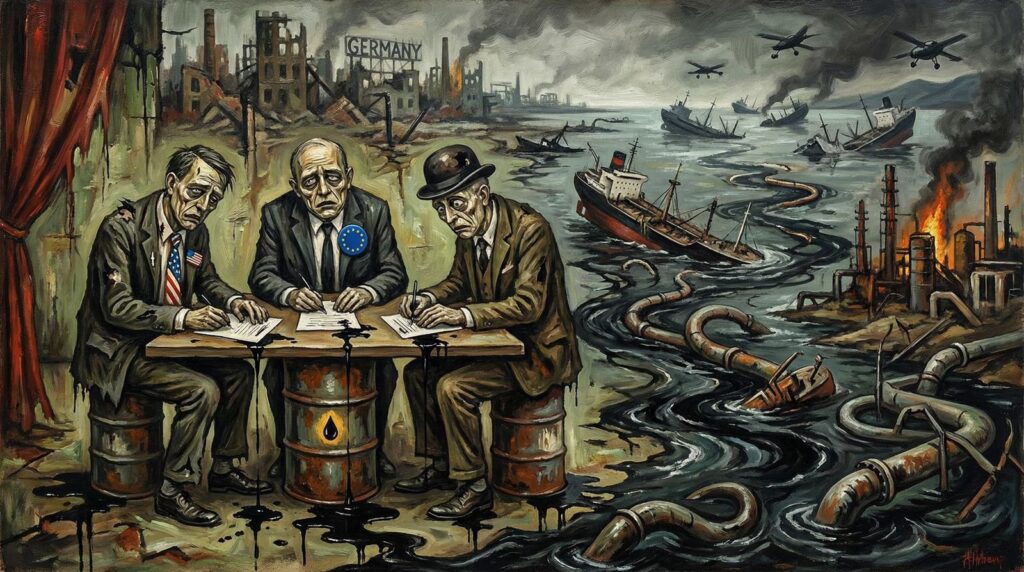
The West has backed itself into an energy‑and‑geopolitics death spiral: a Russia war it can’t win, an Iran war it can’t afford, and an energy system it no longer controls. The same capitals that spent a generation preaching “rules‑based order” are now improvising sanctions waivers and oil carve‑outs in a frantic effort to keep the lights on and the bond market calm.
Start with Europe’s self‑inflicted wound. For two decades, Germany’s entire export machine was a leveraged bet on cheap Russian molecules: high‑value manufacturing riding on low‑cost pipeline gas and predictable oil flows. “Decoupling” from Russia after 2022 didn’t just punish Moscow; it detonated the core cost advantage of German industry. Berlin tore up Nord Stream, nationalized bits of Russian energy infrastructure, and congratulated itself on moral clarity, then quietly rebuilt its energy system on expensive LNG, volatile spot markets, and green fairy tales that don’t keep BASF or the Mittelstand competitive.
Then the Iran war hit, and with it a semi‑permeable blockade of the Strait of Hormuz. Not a clean, one‑off closure markets can rapidly reprice, but a messy, politicized choke: some “non‑hostile” ships slip through, hundreds of tankers idle at either end, insurance see‑saws by the week, and each escalation cycle threatens physical infrastructure. It’s the worst of all worlds, enough flow to sustain denial, enough disruption to embed a structural risk premium into oil and gas.
Layer on Ukraine. EU countries bankroll Kyiv. Ukraine, understandably, uses its one asymmetric lever (cheap, long‑range drones) to hammer Russian refineries, export terminals, and storage. Russia responds by ring‑fencing domestic fuel: gasoline exports are banned to protect its own market, while damaged plants struggle to restart under sanctions on Western equipment and technology. Quietly, a non‑trivial slice of refined product disappears from the global system exactly when the Hormuz bottleneck is tightening freight and insurance costs.
Who gets hurt? Ironically, some of Russia’s biggest fuel customers, especially NATO member Turkey, will be hit hardest: the cheap barrels thin out, the arbitrage games that have cushioned Europe start to fail, and Ankara is forced to bid up alternative supply in the same Atlantic and Med product pool as everyone else. But the pain does not stop in Turkey. Product prices in Europe spike; gasoline and diesel push higher; electricity costs follow. The EU set out to “punish” Moscow and “support” Ukraine; it ends up recreating a 1970s‑style stagflation trap in its own backyard.
Germany is the poster child. It feels this twice over: as an import‑dependent energy buyer and as the industrial core of Europe. Higher fuel and power costs further erode German manufacturing competitiveness and deepen an already visible drift toward de‑industrialization. Energy‑intensive sectors cut or relocate production. What Berlin calls “values‑based foreign policy” is, in practice, a structural tax on German industry and households. You’d think a country that just lived through one Russian gas shock would be looking for ways to shut down the Ukraine front and normalize energy relations with the Eurasian landmass. Instead, ingrained hostility toward the East and a political class addicted to moral theatrics keep doubling down on sanctions and escalation, while German voters fund the bill in lost jobs and higher utility bills.
The UK manages, as usual, to be even more absurd. London went maximalist on Russia sanctions, throttled its own North Sea production with taxes and regulatory hostility, and now relies heavily on imported LNG just as Hormuz is compromised and Middle East risk explodes. It gets the moral preening of “standing up to Putin” and the very practical reward of structurally higher energy bills, weaker growth, and another lost decade dressed up as “resilience.” British Russophobia delivers exactly what you’d expect: self‑inflicted energy vulnerability in a country with actual hydrocarbons under its own seabed.
And then there is Washington, the architect of this madness. For two decades, U.S. Iran policy has been marketed as a security necessity; in practice it has become a machine for destabilizing the very energy system on which the U.S. and its allies depend. “Maximum pressure” on Iran means periodic threats to choke off Iranian exports and constrain shipping around Hormuz, followed by emergency waivers and general licenses when gasoline prices and inflation get uncomfortable. Sanctions are tightened to look tough, loosened to cap prices, then tightened again to appease hawks. This is not strategy; it is domestic political theater transplanted onto the global oil market.
The result is a policy that simultaneously harms the U.S. economy, undercuts its allies, and destabilizes the Asian growth engine that props up global demand. Europe gets hit with a second energy shock just as it tries to climb out of the first. Germany and the UK absorb higher input costs, slower growth, and a politics increasingly hostile to the very Atlanticist consensus that created this mess. Brussels and Berlin keep talking about “strategic autonomy” while aligning themselves with a U.S. Iran posture that makes European energy insecurity permanent.
For India, the picture is just as perverse. Delhi rebuilt its energy security on discounted Russian crude and once relied heavily on Iranian barrels and Chabahar as strategic hedges. Every U.S. sanctions twitch against Iran and Russia pushes India deeper into exposure: higher global benchmarks, more fragile shipping through Hormuz, and constant risk that some secondary‑sanctions crusade will snarl payments or insurance. India ends up paying more for energy, juggling subsidies and tax tweaks, and sacrificing growth to stay on the right side of someone else’s domestic politics.
And Asia as a whole is where this lunacy bites hardest. Japan, South Korea, and much of ASEAN are acutely dependent on Middle Eastern crude and LNG. A semi‑blocked Hormuz and a risk‑laden Gulf are existential vulnerabilities, not seminar topics. China, despite its arsenal of buzzwords about self‑reliance, is still deeply reliant on imported oil and gas. A chronic sanctions‑driven risk premium on energy and shipping is a tax on Chinese and broader Asian growth, and by extension, a tax on the global disinflationary engine that kept Western living standards politically sustainable for three decades. For poorer Asian importers, higher fuel and fertilizer prices are not macro curiosities; they are regime‑risk events.
Going forward, the implications are brutally clear:
-
Energy fragmentation accelerates. Asian states will double down on bilateral supply deals, non‑Western insurance and shipping, and alternative currencies for energy trade, not because they love Tehran or Moscow, but because they no longer trust Washington and Brussels not to weaponize their energy lifelines for domestic signaling.
-
Global stagflation risk becomes structural. If Asian growth has to operate with permanently higher energy costs and chronic shipping risk, the world loses its main shock absorber. Goods get pricier, supply chains less elastic, and every attempt by Western central banks to engineer a clean easing cycle runs into a commodity wall.
-
Western financial leverage erodes. The more Washington uses sanctions to jerk around global energy flows, the stronger the incentive for Asia and the Global South to build payment and clearing systems that route around the dollar and euro. Over time, that drains liquidity and political leverage from the very system that underwrites U.S. power.
-
Strategic realignment deepens. If you’re sitting in Delhi, Beijing, Jakarta, or Seoul, the message is simple: the U.S. and EU are willing to risk your energy security and growth to preserve their narratives about Iran and Russia. That pushes you toward a cooler, more transactional relationship with the West, and toward hedging arrangements with the very “rogue” producers the West is trying to isolate.
The bitter punchline is this: in combining maximalist Russia sanctions, a self‑sabotaging Iran policy, and a performative commitment to “support Ukraine for as long as it takes,” the West has engineered a world in which oil grinding toward $200 is not a remote tail risk but a logical outcome. It is punishing Russia and Iran at the margins, but it is punishing its own middle classes, allies, and long‑term strategic position far more reliably.
You don’t lose a world order in one dramatic moment. You lose it like this: waiver by waiver, embargo by embargo, moral speech by moral speech, until one day you look up and realize the system you thought you ran is being redesigned in Asia, priced in someone else’s currency, and secured by someone else’s navy.
Related reading
- How the Tehran and Delhi Settlements Expose a Petrodollar Already Gone, Gone, Gone, Taking the Bellicose American Empire With It.
- Never Is Hope So Pure As In The Certainty Of Loss: UAE's OPEC Exit and the Structural Dissolution of the Petrodollar
- Five Damned Good Reasons the Loss of the Petrodollar Means the Death of the American Empire
- The Petrodollar Trap: How the Iran War Threatens to Collapse the Financial Architecture of the American Empire