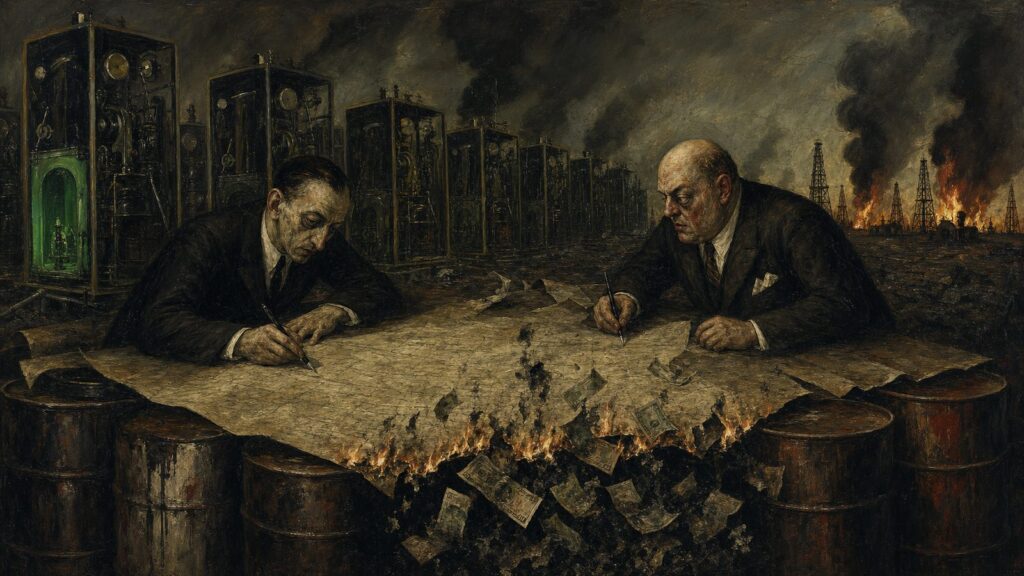
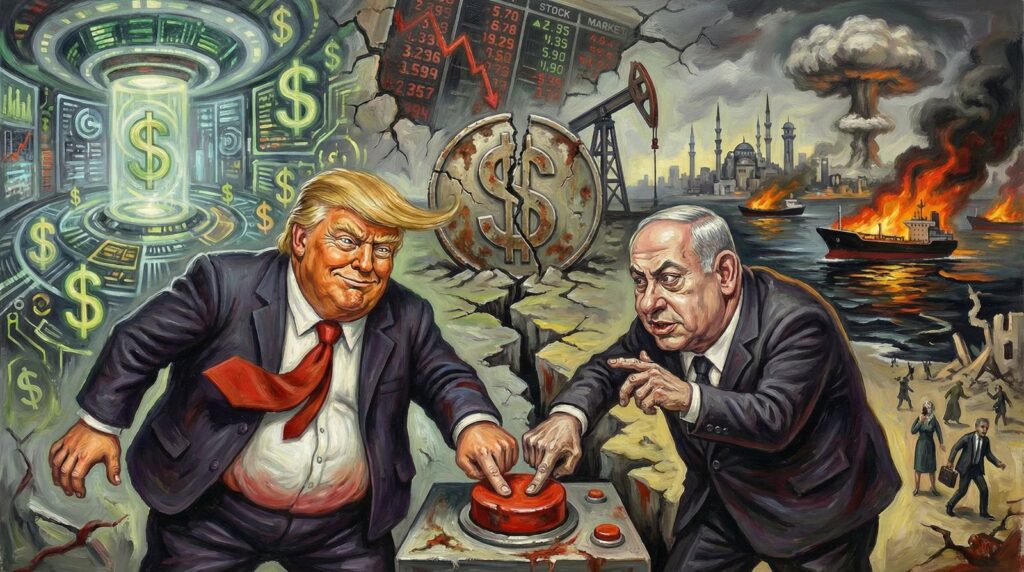
“You go first, Donald. No, you, BiBi.” They made the choice to blow up Iran, taking the petrodollar and America’s AI future with it.
By Scott Ortkiese | Throughline Synthesis | April 3, 2026
so@throughlinesynthesis.com | www.throughlinesynthesis.com
There is a geography argument circulating in macro and geopolitical circles right now. It is elegant, historically literate, and structurally coherent. It goes something like this: the maritime system that rose on the ruins of Beirut, with Dubai at its apex and Hormuz as its spine, was always fragile. A single chokepoint. An irresistible lever for whoever sat beside it. The land routes that geography always preferred are now reasserting themselves; capital and energy will flow from the Gulf through Iraq, Syria, and Lebanon to the Eastern Mediterranean, and Athens, dominant in global tanker shipping, rises as Dubai recedes.
The thesis is correct. The geography was always right.
Two men destroyed it anyway. Their names are Trump and Netanyahu.
But geography does not explain why. And the explanation matters enormously, because without it, the thesis reads as inevitable structural evolution rather than what it actually is: the wreckage of a deliberate, documented, and entirely avoidable catastrophe, executed at the cost of tens of millions of human lives, for reasons that had nothing to do with national security and everything to do with two men’s personal political survival. The deeper story is not about geography at all. It is about a death pact, one Trump himself authored, between the petrodollar recycling loop and the American AI boom he swore would define his legacy. He destroyed both in the same month. Understanding how requires understanding how tightly they were fused.
The Chokepoint Everyone Saw Coming
Every serious strategist, every energy economist, every naval planner, every geopolitician for the last fifty years has known the same thing: twenty percent of the world’s seaborne oil, seventeen million barrels per day, transits a strait that is twenty-one miles wide at its narrowest point. The Strait of Hormuz is not a vulnerability that was discovered. It is a vulnerability that was documented, modeled, war-gamed, and published in classified Pentagon briefings, in Brookings Institution papers, in the pages of Foreign Affairs, and in every serious energy security analysis written since the 1973 oil shock.
Bob McNally, who served as Senior Director for International Energy on the National Security Council under George W. Bush and who war-gamed a Hormuz closure scenario with military officers eight months before the first bomb dropped, identified the central planning failure afterward with clinical precision: the false belief that the Strait of Hormuz would be left untouched by the conflict. That belief was not an intelligence failure. It was a choice to ignore what every serious analyst already knew, because the political performance required a quick, clean victory and the strategic reality offered neither.
The question was never whether the Strait was the Achilles heel of Western energy dominance. Everyone in the room knew it was. The only strategically serious question was what kind of recklessness would be required to trigger the one scenario every energy security framework had spent fifty years trying to prevent.
We got our answer on February 28, 2026.
Geneva Was the Answer. Bombs Were the Response.
The Omani foreign minister had personally told the American Vice President that the parties were this close to a deal. Iranian Foreign Minister Araghchi was in Geneva, saying, “I am here with real ideas to achieve a fair and equitable deal.” The International Atomic Energy Agency (IAEA) director was in the room. The Omani mediator flew to Washington after a session on February 26th, elated, and told the Vice President: we almost have a deal. He then went public on CBS, confirming Iran had already agreed to zero uranium enrichment, even for civilian purposes.
Marco Rubio was publicly saying the president “always prefers peaceful outcomes.”
Within hours, the bombs fell.
Not because intelligence indicated an imminent Iranian nuclear weapons breakout. Tulsi Gabbard, as Director of National Intelligence, had testified before Congress in March 2025, under oath, reiterating verbatim what all sixteen U.S. intelligence agencies had unanimously concluded with high confidence since November 2007: Iran stopped any weapons-related nuclear activity at the end of 2003 and had not resumed it. Not because a red line had been crossed. Not because diplomacy had been exhausted. Because two men, one facing criminal indictment the moment he leaves office and one facing a domestic political crisis fueled by the catastrophic failure of his Gaza strategy, chose war over peace to save themselves, not their countries.
That is not a strategy. That is a war crime.
Professor John Mearsheimer stated without equivocation: “There is overwhelming evidence that the lobby and Israel itself helped in a major way to push the United States into this war.” Speaker Mike Johnson said so on the record. Lindsey Graham bragged publicly that he worked with Netanyahu to advise him on how to convince Trump to attack Iran. The Brookings Institution published Which Path to Persia? in 2009, laying out every option for Iranian regime change, and the United States executed that document chapter by chapter across four administrations. The peace talks were never meant to succeed. Jeffrey Sachs, the day the bombs fell, called it “a war of naked aggression” and “a complete and utter breakdown of competence.” The Chairman of the Joint Chiefs told Trump in January there was no viable strategy. Trump launched it anyway.
What the Closure of Hormuz Has Already Done
When Iran closed Hormuz, not metaphorically and not as a negotiating threat but with mines, anti-ship missiles, and drone swarms the U.S. Navy did not model and cannot currently defeat at scale, it did not close a trade route. It closed the circulatory system of the global economy.
The numbers are not abstractions.
Oil surged past $119 a barrel within weeks, with Goldman Sachs and JPMorgan modeling $150 to $190 as the sustained range and $200 if Iran’s Kharg Island export terminal is struck. Wood Mackenzie puts $150 as its base case, with $200 described as not out of the question by late 2026. Iraqi production collapsed from 4.3 million barrels per day to roughly 1.6 million. Saudi Arabia’s Ras Tanura refinery, one of the world’s largest, was taken offline by Iranian missile strikes. The Qatar Ras Laffan LNG complex, three times the size of Paris, built over thirty years at a cost of hundreds of billions of dollars, supplying one-third of the world’s chip-making helium, was struck and will take three to five years to repair.
Theodore Postol, MIT professor of Science, Technology and National Security and the foremost authority on missile defense systems, confirmed in March 2026 that Iran’s ballistic missiles are now equipped with maneuvering warheads, rocket-assisted terminal acceleration, and electronic countermeasure decoys that exceed every intercept system deployed against them. The THAAD radar systems that were supposed to protect American assets, of which perhaps thirteen exist in the entire world, are being systematically destroyed. Interceptor stocks are nearly exhausted. Intercept rates have been a few percent at most. U.S. bases in the Gulf are now being defended with conventional guns because the interceptors have run out. Postol has stated directly: he is becoming extremely concerned that we are walking into a global nuclear war.
And this is month one.
The Death Pact: How the Petrodollar and the American AI Boom Were Fused, and How Trump Destroyed Both
This is the section the geography thesis cannot write, because it requires understanding the internal architecture of American financial power before the war began. The petrodollar and the American AI boom were not merely correlated. They were structurally fused in a financing loop so tight and so specific that severing one was always going to collapse the other. Trump severed both simultaneously.
Start with the loop itself.
Professor Jiang Shigong described the mechanism with precision: “The Gulf States sell oil, get petrodollars, and then they recycle it back into the American economy, mainly by investing into AI, into data centers, which is now the main engine of growth for the American economy.” This was not a figure of speech. GCC sovereign wealth funds collectively manage nearly $6 trillion, over 40 percent of the global total. In 2025 alone, Gulf funds invested $70 billion into US AI and technology companies, a fivefold acceleration from the prior year. The UAE’s MGX formed a partnership with BlackRock, Microsoft, and Global Infrastructure Partners to raise up to $100 billion for data center infrastructure. Microsoft committed $15.2 billion in UAE investments through 2029, including nearly tripling its deployment of advanced NVIDIA chips in the country. Saudi Arabia’s Public Investment Fund had become one of the most active investors in American technology infrastructure on the planet.
This was the recycling loop in its most evolved form. Gulf states sell oil priced in dollars. The dollars flow into sovereign wealth funds. The sovereign wealth funds flow into American AI infrastructure. The AI infrastructure generates returns denominated in dollars. The dollar remains the world’s indispensable currency. The United States runs $40 trillion in debt at rates the rest of the world finances. The loop closes. Repeat.
Trump stood at the White House in January 2025 and declared Stargate, $500 billion in AI infrastructure, the economic achievement of his presidency. He was not wrong about the strategic logic. He was describing the same loop Jiang described, just from the receiving end. What he did not say, because he did not understand it, was that the loop depended on the physical security of the very chokepoint he was about to bomb.
Now understand what the AI infrastructure pipeline looked like even before the war began. Sightline Climate, tracking 777 large data centers and AI factories announced since 2024, found that only about 5 gigawatts of the roughly 16 gigawatts projected to come online in 2026 was actually under construction when the war began. The remaining 11 gigawatts sat in the announced phase with no visible construction progress. Separately, capacity under construction in the US had already fallen to 5.99 gigawatts at the end of 2025, down from 6.35 gigawatts the prior year, the first contraction since 2020. In 2025 alone, 25 data center projects were canceled due to local opposition, four times as many as 2024, accounting for at least 4.7 gigawatts of planned electricity demand. At least $156 billion across 48 publicly disclosed projects faced blocks or delays from coordinated community opposition. Gartner projected that power shortages would restrict 40 percent of AI data centers by 2027 even in a world without a war in the Persian Gulf.
The pipeline was already fragile. The war shattered it.
Since the Hormuz closure, 30 to 50 percent of the entire 2026 US data center pipeline is now at risk of not materializing before year end. The reasons compound on each other with no relief valve in sight.
The Ras Laffan helium supply, which fed the cryogenic cooling systems of chip fabs in South Korea and Taiwan producing the High Bandwidth Memory modules that power every major AI inference cluster on the planet, was severed in the opening days of the conflict and will not be restored for three to five years. South Korean and Taiwanese fabs producing the chips American AI depends upon are now running on emergency reserves with a calculable depletion date. A single AI-related task consumes up to 1,000 times more electricity than a traditional web search; the grid was already collapsing under existing demand before an oil shock drove energy costs to levels that make new data center construction economically indefensible in half the markets where it was planned. The tariff and supply chain disruptions Trump created simultaneously drove up the cost of specialized transformers, cooling equipment, steel, and concrete that data center construction requires. Delivery timelines for large power transformers had already stretched to two to three years before the war. They are now longer, more expensive, and more uncertain.
The AI financing structure itself was already structurally insolvent before the first bomb fell. OpenAI was projected to burn $14 billion in 2026, up from $8 to $9 billion in 2025. Anthropic’s margins were described in industry reporting as deeply negative. The prices being charged for AI services today do not cover costs. The entire AI boom has been running on the assumption that Gulf sovereign wealth would continue financing the buildout until scale made the economics work. With the Strait closed and GCC oil exports halted, those funds are no longer generating petrodollars. They are in capital preservation mode. The marginal price-setter in American equity markets is leaving. The recycling loop has stopped recycling.
MacroEdge chief economist Don Johnson stated directly: Trump “is going to be scrambling for his next engine as the data center [boom] winds down as a tailwind.” That is the polite version. The precise version is this: the last engine of American economic growth ran on a fuel supply Trump bombed, in service of a foreign government’s regional objectives, without a plan for what came next and without the capacity to rebuild what he destroyed.
An Amazon data center in the UAE was struck by an Iranian drone in the opening hours of the war. The symbolism was not subtle. Neither was the math. Trump promised to build the future. He destroyed its supply chain, its energy infrastructure, its capital base, and its geopolitical foundation, all in the same month, while calling it a victory.
The Geography Was Right. The Politics Are Catastrophic.
The land corridor argument, rehabilitate the Iraq-Syria-Lebanon route to the Eastern Mediterranean, collect transit fees from micro-states along the way, let Athens redistribution networks absorb the new flows, is structurally logical. Geographically inevitable, even, if you take a hundred-year view.
But the corridor does not build itself. It requires political stability across three of the most deliberately destroyed societies in human history.
Iraq: whose governance was dismantled in 2003 by the same Washington that is now bombing its neighbor, whose oil infrastructure is now at 37 percent of pre-war capacity. Syria: whose reconstruction has not begun, whose territory is controlled by at least four separate armed factions, whose infrastructure was destroyed across fifteen years of conflict underwritten by the same Washington-Riyadh-Tel Aviv axis now prosecuting the Iran war. Lebanon: whose banking system collapsed in 2019, whose port was destroyed in 2020, whose political system cannot form a government capable of negotiating a pipeline transit agreement, let alone enforcing one.
These states were not randomly fragile. The Oded Yinon Plan, published in the World Zionist Organization’s journal Kivunim in 1982, named them explicitly: fragment Iraq, Syria, Lebanon, and Saudi Arabia into competing ethnic and sectarian micro-states incapable of unified action against Israeli regional hegemony. Colonel Lawrence Wilkerson, former Chief of Staff to Colin Powell, described Netanyahu’s objective with unsettling directness: chaos, total chaos, running rampant over the entire Levant from Turkey to Eastern Africa. The geography thesis presents the dissolution of the Sykes-Picot map as organic structural evolution. It is not evolution. It is the planned demolition of states, executed across four American administrations, with American ordnance and American taxpayer dollars. Calling it evolution lets the demolition men off the hook. The demolition men are still in office. They are still signing defense budgets.
The Dollar System Washington Is Replacing Itself
The geography argument’s deepest implication is what Dubai’s recession means for the dollar system that Dubai embodied, and whether that system finds a new home or simply ends.
Michael Hudson, who spent decades at Chase Manhattan modeling the balance-of-payments architecture of the dollar system before writing Super Imperialism, the text the Pentagon purchased as a planning manual, has been precise about what follows a break in the petrodollar recycling loop: the chains of payments lead to defaults, and defaults produce the exponential contraction of credit that is the mechanical definition of a depression. The geography thesis describes a world in which capital follows new flow routes to the Eastern Mediterranean. Hudson describes a world in which there is less capital to follow anything, because the system that generated the appearance of capital is being physically destroyed at the same moment it was already financially unwinding, on top of a $40 trillion debt pyramid meeting interest rates it cannot service without the recycling loop running.
Project mBridge, a cross-border digital currency platform settling international payments without touching SWIFT, without routing through correspondent banks, without using US dollars, has processed over $55.5 billion in cumulative transactions, a 2,500-fold increase since its 2022 pilot. Saudi Arabia, the nation whose 1974 agreement with Nixon and Kissinger created the petrodollar system, is now an active participant in the platform designed to make that arrangement obsolete. China’s CIPS payment system connects participants across 119 countries. Russia’s SPFS links 160 foreign banks in over 20 countries. Vladimir Putin confirmed at the 2025 BRICS summit that 90 percent of all transactions between Russia and other BRICS member states are now settled in national currencies, up from 26 percent just two years earlier.
Iran has made the message from the Strait explicit. It is now telling every tanker seeking Hormuz passage: bring yuan. Eight countries are in active negotiations on yuan-denominated passage arrangements. The Strait of Hormuz is now a toll gate, and Tehran owns it. The war that was supposed to end Iranian influence over the region’s energy architecture has formalized and monetized it. Washington did not merely bomb a trade route. It bombed its own operating system and handed the administration of the chokepoint to the adversary it was trying to destroy.
Central banks are confirming the verdict in their reserve decisions. In 2025, central banks purchased 863 tonnes of gold, the fourth-largest annual expansion on record. Gold overtook US Treasuries as the largest reserve asset held by central banks on a mark-to-market basis for the first time since 1996. China’s Treasury holdings ended 2025 at $683.5 billion, the lowest since 2008, after offloading $208.6 billion in long-term US financial assets. Thirty central banks in thirty countries making the same quiet decision: the asset that has backed the world’s monetary reserves for fifty years is no longer the safest place to hold value.
The Athens Thesis and the Insurance Market It Forgot
Greece’s dominance in global tanker shipping is real and structurally consequential. Greek shipowners control the largest share of the global tanker fleet. In the long run, five, ten, twenty years, the geography thesis is probably right that Athens becomes the redistribution node of a post-Hormuz Eastern Mediterranean energy architecture.
But tanker shipping does not move on geography alone. It moves on insurance.
War-risk premiums for vessels anywhere near the Persian Gulf conflict zone have become prohibitive. The Suezmax and VLCC tankers that would carry Gulf crude to Eastern Mediterranean ports are the same vessels whose owners are being asked to transit waters where Iranian anti-ship missiles, equipped with maneuvering warheads and electronic countermeasure decoys that exceed every intercept system deployed against them, have demonstrated range, accuracy, and saturation capacity the U.S. Navy did not model. Postol confirmed intercept rates have been a few percent at most and interceptor stocks are nearly exhausted. Greek shipowners will not transit a war zone that Lloyd’s of London will not insure at economically viable premiums.
The Athens thesis requires the war to end. The war is not ending. Mearsheimer stated without equivocation: we are now in a long war, a war of attrition the Iranians prepared for and are in an excellent position to prevail in. At every step up the escalation ladder, Iran has the ability, in Mearsheimer’s exact words, “to tank the international economy.”
The Countries Washington Left to Burn
The propaganda framing treats this as a bilateral conflict. It is nothing of the sort. What Washington actually did was blow up the energy security of every major Asian economy without a phone call.
Japan holds $1.23 trillion in US Treasury bonds, purchased in significant part because the petrodollar system required it to hold dollar reserves to buy the oil Washington just bombed. Japan received no warning, no consultation, and no offer of compensation. Prime Minister Takaichi told her cabinet Japan will exhaust its oil reserves in eight to nine months. Iran’s IRGC commander told NHK explicitly: Japanese tankers could pass freely if Japan stopped supporting America’s war. That is not diplomacy. It is a public extortion offer demonstrating, in real time, that Japan’s energy security now depends on Iranian goodwill rather than American protection. Former US Ambassador Rahm Emanuel stated plainly: “The president made a decision on Iran without consulting allies, and they’re bearing the brunt of it.”
India had 25 days of oil reserves when the Strait closed and faces a $15 billion immediate fiscal emergency for every $10 rise in crude. India’s pharmaceutical sector, which supplies approximately 40 percent of global generic medicines by volume, is absorbing simultaneous shocks to API costs, excipient costs, and transport costs as petrochemical supply chains fracture.
South Korea, whose semiconductor sector generated $173 billion in exports in 2025, is watching its chip fabs run down their helium reserves toward a cliff edge whose date is now calculable. Samsung and SK Hynix together produce approximately two-thirds of the world’s DRAM and NAND memory, including the High Bandwidth Memory modules that power every major AI data center on the planet. South Korea sourced 64.7 percent of its helium imports from Qatar prior to the conflict. That supply is gone for three to five years. Colonel Wilkerson predicted the loss of South Korea as a US ally within 24 months. The pulling of Patriot missile batteries from Seoul to the Persian Gulf made explicit what Seoul already knew: the only reason American forces are on the Korean peninsula is to fight China, not to protect Korea.
And 45 million additional people are projected to face acute hunger because the fertilizer did not ship during the planting window. Sudan sources over 54 percent of its fertilizer through the Strait of Hormuz. Somalia relies on Gulf sea imports for 30 percent. Kenya depends on them for 26 percent. The World Food Programme projects that if the conflict continues through mid-year, the global total facing acute hunger will exceed 363 million, surpassing the record set at the onset of the Ukraine war in 2022. The agriculture calendar does not pause for ceasefire negotiations. The famine arriving in the Global South is not a risk. It is a calendar event.
92 Million People. 2,500 Years of Civilization.
There is one more thing the geography thesis does not say, and it must be said.
The civilization Pete Hegseth texted about bombing “into the Stone Ages,” while diplomats were negotiating peace in Geneva, gave mankind its first declaration of human rights in 539 BC, two thousand years before the United States existed as a thought. It gave us the postal system. The word paradise. The theological architecture of monotheism: Satan, angels, heaven, hell, the resurrection of the dead, all Zoroastrian, all Persian, all migrated into Judaism during the Babylonian exile and from Judaism into Christianity and Islam. Cyrus the Great freed the slaves of Babylon and rebuilt the Jewish temple. The Cyrus Cylinder’s provisions parallel the first four articles of the UN Universal Declaration of Human Rights, adopted in 1948, 2,487 years later.
Nearly 1,443 verified civilian deaths, including 217 children, in the first month of bombing. Sixty hospitals struck. Forty-four schools. One hundred and twenty-nine residential buildings. Internet connectivity in Iran dropped to one percent of normal. Pete Hegseth had already dissolved the Pentagon unit responsible for civilian casualty verification before the first bomb fell. The men doing the bombing turned off the lights so the world could not fully see what they were doing.
You cannot bomb a civilization into submission. Colonel Douglas Macgregor said it plainly: Persia is 3,000 years old. That civilization is much older than the idea of America. Killing Khamenei has made him a martyr that even people who do not like Islam can honor. Former British diplomat Alastair Crooke called the killing “an incredible error of judgment” demonstrating “complete cognitive dissonance” about who Khamenei was and what he represented to the Shia world. The Iranian people who march nightly in the streets under airstrikes, in rain, in snow, during Eid prayers, are not rising up to welcome American liberators. Every bomb that falls on a school, every hospital whose nurses flee into the streets, every desalination plant taken offline galvanizes a population that knows exactly who is doing this and why.
The geography is rotating on its axis. The rotation is being accomplished by murdering children in a civilization 2,500 years older than the country doing the murdering. Say that plainly, or say nothing at all. Because every country in the Global South is saying it and filing it away for the next infrastructure deal it signs with Beijing instead of Washington.
The Verdict
The Achilles heel of the Western financial and energy system was not a secret. It was the most documented strategic vulnerability in modern geopolitics. Every president, every secretary of state, every national security adviser for fifty years knew exactly where it was and exactly what it would cost if it was triggered.
Trump and Netanyahu triggered it anyway. Not because they had exhausted the alternatives. Not because the intelligence demanded it. Not because their nations’ security required it. Because their personal political survival did. Netanyahu to stay out of prison. Trump to satisfy the donor architecture that purchased his congressional majorities. Miriam Adelson pledged $250 million toward Trump-aligned political operations. Saudi Arabia invested $2 billion in Jared Kushner’s private equity fund. AIPAC spent over $126 million in the 2024 election cycle on congressional races. The agents optimized their own payoff functions. The principals are paying for it in oil prices, famine, broken alliances, a canceled data center future, and the systematic demolition of the financial architecture that made American power possible.
The geography will correct itself. The land corridors will slowly rehabilitate. Athens will rise. Capital will find new routes. The dollar system will restructure, painfully, over a decade, with enormous human cost paid by people who had no vote in any of it.
But the death pact Trump set in motion cannot be unwound by a ceasefire. The petrodollar recycling loop that financed the AI boom does not restart the day the Strait reopens. The sovereign wealth funds that were doubling and tripling their US technology commitments are in capital preservation mode and will remain there through the end of the decade. The chip fab helium supply is gone for three to five years. The thirty central banks rotating out of US Treasuries and into gold are not rotating back. The 45 million people facing acute hunger did not plant a crop this season and will not eat next winter regardless of what the diplomats negotiate in the fall.
Trump promised to build the future. He made a death pact with the financing architecture that was the only thing capable of building it, and he signed the contract with a bomb.
The Greeks called the Persians barbarians.
History corrected them.
It will correct this too, in courtrooms, in midterm elections, in the long merciless memory of the nations that paid the price of two men’s cowardice, and in the quiet arithmetic of the central banks and sovereign wealth funds that are building the world that comes after the one Washington just destroyed.
Scott Ortkiese is an independent geopolitical analyst and journalist. He publishes at Throughline Synthesis and on Substack. This article draws on his prior reporting on the molecular supply architecture of the Persian Gulf, the petrodollar system’s structural collapse, the mBridge and CIPS alternative financial architecture, the economic and strategic dimensions of the Iran conflict, and the civilization history of the Persian Achaemenid Empire.
Related reading
- Five Damned Good Reasons the Loss of the Petrodollar Means the Death of the American Empire
- Brute Force Is Not Progress: The Trillion Dollar AI Bill Everyone Else Is Paying
- The Aluminum Pearl Harbor: Trump and Netanyahu Sank America’s Industrial Fleet
- Drill Baby, Drill: Why Geology and Physics Will Determine the AI Century