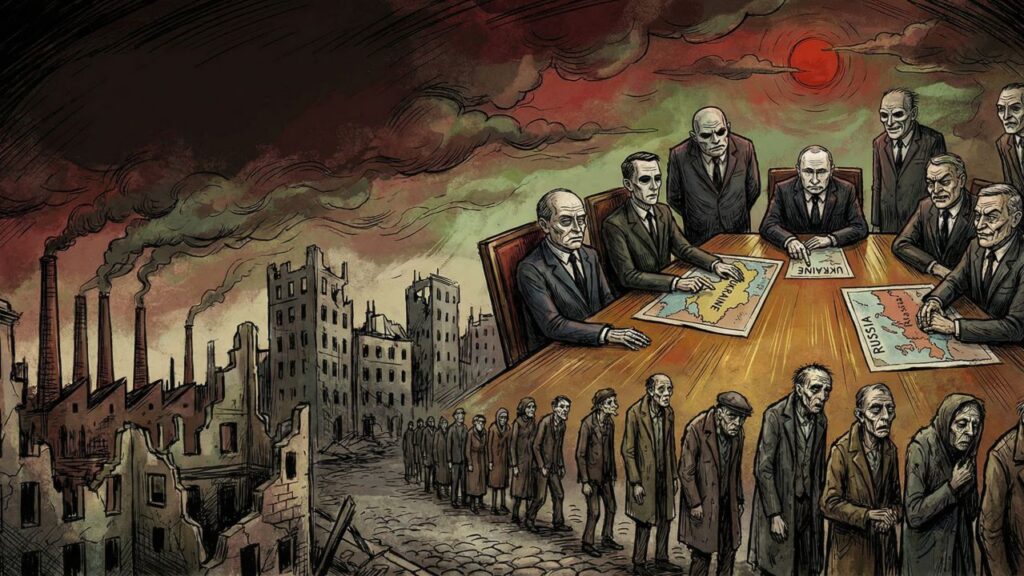
Europe is drifting toward a larger, more dangerous war with Russia because it refuses to confront the real causes of the current one. A stable peace in Ukraine will only be possible if it is embedded in a wider political and economic reset with Moscow, not reduced to another technocratic ceasefire formula.
For three decades, European leaders have walked away from the pan‑European security vision outlined in the Helsinki Accords and the Charter of Paris, replacing “indivisible security” with bloc politics and open‑ended NATO expansion. Each missed opportunity for an inclusive security order, from Moscow’s proposals for a pan‑European framework to ideas for an EU-Russia common space, deepened mistrust and pushed Russia out of the European architecture rather than into it. The result is a continent where the largest nuclear power is excluded from the main security forums, while officials congratulate themselves on holding “peace summits” without one of the belligerents in the room.
Against that backdrop, fast‑tracking Ukraine into the European Union without a parallel normalization with Russia risks hard‑coding a new Iron Curtain. The EU’s foreign and security policy has become so closely aligned with NATO that, from Moscow’s perspective, Ukrainian EU membership now looks like “NATO‑lite”, a hostile, militarized frontier in all but name. A bruised, impoverished, deeply antagonistic Ukraine inside such an EU would not be an anchor of stability; it would be a permanent forward operating base for the next round of confrontation.
At the same time, Europe is inflicting economic damage on itself by treating decoupling from Russia as a virtue rather than a cost. The deliberate shift away from relatively cheap Russian energy toward more expensive imports has driven de‑industrialization, factory closures, and a grinding cost‑of‑living crisis for ordinary Europeans. Reopening economic channels with Russia (energy, transport links, people‑to‑people contact) is not a gift to the Kremlin, but a prerequisite for Europe to arrest its own decline.
None of this can happen while European diplomacy remains captured by a single‑issue obsession with “defeating Russia,” personified in its over‑investment in Volodymyr Zelensky as both symbol and surrogate policymaker. Ukraine itself is shattered: demographically hollowed out, economically bankrupt, and in no position to sustain a vast standing army in peacetime without permanently sacrificing reconstruction. Yet European leaders continue to posture in public, cheering on maximalist demands and recycling war‑time rhetoric as if it were a long‑term strategy.
If Europe wants to avoid sleepwalking into a larger catastrophe, it will have to do the one thing its current elites seem determined to avoid: talk seriously with Moscow about a treaty‑based pan‑European security settlement that includes Russia, Ukraine, and the EU alike. That means moving beyond performative conferences and echo‑chamber summits, accepting that Russia cannot be wished out of the European security equation, and recognizing that Europe’s own stability now depends on the very normalization its leaders have spent the last decade condemning.
Related reading
- Germany's Reckoning: Jeffrey Sachs Documents Three Decades of Diplomatic Deception on Russia and Ukraine
- Misery Loves Company: How a Self-Destroyed UK Led Ukraine to Russian Roulette with All Chambers Loaded
- THE FORTY-DAY MASSACRE: How Boris Johnson Sabotaged Peace and Caused 1.3 Million Casualties for Personal Profit
- Manufacturing War: How the West Built and Sold the Russia-Ukraine War