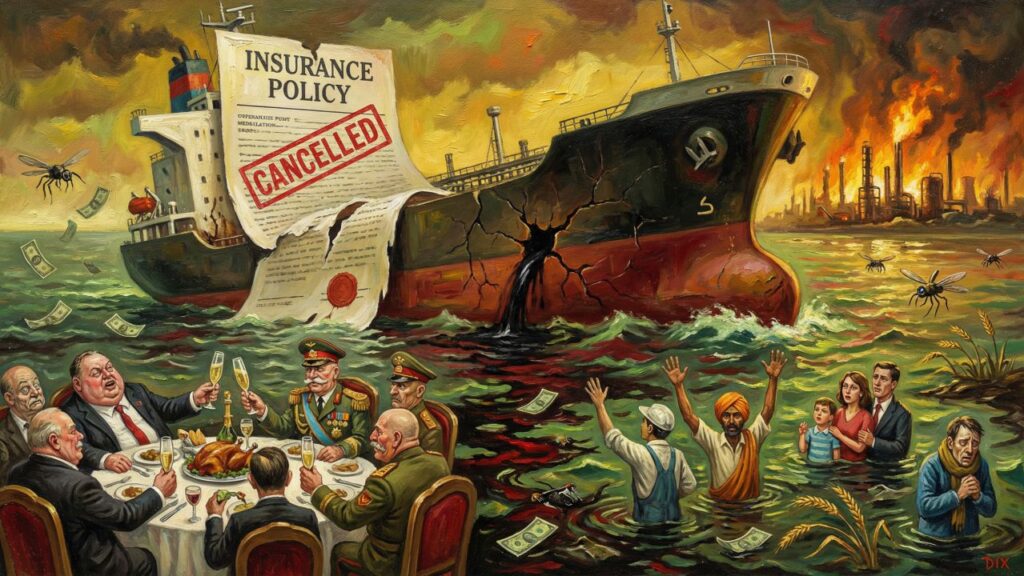
Energy, insurance, and shipping prices are skyrocketing
March 8, 2026
By Scott Ortkiese | so@throughlinesynthesis.com | www.throughlinesynthesis.com
From Spreadsheets to Sticker Shock
The insurance-driven closure of the Strait of Hormuz is not an abstraction confined to Lloyd’s of London trading floors. It is a cascading supply shock now propagating through the entire global economy, from the price of gasoline at the pump in Houston to the cost of fertilizer on farms in Brazil, from factory shutdowns in South Korea to gas rationing warnings in India. The mechanism is deceptively simple: when insurers withdrew war risk coverage in the first days of March 2026, approximately one-fifth of global oil supply and a comparable share of the world’s liquefied natural gas was effectively stranded behind an actuarial blockade. Within one week, the consequences had reached virtually every inhabited continent.
The disruption is not limited to hydrocarbons. The Persian Gulf is also the transit point for 27% of global ammonia exports, 22% of phosphates, and 45% of the world’s traded sulfur, essential raw materials for fertilizer production and, by extension, global food security. Container shipping services to and from the Gulf have been suspended by every major carrier. Air freight rates are surging as shippers scramble for alternatives. The cascading effects are arriving faster and hitting harder than most policymakers anticipated.
Yet the American public is hearing almost none of this. The media coverage of the Iran war has been, as one press critic described it, “credulous, stenographic, and feeble”. The conversation in the United States centers on military operations and Iranian missile intercepts. What is not being discussed, in any sustained or serious way, is the economic catastrophe that this war is engineering for hundreds of millions of people around the world, including Americans themselves.
The Energy Price Shock
Oil
Brent crude surged approximately 10% in the first 48 hours of the crisis, rising to around $80 per barrel, and has continued climbing toward $90. At its peak during the first week, it touched $92. Goldman Sachs raised its price target, projecting that oil could exceed $100 per barrel if the disruption persists. Gregory Daco, chief economist at EY-Parthenon, warned that prices could soar “more than $40 per barrel, climbing toward $110 and remaining above $100 through year-end”.
The immediate cause is straightforward: approximately 13 million barrels per day of crude oil typically transits the Strait, representing about 31% of all maritime crude transport globally. With Strait transits collapsing from 98 ships on February 28 to near zero by early March, and roughly 200 tankers stuck inside the Persian Gulf with diminishing capacity to load or discharge, the physical supply of crude to global markets has been sharply curtailed.
Saul Kavonic of MST Marquee put the scale in historical context: the de facto shutdown of the Strait of Hormuz is “three times the scale of the impact we saw in the energy crisis in the 1970s from the Arab oil embargo and the Iranian revolution”. Even if only half or three-quarters of Strait passage eventually returns, it will still constitute a global energy crisis on a scale not seen in a generation.
Natural Gas and LNG
The gas market shock has been even more violent. European benchmark natural gas (Dutch TTF) surged as much as 54% in a single session, from approximately €30/MWh to above €60/MWh, the largest jump since August 2023 and the highest level since early 2023. Asian LNG spot prices leaped nearly 39%.
The trigger: QatarEnergy, operator of the world’s largest LNG export facility at Ras Laffan, declared force majeure on all shipments after Iranian drone strikes damaged the facility and insurers cancelled war risk coverage for ships attempting to transit the Strait. Qatar accounts for roughly 20% of global LNG supply, approximately 77 to 82 million tonnes per annum. That supply has been removed from the market overnight.
Goldman Sachs estimated that a month-long halt to Hormuz shipping could cause European gas prices to more than double. The timing is devastating: European gas storage stands at approximately 30% of capacity, far below the 54% average for this time of year. The EU, which spent four years pivoting away from Russian pipeline gas toward a diversified LNG strategy anchored by Qatar and US exports, has discovered the Achilles’ heel of that strategy: its dependency on a single maritime chokepoint.
There is no relief valve. US LNG facilities are operating at near-full capacity. Australia’s plants are running at maximum rates with “almost no scope for pushing out additional LNG volumes,” according to Kavonic. The world’s LNG market had no spare capacity before this crisis, and now 20% of supply has been deleted.
What Americans Pay at the Pump
US gasoline prices jumped 11 cents overnight on March 4 to a national average of $3.19 per gallon, the largest single-day increase since Russia’s invasion of Ukraine in March 2022. Prices had already risen 35 cents per gallon from mid-February levels. GasBuddy projects the national average will climb to $3.30, $3.35 in the short term, wiping out all price declines since Trump took office.
If crude reaches $100 per barrel, pump prices would rise another 60 cents per gallon. At $130 per barrel, a scenario some forecasters consider plausible, the San Francisco Bay Area, already at $4.83, could see prices exceeding $6.00. As energy analyst John Kilduff of Again Capital put it: “If crude oil is the flour, gasoline’s the cake, and the price of flour is going up by a lot”.
Stagflation, Recession, or Something Worse
The Fed Trap
The Iran war did not arrive in a vacuum. The US economy was already flashing warning signals before the first bomb fell. GDP growth in the fourth quarter of 2025 came in at just 1.4% year-over-year, badly missing estimates of 2.8%. The producer price index rose 0.8% in January, well above the 0.3% expectation, signaling persistent wholesale inflation. Then the February jobs report landed: the economy lost 92,000 jobs, the second-largest monthly decline since January 2025, against expectations of a 59,000 gain. The unemployment rate rose to 4.4%.
This is the worst possible environment for an oil shock. The Federal Reserve now faces what economists call a “trap”: inflation is running above target, oil prices are surging, and yet the economy is shedding jobs. If the Fed cuts rates to support employment, it risks fueling inflation. If it holds rates steady or raises them, it risks accelerating the recession. Former Treasury Secretary Janet Yellen said the conflict “makes the Fed even more cautious, less inclined to reduce rates than they were prior to these developments”.
The Stagflation Specter
Mohamed El-Erian, one of the most widely followed economists in the world, wrote that “the cumulative effect of these disruptions is a fresh potential bout of stagflation blowing through the global economy”. Mark Zandi, chief economist at Moody’s Analytics, was more direct: “There is no economic benefit to any of this, as the elevated oil prices will hinder growth and escalate inflation. This will exacerbate affordability issues for Americans and complicate monetary policy”.
Société Générale modeled the scenario: if oil prices remain above $90 a barrel for at least three months, global inflation could rise by a full percentage point while global growth drops by 0.2 percentage points. MSCI’s stagflation scenario, built around a sustained Strait of Hormuz disruption, projects US equities falling 13%, with both stocks and bonds declining simultaneously.
The 1970s comparisons are now everywhere. But there is a crucial difference that makes today’s situation potentially more dangerous. When Paul Volcker broke stagflation in the early 1980s by raising interest rates to 20%, the US debt-to-GDP ratio was 35%. Today it exceeds 120%. The fiscal headroom that allowed the Volcker shock, a severe but ultimately effective recession, simply does not exist. The tool that ended 1970s stagflation is not available in 2026.
Rosenberg’s Darker Scenario
Not all economists agree that stagflation is the most likely outcome. David Rosenberg, president of Rosenberg Research, argues that the oil shock will not produce sustained high inflation. Instead, he sees something grimmer: a demand collapse. Higher oil prices will squeeze consumers so severely that spending will contract, and inflation will eventually “come crashing down by the end of the year”. The problem, in Rosenberg’s framing, is not that prices stay high. It is that the economy slows so dramatically that prices eventually fall because nobody can afford to buy anything.
This is the deflation-through-depression pathway. It may avoid the “stagflation” label, but the lived experience for working families, rising unemployment, collapsing consumer confidence, businesses shuttering, is arguably worse.
Who Gets Hit Hardest: A Global Breakdown
The Hormuz disruption does not affect all nations equally. Vulnerability depends on three variables: dependence on Gulf oil, dependence on Gulf LNG, and strategic reserve depth.
The vulnerability hierarchy is stark. Japan sources 95% of its oil from the Middle East, roughly 70% of which transits Hormuz, and holds eight-plus months of oil reserves but only three weeks of LNG if all imports halt. South Korea imports 75% of its oil from the Middle East and 70% via Hormuz, with seven months of oil reserves but extreme exposure through its petrochemical sector. India draws 60% of its oil and 45-53% of its LNG from the Gulf, but holds only about 10 days of crude inventory plus a week of fuel stocks, making it acutely vulnerable to a dual price shock on both oil and gas. Chinasends roughly 40% of its oil imports through Hormuz and sources 30% of its LNG from Qatar and the UAE, but possesses the world’s largest strategic petroleum reserve, giving it a larger buffer. Europe depends on the Strait for 12-14% of its LNG supply, and with gas storage at just 30% of capacity, faces a severe gas price crisis. The United States has minimal direct Hormuz exposure but absorbs the full impact through global oil price transmission and, as economist Justin Wolfers noted, “the US has led this war, but today it’s increasingly clear that the biggest economic impacts, at least among industrialized countries, aren’t going to be felt here,” meaning the geopolitical blowback will be immense even if the direct economic hit is smaller. Singapore, as a refining and transshipment hub, faces both direct supply disruption and secondary port congestion. And Australia, despite being a net energy exporter, has almost no spare LNG production capacity to help fill the global gap.
Japan: The Most Exposed Major Economy
Japan is structurally the most vulnerable industrialized nation. Approximately 95% of its oil imports originate from the Middle East, with around 70% transiting the Strait of Hormuz. Prime Minister Sanae Takaichi told parliament the government would “take every possible measure to ensure the stable supply of energy for our nation”.
Japan’s strategic petroleum reserves provide approximately eight months of coverage if only Hormuz-transiting oil is disrupted. But LNG reserves tell a different story: Japan’s stockpiles would last only about three weeks if all imports were halted. Japanese shipping giant Mitsui OSK Lines has already suspended vessel crossings of the Strait. Petrochemical companies Maruzen Petrochemical and Mitsui Chemicals have cancelled second-half April naphtha import tenders.
South Korea: Petrochemical Nerve Center at Risk
South Korea imports approximately 75% of its oil from the Middle East and is Asia’s largest importer of Middle Eastern naphtha, with 54% of its naphtha supply transiting the Strait of Hormuz. The Korea International Trade Association has estimated that a 10% increase in oil prices would raise import costs by 2.68%.
The petrochemical sector is already buckling. Yeochun NCC (YNCC), one of the country’s major ethylene producers, has declared force majeure and is cutting cracker operating rates. Major buyers including Lotte Chemical, LG Chem, GS Caltex, and SK Energy are weighing whether to secure alternative naphtha cargoes from the US or South Asia at significantly higher freight costs, or simply reduce operations.
India: The Dual Shock
India faces what analysts call a “dual shock”: rising oil import costs compounded by surging LNG contract prices, many of which are indexed to Brent crude. Over 60% of India’s oil imports come from the Middle East, and approximately 45-53% of its LNG comes from Qatar. India has issued warnings of industrial gas rationing.
India’s particular vulnerability is LPG (liquefied petroleum gas). The country imports 80-85% of its LPG needs, almost entirely from Gulf suppliers transiting Hormuz, and maintains no strategic LPG reserves of comparable scale to its oil reserves.
China: Buffered but Not Immune
China possesses the world’s largest strategic petroleum reserves and has diversified its supply chains more aggressively than its Asian neighbors. Yet approximately 40% of its oil imports still transit the Strait of Hormuz, and 30% of its LNG comes from Qatar and the UAE. China is also the destination for roughly 90% of Iran’s crude exports, a relationship now directly disrupted.
Beijing has already ordered its largest refiners to halt diesel and gasoline exports to prioritize domestic supply. Chinese methanol-to-olefins plants, which import large volumes of Iranian methanol, face unavoidable disruption.
Europe: The LNG Strategy Exposed
The EU receives 12-14% of its LNG from Qatar through the Strait. The European Commission has reactivated its Energy Task Force, but options are limited. With gas storage at 30% of capacity, well below the seasonal average, the EU faces a bidding war with Asian importers for scarce Atlantic Basin LNG cargoes.
The irony is acute. Europe spent four years and hundreds of billions of euros building LNG import terminals and signing long-term supply contracts to reduce dependency on Russian pipeline gas. The Hormuz crisis reveals that swapping pipeline dependency for LNG dependency merely traded one geopolitical vulnerability for another. The ECB, which was badly burned by initially dismissing inflation as “transitory” in 2022 when it eventually soared past 10%, is now watching the oil shock with acute anxiety, determined not to repeat the same mistake.
The $1 Billion-a-Day War the American People Didn’t Ask For
The Direct Cost
The Center for Strategic and International Studies estimated that Operation Epic Fury cost $3.7 billion in its first 100 hours alone, or approximately $891 million per day. The Center for American Progress calculated that costs reached $5 billion by March 2, with the campaign “just getting started”. The Pentagon has reportedly drafted a $50 billion supplemental budget request to replace Tomahawk and Patriot missiles, THAAD interceptors, and other equipment used or damaged in the first week.
The Penn Wharton Budget Model projects total costs of $40 billion to $95 billion for a two-month conflict in direct military expenditures. When trade and energy market disruptions are included, the total economic impact on the United States alone could reach $50 billion to $210 billion.
To put that in perspective: the National Priorities Project calculated that the estimated $1 billion per day being spent on this war, annualized, is higher than the appropriated budget of any federal agency except the Pentagon itself. That daily expenditure could cover federal nutrition assistance (SNAP) for more than 40 million Americans, or daily Medicaid costs for the 16 million people expected to lose health coverage due to last year’s Republican budget cuts. A single Tomahawk missile, at $2.2 million, could cover 775 children on Medicaid for a year.
These expenditures are unfunded. As CSIS noted, “only a fraction of the estimated $3.7 billion was accounted for in the existing budget, leaving the majority of the costs, around $3.5 billion, unplanned”. Congress will eventually face a supplemental spending request, which CSIS warned will become “a focal point for opposition to the war”.
The Asymmetric Cost Trap
Iran is not Iraq. It is not Afghanistan. It is, by virtually every relevant metric, a vastly more formidable opponent.
Iran is nearly four times the size of Iraq, with a population of 93 million compared to Iraq’s 25 million in 2003. Approximately 55% of Iranian terrain is mountainous, favoring defense. Unlike Afghanistan, which had a weak central state and decentralized insurgent networks, Iran possesses a centralized command structure, layered air defenses, advanced missile forces, and a navy purpose-built for asymmetric warfare in the Persian Gulf.
Most critically, Iran’s military doctrine exploits a devastating cost asymmetry that is bleeding the US military budget at an extraordinary rate. Each Iranian Shahed drone costs between $20,000 and $50,000 to produce. Each US Patriot interceptor missile costs $3 million to $4 million. The cost-exchange ratio is between 60:1 and 100:1 in Iran’s favor. In one reported instance, up to 11 Patriot missiles were fired to intercept a single Iranian missile, at a cost of $44 million for one interception.
Iran has launched over 2,000 drones in the first week of fighting. Open-source estimates suggest Tehran may possess more than 70,000 drones available for deployment, and given the pace of launches, it can sustain operations for months. These drones can be assembled in garages and are produced across widely dispersed facilities that are nearly impossible to neutralize with airstrikes. Iran’s underground missile production and launch facilities further limit the effectiveness of US bombing campaigns, including B-2 stealth bomber raids.
As international law professor Rein Müllerson observed in conversation with Glenn Diesen: “Iran is ready to go up to the end and fight for its survival. No regime change is foreseeable. Iran will fight until the last missile and drone”. The comparison to Iraq’s rapid military collapse in 2003 is not merely inapt; it is dangerously misleading.
Trump’s Insurance Shell Game
On March 3, President Trump announced on social media that he had ordered the US Development Finance Corporation (DFC) to provide “at a very reasonable price, political risk insurance and guarantees for the Financial Security of ALL Maritime Trade, especially Energy, traveling through the Gulf”.
The announcement was immediately met with skepticism from insurance professionals, legal analysts, and the DFC’s own institutional history. The R Street Institute pointed out the foundational absurdity: “If your business is on fire and you respond by rushing to your insurance agent to purchase fire insurance when the property is in flames, that insurance is invalid. Simply put, you cannot buy fire insurance to cover an actively burning building because insurance applies when events are accidental. If insurance underwriters intentionally choose to provide ‘burning building’ insurance, you can be sure that it will not be at ‘very reasonable price’”.
The DFC’s own website lists Iran as one of nine Middle Eastern countries where “the DFC cannot provide support.” The other excluded countries are Bahrain, Kuwait, Qatar, Saudi Arabia, Syria, Israel, Oman, and the United Arab Emirates. In other words, the DFC is statutorily prohibited from operating in the very countries whose maritime traffic the president says it will insure.
The DFC’s political risk insurance is a development finance tool designed for investments in lower-income countries, not a universal war-risk insurer for global shipping lines. Its statutory authority allows up to $1 billion per transaction in political risk insurance, a figure dwarfed by the scale of the problem. The $20 billion facility that has been floated would require legal and statutory gymnastics that the Cato Institute described as fitting a pattern: “Trump’s declarations routinely begin as sweeping assertions of personal control that immediately cause one to ask, ‘Can he do that?’ That fundamental question then spawns a stream of additional questions as his subordinates maneuver to piece together something that resembles the president’s dream”.
The moral hazard is extraordinary. The president started a war. That war collapsed the insurance market for the world’s most important shipping lane. The president then announced that the American taxpayer would insure that shipping lane against the consequences of the war he started. As the R Street Institute noted: “Eventual political risk losses from the Iran war would be borne by the Treasury and funded by taxpayers”. Coverage by the DFC would likely come with conditions including mandatory coordination with the US Navy and adherence to specific transit corridors, meaning shipowners who accept the coverage effectively cede their operational autonomy to the US military. And even with government-backed coverage, Morningstar DBRS concluded that “as long as the security situation remains volatile, many shipowners may remain reluctant to transit the strait”.
Beyond Energy: The Fertilizer and Food Security Crisis
The dimension of this crisis that is receiving the least attention, and may ultimately inflict the most lasting damage, is fertilizer.
Five Persian Gulf nations (Iran, Saudi Arabia, Qatar, UAE, and Bahrain) together account for over one-third of global urea trade, nearly one-quarter of ammonia exports, and approximately one-fifth of phosphate fertilizer production. But the most acute bottleneck is sulfur.
Nearly half of the world’s traded sulfur transits the Strait of Hormuz. Sulfur is not optional. It is an essential input for producing phosphate fertilizers (MAP and DAP), and there is no commercially viable substitute. As the New York Times reported, “nearly half of the world’s sulfur is currently stranded on the wrong side of the Strait of Hormuz”. Approximately 25% of that sulfur is destined for China’s phosphate production, another quarter for Indonesia’s fertilizer and nickel industries, and significant volumes for Morocco, the world’s largest phosphate producer.
Sulfur prices had already tripled in 2025 before the crisis began. The Fertilizer Institute warns that sulfur disruptions “could further constrain global fertilizer production and amplify price volatility across agricultural input markets”.
The second-order effects reach directly to food prices. If the disruption extends through the Northern Hemisphere planting season, roughly the next 60 to 90 days, the impact on crop yields will be locked in regardless of when the Strait reopens.
The Petrochemical Cascade
Asia’s petrochemical industry depends on the Middle East for 70-80% of its naphtha feedstock, most of which transits the Strait. The disruption has cut 57% of Asia’s naphtha imports virtually overnight.
The cascade is already underway:
-
Indonesia: Chandra Asri Pacific declared force majeure on all contracts
-
Japan: Maruzen Petrochemical and Mitsui Chemicals cancelled April naphtha tenders; Mitsubishi Gas Chemical’s Saudi methanol joint venture has suspended supply
-
South Korea: YNCC declared force majeure and cut ethylene cracker operating rates; Lotte Chemical, LG Chem, and SK Energy are weighing production cuts
-
China: Methanol-to-olefins plants facing disruption from loss of Iranian methanol imports
Jet fuel has reached a record $231.42 per barrel. Industry analysts warn that if Middle Eastern naphtha supply is not restored within approximately four weeks, Asian petrochemical plants will be forced to shut down entirely. Naphtha-derived products include plastics, synthetic fibers, solvents, and chemical intermediates that feed into virtually every manufacturing supply chain in Asia.
Container Shipping and Air Freight: Everything Costs More
Every major container line, Maersk, MSC, CMA CGM, Hapag-Lloyd, COSCO, has suspended or restricted bookings to the Persian Gulf region. Maersk’s rerouting of its ME11 and MECL services via the Cape of Good Hope adds 12-14 days per voyage, removing approximately 350,000 TEU of monthly capacity. CMA CGM has imposed a $3,000/FEU emergency surcharge. Spot rates from Shanghai to Jebel Ali (Dubai) have spiked from $1,800 to over $4,000 per forty-foot container.
Air freight rates are climbing as sea-to-air diversion accelerates: Southeast Asia to Europe is up 6% to $3.82/kg, China to US is up 15% to $6.90/kg, and projections suggest China-to-US air freight could reach $12/kg by April, rivaling COVID-era disruption levels.
Russia’s Windfall
One of the most consequential second-order effects of the Hormuz crisis is the geopolitical windfall for Moscow, precisely the opposite of the outcome Western sanctions were designed to achieve.
China and India, the world’s two largest oil importers, are both racing to secure Russian crude. At least eight VLCCs carrying Russian Urals crude are positioned in the Arabian Sea and near Singapore, with 12 million barrels already committed. Russia’s pricing power has been transformed overnight. Where Moscow previously had to offer steep discounts, every barrel now has eager customers competing for it.
As Müllerson noted, the war also benefits Russia by depleting the very Western weapons systems that were being supplied to Ukraine: “These interceptor missiles cost $5 million each. The US has less military hardware to sell to European countries, which then pass it over to Ukraine”. Müllerson predicted the conflict “would last probably not only weeks but months, some say until the end of the summer,” and characterized it as “another accelerator” of the historical shift from Western dominance toward a multipolar world order.
Why the American People Aren’t Being Told
The American public opposes this war by a margin of 49 to 21 in one poll, and 48 to 28 in another. The Trump administration has not articulated what the war is supposed to accomplish, what its objectives are, what success would look like, or whether it intends regime change. As New York Times columnist Michelle Goldberg observed: “I never in my life thought that I would feel nostalgic for being lied to by George W. Bush in the run-up to the Iraq war, but this is an administration that doesn’t even feel the need to propagandize the population, because it doesn’t feel like it needs the consent of the governed at all”.
The media failure is not accidental. American journalists are speculating on military maneuvers and dutifully noting the position of assets rather than asking the essential questions on behalf of the public: What is the endgame? What is the legal authorization? What are the economic consequences? How will this end? Congress has not authorized this war, as required by the Constitution. Ranking Budget Committee Member Brendan Boyle has formally requested a CBO analysis of the war’s costs, telling taxpayers they “deserve a nonpartisan estimate of the financial and economic impact of President Trump’s reckless war in Iran”.
The inflationary indices are not abstractions. They are the price of eggs, the price of gasoline, the cost of heating a home in Germany, the cost of running a factory in South Korea, the availability of fertilizer in Sub-Saharan Africa, the price of bread in Egypt. They are the $1 billion per day being extracted from the American treasury to fund a war that the American people did not ask for, did not vote for, and overwhelmingly oppose, while the administration simultaneously cuts healthcare and food assistance for millions.
The Timeline Problem
The most dangerous assumption embedded in current policy responses is that the insurance-driven disruption will resolve quickly once military tensions de-escalate. The evidence from every precedent suggests otherwise.
The Suez Canal blockage by the Ever Given lasted six days. The cascading supply chain effects took three months to clear. The Houthi attacks on Red Sea shipping began in November 2023. Two and a half years later, war risk premiums remain elevated and traffic has not fully normalized. The insurance architecture that collapsed at Hormuz, involving reinsurance treaty renegotiations, solvency capital recapitalization, and risk model reconstruction, operates on institutional timescales measured in months, not days.
The IMF, which had forecast solid global GDP growth of 3.3% for 2026 before the war erupted, is now warning that the conflict could be “very impactful on the global economy across a range of metrics”. The duration of the conflict, as the IMF’s Dan Katz emphasized, “is likely to drive most of the impact”. If it lasts weeks, the damage is manageable. If it lasts through summer, as Müllerson and others project, the global economy enters uncharted territory.
The physical supply disruption may last weeks. The pricing and insurance aftershocks will last far longer. And for fertilizer and food production, the damage being locked in during the current planting season will manifest in harvests, and grocery prices, six to twelve months from now.
The world built its energy system, its petrochemical industry, its fertilizer supply chain, and its container logistics network on the assumption that a 21-mile-wide strait between Iran and Oman would always remain open. One man, without congressional authorization, without public support, and without a stated endgame, has proven that assumption wrong. The bill is arriving everywhere, all at once. And the American people are the last to be told.
Related reading
- How An Unnecessary Iran War Turned A Shaky Economy Into A Crash Test
- The Molecules of War: How Washington's Persian Gulf Gamble Is Coming for Your Grocery Bill, Your Smartphone, and Your Economy
- The Aluminum Pearl Harbor: Trump and Netanyahu Sank America’s Industrial Fleet
- Where’s the Business Plan for Trump's $200 Billion Iran "Ask"?