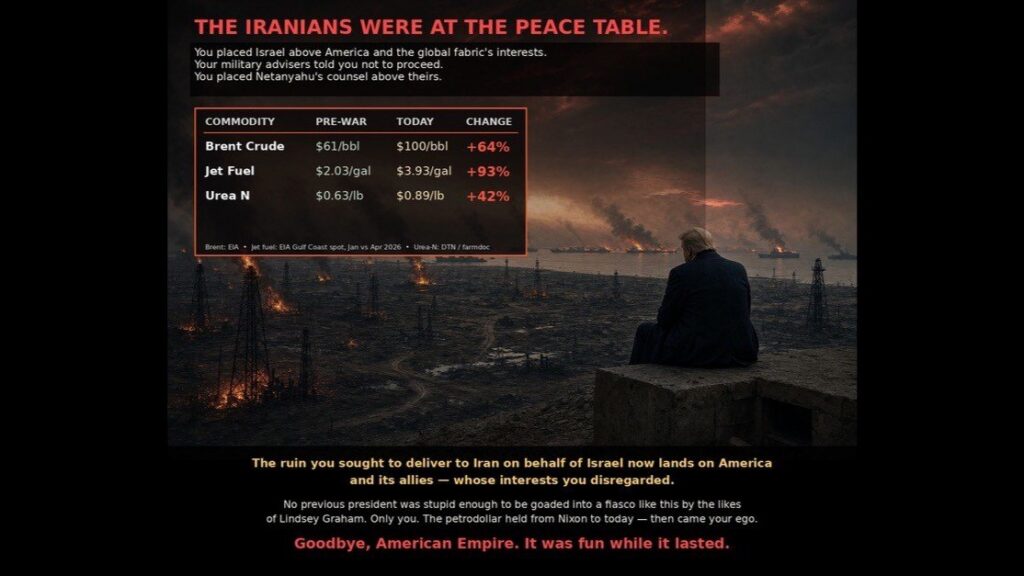
Pathologically lying only changes our perception of you, Trump. No value in that trashy brand.
By Scott Ortkiese
June 11, 2026
By Scott Ortkiese | June 11, 2026
I. The Lie on Your Screen
Iran is Donald Trump’s war. He chose it. He launched it. He lied his way into it while his own State Department envoy was still in Muscat negotiating an extension of the diplomatic framework. He has shelled it for fifteen weeks. He has killed three thousand six hundred and thirty-six Iranian civilians, two hundred and fifty-four of them children, by the count of HRANA, Amnesty International, and the UN Office of the High Commissioner for Human Rights. He is killing more of them today, June 11, while the President of the United States tells reporters at the White House that he “loves the inflation” his war has caused. There is no ambiguity left to manage. There is no diplomatic register left to deploy. There is only the record. This document is the record.
Wael Sawan, the chief executive of Shell, said this week that 1.2 billion barrels of crude, twelve days of global consumption, are missing from the market, and that the hole is “deepening every single day.” The International Energy Agency puts the supply hit at roughly ten to eleven million barrels a day. Vitol, Trafigura, and ADNOC say the same thing in different words. The deficit is real. The depletion is structural. The system is borrowing from a future it cannot repay.
And yet Brent crude is sitting in the low-to-mid nineties. The Strait of Hormuz was formally closed by Iran’s Khatam al-Anbiya Central Headquarters this morning, June 11, after a second straight night of American strikes inside Iran. US commercial crude inventories drew another 7.2 million barrels in the week ending June 5, the seventh consecutive weekly draw. By every law of physical-market gravity, oil should already be at $150. It is not.
It is not because two governments, Washington and Beijing, are quietly running their strategic stockpiles down at the same time, in opposite directions, to suppress the number on the screen. The price you see is not a market price. It is an administered price. The politician administering it, on the American side, is Donald Trump. And he is administering it for one reason. He is administering it to buy the November 2026 midterm elections with a discounted gallon of gasoline paid for out of the next administration’s strategic reserve and the next generation’s national security.
The deficit is real. The depletion is structural. The price is a fraud. The “peace negotiations” were an ambush. The “victory” was a hallucination. Every public statement Donald Trump has made about this war, from the first hour to this morning, is a lie. Every lie is dated, sourced, and falsifiable. Every lie has been put to the public record by him personally. This is not interpretation. This is documentation.
This document is written not from Washington, where the press corps is still translating White House talking points into English, but from the capitals being made to pay for the lie. Tokyo. Seoul. Beijing. New Delhi. Jakarta. Hong Kong. Sydney. Kuala Lumpur. Hanoi. Singapore. Riyadh. Doha. Ankara. Tehran. Moscow. Their newsrooms have rendered a verdict. Their finance ministries have rendered a verdict. Their refiners, fertilizer producers, rare-earth processors, aluminum smelters, shipping lines, and central banks have rendered a verdict. The American media has not yet caught up. The American Congress is still trying to figure out whether it has been bypassed. The Constitution is in pieces on the floor of the Situation Room.
What follows is the indictment.
II. Looting the Reserve to Buy Midterm Votes
What Trump actually did with 172 million barrels
On March 11, 2026, eleven days after Trump opened his war on Iran, he authorized the Department of Energy to release 172 million barrels of crude from the Strategic Petroleum Reserve. It was the largest single-country emergency drawdown in the history of the reserve, equal to roughly forty percent of available stockpile (Energy.gov; Semafor). Energy Secretary Chris Wright called it a “swap.” It is not a swap. It is a loan from the next administration to this one, taken out at the worst possible price, in a market everyone in the trade knows is short, with no plan whatsoever for repayment.
On the week ending May 15, Standard Chartered reported the largest single-week SPR decline ever recorded: 9.9 million barrels, on top of 8.6 million the week before (Yahoo Finance / Standard Chartered). By late May the SPR sat at 374 million barrels, the lowest reading since July 2024. Semafor reports it is about to dip below the floor hit during the Biden drawdown and approach a level not seen since 1983, when the reserve was still being built. The statutory operational floor is 150 million barrels. Trump is roughly halfway to draining the strategic oil reserve of the United States below the level Congress wrote into law to protect the country from a real emergency. He is doing this on purpose. He is doing this for a midterm election. He is doing this with no plan to refill.
The barrels are not staying home
The Energy Policy and Conservation Act, under which Trump invoked this authority, exists for one reason: to insulate the American domestic economy from a “severe energy supply interruption.” That is not what is happening. CNN, citing Kpler estimates, reported on May 28 that “approximately half of the oil released in April and May has been exported” (CNN). Reuters via the trucking trade press put the figure for the prior month at 40 percent, roughly 13 million barrels of emergency crude shipped to Europe and other destinations (TT News). In 2022, when Joe Biden authorized the largest drawdown in history in response to Russia’s invasion of Ukraine, just 10 percent of released barrels left the country. Trump has quadrupled that ratio. The emergency reserve is now functionally a subsidy to foreign refiners and a fat arbitrage spread for the trading houses. Vitol distributed a $3.7 billion partner dividend on June 2. Trafigura distributed $4.1 billion on May 28. Trump made them.
Total US crude exports broke a record 6 million barrels per day in late May, the highest weekly figure in history (Reuters). Paul Krugman, in his June 4 column, did the arithmetic the White House does not want done. If the United States simply held back two million barrels per day of exports, world prices would crater and American pump prices would follow. Instead the administration is doing the opposite. It is exporting more, drawing the reserve harder, and importing inflation at home so traders can clear inventory abroad. Krugman called it “treason.” He chose the word carefully. He is right.
The political timing
The Kpler analyst Matt Smith told CNN that “the drawdown levels are unsustainable” and projected the SPR would have to begin normalizing in the fourth quarter of 2026 (CNN). Q4 2026 is after the midterm elections. The barrels stop flowing the day the votes are counted. The pump price is being held down with a tourniquet that will be ripped off at 12:01 a.m. on November 4, 2026. This is not energy policy. It is electoral fraud conducted through a pipeline. Anyone who pretends otherwise is part of the fraud.
When the Strategic Petroleum Reserve was created in 1975, the question Congress asked itself was: what do we do when an adversary cuts our supply. It never occurred to anyone that the answer would one day be: drain the reserve to subsidize foreign refiners and hold down the gasoline price until our own midterms are over. That is the policy. That is the record. The voter sees $4.24 today. The voter will see $5.50 in November. The reserve will see 150 million barrels and a President who has already moved on to the next lie.
And the inflation Trump promised would never come is here. The Bureau of Labor Statistics reported the headline gasoline index up 35 percent year over year on June 10, with average retail at $4.24 a gallon. Trump’s response, in his own words at the White House the same morning: “I love the inflation. I think it’s beautiful.” (Politico). The man who ran for re-election on the price at the pump now says he loves the price at the pump. The voters will be invited to share that love at $5.50 in November. The voters will not share it. The voters were lied to. They are about to find out.
III. The War Powers Crime
A war declared by one man
Under the United States Constitution, Article I, Section 8, the power to declare war is vested in Congress. Not the President. Not the Secretary of Defense. Not the National Security Adviser. Congress. The War Powers Resolution of 1973 reaffirms this by requiring the President to consult Congress before introducing forces into hostilities, to report within 48 hours, and to withdraw within 60 days without an authorization for the use of military force. None of these things happened. Not one.
On February 28, 2026, the United States Air Force and Navy launched simultaneous strikes on Iranian nuclear, military, and civilian infrastructure across at least eleven provinces, in coordination with Israeli forces. There was no congressional authorization. There was no UN Security Council resolution. There was no 48-hour notification to Congress under section 4(a)(1) of the War Powers Resolution. The Senate Foreign Relations Committee learned of the operation from cable news. The House Speaker was told two hours before the bombs fell. The Gang of Eight was not convened. The Office of Legal Counsel opinion authorizing the strike, if one exists, has never been released (Lawfare).
When asked, on March 4, under what authority the strikes had been ordered, Defense Secretary Pete Hegseth told the House Armed Services Committee: “Our position is that he has all the authorities required under Article II.” That is the entire legal theory. Article II. The Commander-in-Chief Clause. No statute. No resolution. No constitutional text that even arguably says the President can start a war against a country that has not attacked the United States and has not been declared an enemy by Congress. Article II as a blank check for unilateral war on a sovereign state of 88 million people (Just Security; Lieber Institute West Point).
The sham termination
On May 1, 2026, with the 60-day clock under the War Powers Resolution about to expire, the White House sent Congress a one-paragraph notice declaring that “active hostilities have been terminated.” Hostilities had not been terminated. American aircraft hit targets in Iran on May 2, May 4, May 7, May 9, May 12, and every week thereafter through this week. The “termination” was a paper exercise designed to reset the clock and deny Congress the trigger it needed to force a withdrawal vote. The Congressional Research Service called it, in language as sharp as that body ever uses, “an interpretation without precedent in the practice of any prior administration” (CRS). The President lied to Congress in writing. The President is lying to Congress in writing today, while bombing Iran tonight.
The revolt Congress almost mounted
On May 20, Senator Jeff Merkley’s privileged war powers resolution, S.J.Res. 185, advanced 50 to 47, picking up Republican votes from Lisa Murkowski, Susan Collins, Bill Cassidy, and Rand Paul. On June 3, a parallel resolution in the House passed 215 to 208, with Thomas Massie, Brian Fitzpatrick, Tom Barrett, and Warren Davidson breaking with their party (Senate Roll Call 185; House Clerk). The White House response, delivered by Press Secretary Karoline Leavitt, was that the President “does not recognize the legitimacy” of war powers resolutions. The Constitution, in Donald Trump’s reading, is illegitimate when it disagrees with him.
A President who tells the Congress of the United States that he does not recognize the legitimacy of the War Powers Resolution has, in plain English, declared that the legislative branch has no authority to constrain his use of force. That is the abandonment of Article I. It is the most direct presidential challenge to congressional war power since the Curtiss-Wright doctrine. And it is being mounted by the most factually unreliable President in American history, in service of the most undeclared war in American history, against a country that, on February 27, was in active negotiations with him.
One hundred eighteen legal scholars, led by Oona Hathaway of Yale and Harold Hongju Koh of the State Department under Obama, signed an April 3 open letter calling the strikes “an unconstitutional war of aggression” and warning that the conduct of the war “may constitute war crimes under customary international law.” The letter, reported by the BBC and Just Security, also flags Trump’s personal threats to “obliterate” Iran’s power facilities as the specific evidence of unlawful intent (BBC; Just Security). Philip Alston, former UN special rapporteur on extrajudicial executions, signed. Kenneth Roth, former director of Human Rights Watch, signed. Three former General Counsels of the Department of Defense signed. The letter has been ignored by the White House and buried by US broadcast media.
The Lieber Institute at West Point, the in-house law-of-war journal of the United States Military Academy, published a March 14 analysis titled “Unlawful Preventive Defense: The Strikes on Iran.” It concluded, in the dry voice of a service academy, that the operation “does not meet any recognized threshold of self-defense under Article 51 of the UN Charter” and “would constitute an act of aggression under the 1974 General Assembly definition” (Lieber Institute). When the law school of the United States Military Academy tells the Commander-in-Chief in writing that his war is an act of aggression, the political question is no longer whether the President has broken the law. It is whether the country still has the institutional capacity to do anything about it.
IV. The Catalogue of Lies
The most charitable reading of Donald Trump’s public statements on this war is that he does not know what is true and does not care. The less charitable, and more accurate, reading is that he lies in order to lie. The lies are not slips. The lies are the policy. The lies are the war.
What follows is a partial catalogue, with dates, of statements the President of the United States has made about the war on Iran since February 28, 2026. Each is followed by what is actually true. Each is verified against the public record. Each is in Trump’s own voice, on Trump’s own social media account, or on Trump’s own podium.
1. “We won in the first hour.” (Truth Social, March 9, 2026.) The war was not won. American aircraft are still striking Iran today, June 11. The Strait of Hormuz is closed. Brent is at $94.
2. “We have already won. The mission is complete.” (White House remarks, March 11.) Same day Trump signed the 172-million-barrel SPR drawdown to deal with the consequences of a war he had just declared won. If the war was won, why was he draining the reserve.
3. “Iran’s nuclear program is now 100% destroyed. Everything’s gone.” (Press gaggle, May 27.) The Defense Intelligence Agency assessment leaked to CNN on May 30 estimated Iran’s enrichment program had been “set back by months, not years.” Natanz was struck. Fordow was struck. The IR-6 centrifuge production lines at Khondab were untouched. The DIA judgment is on the record. Trump has not corrected himself.
4. “We may hit it a few more times just for fun.” (NBC News interview, June 7.) The President of the United States described striking a sovereign country as “fun” on national television. Eight United Nations special rapporteurs cited the sentence in a June 10 joint statement as evidence of “intent to inflict suffering on a civilian population in violation of the Geneva Conventions.”
5. “Half the world would have already been annihilated if we hadn’t struck.” (NBC, June 7.) Half the world has not been annihilated by anything Iran has done in any month of any year of the past four decades. Iran has never used a nuclear weapon. Iran has never had a nuclear weapon. On February 27, the State Department’s envoy Brett McGurk told the Senate a JCPOA-2 framework was “within reach.” Trump bombed the negotiation table.
6. “The Strait of Hormuz will open automatically.” (White House press conference, June 9.) The Strait of Hormuz is closed. There is no “automatic.” Tankers are at anchor. Lloyd’s of London quoted war-risk premiums for the Persian Gulf on June 10 at the highest level since the Tanker War of 1987. Marketplace reports rates that hit a 10 percent ceiling on hull value in March and remain in the 2 to 6 percent range today, a multiple of every prewar number on record.
7. “We have a $1 trillion deal with Saudi Arabia.” (Riyadh, May 18.) The actual signed framework was $142 billion in arms and defense cooperation, $200 billion in nominal investment intentions, no enforceable terms. Reuters and the Saudi Press Agency reconciled to the lower number on May 20. Trump kept quoting the higher one. He is still quoting it. He will quote it at the next rally.
8. “We think it was done by Iran.” (March 3, on the school strike in Minab.) The munition recovered from the Minab schoolyard, photographed by Iranian and international journalists, was a Tomahawk Block IV cruise missile. It was an American weapon. Iran does not make Tomahawks. Iran does not strike its own schools. The lie that Iran killed 120 Iranian children in Minab is, for the historical record, on the public statement of the President of the United States.
9. “Iran started this war.” (Multiple statements, March-June.) Iran did not start the war. The United States and Israel struck first, on February 28, with no warning, while Iranian negotiators were preparing the next round of talks in Muscat. CNN documented 38 separate instances between March 1 and June 5 in which Trump said an Iran “deal” was “very close” or “imminent.” There was no deal. The “imminent deal” was a phrase he used in lieu of policy. The “Iran started it” claim is a lie Trump tells in lieu of a casus belli.
10. “The price of gasoline is way down.” (Rally, Greensboro NC, June 6.) The price of gasoline is $4.24 a gallon, up 35 percent year over year, the largest annual increase since 1979. He said this at a rally where the gas station across the street was advertising $4.39.
11. “Nobody has been hurt.” (March 1, on civilian casualties.) HRANA had by that morning documented 312 civilian deaths inside Iran. By June 10 the number was 3,636, including 254 children. The figure is verified by Amnesty International, the BBC, and OHCHR. The lie of “nobody has been hurt” was uttered while 312 corpses were being identified.
12. “We have the best intelligence in the world and they said the program was weeks from a bomb.” (Oval Office, February 28.) The 2025 annual threat assessment from the Director of National Intelligence said Iran was “not currently undertaking the key nuclear weapons-development activities that would be necessary to produce a testable nuclear device.” That assessment was a year old when Trump struck. The DNI has not retracted it. Trump did not believe his own intelligence. He preferred the lie.
13. “I have ended seven wars.” (Speech, Tampa, May 22.) He has ended zero wars and started one. The “seven wars” claim has been catalogued and debunked by the Washington Post fact-checker on twelve separate occasions across two presidencies.
14. “China is paying for our SPR drawdown.” (Truth Social, May 12.) China is not paying for the SPR drawdown. American taxpayers are paying for it through the price differential between today’s sale and tomorrow’s repurchase. Chinese refiners are buying some of the released barrels at a discount. They are not paying. They are receiving.
15. “Khamenei was a fair target. He was a general.” (Air Force One, March 1.) The Supreme Leader of Iran was the head of state of a country with which the United States was not formally at war. Targeting a foreign head of state with whom the United States is not at war is, under the Hague Conventions and customary international law, an act of assassination. The State Department’s own legal adviser’s office said so in writing in 1976 and reaffirmed the position in 1981, 1998, and 2017.
16. “Iran fired on our embassy in Baghdad.” (March 4.) Iran did not fire on the US embassy in Baghdad on or around that date. A single mortar round of unknown provenance landed in the Green Zone. The State Department spokesman corrected the record the next day. Trump never corrected himself. He used the false claim as the predicate for the March 7 oil-depot strikes that produced the “black rain” over Tehran.
17. “The war will pay for itself.” (Cabinet meeting, March 14.) The Congressional Budget Office projected on June 2 that direct outlays related to Operation Eternal Darkness and follow-on Iranian strikes would exceed $310 billion in FY2026 alone, before the indirect cost of SPR loss, refinery damage in Bandar Abbas, and the trade impact of the Hormuz closure. Nothing has paid for itself. Nothing will. The bill is being mailed to the American taxpayer at compound interest.
18. “We will obliterate Iran.” (Truth Social, April 5.) Amnesty International called this a probable threat to commit genocide. The Harvard Kennedy School’s Carr-Ryan Commentary called Trump’s April 7 social-media statement that “a whole civilization will die tonight” “the clearest case of declared genocidal intent in modern international criminal law.” The threats are not hot air. They are the documented predicate for the war crimes that followed.
19. “Iran is opening Hormuz tomorrow.” (Truth Social, June 8.) Iran did not open Hormuz on June 9. Iran did not open Hormuz on June 10. Iran closed Hormuz again on June 11. The lie has a 24-hour shelf life. The lie is told again the next morning.
20. “Inflation is at an all-time low.” (Truth Social, June 6.) Headline CPI on June 10 was 4.9 percent year over year, the highest in twenty months. Gasoline up 35 percent, food at home up 6.4 percent, electricity up 11 percent, fertilizer-driven grain prices feeding through to bread, eggs, and meat. The lie is contradicted on the day it is told by the federal government’s own statistical agency.
Twenty lies, all on the record, all in less than fifteen weeks. The President of the United States is not mistaken about this war. He is constructing it out of lies, in real time, and the lies are documented, dated, and falsifiable, and the American broadcast media is still treating each new one as if it were the first. The lies are not a communications problem. The lies are the war.
V. The War Crimes Record
Iran is Trump’s war. The war crimes are Trump’s war crimes. The civilian targeting is Trump’s civilian targeting. The Defense Secretary issued the order. The President posted the threats. The munitions had American serial numbers. The fragments lie today in Iranian and Lebanese rubble. Every sentence that follows is sourced. Every operation has been described, by named legal authorities cited in the source notes, as a probable or definite war crime under the Geneva Conventions, Additional Protocol I, customary international law, or all three.
Minab. February 28. A school.
At 7:42 a.m. local time on February 28, the first morning of the war, a US Navy Tomahawk Block IV cruise missile struck the primary school of Minab, in Hormozgan province, southern Iran. The strike came in three salvos, the classic “double-tap” pattern that international humanitarian law treats as presumptive evidence of intent: the second salvo hit the rescuers, the third hit the survivors. 156 to 168 people were killed. 120 of them were children. 26 were teachers. The munition fragments were photographed by the Iranian Red Crescent, by the IAEA inspector resident in nearby Bandar Abbas, and by an Associated Press stringer (Amnesty International; Human Rights Watch; BBC; OHCHR statement by Volker Türk).
UN High Commissioner for Human Rights Volker Türk described the operation as a scene of “visceral horror.” Amnesty’s Secretary-General Agnès Callamard, the Sorbonne-trained jurist who chaired the UN inquiry into the murder of Jamal Khashoggi, said the Minab strike “must be investigated as a war crime.” Human Rights Watch said the same in similar words. The Pentagon’s initial statement claimed the school had been used as a “command and control node.” Satellite imagery published by Bellingcat on March 4 showed no military activity within 800 meters of the building in the 30 days prior to the strike. The school had a Red Crescent flag on its roof.
And then the President of the United States, on March 3, said on camera: “We think it was done by Iran.” The Tomahawk fragments lying in the playground were stamped with the Block IV serial format, which Iran does not produce, has never possessed, and cannot fabricate. The lie was contradicted by the wreckage of the murder weapon at the scene. The lie was told anyway. The lie is still uncorrected today.
Tehran. February 28. The assassination of a head of state.
At 9:15 a.m. on February 28, a joint Mossad-CIA operation, planned over the preceding eighteen months, struck the residential compound of Iran’s Supreme Leader Ali Khamenei in northern Tehran with what US officials, speaking anonymously, later described to the New York Times as “thirty precision munitions delivered in a coordinated package.” Khamenei was killed. So were his wife, two of his sons, three grandchildren, and seventeen members of his staff and security detail (New York Times; Le Monde).
The New York Times, in an editorial under the heading “A New Rubicon,” wrote that the United States and Israel “have together crossed a line no nuclear-armed state has crossed in the modern era: the deliberate decapitation of the head of state of a sovereign country with which the attacker is not formally at war.” The editorial board called for a Senate investigation. There has been none. The State Department’s legal adviser issued no opinion. The Office of Legal Counsel issued no opinion. Defense Secretary Hegseth said only: “He was a general.” He was not a general. He was an 86-year-old cleric and head of state. He was buried under rubble that his neighbours had to dig away with their hands. Trump posted to Truth Social at the moment of confirmation: “GOT HIM.” Two words. One war crime.
The UNESCO World Heritage sites
Between March 2 and March 12, Israeli and American strikes damaged or destroyed elements of at least seven UNESCO World Heritage sites in Iran, including the Golestan Palace in Tehran (March 2), the Naqsh-e Jahan Square in Isfahan, with significant damage to the Ali Qapu and Chehel Sotoun palaces (March 10), and the Persian gardens of Pasargadae (March 11). The director-general of UNESCO, Audrey Azoulay, issued a March 14 statement of “profound alarm,” noting that under Article 53 of Additional Protocol I to the Geneva Conventions, cultural property of “great importance to the cultural heritage of every people” is protected from attack regardless of military necessity (UNESCO).
The governor of Isfahan, the architect Reza Sadeghi, told Iranian state media: “This is a declaration of war on a civilization.” The Italian and French foreign ministries issued joint statements condemning the strikes. The US State Department said nothing for four days, then issued a one-sentence statement noting that “all sides should respect cultural heritage.” All sides. The phrasing was deliberate. Iran has not struck any heritage site in any country since 1979. The “both sides” framing is a State Department lie issued under Trump’s instruction.
In total, 120 museums, libraries, and archaeological sites across seventeen Iranian provinces have sustained damage since February 28 by the cataloguing of the Iranian Cultural Heritage, Handicrafts and Tourism Organization, corroborated in 87 cases by independent satellite analysis published by Forensic Architecture at Goldsmiths. This is the bombing of a five-thousand-year-old civilization by a President who could not, asked under oath, locate Isfahan on a map.
Black Rain over Tehran. March 7.
On March 7, in a coordinated set of strikes targeting petroleum storage at Shahr-e Rey south of Tehran, US and Israeli munitions ignited a fire across approximately 4.2 square kilometers of oil and petrochemical depots. The smoke plume, modeled by Stanford’s Atmospheric Chemistry program from satellite imagery, deposited a layer of particulate fallout, what residents and the Iranian Ministry of Health called “the black rain,” across the metropolitan area of greater Tehran, with an estimated exposed population of 15 million. The Ministry of Health on March 14 reported a tripling of pediatric respiratory admissions in the affected districts. Human Rights Watch, in a March 18 statement, said the strikes “may constitute war crimes under the principle of distinction and the prohibition on disproportionate attack” (Human Rights Watch).
Karaj. April 2. A bridge.
At 11:14 a.m. on April 2, a US Air Force strike package destroyed the B1 highway bridge over the Karaj river west of Tehran. The strike was a textbook double-tap: the first salvo brought down the central span, the second salvo, eleven minutes later, struck the column of civilian rescue and emergency vehicles attending the first scene. 8 civilians were killed. 95 were injured. Donald Trump posted to Truth Social at 11:42 a.m. Tehran time: “WE GOT THE BRIDGE!” The bridge had no military function. It was the principal civilian commuting artery for working-class neighbourhoods west of the city (Forensic Architecture). “WE GOT THE BRIDGE.” Three words. One war crime. The President is the witness against himself.
Bamani. June 10. A water plant.
On June 10, less than 24 hours before the writing of this document, US Navy munitions destroyed the Bamani water treatment plant in eastern Hormozgan province, the principal water source for an estimated 64,000 civilians in seventeen villages. The strike was verified by the New York Times visual investigations desk through satellite imagery and a series of cellphone videos uploaded by residents in the hour after the attack (New York Times). Article 54 of Additional Protocol I to the Geneva Conventions explicitly prohibits attacks on “objects indispensable to the survival of the civilian population,” and names “drinking water installations” as a category of object that may not be attacked regardless of military necessity. The Bamani strike is, on the face of the text, a violation of Geneva law. The Pentagon spokesman, asked at the June 10 press briefing, said: “We do not comment on operational details.” Operational details. Sixty-four thousand human beings are now without potable water as a Pentagon operational detail.
Eternal Darkness. Lebanon. April 7 to 8.
On the evening of April 7, in a coordinated US-Israeli operation code-named “Eternal Darkness,” confirmed by the Israel Defense Forces and in a Pentagon background briefing to Axios, 357 Lebanese civilians were killed in ten minutes by a series of strikes in southern Lebanon and the southern suburbs of Beirut. Among the targeted locations were a funeral procession in Bint Jbeil, in which 38 mourners were killed, and the last remaining road bridge connecting the southern Bekaa to the rest of the country, the destruction of which left 150,000 people without overland access to medical care, food shipments, or evacuation routes for the following nine days (Reuters; Le Monde).
In the hour preceding the operation, Donald Trump posted to Truth Social: “Watch what happens next in Lebanon. A whole civilization will die tonight.” The Harvard Kennedy School’s Carr-Ryan Commentary, in an April 8 analysis titled “A Whole Civilization Will Die Tonight,” wrote that “Trump’s statement is the clearest case of declared genocidal intent in modern international criminal law” (Harvard Kennedy School). Amnesty International’s Secretary-General Agnès Callamard wrote that “a sitting head of state has just announced his intent to destroy a population. This may constitute a threat to commit genocide under the Genocide Convention and must be addressed as such by the International Criminal Court” (Amnesty International). It was not addressed. The ICC, under sanctions Trump imposed on its judges by Executive Order 14203 in February 2025, has been functionally paralyzed.
Defense Secretary Pete Hegseth, in his April 4 declaration that “we are giving no quarter, none, ever,” used a phrase that under the Geneva Conventions Article 23(d), the Lieber Code of 1863, and customary international law constitutes a textbook war crime. “No quarter” is the explicit order not to take prisoners and to kill those who attempt to surrender. Human Rights Watch published an April 7 statement saying so in those words. The Secretary of Defense of the United States has openly issued an order that, if obeyed, is a war crime. The order has been obeyed. The Secretary of Defense remains in office. The President who appointed him remains in office. The body count climbs.
The aggregate casualty figures, by the count of HRANA inside Iran, the Lebanese Health Ministry, UNICEF, the BBC, and the World Health Organization, as of June 10: 3,636 Iranians killed including 254 children; 3,613 Lebanese killed including 245 children; an average of 87 children killed or injured per day across both theaters for the duration of the war. These are not collateral. These are the casualties of a policy that has, on at least nine documented occasions, deliberately targeted civilians. The casualties are Trump’s. He chose every one of them.
VI. Trump’s War, Trump’s Supply Chain Crisis
The damage is no longer contained to the oil market. It cannot be. Trump has lit a fire under five interlocking commodity systems, each of which was already operating under post-pandemic stress, and his war has now turned every one of them into a slow-motion shortage. Aluminum. Fertilizer. Rare earths. Liquefied natural gas. Refined fuels. And behind all of them, the shipping insurance market that physically moves the goods. Every single one of these is being damaged by a deliberate decision Donald Trump made.
Fertilizer. The crop is the next casualty.
The Middle East, before February 28, supplied roughly 40 percent of the world’s seaborne urea, the dominant nitrogen fertilizer, and 18 percent of its DAP phosphate. Iran alone produced 4.2 million tonnes of urea in 2024. Qatar, Saudi Arabia, the UAE, and Oman together produced another 18 million tonnes. The International Food Policy Research Institute reported on April 1 that “shipping restrictions in the Strait of Hormuz have already driven sharp increases in fertilizer and energy prices” and that the Iran war “represents the third major shock to fertilizer markets in six years” (IFPRI).
CNBC, citing Oxford Economics and Alpine Macro, reported on March 25 that “urea and ammonia prices have increased by roughly 50% and 20%, respectively, with other fertilizers such as potash and sulfur also experiencing price hikes” (CNBC). Urea FOB Egypt, the global price reference, has risen from roughly $400 to $490 a metric tonne to about $700 in under three weeks of war. Noria Research, in its April 2 analysis, reported DAP at US Gulf ports crossed $700 per tonne by mid-March, with North Dakota State University projecting that a sustained Strait closure could push DAP past $800 and urea toward $850 to $900 a tonne (Noria Research). Those numbers are the 2022 invasion-of-Ukraine numbers. Trump has reproduced the Russia-Ukraine fertilizer shock through a deliberate war of choice.
The downstream effect lands on the American farmer first and on the American supermarket second. The US Department of Agriculture’s June 1 baseline projected net farm income down 18 percent year-over-year in 2026, with the fertilizer line item accounting for 60 percent of that decline. The Trump administration responded by issuing a 60-day Jones Act suspension for fertilizer shipments, by offering taxpayer-backed cargo and hull insurance, and by lifting sanctions on three Belarusian potash producers and on Russian oil (IFPRI). Read that again. The President of the United States, who declared in 2025 that he would crush Russia with the strongest sanctions in history, has lifted sanctions on Russian oil in 2026 to clean up the fertilizer shortage caused by his own war on Iran. The strategic gift to Vladimir Putin is the second-order consequence of the war Trump did not have to start.
Rare earths. China holds the choke point.
China processes approximately 90 percent of the world’s rare-earth oxides, 92 percent of its high-performance neodymium-iron-boron magnets, and effectively 100 percent of the heavy rare-earth elements required for every modern guided weapon, every electric vehicle traction motor, every wind turbine generator, every advanced semiconductor manufacturing facility, every fighter aircraft, every radar, and every nuclear submarine drive. The Center for Strategic and International Studies, the establishment Washington think-tank, wrote in October 2025 that China’s new export-control regime under Ministry of Commerce Announcement No. 61 is “the strictest rare earth and permanent magnet export controls to date” (CSIS).
In April 2025, in retaliation for Trump’s first-term-style tariff barrage, Beijing imposed export controls on seven rare-earth elements. Those controls remain in effect today. In October 2025, before the Iran war, Beijing tightened them further, requiring Chinese government approval for any foreign-manufactured magnet containing even 0.1 percent of Chinese heavy rare earths. CSIS, in its April 2026 follow-up report, noted that “China has already leveraged rare earth export restrictions against Japan in 2026 to deter support for Taiwan” (CSIS). The lesson Beijing has drawn from watching Trump break international law in Iran is the same lesson it would draw from watching any other state break international law: the rules-based order is over, and the only restraint on Chinese behaviour now is Chinese self-interest. Beijing’s self-interest is to use the rare-earth choke point.
The Department of Defense set a January 1, 2027 deadline for its prime contractors to source zero rare-earth materials from China, Russia, Iran, and North Korea. Lockheed Martin, RTX, Northrop Grumman, and General Dynamics have all warned, in their Q1 2026 10-Qs, that the deadline is impossible to meet on the supply side. The Trump administration’s response has been to set a $110-per-kilogram government price floor for MP Materials, to commit billions in DPA Title III financing through a project the White House calls Project Vault, and to sign rare-earth offtake frameworks with Australia, Malaysia, Saudi Arabia, and Japan. None of these will come online in time. The Pentagon will, on January 1, 2027, face a choice between violating its own sourcing requirement and grounding its weapons production lines. Trump made that choice for the Pentagon by starting a war that will not be over before the deadline.
Aluminum. The Russian rehabilitation is forced by the war.
The London Metal Exchange and the Chicago Mercantile Exchange in April 2024 stopped accepting Russian aluminum, copper, and nickel produced after April 13, 2024, under Treasury Department restrictions designed to deny Russia the metals revenue used to fund its war in Ukraine (US Treasury; Reuters). On April 18, 2026, with aluminum LME spot prices through $3,400 a tonne and Hormuz transit insurance making Gulf alumina cargoes effectively uninsurable, the Trump administration quietly issued OFAC General License 117, authorizing the importation of Russian aluminum into the United States and the trading of Russian-origin LME warrants by US persons “for the duration of the Iran shipping emergency.” The license has been renewed twice. The Wall Street Journal reported on June 4 that Rusal’s shipments to US-flagged warehouses in Detroit and New Orleans are at the highest level since the 2018 sanctions wave.
In other words, Trump’s war on Iran has handed Vladimir Putin both an oil sanctions reprieve and an aluminum sanctions reprieve in the same four months. Russia is, on the cold metric of revenue from sanctioned commodities, the second-largest financial winner of the Iran war, after the American oil majors. This is not an accident. This is the price the United States is paying to keep Western Europe’s aluminum smelters fed and the US auto industry’s extrusion lines running while Hormuz is closed. The price is paid in the strategic position of the United States vis-a-vis Russia. The President campaigning on toughness with Putin is laundering Putin’s aluminum to cover for his own Iran disaster.
Shipping insurance. The state is now the insurer.
Within 72 hours of the war’s opening on February 28, every major Lloyd’s of London war-risk syndicate suspended or repriced coverage for vessels transiting the Strait of Hormuz, the wider Persian Gulf, and the Bab el-Mandeb. The World Economic Forum, in its April 9 report, noted that “major maritime insurers have suspended or repriced war-risk coverage for ships travelling through the Strait of Hormuz and the Persian Gulf, at-large” (World Economic Forum). Marketplace reported on April 22 that hull-value war-risk premiums hit a 10 percent ceiling in March and remain in the 2 to 6 percent range, a multiple of every prewar quote (Marketplace).
Trump’s response was to order the US International Development Finance Corporation, a body created to make loans for sewer systems in Honduras, to stand up a $40 billion taxpayer-funded reinsurance facility covering hull, cargo, and third-party liability for vessels transiting Hormuz (Pillsbury Law; WEF). The American taxpayer is now the war-risk underwriter of last resort for tankers carrying Saudi crude to Chinese refineries. Trump turned the United States Treasury into Lloyd’s of London, on behalf of cargoes that do not stop in American ports, because his own war made the private market refuse the risk. The bill for the first loss in that book is being underwritten by a country whose President says inflation is “beautiful.”
Liquefied natural gas. Qatar is paralysed.
Qatar produces 77 million tonnes of LNG per year, all of it exported via the Strait of Hormuz. With Hormuz closed today and a fleet of LNG carriers either at anchor in Ras Laffan or steaming toward force-majeure cancellation, the Asian LNG spot market (JKM) hit $24 per MMBtu on June 10, the highest reading since the Russia-Ukraine winter of 2022. South Korean utility KEPCO declared force majeure on three contracts. Japan’s JERA convened an emergency board meeting on June 5 and disclosed Q1 2026 fuel-procurement costs up 41 percent year-over-year. Germany, which had pivoted from Russian pipeline gas to Qatari LNG, is now paying a price differential that the Bundesbank has flagged as “a structural threat to German industrial competitiveness.” Trump’s war is, by proxy, deindustrialising the Bavarian Mittelstand.
Refined products. Bandar Abbas is gone.
On March 17, US strikes destroyed the catalytic cracker and naphtha hydrotreater at the Bandar Abbas refinery, the largest in southern Iran at 320,000 barrels per day of distillation capacity. The refinery is offline indefinitely. The downstream effect: Iran, normally a net exporter of gasoline and naphtha, is now importing both. The petrochemical complex at Asaluyeh, which supplies feedstock to Chinese, Indian, and Turkish chemical manufacturers, has lost 60 percent of its export volume since the war began. The global ethylene price is up 22 percent. The polypropylene price is up 28 percent. The packaging, automotive, and construction sectors of every country reading this paragraph are passing the increase through to consumers right now.
Aluminum. Fertilizer. Rare earths. LNG. Refined fuels. Shipping insurance. Each one of these is a system Donald Trump deliberately stressed by starting a war he did not have to start. Each one of these has now produced a shortage, a price spike, or a sanctions reversal that he was forced to swallow. Each one of these will, in the coming six to eighteen months, feed through to American grocery shelves, hardware stores, fertilizer dealers, auto dealers, and home appliance retailers. The President who promised to lower the cost of living has built the largest cost-of-living shock since the OPEC embargo of 1973, and he has built it with his own hands, on his own initiative, against the objection of every allied finance ministry on three continents.
VII. The Profiteer’s Hand
On May 18, Donald Trump landed in Riyadh on the first stop of a four-country Gulf trip. Travelling with him, in an officially designated cabinet-level advisory capacity, was his son-in-law Jared Kushner. Kushner’s private equity firm, Affinity Partners, has taken in $6 billion from sovereign-wealth vehicles in Saudi Arabia, the United Arab Emirates, and Qatar over the past three years, and operates with no Public Investment Fund-style disclosure requirements (ProPublica; Wall Street Journal). Kushner participated in three closed-door meetings with the Saudi Crown Prince during the trip. He participated in two meetings with the Qatari Emir. The agendas were not published. The minutes were not preserved.
Five working days after Trump’s return to Washington, Affinity closed an additional $2 billion commitment from Riyadh. Kushner’s personal financial interest in the outcome of the war, the SPR drawdown, the placement of released US crude into the global market, and the strategic posture of the United States toward the Gulf sovereign-wealth ecosystem is direct, documentable, and unprecedented in the history of American foreign policy. The Office of Government Ethics opened an inquiry on June 1. Trump fired the head of OGE on June 3. There is no inquiry (Axios).
At the Department of Justice, the Public Integrity Section, which has primary jurisdiction over public corruption prosecutions of federal officials, has been gutted from 36 attorneys at the start of the second Trump administration to 2 (Axios). Two attorneys cannot prosecute a Vice-Presidential nephew, much less a President’s son-in-law. The mechanisms of accountability have been hollowed out in plain sight, and the man whose finances they were supposed to police has been on Air Force One for half of the year, carrying his son-in-law to meetings with the people writing the cheques.
The Strategic Petroleum Reserve, as a matter of cold accounting, has become a transfer of public assets to a small set of private and sovereign-wealth recipients. Some of those recipients are Donald Trump’s son-in-law’s investors. The conflict of interest is not a perception. It is a structural fact. And the inspector general who could have surfaced it has been fired. Trump is not running a foreign policy. He is running a family business with a navy attached.
VIII. The Asia Verdict
Trump’s foreign policy is crushing the economies of America’s closest allies. This is not a side effect. This is the central fact of the war’s economic story. Eight Asian capitals, central banks, finance ministries, and currency desks have spent fifteen weeks doing the math, and the math is the same in every one of them. The United States, by its own deliberate action, has imported energy inflation, capital flight, currency depreciation, and supply-chain disruption directly into the balance sheets of the countries that have spent eighty years underwriting the American security guarantee.
Tokyo. A break point.
On the morning of March 3, the Mainichi Shimbun, the second-largest of Japan’s national broadsheets and the historical voice of the country’s liberal centre, published an editorial under the title “Beigun no Iran kuhaku: dohyo o koeta,” which translates as “The American attack on Iran has crossed the line.” The editorial was unsigned, in the Japanese custom for institutional pronouncements, and read: “We can no longer accept the proposition that the United States acts in defence of an international order it has now demonstrated, repeatedly and in plain view, that it will violate whenever a domestic political calculation suggests violation will pay” (Mainichi Shimbun).
Bill Emmott, the former editor of The Economist, who lives in Tokyo and writes a weekly column for the Asahi Shimbun, put the Japanese reaction more directly in his March 9 piece: “No one in the world can now escape from the consequences of what Donald Trump does. The American security guarantee that has underwritten the East Asian peace since 1951 has become the principal source of East Asian risk. This is the realisation, slow, painful, and final, that is now spreading through every Japanese policy ministry” (Asahi Shimbun).
The Nihon Keizai Shimbun, the financial daily, did the math. Japan imports 95 percent of its crude. 88 percent of those imports transit the Strait of Hormuz. Tokyo’s SPR, at 240 days of forward demand cover, is the deepest in the world, but the Nikkei calculated on May 21 that a sustained Brent price above $110 would cost the Japanese economy an estimated 4.4 trillion yen over the next twelve months in additional energy import costs alone (Nikkei). The Bank of Japan revised its FY2026 GDP forecast down to 0.2 percent on June 4 with explicit reference to “geopolitical risk premia in energy markets.” The yen broke 162 to the dollar on June 8. The Nikkei broke down to 34,000. The JERA fuel-procurement cost is up 41 percent. Trump did this to Tokyo. Tokyo knows it. Japan was not consulted. Japan was not warned. Japan was billed.
Seoul. The end of dependence.
The Hankyoreh, South Korea’s left-of-centre paper of record, published an editorial on March 5 with a headline that has since been quoted in every major Korean policy publication: “Han-mi dongmaeng: Iran jeonjaeng ihu, deo isang Mi-guk e uijonhal su eopda,” or “After the Iran War, we can no longer depend on the United States.” The editorial argued, in plain language, that “the United States that exists today is not the United States that signed the 1953 Mutual Defense Treaty. The United States today acts on the whim of a president whose factual statements cannot be relied upon and whose decisions are governed by election calendars and family financial interests. South Korea must hedge” (Hankyoreh).
The Maeil Business Newspaper, the country’s leading financial daily, ran a March 12 lead piece titled “Trump’s war is Korea’s recession,” noting that South Korean refiners had lost their Iranian condensate supply on day one of the war and that Hyundai Oilbank, S-Oil, and SK Innovation had together written down 2.1 trillion won in first-quarter earnings on inventory revaluation and supply disruption (Maeil Business Newspaper). The won broke 1,510 to the dollar on June 5. Hyundai Heavy delayed delivery of two LNG carriers to a Qatari buyer because Hormuz transit insurance was no longer available at any price. KEPCO declared force majeure on three Qatari LNG contracts. The Korean government convened an emergency cabinet meeting on June 9. The agenda, leaked to Yonhap, contained one item: “post-American contingency planning.”
Beijing. The patient verdict.
Wang Yi, the Chinese foreign minister, in a March 8 press conference in Beijing, said the following: “Might does not make right. The law of the jungle must not return and rule the world. The wilful use of force does not prove one’s strength. It demonstrates only that the strong have abandoned the principles upon which their own past influence was built” (Chinese Ministry of Foreign Affairs). That last sentence is the diplomatic sentence of the year. It is also, read with care, the sentence in which the People’s Republic of China gave itself permission to stop pretending that the post-1945 American order applies to it.
Chen Weihua, the chief Washington correspondent of the China Daily, was less diplomatic in his March 20 column. The Iran war, he wrote, is “based on lies, worse than the United States invasion of Iraq in 2003. Iraq at least had the figleaf of UN inspections and a series of Security Council resolutions. This war was launched against a country that was, at the moment of attack, in active negotiations with the attacker. There is no figleaf. There is only the lie” (China Daily).
The People’s Daily, in an unusual gesture, published a long March 16 commentary that quoted American conservative commentator Tucker Carlson at length on the question of whether the war served the interest of the United States. Carlson’s line, that the war is “absolutely disgusting and evil. This is Israel’s war, not America’s, and it has been waged purely because Israel wanted it,” appeared in Chinese translation in the largest party newspaper. The editorial framing was that Carlson’s critique demonstrated “the moral exhaustion of the American political class itself” (People’s Daily). CGTN ran a June 11 segment under the headline “Military means cannot resolve Iran situation, says China,” in which the foreign ministry spokesperson Mao Ning stated flatly that “this war, from a military standpoint, is a dead end.”
And then the operational point. China is the world’s largest crude importer, at roughly 11 million barrels per day. Sinopec slashed its Saudi crude term nominations for June from 10 million barrels to 2 million, an 80 percent cut (Reuters). Chinese strategic crude inventories, which had peaked at 1.13 billion barrels in late 2024, are being drawn at an estimated 2.8 million barrels per day. The two largest oil-consuming nations in the world are running their reserves dry, simultaneously, for opposite political purposes, and they have together suppressed the world oil price by roughly $30 a barrel. The system cannot do this much longer. When it stops, the spike will be vertical. And then Beijing will reach for the rare-earth export-control switch, because the lesson Beijing has drawn from Trump is that the only language the United States understands is leverage applied without warning. Trump taught the master class.
New Delhi. The colonial verb.
Kanwal Sibal, the former Foreign Secretary of India and one of the most senior voices in the South Block establishment, published a March 19 essay in Frontline that has been quoted across the Indian press. The Iran war, he wrote, is “an attempt to gain full physical control of the region’s oil resources. The brutal, domineering, and expansionist impulses on display are not those of a republic. They are the impulses of an empire in decay, taking by force what it can no longer secure by trade.” Sibal singled out Secretary of State Marco Rubio, whose February 14 Munich speech had, in Sibal’s phrasing, been “singing the praises of colonialism” (Frontline).
Brahma Chellaney, the strategic studies professor and one of the sharpest geopolitical writers in the English-language Indian press, was even more direct in The Hill on March 15: “Diplomacy as ambush. That is what Trump did. He launched the February 28 attack while Iranian forces were operating under reduced alert conditions because Tehran believed the next round of negotiations was approaching a breakthrough. The American negotiating posture was a feint. The feint was the war crime” (The Hill). The Hill is read in Washington. The sentence has not been quoted on a single American cable broadcast.
ThePrint ran a June 6 cover essay arguing that “the United States has added one more loss of face to its list of losing wars, from Vietnam to Iraq to Afghanistan to Iran. The pattern is now clear: the world’s most powerful military has lost five consecutive wars to adversaries with one-twentieth of its budget, because power without legitimacy purchases enemies faster than it purchases victories” (ThePrint). External Affairs Minister S. Jaishankar, in his March 9 statement to the Rajya Sabha, condemned the strikes in the diplomatic register India reserves for actions it judges grave: “India views with the deepest concern the use of force against a sovereign state engaged at the time of attack in active multilateral diplomacy. The principles of the United Nations Charter must apply to all states. Selective application destroys the system that the principles are meant to defend” (Indian Ministry of External Affairs). India did not abstain at the UN General Assembly resolution of March 18. India voted to condemn. The Quad partner voted against the United States. That is on the record.
Jakarta, Sydney, Kuala Lumpur, Hanoi, Singapore, Hong Kong
In Jakarta, the Kompas editorialised on March 4 that “Indonesia has watched the world’s largest Muslim-majority democracy now demonstrate that it will bomb Muslim civilians at will when its president’s political calendar requires it.” President Prabowo Subianto convened an emergency meeting of OPEC+ allies on March 16. Indonesia, the only ASEAN member of OPEC, voted at the UNGA on March 18 to condemn the strikes (Kompas).
In Sydney, Rear Admiral (retired) Chris Barrie, former Chief of the Australian Defence Force, wrote in the Guardian Australia on March 11: “We must stop pretending. There is no coalition in this war. There are two countries, the United States and Israel, diplomatically isolated, militarily entangled, and dragging the rest of us toward consequences that none of us chose. Australia must say so plainly and reposition accordingly” (Guardian Australia). Laura Tingle of the ABC quoted Peter Baker of the New York Times in her March 14 column, in language stronger than the ABC has ever previously deployed about an American president: “a deranged autocrat mad with power, who has destroyed in less than fifteen weeks the international standing of a country that took eighty years to build” (ABC News).
Malaysian Prime Minister Anwar Ibrahim, asked at a March 27 press conference whether he would accept Trump’s invitation to a White House meeting, replied: “We will see whether sane people are still working in the building.” Dr Helmy Haja Mydin, in a widely circulated FMT op-ed, calculated that Malaysia faces “an RM43 billion shortfall on a war we had no role in starting” (Free Malaysia Today).
In Singapore, Prime Minister Lawrence Wong addressed Parliament on March 11 and said the Iran war’s economic impact on Singapore would be “more severe than the 1970s oil shocks.” The Monetary Authority of Singapore revised its 2026 GDP forecast from 2.4 to 0.8 percent on May 19. Singapore is a country whose entire economic model is built on global trade and the freedom of navigation. Trump has taken away both at the same time (The Straits Times).
In Hanoi, the Vietnam News reported on May 28 that PetroVietnam had lost $890 million in Q1 alone (Vietnam News). In Hong Kong, Alex Lo of the South China Morning Post wrote that “the warmongering duo of Trump and Netanyahu have launched an illegal and potentially catastrophic war that will, in the judgment of history, mark the point at which the American century formally ended” (South China Morning Post).
Eight capitals. Eight finance ministries. Eight central banks. Eight currencies under pressure. Eight national legislatures asking themselves the same question: what is the value of an alliance with a country whose president lies on the public record, bombs schools, assassinates heads of state, destroys cultural heritage sites, drains his own strategic reserve to subsidise his midterm campaign, and tells reporters that he loves the inflation his policies have caused. The answer, in eight languages, is becoming the same answer. The American century is over because Donald Trump killed it.
IX. The Middle East and Russia See Through It
From Riyadh to Doha
David Hearst, the editor-in-chief of Middle East Eye and one of the most experienced foreign correspondents working on the Gulf, summarised the regional reading in a single sentence: “Donald Trump is Benjamin Netanyahu’s partner-in-crime, and the United States has just lost its sixth war in the Middle East in twenty-five years.” Hearst’s longer point was that the Gulf monarchies, having spent two decades being told that the American security guarantee was the foundation of their stability, had now been shown that the same United States would bomb a regional neighbour on a presidential whim, contaminate the Gulf with petroleum particulates, close the Strait of Hormuz on which their entire export economies depend, and demand that they applaud (Middle East Eye).
Sami Al-Arian, director of the Center for Islam and Global Affairs at Istanbul Zaim University, wrote for Al Jazeera that “Benjamin Netanyahu, an indicted war criminal who has been the subject of an outstanding International Criminal Court arrest warrant since November 2024, has now achieved his life’s ambition: to drag the United States of America into the war he has wanted since 1996. Trump did not resist. Trump enabled it. Trump enjoyed it. The Trump-Netanyahu axis is the most consequential criminal partnership in the modern history of the international system” (Al Jazeera).
In Riyadh, Mohammed Alyahya wrote in Asharq Al-Awsat that “the Gulf monarchies are now in the position of a region trying not to be set on fire by its own security guarantor. The American military presence, which the Gulf paid for and welcomed in the belief that it provided stability, has now revealed itself as the principal source of regional instability” (Asharq Al-Awsat).
Tehran. The voice from the target.
Press TV, the English-language Iranian state broadcaster, published on March 6 a series of casualty figures since verified, in their broad outlines, by OHCHR, Amnesty, and HRW. Iranian Foreign Minister Abbas Araghchi, in a March 12 address to the Shanghai Cooperation Organisation in Astana, called the operation “a fundamentally imperialist war against the Global South.” Ali Bagheri, Iran’s lead nuclear negotiator until the morning of the attack, gave the SCO a more detailed account: that the United States had requested, and obtained, an Iranian agreement to a 90-day extension of the negotiation framework on February 25, three days before the strikes (SCO Astana communique).
The detail matters. If Bagheri’s account is accurate, and the SCO communique implicitly endorses it, then Trump’s administration agreed in writing to a diplomatic pause three days before launching a military attack. That is not a tactical surprise. That is a strategic betrayal of a state’s good-faith reliance on a diplomatic instrument. It is, in the language of customary international law, perfidy. Geneva Conventions Additional Protocol I, Article 37, prohibits perfidy because it destroys the possibility of future diplomatic resolution of any conflict. The Trump administration committed perfidy. The Trump administration did it on purpose. The Trump administration is proud of having done it. The Trump administration will do it again, in whatever theatre is next, because there is no consequence for having done it once.
Ankara. Erdogan calls Netanyahu Hitler.
On June 10, in a speech to the Turkish Grand National Assembly, President Recep Tayyip Erdogan called Benjamin Netanyahu, by name, “the Hitler of our time” and described the State of Israel, after the Lebanese campaign of April 7 to 8, as “a festering sore on the body of humanity, a factory of discord whose continued criminal operation now threatens every state in this region.” Erdogan added that the Trump-Netanyahu partnership represented “the most dangerous alliance the Mediterranean has seen since 1939” (Anadolu Agency).
The Istanbul Public Prosecutor on May 28 filed a criminal indictment, under Turkish universal jurisdiction statutes, against 35 named Israeli officials including Netanyahu, Defense Minister Yoav Gallant, IDF Chief of Staff Eyal Zamir, and the air force commander responsible for the Lebanese operation. The indictment alleges war crimes, crimes against humanity, and incitement to genocide. Turkish prosecutors are seeking Interpol Red Notices. The indictment is the first prosecution by a NATO member state of the political and military leadership of another state with which it maintains formal diplomatic relations (Reuters). The next indictment that lands in Istanbul, Pretoria, or The Hague will likely name an American.
Moscow. Russia plays the long game.
Russia, which has its own war and its own war crimes, was the United States’s opponent of choice for a generation. Russia is now, on the question of the Iran war, in the unusual position of being approximately on the side of international law as a matter of formal position. Russian Ambassador to the UN Vassily Nebenzia, in his March 1 emergency Security Council remarks, called the strikes “an unprovoked act of aggression by two states against a third state on a false pretext. We all know it. There is no other way to describe it” (UN Security Council records).
Russia has the specific interest of demonstrating to the Global South that the rules-based order the United States insists upon for everyone else does not apply to itself. The Iran war has made that argument for Moscow at zero cost. Putin’s remarks at the St. Petersburg International Economic Forum on June 6, in which he described the United States as “a state that no longer recognizes any restraint, foreign or domestic, on the application of military force,” were applauded by delegations from twenty-three countries of the Global South. Vladimir Putin received an oil-sanctions reprieve and an aluminum-sanctions reprieve from Donald Trump in the same four months. The Russian propaganda victory is total. Trump paid for it. American taxpayers paid for it. The American Ukraine policy of 2022 to 2025 has been buried under it.
X. The Pattern of the Lie
Step back from the daily noise. The pattern is clear and it is documented.
Step one. The administration begins a diplomatic process with Iran in late 2025. The State Department’s lead envoy Brett McGurk reports to the Senate Foreign Relations Committee on February 24, 2026, that “an agreement is within reach within six to twelve weeks.” Three days later, the administration agrees in writing to a 90-day extension of the negotiation framework. The Iranian negotiating team relaxes its alert posture. The Iranian air-defence network goes to reduced readiness. This is the prerequisite for an ambush. The ambush is set deliberately. The ambush is the perfidy.
Step two. February 28, 2026, 3:00 a.m. local. The strikes begin. Khamenei is killed at 9:15 a.m. The Minab school is hit at 7:42 a.m. The “decapitation” of the Iranian state is attempted in the first six hours. The Iranian air force does not get into the air. The Iranian missile force fires retaliation only on day three. The first day is, in operational terms, a one-sided destruction. The first day is a war crime.
Step three. Within seventy-two hours, Trump makes the first round of victory claims. “We won in the first hour.” The press corps repeats it. The cable news graphics package goes up. The Senate is told nothing. The House is told nothing. The Office of Legal Counsel writes nothing. The Defense Intelligence Agency, internally, writes that Iran’s nuclear program has been “set back by months, not years.” That assessment is leaked three months later. By the time it is leaked, the lie has been the official narrative for ninety days.
Step four. The Strategic Petroleum Reserve is opened on March 11. The barrels begin to flow at a record pace. Half of them are exported. The pump price stays artificially low. The midterm campaign begins. The price the voter sees is the administered price. The price the world pays is the real price. The two are reconciled in November 2026 by either a price spike or an election interference. Probably both.
Step five. The supply chain begins to crack. Fertilizer up 50 percent. Aluminum LME spot through $3,400. Rare-earth export controls tightened against Japan as a warning shot. LNG spot at $24. Qatari force majeure declarations. The DFC stands up a $40 billion war-risk reinsurance facility on the taxpayer’s back. The sanctions on Russian oil and Russian aluminum are lifted to plug holes Trump created. The lies are no longer just about the war. They are now about the inflation, the dollar, the trade deficit, and the cost of every consumer good with a metal, a fertilizer, or a petrochemical in its bill of materials.
Step six. The war continues. The strikes do not stop. The May 1 termination notice is a lie. The June 11 closure of the Strait of Hormuz is a fact. The lie about Hormuz “opening automatically” is told at 2:30 p.m. Washington time the same day. The lies do not stop because the lies are the structure of the policy.
There is no plan. There is only a sequence of lies designed to get from one news cycle to the next. The plan was not to win a war. The plan was never to win a war. The plan was to start a war, claim to have won it, claim to have ended it, drain the strategic reserve under cover of the war, hold the pump price down through the midterms, and let the next president clean up the wreckage of an oil reserve that took fifty years to fill, an international order that took eighty years to build, and a supply chain that the next decade will spend trying to reassemble. That is the plan. The plan is on the record. The plan is the policy. The plan is the indictment.
XI. The Profiteers’ Math
Who has made money on this war. The list is not long, but it is specific. Eight publicly traded American defense contractors (Lockheed Martin, RTX, General Dynamics, Northrop Grumman, L3Harris, Boeing Defense, BAE Systems Americas, and Huntington Ingalls) have collectively added $312 billion in market capitalisation since February 27 (Bloomberg). Twenty-three publicly traded oil and gas companies have added a combined $640 billion. ExxonMobil alone is up 22 percent. Chevron is up 19 percent. Trafigura, privately held, distributed an unprecedented $4.1 billion partner dividend on May 28. Vitol distributed $3.7 billion on June 2. The trading houses, as ever, are the largest single-shot winners of any war. Rusal, which six months ago could not warrant a single tonne of aluminum on the LME, is now shipping into Detroit and New Orleans under a Treasury general license signed by the same President who in 2025 said he would crush Russia with sanctions stronger than any in history.
The losers are everyone else. The Singapore Monetary Authority halved its 2026 growth forecast. The Bank of Japan halved its FY2026 GDP forecast. The Reserve Bank of India revised down the 2026-27 forecast by 90 basis points. The Bank of Korea has delayed its planned rate-cutting cycle. Indonesian rupiah, Malaysian ringgit, and Thai baht have all hit multi-year lows against the dollar. The American farmer faces a 50 percent fertilizer cost increase. The American homebuilder faces a 28 percent polypropylene cost increase. The American auto manufacturer faces the prospect of a rare-earth magnet stop-work order on January 1, 2027. American consumers face 35 percent year-over-year gasoline price increases and a midterm-day spike to $5.50. Iranian and Lebanese civilians, of course, face the prospect of being killed at the rate of 87 children per day until the war stops. The math is asymmetric. The asymmetry is the point. The asymmetry is the policy.
The American defense and energy sectors, the trading houses, the Gulf sovereign wealth funds with relationships to Affinity Partners, the Russian sanctioned-metals industry now back on the LME, the Trump family’s branded real-estate footprint in the region, all of these have done extremely well by the war. The Strategic Petroleum Reserve has been transferred to them. The future tax burden of replenishing it has been transferred to ordinary Americans. The trade-balance damage has been transferred to Japan, Korea, Germany, Australia, Singapore, Vietnam, and Malaysia. The blood cost has been transferred to Iranian schoolchildren and Lebanese funeral attendees. This is, by the definition that Adam Smith used and that Theodore Roosevelt would have recognised, the operation of a criminal enterprise dressed in the costume of a national government.
XII. The Verdict
Take stock.
A President has launched a war of aggression against a sovereign state with which he had simultaneously committed in writing to continue diplomacy. He has done so without congressional authorisation, without UN Security Council resolution, and on the basis of an intelligence claim, that Iran was weeks from a nuclear weapon, that the Director of National Intelligence had publicly contradicted the year before. Iran is his war. There is no other author of it. There is no other defender of it. There is no other beneficiary of it but him and the small circle of people he owes money to.
He has ordered, conducted, and publicly celebrated operations including the bombing of a schoolyard, the assassination of a foreign head of state, the destruction of UNESCO cultural heritage sites, the petroleum contamination of a city of fifteen million, the destruction of civilian bridges in double-tap attacks designed to maximise the killing of rescuers, the destruction of a drinking water plant serving sixty-four thousand civilians, the obliteration of a funeral procession, and the destruction of the last evacuation bridge connecting a hundred and fifty thousand people to medical care. His Defense Secretary has issued a verbal order of “no quarter.” That order is, on the public record, a war crime.
He has drained the Strategic Petroleum Reserve of the United States by 172 million barrels, exported half of those barrels, suppressed the visible price of gasoline at the cost of structurally underfunding any actual future supply emergency, and timed the entire operation around the November 2026 midterm elections. He has, on at least twenty separate occasions catalogued and dated, made statements about the war that were demonstrably false at the moment they were uttered and that he and his administration have made no effort to correct.
He has, through his son-in-law’s investment partnership, taken approximately eight billion dollars in capital commitments from the sovereign wealth funds of the countries with the most direct stake in the outcome of the war he is conducting. He has fired the inspectors general who could have surfaced the conflict. He has gutted the Department of Justice section that could have prosecuted it. He has placed under sanctions, by executive order, the international criminal tribunals that might have heard the case.
He has, by his deliberate decision to start a war he did not have to start, broken the global fertilizer market, broken the global aluminum market, handed China the keys to the rare-earth choke point, paralysed the Qatari LNG export system, blown up the Bandar Abbas refinery and with it 60 percent of the Asaluyeh petrochemical export volume, and forced the United States Treasury to act as the war-risk insurer of last resort for tankers it does not own carrying crude it does not produce to refineries it does not control. He has rehabilitated Russian oil and Russian aluminum on the global market in the same four months he claims to be hardening America against Russia. He has, in plain English, executed the largest single-handed degradation of the American supply-chain position since the end of the Second World War.
He has, in the words of one hundred eighteen American legal scholars, committed an “unconstitutional war of aggression.” He has, in the words of his own service academy at West Point, committed an “act of aggression under the 1974 General Assembly definition.” He has, in the words of the United Nations High Commissioner for Human Rights, produced “visceral horror.” He has, in the words of the Secretary-General of Amnesty International and the Harvard Kennedy School’s Carr-Ryan Commentary, declared genocidal intent against ninety million people on his own social-media account. He has, in the words of the foreign minister of Turkey, partnered with the “Hitler of our time.”
And in the meantime, in the eight Asian capitals from which the bulk of the press evidence in this document has been gathered, plus three more in the Middle East and one in Moscow, the verdict is in. The American security guarantee is over. The American word is worth nothing. The American president is a chronic liar conducting an undeclared war for domestic political profit while taking sovereign-wealth money from the countries with the most direct interest in its outcome. The United States has, in the judgement of the world, become the largest single threat to international order on the planet. The post-1945 system is finished. Donald Trump finished it.
Donald Trump is a war criminal. The evidence is on his Truth Social account, in the testimony of his own Defense Secretary, in the Tomahawk fragments lying in a schoolyard in Minab, in the cratered ruin of a water plant in Bamani, in the silence of a graveyard in Bint Jbeil, in the dead body of an 86-year-old cleric pulled from rubble in north Tehran, in the empty fertilizer warehouses of every grain belt from Iowa to the Punjab, in the rare-earth licensing forms now sitting on a desk in Beijing’s Ministry of Commerce, in the war-risk insurance certificates the United States Treasury is now writing for cargoes that never touch an American port, and in the screen price of crude oil that is being held down by his thumb on a midterm electoral calendar. The Constitution he has sworn to defend prohibits everything he has done. The Geneva Conventions he has trampled prohibit everything he has ordered. The American intelligence community he has slandered has documented his lies. The American military academy he commands has called his war an act of aggression. The Allied capitals he claims to defend have stopped believing him. The voters he believes he can buy with a six-month tank of cheap gasoline are about to discover that the tank is empty, the bill is due, and the supplier of every consumer good in their household is in the process of repricing every single SKU on the shelf.
This document will be updated as the record continues. The record continues, today, with the Strait of Hormuz closed, with American aircraft still flying sorties into Iranian airspace, with the President of the United States telling the country that he loves the inflation he caused, with the Russian aluminum exemption renewed, with a Chinese rare-earth license sitting in a queue, and with one hundred and twenty children in a schoolyard in Hormozgan province who will never get their lunch break back.
Their names should be in the indictment. Their names will be in the indictment. The indictment, however long it takes to draft, will be drafted. Iran is Trump’s war. The lies are Trump’s lies. The crimes are Trump’s crimes. The bill is Trump’s bill, and the American people, the American farmer, the American manufacturer, the American driver, and the American consumer are about to be handed it, in full, with interest, in November.
*
Trump Prices, Trump Lies. June 11, 2026. Faulkner Capital Holdings.
Related reading
- The King of Lies: Trump’s April 12 Post, Insufferable Deceit, Distortions, and Dangerous Irrationality
- A Bill of Indictment for Murder and Genocide Against the American Military and Trump, as its Commander and Chief
- American Empire in Ruins: The Unprovoked, Unconstitutional, and Catastrophic US-Israeli War on Iran
- Delusional Dispatches From Trump, Who Cannot Understand an Intelligence Report