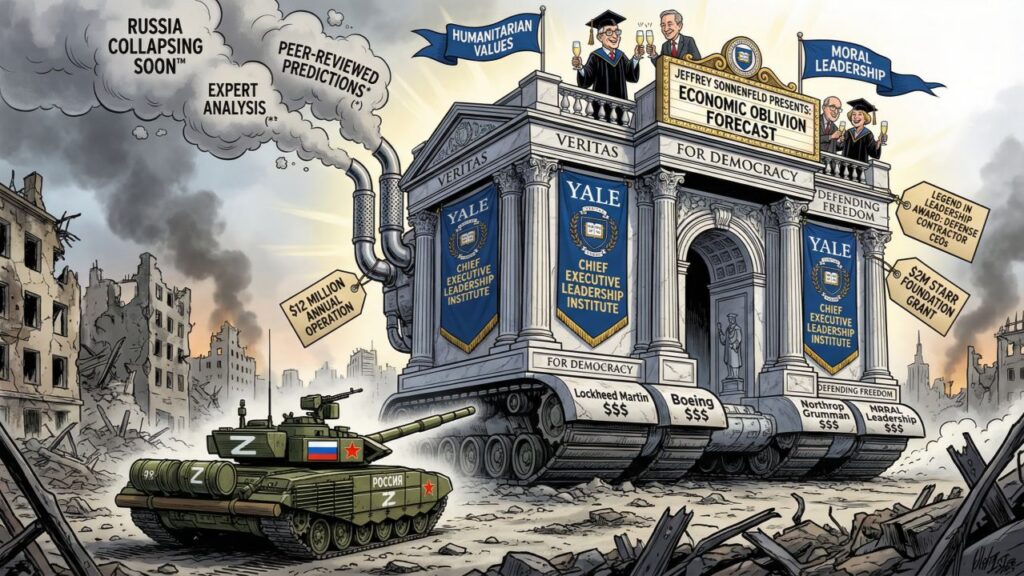
Russian T‑90M tanks kill in ways you can count: burned hulls on the steppe, pulverized apartment blocks, trenches full of the young and nameless. The people who made those tanks necessary (the Yale economists, defense‑industry CEOs, and Congressional war managers) kill in ways you cannot see: committee rooms, donor retreats, white papers, and “expert” testimony that told Washington Russia was on the brink of collapse and the war would be quick, cheap, and bloodless for everyone except the people doing the fighting.
This was not an accidental alignment of interests. It was a three‑way back‑scratching enterprise. Yale and Jeffrey Sonnenfeld went hunting for corporate and defense money and offered Ivy League prestige, awards, and “expert” testimony in return. Defense contractors bought that prestige and the collapse narrative they needed to sell a long war as a smart bet. Congress, addicted to contractor campaign cash and revolving‑door careers, used that narrative to justify roughly 175 billion dollars in Ukraine funding that cycled straight back into the same firms’ order books.
Between 2019 and 2025, defense contractors spent roughly 47 million dollars buying the “knowledge” that underwrote this war: around 34.7 million dollars into the major Washington think tanks that dominate hearings and cable news, and another 12 million dollars per year into Yale’s Chief Executive Leadership Institute (CELI), a CEO club wrapped in Ivy League branding. In return, those institutions produced what their funders needed, authoritative‑sounding predictions that sanctions were “crippling” Russia’s economy, that there was “no path out of economic oblivion”, and that time and economics alone would break the Kremlin long before Ukraine did.
Those predictions were garbage. Russia’s economy bent but did not break; its export flows and war industries adapted; its artillery production surged past the combined output of the United States and Europe. By the time reality caught up, Congress had already appropriated around 175 to 182 billion dollars in Ukraine‑related funding, much of it flowing straight back to the same contractors who had paid to frame the debate, and somewhere between 600,000 and 800,000 Russians and Ukrainians had been killed or wounded.
I. Yale’s 12‑Million‑Dollar “Prestige Shop”
Yale markets itself under the motto “Veritas”, truth. At the Chief Executive Leadership Institute, truth is a line item in a sponsorship deck.
CELI is a revenue engine that generates roughly 12 million dollars a year by selling access to Yale’s name and network: CEO summits, bespoke events, and a marquee “Legend in Leadership” award that functions as an elite loyalty badge. The people receiving those badges are not random. In 2015, CELI honored W. James McNerney Jr., then Boeing’s chairman; between 2020 and 2024, Boeing would receive about 115 billion dollars in United States defense contracts. In 2016, it honored Marillyn Hewson, the Lockheed Martin chief executive whose company would take in roughly 313 billion dollars in Pentagon contracts over that same five‑year span. In 2023, one year into the Ukraine war, CELI gave its award to Kathy Warden, chief executive of Northrop Grumman, even as Northrop sat on about 81 billion dollars in recent Pentagon awards.
In 2023, CELI also announced a 2‑million‑dollar gift from the Starr Foundation, controlled by Maurice “Hank” Greenberg, the former AIG chief and longtime bankroller of America’s foreign‑policy think‑tank complex. Yale was not dragged into this; it went looking for money in the war economy and put its prestige on the table as the product.
II. The “Russia Is Collapsing” Story Yale Sold
In July 2022, Jeffrey Sonnenfeld, Yale professor and CELI founder, published “Business Retreats and Sanctions Are Crippling the Russian Economy” with his research director Steven Tian. The paper claimed Russia faced “no path out of economic oblivion”, that its economy was “imploding by any metric and on any level”, and that Western sanctions and corporate exits were devastating the Kremlin’s war‑making capacity.
Central to the narrative was Sonnenfeld’s viral list tracking companies exiting Russia. Within weeks of the invasion, he was being profiled for assembling a “Yale list” that shamed firms into pulling out; executives admitted they were watching it and feeling the pressure. News outlets repeated his framing: that over one thousand exits would cripple Russia and that sanctions were working “exactly as designed”.
On 15 November 2022, Sonnenfeld carried that story into the House Financial Services Committee. Under oath, he told members that sanctions were “devastating” Russia and that the combination of exits and restrictions was pushing the Russian economy toward collapse, presenting this as fact rather than fragile guesswork.
It was wrong.
III. Reality: Russia Bent, Then Re‑Armed
Western institutions initially predicted an 8.5 to 15 percent collapse in Russian gross domestic product in 2022, numbers widely echoed in media that leaned on those models and on work like Yale’s. The actual contraction was around 2.1 percent. By 2023, Russia’s economy had returned to growth, expanding by roughly 3.6 to 4.1 percent, with similar strength into 2024 as war‑related industrial spending ramped up.
Rather than being “crippled”, Russia’s defense sector reoriented. Public estimates suggest production on the order of two to three million artillery shells per year, putting Russian output ahead of United States and European production combined in that category.
Instead of isolation, Russia re‑routed exports. By 2024, China and India together were buying approximately 191 billion dollars in Russian goods, about 56 percent of total exports, anchoring a sanctions‑resistant cashflow. Russia’s international reserves recovered toward 763 billion dollars, including around 311 billion dollars in gold, which Western institutions cannot freeze.
None of this was hidden. Trade volumes were in customs data; reserve figures were in central‑bank releases; estimates of artillery production were circulating in NATO and European assessments. Yet Yale’s story, and the testimony built on it, treated these fundamentals as background noise.
IV. The Contractor‑Funded Choir
From 2019 to 2023, United States defense contractors pumped at least 34.7 million dollars into a small club of Washington think tanks: roughly 10.2 million dollars to the Atlantic Council, 6.6 million dollars to the Center for a New American Security, 4.1 million dollars to the Center for Strategic and International Studies, about 3.2 million dollars to the Brookings Institution, and the rest spread across other foreign‑policy shops that supply “experts” to Congress and cable news. RAND and similar outfits drew in more than a billion dollars in direct United States government research funding, functioning as in‑house contractors to the Pentagon.
Their outputs lined up with their funding. Contractor‑funded institutions produced the same core line: that Russia was on the brink economically; that sanctions were working and would soon force a climbdown; that Moscow’s war industry would be starved of parts and cash; that time was on the West’s side, so escalation and patience were wise.
A Quincy Institute review found that about 75 percent of contractor‑funded think tanks called for increased United States military spending and escalatory policies after the invasion, while among non‑funded think tanks a majority emphasized diplomacy and warned against open‑ended escalation.
Congress leaned on this ecology. Between 2021 and 2024, around four‑fifths of the think‑tank witnesses called before the House Foreign Affairs Committee came from organizations that take money from arms manufacturers or foreign governments, with no requirement that they disclose it.
V. Congress: Legal Money, Structural Corruption
The cash that greased Capitol Hill was legal: political‑action‑committee donations, maxed‑out campaign checks, independent expenditures.
Sen. Lindsey Graham (R‑SC) has collected roughly 1.2 million dollars from the defense sector over his career. In April 2022, as Congress debated a 40‑billion‑dollar Ukraine aid package, Lockheed Martin’s political action committee spent around 256,000 dollars on 147 contributions to federal lawmakers, including Armed Services leaders. Rep. Adam Smith (D‑WA), then chair of the House Armed Services Committee, took 2,500 dollars from Lockheed that month and 20,000 dollars from General Dynamics in 2023; one of his senior staffers left his office in May 2022 and within weeks became a government‑relations director at General Dynamics. Rep. Rob Wittman (R‑VA) took 24,600 dollars from General Atomics and backed provisions that aligned neatly with its drone and autonomous‑systems portfolio; Rep. Mike Rogers (R‑AL) collected more than 73,000 dollars from L3Harris and other contractors.
Between 2008 and 2018, at least 380 senior Pentagon officials left government to work for defense contractors, including 95 who went directly to the top five primes (Lockheed Martin, Boeing, Raytheon, General Dynamics, Northrop Grumman) with large salary multipliers, and about 90 percent registering as lobbyists.
Nobody needed to say, “Vote for this Ukraine package and you will get a job at Northrop later.” The incentives were obvious.
VI. 175 Billion Dollars and the Body Count
From early 2022 through 2024, Congress approved roughly 175 to 182 billion dollars in total Ukraine‑related aid. About 113 billion dollars of that was authorized in 2022 alone; subsequent packages extended the support. Somewhere between 68 and 71 percent of the total flowed through the Department of Defense, either to backfill United States stockpiles, finance new production, or pay for deployments and support. On the other side of those payments were contractors like Lockheed Martin, Raytheon, General Dynamics, Northrop Grumman, and Boeing, whose combined Pentagon awards for 2020 through 2024 approach 770 billion dollars.
By late 2025, Russian military casualties, dead and wounded, were often assessed in the hundreds of thousands, with some estimates pushing above 400,000. Ukrainian military casualties were likewise measured in the hundreds of thousands once killed and wounded are combined. Verified civilian deaths stood above 13,000 to 14,000, with monitoring bodies clear that true numbers are higher.
Reasonable composite estimates put total casualties (military and civilian, Russian and Ukrainian) between 600,000 and 800,000 people. Roughly eight million Ukrainians have fled abroad; millions more are displaced inside the country; reconstruction costs for infrastructure alone will run into the high hundreds of billions of dollars.
The Yale think‑tank and contractor narrative did not cause the invasion. It did, most certainly, foreclose early off‑ramps by telling Western leaders they could wait for sanctions to break Russia, and it gave Congress the story it needed to fund a long war while promising voters it would be short.
VII. When Americans Wake Up
Americans will wake up when they finally connect two facts in the same thought: the people with the fanciest credentials keep being catastrophically wrong in the same direction, and those “mistakes” always happen to make them and their funders richer and more powerful.
Ivy League people will not do your thinking for you. Their credentials are not a substitute for your judgment; they are branding. They exist to make you hand over the work of thinking so that someone else can rent your consent and steer it toward their preferred outcomes, wars, bailouts, narratives, all wrapped in footnotes and Latin mottos.
Do not give them the intellect you own. They will only steer you to benefit the options they think are theirs.
The only defense is refusing to outsource your mind. Read the claims, follow the money, count the bodies. If the people who tell you what to believe never pay a price when they are wrong, and you do, they are not your leaders or your guides. They are asset managers, and the asset they are managing is you.
Related reading
- Manufacturing War: How the West Built and Sold the Russia-Ukraine War
- Six Billion People Can See What CNN Won't Tell You: Ukraine Is Losing, and the West Wants the Killing to Continue
- If Brad Pitt Were Harald Kujat, Ukraine Would Have Peace, Where's the Press?
- The Western Press Won't Report It: Ukraine's Collapse and the Slaughter Underway