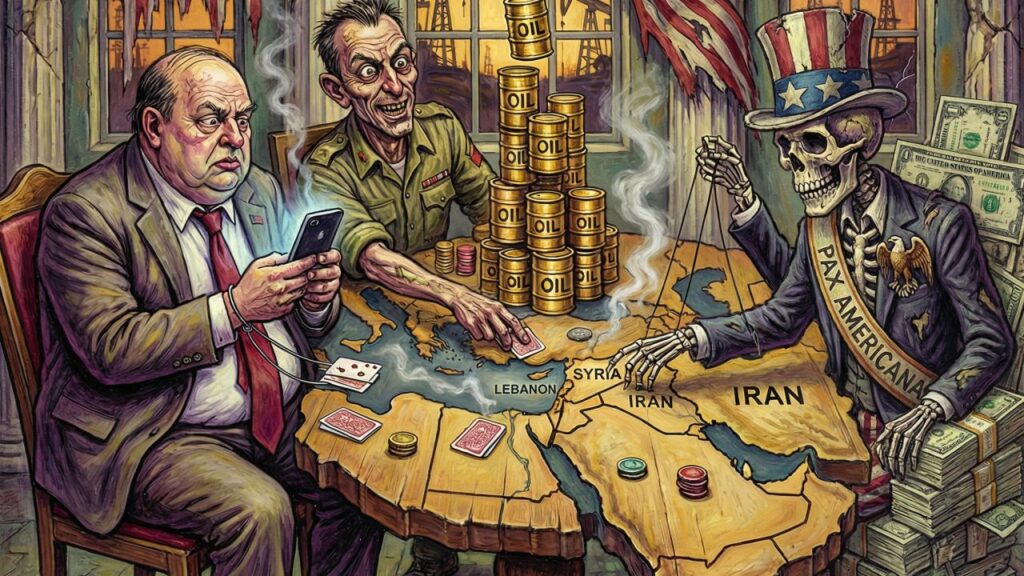
What the Petrodollar Is and Why It Matters
The petrodollar is not a separate currency. It is a system, a set of interlocking arrangements through which the US dollar became the mandatory medium of exchange for the world’s most vital commodity: oil. Every barrel of crude sold by the Gulf Cooperation Council states, and most oil traded globally, is priced and transacted in US dollars. This single fact underpins the entire architecture of American global power.
The system was born out of crisis. In 1971, Richard Nixon severed the dollar’s link to gold, ending the Bretton Woods system and leaving the dollar floating without any anchor. By 1974, with inflation raging and the dollar hemorrhaging credibility, Nixon dispatched Treasury Secretary William Simon and Secretary of State Henry Kissinger to Riyadh with explicit instructions: do not come back empty-handed. The deal they struck with the Saudi royal family was elegant and ruthless. Saudi Arabia, the world’s largest oil producer, would price and sell its oil exclusively in US dollars. In exchange, the United States would guarantee the security of the Saudi monarchy, provide military hardware, and allow Saudi Arabia to purchase US Treasury bonds through a secret “back door” arrangement that bypassed normal competitive bidding. By 1977, Saudi Arabia held roughly 20% of all US Treasury securities held by foreign nations.
The other OPEC and GCC nations followed suit. The dollar’s hegemony was reborn, no longer backed by gold but by something arguably more powerful: the world’s absolute dependence on oil.
How Countries Acquire Dollars: The Mechanics, Step by Step
To understand the petrodollar’s power, consider its mechanics through the concrete example of how Japan buys oil.
Japan imports over 90% of its crude oil from the Middle East, with roughly 75% transiting through the Strait of Hormuz. Japan does not produce oil. It produces yen. But yen cannot buy Saudi or Emirati crude. Only dollars can.
Step one: Japan must acquire US dollars. It does this primarily through four channels. First, Japan earns dollars by exporting goods to the United States and other countries that pay in dollars. Toyota sells cars in America, Sony sells electronics, and those revenues come back in dollars. Second, when export earnings are insufficient, Japan’s central bank or commercial banks enter the foreign exchange market and sell yen to buy dollars. This transaction increases demand for dollars and suppresses the value of the yen. Third, Japan can borrow dollars in international capital markets. Fourth, Japan can draw on its foreign exchange reserves, which are overwhelmingly held in dollar-denominated assets, primarily US Treasury bonds.
Step two: Having acquired dollars, Japan pays the Saudi national oil company, Saudi Aramco, in US dollars for each barrel of crude.
Step three: Saudi Aramco deposits those dollars. The Saudi economy, despite its glittering cities, cannot absorb the volume of dollars that flow in from oil sales. Saudi Arabia imports food, construction materials, and consumer goods, but its domestic economy is too small to spend what it earns. This creates an enormous dollar surplus.
Step four: That surplus must go somewhere. This is petrodollar recycling. The Saudi government, through its sovereign wealth fund, the Public Investment Fund, and its central bank (SAMA), invests those surplus dollars back into the United States, purchasing Treasury bonds, equities, real estate, and increasingly, stakes in American technology companies and AI data centers.
The cycle is now complete. Japan works to earn or borrow dollars. Those dollars flow to Saudi Arabia for oil. Saudi Arabia sends those dollars back to America as investments. America gets to borrow cheaply, run enormous deficits, and finance its military, its consumer economy, and now its AI boom. The dollar circulates. The empire endures.
Why This System Only Truly Benefits America
Professor Jiang, using game theory to analyze this architecture, puts it bluntly: “The American economy is a financial Ponzi scheme” sustained by petrodollar recycling from the GCC. The Gulf States sell oil, get petrodollars, and then recycle them back into the American economy, “mainly by investing into AI, into data centers, which is now the main engine of growth for the American economy”.
This is not hyperbole. GCC sovereign wealth funds deployed over $30 billion into AI projects by early 2025. Accelerated investments in GCC AI data centers are projected to exceed $5 to $7 billion in 2026 alone, part of a broader $30-plus billion pipeline through 2030. The UAE’s Stargate project alone involves a 5-gigawatt AI data center complex in Abu Dhabi, backed by $8 to $10 billion, with partners including OpenAI, Oracle, NVIDIA, and SoftBank. Saudi Arabia’s HUMAIN initiative signed a $3 billion partnership with Blackstone-backed AirTrunk. Amazon’s data center in the UAE was literally struck by an Iranian drone in the opening days of the war.
The petrodollar system grants the United States five interlocking privileges that no other nation enjoys.
Military financing without limit. Because the world must hold dollars and lend them back to the US by buying Treasuries, America can run a $40 trillion national debt and finance 800-plus military bases worldwide at borrowing costs that would bankrupt any other nation. Peter Schiff warns that the deficits from this war “are going to be in the stratosphere” and the US will be “cranking up the printing presses like never before”.
De-industrialization without consequences (until now). Michael Hudson explains that the US shifted from a manufacturing-based economy to a finance-based economy over the past 30 to 40 years, exporting its manufacturing capacity to China. This was only possible because the petrodollar ensured a constant inflow of foreign capital. Living standards for the bottom half of Americans have not risen since 2008, while the wealthiest 10% account for 50% of all consumption growth. The wealth America accumulated since the 2008 crisis “is financial wealth. It’s not the wealth of real production”.
Sanctions as a weapon. Because global trade runs through dollar-denominated channels and the SWIFT messaging system, the US can cut any nation off from the global economy by restricting its access to dollars. This is what gives American sanctions their devastating power against Iran, Russia, Venezuela, and Cuba.
Consumption beyond means. The US runs persistent trade deficits, importing far more than it exports, which would normally collapse a currency. But because every nation needs dollars, the demand never dries up. America consumes the world’s goods and pays with IOUs (Treasury bonds) that the world is forced to accept.
The AI bubble. Jiang identifies the most current and fragile iteration of this cycle: “The entire American economy is propped up by AI investments in data centers and a lot of that comes from the Gulf States. So if the Gulf States are no longer able to sell oil and they’re no longer able to finance this AI bubble in the United States, then this AI will burst and with it the entire American economy”.
For every other nation, the system imposes costs. Japan must earn or borrow dollars to buy the oil its economy requires, depressing the yen and creating dependency. Europe must do the same. Developing nations must export raw materials at depressed prices to acquire dollars, locking them into commodity dependency. The GCC states themselves are trapped: they sit atop oil wealth but are economically fragile constructs, importing 80 to 90% of their food and producing 60% of their fresh water from desalination plants that a single $50,000 drone could destroy.
Why the System Is Fragile, and to Whom
The petrodollar system’s fragility runs in one direction: it is catastrophically fragile for America and for the GCC, while its disruption actually benefits the rest of the world.
Jiang identifies the GCC as “the great vulnerability of the American Empire”. These states are “basically mirages,” desert cities that “50 years ago were just deserts” with no food, no fresh water, and no capacity to sustain large populations naturally. They exist because Pax Americana “needed oil to fund its empire and could offer protection to the Gulf States”. Dubai’s image as a financial hub “is now shattered by this war and they’ll never recover from this”. Millionaires are already fleeing to Singapore and Southeast Asia.
The Strait of Hormuz, only 33 kilometers wide, carries 20% of the world’s oil and 20% of global LNG. Since Iran closed it, tanker traffic has dropped to near zero. Japan’s refiners have already requested emergency releases from strategic petroleum reserves. Thailand suspended crude and petroleum exports on March 1. China ordered its largest refiners to halt diesel and gasoline exports. The price of chartering a large tanker surged to $436,000 per day. Oil approached $120 per barrel, having already risen more than 60% in 2026 before the war even began.
Colonel Lawrence Wilkerson, who participated in war games simulating a Strait of Hormuz closure, reports that in those exercises the price of oil exceeded $200 per barrel, “shippers wouldn’t ship and insurers wouldn’t insure”. Those exercises took place in a more cooperative international environment. Today, as Wilkerson notes, “tell me what kind of spirit we got in the world right now”.
Why the US and Israel Placed This at Risk
If the petrodollar is so important, why did the US and Israel place it in jeopardy? This is the question that haunts every analyst consulted for this article, and the answers converge on a disturbing conclusion: the decision was irrational by any conventional strategic calculus, driven instead by a toxic confluence of personal corruption, imperial hubris, ideological zealotry, and the structural incentives of a declining empire.
Jeffrey Sachs states flatly: “Strategy is a big word when it comes to Donald Trump. I don’t think there is a strategy”. The war aims are incoherent, the narratives contradictory. First it was about nuclear weapons, then ballistic missiles, then helping protesters, then controlling Iranian oil, then the claim that Israel was going to attack anyway so the US had to “preempt” its own ally’s decision. Wilkerson adds that “every statement from Marco Rubio, every statement from Peter Hegseth, every statement from Donald Trump” indicates “they do not understand the nature of this conflict”.
Jiang identifies three converging forces behind the decision.
Hubris. The Maduro kidnapping in Venezuela was “quick, successful and it was an adrenaline rush for Trump and that made him overconfident in the capacity of the American military”. This mirrors the historical pattern: “Why did Hitler invade Stalin? Because he conquered Europe really easily and he thought he was invincible”. Douglas Macgregor echoes this: “Tactics win battles, strategy wins wars. We have no strategy”.
Personal political calculus. Even though “America does not benefit from this war against Iran, Trump himself personally benefits.” The Saudis invested $2 billion in Jared Kushner’s private equity fund. Miriam Adelson financed Trump’s political career and pledged $250 million toward a potential third term. Peter Schiff draws the comparison to George H.W. Bush’s “read my lips” betrayal, calling the war “the biggest political blunder” since. Trump also calculates that a prolonged war requiring ground troops would give him “emergency war powers which will allow him to influence the midterms” and potentially delay elections.
Netanyahu’s agenda of chaos. Wilkerson, who has decades of experience with the region, states: “The objective of BB Netanyahu, for whom we’re fighting this war, is chaos. Not putting in Tehran a regime that would run a reasonably quisling state. He wants chaos, total chaos in the region”. Netanyahu’s goal is the Greater Israel project, expanding control “from Turkey to Eastern Africa,” with “all the Arabs in between”. Wilkerson reports that Netanyahu personally pitched this vision to Erdogan, telling him: “You join with me and we’ll own the Mediterranean. You join with me and you will have access to the highest degree of technological talent, the highest degree of AI skills”. Israel’s strategy is to drag every nation into the war, creating “as much havoc as possible so that they could destroy the region and then be the only one left standing”. Israel has reportedly conducted false flag operations, including a drone from Lebanon (not Iran) that struck Saudi Aramco facilities, and Mossad agents arrested in Qatar suspected of trying to sabotage Qatari oil facilities.
The peace negotiations that were underway made the decision even more inexplicable. The Omani foreign minister, just hours before the American and Israeli strikes, informed the world that “the Iranians had already agreed to zero uranium enrichment even for civilian purposes”. Schiff observes: “There were negotiations going on. Trump claims they weren’t going anywhere, but you’re not supposed to attack the guys that you’re negotiating with. It’s not really good form”. Sachs confirms the negotiations were real and substantive. The decision to strike while talks were active in Geneva, organized by Oman, reveals that the war’s actual purpose was never about preventing a nuclear weapon that Iran was not building, but about something else entirely: maintaining control over the Middle East’s energy architecture and serving Israel’s expansionist project.
How the Iran War Sets Up the Demise of the Petrodollar
The chain reaction is already underway. The sequence of events can be mapped as follows.
Phase One: Physical disruption (Weeks 1 through 4). Iran closes the Strait of Hormuz. Twenty percent of global oil is cut off. GCC nations shut down oil production because they cannot export. Qatar suspends LNG production. Oil prices double, approaching $120 per barrel and climbing. Asian economies begin emergency drawdowns of strategic reserves. Japan has eight months of reserves. South Korea has seven months. India has only 25 days on hand.
Phase Two: GCC economic collapse (Months 1 through 3). With the Strait closed, the GCC cannot export oil, cannot import food (80 to 90% of food supply comes through the Strait), and cannot guarantee fresh water if desalination plants are targeted. Dubai runs out of food within approximately one week. Wealthy expatriates flee to Singapore and Southeast Asia. The real estate bubble collapses. The GCC’s image as a safe financial hub is “shattered” and “they’ll never recover from this”. GCC sovereign wealth funds halt new investments in US assets as they scramble to manage domestic crises.
Phase Three: AI bubble burst (Months 2 through 6). With GCC investment flows into the US freezing, the AI data center boom loses a critical funding source. Jiang’s analysis: “If the Gulf States are no longer able to sell oil and they’re no longer able to finance this AI bubble in the United States, then this AI will burst and with it the entire American economy”. Schiff predicts the US will suffer the economic crisis he has long forecast, “much worse than 2008-09,” with deficits “in the stratosphere” and the Federal Reserve “cranking up the printing presses like never before”.
Phase Four: Dollar credibility crisis (Months 3 through 12). The combination of exploding deficits, war expenditure, and loss of petrodollar recycling forces the Federal Reserve into a corner. If it raises rates to defend the dollar, it makes the $40 trillion debt unsustainable. If it prints money to finance the war and the deficits, it destroys the dollar’s purchasing power. Schiff predicts the dollar’s initial safe-haven bid will reverse and “the markets are going to resume the de-dollarization trend that was already in place”. Gold, already at $5,100 per ounce, will “explode much higher” toward $6,000 and beyond.
Phase Five: Xi Jinping’s currency push (Months 6 through 18). Wilkerson reports that Xi Jinping has already issued a written statement announcing that “I am going to put the RMB forward as the world’s new transactional reserve currency, a replacement for the dollar”. Xi reportedly framed this as reluctant but necessary: “I didn’t want to do this. Deng Xiaoping is rolling over in his grave as I say these words. I didn’t want to do this because I know how debilitating it is”. China and Russia already conduct most of their bilateral trade in yuan and rubles, bypassing the dollar entirely. Brazil and China signed a yuan-real trade settlement agreement in 2023. India has begun purchasing Russian oil in rupees. BRICS members account for 37% of emerging market fuel trade, and one-fifth of oil trades in 2023 were already conducted in non-dollar currencies.
Phase Six: Regional re-ordering (Years 1 through 3). Jiang projects that after the war, “the GCC is done for”. Iran, despite massive infrastructure damage, will survive, “maintain their sovereignty,” control the Strait of Hormuz, and use that control to finance reconstruction. Israel will achieve a version of the Greater Israel project and create what Jiang calls “Pax Judaica,” becoming the technological and financial center of the Middle East with companies like Google, Nvidia, and Oracle potentially relocating to Jerusalem. But this will be a pyrrhic victory built atop the ruins of its neighbors.
Phase Seven: Global restructuring (Years 2 through 5). Jiang identifies three irreversible megatrends that will reshape the global economy: de-industrialization (nations forced to become self-sufficient as cheap Middle Eastern energy disappears), mercantilism (the death of globalization and the rise of regional trade blocs and spheres of influence), and remilitarization (the end of Pax Americana forces every nation to rearm for self-defense).
Where the Major Economies Stand
United States. The war’s primary victim. The petrodollar recycling loop that financed American deficits, military spending, and the AI boom is severed. Schiff predicts Republicans will take a “shellacking” in the midterms and Democrats will win the White House in 2028 with “a socialist mandate”. Jiang warns: “America would suffer a much greater depression than the 1930s. That’s how dire the situation is”. Richard Wolff details how Trump’s coalition is already disintegrating, with the Supreme Court splitting conservatives by striking down tariffs, manufacturing jobs shrinking by 70,000, and 95% of tariffs being paid by Americans, not foreigners.
China. Mixed position. China depends on the Strait of Hormuz for 40% of its oil, creating short-term pain. But China has been building energy self-sufficiency with “an astonishing growth in supply of cheap energy,” particularly solar, wind, and nuclear. Its manufacturing base is intact, its Belt and Road initiative provides alternative supply routes, and Xi’s currency push positions China to capture the financial architecture that America is losing. Jiang warns, however, that China may be “stuck to the old global order” and slow to adapt to the new mercantile reality.
Japan. Uniquely vulnerable in the short term, with 90% of its crude coming from the Middle East and 75% transiting through Hormuz. Prime Minister Takaichi has informed her cabinet that Japan will be out of oil in eight to nine months. But Jiang sees Japan as potentially the first nation to adapt, arguing that Takaichi “appealed to the young” and has “the charisma to galvanize the young to make the sacrifices necessary to de-industrialize, remilitarize and create a self-sufficient economic system”. Japan will “suffer in the beginning, but they will actually be in the forefront of global change”.
Germany. Europe’s largest economy faces compounding crises. Hudson explains that Germany’s pre-war model was brilliant: “buy cheap Russian energy, make really good German cars, subcontract the labor to Poland, and then sell extremely expensive German cars to China”. That model was destroyed in stages: first the US severed Germany from Russian energy (Nordstream), then from the China market (tariffs and trade war), and now from Middle Eastern energy (the Iran war). Chancellor Mertz, whom Sachs calls “belligerent, ignorant, a mix of fawning to the US on the one hand and warmongering on the other,” has failed to even call Putin. Germany is pivoting to military Keynesianism, but Hudson dismisses this as “bastardized Keynesianism” that cannot replace the civilian industrial economy that has been destroyed.
India. Faces acute short-term crisis. India depends on the Strait of Hormuz for 60% of its oil imports. Wilkerson reports India has “only 25 days on hand” of reserves and “about 15 billion dollars they’ve got to raise immediately just to reach the oil prices as they are now and they’re going to go higher”. An Indian business contact told Wilkerson: “This will be a tragedy of the first order for us”. Modi’s alignment with the US and Israel may backfire catastrophically. Sachs argues India should recognize the parallels with British imperial exploitation: “They had the British Empire for a couple of centuries. It should have been enough”.
United Kingdom. Deeply exposed. Britain voluntarily severed itself from Russian energy, then helped the US sever Europe from the same, and now faces the loss of Middle Eastern energy as well. Hudson notes Britain is accepting US demands without resistance, with Trump threatening to raise tariffs if Britain tries to impose digital services taxes on American tech companies. Britain’s economy has no industrial buffer and its military is depleted.
France. Macron’s suggestion of sending an aircraft carrier to the Middle East draws derision from Jiang: “What’s that going to do? Send an aircraft carrier so that the Iranians can sink it with a ballistic missile”. France’s nuclear deterrent gives it some independence, but its economy is entwined with the EU’s dependency structure.
Russia. The war’s clearest economic beneficiary. Oil prices above $100 per barrel generate windfall profits. Russia has built self-sufficiency through BRICS partnerships and domestic production. Wilkerson predicts Putin will use the US entanglement in Iran to move toward Odessa, achieving “all their major military objectives” in Ukraine. GL Doctorow reports that Russian elites were “shocked out of their skins” by the decapitation strike, accelerating calls for Russia to abandon restraint and “bring some pain to the Europeans”. Russia has the “most battle-hardened, well-trained, well-fought army in the world”.
Brazil. As a major oil producer and BRICS member, Brazil benefits from high oil prices and the shift toward local currency trade. Its yuan-real settlement agreement positions it for de-dollarization.
South Korea. Extremely vulnerable, with 70% of oil imports from the Middle East and seven months of reserves. Wilkerson reports South Korea is already debating whether to leave the US alliance, understanding that “the only reason we’re on the peninsula is to fight China, not to protect Korea”. The transfer of THAAD missiles and Patriots from South Korea to the Iran theater accelerated this debate. Wilkerson predicts the US will “lose Korea within 24 months”. Jiang warns that North Korea sees “the perfect opportunity to threaten South Korea because Americans are distracted in the Middle East”.
Canada and Australia. As energy exporters, both benefit from high oil and gas prices but face disruption through their alliance dependency on the United States and exposure to global financial contagion.
The Prognosis
Theodore Postol, the MIT weapons scientist who proved the Patriot missile’s failure in the 1991 Gulf War, provides the technical verdict: missile defense “is a gigantic technical fraud that has been going on for decades”. The Patriot PAC-3 has perhaps “a three or four or five percent intercept rate against long-range ballistic missiles”. Iran’s drones, guided by real-time satellite data from China and Russia through commercial Iridium satellite communications, can strike with “tens of meters precision” from thousands of kilometers away. As radars are depleted and interceptors exhausted, “things are going to go to hell in a hand basket”. Postol is “beginning to become extremely concerned” about the possibility of nuclear weapons use by Netanyahu, whom he calls “a homicidal maniac”.
Wilkerson confirms that nuclear weapons in Israel “were being moved, that some have probably already been uploaded or at least put in the stages of uploading. I know that Netanyahu would not hesitate to use a nuclear weapon”. The surreal situation: “We have two nuclear armed states, one avowed, the United States, and one criminal, Israel, attacking a non-nuclear state”.
The lesson, as Postol notes, is that “Iran made a huge mistake. They should have built a nuclear weapon and then they’d be in North Korea’s state. They might be a pariah, but they would be safe”. Iran has the enriched uranium for 10 atomic bombs and could build them in weeks if pushed to that point.
Sachs places the moment in historical perspective: “We are probably in the early days of World War III”. The US least aligned of all 193 UN member states with multilateral processes, “far and away, and not even close,” now has a president Sachs describes as exhibiting “every trait of megalomania, grandiosity, narcissism” combined with “the dark triad personality of extreme Machiavellianism, malignant narcissism and psychopathy”.
The through-line connecting every analyst in this investigation, from the game theorist to the economist to the colonel to the rocket scientist, is this: the petrodollar system was always a trap. It allowed America to live beyond its means, to de-industrialize without consequence, to wage forever wars on borrowed money, and to believe its own mythology of invincibility. The Iran war did not create the system’s fragility. It merely exposed it. The GCC was always a “mirage,” the dollar’s supremacy always dependent on a chokepoint that a $50,000 drone could shut down, and American strategy always hostage to a foreign leader, Netanyahu, whose objectives are fundamentally different from America’s. The empire, as Jiang observes, “would rather destroy the world than surrender its power”. That is the nature of imperial decline. And it is the nature of the trap the petrodollar built.
Related reading
- How the Tehran and Delhi Settlements Expose a Petrodollar Already Gone, Gone, Gone, Taking the Bellicose American Empire With It.
- Five Damned Good Reasons the Loss of the Petrodollar Means the Death of the American Empire
- The Replacement Is Already Here: What the Petrodollar's Successor Means for Every American
- The Glasshouse Empire War, Debt, and the Petrodollar’s Last Stand