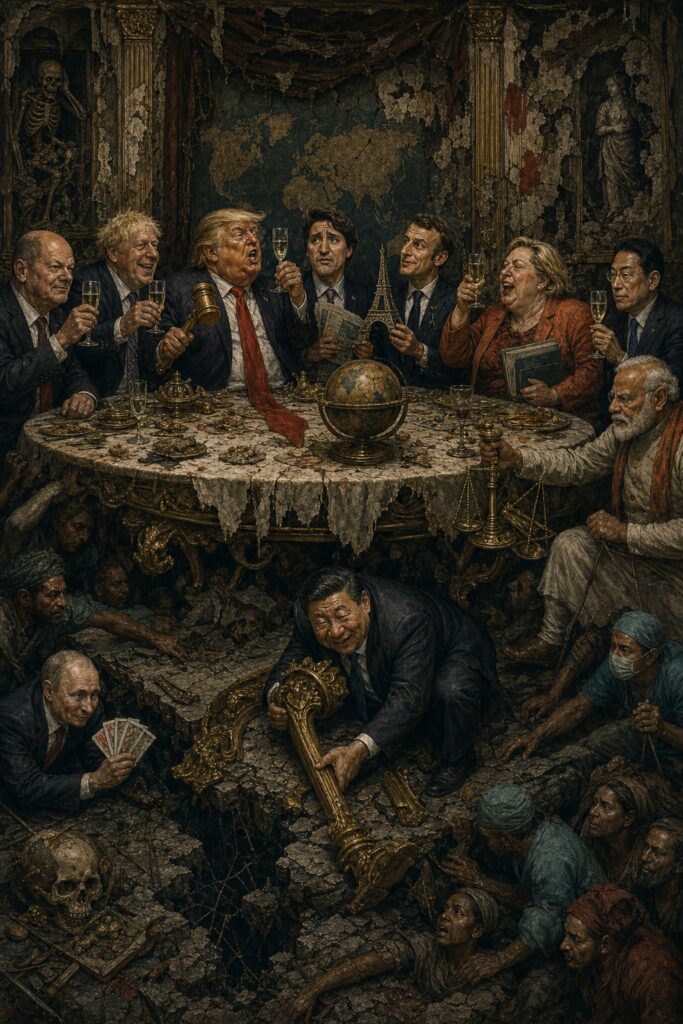
Executive Summary
The G7 was designed in 1975 as an informal caucus of the Western-led industrial democracies. Half a century later, four of the world’s most consequential economies sit outside the table: Russia, China, India, and South Korea. Each was excluded for different reasons and each has developed a distinct critique of the forum’s legitimacy, representativeness, and purpose. Their perspectives, drawn from state media, official statements, academic journals, and policy publications, converge on a common thread: the G7 is increasingly a legacy institution whose authority rests on inherited prestige rather than current economic or demographic reality. A fifth question is equally important: why does the United States, the G7’s anchor power, show no interest in expanding membership to include these four countries, even those it ostensibly considers allies or strategic partners? Understanding how Washington rationalizes the exclusion and how Moscow, Beijing, New Delhi, and Seoul have learned to respond is essential for any honest assessment of the G7’s place in twenty-first century global governance.
The Structural Problem: A Shrinking Share of Global Power
Before examining each country’s perspective individually, it is useful to establish the quantitative backdrop that underpins all four critiques.
According to IMF purchasing power parity data, BRICS nations now account for roughly 40% of global GDP, while the G7’s share has fallen to approximately 28 to 29 percent. This is a complete reversal from 1992, when the G7 commanded roughly 45% of global output and BRICS held less than 20%. The IMF projects the divergence will continue to widen through at least 2028. Growth rate differentials compound the problem: BRICS economies are projected to grow at approximately 3.7% annually against just 1.1 to 1.2% across the G7.[1][2][3][4]
Demographic weight is equally lopsided. As China’s Foreign Ministry pointed out publicly, the seven G7 nations represent roughly 10% of the world’s population, yet they issue statements on global norms, climate frameworks, supply chains, and security architecture that affect the other 90%. Putin, speaking at the St. Petersburg International Economic Forum in June 2026, made the arithmetic explicit: BRICS now accounts for around 40% of global GDP by purchasing power parity, and contributed nearly half of all global GDP growth over the prior five years, compared to just 18% from the G7.[5][6][7][8]
This is the structural frame within which Russia, China, India, and South Korea each build their specific narratives.
Russia: From Expelled Member to Deliberate Opponent
The Ejection and Its Framing
Russia is uniquely positioned among the four countries in this analysis: it was actually inside the club for sixteen years (1998 to 2014), expelled after the annexation of Crimea, and has since systematically reframed its exclusion as a strategic liberation rather than a punishment. This narrative matters enormously for understanding the Kremlin’s public posture.[9][10]
Kremlin spokesman Dmitry Peskov stated bluntly in June 2025: “Our attitude toward the G7, it has long since stopped being an interesting and in-demand format.” He added that “Russia does not consider such a format viable because global trends indicate that the G7’s share in global affairs and global economy will be inexorably shrinking.” Peskov’s assertion that “this is not seasonal volatility” but a structural, long-term trend reflects how seriously Moscow has internalized the counter-narrative.[11][12]
Interestingly, U.S. President Donald Trump gave Moscow a rhetorical opening by stating publicly that kicking Russia out in 2014 was “a mistake” and that the Ukraine war might not have happened if Russia had remained in. The Kremlin accepted the olive branch while simultaneously rejecting its utility. Peskov told reporters that Moscow agrees with President Trump’s view that expulsion was an error, while simultaneously dismissing the group as “uninspiring and rather ineffective.”[12][13]
The Multipolar Doctrine
Russia’s intellectual critique of the G7 goes beyond wounded pride. Foreign Minister Sergei Lavrov, in a November 2025 interview, called the G7 “dying out,” and accused member states of “hypocrisy, duplicity, inability to negotiate, and dishonesty”, citing specifically their abandonment of free-market norms whenever sanctions against Russia, Iran, or Venezuela were needed. This framing transforms economic rules into geopolitical weapons, a central pillar of Moscow’s broader argument.[^14]
Lavrov has also explicitly labeled the G7’s posture a “double containment” strategy aimed simultaneously at Russia and China, positioning Moscow and Beijing as joint targets of an alliance masquerading as an economic forum. For Russian audiences, this narrative is deeply useful: it repositions Russia not as a pariah excluded for breaking international law, but as a co-victim of Western hegemonic strategy alongside the world’s most populous nation.[^15]
Putin, speaking at SPIEF 2026, extended the argument into a full-scale civilizational counter-narrative, calling for “a new development model, not based on the rules of neo-colonialism, where the ‘golden billion’ drains resources from other countries.” Russian Ambassador to the United States Anatoly Antonov sharpened the institutional argument: “It is hard to imagine resolution of global problems without China today. Global political issues should be resolved with more states represented rather than in some elite clubs.” Foreign Ministry spokeswoman Maria Zakharova went further, stating: “It’s impossible to address global policy and economic issues within the framework of exclusive clubs. This is an objective reality.”[16][17][8][18]
BRICS as the Preferred Alternative
Russia’s answer to the G7 is not nostalgia for inclusion but active investment in BRICS as the legitimate successor forum. BRICS, which now includes Brazil, Russia, India, China, South Africa, Egypt, Ethiopia, Iran, the UAE, and Indonesia, has in Moscow’s telling already “overtaken the G7” in economic scale. The Kremlin’s consistent line is that the G20 is a more representative forum for economic coordination, and BRICS the natural home for states that reject unipolarity. Putin stated at SPIEF 2025 that “centres of growth have moved to other regions of the globe” and that Russia is “much more interested in continuing constructive work within the framework of the G20.”[19][20][7][11]
China: Structural Exclusion and the “Cold War Mentality” Critique
A Forum Defined Against China
China was never a member of the G7 and has never formally sought membership. But Beijing’s engagement with the group is intense precisely because the G7 functions increasingly as a coordination mechanism targeting Chinese behavior. CSIS analysts noted candidly ahead of the 2025 Kananaskis summit that “China isn’t on the G7 agenda, but it’s still the main event”, meaning that even without appearing in the formal communique language, China shapes the G7’s agenda on trade, technology, maritime security, and supply chain policy. Chinese diplomats receive urgent representations from Beijing after every G7 statement touching Taiwan, the South China Sea, or Russia-Ukraine.[^21]
The Legitimacy Argument: “You Don’t Represent the World”
The most frequently deployed Chinese argument is the representativeness critique. Chinese Foreign Ministry Spokesperson Lin Jian articulated it directly in May 2025: “The G7 does not represent the world. The seven countries only account for 10 per cent of the world’s population; even combined, they contribute less than China to global economic growth.” He added that the G7 “has long strayed from its original purpose of coordinating for stability in the global economic environment, and has increasingly become a political tool to perpetuate US and Western supremacy.”[^6]
The Global Times, the CCP’s English-language mouthpiece, has been characteristically direct, publishing in March 2025 that “the G7’s imperialist nostalgia has no place in the 21st century,” and in June 2026 describing the group as “outdated” and “a hypocritical club of wealthy nations” that blames China for its own members’ economic slowdowns, rising debt, and declining industrial competitiveness. People’s Daily, the senior CCP organ, has repeatedly urged the G7 to “recognize the prevailing global trend, abandon Cold War mentality and ideological bias, stop manipulating issues related to China, and make more contributions to solidarity and cooperation.” The phrase “Cold War mentality” (leng zhan siwei) is not casual. It is a highly loaded term in Chinese diplomatic vocabulary that frames the G7’s posture as a category error rooted in an obsolete ideological framework.[22][23][24][25]
The “G7 as U.S. Instrument” Argument
Chinese academic and official commentary consistently frames the G7 not as a genuinely multilateral body but as an instrument of American hegemonic strategy. Professor Li Haidong of China Foreign Affairs University stated that “the G7’s approach to international economic affairs clearly reflects a bloc-based, alliance-oriented mindset, deeply rooted in Cold War thinking… they view issues through a divisive ‘us versus them’ lens.” The China Diplomacy portal published in April 2024 that “as the United States has carried out strategic competition and containment against China in an all-alliance manner, the G7 has increasingly become a tool for the United States to win over allies and contain competitors.”[26][27]
Global Times analysis of the June 2025 G7 Finance Ministers meeting noted that “the G7 is no longer the convenient strategic instrument of US Cold War coordination, nor is it the global command center for designing world order. Instead, it has become a symbolic club, one that struggles to maintain internal coherence.” This line of argument serves a dual purpose: it delegitimizes the G7 while simultaneously driving wedges between the U.S. and European G7 members, a consistent strategic objective for Beijing.[28][29]
China’s Preferred Multilateral Frameworks
China’s alternative governance vision centers on the G20 (where it participates as a full member), BRICS+, the Shanghai Cooperation Organisation, and the Belt and Road Initiative framework. When the G20 was hosted in Hangzhou, Beijing explicitly maneuvered to keep the agenda on economic and financial issues and away from political topics where China is on the defensive, demonstrating that China’s preferred governance forum is one where it sets the agenda rather than one that sets the agenda against China.[30][31]
India: The Aspirant Who Refuses to Be Captured
A Distinct Position: Neither Excluded Nor Admitted
India’s position relative to the G7 is unlike any other major economy’s. It has been invited as a special outreach participant at eight consecutive G7 summits as of 2026, yet holds no seat at the table. Prime Minister Modi, accepting President Macron’s invitation to the 2026 Evian summit, framed India’s participation explicitly: “India will not only speak for itself, but it will also give voice to the aspirations of the Global South.” This framing is the key to understanding New Delhi’s posture. India is not seeking validation from the G7 so much as leveraging it as a platform to promote a different vision of global governance.[32][33]
The Representativeness Critique, Indian-Style
India’s critique of the G7’s composition is distinct from China’s or Russia’s because it comes from a country that shares the G7’s stated democratic values but rejects the club’s implicit hierarchy. At the 2021 Cornwall summit, PM Modi argued for the “reform of the multilateral system based on openness, democracy, transparency and inclusion,” framing the G7’s exclusivity as antithetical to its own stated principles. Indian officials have consistently stated that “the resolution of key global crises won’t be possible without India’s engagement, involvement and support”, a pointed reminder that any forum claiming global governance legitimacy that excludes the world’s most populous democracy is, at minimum, incomplete.[34][35][^36]
Modi in 2021 called India “a natural ally for the G7 and its partners to defend democracy and freedom of thought from challenges arising due to authoritarianism, terrorism, disinformation and economic coercion.” This is a sophisticated positioning: India is affirming G7 values while simultaneously making the case that the club’s failure to include India undermines its stated mission. When Canada pointedly excluded India from the 2025 Kananaskis summit over the Nijjar diplomatic dispute, Indian commentators described it as a “diplomatic embarrassment for all parties” that painted the G7 as “an outdated and exclusive club rather than an inclusive forum addressing global challenges.”[37][36]
Strategic Autonomy: India’s Structural Refusal
The deeper story of India and the G7 is not about membership credentials, it is about India’s doctrine of “strategic autonomy,” which the Modi administration has refined into what current policymakers call “multi-alignment with leverage.” India simultaneously participates in the Quad (with the U.S., Japan, and Australia to balance China in the Indo-Pacific), remains a pivotal BRICS+ member, maintains arms and energy ties with Russia, and pursues independent trade negotiations with the EU, UK, and Gulf states. External Affairs Minister Jaishankar encapsulated the doctrine in a widely cited formulation: India is “engaging with all major powers to achieve partisan ends.”[38][39][^40]
This architecture makes full G7 membership structurally inconvenient for India, even if the invitation were extended. Full membership would implicitly commit New Delhi to the group’s anti-Russia sanctions posture (India has continued purchasing discounted Russian oil despite U.S. pressure and 50% tariff threats), to its increasingly explicit anti-China coordination framework, and to a level of alignment with Washington that India’s political establishment views as corrosive to its sovereignty. As one CLAWS analysis summarized: “structural alignment with Washington might erode the very ‘Strategic Autonomy’ India seeks to protect.”[39][40][^41]
India as Bridge, Not Follower
The most consequential aspect of India’s G7 posture is its self-positioning as “Vishwa Bandhu” (World Friend) and representative of the Global South. Rather than seeking admission to the existing club, India is attempting to reshape the terms of legitimacy that the club relies upon. Modi’s consistent advocacy at G7 summits for “universal and affordable access to energy, democratised technological innovation, and structural reform of global governance institutions to reflect twenty-first-century realities” is not a plea for inclusion, it is a challenge to the framework itself. Analysts at the Institute for Global Law and Policy and Vision IAS have noted that India uses its G7 “outreach country” status to advocate for fairer, more inclusive decision-making while maintaining the freedom to align with non-Western blocs on other issues.[42][35][^38]
South Korea: The Aspirant’s Dilemma
A Fundamentally Different Posture
South Korea’s perspective on G7 relevance differs categorically from Russia’s, China’s, and India’s. Seoul does not challenge the G7’s legitimacy, it wants in. But this aspiration itself exposes a set of structural contradictions that illuminate the forum’s limits from a different angle.
South Korea meets the stated criteria for G7 membership by almost every measure: it is a high-income, export-intensive free-market democracy with a GDP comparable to Italy or Canada, a leading position in semiconductors, shipbuilding, batteries, and automotive technology, and a formal security alliance with the United States. U.S. scholars writing in Yonhap News in June 2025 stated flatly that “Australia and South Korea should be at the front of the line to join the G7,” calling them “responsible stewards of the international economy” who “clearly meet” the standard for membership.[43][44][^45]
Yet Seoul remains outside, invited to summits as a guest, praised as an aspirant, but never admitted.[46][47]
Why Membership Eludes Seoul
Korean academic and policy commentary identifies several interlocking barriers. The Korea Economic Institute noted that South Korea’s political instability following recent constitutional crises, perceptions of “weakened democratic credentials,” and unresolved relations with Japan all complicate its candidacy. A JoongAng Daily analysis observed diplomatically that South Korea “may belong to the G7 league in economics” but needs to develop “its diplomatic capabilities” and align more systematically with G7 values on global issues where Seoul has traditionally prioritized domestic political considerations.[48][49]
The deeper structural barrier is geopolitical, not procedural. South Korea is caught in what Korean scholars call the “US-China squeeze,” meaning it is Washington’s most important Northeast Asian ally and simultaneously China’s largest bilateral trading partner. The Korea Times described this as “a nearly impossible position when it comes to the budding Cold War between China and the United States.” Harry Kazianis of the Center for the National Interest stated the bind plainly: “President Lee needs a strong trade relationship with China and their help with North Korea. At the same time, he needs to make sure Washington continues to see the U.S.-Korea alliance as critical.”[50][51][^52]
This structural tension means that G7 membership carries a price: joining would implicitly commit Seoul to the G7’s increasingly explicit anti-China posture, a posture that Chinese economic retaliation (as seen during the THAAD missile defense dispute) has already demonstrated carries severe bilateral costs. As President Lee Jae-myung said at the 2025 Kananaskis summit, South Korea “should not be made to choose between the United States and China” and should not “put all our eggs in one basket.”[^53]
China Uses South Korea’s Exclusion as a Pressure Tactic
In a darkly ironic dynamic, Chinese state media has turned South Korea’s G7 exclusion into a diplomatic tool. When Seoul was not invited to the 2024 G7 summit in Italy, the Global Times published a column arguing that “if South Korea wants truthful respect from the world, it needs to make mature decisions for its profit rather than focusing on G7, but stop blindly following the United States.” The message was explicit: Korea’s G7 aspirations are a chimera used by Washington to extract alignment against China, and Korea’s real interests lie in its economic relationship with Beijing and regional autonomy.[^54]
The Korea Times, in June 2025, argued that Trump’s G7 performance was “a warning: Korea must rethink its diplomatic strategy,” suggesting that the group’s internal incoherence under U.S. pressure makes full membership a more complicated prize than it once appeared. South Korean think tanks increasingly view the “G7 Plus” observer model, regular participation without formal membership, as a rational goal that preserves strategic flexibility.[55][56]
Why the United States Doesn’t Push for Expansion
This is perhaps the most revealing question of all. Washington could, in theory, advocate for expanding the G7 to include democratic emerging economies like India and South Korea, or for re-engaging Russia as a counterbalance to China. That it does not, and has not, reveals the G7’s true function.
The “Democratic Values” Gatekeeping Argument
The United States and its G7 partners maintain that membership requires shared commitment to democratic governance, rule of law, and open societies, a standard established at the founding 1975 Rambouillet summit. Under this framework, China and Russia disqualify themselves through their own governance systems. AP News reported in June 2026 that the G7 has “an unspoken rule that it comprises only democracies,” and that China “significantly lags behind G7 nations in terms of civil liberties” as measured by Freedom House and the World Press Freedom Index. G7 scholar John Kirton stated flatly: “China’s inclusion would indeed be a Trojan horse. With a Chinese leader at the table, individual members might be tempted to diverge from established G7 positions to secure special concessions.” He also argued that the Russia episode, where an imperfectly democratic member was brought in for political reasons and later caused the group significant damage, had “led other leaders to conclude that they should avoid allowing any power that is not fully democratic to join their democratic club again.”[^57]
The G7 as a China Coordination Platform
The most candid U.S. rationale for not expanding the G7 is strategic: the group functions as a coordination platform for managing, competing with, and in some respects containing China. Admitting China would dissolve the forum’s primary purpose. A 2023 Institute of Geoeconomics analysis described the G7’s post-Ukraine pivot as a transformation into “collective economic defense,” whose central mission is breaking dependencies on Chinese chokehold industries in semiconductors, rare earths, and advanced manufacturing. U.S. Secretary of State Marco Rubio demonstrated in March 2025 exactly how Washington uses the G7 instrumentally: the U.S. sought to remove references to Russia sanctions from G7 communique language while simultaneously demanding “tougher language on China,” using the forum as a tool to manage different pressure levels on different adversaries simultaneously.[58][59][^60]
The Biden White House was equally blunt: a 2022 fact sheet describing the G7 as a group of “like-minded democracies solving problems” framed the forum’s value explicitly as its ability to coordinate against “challenges posed by China to our workers, companies, and national security.” China is not absent from the G7 by accident or administrative inertia, it is absent because the G7 is specifically designed to function as a caucus against Chinese economic and geopolitical expansion.[^61]
Why India and South Korea Are Not Pressed for Full Membership
For India and South Korea, the U.S. calculation is more nuanced. Both clearly qualify on democratic governance grounds. But Washington benefits from their current liminal status: as outreach participants and observers, India and South Korea provide rhetorical legitimacy to G7 communiques without holding veto power over them. Full membership would give Seoul and New Delhi the ability to block consensus language on China, Russia, or other issues where their interests diverge from Washington’s. India’s demonstrated willingness to continue purchasing Russian oil, resist U.S. tariff pressure, and maintain active BRICS participation makes full membership politically complicated for Washington. From a U.S. perspective, India as observer is more useful than India as full member, precisely because it maximizes India’s platform contribution while minimizing its veto potential.[33][40][41][42]
For South Korea, the calculus is similar: Seoul’s value to Washington lies partly in its ambiguity. A South Korea formally locked into G7 membership would face immediate Chinese economic retaliation, potentially destabilizing a key Indo-Pacific ally. Washington prefers Korea diplomatically close but structurally flexible.
The Russia Re-Entry Question
Trump’s suggestion that readmitting Russia to reconstitute a G8 would have prevented the Ukraine war has been the most publicly debated expansion question of the current period. European G7 members have resisted this firmly, arguing that re-entry without behavioral change would undermine the sanctions regime that constitutes the West’s primary leverage over Moscow. The U.S. position has oscillated: under Trump, there is rhetorical sympathy for Russian re-entry as a tool to separate Moscow from Beijing; under the broader foreign policy establishment, the prevailing view is that Russia’s inclusion would fracture G7 consensus on Ukraine and weaken the group’s credibility as a rules-based order anchor. Moscow itself has foreclosed the debate by making clear it has no interest in returning on the West’s terms.[62][13][63][18][^12]
Comparative Analysis: Four Critiques and One Structural Reality
Country
Core Argument Against G7 Relevance
Preferred Alternative Forum
Fundamental Goal
Russia
Dying Western club; BRICS surpassed G7 economically; expelled member frames exclusion as liberation
BRICS+, G20, SCO
Legitimize multipolar order; delegitimize Western sanctions regime
China
Represents 10% of humanity; US hegemony tool; Cold War ideology; China contributes more to growth than G7 combined
G20, BRICS, SCO, BRI
Reshape global governance to reflect Chinese power; deflect criticism on Taiwan, South China Sea, trade practices
India
Legitimate democratic partner sidelined; Global South unrepresented; multilateral reform overdue
G20, BRICS+, Quad, bilateral partnerships
Preserve strategic autonomy; position as bridge between Global North and South
South Korea
Qualifies but excluded for geopolitical convenience; membership would force untenable China-US choice
G7+ observer model; ASEAN+; middle-power diplomacy
Gain G7 prestige without sacrificing China trade relationship
The four perspectives, while structurally distinct, converge on a single verdict: the G7 is an institution whose authority increasingly exceeds its representativeness. Russia has made this conclusion a cornerstone of its geopolitical doctrine. China uses it to erode the forum’s legitimacy in the Global South. India acknowledges the G7’s relevance while insisting the forum must reform or cede ground to more inclusive bodies. South Korea is forced to live inside the contradiction, qualifying for the club but unable to fully commit to what membership would require.
What This Means for the G7’s Actual Relevance
These critiques cannot be dismissed as propaganda: they are grounded in measurable shifts in economic weight, demographic reality, and geopolitical alignment. The G7’s combined share of global PPP GDP has declined from 46% in 1995 to below 29% today, while BRICS has risen from 17% to 40% over the same period. The G7’s own internal coherence has been strained by the Trump administration’s resistance to collective communiques.[2][3][7][26][^28]
At the same time, the G7 retains genuine institutional power that its critics tend to understate. It represents the concentration of the world’s most advanced technological capabilities, most liquid financial markets, most influential reserve currencies, and most interconnected military alliances. Beijing-based analyst Wang Zichen acknowledged plainly that “China recognizes that the G7 still represents a very significant concentration of economic, technological, military and financial power.” The G7’s ability to impose and enforce sanctions regimes, coordinate supply chain strategy, set AI governance frameworks, and mobilize development finance remains unmatched by any competing format.[29][58][^61]
The honest answer to the question of how one rationalizes the G7’s relevance in light of these exclusions is this: the G7 is relevant not because it represents the world, but because it coordinates the world’s most powerful states in their competition with the world’s fastest-growing ones. Its legitimacy gap is real; its power is also real. Russia, China, India, and South Korea each understand this in their own way, which is precisely why none of them can stop talking about a club they insist doesn’t matter.
References
1. BRICS Shatters Projections: Now Commands 40% of Global GDP as… – The International Monetary Fund’s latest purchasing power parity data confirms a seismic shift in gl…
2. This chart from The Economist, based on IMF data… – This chart from The Economist, based on IMF data, captures one of the most important long-term macro…
3. BRICS vs. G7: A Shifting Economic Landscape – A comparison of BRICS and G7 economic growth forecasts, highlighting BRICS’ rising global influence…
4. BRICS Surpasses G7 in Global GDP Share, Trade Without Dollar… – According to NS3.AI, recent data from the International Monetary Fund (IMF) indicates that the BRICS…
5. Chinese Foreign Ministry Spokesperson’s Remarks on the Wrong Comment on China by the G7 Summit
6. “G7 political tool to perpetuate US, Western supremacy”: China – The Economic Times – China has criticized the G7 Leaders’ Communique, accusing the group of using China-related issues to…
7. Russian President Vladimir Putin used his address at the 29th St… – Putin said, “The world is transitioning to a distributed, more comprehensive multipolar system,” des…
8. Brics has overtaken G7, Global South new hub of growth: Putin at SPIEF – Russian President Putin’s firm endorsement of the Brics comes at a time when US President Donald Tru…
9. Group of Seven (G7) – Group of Seven, intergovernmental organization that originated in 1975. Members are the United State…
10. The history of the G7 – Bundesregierung – As the world reeled from the first oil shock and subsequent financial crisis, the heads of state and…
11. G7 is ‘unviable’, Kremlin – Moscow has no interest in the format as the constituent nations no longer represent the global major…
12. Kremlin Calls G7 ‘Useless’, Agrees With Trump That Kicking Out Russia Was a Mistake – US News is a recognized leader in college, grad school, hospital, mutual fund, and car rankings. Tra…
13. Putin rules out Russia’s return to Western G7 bloc – Putin firmly rejects rejoining the G7, dismissing the group’s relevance and signaling Russia’s conti…
14. G7 is dying out, demonstrating hypocrisy, inability to… – The Russian foreign minister also pointed out that NATO and the European Union are now little differ…
15. Russia’s Lavrov says G7 is bent on ‘double containment’ of Russia and China – Times of India – Europe News: Russian Foreign Minister Sergei Lavrov said on Saturday that decisions taken by the Gro…
16. [PDF] A Fundamentally New Development Model Is Needed
17. World Free From Neocolonialism: Putin Calls For New Global… – Russian President Vladimir Putin addressed the St. Petersburg International Economic Forum (SPIEF) p…
18. Russia Rejoining Group of Seven (G7) Sparks Debates – Russia is transiting through very turbulent times and yet has an unwavering desire to forge better r…
19. Kremlin Declares G7 Has Lost Relevance After Trump’s Remarks – The Kremlin asserted on February 14, 2025, its belief in the diminishing relevance of the Group of S…
20. West’s efforts to isolate Russia have failed, Lavrov – Foreign Minister Sergey Lavrov says the West’s efforts to isolate Russia have failed completely
21. China Isn’t on the G7 Agenda, but It’s Still the Main Event – CSIS – As G7 leaders meet in Kananaskis, one top priority, China, won’t appear on the public agenda. Behind c…
22. China urges G7 to stop interfering in its internal affairs – People’s Daily – BEIJING, Nov. 13 (Xinhua), China has urged the G7 to stop manipulating issues related to China and
24. The G7’s imperialist nostalgia has no place in the 21st… – The G7’s attempts to revive the rhetoric and tactics of imperialism are not only misguided but also…
25. Chinese State Media Criticizes G7 for Lack of Unity and… – Protests against the G7 summit are taking place in Évian-les-Bains, France, as reported by…
26. China opposes G7’s manipulation of China-related issues – In response to the G7 summit chair’s summary that calls on China to “refrain from market distortions…
27. Why the G7 has become a declining political club – If the G7 becomes a tool for the U.S. to maintain its declining hegemony, its destructive effect on…
28. Is the US losing its sway in the G7? – Global Times – When it comes to China, not only is there no unified stance among G7 members, but even the language…
29. Why Trump and other G7 leaders meeting without China might be a mistake – China’s absence from G7 summits seems increasingly odd given its global economic influence | KNX New…
30. How will China’s success at the G-20 summit be measured? – When China hosts the G-20 leaders’ summit in Hangzhou on September 4 and 5, it will be an important…
31. A Japanese Perspective on Hangzhou G20 – China needs to demonstrate “reciprocity” if it wishes to act as a superpower.
32. Global South’s concerns, meeting with Trump: What’s on agenda for PM Modi at G7 Summit 2026 – The Group of Seven (G7) Summit will be held on June 16 and 17 in Evian, France. This will be the eig…
33. In-Depth: India & G7 | 21 June, 2025 – The G7, like the G20, is not an international organisation. It does not have its own administrativ…
34. On the second day of G7 Summit, Prime Minister takes part in two sessions
35. India at G7 2025: Advocating…
36. India natural ally for G7, partners to take on global challenges: PM Modi – Indian officials said the country’s participation in the meet reflects understanding within the G7 t…
37. Canada’s Refusal to Invite India to the G7 Summit: A Diplomatic Embarrassment for All Parties Involved – By Prashant ShahCanada’s decision to exclude India from the 2025 G7 summit has stirred significant d…
38. [PDF] India’s Non-Alignment Policy in a Multipolar World – IJFMR – While India has successfully resisted taking sides in the Russia-Ukraine conflict, the increasing “T…
39. [PDF] March 2026 No: 497 – CLAWS
40. India-China-US: A New Strategic Triangle? – In 2025, India, China, and the United States are no longer cautiously orbiting one another. Their st…
41. Strategic Autonomy or a Pro-US Tilt? India’s Foreign Policy Under… – The Iran war is forcing India to confront the tension between strategic autonomy and its commitment…
42. Group of Seven (G7) | Current Affairs – Vision IAS – India had participated as an Outreach Country in 51st G7 Summit (2025) held in Kananaskis, Canada.
43. The Case for South Korean Membership in the G7 – Given the threat to free-market democracies posed by authoritarian and revisionist China and Russia…
44. Time for U.S., Japan to Make Case for Adding South Korea to Group of 7 Nations – As the global economy faces growing, complex challenges on multiple fronts, the Group of Seven leadi…
45. U.S. scholars call for G7 membership expansion to include S. Korea, Australia – By Song Sang-ho WASHINGTON, June 11 (Yonhap), Prominent U.S. scholars have called for…
46. President Lee’s G7 summit debut sets stage for ‘pragmatic… – The upcoming G7 meeting in Kananaskis in Alberta, Canada, from June 15 to 17 will mark President Lee…
47. G7 attendance highlights South Korea’s growing stature – Dive into Pacific Forum’s comprehensive analysis of Indo-Pacific events through its three insightful…
48. The Prospect and Implications of G7 Expansion to Include South… – Expanding G7 to include Korea could strengthen its global role, counterbalance China, and reinforce…
49. Upgrading our diplomacy – South Korea’s invitation to the Group of Seven Summit in Britain last month did not draw much attent…
50. [PDF] ACADEMIC PAPER SERIES – Korea Economic Institute
51. Invitation to G-7 sharpens Korea’s dilemma between US… – President Moon Jae-in listens to U.S. President Donald Trump during their phone conversation at Cheo…
52. [PDF] HOW AMERICA VIEWS CHINA-SOUTH KOREA BILATERALISM – The South Korea-United States alliance has come a long way from being an indispensable front-line ch…
53. At G-7 summit, South Korea’s President Lee faces delicate balance in US-China rivalry – Mr Lee has acknowledged that the South Korea-US alliance remains the foundation of South Korea’s dip…
54. Chinese State Media Mocks South Korea’s Absence from G7 Summit – Yoon Suk Yeol(right), the President of South Korea, is seen in a summit meeting with President Joe B…
55. “South Korea’s Survival Strategy: Sustaining Alliances, Division of Labor, and Joining G7 Plus” [De-globalization? New Order!] ⑪ – As the United States adopts a tariff policy based on reciprocity, the global trade order has entered…
56. Trump’s G7 performance is a warning: Korea must rethink its diplomatic strategy – As U.S. foreign policy under President Donald Trump shifts further toward unilateralism and transact…
57. Trump and other G7 leaders are meeting without China. Is that a mistake? – China’s absence from G7 summits seems increasingly odd given its global economic influence. The G7…
58. Why the G7 has significance as a collective economic defense… – To break China’s hold on G7 countries’ chokepoints, strategic goods of which China holds a large sh…
59. US wants no G7 Russia antagonism as allies fear blockage – U.S. Secretary of State Marco Rubio highlighted America’s opposition to language that could hinder n…
60. Russia and China hit back at a G7 that saw them as a threat – HIROSHIMA (CNN): Moscow and Beijing lashed out against the Group of Seven (G7) summit in Hiroshima…
61. FACT SHEET: The United States Continues to Strengthen Cooperation with G7 on 21st Century Challenges, including those Posed by the People’s Republic of China (PRC) | The White House – Today President Biden met with G7 leaders to strengthen our cooperation on economic issues, cyberspa…
62. G7 leaders reject Russia’s return after Trump summit invite – “Russia was removed from the G7 group of nations following its [2014] annexation of Crimea and we ar…
63. Fawal: Dealing with China and Russia at the G7’s Cornwall Summit
Related reading
- The Bahrain Parable: A Cautionary Tale for South Korea, Japan, Singapore, Indonesia, Malaysia, Vietnam, and Thailand
- Dear South Korea, You Have Been Diagnosed with a Fatal American Dependency Cancer
- Neocons, China, and the New Bipartisan Lunacy
- The Hubris of Hegemony: Why the Neoconservative Approach to China Is Futile Lunacy