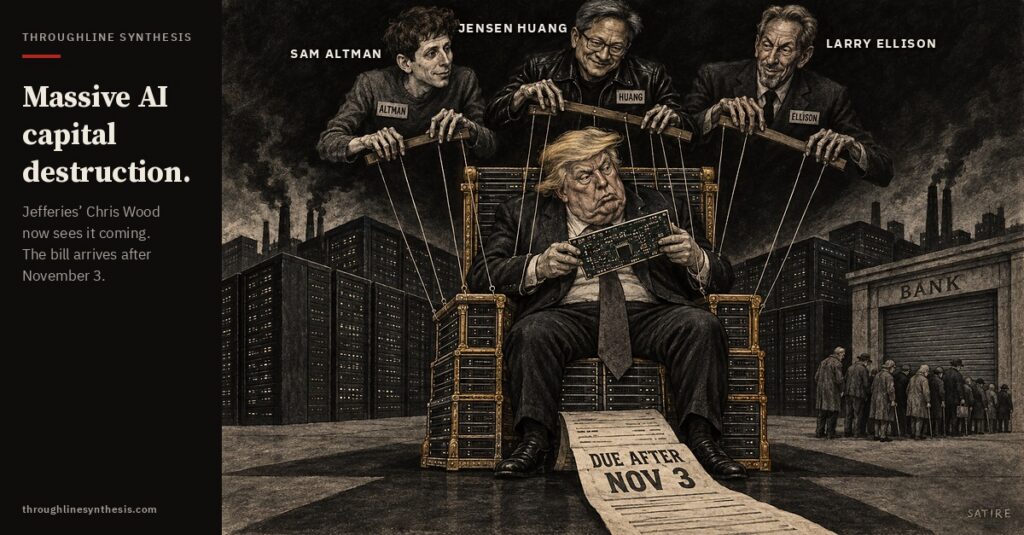
Jefferies’ global equity strategist now reaches the same conclusions I documented in July. On October 12, Breaking Points put his warning before a national audience. Evidence from the past 10 days shows cheaper AI attacking its lenders on 2 fronts; history shows who pays when foreign credit stops; and Washington’s calendar pushes the bill past the midterms onto American and European savers.
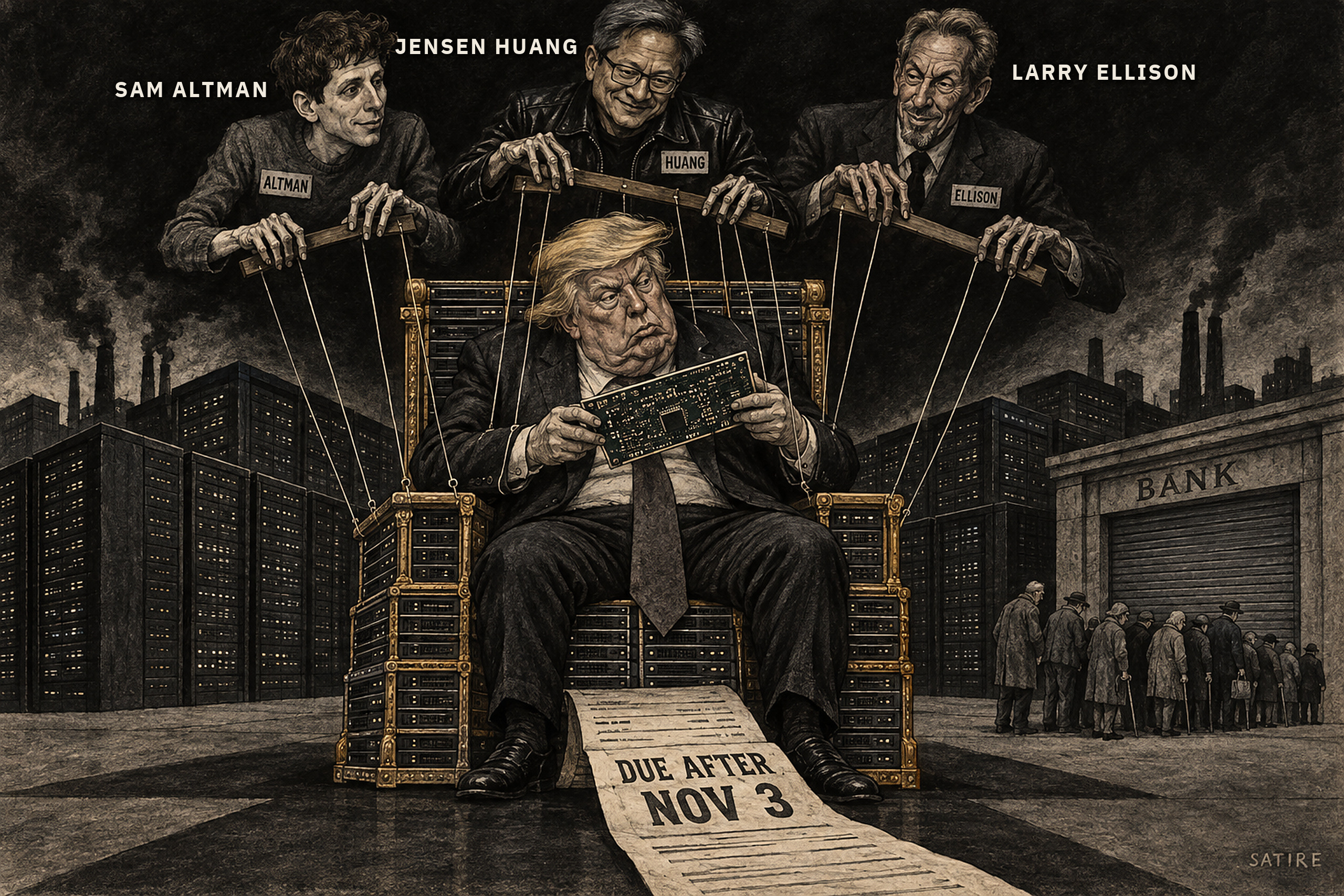
On Friday, October 9, Chris Wood, global head of equity strategy at Jefferies Financial Group and author of its GREED & fear newsletter, told clients that the most likely long-term result of the artificial intelligence, or AI, boom is “massive capital destruction” in the United States, with market share moving to cheaper open-source Chinese models (Bloomberg). He wrote that China “has become a technological peer to the US in AI.” He warned that spending is increasingly financed with debt rather than the cash of the largest cloud companies, and that Moonshot AI’s Kimi K3 and falling token prices raise the question of whether large language models can ever be profitable (The Economic Times, reprinting Bloomberg). In his latest quarterly report, published in Chinese translation on October 12, he compared the AI boom to the 2008 subprime mortgage crisis and identified a structural risk: the cloud giants have extended large amounts of “unsecured credit” to 2 persistently loss-making AI labs (Sina Finance, citing Gelonghui).
On Monday, October 12, Krystal Ball and Saagar Enjeti, the hosts of Breaking Points, read Wood’s note on air. Enjeti gave the argument its shortest form: “technology does not equal business model. They actually are uniquely separate” (Breaking Points). On the same broadcast, the historian Victor Sebestyen, author of a new history of the Weimar Republic, said that “the result of the AI revolution” is among the changes likely to have “the biggest effect” on the world.
I welcome the company. I have published the same case, piece by piece, with dates and documents, since July. Wood writes for investors deciding what to own. I write for the people who will be asked to pay when the owners are wrong.
This article does 5 things. It sets Wood’s statements beside mine, date by date, with links so every reader can check the record. It shows where we agree, where I go further, and where we differ. It adds evidence published between October 2 and October 12, including the software clones Breaking Points discussed and what they mean for lenders. It sets the boom beside the 2 historical cases that best explain who pays: Europe’s railway lending before 1873 and America’s lending to Weimar Germany before 1931. Finally, it brings my forecast forward: the AI financial bubble will collapse soon, the break will begin in credit, and the political calendar now places the bill after November 3, when Americans vote.
The short version
- Wood and I reach the same 4 conclusions from different desks: Chinese open-weight models are destroying the prices that American AI spending needs; the spending is financed with debt; the debt is concentrated on 2 loss-making labs, OpenAI and Anthropic; and credit, not technology, ends the boom.
- Wood published his capital-destruction call on May 30, after my February and March warnings and before most of my bust series. He wrote that “a lot of capital will be destroyed in this AI capex cycle” (The Economic Times). My record shows the mechanism, the order of the failures, and who pays.
- The market is paying for “good enough.” Chinese models took about 65% of the tokens on the OpenRouter marketplace in September and 30% of the dollars, up from 22% and 6% in January (Sina Finance, citing CLSA). By my arithmetic, a Chinese token sold for about 1/5 the price of an American token in both months. The discount held; the volume moved.
- OpenAI told investors its annualized revenue was about $50 billion, down from the $68 billion figure widely reported in late September, and AI stocks fell on the news (CNBC).
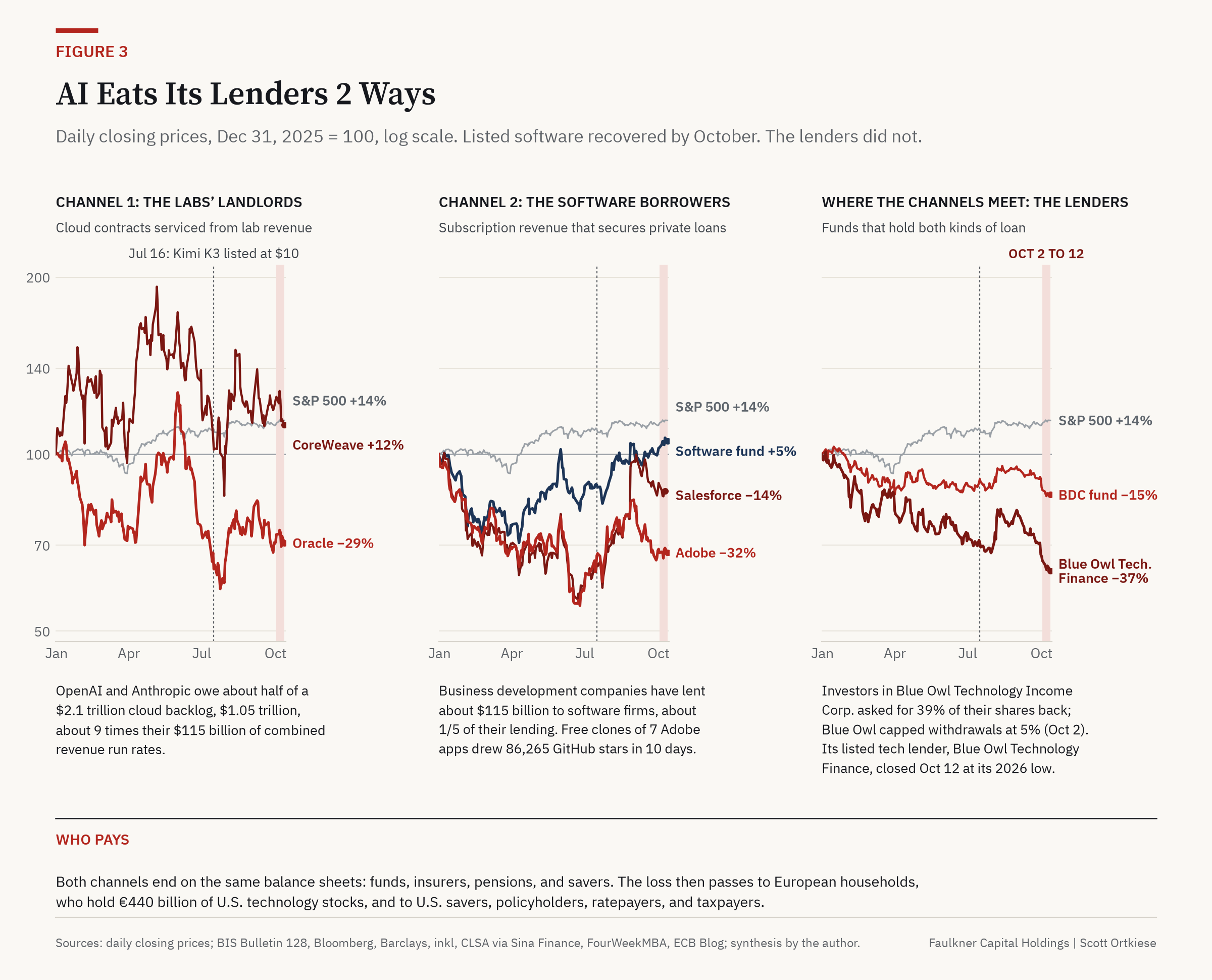
- Cheap AI now attacks a second set of borrowers. A developer used Anthropic’s Claude Opus 5.5 to build free replacements for 7 Adobe applications; they drew 86,265 GitHub stars in about 10 days (FourWeekMBA). Business development companies have lent about $115 billion to software firms, about 1/5 of all their lending (BIS Bulletin 128). AI eats its lenders 2 ways.
- Money got dearer for everyone and scarce for AI. The 10-year Treasury yield touched 5.33% on October 1, its highest since 2002 (24/7 Wall St.); the 30-year mortgage rate reached 7.40% (Freddie Mac); and cloud-company bond spreads widened about 30 basis points this year, while the investment-grade index widened 2 (J.P. Morgan Asset Management).
- Investors asked to redeem 39% of shares in Blue Owl’s $5 billion technology lending fund in the third quarter. Blue Owl paid out 5% (Bloomberg).
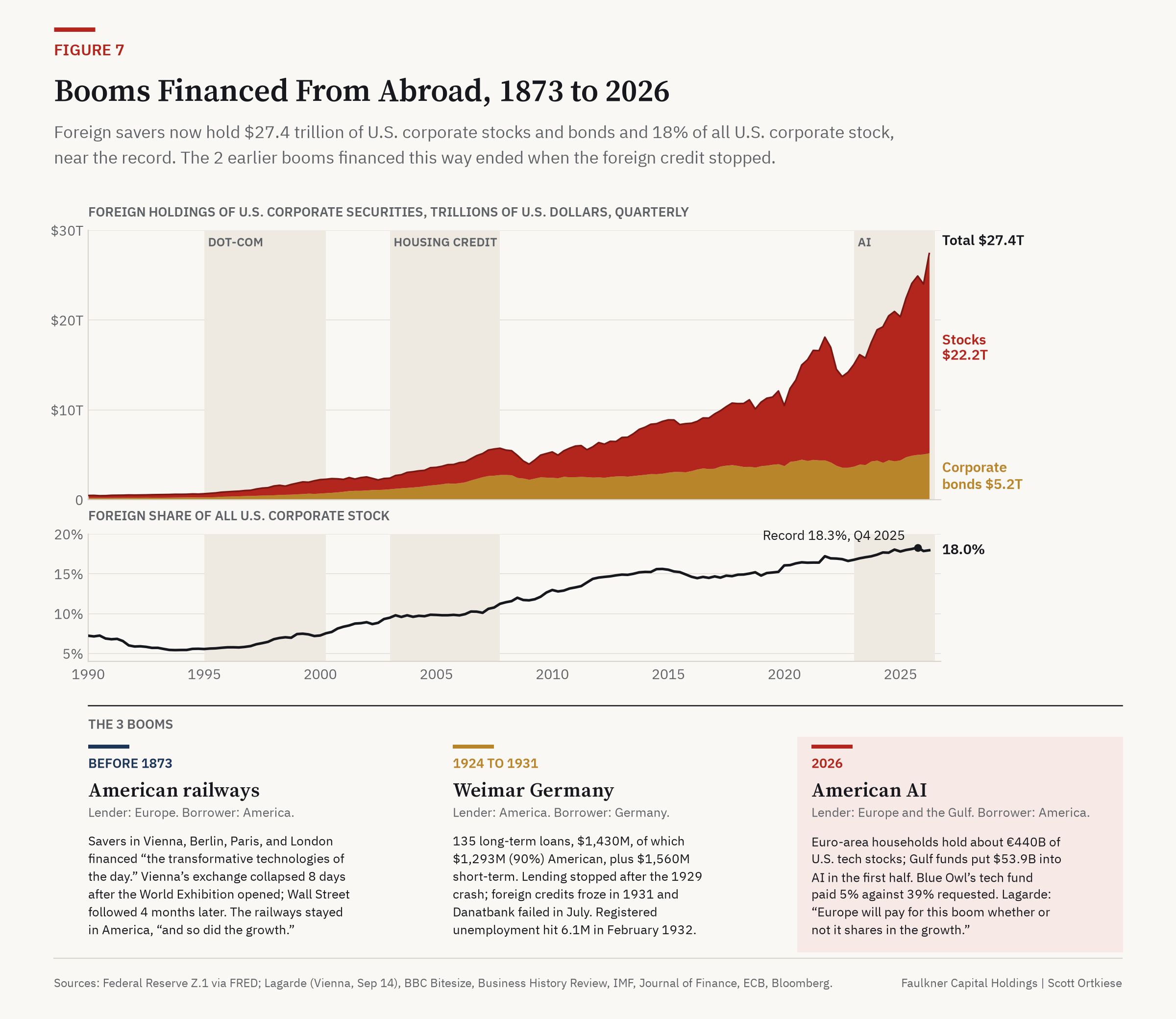
- History names the payer. Before 1873, European savers financed American railways; the crash hit both continents, but the railways and the growth stayed in America, as European Central Bank President Christine Lagarde reminded Vienna on September 14 (Lagarde, Vienna). From 1924 to 1930, American lenders supplied $1,293 million of Germany’s $1,430 million in long-term loans (BBC Bitesize). When the credit stopped in 1931, the banks failed, and the vote moved.
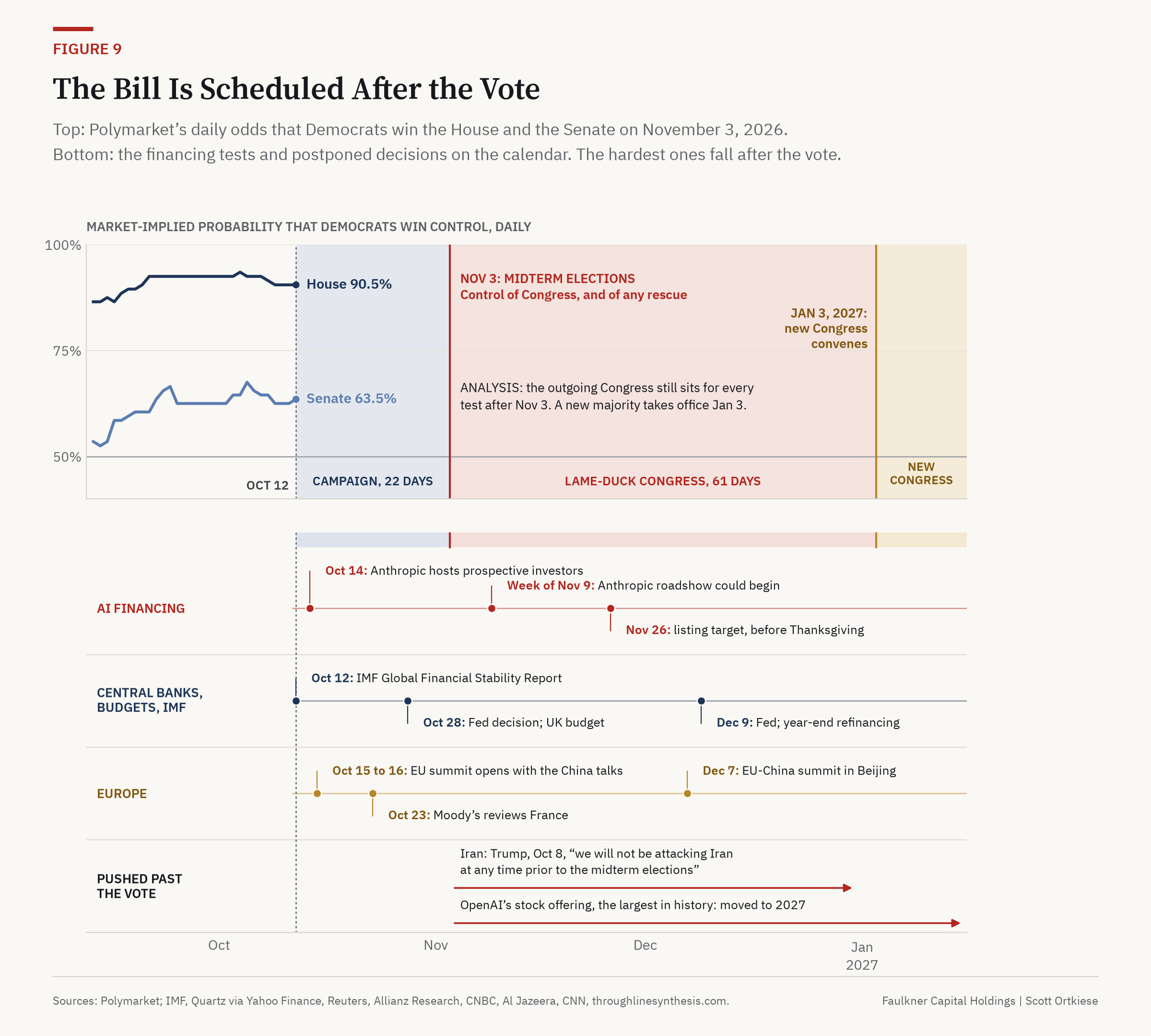
- Washington has pushed back every hard deadline past the vote. Trump said the U.S. will not attack Iran before the midterms (Al Jazeera). Anthropic’s bankers could begin its stock-offering roadshow in the week of November 9 (Quartz via Yahoo Finance). OpenAI has delayed its offering until 2027 (CNN).
- Europe carries the risk without the control. European households hold about €440 billion in U.S. technology stocks, mostly through index funds (ECB Blog). Lagarde: “Europe will pay for this boom whether or not it shares in the growth.” Europe should cut that exposure before the offering window opens and refuse any role in the rescue.
What Wood said, and when
Wood has written about the AI spending cycle every week for months. These statements matter for this comparison, in order.
| Date | Where reported | What Wood said |
|---|---|---|
| May 30 | The Economic Times | “A lot of capital will be destroyed in this AI capex cycle,” most likely by U.S. players, given Chinese AI capital spending of “only” Rmb 841 billion ($124 billion). His base case: adoption slowed by “an over-investment bust in the US.” |
| July 24 | inkl | Hundreds of billions could end in “massive capital destruction” as cheaper Chinese models erode the economics. The 4 largest cloud companies would spend $695 billion in 2026 and $870 billion in 2027, equal to 92% of forecast 2026 operating cash flow. About half of $2.1 trillion in contracted backlog is owed by OpenAI and Anthropic. He cited a study putting the cloud giants’ hidden debt at $1.65 trillion. “The time for an extended AI hangover after the initial surge of enthusiasm is approaching, if it has not already arrived.” |
| July 28 | Business Standard | Top Chinese models processed 36.39 trillion tokens on OpenRouter in the week ended July 19, versus 7.39 trillion for top U.S. models. The cloud giants had issued $194 billion in investment-grade debt this year, versus $55 billion for the U.S. energy sector. |
| September 25 | The Economic Times | “The AI story will be due for a big reset at some point in the not-so-distant future.” Microsoft, Amazon, Alphabet, and Meta spent $165 billion on capital projects in the second quarter while generating $7 billion in free cash flow; consensus put third-quarter free cash flow at negative $12 billion. For India to regain investors’ attention, “the AI story has to blow up.” |
| October 3 | The Economic Times | Stocks usually do badly going into midterms; this year they have not, “primarily because of the stellar earnings growth driven by the highly earnings-accretive AI capex cycle.” The bond market is reaching levels where stock risk is rising, and G7 government bonds are in a structural bear market. |
| October 9 | Bloomberg; The Economic Times | “Massive capital destruction” in the U.S. is the most likely long-term outcome. Top Chinese models processed 76.12 trillion tokens in the week ended September 27, up from 4.37 trillion in late April, versus 14.2 trillion for top U.S. models. |
| October 9 | TokenPost | “My base case remains that they will not generate returns sufficient to justify those investments. Ultimately there will be significant capital destruction.” He added: “The moment credit markets effectively withdraw funding, the entire AI trade could unravel.” |
| October 12 | Sina Finance | Quarterly report compares the AI boom with 2008; the cloud giants extend “unsecured credit” to 2 loss-making labs; the AI story faces a major reset in the not-distant future. |
What I said, and when
My record is public, dated, and linked. Each row is an article on this site.
| Date | Article | What I concluded |
|---|---|---|
| February 19 | E-M-E-R-G-E-N-C-Y: The AI Data-Center Boom | Alphabet, Amazon, Meta, and Microsoft forecast about $650 billion in 2026 capital spending, up 67% from $381 billion in 2025. I set the boom beside the railroad mania and asked what it will do to American jobs. |
| March 30 | The War That Broke the AI Boom | The Iran war attacks the AI boom through energy, supply chains, and the Gulf sovereign money financing it. |
| June 2 | Private Credit Is the New Subprime | Private credit is repeating the opacity of subprime mortgage finance, and AI lending sits inside it. |
| June 9 | AI IPOs: Lost in Space | OpenAI spent roughly $1.69 for every $1 of 2025 revenue. The underwriting banks are paid when the deal closes, not when the analysis holds. |
| July 2 | Altman’s Desperation and the Shakedown Republic | “The debt machine behind the AI capex story is showing the same cracks that private credit showed six months before the 2008 collapse.” |
| July 22 | The Kimi K3 Reckoning | Chinese labs price below the American labs’ cost of goods sold. Kimi K3 “is also what makes the American IPO complex mathematically unfinanceable.” |
| July 23 | The $1.65 Trillion Nobody Was Supposed to Find | The cloud giants’ off-balance-sheet obligations, the same $1.65 trillion figure Wood cited the next day. |
| July 27 | AI Revenue Was Always the Lie | The time bomb is “T-Minus 18 Months.” “When it breaks, and it will break, the bill will not land on Altman, Musk, or Amodei.” |
| July 29 | The American AI Bubble Makes No Sense | “Yes, the crash is coming.” The revenue shortfall becomes undeniable between mid-2027 and the end of 2028; bond markets then refuse to refinance. |
| August 1 | Not an AI Cold War: A Market Rotation in Favor of China | OpenRouter is “closer to a revealed-preference index than any survey.” Chinese share of its traffic rose from 20% to 48% in the last week of June. “Rotations are more durable than shocks.” |
| August 3 | American AI Domination? Not So Fast. | “The American AI cycle has stopped being a growth story. It is now a solvency story.” The exposure is a “two-name customer credit portfolio (OpenAI, Anthropic).” |
| August 12 | The Bailout Is Already Written and the insurance insolvency primer | “The important story is not whether the bubble pops. The important story is who pays when it does.” Through life insurers, the rescue is already written into state law. |
| August 18 | American AI: The Race That Is Already Lost | Chinese labs, Kimi K3 at $15 per million output tokens versus $50 for Anthropic’s flagship, and the political revocability of American AI. |
| August 28 | Trump’s Doomsday Machine, Part II | Trump and Treasury Secretary Scott Bessent are “setting a match to the bond market on the eve of the AI bust.” |
| September 2 | Bessent’s Two Treasuries | One Treasury wages financial war on Iran; the other “suppresses the memo warning that the AI bubble could take the dollar system down.” |
| September 17 | The Data Center Collateral Is Garbage | About $770 billion in 2026 cloud spending versus a $64 billion market for AI platforms and models. “A country that borrows $770bn to install equipment that depreciates over three years has not grown.” |
| September 21 | What Trump Will Claim on September 24 | Trump enters the midterms in “the weakest position any American president has held going into a midterm since anyone began asking.” |
| September 29 | The AI Oligarchs Control Trump and Congress | “November is an opportunity, not an absolution.” Voters must remove the political protection, not merely the officeholders. |
| October 2 | Credit Breaks. AI Falls. | “The bond market will break the financing before the technology runs out of promises.” Bonds first, then private credit, then AI, then the banks and insurers that financed it. “Troubled software loans” would drain lenders “before the next data center asks for cash.” |
| October 6 | Trump’s AI Bubble. You Pay. | “My prediction remains: the AI financial bubble will burst.” Cheaper AI destroys the prices that fixed contracts assume; the shortfall becomes a public bill. |
| October 7 | America’s AI Blunder Is Europe’s Lesson | Anthropic has promised $113 for every $1 of revenue. Europe should cut its exposure, refuse the bailout, and run Chinese open-weight models under European control. |
| October 10 | France’s Debt Crisis | A state paying more to service its debt should not guarantee speculative AI revenue. |
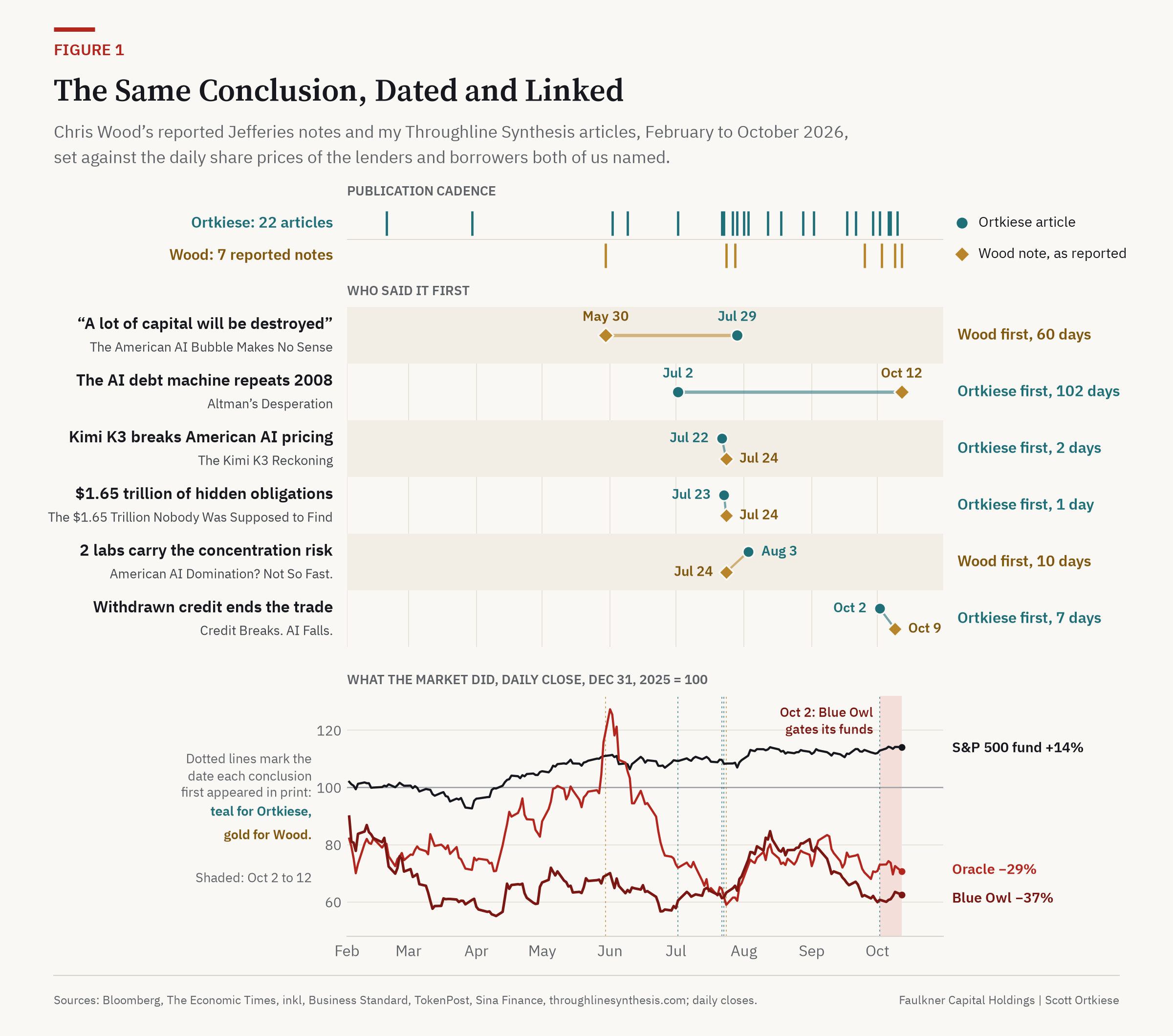
Dates matter, so I state them precisely. Wood published his capital-destruction call on May 30, before my bust series took its full form. I do not claim that ground. He also came first on concentration: his July 24 note put about half the cloud backlog on OpenAI and Anthropic, and I called it a “two-name customer credit portfolio” on August 3. On other points, the order runs the other way. I published the Kimi K3 analysis on July 22; his note citing Kimi K3 was reported on July 24. I published the $1.65 trillion hidden-debt analysis on July 23; he cited the same figure in the note reported the next day. I tied the AI debt machine to the 2008 pattern on July 2; his 2008 comparison was reported on October 12. I wrote that credit would break the financing on October 2; his warning that withdrawn credit could unravel the trade was reported on October 9.
Where we agree
We agree on 6 propositions. Each now has independent support.
Chinese models destroy the price. Wood’s token counts and mine come from the same source, OpenRouter, a marketplace that routes developers’ requests to competing models and publishes what they use. Tokens are the units of text a model reads or writes. Wood’s numbers show top Chinese models processing 5.4 times the tokens of top U.S. models in the week ended September 27: 76.12 trillion divided by 14.2 trillion (Bloomberg). In July, the ratio was 4.9. In August, I called this a rotation, not a shock, because “once capital and workflow have moved, they rarely move back on the strength of political rhetoric” (Not an AI Cold War). According to China Daily’s count, the rotation has continued for 23 consecutive weeks, with Chinese usage at 57.46 trillion tokens versus 16.2 trillion for U.S. models in the week ending October 4 (China Daily). The 2 counts measure different model sets. Both point the same way.
China is a peer. Wood calls it a “technological peer.” On October 7, I cited Stanford’s 2026 AI Index, which puts the best American model 2.7% ahead of the best Chinese model and calls the gap “effectively closed” (America’s AI Blunder).
Debt, not cash, pays for it. Wood shows second-quarter capital spending of $165 billion versus $7 billion in free cash flow, the cash left after operating costs and capital spending (The Economic Times). After spending $165 billion, the 4 companies had $7 billion to spare, and consensus expects that cushion to turn negative in the third quarter. From then on, dividends, buybacks, and the next round of construction must be borrowed. My September 17 article made the same point about the equipment pledged as collateral: chips that lenders expect to wear out in 3 to 4 years (The Data Center Collateral Is Garbage).
The risk is concentrated on 2 customers. Wood says about half of the cloud giants’ $2.1 trillion backlog, contracted revenue not yet delivered, is owed by OpenAI and Anthropic (inkl). Half of that $2.1 trillion is roughly $1.05 trillion owed by 2 companies that don’t turn a profit. I called it a “two-name customer credit portfolio” on August 3 (American AI Domination? Not So Fast.). On October 7, I measured 1 name: Anthropic took in $4.6 billion in 2025 and has promised $518 billion to its partners, about 80% of it noncancelable. That is $113 promised for every $1 of revenue (America’s AI Blunder).
Credit ends it. Wood: “The moment credit markets effectively withdraw funding, the entire AI trade could unravel” (TokenPost). Me, on October 2: “The lender need not conclude that the technology is worthless. It only needs to refuse the additional money required to reach the forecast” (Credit Breaks. AI Falls.).
The technology survives the bust. Wood does not say AI is a fad; he says the AI story is due for a reset. I wrote on October 6: “The technology will not disappear. The promises financing it will break” (Trump’s AI Bubble. You Pay.).
Where I go further
Wood is an equity strategist. His job ends when he tells clients what to sell and what to buy. My work continues past that point, into 3 questions his notes leave open.
Who absorbs the loss? A bust destroys capital only once. Someone owns it when it does. My August 12 course traced that someone to the policyholder: private equity firms bought life insurers and turned their reserves into a funding line for private loans. When an insurer fails, surviving insurers pay assessments to state guaranty associations, and in 44 states they recover those assessments through premium-tax credits, shifting the loss to state taxpayers (The Bailout Is Already Written). On October 6, I set out the test that follows the loss through creditor priority, collectible protection, and available capital. “My forecast is a systemic contraction of credit, not a claim that every bank must fail” (Trump’s AI Bubble. You Pay.). To protect themselves, lenders stop lending to everyone else. That is how a loss in data centers becomes a lost job at a business that never bought a chip.
Why the government keeps the boom alive. Wood notes that AI earnings carried the stock market into the midterms. I explain why the White House needs it to keep going. Trump told TIME, “Growth will pay it off,” and said of the AI industry, “I don’t want to turn it off. It’s tremendous amounts of money” (Trump’s AI Bubble. You Pay.). On September 16, I documented how the cloud companies killed the only AI safety rule Treasury had drafted (Trump Called It a Hoax). On September 29, I traced the money that buys that protection (The AI Oligarchs Control Trump and Congress). The boom is a political asset. They defend a political asset until the election it is supposed to win.
What Europe should do. Wood’s answer for investors is to rotate toward India and other markets that benefit when the AI trade reverses (The Economic Times). My answer for Europe is a policy: “Europe must not finance America’s blunder. It should cut its exposure to American AI stock listings and refuse any role in a bailout” (America’s AI Blunder). Then run the cheaper models on European machines under European law.
Where we differ
We differ on 3 points, and the reader should know them.
First, Wood regards Anthropic as more comfortably positioned than OpenAI (inkl). I do not. Anthropic’s annualized revenue reached $65 billion at the end of July, according to what it told investors (CNBC). Growth is not the question. The question is whether revenue earned at falling prices covers obligations fixed at yesterday’s prices. On that test, $518 billion in commitments versus a 2025 base of $4.6 billion offers little comfort. Anthropic is still adding commitments: The Information reported on October 11 that it signed a previously undisclosed multiyear cloud contract with IREN, whose shares rose 9.01% in overnight trading (The Energy Mag).
Second, Wood’s best way to play the boom remains the suppliers, the companies paid directly by the cloud giants’ spending (Business Standard). That is sound advice for a trader. It is also the mechanism of the loss: suppliers collect cash now, and borrowers carry the debt until revenue arrives at lower prices.
Third, timing. Wood says the reset comes “at some point in the not-so-distant future.” I give a window below.
Technology is not a business model
The Breaking Points segment on October 12 is worth reading closely, because 2 hosts who cover AI every day stated, in plain commercial language, the case Wall Street is only beginning to price.
Ball opened with the scale of the bet. AI, she said, “has like eaten the entire US economy. If you look at just construction, what’s getting built in America, and what’s not, it’s all like data centers.” She added: “We really have placed just a massive bet on these AI frontier model companies really paying off” (Breaking Points). The data below confirm her on construction.
Enjeti separated the 2 things the industry sells as 1. “Technology does not equal business model.” A company can lead a technology, he said, “but somebody can come along either with a cheaper or a more refined or a more efficient way of doing that, and it will grow the industry, but it will crush that very specific first mover.” He added: “being first to market or being at the bleeding edge is super expensive.” Most people, in his account, are “using it as a better Google” (Breaking Points).
Ball then named the assumption on which the valuations rest. The thinking at OpenAI and Anthropic, she said, has been “this sort of zero-sum game where whoever achieves artificial superintelligence first” wins all the market share. Artificial superintelligence means a system that surpasses human ability across fields; artificial general intelligence, a system that matches it. She called both terms “very squishy.” The second assumption, she said, is “a mass willingness to pay for the very very very best technology. Whereas for many not just ordinary consumers but a lot of businesses too, the not quite as good technology may be good enough for them to use to replace human workers.” The public models, she said, are already “good enough,” and “you wouldn’t pay a lot more to have a, you know, somewhat smarter model or even a wildly smarter model” (Breaking Points).
That is the argument I have made since July, stated from the buyer’s side. On July 22, I showed Chinese labs pricing below the American labs’ cost of goods sold (The Kimi K3 Reckoning). On October 6, I wrote that cheaper AI destroys the prices that fixed contracts assume (Trump’s AI Bubble. You Pay.).
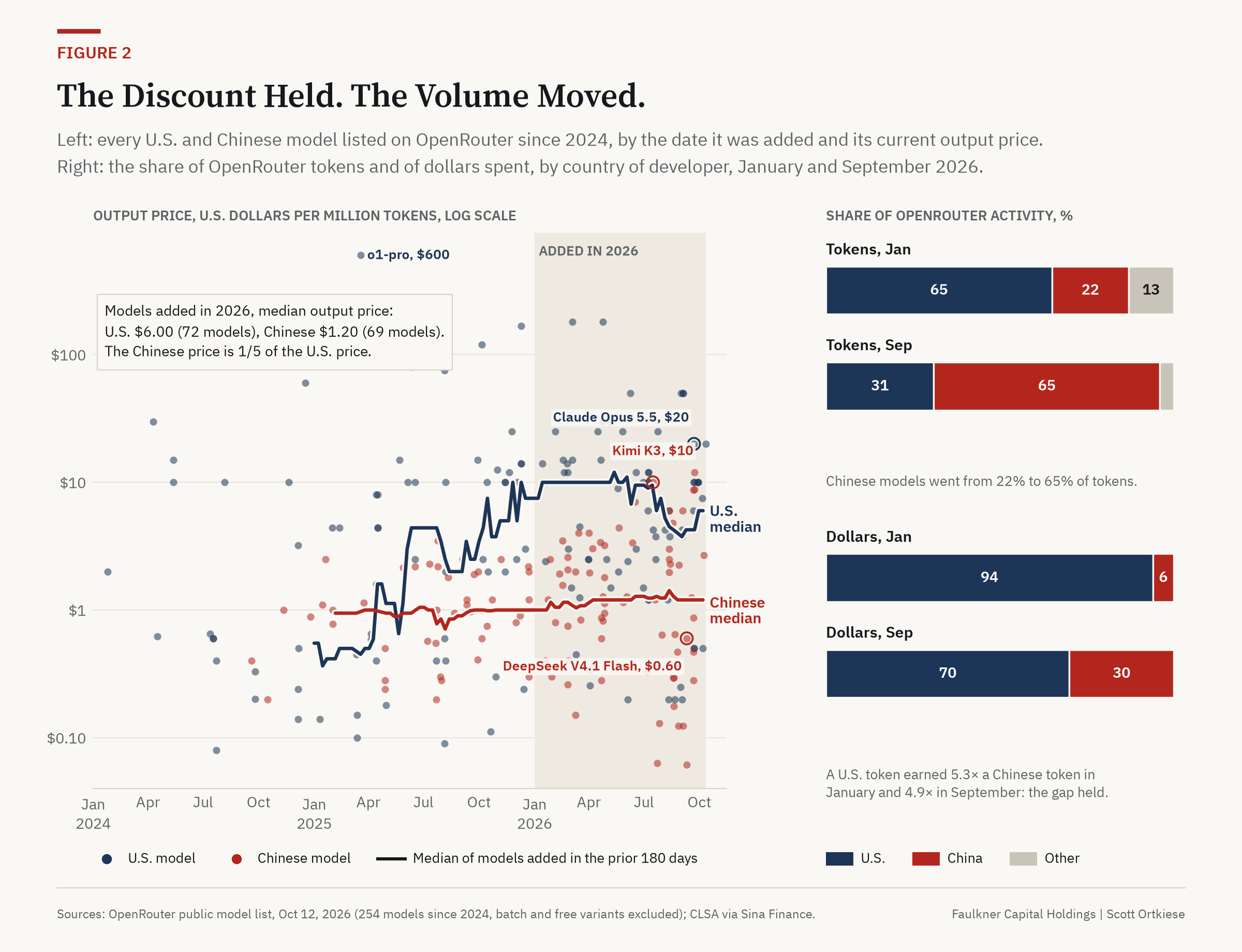
The market data now prove “good enough” in numbers. CLSA, the Asian brokerage, reports that, in January, Chinese models took 22% of OpenRouter tokens and 6% of the dollars spent there; U.S. models took 65% and 94%. In September, Chinese models took 65% of tokens and 30% of dollars; U.S. models took 31% of tokens and 70% of dollars. CLSA puts Chinese prices about 80% below their U.S. peers (Sina Finance, citing CLSA).
My arithmetic on CLSA’s figures shows what happened. Divide each side’s dollar share by its token share to get its price per token relative to the market. In January, a U.S. token earned 5.3 times what a Chinese token earned (94/65 versus 6/22). In September, it earned 4.9 times (70/31 versus 30/65). The ratio confirms CLSA’s 80% discount from an independent direction. OpenRouter’s public price list confirms this a third way: the median output price of the 69 Chinese models added in 2026 is $1.20 per million tokens, versus $6.00 for the 72 U.S. models added in the same months, by my count (OpenRouter models). The decisive point is that the ratio barely moved. The Chinese labs didn’t raise prices to capture revenue, and the American labs couldn’t hold volume at a premium. The buyers moved. The Chinese share of dollars rose 5 times, from 6% to 30%. On October 7, I wrote that American closed models collecting most of the money “is not a moat. It is a lag” (America’s AI Blunder). Figure 2 shows the lag closing.
The strongest case for the labs
Ball made the counterargument herself, and it deserves an answer. OpenAI’s internal models, she noted, are solving outstanding mathematics problems “by the hundreds,” and “the best models” may not be released at all; businesses would instead “run your business processes through them, and that is the way that they earn revenue” (Breaking Points).
The facts behind her point are real. On October 7, OpenAI published full or partial AI-generated solutions to more than 370 outstanding mathematical problems using an unreleased internal model that averaged about 3 hours of computing per solution; by October 8, it had withdrawn 3 of the solutions (Fortune). The Association for Human Mathematics, a group of mathematicians, called the release “not a demonstration of scholarship, but a demonstration of power” (Fortune).
My answer: the strongest case for the labs strengthens the case against their financing. A model kept off the market earns nothing until someone invents the business that sells its output, while the obligations to the cloud companies are fixed and payable now. The public can buy the model Chinese labs match at 1/5 the price. If the frontier stays inside the lab, the revenue must come from the commodity tier. Ball reached the same conclusion: it is “very possible that this is a bubble that there is some sort of major financial reckoning not because the technology isn’t powerful but because it does become more of a commodity with the much cheaper Chinese predominantly open-source models” (Breaking Points).
AI eats its lenders 2 ways
The second half of the Breaking Points segment opened a front Wood’s notes don’t cover, and it may break first.
Adobe in 10 days
On October 3, Brandon Thomas, a software engineer, announced: “I’ve vibe coded replacements to 7 of Adobe’s apps in Rust. They’re open source” (FourWeekMBA). Vibe coding means directing an AI model to write the program. The 7 applications, released under the ArtCraft name, replace Photoshop, Lightroom, Premiere Pro, Acrobat, Illustrator, After Effects, and InDesign. Ball read the description on air: “seven free open-source apps as clean room alternatives to Adobe’s main tools,” built “with help from Claude Opus 5.5” and “without using Adobe source code” (Breaking Points). A clean-room build reproduces what a program does without copying its code.
By 12:04 UTC on October 11, the 7 repositories had 86,265 stars on GitHub, the code-hosting site, where a star marks a user’s interest; the Photoshop replacement alone had 44,649. Of that project’s latest 100 code changes, 76 carried a “Co-authored-by: Claude Opus 5.5” line. Its own roadmap rates its readiness for real work at about 45%. On October 7, the same organization opened projects to replace Microsoft Word, Excel, PowerPoint, Avid Pro Tools, and AutoCAD (FourWeekMBA). Thomas: “AI models enable me to work as an entire company.”
Breaking Points played Chamath Palihapitiya, founder and chief executive of the venture firm Social Capital and co-host of the All-In podcast: “I think that IP and software was effectively rendered worthless two days ago.” When software services become “headless,” he said, meaning usable by AI agents without a human interface, and “you can connect them via MCP to other experiences, the value of IP does no longer exist in software” (All-In Podcast). MCP, the Model Context Protocol, is the standard that lets AI agents operate other programs. Palihapitiya described the clones as “decompiled”; the developers describe clean-room builds. Enjeti compared the moment to Napster and noted that Chegg, the study-help company, “has been destroyed by AI” (Breaking Points).
Wall Street moved the same day. Wells Fargo cut Adobe 2 notches, to Underweight from Equal Weight, lowered its price target to $225 from $270, and estimated that Adobe needs nearly 2 times as much net new annual recurring revenue in its fourth quarter to meet its full-year targets; the shares fell about 2% in morning trading on October 12, as investors weighed the competition ArtCraft poses (Asianet Newsable, citing TheFly).
The counterevidence is strong, and I state it. The S&P 500 software and services index reached its highest level since November 2025 on October 6 and stood 5% higher for the year after falling more than 26% from late January to its April low. Adam Turnquist, chief cross-asset strategist at LPL Financial, said AI “has been more of an enabler for a lot of these software companies, more than a disruptor.” Brian Mulberry of Zacks Investment Management said the real test could come in the second half of 2027 (Reuters). The clones are alpha software. Adobe will not lose its customers this quarter. The lenders, however, do not need Adobe to fail. They need the borrowers’ recurring revenue to stop growing on schedule.
The lenders behind software
This is where the software story becomes a credit story. Business development companies, the publicly registered funds that lend to midsize companies, have lent about $115 billion to software firms, about 1/5 of all their lending and more than 80% of their technology portfolios, according to the Bank for International Settlements. Its economists Fernando Avalos, Giulio Cornelli, and Egemen Eren found that “neither BDCs nor their equity investors have priced software exposure differently,” that spreads had narrowed, and that “a few large BDCs are exposed to a shared pool of borrowers” (BIS Bulletin 128).
Private equity firms bought software companies with borrowed money because subscription revenue looked steady enough to carry the debt. Some loans were sized based on annual recurring revenue, contracted subscription income, rather than earnings. Barclays strategists count more than $150 billion in software-company debt coming due through the end of 2029, and the rule of thumb is to refinance at least 1 year early. Bloomberg’s account of Medallia shows the end of that road: a $1.8 billion loan grew to about $2.8 billion as unpaid interest was added to the balance, the lenders took control, and BDC funds marked the debt as low as 54 cents on the dollar (Bloomberg). PitchBook reports that software’s share of private-equity-backed direct lending volume has fallen from 22% last year to 15% this year, and that the deals still getting done are mostly refinancings and extensions by incumbent lenders (PitchBook via Yahoo Finance).
On October 2, I wrote that “the first failures do not have to be AI projects. Troubled software loans, other leveraged businesses, investor withdrawals, and financing demands will drain resources before the next data center asks for cash.” I cited the finding that 34% of software debt and 45% of payment-in-kind debt in the sample reviewed will mature by the end of 2028 (Credit Breaks. AI Falls.).
Here is my analysis of what the clones add. Cheaper AI attacks the lending chain through two channels. First, Chinese models cut the prices American labs charge, weakening the revenue that must service $1.05 trillion in cloud backlog and the bonds behind it. Second, cheap code erodes the pricing power of the software companies whose recurring revenue underpins about $115 billion in BDC loans. Both channels end on the same balance sheets: the same funds, insurers, pensions, and retail savers. The Blue Owl technology fund where investors asked for 39% of their money back is where the channels meet. The AI boom is financed by lenders whose other large borrower group is being undercut by the AI boom.
10 days of new evidence
Between October 2 and October 12, the evidence moved in 1 direction.
The revenue story cracked
On October 8, OpenAI told investors it had reached roughly $50 billion in annualized revenue as of the end of September. A person familiar with the matter told CNBC that the $68 billion figure widely reported in late September included gross revenue from OpenAI’s partners (CNBC). The Financial Times first reported the figure; Dow Jones summarized it as roughly $20 billion less than OpenAI had signaled (Morningstar, Dow Jones). Oracle fell nearly 6%, CoreWeave nearly 8%, and Nvidia 3% that day (CNBC). The Nasdaq 100 fell 1.4% and the Philadelphia Semiconductor Index 3.4% (Yahoo Finance). Enjeti explained why the chip stocks fell with OpenAI: “people supposedly paying for AI is the backbone of the entire US equities market” (Breaking Points).
Stocks recovered part of the loss the next morning, as analysts argued that the gap reflected an accounting method rather than weaker demand (Morningstar, Dow Jones). That defense proves my point. For 9 days, markets valued OpenAI’s suppliers on a revenue figure that included gross revenue from its partners, for a company valued at $852 billion and preparing a public offering (CNBC). Oracle’s $300 billion, 5-year cloud commitment to OpenAI represents roughly 45% of Oracle’s contracted backlog (Yahoo Finance). When the customer’s revenue shrinks on inspection, the supplier’s backlog shrinks in value with it.
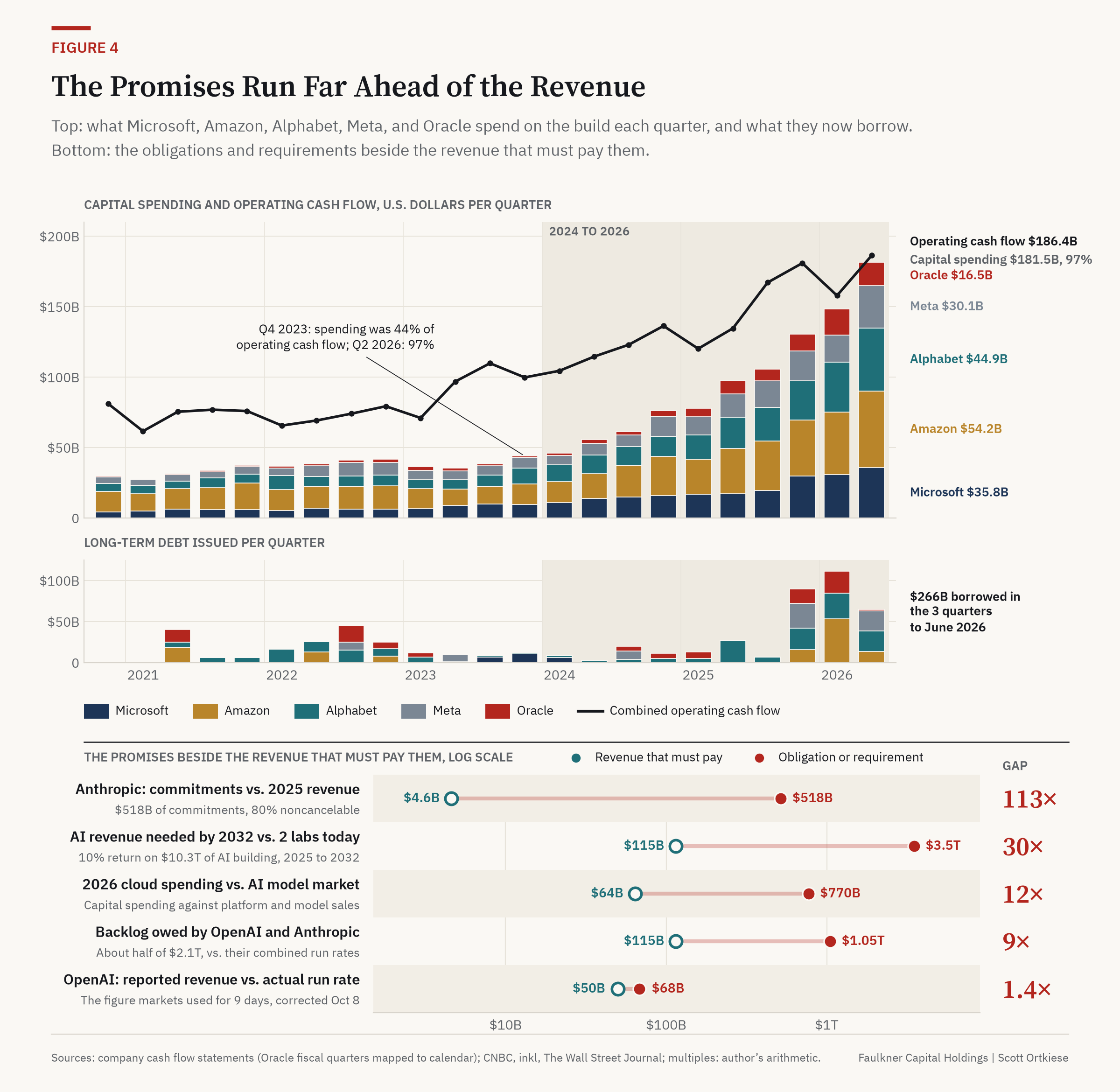
Figure 4 sets each promise beside the revenue that must pay it. The required revenue does not exist. The Wall Street Journal calculates that a 10% return on $10.3 trillion in AI construction from 2025 to 2032 requires $3.5 trillion in annual AI revenue by 2032 (America’s AI Blunder). OpenAI’s roughly $50 billion and Anthropic’s $65 billion reported run rates total about $115 billion, 3.3% of that requirement, at prices below Chinese competition. The 2 labs owe roughly $1.05 trillion in cloud backlog, about 9 times their combined run rate. That is my arithmetic, using the companies’ own figures.
Credit priced the risk
Oracle’s 5-year credit default swaps reached 203 basis points, an 18-year high, after S&P Global cut its rating to BBB-, 1 notch above junk (Startup Fortune). A credit default swap is a contract that pays the holder if a borrower defaults; its annual price, quoted in basis points, measures the market’s fear of default. A basis point is 1/100 of a percentage point. A Morgan Stanley note dated October 7 recommended buying protection on Oracle and selling its 2035 and 2055 bonds, citing investors’ limited capacity to absorb the wave of chip financing (TechFlow, citing Morgan Stanley).
The bond buyers are thinning. Meta’s latest $25 billion bond sale drew peak orders of $96 billion; a comparable $30 billion sale a year earlier drew $125 billion. In September, spreads over Treasuries on bonds from Amazon, Microsoft, Meta, and Alphabet widened from about 50 basis points toward 80 (Startup Fortune). By my arithmetic, Meta’s order book fell 23%, and its coverage, orders per dollar sold, slipped from 4.2 times to 3.8. Jorn Veeneman, global market strategist at J.P. Morgan Asset Management, reported that cloud-company spreads had widened about 30 basis points this year, while the broad U.S. investment-grade index widened 2, and counted about $1.4 trillion in disclosed data-center lease obligations, roughly $1.1 trillion of them off the balance sheet, plus about $1.5 trillion in unconditional purchase commitments (J.P. Morgan Asset Management).
The broad market has not noticed. The ICE BofA index of U.S. investment-grade corporate spreads stood at 0.82 percentage points on October 8, close to the 0.79 at which it began the year (Federal Reserve Bank of St. Louis). The stress is concentrated in the AI borrowers. That is how credit breaks begin: in 1 sector, while the index still looks calm.
CoreWeave, a specialized AI cloud provider that borrowed about $30 billion to buy its chips (inkl), closed at $81.58 on October 8, down 7.77%, with net debt at 8.22 times its trailing earnings before interest, taxes, depreciation, and amortization (Yahoo Finance). On August 3, I wrote that these neoclouds, the specialized AI cloud providers with the thinnest capital cushions, would break first (American AI Domination? Not So Fast.).
The scale of borrowing is no longer in dispute. Morgan Stanley estimates about $3 trillion in AI construction spending through 2028, roughly half financed with debt or debt-like instruments (The New York Times, DealBook). U.S. companies issued nearly $500 billion in new debt in 2026 to finance AI infrastructure, according to Bloomberg data (Yahoo Finance). Vishal Merani, managing director of digital infrastructure ratings at S&P Global Ratings, told DealBook that debt-financed projects “need to meet a higher hurdle rate” as Treasury yields rise (The New York Times, DealBook). A hurdle rate is the minimum return a project must earn to justify its cost of money.
Bonds turned on borrowers
The 10-year Treasury yield touched 5.33% on October 1, its highest since 2002 (24/7 Wall St.). The 30-year yield closed at 5.67% on October 7 (Federal Reserve Bank of St. Louis). On October 2, the 10-year stood at 5.28% (Credit Breaks. AI Falls.); it ended the week of October 9 at 5.243% (Morningstar, Dow Jones). A strong $39 billion 10-year auction on October 7 eased the selling (Reuters via Yahoo Finance). Relief at 5.24% still leaves borrowing costs near their 2002 high. The average 30-year mortgage rate hit 7.40% on October 8, up from 6.30% a year earlier (Freddie Mac).
AI borrowers are part of the reason. Bank of America economists estimated that the surge in corporate debt sales pushed the 10-year yield up by about 0.3 percentage points this year (Startup Fortune). International Monetary Fund Managing Director Kristalina Georgieva said on October 7 that long-term bond issuance by AI-related borrowers is competing with governments for capital (CNBC). That is a trap. AI borrowing raises Treasury yields; higher Treasury yields raise the hurdle rate for AI borrowing. The boom is pricing itself out of its own financing.
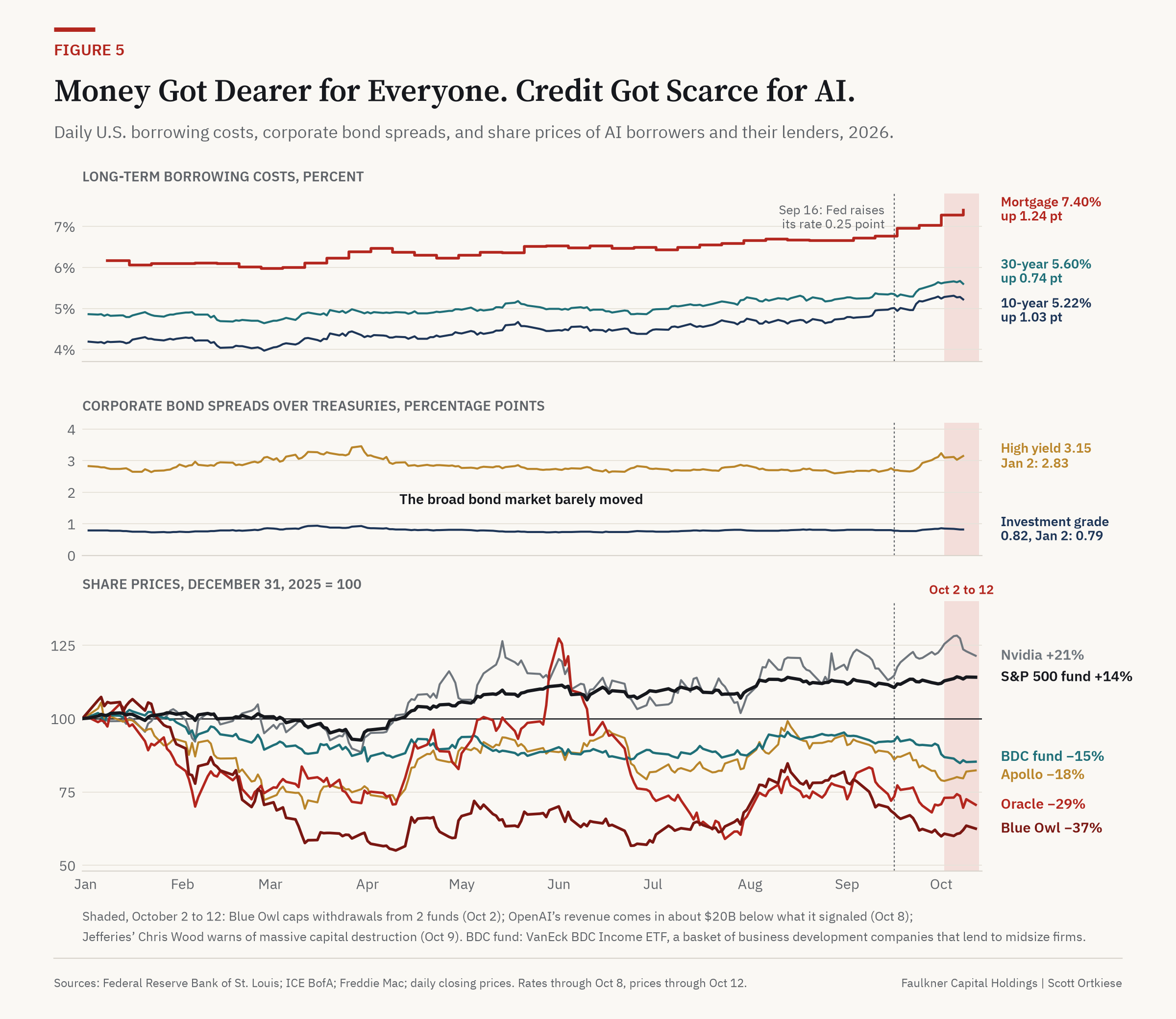
The Federal Reserve will not rescue it with cheap money. Under Chair Kevin Warsh, the Fed raised its benchmark rate by 0.25 percentage points on September 16, and minutes released October 7 show officials expect another increase before year-end; 16 of 18 officials projected 1 more (CNBC). The next decisions are October 28 and December 9 (CNBC).
The oil shock keeps it that way. Amin Nasser, president and chief executive of Saudi Aramco, told the Energy Intelligence Forum in London on October 5 that nearly 3 billion barrels of oil supply have been lost since the Strait of Hormuz nearly closed, that “less than 6 billion barrels of commercial inventories remain today, with the vast majority not practically available,” and that “replenishing inventories while meeting demand could take up to two years.” He cited an IMF scenario in which global growth falls to 2% next year while inflation rises above 6% (Aramco). Energy-driven inflation keeps the Fed raising rates, and higher rates raise the hurdle for every dollar AI builders borrow.
Treasury Secretary Bessent dismissed concerns about an AI bubble on October 3, citing heavy investment by Microsoft, Google, and Meta and revenue growth at Anthropic and OpenAI. He also said, “I can’t control the bond market” (Bloomberg via Yahoo Finance). He is right about the second statement. That is why the first is no defense.
Private credit closed its doors
Investors in Blue Owl Technology Income Corp., a roughly $5 billion fund focused on technology lending, asked to withdraw 39% of their shares in the third quarter. Blue Owl again capped withdrawals at 5% (Bloomberg). Requests exceeded payouts by 34 percentage points, so about 87% of the money investors asked for stayed locked in. Bloomberg attributed the elevated requests to fears about AI. Apollo’s Debt Solutions fund received requests for 14.7% of shares and also paid out 5% (Citywire). In Australia, Metrics Credit Partners froze redemptions in some funds after KPMG declined to sign off on the accounts of 3 listed vehicles (Reuters). Evercore analyst Glenn Schorr said weak new subscriptions may be the more persistent problem (Reuters).
That is the second stage of the sequence I set out on October 2: bonds first, then private credit retreats (Credit Breaks. AI Falls.). A fund that cannot pay its own investors does not make new loans.
The price war reached distribution
American distributors are accelerating the rotation shown in Figure 2. Amazon Web Services made Z.ai’s GLM-5.3 available on its Bedrock service on October 6 and will share revenue with Z.ai based on usage. It has added 6 Chinese open-weight models to Bedrock, and Moonshot’s Kimi K3 became available there in September (China Daily). Amazon’s cloud now sells the Chinese models that undercut OpenAI and Anthropic, the 2 labs that account for about 51% of Amazon’s own contracted backlog (inkl).
Meanwhile, equipment costs are rising. Nvidia told some of its largest customers that server prices with its AI chips will rise by more than 15% in many cases (Tom’s Hardware, citing Bloomberg). Wood reported in July that the Silicon Data index of the average price paid for 1 million tokens had fallen 25% from its late-May peak to $1.55 (inkl). Input costs more; output sells for less. Those are the 2 blades of the scissors that cut a margin to nothing.
AI is all America builds
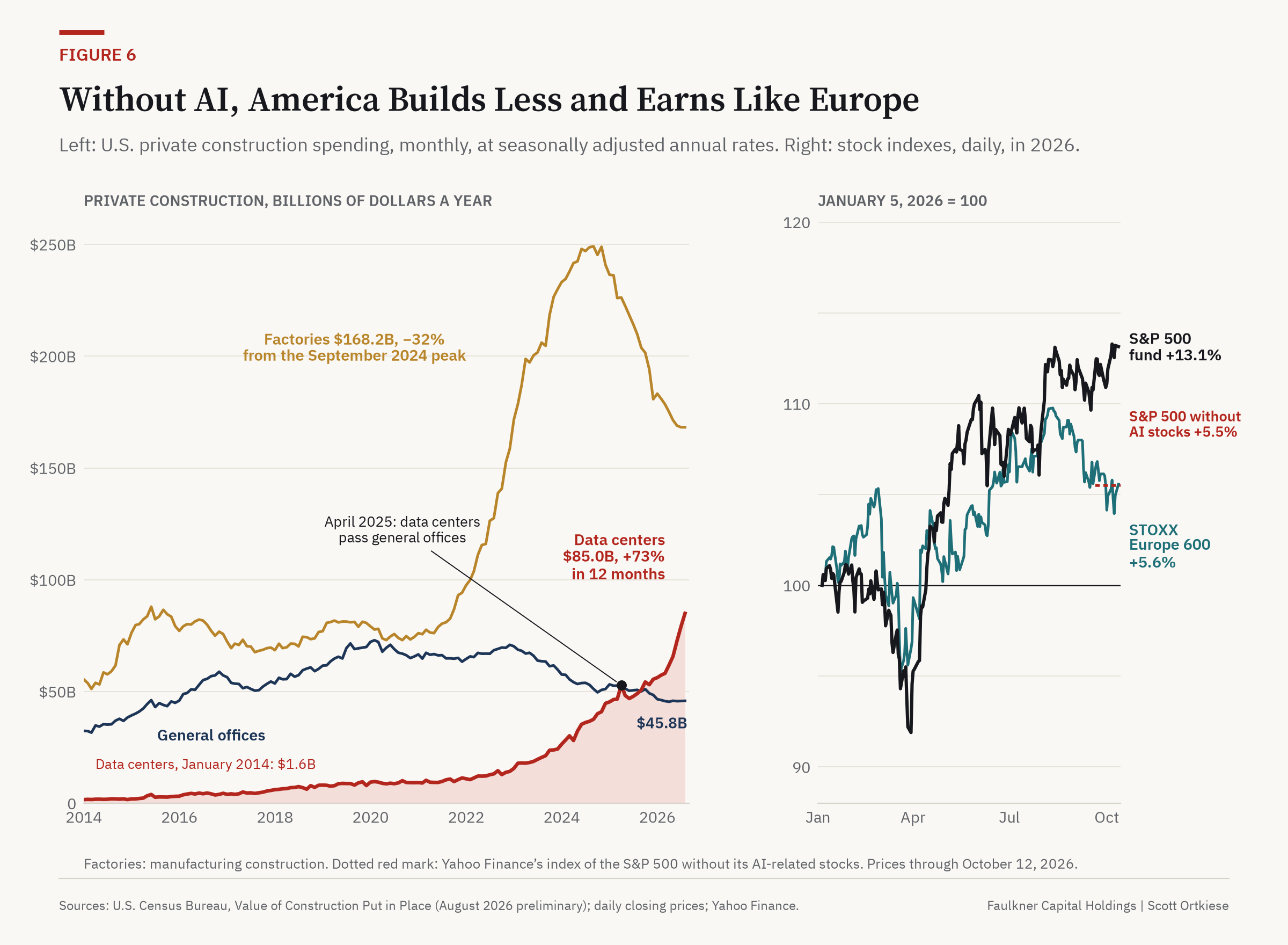
Ball’s remark about construction is a measured fact. Private data-center construction ran at a record annual pace of $84.95 billion in August, up more than 73% from $49.05 billion a year earlier, according to Census Bureau figures. General office construction fell 9.7% to $45.8 billion. All other private nonresidential construction, excluding data centers, fell 5.9% to $688.1 billion. Data centers supplied $5.9 billion, or 74%, of the month’s $8.0 billion increase in private nonresidential spending (iRecruit, citing the Census Bureau). The Census Bureau’s monthly series shows the longer arc. Data-center construction ran at $1.6 billion a year in January 2014 and passed general office construction in April 2025. Factory construction peaked at $249.1 billion a year in September 2024 and has fallen 32% since, to $168.2 billion (U.S. Census Bureau). Bain & Company reported on September 29 that U.S. investment in data centers as a share of output now rivals what the country spent building its railroads, telecommunications networks, and electrical grid (Bain & Company).
The stock market tells the same story. The S&P 500 has risen about 13.5% this year and added roughly $9 trillion in value. An “old economy” S&P 500 index without its AI-related stocks has risen 5.5%, slightly behind Europe’s STOXX 600 at 5.6% (Yahoo Finance). Wood observed on October 3 that AI earnings had carried American stocks into the midterms. Those 2 numbers measure how much. Without AI, America builds less every month, and its stocks perform like Europe’s. The boom is not 1 sector of the American economy. It is the margin of its growth. When it breaks, nothing else is growing fast enough to absorb the loss.
Why the break comes soon
I am certain of the direction and of the mechanism. The question is the date. Here is the case, stated so it can be tested.
The research agrees
The Bank for International Settlements, the central bank for central banks, published a model of the AI investment race in July. BIS Principal Economist Phurichai Rungcharoenkitkul found that, under a conservative baseline, the race produces over-investment about 50% above the efficient level, and up to 3 times the efficient level when demand is less responsive to price. “The larger the boom, the deeper the eventual bust.” “The race to commit early through debt and circular financing also makes a bust more likely.” In its words, “stress in one firm could cascade to others through chains of financial exposures” (BIS Working Paper 1367).
Economists at the European Central Bank concluded in August that a correction in stock valuations is likely whether today’s prices are rational or irrational, and that the timing cannot be known in advance (ECB Blog). The IMF’s Georgieva said on October 7 that global AI investment as a share of output is expected to reach, and likely exceed, what the world spent building railroads, electricity grids, or telecommunications networks (CNBC). Each of those booms ended in a bust that destroyed its financiers and left the infrastructure for others.
Bank of England Governor Andrew Bailey said on October 1 that AI asset prices could correct and reminded his audience that Netscape, an early internet market leader, no longer exists (BBC). Lagarde, who also chairs the European Systemic Risk Board, the EU body that monitors threats to the financial system, warned at its annual conference the same day that frontier AI is concentrated in the United States and China and asked, “who controls access to the models its financial institutions may come to rely on?” (European Central Bank).
5 conditions, all present
A credit-driven bust needs 5 conditions. In October, all 5 are visible.
- Falling prices. Chinese models hold 65% of OpenRouter tokens at about 80% lower prices, and their dollar share is rising (Sina Finance, citing CLSA). AI-built software replacements now attack the subscription prices of the software borrowers as well (FourWeekMBA).
- Fixed obligations. About half of $2.1 trillion in cloud backlog is owed by 2 unprofitable labs (inkl); 80% of Anthropic’s $518 billion is noncancelable (America’s AI Blunder); more than $150 billion in software debt comes due through 2029 (Bloomberg).
- No internal cash. Consensus put the 4 largest cloud companies’ third-quarter free cash flow at negative $12 billion (The Economic Times).
- Rising cost of money. The 10-year yield is at 2002 highs, the Fed is raising rates, and AI borrowers make up roughly 49% of new investment-grade issuance (24/7 Wall St.; CNBC; Startup Fortune). Investor orders for each dollar of cloud-company bonds fell from about 5 times in February to about 2 times in July (Startup Fortune).
- Closing exits. Private credit funds are gating withdrawals (Bloomberg), and new software lending has shrunk to refinancings by incumbent lenders (PitchBook via Yahoo Finance). The remaining large source of new money is the public stock market, through Anthropic’s offering.
The strongest counterargument
The optimists have real evidence. TSMC, the Taiwanese chipmaker, reported record third-quarter revenue of NT$1.49 trillion ($46.71 billion), up 50% from a year earlier (Reuters). Bill Zartler, co-chief executive of Solaris Energy Infrastructure, said higher rates are not slowing the buildout (Yahoo Finance). Software stocks are at 2026 highs, and the sector’s expected 2026 earnings growth has risen from 13.8% at the end of March to 20.6%, according to LSEG data (Reuters).
All 3 statements are true, and all 3 describe the spending and the current quarter, not the repayment. Suppliers are paid in cash when the equipment ships. The borrowers repay over years from revenue earned at falling prices. Record supplier revenue measures how much debt has been committed, not how much will be repaid. The railroad builders also bought record tonnages of steel.
My forecast, brought forward
In July, I dated the undeniable revenue shortfall to between mid-2027 and the end of 2028 (The American AI Bubble Makes No Sense). October’s evidence moves my timetable forward because the financing test now arrives before the revenue test.
My forecast is this. The break begins in credit, in the window that opens after November 3: Anthropic’s roadshow in the week of November 9, the Fed’s December 9 decision, and year-end refinancing. The offering is the hinge. If public investors pay $1.8 trillion to $2 trillion for a company that reported $4.6 billion in 2025 revenue and an operating loss of more than $8 billion (Quartz via Yahoo Finance), the financing chain gets 1 more tranche, and the loss grows larger. If they refuse, or the offering slips, the chain loses its next cash source at a time when private credit is already closed. Either way, the revenue shortfall becomes undeniable in 2027, when the software refinancing wall and the labs’ fixed payments arrive together.
These measures would prove me wrong: Chinese dollar share on OpenRouter stops rising; cloud-company bond spreads tighten as issuance continues; withdrawal requests at technology lending funds fall back below their 5% caps; software borrowers refinance with new lenders at ordinary spreads; and Anthropic prices its offering at its target without strain. I will report each as it arrives.
1873, 1931, and November 3
History does not repeat, and the historian on Breaking Points said so. It does show who pays when a boom financed from abroad meets a credit stop. 2 cases matter here.
Europe financed America once
Lagarde made the first comparison herself, in Vienna on September 14. Before 1873, she said, “savers in Vienna, Berlin, Paris and London could lend abroad. Their money went into the transformative technologies of the day.” British and German savers sent large sums into American railways. “Eight days after the Emperor opened the World Exhibition in the Prater, the Vienna stock exchange collapsed, and four months later Wall Street followed. The crash hit both continents. But what the money had built stayed in the United States, and so did the growth.” Then: “Today, European savers are again financing the transformative technology of the age: artificial intelligence. Again, most of the money is flowing to the United States.” She added: “Europe will pay for this boom whether or not it shares in the growth” (Lagarde, Vienna).
She named 2 channels. First, euro-area households hold about €440 billion in U.S. technology firms. Second, “since euro area long-term rates move with US yields, Europe will bear part of the price of this boom in its own borrowing costs.” The American cloud giants already account for close to 1/10 of new euro bond issuance by nonfinancial companies (Lagarde, Vienna).
My reading adds 1 difference that makes this case worse than 1873. The railways lasted a century. The AI equipment is pledged as collateral with a useful life of about 3 years (The Data Center Collateral Is Garbage). In 1873, the lenders lost their money and America kept the asset. This time, the asset wears out before the debt is repaid.
America financed Weimar
Sebestyen, born in Budapest, worked as a foreign editor for the London Evening Standard and wrote Lenin the Dictator (Victor Sebestyen); he joined Breaking Points to discuss his new book, Weimar Germany: The Death of a Democracy (Penguin Random House). Enjeti opened with the writer Rod Dreher’s warning in a New York Times Opinion video: “We are one economic crash away from something very ugly. It may not be Hitler 2.0. It may not be Stalin 2.0. It might be something all American, but it’s not going to be what we’re used to” (The New York Times).
Sebestyen accepted the premise and limited it. “I agree that we’re in a time of revolutionary change,” he said, and the AI revolution is among the changes “that’s probably going to have the biggest effect.” But there are “significant differences”: Germany had just lost the worst war in history, while the West has had nearly 3 generations of peace and security (Breaking Points).
His economic account is precise. Gustav Stresemann, chancellor in 1923 and foreign minister until 1929, “stabilized the currency. He oversaw the golden period” from 1924 to 1929, when Germany “was the fastest growing economy in Europe, receiving vast amounts of money and help from America.” Stresemann “died in 1929 a few weeks before the Wall Street crash,” and Sebestyen believes he “might have weathered the worst of that storm” (Breaking Points). Stresemann died on October 3, 1929 (Britannica).
The money is documented. From 1924 to 1930, Germany received 135 long-term loans totaling $1,430 million, $1,293 million of which came from the United States, plus $1,560 million in short-term loans (BBC Bitesize). By my arithmetic, American lenders supplied 90% of the long-term money. The Reichsbank estimated total short-term foreign credits from 1924 to 1930 at about 14 billion Reichsmarks, half of it owed by commercial banks (Business History Review). After the 1929 crash, lending stopped, and in 1931 Germany froze foreign short-term credits (IMF).
The IMF volume that records the freeze also states the lesson I take from it: “Without those panics, the stock market crash would have caused a severe but short recession; in other words, it would not have been the Great Depression” (IMF). The 1929 stock crash was survivable. The 1931 credit stop was not. That is why I forecast that this break begins in credit, and why the credit evidence matters more than the stock prices.
The vote follows the banks
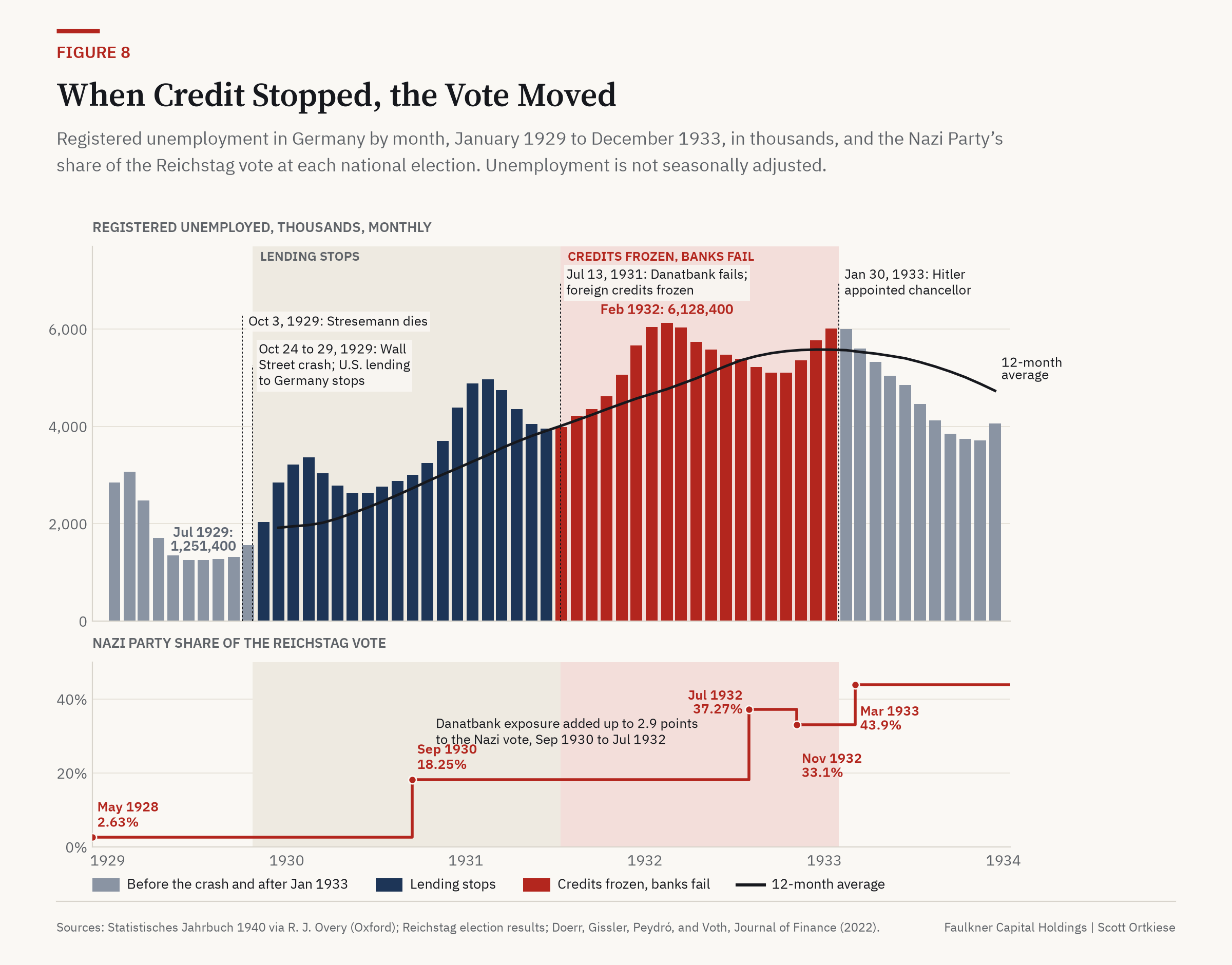
The research measures the credit stop’s impact on German politics. Sebastian Doerr, Stefan Gissler, José-Luis Peydró, and Hans-Joachim Voth studied the July 1931 collapse of Danatbank, the bank at the center of the crisis, and the Nazi vote across 209 German cities. In exposed cities, incomes fell 7.8 percentage points more than the average 14-point decline, and “exposure to Danatbank added up to 2.9 p.p. to the party’s votes between September 1930 and July 1932, equal to 15% of its mean vote gain.” In cities with a long history of anti-Semitism, Danat’s presence added 6 points (Journal of Finance, 2022). Gregori Galofré-Vilà, Christopher Meissner, Martin McKee, and David Stuckler found that districts hit harder by austerity, meaning spending cuts and tax increases, gave the Nazi Party higher vote shares (Journal of Economic History, 2021).
The Nazi Party won 2.63% of the Reichstag vote in 1928, 18.25% in 1930, and 37.27% in July 1932 (Nazi Party election results). Registered unemployment rose from 1.89 million in 1929 to 5.58 million in 1932, by official German figures (Unemployment in Germany, 1932 to 1933), or about 5.6 million at the 1932 peak (German History in Documents and Images). The monthly counts, which are not seasonally adjusted, ran higher in winter: from a low of 1,251,400 in July 1929 to 6,128,400 in February 1932 (R. J. Overy, War and Economy in the Third Reich).
Leaders decide the cost
Sebestyen’s central claim is that none of it was fixed in advance. “I feel very strongly that almost nothing is inevitable in history,” he said. “There’s contingency in almost anything that happens except maybe death and taxes.” Enjeti summarized the book as showing that Weimar “was killed it was not doomed,” and that “leaders themselves matter dramatically” (Breaking Points). In The New York Times, the reviewer Hugh Eakin wrote that, in Sebestyen’s account, the republic “was deliberately killed by politicians, generals, and judges who wanted it gone” (Business Standard, reprinting The New York Times). Paul von Hindenburg, whom Sebestyen calls “one of the guiltiest men in history,” won the presidency in 1925 because a Communist spoiler split the vote. “So this is contingent” (Breaking Points).
His earlier work supplies the contrast. His publisher describes The Russian Revolution this way: “By early 1917, Russia was unreformable,” and the Provisional Government “lasted just eight chaotic months before being ousted by Lenin’s Bolsheviks” (Barnes & Noble). Russia in 1917 was beyond repair. Weimar was not; its leaders made poor choices. America in 2026 is the second case, not the first. Its courts, elections, and central bank still function. What remains open is the choice its leaders make when the credit breaks.
Sebestyen named 2 mistakes by Friedrich Ebert, the republic’s first president, whom he called “a fundamentally decent man.” First, Ebert never challenged the myth that Germany had been stabbed in the back rather than defeated. Second, the governing moderates made “the strategic error of actually seeing where the danger came from”: they feared the Communists while the far right was “the real threat.” His advice to young Americans: “be aware how easy it is to get way too fragmented and how fragile it can be” (Breaking Points).
Here is my application, labeled as mine. Washington now makes Ebert’s strategic error about AI. It names China as the danger. In the South Carolina Senate debate on October 11, appointed Republican Senator Darline Graham said a 2-year data-center moratorium is “dangerous to the national security of our country, because in two years China is going to be so far ahead [that] we are going to be in so much trouble” (NBC News). The danger to American households isn’t a Chinese model running at 1/5 the price. It is a domestic credit structure that has lent more than $1 trillion against revenue that cheap models are taking away. The research on 1931 says the political cost of a credit bust depends on whether the response protects households or makes them pay. That choice will be made in Washington after November 3.
The midterm calendar
Everything in this story now runs through November 3.
Every hard date postponed
Trump said on October 8 that “we will not be attacking Iran at any time prior to the midterm elections” (Al Jazeera), citing “productive” talks with Tehran (Reuters). Oil eased on the announcement (Morningstar, Dow Jones). Anthropic’s roadshow could begin in the week of November 9, after the vote, with a listing targeted before Thanksgiving on November 26 (Quartz via Yahoo Finance). Reuters reported on September 28 that the debut would come after the midterms, superseding a pre-election timetable (Credit Breaks. AI Falls.). OpenAI moved its offering to 2027 (CNN).
Prices are being managed before the vote. On October 9, Trump announced that Russian President Vladimir Putin had agreed to supply more than 300,000 tons of diesel immediately and 500,000 tons in November, and wrote that diesel prices “will be COMING DOWN, IN RECORD NUMBERS, AND FAST!” CNN calculated that the 2 amounts equal 6 million barrels, about 1.5 days of U.S. demand by Energy Information Administration figures; Gregory Brew of Eurasia Group called the effect “a Band-Aid, nothing more” (CNN). Ball and Enjeti read the deal the same way on air: an attempt to talk prices down before the midterms.
The war, the largest stock offering in history, and OpenAI’s offering have all been set for after the election, while prices are talked down before it. That is my reading of the dates, and the dates are public.
AI raises living costs 2 ways
Wood observed that the stock market has defied its usual pre-midterm weakness because of AI capital spending (The Economic Times). Voters do not live in the stock market. They live in their electricity bills and their mortgage rates, and the AI boom raises both.
Data centers use about 49 gigawatts of electricity; planned and under-construction projects total nearly 350 gigawatts, about 25% of current U.S. generating capacity (Stateline). That is more than 7 times today’s demand. Voters facing higher power bills have focused their anger on data centers, and local opposition blocked or delayed at least 120 projects worth almost $200 billion in the first half of the year, according to Data Center Watch (Bloomberg). On the borrowing side, the 30-year mortgage rate stands at 7.40% (Freddie Mac), and AI debt is part of what lifted the 10-year yield (Startup Fortune). Heating oil in Maine is up 80% from a year ago, at $5.96 a gallon (Bangor Daily News), and the Energy Information Administration expects oil-heating households to pay 21% more this winter, about $2,115 (CNBC).
The jobs are not arriving to compensate. Employers added 29,000 jobs in September, far short of a forecast of 84,000; unemployment rose to 4.2%; July was revised to a loss of 10,000; and information services lost 10,000 jobs amid concerns about AI’s effect on employment (CNBC).
Voters are rejecting the buildout
A University of Massachusetts Amherst poll found that 11% of Americans would support an AI data center in their community and 65% oppose one (Stateline). Voters will decide 34 data-center measures in November, covering 35 jurisdictions in California, Florida, Illinois, Kansas, Michigan, Nevada, Ohio, and Wisconsin, according to Ballotpedia; Ohio alone has 20. Local governments adopted 294 moratoriums and bans from January through July, according to Programs.com (S&P Global).
The Senate races carry it. In South Carolina, Democrat Annie Andrews called Senator Graham “Data Center Darline” in their October 11 debate and proposed a “two-year moratorium, protections to ensure your rates don’t go up and a return to real local control.” Graham said she voted for the Ratepayer Protection Act, which aims to shift the energy costs of building data centers from consumers onto AI companies (NBC News). CNN called South Carolina perhaps the most surprisingly competitive Senate race of the cycle (CNN). In Michigan, former Republican Representative Mike Rogers, the Republican Senate candidate, called for a 1-year moratorium on data centers in August. In Ohio, Republican Senator Jon Husted argues that data centers, not households, should pay for new power plants, while Democrat Sherrod Brown attacks him for having championed data-center tax incentives (Axios).
AI money hides its issue
Political groups aligned with OpenAI and Anthropic spent $55.7 million on advertising and voter outreach in 2026 races, $52.6 million of it in safe seats. None of the 95 ads examined mentioned data centers; 7 mentioned AI or an AI company (The New York Times via The Philadelphia Inquirer). The OpenAI-aligned super PAC Leading the Future and the rival Public First network have spent more than $70 million through super PACs this cycle. OpenAI Chief Executive Sam Altman acknowledged that industry spending may have backfired, and OpenAI President Greg Brockman backed out of further funding (Politico); he and his wife canceled a planned second donation of $25 million (MarketWatch). Leading the Future and allied groups spent $8 million to defeat New York Assemblymember Alex Bores, an advocate of AI regulation (Politico).
An industry that cannot mention its product in its own advertising knows what the voters think of it.
Polls point to change
Pew Research Center found that 30% of Americans approve of Trump’s performance and 68% disapprove in a survey taken September 28 to October 4. Only 67% of his own 2024 voters approve, down from 95% early in his second term (Pew Research Center). In the AP-NORC poll, 65% of Americans said Trump’s policies caused today’s cost-of-living problems, and 26% approved of his handling of the economy (USA Today). Democrats lead the generic ballot, the poll question asking which party’s candidate voters prefer for Congress, by 8.9 points in the Silver Bulletin average, the party’s high for the cycle (Silver Bulletin), and by 8 points among likely voters in the Focaldata and Financial Times poll (Focaldata).
The late remedies are not moving votes. In the Politico Poll conducted by PF Global from October 3 to 5 among 2,001 adults, 29% said a $1 drop in gas prices would make them more likely to vote Republican, and 28% said the same of an end to the Iran war; 20% said ending the war would make them less likely. Mike Noble, founder of Noble Predictive Insights, said: “I think a lot of the die is already cast” (Politico). In Texas, Democratic state Representative James Talarico led Republican Attorney General Ken Paxton 47.1% to 43.6% among 1,086 likely voters in a Trafalgar Group survey taken October 6 to 8 (Newsweek). The Democratic super PAC, Senate Majority PAC, committed $5 million to Kansas (Politico) and added $7 million in Ohio and $2.5 million in Iowa (Politico).
On September 21, I wrote that Trump enters this election in the weakest position any president has held going into a midterm (What Trump Will Claim on September 24). The October numbers are worse. The prediction markets agree. On October 12, Polymarket priced Democratic control of the House at 90.5% and of the Senate at 63.5%, up from 86.5% and 53.5% on September 13 (Polymarket, House; Polymarket, Senate).
The lame-duck rescue
Here is the consequence the calendar creates. If the break begins after November 3, the first decisions on any rescue will be made by Trump, Bessent, and the outgoing Congress, which sits until the new Congress convenes on January 3, 2027. If the polls hold, a defeated majority writes the response and the new majority inherits the bill. Bessent has already said the U.S. could repeat a rescue like the $20 billion swap line it gave Argentina: “So could we do that again? Sure” (Bloomberg via Yahoo Finance). He was speaking of foreign rescues. A Treasury willing to rescue a foreign ally’s currency will be asked to rescue a domestic industry Trump calls “tremendous amounts of money.”
On September 29, I wrote that November must remove the political protection, not just the officeholders (The AI Oligarchs Control Trump and Congress). The AI bust makes that concrete. The first question for a new majority is not whether to investigate. It is whether to refuse a bailout the lame duck will try to write and protect the households the 1931 research says a careless response will radicalize.
What America pays
The American bill comes in 6 parts.
- Savers. Index funds, 401(k) accounts, and pension funds own the cloud giants, and they will be offered Anthropic. A $2 trillion stock offering is designed to shift risk from private backers to the public.
- Fund investors. Retail investors who bought business development companies through wealth advisers hold software loans and technology loans together (Bloomberg), and Blue Owl’s technology lending fund already has its gates shut (Bloomberg).
- Policyholders and state taxpayers. Private equity-owned life insurers fund private loans with policyholder reserves. When they fail, surviving insurers pay the assessments, and most states refund them through tax credits (The Bailout Is Already Written).
- Ratepayers. Utilities sign long contracts and build power plants for data centers. When the tenant fails, the plant remains in the rate base.
- Workers. Lenders protect themselves by cutting credit to borrowers who never touched AI (Trump’s AI Bubble. You Pay.).
- Taxpayers. Interest on federal debt rises with the yields that AI borrowing helped lift, and any rescue lands on the same budget.
What Europe must do
Europe did not borrow to build America’s data centers. It bought the stocks instead.
Europe’s exposure is savings
The ECB’s survey of euro-area firms shows they are financing AI investment without new debt, unlike the United States (Cryptopolitan, citing the ECB). That prudence protects European companies. It does not protect European savers. European households hold about €440 billion in U.S. technology stocks, mostly through low-cost index funds (ECB Blog), and euro-area pension funds and insurers hold about the same (America’s AI Blunder). EU equity funds sold to the public, known as UCITS, carry 52% of their geographic exposure in the United States, according to the joint committee of Europe’s banking, insurance, and securities supervisors (European Supervisory Authorities).
The ECB economists named the channel. When funds face redemptions, they sell liquid holdings first and then, if the correction persists, distressed assets, pushing prices lower and triggering more redemptions (ECB Blog). A Wall Street crash becomes a fire sale in Frankfurt and Paris.
The gain Europe is buying is smaller than it looks. Strip out the AI stocks, and the S&P 500 has done no better than Europe’s STOXX 600 this year, and European stocks offer an average free-cash-flow yield of 5.5% versus 3.5% for American stocks (Yahoo Finance). European savers are paying American prices for American AI risk.
Some of Europe’s largest investors see it. Denmark’s ATP pension fund is monitoring the concentration risk, and its chief investment officer, Mikkel Svenstrup, warns that high earnings expectations leave equities vulnerable to disappointment; pension funds are cutting U.S. stock exposure (AMWatch). The European Banking Authority reports that private credit has played a rapidly growing role in AI financing, citing the BIS estimate that AI accounted for more than 1/3 of private credit deals in 2025 (European Banking Authority). The ECB finds euro-area institutions’ direct private credit exposure limited, while flagging AI-related financing for close monitoring (ECB Financial Stability Review).
Europe’s bonds under strain
Britain’s 30-year government bond, or gilt, yield reached 6.036% on October 7, its highest since January 1998, 3 weeks before finance minister John Healey’s first budget on October 28 (Reuters). French 10-year yields have risen 150 basis points since the start of the Hormuz crisis, versus 83 for Germany; Moody’s reviews France on October 23, and every additional 1 percentage point of interest costs French households, companies, and the government €25 billion, or 0.8% of output (Allianz Research). BNP Paribas’s October nowcast puts German third-quarter growth at 0.2% (BNP Paribas).
Lagarde explained why American AI borrowing reaches these bonds: euro-area long-term rates move with U.S. yields, and market participants already attribute part of the rise in U.S. long-term real yields to AI-related borrowing (Lagarde, Vienna). A continent paying more to borrow cannot afford to absorb America’s AI losses as well. On October 10, I wrote that a state already paying more to service its debts “should not guarantee speculative AI revenue without explaining why taxpayers should underwrite that risk” (France’s Debt Crisis). The European Commission has announced €200 billion to boost AI development and €20 billion for up to 5 AI gigafactories (European Commission). Every euro of guarantee in that program should pass the same test.
Europe’s own calendar
EU Trade Commissioner Maroš Šefčovič and Chinese Commerce Minister Wang Wentao reached an understanding on October 9 that could cut Chinese hybrid-car exports to the EU by more than half, with talks on export licenses for rare earths and magnets; EU leaders take up the result at their summit on October 15 and 16, with the trade deficit with China above €1 billion a day (Reuters via Yahoo Finance). The joint statement also pledged to facilitate licensing for dual-use goods (MLex). The channel I proposed on October 7, an EU-China AI and Compute Agreement that counts AI access as a concession in the goods-trade talks, now exists in practice (America’s AI Blunder). The EU-China Summit in Beijing on December 7 is when they should sign it.
Lagarde supplied the principle and the proof on October 1. The proof: “In June, a US export-control directive concerning two advanced models led their provider to suspend access. For Europe, the result was an abrupt cut-off.” The principle: “Europe needs to develop AI capabilities of its own, and be an indispensable part of the supply chain that ultimately produces AI, so that access to tools that are vital for its financial resilience does not depend on a switch controlled elsewhere” (European Central Bank). The fastest way to hold that switch is to run open-weight models, whose trained parameters can be downloaded and operated on European machines, and the strongest open-weight models are Chinese.
Before November 9
- Cut exposure to American AI listings before the Anthropic offering window opens, when index funds will be asked to buy at a $2 trillion valuation.
- Stress-test European funds for a U.S. technology drawdown through the redemption channel the ECB described, and for losses on American software loans held through private credit funds.
- Refuse any role in an American rescue, whether through central-bank swap lines, coordinated purchases, or guarantees.
- Use the October 15 and 16 summit to put AI and compute access on the China agenda, and sign at the December 7 summit.
- Hold the switch: Chinese and European models running in Europe, under EU law, operated by European entities, with every model replaceable by evening (America’s AI Blunder).
The midterms matter to Europe for a simple reason. After November 3, the political reasons to defend the boom weaken, and the effort to sell its risk to the public intensifies. In 1873, Europe financed America’s boom and kept the loss. Europe should not be the buyer again.
The rest of the world
China wins market share and spends less to get it. Wood put China’s AI capital spending at Rmb 841 billion ($124 billion) this year (The Economic Times), versus $695 billion for the 4 largest U.S. cloud companies alone (inkl). On October 6, I showed that China tests existing occupancy before approving some expansion, while Trump’s order prioritizes faster construction (Trump’s AI Bubble. You Pay.). The country that spends 18% as much takes the larger share of the usage.
Japan is caught in the same global bond selloff. Its 10-year yield stood at 3.02% on October 11 (Trading Economics), and its 30-year yield stood at 4.06% on October 9 (Trading Economics). Washington and Tokyo carried out their first coordinated yen-buying intervention since 1998 (Bloomberg via Yahoo Finance).
Taiwan and South Korea are the suppliers, paid now and exposed later. TSMC accounts for roughly 42% of Taiwan’s benchmark index; foreign investors withdrew $70.8 billion from South Korea and $29.6 billion from Taiwan in the first half, and $137.36 billion across 7 Asian markets, the fastest pace in at least 16 years (Mathrubhumi). South Korea’s Kospi fell nearly 11% in a single session on July 28 on AI fears (NationPress). When the cloud giants cut capital spending, these economies lose orders first.
India is Wood’s beneficiary. Foreign portfolio investors have withdrawn Rs 44,166 crore from Indian stocks so far in October, and Rs 3.04 lakh crore, or ₹3.04 trillion, in 2026; the Nifty index is down 13.87% this year (Mathrubhumi). Wood’s point is that India returns to favor when the AI story blows up (The Economic Times).
The Gulf financed the American labs and is being hit by the war. Gulf sovereign funds invested $53.9 billion in AI in the first half of 2026, much of it in OpenAI, Anthropic, and xAI through vehicles such as Abu Dhabi’s MGX (Waseda University). OpenAI is in talks with MGX and other Emirati funds to anchor a $30 billion financing round, with those funds discussing as much as $10 billion (Bloomberg). A suspected Houthi missile attack on Riyadh’s King Khalid International Airport killed 12 people and injured more than 300 (AP), and Saudi Arabia extended the airport’s closure (Politico). The IMF expects its largest growth downgrades in war-hit economies, including Gulf countries struck by Iran, with sharply reduced energy exports (Reuters via Yahoo Finance). On March 30, I wrote that the war would break the AI boom through Gulf money (The War That Broke the AI Boom). The Gulf now bridges OpenAI to its offering while missiles reach its capital and its oil revenue depends on a strait that remains contested.
The rest of the world pays through debt. Georgieva said global public debt is near its highest since World War II and on track to exceed 100% of output, that 17 years of interest rates below growth rates have ended, and that the AI boom’s benefits bypass economies outside its supply chain (CNBC). The IMF’s Global Financial Stability Report, with its first chapter titled “Beneath the Resilience: Rising Risks, Unresolved Vulnerabilities,” is released tonight in Bangkok (IMF).
Dates that decide it
| Date | Event | Why it matters |
|---|---|---|
| October 12, 11:15 p.m. ET | IMF Global Financial Stability Report, Chapter 1 (IMF) | The official assessment of AI and credit risk |
| October 14 | Anthropic hosts prospective investors in San Francisco (Quartz via Yahoo Finance) | First test of demand at $1.8 trillion to $2 trillion |
| October 15 and 16 | EU leaders’ summit, opening with the China talks (Reuters via Yahoo Finance) | Europe’s chance to put AI access into the trade talks |
| October 23 | Moody’s review of France (Allianz Research) | Europe’s sovereign stress meets the AI selloff |
| October 28 | Fed decision (CNBC); UK budget (Reuters) | The last rate decision before the vote |
| November 3 | U.S. midterm elections | Control of Congress, and of any rescue |
| Week of November 9 | Anthropic roadshow could begin (Quartz via Yahoo Finance) | The hinge of the financing chain |
| November 26 | Thanksgiving, the listing target (Quartz via Yahoo Finance) | Price or delay |
| December 7 | EU-China Summit in Beijing (America’s AI Blunder) | The day to sign an AI and Compute Agreement |
| December 9 | Fed decision (CNBC) | Year-end cost of refinancing |
| January 3, 2027 | New Congress convenes | The new majority inherits the bill |
The verdict
Chris Wood and I started at different desks and arrived at the same place. Chinese open-weight models broke the price. Debt, not cash, financed the spending. The 2 loss-making labs owe half the backlog. Credit, not technology, decides the end.
The October evidence adds 2 things. First, a second channel: the same cheap AI that undercuts the labs now undercuts the software companies whose loans fill the same private credit funds. AI eats its lenders 2 ways. Second, history. In 1873, European savers financed America’s railways and took the loss. In 1931, American credit to Germany stopped, the banks failed, and the research shows the vote moved toward extremists where the banks failed hardest. Sebestyen’s lesson is that none of it was inevitable. Leaders chose.
The record also shows what Wall Street’s warning leaves out. The loss has owners: savers in index funds, investors in gated credit funds, policyholders at private-equity insurers, ratepayers, workers, and taxpayers on both sides of the Atlantic. The boom has a political sponsor who needs it to last until November 3. The calendar now places the war, the largest offering in history, and the financing test after the vote, so the outgoing Congress writes the response and the public pays for it.
I wrote on October 6 that a boom sold as Trump’s economic salvation will become another public bill (Trump’s AI Bubble. You Pay.). Jefferies now calls it massive capital destruction. The name changes nothing about who is being asked to pay. Americans can refuse it on November 3. Europeans can refuse it before November 9.
A note on method
Reported facts carry their source in the sentence where they appear. Wood’s statements come from published reports of his notes, linked at each use. Quotations from Breaking Points come from the October 12, 2026, broadcast, including the interview with Victor Sebestyen; where the broadcast and the written record differ on a number, I use the written record. Forecasts, judgments, and arithmetic not attributed to a source are mine and are marked as such. Where 2 sources count differently, such as the OpenRouter token totals reported by Wood and by China Daily, I state both and explain the difference. The historical comparisons are mine; Sebestyen and Lagarde drew their own, and I quote them separately.
Contact: so@throughlinesynthesis.com