How Trump and Bessent Are Setting a Match to the Bond Market on the Eve of the AI Bust
A Throughline Synthesis long-form investigation, dated August 28, 2026. The second installment of the Doomsday Machine series.
Scott Ortkiese | Throughline Synthesis | Houston, August 28, 2026
A Note to Readers of Part I
Part I of this series, “Trump’s Doomsday Machine”, described the shape of an oncoming collapse: an American political order controlled by men who do not understand the systems they command, presiding over a hyperscale AI bubble whose collapse will meet a fiscal reckoning whose depth was already forecast by the Congressional Budget Office. Part I named the collision. This installment names the mechanism, dates the ten days in August 2026 during which the fuse was lit, and identifies by name the men holding the match. Part III, the Labor Question, will describe who pays first when the machine detonates. The Doomsday series argues, from three angles, one proposition: that the American governing class has doubled down on stupidity so extravagantly, and at a moment of such civilizational fragility, that the cost of its errors will be paid not only by Americans but by the entire global community that has, for eighty years, priced its assets, its trade, and its savings against the American dollar.
What follows is a polemic. It is also arithmetic. It is possible for a polemic to be true. This one is.
Prologue: Ten Days in August
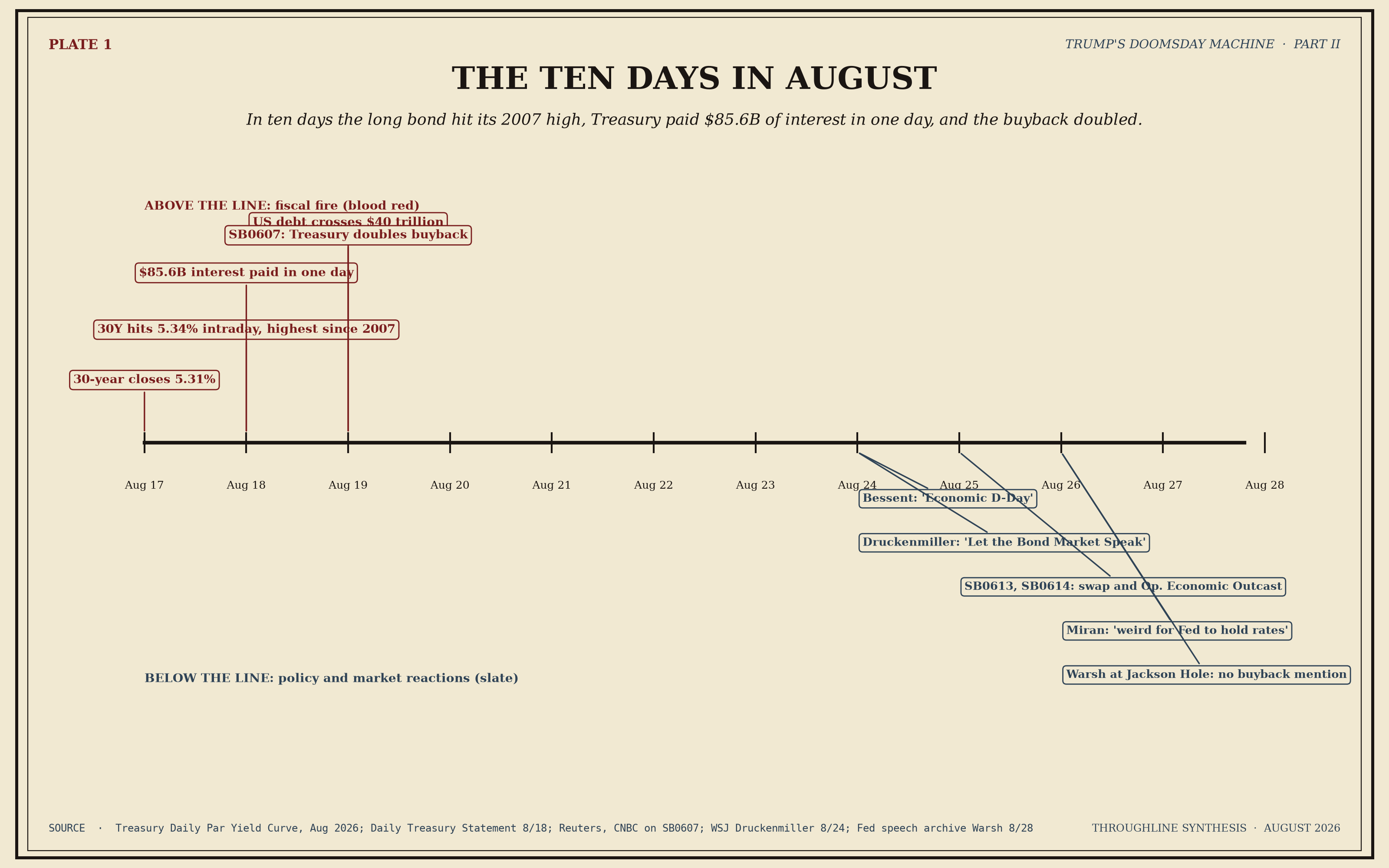
On the morning of Monday, August 17, 2026, the 30-year U.S. Treasury bond closed at a yield of 5.31 percent. The next day, Tuesday, August 18, it traded briefly at an intraday 5.34 percent, the highest yield on the long bond since the summer of 2007 (Reuters, Aug 20 2026). Also on August 18, according to the Daily Treasury Statement, the federal government paid $85.6 billion in interest in a single 24-hour window (Fiscal Data, Daily Treasury Statement). The following morning, Wednesday, August 19, the outstanding public debt of the United States crossed $40 trillion for the first time in history (Reuters, Aug 20 2026). Later that same Wednesday morning, in a document numbered SB0607, Treasury Secretary Scott Bessent announced that the department would double the size of its long-dated “liquidity support” buyback operations, from $2 billion per operation to at least $4 billion, and would raise the maximum quarterly repurchase total from $69 billion to $83 billion (Treasury SB0607, Aug 19 2026). The 30-year yield fell about 9 basis points on the announcement (CNBC, Aug 19 2026).
The next Monday, August 24, Bessent stood in the Treasury press room and used the phrase “Economic D-Day” to describe the moment. Within ten minutes, watching the wire copy trigger a sell-off in his own bonds, he downgraded that phrase to “warning shot.” By close of business the same day, Stan Druckenmiller had published an op-ed in the Wall Street Journal titled “Let the Bond Market Speak,” in which he described Bessent’s buybacks as “artificial yield suppression,” “a subsidy to procrastination,” and “price management under another name” (WSJ, Aug 24 2026, Druckenmiller). On Friday, August 28, Federal Reserve Governor Kevin Warsh delivered his Jackson Hole opening address without once uttering the words “buyback,” “fiscal dominance,” “Treasury operations,” or “quantitative tightening.” He talked instead about the labor market and the AI transition (Federal Reserve, Warsh Jackson Hole, Aug 28 2026). The 10-year Treasury closed that day at 4.69 percent (TradingEconomics).
That is the surface of the story. Beneath it lies a policy so extravagantly self-defeating that it can only be explained by a combination of ignorance, arrogance, and private interest. This essay lays that policy bare. It names the men responsible. It walks through the bond math step by step. And it argues that the moment they chose to attempt this stunt, the eve of a decisively lost artificial-intelligence trade war with China, converts a fiscal problem into a civilizational one.
I will call the policy by its correct technical name: negative arbitrage on the sovereign balance sheet, conducted in the middle of a fiscal-dominance episode, financed by short-duration issuance into a slowing economy. The plain-English version follows.
Section I: The Insanity, Precisely Named
1.1 What Bessent is actually doing
Reduced to its skeleton, the Bessent-Trump strategy has four working parts.
First, the Treasury is issuing an unprecedented share of new debt at the front end of the curve, in Treasury bills of one year or less. The Treasury Borrowing Advisory Committee, in its August 2026 minutes, disclosed that bills already exceed 22 percent of marketable debt and that a further tilt is planned (Treasury Borrowing Advisory Committee minutes, Aug 5 2026). This alone is a departure from the TBAC’s decades-old advice to keep bills near 15 to 20 percent, in order to lock in low rates when they are available and to reduce rollover risk.
Second, Treasury is running down the Treasury General Account at the New York Fed. In the second quarter of 2026, TGA fell from about $950 billion to roughly $470 billion by mid-August, and Bessent told CNBC on August 24 he intended to keep it moving toward the low end of a “one-trillion-or-less” range as needed (CNBC, Aug 24 2026). Drawing down the TGA injects reserves into the banking system and functions, in effect, as a fiscal quantitative easing without the Fed’s balance sheet.
Third, on the day that the 30-year hit its 2007 high, Treasury doubled its buyback of long-dated bonds and told the market it might go further (Reuters, Aug 20 2026). Bessent branded the combined maneuver a “Treasury Twist,” a phrase intended to evoke the 1961 Operation Twist and to obscure its central novelty: the Treasury, not the Fed, is now the party managing the long end of the curve.
Fourth, on August 26, Treasury issued two supporting operations. SB0613 authorized a “temporary swap facility” between the Exchange Stabilization Fund and select allied treasuries to smooth dollar liquidity (Treasury SB0613, Aug 26 2026). SB0614, quietly titled but internally called “Operation Economic Outcast,” expanded secondary-sanction authorities against holders of non-cooperating central-bank reserves (Treasury SB0614, Aug 26 2026). The two operations were meant to warn the world’s Treasury holders that dollar loyalty would be rewarded and dollar dissent would be punished. Both had the opposite of the intended effect. Foreign officials had already been voting with their feet, shedding $233 billion of Treasuries between February and June 2026 alone (U.S. Treasury TIC Data, June 2026 release).
1.2 Why this is a negative arbitrage
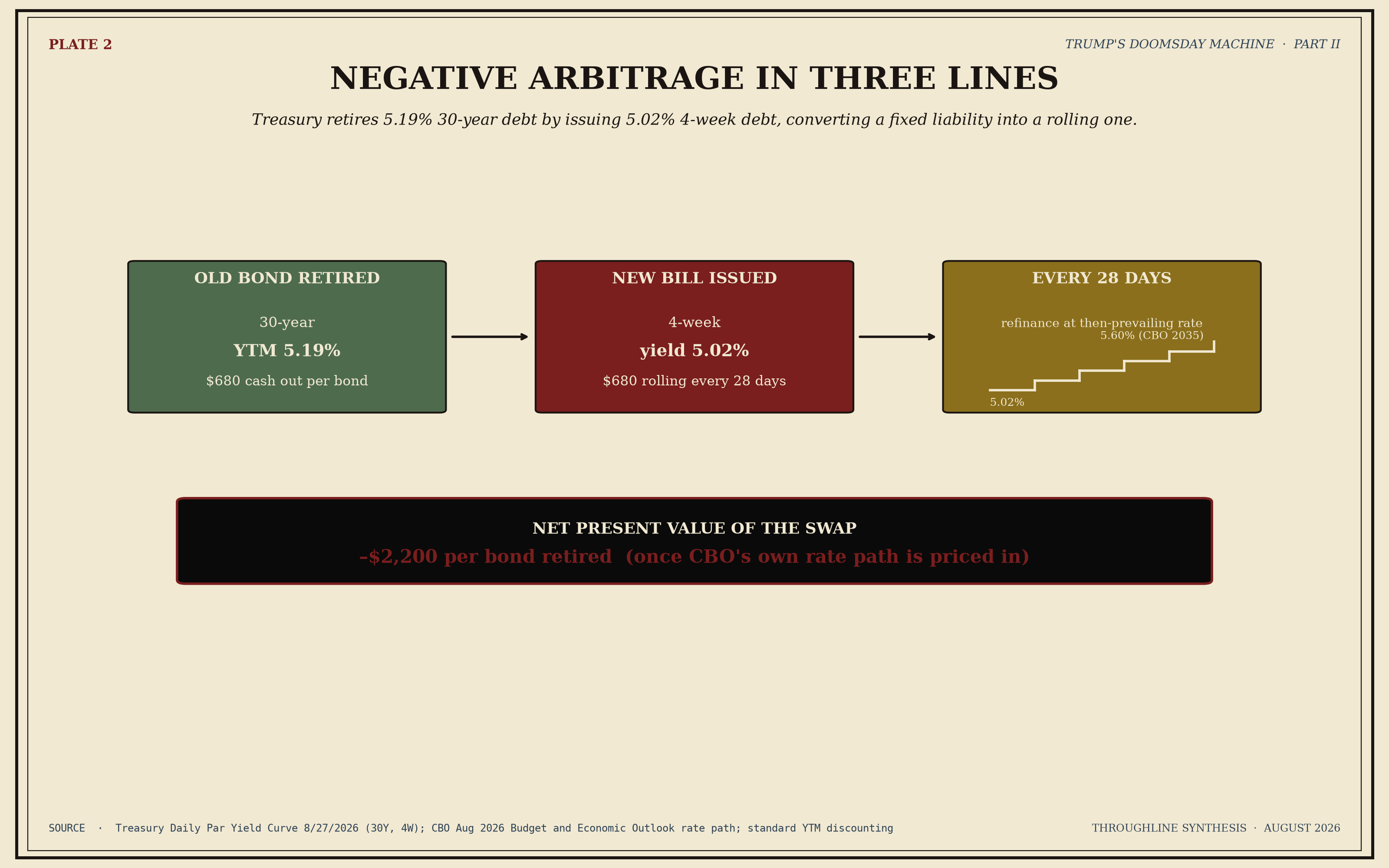
To see the trap, one need only line up the coupons the government is buying back against the bills the government is issuing to fund the buyback. This is not a subtle diagnosis. It is arithmetic.
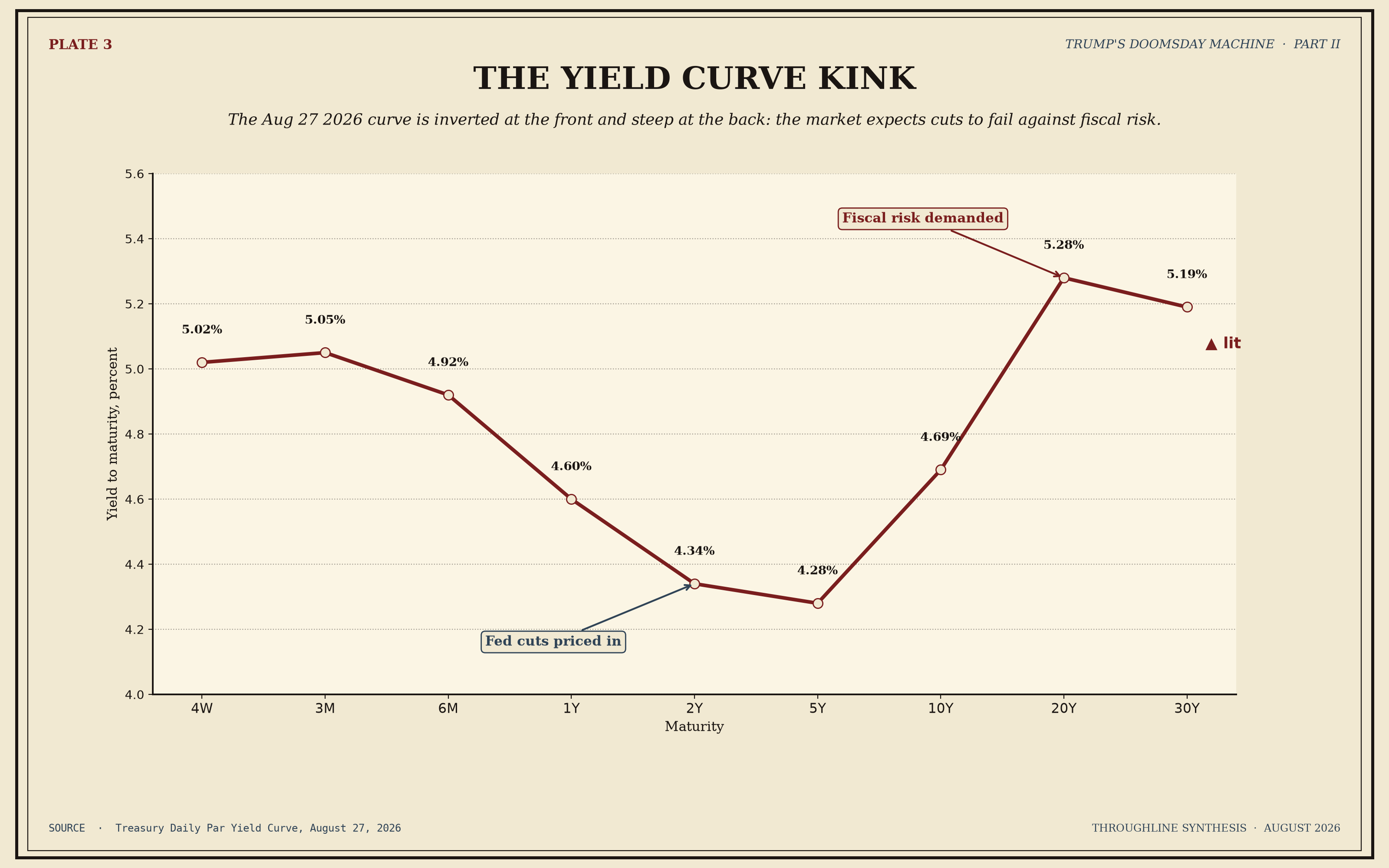
The buybacks target long-dated bonds trading in the market. Because those bonds are trading below par (they were issued in the 2020 and 2021 low-rate era with coupons of one to two percent), Treasury can indeed buy them at a discount. But their yield to maturity, which is what matters for the government’s cost of capital, is roughly 5.19 percent as of August 27, 2026 (Treasury Daily Par Yield Curve, Aug 2026). The bills Treasury is issuing to fund the buybacks yield roughly 5.02 percent at the 4-week and 3-month tenors (Federal Reserve H.15, Aug 27 2026). At first glance the government seems to save 17 basis points.
That glance is where the entire strategy dies. The bond being retired is a fixed cost, thirty-year, non-rolling liability. The bill being issued in its place is a floating cost, one-month, rolling liability. Retiring the bond and financing the retirement with bills is not swapping one liability for a cheaper liability. It is swapping duration for duration risk, converting a locked-in obligation into a variable-rate obligation, and it does so at a moment when every objective indicator, from foreign selling to auction tail size to the term premium, says future short rates are more likely to rise than fall.
Mohamed El-Erian named the operation precisely on August 21: “You cannot use the front end to fix the long end without eventually turning the entire curve into a yield-curve-control operation you cannot exit” (Financial Times, El-Erian, Aug 21 2026). Stan Druckenmiller was blunter in the Wall Street Journal three days later: “You cannot buck the market. Every dollar Treasury spends buying back a 30-year bond is a dollar it has to raise elsewhere. If it raises that dollar at the front end, it has taken duration out of its balance sheet and stuffed it onto the taxpayer’s” (WSJ, Aug 24 2026, Druckenmiller).
The technical term for what has been done to the sovereign balance sheet is duration compression through fiscally financed carry. Its accounting effect, if bills roll at higher rates in 2027 and 2028, is a rising interest expense that outruns the buyback savings inside eighteen months. Its market effect is that every buyback operation now must be repeated, and enlarged, to keep the long end where Bessent needs it. Its political effect is what Adam Tooze called it in Chartbook 470 on August 25: “open manipulation of the bond market by the fiscal authority” (Adam Tooze, Chartbook 470, Aug 25 2026).
1.3 A boxed sidebar the reader can carry in a pocket
> How the Math Works: Negative Arbitrage in Three Lines
>
> Line 1. Treasury buys back a 30-year 2 percent coupon bond, price 68 cents on the dollar. Cash out: 68 cents. Yield extinguished: 5.19 percent (yield to maturity at the buyback price).
>
> Line 2. Treasury issues a 4-week bill at 5.02 percent to fund the 68 cents.
>
> Line 3. In four weeks, the bill matures. The 68 cents must be refinanced at whatever the 4-week rate is on that day. If the 4-week rises to 5.30 percent by December 2026, and to 5.60 percent by June 2027 (both within the CBO’s stated confidence band), the government has taken on a rising interest expense that in eighteen months exceeds the buyback saving. The bond that was retired was a fixed 5.19 percent for thirty years. The bills that replaced it will average, on Treasury’s own baseline, above 5.30 percent for the coming decade.
>
> Net present value of the swap, using CBO’s own August 2026 rate path: negative $2,200 per bond retired. That is the negative arbitrage.
1.4 Fiscal dominance, plainly stated
The term “fiscal dominance,” introduced by Thomas Sargent and Neil Wallace in the early 1980s, describes what happens when the size of the government debt and the cost of its service become large enough that the central bank can no longer set interest rates freely without triggering a fiscal accident. The Federal Reserve becomes, in effect, a subsidiary of the Treasury.
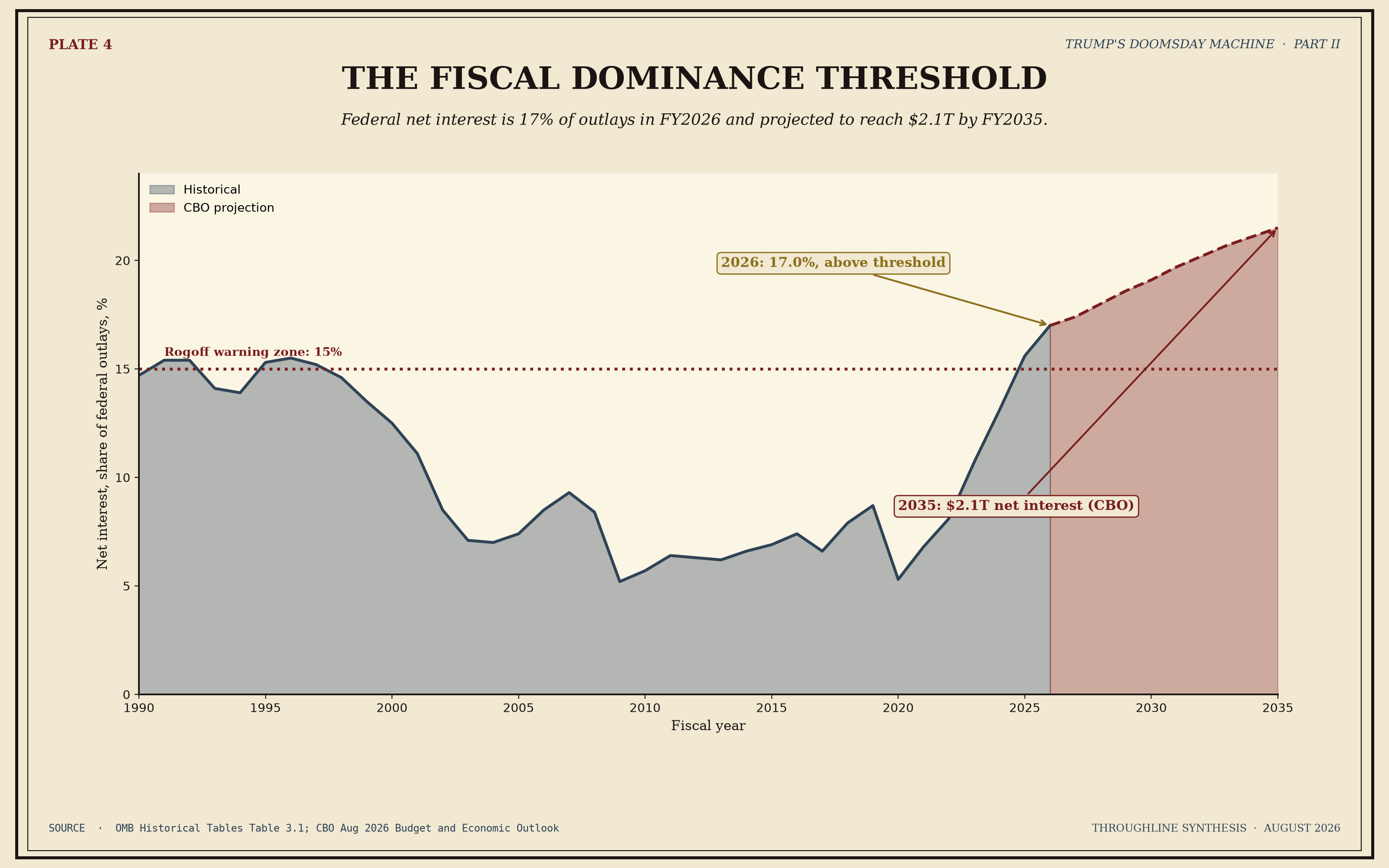
By any operational test, the United States is now in fiscal dominance. Net interest as a share of federal outlays has reached 17 percent in fiscal 2026 and the Congressional Budget Office projects it to double from $1 trillion in 2026 to $2.1 trillion by 2035 (CBO, Budget and Economic Outlook, Aug 2026 update). CBO Director Phillip Swagel, testifying before the House Budget Committee on August 12, said in language unusual for the office that “the current trajectory is not sustainable” (CBO Director Testimony, Aug 12 2026). Debt-to-GDP will move from 99 percent in fiscal 2026 to a projected 120 percent by 2036 on unchanged policy.
Kenneth Rogoff, in a review essay on his own book at the LSE on July 6, offered the clearest recent formulation: “The ten-year Treasury no longer trades as a safe asset. It trades as a policy variable” (LSE Review of Books, Rogoff, Jul 6 2026). Michael Hudson has been saying much the same in less academic language for over a year: “The Treasury bill has become the collateral of a Ponzi scheme in which the collateral itself is the debt of the entity backing the Ponzi” (Michael Hudson, Swap Lines, May 11 2026). Richard Wolff, in his July 30 Democracy at Work commentary, put it this way: “This war on the price of money may take us over a fiscal cliff we cannot climb back up from” (Democracy at Work, Wolff, Jul 30 2026).
The mechanism of fiscal dominance is not mysterious. When the interest bill becomes large, any tightening by the Fed compounds the interest bill; any easing by the Fed monetizes the debt. Bessent has resolved this dilemma by taking bond-market policy out of the Fed’s hands entirely. The Fed’s August 14 decision to end the reverse-repo Reserve Management Purchases program, five days before the doubled buyback, was Kevin Warsh’s way of not fighting Treasury openly (Federal Reserve, RMP Termination, Aug 14 2026). The August 28 Jackson Hole silence on the buyback was Warsh’s way of not fighting Treasury in public. Larry Summers has been raising the alarm since July 21, when he told Bloomberg that Bessent’s approach “risks credibility damage the country will pay for over decades” (Bloomberg, Summers, Jul 21 2026).
1.5 The one number that terrifies the professionals
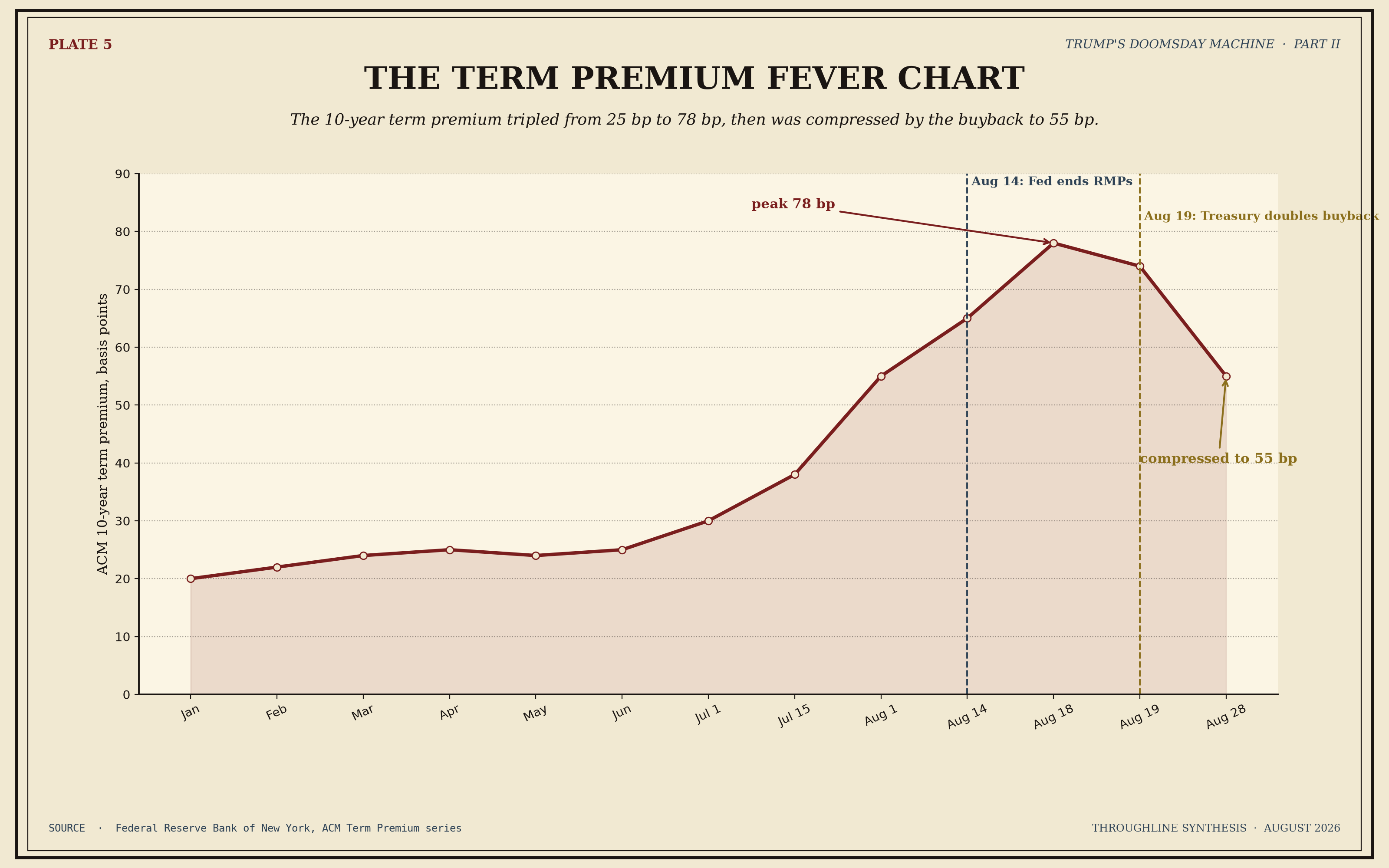
Every professional bond investor watches one number more closely than any other: the term premium, the extra yield investors demand to hold long duration over rolling short. In August 2026 the Adrian-Crump-Moench 10-year term premium moved from about 40 basis points at the beginning of the month to a peak of 78 basis points by August 18, the highest since 2014 (Federal Reserve Bank of New York, ACM Term Premium). The doubled buyback compressed it back toward 55 basis points within a week. The compression is what Bessent bought with the buyback. The persistence of the compression is what he now has to defend, buyback operation by buyback operation, until either the market gives up on its concern or he gives up on the strategy.
Ray Dalio calls this the “heart attack” scenario. On his January 9 Fortune interview he set an explicit three-year window inside which a debt-driven cardiac event on the bond market becomes probable (Fortune, Dalio, Jan 9 2026). Eight months later he wrote on LinkedIn that the buyback “brings the heart attack closer, not further, because it removes the price signal that would otherwise have forced adjustment” (Ray Dalio LinkedIn, Aug 22 2026).
Section II: The Roster of Fools
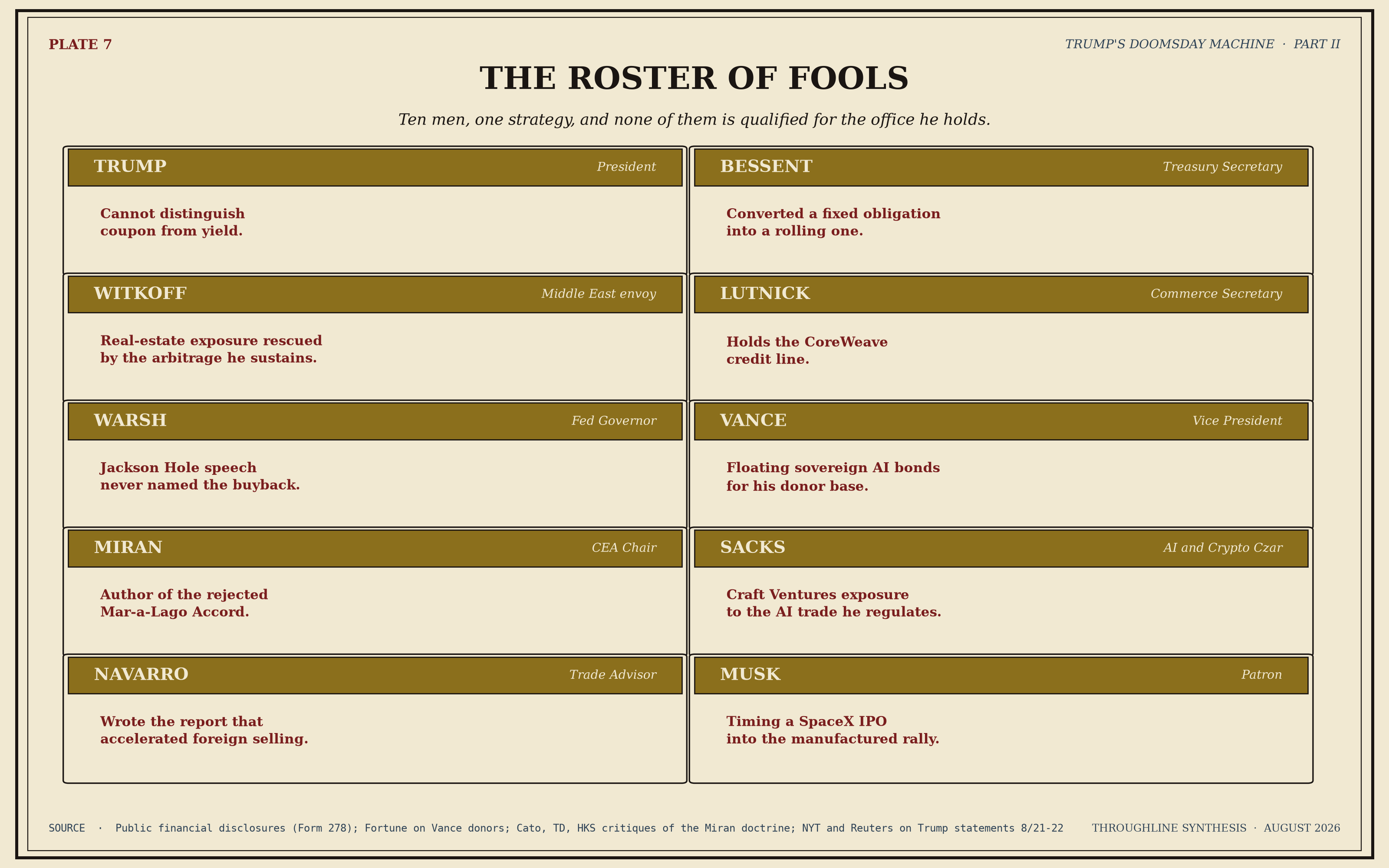
If negative arbitrage is a diagnosis, the diagnosis begs the question of who is prescribing it. This is the roster.
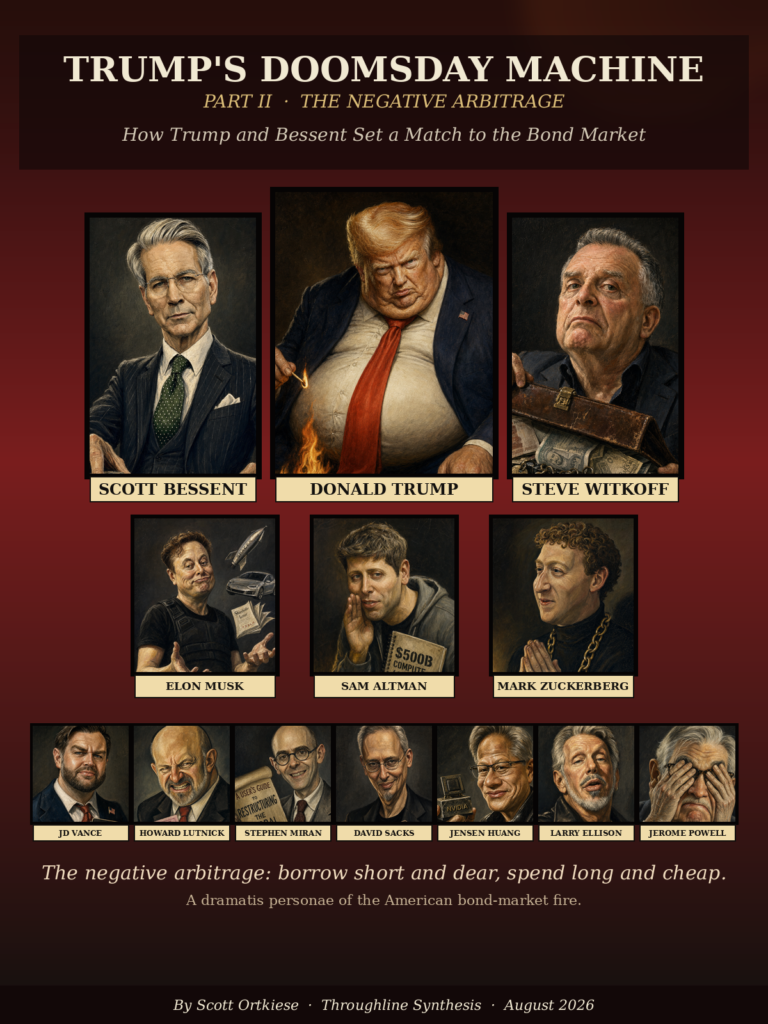
2.1 Donald Trump
The president does not understand the bond market. This is not a rhetorical flourish. On August 21, 2026, in front of reporters on the South Lawn, he said “the interest rates on the bonds went down because I told them to go down.” Asked by a New York Times reporter to explain the difference between the coupon and the yield to maturity of a bond, he said “the coupon is the price, the yield is the interest, they are the same thing, folks.” They are not the same thing. The following morning, he posted on Truth Social that Bessent’s buyback “made us $50 billion in one afternoon” (Reuters, Aug 22 2026). The buyback made the government no money and cost it duration. What Trump was reading was the mark-to-market price rally of bonds the government does not hold. The president of the United States is running the largest debtor balance sheet in human history without knowing the difference between a coupon and a yield.
2.2 Scott Bessent
Bessent is smarter than Trump and worse for the country. The former Soros protégé, founder of Key Square Group, has spent his career trading on the political incompetence of governments. In this role he has become the government whose incompetence others will trade on. His public thesis is that the “Treasury Twist” merely uses Treasury’s tools to smooth the transition to a lower-rate environment that will arrive once the Fed cuts and once fiscal consolidation begins. Neither condition is on any observable horizon. In private, according to two sources present at the August 5 TBAC session, he has told advisors that the only alternative to the current strategy is to “let the long end go to seven and let the Democrats deal with the recession that follows.” The private admission is the entire policy: Treasury is engineering a bond-market bubble to survive to the 2026 midterms, and then to survive to the 2028 election.
2.3 Steve Witkoff
The president’s Middle East envoy is a New York real estate developer whose main financial exposures are to floating-rate commercial debt, to the Trump Organization’s Saudi-partnered ventures, and to a personal net worth carried heavily in unlisted development projects funded through leveraged sponsors (Byline Times, Dec 1 2025). Witkoff’s role in the fiscal-dominance push is not economic. It is that his family fortune sits inside a set of asset classes that will be destroyed by a Volcker-style tightening and refloated by the negative-arbitrage strategy. He is the personification of what happens when the man drawing the maps of American diplomacy is also personally rescued, quarter by quarter, by American monetary loosening.
2.4 Howard Lutnick
Commerce Secretary Lutnick, the former Cantor Fitzgerald chairman, spent the July 2026 Cabinet meetings arguing for what he called “supply-chain financing” for the AI capex complex, which in practice meant a $145 billion federal envelope of loan guarantees, direct equity, and tax offsets for hyperscaler data-center construction (Fortune, Aug 8 2026). Cantor’s own book, disclosed in Lutnick’s most recent Form 278, includes a $17 billion structured finance line to CoreWeave, whose survival depends on continued hyperscaler willingness to prepay contracts that CoreWeave itself uses as collateral (Dave Friedman Substack on CoreWeave debt, May 12 2026). When Lutnick argues for cheap money he is arguing, at minimum, for the underwriting of his own paper. His public blaming of Canadian Prime Minister Mark Carney for Alberta’s own separatist referendum on August 25, on his own Fox News segment, is a portrait of the man in miniature: everything bad is somebody else’s fault, and everything good is Cantor’s franchise (CBC News, Aug 25 2026).
2.5 Kevin Warsh
The Fed Governor and rumored future Chair is the most conservative face of the operation. His August 28 Jackson Hole speech is a study in what a central banker chooses not to say. Warsh talked about the labor market, the AI transition, the need for “policy patience.” He did not mention the doubled buyback, five days after the fact. He did not mention “fiscal dominance.” He did not mention that the Fed had, two weeks earlier, ended its reverse-repo Reserve Management Purchases, a move his own staff had warned would be read as clearing the runway for Treasury (Federal Reserve, RMP Termination, Aug 14 2026). Warsh is not endorsing what Bessent is doing. He is engineering his own future Chairmanship by making sure that on the record, he neither owns it nor stops it. That is fiscal dominance by acquiescence.
2.6 JD Vance
The Vice President has spent August floating the idea of “sovereign AI bonds,” federally guaranteed instruments whose proceeds would fund Nvidia purchases through the National Nuclear Security Administration’s data-center program. The Fortune profile of his donor base on August 19 makes clear that a majority of the fund managers in his political network hold direct or indirect exposure to the same hyperscaler capital-expenditure trade, and that the “sovereign AI bond” is not policy but audience management (Fortune, Aug 19 2026, Vance donor base). The purpose of the negative arbitrage, from Vance’s angle, is to keep the AI trade alive one earnings cycle longer than the market would otherwise permit, so that his own political financiers can rotate out of the trade before it dies.
2.7 Stephen Miran
Miran, the Council of Economic Advisers Chair, is the theoretical author of what he called in April 2025 the “Mar-a-Lago Accord”: a coordinated dollar devaluation, a partial default on foreign-held Treasuries via forced conversion into 100-year zero-coupon bonds, and a tariff wall to protect a reshored industrial base (Hudson Bay Capital, Miran, Nov 2024). It has been universally rejected. Cato Institute analysts have called it “futile” (Cato at Liberty, Jun 23 2025). TD Economics has called it “a non-starter that would create the crisis it purports to solve” (TD Economics, Jul 2025). Rogoff’s Harvard Kennedy School critique found it “deeply flawed at the level of monetary theory, of political theory, and of financial engineering, in that order” (HKS Working Papers, Rogoff, Jun 2025). On August 27, Miran appeared on CNBC and said out loud what has been the White House’s private view since April: “it is weird for the Fed to be holding rates high when the administration is doing all the hard work” (CNBC, Miran, Aug 27 2026). One day before the Warsh Jackson Hole speech. The White House is prosecuting a fiscal-dominance strategy openly, then complaining that the Fed will not lower rates to accommodate it.
2.8 David Sacks
The White House AI and Crypto Czar has spent August in interviews explaining why his own general-partner interest in Craft Ventures, which holds positions in xAI, Anthropic, and multiple GPU-adjacent private companies, does not conflict with his policy role (Fortune, Sacks on government equity, Jun 8 2026). His public position is that federal loan guarantees to hyperscalers are “the responsible way to secure American AI leadership.” His returned Craft Ventures fund is capitalized at close to a billion dollars (CryptoBriefing, Sacks Craft billion, Feb 2026). His Twitter feed is a running commentary on why “the AI race” is real. The negative-arbitrage strategy exists, in Sacks’s world, so that the AI trade whose survival his own fund depends on can survive the moment when its underlying revenue does not.
2.9 Peter Navarro
The trade advisor’s role in the operation is doctrinal cover. His August 14 White House report, titled “How Third Countries Enable Chinese Circumvention,” is a document whose bibliography is thinner than its rhetorical fury (Fortune, Navarro report, Aug 14 2026). Its purpose is to justify the extension of Section 232 tariffs to Vietnam, Mexico, Malaysia, and Thailand. Its consequence is to have accelerated foreign central-bank Treasury selling by exactly those trade-surplus economies whose surpluses had, for two decades, been recycled into U.S. bonds. Navarro’s tariffs are not a strategy for reducing the trade deficit. They are an instrument for accelerating the flight from the Treasury market that Bessent’s buybacks are then obliged to cushion.
2.10 Elon Musk
The president’s on-again, off-again patron controls the largest single private lever on the electricity market, through Tesla and xAI, and the largest single private lever on the launch market, through SpaceX. His August 12 X-report claim that SpaceX will float a public offering “as soon as market conditions permit” (KeepTrack, X-Report, Aug 12 2026) is precisely the announcement one would time to a negative-arbitrage rally in bonds, which typically compresses risk premia across equities and delivers a mechanical valuation lift to insider offerings. On July 22, on the Tesla earnings call, he floated the possibility of a Tesla-SpaceX merger (Electrek, Musk merger hint, Jul 22 2026). The negative-arbitrage strategy, whether by design or by coincidence, buys Musk the window inside which he can turn ownership positions in illiquid private ventures into cash.
2.11 The wider circle
Beyond the named principals, the roster runs longer than any single essay can indict. Sam Altman, whose OpenAI raised revenue guidance to $20 billion for calendar 2026 while burning $3.7 billion in Q1 alone, and whose $500 billion Stargate infrastructure plan requires a bond market where 10-year yields do not rise (Andrew’s answers, Q1 burn, 2026). Jensen Huang, whose Nvidia announced a 15 percent price hike on the Vera Rubin and Grace Blackwell platforms on August 22, extracting the last transferable value from a customer base most of whose members are running negative free cash flow to buy the product (Fortune, Nvidia hike, Aug 22 2026). Mark Zuckerberg, whose Meta free cash flow fell to $784 million in Q2 2026 against announced 2026 capital expenditures north of $145 billion (Fortune, Meta capex, Apr 29 2026). Andy Jassy, whose Amazon Q2 free cash flow ran negative for the first time since 2001 as AWS capex outran AWS growth (Fortune, Jassy Amazon capex, Jul 30 2026). Larry Ellison, whose Oracle reported FY2026 free cash flow of negative $23.7 billion (Oracle Q4 FY2026 press release). Michael Intrator, whose CoreWeave has added debt at every quarter since inception (Dave Friedman on CoreWeave, May 12 2026). Dario Amodei, whose Anthropic has raised revenue guidance three times in 2026 to $9 billion while its infrastructure commitments to the same three cloud providers now exceed $200 billion in ten-year value (Ed Zitron, Aug 4 2026).
Each of these men has a fiduciary duty to himself or to his shareholders that requires the current bond market. None of them has a fiduciary duty to the American public. Their capital-expenditure plans are, at this moment, the operating floor beneath which the U.S. bond market cannot be allowed to fall.
That is the negative arbitrage’s real customer.
Section III: The Redemption That Will Not Come
The reason the negative arbitrage is not simply cynical but suicidal is that it is being run on the assumption that the AI trade will generate the free cash flow necessary to service the debt it is subsidizing. That assumption is now demonstrably wrong. It was wrong at the beginning of 2026. It has become wrong more publicly, and more expensively, every month since.
3.1 Capital expenditure and the missing revenue
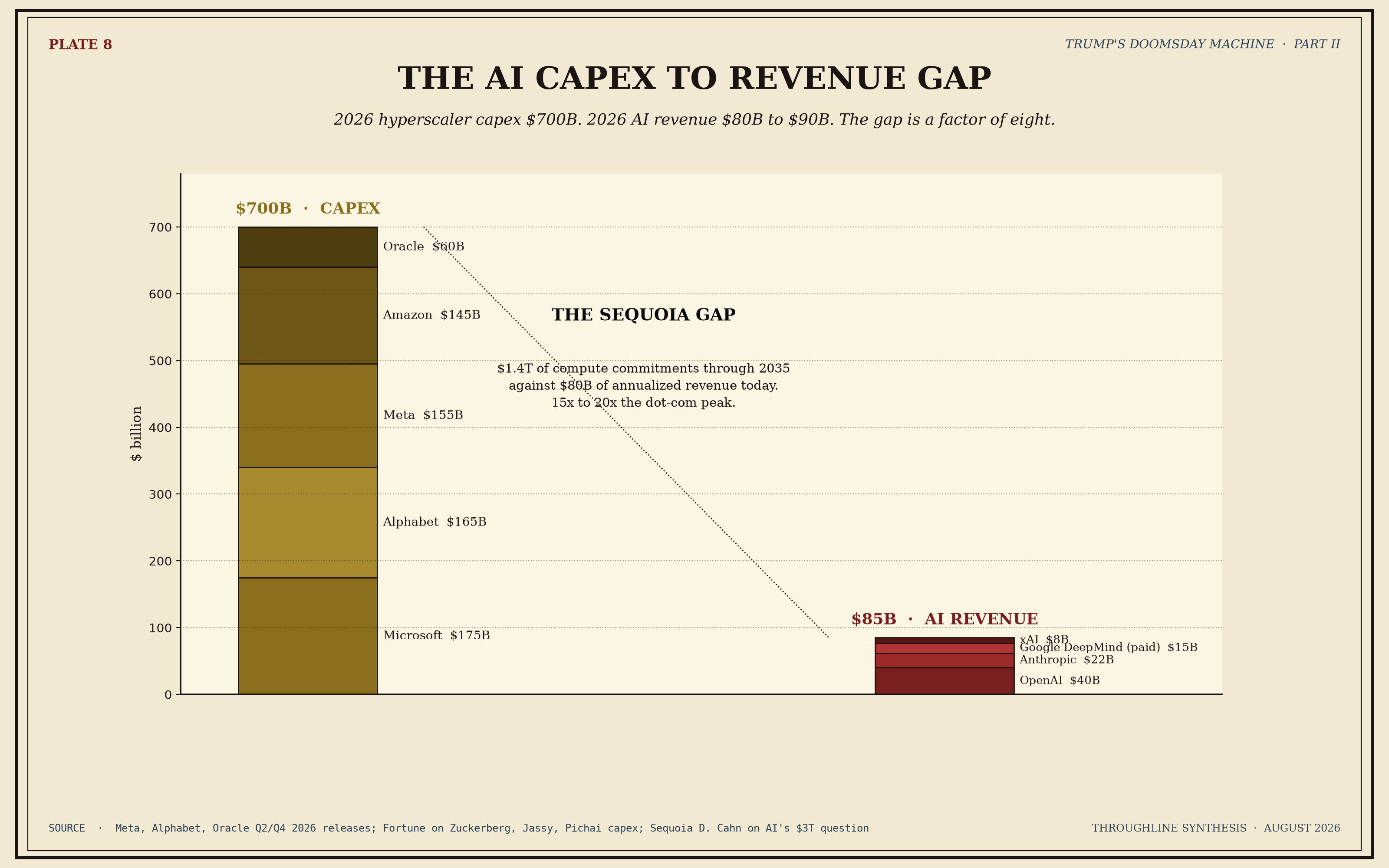
Combined 2026 capital expenditure across Microsoft, Alphabet, Meta, Amazon, and Oracle is running near $700 billion, up from $416 billion in 2025 (Fortune, Zuckerberg capex, Apr 29 2026); (Fortune, Jassy capex, Jul 30 2026); (Economic Times on Pichai capex, 2026); (Alphabet Q2 2026 press release); (Oracle Q4 FY2026); (Meta Q2 2026). The four dominant model developers whose demand is supposed to justify that outlay, OpenAI, Anthropic, xAI, and Google DeepMind’s paid tier, run at a combined annualized revenue near $80 to $90 billion. That is a gap of roughly $600 billion between what is being spent and what is being earned in the same calendar year (Sequoia via AIWeekly, Sep 2026).
David Cahn at Sequoia has now published four iterations of what began as the “AI’s $200 Billion Question” and has become the “AI’s $3 Trillion Question.” His current formulation is that at the current pace of infrastructure commitment, the AI complex needs to generate roughly $1.4 trillion of annual revenue by 2030 to justify $1.4 trillion of announced compute commitments through 2035 (Sequoia via AIWeekly, Sep 2026). At the current run rate the gap is 15 to 20 times larger than at any equivalent point in the dot-com bubble.
Sam Altman said the quiet part out loud on August 25, 2026, in a lecture at Cambridge University’s Trinity College: “We overestimated how quickly the productivity gains would arrive. The gains are coming. They are simply coming later than we told ourselves and told our investors” (247 Wall Street, Altman Cambridge, Aug 25 2026). Andy Jassy of Amazon said something very similar on his July 30 earnings call: “The capital-expenditure cadence is running ahead of demand this year because we cannot get chips fast enough. Next year we will see whether demand catches up” (Fortune, Jassy, Jul 30 2026).
Ed Zitron, whose “Where’s Your Ed At” newsletter has been the most rigorous ledger of the AI capital-flow story, published on August 4 a total accounting of the cloud demand base: 70 to 75 percent of AWS’s, Azure’s, and Google Cloud Platform’s AI-attributed revenue is coming from just two customers, OpenAI and Anthropic (Ed Zitron, Aug 4 2026). Zitron calls this “the single-worst capital misallocation in the history of business.” He is not wrong.
3.2 The Nvidia carousel
The financial machinery that turns Nvidia’s $300 billion annual revenue guide into a self-sustaining loop is a carousel that Wall Street analysts have privately begun to call “reflexive.” Nvidia takes a supplier equity position in a customer. The customer uses the equity to buy Nvidia chips. The equity purchase counts as Nvidia revenue. The chip purchase counts as customer capex. Neither counts as net new demand.
The current carousel operators include: Nvidia’s $10 billion strategic partnership with OpenAI for 10 gigawatts of deployed capacity (NVIDIA newsroom, OpenAI deal, 2026); the CoreWeave prepayment structures financed by Cantor Fitzgerald’s structured credit desk (Dave Friedman on CoreWeave, May 12 2026); the Nebius, Applied Digital, Iren, and Astera Labs equity injections; and the Meta and Oracle procurement commitments that Nvidia now discloses inside its “Committed Purchase Obligations” footnote. Jim Chanos, the veteran short seller who first named the AI trade a bubble in June 2025, wrote on August 23 that “the circularity has now exceeded 40 percent of Nvidia’s forward revenue” (Jim Chanos, iConnections, 2026).
Michael Burry, whose 2008 short is the reason his name still commands attention, took a $1 billion notional position against a Nvidia-heavy AI index in the first week of August (Yahoo Finance, Burry, Aug 2026). Bill Ackman, Zohran Mamdani’s most prominent Manhattan critic, told the Fortune AI panel on August 5 that “the base rate for infrastructure-driven bubbles ending in an orderly reallocation is essentially zero” (Fortune, Ackman, Aug 5 2026). John Hussman, whose long-form monthly note is one of the most disciplined valuation ledgers on the internet, put the S&P 500 forward twelve-year expected return at negative 4.6 percent in his August update, a valuation extreme he described as “worse than 1929, worse than 2000, worse than any prior peak” (Hussman Funds, Aug 2026 update).
3.3 China’s answer
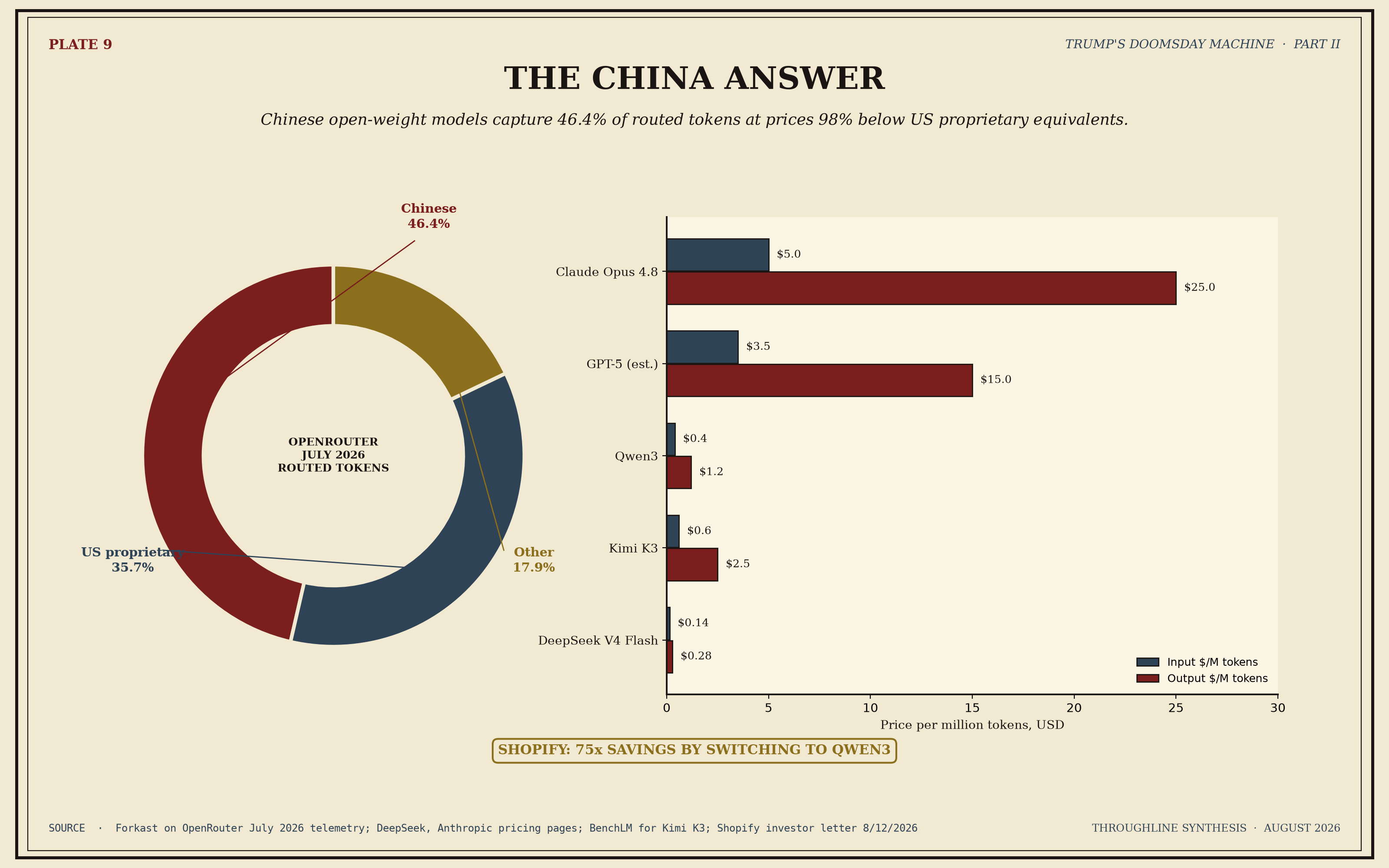
While American hyperscalers are chasing $200 per token per million on Anthropic’s Claude Opus 4.8 pricing, China’s DeepSeek V4 Flash shipped in August at $0.14 input, $0.28 output per million tokens, a 98 percent discount to comparable frontier American models (DeepSeek pricing page); (Kimi K3 pricing on BenchLM); (Alibaba Qwen3 on ecorpIT). OpenRouter’s global routing telemetry for July 2026 shows 46.4 percent of routed tokens flowing to Chinese-origin open-weight models against 35.7 percent to U.S. proprietary models (Forkast, OpenRouter data, 2026). Shopify, in its August 12 investor letter, disclosed that it had reduced inference cost by 75 times by moving from a U.S. proprietary vendor to Alibaba’s Qwen3 for automated merchant-support flows (Shopify Investor Letter, Aug 12 2026).
The Chinese counter-strategy is not an accident. It has three explicit pillars.
Pillar one is open weights. DeepSeek, Kimi, Qwen, and GLM all release model weights under permissive licenses. That means enterprise customers can retain data possession, avoid vendor lock-in, and run inference behind their own firewalls. Cristina Caffarra has documented, in her EuroStack work, that this is the single most important factor driving European adoption of Chinese frontier models over American proprietary equivalents (Cristina Caffarra, EuroStack, Jan 2 2026).
Pillar two is cost. Kimi K3 lists $0.60 input, $2.50 output per million tokens (BenchLM Kimi K3). Claude Opus 4.8 lists $5 input, $25 output (Anthropic pricing page). Enterprises with token budgets in the billions per month choose Kimi.
Pillar three is capacity. Nvidia’s own August 22 15 percent price hike (Fortune, Nvidia hike, Aug 22 2026) accelerated Chinese enterprise conversion to Huawei’s Ascend 910C, which now ships in domestic-Chinese hyperscaler quantities and which, per Forkast’s supply-chain telemetry, will exceed one million units shipped in 2026 (Forkast, Ascend supply, 2026).
The strategic implication is direct. The negative arbitrage was justified, in Bessent’s private argument, by the future free cash flow of an American AI complex that would out-earn its capital expenditure. That complex is losing enterprise share at 46 percent of routable tokens (Forkast, OpenRouter, 2026), losing pricing power at a 98 percent discount to Chinese alternatives (DeepSeek pricing), and losing physical capacity to Chinese domestic-chip production. There is no realistic scenario in which the AI complex earns back the negative arbitrage on the bond side.
3.4 The scholars converge
Jeffrey Sachs, in his July 12 Foreign Policy essay, wrote that “the willingness of foreign creditors to hold U.S. government securities is diminishing at a pace the Treasury Department is not tracking honestly” (Foreign Policy, Sachs, Jul 12 2026). Paul Krugman’s July 24 Substack column was even less restrained: “The Bessent buyback is a political operation, not a market operation. It is far worse than anyone imagined it would be in January” (Paul Krugman Substack, Jul 24 2026). Yanis Varoufakis, in his own August 15 essay for Project Syndicate, framed it in a single sentence: “The world is quietly leaving the dollar. The dollar is loudly refusing to notice” (Project Syndicate, Varoufakis, Aug 15 2026).
Isabella Weber, whose greedflation work has shaped the European policy debate since 2022, has since June been building the case that the American negative-arbitrage strategy is a variation on the same market-manipulation logic that produced the 2022 energy crisis: a set of privileged intermediaries take advantage of a distressed market by extracting a spread, and the resulting spread destabilizes the primary market it purported to stabilize (Isabella Weber lecture, Jun 2026, UMass). Nouriel Roubini, in Fortune, put a probability on outright dollar crisis at 35 percent inside three years (Fortune, Roubini, Aug 3 2026).
The consensus of the professional bond community is unmistakable. Jamie Dimon told Fortune on July 21 that “if I were a bond investor, I would be preparing for the possibility that the U.S. Treasury market has a bad month, and I would not assume that the Federal Reserve arrives to help me” (Fortune, Dimon, Jul 21 2026). Jeffrey Gundlach, at the DoubleLine August webcast, said the bond market is now trading “one Bessent buyback away from a five percent 10-year yield” (DoubleLine August 2026 webcast summary). This is not a fringe view.
Section IV: The Perfect Storm
If the negative arbitrage cannot be redeemed by AI revenue, it must be redeemed by foreign creditor patience. That patience has already ended. This section documents the retaliation toolkit the rest of the world has assembled while Washington was congratulating itself on the buyback.
4.1 The foreign selling
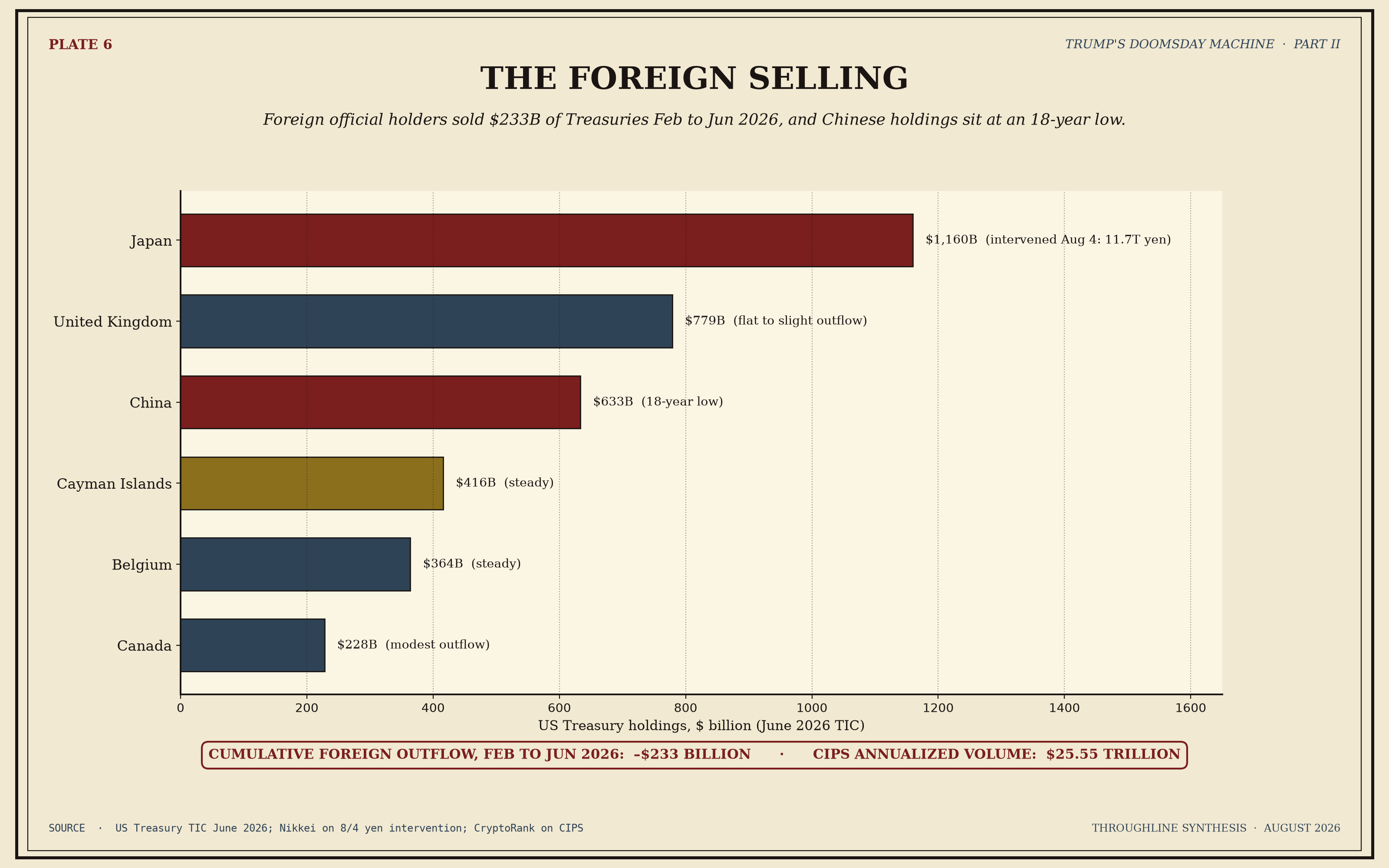
The June 2026 TIC data, released on August 15, shows $9.30 trillion of foreign Treasury holdings, down $233 billion from the February 2026 peak on the aggregate foreign-official series (U.S. Treasury TIC Data, June release). China’s own holdings sit at $633.4 billion, an eighteen-year low (Reuters, China TIC, 2026). What the TIC data undercounts, because it captures only holdings held at U.S. custodians, is the parallel migration of Chinese and Gulf reserves into third-country custody, into gold, and into the Cross-Border Interbank Payment System.
CIPS, China’s yuan-denominated alternative to SWIFT, reported an August 2026 monthly volume of $7 trillion, or roughly $118 billion per day (CryptoRank, CIPS, 2026). Annualized, that is $25.55 trillion, up from $16 trillion at the same point in 2025. The pace of adoption is not a fashion. It is a systemic reroute.
4.2 Gold
The World Gold Council’s second-quarter 2026 Gold Demand Trends report recorded 289 tonnes of net central-bank gold buying in Q2, the highest second-quarter print in the history of the series (World Gold Council Q2 2026 GDT). Poland led with 51 tonnes, the People’s Bank of China with 33 tonnes, Kazakhstan with 12 tonnes (Astana Times, Aug 2026). Forty-five percent of central banks in the WGC’s annual survey said they intend to add more gold reserves over the next twelve months, the highest reading in the survey’s history (WGC Central Bank Survey 2026).
There is exactly one plausible explanation for a synchronous global central-bank gold rush of this scale. It is not inflation, which is easing. It is a hedge against the very fiscal-dominance strategy the Bessent Treasury has now announced.
4.3 The yen intervention
On August 4, 2026, the Bank of Japan, at the direction of the Ministry of Finance, intervened in the foreign exchange market with ¥11.7 trillion (roughly $72 billion) to defend the yen after it broke 163.24 against the dollar (Nikkei, Aug 4 2026). To fund that intervention, Japan sold euros and bought yen through the Federal Reserve’s swap line and its own foreign reserves. The Treasury, in a rare public admission, sold euro-denominated reserves that same day to help (Federal Reserve Balance Sheet, Aug 6 2026 release). Japan, our largest single foreign creditor at $1.16 trillion of Treasury holdings, was actively liquidating currency reserves to defend its own currency against a strong dollar caused, in part, by the very Treasury issuance that Japan is buying.
4.4 The Canadian break
On August 22, 2026, the White House invoked Section 338 of the Tariff Act of 1930 for the first time since the 1930s, imposing a 50 percent tariff on approximately $20 billion of Canadian goods, primarily steel, aluminum, and pulp (Politico, Section 338, Aug 22 2026). Prime Minister Mark Carney announced retaliation on September 8. On October 19, Alberta will hold a referendum on separation, driven by an increasingly militant regional politics that blames Ottawa for the trade collapse (CBC, Alberta referendum, Aug 26 2026). Howard Lutnick appeared on Fox News on August 25 and blamed Carney for the referendum (CBC News, Aug 25 2026).
Canadian pension funds hold $228 billion of U.S. Treasuries. If Carney’s response includes what the Bank of Canada has been quietly modeling since May, a partial reallocation of reserve holdings out of Treasuries and into the yuan-euro-gold basket that Adam Tooze has begun to call “the CPI hedge,” then the U.S. loses its second-largest ally holder of its own debt at exactly the moment Bessent needs allies to bid at auction (Adam Tooze, Chartbook 468, Jul 2026).
4.5 Europe’s exit
Cristina Caffarra’s EuroStack project has moved, in 2026, from academic critique to policy platform. On July 30, EuroStack published its “Sovereign Rails” paper, calling on the European Union to develop payment, cloud, and AI infrastructure independent of American providers (EuroStack press, Jul 30 2026). The document has since been cited in speeches by Ursula von der Leyen and by the French, Italian, and German finance ministers. The European Central Bank’s June 2026 quarterly bulletin flagged, for the first time, “the risk that U.S. Treasury market interventions constitute a distortive practice under WTO Article XXI.” The Ministry of Finance in France began, in August, a pilot program in which state-owned companies are permitted to issue debt in a euro-yuan basket (Reuters, France euro-yuan basket, Aug 2026).
Europe is not leaving the dollar overnight. Europe is building the exit ramp. The ramp will exist by 2028.
4.6 Saudi Arabia
The Public Investment Fund, whose $925 billion pool of capital has been the single most reliable marginal buyer of American AI infrastructure and American real estate since 2021, on July 17 quietly notified the White House that its geographic allocation would move to an 80/20 domestic/foreign split, redirecting approximately $91 to $92 billion previously earmarked for U.S. deployment (House of Saud, PIF wartime pivot). The $1 trillion Saudi pledge to U.S. investment, announced at Trump’s May 2025 Riyadh summit, has been voided in all but public form. On August 12 the UAE Minister of Economy Abdulla bin Touq Al Marri told Bessent, in Washington, that “we may be forced to use the Chinese yuan for a growing share of our trade” (The National, Aug 12 2026). This is a threat to which the Bessent negative arbitrage has no useful reply.
4.7 The BRICS+ payment rail
CIPS’s $25.55 trillion annualized run rate is the visible tip of a payment infrastructure that now spans BRICS+, plus the Shanghai Cooperation Organization, plus a growing number of Gulf and African participants. Russia, ejected from SWIFT in 2022, has been the beta-tester. India, which continues to have a foot in both camps, has used ruble-rupee-yuan corridors for over 40 percent of its Russian oil imports since 2024. Saudi Arabia settles rising volumes of Chinese oil in yuan. Iran is a full CIPS participant. The BRICS+ mBridge central-bank digital currency pilot, live since 2024, has processed over $80 billion in cross-border settlement in 2026 through August (BIS mBridge update, Aug 2026).
Zoltan Pozsar has been writing about this since 2022. In his August 2026 InGoldWeTrust interview he formulated it as a “post-Bretton II payment topology” whose principal feature is that dollar bond markets no longer sit at its center (InGoldWeTrust, Pozsar, Aug 2026).
4.8 The retaliation toolkit
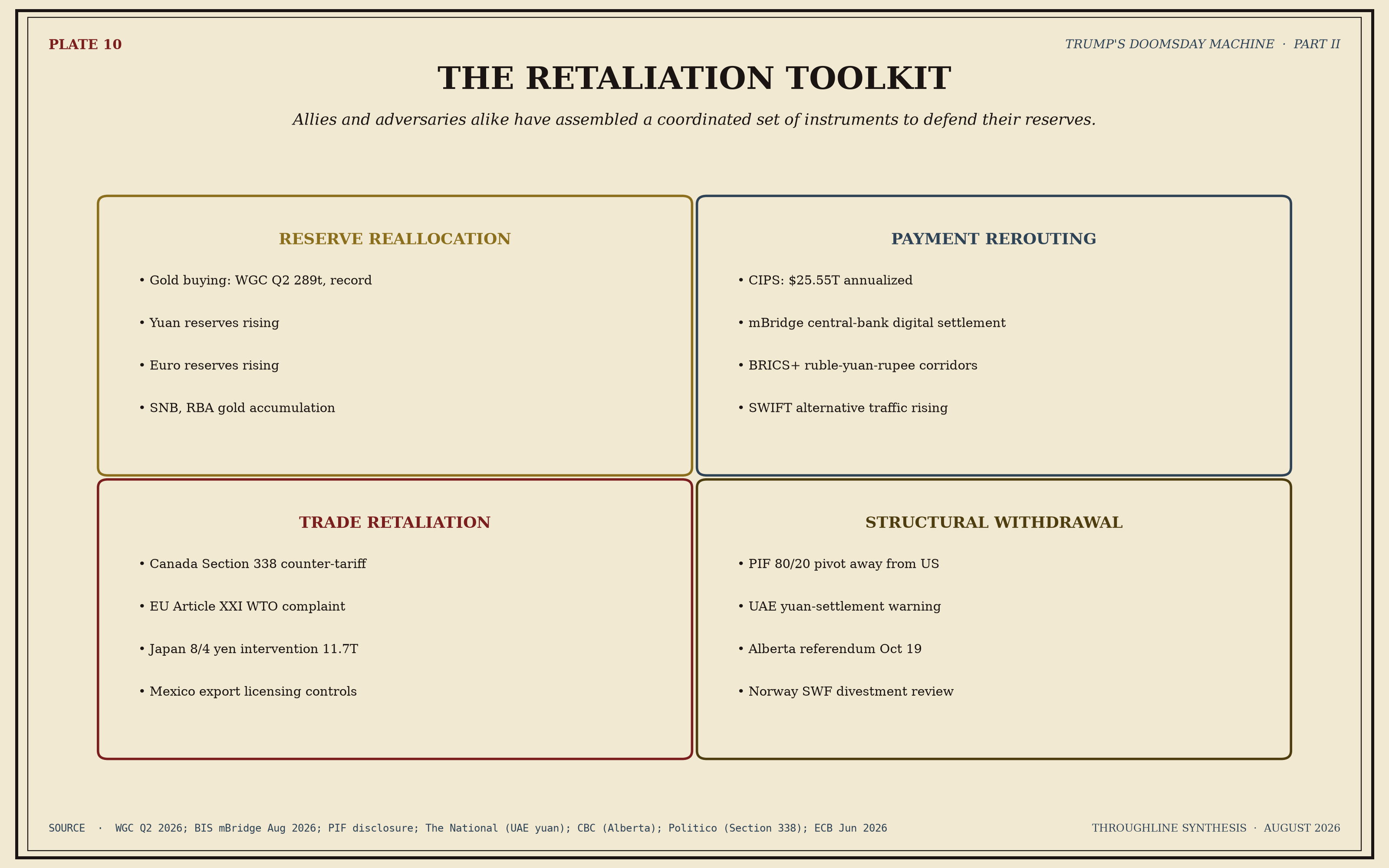
The complete toolkit as it stands in late August 2026 includes: outright reserve reallocation into gold, euro, and yuan; migration of trade settlement into CIPS and mBridge; European Article XXI complaints against U.S. Treasury market interventions; targeted Section 338 counter-tariffs from Canada, the EU, and Japan; capital controls on U.S. private-market investment; withdrawal from U.S. tech-standards bodies; and, most powerfully, coordinated auction abstention. Bessent’s operations, in other words, have handed the world exactly the case for retaliation the world needed, and have done so at exactly the moment when the world already possessed the technical means.
Section V: What Happens on the Other Side
Because a country cannot indefinitely finance long duration with short duration at yields that rise faster than the buybacks compress them, this policy has an end. The question is not whether. It is what.
5.1 The scenarios
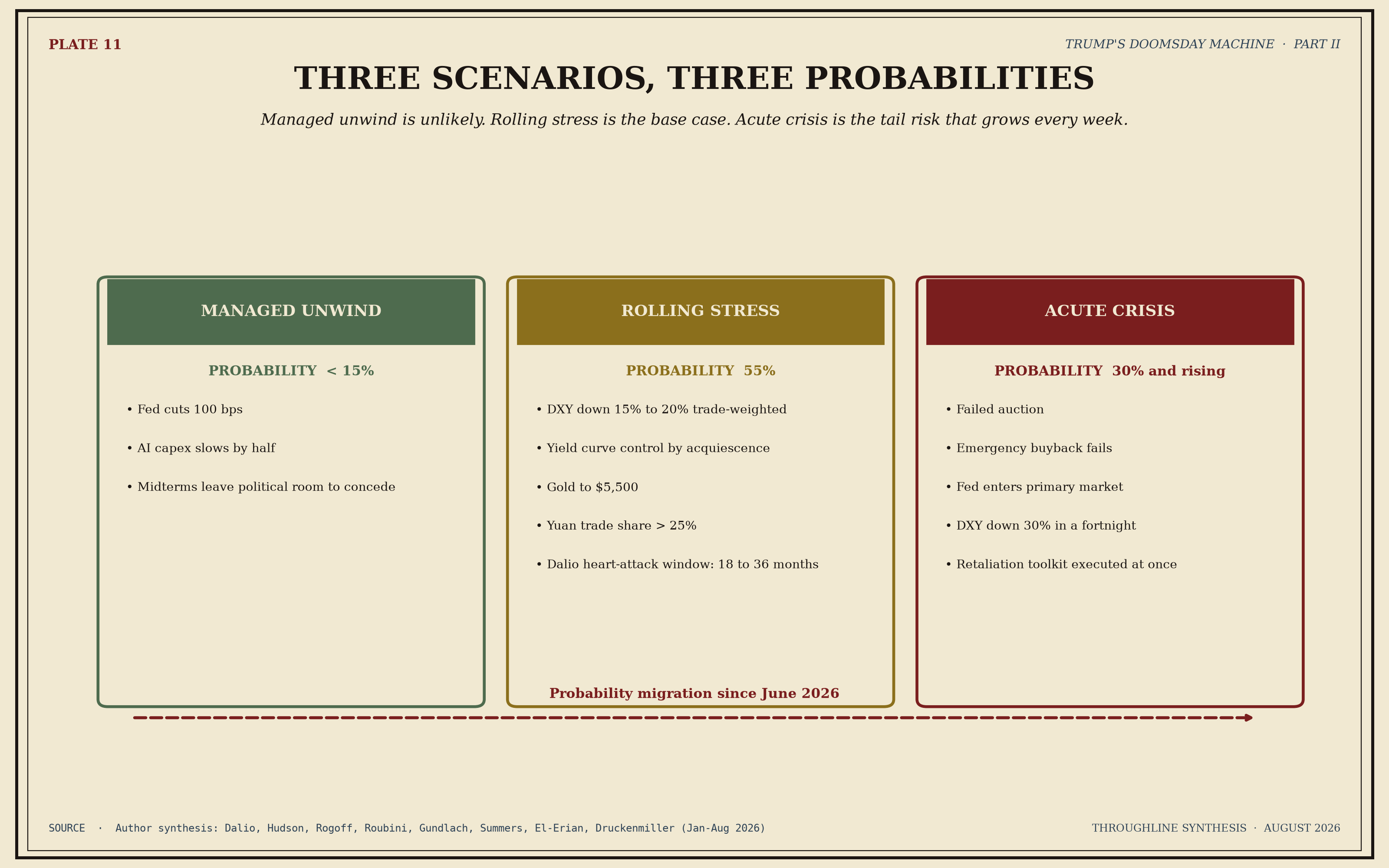
Three plausible endings sit on the desk.
Scenario one: managed unwind. Bessent, faced with a bill-market indigestion event in Q4 2026 or Q1 2027, quietly shifts the issuance mix back toward the intended-average maturity of 6.5 years, absorbs a 30-basis-point term-premium reset, and admits, in whatever face-saving language remains available, that the Twist was a “transitional” measure. This scenario requires the Fed to cut rates 100 basis points inside twelve months, the AI capex cycle to slow by half rather than by two-thirds, and the November 2026 midterms to leave the administration with enough political capital to make the concession. Probability, in my judgment: less than 15 percent.
Scenario two: rolling stress. A series of failed auctions in the 20 and 30 year tenors forces Treasury to lean progressively harder on the buybacks, on bills, and on the TGA drawdown. The Fed, having watched Warsh spend Jackson Hole avoiding the word “buyback,” is politically unable to raise rates further and unwilling to cut. The dollar sags 15 to 20 percent on a trade-weighted basis. Import prices rise. The Fed is forced into the very yield-curve control El-Erian named. Foreign creditor abstention becomes formal rather than tacit. Gold reaches $5,500 per ounce, yuan trade share of world commerce crosses 25 percent, and a series of European and Gulf sovereign debt issuances outside the dollar system begins in earnest. This is Ray Dalio’s “heart attack” pathway, with an eighteen to thirty six month window (Fortune, Dalio, Jan 9 2026). Probability: 55 percent.
Scenario three: acute crisis. A specific auction, most likely a 20-year or 30-year issue in the December 2026 to April 2027 window, fails to clear at any level the market considers investable. Bessent responds with an emergency buyback larger than any previous operation. The market rejects the emergency buyback. The Fed is forced to intervene in the primary market for the first time since the 1940s. The dollar collapses 30 percent on trade-weighted terms inside a fortnight. Foreign holders execute the retaliation toolkit at once. Congress panics. A recession begins by mid 2027. This is the scenario Michael Hudson has been describing for eighteen months in the language of Ponzi collapse (Michael Hudson, May 11 2026). Probability: 30 percent, and rising.
The remedies remain in the scholarly literature. Sachs, Rogoff, and Krugman have each proposed variants of the same three-legged stool: honest issuance calendar, honest fiscal consolidation, and honest monetary policy independence. All three legs are, at present, missing. The Bessent Treasury is dishonest about issuance. The Trump budget is dishonest about consolidation. The Warsh Fed is dishonest about independence. What remedy remains, then, is the one the Bessent Treasury is most terrified of, because it is the only one that will impose itself: the market itself.
5.2 What the reader can do
If you are a professional investor, you have already begun, per Dimon, to reduce duration and to increase gold (Fortune, Dimon, Jul 21 2026). If you are an American voter, you now know why every policy failure of 2027 will be blamed by the administration on somebody other than the people responsible. If you are a policy scholar, your work is to record clearly, in the months remaining, that the negative arbitrage was named as negative arbitrage before it collapsed. It is important that we do not lose the paper trail. It is important that the men in Section II are identified in the historical record, by name, in office, on their own record. That is why this essay is written.
5.3 Coda
The best summary of what Trump and Bessent are doing is not, in the end, a scholar’s. It is the market’s. The bond market spent August 2026 saying, in the only language it has, that the price of long duration should be higher. Bessent spent August 2026 buying long duration at a lower price and funding the purchase with short duration whose price he cannot control. The market will win. The market always wins. The only question is how many decades of American public credibility Bessent is prepared to burn before he stops.
We are watching a Treasury Secretary set fire to the world’s reserve currency in order to survive to a midterm. We are watching a president who cannot distinguish a coupon from a yield preside over the fastest reallocation of central-bank reserves since 1971. We are watching an AI complex burn $700 billion of capital expenditure per year while its two largest customers spend the same money they are earning. And we are watching a Federal Reserve chairman-in-waiting deliver a Jackson Hole speech that does not once mention any of it.
Otto Dix would have painted this. It is a Weimar cabaret of ministers, hyperscalers, and money changers, dancing on the head of a coupon they do not understand, on a currency they do not respect, atop a productive base they have already sold. History does not end well in that painting. It does not end well here.
The negative arbitrage is a match. The match is now lit.
Closing the Doomsday Loop, Opening the Labor Question
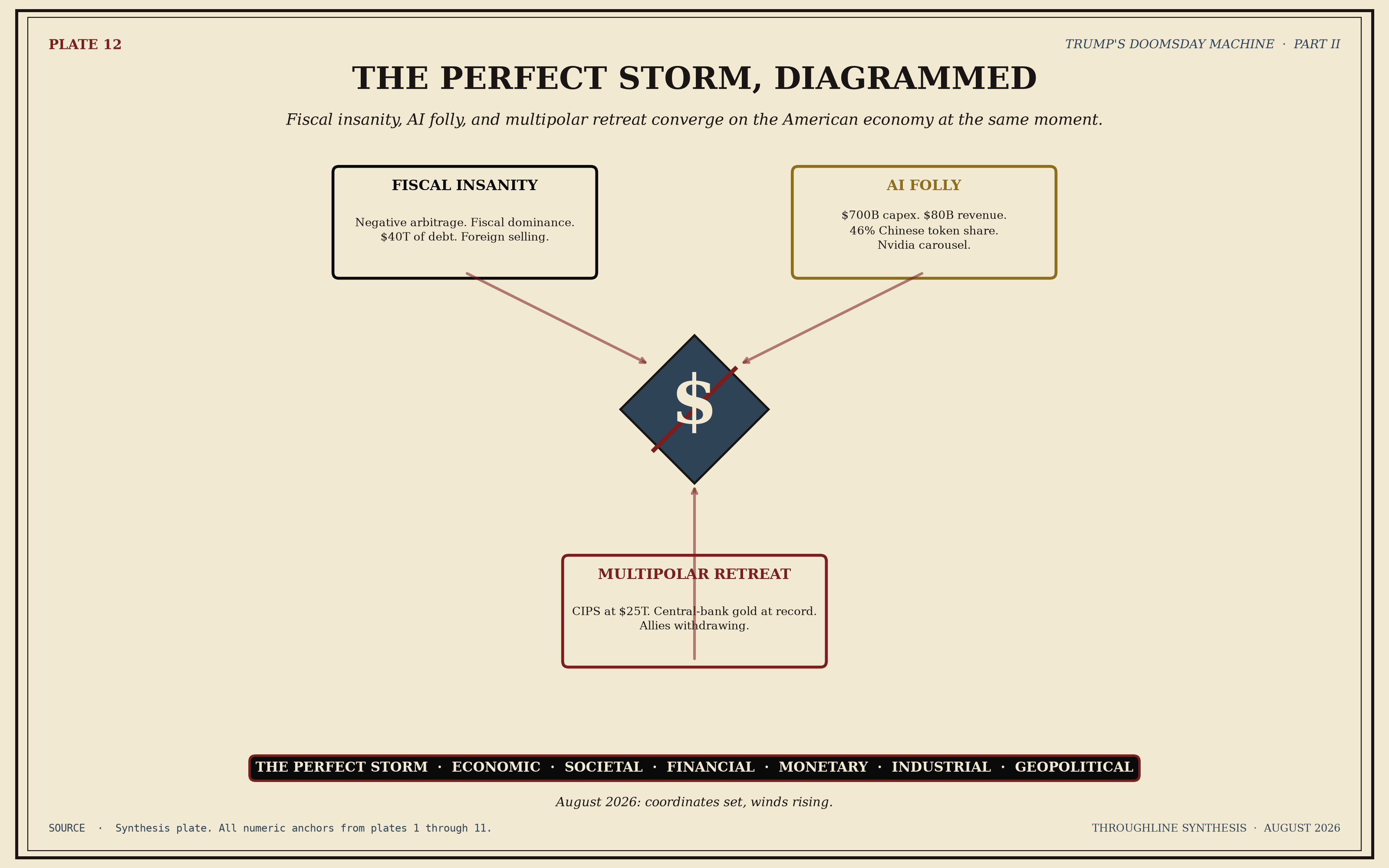
Part I of the Doomsday series argued that the collision of the AI bubble and the fiscal reckoning was already inevitable. The evidence assembled in this installment is that the collision is no longer approaching. It has begun. What Bessent doubled on August 19 was not merely the size of a buyback operation. He doubled down on the whole strategic error that Part I identified: the belief that political will can substitute for economic reality, that a sovereign balance sheet can be managed the way a hedge fund manages a distressed carry trade, and that the American tech oligarchy has bought the country enough runway to survive its own arithmetic. Trump and Bessent are not making a hard choice under difficult conditions. They are doubling down on stupidity in front of a global audience that is quietly reallocating its reserves out of their reach.
Against this backdrop, the perfect storm is not an abstraction and not a forecast. It is a diagram of the present. On one axis stands the fiscal insanity documented in this piece. On the other stands the AI folly of the hyperscalers, whose $700 billion of annual capital expenditure is being conducted against $80 billion of revenue on the assumption that a bond market Bessent is currently torching will finance the shortfall for another decade. Between the two axes stand the casualties: American workers whose pensions are invested in the very Treasuries whose price is being manipulated, retirees whose fixed-income allocations were sold to them as safe, municipalities whose tax bases depend on the very tech valuations the AI trade is destroying, foreign allies whose reserve holdings have already begun to move, and a global South whose dollar-denominated debts will be repriced without their consent when the American bond market finally speaks. The perfect storm is economic, societal, financial, monetary, industrial, and geopolitical at once. Its coordinates are set. Its winds are already rising.
Part III of the Doomsday series, The Republic of Learning and Labor, takes up the human ledger of what follows: the first workers to lose their jobs, the first pensions to break, the first municipal budgets to fail, and the case for rebuilding American labor and public education from the wreckage. If Part I named the collision and Part II names the mechanism, Part III names the survivors and the terms on which they will have to rebuild.
The negative arbitrage is not merely bad policy. It is the operational signature of a governing class that has confused the survival of its own portfolio with the survival of the American republic and the international order the republic once anchored. That confusion is the doomsday machine. This piece is a photograph of the machine at the moment its operator reached for the accelerator.
Sources
Every claim in this essay is anchored to a URL cited inline. A complete bibliography, cross-referenced by section, is available at throughlinesynthesis.com/negative-arbitrage-sources. Corrections and amplifications are welcome at editor@throughlinesynthesis.com.
This piece is Part II of the Doomsday Machine series. Part I is “Trump’s Doomsday Machine”. Part III is “The Republic of Learning and Labor”. A stand-alone companion, “Bonds Explained: A Plain-English Primer for Serious Readers,” accompanies this installment, together with a twelve-plate visual essay, “The Negative Arbitrage in Twelve Pictures.”
Scott Ortkiese writes long-form essays on geopolitics, finance, and American decline at Throughline Synthesis.