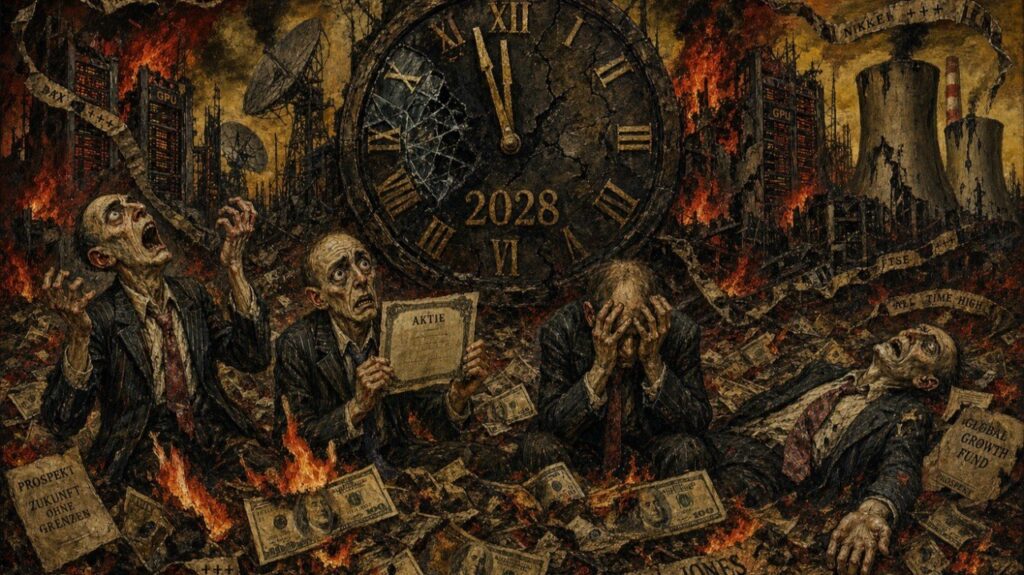
Tick, tick, tick… The story that AI would generate the revenue to service the capex was always a lie.

Every dollar of the $2 trillion AI buildout was sold on a revenue story that never existed. The amortization cliff arrives in months, not decades, and every ladder up which the industry promised to climb has already broken.
THROUGHLINE SYNTHESIS GROUP
By Scott Ortkiese | July 27, 2026 |so@throughlinesynthesis.com
The one number OpenAI hoped you would never see
The polite version, the one Sam Altman still tells senators, foreign heads of state, and any credulous CNBC anchor who will hold a microphone, is that OpenAI will earn one hundred billion dollars in advertising revenue by 2030. That number is not a projection. It is not a stretch goal. It is the plug in the model that lets the rest of the story balance. Without it, the compute obligations do not clear, the private credit does not price, the SPVs do not roll, and the trillion-dollar buildout that Piketty warned about (r>g coming for you at long last) collapses under the weight of its own arithmetic.
The honest version, published on June 4, 2026 by eMarketer principal analyst Nate Elliott, is that the entire U.S. standalone chatbot advertising market will not exceed one billion dollars this year, and will not exceed roughly five-point-four billion dollars by 2030. Elliott used the professional register of an industry analyst who does not want to be sued: “I don’t think there’s any chance they hit that goal.” Translated: OpenAI is going to miss the number that holds the buildout together by ninety percent.
Google earned $294 billion in advertising revenue in 2025. It took Google twenty-seven years, a monopoly over search, a monopoly over YouTube, a monopoly over the mobile browser stack, and a Federal Trade Commission that will not touch it, to get there. OpenAI proposes to reach roughly a third of that number in four years, on a probabilistic surface that hallucinates the answer, from a user base that has been trained since 2022 to expect the product for free.
This is not a business plan. This is a signaling exercise dressed as guidance, aimed at bondholders who need to hear a number, any number, that closes the model on the front cover of the pitchbook. And every serious ad-tech professional who has looked at it has said the same thing eMarketer said.
The Zitron transcript on his July 26 podcast put it more bluntly than the analyst would: the chatbot market is not a real advertising market. Meta, which has the most sophisticated targeting infrastructure ever built, has not turned advertising on inside its own Meta AI product. Not because it cannot. Because the CPMs collapse the moment you try. ChatGPT’s own launch CPMs fell from sixty dollars to twenty-five dollars within weeks of the ad product going live. That is not a monetization curve. That is a repricing to the true clearing rate of a surface that no advertiser trusts.
Four monetization ladders, four broken rungs
The frontier lab defense has four rungs on it. Subscriptions, enterprise, advertising, and API passthrough. Not one of them works. Not one of them will ever work at the scale the capex demands. This is not opinion. This is the arithmetic of every disclosure filed and every study published in the last twelve months.
Rung one. Subscriptions. ChatGPT converts less than three percent of its weekly active users into paying subscribers. Anthropic runs at roughly the same ratio, propped up by Claude Code seats that Cursor and Windsurf both know are already being commoditized. Even at the fantasy of two hundred million paying subscribers globally at twenty dollars each, that is forty-eight billion dollars of annual gross. OpenAI’s cash burn is projected to exceed that number by 2028 on training compute alone.
Rung two. Enterprise. The MIT Sloan Management Review consortium study, released and picked up throughout Q2 2026, found that ninety-five percent of enterprise generative AI deployments delivered no measurable return on investment. Nine out of ten pilots do not become production contracts. Of the ones that do, most are being reforecast downward against Kimi K3 and DeepSeek V4 Pro pricing, which now clears at roughly one-thirtieth the API cost of GPT-5.5 for equivalent benchmark output. Enterprise procurement teams read that column. They are already renegotiating the seats they signed in 2025.
Rung three. Advertising, whose ceiling I described above. The mechanical fact worth repeating is that generative interfaces are a probabilistic surface. The model produces a synthesis. The user consumes the synthesis. There is no click. There is no ranked list of ten blue links against which to run a Vickrey auction. Google’s entire two-hundred-and-ninety-four billion dollar empire is built on those ten blue links. Chatbots do not have them. If Meta cannot make its own AI product advertise against its own social graph, OpenAI is not going to do it against a stateless conversation about Python and hemorrhoids.
Rung four. API passthrough. This was the fallback story. Sell tokens at cost-plus, aggregate the world’s developer workload, charge the margin. Then DeepSeek shipped V3, then R1, then V4, and Kimi shipped K3. The prices I laid out in the July 20 Kimi K3 Reckoning piece have not moved back up. They will not. Because the Chinese labs do not require a return on capital, and the U.S. labs are burning cash at a rate no cost-plus token business can service. The moment a Kimi K3 endpoint clears at seventy percent below OpenAI’s cost of goods, the API passthrough thesis is finished. American labs are now selling below cost to hold share against a pricing floor set in Beijing. That is not a business. That is empires that cannot compete cheating.
Four rungs. Four broken. And the tower is still being built.
The amortization cliff is measured in months
This is the part the industry does not want you to look at. Not because the numbers are hidden. Because the calendar is.
On June 26, 2026, SpaceX priced twenty-five billion dollars in senior notes across five tranches. Seven billion at 5.35 percent maturing 2031. Six billion at 5.65 percent maturing 2033. Six billion at 5.875 percent maturing 2036. Two-and-a-half billion at 6.60 percent maturing 2046. Three-and-a-half billion at 6.65 percent maturing 2056. Eighty-nine billion of demand at the book, priced through par, celebrated as the largest corporate debt issuance of the year. The first coupon payment on that stack is due January 15, 2027. The second follows July 15, 2027. That is six months and twelve months from the day this article is published. And the 2056 tranche is already trading at 91.07 cents on the dollar as of July 17, 2026. The market is telling Musk what Musk cannot tell his shareholders. That paper is being repriced against a business whose AI segment lost six billion dollars in 2025 and another two-and-a-half billion in Q1 2026 alone.
On March 31, 2026, CoreWeave closed the fourth iteration of its Delayed Draw Term Loan, an eight-and-a-half billion dollar facility priced at SOFR plus 225 basis points, rated A3 by Moody’s and A(low) by DBRS. The rating is fiction. The collateral is a fourteen-point-two billion dollar take-or-pay contract from Meta, which itself is now committed to thirty-five-point-two billion dollars of CoreWeave spend plus twenty-seven billion to Nebius, for sixty-two-point-two billion of Meta paper propping up the neocloud category. In Q1 2026, CoreWeave’s interest expense reached five hundred and thirty-six million dollars, which is 25.8 percent of revenue and 46.3 percent of adjusted EBITDA. Management guided Q2 interest to six hundred and ninety million. A four-point-two billion dollar principal repayment is due later this year. Only one-point-two-six billion of the DDTL 4.0 facility has been drawn. Seven-point-two-four billion of additional debt is still coming onto that balance sheet, into a rate environment that is not cooperating.
Meta’s Hyperion campus, the twenty-seven-point-two-nine-four billion dollar Beignet Investor bond arranged by Morgan Stanley and placed with PIMCO and BlackRock, begins amortizing on schedule. The residual value guarantee of twenty-eight billion sits in a footnote at zero, as I documented in the July 23 piece on the one-point-six-five trillion nobody was supposed to find. That footnote goes probable the moment the tenant misses one milestone or the resale value of a hyperscale campus repriced against Chinese silica-and-water efficiency falls below the RVG threshold. When the auditors have to move a twenty-eight-billion-dollar contingent liability onto the balance sheet, they will not do it quietly.
Oracle’s Stargate stack, the flagship Abilene campus operated by Crusoe, the thirty-eight billion dollar Texas-Wisconsin package, the eighteen billion dollar New Mexico loan, the two-hundred-and-sixty billion in future lease commitments disclosed in the May 2026 10-K. Every one of those obligations begins amortizing between now and mid-2028. Oracle’s five-year credit default swap spread rose approximately three hundred and ten percent to a sixteen-year high the week the Nikkei footnote audit went viral. Goldman Sachs’s trading desk reported “signs of panic” among AI-lending credit investors. That was two weeks ago.
The Broadcom-Anthropic thirty-five billion dollar chip and infrastructure package announced by Apollo and Blackstone in June 2026 finances an Anthropic that, on its own disclosed run rates, does not clear the coupon on that paper before 2029, even under the labs’ own bullish forecasts. Apollo priced the deal anyway. Blackstone priced the deal anyway. Because the alternative was admitting that the pipeline of capital that has kept the private-credit shops fat since 2023 has nowhere else to put the money.
Add it up. SpaceX’s coupon calendar starts in six months. CoreWeave’s principal repayment lands this year. Meta’s SPV amortization begins on the schedule set at closing. Oracle’s leases commence in the third quarter of fiscal 2026 through fiscal 2028. Broadcom-Anthropic starts drawing in 2027. And every one of those payment streams was priced against a revenue story that, as eMarketer just documented, is a ninety-percent fantasy.
Eighteen months. That is the runway. Not four years. Not five. Eighteen months from today to the first synchronized failure of the coupon and lease calendar, in an environment where the underlying revenue thesis has already been publicly repudiated by the industry’s own most credentialed analyst.
The revenue is circular, and everyone in the trade knows it
Nvidia sells GPUs to CoreWeave. Nvidia takes a stake in CoreWeave. Nvidia guarantees a portion of CoreWeave’s take-or-pay revenue by anchoring its own inference workloads there. CoreWeave’s disclosed revenue then books as growth on Nvidia’s demand-side story. Meta signs the fourteen-billion take-or-pay with CoreWeave. CoreWeave books Meta as anchor tenant. Meta lists CoreWeave capacity as strategic AI infrastructure inside its own capex disclosures. The same dollar counts as revenue for the neocloud, capex justification for the hyperscaler, and demand validation for the chip vendor. Three times. On three different income statements.
Nvidia also sits behind Nebius. Nebius sits behind Meta. Meta sits behind CoreWeave. CoreWeave sits behind Meta. The circle closes. Michael Burry has been posting the diagram to X in various forms since November 2025, when the mechanics first became irrefutable. Scion Asset Management is short the setup. The GPU depreciation curve, in Burry’s telling, is being extended out on hyperscaler books to keep reported earnings intact. That is the same accounting sleight the pre-2008 banks used on structured investment vehicles. It is legal. It is disclosed. It is catastrophic on the day the assets reprice.
The Nvidia-Nebius-CoreWeave-Meta triangle, plus the Oracle-Crusoe-OpenAI-Blue Owl triangle, plus the Broadcom-Apollo-Blackstone-Anthropic triangle, is the entirety of what the industry calls “AI revenue.” It is not revenue. It is the same dollar circulating between counterparties who are contractually obligated to book it three ways. When one node cannot service its obligations, the whole braid unwinds simultaneously. There is no diversification here. There is only concentration disguised as an ecosystem.
Data Center Dynamics is now the industry’s obituary page
Ed Zitron used the phrase in the July 26 transcript, and it is the correct one. In Q1 2026 alone, one hundred and thirty billion dollars of announced AI data center projects were canceled, delayed, or blocked by local opposition. QTS’s thirty-billion-dollar Digital Gateway proposal was withdrawn. Google’s one-billion-dollar Franklin Township site in Indianapolis was pulled minutes before a council vote it was going to lose. Tucson’s Project Blue, a three-point-six-billion-dollar Amazon campus, was voted down unanimously by the city council. Three hundred separate data-center-related bills were introduced across U.S. state legislatures in the first six weeks of 2026 alone. Fourteen states have proposed moratoriums.
The physical constraint is real and it is running ahead of the financial one. Water permits are being denied. Grid interconnection queues are ten years deep. Ratepayers, whom I described in the Trillion-Dollar Bill piece, have finally noticed that the tariff schedule Governor Sherrill signed in New Jersey and the reforms Governor Spanberger signed in Virginia are the leading edge of a nationwide revolt. The White House convened an emergency utility summit on July 13. It was too late.
When the capex cannot be built because a county commission refuses the water permit, the depreciation schedule the hyperscalers used to justify the debt no longer holds. GPUs sitting in a warehouse in Nevada do not generate revenue. And the SPV bondholder does not care why the campus never opens. He cares that the coupon does not clear.
The S-1 that cannot be written honestly
Every one of these companies is now approaching the point where it must go to public markets. OpenAI’s tender-and-conversion sequence, xAI’s SpaceX-attached raise, Anthropic’s yet-to-be-named vehicle, CoreWeave’s follow-on. The registration statements are being drafted now. And there is not a single securities lawyer in New York capable of drafting risk factors for those documents that both satisfy the SEC’s materiality standard and preserve the growth narrative on which the equity price is being set.
Try it yourself. Try to write the risk factor that discloses that eMarketer forecasts the entire chatbot ad market at ninety percent below the internal forecast used to justify the compute contracts. Try to write the risk factor that discloses that the MIT study found ninety-five percent of enterprise deployments delivered no ROI. Try to write the risk factor that discloses that Chinese pricing has structurally repriced token economics to seventy percent below American cost of goods. Try to write the risk factor that discloses that the residual value guarantees on the SPV structures are contingent liabilities whose probability recognition depends on data center resale values in a market where fourteen states are legislating against new data centers.
You cannot write those risk factors and price the deal at the multiple the bankers are quoting. You can write those risk factors and price the deal honestly, in which case David Sacks and Chamath Palihapitiya have to explain to their limited partners why the mark on the private books just fell seventy percent. Or you can write vague risk factors and let the securities-class-action bar handle the reconciliation in 2028. That is the choice on the table. There is no third option.
Sam Altman is the band on the Titanic
Zitron’s line, and the correct one. Altman is not the captain. Altman is not the iceberg. Altman is the band. His job is to keep the music playing while the passengers on the private-credit deck rearrange the deck chairs and the passengers on the retail deck have their pockets picked as they climb onto the last lifeboats, which are the OpenAI tender shares being offered at valuations no rational analyst would clear.
Musk plays the same instrument, less well. The SpaceX bond was sold to bondholders on the promise that the AI segment losses stabilize before the coupon calendar starts. The AI segment losses did not stabilize. They accelerated. Q1 2026 xAI segment losses of two-and-a-half billion dollars were greater than Q1 SpaceX revenue net of the AI segment. The 2056 paper is already at 91.07. The bond desk knows what the equity story does not.
Amodei is the quieter version, and therefore the more dangerous one. Anthropic is priced against a run rate that requires continuous new capital every six months. When the capital stops, the burn does not. And the Broadcom-Anthropic deal that Apollo and Blackstone stapled together in June is a wager that public equity or sovereign money will absorb the next tranche. Both are less certain than they were a quarter ago.
Who is paying, and who is not paying
Who is paying:
Ratepayers in New Jersey, Virginia, Ohio, Texas, and Louisiana are paying, in the form of tariff schedules that transfer hyperscaler grid costs to residential customers.
Pensioners are paying, in the form of Nvidia-CoreWeave circular-finance paper distributed into public and private pension books through Apollo, Blackstone, KKR, Blue Owl, Brookfield, and Carlyle funds and their affiliates.
Municipal taxpayers are paying, in the form of ten to twenty year tax abatements that hyperscalers have secured on data-center sites whose water and grid draw is being subsidized by the same communities.
Retail buyers of the coming OpenAI tender, the SpaceX follow-on, the Anthropic issuance, and the CoreWeave secondaries will be paying, because they are the last exit for the private-market marks the venture funds cannot hold at the current level.
Bond insurers, monoline guarantors, and the sovereign wealth pools that have been sold Meta-Hyperion, Oracle-Stargate, and Broadcom-Anthropic paper will pay, when the residual value guarantees migrate from footnote to income statement.
Who is not paying:
Sam Altman is not paying. His personal capital in OpenAI is protected by the profit-cap and PBC restructuring.
Elon Musk is not paying. The SpaceX bond ring-fences the operating company. Musk’s personal wealth is compensated in stock that is being marked against a projection the bond desk has already stopped believing.
Dario Amodei is not paying. Anthropic’s cap table protects the founders through the private tender mechanism, exactly as the OpenAI structure does.
David Sacks and Chamath Palihapitiya are not paying. They are marking their books to public sales they have not yet made, and every quarter they hold the mark is a quarter closer to a distribution to their LPs at the current level.
The private-credit shops are not paying. They collected the origination fees on Meta-Beignet, Oracle-Stargate, and Broadcom-Anthropic on closing. The credit risk was placed with pension funds, sovereigns, and municipal-adjacent buyers before the first coupon.
Eighteen months
The story that AI would generate the revenue to service the capex was always the lie. Not because AI has no value. Because the value it has cannot be captured by a probabilistic surface with no clicks, against a Chinese pricing floor, at a subscription conversion rate below three percent, into an enterprise market that has already reported ninety-five percent failure, on infrastructure that municipalities are legislating out of existence.
The runway is not four years. That was the runway the industry marketed when Nikkei’s footnote audit had not yet posted, when the MIT study had not yet cleared peer review, when eMarketer had not yet published Elliott’s ninety-percent shortfall number, when the QTS Digital Gateway was still on the drawing board, and when the SpaceX bond had not yet been priced through par to a coupon calendar starting January 15, 2027.
The runway is eighteen months. Long enough for one more OpenAI tender to clear. Long enough for one more xAI raise. Long enough for one more Anthropic secondary. Long enough for the bankers to book the fees, the founders to book the marks, and the private-credit shops to book the origination revenue.
Not long enough for the coupon calendar to be met, the SPVs to season, the RVGs to remain probable-not, or the S-1 language to be written honestly.
When it breaks, and it will break, the bill will not land on Altman, Musk, or Amodei. It will land where every American bill of the last thirty years has landed. On the ratepayer, the pensioner, the municipal taxpayer, and the retail investor who was told the AI story until the day the coupon did not clear.
The polite version is that the market will correct. The honest version is that empires that cannot compete cheat, and this one has been cheating on its accounting since the second the buildout started.
Read the coupon calendar before someone else writes it in your name.
Scott Ortkiese is President and CEO of Faulkner Capital Holdings. He writes on geopolitics, energy, structured finance, and American decline at throughlinesynthesis.com.
Sources
[1] Adweek, “OpenAI’s Ad Business Is on Pace to Miss Its Own Forecast by 90 Percent, Analyst Says,” June 4, 2026.
[2] eMarketer, “ChatGPT Ad Revenues May Fall 90 Percent Short of OpenAI’s 2030 Target,” June 4, 2026.
[3] Business Insider, “OpenAI Projects ChatGPT Ad Growth Market Doubts,” July 2026.
[4] Futurism, “OpenAI Ad Revenue Financial Projection,” 2026.
[5] Yahoo Finance, “SpaceX Closes $25 Billion Bond,” June 26, 2026.
[6] TradingView, “Space Exploration Technologies Launches $25B Senior Notes,” June 2026.
[7] The Motley Fool, “Elon Musk’s SpaceX Poured $7.7 Billion Into AI Last Quarter,” July 9, 2026.
[8] Tech Times, “Nvidia Circular Financing: $24.9B CoreWeave Debt Puts Pension Funds at Risk,” July 12, 2026.
[9] BytePith, “CoreWeave and Nebius $145B AI Deals on $16B Revenue,” 2026.
[10] Yahoo Finance / DataCenterKnowledge, “$130 Billion in AI Data Centers Blocked or Delayed in Q1 2026.”
[11] Data Center Knowledge, “What QTS’s Cancelled $30B Project Reveals About AI Data Center Development,” 2026.
[12] eMarketer analyst Nate Elliott quoted in-line, June 4, 2026.
[13] Scott Ortkiese, “The $1.65 Trillion Nobody Was Supposed to Find,” Throughline Synthesis, July 23, 2026.
[14] Scott Ortkiese, “Brute Force Is Not Progress,” Throughline Synthesis, July 2026.
[15] Scott Ortkiese, “The Kimi K3 Reckoning,” Throughline Synthesis, July 20, 2026.
[16] Scott Ortkiese, “The Trillion Dollar Bill Is Not Yours,” Throughline Synthesis, July 2026.
[17] Ed Zitron, “Better Offline,” podcast transcript, July 26, 2026.
[18] MIT Sloan Management Review, generative AI enterprise return-on-investment consortium study, Q2 2026.
[19] Fortune, “The Central Bank of Central Banks Sees a $1 Trillion AI Gamble,” June 29, 2026.
Related reading
- Tariffs, Chips, and the Sovereign Debt Time Bomb: How America Is Engineering Its Own Decline
- The $1.65 Trillion Nobody Was Supposed to Find: Read the Footnotes Before Someone Else Buys a Tech Stock in Your Name
- The SpaceX IPO Grift: An Anatomy of the Most Ridiculous Overreach in Capital Markets History
- The Fall