Scott Ortkiese · 1 August 2026 · so@throughlinesynthesis.com
mar·ket ro·ta·tion | \ˈmär-kət rō-ˈtā-shən\ | noun
-
(finance) The systematic movement of capital, demand, or investor preference from one leadership segment of a market to another, driven by relative changes in price, quality, or risk. A rotation out of large-cap technology into industrials.
-
(by extension) The analogous migration of global users, developers, or institutions from an incumbent product or platform to a challenger, once the challenger achieves comparable performance at materially lower cost or with materially fewer conditions. The 2026 rotation from American closed-model AI to Chinese open-weight AI.
Distinguished from crash (which is disorderly) and cycle (which reverses).
Note. Rotations are more durable than shocks. Once workflow, capital, and habit have relocated, they rarely return on the strength of rhetoric alone.
On 1 August 2026, I appeared as the solo Segment 1 guest on The Perspective with Mahrukh Hameed on Pakistan Television, discussing the U.S.-China artificial-intelligence (AI) race. What follows is the argument I made in that segment, expanded for readers.
The short version. America built its AI empire on three assumptions: that compute would stay scarce, that American models would stay best, and that allies would stay dependent. In twelve months, Chinese open-weight labs have falsified all three, which means Washington’s response is now accelerating the very sovereign-AI hedge it was trying to prevent, handing the next twenty years of global AI infrastructure to Beijing by default.
This is not a Cold War. It is a market rotation, and Washington is losing it in real time.
The Cold War Frame Is Wrong
The dominant Washington commentariat frame describes what is happening as a “new AI Cold War” between symmetric superpower blocs. That frame is comfortable in Washington precisely because it implies rough symmetry of instruments, ideology, and end-state. What is actually happening is asymmetric.
1.China is exporting tools. Chinese frontier labs, DeepSeek, Alibaba’s Qwen, Moonshot’s Kimi, Zhipu’s GLM, are releasing model weights under permissive open-source licenses. Any developer or ministry on earth can download, fine-tune, and deploy them locally. President Xi’s announcement at the World AI Conference in Shanghai on 17 July 2026 of 5,000 training seats for engineers from developing countries is a twenty-year infrastructure play that locks the next generation of Global South AI professionals onto Chinese stacks.
2.The United States is exporting restrictions. Export controls on chips, threats of secondary sanctions against third-country users of Chinese models, revocable cloud access, and the Anthropic Fable 5 episode in which allied researchers lost access overnight when an executive order extended controls into cloud-hosted models.
3.The rest of the world can tell the difference. AI is a central pillar of global power competition, but the pillar is not military parity or ideological attraction. It is whose infrastructure becomes the default operating system for the next twenty years of governments, banks, hospitals, and universities.
The OpenRouter Signal
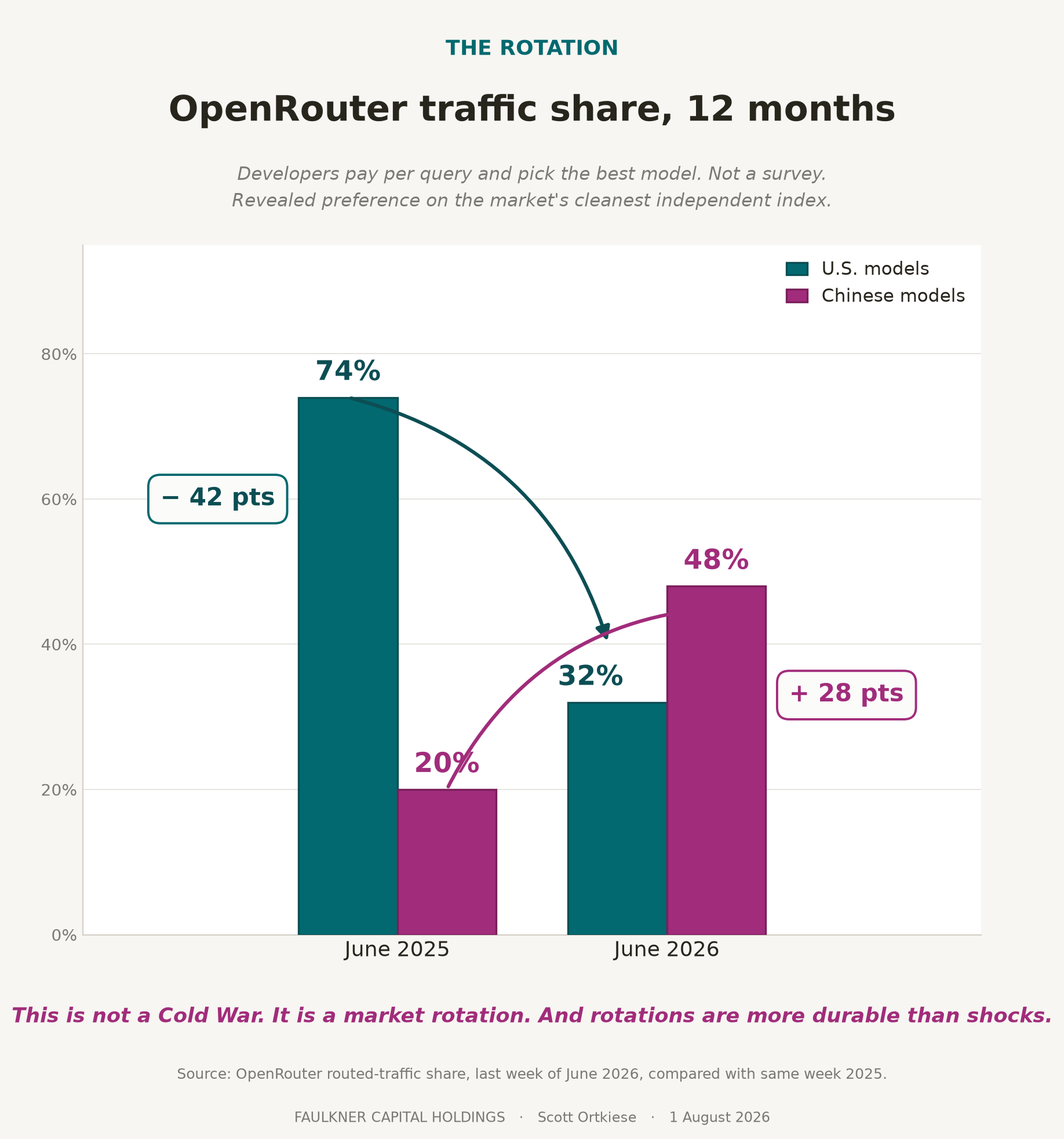
The single cleanest empirical signal of what is actually happening in the global AI market is OpenRouter. OpenRouter is a routing platform, financially independent of any AI lab, on which developers pay per query and choose freely between competing models. It is closer to a revealed-preference index than any survey.
The last week of June 2026 numbers.
1.Chinese models: 48% of routed traffic. Up from 20% one year earlier.
2.U.S. models: 32% of routed traffic. Down from 74% one year earlier.
That is a swing of roughly 28 percentage points in twelve months, in both directions, on the most honest independent measure of global developer preference. It is not the shape of a Cold War, in which capabilities harden along ideological lines and remain frozen for decades. It is the shape of a market rotation.
What “market rotation” means
“Market rotation” is a term from equity portfolio management. It describes the movement of capital and demand from one set of leadership securities to another. In the AI context, it means developers and enterprises worldwide are quietly reallocating query volume from American closed models to Chinese open models, not because of ideology or coercion, but because the Chinese product is cheaper, open, auditable, and now approximately as good on most workloads.
Rotations are more durable than shocks. Once capital and workflow have moved, they rarely move back on the strength of political rhetoric. That is the strategic problem Washington has not yet acknowledged.
The Numbers Washington Cannot Explain Away
Four data points from the last six weeks tell the story more clearly than any commentary.
1.OpenRouter traffic, last week of June 2026. Chinese models 48% (from 20%); U.S. models 32% (from 74%). The market rotation, quantified.
2.American AI Exports Program: 78 applications. The Trump administration’s flagship program to sell American AI to the world drew only 78 applications. A rounding-error response that proves foreign governments and companies have already decided American AI is too politically risky to build their futures on. Michael Kratsios, Trump’s science and technology advisor, is the official architect of a program that has effectively been ignored.
3.Xi Jinping at the World AI Conference, 17 July 2026. 5,000 AI training seats offered to engineers from developing countries. Xi did not offer money. He offered training. Five thousand engineers from the Global South, taught on Chinese AI stacks, who go home and spend the next twenty years building on what they learned. That is not aid. That is architecture.
4.APEC Digital Weeks, 23 July 2026. All 21 member economies, including the United States, formally backed open-source AI with “strong security.” Washington’s own diplomats signed a declaration that contradicts Washington’s domestic strategy of protecting closed American models. When your own diplomats are voting against your industrial strategy, the strategy is already lost.
Three Assumptions, Three Failures
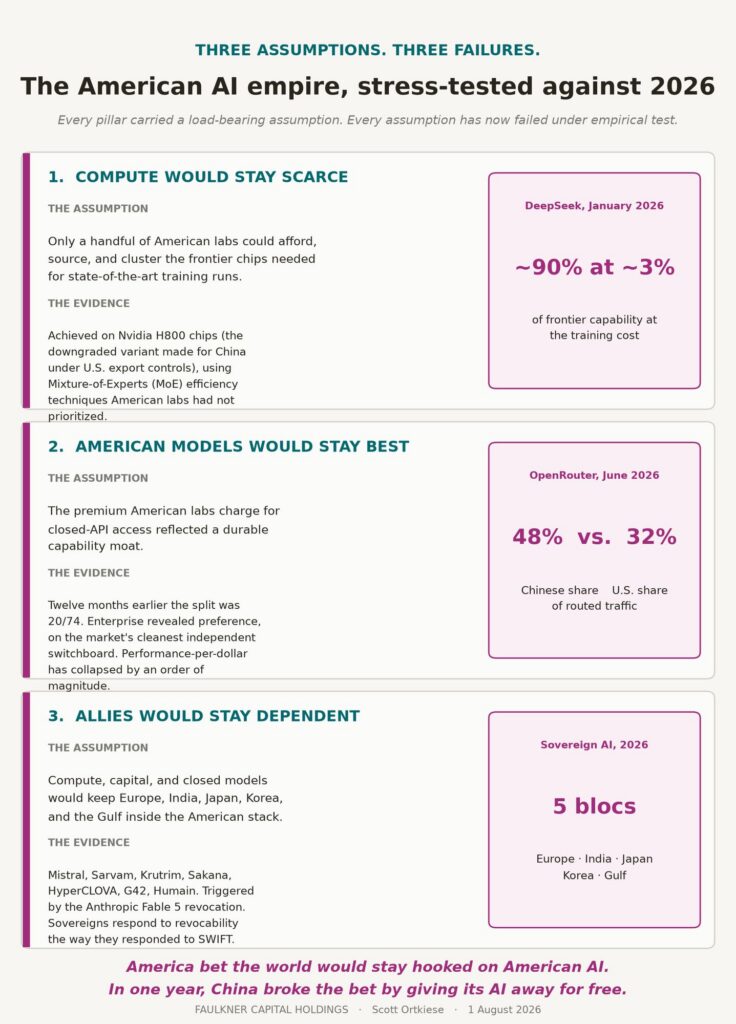
The American AI empire was built on three structural assumptions. Each has now failed under empirical test.
Assumption 1. Compute would stay scarce.
The premise was that only a handful of American labs could afford, source, and cluster the frontier chips needed for state-of-the-art training runs. DeepSeek’s January 2026 release falsified this. DeepSeek achieved roughly 90% of the reasoning benchmark performance of the American frontier at approximately 3% of the training cost, using Nvidia H800 chips, the deliberately downgraded variant Nvidia manufactures for the Chinese market under U.S. export controls, and a Mixture-of-Experts (MoE) architecture that activates only a subset of parameters per query.
The engineering lesson is that hardware constraint became design pressure. Denied brute-force scale, DeepSeek’s team was forced to optimize per-parameter and per-token efficiency in ways American labs, with abundant H100 access, had not been required to prioritize. The technique is now published. It cannot be recalled.
Assumption 2. American models would stay best.
OpenAI and Anthropic still hold an edge on the very hardest reasoning benchmarks. I concede that honestly on air, and I concede it here. But the race that matters is not the frontier. It is the diffusion layer, and the diffusion layer is now Chinese.
When performance-per-dollar collapses by an order of magnitude, the premium American labs charge for closed API (application programming interface) access ceases to be a moat and becomes a tax. Every enterprise CFO in the world, from Karachi to Kuala Lumpur to São Paulo, is doing that math right now.
The BYD parallel. BYD, the Shenzhen electric-vehicle maker whose name stands for “Build Your Dreams,” delivered performance roughly comparable to Tesla at a fraction of the sticker price. DeepSeek plays the same role in AI. It is capability arbitrage on a scale that requires the entire American AI valuation stack to be repriced.
China is not just changing the economics. China is exposing the fact that the American premium was never really about capability. It was about market position. And market positions built on arbitrage-able advantages do not survive contact with a serious competitor.
Assumption 3. Allies would stay dependent.
Every serious allied economy is now building its own AI stack. Europe (Mistral). India (Sarvam, Krutrim). Japan (Sakana). South Korea (HyperCLOVA). The Gulf (G42, Humain).
The trigger was not a technological innovation. It was a political demonstration. When Washington extended export controls from chips into cloud model access, the Anthropic Fable 5 episode being the clearest example, every allied capital and every foreign researcher learned that American AI is politically revocable infrastructure. Sovereigns respond to revocability the same way they responded to SWIFT (Society for Worldwide Interbank Financial Telecommunication) weaponization and dollar reserve seizures. They build alternatives.
The Punchline, in Plain English
America bet that the world would stay hooked on American AI. In one year, China broke that bet by giving its AI away for free. And Washington’s response, more bans, more threats, more revocations, is teaching every other country to build its own instead of depending on us.
We are pushing the world away with the same hand we are using to hold it close.
The Choice Facing the Global South
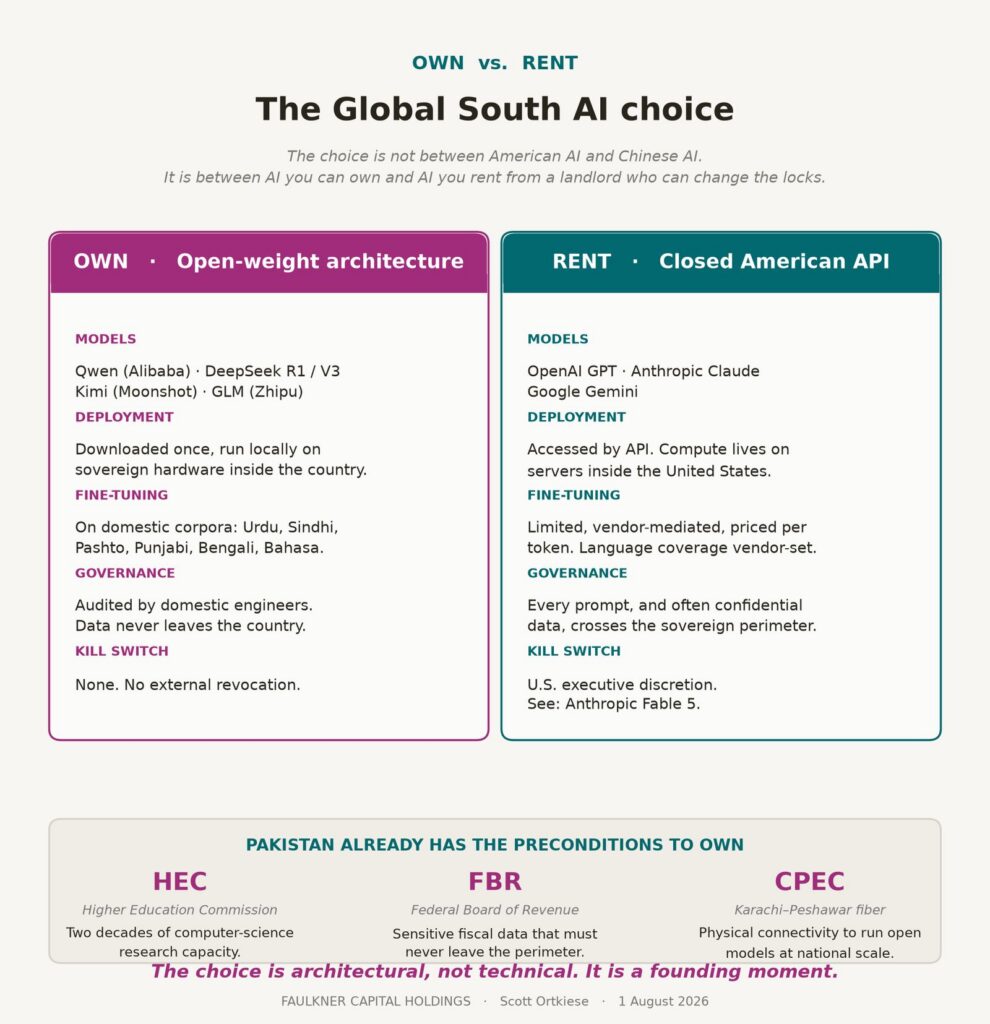
For a country like Pakistan, or Bangladesh, or Nigeria, or Indonesia, the choice is not between American AI and Chinese AI. The choice is between AI you can own and AI you rent from a landlord who can change the locks.
Open-weight architecture. Models such as Alibaba’s Qwen, DeepSeek’s R1 and V3, and Moonshot’s Kimi can be downloaded once and run locally on sovereign hardware. Fine-tuned on domestic corpora (Urdu, Sindhi, Pashto, Punjabi). Audited by domestic engineering teams. No ongoing dependency, no per-query rent to a foreign company, no external kill switch.
Closed American architecture. OpenAI, Anthropic, and Google are accessed by API. Every query sends prompts, and often confidential data, outside the sovereign perimeter to servers inside the United States, subject to U.S. law and U.S. executive discretion. The provider can be issued a national security letter, have its export license revoked, or be ordered by executive action to cut off a specific foreign user, as happened with Anthropic’s Fable 5.
Pakistan’s specific position
Pakistan is well positioned to make the sovereign choice. The preconditions are already in place.
1.Research capacity. The Higher Education Commission (HEC) has spent two decades building computer-science research capacity across the country’s top universities. The talent to fine-tune and evaluate open-weight models exists.
2.Sensitive data that must stay home. The Federal Board of Revenue (FBR) holds granular tax data on the country’s households and firms. Precisely the class of data that should never leave the sovereign perimeter and never be sent to a U.S. cloud provider under any commercial or diplomatic circumstance.
3.Physical infrastructure. The Karachi to Peshawar fiber-optic backbone, built under the China-Pakistan Economic Corridor (CPEC), provides the connectivity to run open-weight models domestically at national scale.
The choice is architectural, not technical. Pakistan’s engineers can technically run Qwen, DeepSeek, or Kimi tomorrow. Whether they do, and whether the state builds the governance framework to do it well, is a political and institutional question.
The same architectural logic, with different specifics, applies to every Global South economy considering the AI question this year.
What Determines the Outcome
Neither the United States nor China “wins” the AI era in the way the question is usually framed. That framing is the trap. The question is not which power builds the best model. The question is whose ecosystem becomes the substrate for everyone else.
On that measure, the leading indicators favor China. Not because Chinese engineering is better, though it is very good, but because China has decided to hand its models to the world for free, while the United States has decided to charge for access and threaten to revoke it.
Three things determine whether the current trajectory continues.
1.Whether Washington abandons the export-control-and-revocation strategy that is teaching allies to hedge.
2.Whether the American AI capital cycle survives the reckoning coming when Chinese open-weight efficiency propagates through the economy. A great many current valuations do not survive that.
3.Whether countries in the Global South make active, sovereign choices in the next 12 to 24 months about their AI architecture, or whether they let those choices be made for them by default.
For Pakistan, for the wider Muslim world, for the Global South generally, this is a founding moment. The infrastructure decisions taken this year and next will shape economic sovereignty for a generation.
The choice is not between America and China. The choice is between owning your AI future and renting it.
Related reading
- How the Tech Billionaires’ Cold War on China and Iran Is Consuming the American Empire
- American AI Domination? Not So Fast.
- The Kimi K3 Reckoning: The AI IPOs Didn’t See It Coming
- The G7’s Relevance Problem: How Russia, China, India, and South Korea See the Club They’re Not In