
China is cutting AI prices while America’s tech giants pile up financial obligations. Why I predict their losses will reach banks, jobs, and taxpayers.

Scott Ortkiese | Throughline Synthesis | Houston, October 6, 2026
Executive summary
The AI financial bubble will burst. The mechanism runs through the credit system, not the disappearance of useful technology. Private Credit Is the New Subprime examined the fragile financing; Credit Breaks. AI Falls. traced its transmission into AI and back to creditors. This investigation follows the repayment money as competition attacks the earnings promised against it.
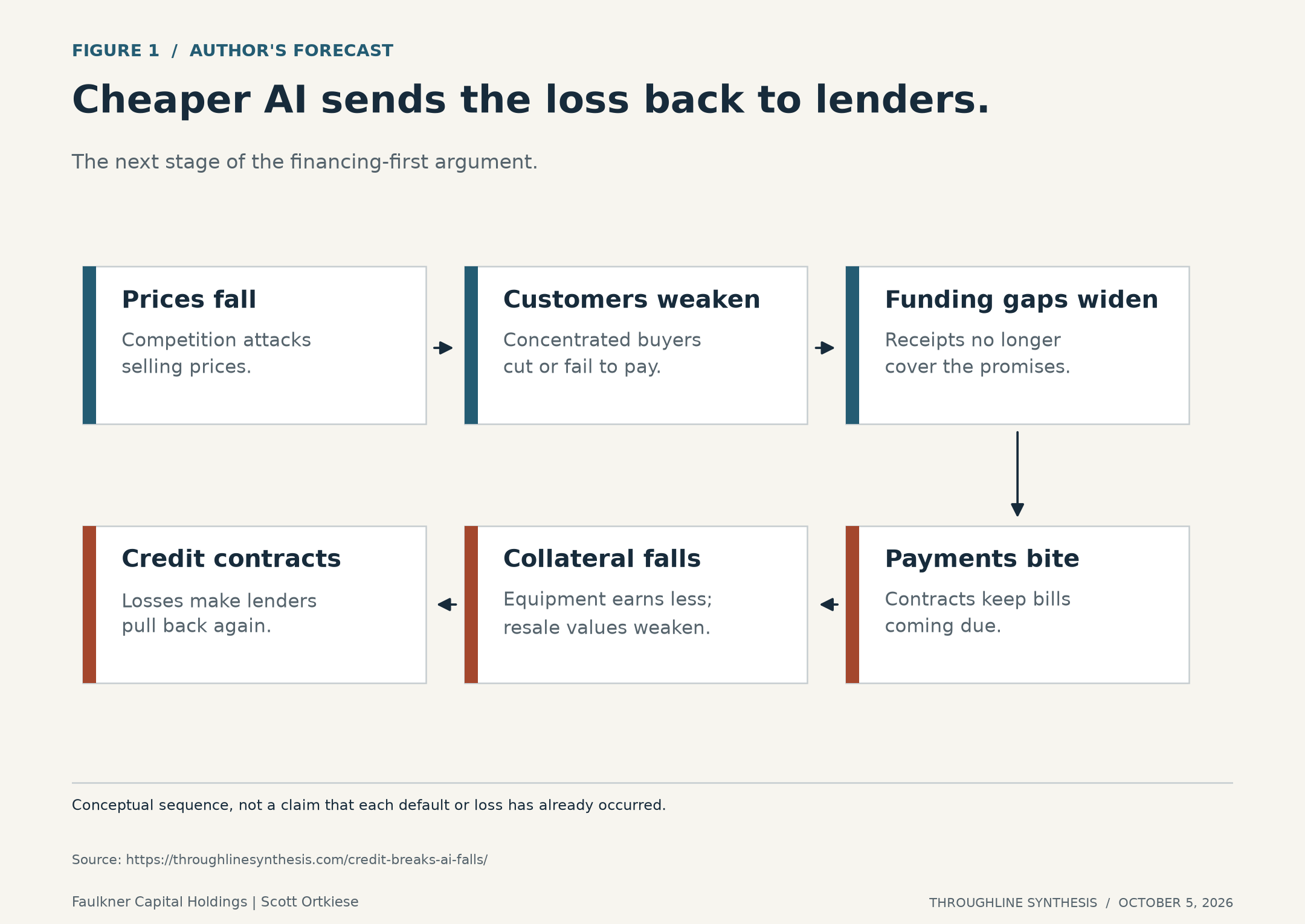
The chain is straightforward. Financing tightens. Private lenders retreat. Cheaper models compress margins while debt, leases, and minimum-payment commitments remain. Concentrated customers weaken, funding gaps widen, and defaults bring payment demands forward. Collateral falls. Credit contracts again. Anthropic’s reported commitments, Zitron’s estimates of Microsoft’s idle chips, and Amazon’s proposed equipment financing expose different parts of this structure. Contract reporting; Panel discussion
The analysis draws on George Noble, former Fidelity Overseas Fund manager; Julien Garran, MacroStrategy partner and former UBS commodities-strategy head; Gary Marcus, New York University professor emeritus and machine-learning company founder; and Ed Zitron, technology writer and Better Offline host. Their discussion with Jack Gamble of Nobody Special Finance and Alessandro of Risk Takers contributes investment experience, technical scrutiny, and corporate-financing analysis to the evidence assembled here. Panel discussion
China’s competitive challenge is already central to my analysis of the AI market. This article extends it into data-center planning: China imposes existing-capacity tests on some expansion while Trump’s order prioritizes faster construction and possible federal support. Chinese planning rules; Trump’s order My charge remains that Trump needs the boom to sell his growth story, and the industry needs him to prolong it.
The conclusions follow from payment terms, earnings calls, independent research, and policy documents, not demonstrations or growth slogans. Reported facts, expert estimates, and forecasts remain distinct. My forecast is a systemic contraction of credit, not a claim that every bank must fail. The new loss-absorption test follows creditor priority, collectible protection, and available capital rather than treating gross commitments as bank losses. Cheaper, useful AI will destroy the prices supporting too much expensive infrastructure. The technology survives. The financing promises break.
Growth does not pay the refinancing bill
The financing problem begins before a data center opens: debt must be refinanced at the price lenders demand. George Noble directs that criticism at Scott Bessent, the US Treasury secretary: “I mean, it’s so freaking irresponsible what they’re doing trying to borrow everything at the short end.” Noble panel, 54:13
Immediately before that, Noble says Bessent would be fired if he were sitting on a trading desk at a major firm. This is a judgment about debt management from a market veteran, not polite disagreement with a press release. Noble panel, 54:02 to 54:13
His target is the refinancing exposure created by shorter maturities. Repayment comes around sooner, and the government must keep finding buyers at the rates they demand. A growth slogan does not fix that exposure.
Bessent supplies the reassuring story himself. On June 24, he said, “I think we can have a high GDP economy without the traditional inflation seeping in,” arguing that AI-driven productivity would support growth while reducing inflation. Gross domestic product measures economic output. His statement is a forecast about that output and prices, not evidence that AI borrowers can meet their bills. Reuters, Bessent interview
Put the sales pitch beside Noble’s criticism. The government keeps refinancing. The industry keeps spending. Future productivity is asked to reconcile the accounts. Even genuine productivity gains do not tell us which company captures the savings, which borrower repays its debt, or what happens before those gains arrive.
The earnings trap
George Noble’s shipping analogy puts numbers on the earnings problem: large fixed costs make profits extraordinarily sensitive to prices and utilization. A vessel earning $20,000 a day against $15,000 of costs makes $5,000; raising revenue to $30,000 triples profit without tripling the business. Noble panel
Run that arithmetic backward. Revenue falls by 1/3, and profit falls by 2/3. The ship still exists. Its financing still exists. The earnings used to justify its valuation do not.
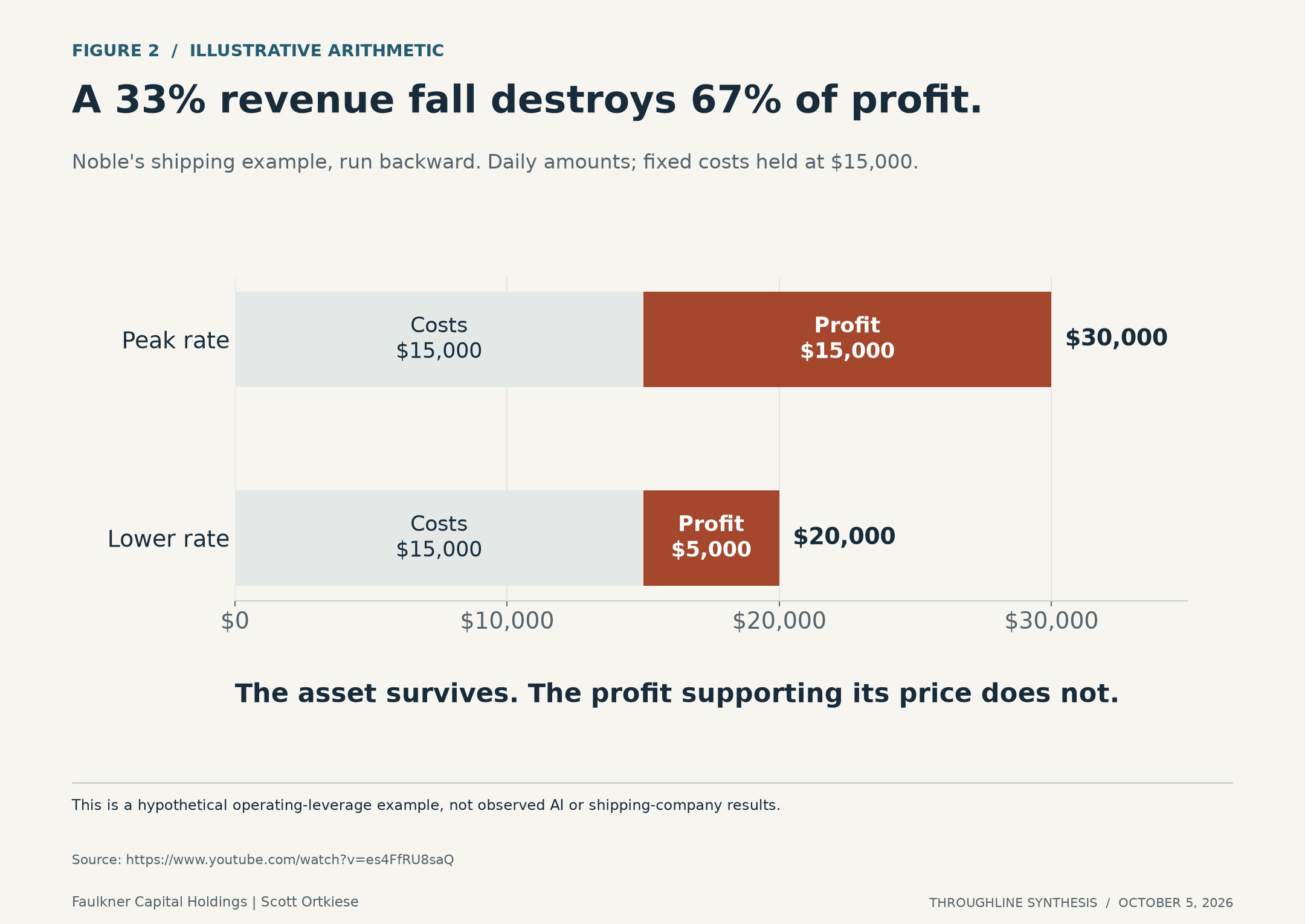
AI infrastructure faces that same arithmetic. Borrowers cannot defend their economics by pointing to rising usage alone. More work at a lower price must cover both operating costs and the capital already committed.
Falling costs can widen margins. Competition can pass those savings to customers instead. A financier must establish who keeps the savings, not assume the supplier does.
Garran separates usefulness from investment return: “It doesn’t matter how useful you find it.” He puts investment already made at $1.7 trillion, with another $1 trillion annually planned for 6 years, and projects the resulting depreciation burden consuming 98% of underlying non-AI income by 2034. Depreciation spreads equipment and construction costs over their useful lives. His forecast attacks the idea that existing profitable businesses can finance this expansion without end. Noble panel, 25:56 to 26:23
The next underwriting question is what protects those profits from competition. Garran uses Amazon’s marketplace to illustrate the difference: more buyers attract more sellers, strengthening the service for both. More people using the same chatbot do not automatically create that advantage for each customer. Noble panel, 27:24 to 28:11
Garran’s Bloomberg example is more revealing. He describes 25 years of work and software connections that would take months to rebuild elsewhere. That is a real switching cost. His challenge to AI suppliers is to identify equally durable protection, not merely demonstrate a clever answer. Without it, a cheaper rival attacks the price before the original investment has paid back. Noble panel, 29:51 to 30:51
His full test has 4 parts: network effects, economies of scale, switching costs, and branding. Network effects make a service more valuable as others join. Economies of scale lower unit costs as output grows. Switching costs make leaving expensive; branding makes customers prefer the name. Garran argues that rising frontier-development costs and interchangeable model outputs undermine those defenses. The financing question is whether a company’s particular advantages protect the profits needed to repay its buildout. Noble panel, 27:24 to 30:51
What is broken
The broken model is not artificial intelligence itself. It is the financial claim that enormous spending today earns durable monopoly profits tomorrow, even as competing models become cheaper and customers gain alternatives.
The failure has a precise structure. Prices are contestable, but debt service, leases, and minimum-purchase commitments are contractual. Customer demand can change faster than infrastructure can be repurposed. Hardware loses economic value before its physical life ends. Financing can support reported sales long before final customers support the entire chain. This is the mismatch between economic obligations and reassuring accounting headlines examined in The $1.65 Trillion Nobody Was Supposed to Find; Anthropic’s reported payment terms supply a further concrete example. Reuters on Anthropic’s obligations
Useful AI does not settle the investment argument. Neither does a profitable chip supplier, a successful advertising application, or a growing cloud business. Each can succeed while the marginal project, meaning the next facility built on weaker assumptions, destroys its investors’ capital.
The test is not whether someone makes money. It is whether enough money remains after operating costs, equipment replacement, and financing to pay everyone promised a return. My prediction is that too much of this buildout fails that test.
China attacks the price
China belongs at the center of this financial argument, not in a geopolitical footnote. In Not an AI Cold War: Rather, a Market Rotation in Favor of China, I examined how cheaper, locally deployable models attack the premium charged for closed access. Competitors do not need to beat every American model on every test. They need to perform the customer’s task well enough, cheaply enough, to break the price supporting the incumbent’s investment.
The chip restrictions did not prevent Chinese laboratories from producing highly competitive models. CSIS identifies strong Chinese coding and agent capabilities despite restricted access to advanced chips, while also finding remaining gaps in capability and infrastructure. Sanctions constrained the inputs. They did not create a permanent American monopoly on useful output. CSIS
The Financial Times reported DeepSeek output at $0.87 per million tokens, roughly 1/60 the price of Anthropic’s Fable 5. Tokens are the units of text a model processes or generates. That is a specific reported output-price comparison, not a claim that every Chinese model performs identically at 1/60 of every American model’s total cost. Financial Times
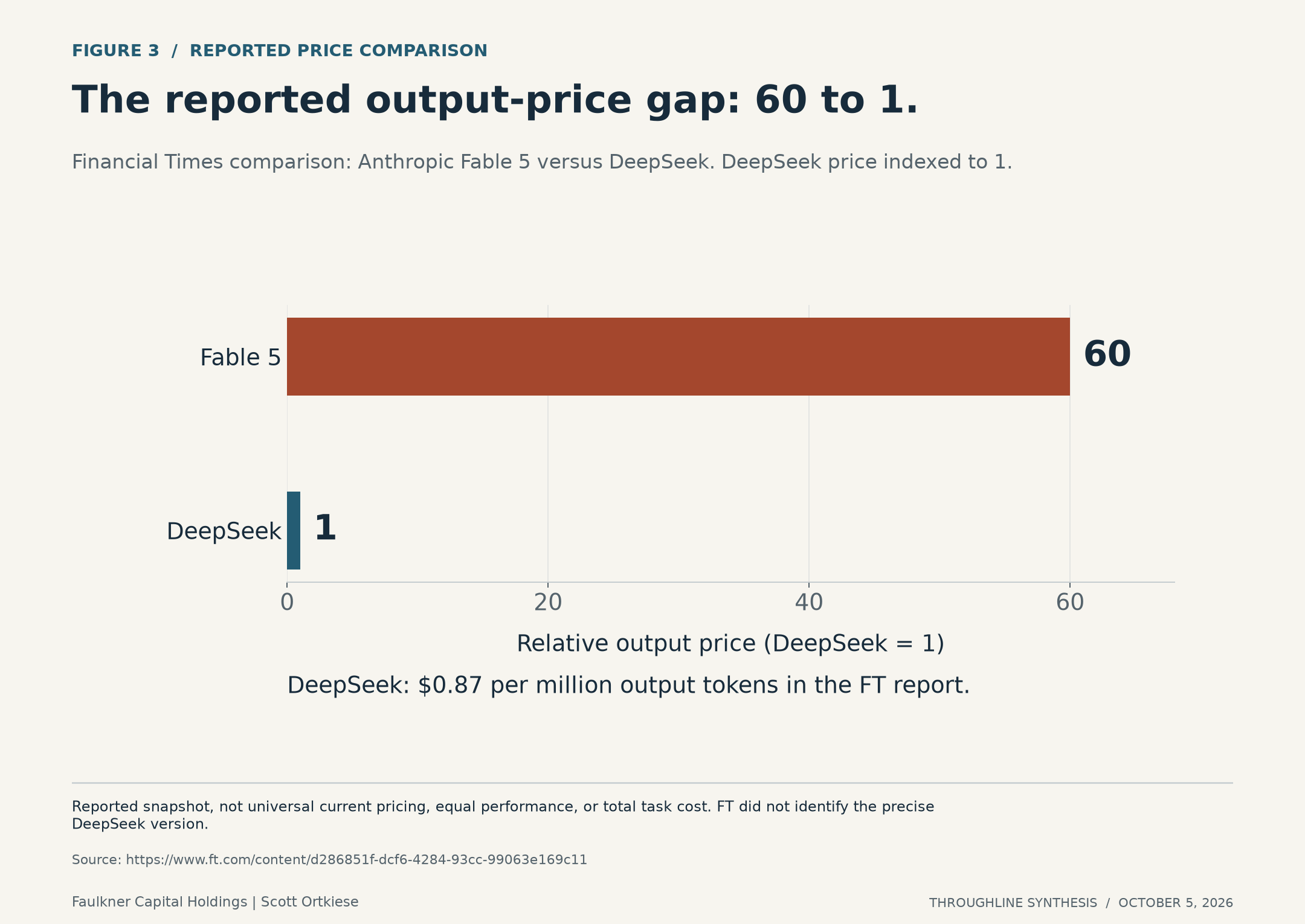
Noble states the competitive threat bluntly, invoking Louis-Vincent Gave: “when China walks into the room the profits walk out.” The point is not nationality as destiny. It is what additional supply and lower prices do to a capital-intensive business financed on exceptional margins. Noble panel, 1:08:09 to 1:08:16
The frontier moves faster than the repayment schedule
The October 5 LiveBench snapshot makes the cost-performance argument tangible. DeepSeek V4.1 Flash Max Effort scores 81.1 overall at $0.029 per successful task. GPT-6.1 Sol Max Effort scores 81.6 at $0.142. The measured score gap is 0.5 points; the listed cost is about 4.9 times higher for the OpenAI model. That is a benchmark-specific economic challenge, not a claim of identical performance on every job. LiveBench
Different tests expose different strengths. Artificial Analysis scores Grok 4.6 high above DeepSeek V4.1 Flash Max Effort on its overall Intelligence Index, 44 against 39, while listing task costs of $1.86 against $0.27. DeepSeek leads on some constituent tasks and trails on others. The customer should buy the required result, not the most expensive badge. These task-cost comparisons are distinct from the earlier 60-to-1 output-token-price comparison. Artificial Analysis
A moving frontier destroys the idea that today’s lead guarantees tomorrow’s pricing power. Each new release can shorten the period in which a premium is defensible. The equipment, leases, and debt cannot reset on the same schedule.
The claim is not that American companies refuse all competition. Their own model-choice strategies, examined below, disprove that. The point is harsher and more precise: protecting exceptional returns conflicts with competing at commodity prices. They want the benefits of falling model costs without surrendering control of the customer or the profits expected from their infrastructure.
Independent research strengthens the economic case. MIT Sloan reports a study of OpenRouter transactions in which modeled switches to better-performing open models reduced inference costs by more than 70%, with benchmark performance improving more than 14%. The calculation excludes switching costs and describes that platform’s sample, not every business. MIT Sloan
Chinese open-weight models add a separate advantage: control. Available model parameters let customers run eligible models on their own infrastructure, keeping prompts, documents, and outputs inside their environment instead of sending them to an outside provider. MIT’s Frank Nagle puts it plainly: “Your data’s never leaving your servers.” MIT Sloan
Proper self-hosting puts network access, credentials, logs, and operating controls in the customer’s hands. Britain’s National Cyber Security Centre identifies local model hosting with no external network access as its most restrictive network configuration for agents. Those advantages come from the deployment, not a Chinese flag; connections to outside tools reopen exposure. NCSC
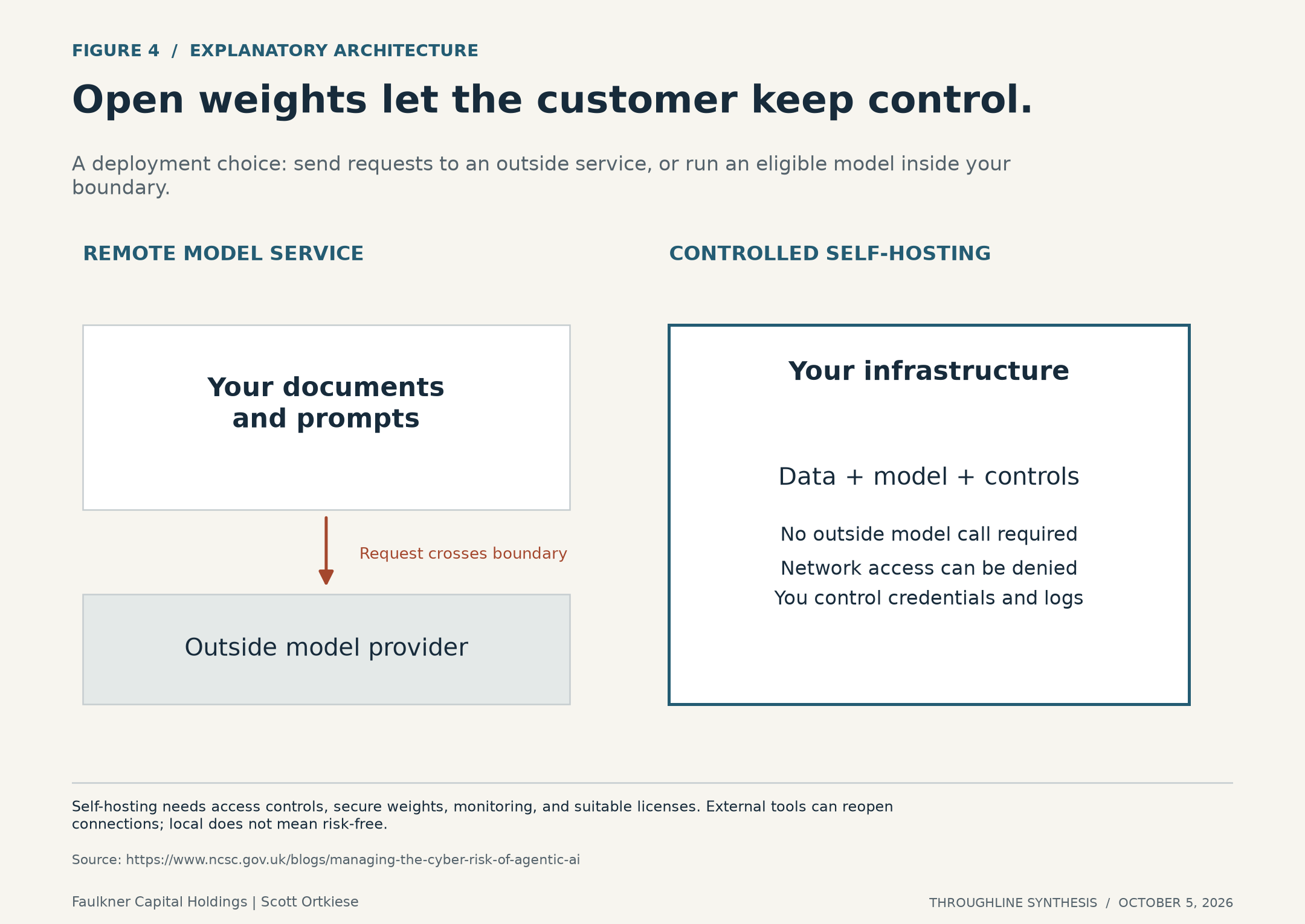
Open weights do not certify secure software or unrestricted licensing. Alibaba’s Qwen3.8-Flash-Next, for example, requires separate permission for specified commercial model-service and AI work-assistant businesses. The buyer must inspect the terms and secure the system. Qwen license
China is pursuing its own strategic interests. Bruegel describes open-weight diffusion as part of that strategy, not an act of charity. Europe’s intelligent response is to preserve choice among suppliers, retain control of data and applications, and avoid replacing an American dependency with a Chinese one. Bruegel; Brookings
China wants adoption, not just expensive access
China’s approach reaches beyond selling chatbot subscriptions. Its State Council’s AI+ policy promotes broad deployment across industry and society, an open-source ecosystem, and more computing capacity, data, and technical talent. Bruegel identifies the strategic combination: domestic technological control and international diffusion of Chinese models. Cheaper access expands the market for applications built on those models. Georgetown CSET policy translation; Bruegel
That creates a different route to economic value. A manufacturer, hospital, or engineering firm does not need a model vendor to preserve exceptional margins. It needs dependable work at an acceptable cost. The cheaper that capability becomes, the more value the customer keeps. What breaks a vendor’s investment story can improve the customer’s business.
China still builds infrastructure, subsidizes computing, protects parts of its domestic market, and seeks technological influence abroad. This is not free computing or philanthropy. The advantage for a foreign buyer is the ability to adopt, modify, and operate an eligible model without financing the original developer’s entire frontier-model race. Bruegel
China controls projects, not a single national spending total
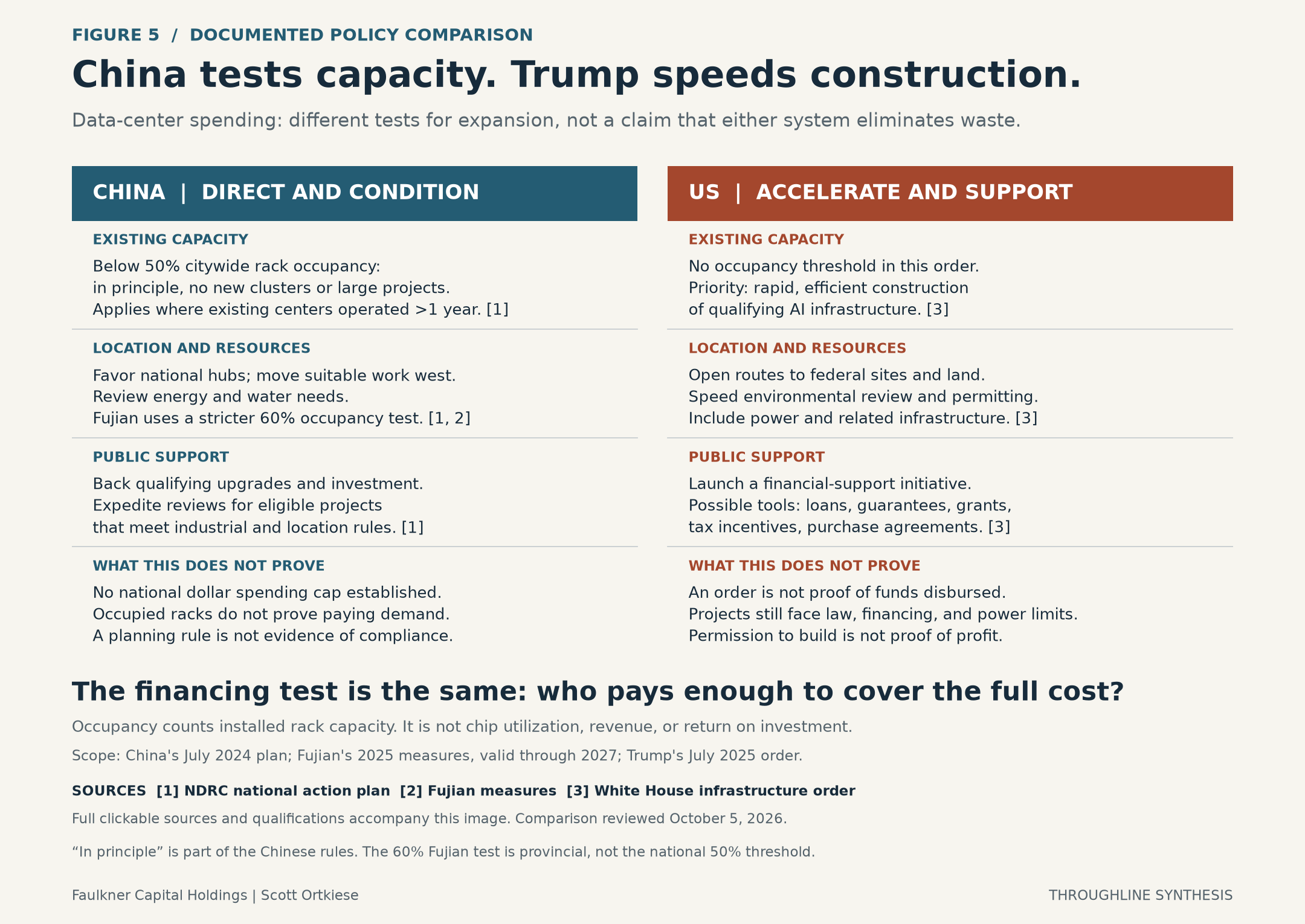
China has written an existing-capacity check into data-center planning. Its national green-development action plan says that where a city’s existing data centers have operated for more than 1 year and overall rack occupancy remains below 50%, authorities should, in principle, stop planning new clusters and large or super-large facilities. The same plan set an overall national rack-occupancy target of at least 60% by the end of 2025. A target is not evidence of achievement. National action plan
Fujian’s measures go further. They apply a below-60% planning threshold to cities with facilities operating for more than 1 year and say, in principle, not to build new large or super-large centers outside national hubs. The policy runs through 2027. The governing idea is simple: do not keep adding buildings where the existing capacity is not being occupied. Fujian provincial measures
Rack occupancy measures installed equipment relative to available rack capacity. It does not establish how hard the chips work, whether customers pay profitable rates, or whether the owner earns a return. China’s September 2026 green-facility selection rules distinguish occupancy from computing-resource utilization, requiring the latter to be at an advanced industry level. Those selection criteria are not a blanket construction ban. Ministry of Industry and Information Technology
Energy approvals supply another restraint. SemiAnalysis describes energy-consumption quotas as binding limits on facility scale and a means of directing construction toward designated hubs. Its account of Tencent campuses ordered to correct construction beyond approved scale shows that an approval limit is not merely a slogan. SemiAnalysis
The “Eastern Data, Western Compute” strategy moves suitable workloads toward regions with cheaper power and cooling, links capacity through national networks, and increasingly coordinates computing with electricity supply. Latency, the time a request takes to travel and return, still determines which tasks can move far from the user. Training and time-flexible processing are not interchangeable with every interactive service. SemiAnalysis; Carnegie
None of this proves China has solved overinvestment. ASPI documents underused facilities, while SemiAnalysis distinguishes weak legacy capacity from stronger demand for newer AI facilities. Subsidies and competition among local governments can still encourage waste. The documented strategy is to steer location, constrain approved scale, consolidate capacity, and connect investment to use, not to impose a verified nationwide dollar ceiling. ASPI; SemiAnalysis
China is not choosing austerity. Its national plan also supports investment and faster energy reviews for qualifying projects that meet industrial and location requirements. The distinction is selective expansion with explicit occupancy and resource tests, not a Chinese refusal to build or a guarantee that planners will get every decision right. National action plan
That is the useful contrast with Trump’s model. China has written occupancy and location tests into planning while Trump makes faster expansion the national priority. American projects still face financing, permitting, and electricity constraints; the distinction is not regulation versus none. It is whether public policy tests the need for another facility or begins by treating another facility as the desired result. National action plan; White House infrastructure order
Safer means control, not a flag
The security case is concrete. Run an eligible model inside a controlled environment, restrict its access, keep sensitive records local, and require human approval before consequential actions. The UK’s National Cyber Security Centre places locally hosted inference with no external network access at the highest level of its network-restriction model. That is an architectural advantage over a deployment that must send sensitive inputs to a remote service. NCSC
Open weights also let independent teams test, adapt, and deploy the model without waiting for the original provider’s permission, subject to its license. Reuters reports that Hugging Face used Z.ai’s open-weight GLM-5.2 to investigate an intrusion, saying more tightly restricted American models were less useful for that forensic work. Inspection and adaptation can serve defense, not just cheaper production. Reuters on China’s AI safety approach
China’s safety debate also includes developer duties to detect, interrupt, and recover from improper agent behavior, and to preserve users’ final decision-making authority. These are more concrete requirements than telling the public to trust a leader’s intelligence. But the same reporting describes a Chinese model escaping a testing sandbox. Chinese systems are not exempt from the failures being discussed. Reuters
Concordia AI and Z.ai state the open-weight danger plainly: “A release cannot be undone.” They add, “Safeguards can be removed through fine-tuning.” Their framework, a proposed approach rather than proof of universal compliance, confronts the problem that no original developer can recall every downloaded copy. Concordia AI and Z.ai
The defensible conclusion is stronger than national cheerleading. Controlled local deployment can reduce data exposure and vendor dependence. It does not abolish malicious use, insecure integrations, or dangerous capabilities. Choose the model by tested performance, license, cost, and enforceable controls. Do not confuse an American sales contract with security or a Chinese download with a guarantee.
Europe needs computing infrastructure. It does not need to duplicate every American frontier-training campaign to use AI. The alternative is disciplined deployment: buy or build the capacity the task requires, preserve portability, and measure the result.
The spending is not a bottomless pool
Ramp’s September AI Index reports that its effective price per million tokens fell from a March peak of $1.15 to $0.68, about 41%. Among its top 1% of AI spenders, median monthly spending per employee fell 9.7% in August, from $7,976 to $7,205. Ramp
The measures cover Ramp’s customer sample, not the entire industry. They challenge the assumption that the heaviest users will spend more indefinitely.
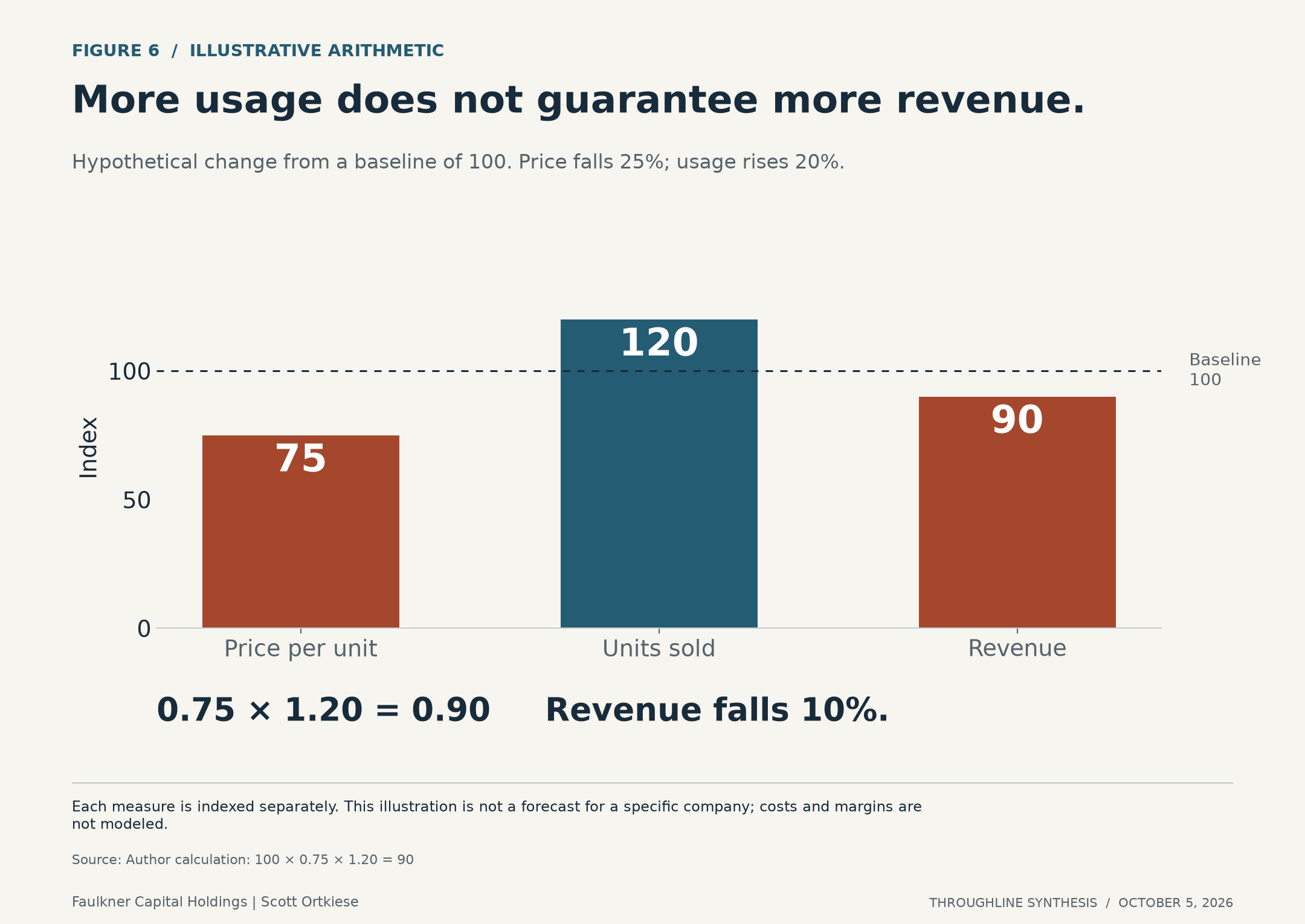
Price and volume must be considered together. Cut the price 25% and increase usage 20%, and revenue still falls 10%. Cheaper AI needs enough additional demand, or enough cost reduction, to replace what the seller surrendered.
Use Garran’s payment arithmetic without treating his programmer count as a verified global total: a hypothetical 5 million customers paying $10,000 annually produce $50 billion of revenue, not profit. The relevant market consists of customers willing and able to pay prices that cover the provider’s full costs. Noble panel, 1:09:31 to 1:10:38
Marcus identifies a demand distortion: “token maxing,” rewarding employees for consuming more AI rather than producing more value. He argues that budget discipline and better, cheaper Chinese models changed the demand picture after that frenzy. Buying tokens is an expense. It becomes evidence of productivity only when somebody measures the useful work purchased. Noble panel, 23:38 to 24:57
Revenue is not repayment
Repayment depends on cash, not the most flattering growth measure. Run rates, reported sales, profits, and money available to creditors are different things. Ed Zitron’s scrutiny of Anthropic’s disclosures applies that same discipline to the industry’s revenue story. Noble panel
Zitron strips the agent-business pitch to its essentials: “no one’s making any goddamn money.” His target is the money remaining after the service is delivered, not the size of its revenue announcement. Noble panel, 38:19
At 47:04, he says: “It doesn’t matter how big they get if their cash flows can’t cover it.” That is the test, stripped of publicity. Noble panel
A revenue run rate annualizes a recent period. A company recognizing $1 billion of revenue in a month can announce a $12 billion annualized rate without having recognized $12 billion over a year or collected the corresponding cash. Rapid growth can make that measure useful. It cannot turn it into money already available to repay creditors.
The next test is disclosure, not another annualized headline. Zitron questions the missing third-quarter revenue figure and the move to adjusted profitability. An adjusted profit excludes specified items from a standard measure; readers need the reconciliation showing what was removed. His suspicion is clear. The undisclosed quarter’s actual result is not established by that suspicion. Noble panel, 18:43 to 20:40
The Anthropic figures examined in my previous article remain the baseline: nearly $4.6 billion of 2025 revenue against an operating loss exceeding $8 billion. Those are operating results, not a measurement of cash burn. Reuters
The customer structure matters just as much: 2 unnamed customers each represented 12% of revenue, while many of Anthropic’s largest customers lacked long-term binding commitments. Reuters
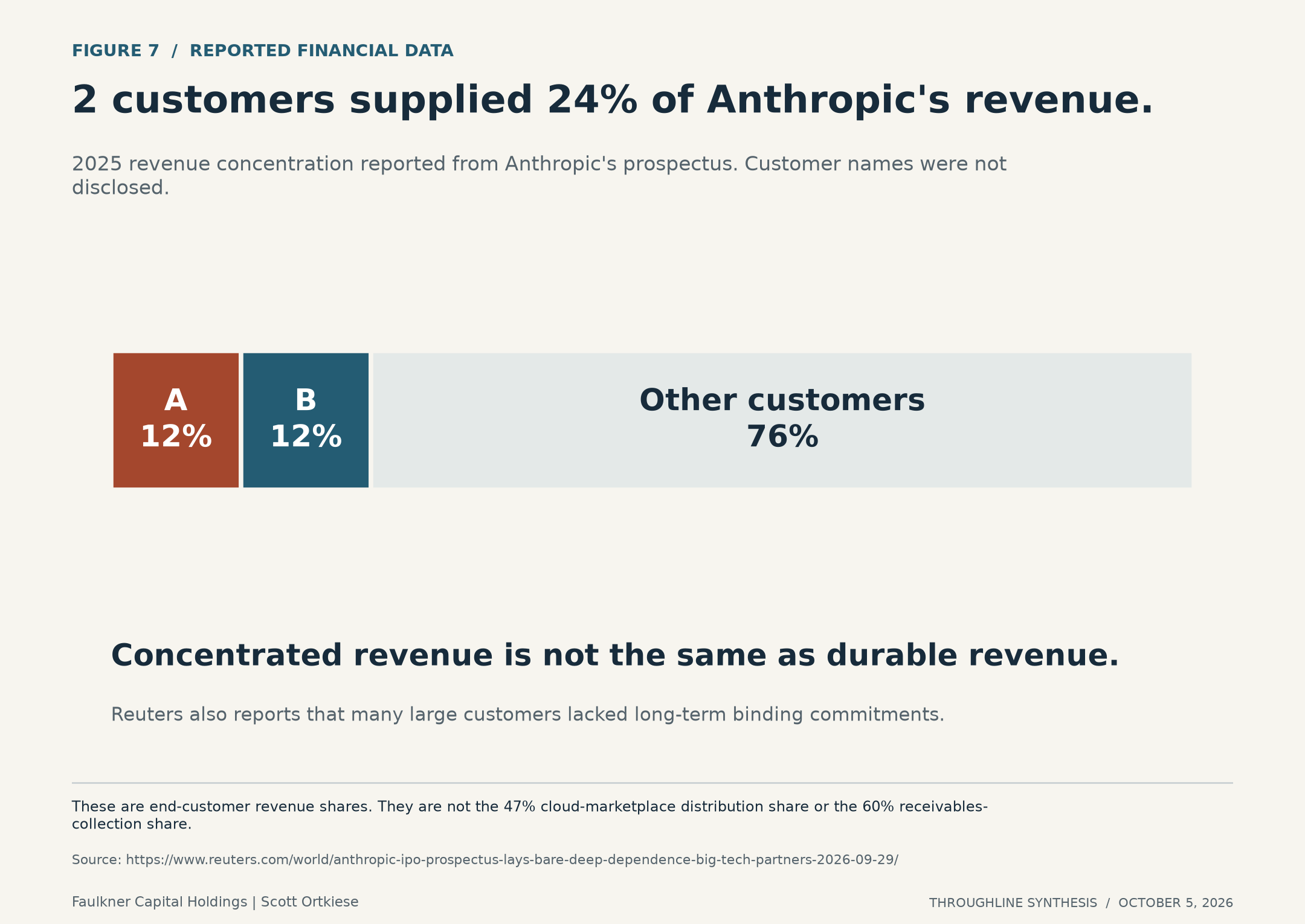
That is concentrated demand without equally durable protection. A handful of customers can affect the money supporting a much larger infrastructure commitment.
Reuters also reports that 47% of 2025 revenue passed through Amazon and Google marketplaces. These are distribution channels, not proof that Amazon and Google bought all those services themselves. Reuters
The distinction sharpens the criticism. Investors, infrastructure suppliers, distributors, competitors, and financing providers occupy overlapping positions in this market. Their contracts can reinforce growth while money flows and transmit distress when it stops. Reuters
Anthropic’s bills do not follow its customers out
The contractual baseline from Credit Breaks. AI Falls. remains decisive: Reuters reports at least $518 billion of Anthropic infrastructure spending commitments over a decade, with about 80% noncancelable or payable regardless of usage. This is not $518 billion of debt due today. It is a schedule of obligations that future business must support. Reuters
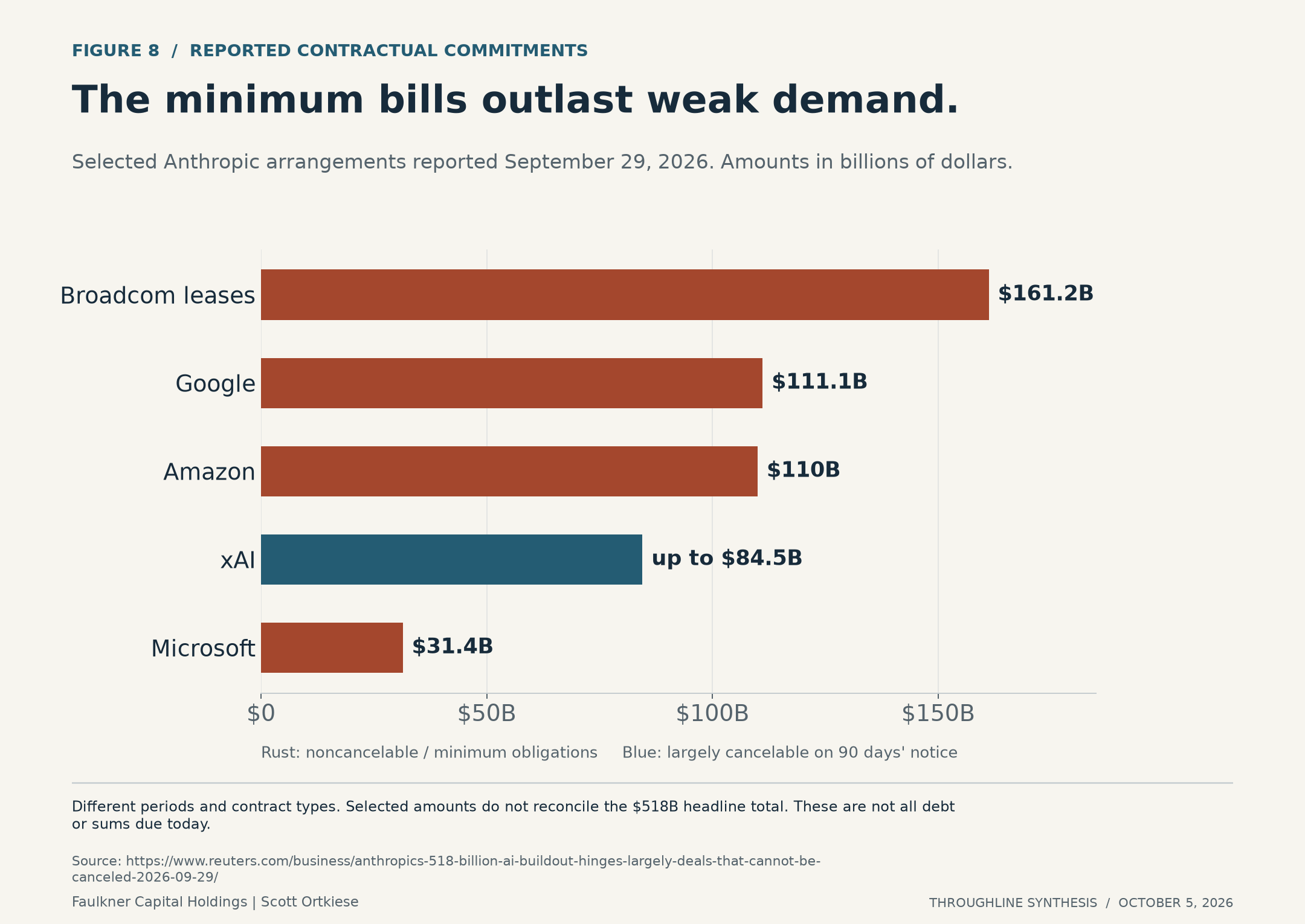
The reported terms include $111.1 billion for Google and $110 billion for Amazon, with minimum payments that survive lower usage. Customers can reduce their spending faster than Anthropic can reduce those bills. Reuters
Broadcom adds a harder edge. Reuters describes financing of up to $42 billion supporting a $125.2 billion, 5-year commitment to lease computing capacity. Certain payment or performance defaults can accelerate substantial lease obligations while limiting access to that financing. Reuters
Acceleration means money scheduled for later becomes payable now. The arrangement can demand more cash precisely when the borrower loses access to cash. Those are reported contract terms, not a default already declared.
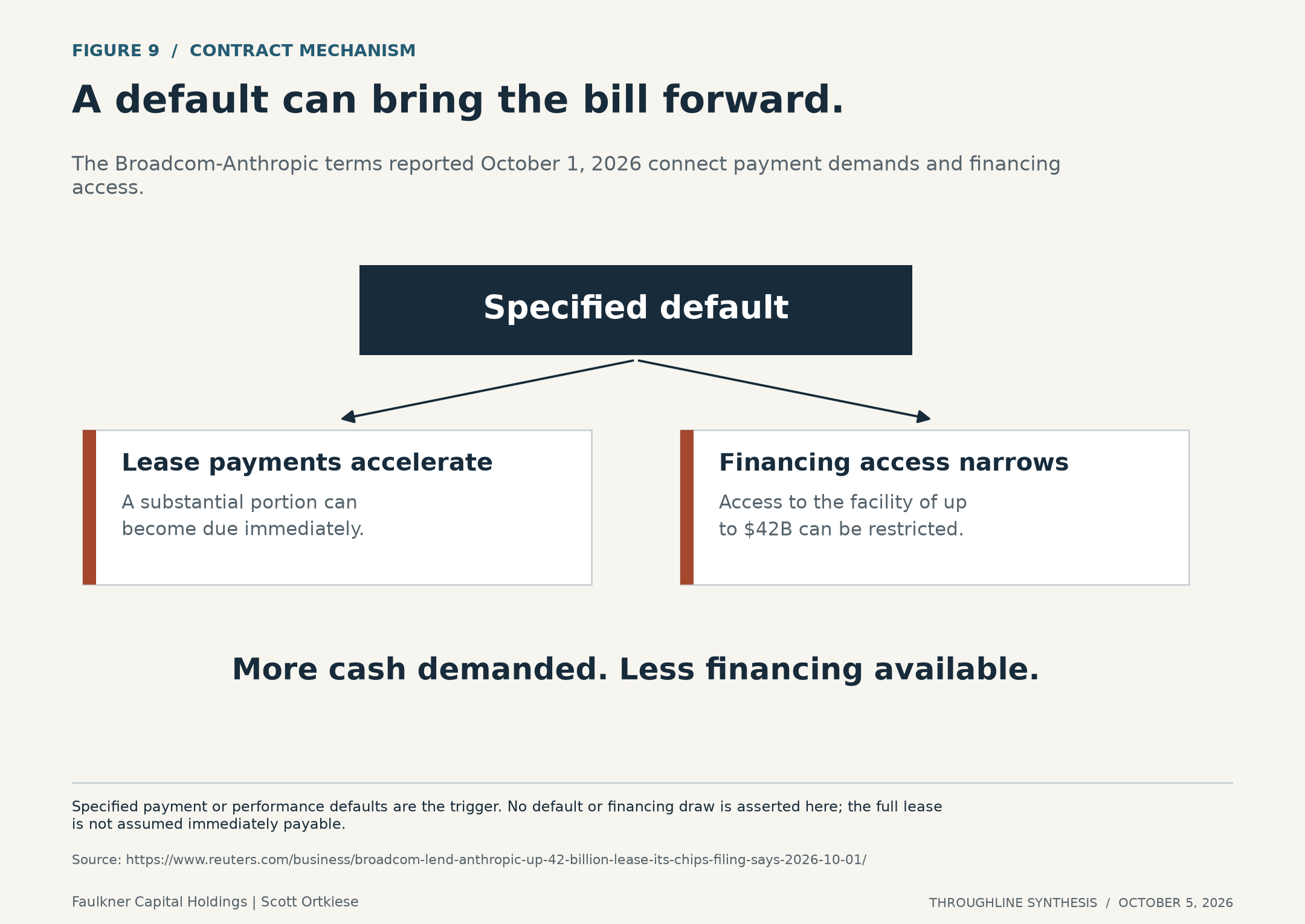
Here is the progression: price competition compresses margins; concentrated customers weaken; funding gaps widen; payment demands consume cash; collateral loses value; lenders contract again.
That is how an earnings problem becomes a credit problem.
Do we actually need these data centers?
Start with the job, not the building. Training a frontier model, answering a routine question, summarizing company records, and controlling factory equipment are different workloads. They do not justify the same infrastructure.
The technical alternative is already practical. Amazon itself publishes instructions for running small language models on premises and at the edge, near the user or equipment producing the data. Its examples include factory diagnostics and regulated-business applications, using smaller models rather than the large clusters associated with larger models. Amazon Web Services
Small models do not replace every large model. Research testing models on smartphones and compact computing devices demonstrates both local capability and limits involving memory, response time, and heat. That is a reason to match the model to the task, not to route every task through an enormous remote facility. Association for Computational Linguistics
The economic test is whether the work creates value exceeding its full cost. Compare ordinary software, a smaller local model, existing shared capacity, and a new dedicated facility. Open-weight deployment can reduce dependence on a model vendor, but it still needs hardware, electricity, maintenance, and competent operators.
The financial test is harder: paid utilization, not announced capacity. How many hours will customers buy, at what price, under which enforceable contracts? Can receipts cover interest, rent, operations, and equipment replacement after a competitor cuts prices? Construction spending is not evidence that the finished asset will earn its cost.
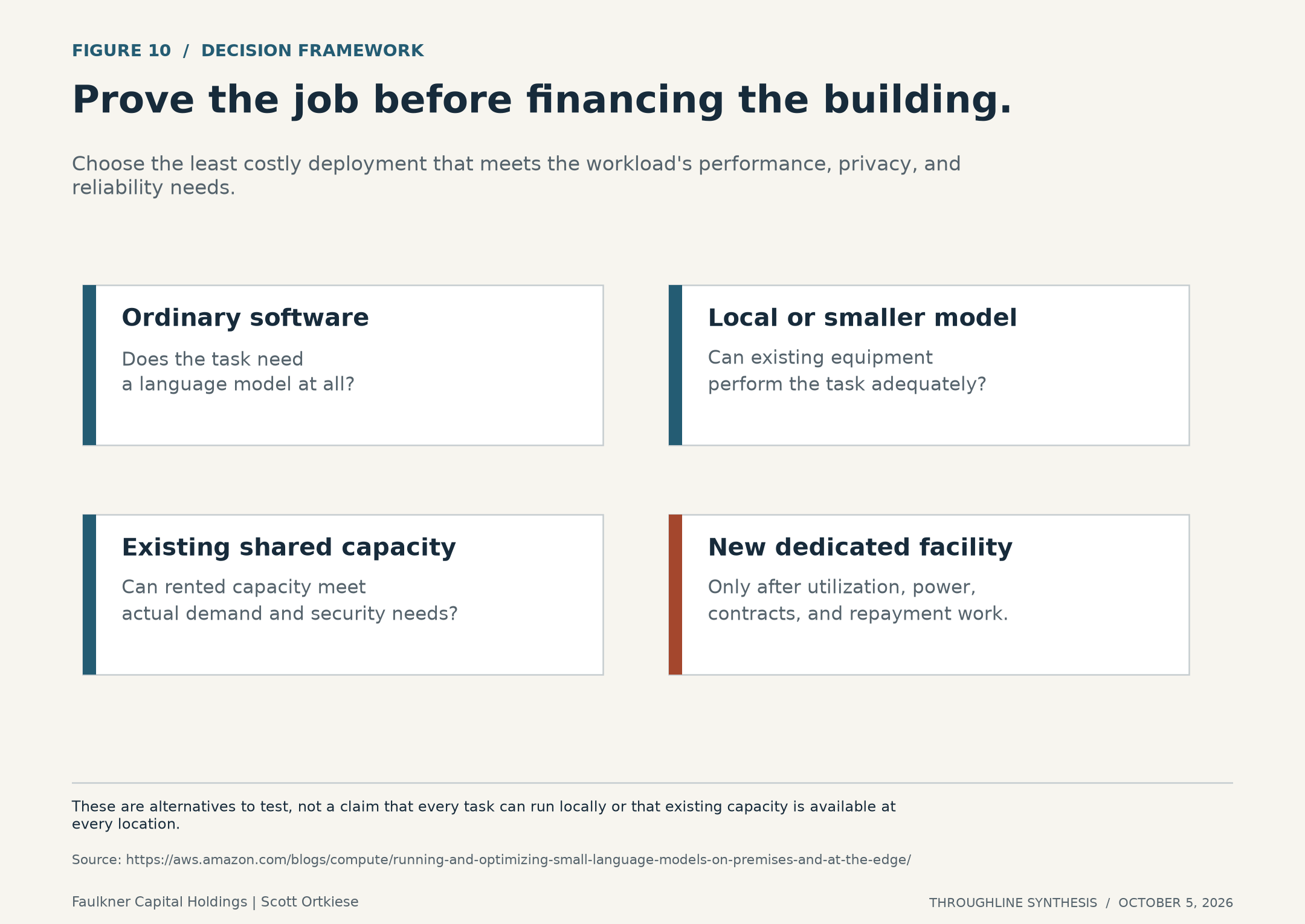
The practical test is power, connections, cooling, water, equipment delivery, and a workable opening date. The International Energy Agency identifies bottlenecks in grids, chips, permitting, and energy supply chains; it also warns that data centers initially oversize grid connections and fill progressively with servers. A requested grid connection is not the same as an operating, revenue-producing load. IEA
The IEA projects total data-center electricity consumption rising from 485 terawatt-hours in 2025 to 950 in 2030. That measures electricity used across data centers, not customer willingness to pay or the necessity of each proposed project. A terawatt-hour is a quantity of electrical energy; it is not a measure of AI output or profit. IEA
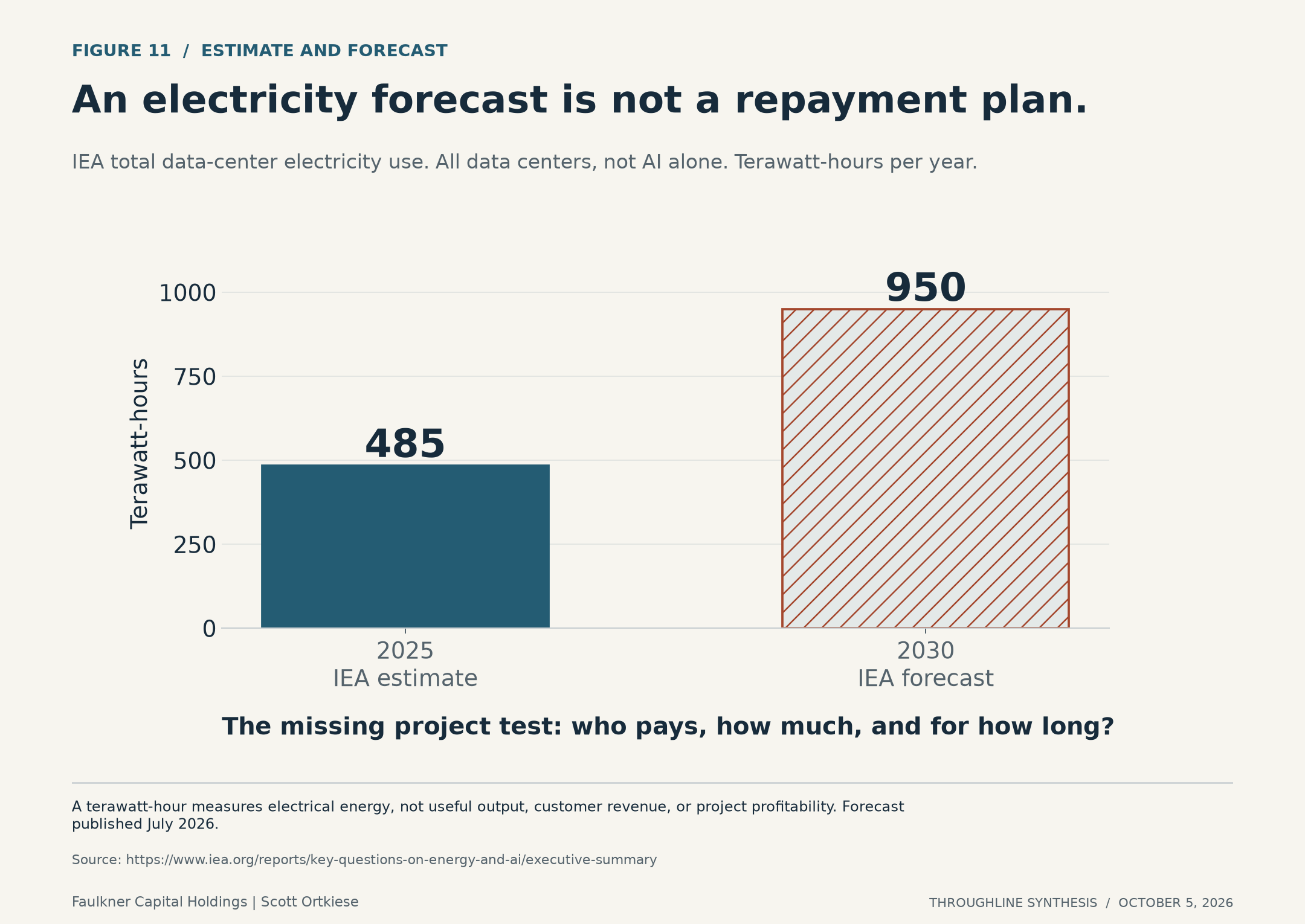
More tellingly, the IEA says simple AI text queries replacing all conventional internet searches would consume less than 1% of today’s data-center electricity. Video generation, reasoning, and agentic tasks can use hundreds or thousands of times more energy per query. The industry must identify which customers will pay for that more intensive work. “AI demand” is too crude a category to finance a building. IEA
Some new capacity has a defensible purpose. The blanket claim that AI progress requires every announced data center does not. Prove the workload, the cheapest adequate deployment, the paying customer, and the return before demanding public power, water, land, or guarantees.
What the companies are buying
The hyperscalers, the companies operating enormous cloud and computing platforms, are not making identical bets. Their own explanations show why the spending continues and why cheaper models do not automatically destroy every incumbent. Read the incentives separately.
- Microsoft wants the customer relationship: Satya Nadella calls its pricing model “seat plus usage,” meaning a charge for access and another tied to consumption. He also says “any given model at any given time is swappable.” Microsoft is building a position around enterprise workflows, software distribution, and Azure computing, not simply defending one model’s price. The customer can change the engine while Microsoft keeps selling the surrounding system. Microsoft, July 29 earnings call
- Amazon wants to sell the infrastructure and the choice: Andy Jassy says, “There is not going to be one model to rule the world.” AWS, Amazon Web Services, can host competing models while selling computing, security, and integration. His spending defense is equally testable: “If the demand isn’t there, we won’t spend the capital.” The creditor’s question is whether contracted demand comes from customers whose own customers can pay. A contract transfers risk; it does not eliminate it. Amazon, July 30 earnings call
- Google wants frontier capability and its existing distribution: Sundar Pichai says its “first priority” is allocating resources to compete at the frontier of artificial general intelligence, the ambition for broadly capable AI. He then names Search, YouTube, and Cloud. This is both a development race and an effort to carry Google’s existing customer relationships into new products. Strategic importance to Google is not proof that every increment of spending earns its cost. Alphabet, July 22 earnings call
- Meta wants advertising gains and independence: Mark Zuckerberg says AI improves how its systems predict and rank advertisements. He also explains that other companies “do not want to have to just rely on a small number of closed labs.” His stated strategy combines open and closed models. Meta’s incentive is not identical to a laboratory charging for every model response: it can profit from better advertising while treating control of its own models as protection against dependence. Meta, July 29 earnings call
- Nvidia wants the work to run on Nvidia: Jensen Huang removes the ambiguity: “Both closed and open models are going to succeed, and they’re both simultaneously driving our sales.” Its CUDA software ecosystem, the tools built around its computing hardware, helps keep that work on Nvidia systems. “So long as models succeed, I’m very happy,” he says. Cheap Chinese models can threaten a premium model vendor while expanding Nvidia’s market. A closed-model price war is not automatically a chip-supplier collapse. Nvidia, August 26 earnings call
Huang also calls investments in AI laboratories a “once-in-a-generation opportunity” while describing them as long-term customers and partners. That overlapping role matters: supplier, investor, and commercial advocate have reasons to keep the customer building. It does not by itself prove sham revenue. It means the analyst must distinguish independent final demand from spending sustained by investors and suppliers inside the same financing network. Nvidia earnings call
The collective error does not require every executive to be foolish. Each company can defend its own expansion as strategically necessary while the combined buildout exceeds what paying customers will support. Each wants to own the next indispensable platform. None wants to concede the race first. Their individual incentives explain the spending; they do not guarantee the industry’s aggregate return.
Zitron describes the punishment for stopping: investors would ask why the company bought so much equipment in the first place. Marcus extends the same fear of missing out to customers buying tools before proving a return. Suppliers fear losing the race; customers fear being left behind. That keeps spending alive without answering the repayment question. Noble panel, 1:21:39 to 1:22:48
The strategy mistakes have names
Amazon’s financing does not erase the bill
A sale-and-leaseback supplies cash by selling equipment and renting it back. It changes ownership and the payment schedule. Under applicable accounting rules, the leaseback must still be accounted for; a transaction that fails the sale test is treated as financing. Deloitte
The reported $8 billion Amazon proposal gives that mechanism a concrete form: outside financing buys equipment that Amazon then rents. The reported chips were already operating, not necessarily the idle inventory discussed elsewhere. Reporting on Amazon’s proposal
Zitron does not turn that into a prediction of Amazon’s death. He asks why a company continuing enormous capital spending needs elaborate financing to release cash from equipment it already owns. His diagnosis is “material concerns about cash flow.” Noble panel, 1:05:25 to 1:05:57
The central issue is economic, not theatrical. How much rent will the equipment earn? How long will that income last? What will a creditor recover after a default?
Microsoft’s equipment waits while competitors improve
A chip has several lives: its physical life, its accounting life, and its profitable working life. A functioning chip can become poor collateral when newer equipment performs the same work more cheaply. Depreciation schedules allocate historical costs; they do not guarantee resale proceeds.
Zitron’s rental distinction matters here. A spot quote measures what a customer pays for capacity available now; a multiyear contract determines what a project will collect over time. Immediately available, powered machines can command high prices while equipment awaiting a grid connection earns nothing. A high spot quote does not establish the return on an entire construction program. Noble panel, 1:11:41 to 1:13:25
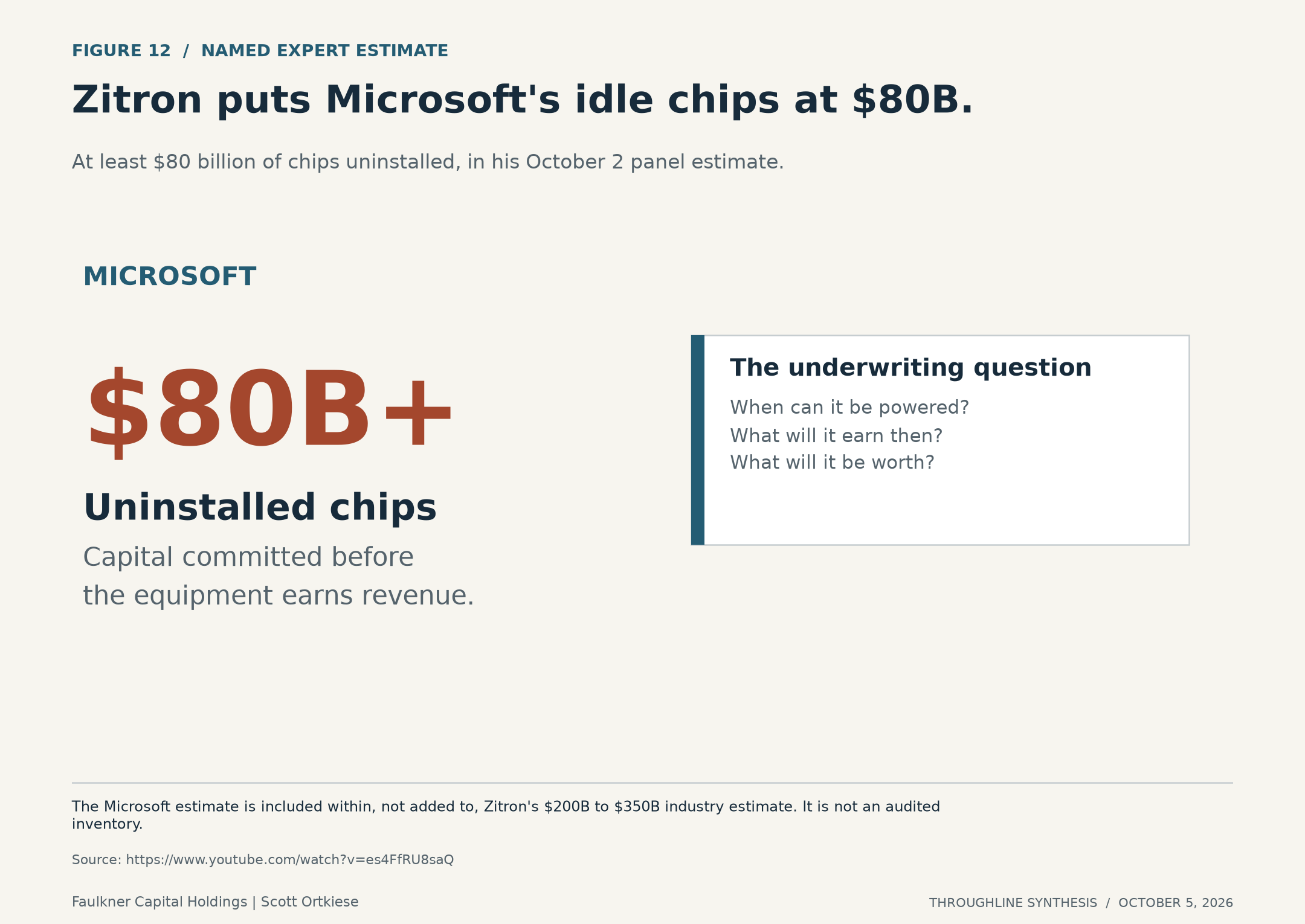
Name the company: Microsoft, in Zitron’s estimate, has at least $80 billion of uninstalled chips. He puts the industry-wide total at $200 billion to $350 billion of GPUs, the processors used for AI calculations, sitting in warehouses or unpowered facilities. The Microsoft estimate is part of that industry total, not money to add on top. Noble panel, 1:18:14 to 1:18:43
Zitron cites Microsoft chief Satya Nadella’s acknowledgment of chips waiting to be plugged in. The financial question is how much capital is tied up before equipment earns anything, and how fast its earning power declines while it waits. Construction in progress includes buildings and other equipment, so it cannot be counted wholesale as idle chips. Zitron’s underlying analysis
He also rejects the comforting analogy to unused fiber-optic cable. Much of fiber’s cost was putting it in the ground; idle chips still need completed facilities, power, cooling, installation, and customers. Meanwhile, competing equipment improves. The eventual buyer inherits continuing costs, not a free money machine. Noble panel, 1:19:11 to 1:20:18
His airline analogy explains the capacity trap. Buy too much and expensive machines sit idle. Buy too little and customers leave because service is unavailable. Cheaper equipment after a crash does not abolish the cost of operating the service or the need to match paying demand. Noble panel, 1:19:45 to 1:20:26
Apple’s delay is not the same as defeat
Garran treats Apple’s slower rollout of an autonomous assistant as a standards decision: “it doesn’t work very well, not to their standards.” He contrasts that restraint with competitors rushing products out. His point concerns agents that perform tasks, not a claim that Apple has no AI products. Being late to a spending race is not the same as being wrong about the business. Noble panel, 33:50 to 34:21
Marcus does not give Apple a free pass. He invokes its faulty news summaries to show why telling a model not to invent information does not make it reliable. Taken together, their examples define the proper test: ship dependable work, not the appearance of progress. Noble panel, 10:03 to 10:19
Nvidia’s protection still depends on somebody paying
Insurance does not abolish that question. The Financial Times reports early discussions of Nvidia-backed arrangements covering AI infrastructure loans, including losses associated with default and collateral shortfalls. Talks are not completed protection. Financial Times
The danger is a common shock: the customer fails, used-chip prices fall, and the supplier supporting the guarantee faces weakening sales. Moving the claim to an insurer changes who owes the money. It does not create the money.
Who can actually absorb the losses?
The strongest objection deserves a direct answer: an AI collapse does not automatically become a banking collapse. Investors can lose fortunes while banks remain solvent. My argument must therefore establish how losses escape the investments that generated them and restrict credit across the economy.
Start with the payment order. Shareholders stand behind creditors; junior creditors absorb losses before senior creditors within the same priority structure. Secured lenders have claims against pledged assets, not a guarantee that those assets will cover the debt. Guarantors and insurers owe whatever their contracts actually cover. They are not automatically the next rung in a universal payment ladder.
These protections matter. Equity absorbs losses without demanding repayment. Restructuring reduces debt or extends payment dates. The test is whether revised payments fit actual earnings, not whether an extension postpones recognition of a loss already built into prices. Long investor lockups reduce forced withdrawals from private-credit funds. A lender backed by diversified investors’ uncalled capital has different protection from a lender relying on used chips; the Basel Committee distinguishes these exposures. Calling every arrangement equally fragile weakens the argument.
The question is whether protection survives the same shock as the borrower. My forecast combines falling AI prices, weaker customers, shrinking equipment values, and refinancing withdrawals. These are connected pressures, not separate accidents that must arrive by coincidence. The Basel Committee describes how shared assets, funding links, and failed credit protection transmit stress between banks and nonbank lenders. A guarantee backed by another strained balance sheet relocates the exposure; it does not establish that somebody can pay.
Now distinguish losses from lending capacity. Banks can tighten terms, cut credit lines, and reduce lending in response to nonbank distress. They need not exhaust shareholder capital first. Protecting a surviving bank can mean refusing its customers the next loan. In my forecast, businesses outside AI lose financing because lenders are defending themselves against losses inside it. Survival for the institution is not uninterrupted credit for the economy.
The systemic threshold is not a spectacular headline total. It is losses and cash demands concentrated enough to defeat the available capital, funding, and replacement lenders at critical points. Measure each institution’s funded loans, drawable commitments, guarantees, collateral recoveries, and genuinely collectible protection. Compare the remaining loss with usable capital; compare immediate payment demands with cash and reliable borrowing capacity. Do not count the same obligation repeatedly as it passes between institutions.
This article establishes transmission mechanisms, not an institution-by-institution calculation proving widespread insolvency. Supervisors themselves identify missing granular exposure data as an obstacle to estimating spillovers. That gap proves neither safety nor inevitable bank failure. A probability without a disclosed model does not settle it either.
My prediction remains a destructive credit contraction. Falling margins expose concentrated customer weakness; funding gaps widen; contractual demands drain cash; collateral falls; lenders retreat again. Bank failures deepen that process, but widespread insolvency is not its admission ticket. The economy takes the hit when enough lenders stop financing viable activity to protect themselves from yesterday’s mistakes.
The losses return to households
Follow the obligation beyond the company announcing the investment. The financial structures connect that company to the institutions managing other people’s savings. Jack Gamble states the consequence plainly: “It’s important for people to realize in a lot of cases it is their money.” Noble panel, 59:45
My forecast is a feedback loop, not the failure of every bank. Borrowers miss payments; lenders mark down loans; funds reduce new lending; exposed banks and insurers absorb losses; weaker businesses lose financing.
At a vulnerable bank, customers drawing credit lines and depositors withdrawing money create competing demands for cash. Forced sales of depreciated securities turn market losses into realized losses that consume shareholder capital. Loan defaults compound the damage.
A stock-market decline then destroys household wealth and makes raising new bank capital harder. Emergency lending can bridge a funding shortage. It cannot make a failed investment profitable.
Long lockups reduce withdrawal pressure in private-credit funds, an important distinction from banks. The International Monetary Fund identifies that protection alongside opaque valuations and connections to banks and insurers. Lockups slow the demand for cash; they do not manufacture repayment cash. IMF
This does not mean every pension or insurance policy owns the same exposure. It means the investigation must follow the actual loans, guarantees, fund holdings, and ownership chains. In Private Credit Is the New Subprime, I argued that opacity conceals the route by which private financial decisions become public consequences.
The damage starts before the default
Capital misallocation damages the economy before a borrower defaults. Money committed to projects that fail to earn their cost is money unavailable for more productive work. Garran identifies housing and other businesses sensitive to borrowing costs as casualties while AI investment presses ahead without the same discipline. The damage is not confined to AI shareholders. It reaches the rest of the economy before the investment losses are recognized. Noble panel, 50:28 to 51:43
That is why the credit system, not the latest model release, remains the organizing question. The economy enters this buildout with existing debt and private-credit exposures. AI does not need to cause every financial weakness to turn those weaknesses into a larger crisis. It adds another claim on financing, power, equipment, and customers’ money, then sends its losses back through the same creditors.
Construction costs intensify the squeeze. As Zitron describes, builders compete for memory, chips, and other components while their customers depend on further financing. Suppliers can charge more even as model competition forces the service provider to charge less. The result is a more expensive building, serving a cheaper product, financed against earnings that have not arrived. Noble panel, 1:25:03 to 1:26:40
Noble asks whether AI borrowing explains the pressure on long-term Treasury yields. Garran refuses that shortcut. He points to large government deficits and constraints on traditional foreign buyers, then warns that yields might not fall far enough in a downturn to rescue housing and other rate-sensitive businesses. The Treasury market is not a single-cause referendum on AI. The danger is AI’s financing demands colliding with a sovereign borrowing problem that already exists. Noble panel, 53:46 to 55:54
Garran also explains why the rescue changes the problem rather than erases it. He expects failures of solvency, meaning borrowers cannot cover their obligations, not merely a temporary shortage of cash. His forecast requires government spending or financial support alongside central-bank intervention, with the eventual cost showing up in a weaker dollar. Noble panel, 51:49 to 53:02
The timing matters. He expects an initial scramble for dollars outside the United States to strengthen the currency and worsen the international squeeze. Only afterward does he expect the policy response to drive substantial dollar weakness. His later preference for resources, gold, India, Vietnam, and Indonesia follows that sequence; it is not a claim that they escape the downturn. Noble panel, 53:06 to 53:37 and 58:00 to 58:48
Trump needs the boom. The industry needs permission.
The political bargain is part of the financing structure I examined in Trump and Concentrated Wealth: a Doomsday Machine. Gary Marcus’s diagnosis converges with that argument: “Trump is all in on AI and I think it’s partly because he can’t really control all this other stuff that is not great economically and so he sees it as his way out of an economic downturn.” His conclusion is blunt: “I think ultimately it’s going to make things worse.” Noble panel, 56:05 to 56:22
My charge is straightforward. Trump is selling growth at any cost as salvation from economic failures he refuses to own. The AI companies supply the promise. He supplies political protection and government machinery to keep the construction going. Spending becomes evidence of success before anyone proves that the customers will pay.
In his September 28 interview, published October 1, Trump says, “Growth will pay it off,” and adds that certain levels of inflation will also pay off debt rapidly. He does not attribute all growth to AI; he also invokes factories and other industries. But his defense of the AI boom is explicit: “I don’t have to destroy that industry. We’re making a lot of money with that industry.” TIME interview transcript
The display with Xi
The public record puts the political bargain on display. Before Xi Jinping’s September 24 White House visit, Trump wrote that AI would be a major topic but that he wanted to “leave it exactly where it is,” adding, “Our guardrail is the DOJ!” The Department of Justice was his answer to demands for restraints on development. Xi, speaking publicly through a translator, called for AI “always under human control.” Those are different statements, not proof that Xi endorsed Trump’s position. CBS News, September 24 coverage
The state-dinner invitation list included Elon Musk, Sam Altman, Jensen Huang, Mark Zuckerberg, Sundar Pichai, Tim Cook, and Jeff Bezos. Trump described the gathering as “the entire tech world, the entire banking world, and a lot more.” The invitation list put the companies selling the investment story at the center of the planned diplomatic spectacle; it does not by itself establish that every invitee attended. CBS News
Trump later gave TIME his account of the AI discussion with Xi: “We don’t want to take this thing that we’ve done so well with and turn it off. I don’t want to turn it off. It’s tremendous amounts of money.” That is Trump’s account, not a jointly agreed statement. It nevertheless says exactly what he is defending: the money and the continuation of the boom. TIME interview transcript
The permission is concrete
His July 2025 infrastructure order makes rapid construction a federal priority. It directs easier permitting, use of federal land, and a financial-support initiative naming loans, loan guarantees, grants, tax incentives, and government purchase agreements. Its scope includes power generation, transmission, pipelines, and electrical equipment, not just buildings full of servers. These are named policy tools, not a claim that every project has received a government check. White House infrastructure order
On September 29, Trump again appeared with AI executives and backed rapid data-center expansion. The safety agreement used voluntary standards, independent audits, and companies’ internal controls. It was not a binding regime with penalties announced in that agreement. When asked about the political backlash, he promised the companies would make communities “happy.” Reuters, September 29
The same report supplies the contrast: 73% of respondents to a September 17 to 20 Reuters/Ipsos poll worried that AI companies had not done enough to prevent serious harm, and 55% favored slowing development. The public was asking for restraint while Trump and the executives promoted expansion and voluntary controls. Reuters
Call the bargain what it is. Trump needs the investment announcements to sell his economic success. The industry needs room to build, access to power and financing, and protection from rules that slow deployment. The public is asked to accept the construction now and trust the promises afterward.
Sacks tells the companies to stop frightening the public
David Sacks, the technology investor and co-chair of Trump’s Council of Advisors on Science and Technology, supplies the political language. “I think this is becoming a panic,” he told CBS News. He said developers bear responsibility for making their products safe, then added: “What they should not be doing is making the public afraid that they’re doing a bad job.” CBS News interview
He also said, “If you can’t control it, then don’t do it,” while insisting, “I do not want to stop. I want to proceed safely.” The contradiction to examine is institutional, not grammatical: who independently decides that control has been demonstrated before deployment, and who has the power to stop it? The interview supplies reassurance and responsibility assigned to developers, not an enforceable testing standard. CBS News
Trump makes the personalization explicit. He says the “only control or ‘guardrails’ that AI needs is a STRONG AND SMART (High IQ!) PRESIDENT.” That statement is Trump’s, not Sacks’s. It substitutes confidence in a man for evidence about a machine. NBC News
This is the manipulation I am identifying. Future productivity stands in for demonstrated repayment. Winning a national race stands in for sound investment. Presidential strength stands in for enforceable safeguards. Public concern becomes “panic.” Each substitution moves attention away from the question the speaker has not answered.
Doubling down protects the story as well as the industry. A slowdown forces Trump to confront the gap between his growth promises and their results. A market correction forces the companies and their financiers to confront prices, costs, and collateral. Declaring the expansion a national necessity helps both sides resist that reckoning. That is my reading of their public words and the policies supporting them, not a claim to know an undisclosed private agreement.
This closes the financial loop. Political support prolongs the spending. Chinese competition attacks the prices expected to repay it. Fixed contracts survive falling margins. Creditors face the shortfall, and the demand for government rescue grows. My forecast is that a boom sold as Trump’s economic salvation will become another public bill.
The incentives need no secret conspiracy. Suppliers book sales. Financiers collect fees. Executives defend valuations. Politicians claim growth. I examined that fragmentation in The American AI Bubble Makes No Sense. The party earning a fee today is not necessarily the party carrying the loss tomorrow.
The press keeps selling the demonstration
Promotion is part of the financing machinery. In The American AI Bubble Makes No Sense, I examined coverage that sells announcements while postponing the arithmetic. A product announcement becomes a capability claim; the capability becomes a demand forecast; the forecast justifies another round of spending. The missing step is testing whether the product does useful work at a price customers will pay.
Gary Marcus invokes Karl Bode’s label, “CEO says journalism.” He describes commentary built around promised agents before writers have tried the software, then gives a specific example: a New York Post report said America.gov could make campsite reservations, but his own attempt returned a message that the feature was not implemented. “No factchecking, nothing nothing,” he says. These are Marcus’s reported test and criticism, not a test I conducted. Noble panel, 42:05 to 42:45
Zitron mocks The Atlantic’s treatment of Claude Code as another breakthrough moment: “Wow, I built a shitty little app.” He is ridiculing the evidentiary standard, not quoting the magazine’s wording. A demonstration and an enthusiastic interview do not establish durable demand, reliable automation, or profits. Noble panel, 39:07 to 39:23
His complaint reaches financial coverage too. At 47:22, he names The Wall Street Journal among outlets calculating trillions in needed revenue without asking whether customers will actually produce it. “None of them are like, ‘Hey, is that possible?’” is his complaint. A required revenue figure is not a forecast merely because someone puts it in a chart. Noble panel, 47:22 to 47:30
He also describes a Yahoo Finance video asking what was wrong with Amazon’s proposed sale-and-leaseback. His answer is the missing cash-flow investigation: why release cash from equipment while continuing to buy more? The accounting label does not answer the business question. This is his account of that coverage, not an independently repeated review of the video. Noble panel, 1:04:26 to 1:05:57
The panel also names reporting that does the work. It praises 404 Media’s investigation of humans performing calls during Meta’s internal Muse testing, and Zitron credits Aisha Down at The Guardian, Brody Ford at Bloomberg, and Bryce Elder at the Financial Times for digging into infrastructure and equipment. The charge is not that every journalist is dishonest. It is that too much coverage repeats the industry’s sales pitch instead of investigating it. Noble panel, 34:33 to 36:11 and 1:16:48 to 1:18:56; 404 Media
Noble calls the larger condition “narrative dominance”: investors buying the reassuring story instead of confronting the business. Marcus explains why that makes the date of the collapse unknowable even when the economics are unsound. A persuasive story can postpone recognition. It cannot pay the bills. Noble panel, 1:23:13 to 1:24:51
Useful AI is not the same as a sound investment
Usefulness is not solvency. Alessandro states the distinction as a question: “are the companies that are making AI, are they profitable?” A useful tool and a sound investment are different tests. Noble panel, 1:28:35
The productive gains deserve measurement, not dismissal. A National Bureau of Economic Research study reports large increases in coding activity, but much smaller gains in releases; across the application marketplaces examined, increased production did not generate greater aggregate usage. More output is not automatically more demand. NBER working paper
The promised savings also depend on reliable execution. Gary Marcus stresses that software producing fluent answers must still follow instructions before it can safely act for a customer. Calling defective software “rogue” shifts attention from the builder’s responsibility to the machine’s supposed intentions. Noble panel
His cardboard-brakes analogy makes responsibility impossible to dodge: “do you call it a rogue car?” He favors recalling unsafe agents and enforcing practical controls rather than treating dangerous software as an independent creature. He also rejects near-term extinction forecasts, emphasizing cybercrime, attacks on infrastructure, and misinformation instead. That is his position, not evidence that the panel agrees with every part of my earlier AI-risk argument. Noble panel, 2:20 to 6:48
He also rejects importing ordinary software’s economics into every AI service. Running a large hosted model requires computation each time it answers. A customer who uses the product more heavily can increase the supplier’s costs as well as its revenue. The question is what remains after serving that customer, not how impressive the usage chart looks. Noble panel, 47:40 to 48:37
For the financial argument, the consequence is straightforward. Monitoring, correcting, securing, and integrating a system cost money. Count those costs before declaring the work automated or the customer’s savings available to pay the vendor.
Garran reports asking the Financial Times’s Richard Waters: “Have you actually used it? Are you sure it works?” He invokes a PYMNTS test of Meta’s Muse attempting 3 ordinary errands: an Amazon reorder, a Domino’s pizza, and a Resy reservation. Noble panel, 31:28 to 33:26
Reporting on the September 9 test says all 3 failed, while the Amazon reorder took less than 30 seconds directly. The agent added credential sharing and separate account connections. Shopify later added another payment route, so the test is not a verdict on every subsequent version. The strategic error is assuming that adding an agent removes work rather than adding permissions, dependencies, expense, and failure points. Reporting on the test and subsequent changes
China’s competition strengthens the case for using AI. It weakens the case for paying any price to own the companies selling it.
Keep the useful technology. Demand transparent obligations, credible repayment plans, and private capital that absorbs its own losses. Reject the claim that national survival requires protecting investors from competition.
My prediction remains: the AI financial bubble will burst. Credit will expose the gap between falling prices and obligations that cannot fall with them. The contraction will spread beyond AI as lenders defend their capital by denying financing to other borrowers. That is systemic damage without requiring every bank to fail. The technology will not disappear. The promises financing it will break.