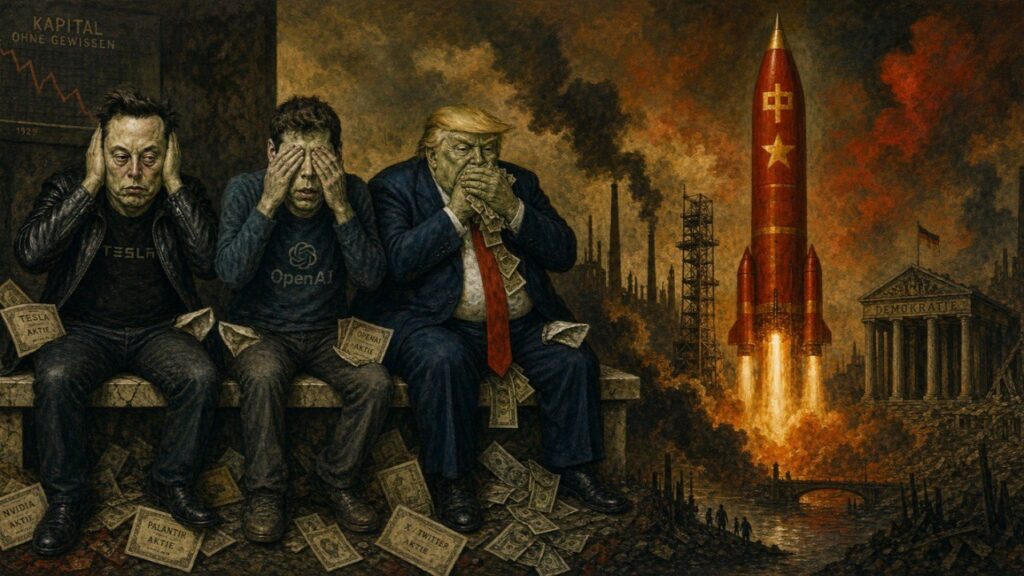
These three grifters were going to screw us anyway.

By Scott Ortkiese | July 22, 2026 | Email: so@throughlinesynthesis.com
Scott Ortkiese | July 22, 2026 | Email: so@throughlinesynthesis.com
Introduction
Empires that cannot compete cheat. That is the pattern, and the United States is not exempt from it. British textile mills tried to ban Indian cotton finishing, French vintners tried to ban Algerian wine, American automakers tried to ban Japanese imports, and each time the tariff or the sanction was defended as a national security necessity while the underlying industry rotted from within. What is happening this week in American AI policy is the same reflex, wearing the same costume, marching to the same music. The three companies at the center of the $3.6 trillion American AI IPO complex, SpaceX with its xAI segment, OpenAI, and Anthropic, cannot beat the Chinese labs on price, on capital efficiency, or on ecosystem access. So Washington is going to rig the game.
The proximate trigger is Kimi K3. Beijing based Moonshot AI released a 2.8 trillion parameter open weight mixture of experts model on July 16, 2026, dated the downloadable weights for July 27, and inside seventy two hours had taken the number one spot on Arena.ai‘s Frontend Code leaderboard with a 1,679 Elo score, beating Anthropic’s Claude Fable 5, jumping seventeen places from Kimi K2.6 (Fortune, Axios, Santage). Moonshot’s list price is fifteen dollars per million output tokens against roughly fifty dollars for Fable 5 and thirty dollars for GPT 5.5, and its earlier Kimi K2.7 Code has been generally available inside Microsoft’s GitHub Copilot on Azure since July 1, 2026 (Tech Times). Further down the same stack, DeepSeek V4 Pro is selling frontier class inference at eighty seven cents per million output tokens, roughly one thirty fourth of GPT 5.5 (Decision and Law). Moonshot suspended new subscriptions two days after the K3 release because demand overflowed its GPU capacity (Euronews).
I want to lay out what has actually happened to the balance sheets of the three American IPO candidates, then set those numbers against what Moonshot, DeepSeek, and Alibaba are doing, and finally show why the collision of the two produces exactly the kind of policy response we are watching Washington reach for. The story on the American side is that all three companies are burning capital at a rate that cannot survive Chinese pricing, and the Chinese side has funded a durable pricing floor lower than the American cost of goods. There is no version of this competition the American labs win on economics. The only way to preserve the trillion dollar valuations is to remove the Chinese from the game by executive order. That is exactly what the administration is now doing, and it is exactly what a dying empire does.
The American Balance Sheets: What Actually Sits On The Ledger
Let me start with what the three American players look like as of the latest disclosures.
OpenAIended the first quarter of 2026 with roughly $73 billion in cash and marketable securities on hand, up from $40 billion at the end of December 2025 after the $122 billion round closed in March at an $852 billion post-money valuation (Lapaas Voice, Bulios, Bloomberg, CNBC). Revenue was $5.7 billion for the quarter, a $25 billion annualized run rate, against a $3.7 billion cash burn, a $9.3 billion operating loss, and a $21.3 billion GAAP net loss when including non-cash restructuring charges (Value Add VC, LinkedIn Kredixai, Creeta). Cash burn is guided at $25 to $27 billion for full year 2026, rising to $57 to $63 billion in 2027 as the renegotiated Microsoft compute arrangement kicks in, and OpenAI’s own internal planning has modeled cumulative cash burn reaching $218 billion by 2030 in the slower revenue scenario (Value Add VC, Field Notes, Luminix). Against the $73 billion cash pile, OpenAI has pre-committed more than $600 billion of cloud provider payments over the next several years (Creeta). At the current burn trajectory, the cash lasts roughly five years. At the 2027 guided burn rate, it lasts eighteen months. Note also that revenue growth has flattened. The company’s run rate held near $25 billion from February through July while ChatGPT weekly active users plateaued around 900 million against a 1 billion internal target (Value Add VC). That is the flattening that ended the 2001 dotcom cycle in miniature, and it is happening while the compute bill is still climbing.
Anthropicfiled a confidential S-1 with the SEC on June 1, 2026 after closing a $65 billion Series H at a $965 billion post-money valuation in March, roughly ten weeks earlier (Anthropic, Reuters, Fortune). Run rate revenue climbed from $9 billion in December 2025 to $47 billion in May 2026 and an estimated $69 billion by early July (Value Add VC, Revenue Memo). Actual 2026 revenue is expected in the $20 to $26 billion range against about $12 billion of training spend and $7 billion of inference spend, and internal projections put Anthropic’s cash burn at roughly one third of revenue in 2026 falling to single digits in 2027 (Revenue Memo). SemiAnalysis has modeled a $1 billion operating profit in the third quarter of 2026 at a six percent operating margin (ChainCatcher). Two structural risks sit on the ledger. First, Anthropic pays xAI $1.25 billion per month for compute through May 2029, roughly $50 billion of total commitment, on a contract with a ninety day termination clause (Digital Applied). Second, OpenAI publicly disputes Anthropic’s revenue accounting, arguing that the true net number is closer to $22 billion because Anthropic books gross customer spend on Amazon Bedrock, Google Vertex, and Azure as revenue and treats hyperscaler payouts as expenses. That accounting question is now an S-1 disclosure issue.
SpaceX and xAIfiled the S-1 in April 2026 at a $1.77 trillion target valuation, priced the offering in June, and the xAI segment inside the filing shows $3.2 billion of revenue against a $6.4 billion operating loss in fiscal 2025, a negative two hundred percent operating margin, worsening from a negative sixty percent margin the year before (Motley Fool, TechCrunch, Gadget Review). First quarter 2026 xAI revenue was $818 million against a $2.47 billion operating loss, an annualized negative three hundred and two percent margin. Capex was $12.7 billion in fiscal 2025 with another $7.7 billion in the first quarter of 2026 alone. Then the balance sheet tells a specific story that the IPO narrative did not. In the last reported quarter, SpaceX cash on hand fell from $24.75 billion to $15.85 billion, a $9 billion drop in ninety days, and in June the company priced a $25 billion bond offering across multiple tranches at 5.35 to 5.65 percent, roughly $1.5 billion in annual interest expense, to replace $20 billion of junk and leveraged debt at X and xAI that had been running at 9.5 to 12.5 percent (Investing.com, Yahoo Finance, Globe and Mail). Fortune reported in the same window that hyperscaler bond demand collapsed, with the demand-to-supply ratio falling from roughly five times in February 2026 to under two times in July 2026, meaning the market is already asking for wider spreads to absorb further AI-infrastructure paper (Fortune). Musk is levering into a market that is losing appetite for the paper, precisely to fund an AI segment that is losing three dollars for every one it earns.
Put the three together. The American AI IPO complex has roughly $100 billion of cash on hand across the three companies, is burning $50 to $60 billion of that cash a year in aggregate, has pre-committed north of $700 billion in cloud infrastructure payments, and depends on an equity market willing to buy $3.6 trillion of new offerings at valuations that require every one of these companies to reach cash flow positive by the end of the decade. That is the position the American players occupy on July 21, 2026.
The Chinese Balance Sheets: What A Real Industrial Policy Looks Like
Now let me lay out the Chinese side.
Moonshot AIclosed a roughly $2 billion round in May 2026 led by Meituan’s Long-Z Investments at a $20 billion valuation, is now in late-stage talks for another $2 billion round at $30 to $50 billion pre-money ahead of a targeted Hong Kong listing in the fourth quarter of 2026 or the first quarter of 2027, and has raised roughly $3.8 to $6 billion in cumulative capital since founding (The AI Rankings, Yahoo Finance, Unite AI, Caproasia). Cash reserves at the last disclosed round were roughly 10 billion renminbi, about $1.4 billion (Ground News). Annual recurring revenue passed $200 million by April 2026 (bota.chat). Alibaba is the largest outside shareholder at a reported 36 percent stake acquired for $800 million in February 2024. Tencent, Meituan, IDG Capital, HongShan, HSG, China Mobile, Tsinghua Capital, and CPE Yuanfeng round out the cap table. That last group of names matters. Meituan brings the largest food delivery and local-services distribution network in China. China Mobile brings the mobile spine. Tsinghua Capital brings state academic linkage. Alibaba brings the cloud infrastructure Moonshot runs on and the outbound distribution to a hundred million small businesses. This is not a Silicon Valley cap table wrapped in a Chinese label. It is an industrial coalition financing a strategic capability at less than one tenth of the capital American IPO investors are being asked to put up.
DeepSeekclosed a $7.4 billion first external round in June 2026 at a $50 to $59 billion post-money valuation, led by Tencent’s $1.4 billion, CATL’s $600 million, and founder Liang Wenfeng’s personal $3 billion commitment through a limited partnership structure that preserved his control (Reuters, China Innovation Watch, BEXORN, Sacra). The Chinese National AI Industry Investment Fund contributed 1 billion renminbi, alongside JD.com, NetEase, and IDG Capital. Fewer than ten investors participated. The follow-on round now under discussion targets $71 billion pre-money, and a mainland China IPO filing is expected later in 2026 with a public debut in 2027 (Reuters, Nirav Shah). DeepSeek V4 Pro sells frontier inference at ninety cents per million output tokens. Kimi K2 Thinking, the model that led directly into K3, was trained for roughly $4.6 million (Intelligent Living). Liang, at 78 percent equity post-round, is now Bloomberg’s richest AI founder, ahead of Dario Amodei and Greg Brockman combined (Straits Times).
Alibabais the closest structural analog to what Microsoft-plus-OpenAI is supposed to be, except it works. The company committed 380 billion renminbi, roughly $56 billion, over the three fiscal years from FY26 through FY28 to cloud and AI infrastructure, with recent updates pushing that figure toward $69 billion, and it is targeting more than $100 billion in annual external cloud and AI revenue within five years (Investing.comAlibaba, Theia, Disrupts). The important number is not the top-line commitment. It is the funding source. Joe Tsai has been explicit that the $56 billion is funded from the roughly $25 billion in annual free cash flow the e-commerce business already produces (HackMD). Alibaba trades at fourteen times forward earnings, its market cap is above $200 billion, its cloud unit grew 26 percent year on year in the latest quarter (DCD), and it does not require the American retirement saver to underwrite its AI capex.
Add Tencent, ByteDance, Xiaomi, MiniMax, Zhipu AI, and MiMo to the picture and you get the same pattern replicated across a dozen labs. Tencent runs at roughly $11 billion of annualized AI-related revenue and 1.4 billion WeChat monthly active users (AI in China). ByteDance private market valuation is around $550 billion. Every one of these labs is either profitable, close to profitable, or explicitly funded by parent free cash flow rather than convertible notes and speculative equity rounds.
Now hold the two side by side.
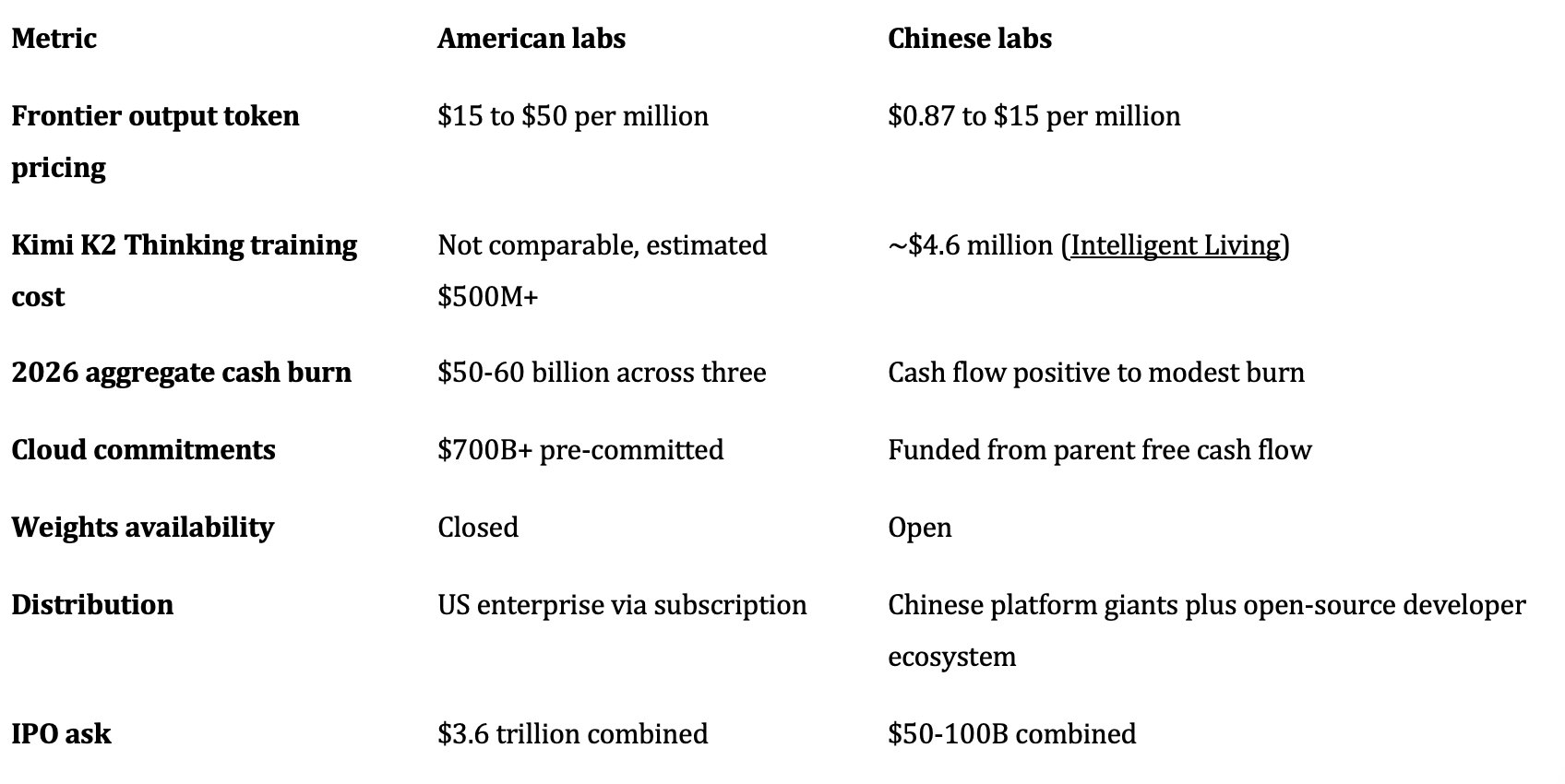
The gap is not incremental. It is structural. The Chinese labs are running at price points below the American labs’ cost of goods sold and doing it with roughly one thirtieth of the aggregate capital consumption. The Kimi K3 release is what happens when you compound that structural advantage for two more quarters. And the Kimi K3 release is also what makes the American IPO complex mathematically unfinanceable in an honest market.
The Real Comparison, Company By Company
Musk against Moonshot and DeepSeek.SpaceX’s IPO valuation depends entirely on the AI TAM narrative in the prospectus. Falcon and Starlink justify perhaps $400 billion in total. The remaining $1.37 trillion sits on xAI. xAI in the first quarter of 2026 generated $818 million of revenue at a $2.47 billion operating loss. Moonshot in the same window generated roughly $50 million per quarter at cash flow modestly negative, valued at $20 billion by an industrial coalition. Grok’s product differentiation was less filtering, faster response, more aggressive pricing. Kimi K3 is now less filtered, faster, cheaper, and downloadable. The developer testimony David Sacks amplified this weekend, that Kimi K3 fixed cybersecurity issues Codex and Fable had refused to touch, is not an isolated data point. It is the pattern. Musk cannot compete with an open weight model at fifteen dollars per million output tokens using a closed model priced above him and losing money at that price. And Musk is now in the position of having sold Anthropic $50 billion of forward compute commitment as a load-bearing xAI revenue line, on a ninety day termination clause. If Anthropic exercises, xAI loses roughly a third of its revenue and Musk’s IPO story fails outright. If Anthropic does not exercise, Anthropic bleeds an additional $50 billion into a compute lease it no longer needs at market clearing rates. Either way, one of the two IPO stories fails, and probably both.
Altman against DeepSeek and Alibaba.OpenAI is not filing yet because the numbers do not survive S-1 disclosure. A $73 billion cash pile sounds like runway until you place it against a guided $57 to $63 billion 2027 burn rate, a $600 billion pre-commitment to Microsoft and Oracle, and a run rate that has flattened at $25 billion for five months while ChatGPT’s user base plateaued below the internal target. Altman needs the IPO to close before the market prices in the flattening. He needs a moat argument that Kimi K3 just kicked out from under him, because the Chinese labs are not merely undercutting his prices, they are undercutting his cost structure. DeepSeek’s inference costs are so low that Liang can price V4 Pro at ninety cents per million output tokens and still fund his own $3 billion equity check. OpenAI paid $17.2 billion to Microsoft for compute in 2025 alone. Every enterprise customer OpenAI serves at a positive gross margin is a customer that could be served at ten times better economics by DeepSeek, Moonshot, or Qwen. The moat is not narrowing. It has already dissolved.
Amodei against Moonshot directly.Anthropic is the cleanest case because Kimi K3 dethroned Claude Fable 5 on the exact benchmark Anthropic has spent two years building brand equity around, front-end coding. Sonnet 4.6 pricing at $15 per million output tokens is now the market ceiling not the market floor. Anthropic’s forty percent gross margin, already twenty three percent above projected inference cost, was built assuming a pricing environment that Moonshot’s fifteen dollar per million output token release has just capped. Anthropic’s Series H closed at $965 billion in March. The confidential S-1 went to the SEC on June 1. Ten weeks separated the two, which is the tell. Anthropic filed because it needed to lock the valuation in before Q3 2026 data would allow the market to price the Chinese pressure. Moonshot filed its shareholder resolution to list in Hong Kong on July 20 at a targeted $30 to $50 billion valuation. Anthropic will be marketing against Moonshot’s IPO road show in the same quarter, and Moonshot will be pricing at roughly one thirtieth of Anthropic’s expected valuation on comparable model quality and vastly better unit economics. There is no coherent story an underwriter can put in front of institutional buyers that survives that comparison.
The Trump Administration’s Response Is Exactly What Dying Empires Do
The Trump administration has read this collision correctly, and its response is the response every dying industrial power has produced when it cannot compete on merit. Ban the import. Sanction the exporter. Wrap the tariff in a national security justification. Wrap the state equity stake in a public interest narrative. Wrap the regulatory capture in a safety concern. Sam Altman, Dario Amodei, and Elon Musk have each spent 2026 in the West Wing arguing that Chinese open weight models are a security threat that Congress must address before American businesses adopt them at scale, because in an open market they cannot survive Chinese competition on price.
The instruments are already in motion. A bill was introduced in Congress in June 2026 to bar Chinese AI models from federal agencies (Reuters). The White House quietly imposed a cybersecurity review that limited OpenAI’s newest model, GPT 5.6 Sol, to administration approved customers in late June, functionally an export control run domestically (AP, WSJ, CNN). The proposal for a five percent government equity stake in OpenAI has resurfaced, a state retainer paid in shareholder dilution for the promise of regulatory protection against Chinese competition. OpenAI’s chief global affairs officer, a former Trump lawyer, published an essay last week asking effectively how the American AI industry could be expected to compete against a free downloadable model, and answered his own question by lobbying for procurement walls. The next step, telegraphed but not yet executed, is a directive under existing export control authorities to bar American cloud providers from hosting Chinese open weight models, which would in practice force Microsoft Azure, AWS, and Google Cloud to unwind the K2 and K3 integrations their own enterprise customers just demanded.
Every one of these instruments is a bailout of Musk, Altman, and Amodei. Every one raises the marketable enterprise value of the three IPOs at the direct expense of the American application layer, the American open source developer community, the American small business AI budget, and ultimately the American retirement saver who will still be told to buy the three offerings at their pre-collapse marks. Chamath Palihapitiya, who is closer to David Sacks than anyone else in the AI policy debate, described the situation last week as forcing American companies to run at fifty to one hundred times competitor costs and compared it to the government mandating that Americans buy oil at eight hundred dollars a barrel when the world price is eighty. Chamath is describing exactly what the administration is doing. He and Sacks will continue to tweet occasionally about competition to protect their libertarian bona fides, and they will continue to help deliver the protection. The complaint is theater. The subsidy is real.
This is what an empire does when it stops being able to compete. American textile mills demanded tariffs against Indian and Chinese fabric in the late nineteenth century when British Manchester was undercutting them. British car manufacturers demanded quotas on Japanese imports in the 1970s when Toyota was undercutting them. American steel demanded Section 232 relief in the 2000s when Chinese steel was undercutting it. Every one of those industries was told that a national security wall would give them time to modernize. Every one of those industries used the wall to defer modernization instead, and then collapsed anyway. Musk, Altman, and Amodei are executing the same play, compressed from forty years into forty months. They cannot outbuild the Chinese labs on capital efficiency because their cost structures were engineered for a monopoly rent extraction that Kimi K3 has just proven unenforceable. They cannot outprice the Chinese labs on tokens because their compute costs are two orders of magnitude too high. They cannot out-distribute the Chinese labs because Alibaba, Tencent, ByteDance, and Meituan collectively command a distribution stack that no combination of Microsoft, Amazon, and Google can replicate for open weight releases in the Global South. So they are asking for the ban. They will get some version of it. And they will use it exactly the way every previous protected industry used it, to defer the reckoning, extract public capital through the IPO window before the wall breaks, and pay themselves through the fee stack and lockup mechanics I laid out in “The 1.77 Trillion Hoax” and “AI IPOs: Lost in Space.”
There is nothing American about this. Americans, in the founding mythology and in the industrial history that produced our best decades, competed. We competed with better ships, better cars, better semiconductors, better software, better logistics, better capital allocation. The dying empires we defined ourselves against, British textiles, French agriculture, Soviet electronics, Japanese banking, all reached a point where their political class decided that protection was cheaper than reform. That is where we are now. The three IPOs are a bet that the American public will not notice the transition and will pay for the deferral through their retirement accounts, their federal procurement dollars, and their higher inference bills. The bet is likely to work in the short term, and it will unwind the same way every previous version has, publicly and expensively.
Where This Actually Ends
The correct industrial policy response to Kimi K3, if the objective were to preserve American technological competitiveness rather than three IPO capital raises, has been sitting in plain view since DeepSeek V3 shipped in January 2025. It is a two part answer.
First, the application layer. If the frontier model layer is commoditizing because Chinese state industrial policy decided to make it a public good, the American opportunity is to build the domestic ecosystem of applications, tools, agents, and vertical products that consume whatever model is best and cheapest. That ecosystem does not need OpenAI or Anthropic to be trillion-dollar companies. It needs cheap inference, open weights, and a competitive domestic developer market. Every ban on Chinese models inside American procurement raises the cost of that ecosystem and cedes the application layer to whichever jurisdiction runs cheaper compute.
Second, industrial data sovereignty, the thesis I have laid out in “The Data Sovereignty Trap.” Proprietary operating data from advanced manufacturing, energy production, chemical processing, refining, pipeline operations, semiconductor fabrication, and grid management is not on the public internet, is not in Common Crawl, and is exactly the substrate a durable industrial AI moat requires. The country that controls that data and attaches it to whatever commodity model wins is the country that captures the value. The United States still holds that data. Chinese labs have been strategic enough to release model weights for free while their state industrial policy focuses on locking in the operating data feedback loops. American policy is doing the opposite. It is protecting the frontier model layer, which is already lost, and neglecting the industrial data layer, which is still winnable.
Neither of these paths requires banning Chinese models. Neither requires state equity stakes in OpenAI. Neither requires David Sacks lobbying for a stripped safety layer on Codex to match Kimi K3’s willingness to answer any prompt. Each requires the honesty to admit that the three IPOs were priced against a competitive structure that has not survived first contact with the Chinese open weight ecosystem, and that the American public should not be conscripted into buying the gap through their retirement accounts.
Coda
Empires that cannot compete cheat, and the empires that cheat the hardest are the ones already in decline. Musk needs the SpaceX IPO to price at $1.77 trillion before the market absorbs what the xAI segment actually costs to run. Altman needs the OpenAI IPO to reach a trillion dollars before the run-rate flattening becomes undeniable in the S-1. Amodei needs the Anthropic IPO to close in the fourth quarter before Moonshot’s Hong Kong listing prints a comparison multiple that his own bankers cannot explain away. All three need Washington to remove the Chinese labs from the American market before the domestic customer base finishes migrating to the Chinese stack, which by the July 27 K3 weights release will be a rational purchasing decision for every corporate CFO in the country.
Washington will oblige, because Washington does not know how to do anything else. The bill will be paid by American retirees, American small businesses, and American developers. The Chinese labs will continue to compound at Chinese cost structures. Alibaba’s e-commerce free cash flow will continue to fund AI infrastructure at rates our public markets cannot match without dilution. And the fourth of July article I wrote three weeks ago about the American republic that nobody kept will look tame compared to the industrial policy record we are writing this month.
There is a version of this story where America competes and wins. It is not the version Musk, Altman, and Amodei are selling, and it is not the version the White House is drafting the executive orders around. The version where America wins requires acknowledging that the frontier model layer has already been priced to zero by an industrial competitor that we underestimated for exactly one calendar year, and pivoting to the application and industrial-data layers where the American advantage is still real. Everything else is a cheat, wrapped in a flag, sold to a public that is being asked to fund the deferral through the retirement accounts we told them were safe.
The Kimi K3 weights ship in six days. The IPO road shows follow. We are about to find out which one the market believes.
Scott Ortkiese is the author of Faulkner Capital Holdings analysis on U.S. decline, AI industrial policy, private credit, and the multipolar transition. Contact through Throughline Synthesis.