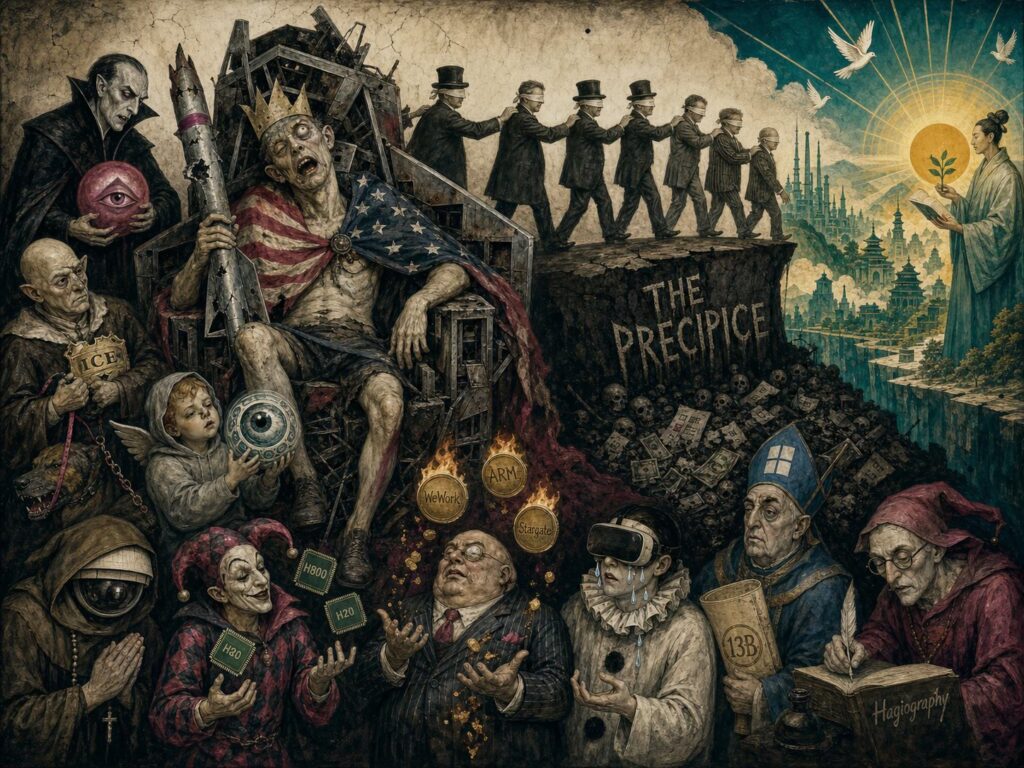
THROUGHLINE SYNTHESIS GROUP
PART II OF THE REVOCABLE EMPIRE*
Note: This is the short version of a 20,000-word article; please contact me at so@throughlinesynthesis.com to inquire about the full-length article.
Open-Source Now Wins on Security, Pricing, and Performance, and the Trap Is Closing on American Greed.
Scott Ortkiese | 2 August 2026 | so@ThroughlineSynthesis.com
In 2015 and 2016, the convicted sex offender Jeffrey Epstein invested forty million dollars into two funds managed by Valar Ventures, the New York fintech venture-capital firm co-founded by Peter Thiel. As of last summer, that stake was worth approximately one hundred seventy million dollars. It is the single largest remaining asset in Jeffrey Epstein’s estate. It is locked inside Thiel’s illiquid funds. And the proceeds, when they eventually distribute, will be paid not to Epstein’s victims but to his estate’s beneficiaries.
In May 2026, three months after the New York Times printed a second investigation naming Thiel across the Epstein archive, Thiel bought a twelve-million-dollar mansion in Buenos Aires and moved his family to Argentina.
That is not a coincidence with the American artificial-intelligence story. It is the American artificial-intelligence story, told through one of its principal architects.
Yesterday, in Not a Cold War. A Market Rotation., I argued that Washington’s Cold War frame was the wrong frame for the U.S.-China artificial-intelligence (AI) race, and that China’s asymmetric strategy of exporting open-weight tools was already winning developer share on the world’s most honest revealed-preference index. That was the geopolitical layer.
This is the financial layer. Because if the American AI stack were financially healthy, the geopolitical rotation would still be losable but recoverable. It is not financially healthy. The July 2026 reporting cycle has now told us what the American AI stack actually looks like on its own balance sheet, and the picture is worse than most equity investors have priced.
The American AI cycle has stopped being a growth story. It is now a solvency story, and the American greed coalition is hanging itself with rope it manufactured, sold to itself, expensed as capital investment, and financed with paper the private-credit funds are still marking at par.
The coalition is not one company. It is a stack. The chip vendors (Nvidia, Advanced Micro Devices, Broadcom). The hyperscalers (Microsoft, Amazon, Google, Meta, Oracle). The two-name customer credit portfolio (OpenAI, Anthropic). The neoclouds (CoreWeave, Lambda, Nebius). The banks (Goldman Sachs, Morgan Stanley, JPMorgan, Barclays). The private-credit funds (Apollo, Blackstone, KKR, Ares, Blue Owl, Sixth Street). The venture capital houses (Sequoia, Andreessen Horowitz, Founders Fund). The law firms (Wachtell, Cravath, Skadden). The accounting firms (Ernst & Young, KPMG, PricewaterhouseCoopers, Deloitte). The comp consultants (Semler Brossy, FW Cook, Pearl Meyer). The captured press. The captured think tanks. The captured political apparatus. Each one takes a fee. None of them is accountable for the ending.
On the other side of the trade is China, deploying the same technology as public infrastructure, on open weights, at cost, to the entire Global South.
The $250 Billion Backstop
On 31 July 2026, the tech reporter Ed Zitron published a follow-up interview reporting a proposed transaction in which Nvidia would guarantee up to $250 billion of the SoftBank/SB Energy data center, while separately advancing an additional $350 billion of Nvidia graphics-processing-unit (GPU) financing to fill the same facility. In plain English, the chip vendor would guarantee the customer of its own chips, using its own money, to justify the construction of the data center that will house those chips.
This is a closed loop. It is the same closed loop that appears, in slightly different form, in every other backstop deal announced in the last twelve months.
The Cascade
FIGURE 1.
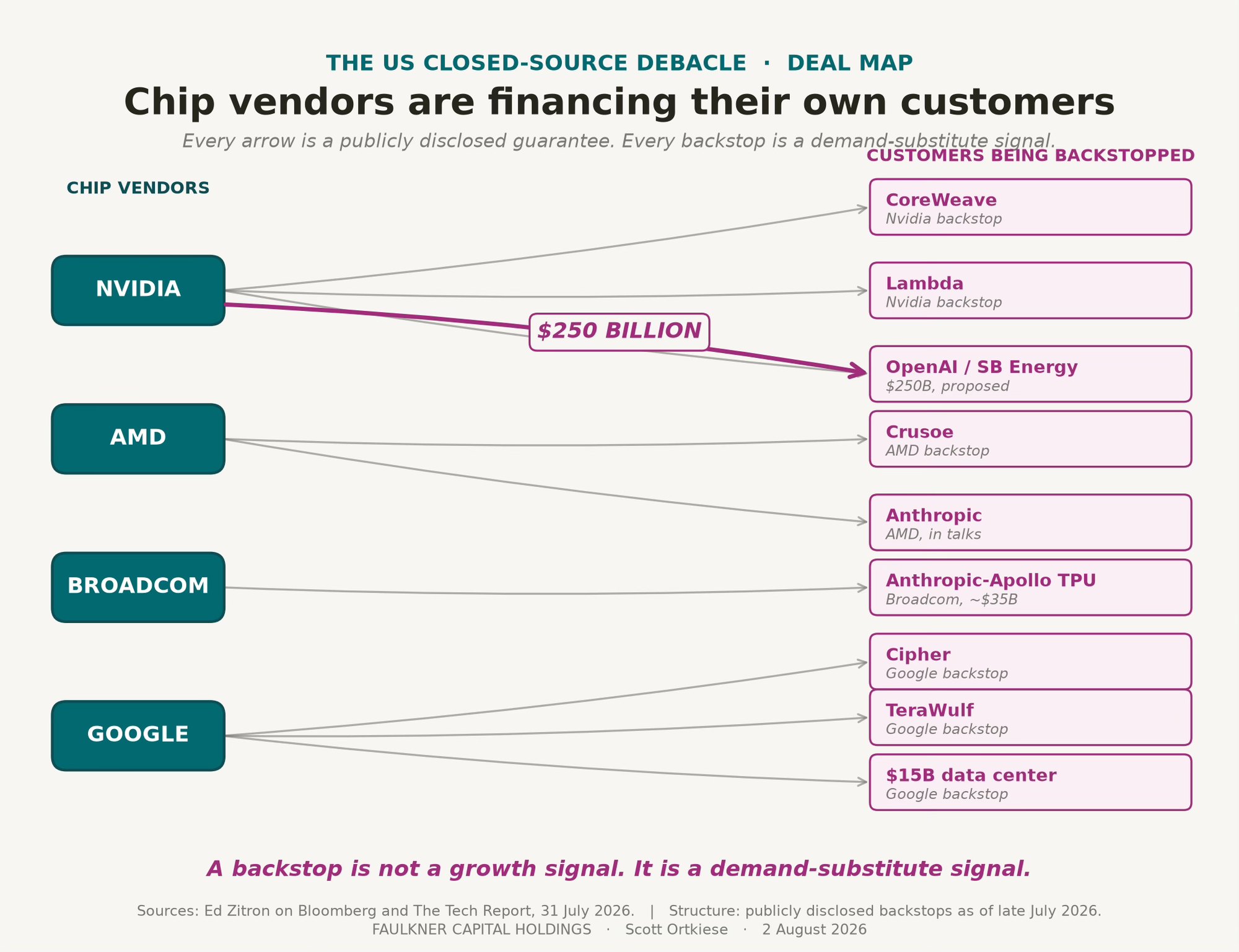
The US Closed-Source Debacle: Deal Map | Seven-plus publicly disclosed vendor-to-customer AI backstops. The chip vendors and hyperscalers are financing the customers who buy their output.
The Nvidia/SB Energy deal is not an isolated event. It is the largest node in a broader cascade of vendor-financed customer commitments.
1. Nvidia guarantees CoreWeave and Lambda. Both are neocloud (AI-first cloud) operators whose only meaningful customer is an OpenAI-adjacent workload.
2. Advanced Micro Devices (AMD) guarantees Crusoe and is in talks with Anthropic. The AMD/OpenAI deal, originally announced as 6 gigawatts (GW) of AI chip demand, was later quietly reframed as a warrant deal.
3. Broadcom guarantees an Anthropic-Apollo tensor-processing-unit (TPU) financing of approximately $35 billion. Apollo is a private-credit firm. This is the same debt product with a different customer wrapper.
4. Google guarantees Cipher, TeraWulf, and a new $15 billion data-center project. The Google contribution to the Anthropic 2027 spend is now estimated by UBS at $76 billion.
Seven-plus backstops from four chip vendors, financing the same handful of customers.
A backstop is not a growth signal. It is a demand-substitute signal. If the demand were real, it would not need to be guaranteed by the vendor.
What Failed Backstops Look Like
FIGURE 2.
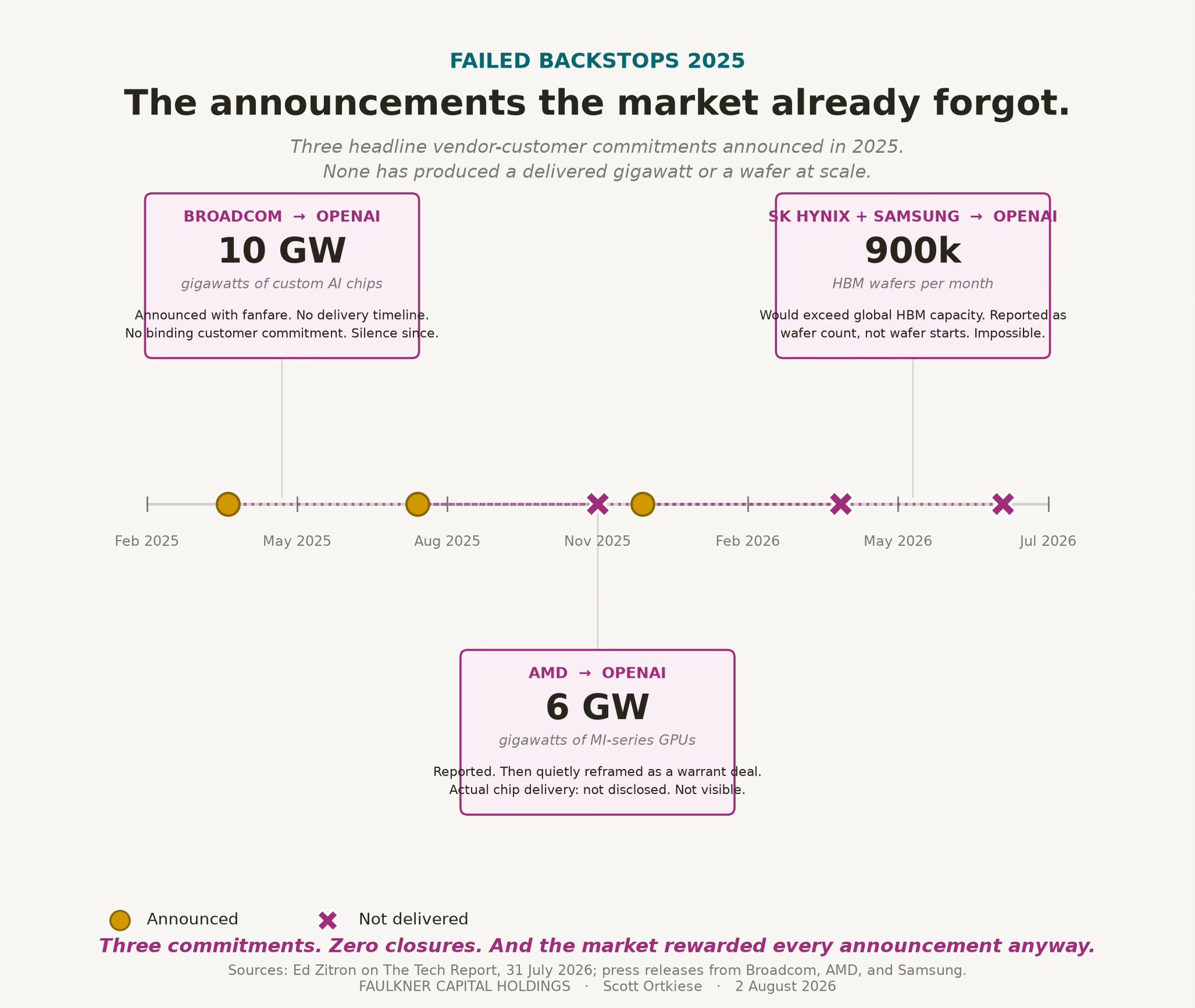
Failed Backstops, 2025 | Three prominent AI backstop announcements from 2025 that never converted. The cascade has a documented failure rate before it has a documented completion rate.
The cascade is not new. It is the second year of the same pattern. In 2025, three headline vendor-customer backstop deals were announced with fanfare, treated as bullish signals, and priced into equity valuations. None has produced a delivered gigawatt or a wafer at scale.
1. Broadcom to OpenAI, 10 GW of custom AI chips. Announced with fanfare. No delivery timeline. No binding customer commitment. Silence since.
2. AMD to OpenAI, 6 GW of MI-series GPUs. Reported. Then quietly reframed as a warrant deal. Actual chip delivery not disclosed and not visible.
3. SK Hynix plus Samsung to OpenAI, 900,000 high-bandwidth-memory (HBM) wafers per month. That number would exceed the entire global HBM capacity. It was reported as wafer count, not wafer starts, and is mathematically impossible at that scale.
Three commitments. Zero closures. And the market rewarded every announcement anyway.
The Post-Revenue Economy
FIGURE 3.
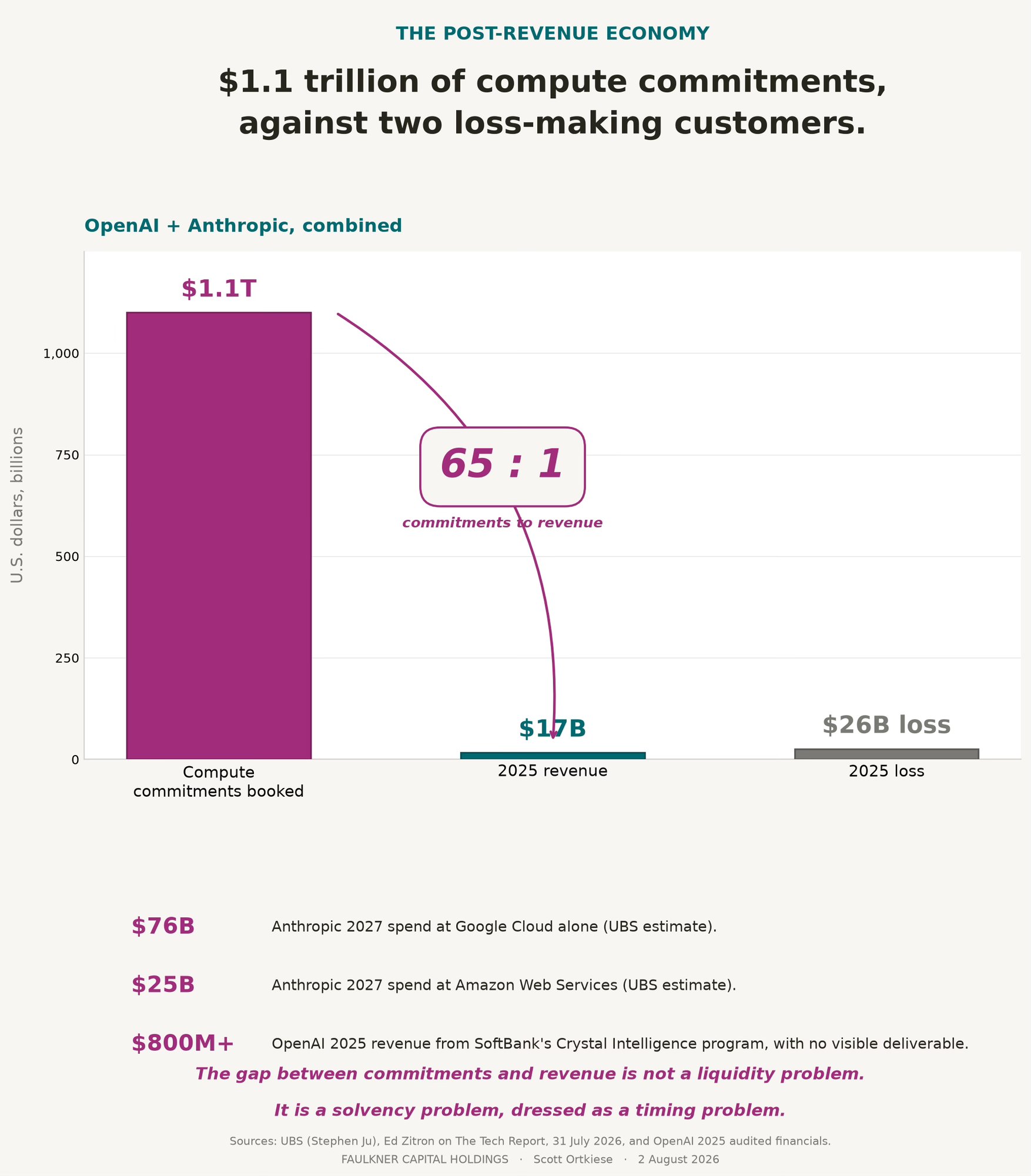
The Post-Revenue Stack: Commitments vs Revenue | Over $1.1 trillion of OpenAI and Anthropic compute commitments set against their disclosed annual revenue. The gap is what the closed loop was designed to paper over.
The scale of vendor backstops has to be measured against the scale of the customer’s obligations, not against the customer’s revenue.
1. OpenAI plus Anthropic have booked approximately $1.1 trillion of compute commitments through 2030, per Zitron’s reporting.
2. Combined 2025 revenue: roughly $17 billion. Combined 2025 losses: roughly $26 billion, of which $20.9 billion is OpenAI’s audited loss.
3. Anthropic’s projected 2027 compute spend, per UBS: $76 billion at Google Cloud plus $25 billion at Amazon Web Services (AWS), before its own revenue crosses $10 billion.
That is not a growth business under a J-curve. That is a company financing forward compute against revenue it does not have.
The point is not that the customers cannot grow into these obligations. The point is that the entire justification for the capital-expenditure (capex) cycle rests on that growth arriving on time, and there is no evidence in the price data that it is arriving.
The Credit-Market Tape
FIGURE 4.
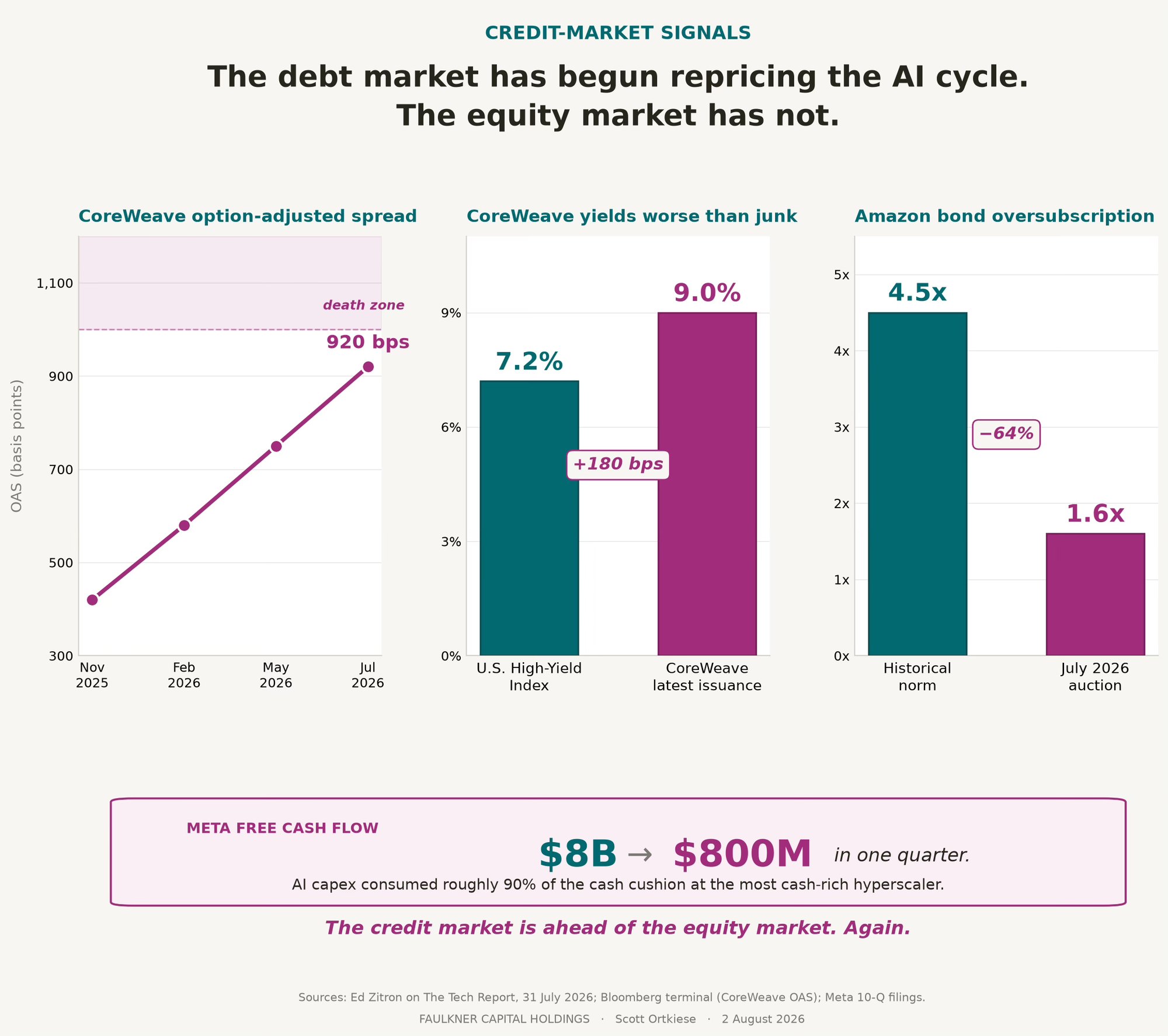
Credit-Market Signals: CoreWeave, Amazon, Meta | AI-linked spread widening at CoreWeave and Amazon, free-cash-flow compression at Meta. The credit market is already pricing an AI hyperscaler risk premium.
When equity markets and debt markets disagree, the debt market is usually right first. That is what makes the July 2026 credit tape the single most important data set of the cycle.
1. CoreWeave option-adjusted spread (OAS) blew through 900 basis points (bps). That is death-zone territory. It says the bond market thinks the company’s credit is impaired even though the equity market is still trading it as an AI growth story.
2. CoreWeave’s latest debt priced at roughly 9 percent yield, above the U.S. high-yield index at around 7.2 percent. CoreWeave is now paying yields worse than the average junk-rated borrower, in the sector everyone insists is booming.
3. The SB Energy Special Purpose Vehicle (SPV), branded through a U.S. Securities and Exchange Commission (SEC) filing as Cosmos LLC, issued approximately $999 million of debt. It is trading 200 bps wider than its issuance price.
4. Amazon’s July 2026 bond auction was oversubscribed only 1.6 times, against a historical norm of 4 to 5 times. That is Amazon, one of the most creditworthy borrowers on the planet.
5. Meta’s free cash flow collapsed from $8 billion to $800 million in one quarter. AI capex consumed roughly 90 percent of the cash cushion at the most cash-rich hyperscaler.
The credit market is ahead of the equity market. Again.
The 2008 Language Returns
Ed Zitron used a specific phrase in the interview, and it is worth quoting because the vocabulary tells us where the cycle is. He described what is happening in the neocloud debt stack as “financial innovation.” That is the language of the 2007-08 subprime cycle, in which collateralized debt obligations (CDOs), CDO-squared products, and synthetic exposures were sold as innovations right up to the point at which they detonated.
The parallel is not aesthetic. The mechanics are the same.
1. An asset with uncertain forward cash flow (a mortgage on a borrower whose ability to repay was speculative in 2007, or a compute commitment from a loss-making AI lab in 2026)
2. is packaged with vendor guarantees (monoline insurance in 2007, or chip-vendor backstops in 2026)
3. and sold to yield-hungry buyers (pension funds and structured-credit desks in 2007, or private-credit funds and neocloud bondholders in 2026)
4. until the underlying cash flow fails to arrive, at which point the guarantees are tested simultaneously, and the guarantors turn out to be exposed to the same risk they were supposed to be insuring.
Financial innovation is the sound a system makes when it is running out of real customers and starting to invent them.
Pricing Collapse
FIGURE 5.
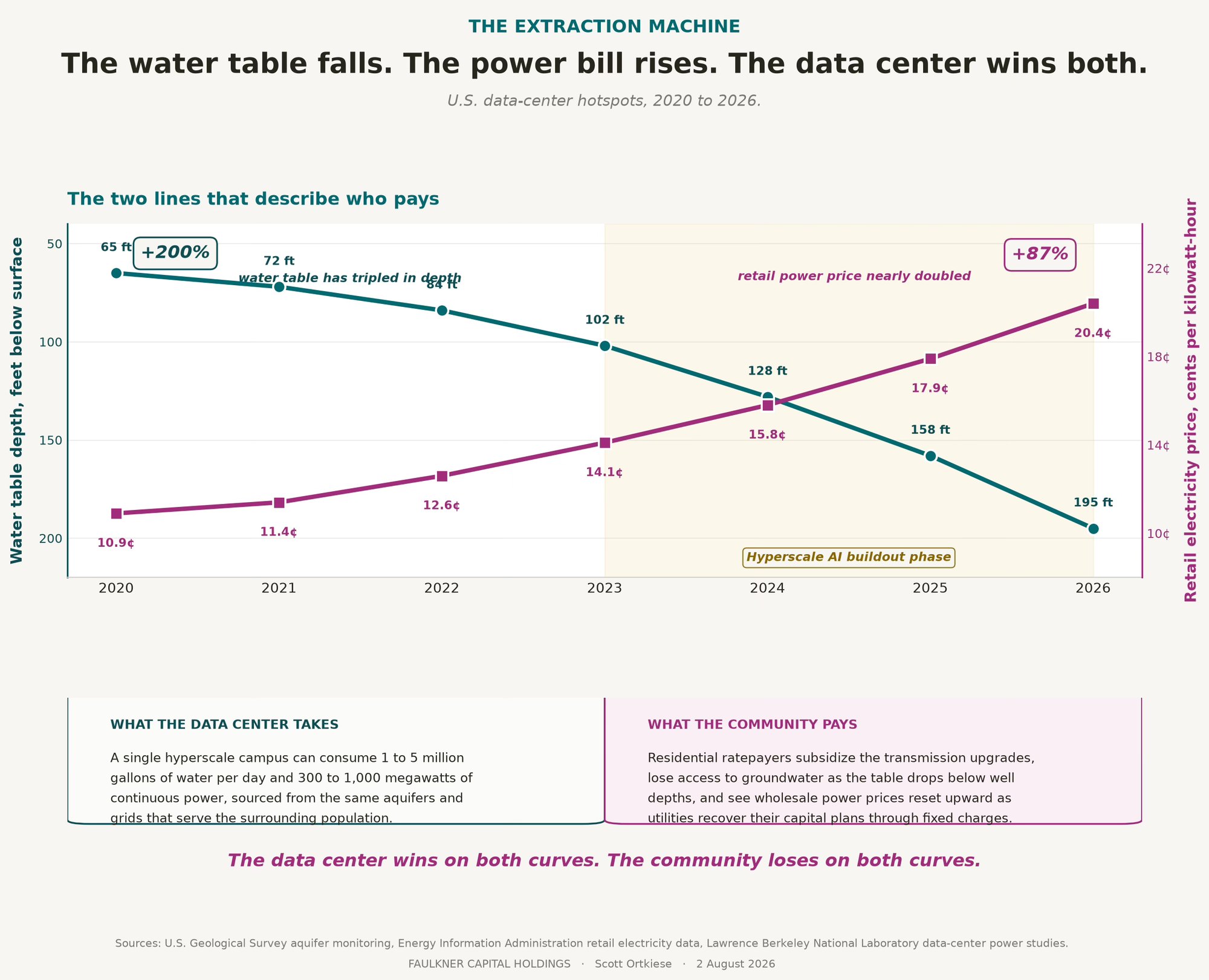
The Extraction Machine: Water Falls, Power Rises | Water tables in U.S. data-center hotspots are 200% deeper since 2020. Retail electricity is 87% higher. The data center wins both curves. The community loses both.
FIGURE 6.
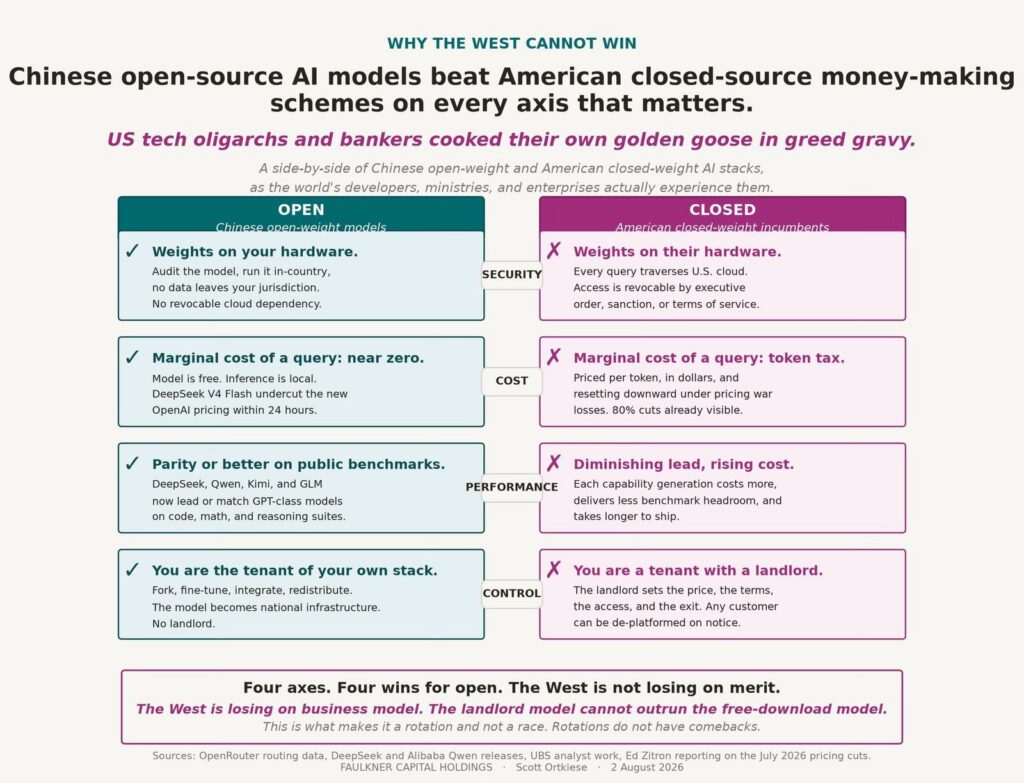
Why the West Cannot Win: Open vs Closed AI | Security, cost, performance, control. Four axes, four wins for the Chinese open-weight stack. The West is losing on business model, not on merit.
The post-revenue economy has one more feature that the market has not fully priced. Prices are collapsing at the top of the cycle, not the bottom.
1. OpenAI’s cheapest model, Luna 5.6, saw its price cut by roughly 80 percent. Its mid-tier model, Terror, was cut by roughly 20 percent.
2. DeepSeek V4 Flash undercut the new OpenAI pricing immediately, and Blue Origin instituted a token cap on its own API to protect margin.
3. This is not a pricing strategy. This is a pricing war among vendors who have already sold forward the compute they have and now cannot afford to lose the marginal customer.
When prices collapse and commitments do not, the gap becomes the loss. That is where a growth story becomes a solvency story.
What Fails First
If this cycle unwinds, it will unwind in a specific order.
1. Neoclouds first. CoreWeave and Lambda have the thinnest capital cushions, the most concentrated customers, and the credit spreads that already say the market has priced them for impairment.
2. Private-credit funds second. Apollo, Blue Owl, and Ares are all disclosed lenders into AI compute deals. They are marking these positions to model, not to market.
3. Chip vendors third. Nvidia, AMD, and Broadcom will be tested on the size of their backstops when the customers they backstopped cannot service the obligations they took on. Nvidia’s $250 billion SB Energy guarantee is the single largest such exposure ever underwritten by a semiconductor company.
4. Hyperscalers fourth. Meta’s cash-flow collapse from $8 billion to $800 million is the first sign that even the giants are running out of coverage. Google’s Anthropic exposure is now booked at $76 billion for 2027 alone.
5. Public equity last. It always is. That is why credit is a better read of the cycle than the S&P.
Why the West Cannot Win
The West is not losing because Chinese engineering is better. It is losing because the American AI stack is a rentier business, and the Chinese AI stack is public infrastructure. A rentier business cannot outrun a free-download business once the free download reaches performance parity. Performance parity has been reached. The rest is arithmetic.
Behind the four wins (security, cost, performance, control) sits an industrial base the American coalition has organized its lobbying strategy around pretending does not exist. Rare-earth refining at 85 to 90% global share. STEM graduates at three-to-one against the United States. Semiconductor Manufacturing International Corporation (SMIC) at 7 nanometers with Huawei’s Ascend accelerators within a factor of two of Nvidia’s H100. New power capacity at 400 gigawatts a year, most of it renewable, at half the American marginal cost. Data-center siting policy that puts hyperscale campuses where the water and power are, not where the tax abatements are richest. A domestic demand base of 1.1 billion internet users. State coordination without state capture of the fee stack. Batteries (Contemporary Amperex Technology Co Limited, or CATL, and Build Your Dreams, or BYD), solar (Longi, Jinko, Trina), electric vehicles, drones (DJI), robotics. Frontier research at Alibaba’s DAMO Academy, Huawei’s 2012 Lab, and the Chinese state quantum program feeding a public-goods release cadence across DeepSeek, Qwen, Kimi, GLM, ERNIE, Doubao, MiMo, Hunyuan, and LongCat. Alignment with the Global South that treats the Chinese stack as a sovereignty asset and the American stack as a revocable dependency.
Ten industrial capabilities, four axes of competition, one direction of travel. The coalition has decided to litigate against arithmetic. Arithmetic wins those cases.
Pax Silica Unmasked
Every declining empire names its extraction project after a peace. The Romans called it Pax Romana. The British called it Pax Britannica. The Americans called the postwar order Pax Americana. Each was a marketing document, applied by the beneficiaries to describe the extraction as a public service. The current label is Pax Silica. It is used by Palantir executives, Anthropic’s policy team, the Special Competitive Studies Project chaired by Eric Schmidt, the Center for a New American Security, the Hudson Institute, and a subset of the technology press that reports what the coalition tells it to report.
Pax Silica is a malignant, ego-driven, farcical moniker. It is self-congratulation dressed as strategy.
It is worth naming what the label conceals. The coalition’s conduct is not stewardship. It is four familiar drives.
1. Political capture. The federal government is now a shareholder in the AI cycle through executive orders, procurement contracts, and equity stakes. The coalition’s regulatory strategy is to make itself politically indispensable so that enforcement of existing disclosure and antitrust law becomes impossible.
2. Self-enrichment. The founders, general partners, and senior executives are running personal exit strategies. Sam Altman’s OpenAI equity, Dario Amodei’s Anthropic equity, Jensen Huang’s Nvidia stake, Masayoshi Son’s SoftBank portfolio, and the carried interest at Sequoia, Andreessen Horowitz, and Founders Fund represent a wealth transfer on a scale unseen since the Gilded Age.
3. Entitlement. The coalition operates on the presumption that it deserves to own the global AI infrastructure by virtue of having led on the technology first. That is the same claim the British East India Company made in 1780 and United States Steel made in 1890. Neither survived competition.
4. Contempt for the citizenry. The community-cost story, the retirement-portfolio concentration story, and the closed-loop financing story all rest on the same underlying attitude: that the American public exists to underwrite the coalition’s buildout through its rate base, its retirement accounts, its water table, and eventually its tax base.
The sanctimony inventory
Once the label is unmasked, the coalition’s foreign-policy narrative collapses on its own terms. The coalition vilifies China for behaviors the American AI stack demonstrably practices, at greater scale, with fewer disclosures.
1. Data harvesting. Trained on the entire public internet without consent. Accuses TikTok.
2. Surveillance. Every query logged in a United States-jurisdiction data center and available to executive order or subpoena. Accuses Chinese cloud services.
3. State direction. A full state-industrial policy of executive orders, procurement, and export controls. Accuses China of state capitalism.
4. Intellectual-property theft. Trained on every copyrighted book, article, image, and codebase without licensing. Accuses China of intellectual-property theft.
5. Human-rights abuse. Deployed inside a border and detention regime deporting people to third-country prisons without due process. Accuses China of human-rights violations.
Each accusation is not just hypocritical. It is projective. The coalition is describing itself.
How This Ends for America
If the coalition is losing on business model, and if it has captured the enforcement authority that would otherwise slow the reprice, what does the ending look like inside the United States? Six moves. Not speculation. Arithmetic.
1. Credit reprice completes. CoreWeave option-adjusted spread widens past 1,500 basis points. Amazon’s next AI-linked issuance prices 100 basis points wider. Meta’s free cash flow turns negative for two quarters. Private-credit AI portfolios at Apollo, Blackstone, KKR, Ares, Blue Owl, and Sixth Street begin to mark down. 6 to 12 months.
2. Equity reprice follows. Nvidia, Microsoft, Amazon, Meta, Alphabet, and OpenAI (once it lists) reprice by 30 to 50% as the closed-loop mechanics become visible on retail brokerage screens. 6 to 9 months after Move 1.
3. Retirement-wealth hit. With Magnificent Seven concentration at 30 to 40% of median household equity, wealth destruction from Moves 1 and 2 is $8 to $12 trillion. The 55-to-65 cohort takes the hit at the least recoverable point in the retirement lifecycle. This is the political detonator.
4. Political crisis. The federal government is a shareholder in the trade. Enforcement of disclosure or antitrust would impair its own equity. Remedies are blocked. Congressional hearings become theater. The Securities and Exchange Commission is captured. 2028 is fought over retirement-account destruction and bailout terms, and neither party is trusted to run either side of the trade.
5. Industrial hollowing. Utilities that overbuilt against AI demand are left with stranded transmission, stranded generation, and community water shortages. Public utility commissions reallocate the stranded costs, jurisdiction by jurisdiction, over 2027 to 2030. The reallocation is bitter, slow, and legally contested.
6. Dollar reprice. The Global South accelerates the renminbi-based and gold-based settlement architecture. The dollar’s share of global reserves falls below 50% by end-2028. The interest bill on federal debt rises to 30 to 40% of federal revenue. The fiscal state can no longer fund the military, entitlements, and AI industrial policy simultaneously. Something has to be cut.
Moves 1 through 3 are already in motion. Once Move 3 completes, the political window closes, and Moves 4 through 6 run on autopilot.
J’accuse…!
With apologies to Émile Zola. His 1898 letter named the principals of a national fraud, one by one, and refused to let the abstraction of “the state” absorb the names. This coda does the same. The Pax Silica coalition is not a policy consensus. It is a group of named individuals running a personal wealth transfer program financed by the American ratepayer, the American retirement account, and eventually the American taxpayer. The list follows.
J’accuse William H. Gates III, founder of Microsoft and long-term shareholder, for quietly selling sixty-five percent of the Gates Foundation Trust’s Microsoft position in the third quarter of 2025 while continuing to lend his personal credibility to the coalition’s public narrative that the closed-source AI cycle is a civilizational necessity. He is telling the public the story, and he is selling the stock (SEC 13F filing, Q3 2025).
J’accuse Satya Nadella, chairman and chief executive officer of Microsoft, for structuring the thirteen-billion-dollar OpenAI investment, marking the stake at approximately two hundred twenty-eight billion dollars, and signing the incremental two hundred fifty billion dollars of Azure commitments announced on 29 October 2025, without disclosing to Microsoft shareholders that the counterparty’s end-market revenue does not cover the compute bill (Microsoft 10-Q, Q3 FY2026; Microsoft IR transcript, 29 October 2025).
J’accuse Samuel Altman, chief executive officer of OpenAI, for converting a nonprofit charter into a public benefit corporation at a five-hundred-billion-dollar valuation on 28 October 2025, for lobbying the federal government to criminalize the open-source alternative that his own product cannot compete with on price, and for turning a mission of safe artificial intelligence for humanity into a private wealth transfer to insiders (BBC, 28 October 2025; Value Add VC, 30 October 2025).
J’accuse Dario Amodei, chief executive officer of Anthropic, for filing confidentially for an initial public offering at a nine-hundred-sixty-five-billion-dollar valuation on 1 June 2026 while running the same safety-to-cash conversion play that OpenAI ran, and for personally lobbying the federal government to restrict distribution of the Chinese open-source models that outperform his own product on the leaderboards (Bloomberg Billionaires Index, 29 May 2026).
J’accuse Jeffrey Preston Bezos, executive chairman and founder of Amazon, for committing thirty-three billion dollars of Amazon shareholder capital to Anthropic while marking the position at seventy-four billion dollars on the balance sheet, and for using his ownership of the Washington Post to provide editorial cover for the coalition’s policy narrative (Business Insider, 21 February 2026; StartupHub.ai, 10 June 2026).
J’accuse Lawrence J. Ellison, founder and chief technology officer of Oracle, for signing the three-hundred-billion-dollar OpenAI cloud contract on 10 September 2025, extracting one hundred billion dollars of personal paper wealth in a single trading session, and structuring the transaction to be paid for out of a federal backstop that has not been publicly voted on (Wall Street Journal, 11 September 2025; Fortune, 16 September 2025).
J’accuse Mark Elliot Zuckerberg, chairman and chief executive officer of Meta Platforms, for driving 2025 capital expenditure to seventy-two billion dollars with a ninety-three-percent growth rate and a guide of one hundred fifteen to one hundred thirty-five billion dollars for 2026, while Meta’s free cash flow collapsed by eighty-eight percent year over year in the third quarter of 2025, and for using his dual-class voting structure to make that trade unilaterally over shareholder objection (Meta 10-K, February 2026; Investing.com, November 2025).
J’accuse Jen-Hsun (Jensen) Huang, chief executive officer of Nvidia, for building his personal one-hundred-fifty-billion-dollar net worth on graphics processing units sold to customers who cannot pay for them without vendor financing from Nvidia itself, and for personally lobbying the export-control regime that forces the Chinese market onto Huawei silicon and forfeits Nvidia’s long-term Chinese revenue in exchange for the short-term mark (Nvidia Form Four SEC filings; Business Insider, September 2025).
J’accuse Masayoshi Son, chairman and chief executive officer of SoftBank Group, for concentrating SoftBank’s balance sheet in a single AI counterparty, for dumping SoftBank’s entire five-point-eight-billion-dollar Nvidia stake in October 2025 to redirect capital into OpenAI, and for chairing Stargate, the joint venture that gives structural cover to the closed-loop financing (Fortune, 11 November 2025; SoftBank annual report 2025).
J’accuse Sundar Pichai, chairman and chief executive officer of Alphabet, for signing a forty-billion-dollar investment into Anthropic in April 2026 conditioned on a two-hundred-billion-dollar reciprocal Google Cloud purchase commitment, running the same closed-loop structure the Wall Street Journal and Bloomberg have flagged at Nvidia and Oracle, at Alphabet’s scale (Yahoo Finance, April 2026; Reuters via The Information, April 2026).
J’accuse Peter Andreas Thiel, chairman of Palantir and co-founder of Founders Fund, for holding positions across every foundation model in the coalition, for using Palantir to sell the Claude model to the Pentagon under a contract the Trump administration signed while publicly labeling Anthropic “left-wing nut jobs,” for accepting a formal 2014 introduction to Jeffrey Epstein from his PayPal Mafia associate Reid Hoffman and by his own admission on the Joe Rogan podcast on 16 August 2024 calling that decision a “moral weakness,” for maintaining a documented multi-year correspondence with the convicted sex offender after Epstein’s 2008 conviction, for accepting a forty-million-dollar Epstein investment into two Valar Ventures funds in 2015 and 2016 that has since grown to approximately one hundred seventy million dollars and now stands as the single largest asset in Epstein’s estate, likely to be distributed to one of Epstein’s former girlfriends and two longtime advisers rather than to his victims, for exiting his California tax residency before the 1 January 2026 residency-trigger date written into Proposition 40, the 2026 Billionaire Tax Act certified for the 3 November 2026 ballot, and for purchasing a twelve-million-dollar mansion in Buenos Aires and moving his family to Argentina in May 2026 to escape the jurisdiction of the country whose ratepayers he expects to underwrite the AI buildout (New York Times, 4 June 2025; New York Times, 5 February 2026; House Oversight document release, 2026; Wall Street Journal 2023 reporting reviewed and re-reported by CNBC, 9 February 2026; Wikipedia entry on Peter Thiel, updated 2026; Jmail Encyclopedia, 13 February 2026; Stanford Daily, 5 February 2026; BBC News, 19 November 2025; New York Times, 28 May 2026; Los Angeles Times, 25 June 2026; CalMatters, 25 June 2026).
J’accuse Marc Lowell Andreessen, co-founder and general partner of Andreessen Horowitz, for authoring the “Techno-Optimist Manifesto” and co-authoring the “Little Tech Agenda” that provided the intellectual cover for the Trump 2.0 AI policy, for concentrating approximately forty percent of a forty-five-billion-dollar assets-under-management book into AI positions where his firm captures twenty percent of the upside, and for framing a personal carried-interest strategy as national purpose (Wikipedia entry on the Techno-Optimist Manifesto, 2024; Broadband Breakfast, 2 January 2025; Value Add VC, 13 June 2026).
J’accuse Elon Reeve Musk, chief executive officer of Tesla, SpaceX, and xAI, for merging xAI into SpaceX on 2 February 2026 at a combined one-point-two-five-trillion-dollar mark to consolidate two speculative valuations inside a privately held vehicle beyond public-market repricing, and for executing that transaction while serving inside the Trump administration as chair of the Department of Government Efficiency (SpaceXAI corporate entry via Wikipedia, February 2026; MEXC market summary, February 2026; Reuters, 6 January 2026).
J’accuse Reid Garrett Hoffman, co-founder of LinkedIn, Microsoft board member since 2017, and partner at Greylock Partners, for being the individual who made the 2014 introduction that placed Peter Thiel inside Jeffrey Epstein’s network, for writing to Thiel that Epstein was “mostly fun, very interesting guy, you may find him perverse, but very smart on biology, computation, macro econ,” for personally flying with Joi Ito to Epstein’s Little St. James island in November 2014, for hosting the July 2015 Epstein dinner with Zuckerberg, Musk, Thiel, and Chan that Epstein subsequently called “wild,” for reportedly sending Epstein a gift of ice cream with a note stating it was “either for yourself or for the girls,” for continuing to serve on the Microsoft board of directors while Microsoft structured the thirteen-billion-dollar OpenAI position that anchors the closed-source stack, and for functioning as the connective fixer between the Silicon Valley donor class and the political apparatus that has now criminalized the open-source alternative (Wall Street Journal 2023 reporting summarized by the National Legal and Policy Center, 15 October 2024; New York Post, 4 March 2026, summarizing Bloomberg News; CNBC, 9 February 2026; Kanekoa The Great summary of Bloomberg News reporting, 30 January 2026).
That is the roster. Every accusation above is documented on the public record. Every dollar quoted is in an SEC filing, a Bloomberg wealth-index calculation, a Wall Street Journal or Reuters or BBC or New York Times report, or a company investor-relations disclosure. There is no ambiguity. The Pax Silica coalition is a personal wealth-transfer program worn as a civilizational costume by the fourteen individuals named above, most of whom will not be inside American jurisdiction when the bill comes due.
The named men will not answer for this in a court. They will answer for it in the tape.
Coda: The Rope, the Merchant, the Buyer
Part I of this argument, published yesterday, ended with a specific claim: that the American AI stack is revocable, and that its revocability is the actual product being sold to the world. What China exports is a durable asset. What America exports is access.
Part II ends with a prosecutorial claim. The American AI stack is not only revocable to its foreign users. It is revocable to itself, by a coalition that is hanging itself with rope it manufactured, sold to itself, expensed as capital investment, and financed with paper marked at par. The rope is the closed-weight, token-tax business model. The merchant is Nvidia and Advanced Micro Devices and Broadcom and the hyperscalers that finance the customers who buy their chips. The buyer is a two-name credit portfolio, OpenAI and Anthropic, whose end-market revenue does not cover the compute bill and whose only path to solvency is a bailout characterized as national security.
The captured press calls the transaction growth. The captured think tanks call it Pax Silica. The captured political apparatus calls it national defense. It is none of those things. It is an extraction cycle, running past the point at which the extraction can be paid for, and the bill will be paid by the same American public whose retirement accounts, water tables, and electricity bills already paid for the buildout.
The credit market has begun to reprice this. The equity market has not. When the two converge, and they always do, it will not be a Cold War loss. It will be a market-rotation loss compounded by a capital-cycle loss, at the same time, in the same names, paid by the same public. The rotation is already happening. The reckoning is what happens next.
A note from the author
Scott Ortkiese is the founder of Faulkner Capital Holdings and writes on geopolitics, capital markets, and the political economy of empire. Part I of this series, Not a Cold War. A Market Rotation., was published on 1 August 2026. Part II builds on the framework introduced in Part I and shifts the focus from the geopolitical layer of the AI race to its financial and capital-market foundations.
Sources include Ed Zitron’s Bloomberg and Tech Report interviews of 31 July 2026, UBS analyst work published by Stephen Ju, OpenAI’s 2025 audited financial statements, and public filings by Broadcom, AMD, Samsung, Meta, and Amazon. All figures reported here are as of the published source date unless otherwise noted.
so@ThroughlineSynthesis.com · Scott Ortkiese · 2 August 2026
Related reading
- Not an AI Cold War: Rather, A Market Rotation in Favor of China.
- The Kimi K3 Reckoning: The AI IPOs Didn’t See It Coming
- The American AI Bubble Makes No Sense. Every Party to It Knows. It Is Happening Anyway. Why?
- The AI Oligarchs Delivered a “Useful Idiot” as the American President