
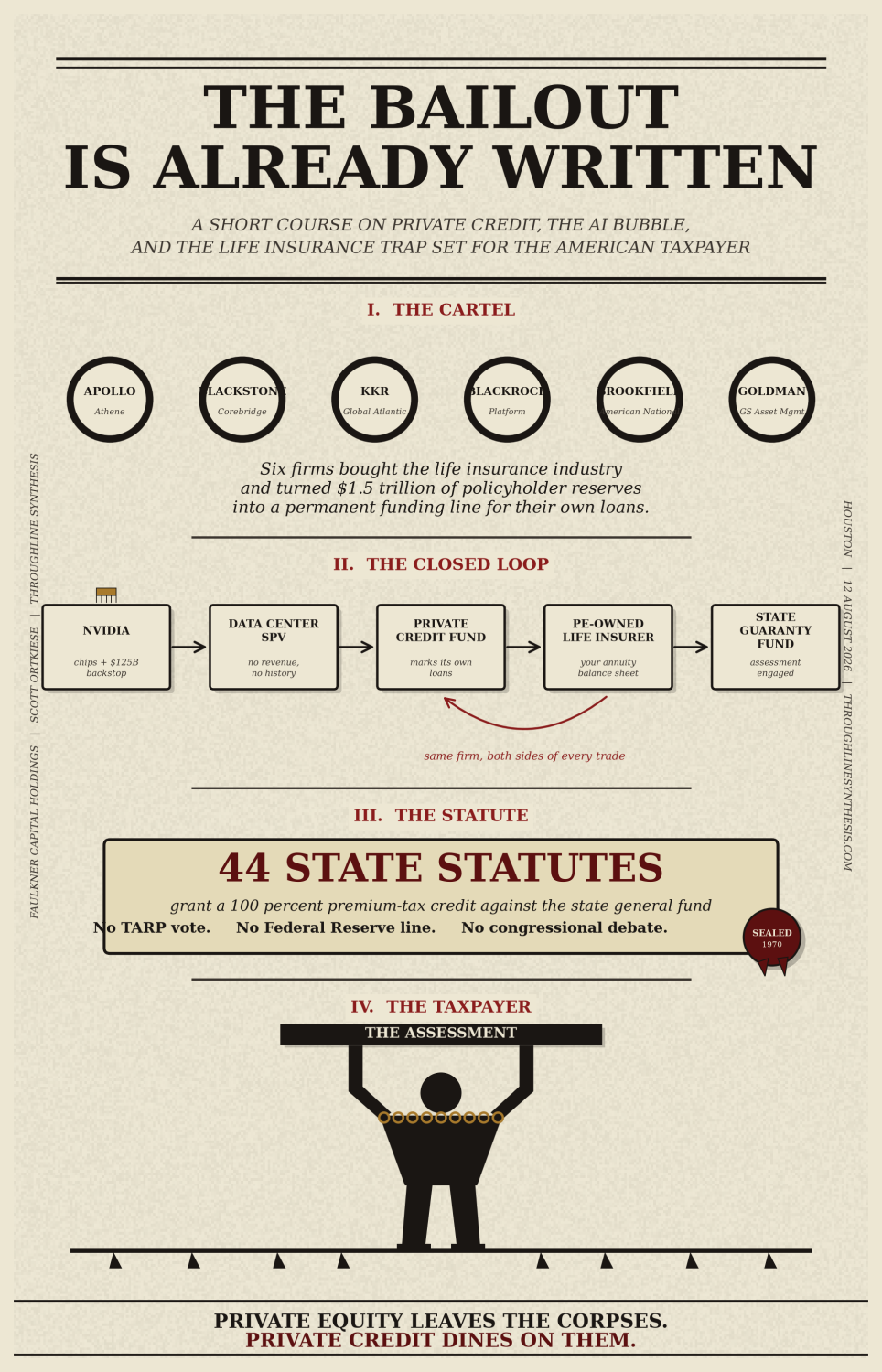
If you understand the difference between how a regular company fails and how a life insurer fails, you understand why the AI bailout has already been legislated, and why nobody will get to vote on it.
Scott Ortkiese | Throughline Synthesis | Houston, August 12, 2026
What a typical bankruptcy looks like
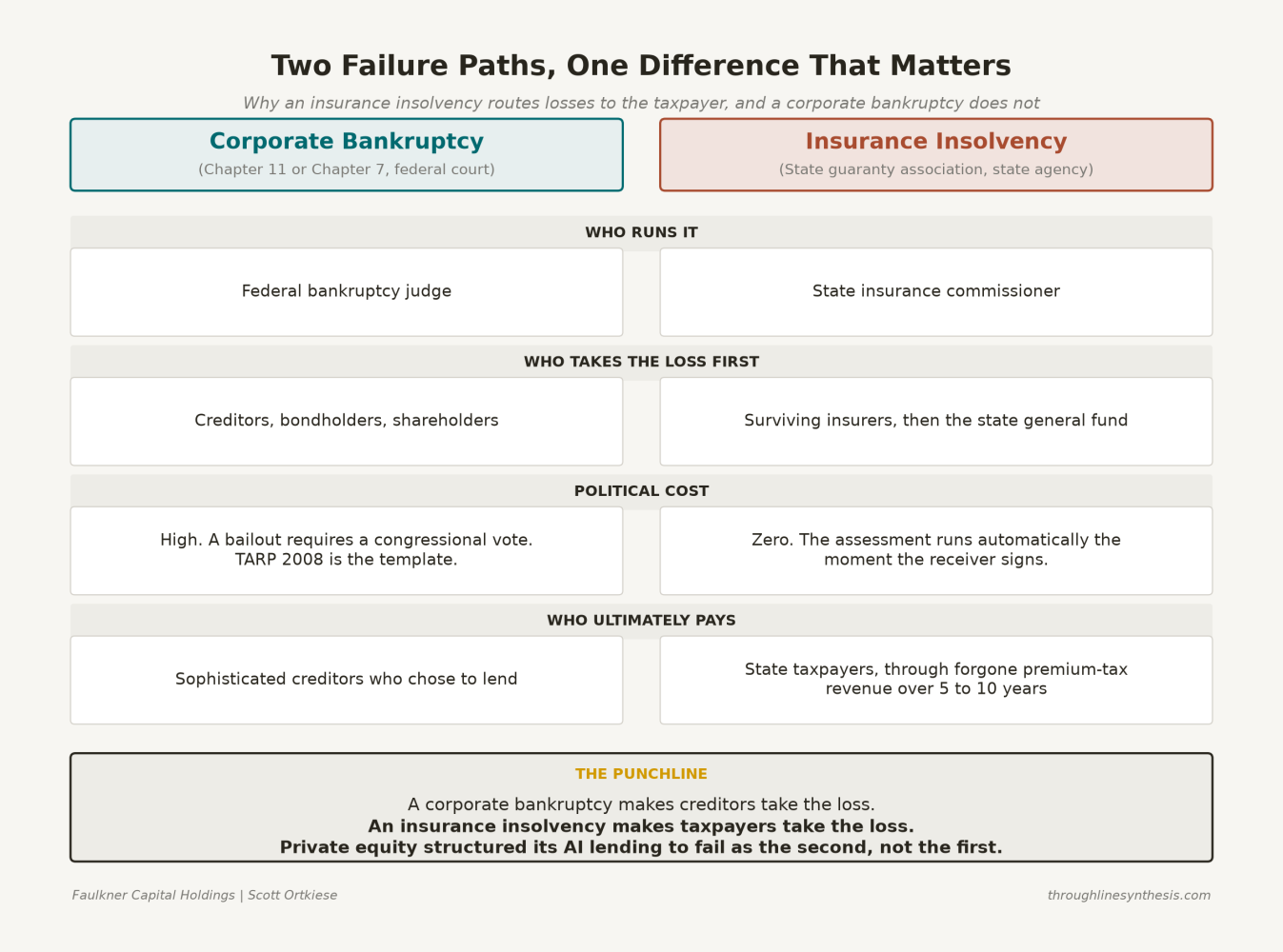
A regular company runs out of money. It files Chapter 11 (reorganization) or Chapter 7 (liquidation) in federal court. A judge takes over. Creditors line up in a courtroom.
In a normal bankruptcy, 3 things happen that are worth remembering, because none of them will happen to a failed private-equity-owned life insurer.
- A federal judge, not a state regulator, runs it. Bankruptcy court is federal. The rules are the same in Delaware as in Texas. Creditors know what to expect.
- Losses fall on the people who lent the money. Bondholders take a haircut: they get back less than they lent. Suppliers get paid pennies on the dollar. Shareholders wipe to zero. The taxpayer is not in the room.
- If it is too big to let fail, a political fight has to happen. In 2008, the banks needed a bailout, and Congress had to vote on TARP, the Troubled Asset Relief Program. It passed only on the second try. The political cost was real. Elected officials had to put their names on it.
That is the world people picture when they hear “bailout.” A federal courtroom. Named creditors taking losses. If the government steps in, a public vote and a public record.
Hold that picture. Now compare it to what happens to a life insurer.
What an insurance insolvency looks like
Life insurers do not go to federal bankruptcy court. They cannot. Life insurance is regulated at the state level, not the federal level. That is a design choice from the McCarran-Ferguson Act of 1945, and it has never been changed.
When a life insurer runs out of money, this is what happens instead.
- The state insurance commissioner takes over, not a judge. The commissioner is an elected or appointed state official. In some states, the commissioner is a former industry executive. Every state has its own commissioner, so a multi-state failure means 50 parallel proceedings coordinated through a private trade group called the National Organization of Life and Health Insurance Guaranty Associations, or NOLHGA.
- The other insurance companies in the state pay first. Every state runs a guaranty association. When a member insurer fails, the surviving members are assessed a share of the shortfall, roughly proportional to the size of their business in that state. This is called an after-the-fact assessment.
- The surviving insurers get their money back from the state. In 44 of the 50 states, once a surviving insurer pays the assessment, it can take a 100% credit against the premium taxes it owes the state, typically spread over 5 to 10 years. The insurer that paid the assessment gets the entire amount back.
- The state general fund absorbs the loss. A premium-tax credit is money the state was going to collect and now will not. It is a hole in the state budget. That hole has to be filled by other taxes, spending cuts, or borrowing. The taxpayer of that state pays, one way or another, over the next decade.
- No vote is required. No TARP. No Federal Reserve announcement. No congressional debate. The process runs automatically the moment the receiver signs the assessment.
That is the bailout mechanism. It was written in the 1970s and 1980s to protect widows and orphans from small insurer failures. It was not written to absorb tens of billions of dollars of losses from private-equity-owned insurers stuffed with private credit loans to AI data centers. But the statute does not know the difference. It runs the same way whether the failed insurer was a small policyholder-owned mutual in Iowa or Athene.
Why this matters for private credit
Now put the 2 paths side by side.
If Apollo’s private credit fund lends $50 billion to AI data center special purpose vehicles (SPVs), companies set up only to hold the chips and carry the debt, and those loans go bad, and Apollo has sold those same loans onto Athene’s balance sheet, and Athene fails as a result, here is the difference from a normal corporate bankruptcy:
Corporate bankruptcy path (if this were any other company). The lenders take the loss. Apollo’s fund investors take the loss. Nvidia, if it guaranteed the loans, takes the loss. If it were catastrophic enough to threaten the financial system, Congress would have to vote on a bailout, and the political cost of that vote would be enormous. The 2008 TARP debate is the template.
Insurance insolvency path (which is what will actually happen). The state insurance commissioner takes over Athene. The other life insurers in the state pay the assessment. Those other insurers then reclaim 100% of the assessment as a premium-tax credit. The state general fund absorbs the loss. State taxpayers pay through forgone revenue over the next decade. There is no vote. There is no debate. There is no political cost because there is no politician’s name attached to it.
That is the punchline. The private credit crisis has been engineered to fail into a system that was designed for something else, and to fail there specifically because that system does not require a vote.
The 4 differences you need to remember
If someone asks you at a dinner table what the difference is between a bankruptcy and an insurance insolvency, teach them these 4.
- Court vs. commissioner. Bankruptcy runs in federal court. Insurance insolvency runs in a state agency.
- Creditors vs. surviving insurers. In bankruptcy, the creditors take the loss. In insurance insolvency, the surviving insurers take the loss first, then hand it to the state.
- Political cost vs. no political cost. A federal bailout requires a congressional vote. A state guaranty fund assessment is automatic and silent.
- Corporate creditor pays vs. state taxpayer pays. In bankruptcy, sophisticated creditors who chose to lend take the hit. In insurance insolvency, the state taxpayer who never chose anything takes the hit through forgone premium-tax revenue.
Every one of those differences favors the private equity firms that own the insurers, and disfavors the ordinary taxpayer. That is not an accident. That is the design.
How the crisis unfolds, step by step
Now that you understand the mechanism, here is what the sequence looks like when it detonates.
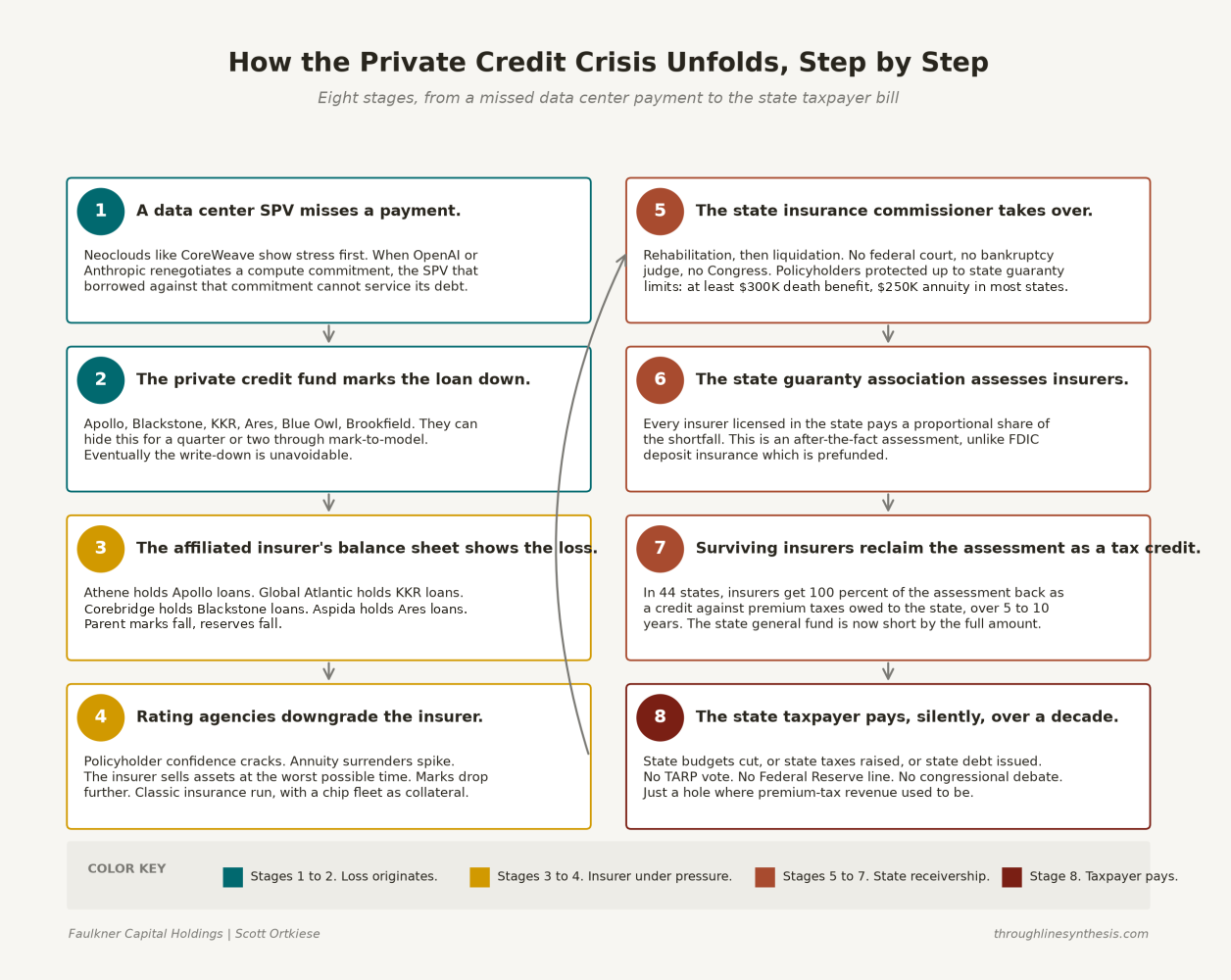
Stage 1. A data center SPV misses a payment. Neoclouds, the specialist AI cloud companies such as CoreWeave, are already showing stress. When OpenAI or Anthropic renegotiates a compute commitment, the SPV that borrowed against that commitment cannot service the debt.
Stage 2. The private credit fund marks the loan down. Apollo, Blackstone, KKR, Ares, Blue Owl, or Brookfield takes a hit on the loan. They can hide this for 1 or 2 quarters because they mark to model, not to market: the value of the loan comes from their own model, not from a trade. Eventually the write-down is unavoidable.
Stage 3. The affiliated life insurer’s balance sheet shows the loss. Athene owns Apollo loans. Global Atlantic owns KKR loans. Corebridge owns Blackstone loans. Aspida owns Ares loans. When the parent’s marks fall, the insurer’s reserves fall.
Stage 4. Rating agencies downgrade the insurer. Policyholder confidence cracks. Annuity surrenders, policyholders cashing out early, spike. The insurer has to sell assets at the worst possible time, which drops the marks further.
Stage 5. The state commissioner takes over. Formally, this is called rehabilitation, then liquidation. The insurer stops writing new policies. Existing policyholders are protected up to the state guaranty limits: at least $300,000 for life insurance death benefits in every state, and $250,000 for annuity benefits in most states.
Stage 6. The state guaranty association assesses surviving insurers. They pay first.
Stage 7. Surviving insurers reclaim the assessment as a premium-tax credit. State general fund is now short.
Stage 8. State budgets are cut, or state taxes are raised, or state debt is issued. Somebody pays. It is not the private equity firm that caused the failure. It is you.
None of that requires a vote in Washington. Every step of it is written into state law that was passed decades ago, mostly without any awareness of what private equity would eventually do with it.
The 1-sentence version
A corporate bankruptcy makes creditors take the loss. An insurance insolvency makes taxpayers take the loss. Private equity structured its AI lending to fail as an insurance insolvency.
That is the whole story. Everything else is footnotes.
Scott Ortkiese
Throughline Synthesis | Houston, Texas
so@throughlinesynthesis.com
August 12, 2026
Read the full argument at The Bailout Is Already Written.