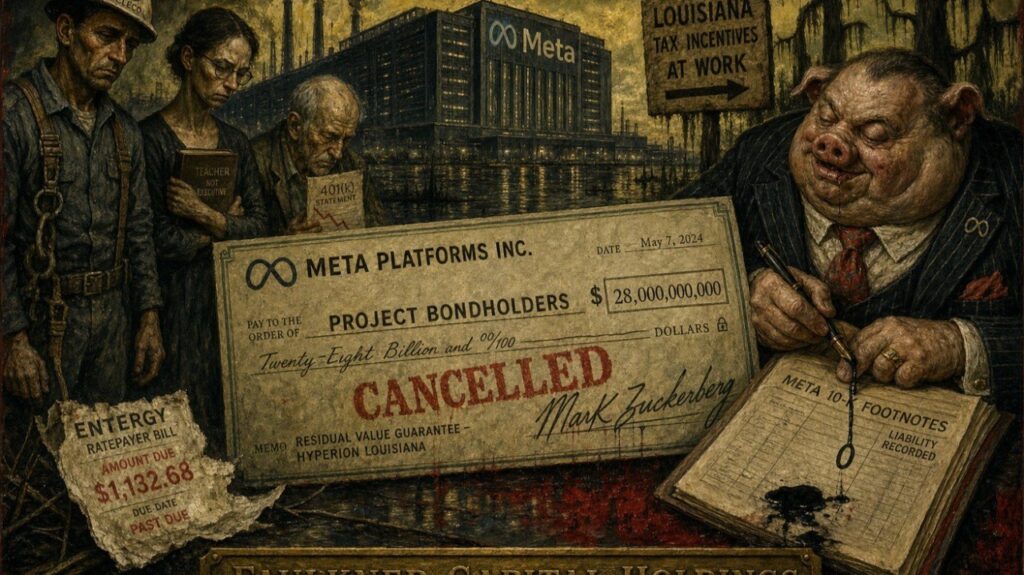
Pigs get fed… Meta promised bondholders $28 billion if the data center’s value falls short, then told investors that promise costs nothing.

By Scott Ortkiese | July 23, 2026 | so@throughlinesynthesis.com
The one number that broke through
On July 20, 2026, Nikkei Asia published a footnote audit of the five largest American technology companies [1]. The reporters did what almost no equity analyst does in public.
They read the small print at the back of the annual reports of Alphabet, Amazon, Meta, Microsoft, and Oracle. They added up the future payment obligations that never touch the balance sheet. Then they put a single number on the pile.
That number is $1.65 trillion.
It is larger than the $1.35 trillion of debt those same companies officially report. It has grown roughly eightfold in four years, tracking the AI capital-spending curve almost perfectly.
Michael Burry retweeted it on July 21. Oracle credit-default-swap spreads hit a sixteen-year high the same week. Semafor, Newsmax, Moneycontrol, Chosun Ilbo, Seeking Alpha, and the Wall Street Journal all followed inside forty-eight hours.
The story went viral because it collapsed something the Bank for International Settlements, Moody’s, and Morgan Stanley had already flagged in pieces into a single defensible headline. It also flattered a suspicion millions of ordinary Americans have carried since 2008: that the accounting is not honest, that the risk is not where the annual report says it is, and that when the bill finally arrives it will not be paid by the people who signed the deals.
This piece explains what those companies are actually doing, why the accounting works, why the numbers are real, and why any American whose retirement, electric bill, water supply, or municipal tax base sits downstream of the AI buildout should read the footnotes for themselves.
What “hidden debt” actually is
“Hidden” is the wrong English word for what is happening. The debt is not concealed in the criminal sense.
It is disclosed, in footnotes, in language most equity investors never read, using accounting elections that current U.S. GAAP permits.
There are three mechanisms. Each one dodges a different balance-sheet consequence.
One: Purchase commitments for chips and servers that have not been delivered.Nvidia has roughly $119 billion in customer purchase commitments outstanding, per a Ground News aggregation of the coverage. Those are signed, contractually binding obligations to buy GPUs on a schedule. Under GAAP, the buyer records nothing on the balance sheet until delivery. The commitment lives in a purchase-obligations table at the back of the 10-K.
Two: Long-dated leases for data centers that have not yet “commenced.”Oracle disclosed $260 billion in future lease commitments in May 2026, then $248 billion of additional lease commitments in its November 30, 2025 SEC filing. Most of it is tied to data centers scheduled to open between fiscal 2027 and fiscal 2029, on fifteen to nineteen year terms. Those obligations do not become on-balance-sheet liabilities until the buildings light up and the lease “commences.” Until then, they live in the footnotes.
Three: The special-purpose vehicle, or SPV.This is the mechanism that turned a normal corporate-finance issue into a national credit story.
A tech company sets up a legally separate entity. It keeps a minority equity stake. It lets private-credit lenders fund most of it with bonds or loans. The SPV builds the data center. The tech company then signs a long-term lease to occupy the completed facility as sole tenant.
If the lease qualifies as anoperatinglease rather than afinancelease under ASC 842, the tenant records only rent expense and a right-of-use asset. The billions of debt sit inside the SPV, which is not consolidated onto the tenant’s books.
The tenant gets the building, the capacity, the AI training clusters, and the market narrative that its balance sheet is pristine. The bondholders get investment-grade yield backed by the tenant’s implicit and explicit obligations. The tenant’s own reported debt line stays reassuringly small right up until earnings day.
None of this is fraud. The Enron analogy that keeps appearing on LinkedIn is rhetorical. Enron used related-party SPVs to disguise losses and consolidate hidden exposures with off-book fraud.
Big Tech’s SPVs are disclosed, arm’s-length, investment-grade, and defended by top-tier counsel. The correct historical analogue is not Enron. It is the pre-2008 treatment of off-balance-sheet conduits and structured investment vehicles at global banks: legal, disclosed, defended, and catastrophic when the assets they held finally repriced.
The Meta Hyperion transaction, in the language of Meta’s own filings
Meta’s $30 billion Hyperion campus in Richland Parish, Louisiana is the case that made the mechanism famous. The deal closed on October 21, 2025, and was at the time the largest private-credit transaction in history, according to Meta’s own investor release, Reuters, Bloomberg, and Global Data Center Hub. The design is the template every other hyperscaler is now copying.
Here is the plumbing:
-
Meta and Blue Owl Capital created an SPV calledBeignet Investor. Meta owns 20 percent. Blue Owl-managed funds own 80 percent, according to Quinn Emanuel’s 2026 client alert[3].
-
Morgan Stanley arranged a$27.294 billionA+ rated project bond, placed largely with PIMCO ($18 billion anchor) and BlackRock ($3 billion), together with about $2.5 billion of equity.
-
The SPV, not Meta, borrows the money. The SPV, not Meta, owns the campus.
-
Meta will develop and operate the site, then take occupancy under an operating leasebeginning June 1, 2029, for five successive four-year terms (twenty years in aggregate).
-
Meta guarantees the debt in three ways that its financial statements do not fully reflect.
Meta’s three guarantees:
-
Aresidual value guarantee (”RVG”)of up to$28 billionobligating Meta to compensate bondholders if the campus value drops below a defined threshold at non-renewal or early termination, active for the first sixteen years of operations.
-
A construction cost-overrun guarantee: Meta absorbs any cost above 105 percent of budget.
-
Full rent payment obligations even if construction runs late.
Here is the sentence that should end the debate about how “off” this debt actually is. It comes directly from Meta’s 2025 annual report, quoted in Quinn Emanuel’s 2026 client alert [3]:
“As of December 31, 2025, RVG payments are not probable and therefore, no liability has been recorded.”
Translation for anyone who does not read GAAP for a living: Meta has written a check-backing promise of up to twenty-eight billion dollars. Its accountants have concluded that because default is not “probable,” the number that appears on the balance sheet for that promise is zero.
The disclosure is legal. The number is not the amount of the promise.The number is zero.
In November 2025, days after closing the SPV, Meta raisedan additional $30 billion in the public corporate bond market. In July 2026, Meta disclosed that the same Louisiana campus will grow to5 gigawatts and more than $50 billionin total investment, per CNBC’s reporting. The $27 billion project bond is a floor, not a ceiling.
The bond market priced the risk more honestly than the accounting rules. The Hyperion project debt priced at roughly 225 basis points over Treasuries, roughly double the spread on Meta’s own corporate bonds. Bondholders are being paid project-finance yields precisely because they know the economic risk is Meta’s even when the legal risk is theirs.
The template moves: Oracle Stargate and xAI Colossus
Meta is the archetype. Oracle and xAI are the extensions.
Oracle and the Stargate stack
Oracle is the infrastructure spine of the $500 billion Stargate initiative announced by OpenAI, SoftBank, MGX, and the White House in January 2025. What that looks like on Oracle’s own filings and disclosures is a set of concentric off-balance-sheet arrangements:
-
Approximately$13 billioninvested by Blue Owl and JPMorgan (about $10 billion as debt) into an SPV that owns the flagship Abilene, Texas Stargate campus operated by Crusoe, with Oracle contracted as compute provider to OpenAI.
-
A$38 billiondebt package Oracle is arranging with banks to fund two additional Texas and Wisconsin data centers.
-
An$18 billionloan financing a Stargate site in New Mexico.
-
$18 billionraised in a single day of public corporate bond issuance to shore up Oracle’s own balance sheet, and $43 billion of additional debt taken on in fiscal 2026, with roughly $40 billion projected for fiscal 2027.
Oracle’s own filings disclose$260 billion of future lease commitmentsas of May 31, 2026 and$248 billion of additional lease commitmentsas of the November 30, 2025 filing. Most of that is tied to data-center leases beginning in the third quarter of fiscal 2026 through fiscal 2028, on terms of fifteen to nineteen years. None of it appeared on the condensed balance sheets.
Nikkei tallied Oracle’s total off-balance-sheet obligations at$273.3 billion, which is more thanthirty timesthe level four years earlier.
The market is finally taking this seriously.Oracle’s five-year credit-default-swap spread rose approximately 310 percent to a sixteen-year high in the days around the Nikkei release. Goldman Sachs’s trading desk described “signs of panic” among AI-lending credit investors.
Oracle’s remaining performance obligations, meanwhile, are $638 billion. Only 12 percent will convert to revenue in the next twelve months. Oracle is spending now for revenue years out. The bondholders and the ratepayers pay first. The revenue arrives, if it arrives, later.
xAI, Valor Equity, and Apollo
The xAI structure is even more direct.
On January 7, 2026, Apollo announced that its funds had led a$3.5 billion capital solutionfor a vehicle namedValor Compute Infrastructure L.P. (”VCI”). VCI was raising a total of$5.4 billionto acquire and lease data-center compute infrastructure “to a subsidiary of xAI Corp” using GB200 Nvidia GPUs, under atriple-net leasestructure. Nvidia itself invested as an anchor limited partner.
Three details deserve attention:
-
The GPU vendor (Nvidia) is now a limited partner in the vehicle that is leasing its own chips to the AI customer, closing the loop between vendor financing, customer receivables, and equity risk.
-
The tenant isa subsidiaryof xAI, not xAI itself. The corporate ring-fencing goes one layer deeper than at Meta.
-
xAI is not a public company, so the disclosure regime is thinner, and the residual value guarantee, if any, is not public.
Meta, Oracle, xAI: how the three SPVs compare
The three deals are not identical. They share a family resemblance and diverge on details that matter for how much protection retail investors, ratepayers, and pension holders actually have.
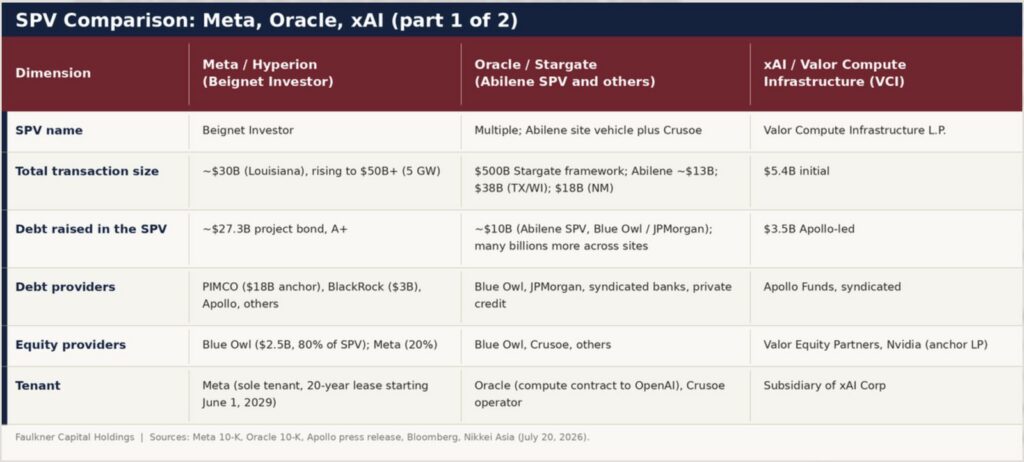
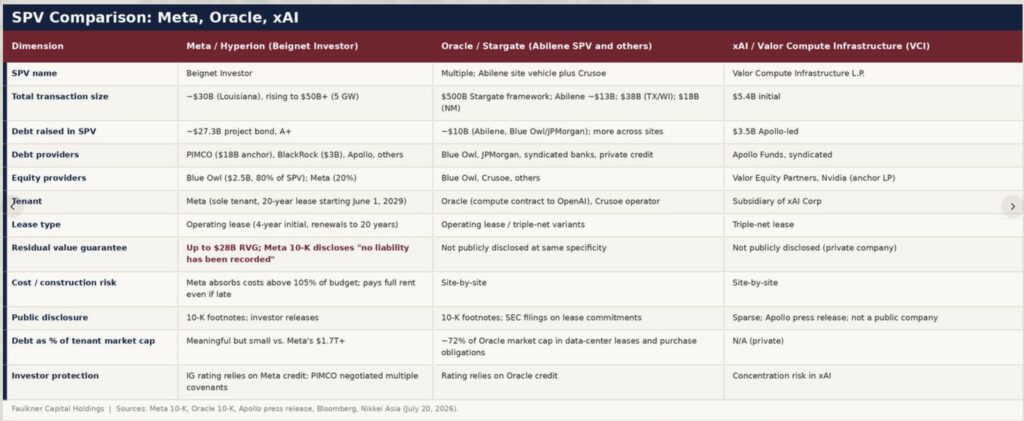
The pattern across the three is straightforward.The same private-credit shops (Apollo, Blue Owl, PIMCO, BlackRock, KKR, Brookfield, Carlyle, JPMorgan) sit on the lender side of every deal.
The tenant sits on the operating side and picks up the residual risk through leases, guarantees, cost-overrun clauses, and vendor commitments. The chip vendor (Nvidia) has now begun to participate as an equity anchor.
The disclosure regime tightens as you move from Oracle (public, U.S.-listed) to Meta (public but with aggressive election of operating-lease treatment) to xAI (private, minimal disclosure).
Why the story went viral
Viral moments in financial reporting have three ingredients: a single big number, a credibility signal, and a moment of market stress that makes the number feel prophetic instead of academic. Nikkei delivered all three in the same week.
The number.$1.65 trillion is memorable, defensible, and denominated in a currency that ordinary readers understand. It is eight times higher than four years ago. It is larger than thereporteddebt of the same five companies. That inversion, off-book bigger than on-book, is the kind of fact that survives being retweeted without a caption.
The signal.Michael Burry retweeted the Nikkei figure on July 21. Whatever one thinks of Burry, his 2005 to 2007 short trade taught a generation of retail and semi-professional investors to interpret his interest as a leading indicator. When the Big Short’s namesake circles a number, the number gets a second life.
The stress.Two independent institutional voices had already been sounding warnings that most investors missed.
Moody’s published a February 2026 report quantifying $662 billion in future data-center lease commitments across the same five companies, an amount equal to 113 percent of the group’s adjusted on-balance-sheet debt. Morgan Stanley estimated the industry may need up to$800 billion in off-balance-sheet financing by 2028.
Oracle’s CDS blew out to a sixteen-year high inside the same week. The Bank for International Settlements had already flagged “shadow borrowing” as a category of concern in March 2026. Nikkei simply aggregated what was already visible in pieces and gave the aggregation a defensible headline.
There is a fourth ingredient the American press has been slower to name. The story landed at a moment when retail investors, Wall Street analysts, and pension trustees have all been marketed the AI story as the growth engine that will lift index returns for a decade.
The Nikkei number is the first widely readable piece of evidence that the AI story is being funded not out of retained earnings and honest debt but out of a growing wall of leased and guaranteed obligations sitting in the footnotes. That is what makes it emotionally viral, not just financially interesting.
Why the numbers are real
Skepticism is appropriate. Big round numbers travel too easily. Three independent facts make Nikkei’s $1.65 trillion defensible.
First, the underlying disclosures are in each company’s own filings.Nikkei did not model the number. It transcribed it out of the notes to Alphabet, Amazon, Meta, Microsoft, and Oracle’s most recent quarterly and annual statements. Anyone with a Bloomberg terminal, a free 10-K PDF, or thirty minutes of patience can re-derive it.
Second, independent third parties have converged on similar orders of magnitude from different starting points.Moody’s finds $662 billion in lease commitments across the same five. Morgan Stanley projects up to $800 billion by 2028. The BIS calls it shadow borrowing. Newsmax cited a source who argued the true figure “may be closer” to $5 trillion once vendor commitments, GPU purchase agreements, and downstream leases are added up. The dispersion of estimates is a feature, not a bug. Reasonable analysts using different scopes arrive within the same order of magnitude, which is how empirical claims are supposed to work.
Third, the company-by-company breakdown is granular and testable.Meta’s off-balance-sheet obligations at roughly $420 billion are 2.8 times its reported debt. Oracle’s $273 billion have grown thirtyfold in four years. Nvidia has $119 billion in customer purchase commitments. All five companies declined to comment on the Nikkei findings. A silent decline is not the response of firms that believe the numbers are wrong.
What those numbers mean for Americans who never bought a share of Meta
Here is the part of the story that almost never makes it into a tech-business headline. The $1.65 trillion is not sitting in an isolated corner of Wall Street.
It is entangled with the balance sheets of pension funds, insurance companies, business-development companies (BDCs), interval funds, and money-market alternatives that Americans hold directly through their 401(k)s and 403(b)s and indirectly through state pension boards, teacher retirement systems, and municipal insurance pools.
The private-credit funds that anchored the Meta Hyperion project bond, the Oracle Stargate SPVs, and the xAI VCI vehicle are the same private-credit funds that Wall Street has been marketing to retail savers for five years as “yield alternatives” and “portfolio diversifiers.” PIMCO, BlackRock, Apollo, Blue Owl, KKR, Brookfield, and Carlyle now sit on the lender side of the entire hyperscaler stack.
When those AI-infrastructure loans reprice, the losses are not landing on the tech companies first. They are landing on the funds that bought the paper, on the retirees whose accounts hold those funds, and on the state pension systems that allocated to those funds.
This is the exact concern I laid out in Private Credit Is the New Subprime on my Substack. The subprime analogy is not casual. Private credit in 2026 has the same three qualities that made 2005 to 2008 subprime dangerous:
-
Opacity: assets marked by the manager, not the market.
-
Duration mismatch: long lock-ups against short-cycle collateral.
-
A fragile demand story: it only works if the underlying cash flows arrive on schedule.
AI capital spending inserts a fourth: server useful life of 18 to 36 months against project bonds of 5 to 20 years and lease commitments of 15 to 19 years.
The retail saver who never bought Meta stock still owns Meta AI risk through her Vanguard bond fund’s private-credit allocation, her state pension board’s allocation to Blue Owl, and her interval fund’s allocation to Apollo. She just does not know it.
The ratepayer downstream of a Meta or an Oracle data center pays a second time. Meta’s Louisiana campus alone is expected to draw multiple gigawatts, with Meta claiming it will cover “the full costs of the energy, water, and related infrastructure the data center uses so consumers aren’t paying the cost.”
That claim will be tested by state utility commissions, community water boards, and municipal tax authorities across every jurisdiction where these campuses land. The historical pattern of ratepayer cost-shifting to residential and small-commercial customers when large industrial loads receive concessional rates is well documented, and it is exactly the mechanism the Brute Force AI Bill workstream tracks in detail.
And the taxpayer, at both federal and state levels, sits behind the whole edifice. State and local tax abatements for data-center construction are already among the fastest-growing categories of forgone public revenue in the American South. Federal energy subsidies, land grants, and permitting concessions add another layer.
When the AI monetization curve underdelivers: the private-credit losses are absorbed first by savers and pensions, the ratepayer subsidies remain baked into utility rate cases for a generation, and the abated tax revenue is not recoverable.
Piketty’s diagnosis, applied to the AI buildout
Thomas Piketty’sCapital in the Twenty-First Centurypublished his central empirical claim in the language of a single inequality:r > g.
When the rate of return on capital (r) durably exceeds the growth rate of the economy (g), wealth concentrates at the top faster than earned income can catch up. Piketty documented this across three centuries of French, British, German, and American data. He argued that the American postwar exception, a middle-class-dominated capital distribution, was the historical anomaly, not the rule.
The AI capital-spending stack is a case study in r > g weaponized.Consider what the mechanism actually does:
-
The equity upside is concentrated at the tenant.Meta, Oracle, Microsoft, Alphabet, Amazon, and (privately) xAI capture the operating returns of the AI compute they lease. Those returns flow to equity holders, dominated in the U.S. case by the founders, insiders, index funds, and top-decile households that hold most of the equity float. In 2026 the top 10 percent of U.S. households own roughly 90 percent of directly held stocks.
-
The debt yield is concentrated at the private-credit lender.PIMCO, BlackRock, Apollo, Blue Owl, KKR, Brookfield, Carlyle, and JPMorgan capture the coupon spread. Their limited partners are sovereign wealth funds, university endowments, insurance companies, and the largest pension boards. This is not a democratizing yield product. This is capital seeking yield in a low-transparency, high-fee, high-lock-up wrapper.
-
The residual risk is diffused across ratepayers, taxpayers, and retail savers holding the paper indirectly.These are the households that Piketty identified as most vulnerable to a widening r versus g gap.
The AI SPV architecture is not just a novel financing technique. It is a mechanism for compounding capital returns at the top of the distribution while socializing capital risk at the bottom. It fits the r > g pattern almost too neatly.
Piketty argued that when concentrated capital rents accelerate beyond the growth rate of the productive economy, political systems tend to respond with either progressive taxation and regulation, or with reactionary populism and a search for scapegoats. The United States in 2026 has chosen the second path, which is why the AI capex story sits alongside the SpaceX IPO story, the Trump kleptocracy story, and the shakedown-republic protection-racket story in the same volume.
The same institutional actors show up in every chapter. That is not coincidence. It is what a late-stage rentier system looks like from the inside.
The SpaceX IPO and the AI SPV are the same story told in two accents
The parallel with the SpaceX IPO is not decorative. The $1.77 Trillion Hoax workstream already laid out the mechanics: float engineering, a 94.6x revenue valuation, TAM reclassification, xAI-linked debt transfer, undisclosed supply-chain concentration, index-driven forced buying, SEC nonintervention, and lockup-cliff timing.
The AI SPV story tells the same story from the other end of the balance sheet. Where SpaceX financed a private-market valuation into a public-market exit, Meta, Oracle, and xAI financed the physical AI buildout through private-credit debt kept off the public accounts.
The extraction points are different. The extractors are the same. The retail saver ends up long both sides of the trade, holding SpaceX through her passive index and holding Oracle project debt through her interval fund, without ever having voted on either exposure.
The most dangerous convergence is this.If the AI monetization curve underdelivers, both trades unwind at the same time and through overlapping counterparties:
-
SpaceX’s valuation compresses as AI TAM expectations collapse.
-
Oracle’s RPO fails to convert to revenue.
-
Meta’s residual value guarantee stops being non-probable and starts being a liability that must be booked.
-
xAI’s VCI collateral (GPUs) reprices on the secondary market against long-dated project debt.
-
The private-credit funds that anchored all four transactions receive redemption requests they cannot meet without gating.
-
The BDCs mark their books to manager estimates that the SEC starts to question.
-
And the retail saver watches the value of her “yield alternative” disappear.
That is not a scenario I invented. That is what the Oracle CDS was telling anyone who cared to look, the week the Nikkei number went viral.
Why Americans do not grasp the systemic risk
This is the deficiency I most want to correct in prior versions of this story. Americans do not understand what is being built and what it costs them, not because the information is hidden, but because the vocabulary used to describe it is designed to make ordinary comprehension hard.
Six specific gaps:
One: The word “off-balance-sheet” sounds technical, and therefore boring.It is neither. It means: the promise exists, the money is owed, the risk is real, and it does not appear where the eye naturally lands. Every American should be able to say the sentence out loud once.
Two: The residual value guarantee is not a footnote curiosity. It is a check written in advance.Meta’s Hyperion RVG of up to $28 billion is Meta pre-committing to reimburse bondholders if the campus is worth less than the debt at year sixteen. That the accountants describe the current probability as “not probable” is not the point. The point is that Meta issued the guarantee at all. The guarantee is the price of getting the debt off the books.
Three: “Operating lease” versus “finance lease” is the accounting hinge on which trillions turn.If Meta’s Hyperion lease qualified as a finance lease under ASC 842, most of the $27 billion project bond would already sit on Meta’s balance sheet as a liability. Meta chose an initial four-year term with renewal options to preserve operating-lease treatment. A four-year initial term for a twenty-year, $50 billion campus is not commercially reasonable. It is accounting reasonable. The distinction matters.
Four: The private-credit universe is not “sophisticated investors only” anymore.BDCs, interval funds, non-traded REITs, and “yield alternative” products are being distributed through financial advisors to households whose only prior exposure to private credit was through pension allocations they never chose. When Phil Tseng left BlackRock TCP Capital and the Manhattan U.S. Attorney’s Office began probing loan marks, the story was about retail money, not just endowment money.
Five: The GPU depreciation cycle collides with the bond amortization cycle.Modern AI training GPUs have useful lives of 18 to 36 months before a new generation makes them obsolete for frontier training runs. Project bonds run 5 to 20 years. Data-center leases run 15 to 19 years. When the collateral behind the debt ages faster than the debt matures, the tenant is left with an obligation to keep paying rent on a facility whose economic purpose has been superseded. The residual value guarantee bites at precisely that moment.
Six: The counterparty concentration is deeper than any of the individual deals suggest.Apollo, Blue Owl, PIMCO, BlackRock, KKR, Brookfield, and Carlyle appear as lenders or equity holders in nearly every large AI SPV. When one of them adjusts risk appetite, the cost of capital shifts for all of them at once. This is the same interconnection that ran through the 2008 financial system before it broke. It is not a comforting parallel.
None of these points is technically inaccessible. All six are missing from the newspaper coverage of the Nikkei story because financial journalism has become an aggregation exercise rather than an explanation exercise. This piece is my attempt to close those six gaps in one sitting.
What Nikkei added, exactly
Nikkei did not discover any of the underlying facts. The Blue Owl deal was reported by Bloomberg and Reuters in October 2025. The WSJ ran “AI Meets Aggressive Accounting” on the Hyperion mechanics in November 2025 [4]. Moody’s had the $662 billion lease-commitment number in February 2026. The BIS flagged shadow borrowing in March 2026.
What Nikkei did was arithmetic.It put a single, defensible, aggregated total on the entire pile.
$1.65 trillion. Eightfold in four years. Larger than the reported debt.
That is the sentence that goes on the front of every follow-on chart, every LinkedIn post, every CDS trader’s screenshot, and every Substack column, including this one.
This is what good financial journalism looks like when it happens. The primary work was the addition. The primary value was the courage to publish the sum.
What comes next
Four of the five hyperscalers report earnings in the four weeks after Nikkei’s story lands. Their headline debt numbers will be reassuring. That is the point of the accounting choices they made.
The interesting numbers will sit fifty pages back in the 10-Qs, in the operating-lease commitments table, the purchase-obligations table, the joint-venture disclosures, and the guarantee disclosures.
Two questions decide whether this becomes a real credit event or a slow drift.
First, does the SEC or the FASB tighten the definition of what counts as a consolidated liability under ASC 842 and Topic 810? A rule tightening that forced Meta’s Hyperion RVG onto the balance sheet would immediately convert billions of off-book exposure into recognized debt at Meta, Oracle, and every hyperscaler using the same template. That is a live regulatory conversation, and it is one the Trump administration has actively suppressed at the SEC as part of a broader deregulatory package.
Second, does the private-credit funding cost keep widening? Oracle’s CDS blowout in July 2026 was not a fluke. It was the first coordinated repricing of AI-lending risk in the American credit markets. If the same repricing spreads to Meta and Microsoft project debt, then the SPV template loses its cost advantage over conventional corporate borrowing, and the whole architecture becomes uneconomic. That is the specific channel through which a bond-market repricing becomes an equity-market repricing becomes a retirement-account repricing.
The people who bought the private-credit paper know what they own. The tenants who signed the leases know what they promised. The bondholders who priced the risk at 225 basis points over Treasuries know what they are pricing.
Almost nobody else does.
That is the deficiency this piece was written to close.
Who pays, in one sentence
Households pay through their retirement accounts. Ratepayers pay through their utility bills. Taxpayers pay through abated corporate revenue. And the AI narrative pays every one of them a little less than it took.
Nikkei put a number on it:$1.65 trillion.
That is the number to remember.
Call to action
I write the full-length version of this analysis, along with the underlying long-form documentation on the Brute Force AI Bill, Private Credit as the New Subprime, and the AI IPO extraction workstreams, on Substack at throughlinesynthesis.com.
If you want to go deeper on any of the mechanisms above, the Meta RVG structure, the Oracle CDS repricing, the xAI vendor-financing loop, or the pension and ratepayer exposure, reach out directly at so@throughlinesynthesis.com.
Sources
-
Nikkei Asia, “Five US tech giants’ hidden debts soar to $1.65tn on opaque AI funding,” Nikkei Asia, July 20, 2026.
-
Chosun Ilbo, English summary of the Nikkei investigation, Chosun Ilbo, July 20, 2026. https://www.chosun.com/english/industry-en/2026/07/20/HAGVRVOO45ETFMI73IYMB3LRXY/
-
Quinn Emanuel Urquhart & Sullivan, “Emerging Litigation Risks in AI Data Centers,” Quinn Emanuel, 2026 client alert. https://www.quinnemanuel.com/media/4dzkfccz/client-alert-ai-data-center-financing-and-litigation-risks.pdf
-
The Wall Street Journal, “AI Meets Aggressive Accounting at Meta’s Gigantic New Louisiana Data Center,” The Wall Street Journal, November 24, 2025. https://www.wsj.com/tech/meta-ai-data-center-finances-d3a6b464
-
Moneycontrol, “Big tech’s trillion-dollar blind spot: $1.65 trillion of AI debt nobody can see,” Moneycontrol, July 22, 2026. https://www.moneycontrol.com/news/business/markets/big-tech-s-trillion-dollar-blind-spot-1-65-trillion-of-ai-debt-nobody-can-see-13980102.html
-
Newsmax, “Big Tech’s $5 Trillion AI Debt: Big Enough to Fail?,” Newsmax, July 22, 2026. https://www.newsmax.com/finance/streettalk/big-tech-ai-data-center/2026/07/22/id/1263709/
-
Ground News, aggregation of coverage, Ground News, July 21 to 23, 2026. https://ground.news/article/big-tech-is-hiding-165tn-in-off-balance-sheet-ai-debt_13bb09
-
AI Weekly, “Five US tech giants’ hidden AI debt hits $1.65T, Nikkei says,” AI Weekly, July 21, 2026. https://aiweekly.co/alerts/five-us-tech-giants-hidden-ai-debt-hits-165t-nikkei-says
-
Semafor, “Concerns grow over AI giants’ hidden debts,” Semafor, July 21, 2026. https://www.semafor.com/article/07/21/2026/tech-stocks-rebound-after-ai-bubble-fear-induced-slump
-
Meta Platforms, investor release on Blue Owl Capital Hyperion joint venture, Meta Platforms Investor Relations, October 21, 2025. https://investor.atmeta.com/investor-news/press-release-details/2025/Meta-Announces-Joint-Venture-with-Funds-Managed-by-Blue-Owl-Capital-to-Develop-Hyperion-Data-Center/default.aspx
-
Kirkland & Ellis, press release representing Blue Owl on the Meta joint venture, Kirkland & Ellis, October 21, 2025. https://www.kirkland.com/news/press-release/2025/10/kirkland-represents-blue-owl-on-joint-venture-with-meta-to-develop-hyperion-data-center
-
Reuters, “Meta forms joint venture with Blue Owl Capital for Louisiana data center,” Reuters, October 21, 2025. https://www.reuters.com/technology/meta-forms-joint-venture-with-blue-owl-capital-louisiana-data-center-2025-10-21/
-
Bloomberg, “Blue Owl Seals Largest Private Capital Deal for Meta’s AI Growth,” Bloomberg, October 16, 2025. https://www.bloomberg.com/news/articles/2025-10-16/blue-owl-seals-largest-private-capital-deal-for-meta-s-ai-growth
-
Global Data Center Hub, “Meta + Blue Owl’s $27B Bet,” Global Data Center Hub, October 26, 2025.
-
CNBC, “Meta Louisiana data center investment reaches $50 billion amid AI push,” CNBC, July 13, 2026. https://www.cnbc.com/2026/07/13/meta-louisiana-data-center-investment-reaches-50-billion-amid-ai-push.html
-
Apollo Global Management, “Apollo Backs $5.4 Billion Valor and xAI Data Center Compute Infrastructure Transaction with $3.5 Billion Capital Solution,” Apollo Global Management, January 7, 2026. https://www.apollo.com/insights-news/pressreleases/2026/01/apollo-backs-5-4-billion-valor-and-xai-data-center-compute-infrastructure-transaction-with-3-5-billion-capital-solution-3214463
-
OpenAI, “Announcing The Stargate Project,” OpenAI, January 21, 2025. https://openai.com/index/announcing-the-stargate-project/
-
Wikipedia, “Stargate LLC,” Wikipedia. https://en.wikipedia.org/wiki/Stargate_LLC
-
Crunchbase News, “Startup Crusoe Nets $11.6B In Fresh Financing,” Crunchbase News, May 21, 2025. https://news.crunchbase.com/ai/startup-crusoe-financing-openai-data-center-texas/
-
Data Center Dynamics, “Crusoe secures $11.6bn in debt and equity for OpenAI’s Stargate data center campus in Abilene, Texas,” Data Center Dynamics, July 14, 2026. https://www.datacenterdynamics.com/en/news/crusoe-secures-116bn-in-debt-and-equity-for-openais-stargate-data-center-campus-in-abilene-texas/
-
TS2, “Oracle shares drop with investors discounting $638 billion AI backlog,” TS2, July 8, 2026. https://ts2.tech/en/oracle-shares-drop-with-investors-discounting-638-billion-ai-backlog/
-
Yahoo Finance, “Oracle reportedly signs major huge cloud data center deals,” Yahoo Finance (Oracle SEC filing summary), December 15, 2025. https://finance.yahoo.com/news/oracle-reportedly-signs-major-huge-111814098.html
-
TMTPost, “Oracle Reportedly In talks with Banks on $38 Billion” package, TMTPost, November 2025. https://en.tmtpost.com/post/7787974
-
TTM Financial, “Meta’s Off-Balance-Sheet Data Center Financing,” TTM Financial, November 25, 2025. https://ttm.financial/m/news/1108262628?lang=zh_CN&edition=fundamental
-
Covenant Lite, “Meta’s $29 Billion Bet with Apollo on AI Data Centers,” Covenant Lite on Substack, 2025.
-
TheValueist, X thread summarizing Meta 10-K disclosure on Beignet Investor, X (TheValueist), November 25, 2025.
-
Ahmad Sunbol, LinkedIn analysis of Meta Beignet SPV and Morgan Stanley $800 billion off-balance-sheet financing projection, LinkedIn, November 2025. https://www.linkedin.com/posts/ahmad-sunbol-131519218_meta-is-building-a-27-billion-data-center-activity-7399812709871067137-Lr_G
-
Hedgie, summary of Nikkei investigation, X (HedgieMarkets), July 20, 2026.
-
Thomas Piketty,Capital in the Twenty-First Century, Belknap Press, 2014.
-
Scott Ortkiese, “Private Credit Is the New Subprime,” Throughline Synthesis on Substack, 2026.
-
Ground News, aggregation of coverage of Michael Burry’s retweet, Ground News, July 21, 2026. https://ground.news/article/the-hidden-debt-of-the-top-5-us-tech-companies-alone-amounts-to-2-460-trillion-won-is-a-debt-bomb-about-to-explode
Scott Ortkiese is President and CEO of Faulkner Capital Holdings. He writes on geopolitics, energy, structured finance, and American decline at throughlinesynthesis.com.