
How bond losses and collapsing private credit will burst the AI bubble and deepen the banking crisis.
Scott Ortkiese | Throughline Synthesis | Houston, October 2, 2026
Analysis through October 2, 2026.
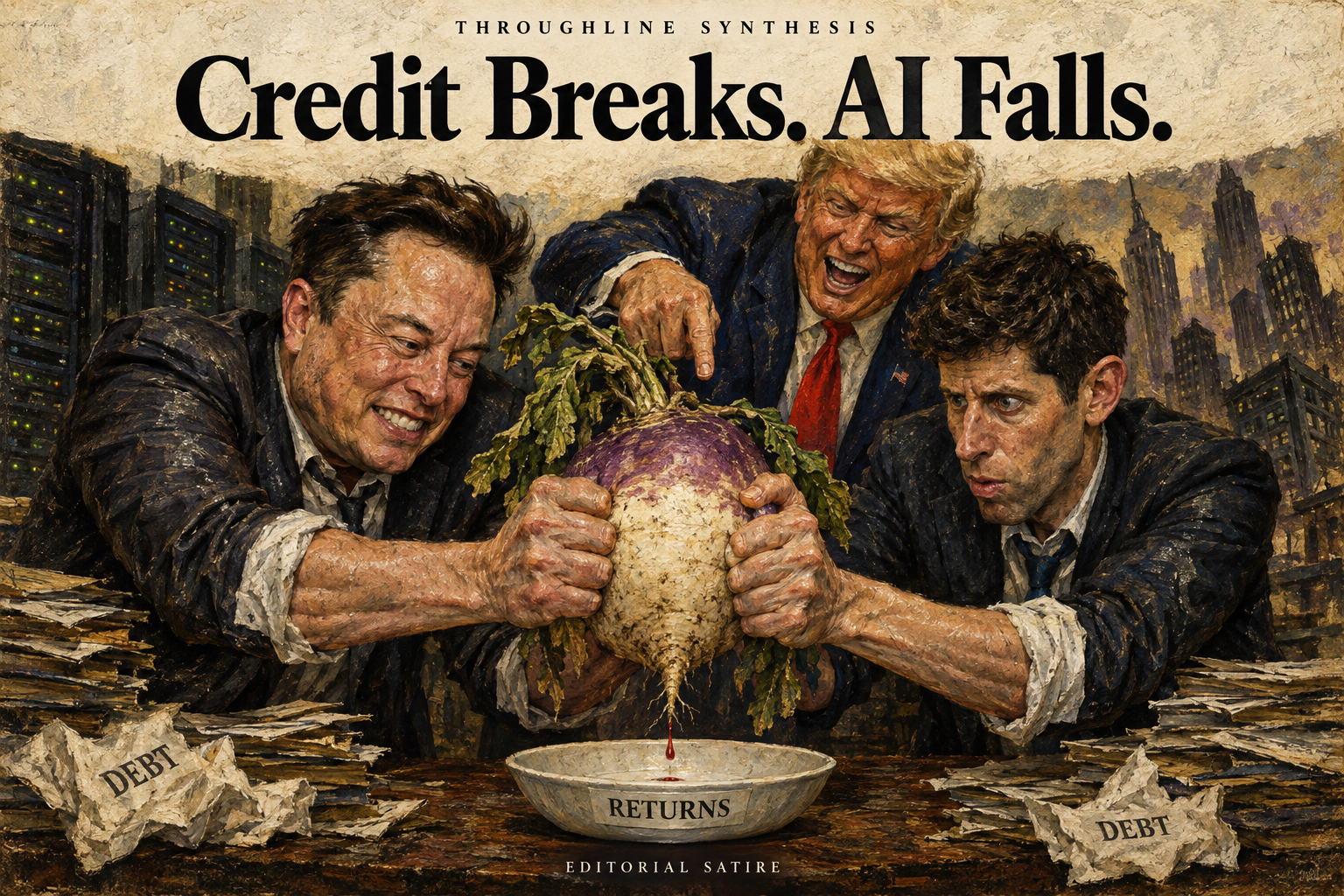
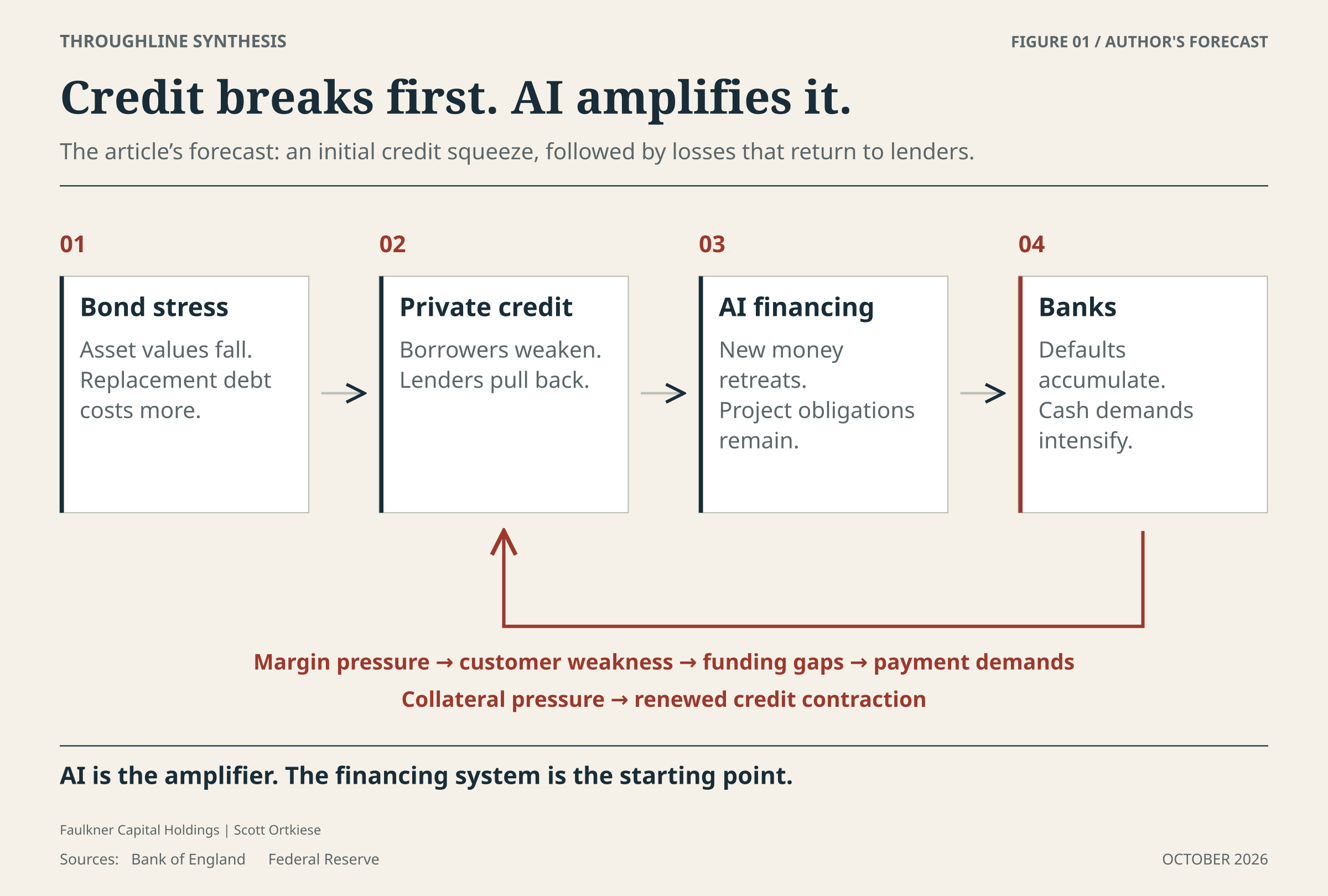
The bond market will break the financing before the technology runs out of promises. Bond losses will weaken lenders. Expensive refinancing and borrower defaults will break private credit’s weakest loans. The retreat in lending will cut off the money sustaining the artificial intelligence, or AI, bubble. Then the AI losses will return to the banks, insurers, and investment funds that financed it.
That is my prediction. The question is when, not whether. AI will survive. The financial bubble built around it will not.
Trump has made the same future growth carry another obligation: the national debt. In his interview published October 1, he moved from defending the AI industry to declaring, “Growth will pay it off.” (TIME interview) Washington and the AI industry are borrowing against the same promised future. The government needs the growth to support its debt. The companies need the financing to produce the growth. The bond market stands between the promise and the payment.
The evidence is already in the financing. On September 18, Reuters reported stalled efforts to distribute $18 billion of loans for an Oracle-leased data center, with banks quoting the debt below face value. (Reuters) On September 28, U.S. Securities and Exchange Commission, or SEC, officials warned that high-level portfolio statistics can obscure restructurings, extensions, and uncollected interest. (SEC) On September 29, Reuters reported that about 80% of Anthropic’s $518 billion infrastructure plan was noncancelable or payable regardless of use. (Reuters)
These are different claims on money, not figures to add together. Their common defect is the dependence on continued financing before the customer produces enough cash to pay the bills. The hyperscalers, the enormous cloud-computing companies, and their partners have written that dependence into leases, guarantees, purchase commitments, and debt agreements.
The next stage is written into the contracts too. Reuters reported on October 1 that certain Anthropic defaults can accelerate substantial lease payments while restricting access to a proposed Broadcom financing facility of up to $42 billion. (Reuters) The demand for cash rises precisely when access to the money contracts.
The Bank of England’s September 30 financial-stability record identifies the same connections: sovereign debt, risky credit, elevated asset valuations, and growing AI borrowing, including opaque and “circular arrangements.” (Bank of England) The committee also describes British banks as well capitalized and highly liquid. (Bank of England) I reject reassurance that stops at the opening balance sheet. The test is what remains after several connected losses and cash demands hit it.
Start with bonds. Follow the lending. Read the AI contracts. The collapse is not waiting for someone to discover that the technology is useless. It is waiting for the financing to stop.
Jeddeloh and Noble put bonds first
Larry Jeddeloh identifies the mistake at the beginning of this chain: treating a change in the financing regime as another buying opportunity in an otherwise familiar bond market. In his September 29 conversation with George Noble, he describes European institutional investors treating a 5% U.S. 10-year Treasury yield as a ceiling. His forecast points toward 10% by 2032. (The Noble Update)
His near-term warning is different and more immediate: a monthly close above 5.30% in the 2-year Treasury yield signals a rapid move toward 6% to 7%. (The Noble Update) The maturity and timetable matter. A long-range forecast of 10% is not a claim that every borrower faces that rate next month. The damage begins well before the terminal number.
Jeddeloh’s central point is speed. A leveraged investor, using borrowed money to enlarge a position, has to survive the route to the eventual yield. A rapid repricing forces sales and repayment demands before the investor has time to recover. (The Noble Update) The destination matters. The journey liquidates the position.
Noble adds the collision between government borrowing and a global capital-spending boom. Both demand financing, while AI companies regard continued expansion as a condition of survival. (Risk Takers, September 30) Washington will not balance its budget because a data-center developer needs cheaper money. The AI companies will not voluntarily abandon the race because Washington needs willing bond buyers.
The financing market will impose the spending discipline the borrowers refuse to impose on themselves. That discipline will arrive through prices, lending terms, and the refusal to supply the next dollar.
The bond market puts a price on every promise
A bond is a tradable loan. Its coupon is the promised interest payment. Its yield is the return available at the price an investor pays. When buyers demand a higher yield on a conventional fixed-rate bond, its price falls. (FDIC examination manual)
“The government will repay it” does not mean “the bond cannot lose value.” Credit risk concerns repayment. Interest-rate risk concerns what those promised payments are worth today. A bank facing withdrawals today cannot pay depositors with a maturity date.
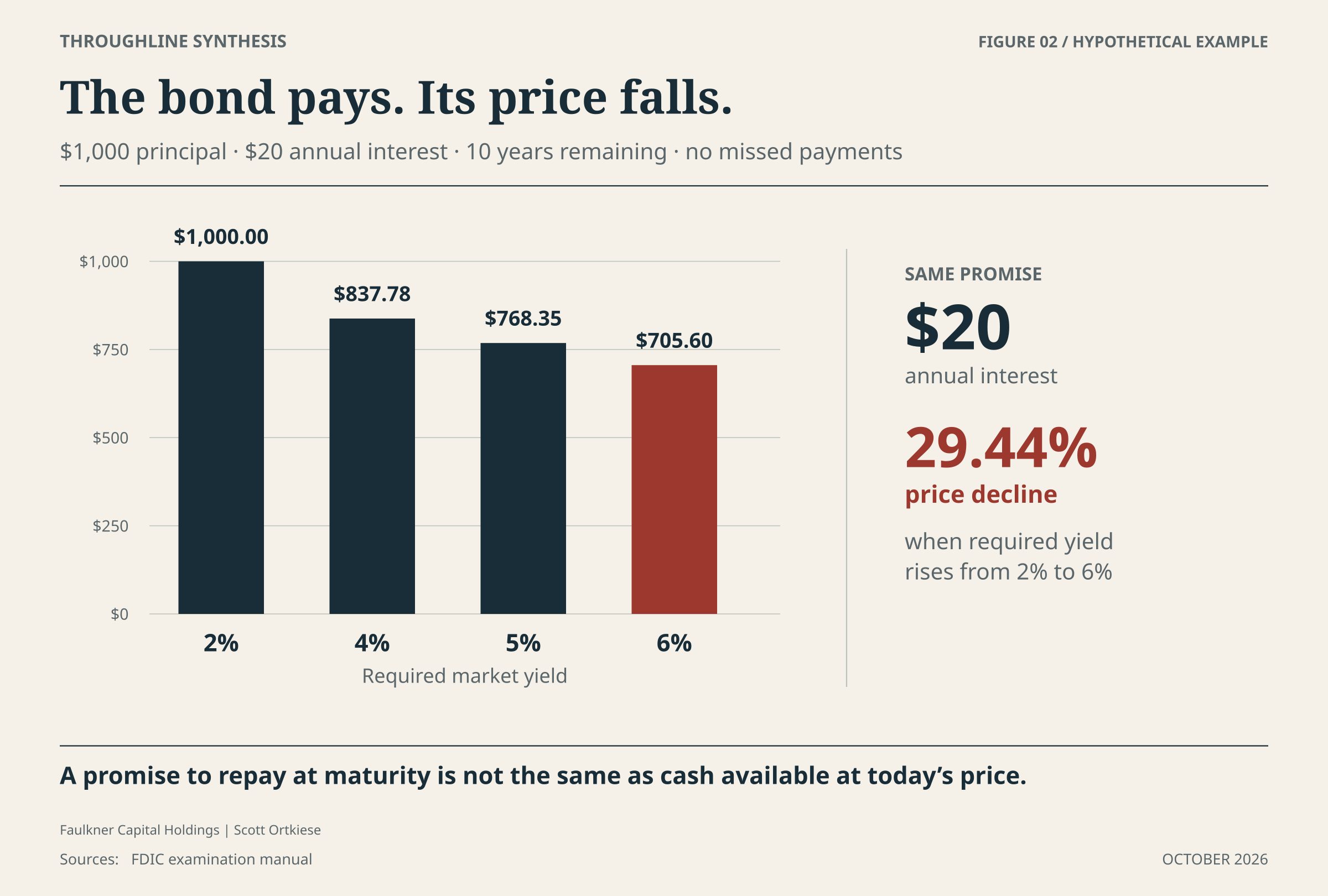
Take a hypothetical $1,000 bond paying $20 annually, a 2% coupon, with 10 years remaining. Discount each payment at the return a new buyer demands, then add the discounted repayment of principal. The result is the price:
| Required annual yield | Calculated bond price | Decline from $1,000 |
|---|---|---|
| 2% | $1,000.00 | 0% |
| 4% | $837.78 | 16.22% |
| 5% | $768.35 | 23.17% |
| 6% | $705.60 | 29.44% |
The borrower has not missed a payment. At a 6% required yield, the old bond has nevertheless lost almost 30% of its original value. Longer maturities and lower coupons generally increase sensitivity to changing rates. (FDIC examination manual)
Treasury yields and AI’s claim on capital
The financing benchmark rose. AI now competes for a substantial share of new debt funding.
Daily closes through October 2, 2026. Hover, tap, or use the date slider. Interactive snapshot, not a streaming feed. The dashed line marks a 2% yield.
AI-related debt issued in 2026 through the early-August observation.
The broader AI ecosystem, not only the largest cloud companies. Debt issuance is a financing flow, not total investment spending or net new borrowing.
Investment-grade issuance
15-year-plus investment-grade issuance
Investment grade is a credit-rating category. The longer-maturity market is a subset of the broader market, not an additional pool to add to it.
Borrowing absorbed is measurable. Borrowing denied to others is not measured here. These figures show competition for financing, not a share of all global investment capital or proof that AI caused the rise in Treasury yields.
Yield series: Cboe TNX daily closes, displayed in yield percent. AI estimates: Goldman Sachs Exchanges, recorded August 3 and published August 5, 2026.
JavaScript is disabled. The dated AI financing figures remain available; use the Cboe link for the yield series.
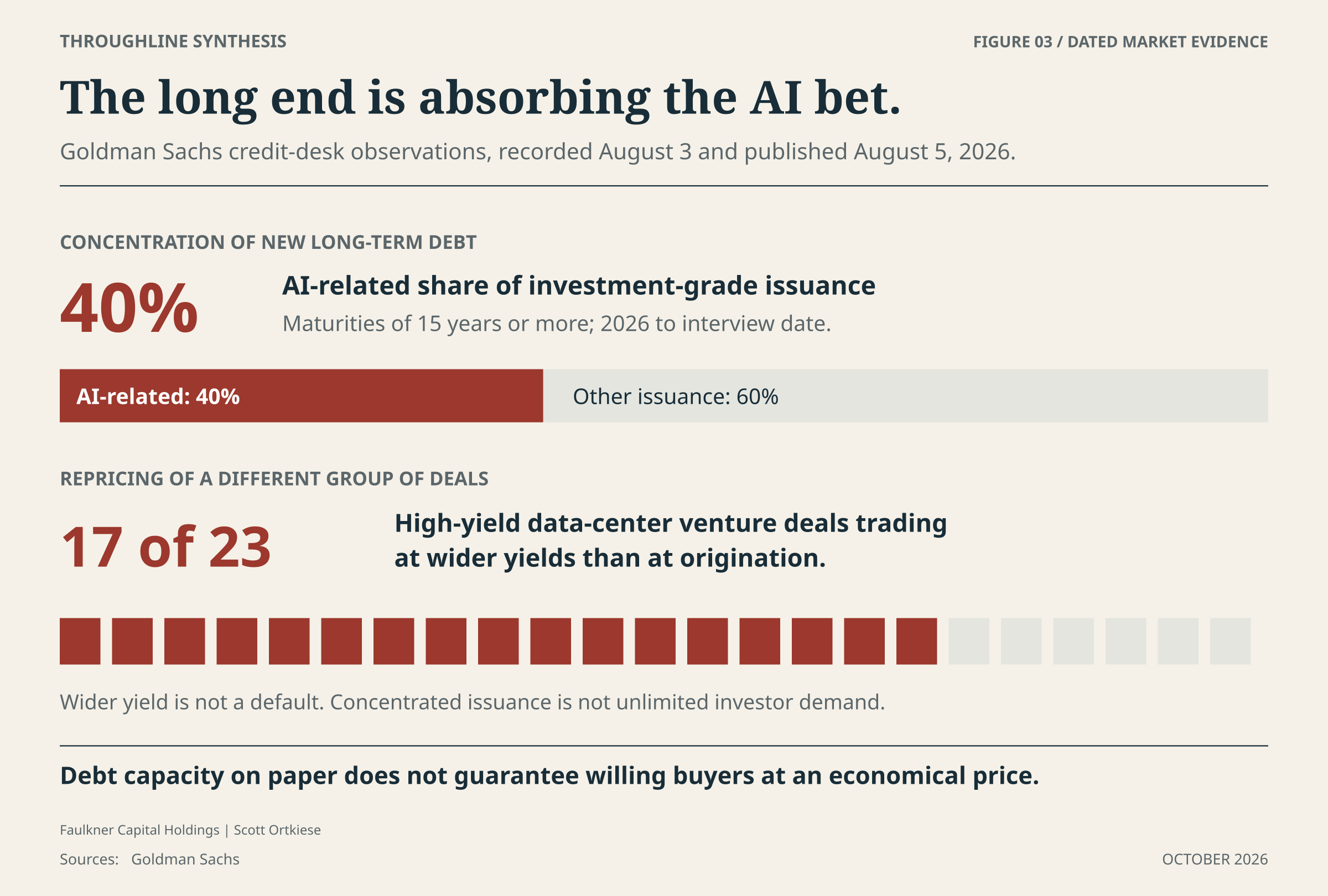
Market inset. The historical yield curve is separate from Figure 2’s hypothetical bond-price calculation. Daily 10-year Treasury closing yields run through October 2, 2026. (Cboe TNX) Goldman’s early-August snapshot records nearly $500 billion of AI-related debt issuance in 2026, about 18% of investment-grade issuance, and 40% of investment-grade issuance with maturities of 15 years or more. (Goldman Sachs) These are separate measures of financing demand, not additive claims on a fixed global investment pool. They measure borrowing absorbed, not the amount of credit denied to other borrowers.
Now follow the effect on a borrower seeking new money. Government yields establish a benchmark; the lender demands an additional return for taking corporate risk. That additional charge is the credit spread. Refinancing means replacing an existing debt with a new loan on the terms available when the old one comes due.
A central-bank rate cut does not guarantee cheaper refinancing. In a simple example, a 4% benchmark plus a 4-percentage-point spread produces an 8% borrowing rate. Let the benchmark fall to 3% while the new lender demands a 7-percentage-point spread. The borrower’s new rate is 10%. The central bank has eased. The borrower’s financing has tightened.
The separate rates must stay separate. A rise in the 10-year Treasury yield does not automatically reset a floating-rate loan tied to an overnight benchmark. It raises the price of long-term financing and reduces the value of existing fixed-rate assets. Floating-rate payments rise when their own contractual benchmark rises; wider credit spreads hit new borrowing, refinancing, and negotiated amendments. The squeeze travels through several contracts, not through 1 universal interest rate.
The buyers are demanding more
The September 23 Treasury auction puts a price on that pressure. The government sold $70 billion of 5-year notes at 5.033%, above the 5.002% yield indicated just before the auction; bids covered 2.21 times the amount offered, below the preceding 6-month average of 2.33. (Dow Jones)
The difference was 3.1 basis points. A basis point is 0.01 percentage point; an auction “tail” means the borrower had to offer more yield than the pre-auction market indicated. America sold the debt. It paid more to do so. That is enough to damage a financing structure built around cheap money.
Goldman Sachs’s own credit desk describes the AI concentration. In an August 3 discussion published August 5, credit-sales head Zach Ablon said AI-related borrowers supplied 40% of that year’s investment-grade issuance with maturities of 15 years or more. (Goldman Sachs) Investment grade is a credit-rating category, not protection against a falling bond price.
In a separate high-yield group, 17 of 23 data-center joint-venture deals were trading at yields above their origination levels. (Goldman Sachs) Ablon also described about 15 insurance clients placing orders of at least $50 million in the 30-year portions of large AI financings in the first quarter, falling to about half that number toward the end of the second. (Goldman Sachs)
That is the trading desk describing a shrinking pool of large buyers. Goldman credit strategist Amanda Lynam still sees ample access to capital, including other currencies and private markets; her distinction is between theoretical debt capacity and the market’s willingness to absorb the issuance. (Goldman Sachs) A borrower’s spreadsheet capacity is not an investor’s purchase order.
Josiah Waters brings the auctions, Japan, leveraged Treasury positions, and energy costs into the same financing story. (Waters) The question is who supplies the next dollar, what that investor demands, and how long that investor can wait.
The cause of a yield increase still matters. Economist Robin Brooks attributes much of September 23’s repricing to growth, inflation, and expected monetary tightening rather than a uniform sovereign-debt panic. (Brooks) The borrower pays the higher financing bill either way. Calling every move a fiscal revolt is unnecessary; ignoring the bill is fatal.
Mohamed El-Erian identifies the transition precisely in his September 27 analysis: “the growing risk that interest rate risk could mutate into credit risk.” (El-Erian) A lower bond price is the first problem. A borrower unable to refinance or pay is the next. His distinction is the throughline of this article, not a forecast that every bond falls indefinitely.
Trump is spending the growth before it exists
Trump’s growth-at-all-costs policy has a financing contradiction at its center. Washington wants to borrow more cheaply while promoting an investment race that needs enormous amounts of capital. It wants trading partners to send money into American projects while threatening the commercial relationships that generate their dollars. And it wants creditors to finance the whole arrangement on the assumption that tomorrow’s productivity will cover today’s promises.
The administration’s own economic report makes the growth wager explicit. Its Council of Economic Advisers projects that tax provisions, deregulation, and energy policies will improve the debt trajectory through faster growth, with further improvements attributed to spending reductions and tariff revenue. (2026 Economic Report of the President, pp. 39-43) Those are modeled policy gains, not money collected. The report’s AI chapter separately promotes faster infrastructure construction, investment incentives, and technology exports; it does not supply a separate AI-specific debt-reduction calculation. (Economic Report, chapter 5)
Read the assumptions before accepting the result. A footnote behind the report’s deregulation growth calculation assumes that regulatory costs consist entirely of economic waste and that the rules produce no market benefits; the report itself concedes that the assumption is violated in practice and points to other potential productivity benefits as an offset. (Economic Report, p. 47, note 2) That is a disputed growth model, not a source of cash with which the Treasury can pay interest.
The same report acknowledges the timing problem: businesses must adopt new technologies and reorganize before productivity gains arrive, sometimes years after the investment. (Economic Report, pp. 98-100) The government’s own case therefore contains the weakness in the financing. Construction bills arrive now. Productivity arrives later. Debt must be serviced in between.
Gita Gopinath, in her interview with Tyler Cowen published September 23, describes the current AI infrastructure buildout as “more of a demand story,” adding pressure to prices before the promised productivity gains arrive. (Conversations with Tyler) Buying chips, securing electricity, and building facilities demand resources immediately. Faster production of other goods and services comes only after the technology works economically inside the businesses adopting it.
Gopinath also rejects the idea that AI spending sits outside monetary policy: she expects higher interest rates to affect it. (Conversations with Tyler) A strategic imperative does not exempt a borrower from its interest bill. The more aggressively the industry borrows to build before competitors do, the more exposed its weakest participants become to the price of money.
This is the policy trap. The buildout supplies spending today, helping sustain the growth celebrated by the White House. The demand for financing and physical resources raises the hurdle the investment must clear. Higher financing costs then attack the projects being counted on to deliver the next round of growth.
The strongest answer from the optimists is real productivity, not presidential insistence. Gopinath agrees that a sustained productivity improvement would help the debt arithmetic, but does not claim that adoption and those gains are assured. (Conversations with Tyler) My conclusion is that the financing will break before the promised gains arrive at the scale and speed needed to carry these obligations.
Flattery is part of the business plan
The public statements show how the sales pitch works. Credit Trump for the promised boom, treat his instincts as a substitute for scrutiny, and turn the White House into a promoter of the companies whose spending he needs to advertise.
Sam Altman, OpenAI’s chief executive, supplied the template at the January 21, 2025 Stargate announcement. He told Trump, “we wouldn’t be able to do this without you,” while promoting a planned $500 billion AI infrastructure initiative. (ABC News) ABC also documented Altman’s $1 million inaugural donation and his reversal from calling Trump an unprecedented threat to America to praising his prospective leadership of the AI industry. (ABC News) The Stargate announcement was a spending plan, not $500 billion already invested, and it is not the separate AI debt-issuance estimate discussed elsewhere in this article.
Jensen Huang, Nvidia’s chief executive, made the bargain more explicit in public. During Trump’s September 14, 2026 call to the All-In Summit, Trump described fears about AI as a hoax serving political insiders and China; Huang answered, “You’re right,” and, “We’re not going to let that happen, sir.” (SFGate, September 15) CNBC’s September 20 account describes Huang’s access to Trump, his campaign against restrictions on Nvidia’s chip exports, and his argument that engineering, rather than slowing the industry, answers the safety problem. (CNBC) Nvidia sells the equipment the expansion consumes. Its chief executive has a commercial interest in keeping that expansion moving.
Elon Musk’s relationship with Trump has included public fights, not uninterrupted agreement. After their feud, Musk praised the January 2026 Venezuela operation as “a win for the world” and posted about a “lovely dinner” with Trump and Melania Trump. (NDTV, January 5) Musk subsequently joined the September 29 White House technology gathering. (Deadline, September 29) His xAI is not outside the financing story: Apollo’s announced $5.4 billion equipment transaction places an xAI subsidiary in the position of lessee, with Apollo-managed capital and Nvidia investment supporting the structure. (Apollo)
David Sacks, the venture capitalist and former White House AI and cryptocurrency czar, reduced oversight to personal loyalty. CNBC records his claim that AI’s necessary guardrail was a “STRONG AND SMART” president. (CNBC) That is not a test of a model, a financing plan, or a safety system. It is an invitation to replace scrutiny with faith in Trump.
Trump’s September 29 gathering showed what the promotion produces. He described the industry’s proposed self-regulation agreement as “morally binding” and emphasized a “tremendous self-policing aspect”; the reported proposal included internal reviews, external auditors, and company-board review, but the agreement itself had not been released. (Deadline) Altman was absent, and the report does not identify every signatory, so attendance and signatures must not be invented. (Deadline)
Nor do these executives agree on every safeguard. CNBC reports that Altman and Musk endorsed calls for slower development and additional oversight while Huang opposed slowing the industry. (CNBC) That disagreement does not erase their companies’ financing obligations or their public cultivation of Trump.
My charge is political and economic: they feed Trump a story in which their expansion proves his greatness. He sells that story as national success. Praise does not collect a customer’s unpaid bill, repay a lender, protect a worker’s savings, or prove that a powerful AI system is safe. When the financing fails, the sales pitch becomes the excuse for asking everyone else to pay.
Growth is not a debt repayment plan
The arithmetic has 3 moving parts: the government’s interest cost, the economy’s growth rate, and the budget balance before interest. That last measure is the primary balance. A primary deficit means the government must borrow even before paying interest on existing debt. (Stanford Institute for Economic Policy Research)
An illustrative economy makes the point. Start with $100 of annual output and $100 of government debt. Let output grow 5% in dollar terms, the existing debt cost 5% in interest, and spending exceed revenue by another $3 before interest. At year-end, output is $105 and debt is $108. The debt ratio rises from 100% to 102.9% despite 5% nominal growth. This is an arithmetic illustration, not an estimate of the U.S. budget.
Nominal growth measures the increase in dollars, including higher prices. Real growth removes the price increase. Interest and growth must be compared on a consistent basis, and the relevant interest expense reflects the whole outstanding debt stock, not just today’s 10-year Treasury yield. A jump in market rates enters the government’s interest bill progressively as debt matures and new borrowing is issued.
Jared Bernstein, Adam Shaw, and Daniel Posthumus explain this in their 2025 Stanford analysis: no magic debt ratio establishes insolvency, but rising interest costs and persistent primary deficits make the adjustment needed to stabilize debt more difficult. (Stanford) Bernstein chaired former U.S. President Joe Biden’s Council of Economic Advisers; that affiliation belongs beside the argument, not hidden behind the university’s name. (Stanford) The arithmetic does not depend on his politics.
The authors draw on Olivier Blanchard’s work to make another essential distinction: even interest rates below economic growth do not excuse an arbitrarily large primary deficit. (Stanford) Faster growth helps. It does not turn every spending commitment and tax reduction into a self-financing policy.
Nor does a productivity boom guarantee permanently cheap capital. Productive new investment also increases demand for financing, a channel the Stanford analysis explicitly recognizes. (Stanford) Borrowers cannot simply insert a higher growth rate into their forecast while freezing the cost of money.
This is why the debt headline is less informative than the next financing requirement. The danger is not a mystical threshold at which the government suddenly becomes a household without a checking balance. It is a rising claim on resources, repeated refinancing, and an escalating conflict over who gives up income to meet the bill.
Inflation sends the bill back to the creditor
Trump supplied the bluntest statement in the interview published October 1: “Certain levels of inflation will also pay off that debt very rapidly. Very rapidly.” (TIME) He also argued that the Federal Reserve’s rate policy was hurting the country more than inflation. (TIME) That is an expressed preference, not an enacted inflation target. It is also a message to everyone being asked to lend him dollars.
Inflation does not cancel the face value of an old Treasury bond. It reduces the purchasing power of its fixed payments. The government’s apparent relief is the creditor’s real loss.
The next creditor responds. Jean Barthélemy, Eric Mengus, and Guillaume Plantin’s research on fiscal dominance explains why anticipated inflation enters the price of newly issued debt; eroding old obligations does not secure the same advantage on new borrowing. (Fiscal Dominance: Implications for Bond Markets and Central Banking) Washington still has to finance new deficits and replace maturing debt. It cannot repeatedly surprise the same market with an announced intention to shrink repayment through inflation.
Fiscal dominance is the pressure to make monetary policy serve the government’s financing needs instead of its price-stability objective. The same research shows how that pressure emerges through conflict between fiscal authorities, the central bank, and bond investors even when the central bank remains formally independent. (Barthélemy, Mengus, and Plantin) A president does not have to abolish the Federal Reserve to make its choices more costly.
Kenneth Rogoff’s August warning is direct: he forecasts “some kind of debt crisis” over the next 5 to 10 years and identifies financial repression and inflation among its forms. (CNBC) Financial repression means using policy to channel savings toward government financing or suppress borrowing costs below the returns an unrestricted market would demand. (Reinhart and Sbrancia, IMF working paper) Rogoff’s warning is not evidence that a compulsory Treasury-purchase program has already been imposed.
Carmen Reinhart and M. Belen Sbrancia’s historical research makes the burden explicit: restrictions on investors and below-market returns subsidize government financing; returns below inflation go further by eroding creditors’ purchasing power. (IMF working paper) The distinction matters to a saver. The government has not discovered free money. It has found someone else to absorb the cost.
The research does not describe creditors as passive. Higher borrowing costs can frustrate a government’s attempt to force central-bank accommodation. (Barthélemy, Mengus, and Plantin) That is the point of the bond market in this story. Trump can demand lower rates. He cannot demand that a long-term creditor ignore the purchasing power of repayment.
At the Bank of Japan’s 2026 research conference, Donald Kohn warned that rising debt and persistent deficits threaten central-bank independence before full fiscal dominance emerges, and that pressure to cut rates to relieve government borrowing costs is dangerous. (Bank of Japan conference record, published September 2026) The policy choices are already pulling against each other. Holding down short-term rates does not command long-term lenders to accept less inflation protection.
That conflict reaches the AI financing through the same benchmark yields, refinancing terms, and collateral values already squeezing private credit. Inflation is not an escape hatch from this article’s opening mechanism. It is another route into it.
Japan and the limits of America’s borrowing privilege
Patrick Boyle’s yen analysis follows a position that crosses national balance sheets: borrow in a low-interest-rate currency, sell it, and buy higher-return assets elsewhere. That is the carry trade. (Patrick Boyle) A strengthening yen makes repayment more expensive for an investor who owes yen but owns dollar assets. During an unwind, selling foreign assets and buying back yen intensifies the pressure on other positions.
Official reserve management is a different channel. Former International Monetary Fund chief economist Maurice Obstfeld describes the July 31 U.S.-Japan intervention to strengthen the yen and connects American support to the risk of Japanese reserve sales disturbing the Treasury market. (Peterson Institute for International Economics) Washington wants Japanese investment, a stronger yen, favorable trade outcomes, and low American borrowing costs. Those objectives pull against one another.
The Federal Reserve’s facility for foreign monetary authorities provides temporary dollars against Treasury collateral, reducing the need for outright sales into a distressed market. (Federal Reserve) It buys time. It does not reconcile incompatible fiscal, currency, and trade objectives.
Washington’s own debt also returns to the market in stages. Existing fixed-rate debt keeps its coupon; maturing debt and new deficits require financing at the next available price. In November 2025, U.S. Treasury Secretary Scott Bessent described regular, predictable issuance as a way to limit concentrated refinancing needs and short-term bills as an issuance “shock absorber.” (U.S. Treasury) A shock absorber is not a permanent source of cheap money.
Boyle interprets the administration’s choices as a bet on falling rates. (Patrick Boyle) The exposure is straightforward: returning frequently to the market means accepting its next price.
Research by Wenxin Du, Ritt Keerati, and Jesse Schreger identifies a deeper distinction. The special value investors attach to dollars has remained strong while the financing advantage attached to Treasuries has eroded, especially at medium and long maturities. (National Bureau of Economic Research) Their “convenience yield” measures the advantage associated with an asset’s special usefulness relative to alternatives. The dollar’s central role does not entitle Washington to permanently cheap debt.
The foreign-affairs literature reinforces that distinction. Henry Farrell and Abraham Newman’s International Security analysis explains how control of central financial networks creates coercive power. (Belfer Center) Eswar Prasad’s Foreign Affairs argument explains why rival currencies lack the dollar’s combination of market depth and liquidity. (Foreign Affairs) Neither proposition obliges creditors to accept yesterday’s return.
Nor does the argument require a coordinated foreign liquidation of Treasuries. Foreign Policy identifies the obstacles: much foreign ownership is private, and deliberate selling damages the seller as well as the target. (Foreign Policy) Creditors will restrict Trump’s options without overthrowing the dollar. They will demand a higher price for the next loan.
South Korea exposes another cost of recruiting allies to finance American ambitions. October 1 reporting identifies foreign-asset income and government-backed foreign-currency borrowing as potential funding sources for its U.S. investment commitments; the $200 billion non-shipbuilding pledge carries a $20 billion annual payment ceiling, not an immediate demand for the entire amount. (Aju Press) KB Kookmin Bank economist Lee Min-hyuk warns that redirecting foreign-asset income into U.S. projects puts reserve replenishment at risk. (Aju Press) The Bank of Korea says the commitments will not reduce its capacity to stabilize the currency. (Aju Press) An investment pledge is not free money. Washington is drawing on resources its allies also need to protect their own financial stability.
Gopinath’s May address to the Atlanta Federal Reserve’s financial-markets conference explains why this is a global balance-sheet problem rather than a bilateral trade scorecard. She identifies U.S. fiscal deficits as a driver of the external financing requirement and notes that foreign Treasury demand has shifted toward private buyers, a more volatile source than official purchases. (Atlanta Fed keynote transcript) A dollar invested in an American technology stock and a dollar committed to long-term Treasury debt are different decisions. The same enthusiasm does not guarantee both.
She also identifies the coordination problem: reducing foreign excess saving without reducing the American financing requirement pushes against the supply of capital and puts upward pressure on global interest rates. (Atlanta Fed) Trade threats do not reconcile that arithmetic. Washington cannot demand that other countries save less, invest more at home, buy more American goods, and provide unlimited cheap financing for American deficits without confronting the conflict among those demands.
Private credit transmits the bond-market squeeze
Private credit is lending negotiated outside public debt markets, often by investment funds rather than banks. Long investor lockups protect many funds against immediate withdrawals, but they do not protect the underlying borrowers against an unaffordable interest bill. (Federal Reserve)
Private credit will stop supplying the next marginal borrower with money as existing losses consume its willingness and capacity to lend. The first failures do not have to be AI projects. Troubled software loans, other leveraged businesses, investor withdrawals, and financing demands will drain resources before the next data center asks for cash.
Floating-rate debt moves part of the interest-rate risk from the lender to the borrower. The lender’s return resets with the loan’s benchmark; the borrower’s operating income does not. The Bank of England identifies predominantly floating-rate debt and elevated withdrawal pressure in retail-oriented private-credit vehicles as connected vulnerabilities. (Bank of England)
Take an illustrative business with $1 billion of debt and $100 million in annual cash before interest, taxes, necessary investment, and principal repayment. An 8% borrowing rate consumes $80 million. A 12% rate consumes $120 million. The business goes from $20 million remaining to a $20 million shortfall before paying those other claims.
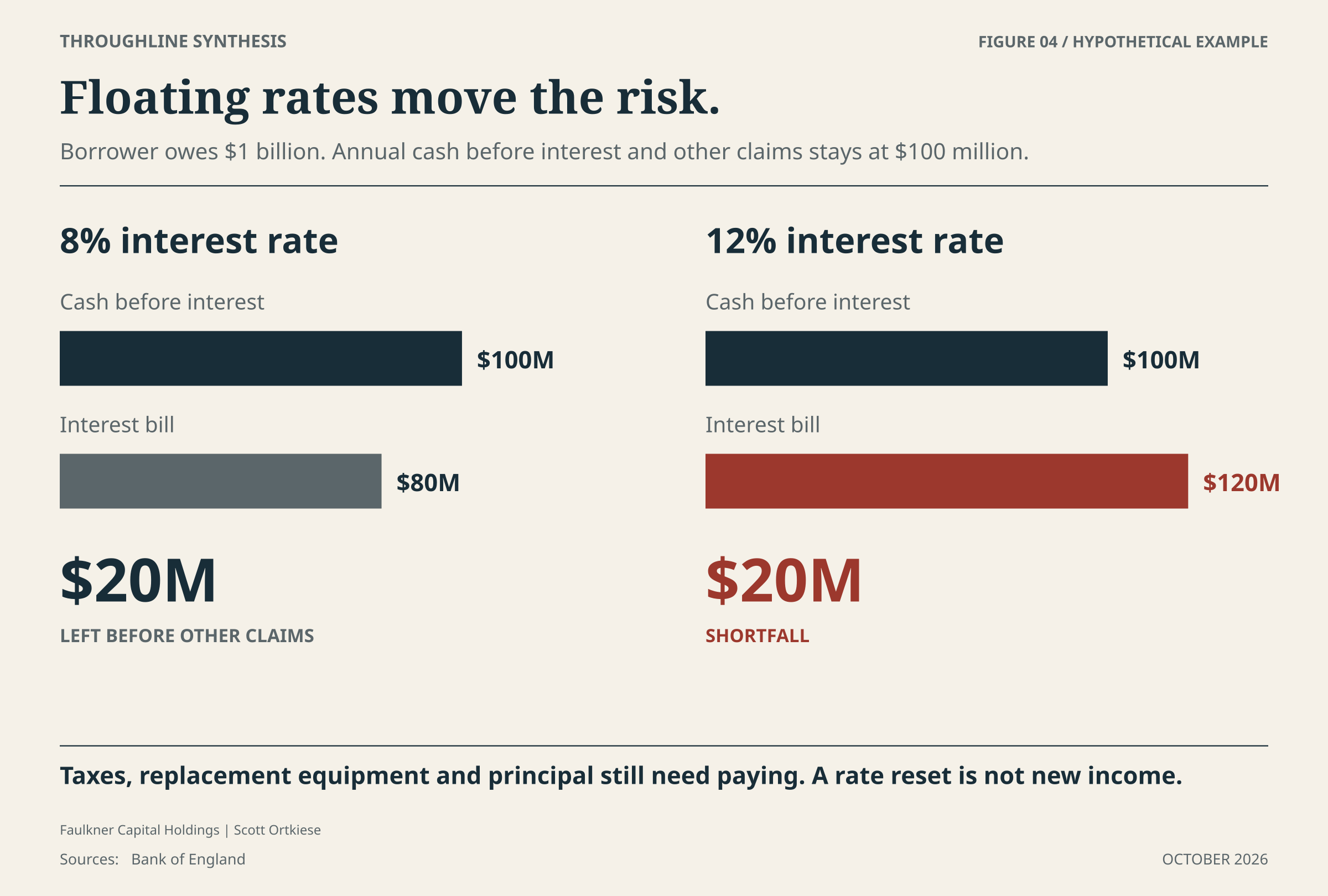
A lender can extend the maturity, amend the contract, or accept interest added to principal. Those actions postpone cash collection. By themselves, they do not repair the borrower’s business. A larger claim against a failing borrower is not a recovery.
The September debt-market review from Alvarez & Marsal reports that at least 7 business development companies managed by 6 firms capped second-quarter redemptions, and that Moody’s moved its U.S. business-development-company outlook to negative. (Alvarez & Marsal) Business development companies finance businesses, commonly through loans. A withdrawal cap is not itself a default. It is a limit on the investor’s access to money.
In the debt population discussed in the review, 34% of software debt and 45% of payment-in-kind debt mature by the end of 2028; the surrounding maturity charts use a PitchBook business-development-company sample, not a census of every private loan. (Alvarez & Marsal) Payment in kind means adding interest to the amount owed instead of collecting cash. The reported income rises while the lender acquires more exposure to the same borrower.
The review also describes competition for stronger loans and low, although rising, nonaccruals, the loans on which lenders stop booking interest because collection is doubtful. (Alvarez & Marsal) Strong borrowers still attract money. That does not rescue the weak borrower whose refinancing disappears.
An appraisal does not pay the withdrawal
SEC Chief Accountant Kurt Hohl and Investment Management Director Brian Daly identify the weakness in stale private-asset marks: valuations must reflect the assumptions market participants would use, including credit spreads and liquidity conditions, rather than simply preserve management’s previous estimate. (SEC) Their September 28 statement calls attention to extensions, restructurings, nonaccruals, and capitalized interest that broad statistics can obscure. (SEC)
Show the cash collected. Show the interest added to principal. Show the maturities extended, the security pledged, and the price an independent buyer will pay. A low default rate is not an answer when contracts keep being rewritten before the payment failure appears.
Private-credit funds are not all banks in disguise. Gregor Matvos, Tomasz Piskorski, and Amit Seru’s study of 1,267 funds over 2000 through 2024 finds substantial investor equity and limited maturity mismatch. (National Bureau of Economic Research) That equity identifies the first loss-bearer. It does not guarantee continued lending or establish the quality of the subsequent AI buildout.
The bank connection sits in the financing promises. Viral Acharya, Nicola Cetorelli, and Bruce Tuckman document the interwoven bank and nonbank system, including bank funding for assets moved outside bank ownership. (National Bureau of Economic Research) Federal Reserve researchers found limited direct bank damage in the private-credit drawdown scenario they tested, while expressly identifying additional pressure from simultaneous demands elsewhere. (Federal Reserve)
A fund’s loss is not automatically its bank’s loss. First, investor equity absorbs damage. Then the funding agreement determines whether the bank advances cash, reduces borrowing capacity, requires more collateral, or suffers an impairment. My forecast concerns the combined demands arriving at institutions already carrying other losses.
That is the bridge into AI. Funds do not have to disappear to withdraw financing. They only have to stop writing the next check.
AI loses its financing before it loses its usefulness
“The bubble is in the margins,” George Noble says. His September 30 argument attacks the earnings underneath the valuation: investors are treating exceptional profits as permanent while the next round of capacity and competition is being financed. (Risk Takers)
Trump is selling AI growth as the answer to the economic damage he is causing. His tariffs raise costs. His war disrupts energy supplies. His tax cuts reward billionaires while leaving government less money to repair the damage. (Joseph Stiglitz)
“Growth will pay it off,” he says. He welcomes inflation as a way to reduce debt. (TIME interview) That means making your dollars buy less while calling the government’s shrinking burden an achievement.
The tech bosses feed his vanity. Sam Altman told Trump Stargate could not happen without him. (ABC News) Jensen Huang embraced Trump’s dismissal of AI dangers. (SFGate) Elon Musk celebrated Trump’s Venezuela operation as “a win for the world.” (NDTV) David Sacks declared that AI’s only guardrail was a “STRONG AND SMART” president. (CNBC)
This is sycophancy with a business purpose: make Trump their salesman. He gets headlines. They get a government championing expansion and self-policing instead of making them prove the public is protected. (September 29 White House gathering)
The bond market does not accept flattery as payment. The 10-year Treasury yield climbed from 0.50% in March 2020 to 5.28% on October 2, 2026. (Cboe TNX) AI-related debt issuance approached $500 billion by August. (Goldman Sachs)
That borrowing competes with homes, factories, and businesses. Cheaper competition attacks the revenue needed to repay it: the Financial Times reported a roughly 60× output-price gap between Anthropic’s Fable 5 and DeepSeek. (Financial Times) Customers can run alternatives without surrendering data. (MIT Sloan)
My prediction: private lenders stop financing the next round. AI companies cannot cover their bills. Defaults hit banks and insurers. Businesses close. Workers lose jobs and savings.
Americans oppose local data centers. (Quinnipiac) The industry’s own leaders warn that AI could wipe out humanity. (Center for AI Safety)
Trump, Musk, Altman, and Huang keep selling the boom. Americans face higher electricity bills, competition for water, and demands to rescue failed investments with taxpayer money. They get rich. We get the bill and the danger.
Figure 2 supplies the balance-sheet mechanism: an unchanged payment promise loses market value as the required yield rises. The adjacent market inset supplies the historical yield record and AI’s measured borrowing demand. Together they show why financing built around expected future earnings comes under pressure before those earnings arrive.
Noble’s shipping analogy is direct: scarce capacity produces exceptional prices, exceptional prices attract more capacity, and investors discover that their “cheap” stock was valued against temporary earnings. (Risk Takers) A price-to-earnings ratio divides the stock-market value by earnings. Put an unsustainable profit in the denominator and an expensive company looks cheap.
Take a hypothetical supplier selling 100 units at $100 each, with a $60 unit cost. It earns $4,000 before other expenses. Increase volume 20% but cut the selling price to $75 while leaving unit cost unchanged. Revenue falls to $9,000 and the contribution toward overhead, financing, and profit falls to $1,800, a 55% decline. More units sold. Far less money earned.
This is an illustration, not Nvidia’s reported unit economics. It isolates Noble’s point: growth in activity does not establish durable earnings. Prices and costs determine the margin. The margin determines what remains for the investor and creditor.
Noble also warns of overordering and equipment waiting for power and completed facilities. (Risk Takers) The economic life of the equipment does not stop while the developer waits for a permit. Financing costs accumulate against hardware that has yet to earn its keep.
The chip supplier, the computing provider, and the AI developer have different margins, but their financing depends on the same chain of spending. Lower chip prices help a new buyer while cutting the resale value of equipment already pledged to a lender. Lower model prices benefit users while reducing revenue per unit of computing sold. Higher volume must overcome that price decline before it supplies more revenue for old infrastructure commitments.
Noble’s margin argument therefore reaches both sides of the loan. The borrower produces less cash. The collateral recovers less after default. The lender loses the payment and part of the protection behind it.
Different borrowers. The same customers.
Steve Eisman follows that dependence through the whole industry. In his October 2 New Money interview, he traces Nvidia’s customers through the hyperscalers to OpenAI and Anthropic, arguing that the health of those model developers supports an extraordinary concentration of the spending above them. (New Money) Noble explains the vulnerable margins. Eisman explains why their deterioration reaches so many apparently separate investments.
Nvidia’s own quarterly filing supplies a hard starting point: 5 direct customers accounted for 22%, 14%, 13%, 11%, and 10% of accounts receivable on July 26, or 70% altogether. (Nvidia filing) Receivables are customer bills awaiting payment, not the company’s total revenue. Nvidia’s direct-customer categories include manufacturers, distributors, system integrators, cloud providers, and model developers; several intermediaries can ultimately serve the same source of demand. (Nvidia filing)
Eisman separately estimates that OpenAI and Anthropic generate roughly 70% of Microsoft, Amazon, and Google’s AI revenue, equivalent to about 25% to 30% of their cloud revenue; he explicitly excludes Oracle from that comparison. (New Money) That is his estimate, not a consolidated audited industry result. It measures a different exposure from Nvidia’s receivables.
The financial consequence is the concentration, not the temptation to add percentages. A portfolio holding chip-company debt, cloud-company bonds, a data-center loan, and an insurer’s shares can repeatedly own claims dependent on the same customers. Different names on the securities do not create different sources of repayment.
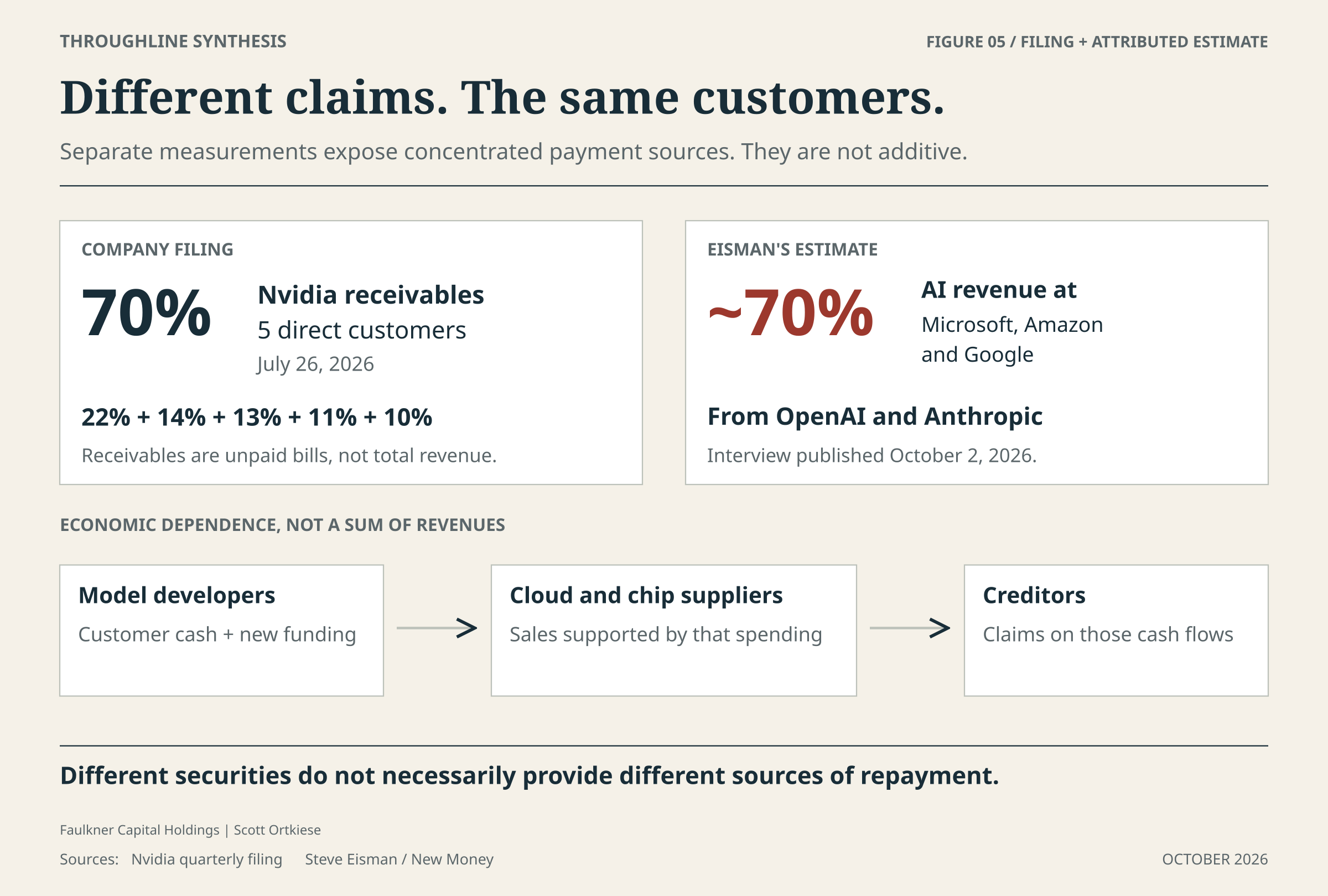
Eisman owns Nvidia and does not predict an inevitable collapse; he also places more weight on customer health than on a mechanical chip-obsolescence timetable. (New Money) I draw the conclusion from the financing: a concentrated customer base cannot support unlimited expansion through repeated capital injections. As credit contracts, the weakness at the customer becomes a revenue problem for the supplier and a repayment problem for the lender.
Anthropic’s bills are firmer than its customer commitments
Noble’s Anthropic analysis exposes the contractual version of the same problem: the company has committed to infrastructure spending that its customers have not committed to fund. (The Noble Update) The supplier has secured a payment obligation. The AI developer has not secured an equivalent obligation from the customer.
Reuters’s September 28 reporting on Anthropic’s confidential prospectus puts the operating economics in view: nearly $4.6 billion of 2025 revenue against an operating loss of more than $8 billion and $7.33 billion spent on computing and infrastructure. (Reuters) Those are 2025 figures, not an estimate of its current annual revenue rate.
Reuters also reports a net loss near $42 billion, including an approximately $34 billion accounting charge tied to financing that could convert into shares. (Reuters) That charge was not operating cash burned. There is no need to inflate the cash-loss story with a noncash number. The operating loss supplies the indictment of the economics already demonstrated.
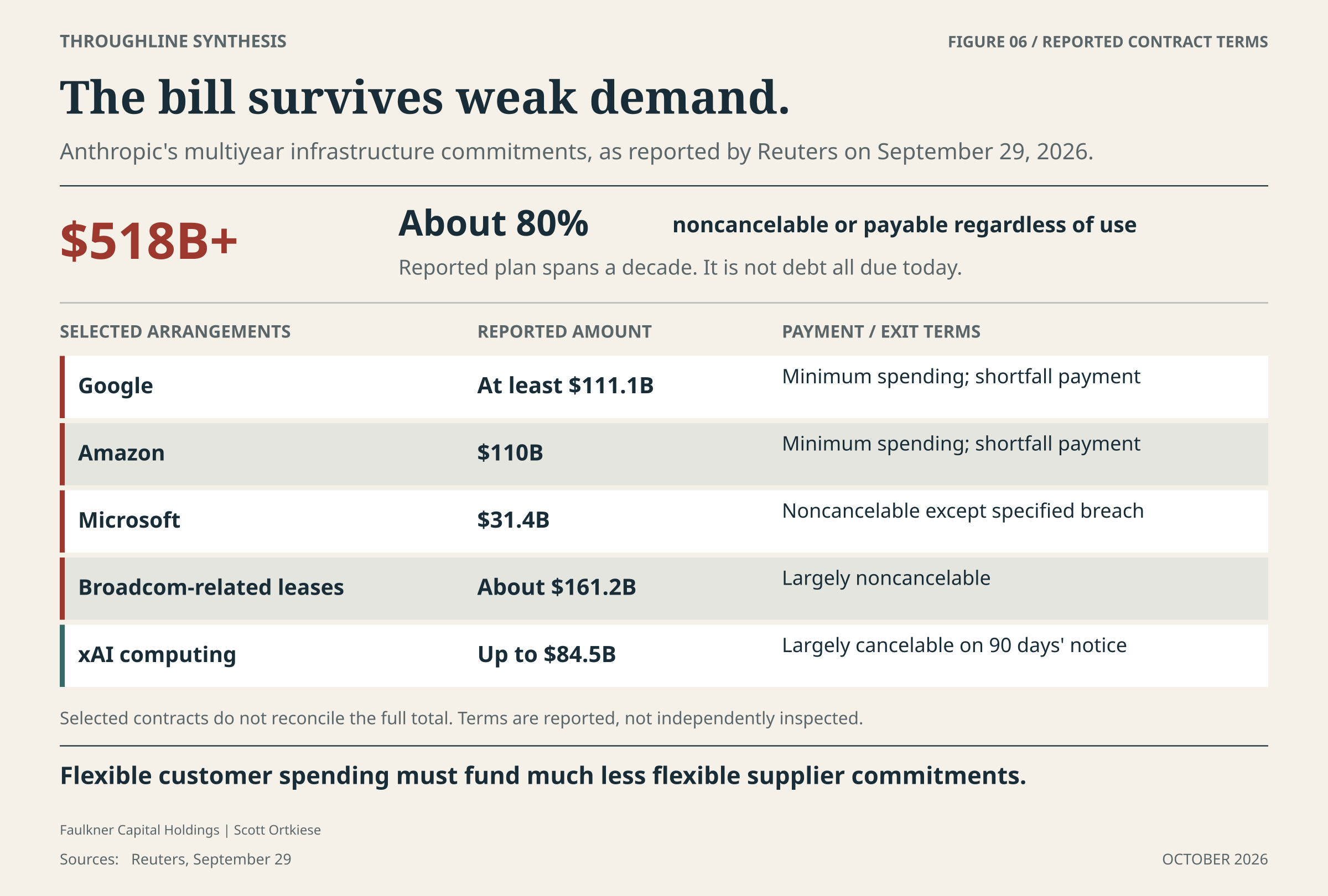
The next day’s reporting sets out at least $518 billion in infrastructure spending over a decade, about 80% noncancelable or payable regardless of use. (Reuters) These are multiyear obligations, not debt all due tomorrow. Their force comes from the payment terms:
| Arrangement | Reported obligation | Payment terms |
|---|---|---|
| Google infrastructure | At least $111.1 billion, April 2026 through July 2033 | Payable regardless of usage; Anthropic pays the difference when spending falls below the commitment. (Reuters) |
| Amazon infrastructure | $110 billion, May 2026 through April 2036 | Minimum-spending obligations with similar shortfall payments. (Reuters) |
| Microsoft infrastructure | $31.4 billion, November 2026 through May 2033 | Payable regardless of usage; noncancelable except for Microsoft’s uncured material breach. (Reuters) |
| Broadcom-related equipment leases | About $161.2 billion | Largely noncancelable, with a stated default exception. (Reuters) |
| xAI computing | Up to $84.5 billion through 2029 | Largely cancelable on 90 days’ notice. (Reuters) |
These selected arrangements do not reconcile the entire headline total. They distinguish hard payment commitments from a substantially more flexible arrangement. Reuters inspected the confidential prospectus; the full agreements are not the evidentiary basis of this article.
Customer concentration makes the mismatch sharper. Reuters reports that 2 unnamed customers each supplied 12% of Anthropic’s 2025 revenue and that many large customers lacked long-term contracts. (Reuters) Separately, Amazon and Google marketplaces generated $2.16 billion of sales, 47% of annual revenue, and cloud partners were responsible for collecting 60% of the $909 million in outstanding customer bills at year-end. (Reuters) The 2 customers and the 2 distribution platforms are different measures, not interchangeable identities.
Anthropic paid about $351 million in cloud-platform distribution fees in 2025, booked within operating expenses while recording the full marketplace sale as revenue. (Reuters) The commercial consequence matters more than a quarrel over the headline: the company pays partners to reach customers and pays partners to supply computing. Revenue is not cash left after both bills.
Ed Zitron adds a necessary test: explain what the revenue headline measures before using it to justify the next financing. His September 29 analysis challenges annualized run rates whose measurement periods and assumptions are not disclosed. (“Dead Money”) An illustrative $1 billion revenue month multiplied by 12 produces a $12 billion run rate. It does not produce $12 billion already earned, collected, or promised by contract.
Keep the questions separate. How much revenue was recognized? How much cash was collected? How much future spending have customers actually committed to? How much of the advertised growth is an extrapolation from a selected period?
Then follow the cash. Deduct service costs, distribution charges, recurring development spending, and other cash expenses; account for collection timing and other working-capital demands; compare what remains with required investment and debt payments. An adjusted profit that omits a recurring cost does not make that cost disappear.
Anthropic argues that computing capacity, not insufficient demand, constrains its growth. (Reuters) Demand at a subsidized price is not the same thing as demand at a price that repays the buildout. The company must produce adequate margins while meeting obligations it cannot reduce as quickly as its customers reduce spending.
That is where the credit contraction will hit. Competition will squeeze the selling price. Contractual minimums will hold up the cost. The next investor will be asked to fund the difference.
The next investor is not a customer
Noble identifies repeated financing at higher valuations as a central support of the AI structure. (Risk Takers) New equity supplies cash. A higher valuation by itself supplies none. Debt supplies cash today and creates another claim on tomorrow.
A company can raise money at a lower valuation by diluting its existing owners. The decisive question is whether enough cash arrives before the bills fall due. The refinancing failure I predict is a failure of amount and timing, not a rule that a lower share price automatically shuts every funding door.
Jeff Snider’s Eurodollar University analysis puts the race against time at the center: committed spending must be financed until customer revenue catches up, and the credit cycle determines the terms on which that waiting period is funded. (Eurodollar University) The useful measure is the cumulative funding gap: the greatest cash shortfall reached along that path after allowing for usable starting cash and financing actually available.
A forecast of profitability in year 5 does not pay an obligation in year 2. Move break-even further away and the company must finance more loss-making periods. Finance those periods with additional debt and interest consumes more of the eventual receipts. The spending creates the need for borrowing; the borrowing makes the spending harder to recover.
The calculation must use cash flows from matching periods. Operating cash flow measures cash generated by the business after operating cash expenses and working-capital movements. Free cash flow generally subtracts capital expenditure from that amount. Treating free cash flow as money available before capital expenditure subtracts the investment twice and invents a financing deficit.
This is why the credit contraction reaches AI before demand has to disappear. The lender need not conclude that the technology is worthless. It only needs to refuse the additional money required to reach the forecast.
An initial public offering sells shares to public investors for the first time. Newly issued shares fund the company; shares sold by existing owners fund those owners. Reuters’s later September 28 report put Anthropic’s expected debut after the November midterms, superseding the earlier pre-election timetable. (Reuters) The offering is a prospective financing, not proof that customers are paying for the business.
Patrick Boyle supplies the valuation arithmetic behind Noble’s earnings argument. His discussion of Scott McNealy’s warning about Sun Microsystems separates the usefulness of a business from the price investors pay for it. (Patrick Boyle) A company valued at 30 times sales trades at 150 times earnings when its after-tax margin is 20%. At a 10% margin, the multiple becomes 300 times earnings.
Time compounds the exposure. A hypothetical $100 billion payment received in 10 years is worth $46.32 billion today at an 8% required annual return. At 12%, it is worth $32.20 billion. The value falls 30.49% without reducing the promised payment.
Lower sustainable margins reduce the earnings. Higher required returns reduce today’s value of those earnings. The borrower asks for more money while offering a less valuable claim on the eventual surplus. That is the financing collision behind the AI bubble.
“Total addressable market” does not solve it. The term describes a market a company hopes to serve, not the cash it captures or keeps. Daron Acemoglu’s Economic Policy analysis begins with tasks improved and costs saved, rather than treating a technical demonstration as an economy-wide productivity dividend. (Economic Policy) Customers’ savings and a supplier’s collectible profit are different things.
The bill accelerates as the financing contracts
Broadcom’s proposed financing for Anthropic makes the danger contractual. Reuters’s October 1 examination of the confidential prospectus reports an agreement to provide up to $42 billion, potentially through notes convertible into Anthropic shares, to finance infrastructure spending. (Reuters) The proposed notes could finance about 1/3 of a $125.2 billion commitment for a 5-year lease of tensor processing unit capacity, the specialized AI processors developed through Google and Broadcom’s collaboration. (Reuters)
Anthropic reported restricted cash deposited for Broadcom’s benefit in April and the possibility of additional contributions under specified circumstances. (Reuters) Restricted cash is not freely available to pay the next unrelated bill. A financing arrangement must be judged by the money the borrower can actually use.
The crucial warning is explicit: certain payment or performance defaults can make a substantial portion of the lease obligations immediately due while limiting access to the $42 billion facility to cover those payments. (Reuters) Acceleration means bringing future payments forward. Here, the payment demand grows as access to its expected financing shrinks.
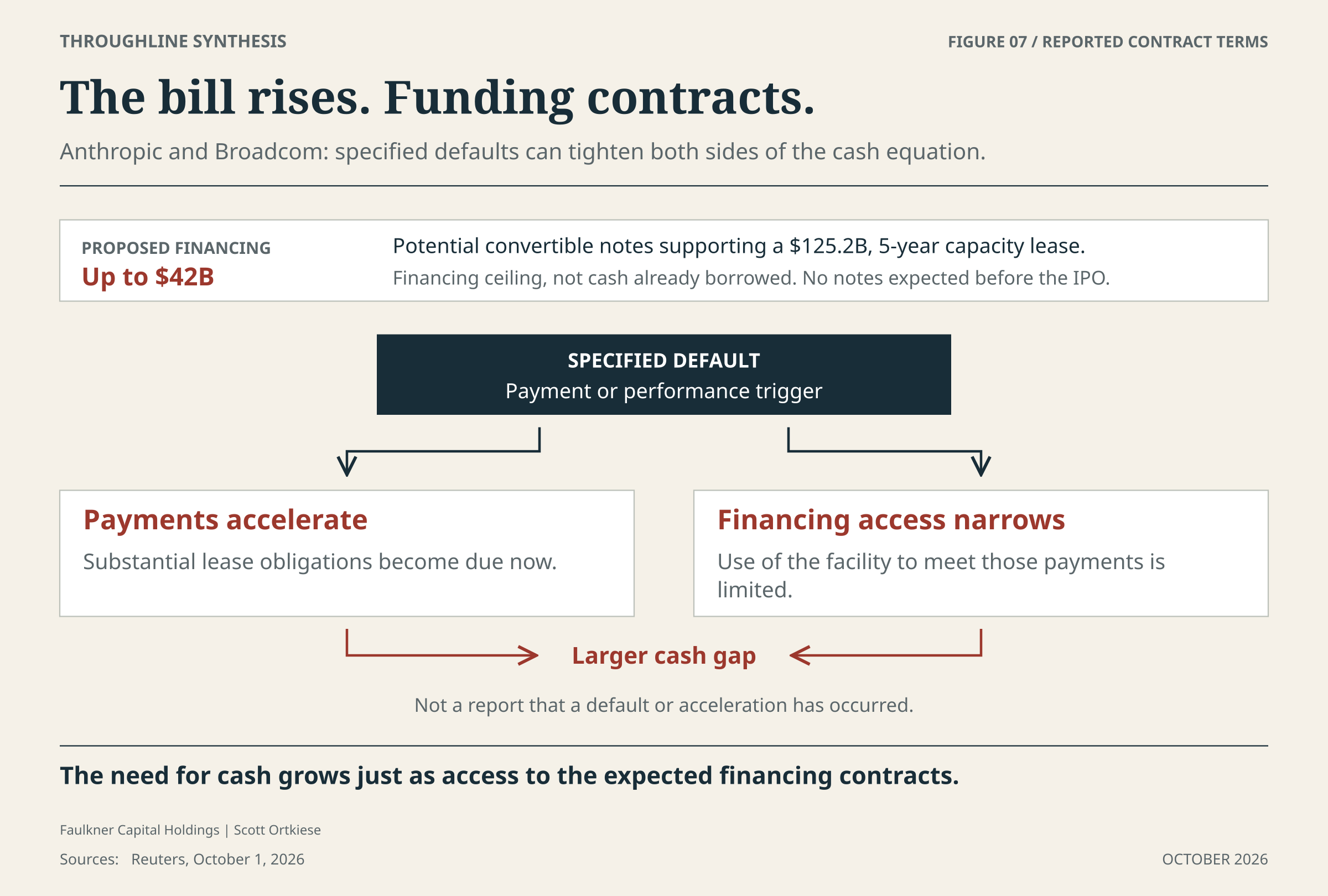
Reuters reports that Anthropic did not expect notes to be sold before completing its initial public offering, and that Broadcom can designate a financing partner. (Reuters) The $42 billion is therefore not debt already drawn. Nor is it an additional $42 billion of infrastructure to add to lease commitments it would help finance.
The prospectus identifies potential conflicts in Broadcom’s simultaneous roles as hardware supplier and financing partner. (Reuters) This is the dependence written in stone by the participants themselves: the customer needs the supplier’s product, the supplier’s financing, and sufficient customer cash to keep both arrangements intact.
Better technology attacks the financing assumptions
The 60× price gap is not an invention. On June 15, the Financial Times reported DeepSeek’s leading model at $0.87 per million output tokens, roughly 60× less expensive than Anthropic’s Fable 5. (Financial Times) Fable 5’s $50 per million output tokens was separately reported in August; $50 divided by $0.87 equals 57.5, rounded to about 60. (Gizmodo) A token is a fragment of text used to meter model input and output. This is a dated comparison of the named models’ output prices, not a universal closed-model markup, a complete operating-cost comparison, or proof of equal performance on every task.
The financial consequence does not require identical performance. Customers only need an alternative that performs their task well enough to reject the premium. The Financial Times also identifies a separate vulnerability: sudden restrictions on access make reliance on American models a commercial risk, while self-hosted alternatives put deployment under the customer’s control. (Financial Times) Self-hosting permits data to remain on the customer’s infrastructure; it does not automatically make a model secure. (MIT Sloan) Price, adequate performance, and control all attack the revenue premium. None reduces the supplier’s existing debt or lease payment.
Brendan Dell’s argument asks whether scale creates a durable commercial advantage or merely an expensive lead that competitors close. (Brendan Dell) Noble’s margin analysis supplies the financial consequence. A lead lasting months cannot support a valuation that assumes decades of protected returns.
Research summarized by MIT Sloan found open models averaged 89.6% of closed-model benchmark performance and generally closed the gap within 13 weeks, down from 27 weeks a year earlier. (MIT Sloan) Open models provide downloadable versions others can run or adapt; closed models are accessed through the provider’s controlled service. (MIT Sloan)
The same study found that closed models retained close to 80% of usage and nearly 96% of revenue on OpenRouter during May through September 2025; that platform represented about 1% of global inference spending, the spending on running models to produce answers. (MIT Sloan) Reliability, integration, security, and switching costs support a commercial premium. (MIT Sloan) They do not make that premium permanent.
Epoch AI’s September 22 research estimates that the expenditure needed to obtain a fixed level of performance fell about 47% per quarter, roughly 13-fold annually, across its benchmark sample since 2023. (Epoch AI) This measures price-performance improvement, not a uniform decline in every producer’s cost.
The revenue arithmetic is unforgiving. At a selling price reduced to 1/13 of its previous level, a supplier must sell 13 times as much comparable output merely to preserve revenue. Costs then determine the profit. More activity is not a substitute for that calculation.
The separation between usage and spending is already visible in a measured customer sample. Ramp’s September release reports that its effective price per million tokens had fallen 41% from the March peak, alongside shifts toward cheaper models. (Ramp) Tokens are the units used to meter model usage. An application programming interface, or API, lets other software call the model and pay for that usage.
October 2 reporting on Ramp economist Ara Kharazian’s newer analysis describes usage rising about 50% from the July spending peak while spending declined; the API data comes from a subsample skewed toward larger customers, not the whole AI market. (The Decoder) That observation establishes neither an industry-wide revenue decline nor a profit figure. It establishes the distinction Noble insists on: more activity does not guarantee more money for the companies financing the capacity.
OpenAI co-founder Ilya Sutskever’s November 2025 discussion places the technical challenge in research, generalization, and learning rather than the assumption that more scale automatically delivers the desired result. (Dwarkesh Podcast) A research problem solved after the financing expires is still a financing failure. Technical progress will transfer value to customers while destroying the returns of investors who paid too much to supply it.
Nvidia’s filing puts the circularity in writing
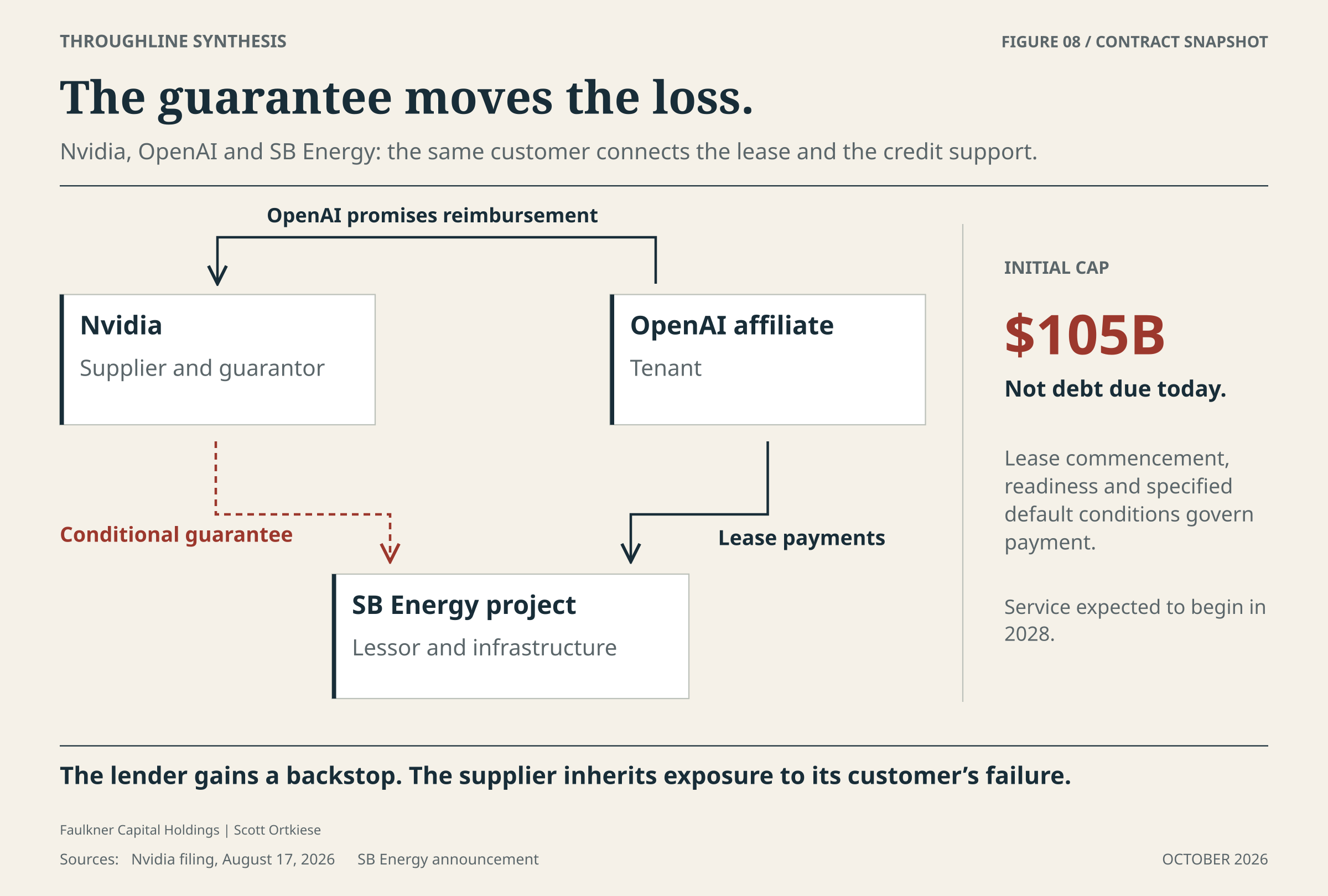
The supplier’s profitable sale is only the beginning of the credit analysis. Follow the buyer’s financing and the supplier’s guarantees. Nvidia’s August 17 filing describes residual value guarantees covering approximately 4.25 gigawatts of computing load at SB Energy’s Portsmouth project in Ohio, with an OpenAI affiliate as tenant and a $105 billion cumulative cap on Nvidia’s initial payment commitment. (Nvidia filing)
A gigawatt measures power, not sales. The guarantees generally begin with the relevant leases, and payment depends on specified conditions, including readiness for service expected to begin in 2028. (Nvidia filing) The $105 billion is a conditional exposure, not debt currently due.
The filing identifies OpenAI insolvency resulting in lease default, or failure to make lease payments, as triggering events. Nvidia’s payment generally covers the shortfall between the guaranteed minimum value and recoveries from replacement leasing or sale; it has remedies including assuming the lease, seeking a replacement tenant, initiating a sale, or temporarily paying specified costs. (Nvidia filing) The agreements also terminate under specified conditions, including the lease’s 20th anniversary, permitted lease termination, or OpenAI attaining a satisfactory credit rating. (Nvidia filing)
Those clauses are the script. The designers have identified the failure, the recovery process, and the party assigned to pay.
SB Energy says it will build, own, and operate the facility under a 20-year OpenAI lease; Nvidia supplies the computing infrastructure and invests $1.5 billion alongside existing investors SoftBank and OpenAI. (SB Energy) The supplier is an investor and credit supporter. The customer is also an investor in its infrastructure provider. Several balance sheets depend on the same customer’s future income.
OpenAI promises to reimburse Nvidia for amounts Nvidia actually pays under the guarantees. (Nvidia filing) A strong Nvidia guarantee protects the project creditor by moving exposure to Nvidia. Nvidia’s reimbursement claim against the failed payer does not create an independent source of money.
Broadcom’s separate June financing announcement supplies the private-credit version. It identifies a $35 billion initial tranche led by Apollo with Blackstone’s Credit & Insurance business, supporting more than 1 gigawatt of Anthropic computing capacity. (Broadcom) A special-purpose vehicle is a separate legal entity used to own assets and issue financing against them. Its separate name does not make the tenant’s cash flow independent.
Bloomberg’s reporting describes Broadcom residual-value support for $6 billion of A1 notes and $24 billion of A2 notes; after specified lease-payment failures and chip liquidation, Broadcom covers the supported creditors’ shortfall. (Bloomberg reporting) The separately reported $4.5 billion of B notes lacks that backing, while Apollo’s Athene insurance arm is identified among the institutional purchasers of A2 notes. (Bloomberg reporting) These are selected reported financing components, not a complete reconciliation of the headline package.
The structure connects the chip buyer, the supplier, private financing, and an insurer through the same demand for computing. The guarantee improves the supported creditor’s position by putting Broadcom behind the claim. It does not remove the customer dependence from the system.
The defect is what credit analysts call wrong-way risk: protection that weakens under the same conditions that make the borrower need it. Weak AI demand damages the borrower’s cash generation and the resale market for its equipment while also attacking the supplier’s sales. The supplier’s balance sheet absorbs a guarantee claim precisely when its operating business is under pressure.
Apollo’s $3.5 billion capital solution for Valor’s $5.4 billion computing-infrastructure transaction provides another structure: an xAI subsidiary rents the equipment, and Nvidia is an anchor investor in the vehicle. (Apollo) Meta’s Hyperion venture instead combines Blue Owl ownership, debt funding involving PIMCO, operating leases to Meta, and a capped residual value guarantee under specified conditions. (Meta)
Different contracts distribute different claims. They do not manufacture an additional paying customer.
Everyone gets paid before the investment proves itself
In “The American AI Bubble Makes No Sense,” I argued that each participant has a reason to approve its part without establishing that the whole structure works. In “Trump and Concentrated Wealth: a Doomsday Machine,” I connected vendor-supported demand to losses spread beyond the people arranging the transactions.
The supplier sells equipment. The contractor builds. The financier arranges the loan and collects a fee. Those are real transactions. None establishes that the final customer will earn enough to support the obligations left behind.
Circular financing need not involve a fictitious invoice. Its weakness is economic: a sale financed or guaranteed by the seller is not proof of independent, self-sustaining demand. Remove that support and the business must replace it with customer cash.
Intelligent people have built a dangerous system because each has a reason to keep it moving. The rewards arrive before the investment is tested. The losses remain with whoever owns the claims when the test arrives.
The creditor gets the coupon, not the upside
An ordinary lender receives agreed interest and principal, not an unlimited share of the borrower’s success. PIMCO makes that asymmetry central to its AI credit research: creditors finance the buildout while bearing execution, utilization, obsolescence, and refinancing risks. (PIMCO) The relevant question is repayment, not the size of the technological dream.
The borrower’s identity determines the risk:
- Diversified cloud-company debt: The creditor has a claim supported by the wider business, including cash generated outside the particular AI project. (PIMCO)
- A facility leased to that company: The creditor depends on the tenant, the lease, completion obligations, guarantees, and termination rights. (PIMCO)
- A facility leased to a specialized computing provider: The rent depends on that provider reselling computing profitably and retaining access to capital. (PIMCO)
- The specialized provider’s own debt: The creditor faces operating performance, equipment replacement, customer concentration, and refinancing directly. (PIMCO)
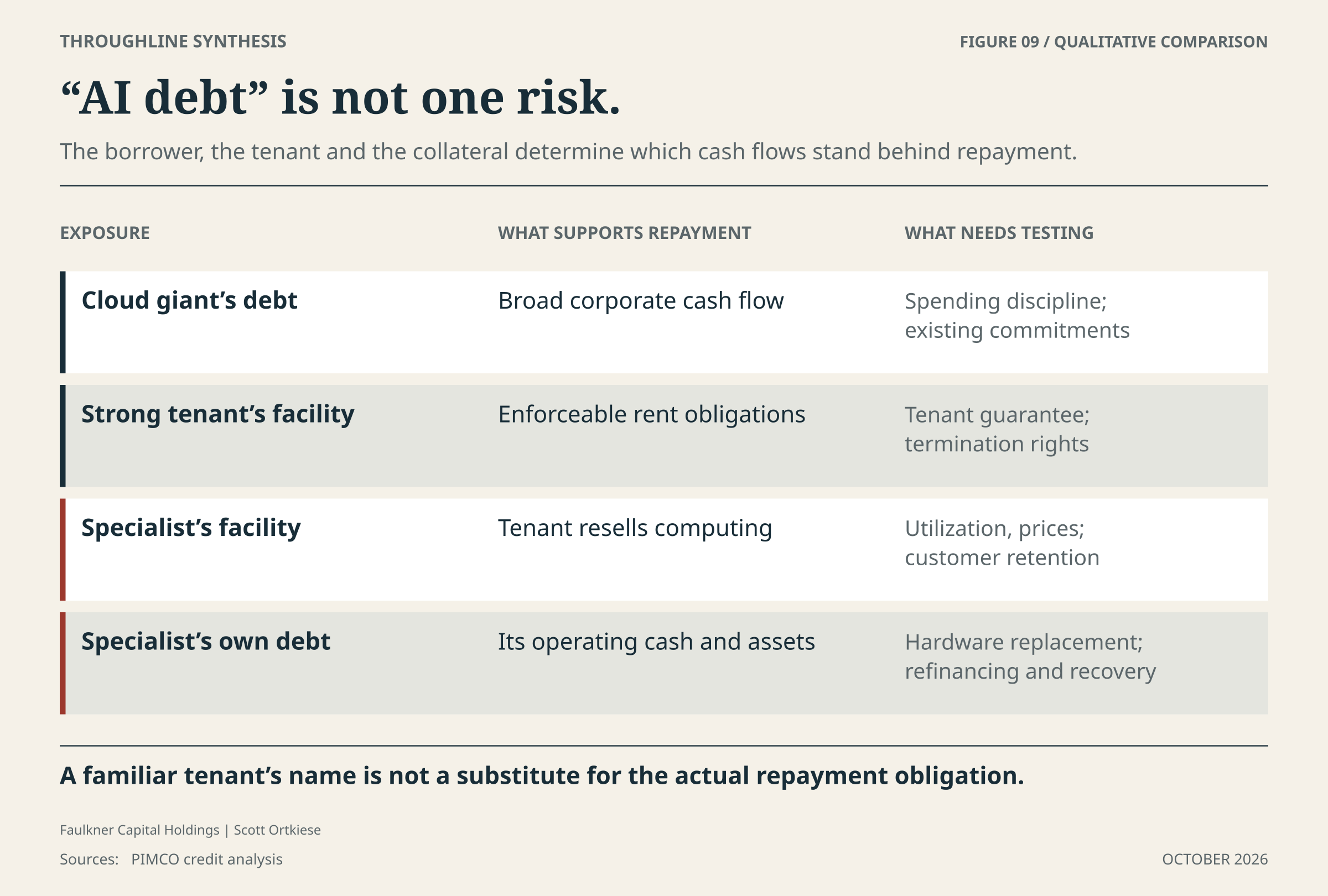
PIMCO identifies an important divide: a strong hyperscaler that cuts discretionary spending quickly enough improves its own cash flow and credit position while reducing suppliers’ revenue. (PIMCO) The strongest companies will defend themselves by withdrawing spending that supports weaker developers, suppliers, and landlords. Survival at the top does not prevent destruction below.
PIMCO is a participant, not a disinterested referee: Meta identifies it among the Hyperion financing investors. (Meta) Its underwriting tests are useful precisely because the promotional label is not enough.
A building is not a chip
A data-center building and its processors have different economic lives. Nvidia’s Ohio support concerns land, power, and shell capacity; the project announcement describes infrastructure designed for successive computing generations. (Nvidia filing; SB Energy) The tenant must still pay for replacement hardware, power, operations, and rent.
A working chip that earns too little is a failed investment. A usable building without sufficient rent does not support its financing. Physical survival does not establish financial value.
Eisman’s objection to an automatic obsolescence argument is useful: he says older chips still attract demand and disputes making depreciation schedules the decisive issue. (New Money) The cash test is harder than the slogan. The equipment must earn enough, for long enough, to cover its financing and replacement, whether it remains technically usable or not.
Accounting does not erase these distinctions. U.S. lease rules generally require tenants to recognize assets and liabilities for leases longer than 12 months, including operating leases. (Financial Accounting Standards Board) Project debt, lease liabilities, future commitments, equity, and contingent guarantees remain different claims. Adding them indiscriminately counts some exposure more than once.
My earlier “The $1.65 Trillion Nobody Was Supposed to Find” argued that headline debt does not capture the full burden of future commitments. Disclosure is not solvency. An accurately disclosed obligation still bankrupts a borrower that cannot pay.
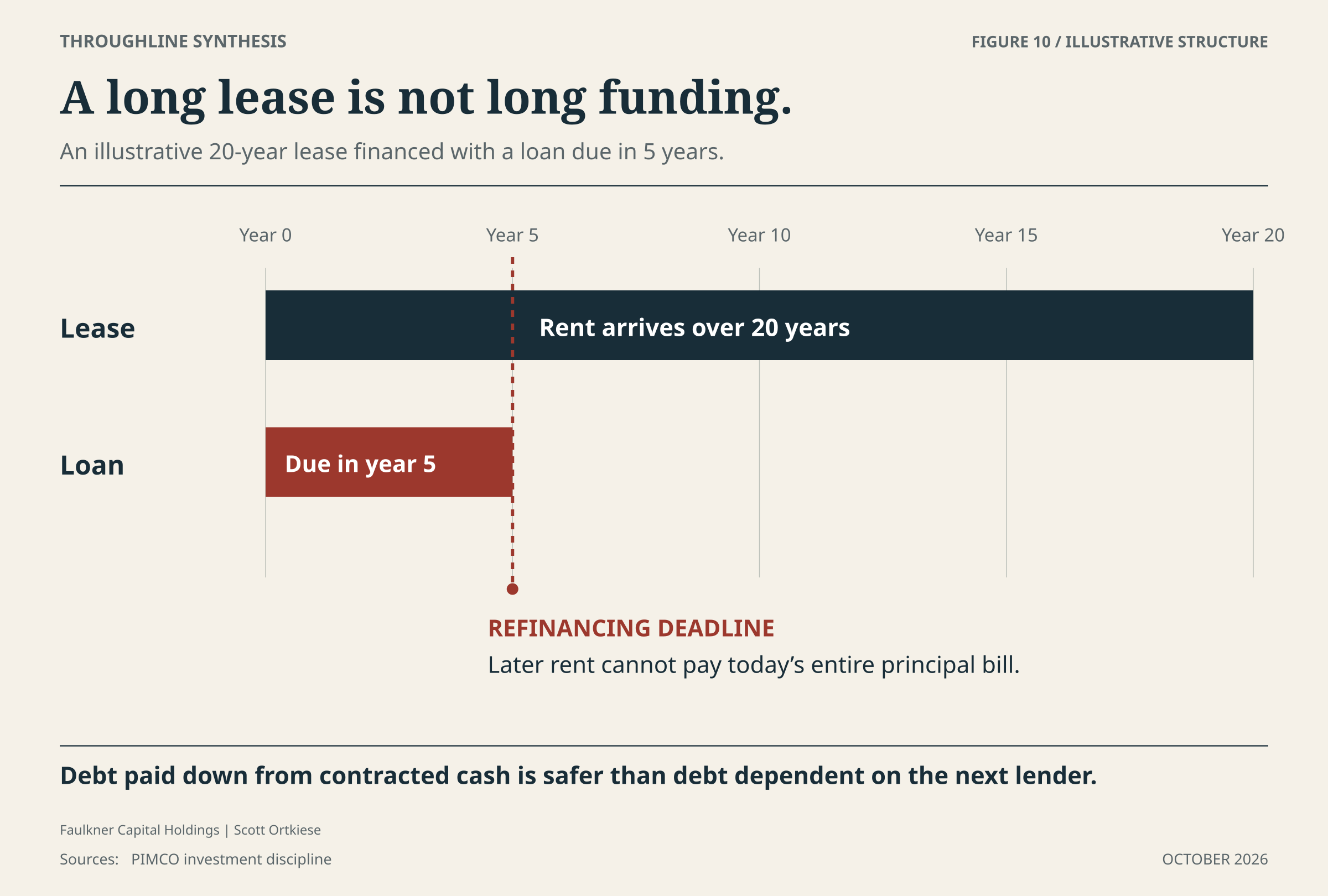
PIMCO’s infrastructure research sets a hard repayment standard: assume zero residual sale value and require contracted cash flows to repay the debt. (PIMCO) This is underwriting discipline, not a claim that every asset becomes worthless. The lender should get paid without needing a favorable resale market.
The same research identifies the mismatch between a 20-year lease and a loan due in 5 years. (PIMCO) Rent due in year 15 does not repay principal due in year 5. The borrower needs sufficient accumulated cash, new equity, an extension, or refinancing. The lease’s length supplies none of them automatically.
Contract exceptions matter for the same reason. Construction delays, power interruptions, termination rights, and force-majeure clauses change the timing and amount of cash available to creditors. (PIMCO) Underwriting means reading those clauses before accepting the revenue forecast.
Debt-service coverage measures cash available for interest and principal divided by the payments due. An illustrative project with $120 million available against $100 million due has 1.2 times coverage. Cut its available cash by 20% and only $96 million remains. The cushion becomes a shortfall.
A gross margin is not a debt-service calculation. A 30% gross margin is measured against revenue; a 10% interest rate is measured against debt. Without the amount of revenue, the amount of debt, operating expenses, required reinvestment, and principal payments, comparing those percentages tells the creditor nothing about repayment.
Equipment replacement belongs in that cash calculation. Depreciation spreads an asset’s cost across its estimated useful life; it is not a new cash payment. Replacing the asset is. A lender who ignores replacement costs finances repayment with money the borrower needs to stay in business.
Project Jupiter exposes the financing bottleneck
Reuters reported that banks were quoting roughly $18 billion of loans for Oracle’s Project Jupiter at 89 to 91 cents on the dollar and holding more of the debt than planned after efforts to sell it stalled. (Reuters) These were quotes, not completed sales of the entire package. They nevertheless expose the bottleneck: an underwriter unable to distribute a loan cannot recycle its financing capacity as planned.
This is bank lending alongside Blue Owl equity, not simply a private-credit fund lending to a startup. (Reuters) The banks and private markets occupy different parts of the same project. The institutional labels do not isolate the cash flows.
On September 24, Reuters reported Oracle’s force-majeure notice over potential power delays. Its source described an extension of lower development-stage rent rather than an exit from the lease, with Oracle still responsible for debt costs. (Reuters) Force majeure is a contractual provision addressing specified extraordinary disruptions. Its effect comes from the agreement, not from announcing the phrase.
Oracle said the project remained on schedule; Blue Owl said its financial commitments were unchanged. (Reuters) Those statements do not answer the creditor’s central question: when does sufficient operating cash begin?
A completed facility collecting rent is an operating asset. An unfinished facility accumulating obligations is a financing requirement. The calendar keeps running for interest, principal, and technological obsolescence.
Zitron identifies the weakness in assurances that a strong customer will honor its commitment: the project must deliver service before the promised payments arrive. (Monetary Matters) CoreWeave’s September 2025 filing describes an OpenAI order of up to approximately $6.5 billion through May 2031, expressly subject to delivery and service-availability requirements and termination provisions. (CoreWeave filing) A future payment commitment is not an unconditional deposit in the developer’s bank account.
Consider an illustrative project with $10 billion already borrowed at 10% annual interest. A 6-month delay adds $500 million of simple interest during the waiting period, before construction overruns or other costs. If the project begins the delay with a $600 million reserve dedicated to interest and no replenishment, only $100 million remains after those 6 months.
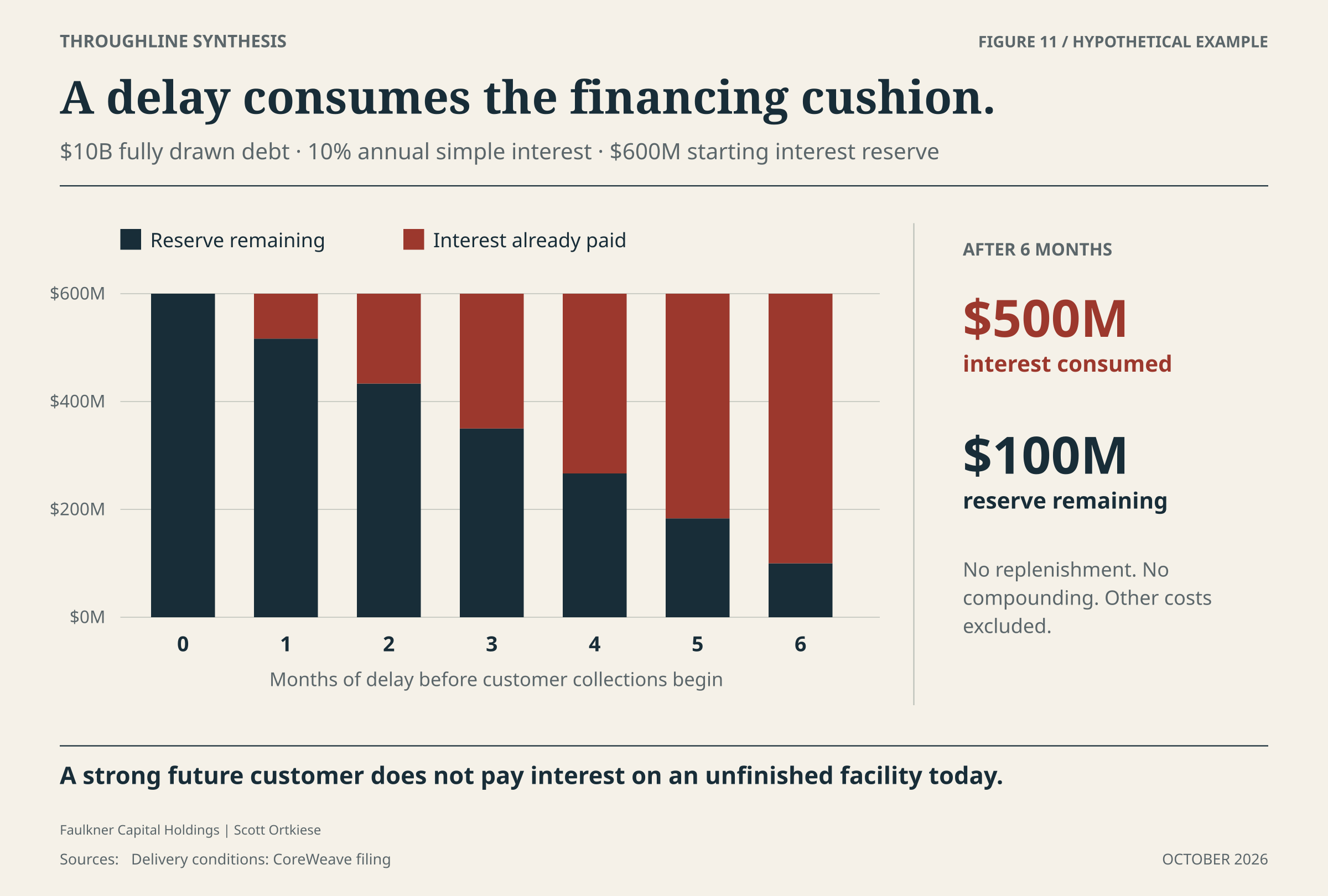
An interest reserve pays the bill by using money already set aside. Capitalizing qualifying construction interest records it as part of the asset’s cost rather than a current expense. (Deloitte accounting guidance) That accounting treatment does not determine whether the interest is paid in cash or financed. Adding unpaid interest to loan principal is a separate financing choice. Neither bookkeeping nor additional borrowing stops the cost of waiting.
This is how completion risk becomes financing risk. A power delay or unfinished facility postpones revenue, consumes the reserve, and sends the borrower back to lenders before the original project has earned its keep. The lenders then price a larger funding need against a weaker margin of safety.
Fortress co-chief executive Jack Neumark states the lender’s bargain plainly: largely fixed returns on successful AI infrastructure, but exposure to falling asset values and an illiquid investment when it goes wrong. (Bloomberg) The lender does not collect the spectacular upside used to sell the project. It still owns the downside.
Noble’s earnings collapse becomes a credit loss
The transition from disappointing earnings to bad debt has a precise sequence. The initial bond and private-credit squeeze reaches companies whose margins, customer concentration, and contractual obligations already require uninterrupted access to new money.
- Margin pressure: Competition reduces the cash retained from each sale. More usage does not repair a business that cannot keep enough of what its customers pay.
- Concentrated customer weakness: The same model developers support demand across chip suppliers, cloud providers, and project vehicles. Their shortfall damages several creditors’ assumptions together.
- Larger funding gaps: Lower retained cash and delayed collections increase the amount needed before the business becomes self-funding. Additional debt adds another claim on future cash.
- Contractual payment demands: Minimum commitments remain, specified defaults accelerate payments, and financing access contracts. A payment or performance failure turns future obligations into a present demand for money.
- Collateral pressure: Defaulted customers leave equipment or facilities to be sold into the same weak market. Guarantee calls transfer losses to suppliers; falling pledged shares create separate demands for cash.
- Renewed credit contraction: Investors and lenders protect what remains by reducing new commitments. Their retreat deprives the next borrower of the money needed to avoid the next default.
The contracts and concentrations described above establish the channels. This combined sequence is the crisis I predict. Extensions and interest added to principal will postpone recognition, not restore the cash required to keep the structure operating.
The losses will then restrict the next loan. Funds will protect cash, sell assets, draw committed facilities, and reduce new lending. Banks will face funding demands from customers whose other sources of money have dried up. Federal Reserve research documents the bank-credit-line connection through which those demands reach the banks. (Federal Reserve)
The Bank of England cites Morgan Stanley’s estimate of about $450 billion in global AI-related debt issuance by early September 2026 and its estimate of $700 billion in private-credit financing for data-center capital spending over 2026 through 2028. (Bank of England) These measure different periods and financing categories. They are not additive, and issuance is not a measure of losses. They establish the scale of the buildout’s dependence on creditors.
This is where my private-credit argument meets my insurance argument. One institution owns project debt. Another finances the fund. Another guarantees payment. Another owns the investment backing a household promise. Separate legal claims do not create separate customers.
Bond stress and private-credit losses withdraw the financing first. AI failures then send damage back through the same institutions. Noble’s earnings analysis explains why more usage will not stop that feedback: the bill requires cash after costs, not a rising count of users.
Insurance carries the loss into the household
Noble identifies insurance as a major conduit into private equity and private credit. (Risk Takers) The National Association of Insurance Commissioners, which coordinates state insurance regulators, identifies the pricing problem directly: private credit is less transparent, less frequently valued, and harder to price. (NAIC)
Long insurance liabilities make long-term investing sensible. They do not make every long-term investment sound. The Bank for International Settlements documents how private-equity-linked insurers, affiliated asset managers, private lending, and reinsurance connect institutions that appear separate. (BIS Quarterly Review)
The Broadcom-Anthropic financing makes that connection tangible: Bloomberg identifies Athene among the institutional buyers of the supported A2 notes. (Bloomberg reporting) That is a reported investment connection, not a finding that Athene has suffered a loss or that every policyholder is exposed to the same transaction. It is enough to show how an AI financing reaches an institution backing household promises.
An affiliated manager earns fees for placing insurer money in assets it originates. Hard-to-value investments make those conflicts harder to police. (BIS Quarterly Review) The household owns a promise. The institution backing that promise owns exposure the household never selected.
Reinsurance transfers specified risks to another insurer. A reinsurer’s failure or an agreement’s termination can return assets and obligations to the original insurer, weaken its capital, and leave it holding investments it cannot readily manage or retain. (BIS Quarterly Review) A transfer is not an eraser.
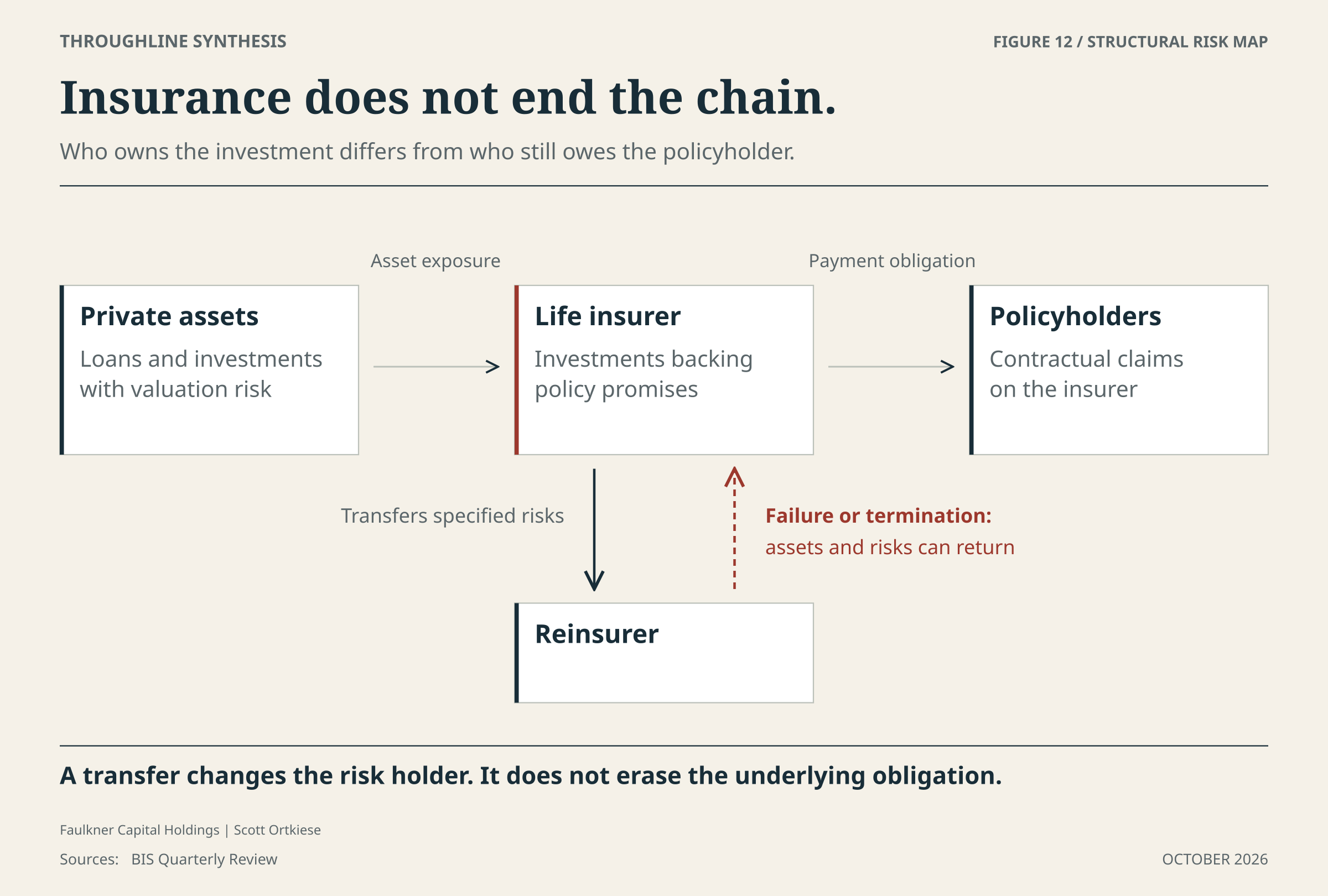
Eligible policy surrenders create another demand for cash, subject to the contracts involved. The BIS identifies unexpected outflows and correlated losses as threats when investments are difficult to sell. (BIS Quarterly Review) A household does not need to own an AI stock to bear the consequences of the AI financing boom.
The demand for cash creates the next loss
Investors under immediate funding pressure sell what buyers will take. The liquid asset becomes the source of cash even when an illiquid investment caused the loss.
The Treasury cash-futures basis trade illustrates the mechanism. A fund borrows against a Treasury through a short-term repurchase agreement, or repo, and sells a futures contract against the bond. It seeks a small pricing difference with a large borrowed position. Federal Reserve research identifies the risks from widening price differences, higher margin requirements, and disrupted repo funding. (Federal Reserve)
A haircut is the portion of collateral value a lender refuses to finance. A margin call demands more cash or collateral. A position that offsets much of its interest-rate exposure still needs cash when its lender changes the advance or its exchange raises the required margin.
Markus Brunnermeier and Lasse Pedersen’s Review of Financial Studies research explains the feedback between funding liquidity, the ability to obtain money, and market liquidity, the ability to trade without moving the price sharply against oneself. (Research paper) Less financing forces sales. Sales depress prices and collateral values. Weaker collateral provokes tighter financing.
SoftBank’s Arm-backed borrowing supplies a direct route from stocks into that credit mechanism. Arm’s annual filing reports that a SoftBank subsidiary pledged 769,029,000 Arm shares, representing 72.0% of Arm’s equity as of May 21, 2026, to secure a financing facility. (Arm filing) The borrowing is the SoftBank subsidiary’s obligation, not Arm borrowing against its own shares. (Arm filing)
The filing describes margin calls when the loan-to-value ratio exceeds specified thresholds, additional cash requirements, possible share sales, and foreclosure following default; it does not disclose the numerical triggers. (Arm filing) Loan to value means the amount borrowed divided by the value of the pledged collateral. A falling share price raises that ratio without a dollar of additional borrowing.
Bloomberg reported in September that SoftBank increased the Arm-backed facility to $25 billion; that is the reported facility amount, not proof that every dollar was drawn. (Bloomberg) The consequence is not confined to shareholders’ paper wealth. Meeting a collateral demand competes with funding new AI investment, and selling pledged shares puts more pressure on the asset supporting the loan.
The house of cards does not require every asset to become worthless. It requires too many investors to demand the same scarce thing at the same time: cash without taking a loss.
The bank’s capital is smaller than its balance sheet
Banks face this sequence from both directions. Bond exposures and funding pressure weaken them at the start. Private-credit and AI losses return later, accompanied by borrowers drawing credit lines and depositors withdrawing money.
Banks finance longer-term loans and securities with deposits available on demand. Withdrawals beyond cash and borrowing capacity force asset sales; sufficiently large sale losses exhaust shareholder capital. (FDIC) Capital is not a separate vault of cash. It is the accounting cushion between assets and liabilities. Cash meets the withdrawal. Capital absorbs the loss.
Take a hypothetical bank with $100 billion of assets, $92 billion of liabilities, and $8 billion of shareholder capital. It sells securities carried at $40 billion for $32 billion, then pays that cash to departing depositors. The bank has $60 billion of assets and $60 billion of liabilities. Its capital is gone.
The securities did not become worthless. A 20% loss on the portion sold eliminated a capital cushion equal to 8% of the original balance sheet. Add loan defaults and the bank has losses beyond that cushion.
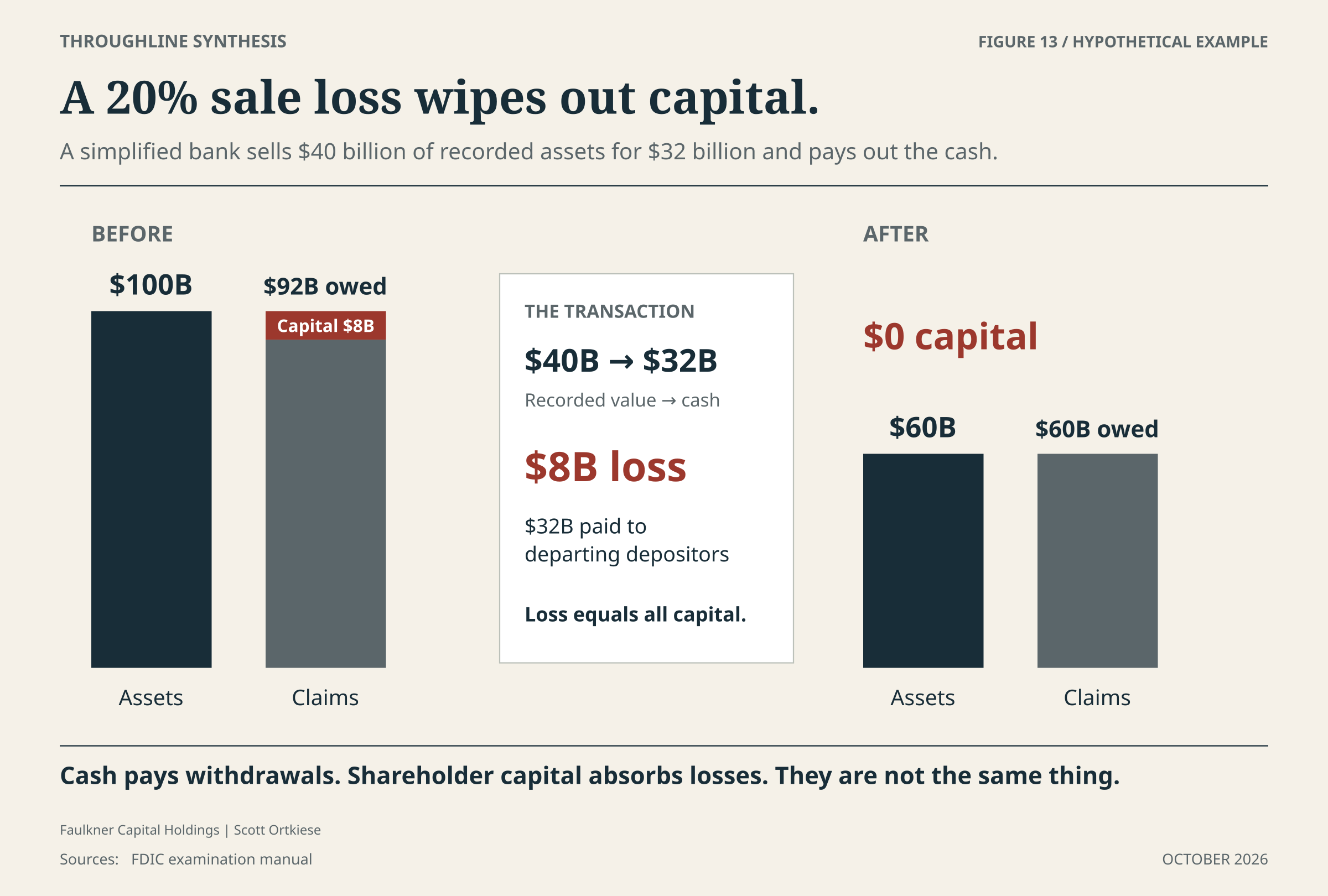
Held-to-maturity securities are carried under rules that do not automatically recognize each interest-rate-driven price change in book value. Available-for-sale securities are recorded at fair value, although unrealized changes affect accounting equity and regulatory capital differently for some banks. (FDIC examination manual) Selling a bond does not deduct an already-recognized loss from capital a second time. The example starts with a carrying value that has not absorbed that sale discount.
There is no universal date when all bonds must suddenly be marked to market. The event that matters is the demand for cash against an asset carried above its sale price. Accounting postpones recognition of some losses. It does not pay a depositor.
A stable base of below-market-rate deposits has genuine economic value. Research published in the Journal of Finance calls this the deposit franchise and explains how its value disappears when deposits leave. (“Deposit Franchise Runs”) A bank cannot assume permanent cheap funding and then cite the value of that assumption as proof that withdrawal risk does not matter.
The Federal Deposit Insurance Corporation, or FDIC, reported $90.1 billion of second-quarter 2026 banking-industry profit and described capital and liquidity as strong. (FDIC) Reporting on the same release put unrealized securities losses at $326.7 billion, 5.5% of amortized cost, meaning adjusted purchase cost. (Regulatory Report) The losses were slightly higher than the prior quarter and lower than a year earlier. (Regulatory Report) That is a June snapshot, not a September mark.
The aggregate does not answer the survival question. Which bank has concentrated withdrawals? Which assets are already pledged? What borrowing capacity is operational today? What remains after securities losses, loan defaults, and committed credit draws arrive together?
Silicon Valley Bank shows why reassuring assessments are insufficient. The Federal Reserve’s failure review records its holding company’s highest supervisory capital rating and satisfactory liquidity rating in August 2022, while internal liquidity tests had repeatedly failed beginning that July. (Federal Reserve review) Management adopted less conservative assumptions and failed to complete funding preparations; it also changed deposit-duration modeling rather than managing the underlying interest-rate risk. (Federal Reserve review)
I want the stress calculation, not the adjective. Management confidence is not cash. A supervisory rating is not capital.
Deposits moving to a stronger bank do not vanish from the system. They leave the institution that needs them. The weakest banks will seek new shareholders while losses are rising and investors are retreating. They will cut lending to protect themselves, leaving businesses without financing and producing the next round of defaults.
A Treasury rally will not repay a failed borrower
Michael Howell’s September 27 analysis argues that the next cyclical phase will favor government bonds as high financing and resource costs brake growth. (Capital Wars) That is not a contradiction to wave away. It distinguishes an initial financing squeeze from the market’s response to the downturn it produces.
Treasuries and troubled corporate loans are different assets. A Treasury rally repairs some interest-rate losses. It does not collect a defaulted AI loan or return capital already consumed in a forced sale.
The corporate borrower also pays a spread above the benchmark. Government yields can fall while distressed borrowers face wider spreads, tighter collateral requirements, and outright refusals to refinance. The relevant price is the borrower’s financing cost, not the central bank’s announced rate.
The sequence does not require every bond to fall forever. It requires the initial squeeze to expose unpayable obligations and the losses to outrun relief. Bonds tighten financing. Private credit retreats. AI loses the money needed to meet its commitments. A later rally does not undo the failures already produced.
The spending stops before the promise is tested
Michael Roberts brings the argument back to the economy supporting the financial claims: an enormous AI investment program sustains activity before the completed assets establish adequate returns. (Michael Roberts) His Brookings reference leads to Stijn Van Nieuwerburgh’s fall 2026 Brookings Papers on Economic Activity research, which projects $10.3 trillion of investment over 2025 through 2032 in data-center buildings, power, networks, chips, and other equipment. (Brookings) That is a projected buildout, not money already spent or a measured loss.
The research warns that exposure is migrating into joint ventures, private credit, separate financing vehicles, leases, and guarantees, all dependent on customer cash flows, collateral values, timely access to power and equipment, and the credit quality of a small group of tenants. (Brookings) Its author stops short of finding systemic risk already comparable to earlier credit booms. (Brookings) My prediction concerns where those connected obligations lead as the credit supply contracts.
Construction spending pays workers and suppliers now. A finished facility must earn its return later. Stopping the financing removes current orders, construction work, and income before anyone resolves the debate over the technology’s eventual productivity.
The administration’s own report concedes that “not every AI-related investment will be profitable.” (Economic Report, chapter 5) That distinction is central to Noble’s margin argument. A technology that makes services cheaper creates a benefit for users without guaranteeing that the firms which financed the capacity will earn enough to repay their creditors.
The contraction therefore has 2 engines. Lenders lose money on existing claims, and businesses lose the spending financed by the next round of lending. The resulting layoffs and lost income weaken other borrowers, deepening the credit losses that started the retreat.
The rescue will allocate the losses, not erase them
War and economic confrontation tighten the same financial constraints. The Bank of England links renewed U.S.-Iran conflict and higher energy prices to weaker growth, higher costs, and pressure on financing conditions. (Bank of England) The International Monetary Fund’s April financial-stability report describes the danger of stocks and bonds falling together during an inflationary supply shock. (IMF)
Higher energy costs squeeze household budgets and data-center economics. Falling stock wealth weakens spending. The retreat in construction and lending destroys jobs before promised productivity gains replace the lost activity. The contraction feeds on itself.
The fiscal position deteriorates with it. Tax receipts weaken, demands for support rise, and the government returns to the same capital market that priced the original squeeze. Noble identifies that contradiction when he asks whether a recession solves the bond problem while simultaneously blowing out the deficit. (Risk Takers)
Joseph Stiglitz adds the missing policy connection: the administration’s tax cuts reduce fiscal room to cushion the disruptions produced by its own policies and by an AI-related employment shock or technology-bubble collapse. (Stiglitz, April 29) He connects tariff and war-related supply disruptions to inflation and the affordability squeeze. (Stiglitz) Stimulating spending does not manufacture missing energy, equipment, or productive capacity. The conflict is not simply growth versus austerity. It is spending commitments versus the resources and financing available to honor them.
Gopinath’s Atlanta address identifies why an AI bust would differ from the dot-com collapse: public debt is higher, fiscal stimulus faces greater market constraints, and foreign investors have more exposure to American equities. (Atlanta Fed) She presents that as a risk to stress-test. I expect it to become the next stage of this crisis: the loss of American market wealth and investment demand will transmit the contraction abroad.
The government and the private sector then arrive at the same market asking for rescue financing. Banks need capital. Funds need liquidity. Companies need replacement loans. Washington needs money to arrest the contraction. A sovereign borrower still able to issue debt is not a sovereign borrower able to rescue everyone at yesterday’s interest rate.
Federal Reserve lending supplies cash against eligible collateral instead of requiring an immediate sale. That buys time; it does not guarantee that every institution gets enough cash before withdrawals exhaust it. The Fed’s account of the 2023 stress also shows why legal access to emergency funding is different from the operational ability to move collateral and obtain enough cash in time. (Michael Barr, Federal Reserve)
Market plumbing creates another constraint. At the Bank of Japan conference, Lorie Logan identified the expansion of Treasury issuance relative to dealers’ capacity to handle it, and called for a clear distinction between support for market functioning and monetary easing. (Bank of Japan conference record) Dealers are the intermediaries that absorb and redistribute bonds. Repairing their ability to process sales is not the same as restoring an insolvent borrower’s earning power.
Emergency liquidity does not manufacture profitable demand. Recapitalization supplies new loss-absorbing money, paid by someone. Restructuring reduces or redistributes claims. These are different operations. None retroactively makes the original investment profitable.
The rescue will decide who takes the loss and who supplies the replacement capital. Shareholders, creditors, new investors, and public authorities will fight over that assignment. Calling the result stabilization will not make the bill disappear.
The cash will deliver the verdict
The AI financing structure requires durable margins, affordable refinancing, repeated equipment replacement, and customer income sufficient to meet fixed commitments. It needs those conditions together. It has treated them as promises instead of tests.
I will watch the financing first: the price of new bonds, the terms of replacement loans, the interest actually collected, the maturities extended, and the prices independent buyers pay for private assets. Then the guarantees, the collateral demands, the bank-line draws, and the cash left after equipment replacement. These are the points where the story becomes a payment.
The hyperscalers and their financiers have written down the obligations. They have identified the tenants, the guarantors, the payment conditions, and the parties expected to absorb a shortfall. They have not written a contract requiring customers to make the whole structure profitable.
That is the house of cards. The claims have been distributed widely enough to call the structure diversified, while too many still depend on the same future spending.
Margin pressure weakens concentrated customers. Their cash shortfalls enlarge funding gaps. Contracts turn those gaps into payment demands, collateral losses intensify the demands, and lenders withdraw the money needed to stop the next failure. The technology can keep improving throughout the collapse.
Trump’s policies tie the public debt story to the private investment story by making future growth the answer to both. The debt needs the boom to continue. The boom needs the credit to continue. Inflation transfers the damage; emergency lending buys time; neither produces the missing investment return.
Credit breaks first. The AI bubble falls because the money sustaining it stops arriving before customers generate enough to replace it. The losses return to the institutions that supplied the money and promised the protection. Bonds start the contraction. Private credit carries it into AI. AI sends it back as a banking and economic crisis.