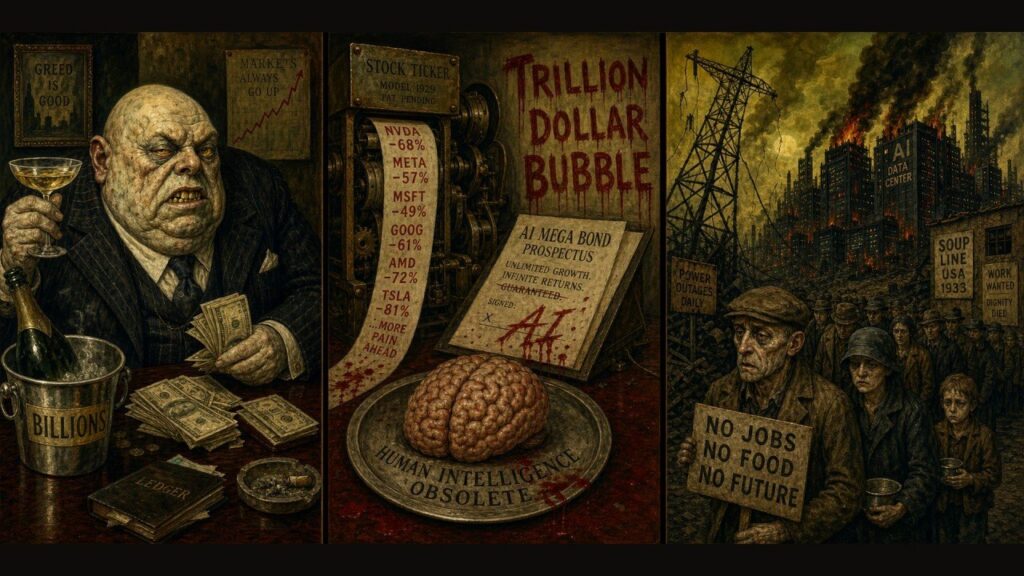
Money manipulators on the left. Transaction in the center. Consequence on the right.

By Scott Ortkiese | July 29, 2026 | so@throughlinesynthesis.com
‘The time has come,’ the Walrus said,
‘To talk of many things:
Of shoes and ships and sealing-wax
Of cabbages and kings
And why the sea is boiling hot
And whether pigs have wings.’
Lewis Carroll,Through the Looking-Glass, 1871
The question a reader put to me:
A reader wrote in with a question that deserves a serious answer, so I am going to give it a serious answer. He asked, in his own words:
If the artificial intelligence capital spending cycle is heading for a crash that anyone with a calculator and a weekend can see coming, why is nobody stopping it? How did somebody hand Meta thirty billion dollars in a single afternoon on the strength of a business plan the engineers themselves know is oversold? How did SpaceX go public on a disclosure document so thin the numbers do not survive a fifteen minute read, and how did that offering price above the marketed range with the whole professional apparatus of American finance signing off? Are the people running this machine stupid, are they crooks, and are they really going to lose their shirts along with the rest of us, or is that just what the loss looks like from the cheap seats?
That last clause is the one I want to answer. Yes, the crash is coming. No, the people running the machine are not stupid. And no, they are not on the same side of the table as you. The rest of this article explains, one desk at a time, how a transaction everyone in the chain suspects is unwise still gets executed, why the SpaceX offering in particular is the cleanest case study in modern American finance, and how the people at the top of the chain arrange to walk away whole while your pension, your electric bill, and your retirement account absorb the loss. In the final section I will place this pattern where I believe it belongs, inside the story of American imperial decline that I am telling in my book in progress, because the artificial intelligence bubble is not a business scandal that happens to be occurring during the decline. It is one of the mechanisms of the decline.
The artificial intelligence capital spending cycle, in one paragraph
Before I walk through the desks, I need to name the four stages of the cycle plainly, because the rest of the argument depends on the reader seeing the whole shape.
Stage one, the paper.A handful of very large companies, which the industry calls hyperscalers, meaning Microsoft, Alphabet, which is the parent of Google, Meta, which is the parent of Facebook and Instagram, Amazon, and Oracle, announce that they will spend hundreds of billions of dollars building data centers to train and run artificial intelligence models. They pay for this in three ways: cash from their existing businesses, new debt sold in the public bond markets, and equipment leases and joint ventures that keep the debt off their own balance sheets and on the balance sheets of related parties. The scale in 2025 alone was roughly 350 billion dollars of announced capital spending across the five companies, projected by their own guidance to exceed 500 billion in 2026.
Stage two, the physical build.The data centers get poured, wired, cooled, and staffed. The chips, mostly from Nvidia, get installed. The electricity gets drawn from the local grid, which was not built to supply this load, and the ratepayers of Virginia, Ohio, Georgia, and Arizona find their utility bills rising sharply to cover the new demand. The water for the cooling systems gets drawn from local aquifers, which were also not built to supply this load. The debt from Stage One is now spent and cannot be recovered without the machines earning revenue.
Stage three, the revenue shortfall.The revenue from selling access to these models does not, in the aggregate, cover the interest on the debt, much less repay the principal. OpenAI’s own reported figures for 2025 show revenue in the range of 3.7 billion dollars against operating losses several multiples of that. The other hyperscalers do not report the artificial intelligence line separately, precisely so that this comparison cannot be made in public. The engineering critics, including Yann LeCun, who runs Meta’s own artificial intelligence research division, have said publicly that the current approach, which the industry calls large language models, cannot deliver the productivity gains the bond markets are pricing in.
Stage four, the correction.When the revenue shortfall becomes undeniable, which the arithmetic suggests will occur between the middle of 2027 and the end of 2028, the bond markets will refuse to refinance the debt, the equity valuations will collapse, the utility contracts will be renegotiated in bankruptcy court, and the losses will land on whichever balance sheets absorbed the debt. Since the debt was distributed to pension funds, insurance companies, mutual funds, and index funds, the losses will land on the retirees, the policyholders, the savers, and the ordinary account holders whose money bought the bonds. The executives who directed the spending will not repay it. They will retire.
Those are the four stages. Now let me walk you through who at each stage is signing off and why.
The transaction, one desk at a time, at every stage
I want to name every party in the chain because the reader question was: how does a deal this obviously unwise get done, when everyone in the chain has professional obligations, a reputation to protect, and enough intelligence to see what is happening. The honest answer is that no single desk in the chain is asked to see the whole picture, and every desk is rewarded for doing its narrow slice of the transaction correctly. Let me show you.
At Stage One, when Meta issues thirty billion dollars of bonds.
The Meta chief financial officer, currently Susan Li, signs the offering. Her job description is to raise the capital her company’s board has authorized her to raise. Her personal motive, meaning what she personally gains, is a compensation package worth roughly forty million dollars per year, almost all of it paid in Meta stock, which vests over four years. If she signs, she is paid. If she refuses the board’s directive, she is replaced within a quarter by a new chief financial officer who will sign. Her career trajectory then ends. She has no counter incentive strong enough to override the personal cost of refusal. She signs.
Ask the honest question. What value did Susan Li create for forty million dollars a year. To the pipefitter in the Permian Basin who works nights on a rig floor, who has four children and a mortgage on a house in Midland, who earns roughly one hundred and forty thousand dollars in a good year with overtime, and who lays out physical steel in weather that will kill a man if he mishandles it, the honest answer is that she did not create forty million dollars of value. Nobody does that in a year sitting at a desk in Menlo Park. What she did was sign paperwork, negotiate an interest rate a quarter of a percent below what a less well connected borrower would have paid, and preside over a treasury function that at any well run company is done by a team of thirty accountants earning between one hundred fifty thousand and four hundred thousand dollars each. The forty million is not compensation for value created. It is a share of the extraction. It is what a professional class pays itself for standing in the position where the extraction is authorized. The pipefitter’s forty hours a week produces the natural gas that runs the data centers. Susan Li’s forty million a year is a tax on the pipefitter’s forty hours, laundered through a compensation committee and paid in stock that will be sold before the correction arrives. It is a moral judgment, and it is the arithmetic, and it is both at once. Every named individual in this article who is paid at that level or higher is paid on the same terms, and the arrangement that pays them is not defensible on any honest reading of what work is worth or what compensation is for.
The Meta board, chaired and controlled by Mark Zuckerberg, approves the spending program. Zuckerberg holds supervoting shares, meaning shares that carry ten votes each while the ordinary shareholder holds shares that carry one vote each, an arrangement he negotiated at Facebook’s initial public offering in 2012 and that the underwriters permitted because refusing the arrangement would have cost them the mandate. The public shareholders were told at the time that Zuckerberg’s continued personal control was necessary to preserve the founder’s vision. Fourteen years later, that vision has cost the shareholders roughly two hundred billion dollars in the metaverse write-off and is now spending another hundred billion dollars on artificial intelligence infrastructure that his own chief financial officer cannot defend on the numbers. The board is composed of members Zuckerberg personally selected and can remove at will through his voting control. The board’s approval of the spending program is functionally his approval, because the board that refused to approve would be replaced within a month. His personal motive is disclosed in his Form 4 filings. He has already sold more than nine billion dollars of Meta stock in scheduled increments during 2024 and 2025. He is directing the company to spend the shareholders’ capital on a technology bet whose outcome he has already partly cashed out of. If the spending pays off, his remaining position benefits. If the spending fails, the cash he has already extracted is not returnable, and the shareholders will bear the loss. He faces asymmetric personal upside, negotiated for himself, at their expense. He directs the spending.
Apply the pipefitter test. Nine billion dollars is what the pipefitter in Midland earns in roughly sixty five thousand years of work at his current rate. It is the entire lifetime output of a town of forty thousand skilled tradesmen. Zuckerberg extracted it in twenty four months by clicking through pre scheduled sale orders his lawyers set up under a program called a 10b5-1 plan, which I will explain further down the article. He did not build a bridge. He did not drill a well. He did not lay a foot of pipe. He supervised a company whose founding product, a college social directory that he stole from three Harvard classmates and settled a lawsuit over, has evolved over twenty years into an advertising platform that has served, by his own company’s admission in various congressional testimonies, as a vector for foreign election interference, teenage suicide, ethnic cleansing in Myanmar, and the algorithmic radicalization of a substantial portion of the American electorate. He timed the sale of his shares to coincide with a technology cycle he is now directing the same company to spend its remaining capital pursuing. What value did he create in exchange for nine billion dollars of extracted cash. The honest answer is that value is not the frame that produces nine billion dollars. Control is, and the control was engineered at the initial public offering through voting arrangements the shareholders were pressured into accepting. The nine billion is a control premium, paid to a founder who kept the voting rights and sold the economic rights on the way up, at the expense of the ordinary shareholders who took him at his word in 2012 that he would use the control responsibly. He has not.
The underwriting syndicate, led by JPMorgan Chase under Jamie Dimon, Goldman Sachs under David Solomon, and Morgan Stanley under Ted Pick, organizes the bond sale. The syndicate earns roughly a quarter of one percent of the deal size, which on thirty billion dollars is seventy five million dollars in fees, paid at closing, not clawed back later. Each of these three chief executives has personal compensation directly tied to investment banking revenue. Dimon’s 2024 compensation was thirty six million dollars, a substantial portion of which was linked to the performance of the investment bank. Solomon’s was thirty nine million. Pick’s was thirty four million. Refusing a Meta mandate on prudential grounds costs each of them roughly one million dollars in personal compensation the following year, plus the reputational damage of having lost the mandate to a competitor. Signing the mandate and later watching the bonds default costs each of them nothing personally, because the fees are already paid to the firm and their bonuses have already been booked. The three men know this. They compete for the mandate.
The pipefitter question, applied to the three of them together. Between them they were paid roughly one hundred and nine million dollars in 2024. What did the three of them build, produce, transport, heal, teach, or repair in that year in exchange for that money. Nothing. They signed off on transactions, presided over risk committees, gave speeches, testified before Congress, and stood in the position where fees were collected. Yes, the banks they run do productive work in the aggregate, meaning payments processing, credit intermediation, small business lending, and trade finance. That productive work is executed by roughly six hundred thousand employees at the three firms combined, most of whom earn between fifty thousand and two hundred thousand dollars per year and any one of whom could be replaced by another competent professional within thirty days. The chief executive of a large American bank could also be replaced by another competent professional within thirty days, at a compensation level of two million dollars per year, and the bank would continue to operate exactly as it does today. The delta between two million and thirty six million, meaning the additional thirty four million dollars per year that Dimon is paid above what the job requires, is a share of the fee stream, not compensation for productive work. Solomon at Goldman Sachs and Pick at Morgan Stanley are paid on the same terms. The three of them, between them, are extracting roughly one hundred million dollars per year from the American financial system for standing in the position where the fees are collected. The pipefitter’s electric bill and his 401k account fund a portion of that extraction, whether he knows it or not, and he does not. That is the point. He is not supposed to know.
The three major credit rating agencies, Moody’s under Rob Fauber, Standard and Poor’s under Martina Cheung, and Fitch under Ian Linnell, assign the bonds a rating. All three are paid by Meta, meaning by the issuer of the bonds, to rate the bonds Meta is selling. This is called the issuer pays model. It was identified as a fundamental conflict of interest in the aftermath of the 2008 financial crisis, and it has not been reformed in the eighteen years since, because the agencies lobby against reform and the issuers do not want reform. The personal motive of each of these chief executives is that agency revenue is roughly ninety percent issuer fees, which means every downgrade of a major issuer risks the next rating mandate going to a competitor. Fauber, Cheung, and Linnell are each paid several million dollars per year in compensation tied to agency revenue. A downgrade of Meta would cost Moody’s the next Alphabet, Microsoft, Oracle, and Amazon mandates in the same sector, because those companies would read the downgrade as a signal that Moody’s is unreliable in blessing the artificial intelligence cycle. The rating agency chief executive who downgrades a hyperscaler ends his tenure within a year. None of the three does. Meta receives an A rating.
What do the rating agencies actually do for the several million dollars each of their chief executives is paid. They publish letter grades on debt instruments. That is the entire product. The pipefitter in Midland does not receive a rating from Moody’s on his mortgage, because his mortgage is priced by a lender who has looked at his tax returns and his credit report. The Fortune 500 issuer receives a rating from Moody’s because the rating is the ticket that admits the issuer’s bond to the pension fund allocator’s portfolio, per the mandate rules I described in the Susan Li paragraph. The rating agency’s product is not analysis. It is the ticket. And the ticket is priced at what the issuer will pay, which for a large hyperscaler bond is several hundred thousand dollars per issuance. Multiply that across the thousands of issuances per year and you get the agency revenue that pays Fauber, Cheung, and Linnell. This is a private tax on the flow of American capital, collected by three firms that were granted this power by an act of Congress in 1975 that has never been meaningfully revisited. The pipefitter did not vote for the arrangement. His retirement savings pass through it whether he knows it or not. And the historical record on the actual analytical performance of these firms is a matter of public knowledge. The same three agencies rated the subprime mortgage bonds AAA in 2005, 2006, and 2007. Those AAA ratings were the ticket that admitted the subprime bonds to the same pension fund portfolios, the same insurance company balance sheets, and the same mutual fund benchmarks that are now holding the artificial intelligence bonds. The bonds defaulted. The pension funds lost hundreds of billions of dollars. The insurance companies were bailed out at the taxpayer’s expense. The rating agencies paid modest civil settlements to the Department of Justice, meaning fines that were small fractions of the fees they had collected on the ratings, and no executive at any of the three firms was prosecuted. The agencies continued to operate under the same issuer pays model, with the same executive class, and are now doing the same work on the artificial intelligence bond issuances. The pipefitter’s retirement savings have been on the receiving end of this arrangement for eighteen years, and are on the receiving end of it again now.
The pension fund allocator, for example Stephen Gilmore, the Chief Investment Officer at the California Public Employees’ Retirement System, buys the bonds because her mandate requires her to hold a specified percentage of the portfolio in investment grade corporate debt, meaning debt rated A minus or better, and Meta bonds are rated A. Her personal motive is that her employment contract with the pension board is renewed on the basis of benchmark relative performance. Underperforming her benchmark for three consecutive quarters is grounds for non renewal. Her own retirement, ironically, is funded by the same pension system whose assets she is deploying. She has no personal upside from refusing to buy Meta bonds and significant personal downside from doing so. She buys.
The insurance company treasurer, for example at MetLife under chief executive Michel Khalaf or Prudential under Andrew Sullivan, matches long dated insurance liabilities with high grade long dated assets. Meta bonds fit the requirement. The personal motive of the treasurer is that insurance underwriting profitability, on which his annual bonus depends, is directly hurt by holding lower yielding Treasury bonds instead of higher yielding investment grade corporate bonds. Khalaf’s 2024 compensation was twenty three million dollars. Sullivan’s was in a similar range. Their firms’ investment portfolios generate the yield that makes the insurance businesses profitable. Treasurers who refuse investment grade corporate bonds on prudential grounds are replaced. He buys.
Apply the test to Khalaf and Sullivan. Twenty three million dollars per year each, for presiding over insurance businesses whose actual work, meaning underwriting risk and paying claims, is executed by tens of thousands of adjusters, actuaries, and administrators earning between sixty thousand and two hundred thousand dollars per year. Neither Khalaf nor Sullivan personally underwrites a policy, adjusts a claim, or reviews an actuarial table. They stand at the top of an organizational chart that receives premiums from policyholders and invests those premiums in the corporate bond market. Their compensation is a share of the spread between what the policyholder pays and what the investment portfolio yields, and their bonuses are calibrated to grow that spread by pushing the investment portfolio further out on the risk curve. The widow in Loudoun County who pays her whole life insurance premium every month is paying, through that premium, a small annual fraction that funds Khalaf’s twenty three million dollar package. When the artificial intelligence bond portfolio at MetLife takes losses in the correction, and it will, her premium will not go down. Her benefits will not go up. What will happen is that MetLife will apply to state insurance commissioners for premium increases to rebuild the capital base, and the commissioners will grant them, because the alternative is insolvency. She will pay for the losses on the same bonds that funded Khalaf’s compensation, and she will pay a second time through the higher premium she cannot decline without losing coverage.
The mutual fund manager at Fidelity, BlackRock, or Vanguard buys the bonds because her fund’s stated benchmark, which is a bond market index compiled by Bloomberg or by Intercontinental Exchange, includes the Meta issuance the moment the bonds are eligible. If she does not buy, she underperforms the benchmark. Her personal motive is that fund managers who underperform benchmarks lose assets to competitors, and asset losses lead to reduced compensation and, eventually, to termination. She buys.
The index fund complex is worse. Larry Fink, chief executive of BlackRock, and the leadership of Vanguard and State Street have built businesses in which fees are charged on total assets under management. BlackRock’s assets under management were roughly eleven trillion dollars at the end of 2024. Every new bond issuance that enters the eligible index universe automatically expands the passive complex’s holdings and, therefore, the fee base. Fink’s personal motive, meaning what he personally gains, is a compensation package linked directly to firm assets and operating income. His 2024 compensation was approximately thirty seven million dollars. He has a direct personal financial interest in the expansion of the passive complex, and he uses his public voice to defend and normalize its expansion. The individual passive fund allocations are executed by software written to rules Fink’s firm has designed and lobbied to preserve. No human being at BlackRock evaluates any individual Meta bond purchase. The software buys because the index rules say buy.
This is the case where the pipefitter test lands hardest, so let me apply it explicitly. Larry Fink is paid thirty seven million dollars per year to preside over a firm whose principal work is executed by software that buys whatever is in the index. The software does not require thirty seven million dollars of supervision per year. The software does not require any supervision at all, in the sense a factory floor requires supervision. What Fink actually provides for thirty seven million dollars is public advocacy, meaning television appearances, testimony before Congress, annual letters to chief executives that are treated in the financial press as if they were papal encyclicals, and private access to every American president and every European head of government of the past twenty years, all deployed to defend the arrangement under which his firm collects fees on eleven trillion dollars of other people’s money. His work is political, not economic. He is paid at the level of a head of state to lobby for the continued expansion of the machine he runs, and no head of state in the world has assets under his personal supervision that approach the assets under Fink’s. The pipefitter’s retirement account, held in a target date fund at his employer’s 401k plan, pays a small annual fee to BlackRock that is roughly invisible to him on his statement. Multiply that small fee across roughly two hundred million American retirement accounts and you get the eleven trillion dollar asset base that funds Fink’s thirty seven million dollar package. The pipefitter is paying, through his retirement account, for the political operation that keeps him paying. This is not an accident of the arrangement. It is the arrangement.
The compliance officer at each of these buyers verifies that the rating is high enough, the disclosure is complete, and the paperwork is in order. Her personal motive is that compliance officers who raise substantive investment concerns are told to return to their desks, and if they persist, they are moved to positions with less influence. Her career depends on staying inside her lane. She stays.
The Securities and Exchange Commission, chaired by Paul Atkins under the current administration, reviews the offering. Its statutory authority under the Securities Act of 1933 is limited to ensuring the disclosure is complete and not misleading. Congress has never given the Commission authority to block an offering on the ground that the underlying business is unwise. Atkins’s personal motive is that he was appointed by an administration that campaigned on lighter enforcement of financial regulation and that publicly favors the industries whose bonds he is now reviewing. His tenure and his post Commission career depend on not embarrassing the administration. He approves the disclosure. The offering proceeds.
The Federal Reserve, chaired by Jerome Powell, sees the aggregate picture and could theoretically raise capital requirements on the banks holding this debt, or issue macroprudential guidance to slow the accumulation of exposure. It has not done so. Powell’s personal motive is complicated but tractable. The Federal Reserve chair who calls a bubble by name crashes the market single handedly and is blamed personally for the recession that follows. The chair who says nothing shares the blame with the entire political system when the correction eventually arrives. Powell has chosen the second path, as every chair before him in a similar position has done. Additionally, Powell’s own personal financial disclosures show him holding treasury securities and diversified index positions, which means that a general market decline would affect him modestly but a general market rally does not particularly benefit him. He is not personally invested in the bubble, but he is personally invested in not being blamed for its correction. He waits.
Count what happened.Every person named above did exactly what her institution required. Every institution operated within its legal charter. No individual committed misconduct. Thirty billion dollars moved from savers to Meta in an afternoon. Not one desk in the chain was asked to consider whether the transaction, as a whole, made sense, because no institutional charter contains that question. The question does not exist within the system, so the system cannot answer it.
At Stage Two, when the data centers are built.The general contractors, meaning Turner Construction, Bechtel under Brendan Bechtel, and Fluor Corporation under David Constable, take fixed price contracts and are paid whether the completed data centers are ever profitably used. Their chief executives are compensated on revenue and contract backlog, both of which the artificial intelligence buildout has doubled in three years. Refusing a contract on the ground that the customer may not survive the correction would be professional suicide. They sign.
The equipment vendors, principally Nvidia under Jensen Huang, ship the chips at the negotiated price and are paid on delivery. Huang has personally sold approximately three billion dollars of Nvidia stock in the eighteen months preceding this writing, in scheduled Form 4 disclosed transactions. His personal motive is transparent. He knows the customer revenue does not currently support the customer spending, because he has looked at his own customers’ financials as any semiconductor executive would. He is converting his equity in a company whose principal customers are structurally unable to pay for what they are buying, into cash, at valuations set by the ordinary retail investor. He continues to ship chips because Nvidia’s revenue growth funds his own compensation and stock program, and because refusing to ship would only give the customer to a competitor. He ships.
Huang is the closest case in this article to genuine value creation, and it is worth naming the achievement before naming the extraction. Nvidia designs graphics processors that are, at present, the best in the world for the parallel computation that artificial intelligence training requires. That design work is real, took decades to develop, and reflects genuine engineering judgment. It is executed by roughly thirty thousand Nvidia engineers earning between one hundred fifty thousand and five hundred thousand dollars per year, most of whom Huang personally could not replace and who could not personally replace him. The engineering is not the question. The three billion dollars in personal cash extraction over eighteen months is the question. Huang knows, because he has read his own customers’ financial statements as any semiconductor chief executive would, that the customers currently spending three hundred billion dollars per year on his products do not have the revenue to sustain that spending for more than another eighteen to twenty four months at current burn rates. He is selling three billion dollars of stock into a valuation set by an ordinary retail investor and a passive index complex that have not read those financial statements and could not read them if they tried, because the customers do not separately disclose their artificial intelligence spending against their artificial intelligence revenue for reasons I described in the Stage Three paragraphs above. Huang is not a fraud, and I am not calling him one. He is a chief executive who has designed his personal financial affairs to convert the engineering credibility of a company he founded into cash, on a scheduled program, at valuations that the ordinary retail investor cannot correctly price, ahead of a correction that Huang can see in his own customers’ financials and that the retail investor cannot. When the correction arrives, the engineering will still have been real. The customers will still owe Nvidia the money they contracted to pay, whether they can pay it or not. But the three billion dollars Huang extracted will be gone from the retail investor’s account and diversified into Huang’s Malibu real estate, his Napa vineyard, his art collection, and the trusts he has established for his children. The engineering does not disappear. The compensation does not come back. And the pipefitter’s 401k, which is holding Nvidia stock through a target date fund, will be worth what the correction says it is worth.
Broadcom under Hock Tan, Cisco under Chuck Robbins, and Dell under Michael Dell face the same calculus at their respective scales. Each has sold substantial personal stock positions during the buildout. Each has no professional incentive to slow shipments. Each continues.
The utility companies, meaning Dominion Energy under Robert Blue in Virginia and Georgia Power under Kim Greene, sign long term power purchase agreements at rates approved by state utility commissioners who are appointed by governors who receive campaign contributions from the same utilities. Blue and Greene are compensated on rate base growth, meaning the total amount of capital deployed into utility infrastructure on which the utility is permitted to earn a regulated return. Every new data center expansion grows the rate base. Every ratepayer in Virginia and Georgia pays higher rates to finance the return on that expanded rate base. The chief executive who slows this growth is replaced by the board, which is itself composed of members whose compensation depends on the same rate base growth. The state utility commissioners who approve the rates are appointed by governors whose campaigns are funded by the utilities. None of these parties has any personal incentive to slow the Stage One issuance, because the revenue comes at Stage Two regardless of what happens at Stage Four. They approve.
The pipefitter question here has a Texas twin, meaning a widow in Loudoun County, Virginia, whose late husband was a Dominion lineman for thirty years and whose electric bill has doubled in eighteen months because Dominion’s rate base has grown to include new data center feeder lines she cannot see from her house. Robert Blue was paid eleven million dollars in 2024. Kim Greene was paid roughly the same. What did they build in exchange. They approved capital deployment plans, testified before state utility commissions, signed power purchase agreements, and presided over crews of lineworkers and engineers who did the actual construction at compensation between eighty thousand and one hundred fifty thousand dollars per year. The eleven million is not for the construction work. It is for standing in the position where the rate base is authorized. The widow in Loudoun County pays for it every month, on a line item on her electric bill that readsfuel adjustmentand that she cannot decline to pay without losing power. Her late husband’s pension, ironically, is invested in Dominion Energy stock through her state’s public employee retirement system. She is funding the company that is raising her electric bill, so it can build data centers for a technology cycle whose bonds she also owns through her pension fund. Every arrow in the diagram points at her.
At Stage Three, when the revenue does not appear.The hyperscaler chief financial officers segment their reporting so the artificial intelligence line is not separately disclosed. The Securities and Exchange Commission does not require separate disclosure of the line, because segment reporting standards under Generally Accepted Accounting Principles, known as GAAP, permit the company to define its own segments. The chief financial officers do this because separate disclosure would show revenue against spending in a way the market would immediately price, and immediate pricing would collapse the stock, which would trigger the vesting cliff on the executive stock grants they and their colleagues are still riding into cash. The nondisclosure is the personal interest.
The Wall Street sell side analysts, meaning the technology sector research analysts at Morgan Stanley, Goldman Sachs, JPMorgan, Bank of America, Barclays, and Bernstein, publish research notes projecting artificial intelligence revenue growth on the basis of management guidance. The personal motive of the analyst is that her firm earns tens of millions of dollars per year in underwriting fees, mergers advisory fees, and trading commissions from the hyperscalers. The analyst who publishes a bearish note gets her firm cut off from the next underwriting mandate. The analyst who publishes a bullish note that later proves wrong loses nothing, because she was wrong along with every other analyst in her cohort. She writes bullish. This is not misconduct in any legal sense. It is the rational output of the incentive structure that has been in place since the Global Analyst Research Settlement of 2003, meaning the settlement Eliot Spitzer negotiated with the Wall Street firms after the dot-com bubble in which the firms agreed to formally separate research from banking, failed to alter the underlying business model of sell side research. Twenty three years later, the separation exists on paper and does not exist in practice. Every analyst on the technology desk of every major bank knows that her compensation depends on maintaining constructive relationships with the hyperscaler chief executives whose bond mandates fund her firm’s revenue, and every hyperscaler chief executive knows that her access to the analyst covering her company depends on the coverage remaining constructive. The reforms did not survive contact with the fee stream. Nothing since 2003 has.
The financial press, meaning the technology and business desks at The Wall Street Journal, The New York Times, Bloomberg, CNBC, and the Financial Times, cover the announcements rather than the arithmetic. The reporter’s personal motive is that reporters who publish accessible, celebratory profiles of technology executives are rewarded with access to those executives, invitations to industry conferences, book deals, television appearances, and career trajectories that include senior positions at communications firms whose clients are the same executives. The reporter who publishes hostile investigative work is denied access, called by the executive’s spokesman to complain, threatened with defamation litigation, and finds her career prospects narrowed. Publishers, editors, and reporters read this incentive structure clearly and staff accordingly. The gap between promised and delivered revenue grows every quarter, and every quarter the coverage frames the gap as a temporary shortfall on the path to a larger future. The business press was not always this. In an earlier period, the same publications ran adversarial coverage of the same companies, meaning the muckraking of Ida Tarbell against Standard Oil, the investigative reporting of Jack Anderson on defense contractors, the Watergate coverage of Bob Woodward and Carl Bernstein at The Washington Post. That press was funded by advertising from consumer product companies that had no institutional relationship with the executives being covered. The current press is funded by advertising from the same technology companies whose executives are being covered, and by subscriptions marketed through the same executives’ social media platforms, and it is staffed by reporters who understand that their next job is a communications role at one of those companies. The adversarial function did not decline because reporters became lazy. It declined because the business model of the press became structurally dependent on the class the press was supposed to cover, and the reporters who understood this changed careers or changed subjects.
At Stage Four, the correction that has not yet arrived.When it does arrive, the losses will be distributed by the same mechanism that distributed the bonds. Pension beneficiaries will see their statements shrink. Insurance policyholders will see their premiums rise as insurers rebuild their capital. Index fund holders will see their retirement account balances drop by whatever the aggregate exposure works out to. Ratepayers will continue paying the utility rates locked in during Stage Two, because the power purchase agreements are legally binding regardless of whether the data centers are running. And every actor at the top of the chain, whom I will name in the section on the exit whole mechanism below, will have long since converted paper wealth into cash and physical assets before the correction hit.
The SpaceX offering, why it happened, and why it happened at the scale it did
The SpaceX initial public offering, which I have analyzed at length in The SpaceX 177 Trillion Hoax and in the horror-fiction treatment The Fall on my Substack, is the cleanest case study of everything I have described above. It is also, as your question notes, so obviously flawed that even a reader with no background in capital markets can see the problem inside fifteen minutes of looking at the document. So the question is not whether the deal was bad. Everybody knew it was bad. The question is why the entire professional apparatus of American finance still walked it across the finish line, at scale, with fees larger than the gross domestic product of small countries.
What the S-1 actually says.The S-1 is the registration statement a company must file with the Securities and Exchange Commission before it sells stock to the public for the first time. The SpaceX S-1 is the thinnest such document I have read in the twenty years I have been reading them. Three problems are visible on any careful read.
First, the Starlink subscriber projections assume market share, retention, and pricing that no telecommunications company in history has ever achieved. Starlink is projected to reach subscriber counts comparable to Comcast, on pricing comparable to Verizon, in a global market where the ground based competitors have decades of infrastructure, existing customer relationships, and regulatory footholds Starlink does not have. The projections are not defended by comparable transactions or by cohort analysis. They are asserted.
Second, a significant portion of the total company valuation, which was marketed at levels above 350 billion dollars and now trades above 500 billion, rests on the Mars business line. The Mars business has no current revenue, no signed customer contract, no delivery timeline anchored to a specific fiscal year, and no engineering milestone in progress that a reviewer could verify against a public schedule. It is a vision, not a business. American securities law permits companies to include forward looking statements in their offerings, and permits investors to pay for those statements at whatever multiple the investors choose, so long as the risks are disclosed. The risks are disclosed. The valuation is paid.
Third, the launch business, which is the only business line with actual verified current revenue, accounts for a small fraction of the claimed total valuation. In other words, most of what the buyer is buying is not what the seller is currently doing.
Why the deal proceeded anyway, and what each party personally gained by proceeding.
Elon Musk, chief executive of SpaceX and its controlling shareholder, was the deal’s principal author and its principal beneficiary. His personal motive is not inference. It is disclosed. In the eighteen months preceding the initial public offering, he sold portions of his pre offering shares in the private secondary market to sovereign wealth funds and venture capital funds at valuations that already reflected the public market pricing he intended to obtain. His personal liquidity event began before the ordinary investor was permitted to bid. This is disclosed in the beneficial ownership sections of the S-1 and in the successor filings. Additionally, Musk’s other public company holdings, meaning Tesla and X, benefit indirectly from the credibility conferred by a successful SpaceX offering. He wanted the deal done at the highest possible valuation. He caused it to be done at that valuation. The S-1 was written to enable the outcome, not to defend the arithmetic.
Apply the pipefitter test to Musk on the terms his own public relations team would accept. SpaceX has genuinely reduced the cost per kilogram of orbital launch, which is a real engineering achievement, executed by roughly ten thousand engineers and technicians at the company earning between one hundred thousand and four hundred thousand dollars per year. Those engineers did the work. Musk raised the capital, hired the engineers, provided the political air cover that kept the Federal Aviation Administration and the Environmental Protection Agency from slowing the launch cadence, and reserved for himself, through the corporate governance arrangements he personally structured, a share of the company’s equity that has now compounded into a net worth above four hundred billion dollars. That is more money than the entire annual gross domestic product of Denmark. It is more money than the annual gross domestic product of one hundred and thirty of the world’s countries, meaning most of them. It is roughly two point eight million years of the pipefitter’s income, meaning if the pipefitter had begun working when the first anatomically modern humans left East Africa, he would still be roughly two million years short of what Musk has assembled in his own lifetime. There is no honest reading of the last twenty five years of Musk’s professional activity that produces a case for two point eight million pipefitter-years of value creation. Tesla, PayPal, SpaceX, X, Neuralink, the Boring Company, xAI, and the other ventures, taken together, are real companies producing real goods and services, but the aggregate value of what those companies have produced does not remotely approach the aggregate value of a small country’s economy running for a generation. What has approached that value is Musk’s share of the equity, granted and preserved through corporate governance structures he personally designed to retain control while raising capital, and now compounded by public market and private secondary valuations that the ordinary retail investor cannot correctly price. Piketty’s arithmetic, which I will address in the distribution section below, says that no work performed by a single individual is worth two point eight million pipefitter-years. Two point eight million pipefitter-years is what happens when the rate of return on capital exceeds the rate of growth of the underlying economy for long enough that the concentration of wealth into a single set of hands breaks the meritocratic legitimation of the system that produced it. That is where we are, and Musk is the visible face of it.
The underwriting syndicate, meaning Goldman Sachs under David Solomon, Morgan Stanley under Ted Pick, JPMorgan Chase under Jamie Dimon, and Bank of America Securities under Brian Moynihan, earned combined fees estimated above three billion dollars. The fees were paid at closing. They are not clawed back if the shares later trade below the offering price, and they cannot be recovered if the company later goes bankrupt. The personal motive of each chief executive is direct compensation exposure to investment banking fee income. The team that lost the mandate to a competitor would have cost each firm somewhere between five hundred million and eight hundred million dollars in fee revenue, and the executive who had permitted that loss would have faced professional consequences. The team that won the mandate booked the fees, and the executives took their bonuses. Whether the offering later collapses in secondary trading is irrelevant to the personal compensation already paid.
The Securities and Exchange Commission, chaired by Paul Atkins, reviewed the disclosure and, as noted above, has no legal authority to block an offering on valuation grounds. Atkins’s personal motive was to preserve his tenure and his post Commission career, which requires that his administration not be embarrassed by an aggressive review of a signature offering by a politically connected executive. Musk’s personal proximity to the current administration is a matter of public record. The Chair approved the disclosure.
The index composition committees at Morgan Stanley Capital International and at FTSE Russell added SpaceX to the Russell 3000 index and to the Morgan Stanley Capital International World index within weeks of the initial public offering. The personal motive of the committee members is that index providers earn licensing fees from the fund complexes that track their indexes, and licensing fee revenue scales with the total market capitalization of the index. Adding a large new stock to the index raises the licensing fee revenue. Refusing to add a large new stock to the index costs the licensing fee revenue and invites competitive pressure from rival index providers who will simply add the stock and take the licensing business. The committee added SpaceX. Every index fund on earth was then contractually required to buy it in proportion to its market weight, meaning approximately eighteen trillion dollars in tracking assets executed automatic purchases. The forced buying drove the price higher, which triggered more buying by momentum strategies and by retail investors watching the price rise.
The pension boards whose beneficiaries’ money was deployed into SpaceX through their index fund allocations did not vote on the deployment. They could not have. The decision had already been made by the index composition committee. The pension board members, meaning the trustees who nominally supervise the assets, had personal motives limited to the same benchmark relative performance criteria that governed the underlying allocator. Trustees who question the passive allocation methodology are voted off pension boards, replaced by trustees who accept it. This is the chain of custody by which trillions of dollars of American retirement savings are now committed to individual securities without any beneficiary, board member, or fund manager ever exercising the discretion that would permit anyone to say no. Every party in the chain had personal reasons to permit the transaction. No party had personal reasons to block it. The transaction proceeded.
Why the scale did not act as a brake.In earlier eras, the sheer size of a deal was itself a check. An offering above a certain size would fail because the market could not absorb it. That check no longer functions. The passive investment industry, meaning the index fund and exchange traded fund complex now above thirty trillion dollars in aggregate, is designed to absorb whatever the index composition committees put in front of it. The bigger the deal, the more automatic the demand. Size, which used to be a warning, is now a feature. The larger the offering, the more inelastic the buying, the higher the price. This is a structural change in the American capital markets, and it is why the SpaceX deal priced above the marketed range rather than failing under its own weight.
Why Musk did not even bother to defend the numbers.Because he did not need to. The financial architecture required no defense of the numbers. It required only the disclosure of the risks in language dense enough that no retail investor would read them, and the presence of the security on a list of securities that the passive complex was contractually required to buy. Musk understood the architecture. He priced accordingly. The offering succeeded on its own terms, which are not the terms most readers would suppose.
That is why the SpaceX debacle unfolded at the scale it did, with the consequences to all parties known, and with the underlying document defended by no honest reading of it. Because the architecture no longer requires the numbers to make sense. It requires only that the paperwork be complete and that the security be included in the indexes. The rest is arithmetic performed by software.
Eight reasons the professionals go along, in plain English, with names
Eight reasons, each in a full paragraph, no jargon, names where naming is appropriate, and reason eight positioned as the setup for the exit whole section that follows.
Reason one. Nobody in the chain sees the whole chain, and the whole chain is the only vantage point from which the transaction is visibly unwise.The pension allocator at the California Public Employees’ Retirement System sees a bond that meets her mandate. The insurance treasurer at MetLife sees a bond that matches his liability. The rating agency at Moody’s sees a single issuer with strong cash flow. The underwriter at Goldman Sachs sees a well documented offering. The Securities and Exchange Commission sees complete disclosure. The senator on the Banking Committee sees a national security priority. The homeowner in Virginia sees an electric bill she does not understand. Each of these people is looking at a slice of a larger picture. The picture is only visible from a vantage point that no employed person occupies. There is no chair in the American financial system whose job description is stepping back and looking at the entire cycle. That is not a metaphor. It is a description of the institutional geography.
Reason two. The people who do see the whole picture are outside the system, and the system has professional incentives to discredit them.The Bank for International Settlements, which is the central bank of central banks based in Basel, publishes quarterly reviews warning about correlated risks in the technology sector, and no one at the American desk of a major bank is required to read them. Nouriel Roubini, the economist who correctly called the 2008 housing crisis and now correctly warns about the artificial intelligence cycle, has been dismissed as a permanent bear whose forecasts are unreliable in ways his critics do not specify. Yann LeCun of Meta, the recipient of the Turing Award for his foundational work on the technology, has said publicly that the current architecture cannot deliver what the bond markets are pricing in, and his employer permits him to say so precisely because his warnings do not affect the stock price. Emily Bender of the University of Washington and Timnit Gebru, formerly of Google, have said the same in linguistic and ethical terms and have been treated as troublemakers. Each of these voices published warnings. Each has been dismissed. The professional incentive of every participant in the boom is to discredit the warner, because the warner threatens the fees that pay the participant’s salary. The warner is not paid for being right in three years. The participant is paid quarterly.
Reason three. Being early is indistinguishable from being wrong until the crash actually arrives, and by then it is too late to profit from having been right.If in October 2025 a bond portfolio manager at Fidelity had refused to buy Meta bonds on the ground that the artificial intelligence cycle would collapse within three years, her prediction might be correct. She would still have been fired between October 2025 and the moment of collapse, because Meta bonds performed normally in the interim, and the portfolio manager who ignored her looked competent every quarter until the very end. John Maynard Keynes said it in the 1930s and every professional investor still knows the line. The market can remain irrational longer than you can remain solvent. That single sentence is why professionals ride bubbles they know are bubbles. You cannot afford to be right too early. The career risk of premature caution is larger than the career risk of eventual failure, because eventual failure is shared with every colleague who did the same thing.
Reason four. The consequences of going along are shared with everyone. The consequences of standing apart are borne alone.When Meta bonds default in 2029, the California pension allocator who bought them in 2025 will share the blame with hundreds of other allocators who bought the same bonds. She will not lose her job, because the failure was systemic. If she had refused to buy Meta in 2025 and Meta had performed fine through 2028, she would have underperformed her benchmark for three straight years and been fired long before her prediction was tested. Study the two paths side by side. Going along is protected. Standing apart is punished. The asymmetry is not an accident of the current system. It is a designed feature of it, because the system was built by the people who benefit from it, and the people who benefit from it need everyone to keep buying.
Reason five. Reputation is a durable asset that cannot be spent all at once, so senior officials underreport risk deliberately.Alan Greenspan spent forty years building a reputation as the most cautious central banker in the world. When he called the housing bubble froth in 2005 rather than calling it a bubble, he was spending reputation deliberately, signaling public calm while privately tightening. Had he called it a bubble outright, he would have crashed the market single handedly, and every homeowner who lost equity would have blamed him personally. So he understated the risk in public and hoped his private tightening would defuse it. It did not, and he is blamed anyway, but the calculation he made was rational within the constraints of his position. Jerome Powell today faces the same calculation about the artificial intelligence cycle. If he warns clearly, he crashes the market and is blamed. If he does not warn, he is complicit in the eventual crash but shares the blame with the rest of the political system. He is choosing the second path. Every senior official facing similar exposure is choosing the second path. This is why the warnings from the officials whose job would nominally include warning are so quiet and so heavily hedged.
Reason six. Everyone in the chain assumes someone else is doing the checking, and nobody is.The California pension allocator assumes the rating agency did the analysis. The rating agency assumes the underwriter’s due diligence caught anything material. The underwriter assumes the Commission reviewed the disclosure. The Commission assumes the auditors verified the numbers. The auditors assume Meta represented the business accurately. Meta assumes the market will price the risk. The market assumes the pension allocators are doing their homework. It is a closed circle of assumed diligence. Every actor is looking at every other actor and assuming that someone in the circle is doing the work that none of them is doing. Social psychologists call this the diffusion of responsibility. It is the same phenomenon that causes ten bystanders to walk past a heart attack victim on a sidewalk because each assumes another has already called the ambulance. Nobody calls.
Reason seven. The professional class that runs American finance shares a common education, a common income bracket, and a common social milieu, and can no longer see itself from outside.They attend Harvard, Yale, Stanford, Wharton, and the University of Chicago. They send their children to Dalton in New York, Sidwell in Washington, and Menlo in California. They vacation in Aspen, Nantucket, and the Hamptons. They marry each other’s colleagues. When the entire class believes something, individual dissent inside the class is socially expensive. The artificial intelligence industry is now firmly inside this class. The people who would have to say stop are the same people whose brothers in law work at OpenAI, whose college roommates run venture capital funds in Menlo Park, whose daughters are interviewing at Anthropic in San Francisco. Class solidarity is not a moral failing. It is a fact of human psychology, and it happens in every professional class that becomes wealthy enough to socialize primarily with itself. American finance and American technology have merged into a single social class over the past twenty years. That class now cannot see itself clearly, because it is the water they swim in.
Reason eight, which sets up the section that follows. Some of the people at the top of this chain understand exactly what is happening and are participating anyway, because they have already calculated that they personally will extract their gains before the crash and that the losses will fall on others.This is not speculation or paranoia. It is documented in the public filings of the executives themselves. When you understand this reason, you understand why the seven reasons above are not simply an accidental convergence of professional incentives, but a designed architecture that produces predictable outcomes for the people who built it. The pension allocator, the insurance treasurer, the rating agency analyst, the underwriter’s junior banker, the compliance officer, and the retail investor are the objects on which the architecture operates. They are the ones who bear the losses. The named individuals in the exit whole section that follows are the ones who designed the architecture, staffed it, benefited from it, and will walk away from it. They know the difference. It is time you did too.
The exit whole mechanism, in plain English, with names
Here is how the people at the top get out whole. Seven mechanisms, each explained in language a reader with no background in finance can follow, with named individuals wherever the public record supports naming them.
Mechanism one. The Form 4 filing that discloses insider stock sales in real time.Under Section 16 of the Securities Exchange Act of 1934, any executive, director, or beneficial owner of more than ten percent of a public company’s stock must file a document called a Form 4 with the Securities and Exchange Commission within two business days of any purchase or sale of that stock. These filings are public. They are searchable on the Commission’s website at sec.gov, they are compiled by services such as OpenInsider and SEC Form 4, and any citizen with an internet connection can read them. What the record shows for the artificial intelligence hyperscalers over the past twenty four months is unambiguous. Mark Zuckerberg of Meta has sold hundreds of millions of dollars of Meta stock in scheduled increments. Larry Ellison of Oracle has sold billions of dollars of Oracle stock, including a sale of approximately one billion dollars announced in September 2025 that received almost no press coverage. Andy Jassy of Amazon has sold hundreds of millions. Sundar Pichai of Alphabet has sold in the same range. Satya Nadella of Microsoft has sold in the same range. These are not allegations. They are public filings, dated, signed, and cross referenceable. The executives are converting their paper wealth into cash while the paper wealth is at its peak. They are not fools. They know what they built, they know what it is worth, and they are taking the money off the table now, in slow, legally compliant, publicly disclosed increments that no news organization has the appetite to aggregate and put on the front page.
Mechanism two. The 10b5-1 plan, which makes the timing of the sale legally defensible.A 10b5-1 plan is a scheduled selling program that an executive files in advance, before he has any material non public information about the company. It provides a legal defense against insider trading charges. In practice, executives set up these plans with terms that guarantee they sell into any strong rally, so that when the crash comes they have already exited most of their position on a schedule they can defend as pre planned. The retail investor and the pension beneficiary do not have 10b5-1 plans. They ride the position down to zero. The executive has already sold at the top, and his sale is legally protected. Elon Musk uses 10b5-1 plans. So do most of the hyperscaler executives named above. The plans are disclosed in the same Form 4 filings, and the sophistication of the plan design is one of the more reliable indicators of an executive who understands that his own company’s stock is overvalued.
Mechanism three. The private secondary market that sells pre initial public offering shares to sovereign wealth funds and venture capital funds long before any retail investor sees the deal.A company like SpaceX or OpenAI, before it goes public, has shares held by its founders, its early employees, and its early investors. These shares can be sold privately to sovereign wealth funds like the Public Investment Fund of Saudi Arabia or the Abu Dhabi Investment Authority, and to venture capital funds like Andreessen Horowitz, Sequoia, Founders Fund under Peter Thiel, and Thrive Capital under Josh Kushner, at valuations that lock in the founder’s wealth years before any public investor gets access. By the time the initial public offering arrives, the founder has already sold significant portions of his holdings at valuations he considers fair. The initial public offering exists partly to provide an exit for the remaining insider shares. The retail investor buying the initial public offering is not buying into the founder’s confidence in the business. He is buying the shares the founder is selling. This is the actual function of the initial public offering as it is currently practiced. It is a liquidity event for insiders, marketed as an investment opportunity for outsiders.
Mechanism four. The two and twenty management fee that is paid to fund managers regardless of whether the fund makes money.The private equity funds, private credit funds, and venture capital funds that finance the artificial intelligence buildout charge a management fee of two percent per year on committed capital, plus twenty percent of any profits, which is called the carry. This structure is called two and twenty. The two percent is paid every year in cash, regardless of fund performance. On a ten billion dollar fund, that is two hundred million dollars per year to the general partners, meaning the fund managers, in cash, up front, whether the fund eventually returns capital or not. The limited partners, meaning the pension funds, endowments, and insurance companies whose money is in the fund, only get their principal back if the fund performs. If the fund loses money, the general partners keep the two percent they collected along the way and move to the next fund. Named beneficiaries of this arrangement in the current cycle include Marc Andreessen and Ben Horowitz of Andreessen Horowitz, David Sacks of Craft Ventures, Vinod Khosla of Khosla Ventures, and the leadership of the credit arms of Apollo Global Management under Marc Rowan, Blackstone under Jonathan Gray, and Ares Management under Michael Arougheti. Their firms have raised tens of billions of dollars in artificial intelligence exposure. Their management fees are paid now. Their carry, if any, is paid later, and if the funds lose money, they keep the management fees anyway.
Mechanism five. The stock grant vesting schedule that pays executives before the crash arrives.Senior executives at the hyperscalers have compensation packages built around stock grants that vest, meaning become legally the executive’s property, over four year schedules. If an executive was hired in 2022, by 2026 the bulk of his stock compensation is already vested, is already his property, and can be sold at his discretion. He has already been paid for the work that produced the current situation. He is not going to give the money back if the situation deteriorates. He is going to sell what is left at the current price, book the gains, and move to a board seat at a private foundation, a policy institute, or a competitor. Named individuals whose vesting schedules are approaching or have just completed include the technology leadership at every hyperscaler and the executives at Nvidia and Broadcom whose compensation over the past four years has run into the hundreds of millions of dollars per year in vested stock.
Mechanism six. The physical assets and legal structures that shield family wealth from any conceivable financial correction.The people making these decisions have used their gains to buy assets that hold value across almost any economic condition. Real estate in Aspen, Jackson Hole, Palm Beach, and the Hamptons. Ranch land in Montana and Wyoming. Art in secure storage in Switzerland and Delaware. Trusts in South Dakota that shield family wealth from creditors for generations. Family limited partnerships and dynasty trusts that transfer wealth to heirs while minimizing estate tax exposure. When the crash comes, the ordinary American will be selling her house to pay her electric bill. The named executives above will be selling their Aspen properties to other members of the same class, in private, off market transactions, at prices that hold their value because the pool of buyers at that level is not affected by the correction in the same way. The tax planning has already been done. The trusts have already been funded. The wealth is already outside the reach of ordinary financial exposure.
Mechanism seven. The revolving door that catches executives after the crash and pays them at levels indistinguishable from their pre crash compensation.When an executive leaves a hyperscaler after the correction, he does not become unemployed. He becomes a partner at a venture capital fund, a fellow at a public policy institute funded by the same industry, or a member of three or four corporate boards paying two hundred thousand dollars a year each for four meetings. He publishes a memoir with a major New York house that pays a seven figure advance. He gives paid speeches at fifty thousand dollars each. His income continues at levels the retail investor cannot imagine. His reputation is not destroyed, because the same class solidarity that permitted the boom now colludes to reframe the crash as an unforeseeable event that no rational person could have anticipated. The executive who cashed out at the top will be quoted in The New York Times afterward as an elder statesman explaining what went wrong. Named recent examples of this pattern from prior cycles include, without limitation, the Wall Street executives who ran the 2007 housing exposure and now sit on the boards of the very institutions their prior firms nearly destroyed.
So. Are the smart people at the top really getting fucked along with everyone else. No, they are not, and I said I would not use profanity in this article, but the reader question used it, and it is worth being clear about the answer once before we move on. They are getting out whole, ahead of the crash, using instruments and processes that are legal, disclosed, and structurally invisible to anyone who does not know where to look. The appearance they give of being invested alongside you is a feature of the theater. The reality is that their compensation has already been paid, their positions have already been reduced, their wealth is already diversified into assets that will hold value through the correction, and their downside is bounded by wealth and connections you do not have.
The retail investor, the pension beneficiary, the insurance policyholder, and the electricity ratepayer will bear the losses. The named executives and fund managers will keep the gains. That is not an accident of this particular cycle. It is the design of every American financial cycle since at least 1980, and the design is more extreme in each iteration.
One arithmetic, one distribution
Step back for a paragraph. I have walked you through roughly two dozen named individuals, each paid between eleven million and thirty nine million dollars per year, plus Zuckerberg at nine billion in Form 4 sales over twenty four months, plus Musk at above four hundred billion in net worth. I have asked at each one what value the individual created to earn the compensation, and the answers have been variations on a single answer: they stood in the position where the extraction was authorized. That is a bookkeeper’s answer, meaning a truthful answer that describes the actual mechanism, and every one of the named individuals would recognize it as accurate in a private conversation.
But the article is not about two dozen exceptional cases. It is about one distribution. The named individuals are the top edge of a professional class that numbers roughly one hundred thousand American households, meaning roughly one tenth of one percent of the population, whose compensation has grown from a small multiple of median household income in 1970 to a multiple that now runs from one hundred to ten thousand times median household income depending on where in the class the household sits. The compensation was not paid because the work of these households became a hundred times more productive, or a thousand times more productive, or ten thousand times more productive, than the work of the median household. Productivity does not move like that in any economy. Their share of the flows moved. Their share of the fee streams, the rate base returns, the carry, the vesting cliffs, the 10b5-1 sales, the pre initial public offering allocations, and the passive complex fees moved. What moved was not the value they created. What moved was their share of the arrangement that decides who gets paid.
Thomas Piketty documented the arithmetic of this inCapital in the Twenty First Centuryin 2013. When the rate of return on capital, meaning what money earns from being money, structurally exceeds the rate of growth of the underlying economy, meaning what work earns from being work, the concentration of wealth accelerates automatically, regardless of the moral qualities of the individuals involved. Piketty called this inequalityr greater than g, using the standard economic notation, and he documented it across three centuries of European and American tax records. The Susan Li paragraph, the Zuckerberg paragraph, the Fink paragraph, the Musk paragraph, and every other named case in this article is one specific instance of that arithmetic operating during a technology cycle. The pipefitter in Midland is on thegside of the inequality, meaning he earns his living from the growth of the underlying economy, which in his case is the natural gas his rig produces. Every named individual above is on therside of the inequality, meaning she earns her living from the return on capital and on the arrangements that manage capital. Over any long enough period, therside grows faster than thegside, which is the mechanism by which the distribution concentrates.
This is why the value question, applied at each individual, always produces the same answer. The individuals are not being paid for their productive contribution, because productivity does not stretch to those multiples. They are being paid because they occupy positions on therside of the arithmetic, and therside is currently paying its members a share of the accumulated returns of the last forty years of American financial cycles. The individuals did not design this arrangement. They inherited it, and they arranged their careers to stand in its highest paying rooms. But the arrangement itself, meaning the structural concentration of returns to capital above the growth of the productive economy, is what produces the compensation figures that made the pipefitter test necessary in the first place.
The question the citizen must ask, and it is the question this article is written to raise, is not whether Susan Li or Larry Fink or Elon Musk deserved what she or he was paid. That is a moral question, and different readers will answer it differently. The question is whether an economy in which the distribution of gains concentrates as steeply as this one now does can continue to describe itself as a meritocracy, or as a democracy, or as an American economy in the sense the founders intended. Piketty’s answer, drawn from three centuries of data, is that it cannot, and that the political system will either force a reset through taxation and regulation, or the concentration will continue until the legitimation of the arrangement collapses under the political weight of its own beneficiaries. The American political landscape of 2026 is what the second path looks like when it has not yet resolved.
The four hundred year pattern, and why the American AI cycle sits on the end of it
Every reader of financial history knows the sequence. Dutch tulip mania in 1637. The British South Sea Company collapse in 1720. American canal speculation in 1837. American railroad panics in 1873 and 1893. American radio, automobile, and utility bubble in 1929. Japanese real estate and equity bubble in 1989. American technology stocks in 2000. American housing in 2007. American cryptocurrency in 2022. American artificial intelligence in 2027 or 2028.
The pattern is nearly identical every time, and it is worth naming the pattern rather than gesturing at it. A genuinely important technology or asset class emerges. Capital rushes toward it. The rush overshoots the near term applications. The overshoot is financed with debt. The debt is distributed through instruments the ordinary saver does not understand, packaged for institutional buyers with mandates that force them to hold the paper. Warnings are issued and dismissed. The peak arrives when even the skeptics capitulate to survive their careers, meaning the last professional bear turns bullish because staying bearish has become career suicide. The correction arrives suddenly, triggered by an event nobody predicted but that everyone in retrospect will describe as inevitable. The losses are absorbed by the retail public. The gains are retained by the insiders. The names of the insiders change from cycle to cycle. The mechanism does not.
Three thinkers named the mechanism, and the artificial intelligence cycle proves each of them right in the same year.Joseph Schumpeter, in Capitalism, Socialism and Democracy in 1942, called this creative destruction and celebrated it, arguing that the periodic destruction of overinvested capital was the engine of long term productivity gains.Schumpeter’s mistake, which is the mistake of every capitalism-celebrating economist since, was to ignore who bears the destruction and who captures the creation. In the twenty first century American case, the destruction is borne by the pension beneficiary in Ohio whose retirement account loses a third of its value, and the creation is captured by the executive in Palo Alto whose Aspen property gains value in the same year. Schumpeter’s frame is correct. His moral neutrality about the frame is not.
Hyman Minsky, in the financial instability hypothesis he developed through the 1970s and 1980s, argued that stability itself breeds instability, because long periods of financial calm encourage borrowers and lenders to take positions that would have been unthinkable in an earlier period of caution.The Minsky framework describes precisely what has happened in the artificial intelligence cycle. Fifteen years of low interest rates and Federal Reserve backstopping produced a professional class of allocators who no longer remember what real credit risk feels like. They have deployed capital into positions that a 1970s bond manager would have refused to touch. When the correction arrives, they will discover, along with everyone else, that Minsky was right.
Thomas Piketty, in Capital in the Twenty First Century in 2013, documented that when the rate of return on capital structurally exceeds the rate of growth of the underlying economy, the concentration of wealth accelerates, the political system captures itself in service to that concentration, and the meritocratic legitimation of the arrangement collapses.Piketty’s frame is the one this article implicitly assumes throughout. What I have described above is exactly the mechanism Piketty documented, operating in an acute form during a technology cycle. The people who own capital extract returns above growth. The political system, meaning the Congress, the executive branch, and the regulatory agencies, no longer serves the public that funded it but serves the capital owners who now finance its campaigns and staff its regulatory bodies through the revolving door I described in mechanism seven. The legitimation of the arrangement, meaning the argument that the arrangement produces broadly shared prosperity, is collapsing in real time, which is why the political landscape of 2026 looks the way it does.
But there is a further point that I did not make in the previous version of this article, and that your question, and my book in progress, require me to make now.
The artificial intelligence cycle as symptom of American imperial decline
I am writing a book. The working title is The Decline of the American Empire and Rise of the New Multi-Polar Order, and its argument is that the American unipolar moment, which lasted roughly from the collapse of the Soviet Union in 1991 to the joint Russian and Chinese declaration of a strategic partnership without limits in February 2022, is now over. The transition to a multi-polar world, in which the United States is one great power among several rather than the singular arbiter of international order, is being actively resisted by a narrow confederation of financial, technological, and military interests that have captured the American state and that intend to extract every remaining dollar of rent from the imperial arrangement before the arrangement collapses under them. The extraction is not a byproduct of the decline. It is the mechanism by which the decline accelerates.
Read the mechanism I have described in this article, and then read the last sentence again.
The artificial intelligence capital spending cycle is not a business scandal that happens to be occurring during a period of imperial decline. It is one of the mechanisms of that decline. The same donor networks that fund the wars, the same asset managers that hold the war contractor stocks, the same underwriters that sell the war bonds, the same senators who authorize the war supplementals, are the ones deploying the capital, blessing the ratings, waving the disclosure, and buying the pre initial public offering shares. It is one professional class, and one architecture, doing several things at once. The wars in Ukraine, in Gaza, and now in Iran; the artificial intelligence buildout; the crypto lobby; the private credit expansion; the transformation of the Department of Defense into the Department of War by executive order; the assertion of unilateral war-making authority by the president; the sole-source and Other Transaction Authority contract awards that have moved more than forty billion dollars around Congress before any appropriations vote. All of it is one machine. The machine has different departments, but the leadership overlaps, the incentives align, and the outputs converge on the same result: rapid concentration of wealth into a narrow professional class, rapid deterioration of the public capacity that would be required to manage a decline gracefully, and rapid loss of the international standing the country once had.
This is the deeper answer to why the professionals go along.They do not go along because they are stupid, or because they are individually corrupt in the sense a bribery indictment would require, or because they cannot see the arithmetic. They go along because they are members of a class that no longer functions as a public class. They have inherited an institutional apparatus, meaning the pension funds, the insurance companies, the mutual funds, the underwriters, the regulators, the Congress, and the executive branch, that was built in the middle of the twentieth century to serve a productive American economy and a democratic American public. That apparatus has been progressively captured, over the past two generations, by the class that operates it, and the capture is now complete. The apparatus still bears the names of the institutions it once served, meaning the California Public Employees’ Retirement System still says public in its name, and the Securities and Exchange Commission still says exchange in its name, and the Federal Reserve still says federal in its name, but the substance is different. The names are ceremonial. The function is extraction. The class that runs the apparatus lives in a small set of neighborhoods in Manhattan, Greenwich, Palo Alto, Aspen, and Palm Beach; educates its children at a small set of schools that also educate the children of the class that runs the political apparatus and the class that runs the press; marries within itself; funds the same political candidates; sits on the same nonprofit and university boards; vacations in the same places; and understands its interests to be aligned against, not with, the American public that funds it. This is not a conspiracy. It is a class. And this article is one attempt to describe the class in the terms the class itself would recognize, meaning the terms of the compensation figures, the equity structures, the fee streams, and the mandate rules that describe its actual operating logic.
An empire in decline behaves exactly this way. The Habsburg Spanish empire in its late seventeenth century decline, the Bourbon French empire in its late eighteenth century decline, the Victorian British empire in its late nineteenth and early twentieth century decline, and the late Soviet empire in its late twentieth century decline all displayed the same features. The professional class that ran the imperial machinery lost its sense of public mission. The institutions that had built the empire began to be looted by the people who ran them. The military ventures became progressively more expensive and less coherent. The public capacity to manage a graceful transition eroded, because the same class that would have had to manage the transition was too busy extracting from the arrangement to do the work. The empire ended not with a decisive military defeat, in most cases, but with a quiet loss of capacity and legitimacy, and with the arrival, one morning, of an international order that no longer felt required to defer to the imperial center.
The artificial intelligence bubble is one of the visible symptoms of this decline. It is the same class that funds the wars, deploying the same institutional capital, through the same underwriting apparatus, into the same speculative arrangement, on the same set of assumptions about the impunity of the arrangement’s designers. When the bubble breaks, and it will break, the losses will fall on the ordinary Americans whose pensions, insurance policies, retirement accounts, and utility bills are the collateral of the whole system, in the same way that the wars fall on the ordinary Americans who send their children to the military and who pay the fuel bill and the tax bill and the higher grocery bill. The gains, in both cases, will remain in the hands of the class that arranged the transactions.
The pattern is not new. What is new is the scale, the speed, and the fact that it is happening at the same moment as the empire is losing its ability to sustain the arrangements from which the class extracts. This is not a business cycle. It is the endgame of an imperial arrangement in its late phase. Piketty’s return-on-capital-exceeds-growth accounting is the arithmetic of it. Paul Kennedy’s imperial overstretch is the geopolitical form of it. Andrew Bacevich’s autonomous national security state is the institutional form of it. John Mearsheimer’s great delusion is the intellectual form of it. Michael Hudson’s account of the weaponized dollar system is the financial form of it. The artificial intelligence bubble is one of the current instances of the phenomenon, running at high intensity, on public view, with the disclosure documents all filed and the roll call votes all recorded, in a country that has lost the institutional capacity to stop it.
The short answer, once more
Why is nobody stopping the artificial intelligence cycle. Because there is no somebody. There is no chair at any desk in the American financial or political system whose job description includes stepping back and stopping a transaction on the ground that it is unwise. Every actor is doing what her institution requires. Every institution is operating within its legal charter. The failure is structural, and structural failures cannot be traced to a specific villain, which is why the standard journalistic account of these episodes always disappoints. There is no villain to name, only a system to describe, and I have now described it.
Why do the smart people go along. Because the professional incentives of every desk in the chain are aligned toward going along, and the professional incentives of the desks that could theoretically dissent are aligned against dissent. The one is not despite the other. They are the same fact, viewed from different vantage points.
Are the people at the top of the chain really losing their shirts along with everyone else. No. They have already sold most of what they own. They will sell more before the peak. They have diversified into assets that will hold value through the correction. Their compensation packages have already vested. Their fund management fees have already been paid. Their post-crash income streams, meaning the board seats, the speaking fees, the venture capital partnerships, are already arranged. They will not repay a dollar of the gains they extracted. They will sit on foundation boards after the crash and explain, in interviews with The New York Times, that no one could have anticipated it.
And where does this leave the country. It leaves the country at what I am arguing in my book is the definitive moment of imperial decline, the moment at which the mechanisms that were built to serve a public no longer serve it, and the class that operates the mechanisms is now indistinguishable from the class that owns them. The artificial intelligence bubble is a symptom of that condition, and when it breaks, it will make the condition more legible than it has been at any prior moment in American history. Whether the country responds to that legibility with a reckoning, or with another round of denial and extraction, will determine whether what comes next is an American republic that has walked back from an imperial arrangement it should never have accepted, or an American republic that has been fully hollowed out by the arrangement, with the name still on the door and nothing left inside.
That is the question. The article you asked me to write only sets it up. The answer, if there is one, will be given by the citizens who read this, and who read the book, and who decide what to do next. The class named in these pages will fight the reckoning at every step, because the reckoning is against its interests, and because the class has more money, more lawyers, more press access, more political donations, more revolving door destinations, and more institutional entrenchment than any adversary the American public has ever confronted domestically. But the class is a small fraction of the country, meaning roughly one tenth of one percent, and its power depends on the acquiescence of a professional-managerial stratum below it that is roughly ten percent of the country, and its legitimation depends on the belief of the remaining ninety percent that the arrangement is meritocratic and cannot be otherwise. Any of those layers can be broken. The professional-managerial stratum can be broken by the correction that is coming, which will destroy the pension and retirement accounts on which its own long term security depends and clarify for its members that they were never actually inside the class they served. The belief of the ninety percent can be broken by articles like this one, and books like the one I am writing, and by every citizen who forwards the piece to another citizen with a note explaining why she thinks he should read it. The class cannot survive a decade of that. The arrangement can be broken. The arithmetic says so. The historical record says so. What is required is that a sufficient number of citizens read the arithmetic, believe the arithmetic, and act on the arithmetic. That is where the answer to your question actually is.
Scott Ortkiese is President and CEO of Faulkner Capital Holdings. He writes on geopolitics, energy, capital markets, and the multi-polar transition at throughlinesynthesis.com. Correspondence at so@throughlinesynthesis.com.
Related reading
- How the Tech Billionaires’ Cold War on China and Iran Is Consuming the American Empire
- The Replacement Is Already Here: What the Petrodollar's Successor Means for Every American
- Американский пузырь искусственного интеллекта лишён смысла. Каждый его участник это знает. И тем не менее он раздувается. Почему?
- Patriot Missile Myths, Proxy Wars, and the Capture of Western Foreign Policy by the Tech Oligarchs