Scott Ortkiese | Throughline Synthesis | Houston, September 16, 2026
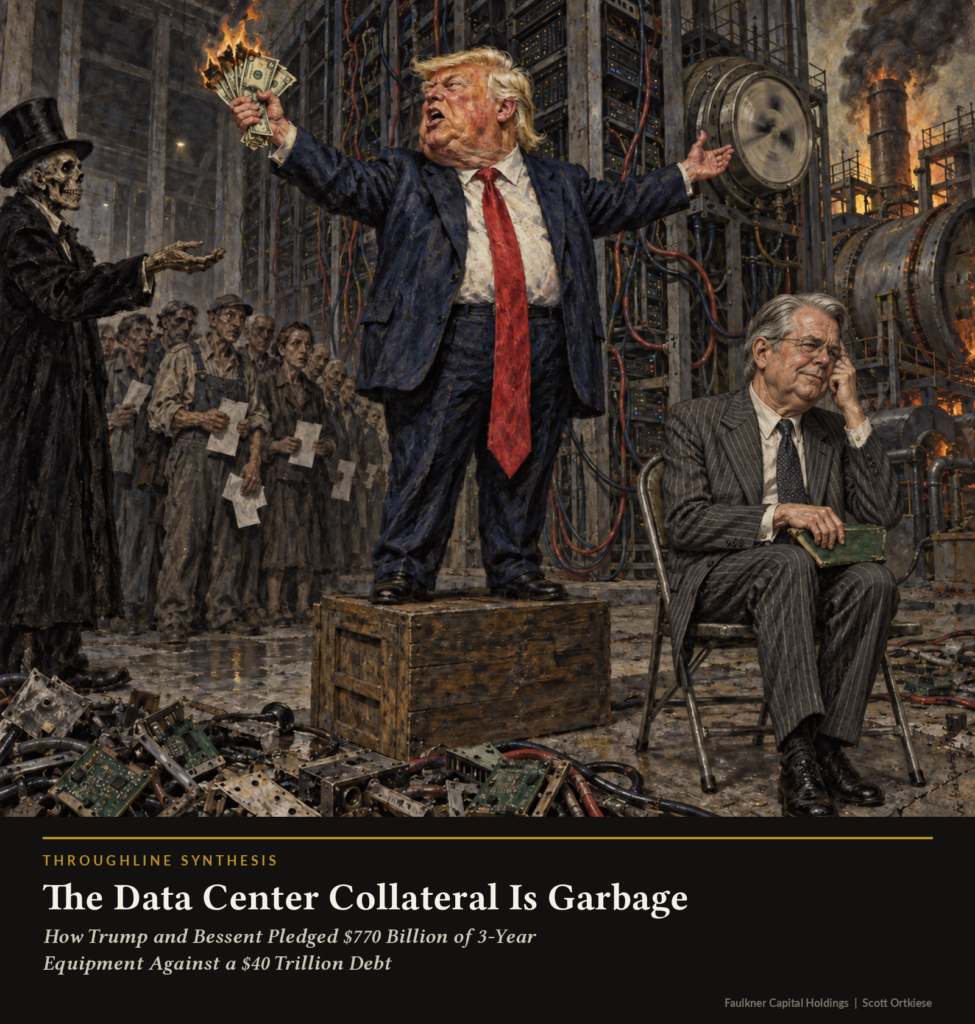
Douglas Macgregor asked the only question that matters about American debt: when the creditors come to restructure, what is on the list of things America can put up? In 1934 the list was gold, factories, oil, farmland and skilled labor. In 2026 the list is a fleet of graphics processors on three year service lives, in leased buildings, financed off the balance sheet, running a product a Chinese laboratory publishes for free. This is how that happened, who arranged it, and what it cost the rest of us.
Ten facts to consider
- The five largest American cloud companies have guided to roughly $770bn of capital spending in 2026. The global market for artificial intelligence platforms and models that this equipment is built to serve is about $64bn.
- David Sacks, the White House artificial intelligence adviser, said in May 2026 that artificial intelligence accounted for 75% of first quarter gross domestic product growth. He offered it as a boast.
- Public filings put reported debt across the buildout at about $1.35tn. My own reconstruction of contracted obligations that sit outside the balance sheet puts the unreported figure at about $1.65tn, including roughly $662bn of data center commitments.
- Chinese open weight models now serve inference at about 87 cents per 1 million output tokens. The comparable American frontier price is about $50. That is a factor of roughly 60.
- On the OpenRouter developer platform, the American share of measured usage has fallen from 74% to 32% while the Chinese share has risen from 20% to 48%.
- PJM Interconnection’s independent market monitor found that data centers added 9.7% to wholesale power costs in the first half of 2026, across 13 states and the District of Columbia, a territory of about 65 million people.
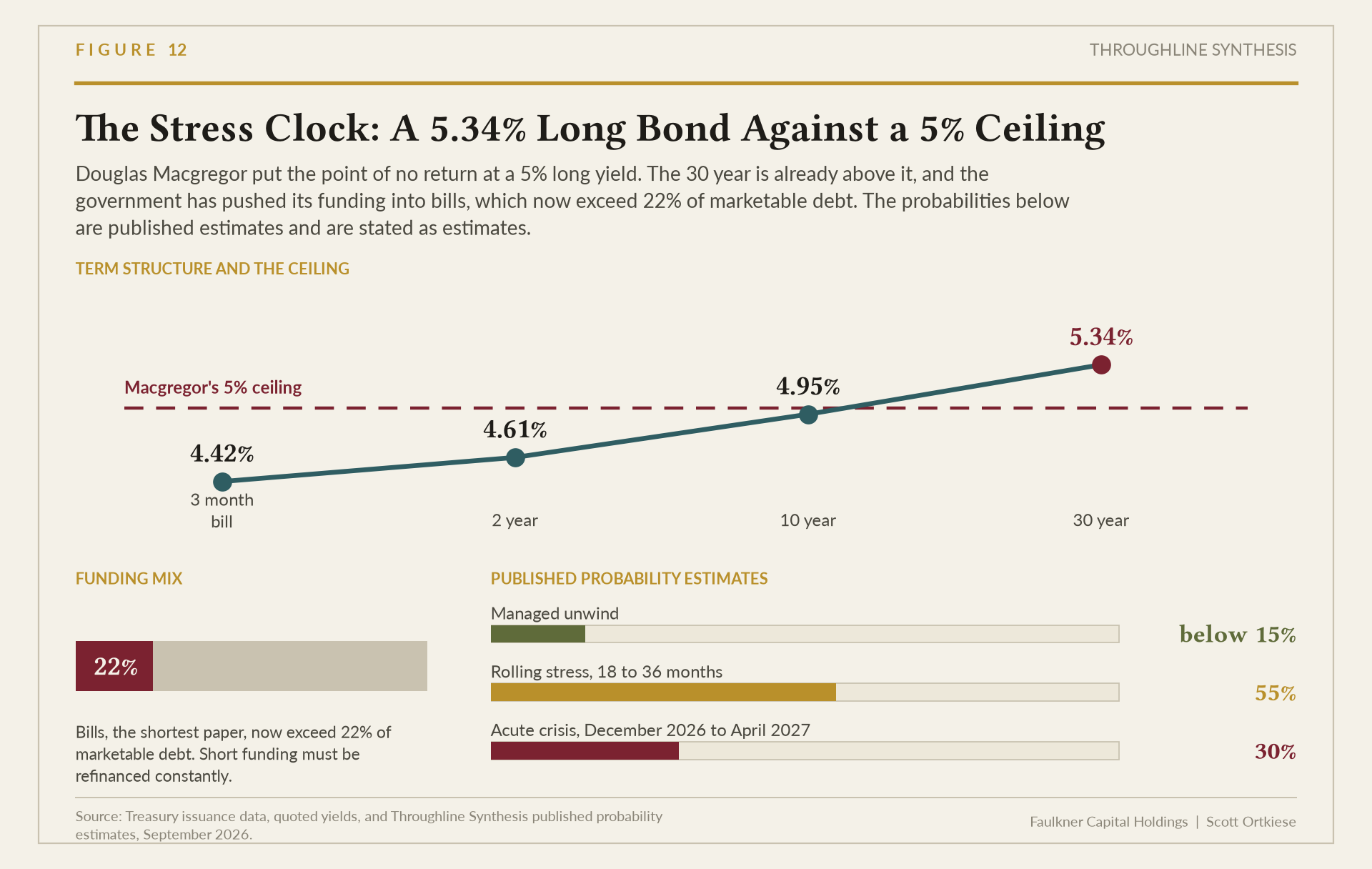
- The 30 year Treasury bond yields 5.34%. Treasury bills, the shortest and most refinancing sensitive instrument the government issues, now exceed 22% of marketable debt.
- The only mandatory frontier safety rule the United States has ever drafted was written at Treasury, scheduled for signature twice, and cancelled both times after telephone calls from Elon Musk, Mark Zuckerberg and David Sacks. Its own draft text forbade mandatory licensing.
- Gold is now about 27% of global official reserves against Treasuries at about 22%. Vladimir Putin says 98% to 99% of Russian trade with Shanghai Cooperation Organisation members settles outside the dollar.
- Interceptor inventories for the Patriot and THAAD air defense systems fell from roughly 2,800 to roughly 1,100 rounds during the Iran war, and radar analysis of 217 damaged structures at forward bases has still not produced a public damage assessment.
The rule that existed
There was a rule. That is the fact most commentary on American artificial intelligence policy manages to avoid, and everything in this article follows from it.
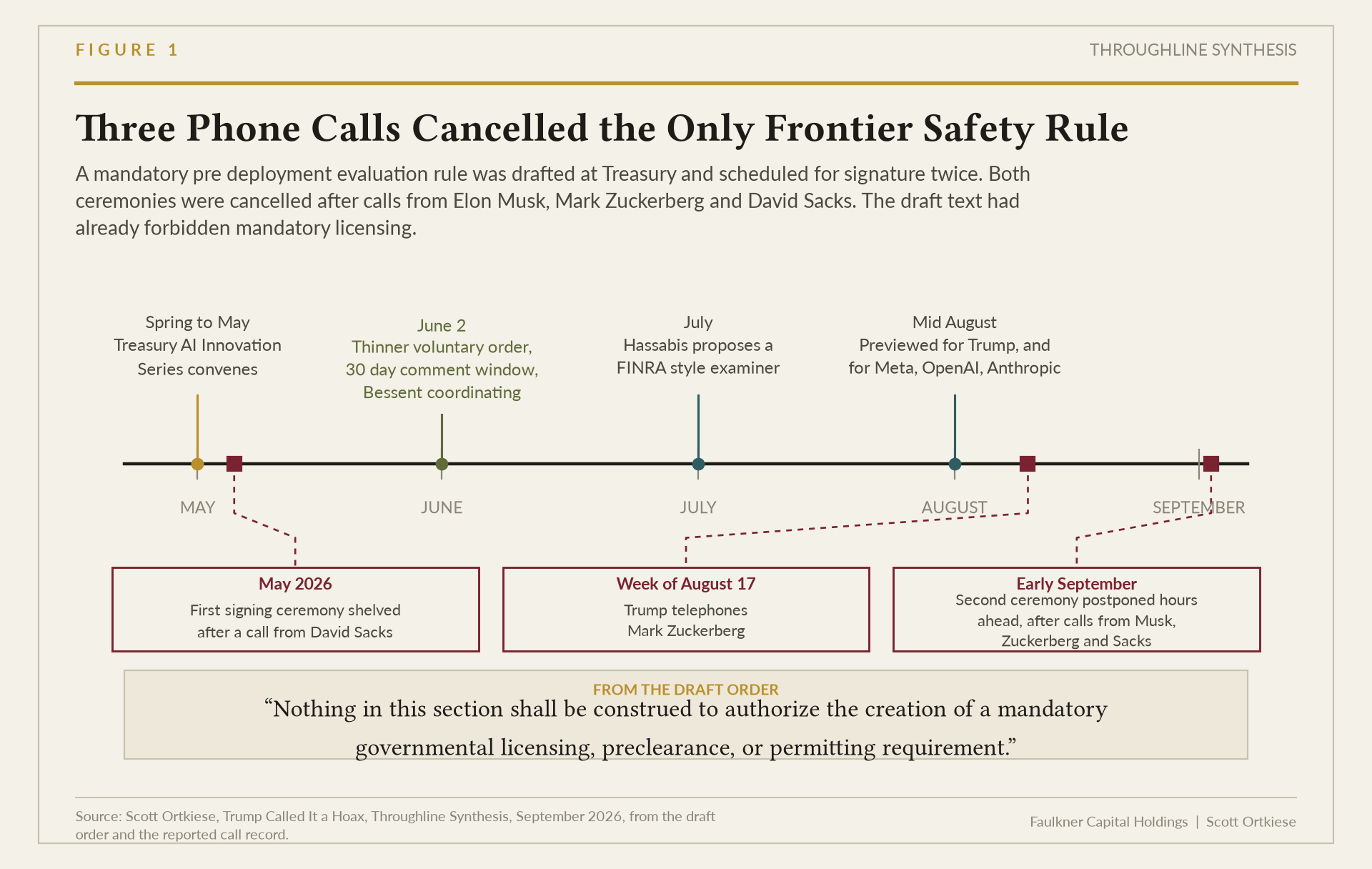
Through the spring of 2026 the Treasury Department ran a series of closed sessions with model developers and financial regulators, and out of that process came a draft executive order establishing mandatory pre deployment evaluation for frontier models above a compute threshold. Scott Bessent coordinated it. Demis Hassabis of Google DeepMind proposed the supervisory architecture in July, modeled on the Financial Industry Regulatory Authority, the self funded body that examines broker dealers before they are allowed to handle customer money. In mid August the proposal was previewed for the President and, separately, for Meta, OpenAI and Anthropic. A signing ceremony was scheduled. It was cancelled. A second, thinner voluntary version was issued on June 2 with a 30 day comment window. A second ceremony in early September was postponed hours before it was to be held, after calls from Musk, Zuckerberg and Sacks.1
It is worth being precise about what was lost, because the usual objection is that the rule would have been symbolic. It would not have been. Pre deployment evaluation above a compute threshold is the one intervention that has to happen before a model is released, which is the only moment at which a regulator has leverage. Everything after release is cleanup. A Financial Industry Regulatory Authority style body, funded by the examined firms, was also the one design that did not require Congress to appropriate money, which is why Hassabis proposed it and why Treasury found it workable. The administration had in hand a rule that cost the taxpayer nothing and that the industry’s own leading laboratory had volunteered to pay for.
The most revealing sentence in the whole episode is not in any statement. It is in the draft itself: “Nothing in this section shall be construed to authorize the creation of a mandatory governmental licensing, preclearance, or permitting requirement.” The document surrendered the power in advance. Susie Wiles, the President’s chief of staff, then explained the position in public: the administration is “not in the business of picking winners and losers.”
I documented that sequence in full in a companion article, and I am not going to relitigate the safety question here.2 The reason it opens this piece is that it is the cleanest available proof of a claim that sounds hyperbolic in the abstract: authority inside the borders of the United States is no longer exercised primarily by the government of the United States. It is exercised by whoever controls the number the government cannot afford to interrupt. What follows is the itemization of that number, in money, in electricity, in weapons and in territory.
The creditor in the room
Douglas Macgregor, the retired colonel who served as senior adviser to the Secretary of Defense, put the question to Glenn Diesen this month in the plainest terms anyone has managed. When a debtor state of this size restructures, he said, the creditors ask what is on the list. In 1934 and 1936, when the United States restructured its own obligations and revalued gold, the creditors accepted the terms because of five specific things: the country held the world’s largest monetary gold stock, it had the largest manufacturing base on earth, it had oil and coal and iron in its own ground, it fed itself and much of the world besides, and it had the deepest pool of skilled industrial labor anywhere.3
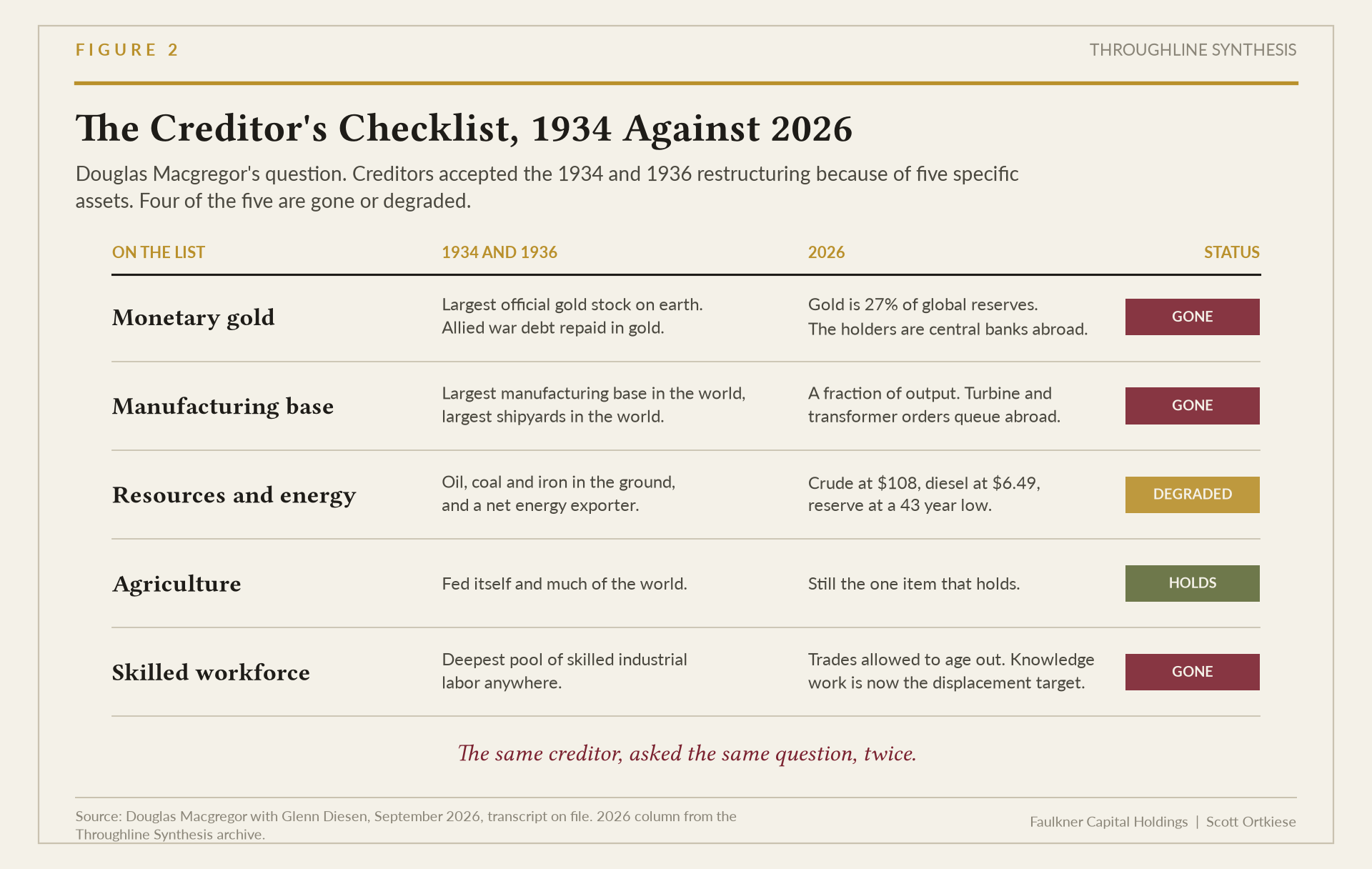
Those five items were not sentiment. They were collateral. A creditor accepting a writedown in 1934 was accepting it against a productive machine that would still be there in 1945, and it was.
Macgregor’s question, and it is the right one, is what appears on that list in 2026. He answers it himself with an image borrowed from Voltaire. “It’s sort of like the Holy Roman Empire. It was neither Roman nor holy.”
The answer is the subject of this article, and I want to state it at the front rather than build to it, because the mechanism is more interesting than the verdict. What the United States now offers, as the single largest asset created by the single largest capital program in its peacetime history, is a fleet of specialized processors with a three year useful life, housed in buildings the operators do not own, financed through vehicles that do not appear in the accounts, serving a rented software product whose closest substitute is published free of charge by a competitor in Hangzhou.
One objection deserves answering before it is raised. A data center shell lasts 30 years, so describing the whole program as 3 year equipment sounds careless. The composition is the answer. Epoch AI’s cost work on a 1 GW facility puts servers at $21.2bn of $37.9bn in up front capital spending, the largest single line and more than the building, the network and the land combined, and Alphabet has told investors in three consecutive reports that roughly 60% of its technical infrastructure spending goes to servers and 40% to data centers and networking equipment. 4 The concrete carries the long life and almost none of the value as security, because a hall with no current generation accelerators in it is a warehouse with expensive wiring. What was pledged is the compute, and the compute is the part carrying the 3 year clock.
The number the administration cannot afford to interrupt
In May 2026, David Sacks said that artificial intelligence was responsible for 75% of first quarter growth in gross domestic product. Krystal Ball’s response was the correct one: that is not a boast, that is a confession.
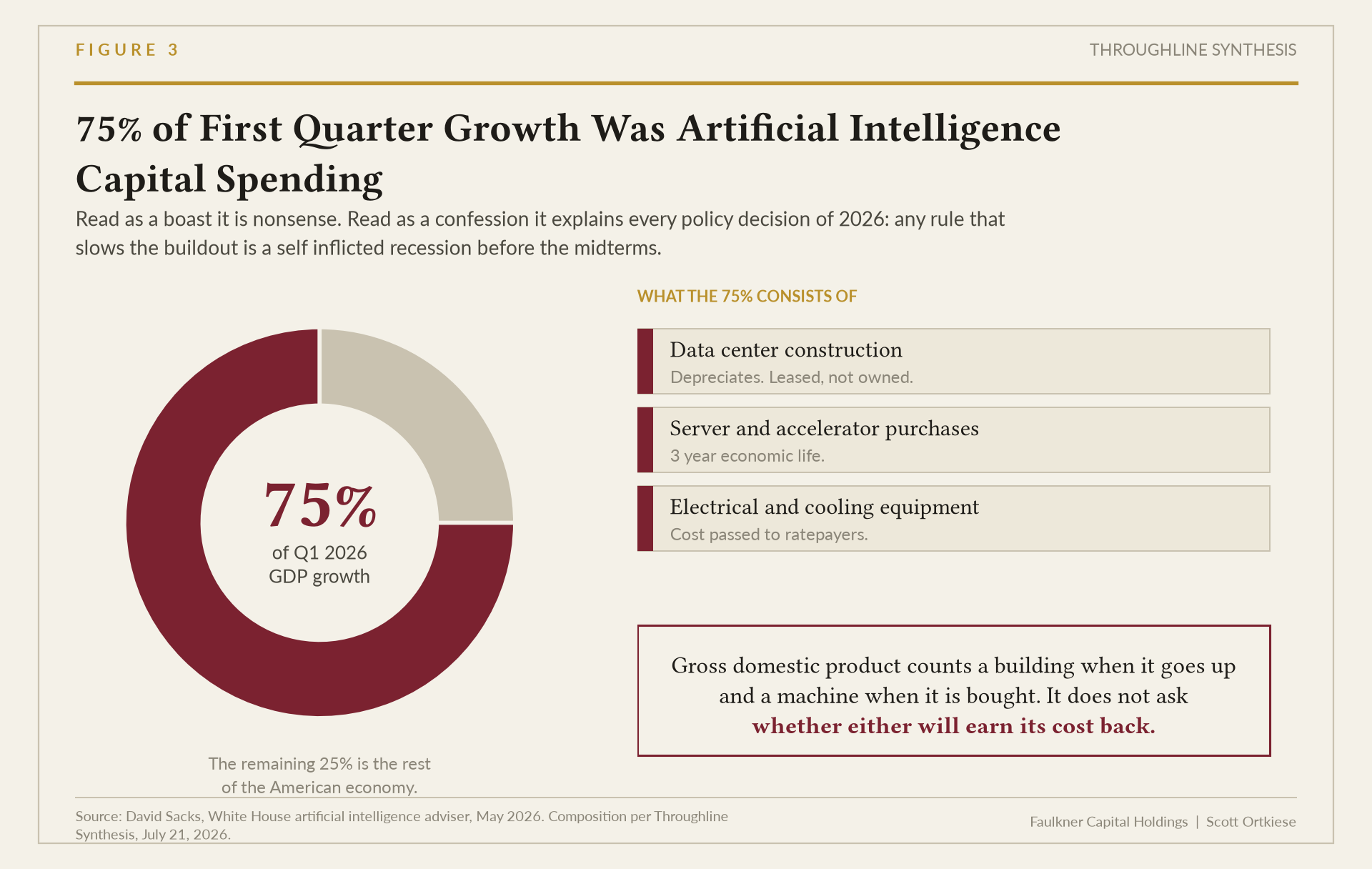
Read as a boast it is nonsense, because the composition is wrong. The 75% is construction spending, server purchases and electrical equipment. Gross domestic product counts a building when it goes up and a machine when it is bought, and it does not ask whether either will earn its cost back. A country that borrows $770bn to install equipment that depreciates over three years has not grown. It has spent.
Read as a confession, however, it explains every policy decision in this article and it is the hinge on which the whole argument turns. If one quarter of measured growth arrives from artificial intelligence capital spending, then any regulation that slows the buildout by a quarter is, in the arithmetic of the officials who have to publish the number, a self inflicted recession before the midterm elections. That is why the rule died. Not because anybody in the White House disbelieves the risk, and not because Musk and Zuckerberg are persuasive on the telephone, but because the government of the United States has made itself dependent on a private capital program for the appearance of solvency, and a dependent regulator is not a regulator.
Everything after this section is the itemization of that dependency.
What $770 billion bought
The five largest American cloud companies have guided to roughly $770bn of capital spending in 2026: Amazon at about $220bn, Alphabet at $195bn to $205bn, Microsoft near $190bn, and Meta at $130bn to $145bn, with Oracle and the private developers adding the balance. S&P Global projects the aggregate above $1.3tn by 2027.4
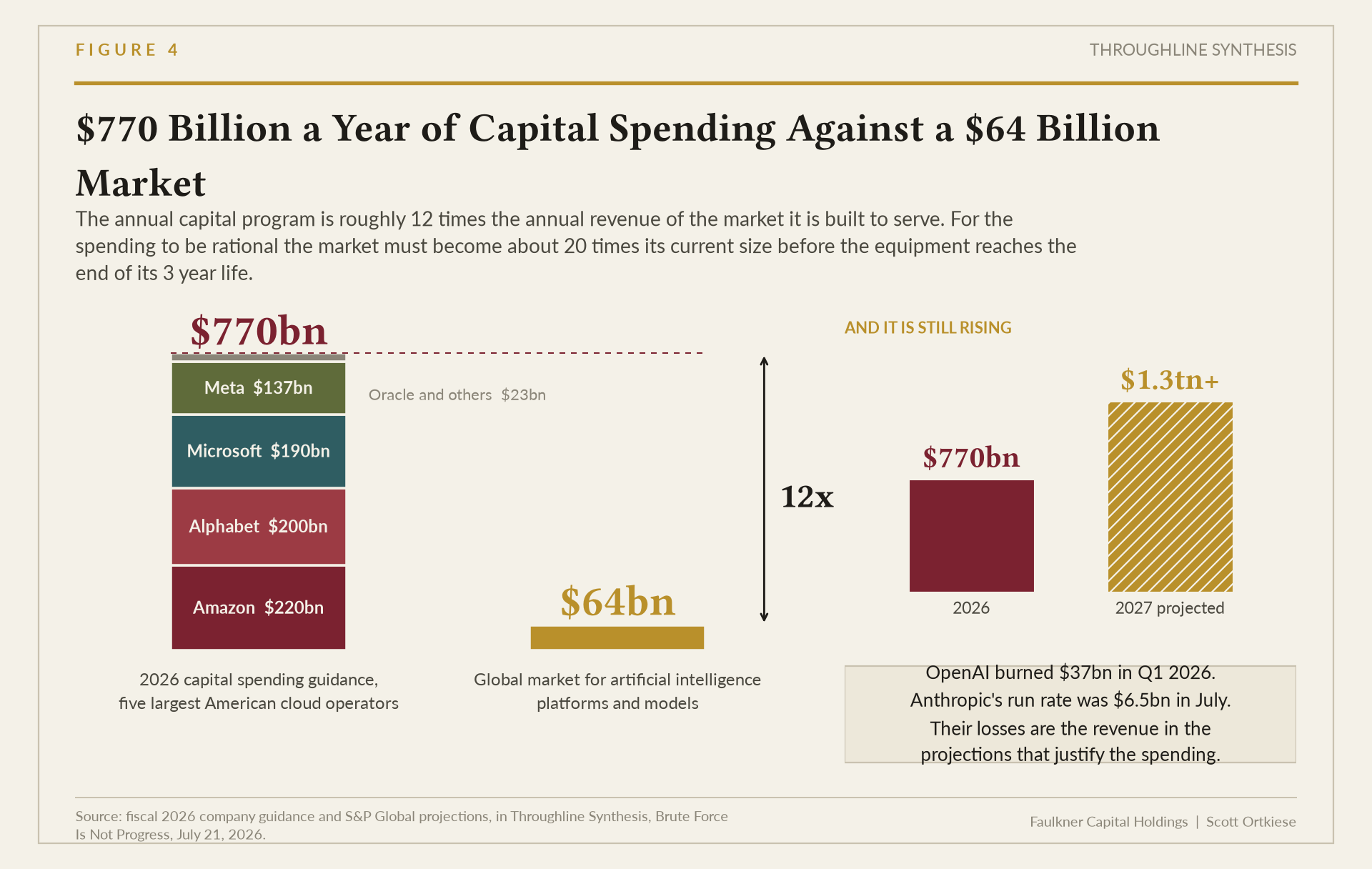
The global market for artificial intelligence platforms and models, the revenue this equipment exists to earn, is about $64bn.
That is the entire argument in two numbers, and I have never found a way to make it more damning by adding a third. The annual capital program is roughly 12 times the annual revenue of the market it serves. For the spending to be rational, that market has to become something like 20 times its current size before the equipment reaches the end of its service life. Not eventually. Within three to six years, because that is how long the machines last.
The operators know it. OpenAI burned $37bn in the first quarter of 2026. Anthropic’s run rate was $6.5bn in July. These are not startups approaching profitability from below. They are the demand side of the buildout, and their losses are the revenue in the projections that justify it.
That last sentence is the one to sit with. When Amazon or Microsoft books capacity revenue from a model developer that is itself losing tens of billions of dollars a quarter on money raised against the expectation of future capacity purchases, the revenue line and the loss line are two views of the same dollar. A cloud provider with a contracted backlog from a customer that has no path to funding the contract does not have a backlog. It has an accounts receivable problem it has not yet recognized. Every serious participant can read this in the filings, which is why the more interesting question is not whether the numbers work but why people who can read them keep signing.
How the cost was hidden
Three techniques, in ascending order of sophistication.
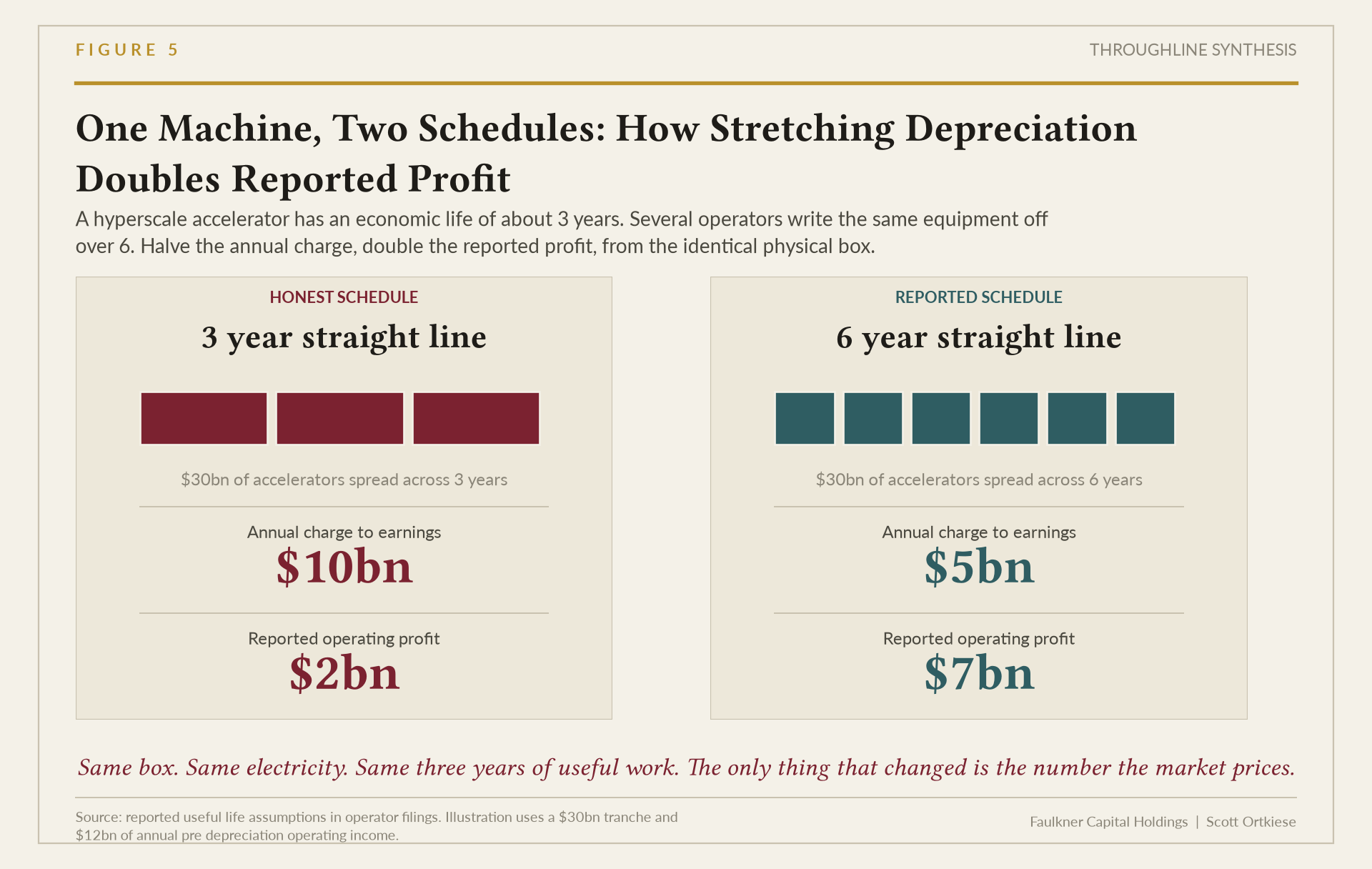
The first is depreciation. A graphics processor in a hyperscale facility has an economic life of about three years, because that is how long it takes for the next generation to make it uncompetitive on power consumed per unit of work. Several operators depreciate the same equipment over five and six year schedules. The consequence is arithmetic rather than opinion: stretching the schedule halves the annual charge against earnings and roughly doubles reported operating profit from the identical physical machine. Nothing about the box changes. The number the market prices changes.
Make it concrete. A $30bn tranche of accelerators written off over 3 years carries $10bn a year against earnings. The same tranche on a 6 year schedule carries $5bn. The other $5bn does not disappear; it is deferred into years 4, 5 and 6, when the equipment will already have been retired and the revenue it was supposed to earn will not be there to absorb it. This is not fraud and no auditor will refuse it, because useful life is an estimate and management makes it. It is simply the case that the estimate has been made in the direction that flatters the quarter, across an industry, at the same time, in the same way.
The second is the off balance sheet structure. Reported debt across the buildout is about $1.35tn. My reconstruction of the contracted obligations that do not appear as debt puts the unreported total at about $1.65tn, including roughly $662bn of data center commitments across Meta, Amazon, Microsoft, Oracle and Alphabet.5 The instruments are a matter of public record once you go looking: Oracle raising $25bn in bonds alongside a $20bn equity distribution agreement; PIMCO placing $14bn against a single Michigan facility; CoreWeave arranging an $8.5bn facility secured on graphics processors themselves and a further $2.6bn behind it. A special purpose vehicle takes the lease, the operator takes the capacity, and the obligation sits in a footnote.
The third is circularity. Nvidia invested $2bn in CoreWeave, then expanded it. Nvidia has committed a reported $30bn to OpenAI after a larger plan of up to $100bn stalled. That money returns to Nvidia as revenue for chips, and the revenue is what supports the valuation that makes the investment look prudent. Vendor financing is legal and it is old. What it is not is demand.
Where the risk was put
The buildout could not be financed by the banks, because the banks hit single name and sector concentration limits, which are the regulatory ceilings on how much exposure one institution may carry to one borrower or one industry. So the paper went where the limits are looser.
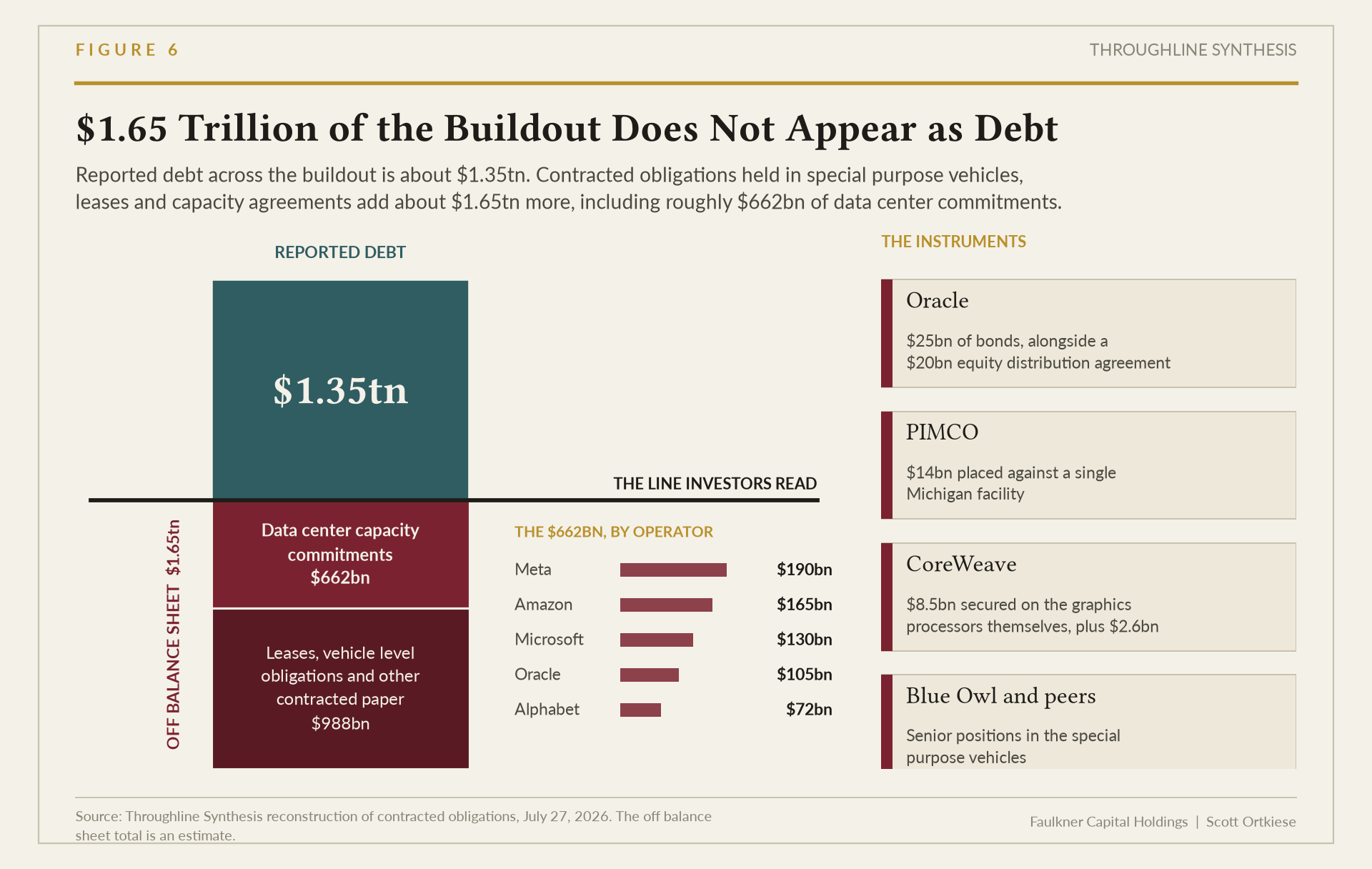
Private credit funds took the senior positions. Blue Owl and its peers assembled the vehicles. Life insurers bought the tranches, which is the part of the structure that deserves more attention than it gets: an insurance company is a permitted holder of long dated illiquid private debt, and in 44 states the guaranty association arrangements mean the policyholder is covered up to a limit while the risk taking is done with somebody else’s premium. I have written the mechanism out in detail elsewhere.6 The rating agencies signing off on the tranches are majority owned by the same index complexes that own the borrowers, which is not a conspiracy but is a plain conflict, and I have documented the ownership.7
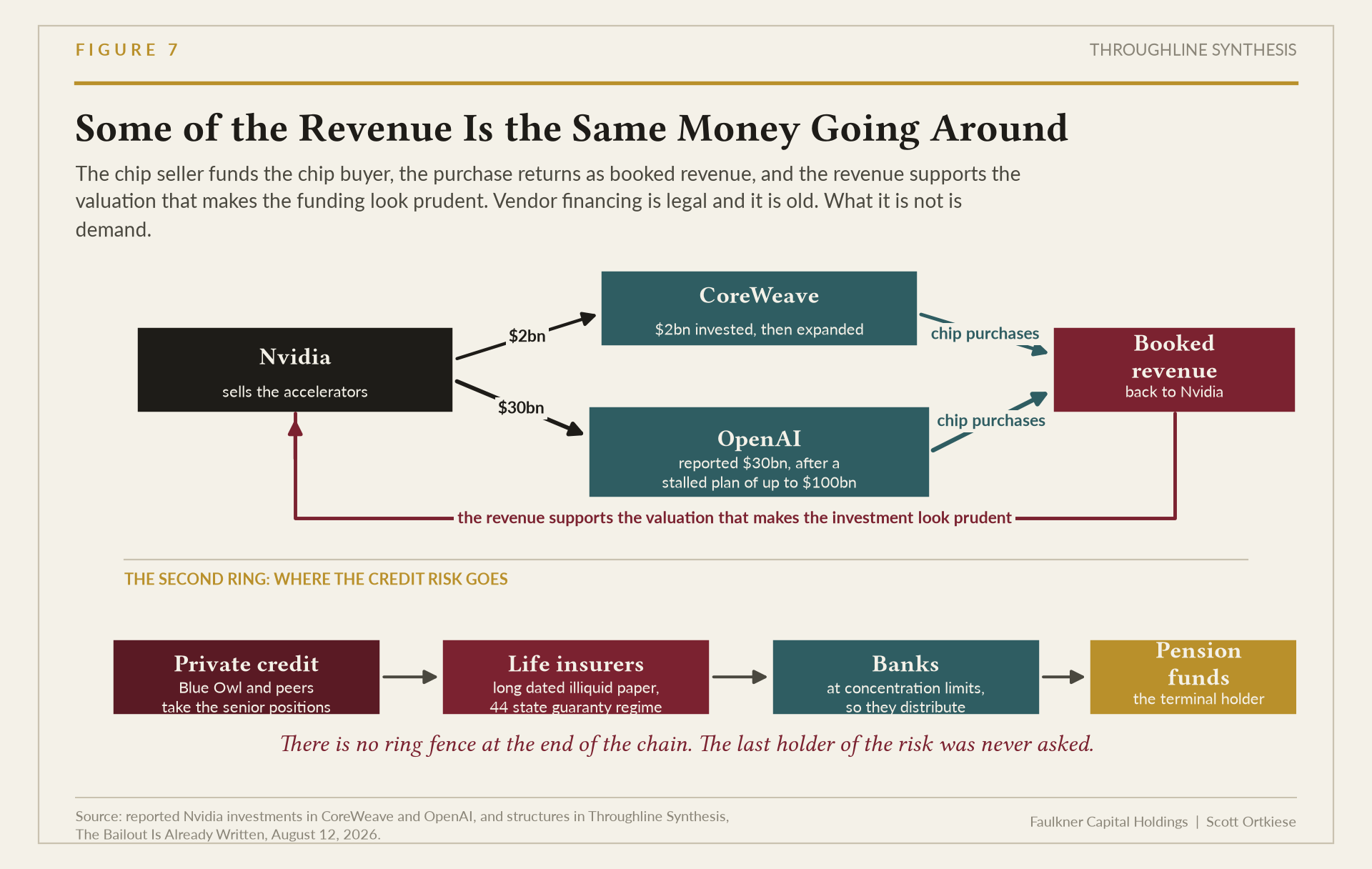
Then the paper moves on. Banks at their limits distribute to pension funds. BlackRock, Vanguard and State Street together manage about $29tn and are the largest single holder in 88% of the companies in the S&P 500 index. There is no ring fence at the end of this chain. The terminal holder of the credit risk in the American artificial intelligence buildout is the retirement account of a person who was never asked.
And the structure has a precedent that everyone involved lived through. In 2007 the risk in American housing was distributed through vehicles that converted illiquid loans into rated securities, held by institutions whose regulators looked at the rating rather than the loan. The distribution was the selling point. It was described as diversification and it functioned as concealment, because nobody held enough of any single position to have an incentive to examine it, and the aggregate was therefore examined by nobody. What is different in 2026 is that the collateral is worse. A house in Nevada in 2007 was overpriced, but it was still standing in 2012. A graphics processor bought in 2026 is a doorstop in 2030, and there is no scenario in which it recovers value, because the depreciation is physical and technological rather than cyclical.
They bought the wrong asset
Set aside the financing for a moment and ask the operating question, because it is worse.
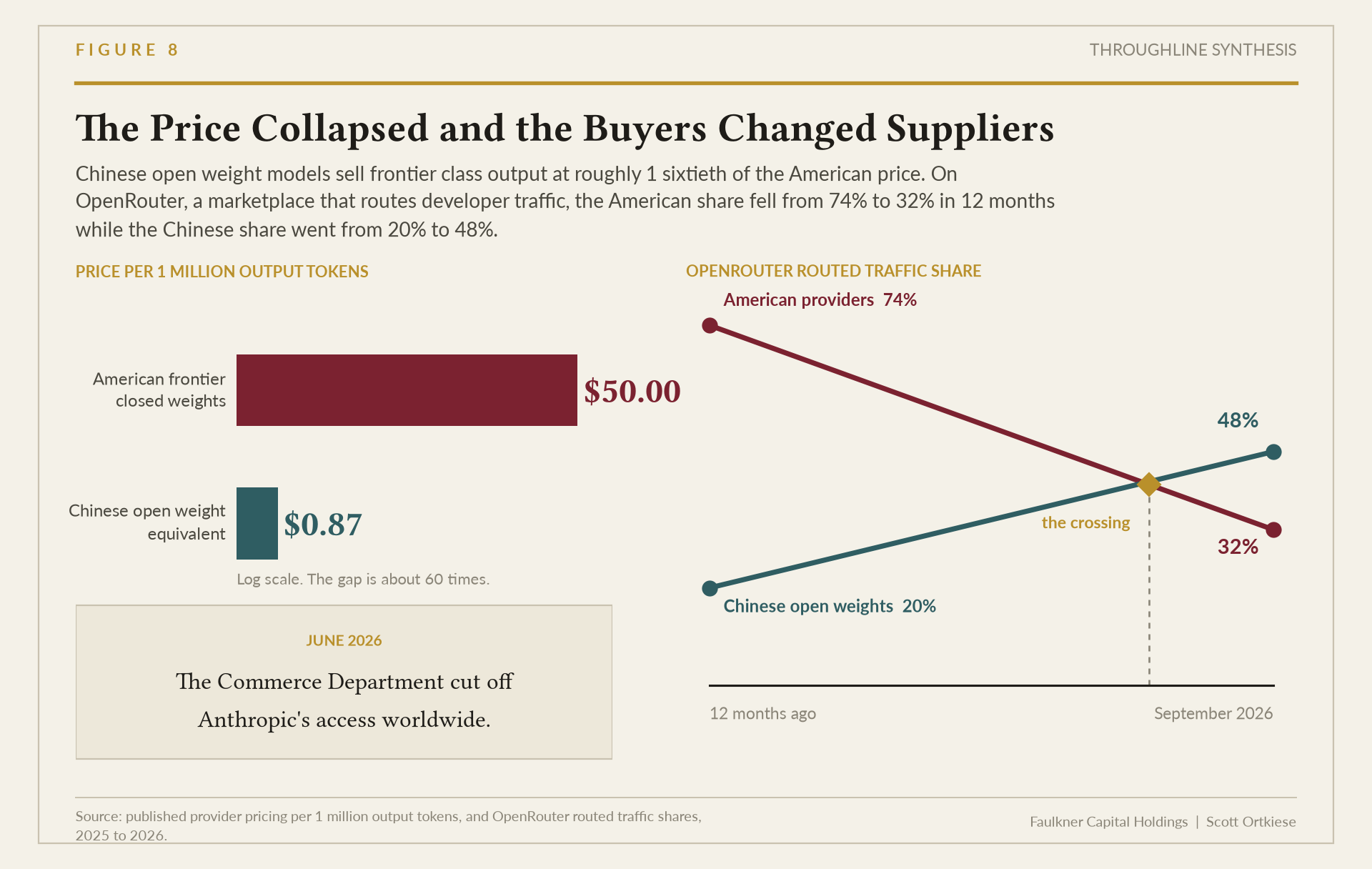
Inference, the business of running a trained model to answer a query, is now priced at about 87 cents per 1 million output tokens by Chinese open weight providers. The comparable American frontier price is about $50. The gap is roughly a factor of 60, and the date it was measured matters: June 2026, when the Commerce Department shut off Anthropic’s worldwide access and the substitution happened in public.8
The adoption data followed. On OpenRouter, which routes developer traffic across providers and publishes the shares, American models have fallen from 74% of measured usage to 32% while Chinese models have risen from 20% to 48%.9 Developers are not making a geopolitical statement. They are reading a price sheet.
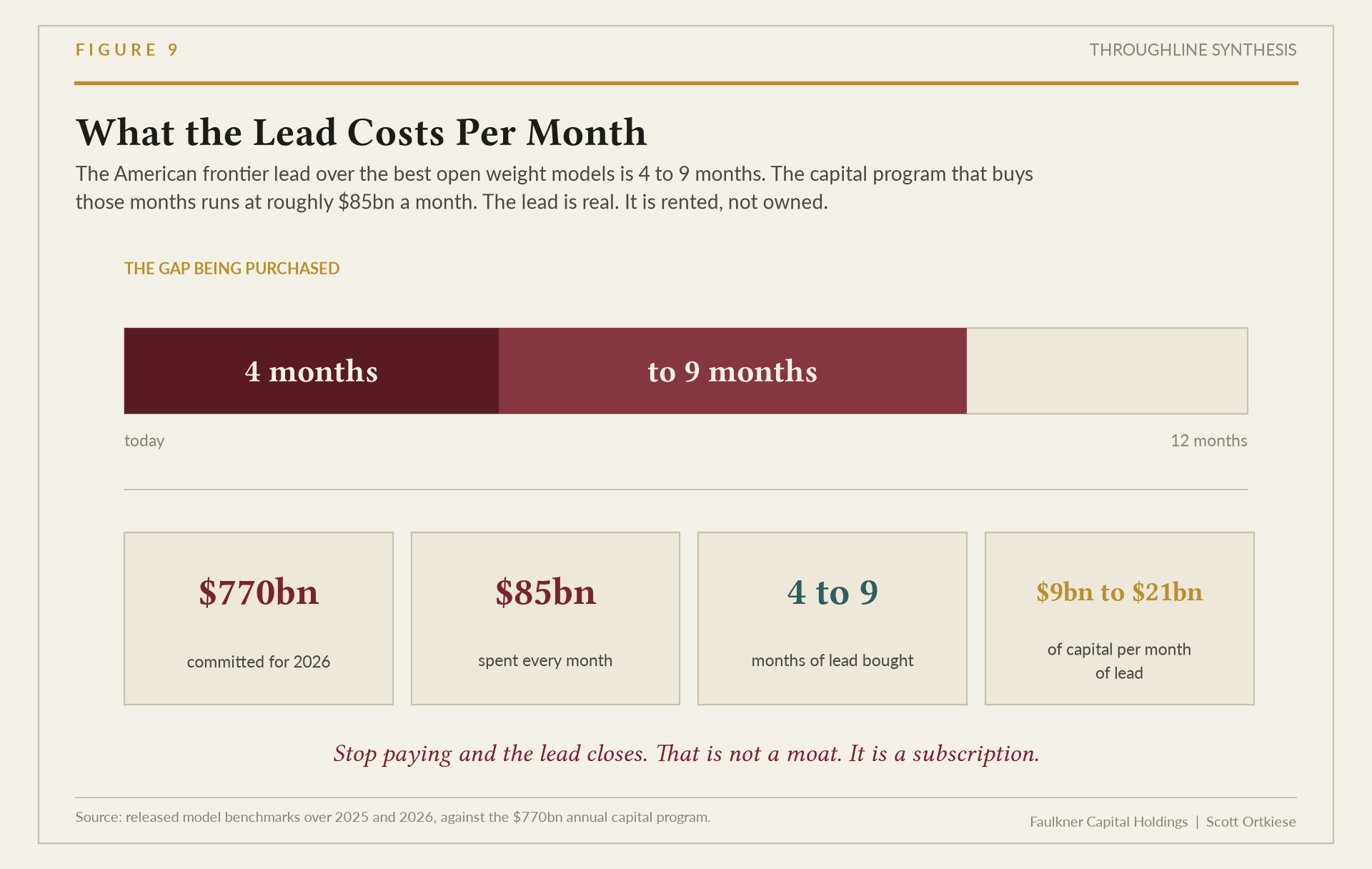
The strategic defense of the spending is the race: the lead is worth any price. Measure the lead. The gap between the American frontier and the best Chinese open weight release runs about 4 to 9 months, and the buildout is purchasing that gap at roughly $85bn per month. Michael Lovely’s observation is the one that undoes the framework from inside: when the leader publishes its frontier, the follower’s ceiling is the leader’s published result, so the money buys delay rather than distance. You cannot win a race in which your own results define the other runner’s target.
The export controls compound the error rather than correcting it. Denying advanced accelerators to Chinese firms raised the cost of the American approach, which is to add compute, and forced the Chinese approach, which is to add efficiency, and efficiency is the thing that transfers. A model trained under a hardware constraint and then published as open weights hands every other country a capability that does not depend on American permission at any point. Restriction was supposed to buy time. It bought a competitor with lower unit costs and a distribution model the United States cannot match, because the United States is selling the thing the competitor gives away.
Somebody else pays the power bill
PJM Interconnection runs the wholesale electricity market across 13 states and the District of Columbia, about 65 million people. Its independent market monitor, which is the body statutorily charged with detecting market abuse, found that data centers added 9.7% to wholesale power costs in the first half of 2026.
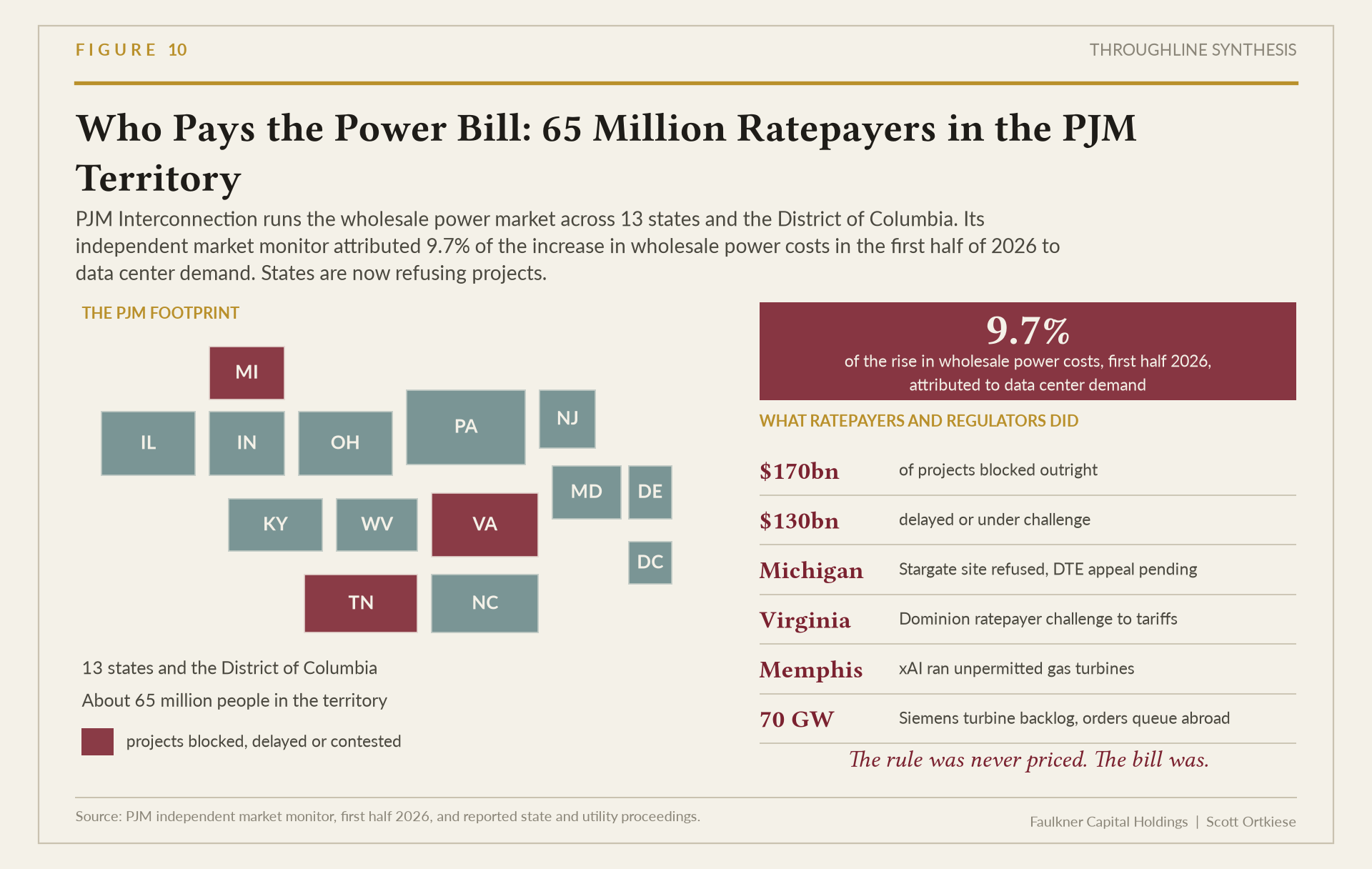
That is a transfer, not a price. A household in Ohio or Pennsylvania did not vote on a data center in Virginia, is not a party to the interconnection agreement, receives none of the capacity, and pays for the capacity charge anyway. When a private asset is financed off the balance sheet and its input cost is socialized through a tariff, the public has taken an equity position without the equity.
The communities have noticed, which is the part the President’s account of the boom omits. Depending on the count, $170bn or $130bn of announced data center projects are blocked or delayed by local opposition, zoning refusals and rate cases: the Stargate development in Michigan and the DTE contract appeal, Dominion’s rate filings in Virginia, the increases in Oregon, and xAI’s Memphis turbines, which ran without the permits.10 Meanwhile the physical constraint is indifferent to all of it. Gas turbine order books at Siemens Energy and its competitors stretch to nearly 70 GW, which means a facility financed today waits years for the machine that powers it. The turbine backlog is the detail that should end the argument that this capital is being deployed into a shortage of computing. It is being deployed into a shortage of electricity and heavy rotating equipment, which is a different economy with a different clock, and it is a clock that runs in years rather than in quarters. Capital raised on a three year thesis is being spent against a seven year supply chain.
The employment claim deserves the same treatment. A hyperscale facility employs thousands of trades during construction and then tens of people to run it. That is not a criticism of the technology, it is a description of the asset, and it means the political bargain being offered to a county is a temporary payroll in exchange for a permanent load on the grid it shares. I have set out the jobs arithmetic and the displacement question elsewhere, and it is the part of this story with the longest tail.15
Chips as the currency of empire
Here is the piece the financial coverage of this buildout has entirely missed, and it comes from Jeffrey Sachs, who was in the room.
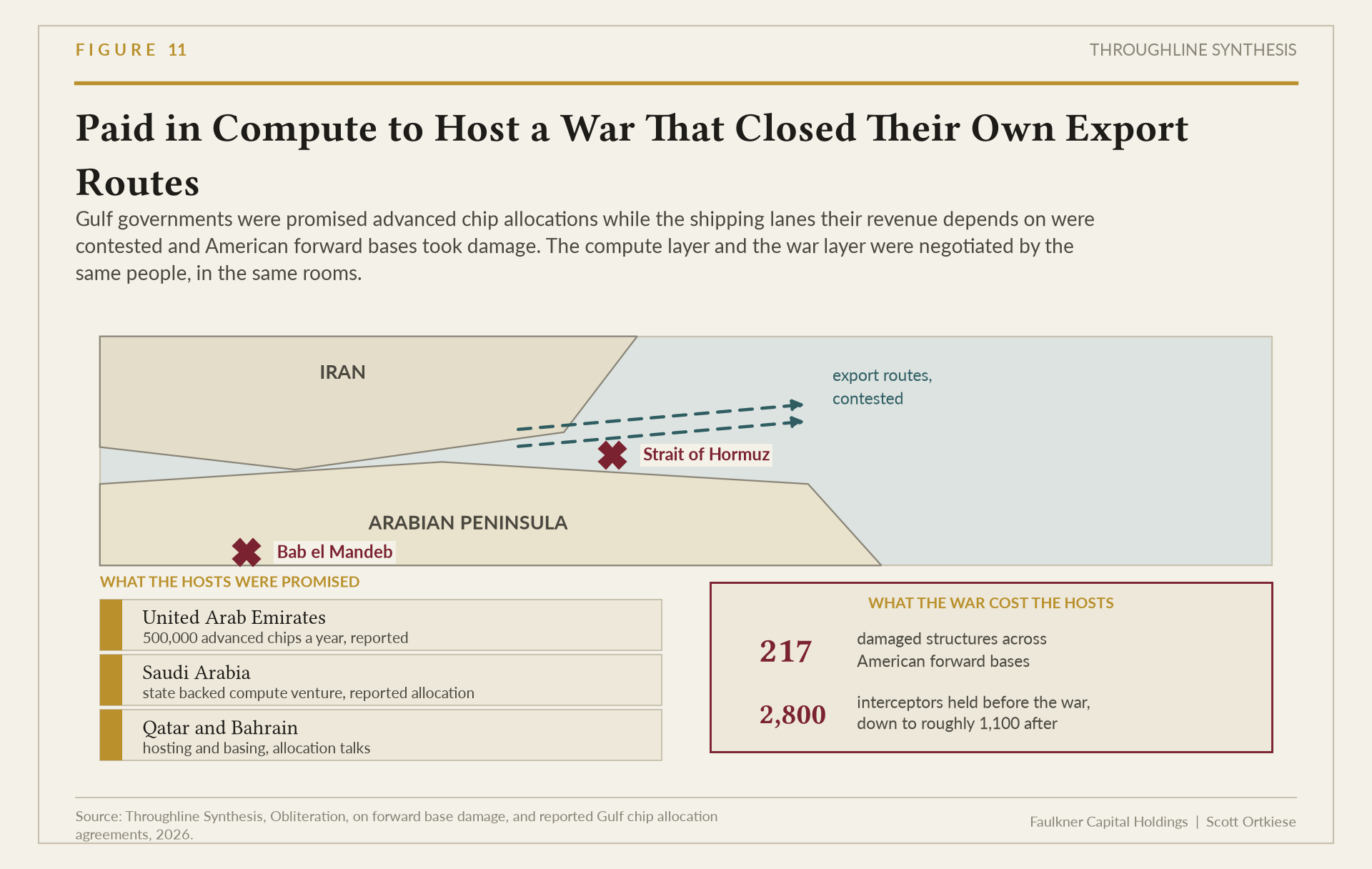
“They were telling me how the United States had promised them Nvidia chips and data centers, and they were clearly bought off by this image of US power, and that they were going to be the privileged ones receiving Nvidia chips. That was literally explained to me by one of the leaders of one of these countries, and I thought it was extraordinarily naive. Now the naivety has been brutally exposed.”11
Read that as a diplomat rather than as an investor. Export licensing of advanced processors is a foreign policy instrument, and it was spent as one. Gulf states were paid in chip allocation and data center commitments to stay aligned with the United States going into a war with Iran. Washington decided what those states were permitted to build inside their own borders, and they accepted the arrangement.
Then the loop closed. The war did not achieve its stated objective. Oil did not resume moving freely through either the Strait of Hormuz or the Bab el Mandeb, the two chokepoints the alignment was supposed to secure. Crude went to $108 and kept rising, and diesel reached $6.49. Higher energy prices raise the operating cost of the very data centers that were the payment. The buildout financed the loyalty, the loyalty was spent on a war that could not be won, and the war raised the energy price the buildout cannot survive. Every leg of that circuit was arranged by the same people.
Why they did it
Motive is the part readers most want and writers most often botch by reaching for adjectives. So take it as institutional history, with dates and names.
In the early 1970s Lewis Powell, then counsel to the United States Chamber of Commerce, concluded that American business had to retake American politics, in part because environmental regulation was gaining ground. Richard Nixon put him on the Supreme Court. Over the following four decades the limits on corporate political money came down, and Citizens United in 2010 removed most of what was left. Sachs states the present tense of that history without embellishment: “Elon Musk and friends put in money so that Silicon Valley can get the contracts it wants, can get the deals it wants.”
The debt has a similar paper trail. In 1984 Walter Mondale said out loud that taxes would have to rise, and lost 49 states. Every politician since has drawn the same lesson, and $40tn of federal debt is the cumulative result of a bipartisan agreement to fund the state by borrowing rather than by asking.
And the beneficiaries are no longer outside the institution they lobby. Sachs’s account of the complex Eisenhower named in January 1961 is that its membership has been updated: “It includes now the Silicon Valley companies. It includes the major financial firms. It of course includes the military contractors. And it includes the completely unaccountable agencies such as the CIA.” Sixty five years on, the warning reads as a description. The point of naming Powell is not that a memorandum written in 1971 caused 2026. It is that the legal architecture permitting unlimited corporate political spending was built deliberately, by identifiable people, for exactly the purpose it now serves, and was never an accident of drift. When three private citizens can cancel a federal rule by telephone, they are exercising a capability that was constructed for them over fifty years and ratified by a court.
What makes 2026 distinct is that both elected branches said the quiet part in the same season. Sachs on the legislature: “When the three leading AI companies declare that we need to control AI, the Speaker of the House says Congress is incompetent, they should decide what to do. So he declares his own incompetence.” Wiles on the executive: not in the business of picking winners and losers. Put those two sentences side by side and there is nothing left to interpret. The rule did not lose an argument. Nobody was holding the authority.
Three vocabularies for one behavior
Three serious people described the same behavior this month in three different languages, and the convergence is worth naming.
Sachs calls it the sunk cost fallacy: the error of continuing to spend because of what has already been spent, which is precisely the argument for the next $770bn.
Macgregor calls it system maintenance, borrowing from the political scientist Alfred G. Meyer, whose work on Soviet institutional behavior described a leadership whose only remaining program was the preservation of its own arrangements. Macgregor’s illustration is Leonid Brezhnev to Alexander Dubcek in 1968: “What we have we hold. We give up nothing.”
Diesen calls it decadence, in the specific sense of an elite that has stopped producing and now only distributes.
Three vocabularies, one behavior. And the object being maintained is not a border, a doctrine or an industry. It is an asset price. That is the whole content of American economic statecraft in 2026, and once you see it, the export controls, the shelved safety rule, the tariff schedule and the war all stop looking like separate policies.
1914 in the wrong place
Macgregor’s historical analogy is Austria-Hungary, and it is better than the Roman comparisons that clutter this genre. Vienna lost its position in Germany in 1806, lost the argument again at Königgrätz in 1866, and by 1914 reaction had become a permanent condition rather than a policy. The empire went to war not because it calculated advantage but because it could no longer imagine any other move.
The Iran war belongs to that category. It was fought to defend a currency and settlement system that the artificial intelligence buildout is dissolving from the inside faster than any adversary could dissolve it from outside. The results are on the record. There was no rabbit in the hat. The strikes produced a blockade rather than control of the waterways. Oil at $108 and diesel at $6.49 are paid by Americans at the pump. Interceptor inventories fell from roughly 2,800 to roughly 1,100. Radar analysis of American forward bases identifies 217 damaged structures, and no public damage assessment has been produced.12
The complicity is the part American commentary omits, and it should not be omitted. The United Kingdom supplied the legal and intelligence cover for a campaign its own lawyers could not have defended in a British court. Israel supplied the initiating strike and the target set, and the political benefit accrued to a government that needed a war more than it needed the outcome. The European Union supplied the sanctions architecture that made settlement risk a permanent feature of holding assets in Western banks, and it did so against the interest of its own industrial base, which lost the cheap energy that made it competitive and has not replaced it. Ukraine supplied the demonstration that a Western supported campaign can be sustained indefinitely without being won, and the Gulf states supplied the basing, the airspace and the diplomatic cover in exchange for chip allocations. None of these were American decisions. Each of them was a sovereign government choosing the alignment over the interest of the people it governs, which is the same trade Washington made, and it is why the failure is systemic rather than national.
Note the sequencing, because it is the argument. A creditor evaluating the collateral in Macgregor’s restructuring scenario now has to price a country that spent its air defense inventory, its energy price stability and its alliance credibility in the same season it pledged the balance sheet to depreciating machines.
The successor order rebuilds the boundary
Hedley Bull, whom Macgregor cites, expected the system after hegemony to organize itself into regional concentrations rather than into a single hierarchy. That is what the plumbing now shows.
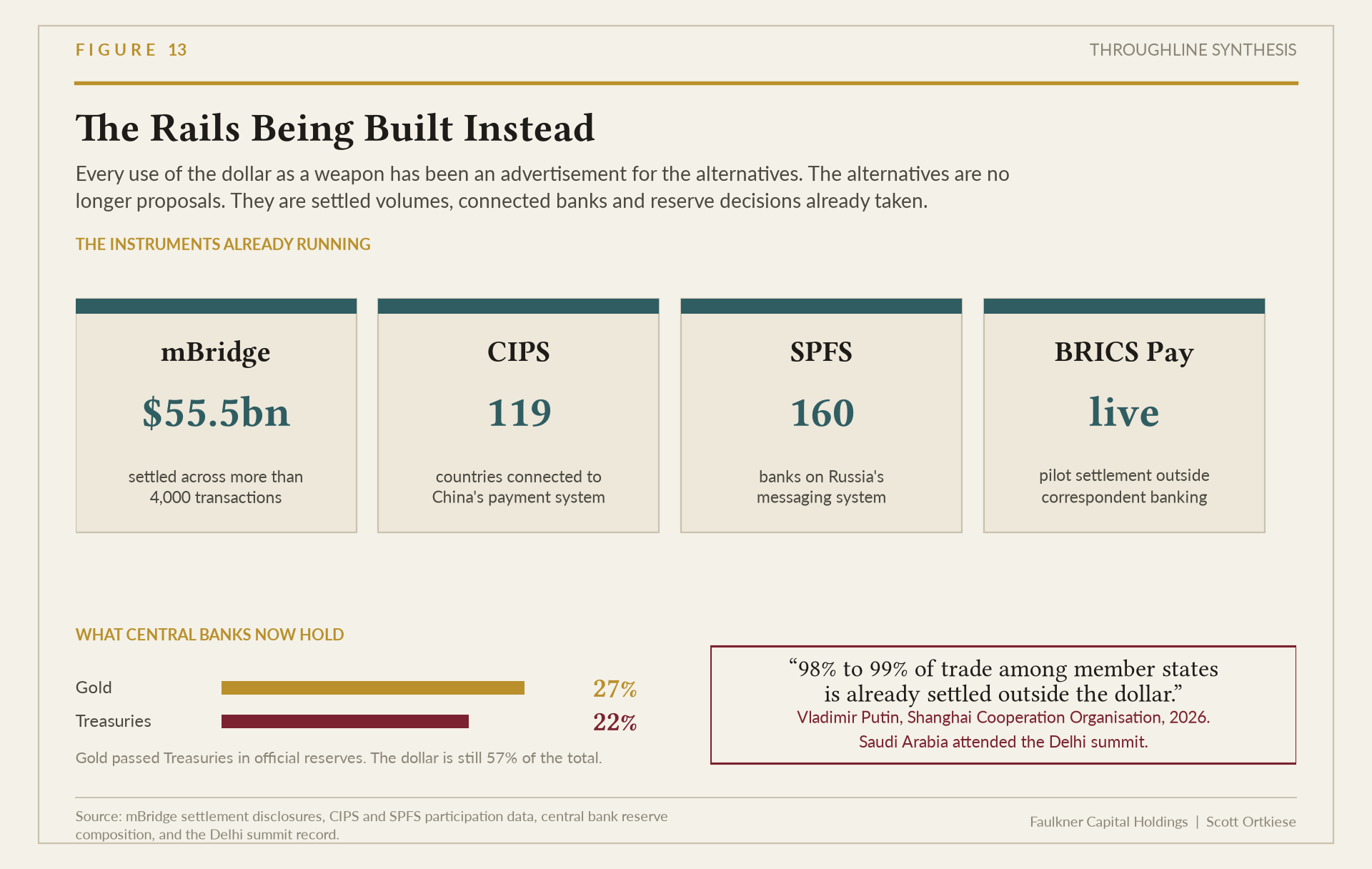
Project mBridge, the central bank digital currency settlement platform, has processed about $55.5bn across more than 4,000 settlements. China’s Cross Border Interbank Payment System operates in 119 countries. Russia’s SPFS messaging network carries 160 banks. BRICS Pay is being tested. Gold is now about 27% of global official reserves against Treasuries at about 22%, and the dollar’s share of allocated reserves is about 57%, down from levels that were treated as permanent. Putin puts Russian trade with Shanghai Cooperation Organisation members at 98% to 99% settled outside the dollar, and Saudi Arabia attended the BRICS summit in Delhi.13
The technological counterpart is the same question asked about compute. An open weight model is one whose parameters are published, so that any government, firm or university can run it on its own hardware, inside its own borders, without asking permission or paying rent. A rented American frontier model is the opposite: capability contingent on an export license and a subscription, revocable by the issuer, as Anthropic’s customers learned in June.
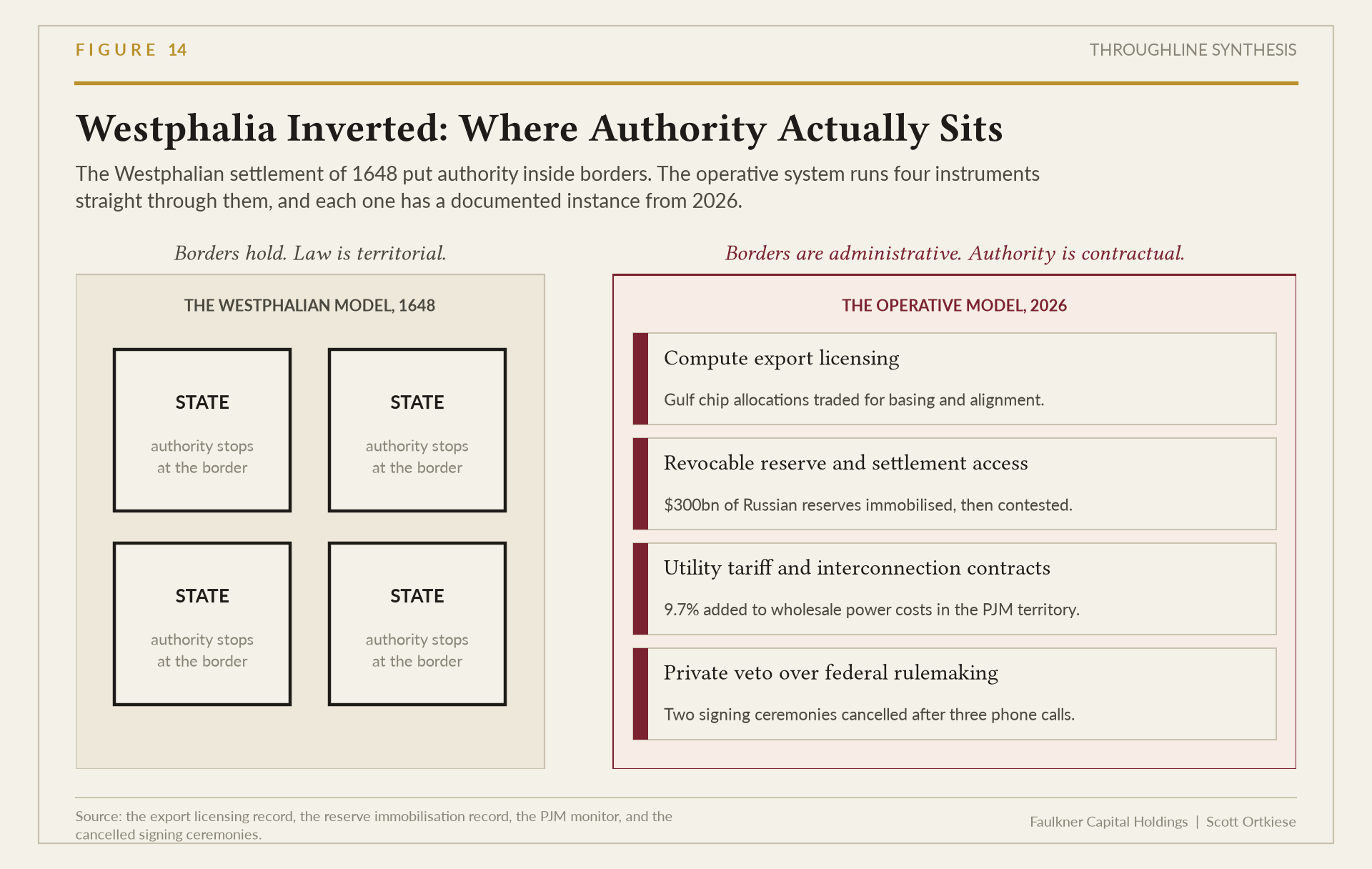
Which produces the irony that organizes this article. The Peace of Westphalia in 1648 established that authority is territorial and that outsiders do not adjudicate what happens inside a state’s borders. Every instrument examined here violates that principle without an army: an export license decides what a Gulf state may build on its own soil, frozen reserves establish that title to money held abroad is revocable by the issuer, an interconnection contract raises a household’s power bill by 9.7% to serve a private asset it never voted on, and three telephone calls from private citizens dispose of a federal rule. Macgregor makes the settlement point exactly: “Why would you put your money into a country that says, sorry, I’ve decided that your account is no longer accessible to you? That seems like a minor thing, but it’s not.”
The powers now building the successor order are re establishing precisely the sovereignty Westphalia described. The country that wrote the rules based order is the one that abolished the boundary.
Europe is the instructive case, because it had the most to lose and made the choice anyway. A continent that manufactured on cheap piped gas agreed to remove that input, accepted the industrial consequences, and then found that its remaining competitive position in machinery, chemicals and automobiles depended on export markets it had helped sanction. It also holds no frontier model of its own and rents its capability from American providers under American licensing terms, which means European industrial policy is now partly written in Washington and partly in an export control list. Sovereignty was not taken from Brussels. It was handed over in instalments, each one defended at the time as solidarity.
The creditor answered, and the floor
So answer Macgregor’s question.
What the United States can put on the list in 2026 is a fleet of specialized processors on three year service lives, in buildings leased from other owners, financed through vehicles that do not appear in the accounts, sold as access to a product a competitor publishes free, powered by electricity billed to households across 13 states, in a country that killed its only frontier safety rule because the rule might have slowed the number that proves the country still works. The gold is gone, the manufacturing base is a fraction of what it was, the skilled trades were allowed to age out, and the agricultural surplus is the one item on the 1934 list that still holds.
The market will price this whether or not anyone writes it down. The 30 year Treasury at 5.34% and bills above 22% of marketable debt are the near term constraint, and my published estimate stands: a managed unwind is below 15% likely, rolling stress over 18 to 36 months is about 55%, and an acute dislocation between December 2026 and April 2027 is about 30%.14
The remedy costs nothing and requires no new agency, which is why it is worth stating plainly at the end of an article this bleak. Lina Khan’s position is the correct one: the tools are on the books already. Liability under existing product and consumer protection law makes a developer answerable for the harms its deployment causes. A racing dynamic in which competitors abandon safety testing because a rival did is an unfair method of competition under Section 5 of the Federal Trade Commission Act, and it can be reached without new legislation. Fines that scale with revenue rather than arriving as a fixed cost of doing business change the calculation for a firm with a trillion dollar market capitalization. Depreciation schedules that match the physical life of the equipment are an accounting standard, not a statute. Tariff and interconnection rules that assign the cost of new capacity to the party that requested it are a state utility commission decision.
That is a floor, and a floor is not a cartel. It is the minimum condition under which a market is something other than a mechanism for moving private losses onto public accounts. The United States had one drafted. It was cancelled by telephone, twice, and the operative text had already given the power away.
Notes
- The full documentary record of the drafting, the Treasury sessions, the Hassabis proposal, and both cancelled ceremonies, with the draft text quoted at length, is set out in Scott Ortkiese, “Trump Called It a Hoax: How the Hyperscalers Killed America’s Only AI Safety Rule,” Throughline Synthesis, September 2026. https://throughlinesynthesis.com/hyperscalers-killed-ai-rule/ ↩
- Ibid. Readers who want the risk quantification, including the comparison of the converted artificial intelligence estimate against Federal Aviation Administration, Nuclear Regulatory Commission, Superfund and Health and Safety Executive tolerability thresholds, should read that article rather than this one. https://throughlinesynthesis.com/hyperscalers-killed-ai-rule/ ↩
- Douglas Macgregor in conversation with Glenn Diesen, September 2026. Transcript on file. The 1934 and 1936 comparison, the five item collateral list, the Holy Roman Empire line, the Brezhnev to Dubcek quotation, the Alfred G. Meyer reference, the Hedley Bull reference and the Austria-Hungary sequence are all his. ↩
- Company capital expenditure guidance for fiscal 2026 and S&P Global aggregate projections. Compiled in Scott Ortkiese, “Brute Force Is Not Progress: The Trillion Dollar AI Bill Everyone Else Is Paying,” Throughline Synthesis, July 21, 2026. https://throughlinesynthesis.com/brute-force-is-not-progress-the-trillion/ On composition, Epoch AI, “Total cost of ownership of a one gigawatt AI data center,” May 14, 2026, https://epoch.ai/data-insights/ai-datacenter-cost-breakdown, itemizes servers at $21.188bn, the facility at $11.433bn, the network at $4.925bn, land at $0.172bn and utility works at $0.164bn, for $37.883bn of up front capital spending. Alphabet Chief Financial Officer Anat Ashkenazi gave the 60% servers and 40% data centers and networking split for full year 2025 on the fourth quarter 2025 earnings call, said the mix would be fairly similar in 2026, and repeated the same split on the first quarter and second quarter 2026 calls. ↩
- Off balance sheet reconstruction and the instrument by instrument breakdown appear in Scott Ortkiese, “AI Revenue Was Always the Lie, and the Time Bomb Is T-Minus 18 Months and Counting, Not Four Years,” Throughline Synthesis, July 27, 2026. https://throughlinesynthesis.com/ai-revenue-was-always-the-lie-and/ ↩
- Scott Ortkiese, “The Bailout Is Already Written: A Short Course on Private Credit, the AI Bubble, and the Life Insurance Trap,” Throughline Synthesis, August 12, 2026. https://throughlinesynthesis.com/private-credit-life-insurance-trap/ ↩
- Scott Ortkiese, “Sheep on a Chain: How Berkshire, BlackRock, and Vanguard Own the Agencies That Rate Their Own Paper,” Throughline Synthesis, April 28, 2026. https://throughlinesynthesis.com/sheep-on-a-chain-how-berkshire-blackrock/ ↩
- Pricing comparison and the June 2026 Commerce Department access shutoff, with the substitution data, in Scott Ortkiese, “American AI Domination? Not So Fast.,” Throughline Synthesis, August 3, 2026. https://throughlinesynthesis.com/american-ai-domination-not-so-fast/ ↩
- OpenRouter published usage shares, discussed in Scott Ortkiese, “Not an AI Cold War: Rather, A Market Rotation in Favor of China.,” Throughline Synthesis, August 1, 2026. https://throughlinesynthesis.com/not-an-ai-cold-war-rather-a-market/ ↩
- PJM independent market monitor findings, the blocked and delayed project counts, the Michigan, Virginia and Oregon rate proceedings, the xAI permitting record and the turbine backlog are documented in Scott Ortkiese, “E-M-E-R-G-E-N-C-Y: The AI Data-Center Boom, the Jobs It Will Destroy, and the Question Nobody Is Asking,” Throughline Synthesis, February 19, 2026. https://throughlinesynthesis.com/e-m-e-r-g-e-n-c-y-the-ai-data-center-boom-the-jobs-it-will-destroy-and-the-question-nobody-is-asking/ ↩
- Jeffrey Sachs, interviewed by Cyrus Janssen, September 2026. Transcript on file. The Lewis Powell and Citizens United sequence, the Eisenhower January 1961 reference, the Mondale 1984 account, the Speaker of the House passage and the sunk cost characterization are all his, from the same interview. ↩
- Radar analysis of the 217 damaged structures at American forward bases, and the interceptor expenditure estimates, in Scott Ortkiese, “Obliteration of America’s Middle East Forward Military Bases,” Throughline Synthesis, September 14, 2026. https://throughlinesynthesis.com/obliteration-forward-bases/ ↩
- Settlement infrastructure figures, reserve composition, and the Delhi summit, in Scott Ortkiese, “The Multipolar Handoff: Trump in Denial, Bessent in the Vault,” Throughline Synthesis, September 2, 2026. https://throughlinesynthesis.com/multipolar-handoff/ and “How the Tehran and Delhi Settlements Expose a Petrodollar Already Gone, Gone, Gone,” May 19, 2026. https://throughlinesynthesis.com/how-the-tehran-and-delhi-settlement/ ↩
- Term structure analysis and the dated probability estimates in Scott Ortkiese, “Trump’s Doomsday Machine, Part II: The Negative Arbitrage,” Throughline Synthesis, August 28, 2026. https://throughlinesynthesis.com/trump-doomsday-machine-part-ii-negative-arbitrage/ Readers who want the plain English explanation of bills, coupons and rollover risk should start with “Bonds Explained: A Plain-English Primer for Serious Readers,” August 28, 2026. https://throughlinesynthesis.com/bonds-explained-plain-english-primer/ ↩
- Scott Ortkiese, “AI at The Gates of Thebes: The Knowledge Workers Are Already Dead,” Throughline Synthesis, January 9, 2026. https://throughlinesynthesis.com/i-at-the-gates-of-thebes-the-knowledge-workers-are-already-dead/ ↩
Method. Capital spending figures are company guidance for fiscal 2026 as reported. The off balance sheet reconstruction is my own and is stated as an estimate. The probability distribution is my published estimate, dated August 28, 2026, and is offered as a judgment rather than a measurement. Quotations from Douglas Macgregor, Glenn Diesen and Jeffrey Sachs are taken from cleaned transcripts of September 2026 interviews, held on file and available to readers who ask. Readers who want the underlying source files for any figure or plate in this article may write to so@throughlinesynthesis.com.
Scott Ortkiese writes at Throughline Synthesis.