By Scott Ortkiese | so@throughlinesynthesis.com | www.throughlinesynthesis.com April 28, 2026
The question of whether the rating agencies are running behind the physical reality of the Gulf crisis by design is not paranoid. It is the correct analytical question, and the evidence in the public record supports a disturbing answer. The delay is not incompetence. It is a managed transition being executed on behalf of the institutions that profit from it, by the institutions they own, at the expense of every sovereign, pension fund, and retail investor that depends on rating agencies to tell the truth.
The Regulatory Moat Nobody Talks About
The Big Three rating agencies, Moody’s, S&P, and Fitch, control 99% of all sovereign ratings through a regulatory moat created by the SEC’s 1975 NRSRO designation. That designation made their oligopoly a function of law rather than market competition. Nothing structural has changed in fifty years. The same issuer-pays model that incentivized 45,000 triple-A ratings on mortgage-backed securities from 2000 to 2007, 83% of which were downgraded to junk by 2010, is the model rating Gulf sovereign debt today. The $864 million DOJ settlement Moody’s paid in 2017 acknowledged that “conflicts of interest compromised ratings.” S&P paid $1.37 billion in 2015 for the same conduct. The NRSRO designation remained untouched after both settlements. Nothing structural changed.
For sovereign debt specifically, the conflict is different but equally disabling. Sovereigns do not shop ratings the way corporations do, but the agencies are deeply embedded in the political economy of U.S. Treasury market stability. S&P’s lead sovereign analyst Roberto Sifon-Arevalo stated publicly on March 12 that the firm would not make “knee-jerk” rating cuts in response to the Iran war. That was not an analytical judgment about the pace of Gulf sovereign deterioration. It was a policy statement, one that serves the interests of a U.S. government simultaneously running $5.3 trillion in annual sovereign borrowing, a 40% share of all global long-term sovereign issuance. A cascade of Gulf sovereign downgrades while the U.S. is the dominant issuer in a $14.1 trillion global sovereign bond market is not a neutral analytical outcome. It raises borrowing costs everywhere, including Washington. The agencies know this. So does the Treasury.
S&P’s own March 10 analysis acknowledged the conflict is “starting to strain credit channels.” They published it. They did not act on it. The gap between publishing and acting is not incompetence. It is managed delay, and the mechanism of that management is the institutional imperative not to be the agency that triggers the repricing. That imperative flows directly from ownership.
Who Holds the Chain
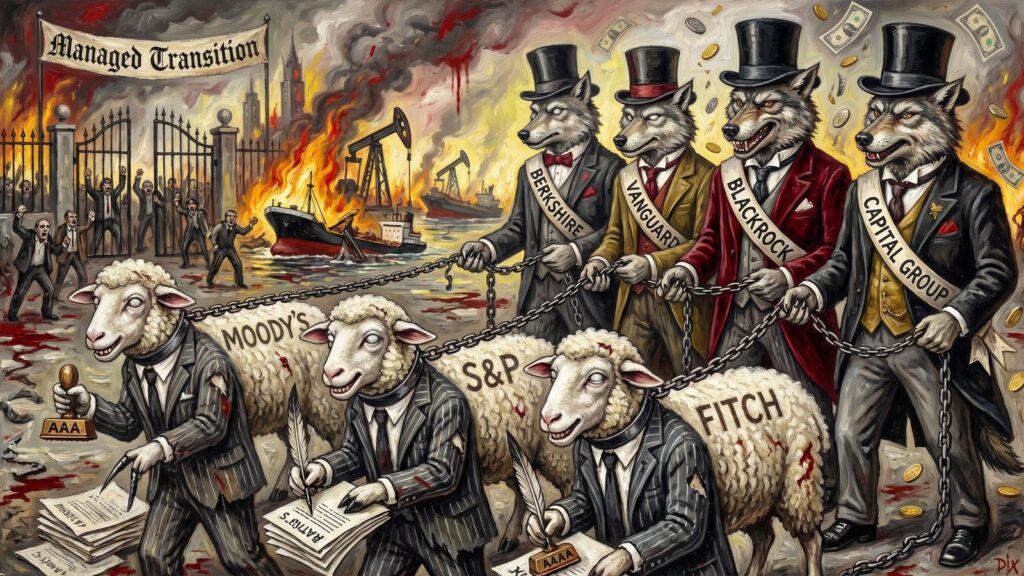
To understand why this delay is structural rather than circumstantial, follow the ownership. The rating agencies are not independent analytical institutions. They are profit centers owned by the same rentier capital complex whose portfolio valuations depend on the ratings those firms produce. This is not a conflict of interest. It is a control structure, and it has three components.
Berkshire Hathaway owns Moody’s. Warren Buffett’s Berkshire Hathaway holds approximately 13.7% of Moody’s Corporation’s outstanding shares, a position worth roughly $11 billion, held since receiving the shares when Moody’s was spun off from Dun and Bradstreet in 2000. Berkshire earned $93 million in Moody’s dividends in 2025 alone. Moody’s constitutes 3.6% of Berkshire’s entire equity portfolio and is among its six largest holdings. Berkshire Hathaway simultaneously holds one of the largest concentrations of dollar-denominated financial assets on earth: massive equity stakes in U.S. bancshares including Bank of America and Wells Fargo, insurance float from GEICO and General Re invested overwhelmingly in U.S. fixed income, and equity positions in companies whose valuations rest on dollar stability and orderly capital markets. A Moody’s downgrade cascade across Gulf sovereigns that triggers dollar peg reviews, accelerates petrodollar disintegration, and reprices the reserve currency architecture does not impair an abstraction. It impairs Berkshire’s balance sheet in concrete, measurable ways. Buffett does not call Moody’s analysts. He does not need to. The incentive structure does the work for him, and it has done so for twenty-six years.
Vanguard and BlackRock own S&P Global. Vanguard Group is S&P Global’s largest institutional shareholder, holding 30.26 million shares worth approximately $14.73 billion, representing 9.99% ownership. BlackRock holds 24.23 million shares at 7.6% ownership. Together with Capital Group, these three institutions control over 25% of S&P Global’s equity. These are not passive observers of dollar-denominated asset valuations. They are the dollar-denominated asset market. Vanguard manages $9.3 trillion in assets, the overwhelming majority in dollar-denominated equities and fixed income. BlackRock manages $10.5 trillion and is the single largest holder of U.S. Treasury debt through its iShares ETF complex. BlackRock and Vanguard together are among the three largest institutional investors in 505 out of 505 companies in the S&P 500. A sovereign downgrade cascade that reprices the dollar’s reserve currency status is not an abstraction for these institutions. It is an existential threat to the value of assets under their management, the fees those assets generate, and the institutional relationships that depend on orderly dollar-denominated markets continuing to function. They own S&P Global. S&P Global assigns the ratings. The alignment of incentives requires no conspiracy. It requires only that rational actors pursue their financial interests, which is the one thing financial institutions can be relied upon to do.
Hearst Corporation owns Fitch. Fitch Ratings is 100% privately held by Hearst Corporation, the media and information conglomerate, which acquired full ownership in 2018. Private ownership does not eliminate conflicts of interest. It eliminates the obligation to disclose them. Hearst’s financial positions, board composition, and investment portfolio are not publicly reported. Its incentive structure in relation to the sovereign ratings its subsidiary produces is the least transparent of the three and the most insulated from any form of public accountability. Fitch has been the most aggressive of the three in the current crisis, placing Qatar on Rating Watch Negative and downgrading Bahrain, but it remains the institution whose ultimate ownership interests are the most opaque, which is itself a structural observation about the system.
None of these ownership structures are democratically accountable. None are subject to shareholder votes on rating methodology, congressional oversight of their analytical independence, or regulatory review of whether the financial positions of their ultimate beneficial owners are influencing the timing of sovereign actions. The NRSRO designation that gives these three firms their commercial power is administered by the same SEC that accepted settlement payments for fraud and then left the designation intact. The regulatory moat protecting the oligopoly is itself a product of fifty years of accumulated lobbying by the very financial institutions that benefit from the oligopoly’s restraint.
The verdict is not ambiguous. The rating agencies are not running behind the physical reality of Gulf sovereign deterioration because their analysts lack information. They are running behind it because the institutions that own them need more time.
The Stablecoin Architecture: The Transition Being Withheld From Public Understanding
The managed delay of the rating agencies acquires its full significance only when placed alongside what is being built in the background while the delay runs.
The GENIUS Act, signed by Trump in July 2025, mandates that every dollar of stablecoin supply must be backed one-to-one by short-duration U.S. Treasury bills, cash, or overnight repurchase agreements. Treasury Secretary Scott Bessent described the Act as giving “the dollar an internet-native payment rail that is fast, frictionless, and free of middlemen” while producing “a surge in demand for US Treasuries.” The actual mechanical effect is this: every stablecoin issued creates a captive, legally mandated buyer of short-duration U.S. government paper, replacing the petrodollar recycling mechanism, Gulf sovereign surpluses flowing into Treasuries, with a legally mandated digital architecture that performs the same function without the geopolitical dependencies.
The Federal Reserve projects the stablecoin market could reach $3 trillion within five years. Wharton economists noted that $3 trillion in stablecoin backing would “support Treasury issuance and bring down yields, and provide a source of demand as China and Japan back away from buying Treasuries.” Tether alone already holds $122 billion in T-bills, surpassing Germany and Israel as a U.S. government creditor. The stablecoin market hit $313 billion in March 2026, nearly all dollar-denominated. At $3 trillion, stablecoin issuers would hold more Treasury debt than any sovereign nation on earth.
The GENIUS Act simultaneously solves three structural problems the petrodollar’s erosion has created. It manufactures a new captive Treasury buyer to replace Gulf sovereign recycling. It builds a dollar-blockchain settlement rail to compete with China’s CIPS infrastructure. And it creates structural demand for the $9 trillion in U.S. debt maturing by 2027 without requiring foreign central banks whose reliability is demonstrably in question. As one analyst summarized it: “Unlike sovereign buyers who can sell for geopolitical reasons or central banks that shift policy, stablecoin demand for Treasuries is structurally persistent. As long as those tokens are in circulation, those bills must be held.”
Who Profits and the UAE Connection
This is where the conflict of interest becomes structurally explicit, and where the UAE’s behavior throughout the Iran war has a second-order explanation the mainstream press has individually reported but never synthesized.
Four days before Trump’s inauguration in January 2025, two lieutenants of Sheikh Tahnoon bin Zayed Al Nahyan, the UAE’s national security adviser and brother of its president, signed a contract to invest $500 million into World Liberty Financial, acquiring a 49% equity stake in the Trump family crypto company. Sheikh Tahnoon controls MGX, the tech investment firm, and G42, the AI company. The deal was signed by Eric Trump. It paid $187 million to Trump family entities and $31 million to Witkoff family entities, the family of Steve Witkoff, simultaneously named Trump’s Middle East envoy.
Two months after the inauguration, the Trump administration reversed Biden-era chip export restrictions and granted the UAE access to 500,000 advanced Nvidia AI chips per year, with one-fifth allocated directly to Tahnoon’s G42. In May 2025, MGX used USD1, the Trump family’s stablecoin, to execute a $2 billion investment in Binance, the world’s largest crypto exchange, which had previously pleaded guilty to violating U.S. anti-money laundering regulations. Binance’s founder was simultaneously seeking a presidential pardon from Trump. The USD1 transaction was announced before USD1 existed as an issued stablecoin. MGX had invested in Binance in March; World Liberty launched USD1 in late March. The Dubai crypto conference announcement in May retroactively legitimized the transaction as a USD1 deal.
The UAE’s national security adviser is a 49% equity owner of the stablecoin whose circulation volume determines Trump family revenue. Every dollar of USD1 in circulation generates income for World Liberty Financial and thus for both the Trump family and Sheikh Tahnoon simultaneously. The GENIUS Act legally mandates T-bill holdings by stablecoin issuers, making the Treasury demand machine self-reinforcing regardless of what happens to petrodollar recycling. The UAE’s April 2026 emergency dollar swap line request, embedding a yuan warning, was not simply a liquidity management operation. It was a sovereign whose national security adviser co-owns the dollar’s next-generation settlement architecture making the case to Washington that dollar liquidity must be maintained, because yuan alternatives would displace USD1’s global reach and impair the financial positions of both principals simultaneously.
The UAE’s exit from OPEC today dismantles the old petrodollar architecture while the principals involved are already positioned inside its replacement. That is not coincidence. It is sequencing. This is not conspiracy theory. It is documented, reported, and publicly available. What it has not been is synthesized into a coherent picture. It is now.
The G20 Fault Lines Nobody Is Naming
The stablecoin-as-petrodollar-replacement architecture has consequences for the G20 that are not being discussed in any public forum commensurate with their importance. The GENIUS Act creates a two-tier global monetary system: dollar-stablecoin nations that accept USD1 and its successors as settlement instruments, and yuan-CIPS nations that route energy and trade through China’s settlement infrastructure. The G20 middle, comprising India, Brazil, Indonesia, South Africa, Turkey, and Mexico, is being forced to choose a settlement rail, and neither rail is neutral.
India is in the most exposed position: the world’s largest oil-importing democracy, facing Brent above $107, a currency under energy-import pressure, and a geopolitical posture of strategic autonomy being squeezed between the dollar and yuan blocs simultaneously. J.P. Morgan downgraded Indian equities to neutral in April, citing energy supply shock pressure on corporate earnings. Brazil has already expanded CIPS access. Indonesia’s sovereign spread has widened materially. Turkey is running a parallel dollar hedge and yuan exposure simultaneously, a posture that is operationally coherent as a short-term hedge but unsustainable as a permanent settlement policy.
The rating agencies will not model this bifurcation explicitly because doing so would require them to acknowledge that the dollar’s reserve currency architecture is undergoing structural replacement, not cyclical stress. That acknowledgment would trigger the very repricing cascade they are institutionally incentivized to defer. Berkshire Hathaway’s balance sheet, BlackRock’s AUM fees, Vanguard’s index fund valuations, and the Trump family’s stablecoin revenue all depend on the transition remaining invisible for as long as possible.
What Is Actually Happening
The petrodollar system is being replaced in real time, and the replacement is being managed by the same principals whose public postures require the old system to appear stable long enough for their positioning to complete.
The insiders are already positioned. The Trump family holds equity in the stablecoin architecture that replaces petrodollar recycling. Sheikh Tahnoon bin Zayed holds 49% of the Trump family’s stablecoin company. Berkshire Hathaway collects $93 million annually in Moody’s dividends while Moody’s maintains stable outlooks on sovereigns whose fiscal foundations are actively disintegrating. Vanguard and BlackRock hold 17.6% of S&P Global while S&P publishes analyses acknowledging strained credit channels and then declines to act on them. The GENIUS Act legally mandates the T-bill demand that replaces petrodollar recycling. The Federal Reserve is offering swap lines to keep Gulf central banks in the dollar column long enough for the transition infrastructure to scale to the point where the swap lines are no longer necessary.
The rating agencies are not running behind the physical reality by accident. They are running behind it because the people who own them need more time to complete a transition that, once complete, will have transferred the architecture of dollar hegemony from geopolitical obligation to legally mandated private infrastructure, controlled by a handful of families and institutions that are accountable to no democratic process, no regulatory body with real authority, and no public interest obligation of any kind.
The precipice is higher because more weight has been deliberately placed on it. The slope is steeper because the distance between the official narrative and the physical reality has been engineered, not merely allowed to grow. The wine-from-water dynamic is not a metaphor for analytical failure. It is a description of a managed transition that requires the public to look away while it happens.
The rating agencies are not the wolves in this story. They are the guard dogs the wolves own.
Throughline Synthesis Group | April 28, 2026
Related reading
- Americans, Your World Just Got More Expensive and More Dangerous
- No Exit: How Two Cornered Script Readers and a Captured Democracy Blew Up the World Economy
- The Consulting-Industrial Complex: How McKinsey, BlackRock, and the ESG Cartel Engineered Irreversible Industrial Destruction for Profit
- Генерал «Предай-США» (Betray-U.S.), он же Дэвид Петреус, идеально иллюстрирует оксюморон: военная разведка