
Too much money, zero sense.

By Scott Ortkiese | July 21, 2026 | Email: so@throughlinesynthesis.com
NOTE: The laughable SpaceX IPO, with a securities filing on par with Aesop’s Fables. Quick to the trough, thought Musk. Not so fast, they told Altman. Our sleepy democracy has let Trump run wild while the tech oligarchs practiced their own notion of “economic statecraft.” When will the American public wake up and realize these are insufferably stupid men, not geniuses, with unearned paper money, leading the world to ruin?
The polite version, and the honest one
The polite version of the AI story is that a small number of American companies are building the next platform layer of the economy, and the world is paying to hold their beer. The honest version is simpler. Generative AI, in its current architecture, is a shockingly inefficient use of memory, storage, electricity, water, land, and capital. The companies running it know this. They keep scaling anyway because scaling is the cheapest way to defend a trillion dollar valuation, and because the cost of the inefficiency is not landing on their income statements. It is landing on your laptop price, your power bill, your municipal water table, and your retirement account.
The Atlantic’s Alex Reisner laid the engineering charge cleanly in July 2026, in a piece calledGenerative AI Is an Engineering Disaster. His summary is worth repeating in plain language. Large language models scale quadratically in the length of their input, not logarithmically, which is how any competent piece of software is expected to scale. When they get bigger, they get worse per parameter, not better. The industry’s response has been to add more chips, more memory, more electricity, more water, and more data, faster, rather than to redesign the software. Reisner reports that he asked several AI researchers whether they could name any other real world software that scales this poorly, and none of them could think of any.
That is the technical indictment. The economic and political indictment is worse, and the honest reading requires putting the capital markets picture first, because the capital markets picture is what makes every other cost in this essay unavoidable.
The capital markets picture, moved to the front where it belongs
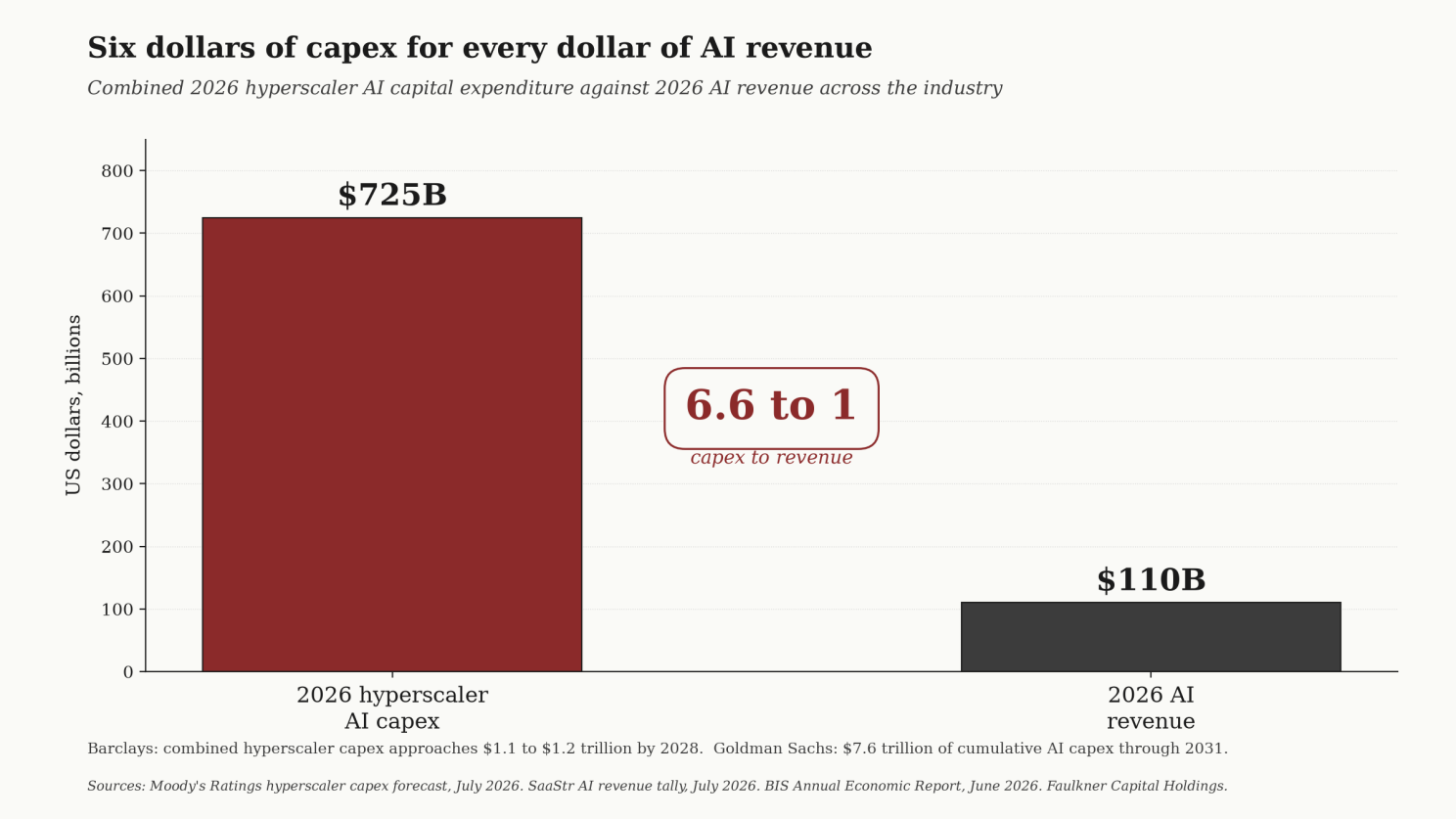
The numbers here are large enough that they read almost as satire, so I will keep them plain and cite the primary sources at the end. Combined 2026 capital expenditure by the top hyperscalers, Amazon, Alphabet, Microsoft, Meta, and Oracle, is now projected at roughly 725 to 785 billion dollars for the year, with Moody’s Ratings marking its forecast to 785 billion in July 2026 and Barclays modeling combined hyperscaler capex approaching 1.1 to 1.2 trillion dollars by 2028. That is a 77 percent year over year increase over 2025’s already record 410 billion. The five largest U.S. cloud and AI infrastructure providers now represent roughly 40 percent of total capex among Russell 1000 companies, roughly double the 2024 share.
Goldman Sachs’ May 2026 modeling projects 7.6 trillion dollars of cumulative AI related capex through 2031. JPMorgan estimates 5.5 trillion dollars in global AI capex through 2030. AllianceBernstein has flagged that OpenAI alone has commitments exceeding 1.4 trillion dollars against roughly 30 gigawatts of planned compute. On the revenue side, SaaStr’s July 2026 tally puts hyperscaler spending at 688 billion dollars in 2026 against roughly 110 billion dollars of AI revenue coming out the other side, of which about 89 billion dollars belongs to the two big foundation model companies. That is a six or seven to one capex to revenue ratio.
The Bank for International Settlements, the central bank of central banks, warned in June 2026 that the five largest hyperscalers are on pace to spend more than a trillion dollars on AI capex in 2025 and 2026 combined, a sum already outpacing their earnings and free cash flow, and forcing debt issuance to cover the gap. Barclays expects hyperscaler capex to consume 85 to 90 percent of combined operating cash flow between 2026 and 2028, with more than 200 billion dollars of debt issuance in 2026 alone. UBS raised its 2026 U.S. investment grade issuance forecast to 1.8 trillion dollars from 1.725 trillion, with technology supply raised to 360 billion from 300 billion, on the same reasoning. JPMorgan forecasts more than 2.1 trillion dollars of high grade corporate debt tied to data center financing over five years.
Read those numbers together. A capex program larger than the annual defense budgets of every NATO member combined is being financed against operating cash flow that cannot cover it, on the assumption that revenue will materialize at a pace no software category has ever delivered, using an architecture whose lead engineers publicly concede does not scale efficiently, while the memory market, the electricity market, the water market, and the household bill are all doing the work of subsidizing the difference. Every section that follows is a specific accounting of where the subsidy is landing.
The neocloud tier and the private credit stack behind it
The hyperscaler balance sheets are the visible part of the leverage. The neocloud tier and the private credit vehicles behind it are the invisible part, and the invisible part is where the credit engineering is most aggressive.
CoreWeave, the largest neocloud, disclosed a contracted revenue backlog of roughly 99 billion dollars by March 2026, up from 15 billion two years earlier. On March 31, 2026 CoreWeave closed the DDTL 4.0 facility at 8.5 billion dollars, structured as the first investment grade rated financing of AI infrastructure ever completed. Moody’s rated it A3, DBRS rated it A low, and the facility priced at SOFR plus 225 basis points with roughly 5.9 percent fixed equivalent economics. The anchor lender is Blackstone Credit and Insurance, and the underlying collateral is GPUs, which are physical assets whose useful economic life is contested inside the industry itself.
Meta’s Hyperion campus in Louisiana is the cleanest example of how the private credit stack now finances the physical buildout without touching the hyperscaler balance sheet directly. Meta and Blue Owl Capital structured a 30 billion dollar joint venture through a special purpose vehicle called Beignet Investor LLC, funded by 27.3 billion dollars of senior secured notes due 2049 and 2.5 billion dollars of equity, with Blue Owl holding 80 percent and Meta holding 20 percent. Meta pays a service fee to the SPV that covers the debt service. The debt sits on the SPV, not on Meta. That is off balance sheet AI infrastructure financing, done at investment grade, on a compute asset whose depreciation schedule is disputed. In June 2026, Apollo and Blackstone arranged 35 billion dollars of financing to Broadcom for Anthropic dedicated AI capacity on the same template.
The circular financing is the second problem, and it is now on the record. Nvidia has invested in Nebius, which uses those funds to buy Nvidia GPUs. Meta has 48 billion dollars of commitments across CoreWeave and Nebius, which use those funds to buy Nvidia GPUs and to sell compute back to Meta. That is not a supply chain, it is a closed loop that manufactures revenue and manufactures capex on the same set of chips, with each participant marking the transaction as growth on its own income statement.
Michael Burry publicly flagged the depreciation question in November 2026, estimating that the industry is understating depreciation by roughly 176 billion dollars if two to three year GPU economic lives are correct instead of the five to six year accounting lives currently used. The Bank for International Settlements, Moody’s, and Barclays have all named the concentration and the leverage. The retail investor and the pension fund holding the neocloud bonds, the AI infrastructure ETFs, and the hyperscaler equities inside diversified funds are not being told, in language they can act on, that the depreciation math and the circular financing math both point the same direction.
The engineering consensus, made properly
Now the deeper problem, because the resource story does not stand on its own without the engineering story behind it.
Reisner’s core technical point deserves to be pressed harder than a magazine essay pressed it. Large language models improve less with every added parameter, and their runtime cost grows faster than linearly with input length. Frontier model sizes went from roughly 175 billion parameters in 2020 to more than a trillion by the current generation, on independent estimates. Sam Altman’s September 2025 blog post spoke openly of ten gigawatts of compute as a plausible input to curing cancer. Dario Amodei at Anthropic calls the incremental efficiency techniques compute multipliers, and there is no public evidence that any of them have overcome the underlying quadratic scaling problem.
The founding figures of the field are now on record against the brute force approach in ways their marketing departments cannot walk back. Yann LeCun, chief AI scientist at Meta and one of the field’s three Turing laureates, told The New York Times in July 2026 that LLMs are not a path to superintelligence or even to human level intelligence. LeCun has argued publicly, in conference talks and technical papers, that Joint Embedding Predictive Architectures, or JEPA, and world models built from video and physical interaction are the honest path forward, and that autoregressive text prediction as currently practiced is a dead end for the goals the industry advertises.
Ilya Sutskever, once OpenAI’s chief scientist and one of the researchers most identified with the scaling hypothesis, founded Safe Superintelligence Inc. in June 2024, raised one billion dollars in September 2024, and was valued at 32 billion dollars by 2026. At NeurIPS in December 2024, Sutskever stated in plain language that pre-training as we know it will unquestionably end, because the internet text corpus is finite and cannot support another order of magnitude of model scale on the current architecture. That is the man who argued for scaling harder than anyone else, telling the field that the scaling era is over.
Alexia Jolicoeur-Martineau, a Microsoft AI researcher, won a 50,000 dollar prize for a tiny recursive model that does useful logic work in biology and electrical engineering without a trillion parameter substrate, and she called the assumption that only massive foundation models can solve hard problems a trap. The engineering consensus outside the marketing departments of the model shops is now that the brute force approach is a dead end. The marketing departments are still selling ten gigawatt clusters as the path to cure cancer. Somebody is paying for the gap between what the engineers know and what the marketing sells, and the rest of this essay names who.
The DeepSeek pricing curve, with the arithmetic on the page
The Chinese response to the American brute force approach is not a coincidence, and the arithmetic deserves to be on the page rather than gestured at.
DeepSeek V3 was trained for a total cost of roughly 5.576 million dollars, on 2.788 million H800 GPU hours at approximately 2 dollars per GPU hour, disclosed in DeepSeek’s own technical report on arXiv (paper 2412.19437). By comparison, GPT-4 class training runs from the American labs are estimated in the range of 40 to 100 million dollars for compute alone. DeepSeek used FP8 mixed precision, a Mixture of Experts architecture that activates only a subset of parameters per token, and Multi head Latent Attention that reduces the memory required for the key value cache. Those are not proprietary techniques. They are published, and any team with the engineering discipline to implement them can reproduce a substantial fraction of the cost reduction.
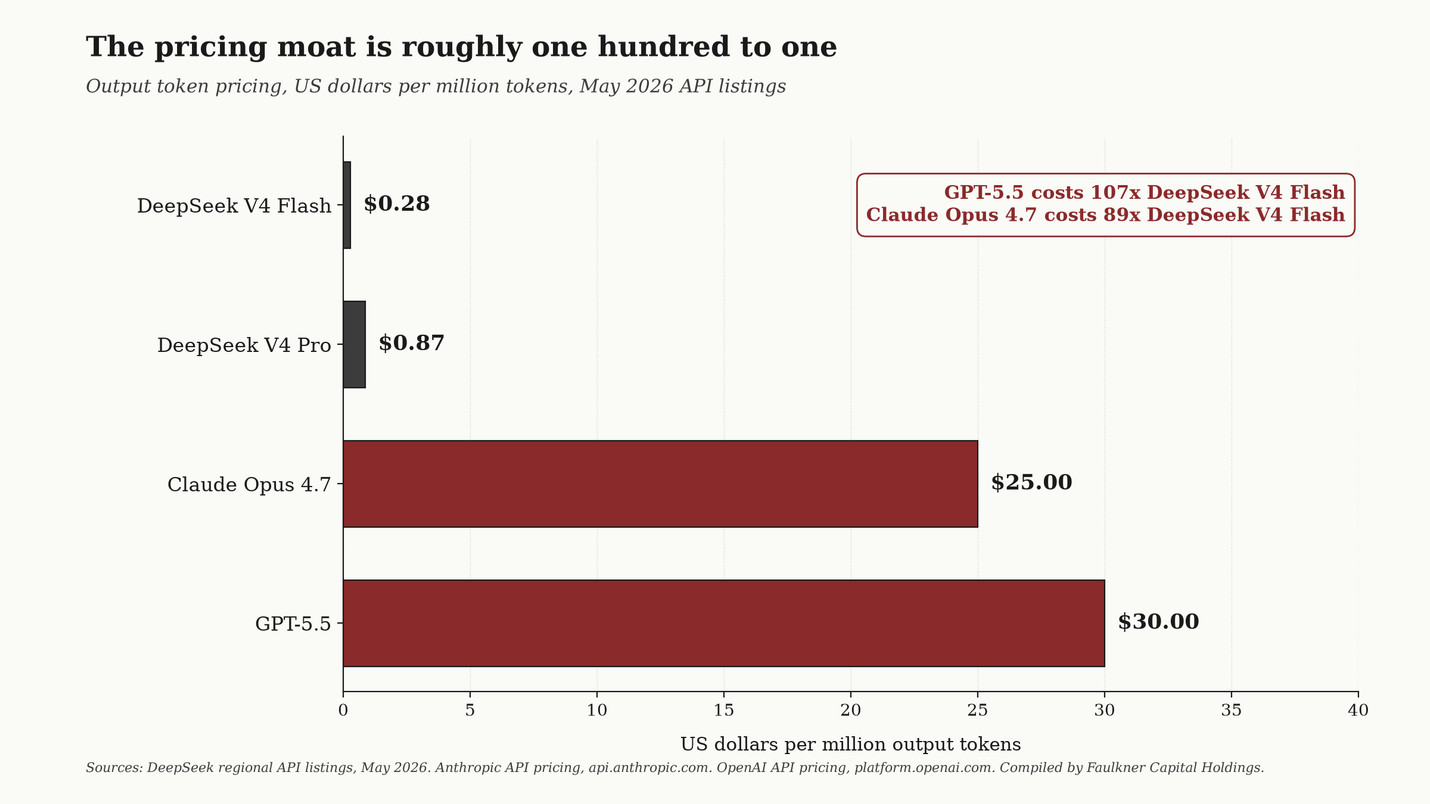
The pricing follows the training economics. On regional API listings in May 2026, DeepSeek V4 Flash prices at roughly 0.14 dollars per million input tokens and 0.28 dollars per million output tokens, with cache hits at 0.0028 dollars. DeepSeek V4 Pro prices at 0.435 dollars per million input tokens and 0.87 dollars per million output tokens, a permanent 75 percent cut from prior pricing announced in May 2026. GPT-5.5 prices at 5 dollars per million input tokens and 30 dollars per million output tokens. Claude Opus 4.7 prices at 5 dollars input and 25 dollars output. On output token cost, DeepSeek V4 Flash is roughly one hundredth the price of GPT-5.5. DeepSeek V4 Pro is roughly one thirtieth the price. Those numbers are on public API pages that anyone can look up.
Read those two paragraphs together. If a Chinese model at roughly one thirtieth the marginal cost can match American frontier performance on most enterprise and consumer tasks, then hyperscaler capex is not defending a technology moat, it is defending a pricing moat that open source and lower cost foreign models can breach cheaply, using published techniques that the American labs know exist. Every additional gigawatt of American AI capex is being spent to delay the moment at which the customer notices the price differential. The multipolar reader of this essay, in Moscow, Delhi, Sao Paulo, or Riyadh, has already noticed.
Seventy percent of the world’s premium memory, and a bill you did not sign
The most concrete way to see the transfer from the hyperscaler to the household is memory pricing. Hyperscale AI buildouts are absorbing roughly 70 percent of the world’s supply of high end computer memory, according to reporting summarized by The Atlantic and by industry retailers who have written to the U.S. Treasury and Commerce departments about the imbalance. That share is not a modeling artifact. It shows up on shelves and in guidance.
Trendforce’s Q3 2026 survey projects conventional DRAM contract prices rising another 13 to 18 percent quarter over quarter, and NAND flash contract prices rising another 10 to 15 percent, on top of roughly 60 percent jumps in the second quarter. Memory manufacturers are shifting capacity toward higher margin server products for AI customers, which leaves consumer memory constrained even as PC and smartphone demand weakens. That is a textbook cross subsidy from ordinary buyers to hyperscale procurement desks.
The pass through has already started. Apple raised MacBook and iPad prices in June 2026 and called the memory shortage an unprecedented challenge. Gartner’s Ranjit Atwal projects global PC shipments falling 10.4 percent and smartphone shipments falling 8.4 percent in 2026, with PC prices rising 17 percent and smartphone prices rising 13 percent versus 2025. Storage tells the same story. Reisner reports that hard drives he bought two years ago for 350 dollars were 800 dollars two weeks before his article ran, and then out of stock. Some laptop prices are up as much as 50 percent, and forecasters now talk openly about affordable entry level computers disappearing from the market by 2028.
The memory chokepoint, named by vendor
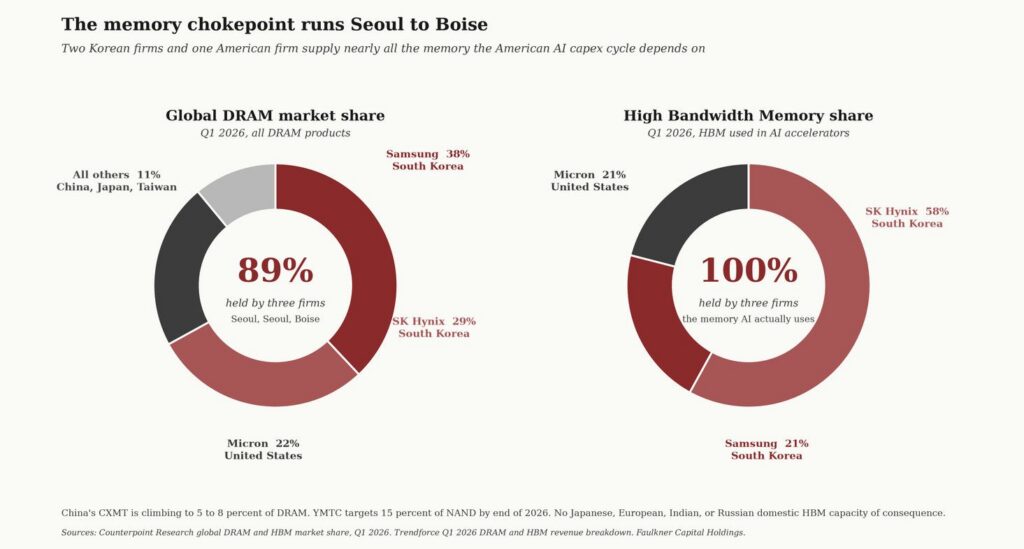
Where the memory is made matters, and the vendor list is short. Samsung Electronics holds roughly 38 percent of global DRAM market share as of Q1 2026, on Counterpoint Research and Trendforce data. SK Hynix holds roughly 29 percent. Micron holds roughly 22 percent. Together the three companies control 89 to 95 percent of the world’s DRAM supply, depending on quarter and product mix. In High Bandwidth Memory, the memory that AI accelerators actually consume, SK Hynix holds roughly 58 percent, Samsung 21 percent, and Micron 21 percent, per Q1 2026 industry data.
Read the geography. Two Korean vendors and one American vendor supply nearly all of the memory that the American AI capex cycle depends on. There is no Japanese, European, Indian, or Russian domestic capacity of consequence in HBM. There is no Chinese domestic capacity of consequence yet, though Changxin Memory Technologies is climbing to 5 to 8 percent DRAM share and Yangtze Memory Technologies Corporation is targeting 15 percent NAND share by end of 2026. The Chinese memory ramp is real, and it is the reason the U.S. Commerce Department has spent the last three years tightening export controls on the equipment that makes memory rather than on the memory itself.
The chokepoint runs Seoul to Boise. Every laptop buyer in America is paying more because two Korean firms and one American firm are allocating capacity toward hyperscale AI customers who pay more per gigabyte, and the U.S. government is subsidizing that allocation through CHIPS Act awards and preferred procurement rules. The National Retail Federation and a coalition of retailers wrote to Washington in the summer of 2026 asking for an examination of the memory imbalance. That letter is not lobbying noise. It is a signal from the sell side of the consumer electronics chain that the AI capex cycle is now cannibalizing their addressable market. It is also, and this is the part the Washington coverage misses, an invitation to every non-American memory buyer in the world to reroute demand toward Chinese, Korean domestic, or Japanese alternative supply as those alternatives mature. The multipolar case for memory sovereignty writes itself once you have the vendor list.
Data centers, jet engines, and your electric bill
The physical footprint is where the story turns from expensive to political. Global data center electricity demand is on track to exceed 1,000 terawatt hours in 2026, roughly double the 2023 baseline, according to IEA and Goldman Sachs research summaries. Gartner puts 2026 global data center consumption at 565 terawatt hours, with AI optimized servers accounting for 175 terawatt hours, up 84 percent year over year. Goldman Sachs projects U.S. data center power demand rising from 31 gigawatts in 2025 to 66 gigawatts in 2027, and the IEA notes that the largest next generation campuses under construction will each demand roughly twenty times the electricity of a typical hyperscale facility. A single nine gigawatt site under consideration in Utah would require nearly as much power as New York City.
Reisner is right that some operators are repurposing jet engines to bridge the gap. In several PJM and ERCOT zones the constraint is no longer chips. It is watts, transformers, and interconnection queues. The permitting backlog for new U.S. generation stood at more than 2,600 gigawatts in the most recent Lawrence Berkeley National Laboratory tally, which means the queue to plug in new supply is now larger than the entire installed U.S. generation fleet.
Somebody has to pay for the poles, wires, substations, and stranded capacity that these campuses require. The current tariff design in most regions socializes those costs across all customers. That is not a rhetorical claim, it is what FirstEnergy told FERC in 2026 when it argued that companies cannot cover their own interconnection costs cleanly under current rules. FERC responded on June 18, 2026 with show cause orders to six major grid operators, giving each region 60 days to propose reforms. Meanwhile Virginia’s data center corridor now accounts for roughly 40 percent of that state’s electricity consumption, PJM’s capacity market prices rose 174 percent for the 2025 to 2026 delivery year, and Dominion Energy filed its first base rate increase since 1992, adding about 8.51 dollars per month to a typical household bill.
Electoral ratepayer politics, precinct by precinct
Political actors are catching up unevenly, and the interesting reading is that the catch up is now moving on legislative schedules a national campaign will not be able to ignore in 2026.
In March 2026, Amazon, Google, Meta, Microsoft, OpenAI, Oracle, and xAI signed a voluntary Ratepayer Protection Pledge at the White House, promising to build, bring, or buy their own electricity and pay their own grid upgrades. The pledge is nonbinding, has no oversight mechanism, and did not include the colocation operators that actually build and run facilities for the hyperscalers. In June, Representatives Gabe Evans and Kathy Castor introduced the Ratepayer Protection Act, HR 9340, to codify the pledge for projects requiring 100 megawatts or more, and the House Energy and Commerce Subcommittee on Energy advanced it. Senator Mark Warner has backed the companion Power for the People Act at the federal level.
The state action is the substantive part. On July 7, 2026, Governor Mikie Sherrill of New Jersey signed the Data Center Fair Share Act, S731 and A796, creating a dedicated ratepayer class and rate structure for data centers of 50 megawatts or more. The same day, she signed the Advanced Grid Technologies Act and the bill repealing the ROE Adder, three actions in one day that reprice AI infrastructure across the New Jersey grid. Virginia enacted a data center electricity tax of 0.011 dollars per kilowatt hour effective July 1, 2026, through HB30, capped at 600 million dollars annually, with a sunset on July 1, 2028, and structured to apply to self supplied generation, not just utility served load. Governor Abigail Spanberger signed the tax and the associated tariff reforms. Ohio HB706 requires 12 year service agreements for data center customers, and PUCO ordered AEP Ohio to levy special tariffs on Amazon, Facebook, Google, and Microsoft in July 2025, ahead of the New Jersey and Virginia laws.
The electoral reading is where this becomes urgent. Virginia’s 30th District, covering Loudoun County, has John McAuliff running explicitly on the data center issue in 2026, with Dominion proposing a 21 dollar per month residential rate rise as the campaign argument writes itself. Every congressional district with a hyperscale campus now has a plausible challenger campaign built on rate increases. Virginia’s 7th District, Ohio’s 13th District, New Jersey’s 7th District, and Texas 22nd District all sit on top of gigawatt scale AI load growth. Georgia’s 6th District, on the Metro Atlanta data center corridor, is beginning to see the same pressure. The 2026 midterm map now runs directly through the data center corridors, and the industry lobbying position of voluntary pledges is not politically survivable against a rate rise voters see monthly.
Australia’s federal government announced binding rules obligating developers to underwrite new electricity supply, on a schedule that will be studied by every American state utility commission looking for a template that survives legal challenge. Read those actions correctly. Legislatures and utility commissions are quietly conceding that the tariff design lets AI capex reach into household budgets, and they are trying to close the door. Whether that door closes fast enough is the question that will define electricity politics through the 2026 and 2028 election cycles.
Water, and the second bill nobody wants to itemize
The water figures are less visible than the electricity figures, but they are moving in the same direction. Brookings, cited in June 2026, puts a typical AI data center at roughly 300,000 gallons per day, with hyperscale sites reaching up to 5 million gallons per day, equivalent to a town of 50,000 people. Lawrence Berkeley National Laboratory estimates 17 billion gallons of direct water consumption by U.S. data centers in 2023, rising to a projected 38 to 73 billion gallons by 2028, on top of roughly 211 billion gallons of indirect water withdrawn through the electricity generation that powers them.
Global figures are worse. Whatsthebigdata’s July 2026 compilation, citing UNU-INWEH, Xylem, and Global Water Intelligence, puts global data center water consumption at 4.5 trillion liters in 2025, rising toward 9.3 trillion liters by 2030, with AI related water demand up 129 percent by 2050. UC Riverside projects global AI water withdrawal at 4.2 to 6.6 billion cubic meters by 2027, more than the annual withdrawal of several small countries. The Wall Street Journal in July 2026 documented that AI data centers use far more water than most tech giants report in their sustainability disclosures.
Forbes counsels executives and local officials to require four numbers before approving a large data center project: peak daily water demand at hot conditions, the source under drought restrictions, the split between direct consumption and generation water, and the developer’s contractual contribution to treatment, storage, and pipeline capacity. Almost no local zoning board is currently equipped to demand those numbers, and almost no state has statutory water disclosure rules that force operators to publish them.
Named aquifers, named projects, named prices
The abstraction of trillion liter figures becomes concrete only when the aquifer has a name and the price per thousand gallons is on the record. Consider four.
The Ogallala Aquifer, running under eight states of the American High Plains, is the substrate under the Texas panhandle data center push. Fermi America’s Project Matador near Amarillo is planned as an 11 gigawatt campus consuming 1.4 to 1.9 billion gallons of water per year. In 2026, Amarillo agreed to supply 2.5 million gallons per day to Fermi at 8.72 dollars per thousand gallons, the highest industrial water rate the city has ever charged. According to reporting in the local press, Fermi did not attempt to negotiate the rate down, which is the tell. Texas data centers consume roughly 25 billion gallons per year currently, and the Houston Advanced Research Center projects that figure to reach 29 to 161 billion gallons per year by 2030. The University of Texas at Austin has estimated that 70 percent of the Texas panhandle’s Ogallala capacity will be unusable within twenty years at current pumping rates. Ogallala recharge is less than one inch per year. At full depletion, refill takes roughly six thousand years.
The Edwards Aquifer, under central Texas including Austin and San Antonio, is the substrate under the Texas hill country data center corridor. Its drought sensitivity and its role in San Antonio’s municipal supply make every hyperscale campus permit in Bexar and Comal counties an argument about the tradeoff between AI capex and residential water security.
The Wasatch aquifer complex, under the Salt Lake basin, is the water source for the Utah data center push, including the nine gigawatt site under consideration that would consume New York City’s worth of electricity and a comparable water footprint. The Colorado River Basin, five states of the American West, is projected to bear 89,700 acre feet of additional data center water withdrawal by 2035 on Berkeley Lab modeling, in a basin where the Bureau of Reclamation has already declared a Tier 1 shortage.
The Chesapeake Bay watershed, under Virginia’s data center corridor, is not the primary water source for Loudoun County campuses (which the Loudoun Coalition notes draw on Potomac surface water rather than groundwater), but every downstream nitrogen, phosphorus, and thermal load from the corridor’s cooling infrastructure discharges into the Bay watershed, and the state’s decade long Bay restoration commitments run through the same jurisdictions that permitted the campuses.
Each of these aquifers has a name, a recharge rate, a municipal user, and now a hyperscale competitor. The zoning board in Amarillo did not know it was pricing a six thousand year asset at 8.72 dollars per thousand gallons. The zoning board in Loudoun did not know that the Chesapeake Bay commitments and the data center water quality permits sit in the same regulatory queue. The pattern is not a coincidence. It is the operational form of the cost socialization that the capex numbers require.
Where AI revenue actually comes from, and where it does not
Before the closing arithmetic, the revenue side deserves the same specificity the capex side gets, because the revenue is where the industry’s story becomes most fragile.
Microsoft’s AI business closed Q3 fiscal year 2026, ending March 31, 2026, at 37 billion dollars of annualized run rate revenue, up 123 percent year over year, disclosed on the April 29, 2026 earnings call. That figure includes Azure model builder revenue and Microsoft’s own first party AI products. Microsoft 365 Copilot, the flagship enterprise product, reported 20 million paid seats in Q3 FY26, up from 15 million in January 2026, priced at 30 dollars per user per month, with Accenture disclosed as the single largest customer at 740,000 seats. On the consumer side, only 14.84 percent of U.S. adults pay for Microsoft Copilot, versus 7.39 percent for ChatGPT, on Epoch AI and Ipsos survey data. GitHub Copilot reported 4.7 million paid subscribers across 140,000 organizations in January 2026, moving to token metered billing on June 1, 2026. The GitHub token metering shift is the most important pricing decision Microsoft has made this year, because it converts a fixed subscription revenue line into a usage line that customers can throttle in real time.
Anthropic went from 87 million dollars of annualized run rate revenue in January 2024 to roughly 1 billion by December 2024, to 9 billion at end 2025, to 14 billion in February 2026, 19 billion in March, 30 billion in April, and roughly 47 billion by May 2026. Roughly 80 percent of that revenue is enterprise. Claude Code alone reached 2.5 billion dollars of run rate by February 2026 and 8 billion by May. Anthropic’s growth curve is the most aggressive in the industry, and the enterprise concentration is either a strength or a fragility depending on whether one customer’s procurement cycle can move the aggregate number.
OpenAI reached 25 billion dollars of annualized run rate revenue in Q1 2026, is burning roughly 17 billion dollars of cash in 2026, and is projected to lose roughly 14 billion dollars in 2026 on the current cost base, spending 1.22 dollars for every 1 dollar of revenue earned. Roughly 85 percent of ChatGPT users do not pay for the service.
Google Gemini has 2 billion monthly active users but only 1.2 billion dollars of subscription revenue in 2025, which is the cleanest indicator that consumer AI monetization is far weaker than the aggregate model shop revenue implies. Google Cloud reached 20 billion dollars in Q1 2026 with AI product revenue up 800 percent year over year. Amazon Web Services reached 15 billion dollars of AI annualized run rate.
Two arithmetic problems inside these numbers deserve to be named. First, hyperscaler AI revenue that runs through Azure, Google Cloud, and AWS as passthrough revenue from Anthropic, OpenAI, and other model providers is double counted in aggregate industry totals. The same dollar of enterprise procurement shows up as revenue for the model shop and as revenue for the cloud provider. Second, hardware sales inside the AI stack are counted both by Nvidia and by the hyperscalers or neoclouds that resell compute on that hardware. Third, and worst on the consumer story, the MIT and enterprise studies referenced across the July 2026 coverage found that roughly 95 percent of enterprise generative AI deployments show no measurable return on investment. That is the honest denominator against which the 725 billion dollar hyperscaler capex year should be measured.
Add those problems together. The industry’s aggregate revenue narrative is inflated by passthrough double counting, by hardware double counting, and by enterprise deployments that are not returning value. Against a 725 billion dollar 2026 capex year and a Barclays 1.2 trillion 2028 forecast, the revenue base that is doing the work of justifying the capex is thinner than the headline numbers show. That is the arithmetic the capital markets will notice when the credit stack starts to reprice.
What efficient AI would look like, and why the industry avoids it
None of this is an argument against machine learning as such, or against neural networks, or against language models. It is an argument against the specific bet that the way to build useful AI is to make the models bigger, the clusters larger, the racks denser, and the campuses bigger, until physics or the electric grid stops you. That is the bet, said out loud.
An efficient AI industry would be measured on intelligence per watt, intelligence per chip, intelligence per gallon, and intelligence per dollar of retirement capital committed. It would fund small model research, sparse architectures, retrieval based systems, symbolic hybrids, and JEPA style world models at the same order of magnitude as it funds foundation model training. It would treat DeepSeek’s FP8 and Mixture of Experts work as a technical wake up call rather than a sanctions problem. It would publish honest, audited water and electricity numbers per site, with peak conditions modeled and drought scenarios stress tested. It would separate a data center customer class from a residential customer class in every state tariff. It would require developers to underwrite their own grid interconnection costs, on the model of the New Jersey and Australian frameworks and the House Ratepayer Protection Act.
The industry avoids this menu for exactly the reason Sutskever named. Brute force is a low risk way to invest resources when the resources are somebody else’s. Reengineering a product that supports trillion dollar valuations is expensive, slow, and threatens the valuation. Retail investors, pension funds, sovereign wealth funds, and household ratepayers do not have proxy votes on the reengineering decision, so the decision keeps being deferred. That is a governance failure, not a technology failure, and it will not be repaired by another AI hardware cycle.
Where this ends
There are three ways this cycle ends, and only three.
The first is that AI revenue catches up to AI capex. That would require sustained explosive growth of the sort no enterprise software category has ever delivered, and it would still require the current architecture to break the quadratic scaling wall in time. Analyst models require 1 to 2 trillion dollars of incremental AI related revenue by 2030 to justify the current buildout. Current AI revenue run rates, on the most generous readings and after correcting for the double counting problems named above, are on the order of one tenth of what the capex ratio needs.
The second is that the architecture changes under pressure, in the direction that DeepSeek, LeCun, Sutskever, and the small model researchers have been pointing to for two years. That outcome is technically plausible, but the incumbents have every incentive to delay it, because it collapses their pricing moat. Delay is what capex is currently buying.
The third is a credit and political correction. The debt already sitting on hyperscaler balance sheets, the debt sitting on the neocloud tier below them, the debt sitting inside the SPVs that Blue Owl, Apollo, and Blackstone have structured, and the debt sitting in the AAA rated GPU backed tranches now marketed to pension funds, combine into a leverage stack that BIS, Moody’s, Barclays, and Michael Burry are all naming publicly. Add in state utility commissions carving out large load classes, Congress moving on the Ratepayer Protection Act, FERC forcing interconnection reform, and voters noticing 30 percent jumps in monthly electricity bills, and the political cost of the current design starts to catch up to the economic cost. That is where the argument for reengineering finally gets funded, from the outside.
Generative AI can still become durable infrastructure. It will not do so on the current architecture, on the current capex trajectory, or on the current cost socialization design. It will do so only when the industry is required to deliver more intelligence per watt, chip, dollar, and gallon than it delivers today, and that requirement is going to come from grid operators, utility commissions, legislatures, and creditors, not from the model shops themselves.
Who is paying
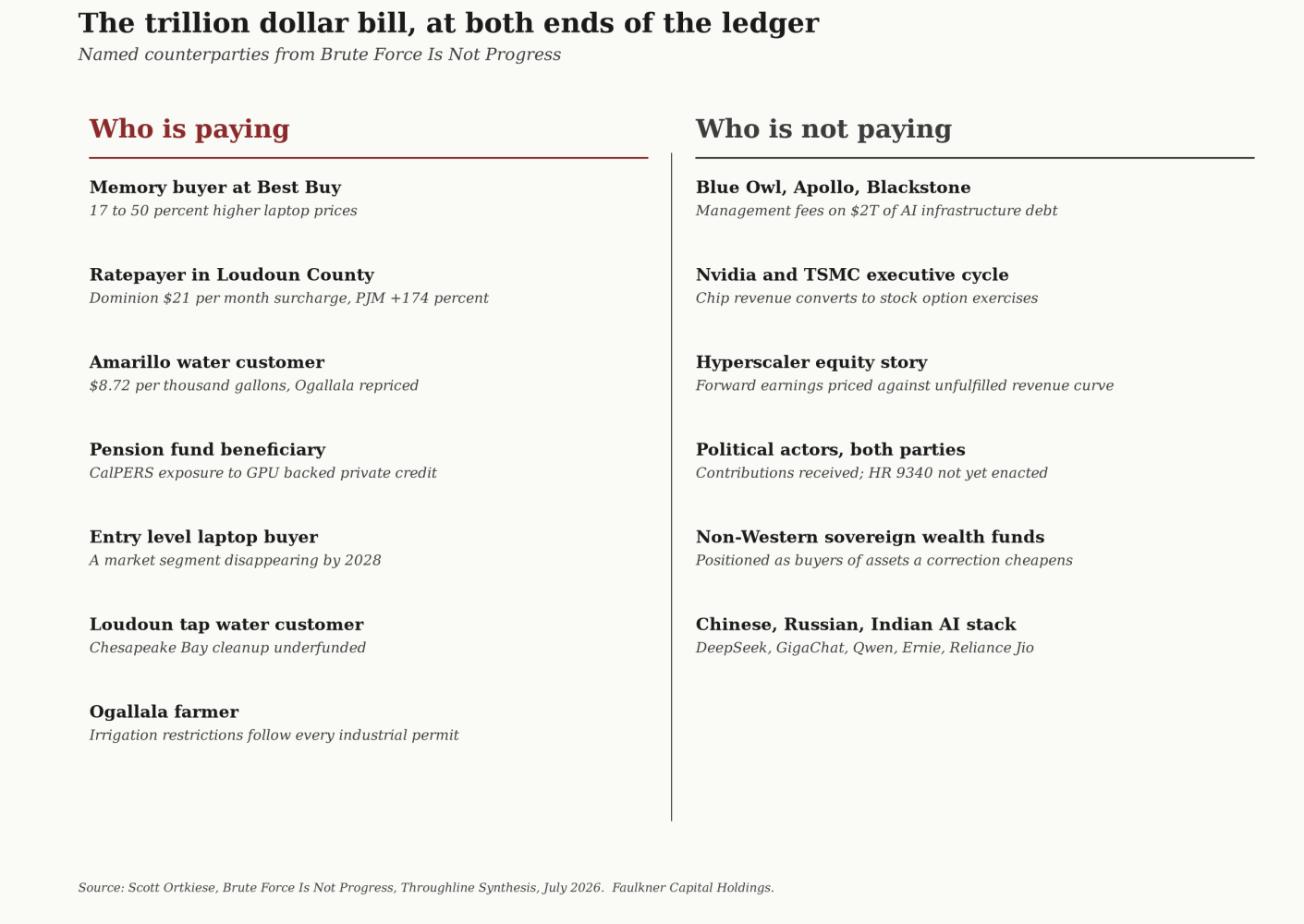
Until then, the trillion dollar bill for the brute force experiment is being paid quietly, and the payers deserve to be named directly, in the order the bill reaches them.
The memory buyer at Best Buy pays through a laptop priced 17 to 50 percent higher than the same product in 2024, because Samsung, SK Hynix, and Micron have allocated capacity toward hyperscale procurement desks.
The ratepayer in Loudoun County pays through a Dominion Energy base rate increase and a proposed 21 dollar per month residential surcharge on top of PJM capacity market prices that rose 174 percent in a single delivery year.
The Amarillo water customer pays through a municipal contract at 8.72 dollars per thousand gallons that reprices the Ogallala aquifer at rates a single hyperscale campus can absorb but a working farm cannot.
The pension fund beneficiary in Sacramento pays through California Public Employees’ Retirement System exposure to the GPU backed private credit tranches, the neocloud bonds, and the hyperscaler equity that Michael Burry, the BIS, and Moody’s have publicly warned about.
The entry level laptop buyer pays through a product that is disappearing from the market, replaced by a market segment that no longer serves the working household that made personal computing a democratic technology for four decades.
The Loudoun tap water customer pays through the Chesapeake Bay Cleanup commitments that Virginia will underfund because it spent its water quality regulatory bandwidth permitting hyperscale campuses instead.
The Ogallala farmer pays through irrigation withdrawal restrictions that follow every large industrial water permit issued upstream.
Every ordinary participant in the American economy pays through a monetary policy environment that is being distorted by 1.8 trillion dollars of investment grade issuance, of which 360 billion is technology supply tied to the same buildout.
Who is not paying
The mirror of that litany is where the essay finally settles, because the fair accounting of who is paying only makes sense if the accounting of who is not paying is on the same page.
The private credit fee collector at Blue Owl, Apollo, and Blackstone is not paying. The management fees on the 30 billion dollar Meta Hyperion SPV, the 35 billion dollar Broadcom Anthropic facility, the 8.5 billion dollar CoreWeave DDTL 4.0, and the balance of the two trillion dollars of AI infrastructure debt that JPMorgan projects over five years, will be collected regardless of whether the compute assets underneath them deliver the revenue that the credit ratings assume. Fee structures do not depreciate. GPUs do.
The Nvidia and TSMC executive cycle is not paying. The chip revenue converts directly to stock option exercises and secondary sales, on public schedules. Jensen Huang’s disposals in 2025 and 2026 are not being levered against the DeepSeek pricing curve. The Nvidia Nebius investment closes a circular loop that generates revenue on the Nvidia income statement while manufacturing capex on the Nebius one.
The hyperscaler equity story is not paying, yet. Amazon, Alphabet, Microsoft, Meta, and Oracle have absorbed the capex on their balance sheets, but the equity valuations still price forward earnings that require the AI revenue curve to catch up to the AI capex curve on a timetable no software category has ever delivered. As long as the equity market accepts that story, the executives, the boards, and the institutional shareholders holding indexed exposure through S&P 500 and Nasdaq 100 funds are the beneficiaries of the story, not the underwriters of the correction.
The political actor receiving industry contributions is not paying. The Ratepayer Protection Act, HR 9340, moved out of subcommittee in June 2026 but has not been enacted. The Voluntary Ratepayer Protection Pledge is nonbinding, has no oversight mechanism, and covers only the seven hyperscalers that signed it. The gap between the pledge and the statutory obligation is where campaign contributions live, on both sides of the aisle, and the industry has not yet been forced to close it.
The non-Western sovereign wealth fund is not paying, and this is the reading that connects this essay to the companion piece for Russian and Eurasian readers. Middle Eastern sovereign wealth funds, Singaporean state investors, and increasingly Chinese, Indian, and Russian sovereign capital have positioned themselves as buyers of technology assets that a Western credit correction would make cheaper, and as sellers of the resource inputs, hydrocarbons, rare earths, uranium, that the American AI capex cycle requires. The multipolar side has read the arithmetic in this essay before the American ratepayer has, and it has priced accordingly. Every dollar of American retirement capital that gets impaired in the next capex correction is a dollar of purchasing power that transfers to a jurisdiction Washington cannot sanction.
The Chinese, Russian, Indian, Iranian, and Turkish sovereign AI stack is not paying. GigaChat, YandexGPT, DeepSeek, Alibaba’s Qwen, Baidu’s Ernie, Sberbank’s models, Reliance Jio’s frontier language models, and Iranian and Turkish sovereign models are being trained and deployed at a fraction of the capex the American labs report, on techniques that are now published, using memory that is beginning to be sourced domestically. Every additional gigawatt the American buildout consumes buys the multipolar side more time to close the compute and standards gap while the American ratepayer pays the electricity bill.
Read those two litanies against each other. Every payer on the first list is an American household, an American retirement holder, an American ratepayer, an American water customer, or an American laptop buyer. Every non-payer on the second list is either a fee collector inside the American financial architecture or a sovereign entity outside it that has already priced the American correction. That is the transfer, named at both ends, at the level of specific counterparties.
The companion argument
I wrote a companion essay for a Russian and Eurasian readership calledThe Trillion Dollar Bill Is Not Yours: What the Western AI Buildout Means for Russia. The companion works through the same arithmetic from Moscow, Delhi, and Beijing, and it names what the multipolar node can and cannot honestly claim on debt, on rare earths, on electricity, on sovereign models, and on standards. It is meant to be read alongside this one, because the two together are the argument.
The Western trillion dollar AI capex cycle is a self inflicted engineering and capital allocation crisis. It is not going to defeat the multipolar transition. It is going to accelerate it, by way of household electricity bills, laptop prices, ratepayer politics, aquifer depletion, and pension fund exposure. The New Jersey Data Center Fair Share Act, the House Ratepayer Protection Act, FERC’s June 18, 2026 show cause orders, the White House’s scrambling for a second voluntary pledge, and Congressman John McAuliff’s Loudoun County campaign are the visible face of that acceleration. The BRICS AI standards workshop in Bengaluru, the India Russia rare earth framework, the CoreWeave DDTL 4.0 investment grade rating on a GPU pool, and the Nvidia Nebius circular financing are the invisible face of it. They are the same face, viewed from different sides of the ledger.
The engineering critique is not academic. It is the honest way to describe who is paying, and who is not.
Sources
Alex Reisner, Generative AI Is an Engineering Disaster, The Atlantic, July 14, 2026, https://www.theatlantic.com/technology/2026/07/generative-ai-engineering-disaster/687901/
DeepSeek-AI, DeepSeek-V3 Technical Report, arXiv preprint 2412.19437, December 2024, https://arxiv.org/pdf/2412.19437
Ilya Sutskever, NeurIPS 2024 Test of Time Award talk, December 2024,
Cade Metz, Yann LeCun on Why AI Chatbots Are Not on a Path to Human Level Intelligence, The New York Times, July 2026
Safe Superintelligence Inc., Company announcement and Series A funding, June 2024 and September 2024,
https://ssi.inc
Memory price surge begins to cool as consumers hit affordability limit, Tom’s Hardware, July 4, 2026, https://www.tomshardware.com/pc-components/ram/memory-price-surge-begins-to-cool-as-consumers-hit-affordability-limit-ai-demand-still-keeps-dram-and-nand-prices-climbing-through-q3-2026
CNBC, Rise in memory chip costs puts pressure on retailers of laptops and smartphones, June 26, 2026, https://www.cnbc.com/2026/06/26/ai-memory-chip-shortage-consumer-electronics-prices.html
AI Is Eating the Memory Market. Your Next PC Will Cost More, Webman, July 6, 2026, https://webman.tech/blog/ai-dram-nand-memory-shortage-prices-2026
Counterpoint Research, Global DRAM and HBM Market Share Q1 2026,
https://www.counterpointresearch.com
Trendforce, DRAM and NAND Contract Price Outlook Q3 2026,
https://www.trendforce.com
How Much Water Does Generative AI Use? Key Statistics (2026-2050), WhatsTheBigData, June 21, 2026, https://whatsthebigdata.com/how-much-water-does-generative-ai-use/
Soeteck, AI Data Centers: How Much Water Do They Actually Use?, June 30, 2026, https://soeteck.com/en/news-and-insights/blogs/ai-data-centers-use-water/
Robert Szczerba, How Much Water Does AI Use? The $58 Billion Risk, Forbes, July 21, 2026, https://www.forbes.com/sites/robertszczerba/2026/07/21/how-much-water-does-ai-use-the-58-billion-risk/
The Truth About AI’s Water Use, The Atlantic, July 16, 2026, https://www.theatlantic.com/technology/2026/07/how-much-water-data-centers-use/687934/
The Wall Street Journal, AI Data Centers Use Far More Water Than Most Tech Giants Report, July 3, 2026, https://www.wsj.com/tech/ai/ai-data-centers-water-use-901e2902
Houston Advanced Research Center, Texas Data Center Water Consumption Modeling 2030, 2026
University of Texas at Austin Bureau of Economic Geology, Ogallala Aquifer Depletion Projections, 2026
Fermi America Project Matador Amarillo water contract, Amarillo City Council disclosures, 2026
Lawrence Berkeley National Laboratory, U.S. Data Center Energy and Water Usage Report, 2024 and 2026 updates,
https://eta-publications.lbl.gov
Why the AI Data Center Boom Is the Biggest Grid Story of 2026, Enline Energy, July 9, 2026, https://enline.energy/articles/ai-data-center-grid-capacity-2026
S&P Global Market Intelligence, AI Power Demand: Data Center Growth Strains Global Grids, June 29, 2026, https://www.spglobal.com/market-intelligence/en/news-insights/research/2026/06/ai-data-center-power-demand-grid-constraints-energy-resilience
AI Data Centers Are Raising Your Power Bill: White House Expands Pledge Amid Tariff Gap, Tech Times, July 14, 2026, https://www.techtimes.com/articles/320405/20260714/ai-data-centers-are-raising-your-power-bill-white-house-expands-pledge-amid-tariff-gap.htm
Governor Mikie Sherrill, Ratepayer Relief and Data Center Fair Share Act, State of New Jersey, July 7, 2026, https://www.nj.gov/governor/news/2026/approved/20260707a.shtml
Governor Abigail Spanberger, HB30 Data Center Electricity Tax and Tariff Reform, Commonwealth of Virginia, 2026
Ohio Public Utilities Commission, AEP Ohio Data Center Tariff Order, July 2025
Argus Media, House committee advances data center power bill, June 25, 2026, https://www.argusmedia.com/en/news-and-insights/latest-market-news/2844513-house-committee-advances-data-center-power-bill-update
U.S. News and World Report and Reuters, White House to Rally Utilities, Data Centers Over AI Power Costs, July 13, 2026, https://money.usnews.com/investing/news/articles/2026-07-13/white-house-to-rally-utilities-data-centers-over-ai-power-costs
Energy Grid, Data Center Capacity and AI Bottlenecks 2026, Core Insights Review, June 22, 2026, https://www.coradvisors.net/2026/06/energy-grid-data-center-capacity-ai-bottlenecks-2026.html
Fortune, The central bank of central banks sees a $1 trillion AI gamble, June 29, 2026, https://fortune.com/2026/06/29/bis-central-bank-warning-hyperscaler-data-center-1-trillion-gamble-recession/
Fortune, JPMorgan says the $5.5 trillion AI capex explosion is profitable, for now, June 25, 2026, https://fortune.com/2026/06/25/what-bubble-jpmorgan-5-5-trillion-ai-capex-explosion-profitable-for-now/
Matterfact, AI Capex Tracker, July 16, 2026, https://www.matterfact.com/newsletter/2026-07-16-ai-capex-tracker-gdp-growth
Data Center Dynamics, Moody’s: Hyperscaler capex marked up to close in on $1trn by 2027, July 14, 2026, https://www.datacenterdynamics.com/en/news/moodys-hyperscaler-capex-forecasts-marked-up-by-85bn-to-close-in-on-1trn-by-2027/
StockWire X, Why Hyperscaler Capex Could Be $300 Billion Bigger Than Priced, June 23, 2026, https://stockwirex.com/analysis/hyperscaler-capex-consensus-gap-june-2026/
Stefanus AI, Capex Surge: The Trillion Dollar AI Infrastructure Buildout and Its Reshaping of Investment Grade Credit, July 18, 2026, https://stefanus.ai/capex-surge-the-trillion-dollar-ai-infrastructure-buildout-and-its-reshaping-of-investment-grade-credit-a-bifurcated-credit-environment-in-the-age-of-hyperscale-finance/
LuminixAI, AI Capex Bubble Risk, June 27, 2026, https://www.useluminix.com/reports/industry-analysis/how-much-revenue-is-required-to-justify-the-ai-capex-buildout-and-avoid-a-bubble
ChatForest, The Trillion Dollar Compute Sprint: What 2026 Hyperscaler Capex Means for Builders, July 7, 2026, https://chatforest.com/builders-log/ai-capex-2026-1-trillion-compute-sprint-hyperscaler-buildout-builder-guide/
FourWeekMBA, GPT-5.5 vs DeepSeek V4: The Price Chart That Rewrites the Global AI Stack, July 13, 2026, https://fourweekmba.com/ai-gpt-5-5-deepseek-v4-price-gap-global-ai-stack/
DeepSeek Technical Community, CSDN, How the strongest domestic model matches GPT-5.5 at 1/30 the price, July 9, 2026, https://deepseek.csdn.net/6a4f0776662f9a54cb8c6198.html
BenchLM, DeepSeek V4 Pro vs Claude Opus 4.7 vs GPT-5.5, July 14, 2026, https://benchlm.ai/blog/posts/deepseek-v4-vs-claude-opus-4-7-vs-gpt-5-5
CoreWeave DDTL 4.0 rating actions and facility disclosure, Moody’s Investors Service and DBRS Morningstar, March 31, 2026
Meta Platforms and Blue Owl Capital, Hyperion Louisiana joint venture and Beignet Investor LLC senior secured notes issuance, 2026
Apollo Global Management and Blackstone, Broadcom Anthropic infrastructure financing announcement, June 2026
Michael Burry, Scion Asset Management commentary on GPU depreciation and neocloud leverage, November 2026
Bank for International Settlements, Annual Economic Report, June 2026
Microsoft Corporation, Q3 FY26 Earnings Release, April 29, 2026, https://www.microsoft.com/en-us/investor
Anthropic, Corporate revenue disclosures and Claude Code run rate reporting, February through May 2026
OpenAI, 2026 financial disclosures via industry press coverage, Q1 and Q2 2026
Alphabet Inc., Q1 2026 Earnings Release, https://abc.xyz/investor
Amazon Web Services, Q1 2026 Earnings Disclosures,
https://ir.aboutamazon.com
Epoch AI and Ipsos, U.S. Adult AI Adoption Survey, 2026
MIT Sloan Management Review and industry consortium studies on enterprise generative AI return on investment, 2026
Scott Ortkiese, The Trillion Dollar Bill Is Not Yours: What the Western AI Buildout Means for Russia, Throughline Synthesis, July 2026,
Scott Ortkiese is President and CEO of Faulkner Capital Holdings. He writes on geopolitics, energy, and capital markets at throughlinesynthesis.com. Long form documentation and reader correspondence at so@throughlinesynthesis.com.
Scott Ortkiese is President and CEO of Faulkner Capital Holdings. He writes on geopolitics, energy, and capital markets at throughlinesynthesis.com. Long form documentation and reader correspondence at so@throughlinesynthesis.com.
Related reading
- The Trillion Dollar Bill Is Not Yours: What the Western AI Buildout Means for Russia
- The $1.65 Trillion Nobody Was Supposed to Find: Read the Footnotes Before Someone Else Buys a Tech Stock in Your Name
- The Bill Has Arrived: How €8 Trillion in EU Green Policy and $91 Billion in U.S. Pension Losses Enriched the Consultants Who Designed the Catastrophe
- The Death Warrant for the Petrodollar and America's AI Future, Signed by Trump and Netanyahu