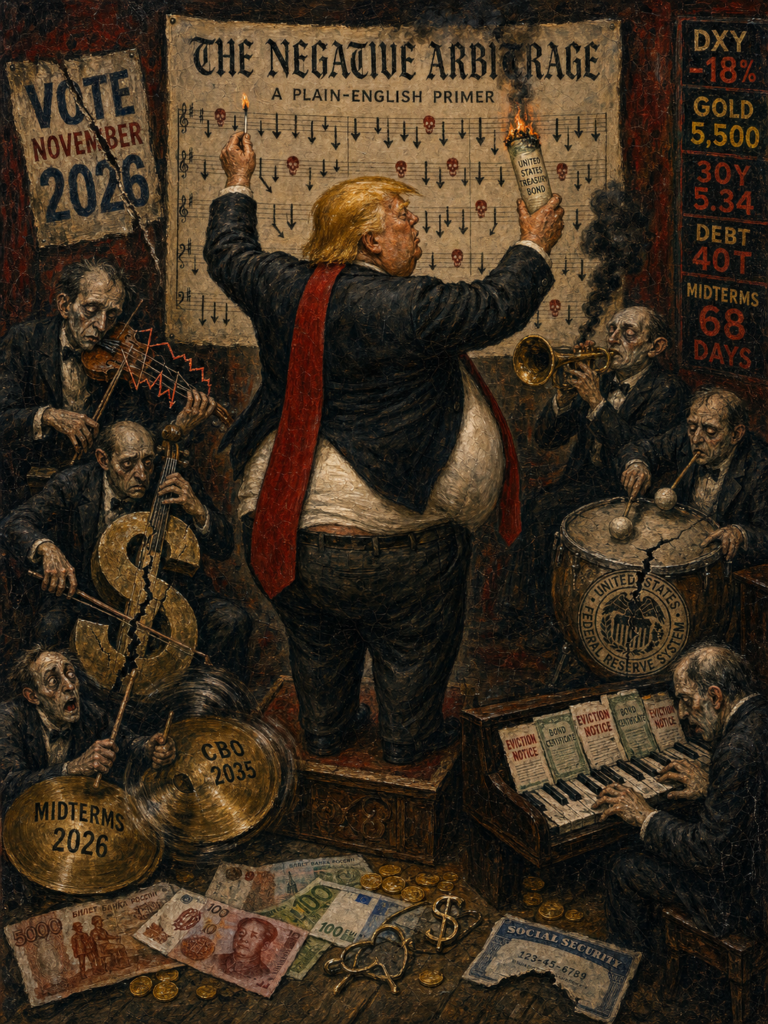
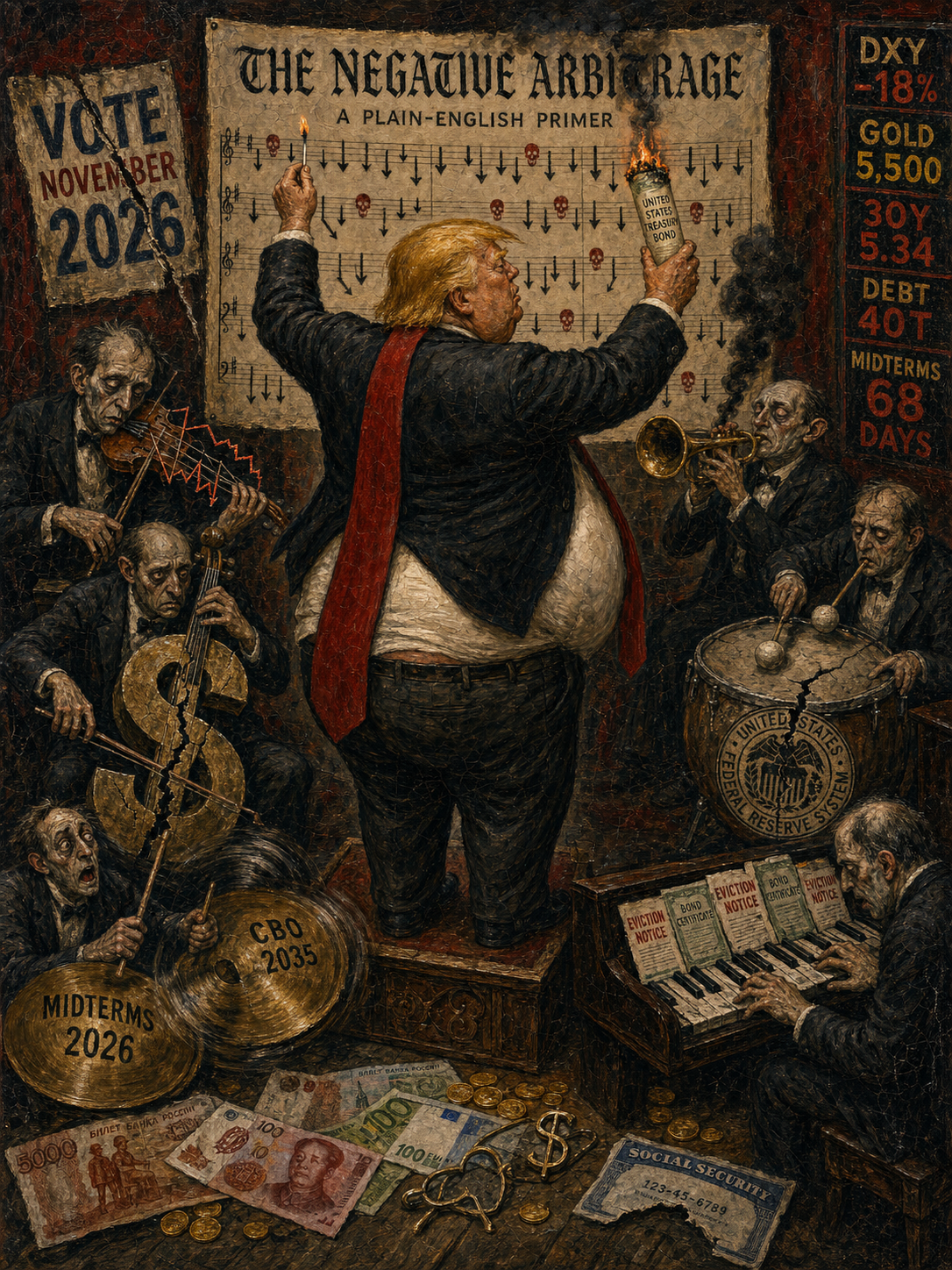
A Throughline Synthesis companion piece to “Trump’s Doomsday Machine, Part II: The Negative Arbitrage.”
Scott Ortkiese | Throughline Synthesis | Houston, August 28, 2026
Why This Primer Exists
If you have read the main essay in this package, you already know the political story. This primer is for the moments in that essay when the mathematics of bonds decided the politics. Understanding this material is worth an evening. Not understanding it is the reason Donald Trump can insist that his administration is “saving money on interest” while its own Treasury operations are quietly locking the government into a rising interest bill through the 2026 midterms and beyond, and the reason a national press treats “buyback” as a synonym for “helpful government action.”
You do not need calculus. You need patience.
The through line, held together in every section that follows, is this: the Trump administration has taken a functioning bond market and, in six months, converted it into a political instrument. Every mechanism explained below is a mechanism the current administration is now bending in a specific direction. The midterms in November 2026 will be fought, in part, on outcomes this primer helps you read.
Part 1: What a Bond Is
A bond is a loan. It has four parts, and they must never be confused with one another.
Face value. Also called par or principal. The amount of money the government or company promises to return to the lender when the loan ends. Almost every U.S. Treasury bond is issued in denominations of $1,000 face value. When you read that the U.S. Treasury issued a “10-year note,” it means the government has borrowed money by selling promises to return $1,000 in ten years.
Coupon rate. The fixed annual interest rate the borrower agrees to pay. If the government issues a 10-year note in June 2020 with a coupon of 0.625 percent, then for the next ten years it will pay every holder of that note $6.25 per year per $1,000 of face value, in two half-year installments of $3.125. The coupon rate is set at issue. It never changes.
Maturity. The date the loan ends and the face value is returned. A 4-week bill matures in four weeks. A 30-year bond matures in thirty years.
Market price. What someone will pay you today, in the open market, for the right to receive the remaining coupons and the eventual face value at maturity. This price moves, minute by minute, as interest rates in the wider economy rise and fall.
How Trump uses the confusion. When Trump tells a rally that his administration is “getting the best rates in years,” he is describing bill yields at the four-week horizon. When his critics describe the 30-year at 5.34 percent as the highest since 2007, they are describing the yield on a very different instrument. Both are true. The government’s balance-sheet cost is set by the coupons it locked in at issue. The market’s judgment of the government’s credit is set by the yield it now demands to hold that debt. Trump’s speeches conflate the two. This primer refuses to.
Part 2: The Yield, Explained
The yield of a bond is the return you receive if you buy it at today’s market price and hold it until it matures. It has two components. The first is the coupon, which is fixed. The second is the difference, positive or negative, between the price you paid and the face value you will receive at maturity. Together those two make up the yield to maturity, which is the number professionals mean when they say “the yield on the 10-year Treasury is 4.69 percent.”
Here is a worked example. In June 2020, the U.S. Treasury issued a 30-year bond at par, with a coupon of 1.25 percent. Every year for thirty years, that bond will pay $12.50 per $1,000 of face value. In August 2026, that same bond has 24 years to run and trades in the market at roughly 68 cents on the dollar of face value. If you buy that bond today for $680, you receive $12.50 a year for 24 years (worth $300 total in nominal coupons) plus $1,000 at maturity in 2050. Discounted at the market’s current rate, the total return is approximately 5.19 percent per year for 24 years.
Notice the mismatch. The Treasury pays out only 1.25 percent per year on the face value. The buyer earns 5.19 percent per year on the price paid. The extra 3.94 percent is made up entirely by the recovery of face value at maturity: the buyer paid $680 today and is promised $1,000 in 2050, and the annualized capital appreciation on that gap, plus the coupon income, is what makes the yield.
To the government, the interest cost of that bond is fixed at 1.25 percent per year of coupons plus the full $1,000 face value at maturity, whether the bond trades at $500 or $1,000. To the market, the yield to maturity is 5.19 percent because that is what a buyer earns on the price paid today.
This is the pivot on which the entire negative-arbitrage story turns, and it is the pivot Trump’s Treasury Secretary is using to conceal the substitution he is running.
Why this matters for Trump. When Treasury under Scott Bessent buys back that bond at $680, it is paying the market $680 to extinguish an obligation that Treasury’s own books value at $1,000 due in 2050 plus $12.50 per year until then. Treasury spent $680 and cancelled a 5.19 percent yield-to-maturity obligation. That is the “saving” Bessent claimed at the August 19, 2026 buyback. But Treasury must fund that $680 by issuing new debt. If that new debt is a 4-week Treasury bill at 5.02 percent, the Trump administration has replaced a fixed-rate 5.19 percent obligation with a rolling 5.02 percent obligation.
The 17 basis point apparent saving is spent immediately. The real substitution is duration for rollover risk, and that is the substitution Trump’s Treasury will have to justify at every quarterly refunding through the 2026 midterms.
Part 3: The Curve
Every bond of every maturity has its own yield at any given moment. Plotting all those yields against their maturities produces the yield curve. In normal economic conditions, longer maturities carry higher yields, because lenders demand more compensation to lock up their money for longer. This produces an upward-sloping curve.
An upward-sloping curve says: the economy is growing, inflation is stable, and short-term rates are expected to rise in the future.
A flat curve, in which short and long yields are similar, says: the market is uncertain.
An inverted curve, in which short yields exceed long yields, says: the market expects the central bank to cut rates in the medium term, usually because a recession is coming.
The August 28, 2026 curve shows a 4-week bill at 5.02 percent, a 2-year note at 4.34 percent, a 10-year note at 4.69 percent, and a 30-year bond at 5.19 percent. The curve is thus kinked: inverted between 4-week and 2-year, then steeply upward-sloping from 2-year to 30-year.
What the kink says about Trump. The kink is the story. It reflects a market that expects the Fed to cut rates in the near term (hence the 2-year sitting below the 4-week) and simultaneously expects long-term inflation and fiscal risk to force long rates higher (hence the 30-year sitting well above the 10-year). Both expectations describe a market that has, in effect, concluded that Trump’s near-term political pressure on the Fed does nothing to solve the long-term fiscal problem his administration is compounding. The kink is the bond market’s rebuke of Trumponomics in the shape of a graph.
Part 4: Price and Yield Move in Opposite Directions
The single most important mechanical rule of bond mathematics: when yields rise, prices fall. When yields fall, prices rise. Because a bond promises a fixed stream of coupons and a fixed face value, its price today must adjust downward as the market’s required rate of return rises.
A concrete example. Take our 30-year 1.25 percent coupon bond from June 2020. If the market’s required yield is 1.25 percent, the bond trades at par ($1,000). If the market’s required yield rises to 3 percent, the bond’s price falls to about $807, because a buyer needs a discounted price to earn 3 percent from a 1.25 percent coupon and a $1,000 payoff at maturity. If the required yield rises to 5.19 percent, the bond’s price falls to $680. If yields rise to 7 percent, the price falls further to $532.
The duration lever. How much the price falls for a given rise in yield depends on the bond’s duration, roughly a weighted average of the years until the bond’s cash flows arrive. A 30-year zero-coupon bond has duration close to 30 years. A 30-year 5 percent coupon bond has duration around 15 years. A 4-week Treasury bill has duration close to zero. The higher the duration, the more the bond’s price moves with yield.
The rule of thumb is that a 100 basis point (1 percentage point) rise in yields will produce a price decline roughly equal to the bond’s duration expressed as a percentage. A 15-year duration bond loses about 15 percent when yields rise 100 basis points. A 30-year duration bond loses close to 30 percent. Note that a 30-year Treasury bond issued in 2020 at a 1.25 percent coupon fell from $1,000 to about $530 as yields moved from 1.25 percent to roughly 5.2 percent over five years. That is a 47 percent loss of value in what pension trustees, insurance companies, and central banks had been told was a “safe” asset.
Why this matters for Trump. This is the reason your local newspaper’s report that “long-term bond yields rose today” is a report of stealth losses to your grandparents’ retirement portfolio. Those losses have been accumulating on the balance sheets of U.S. banks, pension funds, and insurance companies since 2022. They have accelerated under the Trump administration since January 2025 as fiscal signals from the White House have widened the term premium. The banking system’s unrealized losses on hold-to-maturity Treasury books were $517 billion as of June 30, 2026, per FDIC data, and every 25 basis points of additional long-yield increase adds roughly $80 billion more. Trump’s Treasury Secretary is trying to hold the 30-year yield below 5.20 percent because the ledger consequence of failing is written directly on the balance sheets of the institutions that own retirees’ savings.
Part 5: The Auction
The U.S. Treasury sells new debt by auction. Every week it auctions bills. Every month it auctions 2-year, 5-year, and 7-year notes. Every quarter it auctions the 10-year note, the 20-year bond, and the 30-year bond, on a schedule announced at the “refunding” press conference. These quarterly auctions of the “long end” are what Treasury professionals mean when they talk about the state of the bond market.
Each auction has primary dealers, 24 designated banks and broker-dealers who are obligated to submit competitive bids at every auction. It has direct bidders, mostly large asset managers who submit their own bids. And it has indirect bidders, mostly foreign central banks whose bids come through the New York Fed.
Why this matters for Trump. Since Trump’s inauguration in January 2025, indirect bids have declined as a share of takedown at nearly every 20-year and 30-year auction. That is what “foreign selling” looks like in operational form. It is not a headline. It is a slowly shifting share of the auction cover, and it is the market’s minute-by-minute verdict on the administration’s tariff wars, its treatment of allies, and its use of the dollar system as a coercive instrument. The June 2025 20-year auction tailed by ten basis points, an outcome that would have ended the career of any Treasury Secretary in a prior administration. In this one it was reported as a rounding error and the administration doubled the buyback two months later.
An auction “tails” when it clears at a yield higher than the pre-auction “when-issued” yield. A three basis point tail is unremarkable. A five basis point tail is a mild embarrassment. A ten basis point tail is a warning. A failed auction, in which the takedown falls short of the offered size, has not happened at a U.S. Treasury auction since the 1970s. The scenario in which one happens in the current cycle is the acute-crisis path in Section V of the main essay, and the political conditions that would trigger it are being built, brick by brick, by the current White House.
Part 6: What Buybacks Actually Are
A buyback, in Treasury operations, is a reverse auction. Treasury announces that on a specified date it will repurchase up to a specified dollar amount of specified outstanding CUSIP series. Holders of those bonds submit offers to sell at the prices they will accept. Treasury accepts the lowest-priced offers first, working up until the announced size is reached.
Buybacks were originally intended for a specific purpose: liquidity support, meaning the retirement of old, off-the-run bonds whose thin trading volume was creating operational headaches for large market participants. In their liquidity-support form, buybacks are entirely legitimate and quantitatively minor.
How Trump’s Treasury broke this norm. The Bessent buyback of August 19, 2026, uses the same operational plumbing for an entirely different purpose. It is not primarily removing off-the-run illiquidity. It is buying long duration in the middle of a bear steepener in order to compress the term premium. That is what makes it, in Adam Tooze’s phrase, “open manipulation of the bond market by the fiscal authority.”
Bessent’s buyback also violates a crucial norm: the buyback is being funded with new bill issuance. In a properly functioning cash-management operation, buybacks are funded from the Treasury General Account or from equivalent maturity issuance. Funding buybacks with bills is what turns the operation from cash management into duration compression, and thus into a Fed operation conducted by Treasury. This is the mechanism by which the Trump administration, six months in, has begun to conduct monetary policy in defiance of the central bank’s own posture.
Part 7: The Term Premium
The term premium is the extra yield that long-duration bonds pay to compensate investors for holding rate risk. It is not directly observable. It has to be estimated. The most widely used estimate is the Adrian-Crump-Moench model published by the Federal Reserve Bank of New York. In the low-rate decade of 2010 to 2020, ACM’s 10-year term premium ran roughly zero, sometimes slightly negative. In August 2026 it peaked at 78 basis points and, after the Bessent buyback, compressed to about 55 basis points.
Why this matters for Trump. The size and volatility of the term premium is the closest thing the bond market has to a fear gauge, and the gauge is registering the current White House. Every basis point of term premium is a basis point of interest expense on new Trump-administration issuance. Every buyback operation is Bessent’s attempt to hold the term premium down. And every attempt to hold the term premium down without addressing the underlying fiscal cause of its rise, and the underlying cause is the current administration’s fiscal and trade posture, adds to the eventual cost of doing so. The bond market will be pricing that eventual cost through the November 2026 midterms.
Part 8: The Treasury General Account
The Treasury General Account is the U.S. government’s checking account, held at the New York Fed. In normal times it runs between $500 billion and $800 billion. During the pandemic it climbed above $1.6 trillion.
How Trump’s Treasury is using it. Under Bessent, TGA has been drawn down aggressively from about $950 billion in Q2 2026 to roughly $470 billion by mid-August, with $1 trillion identified as the ceiling target.
When Treasury spends from TGA, dollars move from the Fed’s balance sheet to the banking system. That functions as a mild fiscal easing. In effect, running down the TGA is a way to inject cash into the economy without formally issuing new debt. It is a legitimate cash-management tool that Bessent is using at a scale, and in a direction, that makes it a de facto monetary intervention. Trump’s Treasury is easing while telling the Fed to ease. If the Fed refuses, Trump’s Treasury eases anyway.
Part 9: What “Bill-Bias” Means
Treasury has three broad classes of debt instrument: bills (up to 1 year), notes (2 to 10 years), and bonds (20 and 30 years). The Treasury Borrowing Advisory Committee has historically recommended that bills stay near 15 to 20 percent of marketable debt outstanding.
How Trump’s Treasury broke this norm. Under Bessent, bills exceed 22 percent of the total and are on a rising trajectory. Bill-biased issuance is politically attractive because bill yields, tied to the Fed’s short-rate target, are what dominate the daily headline. Trump can point to a low bill yield and claim victory. Bill-biased issuance is technically dangerous because bills roll every four weeks. If you finance the government with bills, you have to refinance the government every month at whatever rate then prevails.
The rollover cliff is the term of art. Under Trump’s bill-heavy issuance strategy, if short rates rise 100 basis points, the government’s interest bill rises by roughly 100 basis points on all bill-financed debt inside twelve months, versus the 20 to 30 year lag that the same rate increase would have taken to fully hit the government’s balance sheet under the historical duration mix. Trump has, in effect, mortgaged the interest bill of the second half of his term to the monthly whims of the bill market.
Part 10: Fiscal Dominance in One Paragraph
Fiscal dominance is the condition in which the size of the government’s debt and the cost of its interest bill make it impossible for the central bank to raise rates without triggering a fiscal accident. In fiscal dominance, the central bank formally sets short rates, but its decisions are constrained by the Treasury’s balance sheet. The central bank is, in effect, a subsidiary of the Treasury.
Where Trump’s America stands. The technical marker of fiscal dominance is when interest expense exceeds a threshold share of government revenue. Rogoff has argued the threshold is about 15 percent. In fiscal 2026 the U.S. has crossed 17 percent. Fiscal dominance is not a possible future. It is the present condition, and it is the condition Trump inherited, sharpened by his first six months, and has now formally acknowledged through the August 2026 policy. The Bessent buyback is not a defense against fiscal dominance. It is an admission of it, staged as an initiative.
Part 11: Yield Curve Control
Yield curve control is a monetary policy under which the central bank commits to buy or sell government bonds in whatever quantity is required to hold specified yields at specified maturities. The Bank of Japan practiced yield curve control from 2016 to 2024 with mixed results and permanent structural damage to its bond market. The Federal Reserve practiced yield curve control during World War II and for three years afterward.
Why Trump risks getting there. When Mohamed El-Erian warned on August 21 that the Bessent buyback risked becoming “yield curve control by another name,” he meant that the Trump administration’s Treasury cannot indefinitely defend a specific yield level without in effect committing to unlimited operations. The point is a subtle one. Bessent has not announced a yield ceiling. But every additional buyback operation is an implicit defense of a yield ceiling. If the market ever concludes that Bessent will double the buyback again to defend the 30-year at 5.20 percent, then the 30-year is under yield curve control whether Trump’s Treasury uses the phrase or not.
The exit from yield curve control is always violent. It requires either the political conditions that eliminate the need for it (which is what the entire Trump negative-arbitrage strategy has abandoned), or an outright default, or a currency collapse, or an inflation shock that resets nominal yields at levels that make holding long duration profitable again. None of those exits are compatible with a competitive Republican midterm.
Part 12: Duration Compression and Its Opposite
Duration compression is what the buyback does: it removes long duration from the market’s inventory and replaces it with short duration on the government’s balance sheet. Duration extension is the opposite: the market takes on more long-dated bonds at higher yields when Treasury issues them.
The ratchet, in Trump’s hands. The mistake made by every previous administration that attempted a buyback-and-bill strategy is the same mistake being made now, and it is being made faster and louder. Duration compression is a market intervention that must be repeated to persist. Once repeated, it becomes a commitment. Once a commitment, it becomes a target. Once a target, it becomes yield curve control. Once yield curve control, it becomes the property of the political system, not of the bond market. Once the property of the political system, it becomes a subsidy for whichever holders are politically favored. Once a subsidy, it accumulates constituencies that resist its unwinding.
That is the ratchet. Trump has begun to turn it. Every future Republican Treasury Secretary, and every future Democratic one, will inherit the position of the tooth on the gear.
Part 13: A Glossary of Terms Used in the Main Essay
Basis point (bp). One-hundredth of one percent. 100 basis points equal 1 percentage point.
Bear steepener. A market condition in which long-dated yields rise faster than short-dated yields, steepening the curve.
Bull flattener. A market condition in which long-dated yields fall faster than short-dated yields, flattening the curve.
CUSIP. The unique identifier for a specific bond issue. Every U.S. Treasury bond has a distinct CUSIP.
On the run. The most recently issued bond of a given maturity. On-the-run bonds trade with tighter bid-ask spreads and set the market yield.
Off the run. Older bonds of the same maturity. Off-the-run bonds trade less actively and are the primary target of legitimate liquidity-support buybacks.
Primary dealer. One of 24 designated banks and broker-dealers obligated to bid at every Treasury auction.
Refunding. The quarterly Treasury announcement, in February, May, August, and November, of the issuance calendar for the coming quarter. Trump’s next refunding falls one week before the November 2026 midterms.
Reverse repo. A short-term collateralized lending operation. Under the Fed’s Reverse Repo Program (RRP), money-market funds park cash at the Fed overnight in exchange for a floor rate.
RRP wind-down. The August 14, 2026 Fed announcement that it would end its supplementary reverse-repo Reserve Management Purchases program. Five days before Bessent’s doubled buyback.
Section 232. A Trade Act provision authorizing tariffs on national-security grounds. The Trump administration has expanded its use in 2026.
Section 338. A 1930 Tariff Act provision, unused since 1934, authorizing retaliatory tariffs of up to 50 percent on trading partners deemed to be discriminating against U.S. commerce. Invoked against Canada by the Trump administration on August 22, 2026.
Term premium. The extra yield demanded to hold long duration over rolling short. See Part 7.
TIC data. The Treasury International Capital data, published monthly by the U.S. Treasury Department, reporting foreign holdings of U.S. securities.
Part 14: The Two Numbers Worth Memorizing Before You Vote
If you memorize nothing else from this primer, memorize these two.
Number one: $2.1 trillion. That is the CBO’s August 2026 projection for federal net interest expense in fiscal 2035, up from about $1 trillion in fiscal 2026. This projection assumes the Treasury bond market remains functional. If the market becomes dysfunctional, the number is materially larger. Every candidate who runs for federal office in November 2026 will face this number. Most will not answer for it.
Number two: 46.4 percent. That is the July 2026 share of tokens routed through OpenRouter that landed on a Chinese-origin open-weight model, versus 35.7 percent on a U.S. proprietary model. This is the empirical answer to the question “is American AI winning?” It is not. And the Trump administration’s tariff and export-control posture is accelerating the loss.
The main essay in this package explains why these two numbers, taken together, describe a fiscal-industrial policy in the process of failing, with the Trump administration’s fingerprints on every fault line.
A Note for the Midterm Reader
This primer is aimed at the educated non-specialist reader. Every technical claim is stated in language a lawyer, a diplomat, a working journalist, or a Sunday-morning reader of the Financial Times can follow. Where the mathematics has been sacrificed to clarity, it has been sacrificed only as far as the sacrifice can be undone in a second reading. Where the language is polemical, the polemic follows the numbers.
The bond market is not a place where economics stops and finance begins. It is the plumbing beneath every other market and beneath every other public commitment. When the plumbing fails, so does the house. The Bessent Treasury, at Donald Trump’s direction, has taken a wrench to the plumbing while announcing that it is remodeling the kitchen. In November 2026, voters will decide whether to keep the plumber. Understanding this primer is understanding, at the most basic level, why the noises coming from the walls of the American house should worry every one of its inhabitants, and why the ballot two months from now is a ballot on the bond market too.
Corrections, sharpenings, and requests for further explanation are welcome at so@throughlinesynthesis.com. This primer is intended to be read alongside “Trump’s Doomsday Machine, Part II: The Negative Arbitrage” in this same package.