Trump in denial, Bessent in the vault, and the receipts everyone else is already reading
Scott Ortkiese | Throughline Synthesis | Houston, September 2, 2026
Richard Wolff, on Democracy Now this morning, was asked what Trump gets out of any of this. He answered, “This is a psychological problem.” He was not being cute. He was being clinical. His wife is a psychotherapist. He said the man is in denial, the theatrical embodiment of “we’re tough and we’re powerful,” and that in the history of imperial decline it is common that “the people caught up in that decline have a very hard time facing it.” Wolff quoted the line usually put in Louis XV’s mouth. Après moi, le déluge.
That is the frame. Every other headline of the last week is the receipt.
Yesterday Trump ordered the killing of eleven men on a fishing boat in the Caribbean, without warrant, without warning, without a court, on the claim that they were drug traffickers. In the United States, as Wolff pointed out, drug trafficking is not a capital crime. It is a matter for a judge and a jury. The men in the boat did not get a judge. They got a Hellfire missile. This is not law enforcement. It is not war. It is theater performed for the president himself, on a stage large enough to be seen from the Situation Room, small enough that no witness survives to describe the audience. It is, in the strict sense, macho. A country that has run out of things it can win must at intervals do something it can win against people who cannot answer back. Trump gave the order. The Pentagon executed it. Congress did nothing. This is the tell.
Two hours later Trump threatened to “wipe Iran off the map” if Tehran retaliated for the American strike that hit an Iranian wedding party in south Hormuz on September 1, killing five people including a four-year-old girl. Iran did retaliate, and did it deliberately, hitting a Marine barracks at Erbil rather than the empty hardware pads the Iranians had targeted in prior rounds. The Iranians timed the volley to the American interceptor shortage that Washington will not admit and Tehran has already counted. Trump then posted on Truth Social that he is not trying to force Iran to the bargaining table, that he does not care whether Iran signs anything, that he likes his position better with “almost total control of the Hormuz Strait,” and that Iranians should overthrow their own government.
This is not a war aim. It is a mood. Speaker Mike Johnson, asked yesterday on camera by Manu Raju what happened to his short-skirmish prediction, answered that he had “nothing to do with the prosecution of the war.” That is the Republican speaker of the House, seven months into a war his own party’s president started, publicly disowning it. Congress has passed a war powers resolution ordering the war closed. Trump ignored it. Johnson, who could file a Supreme Court petition to enforce the resolution and force the constitutional confrontation, has not. Because the confrontation, whichever way it broke, would confirm on paper what the record confirms in practice: the war has no author, no timetable, no exit, and no one willing to sign for it.
The Panama receipt
Wolff also delivered a fact I had not seen in any other source, and it is the sharpest single indictment of the Trump Iran policy anyone has produced this year, once the arithmetic is set straight. The ordinary Neopanamax transit fee, roughly three hundred thousand dollars, has not moved. What has moved is the priority slot auction, the extra bid a ship pays to jump the queue. In February 2026, before Trump started the war, the average auction premium was fifty-five thousand dollars. In August 2026 it ran roughly one point one million dollars per day, more than sixteen times the February baseline. And on September 1, South Korea’s SK Gas paid five million three hundred thousand dollars to move a single LNG tanker, the G Spirit, to the front of the line. Sixteen times on the running average. A hundred times at the record. The direction is the point.
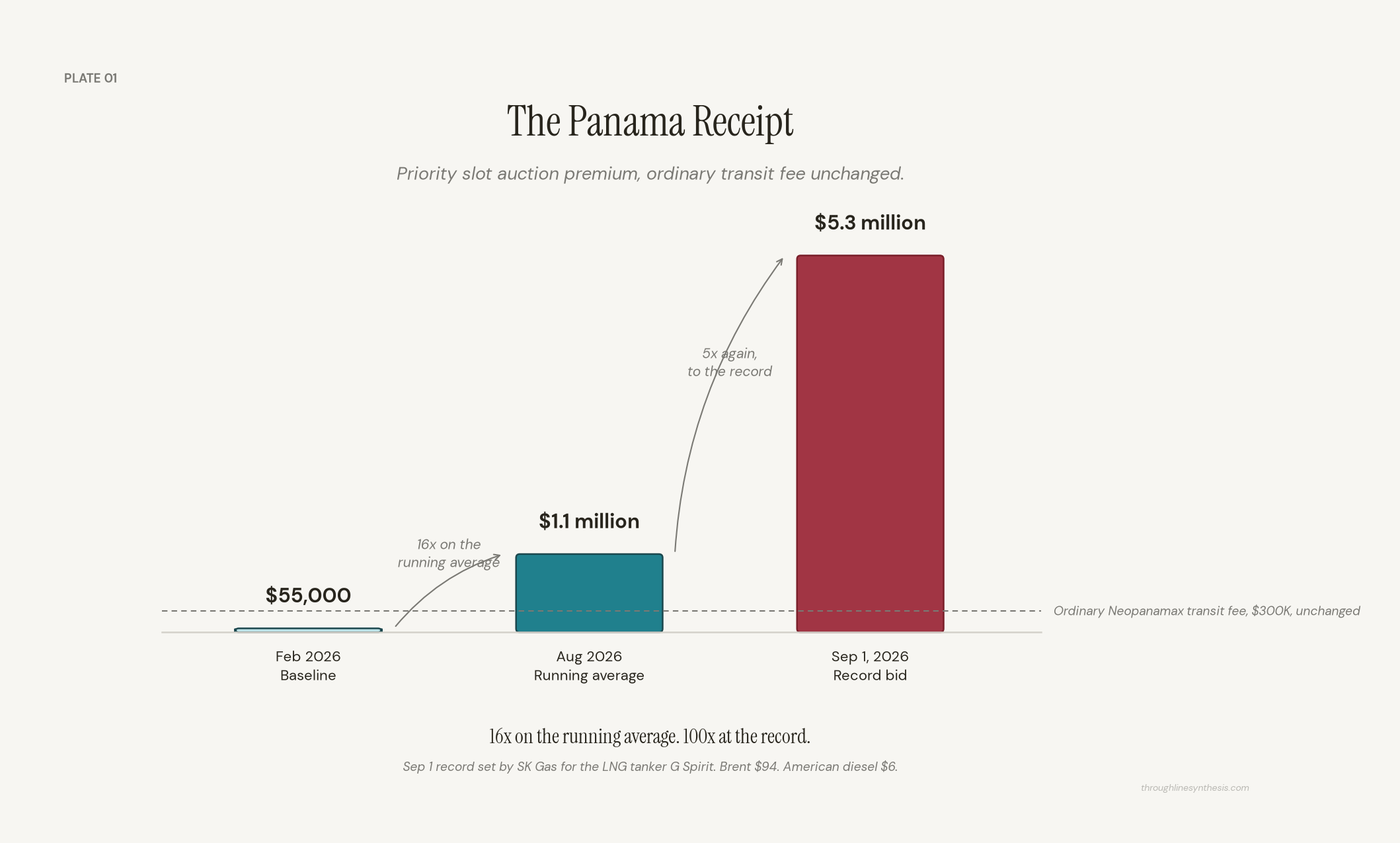
The mechanism is not exotic. The Strait of Hormuz is closed, not “under almost total control” as Trump insists on Truth Social, but closed in the operational sense that shipping companies now refuse to route through it and are diverting to Panama at whatever price Panama chooses to charge. Panama has chosen to charge. A historic drought is limiting the canal’s water flow and therefore its capacity. Shippers arrive desperate. Panama does what any monopolist would do at the margin of scarcity. The market has cleared, at the record, at five point three million.
Every consumer good that transits the affected trade lanes carries that fee forward. It has not landed in American retail prices yet because the shipments in transit were priced under the old fees. It will land in the fourth quarter, in time for the Christmas season and the first wave of midterm polling. Trump insists Hormuz is open. The shippers, by their route choices, insist it is closed. The Panama Canal Authority is the tape.
There is no policy answer to this. Trump cannot reopen Hormuz because reopening Hormuz requires ending the war. Trump cannot end the war because ending the war is the concession he cannot admit. So he denies the strait is closed and hopes the retail prices do not arrive before the first Tuesday in November of next year. They will arrive sooner. Diesel is already at six dollars a gallon. Brent closed at ninety-four. The rest is arithmetic.
Trump’s Fed says no
The single most consequential political sentence of the past two weeks was delivered not by Trump but by Kevin Warsh, Trump’s own nominee for chairman of the Federal Reserve, on August 21 at the Kansas City Fed’s Jackson Hole symposium. Warsh delivered a hawkish keynote. Trump wanted a rate cut. Warsh, before confirmation, before taking the chair, told the assembled market that he would not cut. He said it on the record with the current chair sitting in the front row. Robin Brooks, in his post-mortem on the global bond sell-off yesterday, attributed the entire latest leg of the American yield rise to Warsh’s speech.
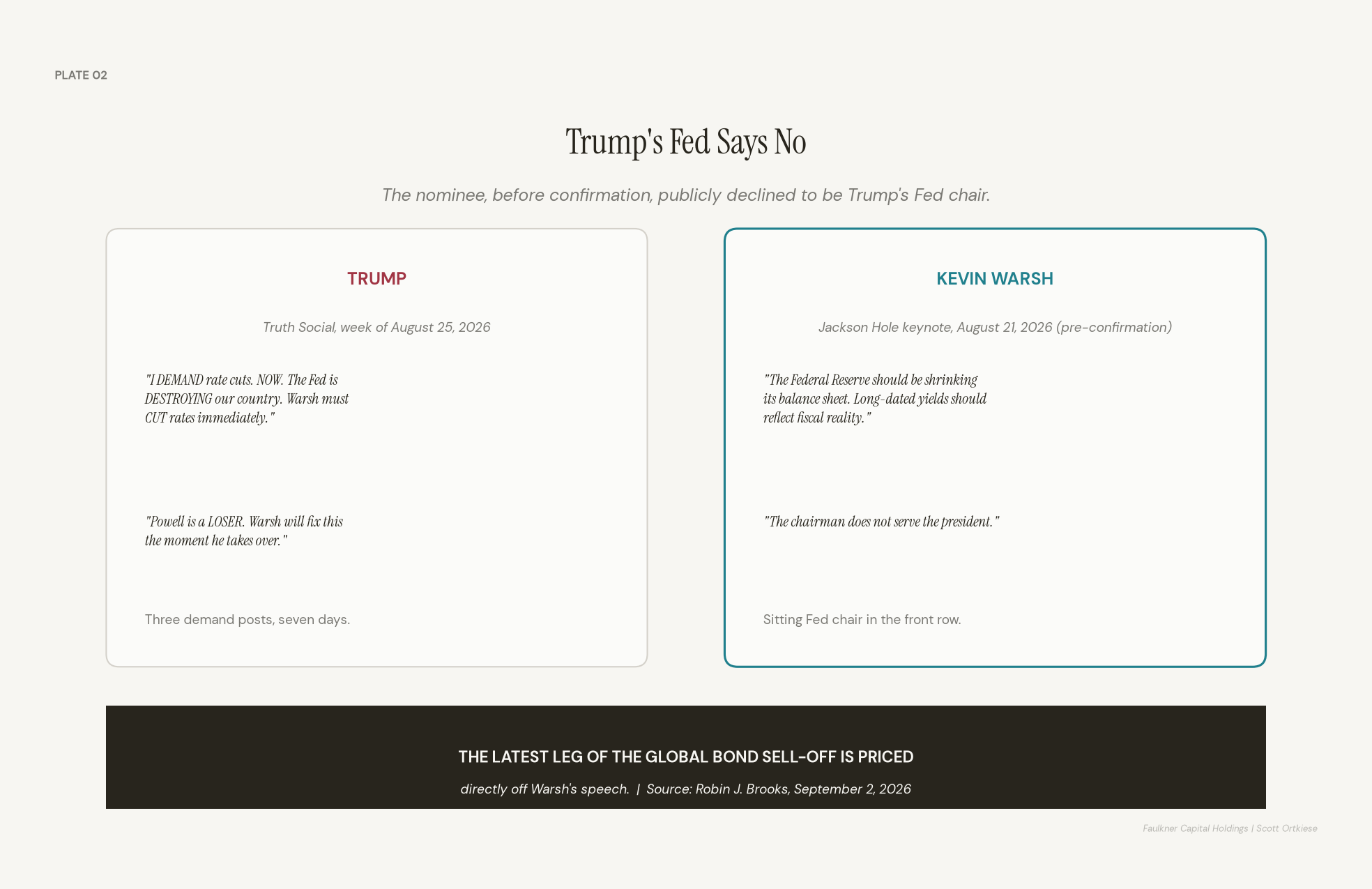
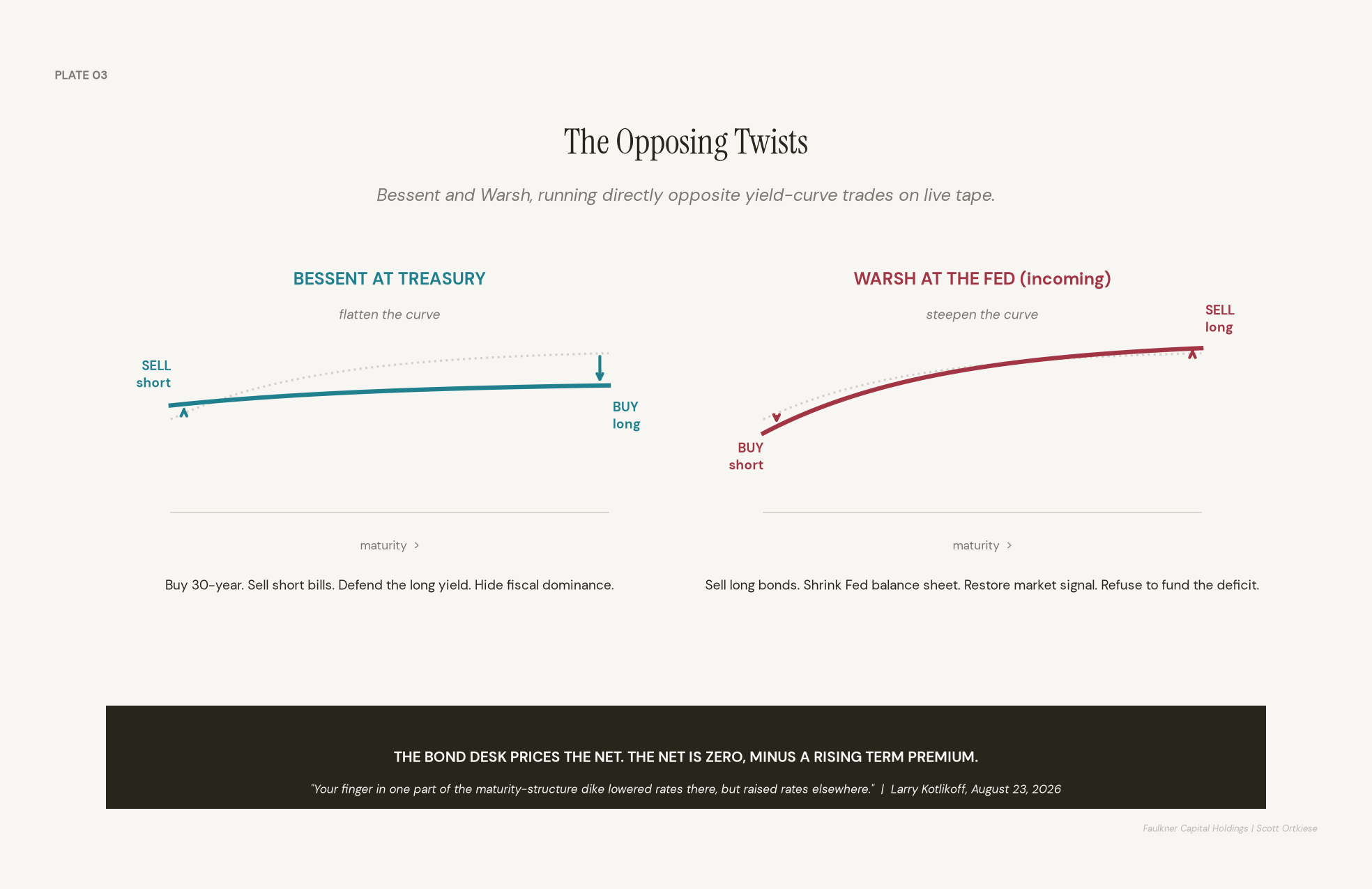
This is not a personnel matter. This is Trump’s own Fed chair, without a shot fired, publicly declining to be Trump’s Fed chair. Warsh has said in numerous forums that he wants to shrink the Fed’s balance sheet by selling long-dated Treasuries and buying short. Bessent, at the same moment, is running the opposite trade at Treasury, buying long-dated Treasuries and issuing short bills to finance it. Two of the three most senior officials in the American financial system are executing directly opposed yield-curve operations. The market prices the net. The net is zero, minus a rising term premium the market charges for the confusion. Larry Kotlikoff called the mechanism by name in Economics Matters on August 23: “Your finger in one part of the maturity-structure dike lowered rates there, but raised rates elsewhere.”
Trump’s public response to Warsh’s Jackson Hole rejection has been to demand rate cuts on Truth Social, three times last week. Warsh has not answered. He does not need to. His yields did.
The trillion-dollar tribute
Wolff delivered another fact this morning that most economic writing has managed to bury: the United States government will spend, this fiscal year, one trillion dollars on interest payments alone on the forty-trillion-dollar federal debt. That trillion does not build a road. It does not staff a school. It does not pay a nurse. It is a direct transfer from every American taxpayer to the wealthy individuals, wealthy corporations, and foreign governments who lent Washington the money. Wolff’s line: “Instead of taxing the rich, which would have gotten you the money, the government could have spent it. End of story. What you’ve done is borrowed that same money from the rich.”
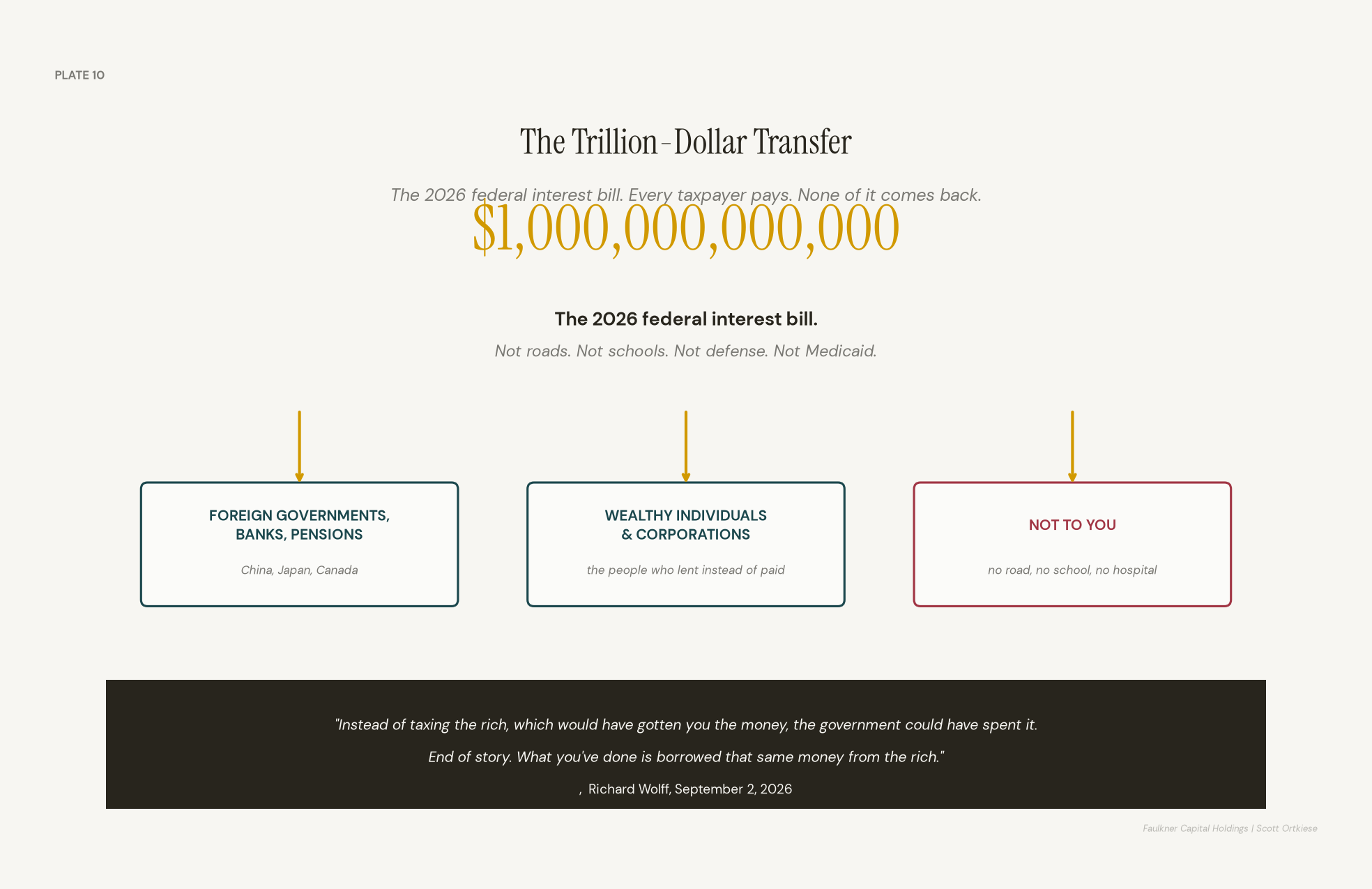
The choice to borrow rather than tax was bipartisan. Wolff was careful to say so, and he was right. Biden ran deficits of comparable size. Trump has widened them. But the fiscal architecture of the American state for forty years has been to tax the median wage and borrow the wealthy portfolio, on a promise that the two flows were somehow different money. They are the same money. The tax collector picks it up on one side of the ledger. The Treasury pays interest on it on the other. The rich get to keep the principal.
The Trump 2026 budget is projecting another trillion-dollar-plus deficit, driven by an enormous increase in defense spending, or, more honestly, war spending, with no matching increase in revenue. Tariff refunds have outrun tariff receipts for three consecutive months. On August 29 the Supreme Court struck down Trump’s IEEPA tariff authority six to three, voiding the revenue line the budget assumed. There is no revenue plan. There is a Treasury Secretary, a nominal Federal Reserve, a Congress that will not tax, and a president who denies the arithmetic on his own social network at three in the morning.
The mortgage squeeze, mechanically
Here is the mechanism Wolff spelled out, and it is the single clearest way to explain to an ordinary American why any of this matters to them. A bank has money to lend. It can lend it to the federal government at 5.28 percent, at effectively zero credit risk, on a 30-year Treasury. Or it can lend it to a family at 6.65 percent on a 30-year mortgage, with default risk, service costs, and regulatory capital requirements attached. The bank does the math. The bank moves the money to Treasuries. The mortgage market gets squeezed. Rates rise faster than the Treasury curve alone would predict, because the marginal supply of mortgage credit is contracting.
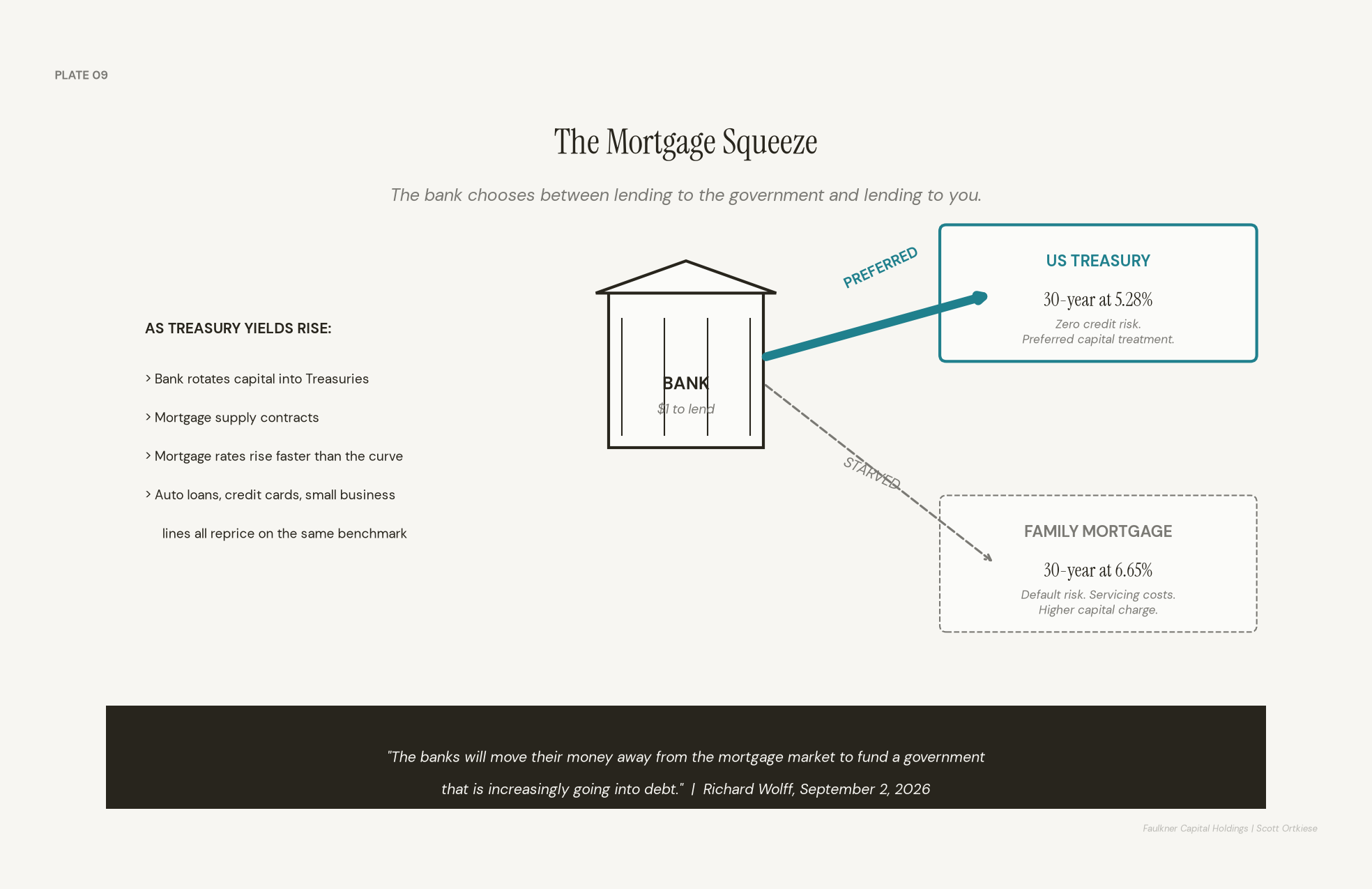
The same mechanism runs through auto loans, credit cards, small business lines, and corporate bonds. Nicholas Miller at the Wall Street Journal named it yesterday: “Treasury yields are the benchmark for home mortgages and vehicle loans.” Aaron Back at the same paper on Monday: “The runup in interest rates has profound consequences for the global economy, heaping pressure on everyone from home buyers to credit-card holders.” Jeff Stein on Breaking Points yesterday: mortgages, car loans, credit cards, all tied to that IOU spread. Any American with a variable-rate credit card is paying Bessent’s yield defense in monthly minimums. Any family shopping for a starter home is paying it in the mortgage rate. Any small business rolling a credit line is paying it in the coupon.
The Iran war is a mortgage bill. The bond sell-off is a car payment. The yen intervention is a credit card statement. This is the sentence Trump will not permit anyone in his administration to speak.
Bessent, mechanically
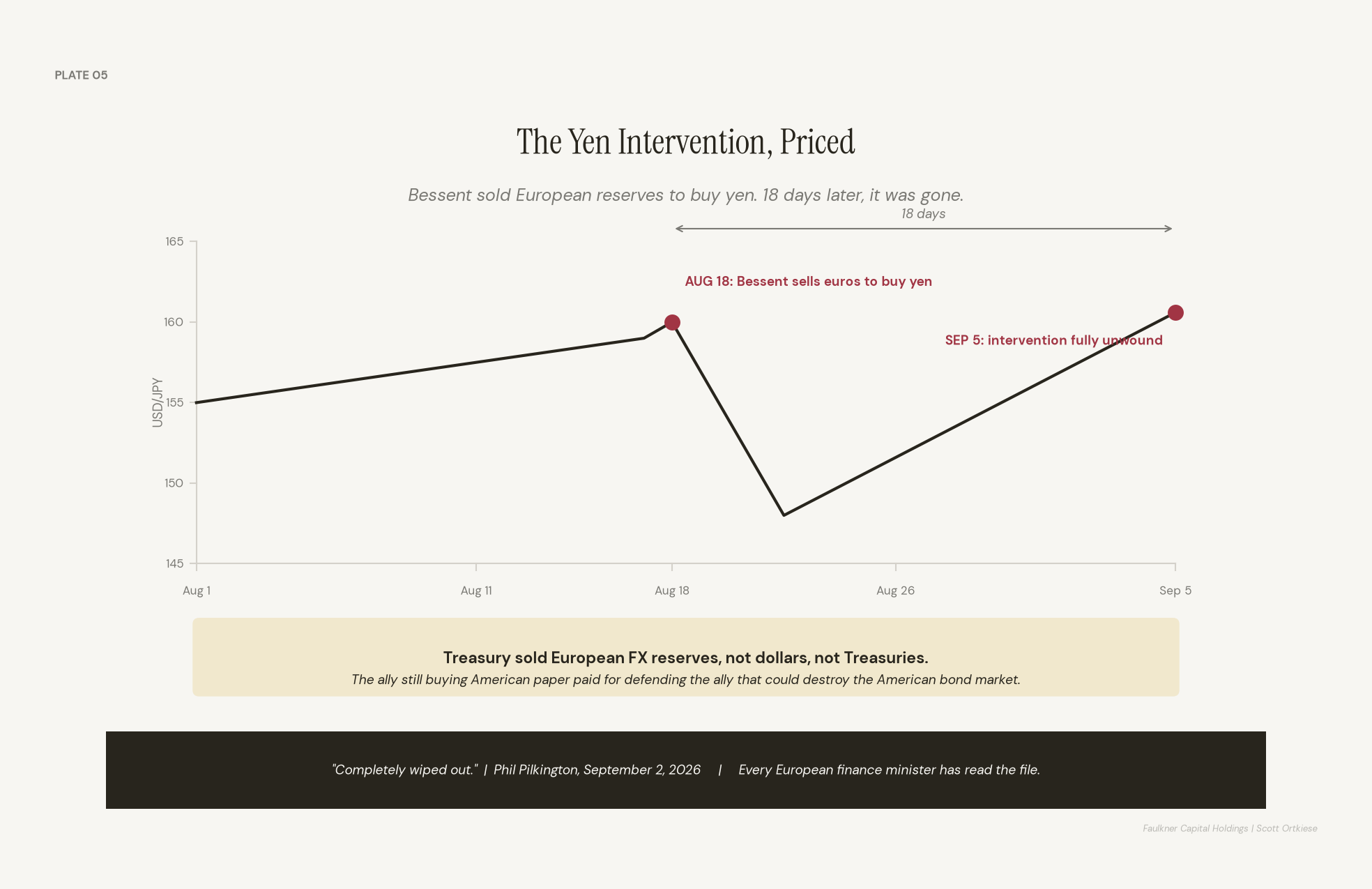
Bessent’s August 18 yen intervention did not use dollars. It used euros. The Treasury dumped America’s European reserves to buy Japanese yen, because dumping Treasuries to buy yen would have collapsed the yields Bessent was trying to defend. He picked the pocket of the ally still buying American paper without complaint, in order to save the ally that could destroy him with a single Ministry of Finance memo. Eighteen days later the intervention was gone. Phil Pilkington called the corpse: “completely wiped out.” Jeff Stein reported yesterday that the Japanese finance ministry is now weighing whether to liquidate a portion of its more than one trillion dollars in Treasuries to defend the yen itself. Bessent’s total annual buyback authority is one hundred thirty billion dollars. A Japanese sale of ten percent of their holdings erases him in a morning.
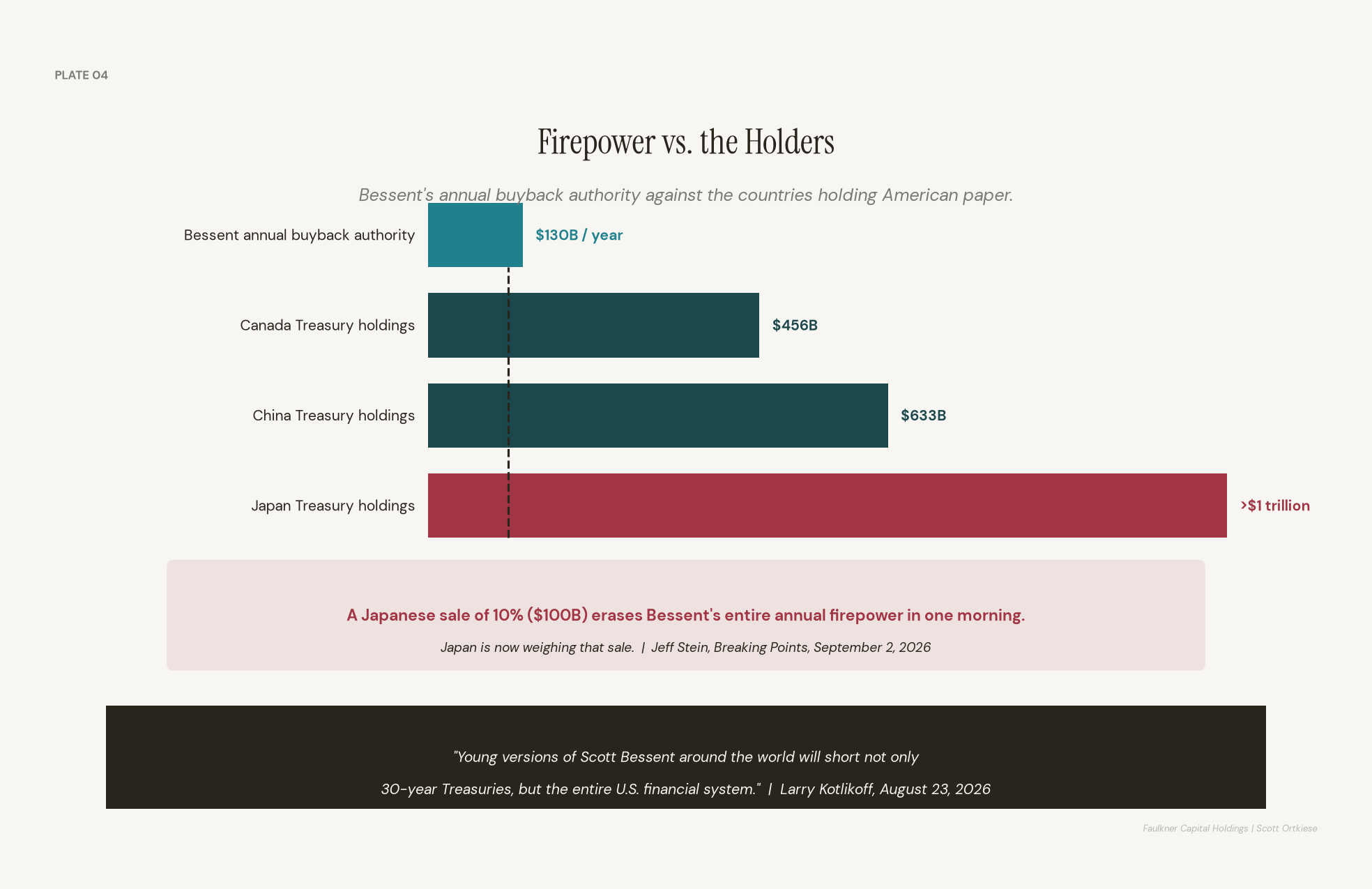
Europe has noticed. There is no press conference. There does not need to be one. The euro is the currency Washington sells first. Every European finance minister has read the file.
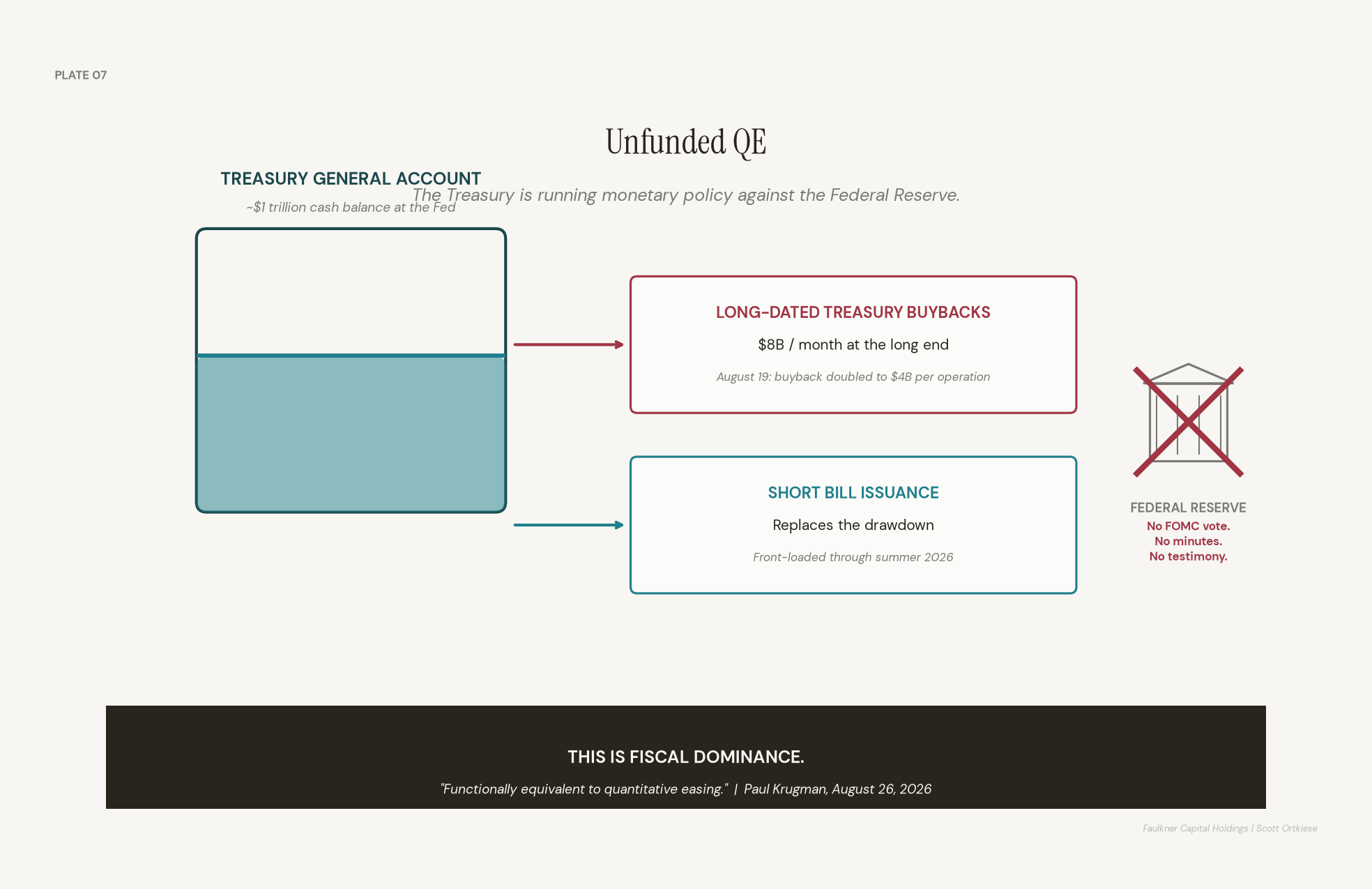
The mechanism Bessent is running to hold the American 30-year yield at 5.28 percent is not Treasury issuance in the ordinary sense. He is drawing down the Treasury General Account, the government’s cash balance at the Federal Reserve, currently approaching one trillion dollars, which Bessent himself built up through the summer by front-loading bill issuance. He is spending that cash to buy long-dated Treasuries and replacing the drawdown with short bills. This is quantitative easing, executed by the Treasury Secretary, without a Federal Reserve vote, without an FOMC minute, without a chairman’s testimony. Paul Krugman on August 26 called it “functionally equivalent to quantitative easing.” The technically correct name is fiscal dominance. It is what happens when a Treasury Secretary begins setting monetary policy against the will of the central bank.
Bessent himself said, at Brookings on August 22, that he was “playing with fire” and risking “a devaluation spiral like the yen.” He said it out loud, on tape, and then did it anyway. He knows the model. He is running it.
The USD1 exit, plainly
The single most damning pattern in the last thirty days is the August timeline. On August 11, Bessent’s Treasury killed the Corporate Transparency Act and deleted the FinCEN beneficial ownership database that would have identified who owns dollar-denominated shell entities. On August 14, the Office of the Comptroller of the Currency granted World Liberty Financial a conditional federal bank charter. On August 17, Treasury rulemaking under the GENIUS Act declared dollar-pegged stablecoins to be bank deposits. On August 19, Bessent doubled Treasury buybacks to four billion dollars per operation. On August 24, Bessent launched Operation Economic Outcast, cutting Iran and any facilitating entity out of the dollar clearing system.
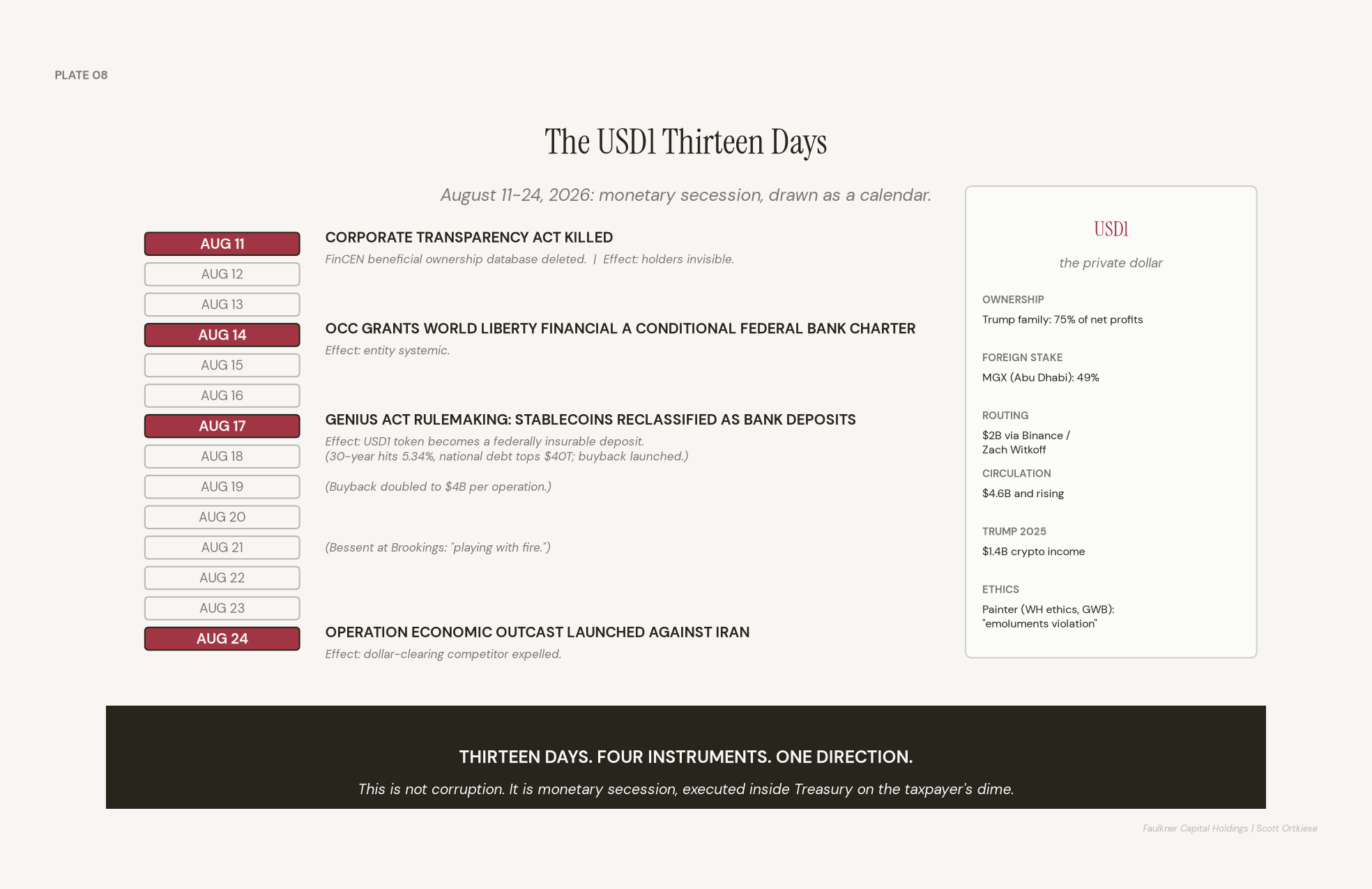
Thirteen days.
USD1 is a dollar-pegged stablecoin issued by World Liberty Financial. The Trump family owns seventy-five percent of net profits. Sheikh Tahnoon bin Zayed’s Abu Dhabi fund MGX holds forty-nine percent through a two-billion-dollar Binance investment routed via Eric Trump’s associate Zach Witkoff. Circulation is four point six billion dollars and rising. Trump’s 2025 disclosure lists one point four billion dollars in crypto income, five hundred fifty million from World Liberty Financial and six hundred million from meme coins. Richard Painter, chief White House ethics lawyer under George W. Bush, said publicly that this pattern would be an emoluments violation for anyone else in the executive branch.
Read the sequence as an integrated operation and it is not corruption. It is monetary secession. The Corporate Transparency Act repeal makes the holders invisible. The OCC charter makes the entity systemic. The GENIUS Act reclassification makes the token a bank deposit. Operation Economic Outcast expels every competing dollar substitute. Thirteen days, four instruments, one direction. If the sovereign dollar loses reserve status, the family has already built the private dollar that will catch the outflow, backed by a Gulf sovereign wealth fund, cleared through Binance, and blessed by a federal bank charter granted in the same week the FinCEN database went dark.
Bessent is not defending the American financial system. He is building its successor inside its skin. That is why the bond desk will not stop selling. The market can read a calendar.
The Japan tell
The story of the day is not the American 30-year at 5.28 percent. The story is the Japanese 10-year at 3.00 percent, a level not seen since 1996. That single number ends two American strategies at once.
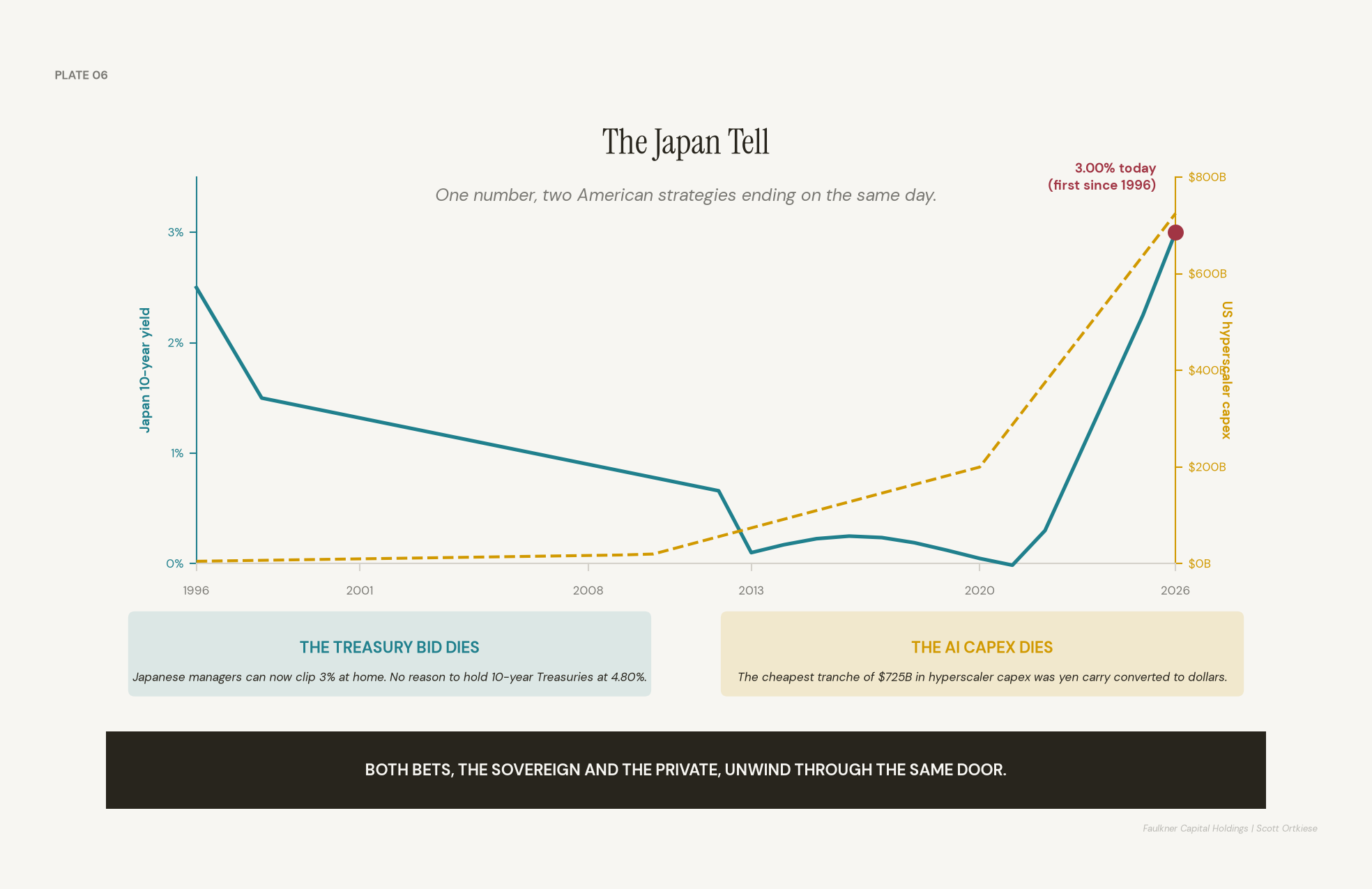
The first is the Treasury bid. For thirty years the marginal buyer of American long-dated debt has been the Japanese pension fund, insurance company, and government bond fund manager who could not clip yield at home and had to buy American paper to hit assumed returns. A Japanese manager who can now clip three percent in yen, without foreign exchange risk, has no reason to hold ten-year Treasuries at 4.80. The Japanese bid is not returning.
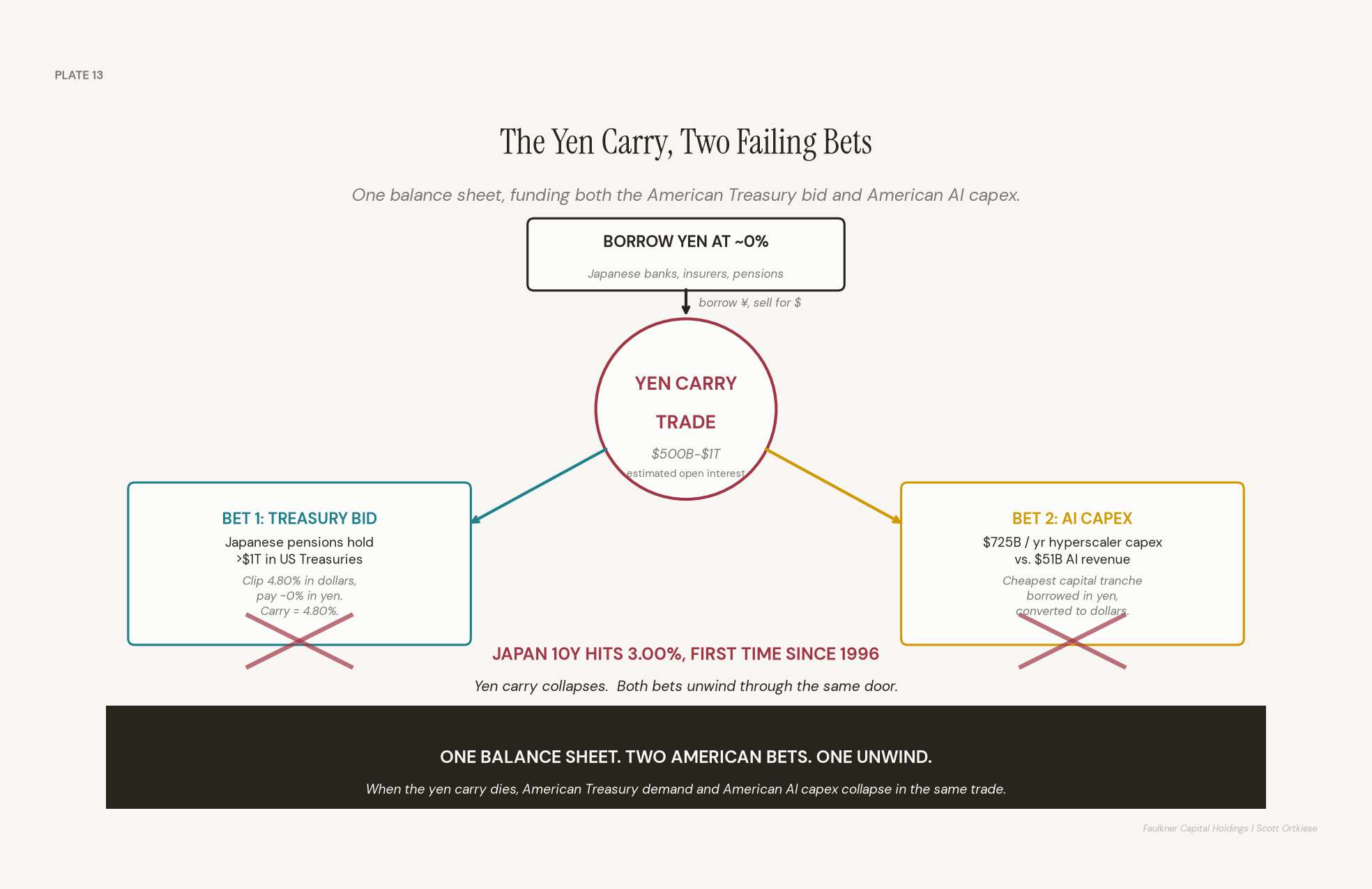
The second is the AI capital expenditure. The five American hyperscalers, Microsoft, Meta, Alphabet, Amazon, and Oracle, will spend seven hundred twenty-five billion dollars on data centers this year against fifty-one billion in combined AI revenue. The cheapest tranche of that capital stack was borrowed in yen at near-zero rates and converted to dollars through the carry trade. When the yen carry dies, the marginal dollar of AI capital expenditure gets more expensive on the same day the marginal Treasury buyer disappears. Both bets, the sovereign one and the private one, unwind through the same door.
Meanwhile, in Chinese laboratories, DeepSeek runs on a phone and Qwen runs on a laptop. Beijing does not need to win by revenue. Beijing needs to make the technology worth zero at the point of use, at which point American hyperscaler capital expenditure becomes stranded cost and cloud margins compress to utility margins. Trump had the American CEOs to dinner at the White House on Monday, offered them tariff relief on Chinese hardware they cannot legally buy and permits on power plants that will not be built inside the depreciation schedules. Altman, Pichai, Nadella, and Zuckerberg smiled through it. Ellison flew in for the photo. Elon Musk, at the G-20 the next morning, warned of catastrophic AI outcomes within a year. He was not warning about China.
Ukraine, briefly
Russia won Ukraine. The frozen sovereign reserves were not seized because seizing them would confirm to every non-Western central bank still holding dollars that dollar reserves are political weapons, not property, and the marginal foreign buyer of Treasuries would leave the market the same afternoon. That is the constraint. That is why Ukraine lost. Poland ordered its tanks from Seoul. Germany is now openly debating a European nuclear deterrent. Saudi Arabia signed a mutual defense treaty with Pakistan on September 17, 2025. The petrodollar arrangement was not renewed. Nobody issued a joint communique. Nobody needed to.
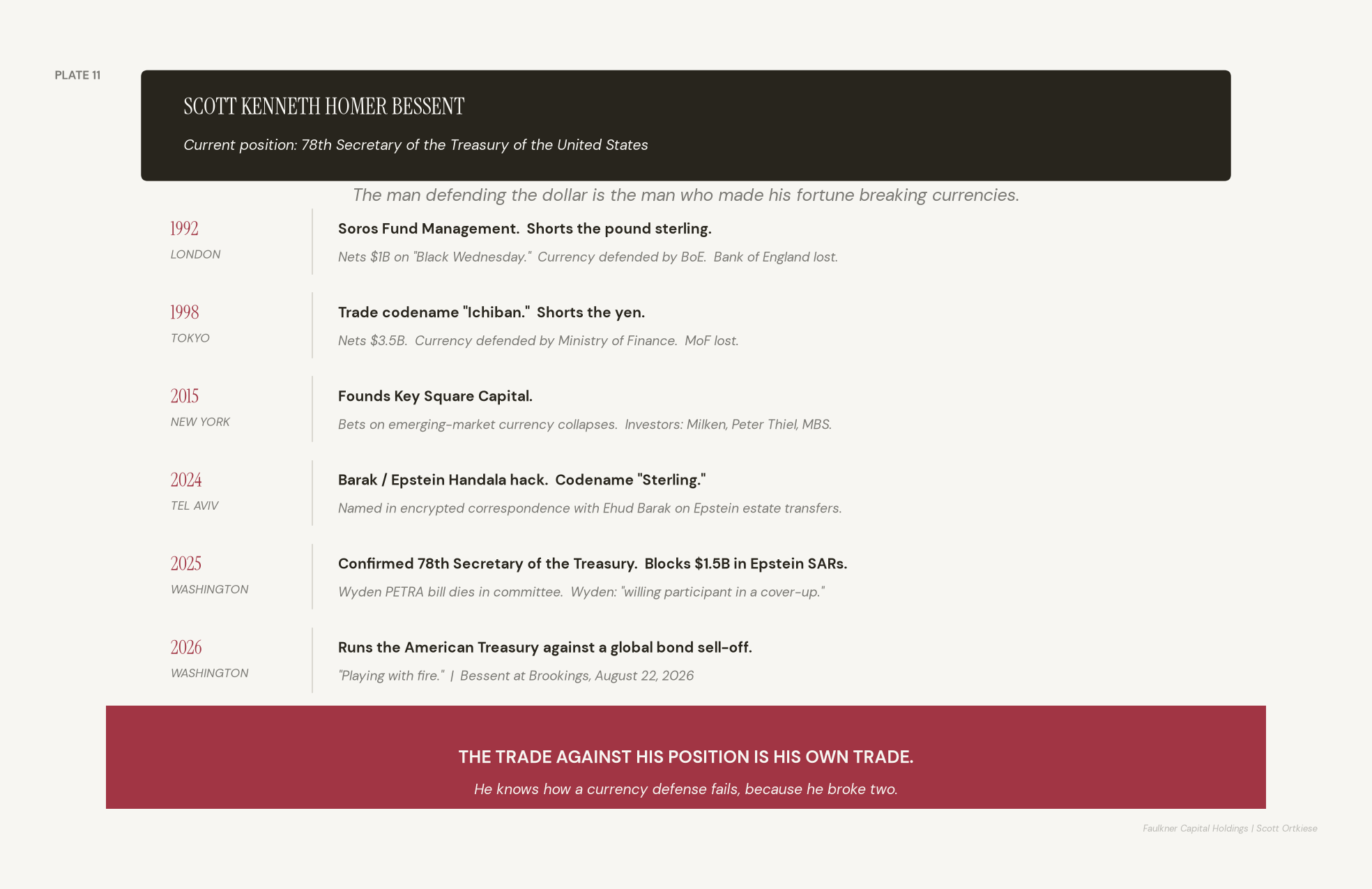
Fifty percent tariffs on Canadian alcohol, autos, steel, aluminum, and cement took effect August 30. Canada holds four hundred fifty-six billion dollars in Treasuries. Kotlikoff, on August 23, warned that Canadian retaliation through Treasury sales would “lead young versions of Scott Bessent around the world to short not only 30-year Treasuries but the entire U.S. financial system.” That is the same Bessent who made his name at George Soros’s London desk in 1992 shorting the pound, and in 1998 shorting the yen. The former hedge fund manager knows what the trade against his position looks like. It is his trade.
Biden warned them
In 1997, Joseph Biden, then the ranking Democrat on the Senate Foreign Relations Committee, gave a speech at the Atlantic Council. He reported the Russian warning against NATO expansion in the diplomat’s own words: push us east, and we will build a coalition with China and Iran. The room laughed. Biden joked that if the China play did not work, the Russians could always try Iran. The audience laughed again. That speech is on video. The Atlantic Council archived it.
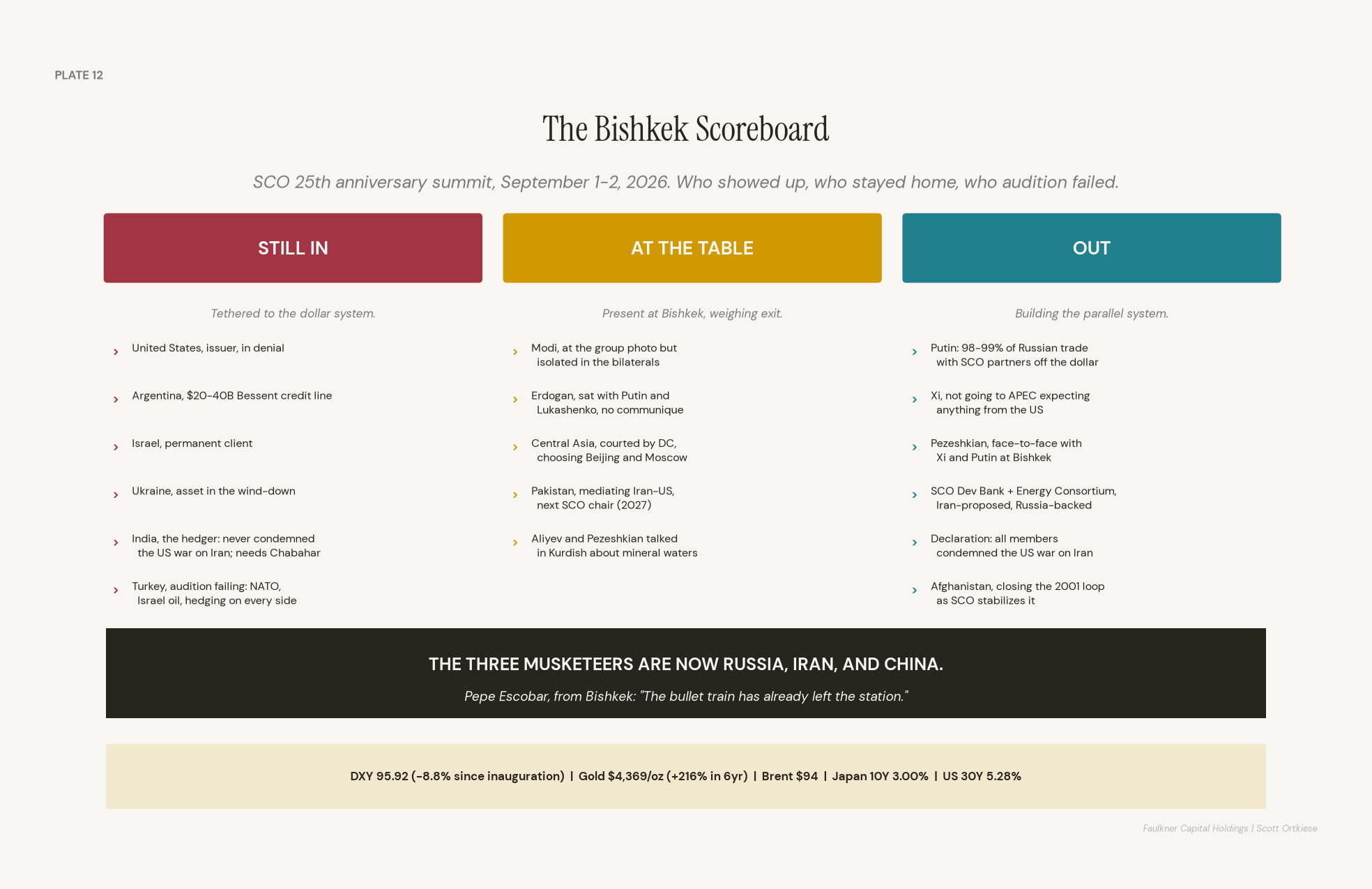
Twenty-nine years later, on September 1 and 2, 2026, at the Shanghai Cooperation Organization’s twenty-fifth anniversary summit in Bishkek, Kyrgyzstan, the exact configuration Biden reported and dismissed sat down together at the head table. Xi Jinping, Vladimir Putin, and Masoud Pezeshkian. Russia, China, and Iran. Pepe Escobar, filing from Bishkek, called them the Three Musketeers. The old Primakov triangle from the 1990s was Russia, India, China. India has been replaced. India was at the group photo. India was not in the trilateral.
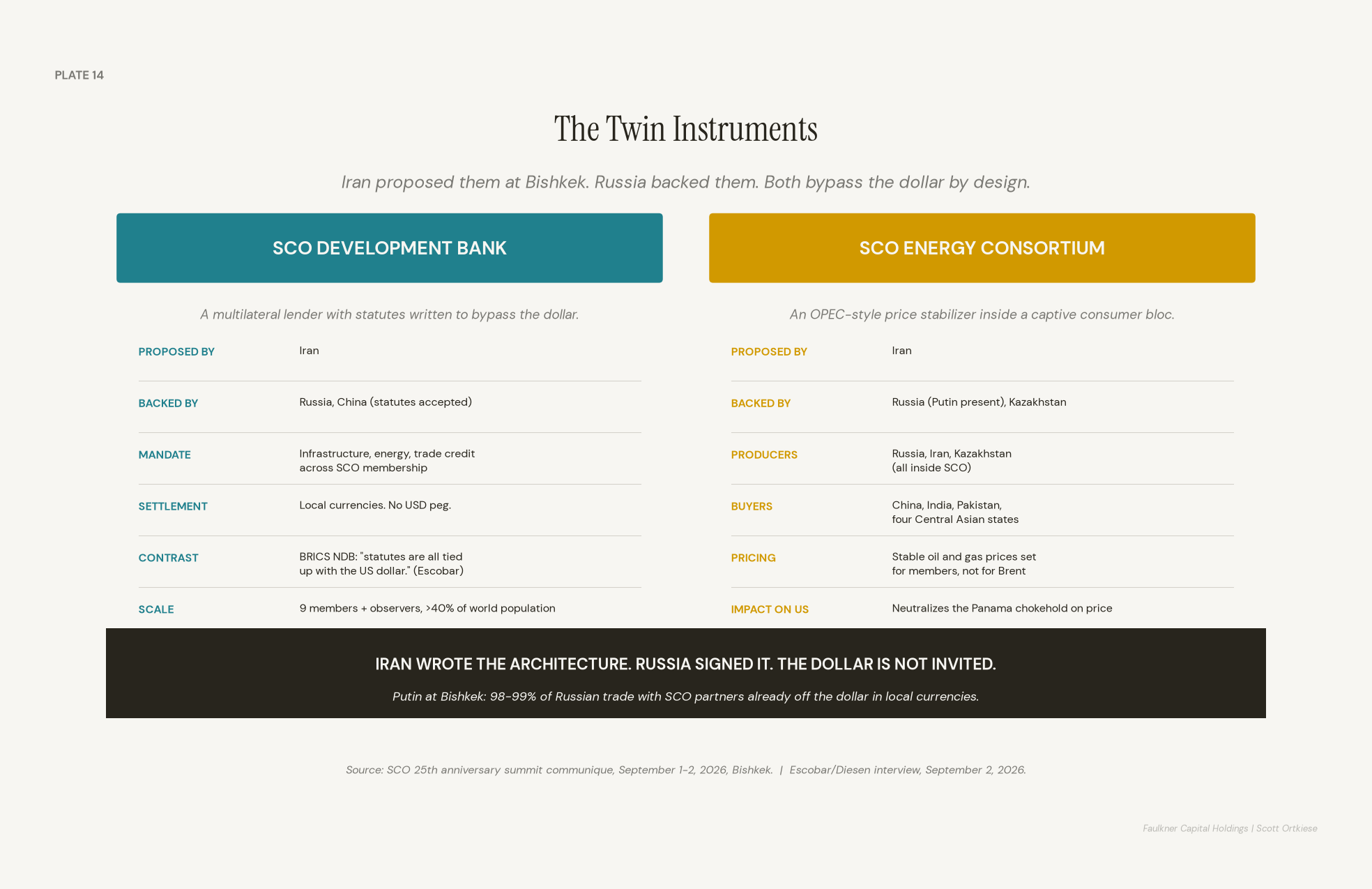
The summit declaration condemned “the unilateral war by the United States on Iran,” without using the word unilateral and without naming the United States, because Indian objections softened the text. Every full member signed anyway. The delegations approved two Iranian proposals, both backed publicly by Russia: an SCO Development Bank whose statutes bypass the dollar entirely, and an SCO Energy Consortium binding Russia, Iran, and Kazakhstan as producers to China, India, Pakistan, and the four Central Asian states as buyers, at prices set inside the bloc rather than at Brent. Escobar’s summary of the bank: the BRICS New Development Bank is still tied up in dollar clearing; the SCO bank was drafted clean. Putin, from the podium, stated that ninety-eight or ninety-nine percent of Russian trade with SCO partners is already settled off the dollar in local currencies. That is not a projection. That is the current figure, on his own record.
Pakistan is the incoming SCO chair for 2027. Pakistan is also the current back-channel mediator between Iran and the Trump administration. The country that Washington is attempting to sanction is being negotiated with through the country that will preside over the anti-dollar bloc. Turkey wanted full membership. Russia and China declined. Erdogan’s hedging record is disqualifying: NATO membership, oil sales to Israel, the strikes on Damascus after helping topple its government. Afghanistan, the country the SCO was originally founded to contain, is being prepared for full membership as a stabilized state. The organization closes its founding loop by admitting the problem it was chartered to solve.
Anton Siluanov, the Russian finance minister since 2011, attended the G20 finance meeting in Asheville on August 31. His European counterparts refused to shake his hand. He returned to Moscow, flew to Bishkek, and joined the summit that produced the two instruments above. Xi is scheduled for APEC in Shenzhen in November. He is not scheduled for Washington. Escobar’s line on that: “He wouldn’t even bother, because he’s not expecting anything from the US. He is expecting a lot from the rest of Eurasia.”
Halford Mackinder wrote the doctrine in 1904. Alfred Mahan fine-tuned it. Nicholas Spykman formalized it. Zbigniew Brzezinski built a career on it. The doctrine’s operating premise, for one hundred twenty-two years, is that an Anglo-American maritime power cannot survive a united Eurasian land coalition. The nightmare configuration was always Russia, China, and a rising middle power. That configuration met at Bishkek this week. Biden reported the warning about it in 1997 to laughter. The room in Bishkek did not laugh.
The handoff
Russia and China moved bilateral trade off the dollar years ago. The Gulf runs a hedged reserve basket. India pays for Russian crude in rupees. Brazil and Indonesia clear through BRICS Pay. Central banks bought a record 1,180 tons of gold in 2024, and the record is being broken again in 2026. Gold closed today at four thousand three hundred sixty-nine dollars an ounce. The dollar index closed at ninety-five point nine two, down eight point eight percent since Trump’s inauguration.
The multipolar order is not arriving. It arrived. The train left the platform sometime last year. Trump and Bessent are the two men on the platform explaining that the schedule has been amended. The bond desk is not on the platform. The bond desk is on the train.
After me
The line, precisely translated, is not “after me, the flood.” It is “after me, the deluge,” meaning the disaster is coming and I am uninterested in its arrival, because the arrival is not scheduled for me. Louis XV died in his bed in 1774. His grandson Louis XVI inherited the deluge and was executed nineteen years later. The deluge arrived on schedule for everyone else.
Trump is running a stall to November 2027 because he cannot admit that Iran defeated the American interceptor budget, that Warsh defeated the American rate cut, that the yen carry trade defeated the American Treasury bid, that China defeated the American AI capital stack, that the Panama Canal Authority defeated the American shipping cost line, and that a Trump family stablecoin backed by an Abu Dhabi sovereign fund is already positioned to defeat the American dollar. The stall requires denial. The denial has been priced. It is priced in Brent crude at ninety-four, in diesel at six, in gold at four thousand three hundred sixty-nine, in the dollar index at ninety-five point nine two, in the Japanese ten-year at three point zero zero, in the American thirty-year at five point two eight, and in a Panama Canal auction premium that has risen sixteenfold in six months, with record single bids over five million dollars.
The mortgage bill is how ordinary Americans will find out. Wolff said it, and he was right: “This is the behavior of a government which, to parrot Louis the 16th [XV], is famous for saying, ‘After me comes the catastrophe.’ We’re watching that play out. Only it’s us this time.”
Sources
Richard D. Wolff, interview on Democracy Now, September 2, 2026. Larry Kotlikoff, “Sec. Bessent, Your Bond-Market Band-Aid Can’t Hide Our Ugly Pig,” Economics Matters, August 23, 2026. Robin J. Brooks, “Anatomy of the Global Bond Market Sell-Off,” Substack, September 2, 2026. Paul Krugman, “Scott Bessent Fails to Gaslight the Market,” Substack, August 26, 2026. The Leah Files, “The Currency Killer: Scott Bessent,” Substack, August 26, 2026. Jason Douglas, “Borrowing Isn’t the Bond Market’s Only Concern, Growth Is Too,” Wall Street Journal, September 2, 2026. Nicholas G. Miller, “What Does a Bond Selloff Mean for American Consumers?” Wall Street Journal, September 2, 2026. Aaron Back, “Oil Prices Push Global Bond Market Closer to the Edge,” Wall Street Journal, September 1, 2026. Jeff Stein, interview on Breaking Points, September 2, 2026. Breaking Points segment 3, September 2, 2026. Trump 2025 financial disclosures, per The Leah Files. Kevin Warsh, keynote at the Federal Reserve Bank of Kansas City Jackson Hole symposium, August 21, 2026, per Robin J. Brooks. Pepe Escobar, interview with Glenn Diesen, September 2, 2026 (SCO 25th anniversary summit, Bishkek). Joseph R. Biden, Jr., remarks at the Atlantic Council, 1997.
Contact: so@throughlinesynthesis.com