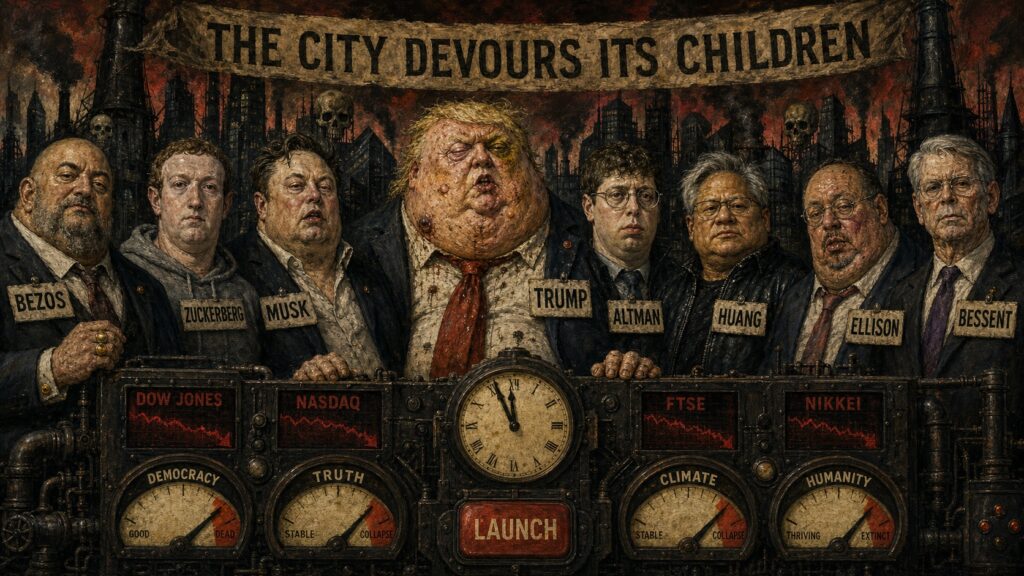
How a class small enough to fit in a ballroom, aligned behind an unqualified and morally bankrupt president, has built a wealth pump that is hollowing out organized labor, dismantling the middle class, converting the retirement savings of the American worker into the paper wealth of the tech oligarchy, and conscripting the American service member and reservist into wars that fund the pump. And, following Ryan Grim, Gabriel Zucman, and Thomas Piketty, how we tax the wealth back.
Scott Ortkiese | Throughline Synthesis | 25 August 2026
so@throughlinesynthesis.com | www.throughlinesynthesis.com
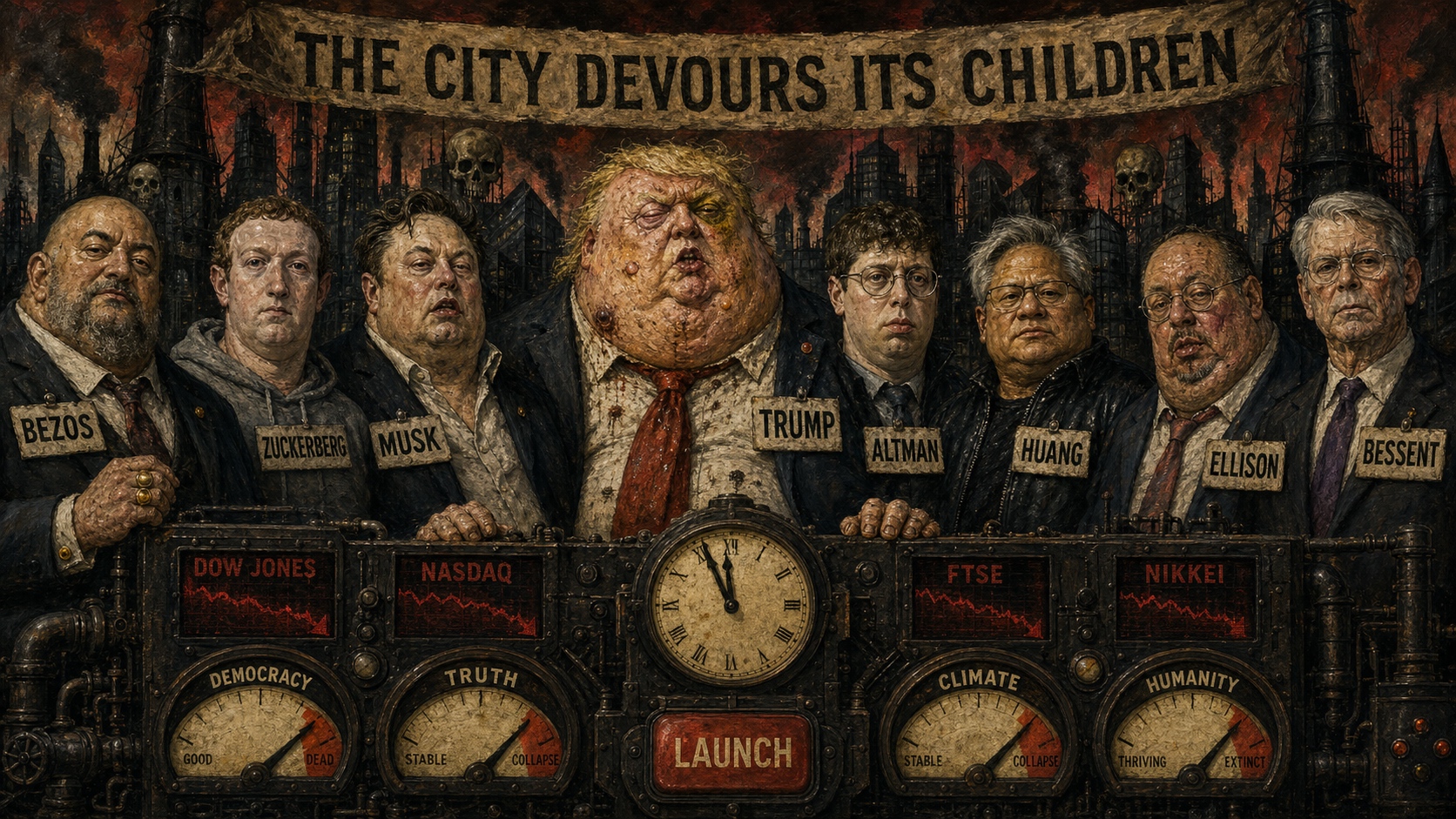
I. A Note on the Word “Doomsday”
There is a temptation, when the news is this bad, to reach for the Cold War word. To picture a mad general in a bunker with a red telephone. To imagine, as Kubrick did, a single device wired to end the world, unspoken and unspeakable, hidden in a Soviet mountain because the whole point of a Doomsday Machine is that you cannot un-build it once it is built.
That is exactly the wrong picture.
The Doomsday Machine currently disassembling the United States, the Atlantic alliance system, the petrodollar, the American middle class, the American industrial base, the American armed forces, the American retirement account, and the American century itself, is not hidden. It is not classified. It is not the secret product of a rogue ideologue in a nuclear silo. It was announced in press releases. It was filed with the Securities and Exchange Commission (SEC). It was proudly narrated on podcasts by the men building it, in essays they published under their own names, on stages where they were paid to give the keynote. The Bank for International Settlements (BIS) has a chart of it. The Financial Times has a section for it. Meta’s 2025 annual report says, in words a first-year accounting student would understand, that the roughly $28 billion residual value guarantee on its $27 billion Louisiana data-center venture is, “as of December 31, 2025,” of payments that are “not probable and therefore, no liability has been recorded.”1
The Machine is a matter of public record. The scandal is not that it was concealed. The scandal is that it was disclosed, and no one who mattered was required to read the disclosure, and the people who did read it, the small class of specialist writers, retired professors, one or two remaining reporters, and the occasional independent, were called shrill. What follows is an account of what the machine is, who built it, how the parts fit, why the parts are now, mechanically and financially, incapable of not producing the outcome they are producing, and why the outcome, a simultaneous decline of the empire, collapse of the AI capital cycle, insolvency of the life insurance sector, dismemberment of the alliance system, and the domestic imposition of a permanent oligarchy dressed in a democracy’s clothes, is not the accidental byproduct of stupidity or bad luck. It is the direct, foreseeable, and in most cases already-legislated output of choices made by nameable people for nameable reasons.
If it looks scripted by an evil mastermind, that is because it was scripted, in the ordinary sense of the word: written down, in advance, by identifiable authors. It is only “evil” in the sense that any large operation that treats human beings as an “addressable market” and an “externality” is evil. The mastermind is not one person. It is a class small enough to fit in a ballroom, as I have written before,2 and by now most of them have been in the same ballrooms together, and their filings, when read side by side, tell you exactly what they are doing and why.
This piece is written to organized labor, to public sector workers, to trade unionists, to retirees whose pensions have been fed into the machine, to the American service member and reservist whose lives and benefits are the ordnance the machine consumes, and to the middle-class voters whose homes, wages, savings, and school districts are the fuel. The Doomsday Machine, in other words, is not a threat. It is an operating system. And we are already inside it. The good news, and there is good news, is that operating systems can be rewritten. Ryan Grim, in his opening monologue to Gabriel Zucman on Breaking Points this week, gave the assignment in one sentence: “The rich have to start giving back some of their wealth to normal people rather than the other way around. The only way to do this is to tax their wealth.”R1 The rest of the tape names the machine that has to be dismantled first.
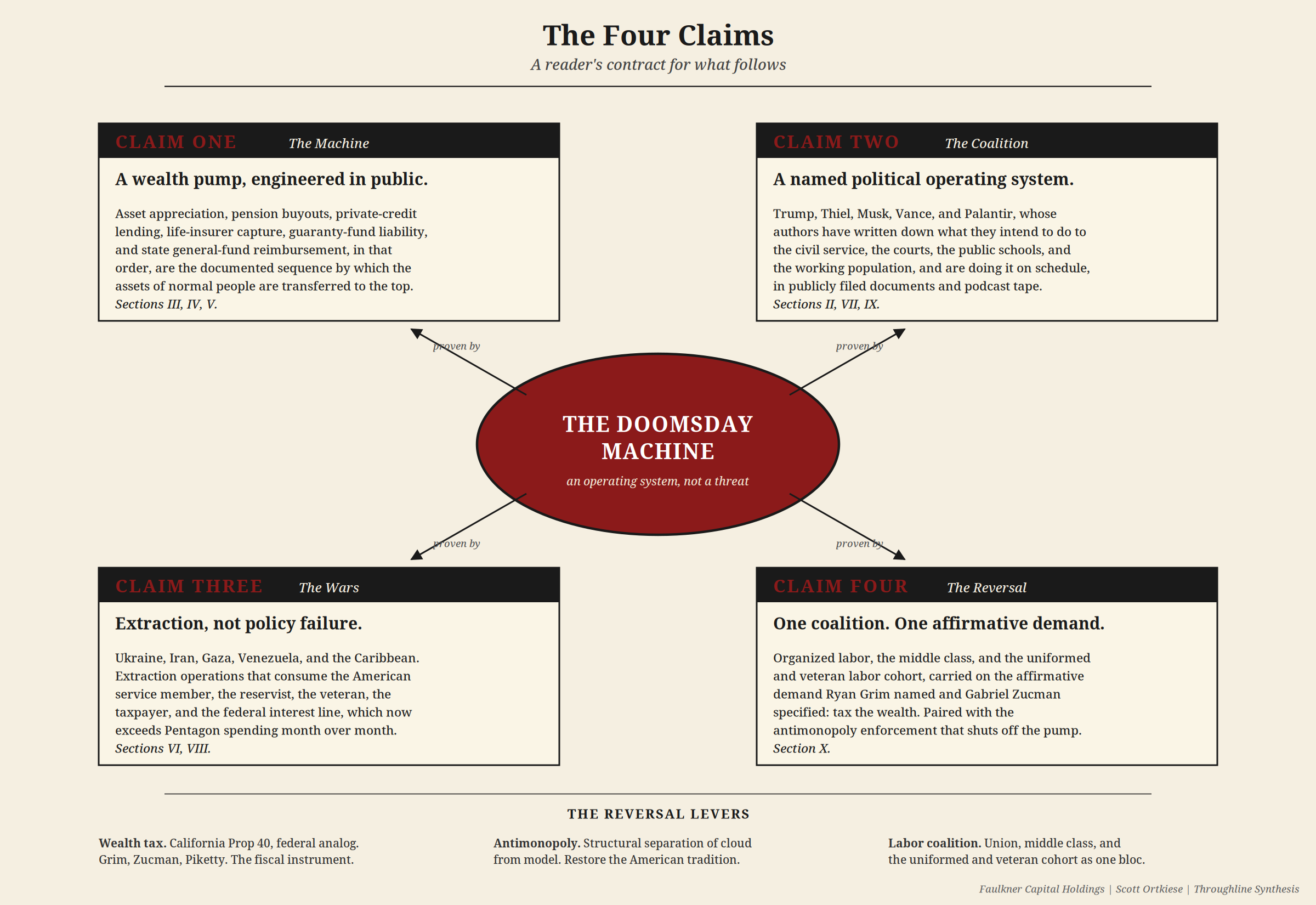
The four claims share a single underlying diagnosis: the American middle class no longer lives under public government, open market, or common law. It lives under a small number of privately governed platforms, financial vehicles, and political programs, in which the rules are set by algorithm, by covenant, or by executive order, and in which the citizen has been redesignated as an addressable market and an externality. Concentrated wealth is the terminal output of the machine. Its upstream mechanism, in the American tradition, is monopoly, the concentration of economic and political power in private hands, and its remedy, in the same tradition, is the pairing of a wealth tax with the enforcement of antimonopoly law, so that the pump is drained on the fiscal side and shut off at the source on the structural side.
A reader’s contract, then, for what follows. This article will prove, in ten sections, four claims. First, the machine that is destroying the American middle class and organized labor is not hidden and not accidental; it is a wealth pump, engineered in public, that transfers the assets of normal people to the top through a documented sequence of asset appreciation, pension buyouts, private-credit lending, life-insurer capture, guaranty-fund liability, and state general-fund reimbursement. Second, the political operating system of the machine is a Trump-Thiel-Musk-Vance-Palantir coalition whose named authors have written down what they intend to do to the civil service, the courts, the public schools, and the working population, and are doing it on schedule. Third, the wars the machine requires, in Ukraine, Iran, Gaza, Venezuela, and the Caribbean, are extraction operations that consume the American service member, the reservist, the veteran, the taxpayer, and the interest line of the federal budget, which now exceeds Pentagon spending month over month. Fourth, the machine can be reversed only by an alliance between organized labor, the middle class, and the uniformed and veteran labor cohort, carried on the affirmative demand Ryan Grim named and Gabriel Zucman specified: tax the wealth. Every section that follows is written to make one of those four claims stand up on its own evidence.
II. The Foundational Text: Nobody Was a Libertarian
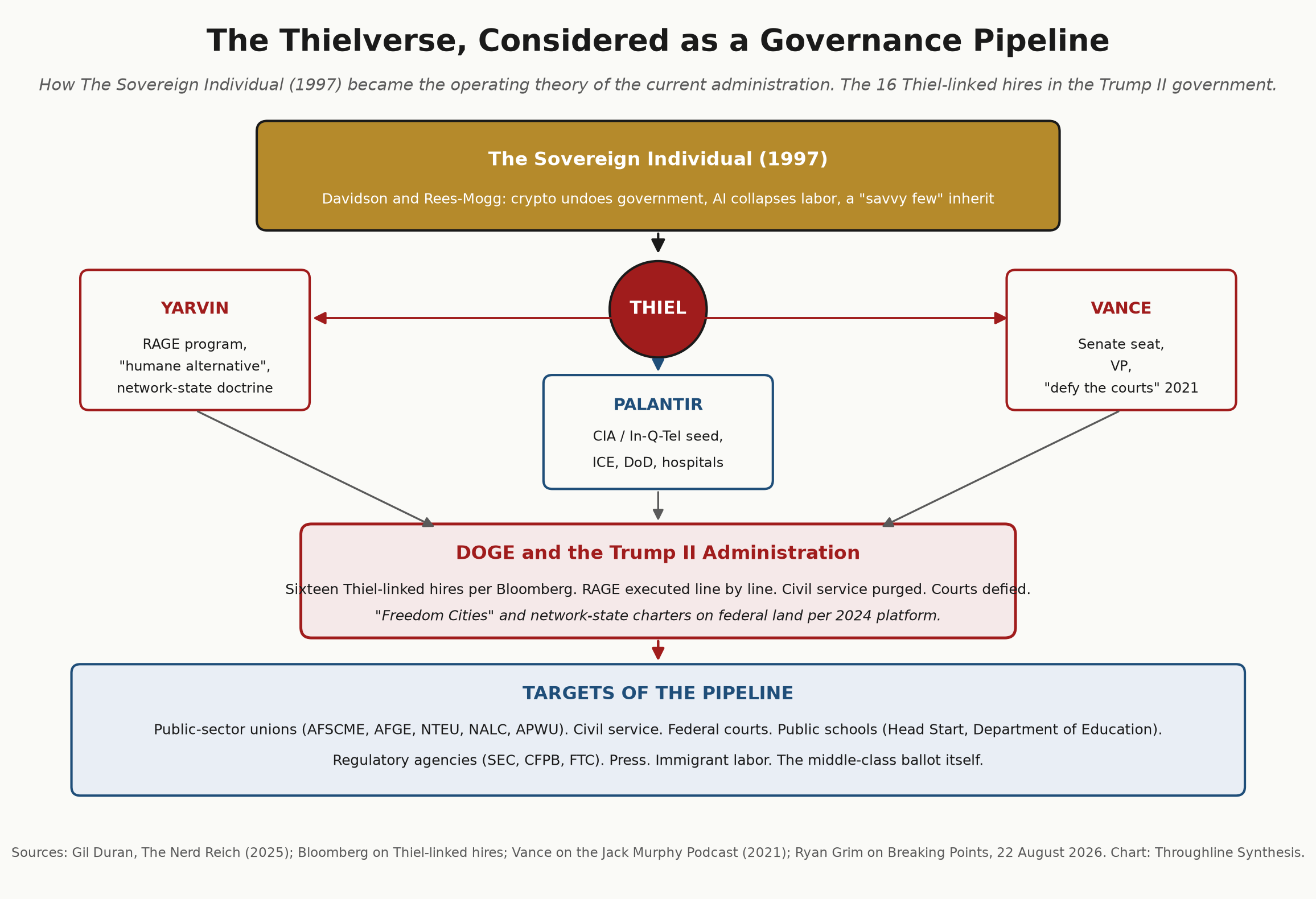
The semi-intellectual history that produced the current American regime is not obscure. It is, if anything, over-documented. Peter Thiel, born in Germany, raised in the Bay Area, PayPal co-founder, Palantir chairman, Founders Fund general partner, and single most influential political financier in the Republican Party for the past decade, read a book called The Sovereign Individual in 1997. He has spent the twenty-nine years since acting on it.
The book predicted, per Thiel’s own repeated public account, that in the twenty-first century “cybercurrency” (what we now call crypto) would undermine government authority; that “advanced automation” (what we now call AI) would collapse the labor market and concentrate wealth among a “savvy few”; and that a “sovereign individual” class would emerge, unmoored from democracies, whose real jurisdiction would be capital itself. Thiel has credited this book with being the inspiration for PayPal. He has funded Curtis Yarvin, the blogger who spent the 2000s and 2010s proposing, in his own words, that the United States needed to be “retired,” replaced by monarchy, its civil service purged, its diplomatic corps eliminated, its poor made subject to “a humane alternative to genocide,” into legitimacy. Yarvin’s proposed program was called RAGE, an acronym for Retire All Government Employees. As Gil Duran documents in The Nerd Reich, the program implemented in the second Trump administration’s first year, the Department of Government Efficiency (DOGE), was an almost letter-for-letter enactment of Yarvin’s blueprint, right down to the four-letter, all-caps acronym.3
The important thing about this history is not that it is strange. It is that it is not strange enough. In 2010, at a libertarian event, Thiel gave a speech in which he said that government was “fundamentally evil” and that technology was “the incredible alternative to politics.” At the time he said those words, his largest single client, through the company he chaired, Palantir Technologies, was the United States government, and his single largest early institutional backer was In-Q-Tel, the Central Intelligence Agency’s venture arm. Palantir was named for the seeing-stone in Tolkien’s Lord of the Rings, an object an evil wizard wielded to enslave lesser minds. The company’s founders picked the name themselves. There is no subtext to interpret. The text is the text.
These men, as Duran puts it and as I have argued at length, were never libertarians. They wanted to be the government. Now that they are the government, the mask, in Duran’s phrase, is fully off.4
This matters because the operating theory of the current administration, that a “CEO president” should install himself as a functional dictator, purge the civil service, defy the courts, dismantle diplomatic capacity, cede geopolitical terrain in bulk, and use the vacated space to install a “network of freedom cities” governed by corporate charter, is not my paranoid reading as a hostile critic. It is the announced program. It was in the 2024 platform. Trump promised to build ten “freedom cities” on federal land. Nobody at the political desks bothered to ask what a freedom city was, because if they had asked, they would have found themselves reporting on the network-state cult, and that is not a beat American editors want to assign.
Sixteen people connected to Thiel, per Bloomberg’s count that Duran cites, sit inside the Trump administration. JD Vance is one of them. Vance was not talent-spotted; he was manufactured. Thiel funded his stint as a Silicon Valley venture capitalist, funded his Senate race, funded his conversion to a political persona, and, per Vance’s own repeated statements, effectively funded his conversion to Catholicism. In 2021, on the Jack Murphy podcast, Vance said in plain English that a returning Trump administration should purge the federal government “like Yarvin had recommended” and that Trump should “defy the courts” and force the Supreme Court “to force him to follow their dictates.” That is the sitting vice president of the United States, on tape, describing a plan for the destruction of constitutional government, which plan has, in most of its meaningful particulars, been implemented.5
If a foreign intelligence service had spent thirty years constructing an operation to place a hostile ideological network inside the U.S. government, we would call it the greatest counter-intelligence failure in American history. Because the network is domestic, and rich, and wears the correct suits, and appears on the correct podcasts, we call it “the tech industry.” This is a category error, and Joe Biden, whatever else may be said of him, was correct to warn in his final address that a “tech industrial complex,” radicalized, powerful, and rising in our midst, was now the primary domestic threat to American democracy. He was, of course, catastrophically late. A few days later, Elon Musk stood behind the presidential seal and threw what most fair observers concluded was a Hitler salute, twice, and by the end of the week the Overton window had moved so far that the debate was about whether it was rude to notice.
That is where we begin. It is also, importantly, where Chamath Palihapitiya, who is not an ally of mine and not a source of mine, arrives on his own. On the All-In podcast last week, quoted by Ryan Grim on Breaking Points, Palihapitiya said, of his own class: “Silicon Valley has completely lost what made it great… It has become the equivalent of what Harvard used to be. It’s a credentialing place.” When one of the sixteen richest men in America says the industry he helped make is a credentialing machine for greed, and Ryan Grim’s on-air response is that the villains have named themselves, the argument that this is a fringe critique has been retired by the accused.R1
III. The Machine, Considered as an Engineering Problem
Wealth in this country and this century, as Thomas Piketty demonstrated in Capital in the Twenty-First Century and again in Capital and Ideology, compounds faster than national income and faster than wages. r is greater than g.P1 What that means, over forty years, is that a class of asset-holders separates decisively from a class of income-earners, and once the separation is large enough, the two classes cease to share a country in any operational sense. The asset-holders own the equities, the venture funds, the private credit vehicles, the sovereign-immune trusts, the newspapers, the platforms, the model weights, the fabs, the satellites, the launch vehicles, the payment rails, the identity systems, and, critically, the retirement savings of the income-earners, which they have re-engineered, over the same forty years, into a permanent captive bid for their own paper.
Piketty’s data set, which now runs from the eighteenth century to the present and covers most of the OECD, is uncontested at the level of the top-line finding: the twentieth-century compression of wealth was an anomaly produced by two world wars, a Great Depression, and the tax regimes those catastrophes made politically possible. Absent that specific historical accident, the ordinary tendency of capitalism, in Piketty’s phrase, is toward hereditary concentration. The top 1% of Americans now own roughly half of American equities and mutual-fund shares. The bottom 50% own 1.1%. In Capital and Ideology, Piketty’s second and, for my purposes, more important book, he shows that the political defense of that concentration operates by producing an ideology, sacred property, meritocratic desert, entrepreneurial genius, that renders the concentration itself unspeakable in polite company.P1 What the ballroom calls “wealth creation,” Piketty’s data set calls compound extraction.
This is what I have called the AI capex loop,6 and it is worth repeating in miniature because everything else in this article turns on it.
Three passive asset managers, BlackRock, Vanguard, and State Street, collectively manage more than $29 trillion. They are the largest shareholder in 88% of the S&P 500 and, on their current trajectory, will control about 40% of the vote at those companies within two decades. The proxy-advisory market that tells them how to vote is controlled by two firms, Institutional Shareholder Services (ISS) and Glass Lewis, which together account for 90%. Their capital flows do not reflect investor conviction. They are the mechanical output of 401(k) and Individual Retirement Account (IRA) contributions, target-date funds, and index-inclusion rules written by Morgan Stanley Capital International (MSCI), FTSE Russell, S&P, and Nasdaq. When those rules change, tens of trillions of dollars move. When Nasdaq rewrote its “Fast Entry” rule for the SpaceX Initial Public Offering (IPO) in the spring of 2026, roughly $18 trillion in tracking assets were compelled to buy.7
That capital, once inside, is recycled through Microsoft into OpenAI, through Nvidia into CoreWeave and Lambda and Crusoe, through Google into Anthropic and TeraWulf and Cipher and Cosmos, through Broadcom into Apollo-financed tensor-processing tranches, through Blackstone and Apollo and Kohlberg Kravis Roberts (KKR) and Brookfield and Ares into private credit funds, through those private credit funds into the neoclouds and data-center Special Purpose Vehicles (SPVs) that build the physical machine, and through the whole thing back into the hyperscalers as “revenue” that is not revenue. This is not a market. It is a private government. Ed Zitron’s reporting on 31 July 2026 documented the Nvidia guarantee structure: up to $250 billion in SoftBank/SB Energy data-center exposure, up to $350 billion in additional Graphics Processing Unit (GPU) financing, guarantees to CoreWeave and Lambda, an Advanced Micro Devices (AMD) guarantee to Crusoe, an AMD-Anthropic conversation, a Broadcom guarantee of roughly $35 billion of Anthropic-Apollo Tensor Processing Unit (TPU) financing, Google-guaranteed Cipher, TeraWulf, and a new $15 billion data-center project.8
This is not investment. It is not even, strictly speaking, financing. It is vendor-financed circular revenue, in which the chip vendors guarantee the customers who buy the chips, and the customers claim, as revenue, the chips they bought with the vendors’ guaranteed money, and the vendors book, as revenue, the sales of the chips they financed the customers to buy. In accounting terms, it is a demand substitute. The reason it exists is that real end-user demand for enterprise AI, at the prices required to justify the capex, does not. Or, in the sharper phrase I used at the time: “Financial innovation is the sound a system makes when it is running out of real customers and starting to invent them.”9
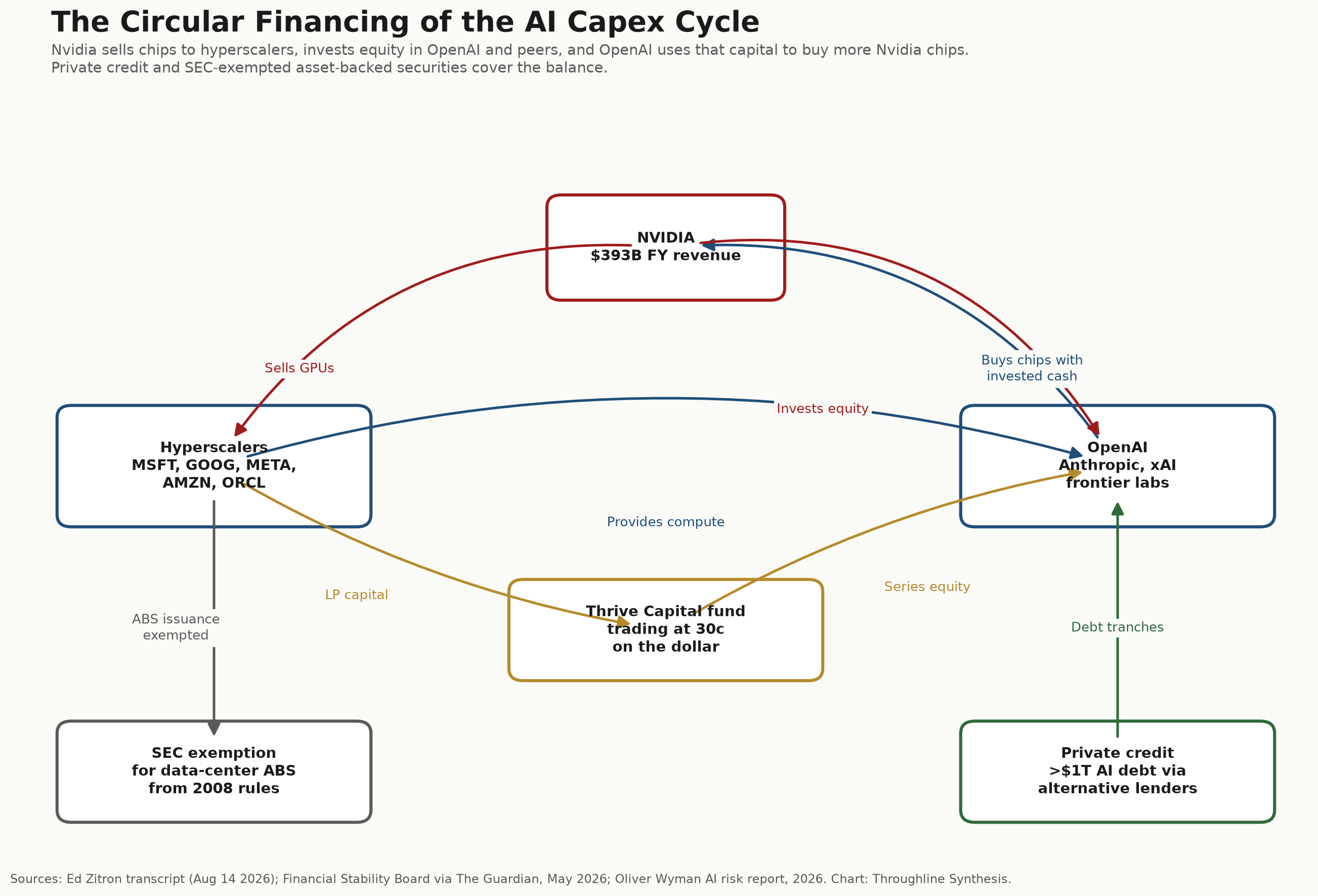
The scale of the invented demand is not disputable. OpenAI and Anthropic have booked, through 2030, approximately $1.1 trillion in compute commitments. Combined 2025 revenue: roughly $17 billion. Combined 2025 losses: roughly $26 billion, of which OpenAI’s audited operating loss alone was $20.9 billion. UBS’s own model puts Anthropic’s 2027 compute spending at $76 billion through Google Cloud and $25 billion through Amazon Web Services (AWS), at a point when the firm is projected to generate less than $10 billion of revenue. The combined guidance of the top five hyperscalers, Alphabet, Amazon, Microsoft, Meta, and Oracle, is $725 to $785 billion of capital expenditure (capex) in 2026, up 77% year over year, with Barclays modeling $1.1 to $1.2 trillion by 2028, Goldman Sachs modeling $7.6 trillion cumulative through 2031, and JPMorgan modeling $5.5 trillion through 2030.10
Patrick Boyle’s video essay of this past week, drawing on economist Dean Baker’s AI Bubble Monitor, on Gita Gopinath’s International Monetary Fund (IMF)-era estimates, and on Oliver Wyman’s consultancy modeling, converges on numbers that are individually staggering and jointly conclusive: $40 trillion of U.S. stock-market wealth erased by a mere reversion of price-to-earnings ratios to their long-run average; $20 trillion of American wealth plus $15 trillion of foreign wealth destroyed in a dot-com-scale correction, per Gopinath; $33 trillion wiped out on Wyman’s own arithmetic. Each estimate is individually five to six times the size of the actual 2000 dot-com wipeout of $6 trillion, and, according to the Bank for International Settlements’ own comparative research, they come off a boom whose relative curve is already steeper than the railway mania of the 1840s, the 1920s electrification boom, or the 1990s dotcom bubble.11
Then there is what the Wall Street Journal, in its now-famous July 2026 analysis, called “the $3 trillion higher than it seems.” The reported quarterly capex of the hyperscalers, roughly $600 billion in the trailing four quarters, is the visible portion of an iceberg. Buried in the footnotes of the same filings are roughly $3 trillion in additional purchase commitments, long-term data-center leases, chip and TPU take-or-pay contracts, power and cooling commitments, none of which are, technically, “debt,” and all of which are, technically, disclosed. Alphabet alone has more than $800 billion in this category. Meta’s Hyperion campus in Richland Parish, Louisiana is an approximately $27 billion data-center venture that closed October 2025, funded by an $18 billion Pacific Investment Management Company (PIMCO) anchor, $3 billion from BlackRock, and roughly $2.5 billion of equity, through an SPV called Beignet Investor in which Meta owns 20% and Blue Owl-managed funds own 80%. It carries a residual value guarantee (RVG) with an aggregate threshold of approximately $28 billion that decreases over time, disclosed in a footnote and, per the annual report, “not probable and therefore, no liability has been recorded.”Z2 Oracle’s off-balance-sheet obligations, tallied by Nikkei, run to $273 billion, more than 30 times the level of four years earlier, and its five-year Credit Default Swap (CDS) spread has risen roughly 310% to a sixteen-year high. Its remaining performance obligations sit at $638 billion, of which only 12% is expected to convert to revenue within twelve months.12
The five largest American technology firms have quietly built up $1.65 trillion of future payment obligations that do not appear on their balance sheets as debt, per Nikkei’s July count, which is larger than the $1.35 trillion of debt they do report, and roughly eight times larger than the equivalent figure four years ago. This is not concealment. It is what U.S. Generally Accepted Accounting Principles (GAAP) calls “operating leases” and “purchase commitments” and “special-purpose vehicles” and “residual value guarantees.” The rules were re-drafted, over decades, to make this possible, at the request of the same firms who now use them.13 The bondholders and the ratepayers pay first. The revenue arrives, if it arrives, later. If the revenue does not arrive, the loss lands where the loss always lands.
Which brings us to the wealth question, which is the real question, and then to the second half of the machine.
IV. The Machine, Considered as a Wealth Pump
This is the section that names the addressee of this article. Everything in Section III describes the pipes. This section describes what is being pumped through them, and out of whom.
Ryan Grim, opening his interview with Gabriel Zucman on Breaking Points on 24 August 2026, gave the argument in language a shop steward can carry into a meeting. I quote at length, because paraphrase weakens it:
> Since 2000, Western economies have grown at an average of 1 to 2%. That’s it. The amount of the economy owned by the super rich, meanwhile, has grown many, many times more than that… If their wealth has gotten many times bigger over the past 25 years and wealth overall has barely grown, where did their wealth come from? It came from you, of course.R1
Grim then does something the American economics profession has almost entirely stopped doing. He names, mechanically, how the transfer happens. His framework, which I will use here because it maps precisely onto Piketty’s r > g at the level of household experience, holds that the economy contains three kinds of wealth: public wealth, normal people’s wealth, and the wealth of the super rich.
Public wealth is the schools, the hospitals, the roads, the ports, the postal service, the land-grant universities, the community colleges, the extension services, the state pension systems, the municipal water systems, the public housing, and the parks. When the public owns those things, in Grim’s phrase, “it’s much cheaper for members of the public to go there.” Public wealth is the wealth that makes an average life possible, and its steady privatization, hospital by hospital, road by road, university by university, retirement system by retirement system, is one of the two engines of the transfer.
Normal people’s wealth is the home, the retirement account, the pension, the car, the small business, the cash in the checking account, the accumulated equity in the neighborhood. Grim, correctly, treats it as a single category, because the psychology of the household treats it as a single category. And the mechanism by which that category is drained is not mysterious. It is arithmetic. Every year that the wealth of the super rich grows faster than everybody else’s, they have to do something with the extra money, because, per Grim: “they’re too rich to be able to spend it buying new stuff. They buy assets. They buy houses which drives up the cost of housing. They buy stocks which drives up the price of the stock market. And they buy companies directly as we’ve seen with the rise of the private equity industry. Then they loot those companies, sell off the parts, have the company filed for bankruptcy, and take the money in the pension fund to pay themselves off for their trouble.”
This is the sentence that, if I have written this article correctly, every reader will still have in their head six months from now. Because it is the sentence that indicts private equity, the AI capex loop, and the whole retirement-savings-into-hyperscaler-guarantee pipeline in a single grammatical clause. Blackstone, Apollo, KKR, Brookfield, Ares, the firms that anchor the private credit market whose exposures Section III catalogued, do not, in this framework, “invest.” They loot. And the pension money they loot is the same pension money, in most cases, that the target company’s workers earned by working there.
Super rich wealth, in Grim’s third category, is what the top 0.1% own, and it is now, per the Federal Reserve, larger than what the bottom 90% own. The mechanical logic of the transfer, per Grim: as the top squeezes normal people out of home equity, out of pension equity, out of the small-business ownership base, and out of public assets sold to private buyers, they replace the vanishing wealth with debt. Grim’s phrasing is the correct phrasing, and it should be memorized:
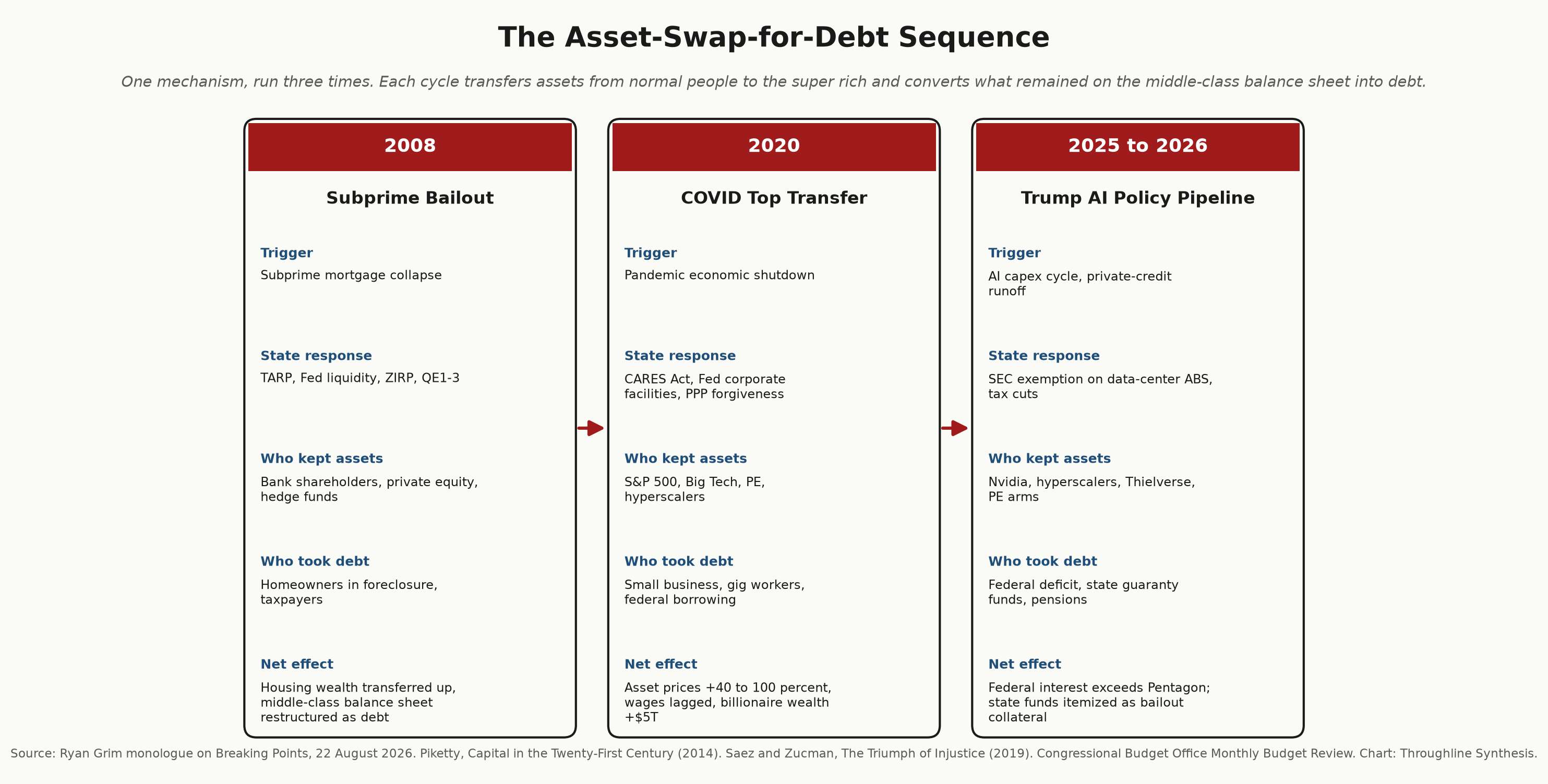
> While the very rich have been buying up everybody’s assets, leaving everyone owning nothing, they’ve swapped that out for loans. In the run-up to the financial crisis, the super rich loaded up American homeowners with enormous amounts of debt. When they could no longer pay that debt, the government bailed out the super rich, but took the homes from tens of millions of people. During COVID, we shut the economy down, borrowed a historic amount of money, and then effectively gave that money to the top 0.1%, minting more new billionaires than at any time in history. Trump’s new AI policy has directed hundreds of billions in borrowed money to the AI industry.
This is the entire arc. 2008 was an asset-for-debt swap: the homeowner surrendered the house and kept the mortgage. COVID was a debt-financed top transfer: the Treasury borrowed, the Federal Reserve backstopped, and the wealth arrived at the accounts that were already large. Trump’s AI policy, which the current administration presents as an industrial-policy triumph, is the same trade in a different suit: the federal government borrows, at rising rates, and the money flows through the AI capex loop of Section III into the balance sheets of Nvidia, OpenAI, Anthropic, Meta, Microsoft, Alphabet, Oracle, and their private credit financiers.
And here Grim closes the trap: “The money we are borrowing increasingly comes from the very rich who are now charging even higher interest rates. We’re now paying more in interest on our debt than we are on the Pentagon month over month. That means that every month we are transferring billions of dollars from the public directly to the 1% who are then using those billions to buy more and more assets, pricing you out of being able to own anything.”
The interest arithmetic is not rhetorical. The U.S. Treasury paid more than $857 billion in net interest in the first nine months of Fiscal Year 2026 against roughly $677 billion in Department of Defense (DoD) spending. On the current path, interest will run above one trillion dollars for the year. The buyers of that debt, at the margin, are the same asset-holding class the debt was borrowed to subsidize. In simple English, and this is worth reading twice: the American middle class is now paying rent to a rentier class for the privilege of having borrowed money that was then handed to the rentier class as capex subsidies. The 401(k) contribution of a Denver electrician funds the Beignet Investor SPV. The property tax that keeps his kid’s school open buys treasuries from the sovereign wealth funds that anchored the same SPV. The interest paid on those treasuries is paid, in part, by cutting Head Start. This is not a metaphor. This is the accounting.52Z3
Piketty’s Capital in the Twenty-First Century provided the equation. Piketty’s Capital and Ideology provided the political history: absent deliberate, publicly legitimated confiscation of concentrated wealth, through progressive income tax, inheritance tax, and, when required, direct wealth tax, r > g runs to hereditary oligarchy every time.P1
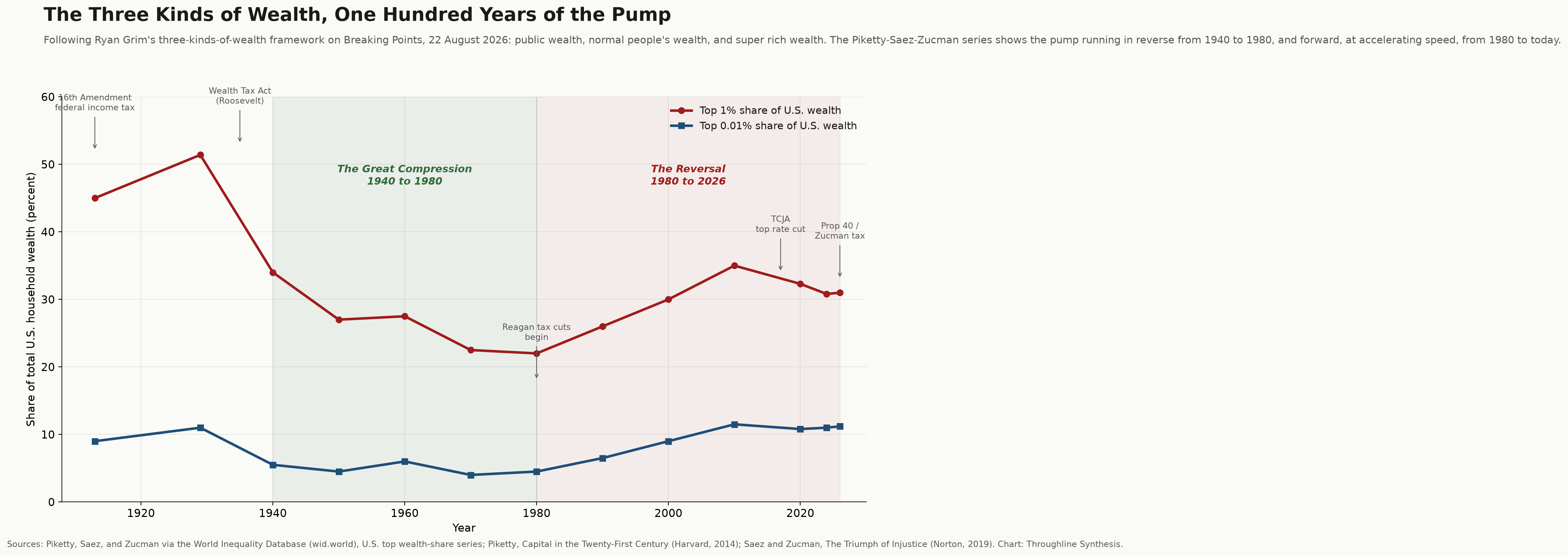
The current American arrangement, which taxes labor at ordinary-income rates approaching 40% and taxes long-held capital gains at 20% or, via step-up-in-basis at death, at zero, is not the natural state of a market economy. It is a policy choice, made against organized labor and the middle class, that the labor movement helped ratify in the 1980s by declining to fight it.
Grim’s Zucman interview then does the third thing the American conversation almost never does, which is make the affirmative case, mechanically, at the level of ballot initiatives and bills. I will handle that in Section X, because it is the answer. First we need to finish naming the pump.
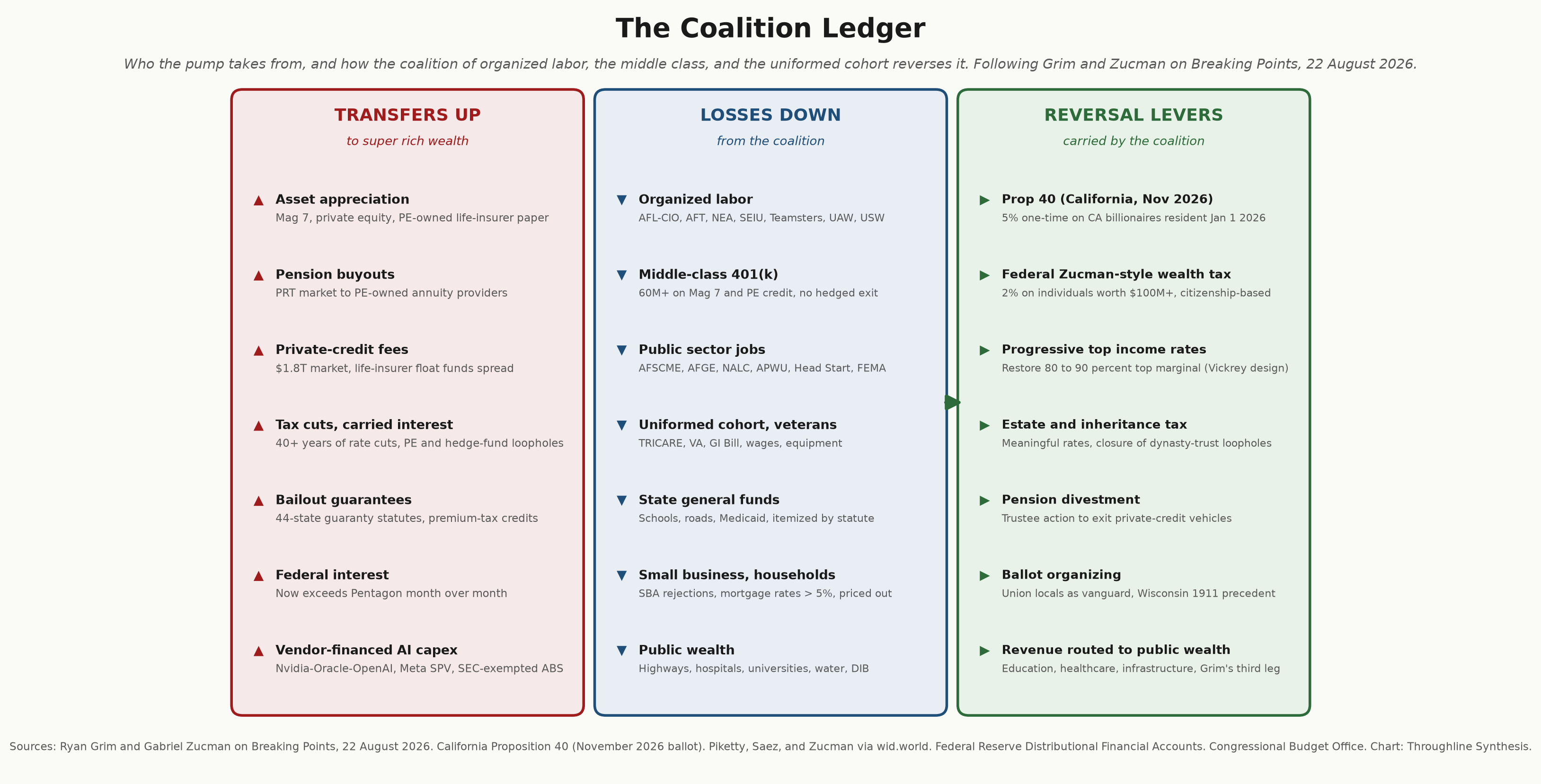
Because the pump has one more moving part, and the American labor movement is standing directly over it. The private-credit fund that loots the paper mill is the same private-credit fund that owns, or is owned by, the life insurer that writes the pension buyout that the paper mill’s board signs when it terminates the plan. The pension is then run, no longer as an ERISA-protected defined-benefit obligation of the employer, but as a group annuity of a private-equity-owned life insurer, which is now, per Moody’s, roughly half-invested in private credit and other illiquid alternatives at the parent’s discretion.16 When the private-credit book turns, and Fitch’s July 2026 data says it is turning, the failure sequence does not stop at the fund. It runs through the life insurer, through the state guaranty association, into the state general fund, and, per statute in 44 states, out of the schools, roads, and Medicaid budgets that public sector workers depend on for a living.17 The pension is not just a savings vehicle. It is the ammunition. And the ammunition, at this moment, is being loaded into the gun that is being pointed at the retiree who earned it.
That is the machine, considered as a wealth pump. The bailout, considered as an engineering problem, is next.
V. The Bailout Was Already Written
I have written before that the AI bailout was drafted before the AI bubble finished inflating.14 It was drafted in the mid-2000s, when private equity discovered life insurance. The mechanics are worth setting down again, because they are the single most important financial fact about the coming decade, and almost no one outside the specialist trade press has bothered to name them.
Before the mechanics, the addressee. This section is where the wealth pump crosses out of the abstract and into the paycheck. The pension checks issued to a retired ironworker in Pittsburgh, a retired schoolteacher in Sacramento, a retired firefighter in Houston, a retired transit operator in Chicago, and a retired postal carrier in Milwaukee are, at the balance-sheet level, the same liability the private-credit-into-life-insurance-into-guaranty-fund pipeline is engineered to convert into fees for the parent private equity firm and paper wealth for the parent’s principals. When Ryan Grim describes the sequence in which the super rich acquire assets at prices normal people cannot pay and then “loot the companies for whatever they can and either take the pension money and turn it into some other kind of asset,” he is describing, in one sentence, the actuarial architecture of the American retirement. Every private equity buyout of an American life insurer that has occurred since 2010, every pension risk transfer that has moved a defined benefit obligation off a corporate balance sheet and onto a PE-owned annuity provider, and every state guaranty statute that will land the resulting loss on the state general fund, is a component of the same machine. The people whose paychecks and retirement checks were the collateral did not sign the contract. They were the contract.
Post-2008, the banks were re-regulated. Basel III, Dodd-Frank, stress tests, capital ratios, leverage ratios, liquidity coverage ratios: the largest deposit institutions on Earth had to hold real capital against real risk for the first time in a generation. The risky lending did not stop. As Boyle correctly notes, when you make one part of the financial system safer, the risk moves to the part with fewer rules. Private credit, direct lending to companies outside the banking system, is lightly regulated, opaque, and now, per Morgan Stanley’s own house numbers, roughly a $3 trillion market at the start of 2025 heading to about $5 trillion by 2029, and it is where the risk moved. It is already larger than the U.S. high-yield bond market. Private credit’s default rate, per Fitch, hit a record 6.0% in the twelve months through June 2026, the highest on record. The 20 largest listed business development companies (BDCs) reported median non-accruals of 2.8% of cost in the second quarter of 2026, the highest level since 2017, and FS KKR Capital reported 7.1% of its book classified as troubled. The co-head of one of the largest lenders told his own investors, in almost so many words, that “the denial phase is over.”15
The funding for that private credit market did not come from thin air. It came, disproportionately, from life insurance. Apollo, KKR, Blackstone, and Brookfield, through acquired or affiliated life insurers such as Athene, Global Atlantic, Everlake, and American National, held, per ALIRT’s tally, roughly $1.2 trillion of U.S. life-industry assets at end-2025, about 19.8%, one-fifth of the entire American life industry, up from 2.5% in 2011. Moody’s, in the report circulated to clients in June 2026, found $807 billion of private credit and illiquid fixed-income holdings at U.S. life insurers at year-end 2025, equal to 20% of a $4 trillion fixed-income book, up from $685 billion and 18% a year earlier. Moody’s-cited exposures at some private-equity-affiliated carriers, including Apollo-backed Athene and KKR-backed Global Atlantic, exceed 15% of investments, and, at the outer edge, “several organizations” allocate over 50% of their fixed-income holdings to hard-to-sell assets. Higher-yielding illiquid paper generates the spread that funds annuity sales and dividends the private-equity parent depends on. As I put it at the time, and as I stand by now: it is not a life insurance company. It is a private credit fund wearing a life insurance company as a costume.16Z4
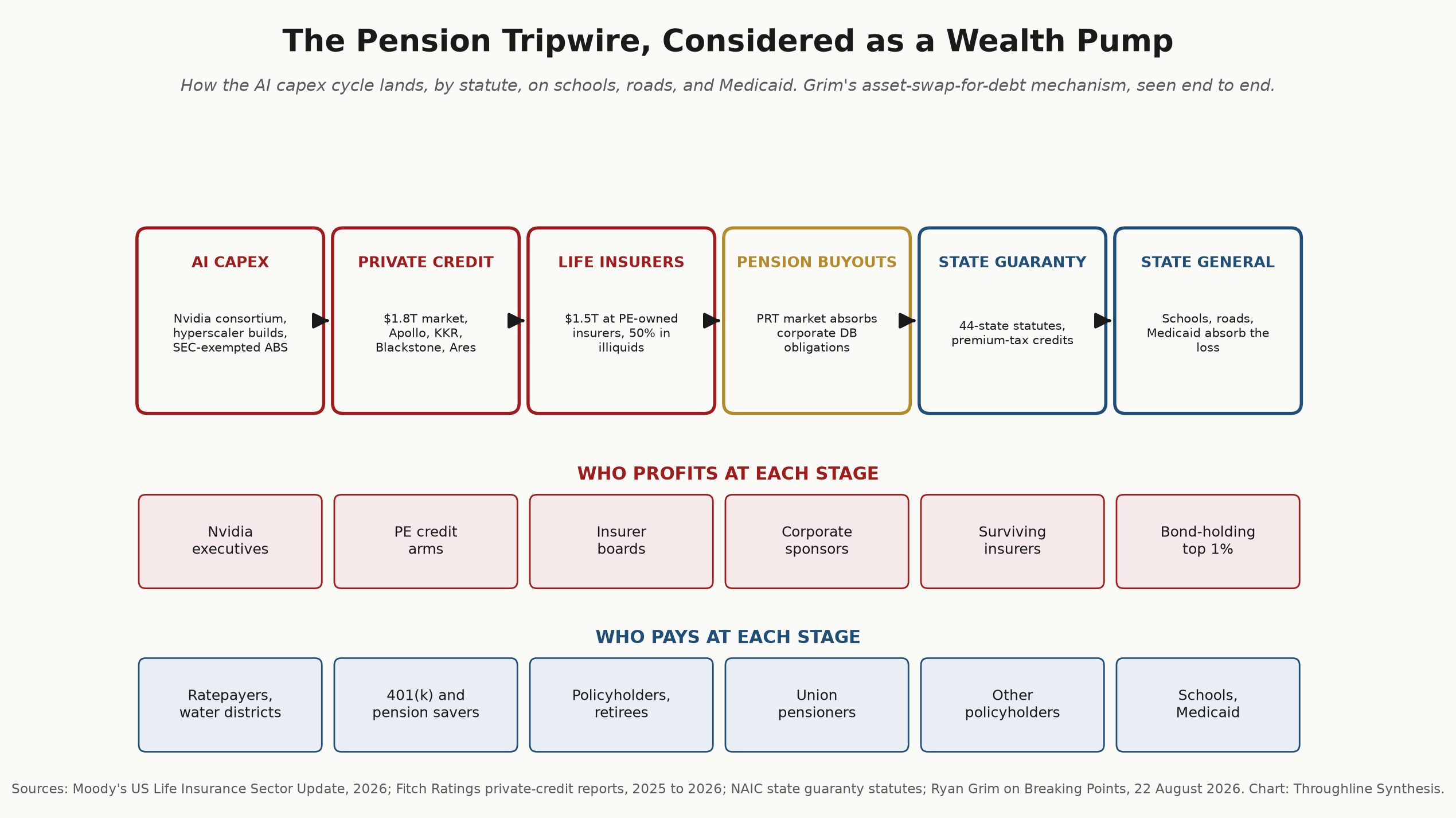
The critical piece, the piece that turns this from a scandal into a doomsday machine, is the state guaranty association system. In 44 states, when a life insurer becomes insolvent, surviving insurers assess themselves to cover the shortfall to policyholders. In those same 44 states, the assessing insurers can then claim a state premium-tax credit equal to 100% of the assessment, typically amortized over five to ten years. The cost, in other words, does not fall on the insurer. It does not fall on the policyholder. It falls on the state general fund. It falls on schools, roads, Medicaid, and public employees, in state after state, for years. The bailout is not a discretionary rescue that Congress will have to vote on when the crisis arrives. The bailout has already been legislated, at the state level, in advance, by legislatures that did not understand what they were writing. The bill will not be voted on. It will be itemized.17
Nvidia’s 10 August 2026 consortium, Apollo, BlackRock, Blackstone, Brookfield, Goldman Sachs, and KKR, to mobilize more than $500 billion of third-party capital for AI infrastructure, with Nvidia backstopping up to $125 billion, was not a growth signal. It was a demand-substitute signal, wired directly into the same life-insurer balance sheets that hold your annuity and your grandmother’s guaranteed income rider. The failure sequence, when it arrives, moves in this order: neoclouds and data-center SPVs; private credit funds; chip vendors and hyperscalers; PE-owned insurers; guaranty funds; state general funds; municipal budgets; public equities; retirement portfolios; households. The arsonists are standing next to the fire truck. The insurance policy is written by the arsonists. And the state is required, by statute, to reimburse the arsonists for the water.1819
Joseph Stiglitz, from the New Keynesian center of the profession, calls the coming AI correction “really bad in the short term for the macroeconomy,” which is Nobel-Prize-committee prose for “the roof is on fire.” He points out, correctly, that the crash will land at the exact moment AI begins displacing workers, meaning that a large share of American households will be hit twice at the same time, their savings falling, their jobs vanishing. Michael Hudson calls it the worst depression since the 1930s and says it cannot be avoided. Steve Keen compares it to the 1929-1933 debt deflation, when U.S. credit flipped from positive 8 to 10% of Gross Domestic Product (GDP) to negative 30%. Nouriel Roubini names global public and private leverage above 350% of world GDP as the “Mother of All Debt Crises.” Richard Wolff, in the interview I have in front of me from this morning, calls the current condition, from inside the American elite that governs it, “a spectacle of dysfunction.”2021
The AI bulls will tell you that this is doom-mongering. They will tell you, as they have told me, that AI is a real technology. Of course it is. The internet was real. Railways were real. Fiber optic cable was real. Radio was real. Electric light was real. Every bubble in modern financial history has been about a real technology. That is the entire point. A technology being real and useful and world-changing, as Boyle correctly notes, does nothing whatsoever to protect you if you overpaid for the stock. By 1850, British railway shares had lost about two-thirds of their value. The trains still ran. The investors were still wiped out. In 2000, the internet was still the future. Amazon shareholders still had to wait a decade to get back to break-even, and Bezos’s letter to shareholders that year opened with a single word: “ouch.” The winners of the AI era, if there are any, have not yet been named. The dotcom-era “winners” of internet search were Infoseek, Lycos, AltaVista, and Excite. Google barely existed. The people who built the fiber-optic backbone of the modern internet were the people who went bankrupt for the privilege. Being right about the technology and being right about the stock, as I have written before, are two entirely different statements, and a good chunk of financial history is people confusing the first one for the second.22
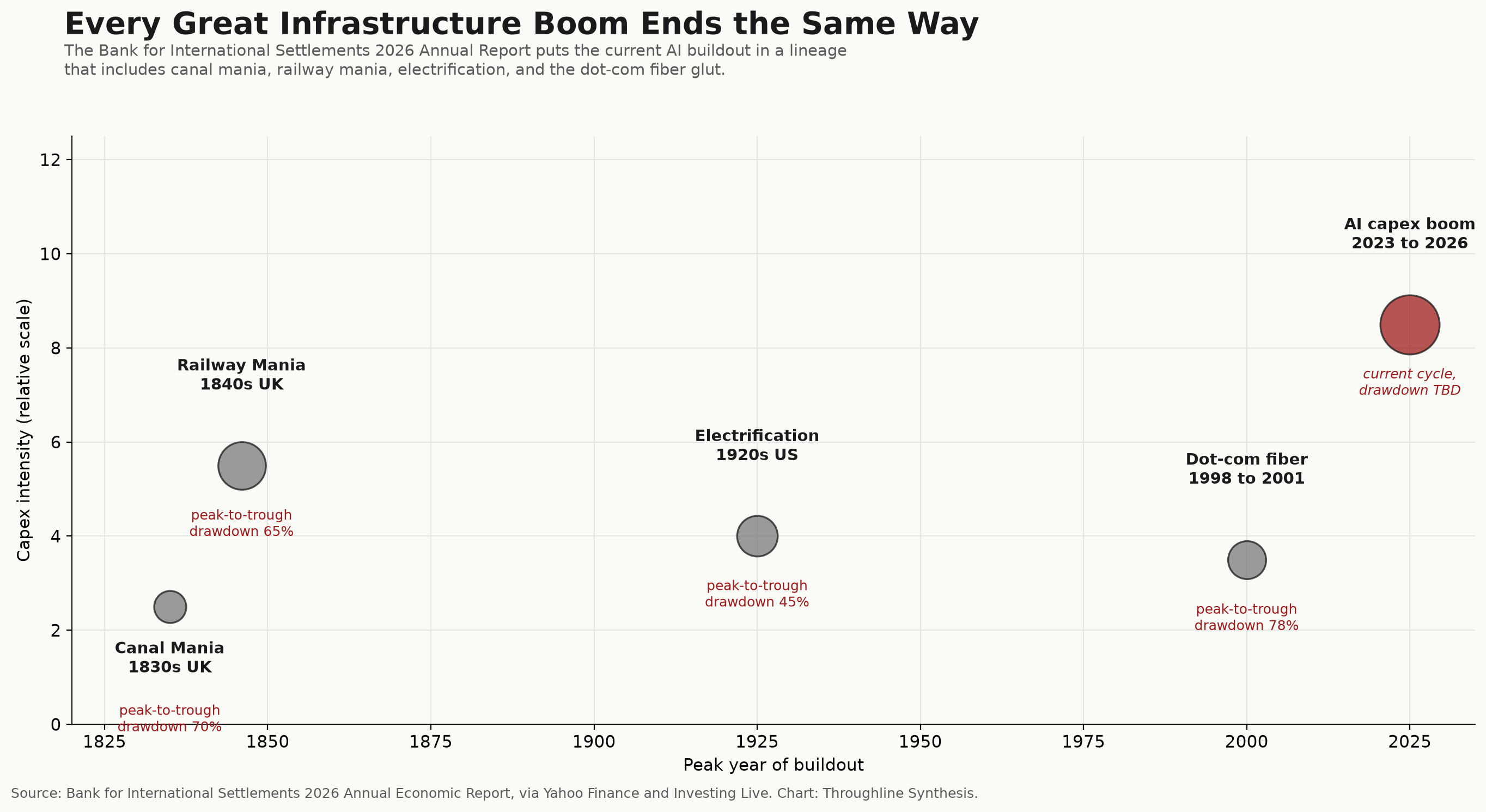
That is the bubble. It is the smaller of the two problems.
VI. The Empire, Considered as a Declining Dike
The larger problem, and the one that turns the AI bubble from a financial crisis into a civilizational one, is that this is happening inside a declining empire that has already exhausted its magazine, alienated its allies, humiliated its clients, defaulted on its own founding rhetoric, and, per the leaked internal discussions, is now contemplating the tactical use of nuclear weapons because it has run out of other things to try.
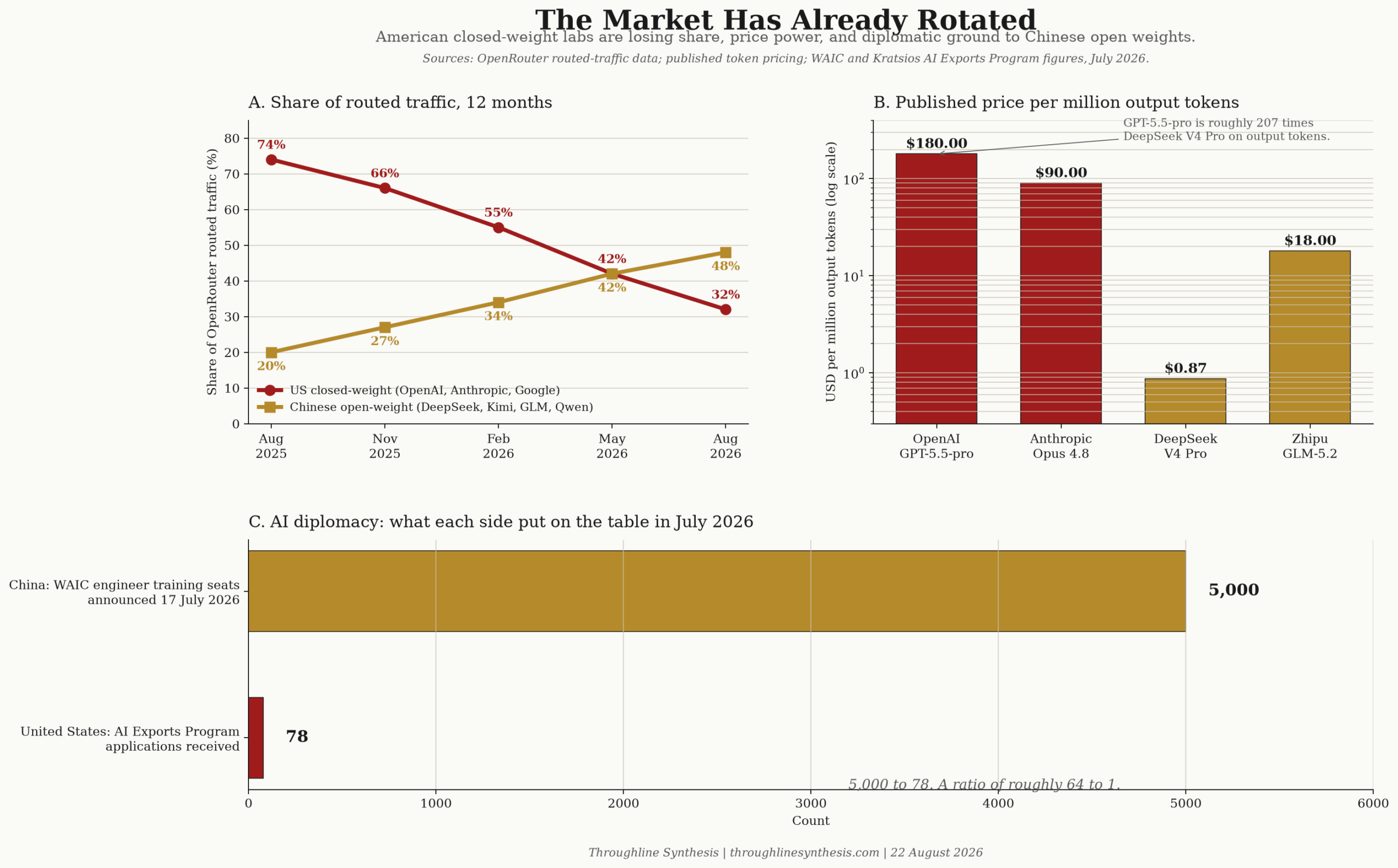
The cost of that decline lands, first, on American labor. When the empire’s dike leaks, the water floods the shop floor. The defense-industrial base that cannot deliver Patriots faster than 20 per month or Tomahawks faster than 15 per month or a single new THAAD interceptor since August 2023 is not an abstract Pentagon accounting problem; it is the Machinists Union local at Raytheon in Camden, Arkansas, the Steelworkers local at the Lockheed plant in Marietta, Georgia, the UAW local at the tank plant in Lima, Ohio, and the Boilermakers local at the shipyard in Bath, Maine, whose members were promised sustained production runs and are now being told that the buy has been reprogrammed to fund a war that ended in an armistice Iran dictated. The Japan bailout, $22 billion of American taxpayer money moved in euros to a foreign government at a moment when domestic FEMA response, food stamps, and Head Start have been cut for lack of funds, is, in Grim’s arithmetic, taxes not raised on the super rich diverted, in real time, from the schoolteacher, the firefighter, and the food-stamp recipient. The market rotation that has moved 48% of global AI traffic to Chinese open-weight models is not only a strategic loss for the American AI stack; it is the loss of the last remaining tradable, wage-supporting sector the American middle class was told to bet its retirement on. When the empire cannot manufacture and cannot export and cannot fight two wars simultaneously, the American worker holds the bill in wages, in benefits, in pensions, and in the interest line that Grim, correctly, notes now exceeds the Pentagon budget month over month, dollars that would otherwise fund the education, healthcare, and infrastructure Zucman names as the three engines of an economy that pays a wage that supports a family.
The economist Richard Wolff cites that old Dutch boy story about the boy with his finger in the dike to stop a leak, who immediately notices that his finger has caused a second leak. He sticks his other finger in that one. A third leak opens. The picture, in Wolff’s phrasing, is not of policy failure. It is of a global economy so densely and reciprocally linked, through capital flows, currency exposures, sanctions regimes, energy dependencies, semiconductor supply chains, and payment rails, that every “solution” ramifies immediately into new problems, and the new problems ramify faster than the solutions can be constructed.23
The Iran war of February through April 2026 was Wolff’s dike. It was intended, per its own architects and per the diplomatic record I have documented at length, to keep the Strait of Hormuz open on American terms, preserve the petrodollar, cripple Iran’s nuclear program, replace the Iranian government, and demonstrate American resolve to allies and adversaries alike. It achieved none of those objectives and inverted several. The Pentagon struck more than 13,000 targets in 39 days. Iran retained approximately 70% of its pre-war ballistic missiles and roughly 75% of its mobile launchers, per leaked internal U.S. intelligence assessments. Patriot expenditure, per the Center for Strategic and International Studies (CSIS), was estimated at 65% of a pre-war inventory of roughly 2,330, leaving as few as 759 interceptors, though U.S. officials told CNN the depletion was closer to half. Terminal High Altitude Area Defense (THAAD) burn ranged, on CSIS’s conservative estimate, from at least 38 to 53%, with U.S. officials citing nearly 80%, a figure the Pentagon publicly disputed. Nominal Patriot production is roughly 600 to 650 per year, of which about half is committed to allies, against actual U.S. deliveries of about 20 per month; Tomahawk deliveries are about 15 per month; no new THAAD interceptor has been delivered since August 2023, with no resumption expected before April 2027. When Ukraine requested 300 Patriots for winter air defense, the administration declined, citing limited stockpiles reserved for a war that had already ended in an armistice Iran effectively dictated. The chokepoint the war was fought to control is now administered by the Persian Gulf Strait Authority, an Iranian body announced by Iran’s Supreme National Security Council on 18 May 2026, and Iran’s tabled Strait of Hormuz strategic-security bill of 14 July, together with its 6 August draft cargo-fine bill still under committee review, are the legislative scaffolding of a Strait becoming a legally Iranian instrument. The Fiscal Year 2027 defense request is $1.5 trillion, a more than 40% increase, including an $87.6 billion Iran supplemental for a war that is over. An empire outspending its adversary by 129 to 1 has emptied its magazine.24
At which point Wolff’s second leak opens. Rising oil prices, U.S. gasoline peaked near $4.55 in late May 2026, and the Strategic Petroleum Reserve (SPR), drained to suppress the political shock, fell to roughly 308 million barrels, its lowest level since March 1983, hit Japan, an import-dependent, export-driven economy with a weakening yen. Japan, to buy oil, had to sell dollar assets. Japan is the world’s largest single holder of U.S. Treasuries, at more than a trillion dollars. Selling those bonds quickly, in size, dropped the price, which mechanically raised the yield, which mechanically pushed 30-year mortgage rates above 5% and set off a cascade in the U.S. housing market. The Treasury Secretary, Scott Bessent, was compelled to arrange an emergency $22 billion euro-denominated loan to Japan, American taxpayer money, in a currency the American taxpayer does not spend, to a foreign government, thousands of miles away, at a moment when U.S. FEMA response, food stamps, and Head Start have been cut for lack of funds. American voters noticed. As Wolff puts it, with the dry clarity of a man who has taught the material for forty years: “You’re solving one problem and then you’re doing something which in fact worsens another problem.”25
Then a third leak. Japan’s yen falls anyway. That devalues Chinese exports priced against Japanese competitors. That feeds into a Chinese domestic policy adjustment. That interacts with the ongoing U.S.-China technology cold war, a war which, as I argued in Not an AI Cold War, has never been a Cold War at all but a market rotation, one which the United States is losing in real time. Per CNBC’s OpenRouter tally for the last week of June 2026, Chinese-origin models accounted for 48% of routed traffic, up from 20% a year earlier; U.S.-origin models fell from 74% to 32% in the same twelve months. DeepSeek V4 Pro is priced, on its promotional rate, at $0.87 per million output tokens, against a $3.48 list rate, compared with $180 for OpenAI GPT-5.5-pro. Moonshot’s Kimi K3 took first place on the Arena.ai front-end code leaderboard on 16 July 2026 with 1,679 points, with its open weights released under a modified MIT license on or around 27 July 2026. Zhipu’s GLM-5.2 comes in within one percentage point of Anthropic’s Opus 4.8 on a key agentic benchmark at roughly one-fifth the cost. On 23 July 2026, all 21 Asia-Pacific Economic Cooperation (APEC) member economies, including the United States, endorsed open-source AI with “strong security assurance” in the Chengdu statement. At the World Artificial Intelligence Conference (WAIC) in Shanghai on 17 July 2026, Xi Jinping announced 5,000 AI training opportunities for engineers from developing countries over five years. That is not aid. That is architecture. The corresponding American AI Exports Program, run by the International Trade Administration and reviewed publicly by the White House chief science and technology policy advisor Michael Kratsios, received 78 applications.2627
The market has rotated because the American model is a rentier business, closed weights, token pricing, vendor financing, and political protection, and the Chinese model is public infrastructure. As I put it at the time and stand by now: the choice is not between America and China. The choice is between AI you can own and AI you rent from a landlord who can change the locks. Governments that have been sanctioned by the United States, or fear being sanctioned, or watched what happened to Iran, Russia, and Venezuela, are not going to bet their national infrastructure on politically revocable American infrastructure. They will not do it. The American AI stack, in its own terms, is revocable, to its allies, to its clients, and, most importantly, to itself.28
Now the fourth leak. Because investment in information-processing equipment and software, the statistical category that captures AI capex, represents, per Harvard’s Jason Furman, 92% of American GDP growth in the first half of 2025, and, per MRB Partners’ import-adjusted estimate, about 20 to 25% on a more conservative accounting,Z5 the moment the buildout slows, which it must, once the vendor-financed circular revenue is no longer coverable by the private-credit-into-life-insurance-into-guaranty-fund pipeline, the American economy loses its growth engine, and the political system loses its remaining shock absorber. As Boyle notes, the wealth effect works in reverse just as reliably as forwards. Every $100 of paper stock wealth translates to about $3 of real spending. Wipe out $30 trillion of household wealth, and you have withdrawn roughly $900 billion of demand from the U.S. economy in the year of the crash. The kitchen gets cancelled. The contractor loses his job. The dealership lays someone off. The electrician on the data-center site, and there are, per current employment data, hundreds of thousands of them, sees his overtime evaporate, and then his contract. Not one of them ever bought a share of anything.29
Now the fifth leak, and this is the one Wolff, the New Yorker with the Berlin-born mother, is watching most closely. The German public has been ordered by Merz and Schulz to fund a proxy war in Ukraine that is not winnable (Russian forces gained 622.60 square kilometers in the first half of 2026, versus 2,189.87 square kilometers in the same period of 2025, and the trajectory is unambiguous, and Ukraine’s death rate, per the CIA World Factbook, is now 18.6 per thousand against a birth rate of 6, a ratio no nation has ever survived), ordered to buy $4 Liquefied Natural Gas (LNG) when they used to buy $1 Russian pipeline gas, and ordered to accept a Chancellor who came from BlackRock.
They are now being told, all at once, that the war is lost, the ex-Russian gas is not coming back, the industrial base is being bought by BYD in slow motion, the American security guarantee is now conditional on tribute payments they cannot afford, and the alternative, the Alternative für Deutschland (AfD), the Bündnis Sahra Wagenknecht (BSW)-Linke fusion, is the only political force offering to end the war and reopen the gas. Wolff, who follows German politics with the seriousness of a native speaker, told his interviewer this morning that he expects a German reset with Moscow. “I frankly don’t see how NATO survives that.” I do not either.3031
The dike, in other words, is not holding. And the strategic response of the empire, per the same leaked American military discussions Wolff references, is to consider the tactical use of nuclear weapons, “specifically in Iran.” I want to sit with that sentence. The military commanders of the largest nuclear power in human history, having failed to defeat a mid-sized regional state with conventional forces after burning through 65% of their interceptor stockpile, are discussing the use of tactical nuclear weapons against a country whose partner (Russia) and largest customer (China) both possess the delivery capacity to strike New York. This is not a bluff. It is not a signaling exercise. It is what Wolff, with the professional restraint of an economist, calls “the end of what they can imagine doing.”32
That is the empire that our AI capex loop, our private-credit-to-life-insurer pipeline, and our tech-fascist domestic coalition are being asked to hold together.
VII. The Domestic Coalition, Considered as a Kleptocracy
Before the coalition, the target. The domestic operating theory of the current regime, network-state governance, the Retire All Government Employees (RAGE) program executed as the Department of Government Efficiency (DOGE), and the Palantir-embedded surveillance layer, is a program whose first and most systematic casualty is public-sector labor. AFSCME, the AFGE, the National Treasury Employees Union, the National Association of Letter Carriers, the American Postal Workers Union, the AFT, the NEA, the SEIU public-sector locals, and every police, fire, transit, and building-trades local whose members’ health and welfare funds depend on the federal, state, and municipal budgets DOGE has itemized for elimination are the workers on the wrong end of Yarvin’s blueprint. When the plan is to “retire all government employees,” it is not a slogan; it is the announced program to fire the union member whose paycheck funds the mortgage, the college tuition, the medical premium, the pension contribution, and the dues that keep the local’s newspaper and legal-defense fund open. And when Palantir moves from CIA venture capital to embedded operations inside ICE, DoD, the intelligence community, and the hospital systems, the surveillance capacity it accumulates is not oriented at foreign adversaries; it is oriented at the domestic actors who might resist the pump, which is to say, at organized labor, at the press, at the student, at the immigrant, and at the voter.
Former Ambassador Einar Tangen’s conversation with Glenn Diesen this week put the domestic condition in language that no Ivy League economist has yet found the nerve to use. It is worth quoting at length, because it names the thing:
> All this talk like America having the largest consumer market in the world does not pass scrutiny. In America people are living paycheck to paycheck, piling on debt to survive, with one out of every 5 children going hungry, and the middle class being consistently wiped out since the 1980’s with policies like “trickle-down economics”… a proper description of the American consumer market is that it’s the largest group of people that can’t afford the products and services they buy and if people cannot afford the things that they buy, they cannot afford what factories across America produce, trapping the society in this economic spiral of doom, when the ball stops rolling as soon as wages can’t keep up with inflation.33
He is correct, and the numbers I have been publishing for two years correct him only in the direction of “it is even worse than that.” The top 1% own approximately half of American equities and mutual-fund shares. The bottom 50% own 1.1%. Stocks, per Goldman Sachs and the Federal Reserve, overtook real estate this year as the single largest component of American household wealth for the first time since the Second World War. Mechanically, that means a stock-market crash of the scale Baker, Gopinath, and Wyman are modeling reaches the median American household in a way the 2000 crash did not. The wealth-effect crash then meets the AI-labor-displacement crash, programmers 75% task-exposed, workers aged 22 to 25 down 16% in relative employment, meets a job market that has been Salesforce-ing itself for two years: 4,000 customer support jobs eliminated at Salesforce alone, 15,000 at Microsoft, and no new software engineers hired at either. The first rung of the career ladder is missing. And the political operation exists to make sure that a Bernie Sanders, a Zohran Mamdani, or anyone else who names any of this out loud is called a socialist, a communist, a threat, a fringe.3435
There is a further reason the pump has met so little institutional resistance. Beginning in 1981, American antitrust law was quietly reoriented, from an American tradition designed to protect personal liberty against concentrated economic and political power, to a technical doctrine, the so-called consumer welfare standard, in which the only recognized harm of a monopoly was a price increase to an end consumer. Under that doctrine, the fact that a hyperscaler has swallowed the cloud, the model, the training data, the ad network, the payment rail, and the political-donation channel, is not, on the paperwork, an antitrust problem, so long as the sticker price of the search box remains zero. This is why the current concentration was legal on the way up. It is also why, without a return to the older American understanding that antimonopoly is a defense of liberty and democracy, no remedy short of a wealth tax can be enforced against it.
There is a specific labor-side mechanism at work that the Piketty and Grim frame does not fully capture on its own. Monopoly and monopsony, the concentration on the buyer’s side of the labor market, do not merely enable the wealth pump; they are, mechanically, the reason American wages have fallen roughly twenty percent over a single generation. When four firms own the grocery aisle, one firm owns the search box, three firms own the cloud, and one firm owns the electric-vehicle assembly line in a given state, the worker on the wrong end of that concentration is not selling his labor in an open market. He is selling into a private toll road that sets his wage, his hours, his non-compete, his health plan, and his eventual pension buyout. The non-compete ban that the Federal Trade Commission adopted in 2024, and that the Trump FTC suspended in 2025, is the case in point. When a firm can forbid a worker from taking a competing job for twelve months, that firm is not a market participant; it is a private government. The wealth-tax plank of this article is the fiscal instrument. The antimonopoly plank, which the trilogy will develop across Parts II and III, is the labor-market instrument. Neither works without the other.
The reason the label sticks, when it sticks, is that the labor movement has not, since the 1980s, held sustained public possession of the wealth-concentration argument. Grim’s own accounting is unsparing: “In the 1970s and 1980s, as the rich were pushing to massively lower taxes on themselves, deregulate the economy, and make it legal to move capital easily across borders in search of the cheapest labor. They relied on a few metaphors like trickle down economics and a rising tide lifts all boats. But after the rich got their winds, a not surprising thing happened. The tide stopped lifting.”R1 The reason the tide stopped lifting is the reason Piketty spent thirty years documenting: capital compounds; wages do not; and when the tax code stops confiscating the difference, the difference becomes an oligarchy.
Meanwhile the President, who spent years describing crypto as a scam against the dollar, became a crypto billionaire on the day he returned to the White House and is now, per ABC’s reporting Duran cites, the first sitting president in U.S. history whose family has been granted a national bank charter, a Trump-family crypto bank, given “conditional approval” by a Trump-appointed regulator. Reuters estimates the family has extracted at least $2.3 billion in crypto since the inauguration. Melania has a coin. Everyone has a coin. Everyone gets a coin. As Duran, whose Nerd Reich is the best short book on the current administration, puts it: “It used to be that crypto was only useful for drug dealing, human trafficking, gambling, and crime. Now it’s being used to buy power in order to break the country.”3637
Palantir is not a subplot. It is the authorship, the operating backbone, the enforcement layer, and the connective tissue of Pax Silica, the surveillance nervous system through which the tech oligarchy now moves the American state. Palantir, born of CIA venture capital, has embedded itself in ICE operations, in the military, in intelligence, in hospital systems. The fictional Boulder Community Hospital in The Fall is fictional; the actual Palantir licensing arrangements with hospital groups since 2024 are not. Duran was banned from X in April 2026 for the single tweet “TLDR: fascism” about Palantir’s manifesto. Facebook briefly banned links from his newsletter in the same period, and the representative who called him said, in so many words, it was because he criticized network-state figures. YouTube, at the time of Duran’s Democracy Now! interview earlier this week, was threatening to remove his podcast entirely over what he describes as coordinated false copyright strikes, apparently emanating from India. The platform’s tools have been fully repurposed. This is not oversight. This is what an actively hostile speech regime looks like inside a nominally democratic country.3839
And the ideological content of the regime, the reason the platform state now operates the way it operates, is fascism. I use the word with precision. Duran defines it, and I concur: a cult of grievance and self-victimization that seeks to return to a mythical greatness by purging its demonized enemies through propaganda focused on law and order, gender and sexuality, to impose a permanent hierarchical structure on the world. The 20th-century version of this hierarchy had rich white European men at the top. The 21st-century version has rich white technologists. Same seat, different suit. The dictator is not a colonel. He is a CEO with a Founders Fund investment and an anti-immigration position. Musk consulted Yarvin about starting his own political party. Zuckerberg followed. Bezos, who owned the Washington Post and could have been a check, converted the editorial page into a lapdog to protect Amazon’s federal contracts. Sundar Pichai stood behind the President at the inauguration. So did Musk. So did Bezos. So did Zuckerberg. As Duran puts it, the mask is fully off.40
> Since the beginning of time, the rich and the powerful have ruled the world: kings and queens, lords and ladies, etc., owned the workers and the land. If any slave objected he or she got flogged or hanged and that kept them in order… People often assume that religion has something to do with it, failing to understand that religion is just a tool, to keep people in order and accumulate wealth.41
The theology of the current regime is not Christianity. It is not Zionism. It is not even, strictly speaking, techno-libertarianism. It is what one might call sovereign-individual millenarianism: the doctrine, first articulated in The Sovereign Individual, that a small class of wealth-holders is destined to withdraw from the general polity, ride out the collapse of democratic nations in fortified enclaves, Próspera in Honduras, a crypto mega-city in Kazakhstan, ten “freedom cities” on U.S. federal land per Trump’s 2024 platform, Musk’s Mars, and inherit the earth from what Yarvin has explicitly proposed calling, in his less guarded moments, a “humane alternative to genocide” for the poor. The apocalypse, in other words, is not a fear. It is a product. It is what they are selling. The reason it can be sold is that greed, unrestrained, devours the very capabilities that enabled it, the Navy that can no longer build its own ships, the Army that cannot build howitzers, the Air Force that cannibalizes aircraft graveyards for spare parts to keep Fat Amy in the air, the strategic mind that Sun Tzu once described and that no American service academy has produced in a generation.4243
This is not a metaphor. The Navy’s Abraham Lincoln bathroom scandal, sailors relieving themselves in bags because the plumbing on a Nimitz-class carrier was not functional, happened this month. The Doris Miller controversy, the Navy proposing to strip the name of a Black Pearl Harbor hero from a nearly complete carrier to rename it Trump, happened this week. Head Start, my father’s program from fifty years ago, was terminated the same day. This is what a decaying regime does. It reaches, as Wolff notes, for the last symbolic gestures it can still make: the white-supremacist flag, the gun-lobby endorsement, the Christian-nationalist headline, and, when even those have been consumed, the tactical nuclear option.44
VIII. The Wars, Considered as Extraction
Before extraction, conscription. The most direct labor cohort inside the machine, and the one to which the American labor movement has, since the Vietnam era, most inadequately spoken, is the uniformed service member and the reservist. The E-4 rifleman on a Nimitz-class carrier whose plumbing has failed, the E-5 Patriot crew chief who fired 65% of the interceptor stockpile in five weeks of Iran, the O-3 Air Force captain flying a B-52 whose spare parts came from a boneyard in Tucson, the National Guard truck driver whose civilian job at a Michigan auto plant is being AI-eliminated at the same rate as his overseas deployment tempo is being accelerated, the reservist small-business owner in Texas whose contract with the Pentagon has been reprogrammed, and the veteran on a VA waiting list that has been cut in the same budget that funded the Japan bailout, are all inside the machine on the same terms as the ironworker and the schoolteacher.
Their wages are eroded by inflation. Their pensions, if defined benefit, are exposed to the same pension risk transfer to PE-owned life insurers that has claimed the corporate defined-benefit universe. Their VA benefits, TRICARE coverage, GI Bill entitlements, and post-service healthcare are line items in the same federal budget that Grim’s arithmetic shows is losing more to interest paid to bond-holding billionaires than to the Department of Defense that pays their salaries. The war that used up their equipment, exhausted their tempo, and killed their comrades did not, per its own operators’ internal assessments, achieve its stated objectives. It did, per its own financial architecture, transfer wealth to the defense contractors and financiers who supplied the equipment and to the private-credit and life-insurance vehicles that hold the corporate paper. The service member and the reservist are labor. The AFL-CIO and the Change to Win federation have historically counted them as members through the reserve component locals of the Machinists, the UAW, the Teamsters, the CWA, and the building trades. This section, and this trilogy, count them by name. The alliance the trilogy proposes is not organized labor plus middle-class voters against the tech oligarchs and Trump. It is organized labor, the middle class, the service member, the reservist, and the veteran, against the concentration of wealth that has treated all five as expendable inputs.
Richard Wolff, Gil Duran, and Michael Hudson made one further observation that closes the geopolitical loop, and I want to give it its due:
> On top of that, you don’t generate profits by winning wars but by continuously being in a state of conflict, economically draining the adversary (and your own taxpayers) you are in conflict with… China now provides nations with an alternative which is a thorn in those powers’ side since it undermines the approach that has been taken for the last century, if not longer.45
The wars, as I have argued in Never a Winning Strategy and again in The Depression Is Already Here, are not for winning. They are for continuing. The Ukraine war is a proxy war whose military front is barely moving and whose demographic base is disappearing at roughly three deaths per birth, whose Defense Minister Fedorov was removed on 15 July with the standard sequence of protests, and then the dismissal of commander-in-chief Syrskyi on 21 July, the classic mid-war political-military collapse. The Iran war did not achieve any of its stated objectives and depleted the U.S. interceptor stockpile at a rate that the Pentagon’s own production timelines cannot replace before mid-2027. The Gaza campaign, and here I use the words “genocide” and “holocaust” with the precision demanded because a war requires a military on the other side and the Palestinian territories have not had one, is now the reputational and legal centerpiece of the disintegration of the postwar international-law order. The killing of more than 200 fishermen in Caribbean and Western Pacific waters by U.S. forces, “no judge, no jury, no lawyer, no evidence,” as Wolff describes it, a policy America does not apply to drug traffickers convicted inside America, where drug trafficking is not a capital crime, is a demonstration to the Latin world that the Pax Americana now operates by satellite-based extra-judicial execution, and no longer bothers to pretend otherwise. This is not decline. This is decadence. Rome, on any Roman’s most self-critical day, at least built the aqueducts.46474849
The cause of these wars is the search for land, resources, and people to subjugate. The Gaza objective is the Riviera-of-the-Middle-East development play. Iran’s objective is the Strait of Hormuz and, more precisely, the petrodollar pricing regime. The Ukraine objective is what remains of Ukrainian mineral, agricultural, and demographic capital, and what can be extracted from European taxpayers to buy it. The Venezuela objective, not covered in the transcripts but recognized by readers of my Faulkner Capital work, is the world’s largest heavy-oil reserve, restructured through a ministry-led licensing regime. The wars are the extraction. They are not policy failures whose good intentions have miscarried. They are extraction operations whose intent to extract has been broadly successful, for the extractors. Only the empire is failing, because extraction has consumed the empire’s own operational capacity. The Navy cannot build ships. The Army cannot build howitzers. The Air Force cannot deliver the weapons systems it promised. The service academies cannot produce strategists. And the Pentagon cannot fight two wars simultaneously because it has run through 65% of its Patriot inventory in five weeks against a country of 87 million.5051
This is what I mean when I say the machine has no reverse gear. The extraction cannot slow down, because the extractors have committed the extracted proceeds to the AI capex loop, and the AI capex loop cannot slow down because it is now the last remaining source of American GDP growth, and if the AI capex loop breaks, the private credit market breaks, and if the private credit market breaks, the life-insurance sector breaks, and if the life-insurance sector breaks, the state guaranty funds break, and if the state guaranty funds break, the school-funded, road-funded, Medicaid-funded state general fund breaks, and if that breaks, the federal government has to bail out the states, and if the federal government has to bail out the states, its interest payments, which already exceeded $857 billion in the first nine months of Fiscal Year 2026 against $677 billion in Department of Defense (DoD) spending, at total debt of $39.83 trillion as of 4 August 2026, must be paid in a currency the world is actively rotating out of. The multilateral central bank digital currency platform (mBridge), China’s Cross-Border Interbank Payment System (CIPS), direct bilateral yuan-ruble-rupee settlement, and central bank gold accumulation are not marginal experiments. They are the payment system the next generation of governments is building.525354
Wolff’s summary, which I want to end this section with because it is exactly correct, is: “We are living through the dismemberment, the dissolution of the world economy built around the United States, and I don’t think there is anything that can be done to stop it.” The single caveat he provides is tactical nuclear weapons. That is the caveat. That is what “there is nothing else on the table” means.55
IX. The Script
So, is it scripted?
If by scripted you mean a single conspiratorial author sitting in a bunker with a stack of pages titled End of the American Century: no. Nothing that big could survive its own leak.
If by scripted you mean a small enough class of nameable people who share the same books, the same investments, the same podcasts, the same lawyers, the same auditors, the same rating agencies, the same index providers, the same guaranty structures, the same wars, the same enemies, the same friends, and the same set of publicly filed documents describing exactly what they plan to do next: then yes. It is scripted. The script is a matter of public record. It is in Thiel’s 2010 speech. It is in Yarvin’s 2007 blog posts. It is in Vance’s 2021 podcast. It is in Meta’s Beignet Investor SPV. It is in Oracle’s 10-K. It is in the SpaceX Registration Statement on Form S-1 at page 142. It is in the Nvidia guarantee memoranda. It is in the state guaranty statute in each of 44 states. It is in the OpenAI compute commitments. It is in the American AI Exports Program’s application count. It is in the DoD’s Iran interceptor accounting. It is in the FY2027 budget request. It is in the Doris Miller renaming. It is in the ABC bank-charter story. It is in the coin.56575859606162
The reason the machine looks scripted is that the people who wrote its parts wrote them to fit together, because they did fit together, because the r > g logic of the last forty years produced a class whose collective interest was so specific and so narrow that any of them, sitting at their desks and doing their own well-compensated jobs, would independently arrive at approximately the same instructions. Larry Fink, at $37 million a year, does his job. Jamie Dimon, at $36 million, does his. Rob Fauber at Moody’s, Martina Cheung at S&P, Ian Linnell at Fitch, all doing theirs. Susan Li at Meta, at roughly $40 million a year, does hers. Robert Blue at Dominion, Kim Greene at Georgia Power, at $11 million each, do theirs. Jensen Huang, who has sold approximately $3 billion of Nvidia stock in the last eighteen months, does his. None of them, individually, needs to have read The Sovereign Individual. The system, as I have written elsewhere, produced the outcome the way water finds the sea.6364
This is not a conspiracy. It is a class. And the class has already written the exit. Form 4 sales. Rule 10b5-1 trading plans. Private secondary offerings. Family offices in South Dakota trusts. Physical assets in jurisdictions that do not extradite. Post-crash board seats. Speaking fees. Foundation launches. Ambassadorships. The extraction, as I have said before, is not a plan for the crash. It is a plan through the crash. They are getting out whole, ahead.65
And this is the political fact organized labor is asked to sit with. The class that wrote the script did not write an exit for the ironworker, the schoolteacher, the postal carrier, the transit operator, the nurse, the firefighter, the E-4 rifleman, the reservist small-business owner, the retired federal employee, the food-stamp recipient, the school district, the community hospital, or the state Medicaid line. Every one of those figures is inside the script as a source of extraction, not a destination of protection. The exit the machine has written for its authors is precisely the exit it has denied to everyone else. That is not a philosophical observation. That is the mechanical implication of Grim’s arithmetic: if the interest transfer is running north to the top 1% at a rate that exceeds the Pentagon budget month over month, then the wage, the pension, the benefit, the school funding, and the Medicaid line are, at the level of the federal ledger, being converted into that interest transfer in real time. The script has an author and it has a beneficiary. The author is nameable. The beneficiary is a class. Organized labor, the middle class, and the uniformed and veteran labor cohort together have the numbers and the standing to name both and to insist on the reversal.R1
Ford Somerville Ford, the fictional character in The Ruins whom I made carry this argument in a different register, says of them: “They did it because we were not real to them.” That is the entire moral case. If you are treated as an “addressable market,” you are not a citizen. If you are treated as an “externality,” you are not a person. If your retirement account is engineered into a captive bid for the paper of the same men who will fire you and cut your school district’s budget and turn off your city’s water when the private-credit-to-life-insurer-to-guaranty-fund pipeline blows through the state general fund, then you are not, in any legal or moral sense, being represented. You are being processed. The paperwork promises agency. The structure has removed it.66
X. What We Do About It: Tax the Wealth
I have four concluding recommendations, and I address them to organized labor, to the middle class, to the American service member, reservist, and veteran, and to the readers who still, on the record, believe in a country in which their children can own a house, hold a job, retire in dignity, wear the uniform without being spent as ordnance, and vote in an election whose outcome is not a foregone corporate transaction. Policymakers, per Wolff, are on average my age or older, share my elite educational credentials, and, in the majority, still politely muddle through with the resources of a wealthy America no longer ours. The younger cohort, per Wolff’s careful reading of American disaffection, does not remember the Cold War, does not care about the Cold War, and, on the current evidence, does not intend to inherit the war it is being handed. This is where our alignment is.
One. Read the filings. Nobody read the S-1 for SpaceX. Nobody read the 10-K for Oracle. Nobody read the footnote in Meta’s annual report about Beignet Investor. Nobody read the guaranty-association statutes in their own state. Read them. The Doomsday Machine was written in public. Its authors relied on the assumption that the public would not read what they had written.
Two. Name the class. The Peter Thiels, the Elon Musks, the Sam Altmans, the David Sackses, the Marc Andreessens, the Jacob Helbergs, the Palmer Luckeys, the Alex Karps, the Michael Kratsioses, the Howard Lutnicks, the Susie Wileses, the Steve Witkoffs, the Jared Kushners, the Larry Finks, the Marc Rowans, the Jim Zelters, the Jonathan Grays, the Bruce Flatts, the Michael Aroughetis, the Jensen Huangs. Learn the names. Repeat the names. The tactic that has worked, throughout this administration, is asymmetric anonymity: everyone knows who Trump is, and almost no one knows who Marc Rowan is, and Marc Rowan is the more important actor. The names are the accountability. As I put it in American AI Domination? Not So Fast: “The named men will not answer for this in a court. They will answer for it in the tape.”67
Three. Refuse the frame. Silicon Valley is not innovation. Crypto is not finance. AI is not intelligence. Palantir is not defense. Freedom Cities are not freedom. DOGE was not efficiency. Terafab is not a fab.68 The war on Iran was not for the nuclear program. The war on Ukraine is not for democracy. The war on Venezuelan and Palestinian fishermen is not for law enforcement. The bailout is not a rescue. The tax cut is not for jobs. The IPO is not for capital formation. The residual value guarantee is not “not probable.” The 22 billion euros to Japan are not being repaid. The retirement account is not diversified. Read every sentence with the assumption that the person who wrote it was paid to write it that way. Because in almost every case, they were.
Four. Separate the cloud from the model. The circular financing of Section III is possible only because the same three firms, Amazon, Microsoft, and Google, own the cloud on which the models train, the model equity, the training data, the ad networks that monetize inference, and the payment rails that settle the compute. This is not a market. It is a private toll road, and the tolls are paid by every ratepayer, taxpayer, and pension beneficiary in the country. The remedy, on the American antimonopoly tradition, is structural separation: the cloud is essential infrastructure, and it is to be operated as a regulated utility, with ownership clearly separated from the AI companies whose products run on top of it. Every remaining plank of this article depends on this one being politically live. It is the single antitrust remedy that turns the AI capex loop from a doomsday machine into a bounded utility.
Five. Tax the wealth. This is the affirmative demand. It is the plank that the three previous recommendations were built to make possible. It is the answer Ryan Grim named in one sentence and Gabriel Zucman spent an hour of the Breaking Points tape walking through: “The rich have to start giving back some of their wealth to normal people rather than the other way around. The only way to do this is to tax their wealth.”R1
The specifics matter, because the enemies of this demand will tell you, and are already telling you, that a wealth tax is impossible, illegal, unenforceable, un-American, communist, and a job-killer. Every one of those objections was previously deployed against the progressive income tax, and every one was defeated in living memory. Zucman, on the record, dismantles them in order.
On migration. Empirically, per Zucman’s own peer-reviewed literature, the relocation response of the ultra-wealthy to state-level and country-level wealth taxes is small. It is also solvable by policy design. California’s Proposition 40, on the ballot in November 2026, imposes a 5% one-time tax on the net worth of California billionaires resident on 1 January 2026, a date that has already passed. Move now, still owe the tax. Move next year, still owe the tax. It is a rounding error against the growth their portfolios booked over the last two years, which Zucman puts at more than 200%. Ninety percent of revenue is constitutionally dedicated to a Billionaire Tax Health Account for health care services for the public, with Medi-Cal as the dominant permitted use, and the campaign has been carried, principally, by SEIU-United Healthcare Workers West (SEIU-UHW), the state’s largest healthcare-workers union, which has contributed more than $31 million to the yes side. The California Teachers Association, whose president David Goldberg has said the measure “intentionally goes around public education funding, it cuts it out of receiving resources,” has taken the extraordinary step of active opposition, an omission the next iteration of the bill should correct.R2
On the federal level. The United States, uniquely among developed nations, taxes its citizens on worldwide income. Applied to a federal wealth tax, that structure closes the migration loophole before it opens. Move to Milan, keep paying. Renounce citizenship, and the ten-year covered-expatriate tail applies. This is not a hypothetical. It is how the U.S. income tax already works.
On the “too complicated” objection. This is the same objection the Forbes columns of 1912 leveled at the federal income tax that the 16th Amendment authorized in 1913. Creating the tax, in Zucman’s phrasing, does not merely produce revenue. “You always create much more than a tax. You create accounting standards. You create tools of valuation. You create an administration to enforce the tax.” Art is valued by insurance underwriters, and the tax authority can require insurance-value reporting. Private equity stakes are valued by non-recourse-loan collateral covenants, and Representative Ro Khanna’s proposed mechanism uses that valuation directly: if you have pledged your equity as collateral at a stated value, that is your value for tax purposes; if the value falls later, you do not owe the tax back.
On the shape of the ideal system. Zucman is explicit. In an ideal tax system, there are three legs: a progressive income tax; an inheritance and estate tax; and, for the super rich, on top of these two, a wealth tax. William Vickrey, later a Nobel laureate in economic sciences, was one of three members of the Shoup Mission of 1949 to 1950 who saw the final report, and that mission recommended, for postwar Japan under the Supreme Commander for the Allied Powers (SCAP), a net worth tax on individuals’ properties at rates of 0.5% to 3% as the progressivity offset for lower top income-tax rates, alongside a corporate tax and a substantially revised real-estate tax. The Shoup structure, in one form or another, is why postwar Japan and postwar Europe compressed inequality faster than any period in modern history.Z1 Piketty’s data set, published under the discipline of the World Inequality Database (WID.world), is the ledger of that compression, and of its systematic dismantling from the late 1970s forward.
On which states go first. Zucman, correctly, cites the Wisconsin precedent. Wisconsin adopted a progressive state income tax in 1911. Two years later, the 16th Amendment authorized the federal income tax that has funded the entire American state since. Vanguard states pave the way. California is the vanguard state that has, at other historical junctures, paved the way in the wrong direction, Prop 13 in 1978 as harbinger of the Reagan revolution, and now stands in a position to pave the way in the right direction. Prop 40 is the Wisconsin 1911 of the wealth-tax era. Every California voter, and every labor local in California with a member on the Medicaid rolls, is asked to make it so.
On France and the block. The French National Assembly, on 20 February 2025, adopted, in first reading, the 2% minimum wealth tax on individuals worth more than 100 million euros, the tax the French press calls the Zucman tax, by 116 votes to 39 with 31 abstentions. It was rejected by the conservative-and-centrist-majority Senate on 12 June 2025 by 188 to 129, and later voted down again in the Assembly when it returned during the autumn budget cycle. The French public, per polling in September 2025, backs the tax at roughly 74 to 86 percent, depending on the sponsor and the question, with the Ifop poll commissioned by the Socialist Party at the top of that range. In no polity in the developed world does the wealth tax lose on the merits. It loses on procedural obstruction. The remedy for procedural obstruction is public pressure carried by organized labor. This is not an editorial. It is a description of the mechanism.R3
On what the revenue does. Every dollar of wealth-tax revenue routed to education, healthcare, and public infrastructure, in Zucman’s phrasing, restores the “three drivers of economic growth” that the concentration of wealth at the top has starved for forty years. Public wealth, in Grim’s three-part framework, is rebuilt. Normal people’s wealth, no longer converted to debt at the top of every business cycle, is rebuilt with it. The concentration mechanism is reversed. r ceases to exceed g for reasons that require a war or a depression. Piketty’s twentieth-century compression, this is the argument Piketty spent thirty years making, was a policy choice. It can be made again.P1
Now the labor addressee, expanded to its actual coalition. The single most important political fact about the coming decade is that organized labor, which has been on the defensive since Powell, Reagan, Bush, Clinton, Bush, Obama, Trump, and Biden, in that order, spent forty years dismantling its statutory protections, is the only remaining political actor in the United States with the mass, the geographic distribution, the mailing lists, the strike infrastructure, the pension funds, the newspaper contracts, the health-and-welfare funds, the training academies, and the constitutional standing, in 44 state guaranty statutes, in the pension buyout market, in the Nvidia consortium’s balance sheet, in the ratepayer-funded data center load studies, in the Medicaid line item of the state general fund, and in the ballot access rules of every state that has a wealth-tax initiative pending, to reverse the pump. The AFL-CIO, the Change to Win federation, the AFT, the NEA, the SEIU, the Teamsters, the CWA, the UFCW, the UAW, the Steelworkers, the LIUNA, the Fire Fighters, the Nurses United, the AFSCME, the postal locals, the building trades, the transit locals, and the emerging tech-and-warehouse organizing at Amazon, Google, Microsoft, Starbucks, Uber, and the AI data-center construction sites: all of them are directly on the machine. All of them are addressable inside the machine. None of them is optional.
And the coalition does not stop at the picket line. The American service member, the reservist, and the veteran, and the labor locals inside the defense-industrial base that build the weapons those service members carry, are, on the wage, the pension, the benefit, and the interest-line arithmetic, the same working population that Prop 40 and its federal analog were written to protect. The middle-class household in a purple suburb whose 401(k) statement has, this year, become a paper claim on the same private-credit book that the state guaranty statute will convert into a school-district cut, is on the same side of the ledger. The small-business owner whose Small Business Administration loan was denied while the Japan bailout was funded is on the same side. The immigrant nurse whose union carried the SEIU Prop 40 campaign is on the same side. The public-school teacher whose district’s Head Start funding was itemized on the same day Doris Miller’s name was proposed for erasure is on the same side. This is the alliance the trilogy proposes. It is not a coalition of ideology. It is a coalition of the arithmetic. It is who Ryan Grim’s monologue was addressed to when he said, in one sentence, that the rich have to start giving back some of their wealth to normal people rather than the other way around. Normal people, on the arithmetic, is that coalition. On the tape, that coalition is the majority.
The trilogy of which this article is Part I is written to make the case, in a form organized labor can carry into a boardroom, a bargaining session, an executive board meeting, and a ballot campaign. Part II, The Labor Question in the AI Capex Bust, lays out the seven-point labor program the AI capex bust makes possible. Part III, The Republic of Learning and Labor, lays out the ten-point fusion of public education and organized labor that, once achieved, restores public wealth as the third leg of a rebuilt American economy. The wealth-tax plank is common to all three. It is the mechanism that funds every other plank. It is the one plank without which every other plank fails.
The Doomsday Machine is not fate. It is not the weather. It is not a natural disaster and it is not an act of God. It is a device, built by a class small enough to fit in a ballroom, funded by the retirement savings of a country that does not know its own savings were being lent to the people who built the device, wired to the electric grid of a country whose ratepayers were not told they were paying to power it, insured against by a set of state statutes almost no state legislator has ever read, and it has now begun to run.
We do not have the option of not being inside it. We do have the option of naming it, of naming its authors, of refusing to forgive it, of refusing to explain it away, of voting Prop 40 into law in November, of demanding a federal analog in the next Congress, of directing our pension trustees to divest from the private-credit vehicles that are loading the gun, of instructing our elected officials that a vote against a wealth tax is a vote to itemize our schools and our Medicaid on the next state bailout invoice, and of not, when the tape rolls, being surprised.
The country is what you are standing in. It is on fire. That is not a metaphor.
The Doomsday Machine has a name. It is ours only if we insist. And we insist by taxing back the wealth that built it. And we insist, on the older American terms, that liberty from all masters, public or private, requires public government, open market, and common law. The wealth tax is the instrument. Antimonopoly is the tradition. Labor is the leader. That is the trilogy.
Notes and Sources
- 1. Meta Platforms Inc., 2025 Annual Report and 10-K disclosures on Hyperion / Beignet Investor SPV, Louisiana; residual value guarantee treatment under Accounting Standards Codification (ASC) 842. See also Nikkei Asia, “Big Tech’s hidden \$1.65tn in payment obligations,” 20 July 2026. https://asia.nikkei.com ↩
- 2. Scott Ortkiese, “Gone Pecans: How three firms, twenty-three banks, and one sovereign fund engineered the end of the American individual,” Throughline Synthesis, 2026. https://throughlinesynthesis.com/gone-pecans-how-three-firms-twenty/ ↩
- 3. Gil Duran, The Nerd Reich: Silicon Valley Fascism and the War on Democracy (2026); Duran interview on Democracy Now!, 22 August 2026, transcript on file. Includes citations to Thiel 2010 speech; Yarvin, “Unqualified Reservations” archive; JD Vance on Jack Murphy Live podcast, 2021; Bloomberg reporting on 16 Thiel-linked Trump administration figures; ABC News, “Trump-appointed regulator grants Trump family crypto business bank charter,” August 2026. ↩
- 4. Gil Duran, The Nerd Reich: Silicon Valley Fascism and the War on Democracy (2026); Duran interview on Democracy Now!, 22 August 2026, transcript on file. ↩
- 5. Gil Duran, The Nerd Reich: Silicon Valley Fascism and the War on Democracy (2026); Duran interview on Democracy Now!, 22 August 2026, transcript on file. ↩
- 6. Scott Ortkiese, “The American AI Bubble Makes No Sense. Every Party to It Is Getting Rich,” Throughline Synthesis, 29 July 2026. https://throughlinesynthesis.com/the-american-ai-bubble-makes-no-sense/ ↩
- 7. Scott Ortkiese, “Gone Pecans: How three firms, twenty-three banks, and one sovereign fund engineered the end of the American individual,” Throughline Synthesis, 2026. https://throughlinesynthesis.com/gone-pecans-how-three-firms-twenty/ ↩
- 8. Ed Zitron, “The Nvidia Guarantee Structure,” Where’s Your Ed At, 31 July 2026. Nvidia consortium announcement, 10 August 2026, with Apollo, BlackRock, Blackstone, Brookfield, Goldman Sachs, KKR. ↩
- 9. Scott Ortkiese, “American AI Domination? Not So Fast.” Throughline Synthesis, 2 August 2026. https://throughlinesynthesis.com/american-ai-domination-not-so-fast/ ↩
- 10. Scott Ortkiese, “The Trillion Dollar Bill Is Not Yours: What the Western AI Buildout Means for Russia,” Throughline Synthesis, 21 July 2026. https://throughlinesynthesis.com/the-trillion-dollar-bill-is-not-yours/ Includes Barclays, Goldman Sachs, JPMorgan capex projection models; BIS June 2026 hyperscaler bond issuance flag. ↩
- 11. Patrick Boyle, “The AI Bubble: How Much Money Is Actually at Stake?” video essay transcript, August 2026, on file. Draws on Dean Baker, AI Bubble Monitor; Gita Gopinath, former IMF chief economist; Oliver Wyman consultancy modeling; Bank for International Settlements comparative buildout research (railway mania 1840s, electrification 1920s, dotcom 1990s); Wall Street Journal, “Why Big Tech’s AI spending is \$3 trillion higher than it seems,” July 2026; Financial Times reporting on private-credit distress; Fitch record private-credit defaults, July 2026. ↩
- 12. Wall Street Journal, “Why Big Tech’s AI spending is \$3 trillion higher than it seems,” July 2026; Alphabet, Amazon, Meta, Microsoft, Oracle 10-K and 10-Q filings, 2025-2026. ↩
- 13. Scott Ortkiese, “The \$1.65 Trillion Nobody Was Supposed to Find,” Throughline Synthesis, 2026. https://throughlinesynthesis.com/the-165-trillion-nobody-was-supposed/ ↩
- 14. Scott Ortkiese, “The Bailout Is Already Written: A Short Course on Private Credit, the AI Bubble, and the Life Insurance Trap Set for the American Taxpayer,” Throughline Synthesis, 12 August 2026. https://throughlinesynthesis.com/private-credit-life-insurance-trap/ ↩
- 15. Patrick Boyle, “The AI Bubble: How Much Money Is Actually at Stake?” video essay transcript, August 2026, on file. ↩
- 16. Scott Ortkiese, “The Bailout Is Already Written,” Throughline Synthesis, 12 August 2026. https://throughlinesynthesis.com/private-credit-life-insurance-trap/ Includes Morgan Stanley private-credit market projection; Moody’s private-credit / illiquid asset survey of U.S. life insurers year-end 2025; state guaranty-association premium-tax-credit statutes in 44 states. ↩
- 17. Scott Ortkiese, “The Bailout Is Already Written,” Throughline Synthesis, 12 August 2026. https://throughlinesynthesis.com/private-credit-life-insurance-trap/ ↩
- 18. Ed Zitron, “The Nvidia Guarantee Structure,” Where’s Your Ed At, 31 July 2026. ↩
- 19. Scott Ortkiese, “The Bailout Is Already Written,” Throughline Synthesis, 12 August 2026. https://throughlinesynthesis.com/private-credit-life-insurance-trap/ ↩
- 20. Richard D. Wolff, interviewed by Glenn Diesen, transcript 22 August 2026, on file. ↩
- 21. Scott Ortkiese, “No Exit: How Two Cornered Script Readers and a Captured Democracy Blew Up the World Economy” (“The Depression Is Already Here”), Throughline Synthesis, 2026. https://throughlinesynthesis.com/the-depression-is-already-here-how/ Citing Michael Hudson, John Mearsheimer, Jeffrey Sachs, Richard Wolff, Steve Keen, and Nouriel Roubini. ↩
- 22. Patrick Boyle, “The AI Bubble: How Much Money Is Actually at Stake?” video essay transcript, August 2026, on file. ↩
- 23. Richard D. Wolff, interviewed by Glenn Diesen, transcript 22 August 2026, on file. ↩
- 24. Scott Ortkiese, “Never a Winning Strategy: Shoot and Bomb Everything from a Bully Pulpit,” Throughline Synthesis, 7 August 2026. https://throughlinesynthesis.com/never-a-winning-strategy/ ↩
- 25. Richard D. Wolff, interviewed by Glenn Diesen, transcript 22 August 2026, on file. ↩
- 26. Scott Ortkiese, “Not an AI Cold War: Rather, A Market Rotation in Favor of China,” Throughline Synthesis, 1 August 2026. https://throughlinesynthesis.com/not-an-ai-cold-war-rather-a-market/ ↩
- 27. Scott Ortkiese, “American AI: The Race That Is Already Lost,” Throughline Synthesis, 18 August 2026. https://throughlinesynthesis.com/american-ai-race-already-lost/ ↩
- 28. Scott Ortkiese, “Not an AI Cold War: Rather, A Market Rotation in Favor of China,” Throughline Synthesis, 1 August 2026. https://throughlinesynthesis.com/not-an-ai-cold-war-rather-a-market/ ↩
- 29. Patrick Boyle, “The AI Bubble: How Much Money Is Actually at Stake?” video essay transcript, August 2026, on file. ↩
- 30. Richard D. Wolff, interviewed by Glenn Diesen, transcript 22 August 2026, on file. ↩
- 31. Scott Ortkiese, “There Is No Ukrainian Victory Left to Win,” Throughline Synthesis, July 2026. https://throughlinesynthesis.com/there-is-no-ukrainian-victory-left/ ↩
- 32. Richard D. Wolff, interviewed by Glenn Diesen, transcript 22 August 2026, on file. ↩
- 33. Einar Tangen, in commentary published in response to Diesen interview, 22 August 2026, transcript on file. ↩
- 34. Scott Ortkiese, “The American AI Bubble Makes No Sense,” Throughline Synthesis, 29 July 2026. https://throughlinesynthesis.com/the-american-ai-bubble-makes-no-sense/ ↩
- 35. Scott Ortkiese, “The American AI Bubble Makes No Sense,” Throughline Synthesis, 29 July 2026. https://throughlinesynthesis.com/the-american-ai-bubble-makes-no-sense/ ↩
- 36. Gil Duran, The Nerd Reich (2026); Duran interview on Democracy Now!, 22 August 2026, transcript on file. ↩
- 37. ABC News, “Trump-appointed national bank regulator grants Trump-family crypto business conditional bank charter,” August 2026; Reuters, “Trump family crypto earnings,” 2026. ↩
- 38. Gil Duran, The Nerd Reich (2026); Duran interview on Democracy Now!, 22 August 2026, transcript on file. ↩
- 39. Scott Ortkiese, “The Fall: A Short Story,” Throughline Synthesis, 17 August 2026. https://throughlinesynthesis.com/the-fall/ ↩
- 40. Gil Duran, The Nerd Reich (2026); Duran interview on Democracy Now!, 22 August 2026, transcript on file. ↩
- 41. Einar Tangen, in commentary published in response to Diesen interview, 22 August 2026, transcript on file. ↩
- 42. Gil Duran, The Nerd Reich (2026); Duran interview on Democracy Now!, 22 August 2026, transcript on file. ↩
- 43. Einar Tangen, in commentary published in response to Diesen interview, 22 August 2026, transcript on file. ↩
- 44. Richard D. Wolff, interviewed by Glenn Diesen, transcript 22 August 2026, on file. ↩
- 45. Einar Tangen, in commentary published in response to Diesen interview, 22 August 2026, transcript on file. ↩
- 46. Scott Ortkiese, “Never a Winning Strategy,” Throughline Synthesis, 7 August 2026. https://throughlinesynthesis.com/never-a-winning-strategy/ ↩
- 47. Scott Ortkiese, “The American AI Bubble Makes No Sense,” Throughline Synthesis, 29 July 2026. https://throughlinesynthesis.com/the-american-ai-bubble-makes-no-sense/ ↩
- 48. Scott Ortkiese, “Who’s Afraid of Big, Bad Sayed?” Throughline Synthesis, 9 August 2026. https://throughlinesynthesis.com/whos-afraid-of-big-bad-sayed/ ↩
- 49. Scott Ortkiese, “How the Tech Billionaires’ Cold War on China and Iran Is Consuming the American Empire,” Throughline Synthesis, 2026. https://throughlinesynthesis.com/how-the-tech-billionaires-cold-war-on-china-and-iran-is-consuming-the-american-empire/ ↩
- 50. Einar Tangen, in commentary published in response to Diesen interview, 22 August 2026, transcript on file. ↩
- 51. Scott Ortkiese, “Never a Winning Strategy,” Throughline Synthesis, 7 August 2026. https://throughlinesynthesis.com/never-a-winning-strategy/ ↩
- 52. Scott Ortkiese, “Never a Winning Strategy,” Throughline Synthesis, 7 August 2026. https://throughlinesynthesis.com/never-a-winning-strategy/ Also Treasury Monthly Statement of Receipts and Outlays, June and July 2026. ↩
- 53. Scott Ortkiese, “How the Tehran and Delhi Settlements Expose a Petrodollar Global Depression,” Throughline Synthesis, 19 May 2026. https://throughlinesynthesis.com/how-the-tehran-and-delhi-settlement/ ↩
- 54. Scott Ortkiese, “There Is No Ukrainian Victory Left to Win,” Throughline Synthesis, July 2026. https://throughlinesynthesis.com/there-is-no-ukrainian-victory-left/ ↩
- 55. Richard D. Wolff, interviewed by Glenn Diesen, transcript 22 August 2026, on file. ↩
- 56. Gil Duran, The Nerd Reich (2026); Duran interview on Democracy Now!, 22 August 2026, transcript on file. ↩
- 57. Scott Ortkiese, “The Trillion Dollar Bill Is Not Yours,” Throughline Synthesis, 21 July 2026. https://throughlinesynthesis.com/the-trillion-dollar-bill-is-not-yours/ ↩
- 58. Scott Ortkiese, “The Bailout Is Already Written,” Throughline Synthesis, 12 August 2026. https://throughlinesynthesis.com/private-credit-life-insurance-trap/ ↩
- 59. Scott Ortkiese, “Never a Winning Strategy,” Throughline Synthesis, 7 August 2026. https://throughlinesynthesis.com/never-a-winning-strategy/ ↩
- 60. Scott Ortkiese, “Not an AI Cold War,” Throughline Synthesis, 1 August 2026. https://throughlinesynthesis.com/not-an-ai-cold-war-rather-a-market/ ↩
- 61. ABC News, “Trump-appointed national bank regulator grants Trump-family crypto business conditional bank charter,” August 2026; Reuters, “Trump family crypto earnings,” 2026. ↩
- 62. Scott Ortkiese, “Terafab is not a fab: Hey Governor Abbott, Don’t Fall for Musk’s Terafab Bamboozling of Texans,” Throughline Synthesis, 10 August 2026. https://throughlinesynthesis.com/terafab-bamboozling-abbott/ ↩
- 63. Scott Ortkiese, “The \$1.65 Trillion Nobody Was Supposed to Find,” Throughline Synthesis, 2026. https://throughlinesynthesis.com/the-165-trillion-nobody-was-supposed/ ↩
- 64. Scott Ortkiese, “The American AI Bubble Makes No Sense,” Throughline Synthesis, 29 July 2026. https://throughlinesynthesis.com/the-american-ai-bubble-makes-no-sense/ ↩
- 65. Scott Ortkiese, “The American AI Bubble Makes No Sense,” Throughline Synthesis, 29 July 2026. https://throughlinesynthesis.com/the-american-ai-bubble-makes-no-sense/ ↩
- 66. Scott Ortkiese, “The Ruins: A Short Story,” Throughline Synthesis / LinkedIn, 15 August 2026. https://www.linkedin.com/pulse/ruins-scott-ortkiese-0lprc ↩
- 67. Scott Ortkiese, “American AI Domination? Not So Fast.” Throughline Synthesis, 2 August 2026. https://throughlinesynthesis.com/american-ai-domination-not-so-fast/ ↩
- 68. Scott Ortkiese, “Terafab is not a fab,” Throughline Synthesis, 10 August 2026. https://throughlinesynthesis.com/terafab-bamboozling-abbott/ ↩
- R1. Ryan Grim, opening monologue and interview with Gabriel Zucman, Breaking Points, 24 August 2026, YouTube video, transcript on file. Includes Chamath Palihapitiya All-In podcast excerpt on Silicon Valley as “credentialing place”; the three-kinds-of-wealth framework (public wealth, normal people’s wealth, super rich wealth); asset-swap-for-debt sequence covering 2008 subprime, COVID top transfer, and Trump AI policy borrowing pipeline; interest-exceeding-Pentagon arithmetic; the four options for the federal deficit and why cutting waste alone cannot close the gap; California Proposition 40 (5% one-time tax on California billionaires resident 1 January 2026, 90% revenue to Medicaid, SEIU nurses local sponsorship, statewide teachers’ union withholding support over education omission); France Zucman tax (2% minimum on €100M+, adopted by National Assembly February 2025, blocked by conservative Senate, 80-90% French popular support); citizenship-based taxation as migration solution; insurance-value valuation for art and non-recourse-loan valuation for private equity stakes (Ro Khanna mechanism); Wisconsin 1911 progressive state income tax as precursor to federal 1913 income tax; California Prop 13 (1978) as harbinger of Reagan revolution; Vickrey commission postwar Japan design (progressive income tax with 80-90% top marginal, estate tax, wealth tax); revenue routing to education, healthcare, and infrastructure as “true drivers of economic growth”; Gary Stevenson’s Gary’s Economics as accessible entry point. Gabriel Zucman, We Need to Tax Billionaires (2025). ↩
- P1. Thomas Piketty, Capital in the Twenty-First Century (Harvard University Press, 2014), on the r > g logic and the twentieth-century compression as a policy anomaly; Thomas Piketty, Capital and Ideology (Harvard University Press, 2020), on the ideological defenses of hereditary concentration and the political history of confiscatory taxation. See also Emmanuel Saez and Gabriel Zucman, The Triumph of Injustice: How the Rich Dodge Taxes and How to Make Them Pay (W.W. Norton, 2019). ↩
- R2. California Proposition 40 (Billionaire Tax to Fund Health Care for the Public Act, Attorney General file 25-0024), initiative text, California Office of the Attorney General.pdf); Legislative Analyst’s Office analysis; Yue Stella Yu, “California unions divided over billionaire tax,” CalMatters, 27 June 2026; Sameea Kamal, “Billionaire tax splits California Democrats,” CalMatters, 15 August 2026, including CTA president David Goldberg’s opposition statement and SEIU-UHW contribution figure exceeding \$31 million. ↩
- R3. French National Assembly, “Impôt plancher de 2% sur le patrimoine des ultra-riches” dossier, first reading adopted 20 February 2025 by 116 to 39, Assemblée Nationale; French Senate rejection 12 June 2025 by 188 to 129; Ifop poll for the Parti socialiste, September 2025, and separate polls placing public support between 74% and 86%. Zucman’s 2% floor proposal, technical brief on gabriel-zucman.eu. ↩
- Z1. Carl S. Shoup, Report on Japanese Taxation by the Shoup Mission, GHQ/SCAP, September 1949, with William Vickrey as one of three principal drafters who saw the final report; FRUS, 1949, The Far East and Australasia, Volume VII, Part 2, Document 131, documenting the mission’s terms of reference and design intent; net-worth tax rate range of 0.5% to 3% on individuals’ property, alongside a corporate tax and revised real-estate tax, as the progressivity offset to reduced top income-tax rates. ↩
- Z2. Meta Platforms, Inc., Annual Report on Form 10-K for the fiscal year ended December 31, 2025, as filed with the SEC, on the Hyperion / Beignet Investor SPV, the residual value guarantee threshold, and Meta’s disclosure that payment is “not probable and therefore, no liability has been recorded.” ↩
- Z3. Congressional Budget Office, “Monthly Budget Review: June 2026,” released July 2026, CBO; Federal Reserve Distributional Financial Accounts, “Share of Total Net Worth Held by the Top 1% (99th to 100th Wealth Percentiles),” FRED, series WFRBST01122, for wealth-share and interest-outlay context supporting Grim’s arithmetic. ↩
- Z4. Morgan Stanley Investment Management, “Private Credit Outlook and Considerations,” Morgan Stanley Ideas, on the \$3 trillion current market and \$5 trillion 2029 projection; ALIRT Insurance Research, “Privately-owned insurers now hold nearly 20% of US life industry assets,” Insurance Business Magazine, 2026; Fitch Ratings and Reuters, “Private credit roundup: earnings hold up, defaults and redemptions remain elevated,” Reuters, 31 July 2026. ↩
- Z5. Jason Furman, on X, 1 October 2025, reporting 92% of first-half 2025 U.S. GDP growth attributable to investment in information-processing equipment and software; Christiaan Hetzner, “Data centers boosted GDP so much that without them growth in the first half of 2025 was ‘essentially zero,'” Fortune, 7 October 2025; MRB Partners commentary on import-adjusted attribution in the 20-to-25% range. ↩