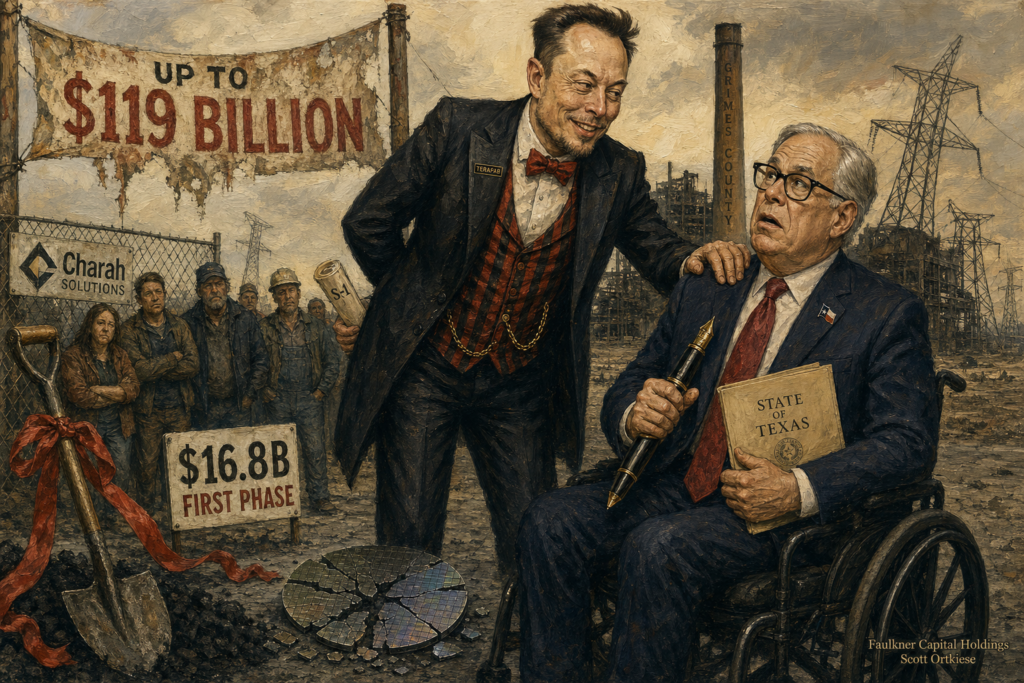
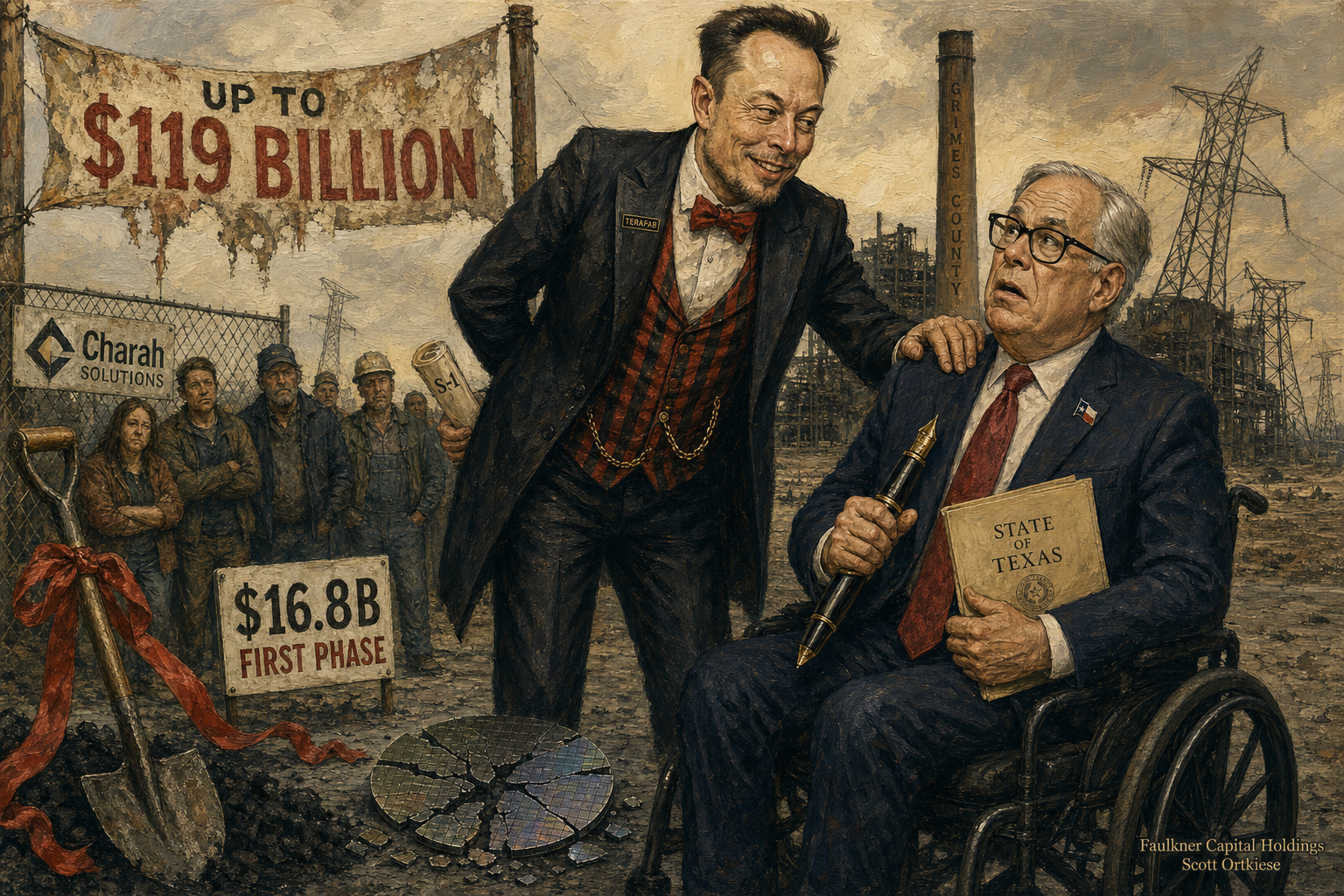
Here’s the real story, and it ain’t that pretty at all unless you’re part of the con
Scott Ortkiese | Throughline Synthesis | Houston, August 11, 2026
Where this piece sits
This article is part of Throughline Synthesis’s ongoing coverage of the American AI buildout as an accounting, engineering, ratepayer, and geopolitical problem, rather than an innovation story. Companion pieces:
– [“The $1.65 Trillion Nobody Was Supposed to Find”](https://throughlinesynthesis.com/) on off-balance-sheet AI buildout obligations hidden in Big Tech footnotes.
– [“Brute Force Is Not Progress”](https://throughlinesynthesis.com/) on AI capex, ratepayers, water, memory, and credit risk.
– [“The Data Sovereignty Trap”](https://throughlinesynthesis.com/) on why compute infrastructure is not the same as industrial data sovereignty.
– [“The SpaceX $1.77 Trillion Hoax”](https://throughlinesynthesis.com/) on the IPO mechanics behind the June 12, 2026 SpaceX float.
Read alongside those, this piece asks a specific version of a larger question. The American AI buildout is a wager, and it is a wager with two tails. If the closed-source, hyperscale approach works, and if the buyers of the output exist, and if the power and water and workforce can be assembled, then the last few years of capital expenditure is a rational bet on a durable industrial rent. If any of those conditions fails, and especially if Chinese open-source model families continue to close the price and performance gap, the same buildout is a set of stranded assets on twenty-five-year depreciation schedules with matching debt. Terafab, the newest and largest and most triumphalist of these announcements, is a good case study in what the wager looks like at the level of a single project. Because at the level of the single project, most of the assumptions are already visibly failing.
Why this article, and why now
On August 6, 2026, Governor Greg Abbott’s office announced that a company called Terafab had committed to a $16.8 billion first-phase semiconductor facility in Grimes County, Texas, on the site of a decommissioned coal plant, ninety miles northwest of Houston.1 The wire services reported it. Bloomberg, CNBC, Reuters, and the New York Times all ran the announcement in factual-recap form. The Houston Chronicle and the Austin American-Statesman both treated it as a Texas economic-development story. The White House posted approvingly. Musk himself put it on X. The headlines that followed cited a top-line figure of “up to $119 billion,” which came not from the Abbott announcement but from an earlier public document you will meet in a moment, and which the announcement itself did not confirm.
There is a reason to write this now. First, the announcement is fresh, the primary documents are on the record, and the local political process that produced $1.66 billion in school-tax abatements8 is still contested at the county level. Second, this is not an isolated deal. It is the same pattern of announcement engineering, ratepayer subsidy, and speculative capex Throughline Synthesis has been documenting in every direction, from Meta’s Louisiana gas plants to OpenAI’s Stargate to the private-credit-backed data-center buildout mapped in “The $1.65 Trillion Nobody Was Supposed to Find.” Third, and most important, the honest version of the Terafab story is not being told anywhere the marginal American reader is likely to encounter it. The financial press reported the number, not the disclaimer. The trade press reported the vision, not the equipment queue. The local press reported the jobs, not the process node. The strategic press reported the “American semiconductor sovereignty” frame, not the arithmetic that makes that frame incoherent. And Musk himself, in the July 2026 interview quoted later in this piece, has already told you what he thinks of the political phase of his career that produced the deal.45
Fourth, and this is the piece the trade press has been unable to say plainly, the announcement lands into a market that is already discounting the story. On the same weekend the Abbott press release ran, a $45 billion AI-thematic hedge fund called Situational Awareness, run by a twenty-four-year-old former OpenAI employee named Leopold Aschenbrenner, lost roughly two-thirds of its value in a matter of weeks as prime brokers at Goldman Sachs and JPMorgan issued margin calls on the same long-SK-Hynix, short-Adobe book the entire street had been running. Korean retail investors, the “Donghak ants” I documented in my Substack coverage, were margin-called on the same underlying names. Citadel bought the collapsing portfolio at auction. As Patrick Boyle observed in his forensic account of the blow-up, a bank’s enthusiasm for your AI thesis ends precisely at the point where it might have to hold the bag for it.47 Terafab’s rhetorical scale, and Governor Abbott’s willingness to lend a press conference to it, is what an industry announcement looks like when the market has already begun to unwind the trade the announcement is designed to reinflate.
Fifth, and this is the honest name for what this article is doing, Governor Abbott is being asked to countersign a bamboozling. Not a mistake, not an oversight, not a good-faith miscalculation. A bamboozling. Terafab is a public-facing announcement whose own SEC filing, submitted twelve weeks before the governor’s press conference, states in the plainest available English that there are no binding commitments, no financial terms, no IP rights, no capex contribution schedule, and no obligation on either Tesla or Intel to remain part of the project.10 Every one of those disclaimers was in the record before the governor’s staff walked to the podium. This piece is not a warning about a future risk. It is a summary of what has already been documented in a public filing, offered to the office that has not yet fully signed the state paperwork, so that the office knows, if it signs, exactly what it is signing.
The plain-English version, before the details
Here is what actually happened, stripped to the sentence level, without the industry jargon.
- A company was announced. On March 21, 2026, Elon Musk unveiled a new company called Terafab at the defunct Seaholm Power Plant in Austin, Texas. Terafab is presented as a joint effort of SpaceX, Tesla, Intel, and Musk’s AI startup xAI. Its stated mission is to build the world’s largest semiconductor factory, called a “fab,” in Grimes County, on the site of another defunct power plant.9 A fab, short for fabrication plant, is a chip manufacturing plant, the specialized factory where raw silicon is turned into finished computer chips inside sealed rooms cleaner than a hospital operating theater. A modern one costs about $20 billion for a single production line, takes years to build, and requires several thousand specialists trained over many years to operate. There are roughly two dozen of them on the planet capable of producing the most advanced chips, most of them in Taiwan and South Korea, and only one in the continental United States, in Arizona, operated by a Taiwanese company. Fabs are not built quickly, they are not built cheaply, and they are not built by companies that have never built one before.
- A number was floated. The number that then drove weeks of coverage was “up to $119 billion.” That figure did not come from the announcement or from any signed contract. It came from a filing SpaceX made with the Securities and Exchange Commission on May 20, 2026, in preparation for its June 12 initial public offering. That filing is called an S-1. An S-1 is the document a private company registers with the SEC to sell shares to the public. Because the SEC penalizes companies for lying to public investors, S-1s are the closest thing in American corporate life to a document that a company’s own lawyers have forced it to be honest in.2
- Its own lawyers said it was not real. On the Terafab pages of that S-1, SpaceX’s own counsel disclosed that the arrangement is a “general framework” with “no financial terms,” “no IP rights,” and “no binding commitments,” and that both Intel and Tesla are “not obligated to remain a part of the project.” Those are direct quotes from the filing. They are the reason the S-1 matters. Without those disclaimers, SpaceX would have exposed itself to securities-fraud liability if any of the Terafab announcements turned out to be untrue. With those disclaimers, the announcements can be as ambitious as anyone wants them to be, because the accompanying legal document has already privately conceded that none of it is contractually promised.10
- Then a smaller, real number was announced. On August 6, 2026, Governor Abbott’s office confirmed a $16.8 billion “first phase” number. That is roughly $38 billion below the first-phase figure SpaceX had itself put in its own S-1 twelve weeks earlier. The financial press treated the reduced number as news, without noting that the same company’s own filing had already said the entire structure was non-binding.11
- Intel is doing the actual work. The physical facility is being run by Gary Jiang, a seventeen-year Intel veteran who most recently ran Intel’s 18A ramp in Arizona. The process technology is Intel 14A, Intel’s proprietary next-generation manufacturing node. Musk’s companies are the anchor customers. In the words of industry analyst Adrien Sánchez at Yole Group, Terafab is “an Intel fab expansion with Tesla, SpaceX, and xAI as anchor customers, rather than a standalone manufacturing venture.”3
- The node has not shipped. Intel 14A targets risk production in 2028, has no released Process Design Kit as of the groundbreaking, and has no committed external customers. The prior node, 18A, has documented yield problems that Intel’s CEO Lip-Bu Tan publicly said in March 2026 he was “reconsidering.”4
- The tools do not exist in the quantities required. 14A requires ASML High-NA EUV lithography scanners at $350 to $400 million each, weighing 150 tons, shipped in roughly forty containers per unit. ASML shipped forty-eight EUV systems worldwide in 2025, across all customers. Only “a handful” of High-NA units have been built in total.5
- The scale claim is unprecedented. Terafab’s marketing footprint of 100 million square feet is approximately 9.8 times the total floor area of TSMC’s Fab 18 complex in Tainan, the flagship advanced-node site of the dominant foundry on the planet, which was built in three phases over many years.6
- The customer book is captive and speculative. The named customers are Optimus (zero verified production units on Tesla’s most recent earnings call), Cybercab (no regulatory approval publicly disclosed), and “space-based data centers” for SpaceX. No external merchant-foundry customer has been named.7
- The bill lands on a Texas county of 34,000 people. Iola ISD and Anderson-Shiro CISD approved $1.66 billion in JETI school-tax abatements for a facility whose developer, in the same public filings, has documented that none of it is contractually committed. The residents’ request for clawback provisions, reported at approximately 900 signatures, is a request, not a contract.8
That is the picture. Everything that follows in this article is documentation of those ten points against the primary sources. Nothing beyond those ten points is decoration.
What SpaceX is doing, and what it wants
Before the details, one more piece of framing, because it is the piece a reader unfamiliar with the mechanics of large American industrial announcements will not otherwise see.
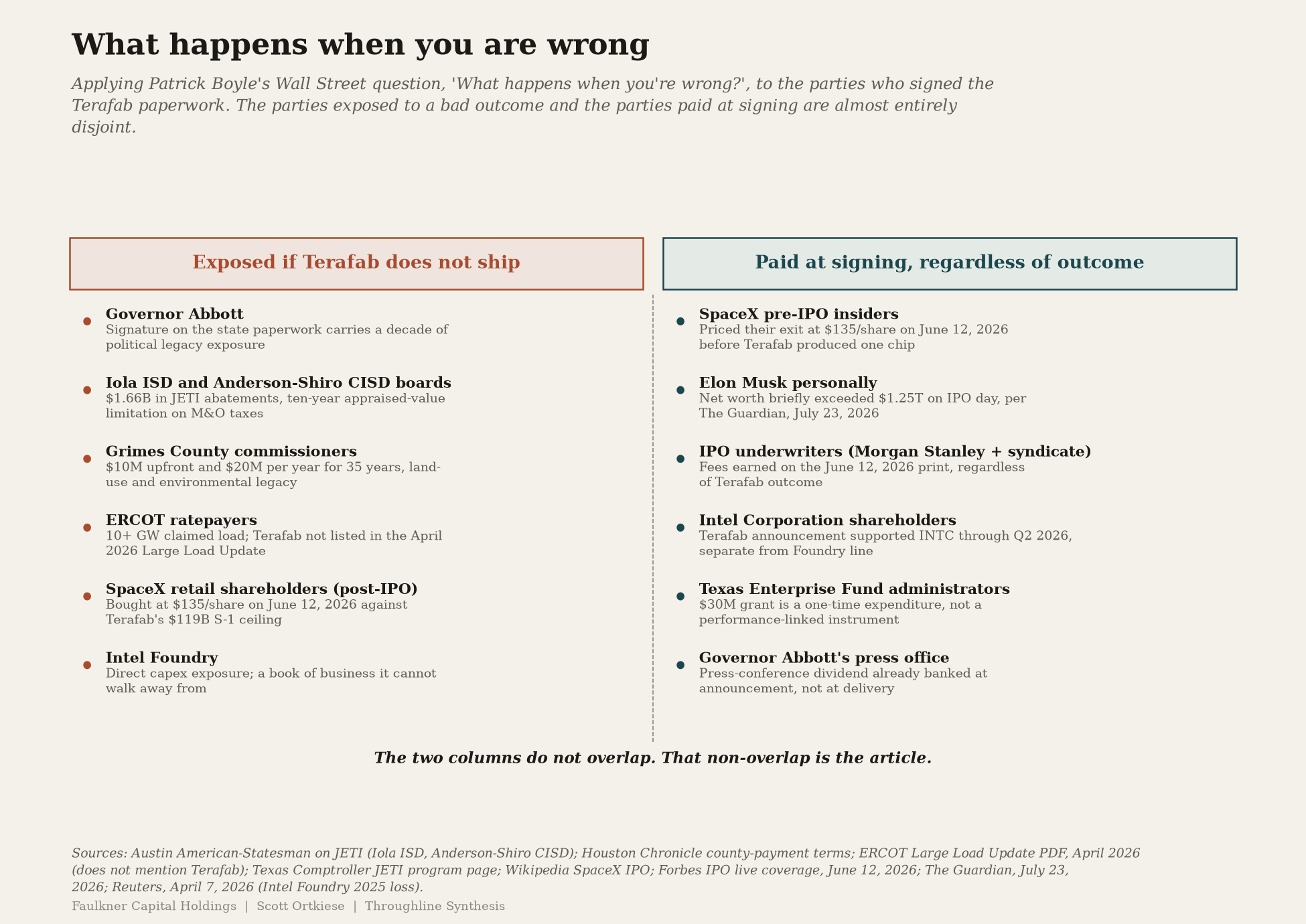
Patrick Boyle framed the cultural asymmetry that produces announcements like Terafab as sharply as anyone has: “Silicon Valley asks whether a thing can be built. Washington asks whose permission you need. Wall Street asks a colder question. What happens when you’re wrong?”47 Terafab is a project that Silicon Valley has convinced itself can be built, that Washington has been asked to grant every permission for at once, and that the New York money is quietly declining to underwrite at the offered terms. Each of the three cultures is reading the same document and answering a different question about it. The document is winning in the two cultures whose questions can be answered rhetorically and losing in the one culture whose question requires a signed contract.
The Wall Street question is the one this article is asking on Governor Abbott’s behalf, on Iola Independent School District’s behalf, on the Grimes County Commissioners Court’s behalf, on ERCOT’s behalf, and on behalf of every retail investor who bought SpaceX at the June 12, 2026 IPO. What happens when you are wrong. When Intel 14A does not yield in 2027. When the ASML High-NA scanners the facility depends on do not arrive in the required quantity. When the anchor customer book, Optimus and Cybercab and space-based data centers, does not materialize. When the $1.66 billion in JETI school-tax abatements has already been granted and the resident petition for clawback provisions has already been declined. When the Musk-Trump political relationship on which the Space Force and Golden Dome contracts depend enters a second public breakdown. What happens then, to each of the parties who signed. That is the question the rest of this piece answers, party by party.
The short answer, which the long answer will document, is that the parties who signed and the parties who benefit are almost entirely disjoint. The SpaceX pre-IPO insiders who priced their exit at $135 a share on June 12, 2026 have already been paid. The signing parties who are exposed to the outcome, the Iola ISD board and the Anderson-Shiro CISD board and the Grimes County commissioners and ERCOT ratepayers and the governor personally, are exposed at the moment of signing and are not paid at all.
SpaceX is not building a fab because it is a semiconductor company. It is not one, and it does not want to become one. Fabs, as described in the plain-English section above, are among the worst businesses in modern industrial history for anyone not named TSMC. They require tens of billions of dollars of capital per production line, they produce razor-thin margins outside the top of the leading edge, they are technologically obsolete on a roughly five-year clock as the industry moves to the next node, and they are politically fragile everywhere they operate. The last twenty years of chip-industry history have been an unbroken record of American companies, from Intel to GlobalFoundries to IBM Microelectronics, failing to make the economics work at scale. SpaceX’s investors know all of this. Tesla’s investors know all of this. Musk knows all of this.
What SpaceX is doing with the Terafab announcement is something else. It is using the shape of a fab commitment to unlock a specific bundle of things it does want. It wants school-district tax abatements it can list against future depreciation. It wants a governor’s press conference that certifies its industrial seriousness in the eye of the federal government, at a moment when its founder’s political relationship with the White House has publicly disintegrated. It wants a headline number, “up to $119 billion,” that anchors expectations for the June 12, 2026 IPO at the top of an aggressive valuation range. It wants a set of federal contract adjacencies, from Space Force to Golden Dome, that flow more easily to companies with a documented American manufacturing footprint. It wants the political cover of “reindustrialization” at a moment when the actual reindustrialization is happening in Chinese and Korean fabs. And it wants, from Intel specifically, an anchor tenant that can absorb some of Intel Foundry’s $10.32 billion 2025 operating loss17 into Musk-company demand rather than public-market shareholder patience.
Terafab is not a fab. It is a lobbying instrument, priced at $16.8 billion phase-one and rhetoricized at $119 billion top-line, on a decommissioned coal plant, in a county of 34,000 people, running on a process node that has not shipped, using tools that barely exist, for a customer book that does not exist, paid for by school-district taxpayers whose clawback protections are a resident petition rather than a contract.
Every section below documents one part of that sentence.
The Seaholm rehearsal
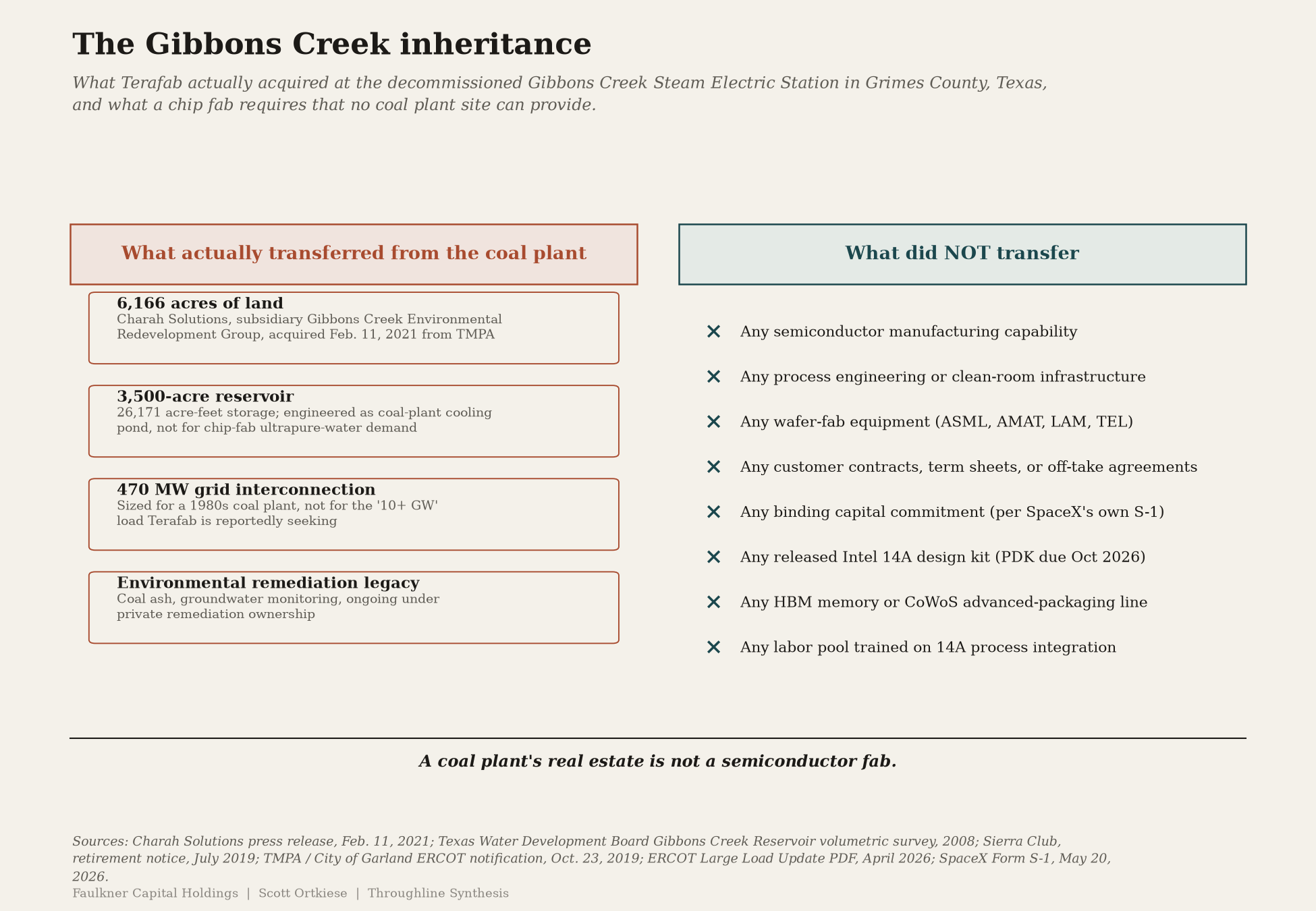
Terafab was first unveiled publicly on March 21, 2026, not in Grimes County, but at the defunct Seaholm Power Plant in downtown Austin.9 The choreography is worth pausing on. A company promising “the largest and most valuable building on Earth” chose, as its debut stage, an early-twentieth-century coal-and-gas power station, decommissioned in 1989, now redeveloped as event and restaurant space. Then, when it came time to actually break ground, the company chose a different decommissioned Texas power plant, this one retired in 2019, three hundred acres of ash-remediation land under private ownership by a firm called Charah Solutions.
The symbolism is not subtle, and it is not the symbolism the announcement intends. The American AI buildout has taken to inhabiting the shells of the previous American energy order because that is the real estate that comes with the grid interconnection and the water rights and the property already taken out of any competing use. The infrastructure of the twenty-first century is being poured into the foundations of the twentieth. That is not a metaphor. It is the actual physical fact of where the concrete goes.
What the S-1 forced them to say
Every serious question about Terafab is answered by SpaceX’s own S-1, filed May 20, 2026 in preparation for the June 12 IPO. The filing runs 308 pages. Its Terafab section contains language that no responsible business reporter should have been able to read past.
The reason that language is in the filing is worth being explicit about. An S-1 is the document the SEC uses to hold a company accountable to public investors. If a company describes a project in the S-1 as a firm commitment when in fact no such commitment exists, and public shareholders buy stock on that basis, the company is exposed to securities-fraud liability under the Securities Act of 1933 and to private class actions by anyone who lost money on the misrepresentation. Corporate counsel therefore forces the S-1 to be more honest than the press release. That gap between the two documents is where the Terafab story lives.
Electrek quoted the S-1 directly: “While we have a framework agreement with Tesla, neither Tesla nor Intel are obligated to remain a part of the project, and we may not enter into any such definitive agreements.” And: “Any specific projects undertaken pursuant to this framework will be subject to separate negotiations and agreements (including any development timelines, milestones and capital expenditures) and have not yet been determined.”10
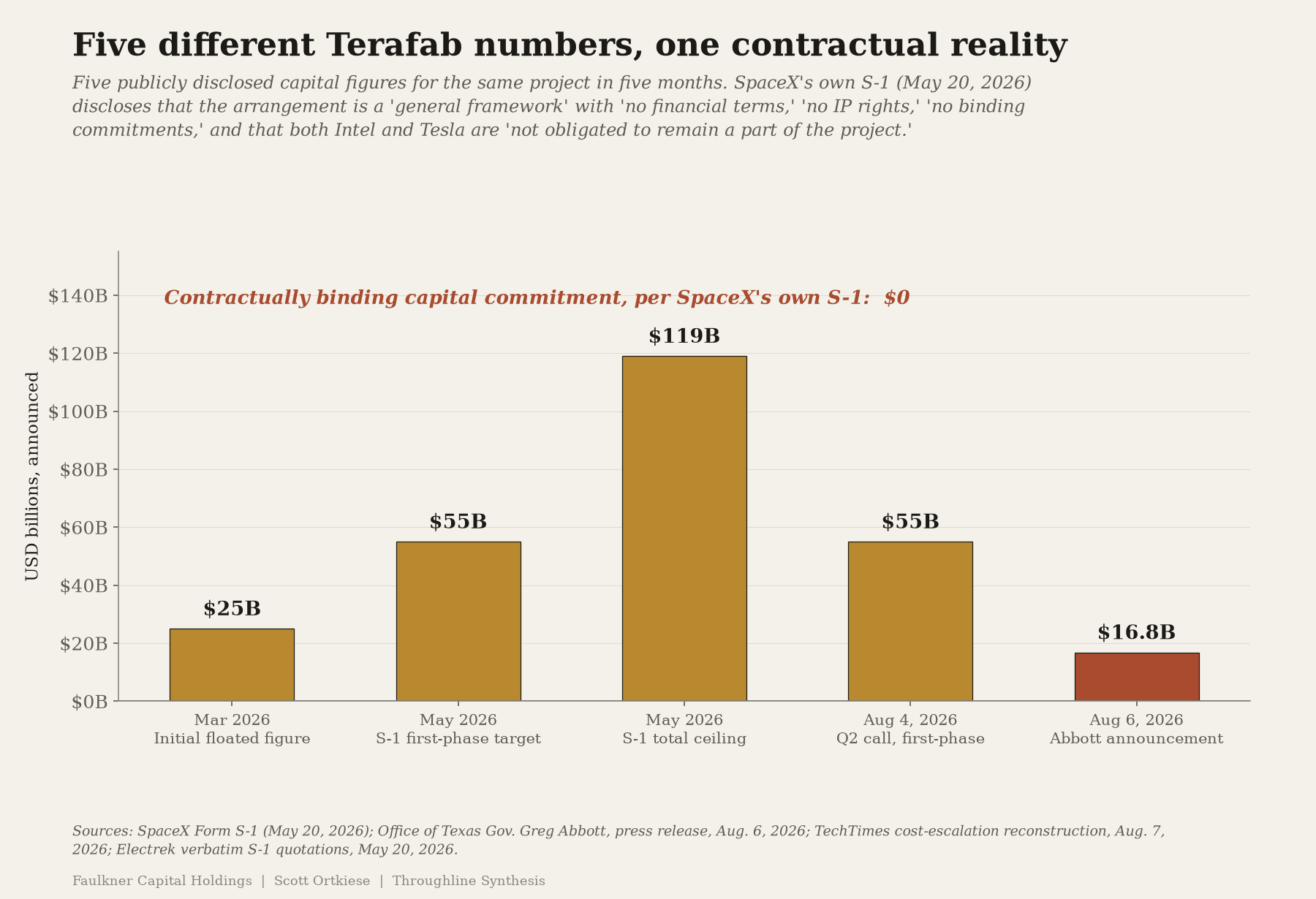
TechTimes’ investigative reconstruction added the numbers. In March 2026, a $20 to $25 billion Terafab figure was floated with no binding commitment. By the May 20 S-1, the number had become $55 billion first-phase, with a $119 billion ceiling across all phases. On the August 4 Q2 earnings call, the $55 billion was reiterated with a verbal “late 2027 first chip production” target. Two days later, Governor Abbott’s press release announced a $16.8 billion first phase, roughly $38 billion below the number SpaceX had itself put in its own S-1 twelve weeks earlier.11
Read that again slowly. The first-phase figure in the confirmatory announcement was thirty-eight billion dollars lower than the first-phase figure in the SEC filing the same company had filed three months before. And the SEC filing had, on the same page, explicitly disclaimed that any of it was a binding commitment.
The financial press treated the announcement as news.
Whose fab is this, actually
The most useful single sentence written about Terafab was not written by a journalist. It was written by an industry analyst named Adrien Sánchez at Yole Group, and it was reported by TechTimes. Sánchez called Terafab “an Intel fab expansion with Tesla, SpaceX, and xAI as anchor customers, rather than a standalone manufacturing venture.”12
Everything about the physical facility confirms Sánchez’s reframe. The on-site director is Gary Jiang, an Intel veteran of seventeen years who ran Intel’s own 18A ramp in Arizona.13 The process technology is Intel 14A, an Intel proprietary node.14 The equipment is ASML lithography that only Intel, TSMC, Samsung, and SK Hynix currently know how to install and operate at scale.15 Intel’s CEO Lip-Bu Tan delivered the effusive quote in the announcement release (“Elon has a proven track record of re-imagining entire industries. Terafab represents a step change in how silicon logic, memory and packaging will get built in the future.”).16 Intel’s balance sheet carries the $10.32 billion 2025 operating loss at Intel Foundry that this deal is quietly designed to help stanch.17
Musk’s companies are the customer. Intel is the fab. The rhetoric is Musk’s. The chips, if any ever get made, will be Intel’s.
This distinction matters because it collapses the “American semiconductor sovereignty” narrative the announcement was built to project. The United States is not adding a new fab operator. It is adding a new demand contract for the fab operator that has spent the last three years documenting its inability to hit its own node timelines.18 Terafab is not a break with the American semiconductor status quo. It is the American semiconductor status quo, wearing a Tesla logo.
The engineering nobody bothered to check
Every technical claim in the Terafab announcement is contradicted by publicly available engineering facts that a competent business reporter could have surfaced in an afternoon.
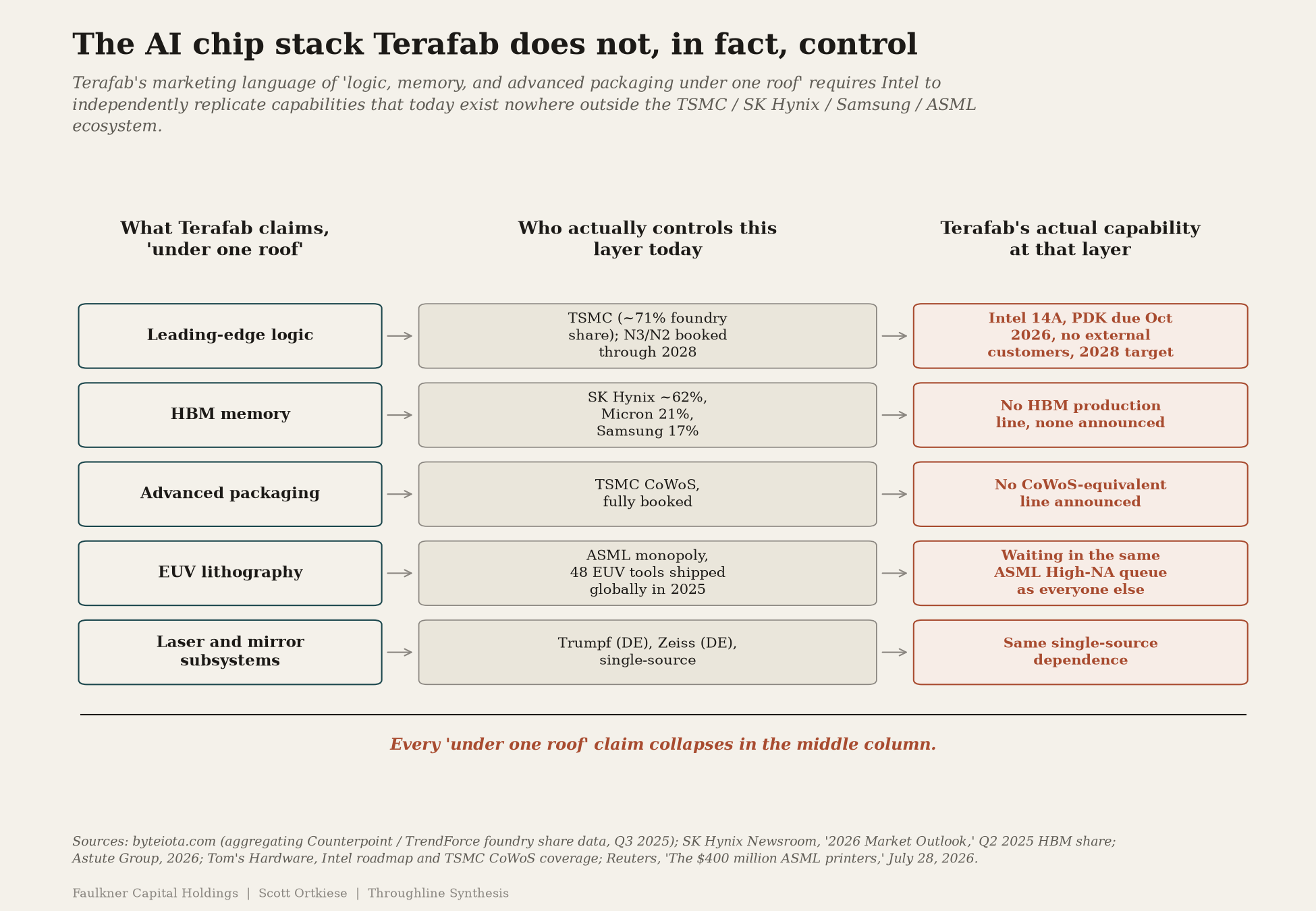
The node. Intel 14A targets risk production in 2028 and high-volume manufacturing in 2028 to 2029. The external PDK, the document Intel’s customers would need to design chips against the process, is targeted for October 2026, meaning as of the Terafab groundbreaking there is no released design kit for the process the facility is being built to run.19 Intel has zero committed external customers for 14A. The prior node, 18A, is in yield trouble that the Reuters newsroom felt confident enough to publish under a CEO’s own name.20
The tools. ASML holds a monopoly, Reuters’ own word, in cutting-edge EUV lithography. The High-NA EUV scanners Intel 14A depends on cost between $350 million and $400 million each. Each machine weighs 150 tons, uses lasers built by Trumpf in Germany and mirrors built by Zeiss in Germany, and ships in approximately forty cargo-plane containers per unit. ASML delivered forty-eight EUV systems globally across all customers in 2025. Its 2027 target is eighty-five. Only “a handful” of High-NA units have been built in total. There is no world, on any plausible ASML production schedule, in which one facility in one Texas county receives enough of these tools to run at anything approaching the claimed footprint before the end of the decade.21
The memory. The Terafab pitch includes “memory under one roof.” The current HBM market: SK Hynix, 62 percent share of Q2 2025 HBM shipments and 57 percent of HBM revenue; Micron, 21 percent; Samsung, 17 percent. HBM3e, the generation used in current AI-chip packaging, represents roughly two-thirds of total HBM shipments in 2026.22 Neither Intel nor any Musk-affiliated company has an HBM production line, a CoWoS-equivalent packaging line, or any credible near-term path to either. Every AI accelerator that matters today ships out of TSMC’s CoWoS lines with SK Hynix HBM stacks on top. Nothing about a Texas building changes that.
The scale. TSMC’s Fab 18 complex in Tainan, the world’s flagship advanced-node site, occupies 950,000 square meters of total floor area, including 160,000 square meters of cleanroom, built out over three phases across many years. Terafab’s claimed 100 million square feet, or 9.3 million square meters, is approximately 9.8 times the total floor area of Fab 18.23 There is no comparably documented single-site precedent for any semiconductor facility of this scale anywhere in the industry’s history.
The labor. The Semiconductor Industry Association projected a 67,000-worker deficit by 2030 in the American semiconductor workforce. TSMC’s Arizona buildout, which is a fraction of Terafab’s claimed footprint, was delayed for what the Wall Street Journal reported as “a significant shortage of professionals qualified to construct semiconductor production facilities in the United States.” Terafab proposes to solve that constraint in a rural Texas county of 34,000 people, without TSMC’s decades of accumulated US-hiring infrastructure, on a schedule that puts first-chip production in late 2027.24
Each of these constraints is public. Each has been reported. None appears anywhere in the Abbott press release, or in the vast majority of the wire-service coverage that followed it. Bloomberg, CNBC, Reuters, the New York Times, TechCrunch, the Houston Chronicle, the Austin American-Statesman: each ran the announcement in factual-recap form, dutifully citing the dollar figures and the jobs numbers and the Musk quotes, and none of them foregrounded the S-1’s own disclaimer.25
The named-names accounting
The industry analysts who saw what was in the S-1 said so. Patrick Moorhead, on X on August 6, flagged the absence of any SEC filing “on contract, economics, 14A commitment, IP license, capex contribution, equipment commitment, or division of responsibilities,” and observed the two-year lead time on complex wafer-fab equipment plus the roughly one year required to qualify a new process.26 Ben Bajarin of Creative Strategies told CNBC in May that Musk-affiliated companies would find it “very, very hard” to get priority at TSMC and added that “you don’t just wake up one day and say, ‘I’m going to be a foundry.'”27 Ming-Chi Kuo named “excessive scope, a tight timeline, and a chip engineering talent shortage” as the structural risks.28 BofA Securities described Terafab’s near-term impact on TSMC as “limited,” citing “high execution risks, massive costs, and long timelines.” Bernstein called the full vision “herculean,” with costs potentially reaching “into the trillions.” TrendForce called full-stack 2nm fabrication under one roof “unrealistic in the near term.”29 Electrek’s Fred Lambert drew the sharpest historical parallel: “This is Tesla’s Battery Day on steroids. And if you’ve been following how that turned out, you should be very skeptical.”30
Then there is the second tier: analysts whose adjacent optimism did the work of validating Terafab without ever having to validate Terafab.
Dan Ives at Wedbush pivoted from Terafab into speculation about a formal Tesla-SpaceX merger “as early as 2027,” a trick that lets a bullish analyst decline to engage with the feasibility question by changing the subject to the corporate-structure question.31 Stacy Rasgon at Bernstein spent June and July on CNBC saying he was “feeling better about Intel than I have in a long time,” without directly addressing Terafab’s specific claims about Intel’s ability to run a facility ten times the size of Fab 18 on a node that has not yet released its PDK.32 The word Wall Street uses for this pattern is “adjacent bullishness.” The word the rest of the language uses is “cover.”
And then there is the third tier: the analysts and writers whose absence is itself the tell.
SemiAnalysis, Dylan Patel’s operation, publishes granular fab-economics coverage of every serious announcement in the industry. In the search I ran for this article, I could not find a SemiAnalysis piece specifically on Terafab. Ed Zitron writes almost daily on AI-bubble economics and has been consistently sharp on hyperscaler capex hallucinations. I could not find a Zitron piece specifically on Terafab. Molly White, whose “Web3 Is Going Just Great” documented the previous bubble in real time and who now writes on Musk’s political-corporate entanglements, did not appear to have covered Terafab. Cory Doctorow, whose “enshittification” framework is the sharpest structural critique of platform monopolies working today, did not appear to have covered it either.33
I do not want to overclaim on absences. A piece I did not surface is not a piece that does not exist. But the pattern is worth naming: the writers most likely to have called Terafab what it is were, on the evidence available, not doing so, while the writers most likely to launder the announcement into an investment thesis were doing so at volume.
This is not conspiracy. It is capital structure. The same pension funds, insurance companies, and university endowments that fund critical financial journalism through their subscriptions and advertising are the ultimate lenders behind the private-credit-backed AI infrastructure buildout I documented in “The $1.65 Trillion Nobody Was Supposed to Find.” Nobody wants to be the one who called the emperor naked while still holding his paper.34
What Grimes County actually agreed to
Iola Independent School District and Anderson-Shiro Consolidated Independent School District approved $1.66 billion in JETI tax abatements for Terafab in mid-2026. JETI, the Jobs, Energy, Technology and Innovation Act, is the Texas successor to the expired Chapter 313 abatement program. The standard structure is a ten-year school-district Maintenance and Operations tax appraised-value limitation, with a 75 percent discount on job and investment thresholds for facilities in qualifying opportunity zones. For counties with 99,999 or fewer residents, which includes Grimes County at approximately 34,000 people, the minimum thresholds are just 10 jobs and $20 million in investment.35
The county-level agreement, as reported by the Houston Chronicle, includes a $10 million upfront payment to Grimes County plus $20 million per year for thirty-five years.36 The Statesman’s coverage confirms the $1.66 billion school-tax figure and notes that as of publication the JETI package was still awaiting Governor Abbott’s sign-off.37
There is a residents’ petition, reportedly signed by approximately 900 Grimes County residents, requesting that clawback provisions be added to the abatement agreements. The most important thing to understand about that petition is that it is a request, not a contract. As of the primary-source documentation available for this article, no statewide JETI clawback framework and no Terafab-specific clawback provision has been enacted. The public narrative of “accountability mechanisms” that has surrounded the deal in local coverage refers to accountability mechanisms that do not, at time of writing, appear to exist.38
Patrick Boyle, drawing on Ezra Klein’s interview with the sociologist Jasmine Sun, named the underlying cultural mismatch as directly as it can be named: “People in Silicon Valley have spent their entire careers watching impossible-looking problems cave as soon as enough smart engineers throw code at them. To that culture, every obstacle is temporary and every wall is just a bug that hasn’t been patched yet. Washington runs on the opposite energy. In Washington, things that ought to be simple to fix become permanently impossible because everyone involved wants a different outcome and nobody will budge. And the one thing Silicon Valley desperately wants to build right now, gigawatt power plants and vast data centers out in rural counties, turns out to be a Washington problem, not a coding problem. Building data centers is all about permits, land rights, utility boards, and angry local residents. You can’t resolve a room full of people who want opposite things by writing better code.”47 That is what is happening in Grimes County. The 900-signature petition is what “a room full of people who want opposite things” looks like when the room is a rural Texas county and the code being written is a school-district tax abatement.
Grimes County is a county of 34,000 residents, median household income $69,803, median property value $237,400. It is being asked to underwrite, through a school-district M&O tax abatement of $1.66 billion, a facility whose developer’s own SEC filing describes the underlying project as a “general framework” with “no binding commitments,” and whose stated full-scale water and power demands do not, as of the most recent ERCOT large-load planning document, appear anywhere in the public grid interconnection queue.39
The Taiwan question, and the question behind it
The reason to write this article for a Russian audience as well as an American one is that a serious Russian reader will ask the question a serious American reader tends not to ask, which is: does Terafab actually change the geopolitical dependency on Taiwan?
The answer is no, and the reasons are not subtle.
First, Terafab, if it is ever built, produces custom AI inference chips for Musk’s own products on an Intel 14A trailing-edge-to-mid-edge node. It does not build the leading-edge N3 and N2 logic that Apple, Nvidia, AMD, Qualcomm, and the rest of the world buy from TSMC.40 TSMC captured approximately 71 percent of the global semiconductor foundry market in Q3 2025, with Intel Foundry at 6 percent and Samsung at 6.8 percent, and TSMC’s advanced-node capacity is booked through 2028.41 The overwhelming share of Nvidia GPUs, Apple silicon, and every hyperscaler’s custom accelerator flows through Taiwan, not Texas.
Second, Terafab does not build HBM memory. That is SK Hynix, Samsung, and Micron, in that order, and none of them are in Texas.42
Third, Terafab depends on ASML EUV lithography built in the Netherlands from German laser and mirror subsystems, using Japanese chemicals and wafers. The Taiwan question is inseparable from the Netherlands, Germany, and Japan questions, and no Texas building changes that architecture.43
Fourth, Taiwan reunification is not a semiconductor question in the first place. The 2026 Annual Threat Assessment of the US Intelligence Community, as reported by Al Jazeera, states that “Chinese leaders do not currently plan to execute an invasion of Taiwan in 2027, nor do they have a fixed timeline for achieving unification.” Bonnie Glaser at the German Marshall Fund is quoted: “Xi Jinping doesn’t have a fixed timeline for reunification and prefers to achieve that goal without using force.” Kitsch Liao at Taiwan’s Doublethink Lab identifies the 2030s as “a potentially more dangerous timeframe” based on “capability not intent.” Beijing has stated its intention to complete reunification by 2049, the centenary of the People’s Republic, “through either peaceful or forceful means.”44
None of these named experts, and neither the US intelligence assessment nor the Chinese statements, treats a Texas fab announcement as a variable in the calculus. Taiwan’s centrality is a geological and industrial fact. Beijing’s timeline is driven by PLA readiness, domestic politics, and US Pacific posture. A press release from a decommissioned coal-plant site in Grimes County does not enter the equation.
The honest strategic reading, whether for an American reader or a Russian one, is this: Terafab is not the American answer to Chinese chip sovereignty. It is a symptom of the same problem it purports to solve. The United States is trying to close a strategic industrial gap with pension-fund capital, ratepayer subsidies, school-district tax abatements, and press-release engineering, on a decommissioned coal-plant site, using a process node the vendor itself has not yet released a design kit for, on a schedule that even the vendor’s own analysts call herculean, on the closed-source side of a global software architecture where the open-source side, driven out of China and out of Korean and European research groups, is closing the price-to-performance gap on a quarterly clock.
Study the announcement. Do not envy it.
Who inherits the site
Terafab, and the coal plant that will not save the American empire.
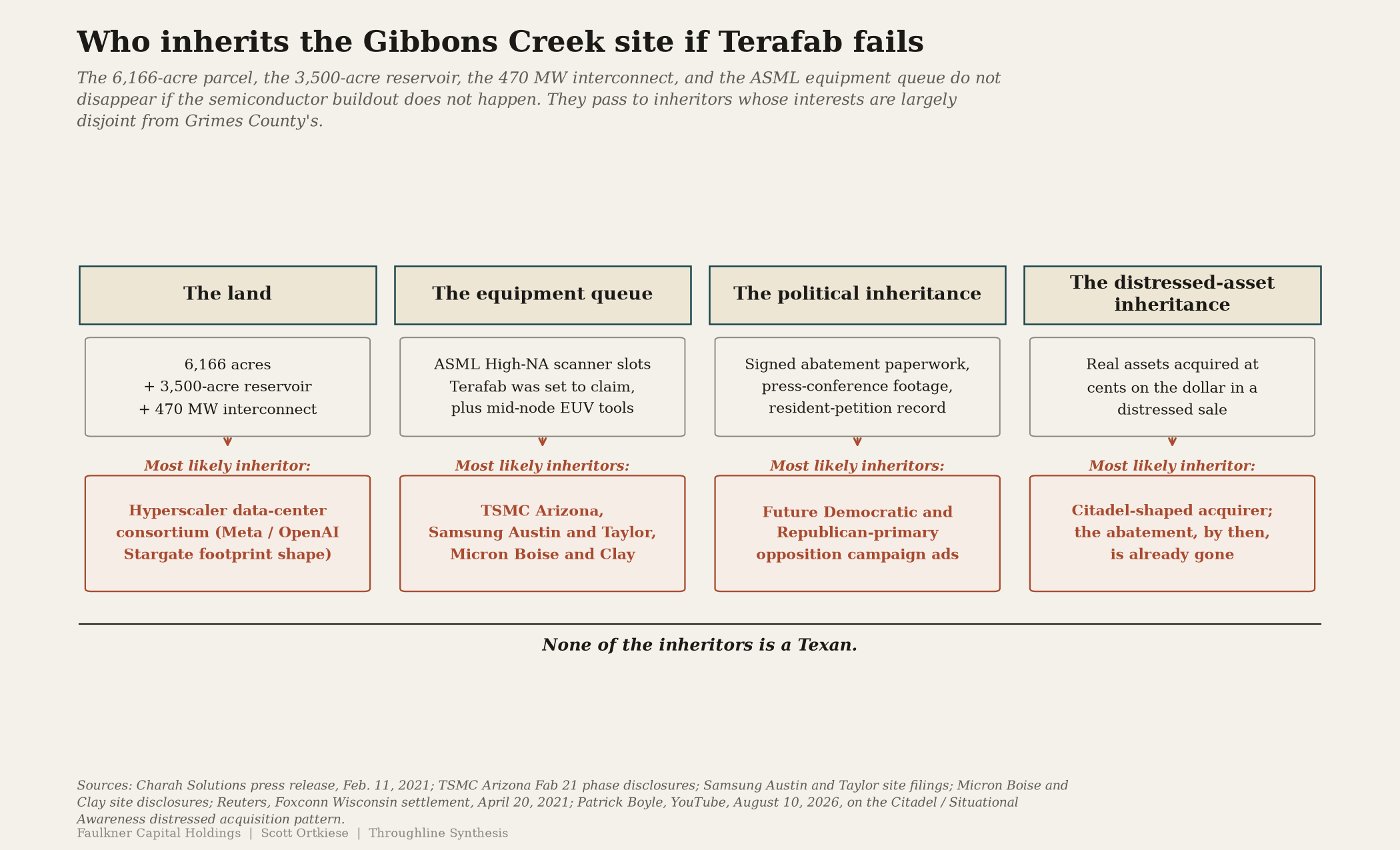
Say the announcement fails. Not partial success, not two out of ten points, not a face-saving “first-phase-completed” ribbon-cutting on a smaller building than the one promised. Say it fails outright, the way Foxconn’s Wisconsin LCD announcement failed in 2017, the way TSMC’s Arizona schedule slipped in 2023 and 2024, the way Intel’s 18A ramp slipped in 2025 and 2026.48 What inherits the site.
The honest answer is not a mystery. It is written into the physical infrastructure that Charah Solutions bought in 2021 and into the equipment queue at ASML in Veldhoven.
First, the land. The 6,166 acres of the retired Gibbons Creek coal-plant complex, plus the 3,500-acre reservoir, plus the 470 megawatts of existing grid interconnection, do not disappear if the semiconductor buildout does not happen. They become the largest single contiguous power-and-water parcel in the Central Texas data-center corridor. The most likely inheritor is not another chip company. It is a hyperscaler data-center consortium of the same shape as the Meta Louisiana and OpenAI Stargate footprints Throughline Synthesis has documented elsewhere. Grimes County ends up with a large industrial site, on ratepayer-subsidized power, running someone else’s inference workload, without any of the semiconductor jobs the abatement was granted to deliver.
Second, the equipment queue. If the ASML High-NA scanners intended for Terafab do not ship to a functioning Terafab, they do not vanish from the schedule. They ship to the next customer on the queue. That customer is not in Grimes County. It is TSMC’s Arizona expansion in Phoenix and Fab 21 Phase 2, Samsung’s Austin and Taylor sites, and Micron’s Boise and Clay sites. Every ASML slot Musk’s announcement was supposed to secure for Texas is a slot the existing American semiconductor operators, and the Taiwanese and Korean operators who serve the American market from within the United States, would take instead. The strategic sovereignty argument, the one thing the Terafab announcement was rhetorically designed to establish, is best served by Terafab not being built.
Third, the political inheritance. A Wisconsin Foxconn analog does not disappear when the announcement collapses. It becomes a decade-long museum piece the opposing party campaigns against. Governor Abbott’s signature on the Terafab paperwork is a signature that a future Texas Democratic opponent, or a future Texas Republican primary opponent, will run against for the remainder of his political career. The residents of Grimes County who signed the petition against the abatement, all nine hundred of them, know exactly what it is they were petitioning against. They will still know in 2028, 2030, and 2032.
Fourth, the Ken Griffin analog. When Terafab does not ship, and someone acquires the underlying real assets at cents on the dollar in a distressed sale, the buyer will not be a semiconductor operator. It will be a distressed-asset acquirer of the same shape as Citadel’s auction win on the Situational Awareness portfolio Boyle described. The pattern is old and it is stable. American announcements collapse. American announcements are then acquired by financial actors who have already been paid on the previous cycle. The site inherits new ownership. The abatement is already gone.47
“I got carried away, frankly”
One last piece of context matters, because it is the piece the American business press is most reluctant to name.
The Terafab announcement lands in the middle of a Musk-Trump relationship that Elon Musk himself, in a July 2026 interview with The Economist as reported by The Guardian, described as follows: “I got carried away, frankly.” Musk was speaking about his tenure as head of the Department of Government Efficiency, into which he poured, by his own account, energy that he “would have basically” put “on my companies” instead. The Guardian’s read of the interview: an “admission” from a figure who “helped get [Trump] elected in 2024 with $200m in financial backing” and then oversaw the elimination of “tens of thousands” of federal jobs before publicly breaking with the president.45
Two months later, SpaceX received $6.45 billion in Space Force contracts in the week before its IPO: $4.16 billion for satellites supporting Trump’s “Golden Dome” missile-defense project, and $2.29 billion for a low-Earth-orbit communications network. One-fifth of SpaceX’s 2025 revenue came from government agencies, and the company’s own S-1 discloses that “business with governmental entities is subject to changes in policies, priorities, regulations, mandates, and funding levels.”46
Read those two paragraphs together. This is not a story about a private company making a strategic industrial bet. It is a story about a public-facing announcement, tied to a governor’s press conference, on a site inheriting decades of state-agency infrastructure, from a company whose government-contract revenue exceeds one-fifth of the top line, whose founder was until recently the second most powerful political figure in the country, and who has publicly said he regrets it.
Terafab is not a factory. It is a lobbying instrument, priced at $16.8 billion phase-one and rhetoricized at $119 billion top-line, on a decommissioned coal plant, in a county of 34,000 people, running on a process node that has not shipped, using tools that barely exist, for a customer book that does not exist, paid for by school-district taxpayers whose clawback protections are a resident petition rather than a contract.
Anyone who tells you otherwise, from a chair that pays them to say so, is not doing analysis. They are doing marketing.
Patrick Boyle, on Wall Street’s oldest lesson about announcements of this shape: the largest and most confidently priced short-term commitment is often the last thing you see before the entire structure comes apart. He was talking about Situational Awareness. He might as well have been talking about Terafab. The scale of the announcement, in his account, is the tell. A serious industrial commitment is small at the start, quiet, boring, and grows through executed milestones. A performance is large at the start, loud, ambitious, and shrinks through disclaimed milestones. Terafab’s arc from a $119 billion S-1 ceiling to a $16.8 billion first-phase press release, over twelve weeks, is the shape of a performance, not the shape of a build. And a bank’s enthusiasm for that performance ends exactly where the bank might be asked to hold the paper.
The closing question is Boyle’s, and it is now for Governor Abbott’s desk. What happens when you are wrong. If the answer for the governor’s office is “nothing, we have already been paid our press-conference dividend,” then say so plainly. If the answer is “we are exposed with the residents of Grimes County and the Iola ISD board and the ERCOT ratepayers and the retail SpaceX shareholders,” then decline to sign the outstanding paperwork until the resident petition for clawback provisions is enacted into law rather than acknowledged and shelved.
That is not a hard ask. That is the minimum a governor’s office owes the state it governs, on a project whose developer has already, in its own SEC filing, told you what it thinks the arrangement is worth.
Contact: so@throughlinesynthesis.com
Notes
- Office of Texas Governor Greg Abbott, “Governor Abbott Announces SpaceX Expansion in Grimes County,” press release, August 6, 2026, https://gov.texas.gov/news/post/governor-abbott-announces-spacex-expansion-in-grimes-county. ↩
- “SpaceX S-1: Tesla, Terafab, Macrohard… not a done deal,” Electrek, May 20, 2026, https://electrek.co/2026/05/20/spacex-s1-tesla-terafab-macrohard-not-done-deal/; “SpaceX Confirms Terafab Texas… Filing Shows $38B Gap,” TechTimes, August 7, 2026, https://www.techtimes.com/articles/323484/20260807/spacex-confirms-terafab-texas-own-filing-shows-38b-gap-first-phase-figures.htm. ↩
- Yole Group analyst Adrien Sánchez, quoted in TechTimes, ibid. ↩
- “Intel’s fab roadmap examined,” Tom’s Hardware, https://www.tomshardware.com/tech-industry/semiconductors/intels-fab-roadmap-examined; “Intel CEO Lip-Bu Tan reconsidering fate of chipmaker’s 18A manufacturing tech, CFO,” Reuters, March 4, 2026, https://www.reuters.com/technology/intel-ceo-lip-bu-tan-reconsidering-fate-chipmakers-18a-manufacturing-tech-cfo-2026-03-04/. ↩
- “The $400 million ASML ‘printers’ key for the AI chip boom,” Reuters, July 28, 2026, https://www.reuters.com/world/asia-pacific/250-million-asml-printer-behind-nvidias-chips-2026-07-28/. ↩
- TSMC Fab 18 press release, https://pr.tsmc.com/english/news/1951; “Terafab,” Wikipedia, https://en.wikipedia.org/wiki/Terafab. ↩
- “Tesla Optimus production count remains zero as Q2 earnings call looms Wednesday,” TechTimes, July 20, 2026, https://www.techtimes.com/articles/321012/20260720/tesla-optimus-production-count-remains-zero-q2-earnings-call-looms-wednesday.htm; SpaceX S-1 chip-supply risk factor as reported by Yahoo Finance, https://finance.yahoo.com/sectors/technology/articles/spacex-admits-cant-enough-chips-115253900.html. ↩
- “Terafab school tax breaks,” Austin American-Statesman, https://www.statesman.com/business/article/terafab-texas-school-tax-breaks-elon-musk-abbott-22346145.php; ERCOT April 2026 Large Load Update, https://www.ercot.com/files/docs/2026/04/01/ERCOT_LargeLoad_Update_April2026_B-C_-Hearing.pdf. The ERCOT PDF, as reviewed for this article, does not contain the word “Terafab.” ↩
- “Terafab,” Wikipedia, https://en.wikipedia.org/wiki/Terafab, citing the March 21, 2026 unveiling at the Seaholm Power Plant in Austin. ↩
- Electrek, “SpaceX S-1,” May 20, 2026, verbatim quotations from the S-1 registration statement. ↩
- TechTimes, “SpaceX Confirms Terafab Texas… Filing Shows $38B Gap,” August 7, 2026. ↩
- Yole Group analyst Adrien Sánchez, quoted in TechTimes, ibid. ↩
- TechTimes, ibid., identifying Gary Jiang as the on-site director and his prior seventeen-year Intel tenure including the 18A Arizona ramp. ↩
- Tom’s Hardware, “Intel’s fab roadmap examined.” ↩
- Reuters, “The $400 million ASML ‘printers’,” July 28, 2026. ↩
- Intel CEO Lip-Bu Tan quote, “Intel to join Musk’s Terafab mega AI chip project,” Reuters, April 7, 2026, https://www.reuters.com/business/autos-transportation/intel-join-musks-terafab-mega-ai-chip-project-2026-04-07/. ↩
- Reuters, ibid., citing Intel Foundry’s 2025 operating loss. ↩
- Reuters, “Intel CEO Lip-Bu Tan reconsidering fate,” March 4, 2026. ↩
- Tom’s Hardware, “Intel’s fab roadmap examined”; “Intel pulls forward 14A timeline by one year,” TrendForce, July 24, 2026, https://www.trendforce.com/news/2026/07/24/news-intel-pulls-forward-14a-timeline-by-one-year-targeting-2028-mass-production-near-tsmcs-roadmap/. ↩
- Reuters, “Intel CEO Lip-Bu Tan reconsidering fate,” March 4, 2026. ↩
- Reuters, “The $400 million ASML ‘printers’,” July 28, 2026; “ASML High-NA EUV Twinscan EXE Machines Cost $380 Million,” TechPowerUp, https://www.techpowerup.com/319071/asml-high-na-euv-twinscan-exe-machines-cost-usd-380-million-10-20-units-already-booked; “ASML lifts 2026 outlook back on stronger AI demand,” Reuters, April 15, 2026, https://www.reuters.com/business/asml-lifts-2026-outlook-back-stronger-ai-demand-2026-04-15/. ↩
- “SK Hynix holds 62% of HBM,” Astute Group, https://www.astutegroup.com/news/general/sk-hynix-holds-62-of-hbm-micron-overtakes-samsung-2026-battle-pivots-to-hbm4/; SK Hynix Newsroom, “2026 Market Outlook: Focus on the HBM-led Memory Supercycle,” https://news.skhynix.com/en/2026-market-outlook-focus-on-the-hbm-led-memory-supercycle/. ↩
- TSMC Fab 18 press release, https://pr.tsmc.com/english/news/1951; footprint arithmetic against Terafab’s claimed 100 million square feet. ↩
- “US will be short 67,000 chip workers by 2030, industry group says,” Reuters, July 25, 2023, https://www.reuters.com/technology/us-will-be-short-67000-chip-workers-by-2030-industry-group-says-2023-07-25/; “TSMC delays start of first Arizona chip factory, citing worker shortage,” Wall Street Journal, https://www.wsj.com/tech/tsmc-delays-start-of-first-arizona-chip-factory-citing-worker-shortage-4a9344e5. ↩
- “SpaceX says Terafab to be built in Texas with initial investment of $16.8 billion,” Reuters, August 6, 2026, https://www.reuters.com/business/media-telecom/spacex-says-terafab-be-built-texas-with-initial-investment-168-billion-2026-08-06/; “Terafab: what to know,” Houston Chronicle, https://www.houstonchronicle.com/news/houston-texas/space/article/terafab-what-to-know-22378844.php; “Terafab school tax breaks,” Austin American-Statesman, https://www.statesman.com/business/article/terafab-texas-school-tax-breaks-elon-musk-abbott-22346145.php. ↩
- Patrick Moorhead, X thread, August 6, 2026, https://x.com/PatrickMoorhead/status/2085444973877764242. ↩
- Ben Bajarin, Creative Strategies, quoted in CNBC coverage of Terafab, May 6, 2026. ↩
- Ming-Chi Kuo, cited in TechTimes, August 7, 2026. ↩
- BofA Securities, Bernstein, and TrendForce analyst commentary as characterized in aggregated Terafab coverage; cited in TechTimes and Electrek. ↩
- Fred Lambert, Electrek, “SpaceX S-1,” May 20, 2026. ↩
- Dan Ives, Wedbush, cited in TechTimes and aggregated Terafab coverage. ↩
- Stacy Rasgon, Bernstein, CNBC appearances, June to July 2026. ↩
- Based on a targeted August 10, 2026 search for Terafab-specific coverage by SemiAnalysis, Ed Zitron, Molly White, and Cory Doctorow. Absence of discovered coverage does not prove absence of coverage; a subsequent piece from any of these writers may exist. ↩
- Scott Ortkiese, “The $1.65 Trillion Nobody Was Supposed to Find,” Throughline Synthesis, July 2026, https://throughlinesynthesis.com/. ↩
- Texas Comptroller, JETI program page, https://comptroller.texas.gov/economy/development/prop-tax/jeti/. ↩
- Houston Chronicle, “Terafab: what to know,” https://www.houstonchronicle.com/news/houston-texas/space/article/terafab-what-to-know-22378844.php. ↩
- Austin American-Statesman, “Terafab school tax breaks,” https://www.statesman.com/business/article/terafab-texas-school-tax-breaks-elon-musk-abbott-22346145.php. ↩
- Based on documentation reviewed for this article, no statewide JETI clawback framework and no Terafab-specific clawback provision was found in enacted form as of publication. A resident petition requesting clawback protections is a request, not a contract. ↩
- Grimes County demographic data: “Grimes County, Texas,” Wikipedia, https://en.wikipedia.org/wiki/Grimes_County,_Texas; Texas-Demographics.com, https://www.texas-demographics.com/grimes-county-demographics; Data USA, https://datausa.io/profile/geo/grimes-county-tx. ERCOT April 2026 Large Load Update PDF, https://www.ercot.com/files/docs/2026/04/01/ERCOT_LargeLoad_Update_April2026_B-C_-Hearing.pdf. ↩
- Tom’s Hardware, “Intel’s fab roadmap examined.” ↩
- “TSMC dominates 71% of chip foundry market in 2026,” byteiota.com, https://byteiota.com/tsmc-dominates-71-of-chip-foundry-market-in-2026/. Aggregator source; directional claim consistent with wide industry consensus and corroborated by ASML EUV monopoly data in Reuters, July 28, 2026. ↩
- Astute Group and SK Hynix Newsroom, as cited above. ↩
- Reuters, “The $400 million ASML ‘printers’,” July 28, 2026. ↩
- “US intelligence agencies not expecting China to invade Taiwan in 2027,” Al Jazeera, March 19, 2026, https://www.aljazeera.com/news/2026/3/19/us-intelligence-agencies-not-expecting-china-to-invade-taiwan-in-2027. ↩
- “Elon Musk regret Trump DOGE AI,” The Guardian, July 23, 2026, https://www.theguardian.com/technology/2026/jul/23/elon-musk-regret-trump-doge-ai. ↩
- “SpaceX awarded $6.45B in Space Force contracts ahead of IPO,” TechCrunch, May 29, 2026, https://techcrunch.com/2026/05/29/spacex-awarded-6-45b-in-space-force-contracts-ahead-of-ipo/. ↩
- Patrick Boyle, “How a 24-year-old lost two-thirds of a $45 billion hedge fund in weeks,” YouTube, August 10, 2026. Boyle’s account of the Situational Awareness / Leopold Aschenbrenner blow-up draws in part on Rob Copeland’s New York Times reporting, Matt Levine’s Bloomberg column, and Paul Davies at Bloomberg, and integrates Ezra Klein’s interview with sociologist Jasmine Sun on the Silicon Valley / Washington cultural mismatch around data-center siting. The three-culture framing (“Silicon Valley asks whether a thing can be built. Washington asks whose permission you need. Wall Street asks a colder question. What happens when you’re wrong?”) is Boyle’s, as are the reflections on the shape and scale of announcements as tells (“the last thing you see before the whole thing comes apart”) and the Ken Griffin / Citadel distressed-acquirer pattern applied here to the Terafab site. ↩
- Foxconn Wisconsin LCD announcement precedent: “Foxconn deal in Wisconsin: rise, fall and settlement,” Reuters, April 20, 2021, https://www.reuters.com/world/us/foxconn-deal-wisconsin-rise-fall-settlement-2021-04-20/. TSMC Arizona schedule slippage: Wall Street Journal, “TSMC delays start of first Arizona chip factory, citing worker shortage,” cited above. Intel 18A ramp: Reuters, “Intel CEO Lip-Bu Tan reconsidering fate,” March 4, 2026, cited above. ↩