Scott Ortkiese | Throughline Synthesis | Houston, August 7, 2026
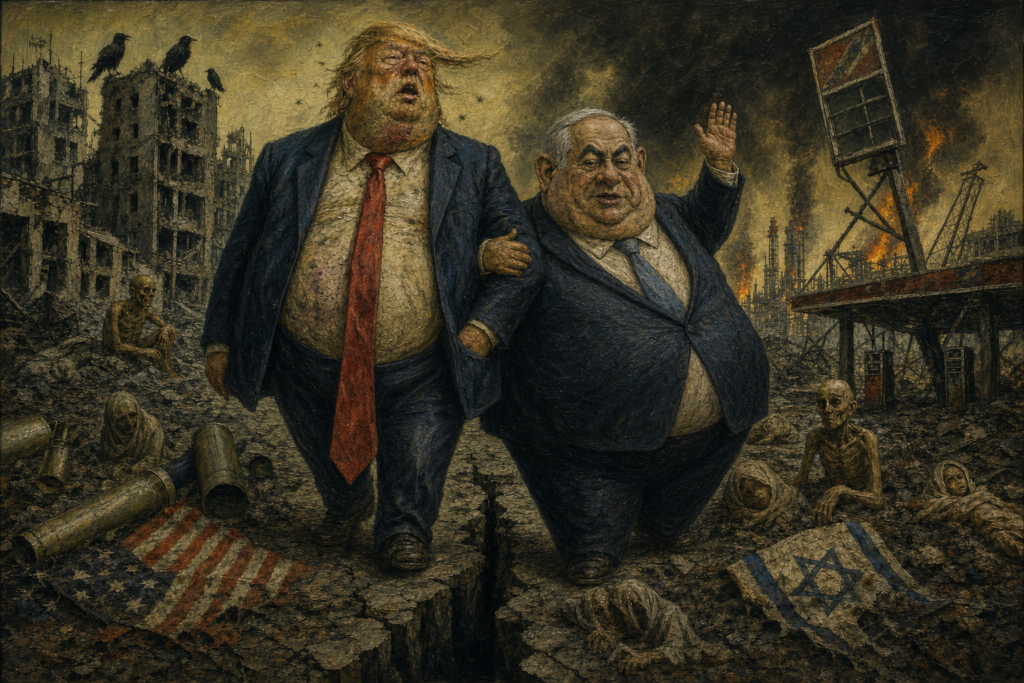
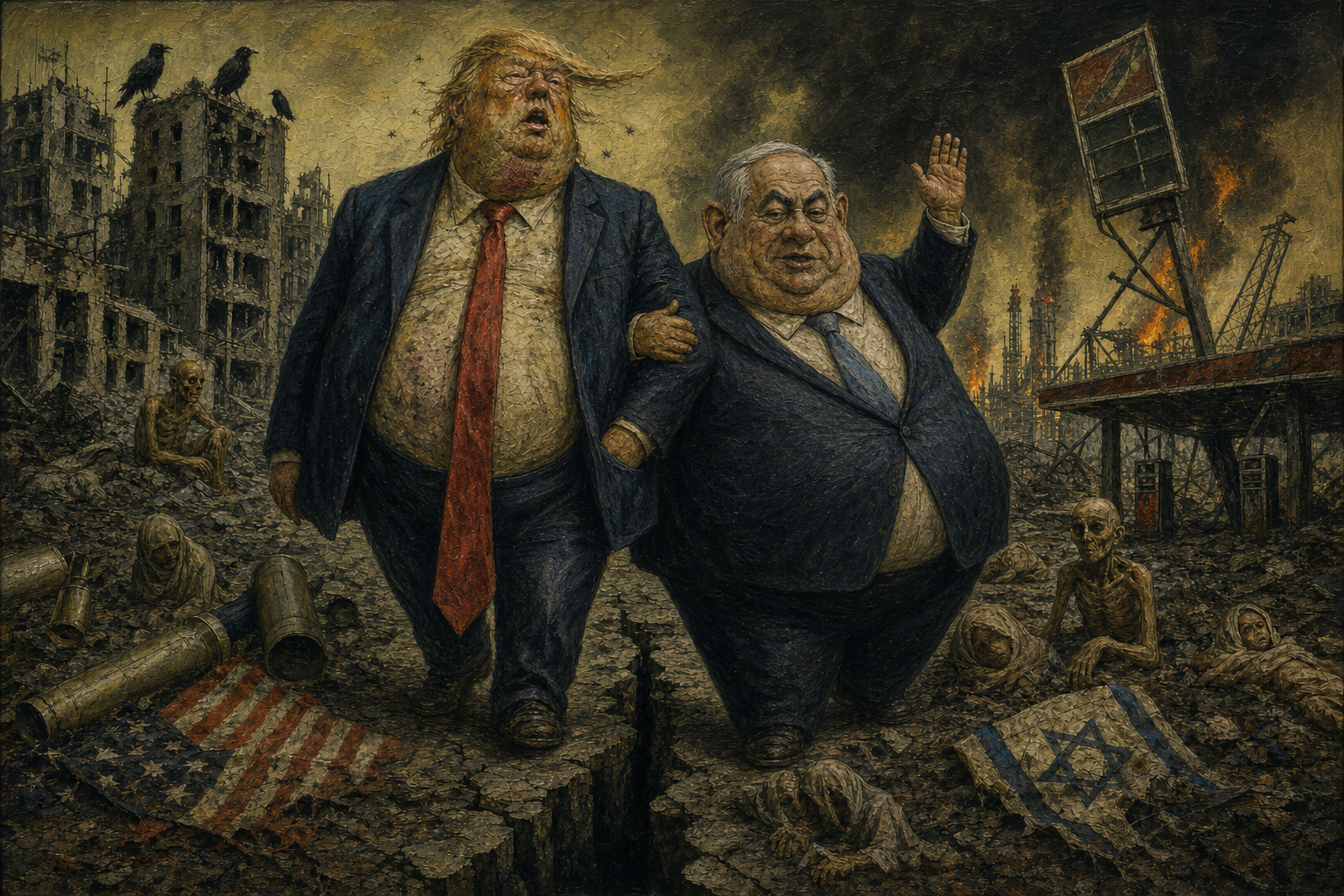
The United States and Israel opened an unprovoked war against Iran on February 28, 2026. The West has funded an unwinnable war in Ukraine for four and a half years. Washington is losing both, and the two defeats are not separate events. They draw down the same stockpile, they consume the same negotiating bandwidth, and they enrich the same people. What follows leans on four long interviews conducted by Glenn Diesen in the first week of August, with the journalist Pepe Escobar, Jennifer Kavanagh of Defense Priorities, Nicolai Petro of the University of Rhode Island, and retired Air Force Lieutenant Colonel Karen Kwiatkowski. These four are the sources. They are named, they are on the record, they are dated, and among them they hold four decades inside the State Department, the Pentagon, the National Security Agency, Washington’s defense analysis establishment, and West Asia itself. What they say is the evidence. The documents cited alongside them are corroboration, not permission.
Eight facts to consider
- American forces struck more than 13,000 targets in Iran in the 39 days between February 28 and the April 8 ceasefire. That figure is the Pentagon’s own, published in the Operation Epic Fury fact sheet of April 6, 2026.1 Leaked United States intelligence assessments reported in May concluded that Iran had retained roughly 70 percent of its pre-war ballistic missile stockpile and roughly 70 percent of its mobile launchers.2
- The interceptor magazine that was supposed to make this affordable is close to empty. Estimates derived from the Center for Strategic and International Studies put Patriot expenditure at about 65 percent of the pre-war inventory, leaving as few as 759 interceptors, and THAAD expenditure anywhere from 38 percent to nearly four-fifths depending on the vintage of the estimate.3 The actual inventories are classified. Every number in public circulation is an outside estimate, and the Pentagon’s public position remains that the force “has everything it needs.”4
- Replacement is not happening at war tempo. Nominal Patriot capacity is about 600 interceptors a year. Actual deliveries to the Pentagon are running near 20 a month, and Tomahawk deliveries near 15 a month.5 No new THAAD interceptors have been delivered since August 2023, with resumption not expected before roughly April 2027.6
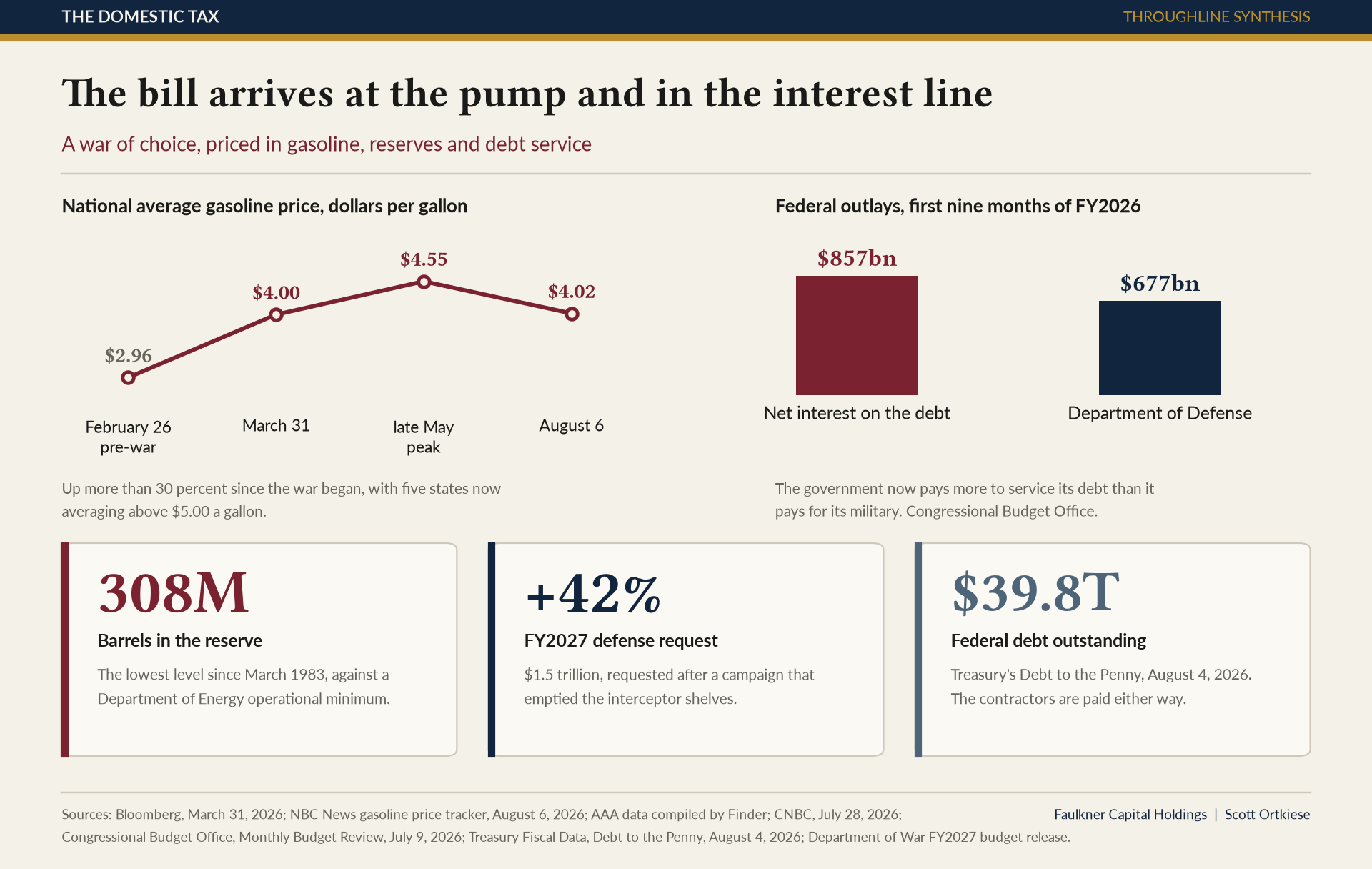
- The bill for the war that was supposed to last a weekend is a Fiscal Year 2027 request of $1.5 trillion, a 42 percent increase, consisting of a $1.15 trillion base, $350 billion through reconciliation, and an $87.6 billion Iran supplemental.7
- Ukraine asked for 300 Patriot interceptors to survive the coming winter. Volodymyr Zelenskyy put the number in public on July 14: “We have calculated that this package should include 100 Patriot missiles per month, 300 missiles for the winter.”8 The administration’s answer has been that the interceptors are being held for Iran.9
- The Russian offensive that Western reporting treats as inexorable has nearly stopped. The Institute for the Study of War recorded Russian gains of 622.60 square kilometers in the first half of 2026 against 2,189.87 square kilometers in the same period of 2025, which is 28.43 percent as much ground.10 Neither side is winning. Both sides are feeding men into a line that is barely moving.
- Ukraine’s demographic account is closing regardless. The CIA World Factbook records a death rate of 18.6 per 1,000 and a birth rate of 6 per 1,000, roughly three deaths for every birth, the worst such ratio on earth.11
- The gasoline is a domestic tax on a foreign war. The national average crossed $4.00 a gallon on March 31, the first time since August 2022, peaked at about $4.55 in late May, and is above $4.00 again in early August, up more than 30 percent since the war began, with five states averaging above $5.00.12 The Strategic Petroleum Reserve has fallen to roughly 308 million barrels, its lowest level since March 1983.13
The war was never about the nuclear file
Begin where Pepe Escobar begins, because if he is right about this, every subsequent argument about enrichment percentages is a distraction that the people who started the war are happy to have us conduct.
“No one should ever forget that this war has nothing to do with the Iranian nuclear dossier. This is an oil war. This is a checkpoint-and-chokepoint war. This was a war to make sure that the Strait of Hormuz, and beyond, and every form of energy exported by Iran, which should have gone through regime change in the first 48 hours of the war, would be priced in petrodollars and not in petroyuan or other currencies.”
The documentary record says he is right.
The Islamabad Memorandum of Understanding between the United States and Iran, whose full text was published on June 17, is the agreement Washington itself drafted, and the operative maritime clause commits Iran to arrange safe passage of commercial vessels “with no charge, for 60 days only,” to complete demining within 30 days, and to “conduct dialog with the Sultanate of Oman to define the future administration and maritime services in the Strait of Hormuz.”14 Read that clause as a statement of American war aims and it becomes clear what the war was for. The United States did not use its one signed instrument to secure inspections. It used it to secure toll-free transit and to hand the future administration of the strait to a mediator it hoped to control.
The nuclear file was not the priority in the text either. It was flagged for immediate negotiation with resolution deferred to a later stage, which is precisely the sequencing Escobar describes and precisely the sequencing Washington is now trying to reverse. And on the American side the ignorance is total. The International Atomic Energy Agency stopped verification after February 28 and has since stated that it cannot establish the size, composition, or location of Iran’s enriched uranium.15 The last verified figure, 440.9 kilograms enriched to 60 percent, dates from June 13, 2025.16 Escobar’s summary is correct: “the Americans have no clue whatsoever about how much enriched uranium Iran has, or where it is.”
He then cites Theodore Postol of MIT for the consequence. Postol’s estimate is ten to twenty weapons’ worth of material, and four to six weeks to move from 60 percent to weapons grade once a decision is taken.17 Four to six weeks is a decision window, and the war is what destroyed the ability of anyone in Washington to know whether the clock has started. A country that had accepted verification now has no verification, unknown material, and every incentive that the last six months could possibly have supplied.
That is what a nonproliferation policy conducted by bombing produces. And it is the second-order effect. The first-order effect is at the strait.
Iran now owns the chokepoint
The single most consequential thing said in any of the four interviews is Escobar’s account of what Tehran and Muscat are actually negotiating, and the Guardian published the same architecture three days earlier without noticing what it had.
Escobar describes two parallel and non-intersecting tracks. The first is a temporary technical arrangement between Iranian and Omani engineers: everything sailing into the strait subject to the Revolutionary Guard navy, its procedures, the new Persian Gulf Strait Authority, and the payment of fees, while everything sailing outward is cleared by Omani authorities under Iranian supervision. His summary: “100 percent Iranian control coming in and, let’s say, 50 percent Iranian control going out.” The second track is the permanent one, the legislation moving through the Majlis.
The paper trail runs with him. The Persian Gulf Strait Authority was announced by Iran’s Supreme National Security Council on May 18, 2026 as the sole issuer of transit permits, charging fees for passage.18 Iran’s deputy foreign minister has described an agreement with Oman on permits and licences.19 And the Guardian, on August 4, reported that the United States and Europe are pressing Oman to accept a temporary agreement under which ships “would enter the strait on a route close to Iran” and “leave on a route passing through Iranian and Omani waters,” with officials in Muscat fearing the arrangement would leave Iran with “near permanent dominance of the vital oil shipping channel.”20
In on the Iranian route, out through shared waters. That is Escobar’s ratio, in the same terms, arriving from the opposite direction, in a British newspaper quoting frightened Omani officials. What it means has not been said plainly in any American outlet, so here it is: the United States went to war to keep the Strait of Hormuz open on American terms and is now lobbying a small Gulf sultanate to accept Iranian terms before Iran’s parliament imposes worse ones.
The permanent track is a sequence of bills rather than a single statute, and each one is worse for Washington than the last: a twelve-article motion ratified in committee on April 21 titled “The Law on Establishing Iran’s Sovereignty over the Strait of Hormuz,” barring vessels of Israel and hostile states and requiring fees in rial; a bill formally tabled on July 14 on “strategic action for the security and sustainable development of the Strait of Hormuz and the Persian Gulf”; and a bill still under parliamentary review on August 6 with fines up to 20 percent of cargo value.21 The direction of travel is one way, and it is not toward the United States Navy.
Escobar’s forecast of the American reaction when the permanent version passes is that “the Trump administration is going to be beyond freaking out, with unexpected consequences.” That is not analysis so much as a weather report, and the price of the weather is already visible on the sign at the corner gas station: above $4.00 nationally, above $5.00 in five states, against a pre-war baseline of $2.96, with the Strategic Petroleum Reserve at a 43-year low and therefore unavailable as an instrument of price suppression.22
Escobar’s point about the reserve is that the depletion clock was public and the government ran it down anyway. It is: 308 million barrels, the lowest level since March 1983, against a Department of Energy operational minimum, while JPMorgan warns that global and OECD inventories tighten through September.23 The administration spent the nation’s oil insurance policy to suppress the price of a war it chose, and the insurance is now gone with the war still running.
The box
Escobar’s second structural insight is the one American commentary is least able to state, and it is the reason the Iran war and the Israel question cannot be separated in an honest account.
“They’re running out of bases. In fact, they had to transfer most of it to Israel, which, from a Sun Tzu point of view, is brilliant, because the Iranians managed to put the US inside the Israeli box.”
The record he is describing: American offensive assets went into Israel before the first shot: twelve F-22 Raptors deployed to Ovda Airbase in southern Israel on February 24, described as the first American deployment of offensive weaponry in Israel, and by February 27 fourteen Air Force refueling tankers at Ben Gurion Airport.24 The reason they went there is the part that matters most. Gulf allies blocked American use of their bases and airspace for strikes on Iran.25 Washington did not choose Israel as a platform. Washington was left with Israel as a platform.
Since then at least 20 American bases in the region have been damaged, and Central Command is weighing moving base functions out of Bahrain, Kuwait, and Saudi Arabia into Israel, including a possible new large base in the Negev, with no final decisions announced.26 The Jewish Institute for National Security of America is already lobbying to make Ovda permanent and to homeport a guided-missile destroyer at Haifa.27 That is the trajectory Escobar names: an American force posture in West Asia progressively consolidated onto the territory of the one regional state that wants the war to continue, at the moment that state is the most exposed target in the theater.
Which sets up the test he proposes, and it is the sharpest thing said in any of the four interviews. Israel’s interest, he argues, now diverges from the American interest, because Israel must sabotage any settlement that leaves Iran standing. “So then everybody will be able to see very clearly whether the Trump administration is thinking in terms of US national interests, or whether they are once again being controlled by Israeli interests and a Greater Israel program. This would be quite enlightening for the whole planet to see, live, in front of all of us.”
That is a falsifiable test, published in advance, with a defined observation window, and it is worth more than a decade of arguments about influence, because it requires no one to concede a premise. If a settlement becomes available and Washington refuses it to preserve Israel’s freedom of action, the question is answered by conduct in front of witnesses. Escobar’s forecast of Israel’s method in the interim: “the only thing they know how to do is to kill people… Killing people means killing members of the Iranian leadership, and trying by all means to sabotage the possibility of the MOU being back on track.”
That is the demonstrated method, and the demonstration is not confined to Iran. Between February 28 and mid-July, reporting compiled by Middle East Eye documented more than 3,795 Israeli ceasefire violations in Gaza. Karen Kwiatkowski, who spent her career inside the American institution that pays for it, states the American share plainly: “we watched Gaza get decimated for almost three years… how many realize that we fund every penny of it?” I use the word genocide to describe a genocide, and the reason to place it in this section rather than in a separate paragraph of moral commentary is that it is evidence. A government that conducts itself that way in Gaza is not going to be restrained by an American preference for a settlement in Tehran.
Beijing, Islamabad, Muscat, Sanaa
Here is the fact that should have reorganized American foreign policy coverage months ago and has not: the diplomatic architecture of this war contains no Western institution.
Escobar names the channel as Beijing to Islamabad to Tehran, and identifies the interest behind it. “China wants a peaceful resolution of this war. What we have now is a no-war, no-peace situation, which is the last thing the Chinese want. The Chinese are absolute sticklers for stability, continuity and predictability, and this involves one of their key strategic allies across Eurasia.” The material basis is real and dated: China and Iran signed a 25-year strategic cooperation agreement in Tehran on March 27, 2021, under which China committed a reported $400 billion of investment in Iranian energy and infrastructure in exchange for long-term discounted oil, and Pakistan holds the China Pakistan Economic Corridor, the flagship project of the Belt and Road Initiative.28 Both are Belt and Road partners. Both sit between South Asia and West Asia. The mediation is not sentiment. It is infrastructure protecting itself.
The traffic is documented. Araghchi was in Islamabad on July 23, and before that on April 24 and June 23, and Foreign Minister Ishaq Dar extended a further invitation on August 3.29 Three visits in four months, and the Iranian foreign ministry says the only negotiation actually under way is with Oman over the strait.30 Escobar has the channel right and Washington’s briefings about an imminent deal are the fiction.
Then Yemen, where Escobar’s reporting is at its most valuable because he asked the question no Western outlet asked: why now. The answer he received in Sanaa was preemption. Ansar Allah assessed, in coordination with Tehran, that Washington was preparing a general offensive against the whole Axis of Resistance, and opened a second front to complicate it. The declared logic was “a siege against a siege,” a response to more than eleven years of Saudi aerial blockade and to the 2019 memorandum Riyadh broke.
The public record supports the structure. The Houthi maritime embargo of Saudi Arabia was declared on July 20, 2026, and enforcement was immediate: on July 21 a Chinese-owned vehicle carrier bound for Jeddah turned around after the Houthi-run coordination center emailed its operator that transit clearance was cancelled.31 Chinese vessels are cleared case by case and are to be exempt from the Houthi transit-fee regime, which is the arrangement Escobar reports, functioning without a signed instrument.32 A movement that no Western government recognizes as a state is now issuing and cancelling transit clearances in the Red Sea, and granting differential treatment to Chinese cargo. That is sovereignty exercised in fact, and it is being exercised in a currency of favors that Washington cannot bid for.
Escobar’s description of how these actors coordinate should be read by anyone who has been told this is an Iranian puppet network. “It’s very far from monolithic.” The Axis works, in his account, as a decentralized mosaic in which each member solves its own problem on its own timetable: Iran negotiates Hormuz with Oman, Ansar Allah runs its own campaign against Riyadh, Iraqi factions structure their own response to the joint American and Saudi strike on the Popular Mobilization Forces on July 29, and Hezbollah waits.33 A network that can be coordinated without being commanded is harder to defeat than a hierarchy, because there is no center whose destruction ends it. Thirteen thousand targets in 39 days is what it looks like to bomb a hierarchy that is not there.
The state of the Iranian government
Escobar reports an open fight in Tehran between the presidency and the Revolutionary Guard command, with the interior minister and former Guard commander Ahmad Vahidi on one side of it. The public traces of that fight are these. It was alleged in May that President Pezeshkian had offered to resign over operations instigated by commanders including Vahidi, and Tehran denied it.34 On August 4 Pezeshkian denied on television that he had repeatedly threatened to resign, saying “if I want to resign, I will officially announce that I have resigned. I will not resign, I will stand,” and insisting he was in complete harmony with the military.35
A head of government does not hold a televised press conference to deny that he is quitting unless someone with standing has been saying he is. And the split itself is on the record from the hardline side, in writing. The conservative-dominated Assembly of Experts issued a statement calling hopes of an agreement with the United States “futile,” describing “whispers of capitulation in the name of defending peace” as “an unforgivable betrayal,” and calling trust in the American government “nothing more than a mirage.”36
Escobar’s claim about the Supreme Leader is confirmed by the same reporting. Mojtaba Khamenei, confirmed on March 8 and 9 after his father was killed in the opening strikes of February 28, opposed talks with the United States in principle in April and allowed them to proceed in deference to Pezeshkian.37 Escobar: “he gave a chance to the diplomatic channel to go on… even though he was opposed to the MOU from the start. The whole situation proved his point. He was correct from the start. He knew the thing would never work with the Americans.”
That is the durable political consequence of the American decision to break its own agreement, and it deserves to be stated as coldly as possible. Trump declared the memorandum and the ceasefire “over” on July 8, 2026.38 The formal 60-day negotiating window still runs to about August 16. The practical effect of breaking it is that the faction inside Iran which argued that agreements with Washington are worthless has been vindicated by the American government itself, in writing, on a dated record, at the exact moment the West needs an Iranian faction capable of signing something. Escobar’s citation of Lavrov’s formula, that the United States is non-agreement-capable, is not Russian propaganda in this instance. It is a description of what happened to a document the United States drafted.
Pezeshkian, notably, is still trying. He said the memorandum “could become a foundation for Iran’s future foreign relations” and that Iran “must strive to compel the enemy to remain committed to what it has signed.”39 Washington’s answer to that sentence is a criminal investigation into its own leakers, which is the subject of a later section.
One stockpile, three theaters
The chokepoint is why the war was fought. The magazine is why it cannot be won.
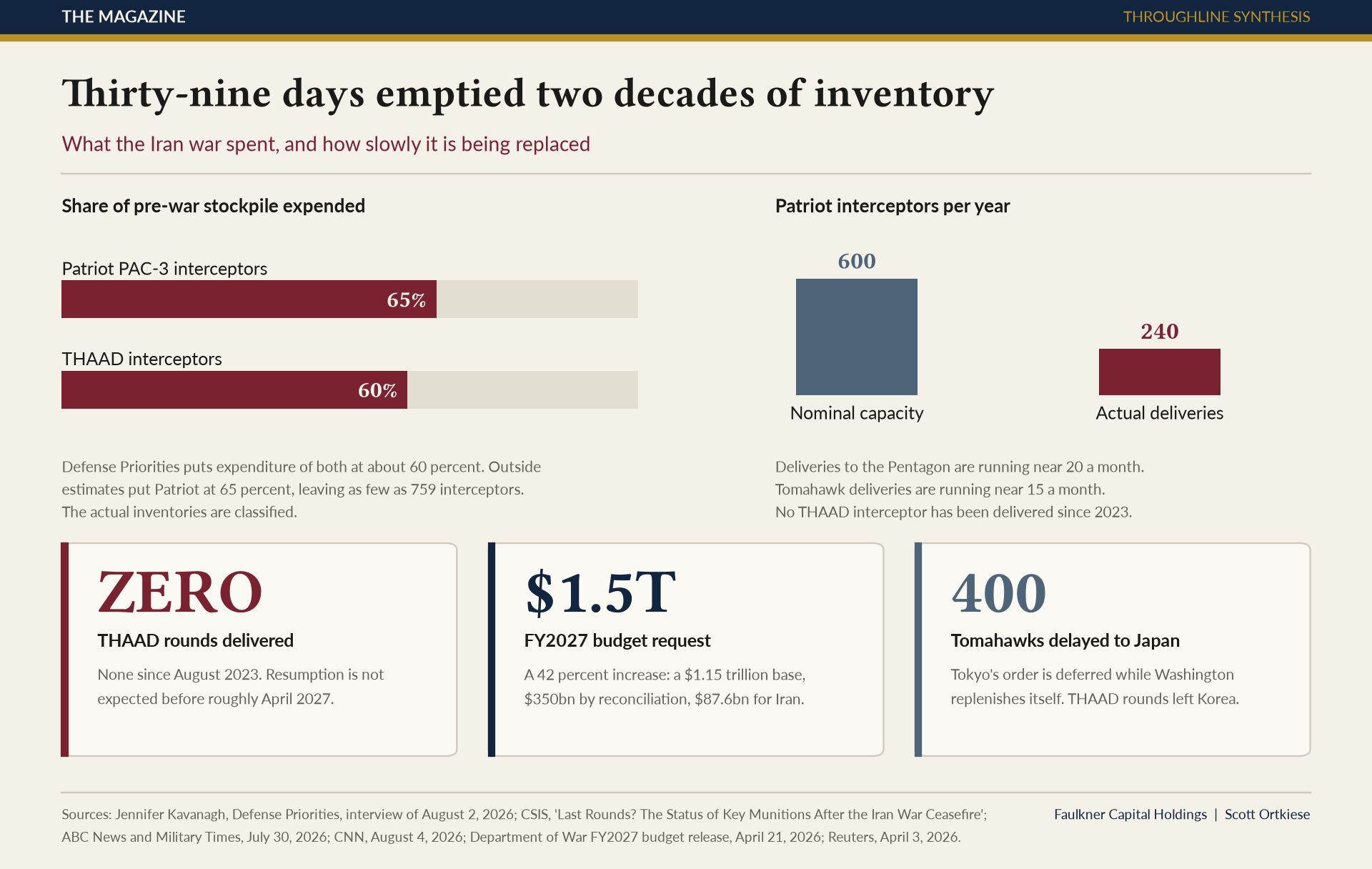
Jennifer Kavanagh is the most conservative of the four voices and therefore the most useful. She directs military analysis at Defense Priorities. She does not use the word empire. She does not mention Israel or any lobby. She takes care to say that “the U.S. is not running out of munitions” and that “the U.S. also has plenty of munitions,” and she notes that “these are just rough numbers” because “the actual numbers are classified.” She is the floor of the argument, not the ceiling, and the floor still gives way.
Because what she then says is that Washington has expended “about 60% of its stockpiles of both of those,” Patriot and THAAD, and that this is “a lot for a war that lasts only six weeks.” Run her arithmetic on Ukraine’s winter. She estimates the interceptors Washington can spare for Kyiv at “probably in the dozens, less than 100, for sure, over the course of an entire winter,” and then measures that against Russian strike packages, which now run 30 to 40 ballistic missiles at a time.40 Forty missiles twice a week against fewer than a hundred interceptors is a magazine that empties in the first week of the winter she is describing, and Ukraine’s air defense is built to plug into NATO’s Link 16 architecture, which means it cannot be substituted from any other supplier.
Then extend the same magazine eastward. Kavanagh: “it’s kind of silly, in my view, to even talk about a U.S.-China war right now because we’ve seen how severely U.S. missile and munition stockpiles have been depleted in Iran.” That sentence is the whole Indo-Pacific strategy of two administrations, dismissed as arithmetic. THAAD interceptors were pulled off the Korean peninsula and sent west, a fact worth stating precisely because it is usually stated wrongly: the batteries stayed, the launchers were back at Seongju by June 21, and it was the ammunition that left.41 Japan has been told its order of 400 Tomahawks will be delayed while Washington replenishes itself.42 The alliance system is being quietly stripped for parts to sustain a war against a country whose 2025 military budget SIPRI puts at $7.4 billion against an American $954 billion, a ratio of roughly 129 to 1.43 An empire outspending its adversary by 129 to 1 has emptied its magazines and is stripping Korea and Japan to refill them.
The demonstration ran in reverse
The war was sold as a demonstration. It became one.
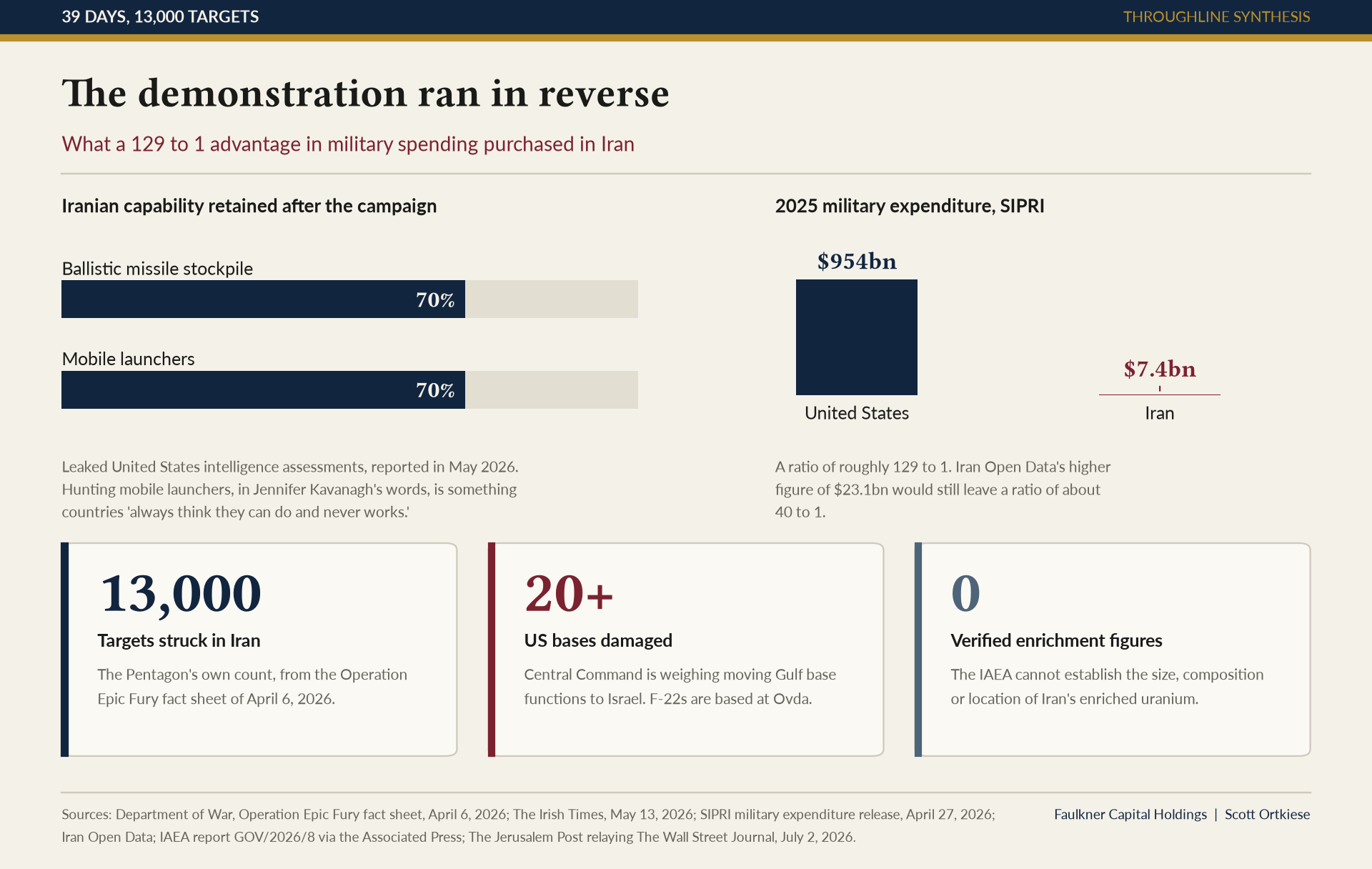
Kavanagh, on the operational premise: “Trying to hunt mobile missile launchers is something that countries always think they can do and never works.” Thirteen thousand targets, and 70 percent of the launchers still in the field. Kwiatkowski, who worked in the Pentagon and at the National Security Agency and who watched the Office of Special Plans manufacture the Iraq case from the inside, reports the same failure from the targeting side, quoting what she has heard from officers: “We can’t find new targets. We’re hitting the same targets two or three times.”
Her exchange-ratio point should end the American procurement debate. “When you use half-million-dollar systems or $100,000 missiles against something that cost the enemy $15,000 or $20,000, and they have literally hundreds of thousands of them while you have only a few expensive interceptors, that’s a sign that you’re in big trouble.” And the ratio is worse than one for one, because “we send up two or three PAC-2 or PAC-3 interceptors, five or six, 10 or 11, to intercept one incoming missile.” That is not incompetence. It is the design. In her words, “high-value, very expensive items with long logistics tails make you money. Lots of cheap ammunition and cheap drones… No, we didn’t invest in that, because it isn’t profitable.”
The bombing of a girls’ school in Tehran belongs here rather than in a separate paragraph about atrocity, because Kwiatkowski explains it as targeting doctrine and not as an accident. The logic she describes is: “Why don’t we kill a bunch of the senior officers’ kids? That will break their hearts.” Her verdict on the result is the verdict on the whole campaign. “Of course, it broke their hearts, but not their will.”
Escobar’s assessment of the outcome is the one the American press cannot print: an empire “reduced to this position of being humiliated by a mid-size power under sanctions for 47 years.” Sanctions on Iran do run to roughly that span, from the 1979 hostage crisis. And his conclusion about the negotiating position is arithmetic rather than rhetoric. “Their strategic assets in the Persian Gulf and West Asia are evaporating. So what cards do they have? No cards at all.” The off-ramp, he notes, is the memorandum Washington itself signed and then repudiated, “which we all know Trump will never do. So once again, even the way out, the off-ramp, is now off.”
Escobar’s judgment is that Iran’s emergence as a top regional power and a leading power of the Global South “is now irreversible.” What makes it irreversible is not Iranian strength. It is demonstrated Western inability to reverse it after 13,000 strikes, the killing of a head of state, and the expenditure of most of an interceptor inventory built over two decades.
The bandwidth problem
There is a second coupling between the two wars, and it is scarcer than interceptors. It is attention.
Kavanagh: “I still think Witkoff and Kushner are quite distracted with Iran. It’s going to be really difficult to find the diplomatic and political space in Washington, D.C., for a serious push for an end to the war in Ukraine while Iran is ongoing.” Her forecast is a cycle of “bombing and talks, bombing and talks, at least through the end of the year, which means that then we’re in the winter, and Russia has no incentive to negotiate until the winter is over.” On the diplomacy that was supposed to have settled it: “The Anchorage framework isn’t going to work. Kyiv didn’t like it, and we’re starting over.” And: “we spent a year on this, and now we’re back to where we were.”
Two negotiators, two wars, one calendar. The Ukrainian settlement is not failing because it is intractable. It is failing because the people assigned to it are in the Gulf, and the reason they are in the Gulf is a war of choice begun on February 28.
Whose war is it
Nicolai Petro served as special assistant for policy on the Soviet Union at the State Department. He is describing a country he has studied for forty years, and what he describes is not a nation defending itself but an apparatus consuming itself.
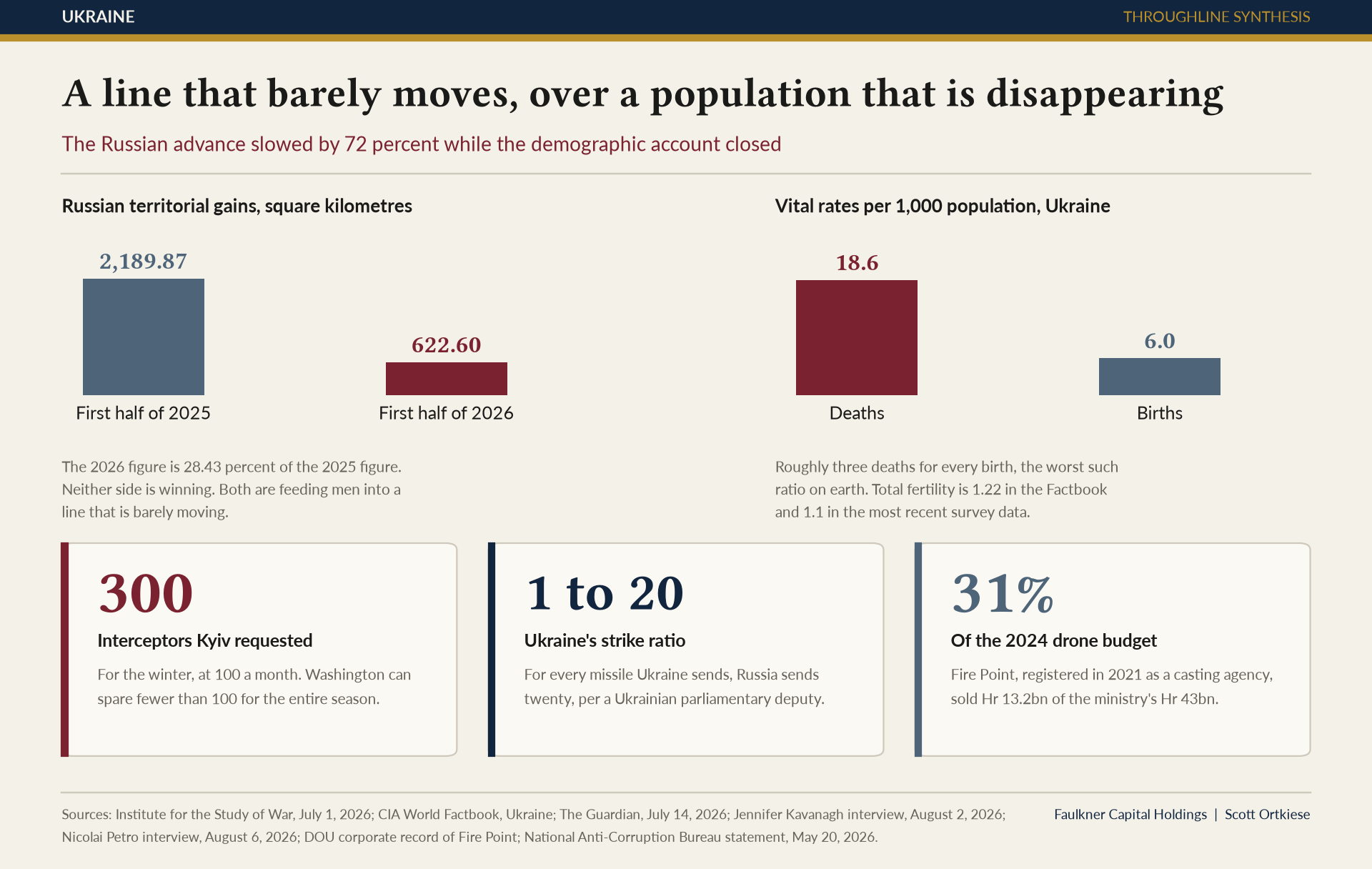
Start with his structural observation: “All of Ukraine’s resources are external.” A state whose resources are entirely external has no domestic constituency that can end its war, because ending the war ends the transfer. Then the internal logic. Kyiv’s own deputy, quoted by Petro, on the strike campaign: “for every missile Ukraine sends, Russia sends 20.” The 40-day deep-strike campaign that Zelenskyy approved on June 25 as a Security Service operation ended on August 4, having traded at that exchange rate the entire way.
Then the command crisis. Mykhailo Fedorov, the defence minister, was removed on July 15. Street protests began on July 16. Oleksandr Syrskyi was dismissed as commander-in-chief on July 21, with Mykhailo Drapatyi named as successor.44 In his farewell Syrskyi claimed that “this year under my command, 700 square kilometers of our land were liberated.”45 Kavanagh’s comment on the sequence is one sentence long and it is enough: “if you’re winning the war, you don’t change your military leadership.”
Petro’s most valuable contribution is to refuse the personality reading of that crisis. “It isn’t so much Syrskyi versus Fedorov; they’re the public faces of the debate. A better way to understand it may be Skyfall versus Fire Point.” Two drone and missile manufacturers, competing for the state’s procurement, with “representatives in Western capitals, particularly London.” The corporate record bears him out. Fire Point was registered in 2021 as Centrocast, a casting and locations agency, renamed in February 2023, and transferred to Yehor Skalyha, a film-industry location specialist whose credits include productions made with Zelenskyy.46 It sold 13.2 billion hryvnia of drones to the state in 2024 out of the 43 billion the ministry spent on drones, just under a third of the entire national drone budget in a single year.47 The anti-corruption bureau opened proceedings in February 2025 and said on May 20, 2026 that the company and its founders are not suspects.48 Skyfall is the rival house, owned by Oleksandr Konotopskyi.
That is the picture: a wartime procurement system in which a casting agency became a missile manufacturer inside two years and captured a third of a spending line, while the country’s ambassador to Washington was dismissed on August 3 amid suspicion of illegal enrichment of roughly $310,000.49 Petro’s line about the protests belongs here. “No one in Ukraine, I think, takes these protests very seriously… Every one of these protests is illegal, and the government is fully within its rights under martial law to disperse them if it chose. Its choice not to do so is probably more an indication of who funds them and stands behind them.”
And the mechanism that keeps it running past any ceasefire: a ceasefire does not end martial law, and the end of martial law is the only condition under which elections follow. As Petro puts it, a ceasefire “wouldn’t oblige the Ukrainian authorities to submit themselves to a popular vote.” The war, in his phrase, “has become this self-generating thing that Zelenskyy needs to keep him in his political position,” because Zelenskyy “can’t see a Ukraine without himself.” Kwiatkowski’s description of what Ukraine is to its sponsors is colder and fits the evidence: “the resources, the people, cheap labor, and land on which to run exercises.”
The favor machine
The temptation, at this point in the argument, is to name a lobby and stop. That is the weaker version of the case, and it is weaker for a specific reason: it invites the reply that the lobby is one voice among many, and the argument then dissolves into a fight about influence rather than about structure.
Kwiatkowski, who has more standing to make the ethnic version of the argument than almost anyone and who does report from her own experience that “our intelligence in the region is all Mossad-provided,” declines to make it. Her formulation is structural. “I’m not just talking about AIPAC; I’m talking about anybody. You buy a politician, and you expect to get something from it. That’s our system.” And: “government is nothing but a huge favor machine.” And, most usefully: “For decades, our military budgets haven’t been written by Congress or the executive branch. They’re written by the very contractors who are going to get the money.”
That version cannot be deflected, because it does not depend on anyone’s ethnicity or anyone’s dual loyalty. It depends only on the observable fact that the people who receive the appropriation write the appropriation. The pro-Israel donor network is not an exception to that system. It is the best-organized instance of it, which is why it is the most visible, and why the visibility is repeatedly used to change the subject. Escobar’s live test, described above, is the honest way to settle the question, and it settles it by conduct rather than by identity.
Kavanagh, from an entirely different starting point, asks the question that follows from the same structure and that no one in Washington has answered: “if we have all the missiles we need, why do we need a $1.5 trillion defense budget?” Either the magazine is full and the request is fraud, or the magazine is empty and the war was launched by people who knew it was empty. There is no third reading. Meanwhile the arithmetic of the state Kwiatkowski describes has arrived where she says it has: debt approaching $40 trillion, and net interest now exceeding military spending. Over the first nine months of Fiscal Year 2026 the Congressional Budget Office recorded $857 billion in net interest against $677 billion for the Department of Defense.50 Her image for it: “This car we have been driving for 45 years is broken.” And: “our plane is crashing.”
Vassals with a veto
The word usually reached for here is client, or satellite, or worse. The evidence does not support it, and the truer description is harsher.
A slave does not deny the master the use of his airspace. Gulf states blocked American use of their bases and airspace for strikes on Iran, which is why the F-22s went to Ovda.51 Oman is negotiating the transit regime of the world’s most important oil chokepoint directly with Tehran, while Washington demands no fees and Muscat worries about Iranian dominance rather than about American displeasure.52 Pakistan positioned itself as the mediating channel, and Escobar reports that Islamabad told Riyadh it would not be dragged into a Saudi war despite a mutual defense pact. In Jordan, where roughly 4,000 American troops are stationed and where a strike on Muwaffaq al-Salti Air Base killed three American service members on July 17, hundreds of political and legal figures signed an open letter calling for the American withdrawal.53 And Escobar reports that Mohammed bin Salman telephoned Trump personally to stop a further strike on the grounds that everyone in the Gulf would pay for it, which is exactly the behavior every item above would predict.
These are not slaves. They are vassals who have discovered that they hold a veto, and who are exercising it against the war their patron is fighting in their neighborhood, in the specific week the patron ran out of interceptors. That is a far more serious problem for American power than servility would be, because servility can be commanded and a veto cannot. Every one of those vetoes is a piece of the multipolar order being assembled in real time, by American allies, out of American failure.
The Roy Cohn problem
Escobar’s last contribution is the one that explains why none of the above will produce a policy change, and it is a psychological argument rather than a geopolitical one, which is exactly why it should be tested against behavior rather than accepted.
He points to a New Yorker excerpt from a new book about Roy Cohn, the lawyer who trained a young Donald Trump, and lists the lessons: never concede defeat, never concede a mistake, blame others, pose as the alpha, never answer a contradiction, control the narrative full time, speak louder than anyone else, turn everything into a wrestling spectacle. His conclusion: “as president of the United States he is implementing that on a global scale. But the problem is that everybody on a global scale in positions of power already knows how he thinks, how he reacts and what disturbs him completely. And the Iranians are using that with extreme sophistication.”
The version of that argument that does not require a psychiatrist arrived this week, on the record. On August 6, after Reuters reported that the United States had exhausted nearly all of its long-range precision missiles, the President insisted the country holds “massive amounts” of munitions and said he wants to prosecute the “leakers” who told the press otherwise, warning they would be hunted down. The Wall Street Journal reported the same day that he had ordered new investigations into the disclosures, an escalation after weeks of headlines about depleted stockpiles.54
Read that sequence against the fact pattern in this article. Independent estimates, the Pentagon’s own target count, allied procurement delays, a Korean ammunition transfer, an interceptor allocation denied to Ukraine, and a $1.5 trillion budget request all point one way. The administration’s response is not a counter-argument. It is a criminal referral. Glenn Diesen put the civil-liberties consequence in a single question: if the reporting is fake, then the government is proposing to imprison people for arguing that there is a shortage of missiles.
This is the mechanism by which a losing war becomes an unending war. The information required to stop it is classified, the people who disclose it are prosecuted, the budget that rewards the failure is expanded, and the officials who would have to negotiate the exit are booked in the Gulf until winter. Kavanagh, who is friendly to the administration’s stated intentions and says “President Trump is still very serious about wanting peace,” nonetheless forecasts bombing and talks through the end of the year. She is describing the same machine from the inside of Washington’s assumptions.
What the words mean
I use the word war to describe a war. The joint American and Israeli attack on Iran that opened on February 28, 2026 had no congressional authorization and no Security Council authorization, and it killed the head of a sovereign state during active negotiations. Kwiatkowski, who spent her career inside the institution that executed it, states the legal conclusion without hedging: “in the case of the United States, on Israel’s behalf, attacking Iran, that’s an illegal war… the Iranians have justice on their side.” Kavanagh, who would never use that language, produces the strategic conclusion that matches it, and the two together are the case.
Ukraine is the same act with a longer fuse and a subcontractor. George Kennan wrote in The New York Times on February 5, 1997 that expanding NATO “would be the most fateful error of American policy in the entire post-cold-war era,” and predicted precisely the militarized Russia the policy then produced.55 George Soros had already written in November 1993 that NATO could supply the technology while Eastern Europeans supplied the manpower, expressly to reduce “the risk of body bags for NATO countries.”56 The subcontracting was a stated design goal, in print, thirty-three years ago. In 2022, when the war could have ended in its second month, Davyd Arakhamia, who led Ukraine’s delegation, said on Ukrainian television that Russia was ready to end it in exchange for neutrality, and that “when we returned from Istanbul, Boris Johnson came to Kyiv and said that we would not sign anything with them at all, and let’s just fight.”57 Johnson’s visit is documented for April 9, 2022.58 Zelenskyy and Johnson both deny the causal reading, and Arakhamia has since qualified it, and readers are entitled to that qualification. What no one denies is that Zelenskyy told The Economist on March 27, 2022 that he was prepared to discuss neutrality, and that four and a half years later Ukraine has lost the territory, the settlement, and the population. Kwiatkowski’s summary of that episode is that “the United States and Boris Johnson blew up the potential peace agreement in Istanbul,” and her summary of the operative principle is Thucydides: “the powerful do what they will, and the weak suffer what they must.”
The exit
Petro offers the historical analogy that fits, and it is not a Russian one. “Russia can’t be defeated, just as America couldn’t be defeated in Vietnam. But America could defeat itself.” Kwiatkowski offers the image: “The whole imperial project has been exposed, as if a curtain had been pulled away in The Wizard of Oz.” Escobar offers the genre, and the diagnosis behind it: an empire “that assumed it would have a free lunch throughout the 21st century,” now starring in what he calls not a Greek tragedy but “a very trashy American pop remake of a Greek tragedy.” Kavanagh, who agrees with none of their politics, offers the operational fact that makes all three of them right, which is that the magazine is empty, the diplomatic bandwidth is spent, and the cycle runs at least through the winter.
None of this is against American interests. It is against the American national interest, and entirely consistent with the extraction interest, which is a different thing and the only thing that explains why it continues. A $1.5 trillion request follows a war that emptied the shelves. The contractors who wrote the request will be paid either way. St. Augustine’s definition, which Kwiatkowski reaches for and which has waited sixteen centuries for this application, is that the state is a band of thieves.
The war was fought for a chokepoint, and the chokepoint now belongs to Iran. It was fought to price energy in dollars, and it has produced an Iranian permit authority, an Omani clearance regime, and a Yemeni movement issuing transit approvals with a Chinese exemption. It was fought to demonstrate American power, and it demonstrated the depth of the American magazine to every capital that was watching. The second war, in Ukraine, is losing its air defense to the first, its negotiators to the first, and its population to arithmetic no ceasefire can reverse.
There is no version of continuing that produces a better outcome than stopping produced in March 2022, or in June 2026. The only policy left that serves the country rather than the people billing it is to stop.
Notes
- Department of War, “Operation Epic Fury Fact Sheet,” April 6, 2026. https://media.defense.gov/2026/Apr/06/2003907108/-1/-1/1/OPERATION-EPIC-FURY-FACT-SHEET-APRIL-6-2026.PDF ↩
- The Irish Times, “US intelligence shows Iran retains substantial missile capabilities,” May 13, 2026. https://www.irishtimes.com/world/middle-east/2026/05/13/us-intelligence-shows-iran-retains-substantial-missile-capabilities/ ↩
- ABC News, July 30, 2026, https://abcnews.com/Politics/us-patriot-interceptor-stockpile-diminished-65-iran-war/story?id=135198306 ; Military Times, July 30, 2026, https://www.militarytimes.com/news/your-military/2026/07/30/iran-war-depleted-us-patriot-missile-stockpiles-creating-readiness-challenges-experts-say/ ; CNN, August 4, 2026, https://www.cnn.com/2026/08/04/politics/us-iran-key-missile-interceptors-low ↩
- Congressional Research Service, Insight IN12668. https://www.everycrsreport.com/reports/IN12668.html ↩
- Institute for the Study of War, June 13, 2026, https://understandingwar.org/research/russia-ukraine/russian-offensive-campaign-assessment-june-13-2026/ ; CNN, August 4, 2026, https://www.cnn.com/2026/08/04/politics/us-iran-key-missile-interceptors-low ↩
- CSIS, “Last Rounds? The Status of Key Munitions After the Iran War Ceasefire.” https://www.csis.org/analysis/last-rounds-status-key-munitions-iran-war-ceasefire ↩
- Department of War, April 21, 2026, https://www.war.gov/News/Releases/Release/Article/4466038/department-of-war-releases-the-presidents-fiscal-year-2027-budget/ ; CSIS, https://www.csis.org/analysis/unpacking-15-trillion-fy-2027-defense-budget-topline ; Breaking Defense, June 2026, https://breakingdefense.com/2026/06/white-house-sends-87-6b-supplemental-to-congress-with-67b-for-defense/ ↩
- The Guardian, July 14, 2026. https://www.theguardian.com/world/2026/jul/14/ukraine-war-briefing-zelenskyy-seeks-300-patriots-to-get-through-winter ↩
- The Hill via AOL, July 29, 2026. https://www.aol.com/articles/zelensky-says-asked-trump-emergency-201323000.html ↩
- Institute for the Study of War, July 1, 2026. https://understandingwar.org/research/russia-ukraine/russian-offensive-campaign-assessment-july-1-2026/ ↩
- CIA World Factbook, Ukraine, 2024 estimates, archived copy. https://web.archive.org/web/2025/https://www.cia.gov/the-world-factbook/countries/ukraine/ The same page gives a total fertility rate of 1.22, and the Multiple Indicator Cluster Survey for 2025 and 2026 reports 1.1. The widely circulated 0.7 figure dates from 2023 and is superseded. ↩
- Bloomberg, March 31, 2026, https://www.bloomberg.com/news/articles/2026-03-31/us-gasoline-price-rises-above-4-as-war-sends-fuel-costs-surging ; CNBC, July 8, 2026, https://www.cnbc.com/2026/07/08/iran-conflict-may-lift-gas-priceshow-a-budget-reset-can-help.html ; NBC News gas price tracker, August 6, 2026, https://www.nbcnews.com/business/consumer/gas-prices ↩
- CNBC, July 28, 2026. https://www.cnbc.com/2026/07/28/us-strategic-petroleum-reserve-spr-iran-oil-strait-hormuz ↩
- CNN, full text of the Islamabad Memorandum of Understanding, June 17, 2026. https://www.cnn.com/2026/06/17/middleeast/us-iran-war-mou-text-intl ↩
- IAEA report GOV/2026/8; Associated Press summary, https://apnews.com/article/iran-nuclear-iaea-uranium-enrichment-suspend-ccf574a324504b985f4b158f9d3d6941 ↩
- Associated Press, on the IAEA’s September 2025 report. https://apnews.com/article/iran-nuclear-iaea-weapons-grade-uranium-c3ae6a8aae96d54355df73842916a324 ↩
- Theodore Postol, interviews of April and June 2026. https://podcasts.apple.com/us/podcast/irans-nuke-program-is-intact-mit-prof-ted-postol-lt/id1761369345?i=1000717581163 and https://heininger.substack.com/p/iran-already-has-the-bomb-and-washington ↩
- Euronews, May 18, 2026. https://www.euronews.com/2026/05/18/iran-sets-up-hormuz-transit-authority-to-charge-ships-for-passage ↩
- Reuters, April 7, 2026. https://www.reuters.com/world/middle-east/can-iran-charge-fees-ships-transit-strait-hormuz-2026-04-07/ ↩
- Patrick Wintour, The Guardian, August 4, 2026. https://www.theguardian.com/world/2026/aug/04/irans-president-denies-threatening-to-resign-during-talks-over-strait-of-hormuz ↩
- Press TV, April 21, 2026, https://www.presstv.ir/Detail/2026/04/21/ ; Al Jazeera, July 14, 2026, https://www.aljazeera.com/news/2026/7/14/iran-lawmakers-present-hormuz-management-bill-as-us-war-heats-up ; Anadolu Agency, August 6, 2026, https://www.aa.com.tr/en/us-israel-iran-war/iranian-parliament-reviews-bill-to-restrict-strait-of-hormuz-transit/4020491 ↩
- NBC News gas price tracker, August 6, 2026, https://www.nbcnews.com/business/consumer/gas-prices ; pre-war baseline of $2.96 on February 26 from AAA data compiled at https://www.finder.com/economics/gas-prices ↩
- CNBC, May 16, 2026, on JPMorgan’s September global-inventory call. https://www.cnbc.com/2026/05/16/oil-inventory-stockpile-iran-war-strait-hormuz.html ↩
- Compiled record of the February 2026 buildup, including the Ovda and Ben Gurion deployments. https://en.wikipedia.org/wiki/2026_United_States_military_buildup_in_the_Middle_East ↩
- Same source, on Gulf refusal of bases and airspace for strikes on Iran. ↩
- The Jerusalem Post, July 2, 2026, relaying The Wall Street Journal, https://www.jpost.com/middle-east/article-901210 ; Dawn, June 29, 2026, https://www.dawn.com/news/amp/2011497 ; Roya News, July 3, 2026, https://en.royanews.tv/news/71356 ↩
- JINSA, Basing Insight, July 15, 2026. https://jinsa.org/wp-content/uploads/2026/07/Basing-Insight-7.15.26.pdf ↩
- Axios, March 27, 2021, https://www.axios.com/2021/03/27/iran-china-25-year-cooperation-agreement ; Iran Watch, March 27, 2021, https://www.iranwatch.org/news-brief/china-400-billion-iran-deal-could-deepen-influence-mideast The full text of the agreement has never been published, and the $400 billion figure comes from a draft obtained by The New York Times. ↩
- Pakistan Ministry of Foreign Affairs, visit of the Iranian delegation, July 23, 2026, https://mofa.gov.pk/press-releases/visit-of-the-iranian-delegation-to-pakistan ; press briefing transcript, August 6, 2026, https://mofa.gov.pk/press-releases/transcript-of-the-press-briefing-by-the-spokesperson-on-thursday-6th-august-2026 ↩
- Iranian foreign ministry spokesman Esmail Baghaei, August 3 and 4, 2026, stating that the only talks under way were with Oman on management of the Strait of Hormuz. ↩
- Reuters, July 29, 2026, on the July 20 embargo declaration and its enforcement. https://www.reuters.com/world/middle-east/houthis-say-they-will-target-saudi-linked-shipping-2026-07-29/ ↩
- Reuters, July 29, 2026, on the proposed transit-fee regime and the Chinese exemption; Atlantic Council, July 20, 2026, https://www.atlanticcouncil.org/dispatches/the-houthis-just-announced-a-blockade-on-saudi-arabia-what-does-it-mean-for-the-global-economy/ ↩
- Al-Monitor, July 2026, on the joint American and Saudi strikes on Iran’s allies in Iraq. https://www.al-monitor.com/originals/2026/07/major-gulf-fighting-restarts-us-and-saudi-strike-irans-allies-iraq ↩
- Al Jazeera, May 7, 2026. https://www.aljazeera.com/news/2026/5/7/irans-president-pezeshkian-seeks-to-quash-divided-leadership-narrative The resignation claim originates with Iran International, a London-based outlet opposed to the Islamic Republic, and was denied by Tehran. ↩
- The Guardian, August 4, 2026. https://www.theguardian.com/world/2026/aug/04/irans-president-denies-threatening-to-resign-during-talks-over-strait-of-hormuz ↩
- Same, quoting the Assembly of Experts statement. ↩
- Same, on Mojtaba Khamenei’s April position; on the succession, the Assembly of Experts announced him on March 8 and 9, 2026. ↩
- JINSA, Basing Insight, July 15, 2026, recording Trump’s July 8 declaration. https://jinsa.org/wp-content/uploads/2026/07/Basing-Insight-7.15.26.pdf ↩
- The Guardian, August 4, 2026, quoting Pezeshkian. ↩
- Euromaidan Press, June 5, 2026, on Russian conversion of surface-to-air missiles and strike-package composition. https://euromaidanpress.com/2026/06/05/russia-more-than-doubles-production-of-converted-sams-to-make-ballistic-missile-strikes-even-harder-to-defend/ ↩
- Arms Control Association, May 2026, https://www.armscontrol.org/act/2026-05/news/us-moves-missile-defenses-middle-east ; Yonhap, June 21, 2026, https://en.yna.co.kr/view/AEN20260621002900315 ↩
- Reuters, April 3, 2026. https://www.reuters.com/world/asia-pacific/japans-order-tomahawk-missiles-delayed-by-us-use-iran-bloomberg-news-says-2026-04-03/ ↩
- SIPRI, military expenditure release, April 27, 2026. https://www.sipri.org/media/press-release/2026/global-military-spending-rise-continues-european-and-asian-expenditures-surge Iran Open Data puts Iran’s 2025 public military budget at $23.1 billion, which would make the ratio roughly 40 to 1. https://iranopendata.org/en/article/iran-defense-budget-2025-soars-35-percent/ ↩
- Associated Press, July 15 and July 21, 2026. https://apnews.com/article/russia-ukraine-war-fedorov-defense-minister-966aa6f66b81df96310531af1f11fba5 and https://apnews.com/article/ukraine-zelenskyy-syrskyi-army-chief-504513cfcc5cbc55175dc605cc711793 ↩
- NV.ua, July 22, 2026. https://english.nv.ua/nation/syrskyi-resigns-as-ukraine-s-commander-in-chief-after-2-5-years-in-office-50626271.html ↩
- DOU, corporate history of Fire Point. https://dou.ua/lenta/articles/everything-about-fire-point/ ↩
- Same, on the 2024 drone procurement share. ↩
- UNN, May 20, 2026. https://unn.ua/en/news/fire-point-and-its-founders-do-not-have-the-status-of-suspects-nabu ↩
- Kyiv Independent, August 3, 2026, https://kyivindependent.com/zelensky-dismisses-ukraines-ambassador-to-us-stefanishyna/ ; Reuters, August 6, 2026. Stefanishyna has been dismissed and is a suspect, not an indicted defendant. ↩
- Congressional Budget Office, Monthly Budget Review: June 2026, published July 9, 2026. https://www.cbo.gov/system/files/2026-07/61982-MBR.pdf Treasury Debt to the Penny recorded $39,828,435,390,891.55 on August 4, 2026. https://fiscaldata.treasury.gov/datasets/debt-to-the-penny/about ↩
- Compiled record of the February 2026 buildup. https://en.wikipedia.org/wiki/2026_United_States_military_buildup_in_the_Middle_East ↩
- The Guardian, August 4, 2026. https://www.theguardian.com/world/2026/aug/04/irans-president-denies-threatening-to-resign-during-talks-over-strait-of-hormuz ↩
- Los Angeles Times, July 28, 2026, https://www.latimes.com/world-nation/story/2026-07-28/jordan-faces-dilemma-in-its-growing-role-in-the-iran-war ; The New York Times, July 29, 2026, https://www.nytimes.com/2026/07/29/world/middleeast/jordan-us-military-iran-war.html ↩
- The Washington Times, August 6, 2026, https://www.washingtontimes.com/news/2026/aug/6/donald-trump-vows-punish-leakers-who-said-us-munitions-running-short/ ; The Wall Street Journal, August 6, 2026, https://www.wsj.com/politics/national-security/trump-orders-leak-probe-after-venting-about-media-coverage-of-munitions-stockpile-bdd0251b The underlying report is Reuters, August 4, 2026, https://www.reuters.com/world/us-has-used-virtually-all-its-long-range-precision-missiles-during-iran-war-2026-08-04/ ↩
- George F. Kennan, “A Fateful Error,” The New York Times, February 5, 1997, page A23. https://ius.bg.ac.rs/wp-content/uploads/2023/03/2.-New-York-Times-George-Kennan.pdf ↩
- George Soros, “Toward a New World Order: The Future of NATO,” November 1, 1993. https://georgesoros.com/1993/11/01/toward-a-new-world-order-the-future-of-nato/ ↩
- Davyd Arakhamia, 1+1 television interview, November 2023, transcript. https://artsakh.news/en/news/280232 ↩
- UK Government, “Prime Minister pledges UK’s unwavering support to Ukraine on visit to Kyiv,” April 9, 2022. https://www.gov.uk/government/news/prime-minister-pledges-uks-unwavering-support-to-ukraine-on-visit-to-kyiv ↩
All four interviews cited were conducted by Glenn Diesen and published between August 2 and August 7, 2026. Quotations are taken from full transcripts of the broadcasts and are reproduced as spoken. Every documentary citation above was checked against the primary source. Nothing in this article rests on an unnamed official, a background briefing, or an anonymous leak, which distinguishes it from the coverage it contradicts.
Scott Ortkiese writes on geopolitics, energy, and capital markets at Throughline Synthesis. Readers who want the underlying long-form documentation and source files may write to so@throughlinesynthesis.com.