Stephen Kinzer’s new book documents how America poisoned the wine of European peace. Washington poured the same poison in Tehran, with a genocidal Israeli government, a row of Gulf client monarchies, a corrupt Trump administration, and a European leadership class that has bamboozled its own voters.
“The gentleman died because he drank some wine with poison in it.”
“How did the poison get in the wine?”
“Arsenic and Old Lace,” 1944. Stephen Kinzer says this is the question he has spent his career trying to answer.
The West did not stumble into the Ukraine war. Washington spent 75 years turning Ukraine into a weapon against Russia. NATO and Europe’s leaders armed Ukraine for 8 years under cover of a peace deal, refused the 5 words that might have stopped the invasion, and then walked away from the peace talks that could have ended the war in its second month. Then they told you the war was “unprovoked.” On February 28, 2026, Washington ran the same play on Iran, this time with Israel. They bombed a country 2 days after a round of negotiations, with the next round already on the calendar, and called it self-defense.
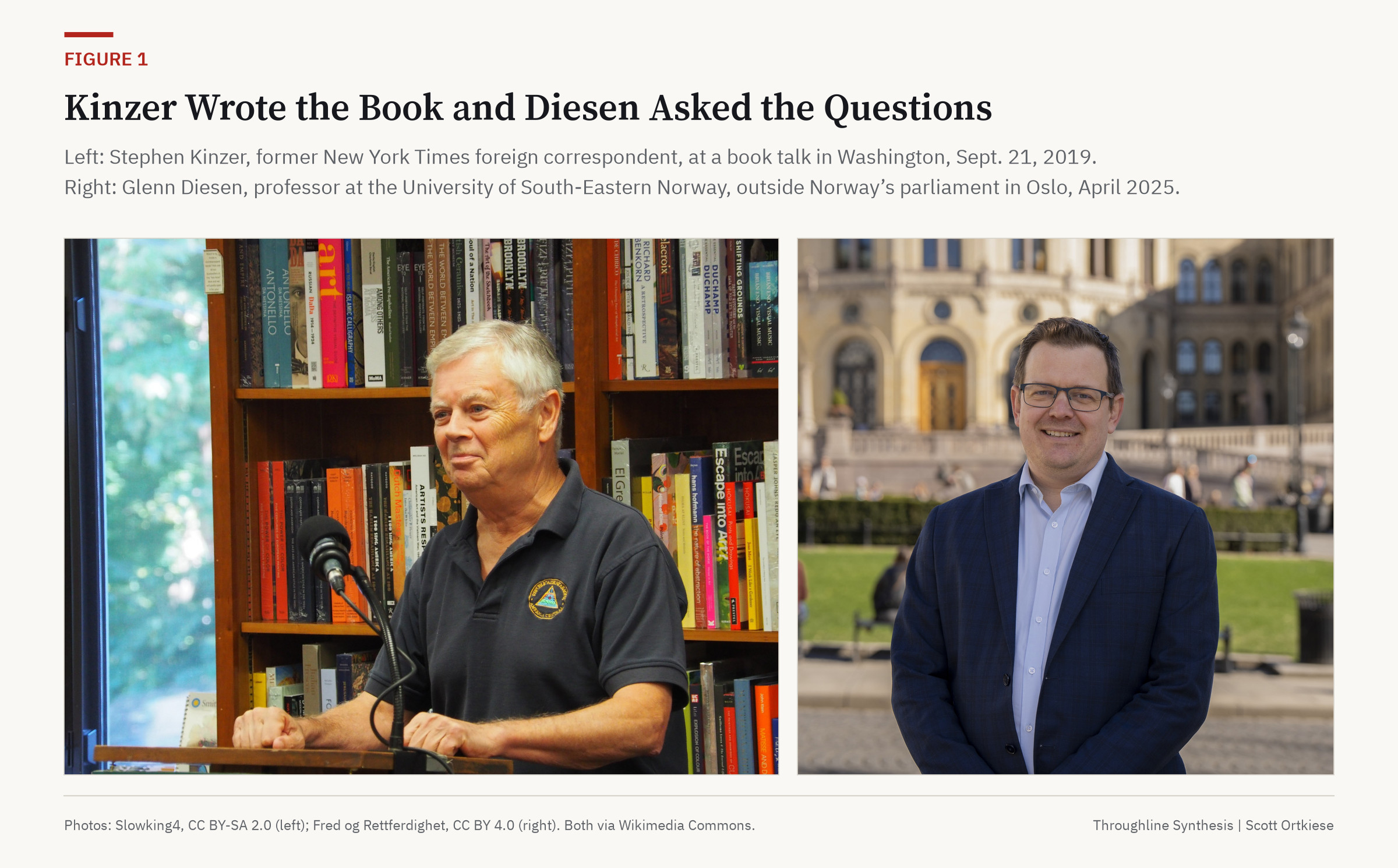
That is the case this article makes. It rests on a 48-minute interview with Stephen Kinzer that Glenn Diesen, professor at the University of South-Eastern Norway, published on November 2, 2026, and on Kinzer’s new book, “Boiling Point: How America Brought War to Ukraine,” published by Henry Holt on November 3, 2026. Kinzer spent more than 20 years at The New York Times, most of them as a foreign correspondent, and is now a senior fellow at Brown University’s Watson School. He wrote the standard histories of the American coups in Iran in 1953 and Guatemala in 1954. He is nobody’s Kremlin mouthpiece. I agree with every argument he and Diesen make, and I have been making the same case on this site all year, in The Managed War, in The Sabotage of the Istanbul Peace Negotiations, and in The War Pigs Used Ukraine as Their Proxy.
What follows walks through the Kinzer and Diesen conversation point by point, tests each claim with the documents, and then lays the Iran war next to the Ukraine war so you can see the same method at work and how many of the same people are working it.
1 Word Did the Work: “Unprovoked”
Kinzer wrote the book because of 1 word. “One of the reasons that I felt moved to write this book all comes down to one word,” he told Diesen. “That was unprovoked.” Kinzer says he searched The New York Times and found the phrase “unprovoked invasion” 327 times in the 2 months after February 24, 2022. That is more than 5 times a day. The count is Kinzer’s own and I have not found a published replication, but you don’t need one. You read the papers. Kinzer’s point is that the word did not appear only in editorials. It appeared in the news columns as a plain fact, welded to the noun, “like the February invasion or the military invasion.”
The word was a policy, not a description. Diesen explains what it accomplished. Once everyone agreed the war was unprovoked, there was no diplomacy to be had. If a man woke up one morning and decided he wanted territory, he is the new Hitler, talking to him only emboldens him, and so boycotting diplomacy becomes a virtue and weapons become “the path to peace.” Diesen says he has never seen narrative control this tight: “It’s either you repeat the official truths or we will accuse you of conspiring with the enemy against us.” War, he says, is no longer 1 policy option. It is the only option allowed.
Kinzer turns that logic around. If the belief that the war was unprovoked is what blocks negotiation, then showing it was provoked can reopen the door. “The only option to negotiating with Russia is not negotiating with Russia,” he says. “Those are the only two possibilities.”
The picture you were shown is the last frame of a long movie. Look only at February 24, 2022, Kinzer says, and you get a simple story: 1 country invaded another, 1 aggressor, 1 victim. But that day “can really be best seen as the climactic frame in a very long movie and you have to see the whole movie to understand why the events of that day happened.”
Provoked is not a legal verdict, and Kinzer does not pretend it is. On March 2, 2022, the UN General Assembly voted 141 to 5 to condemn the invasion under the UN Charter. Kinzer told The Brown Daily Herald that the invasion “might have been wrong. It was certainly aggressive,” but “it was definitely not unprovoked.” He told Diesen his book “is not a rant” and forces no conclusion: “I just want everybody who has an opinion about this war to know this history.” Fine. I will draw the conclusion he leaves open. The governments that quote the Charter at Moscow have their own record. NATO bombed Yugoslavia for 78 days in 1999 without Security Council authorization. The United States and Britain invaded Iraq in 2003 without it. The United States and Israel bombed Iran in 2025 and 2026 without it. They have no standing to lecture anyone. Hold on to that vote. It comes back when we get to Iran.
The 75-Year Project: America Built Its Ukraine Operation on Hitler’s
“This has been a 75-year project by the United States,” Kinzer says. “Ever since the period right after World War II, the United States has been trying to turn Ukraine into a battering ram to use against Russia.” The war, he says, “really has very little to do with Ukraine,” and neither did the decades of American intervention that helped produce it.
It started when the CIA opened for business in 1947. Frank Wisner ran the Office of Policy Coordination, the CIA’s covert action arm, from September 1, 1948. Kinzer says Wisner concluded, “probably quite correctly,” that if you wanted to make trouble for the Soviet Union inside the Soviet Union, Ukraine was the place. So Washington dropped armed commandos into Soviet Ukraine to start a guerrilla war. Kinzer dates the program to 1947 in the interview. The record is more exact: the U.S. Army took its first Ukrainian nationalist leader under protection in December 1947, the CIA began working with his group in 1948, and the first flight went in on September 5, 1949, “the first American act of covert war in Ukraine.” The U.S. National Archives’ own study records that individual members of the teams sent in from 1949 to 1953 “were captured and killed.” Washington kept sending them anyway.
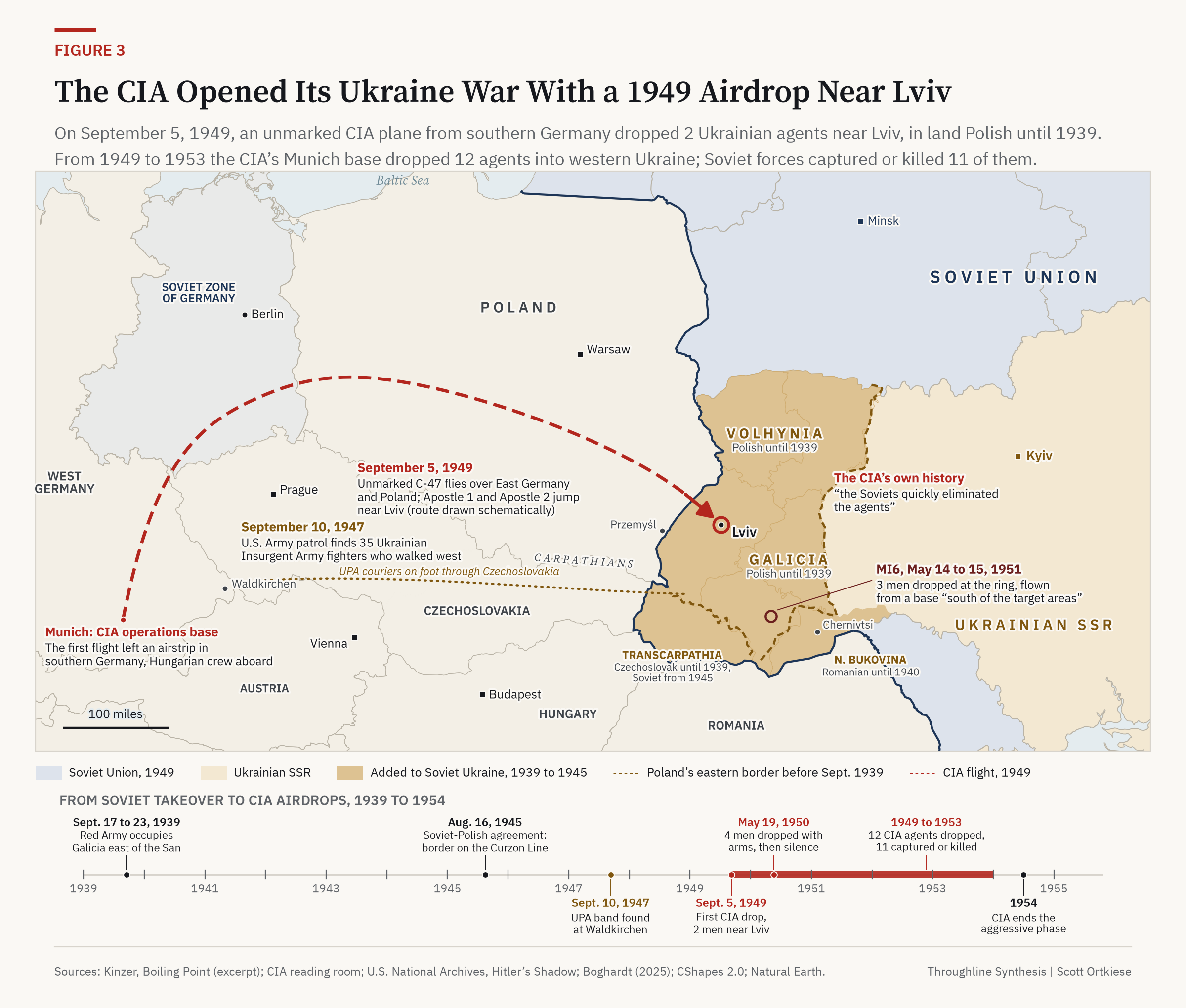
America had no anti-Soviet Ukrainians of its own, so it bought Hitler’s. During the war, the Soviet Union was an ally. Washington had no network of anti-Moscow partisans ready to use. So, Kinzer says, it made “a wonderfully coherent deal” with General Reinhard Gehlen, the Wehrmacht general who ran German military intelligence on the Eastern Front. Gehlen surrendered to the U.S. Army on May 22, 1945, 2 weeks after the war in Europe ended, having copied his files to microfilm and hidden them. The Army and then the CIA sponsored his network, former Nazis included, until it became West Germany’s intelligence service. In Kinzer’s telling, the deal was simple: instead of hanging Gehlen, the Americans hired him and paid him well, and Gehlen handed over his files on the anti-Soviet activists of Ukraine and Eastern Europe. “Those people,” Kinzer says, “became the foundation of the American project in Ukraine. And right up until that point, they had been the foundation of the Nazi project in Ukraine. They were the same people.”
The record names them. The CIA’s man was Mykola Lebed, a security chief of the Organization of Ukrainian Nationalists who trained at a Gestapo center in 1940 and who in April 1943 proposed to “cleanse the entire revolutionary territory of the Polish population.” The CIA brought Lebed to New York on October 4, 1949 under a false name. When the Immigration and Naturalization Service called him “a clear-cut deportation case,” Allen Dulles, then the CIA’s deputy director, wrote that Lebed was “of inestimable value to this Agency and its operations” and asked that he be given permanent residence. Kinzer says some of the Ukrainians at the center of the CIA project had taken part in horrific massacres and would have been barred from the United States if Dulles had not made special arrangements. Lebed is the documented case. Britain’s MI6 backed Stepan Bandera’s rival faction from 1949 to 1954. I documented what those men did to the Poles of Volhynia in Blood, Hypocrisy, and the UPA.
“The American project in Ukraine is built on the foundation of the Nazi project,” Kinzer says, and that “gave it a certain tint that it has never lost.” He argues the inheritors of that tradition remain powerful in Ukraine today, in the militias doing the fighting and in politics, and that some are American allies. “There’s a through line from how we found our first anti-Russian Ukrainians to who those anti-Russian Ukrainians are today in some cases.” Diesen adds that you can still hear it in the slogans of Bandera and the Organization of Ukrainian Nationalists, and that many of the same organizations still exist.
The cynicism was there from the start. Diesen quotes Harry Truman, then a Democratic senator from Missouri, quoted in The New York Times on June 24, 1941, 2 days after Germany invaded the Soviet Union: “If we see that Germany is winning we ought to help Russia and if Russia is winning we ought to help Germany, and that way let them kill as many as possible, although I don’t want to see Hitler victorious under any circumstances.” There are no values in that logic, Diesen says. It is balance-of-power arithmetic. Once Germany was beaten, the arithmetic pointed at the former ally. In May 1945, Winston Churchill, Britain’s prime minister, had his planners draw up Operation Unthinkable, a plan for an attack on the Soviet Union with a hypothetical start date of July 1, 1945 that would “count upon the use of German manpower.” Its stated object was “to impose upon Russia the will of the United States and British Empire.” It was never carried out. The logic survived, and it explains why allying with the remnants of the Third Reich in Ukraine looked attractive.
Kinzer answers with another Truman line: “The only thing new in this world is the history you didn’t know.” He hopes his book is exactly that.
The method changed. The target did not. Kinzer has written the books on the old playbook, the one the CIA ran against Mohammad Mossadegh in Iran in 1953 and Jacobo Arbenz in Guatemala in 1954 and tried to run against Patrice Lumumba in Congo. After the intelligence scandals of the 1970s, he says, “visionaries in the Reagan administration” decided that since covert operations kept getting exposed, “we should just do it all overtly.” Congress funded the National Endowment for Democracy in 1983. One of its founders, Allen Weinstein, told The Washington Post in 1991: “A lot of what we do today was done covertly 25 years ago by the CIA.” Kinzer calls Ukraine the “paragon of this postmodern form of intervention”: the endowment, the U.S. Agency for International Development, Freedom House, George Soros’s Open Society Foundations, and their European counterparts, all pushing the same line. He says Ukraine became the number 1 target in Europe for that money.
Kinzer has seen this movie from the front row. His first war as a correspondent was the Contra war in Nicaragua, where he ran the Times bureau from 1983 to 1989. “One thing we all realized at that time was this war has nothing to do with Nicaragua,” he says. “That country just had the bad luck to be the stage on which giant powers fought.” Historians estimate that nearly 31,000 Nicaraguans died in it. Ukraine is the same stage with a bigger body count. “Now we’ve had tens of thousands of Ukrainian kids killed and huge swaths of that country devastated. It’s all because America wanted to make some political points.” I take “kids” to mean the young soldiers. Kinzer has watched war up close, and he calls it “the worst thing in the world.” What disturbs him is hearing it “tossed around as just another policy option.”
Why Washington Hates Russia
Kinzer gives a full section of the book to a question nobody in Washington asks: why is American policy so fiercely anti-Russian? Some writers, he says, trace the feeling back to the split between Rome and Constantinople. Others place it in the early 19th century, when Britain was on imperial adventures across South Asia, Central Asia, and the Caucasus and feared Russia would take what London wanted to take. “It was important for them to create an image in the British mind that Russia was evil,” Kinzer says. “Otherwise, they couldn’t justify all of these imperial wars. That’s what the Crimean War, for example, was all about.” John Stuart Mill was already complaining about an “epidemic disease of Russophobia” in 1836. I traced that lineage in Russophobia and the West’s Forgery That Launched Two Centuries of War.
The hatred should have ended in 1991. It didn’t. The Soviet Union vanished. A new country emerged, about a quarter smaller in territory and politically different. Western policy did not move. “There’s something about Russia in the western mind,” Kinzer says, “that makes it fit very easily into our need to have some enemy as a kind of organizing principle.”
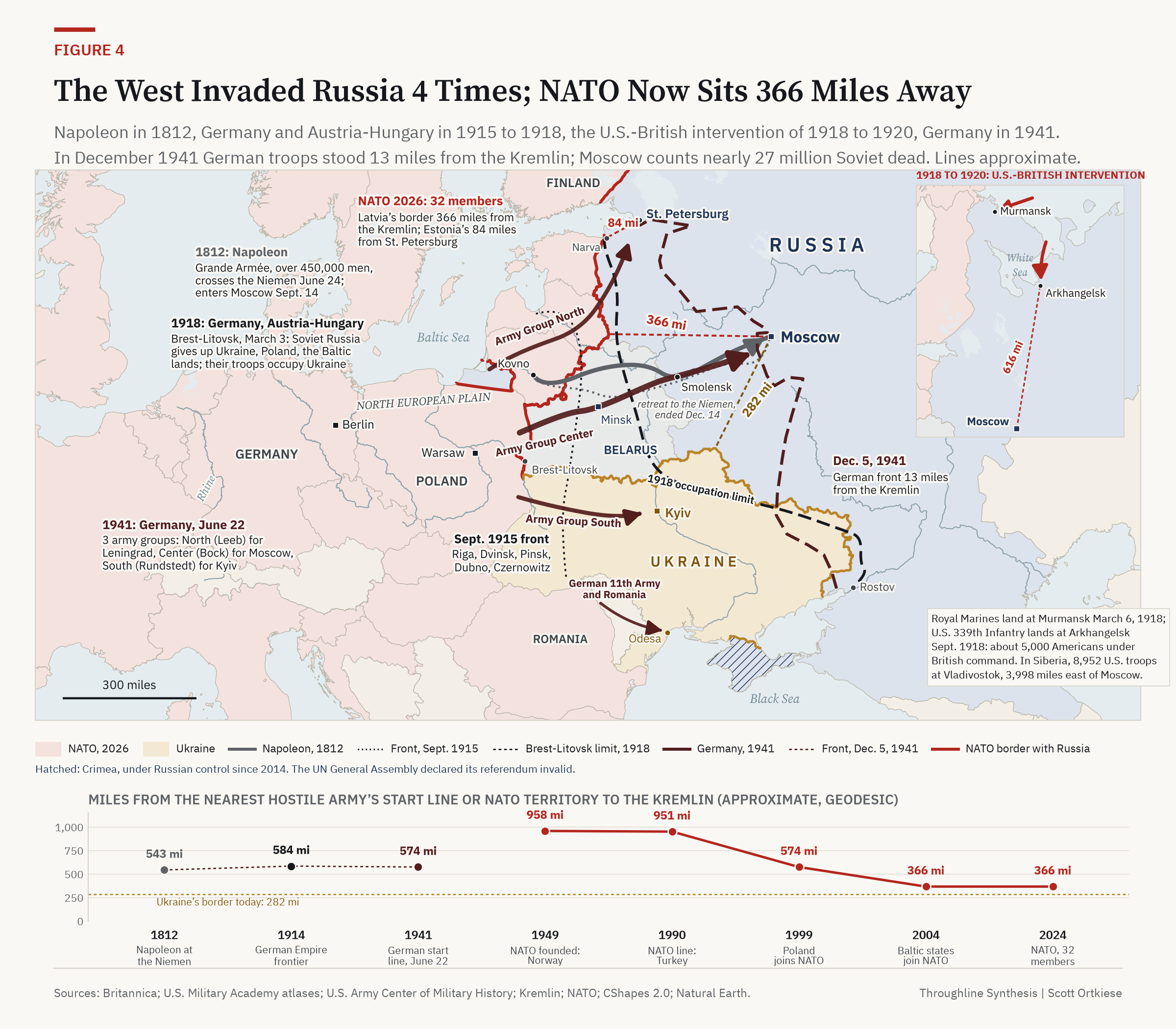
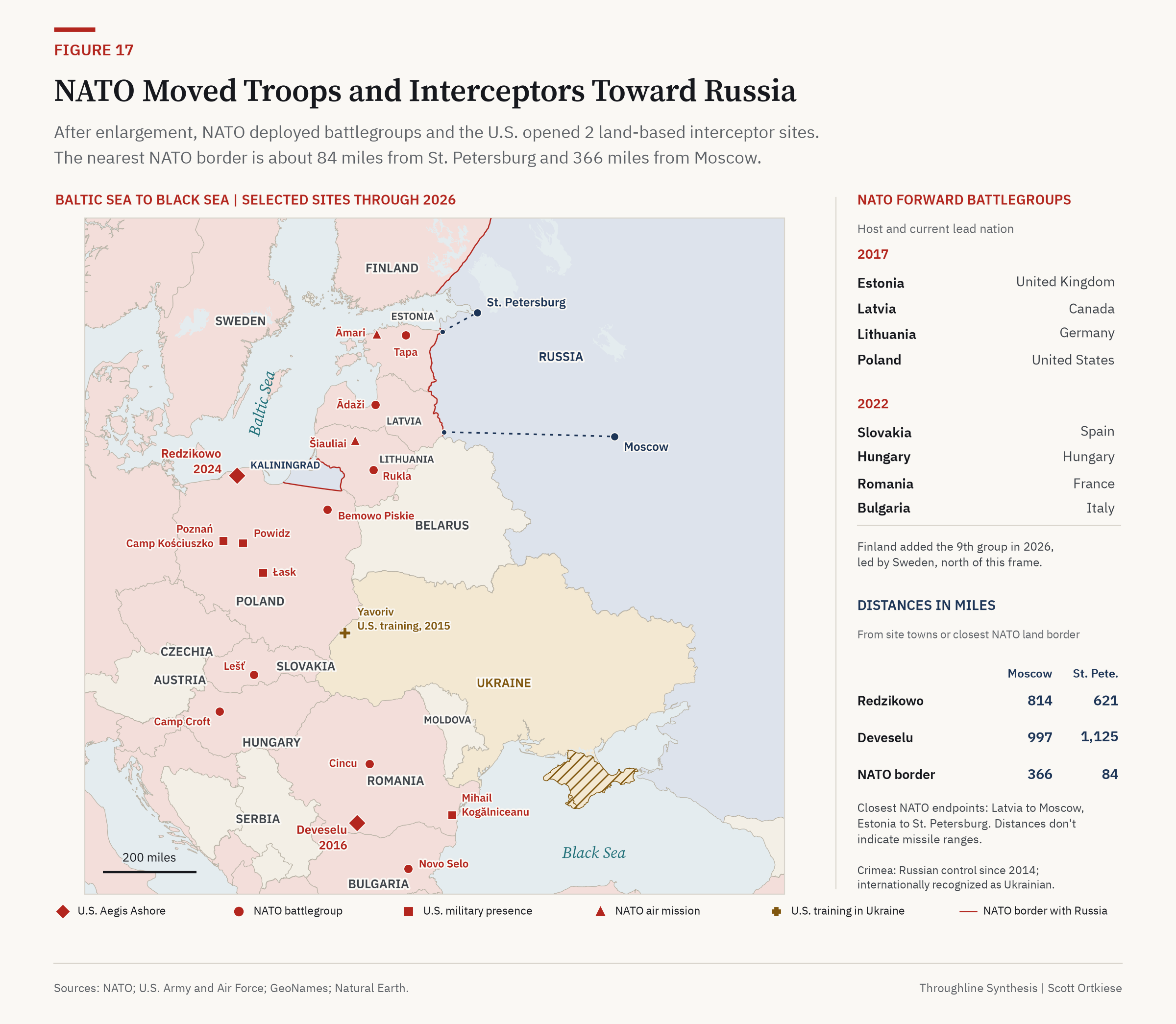
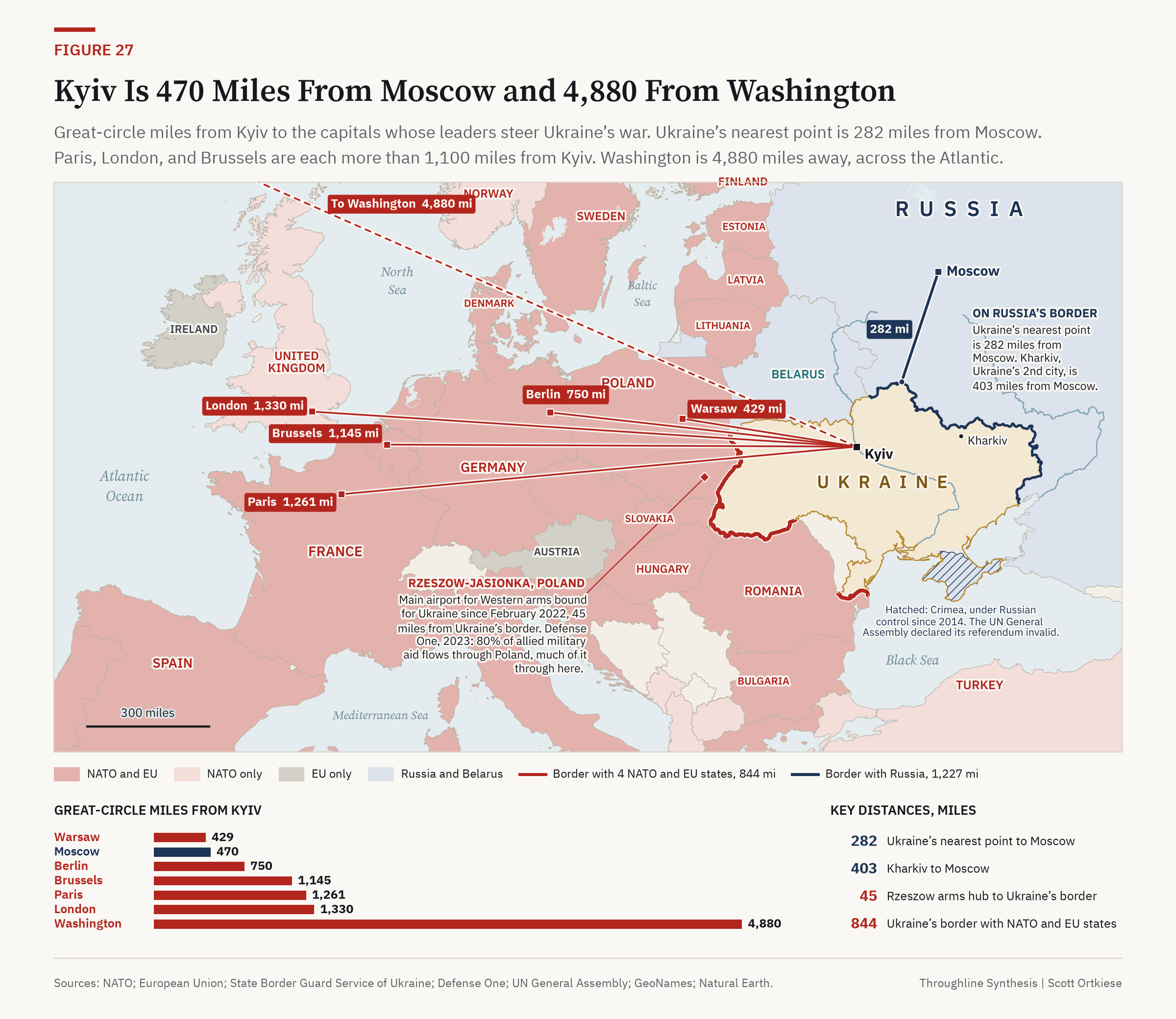
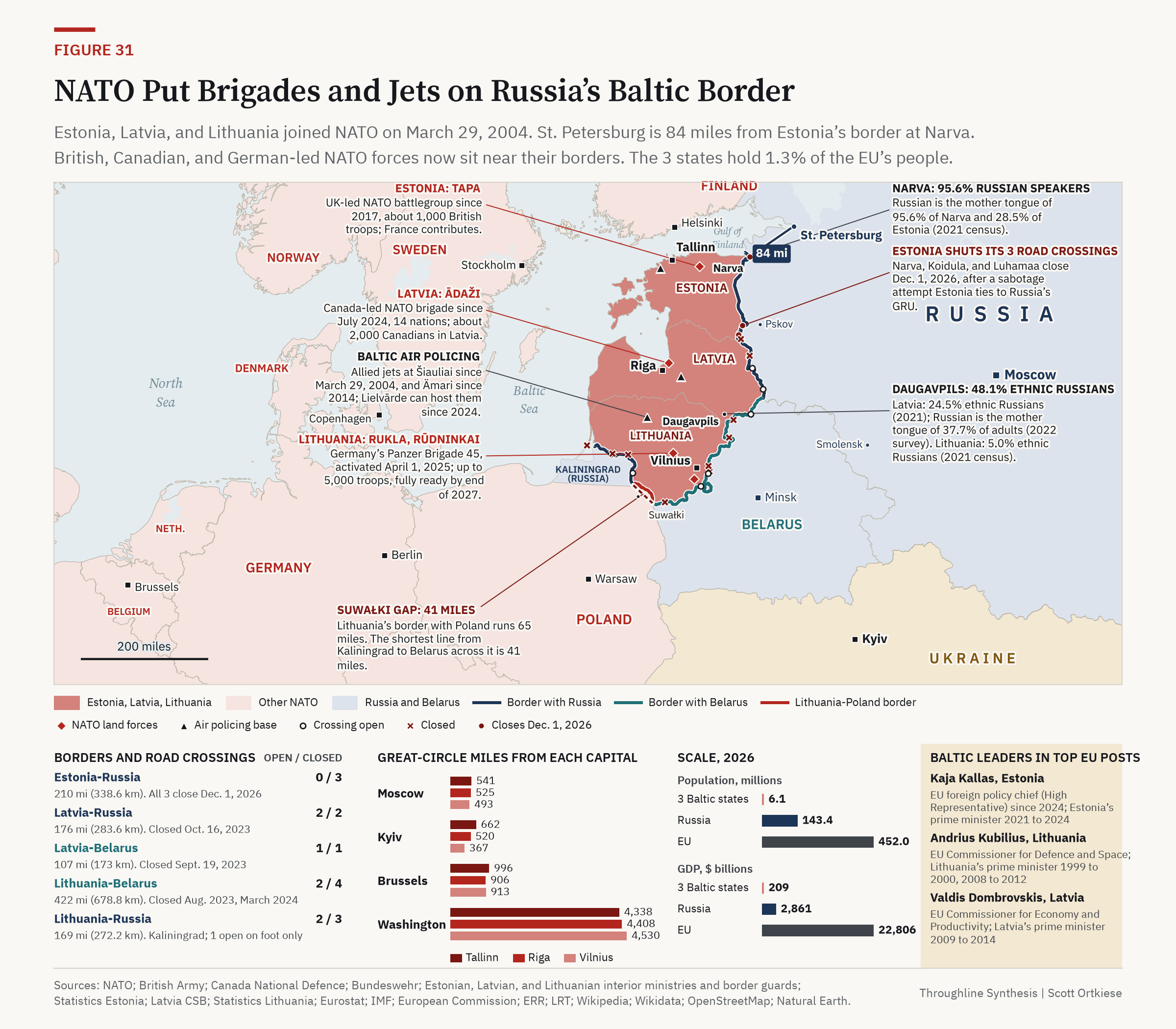
Russia does not count miles out of paranoia. It counts them because the West keeps coming. Napoleon crossed the Niemen on June 24, 1812, with over 450,000 soldiers and entered Moscow on September 14. At Brest-Litovsk on March 3, 1918, Soviet Russia gave up Ukraine, its Polish lands, and the Baltic provinces, and German troops occupied Ukraine. In September 1918, the U.S. 339th Infantry, about 5,000 Americans, landed at Arkhangelsk under British command, and 8,952 more went to Siberia. On June 22, 1941, 3 German army groups attacked; Putin, Russia’s president, says almost 27 million Soviet citizens died. NATO now sits 366 miles from the Kremlin, measured in a straight line.
Then Kinzer makes the argument that will get him attacked the most. He says that for generations, American policy toward Russia was made by senior officials whose families came from the Russian Empire, the Soviet Union, or Eastern Europe, people who “imbibed anti-Russia passion with their mother’s milk.” He calls it “quite understandable considering history” and “not so excusable that they came to take over American foreign policy.” He says there has never been another case of immigrants and their children and grandchildren coming to dominate American policy toward the country they were raised to hate. His list:
- Zbigniew Brzezinski, national security adviser to President Jimmy Carter, born in Warsaw in 1928 to a Polish diplomatic family with roots in Brzezany, a Galician town that is now Berezhany, Ukraine. Kinzer says the foreign policy establishment begged Carter not to appoint him. Clark Clifford, who had advised Democratic presidents since Truman, was asked by Carter what job Brzezinski should get instead. Clifford’s answer: “Make him the first American ambassador to the Bermuda Triangle.” Kinzer says Brzezinski led Carter to intervene against the Soviets in Afghanistan. Carter signed the first order for covert aid to the Afghan insurgents on July 3, 1979, almost 6 months before Soviet troops arrived. That first aid was nonlethal. Brzezinski later told a French magazine that Washington “knowingly increased the probability” that Moscow would intervene, a boast some historians dispute. He pushed the boycott of the 1980 Moscow Olympics and turned the detente of the Nixon and Ford years in a different direction.
- Madeleine Albright, born in Prague in 1937, Brzezinski’s student at Columbia and his hire on the National Security Council. As UN ambassador and then secretary of state under President Bill Clinton, she drove American policy on the intervention in Bosnia and NATO’s 1999 bombing of Yugoslavia.
- Victoria Nuland, assistant secretary of state, whose grandfather emigrated from Bessarabia, a region now divided between Moldova and Ukraine. She handed out food to protesters and riot police on Kyiv’s Maidan on December 11, 2013.
- Alexander Vindman, the National Security Council officer who became a celebrity for testifying about Trump’s 2019 call with Ukraine’s president. He was born in Kyiv, in the Ukrainian Soviet Socialist Republic, in 1975.
- George Soros, born in Budapest in 1930. His Ukrainian foundation reports $380 million spent in Ukraine since 1990.
- Antony Blinken, secretary of state under President Joe Biden, whose father’s family came from Eastern Europe.
Kinzer’s charge is about power, not passports. He says the major grant makers at the National Endowment for Democracy and Open Society shared the same background, and that all of these people had “grown up desperately trying to think of ways to wound Russia.” Ukraine “is magnetically attractive to anyone who wants to weaken or subvert or undermine or destroy Russia.” You would like to think such officials carry out policy set by elected leaders. “That’s not the way it turned out. They set the policy and there was no group pushing back against them.” They gathered in the Democratic Party, Kinzer says, because the Republicans of that era were conservative businessmen with no interest in ideological crusades, and they turned both the foreign policy apparatus and the Democratic Party into “a world center of anti-Russian action.”
Diesen adds the mechanism. After the Bolshevik revolution, he says, Washington needed experts on a power it did not understand, and it went to the people who had fled it. Ask the emigre community who the Soviets are, and you will hear that they are the most evil people in the world who want to conquer everything. Build policy on that, and you get the policy we got.
Ancestry does not prove motive, and Kinzer’s critics have already pounced on that. The EUobserver’s reviewer summarized the thesis as “a clique of influential Americans” hijacking foreign policy “to settle personal and family grudges” and called it wrong. Judge it by the results instead. Every name on that list pushed in 1 direction, across 45 years of American policy, and the people who warned against it, from Kennan on down, lost every time.
1990 to 1999: The Greatest Lost Opportunity of Our Lifetimes
Russia had never been more pro-Western. Diesen sets the scene. After the Cold War, Russia wanted to be “a normal European country.” Diesen says it even neglected the former Soviet republics because they looked like baggage on the road west. There was a framework ready: the Helsinki Final Act of 1975, Mikhail Gorbachev’s “common European home” in 1989, the Charter of Paris for a New Europe in 1990, and the Budapest summit of 1994, which turned the Helsinki process into the Organization for Security and Co-operation in Europe. All of it rested on indivisible security, the principle that no state strengthens its own security at the expense of another’s.
“This is probably the greatest lost geopolitical opportunity of our lifetimes,” Kinzer says. “We never did anything like what Metternich did after the end of the Napoleonic wars. Call all the parties together and try to design a security architecture that everybody can live with.” The Congress of Vienna gave defeated France a seat. Washington gave Russia a lecture.
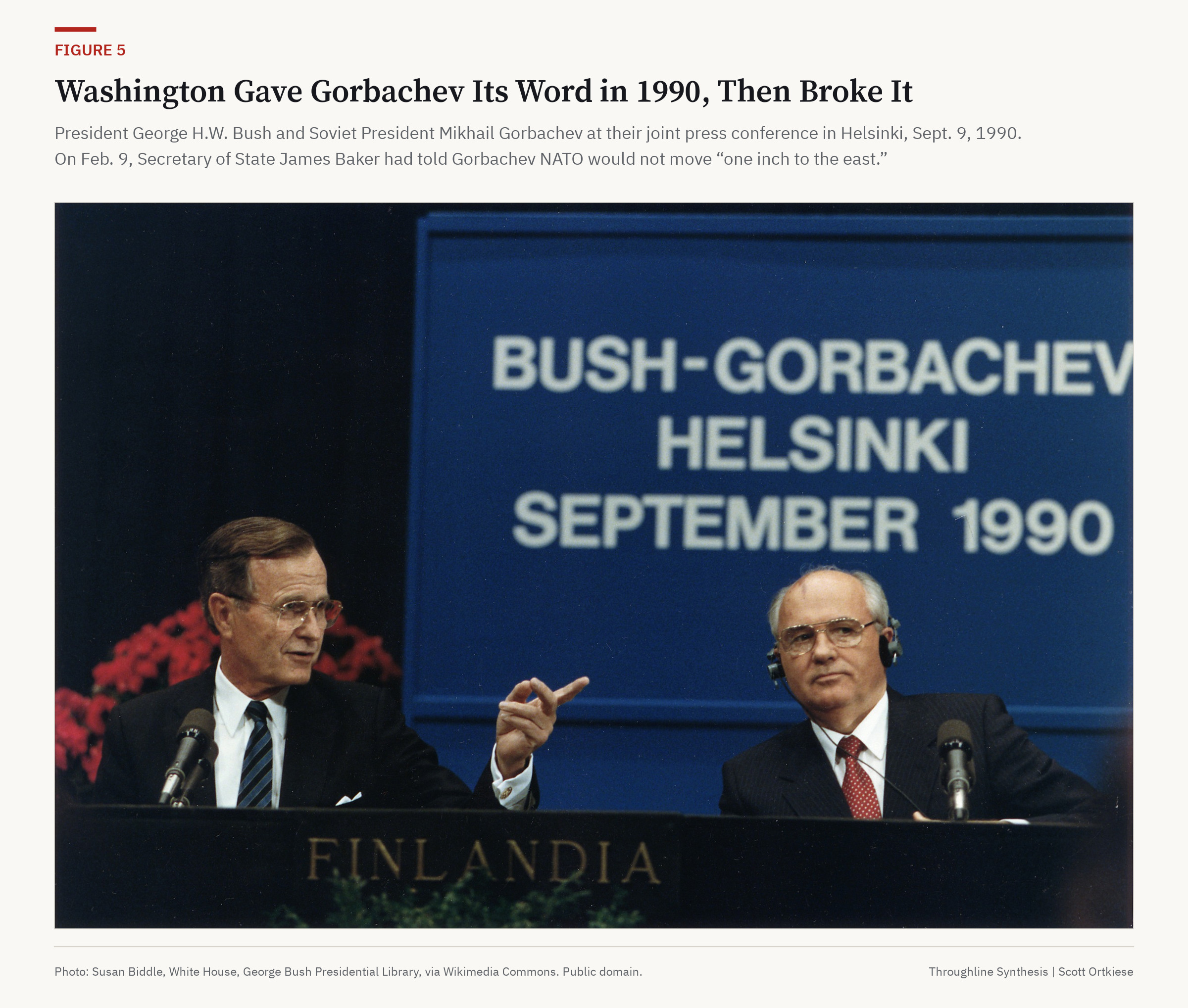
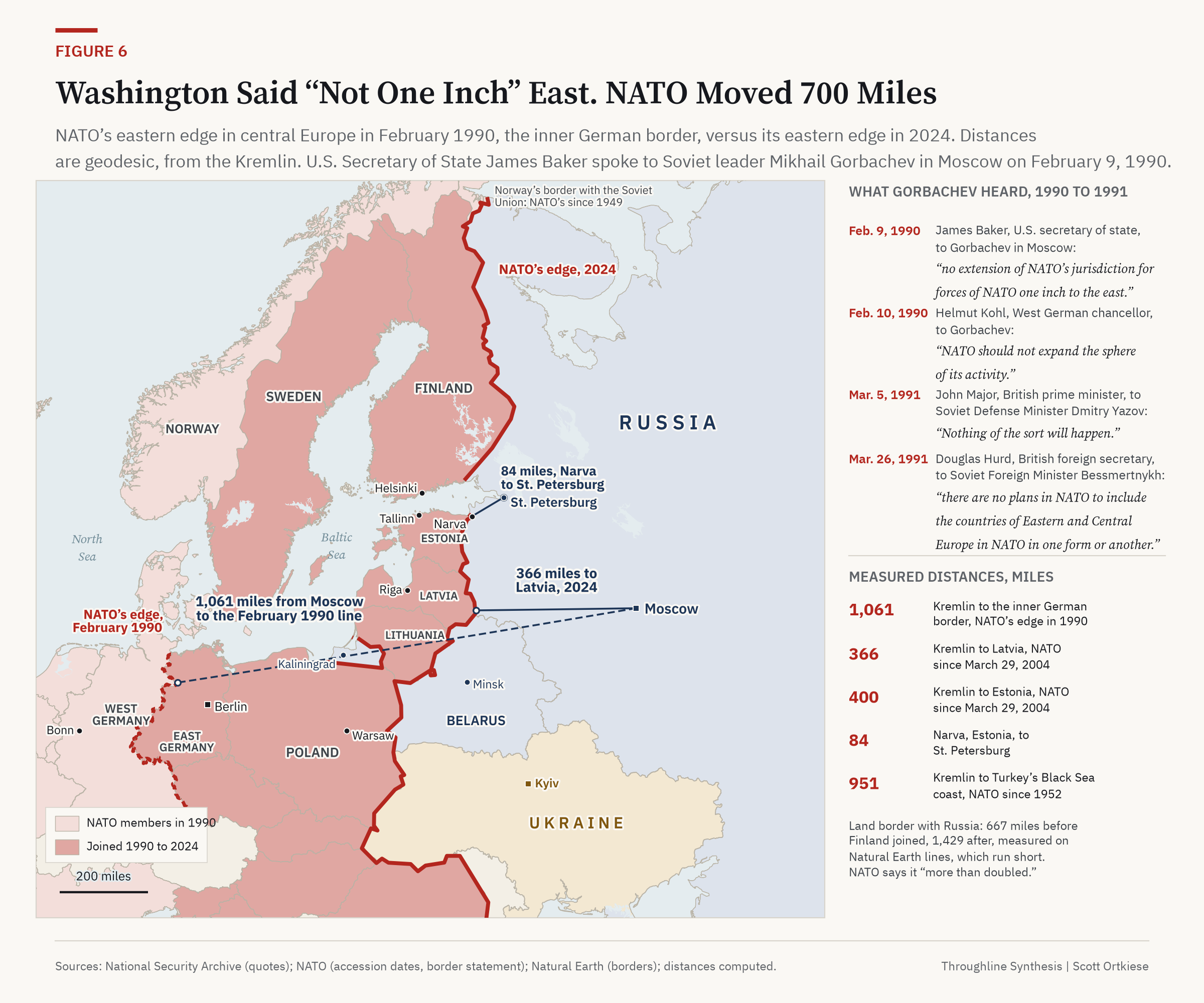
President George H.W. Bush and Secretary of State James Baker had the right idea, Kinzer says, and then Bush lost the 1992 election. The assurances they gave are in the files. On February 9, 1990, in Moscow, Baker told Gorbachev there would be “no extension of NATO’s jurisdiction for forces of NATO one inch to the east.” He used the formula 3 times in 1 meeting. West German Chancellor Helmut Kohl told Gorbachev the next day that “NATO should not expand the sphere of its activity.” John Major, Britain’s prime minister, told the Soviet defense minister in March 1991 that East Europeans joining NATO was not going to happen: “Nothing of the sort will happen.” None of it was written into a treaty. All of it was said by the people with authority to say it, while Soviet troops were still in Germany. The National Security Archive calls it a “cascade of assurances.”
Then came Clinton. Kinzer tells it as 1 scene. In April 1993, 3 months into Clinton’s presidency, Vaclav Havel, president of the Czech Republic, and Lech Walesa, president of Poland, came to Washington for the opening of the U.S. Holocaust Memorial Museum and pressed Clinton to bring them into NATO. Walesa told him on April 21: “We are all afraid of Russia.” In Kinzer’s telling, Clinton went back to the White House and told his aides, “Let’s do this.” The archives show a longer internal fight. The outcome was the one Kinzer describes.
The experts told him not to. George Kennan, the diplomat who designed the containment of the Soviet Union, wrote on February 5, 1997 that expanding NATO “would be the most fateful error of American policy in the entire post-cold-war era.” In 1998 he told Thomas Friedman, the Times columnist: “I think it is the beginning of a new cold war,” and he predicted that when Russia finally reacted, the people who expanded NATO would say “that is how the Russians are.” On June 26, 1997, 50 foreign policy experts, including former senators, cabinet officers, ambassadors, and admirals, among them Robert McNamara, Paul Nitze, Sam Nunn, and Jack Matlock, the last U.S. ambassador to the Soviet Union, wrote to Clinton that expansion was “a policy error of historic proportions.” Clinton went ahead.
“If you have to pick one person who set the ball rolling toward war in Ukraine, it probably was Bill Clinton,” Kinzer says. He doesn’t think it’s fair to blame 1 man, and his reason is worse than blame. Clinton was acting rationally by his own lights. He did not know or care anything about Europe or Russia, Kinzer says. Pat Buchanan’s 1992 joke was that Clinton’s foreign policy experience was “pretty much confined to having had breakfast once at the International House of Pancakes.” What Clinton cared about was reelection in 1996.
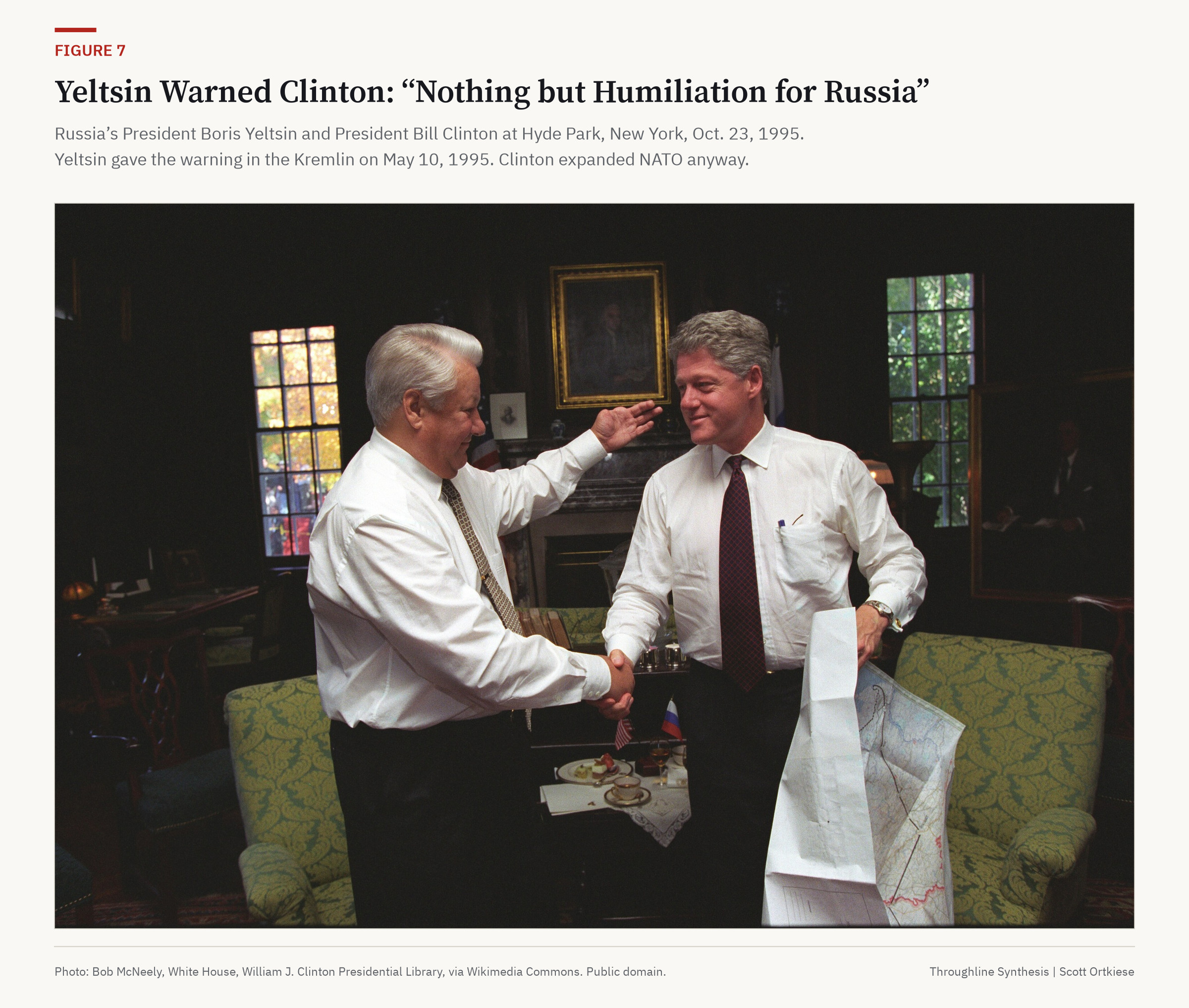
Votes. Bob Dole, the Republican nominee, was promising to push NATO east faster. Kinzer says that electrified voters of Polish, Hungarian, and other Eastern European descent in states like Pennsylvania, Illinois, and Indiana. Had Clinton said the statesmanlike thing, that expansion might provoke a war in Europe years after he left office, Kinzer says, “he would have lost the election. I think that was his calculation.” Diesen notes that pressure from Eastern European voters was widely cited at the time as a reason Clinton abandoned the 1990 settlement. You don’t have to take either man’s word. On May 10, 1995, in the Kremlin, Clinton said it himself to Boris Yeltsin, Russia’s president. The declassified transcript has Clinton saying: “The Republicans are pushing NATO expansion. Wisconsin, Illinois and Ohio are key.” Yeltsin answered: “I see nothing but humiliation for Russia if you proceed,” and called it a “new form of encirclement.” On October 22, 1996, 2 weeks before the election, Clinton went to Detroit and promised the first new members by 1999. Dole answered the same day that the invitations should go out at once, with a summit in 1998 to welcome the new members.
Money. “Probably the best-heeled lobby in America, the defense lobby,” Kinzer says, “was in overdrive.” Every country that joins NATO, he says, becomes a customer for “new planes, new tanks, new screwdrivers, everything. That’s the greatest bonanza imaginable for American arms companies.” Diesen remembers the headline. So does the archive: “Arms Makers See Bonanza In Selling NATO Expansion,” The New York Times, June 29, 1997. The president of the U.S. Committee to Expand NATO, Bruce Jackson, was at the same time director of strategic planning at Lockheed Martin, the largest American weapons maker. They did it in the open.
Diesen frames the choice as 2 hypotheses. Either it was cynical power politics, “Russia’s now weak, let’s crush it,” or it was domestic politics, ethnic voters seeking historical vengeance and contractors seeking sales. He notes the second would not count as rational foreign policy. Kinzer’s reply: “We don’t use rationality as the key guide for our foreign policy. That’s a given.” Another president, he concedes, might have made the same calculation. That is the indictment. The system produced the decision, and in the United States, Kinzer says, “long run only means something like next week or next month. We don’t learn from history and we don’t look forward to the future.” Gore Vidal had the name for it: “the United States of Amnesia.”
Underneath sits what Kinzer calls a psychological barrier. A shared security order means compromise, and compromise means “accepting a world that we don’t dominate.” The American mind is not equipped for it. “We can’t deal with the idea of a world in which lots of important things happen and we don’t have anything to say about it.” Kinzer thinks this will decide how violent the coming decades are. American power is declining in relative terms, and that is inevitable. Either Washington accepts it, or it lashes out and causes “all kinds of global conflict.” His verdict: “The Ukraine war is an example of that latter option. That’s what I find so terrifying about it.”
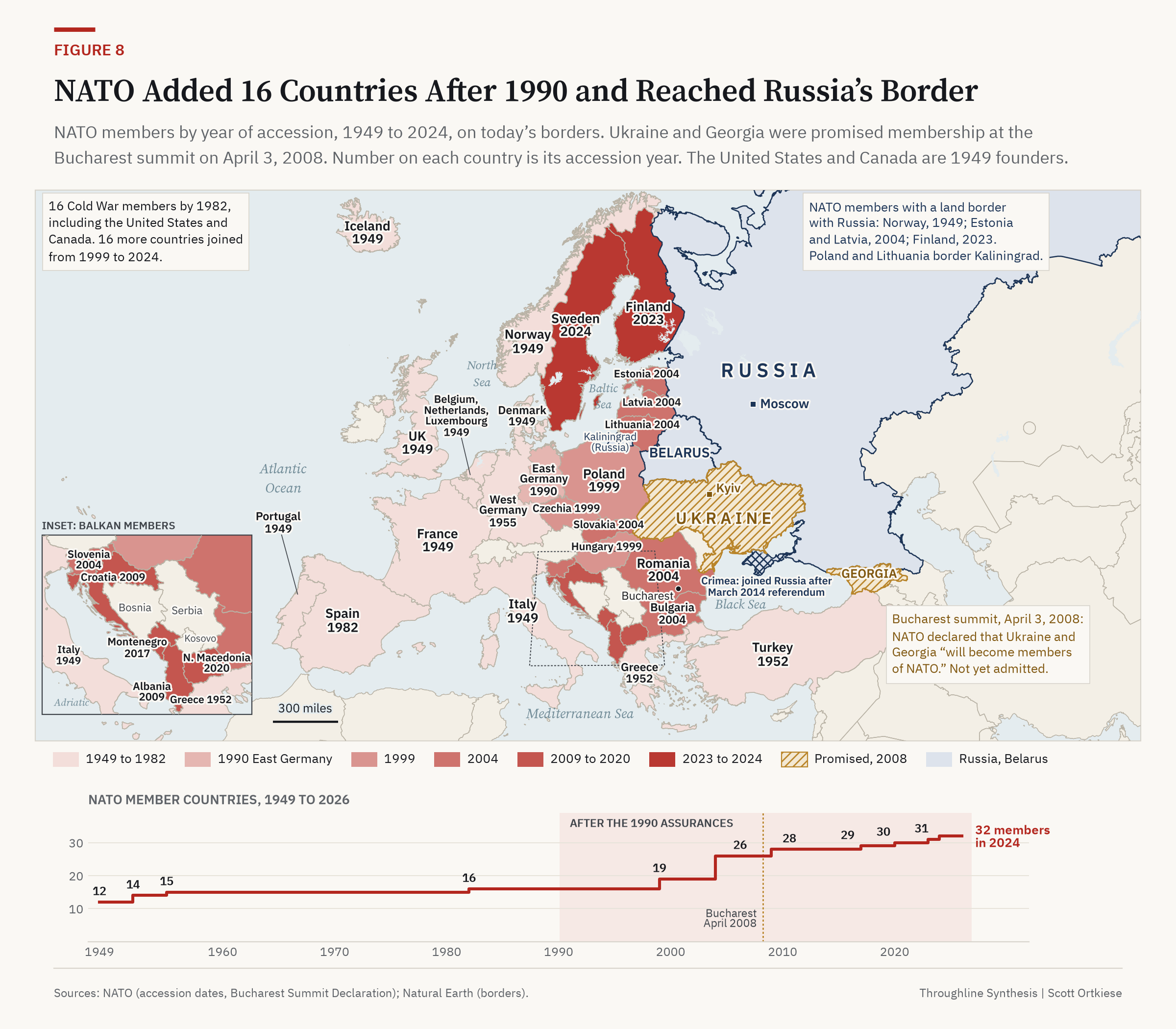
NATO took in Poland, Hungary, and the Czech Republic in 1999 and bombed Serbia for 78 days the same spring without Security Council authorization. It took in 7 more states in 2004, including the 3 Baltic republics on Russia’s border. Washington pulled out of the Anti-Ballistic Missile Treaty in 2002 and put missile defense launchers in Romania and Poland. In Munich in 2007, Vladimir Putin, Russia’s president, asked the question out loud: “Against whom is this expansion intended? And what happened to the assurances our western partners made after the dissolution of the Warsaw Pact?”
2008 to 2014: They Knew It Meant War, and They Did It Anyway
Ukrainians did not want NATO. Diesen recalls the warning European leaders gave between the 1990s and 2014: “Let’s be honest, only about 20% of the Ukrainians actually want to join NATO. So how hard are we going to actually push for this?” The polls bear him out. Pew found in 2009 that 28% of Ukrainians favored joining and 51% opposed. Ukraine’s Razumkov Centre found in 2012 that 15% would vote yes in a referendum and 62% would vote no.
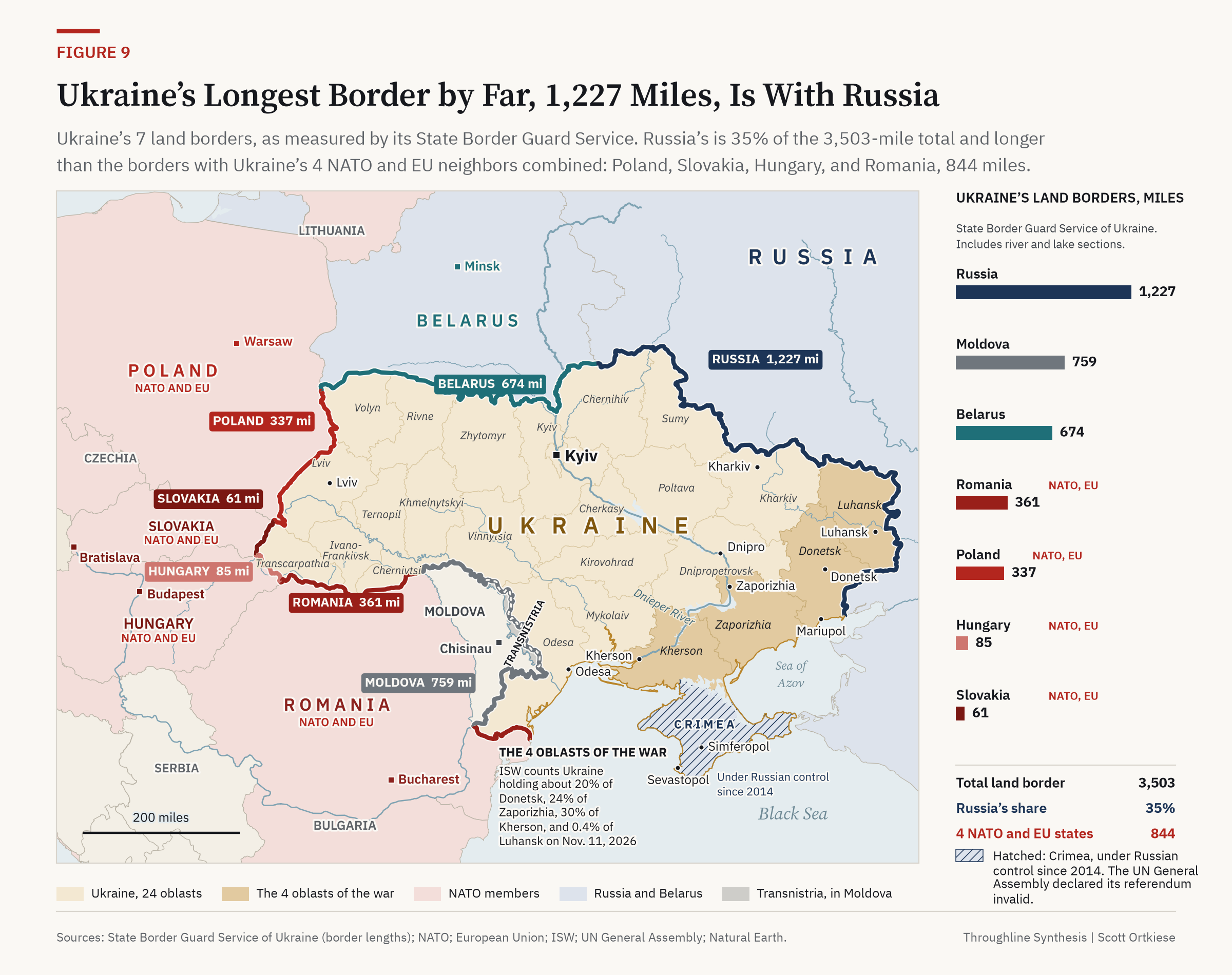
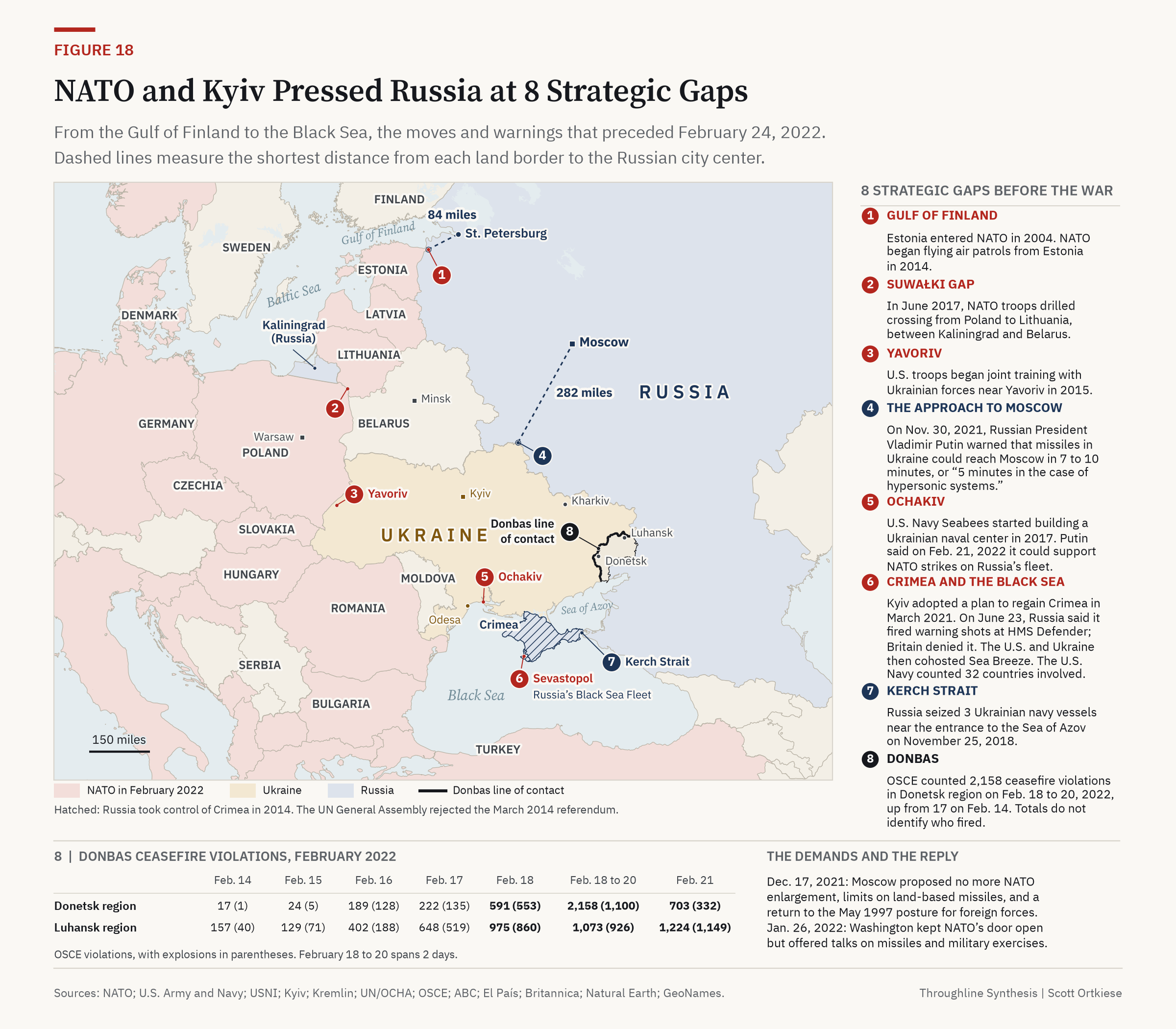
Washington’s own ambassador told them it meant war. On February 1, 2008, William Burns, the U.S. ambassador in Moscow and later Biden’s CIA director, sent a cable titled “Nyet Means Nyet: Russia’s NATO Enlargement Redlines.” It reported that Russian officials and experts feared NATO membership for Ukraine “could potentially split the country in two, leading to violence or even, some claim, civil war, which would force Russia to decide whether to intervene.” Diesen summarizes the cable: because membership was so unpopular in eastern Ukraine, you would get revolt, then civil war, and then a reluctant Russian use of force. Burns was reporting a risk, not issuing a forecast. Every piece of it came true. Russia took Crimea in March 2014, the Donbas went to war that April, and Russia invaded in 2022.
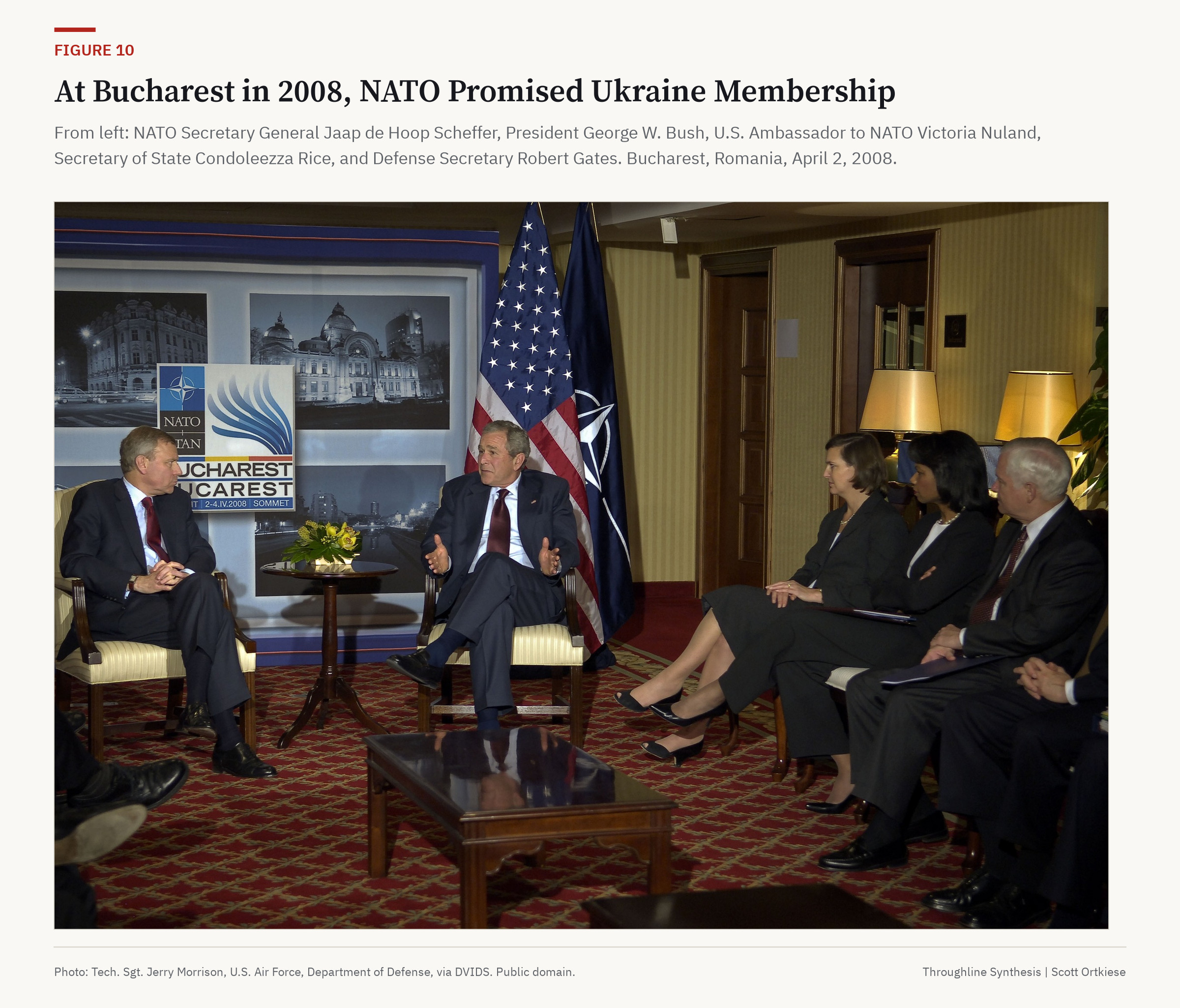
Germany’s chancellor knew too. Angela Merkel, chancellor of Germany from 2005 to 2021, blocked a formal Membership Action Plan at the Bucharest summit. She wrote in her 2024 memoir that she understood Putin would treat the promise of membership as a declaration of war. On April 3, 2008, NATO made the promise anyway: Ukraine and Georgia “will become members of NATO.” “They kind of knew,” Diesen says, “that this is the most provocative thing we could do.”
Kinzer says Washington did not hold back out of fear that Russia would react. It counted on it. “I think they figured out this is a great project because it works either way,” he says. If NATO reaches Russia’s border and Russia does nothing, Washington has advanced “our project of surrounding Russia and making it the next target.” If Russia reacts, “they’re going to be invaders and we can portray them that way to the whole world.” A violent Russian response “was not in any way a negative factor. In fact, I think a lot of people in Washington thought that’s another reason to do it.” Then, just as Kennan warned, “we will then say they’re the aggressor and they’re always like this.”
First, they needed a government in Kyiv that would play along. Ukraine became independent in 1991. For the next 2 decades its governments were, in Kinzer’s word, “neutralist,” more or less depending on the president. Viktor Yushchenko, president from 2005 to 2010, sought NATO membership. Viktor Yanukovych, elected in 2010, made nonalignment official policy. Neutrality is the course Henry Kissinger, the former U.S. secretary of state, urged in The Washington Post in March 2014: Ukraine “should function as a bridge” between East and West, not as either side’s outpost. That did not suit Washington. “Before they could get the big project going of pushing Ukraine into active conflict with Russia,” Kinzer says, “they had to get a Ukrainian government that would be their partner.”
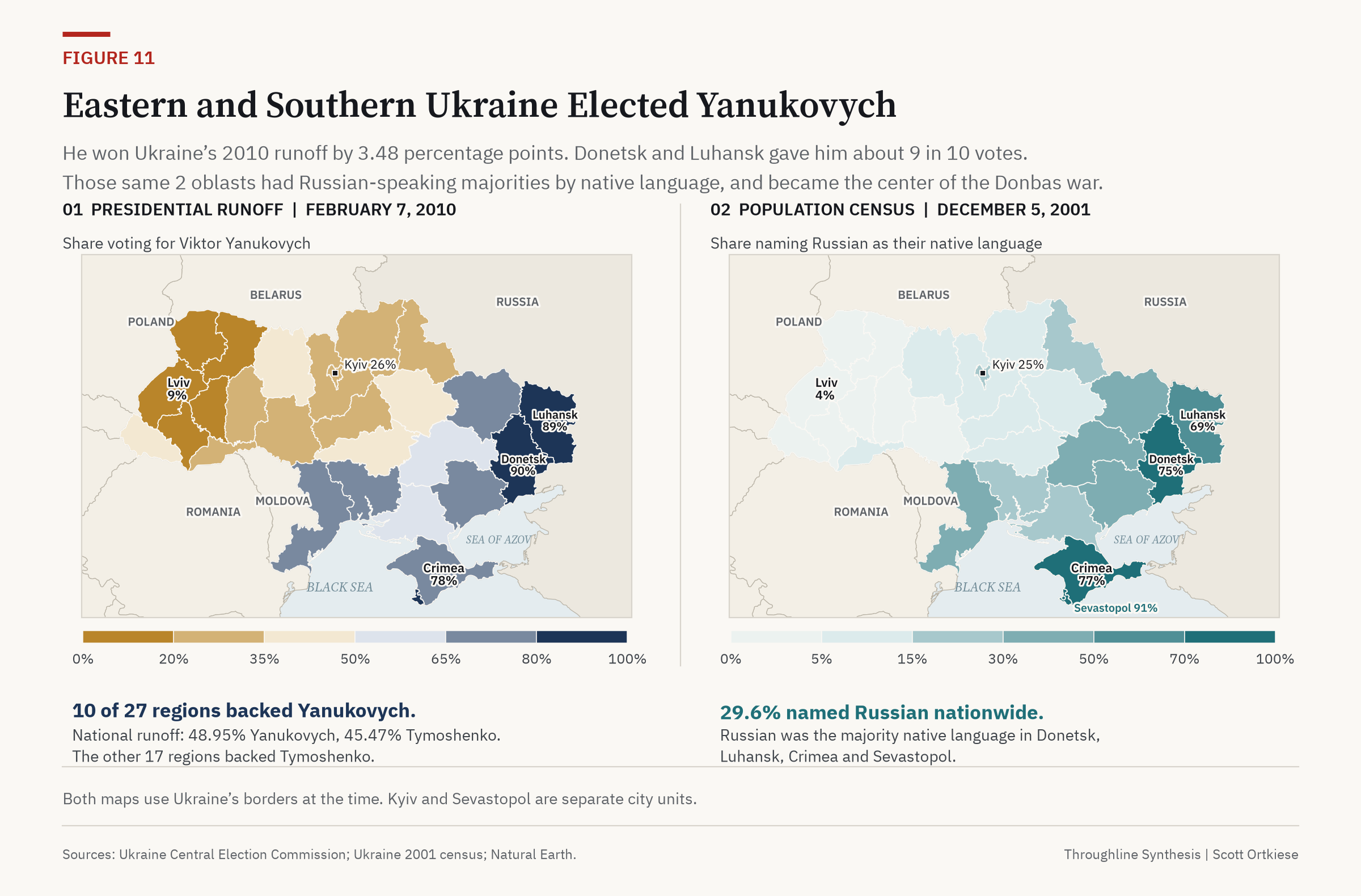
So Washington paid for one. Kinzer says the United States spent “millions and millions of dollars” through nongovernmental organizations “to support and in many cases create” Ukrainian groups that would promote the American project: Ukraine should join NATO, and Ukraine should confront Russia. Nuland put a number on the whole effort on December 13, 2013. Since 1991, she said, “we’ve invested over $5 billion to assist Ukraine in these and other goals that will ensure a secure and prosperous and democratic Ukraine.” That figure covers 22 years of every kind of American aid, not a protest budget. The protest-era pieces are documented separately. USAID’s own inspector general audited a $14.3 million civil society program running from 2008 to 2014. When the Maidan protests began in November 2013, Kinzer says, the groups that planned and organized them and that kept tens of thousands of demonstrators in the square for months “were all paid for by the United States.” He grants that the protesters had legitimate grievances. Diesen grants that the government of President Viktor Yanukovych was “very much corrupt.” Neither point changes who paid. The documents prove that American money went to specific Ukrainian groups. That it reached every organizer is Kinzer’s charge, and I believe him.
Then Nuland walked through the crowd. “Just imagine,” Kinzer says, “a diplomat from, say, Russia showing up at a protest against ICE or a protest against U.S. foreign policy and telling people, ‘Go out there and protest. We love that in Russia.’ He would be reviled and arrested.”
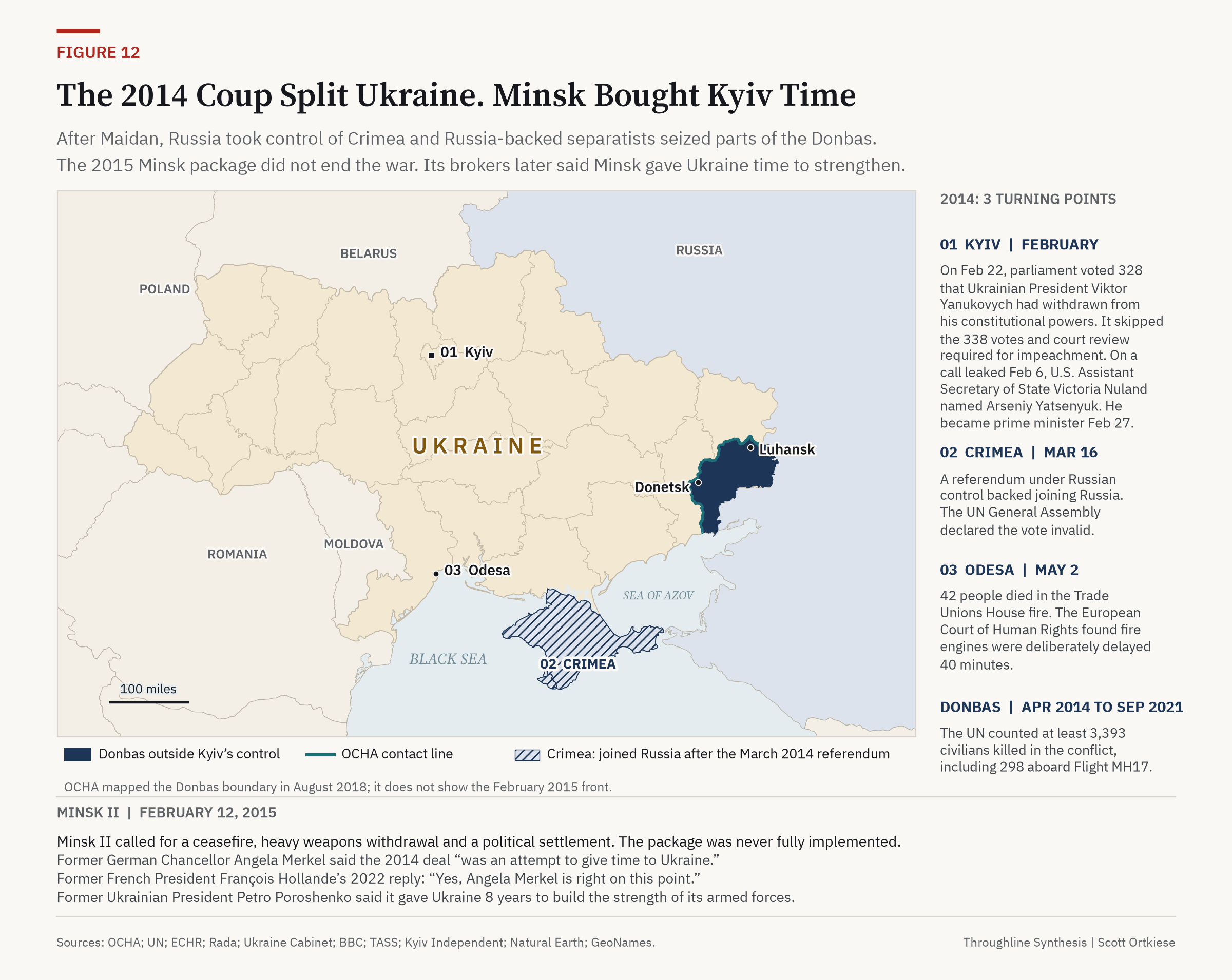
Then she picked the prime minister. In a phone call posted online on February 6, 2014, Nuland told Geoffrey Pyatt, the U.S. ambassador in Kyiv: “I think Yats is the guy who’s got the economic experience, the governing experience.” Yats was Arseniy Yatsenyuk. On February 21, the foreign ministers of Germany, France, and Poland brokered a deal between Yanukovych and the opposition for early elections, and the White House welcomed it. It lasted 1 day. On February 22, Ukraine’s parliament declared with 328 votes that Yanukovych had removed himself from office. It skipped the impeachment procedure in the constitution, which requires 338 votes and a court review. On February 27, Yatsenyuk became prime minister. Kinzer says in the interview that Nuland chose the next president. The office was prime minister. The point stands: an American assistant secretary was recorded naming her choice to run Ukraine’s government, and 3 weeks after the recording surfaced he had the job. Washington had what Kinzer calls “a new government that was willing to do America’s bidding.”
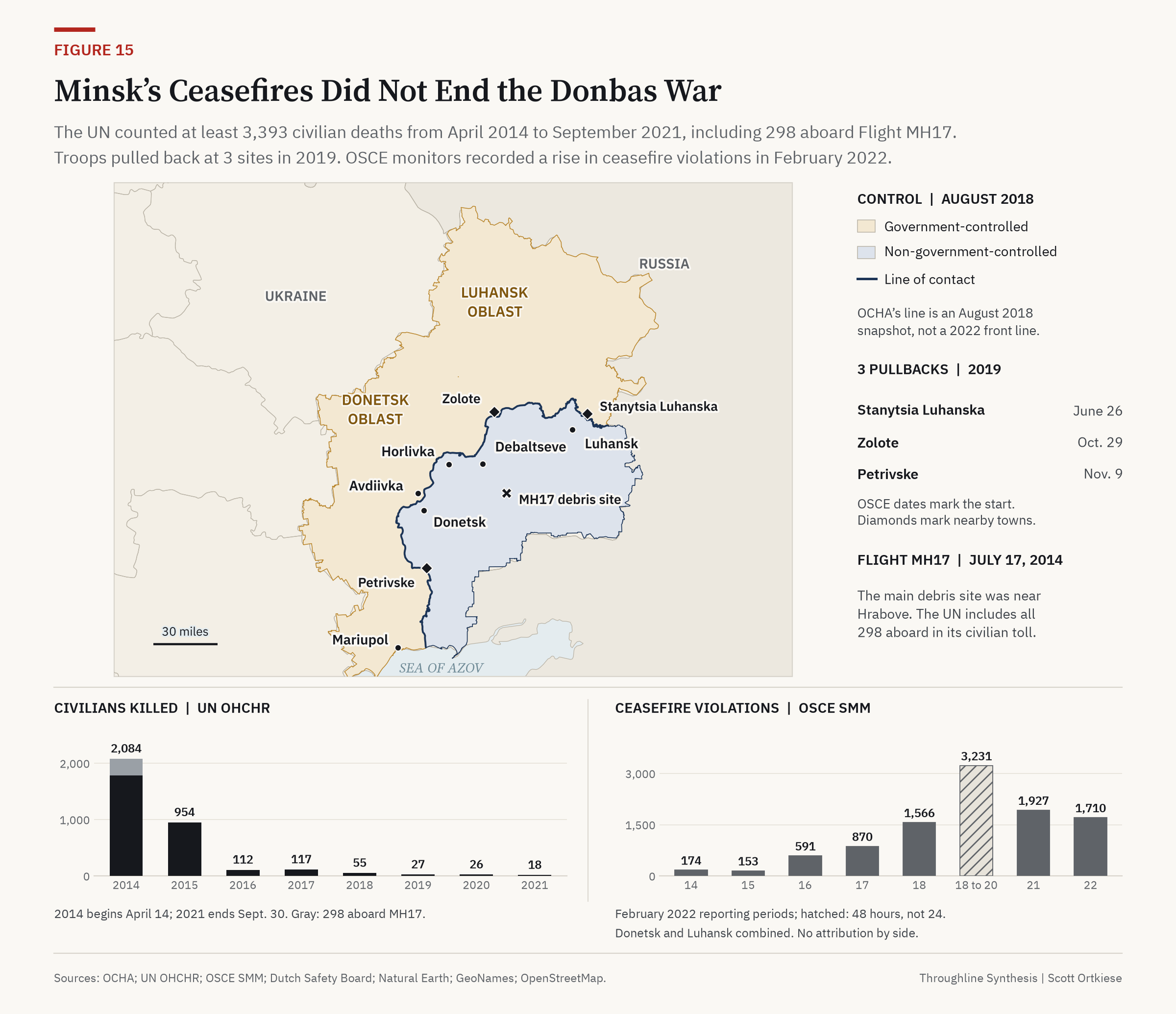
The country split, just as Burns had warned. Russian troops took control of Crimea, and a referendum there on March 16, which the UN General Assembly declared invalid, endorsed joining Russia. Armed separatists backed by Russia took over much of the Donbas. On May 2, 2014, 42 people died in the burning Trade Unions House in Odesa. The European Court of Human Rights ruled in March 2025 that Ukrainian police stood by and that fire engines were “deliberately delayed for 40 minutes.” The UN counted at least 3,393 civilians dead in the Donbas war between April 2014 and September 2021, including the 298 people aboard Malaysia Airlines Flight 17.
2014 to 2022: 8 Years of Arming Ukraine Under Cover of a Peace Deal
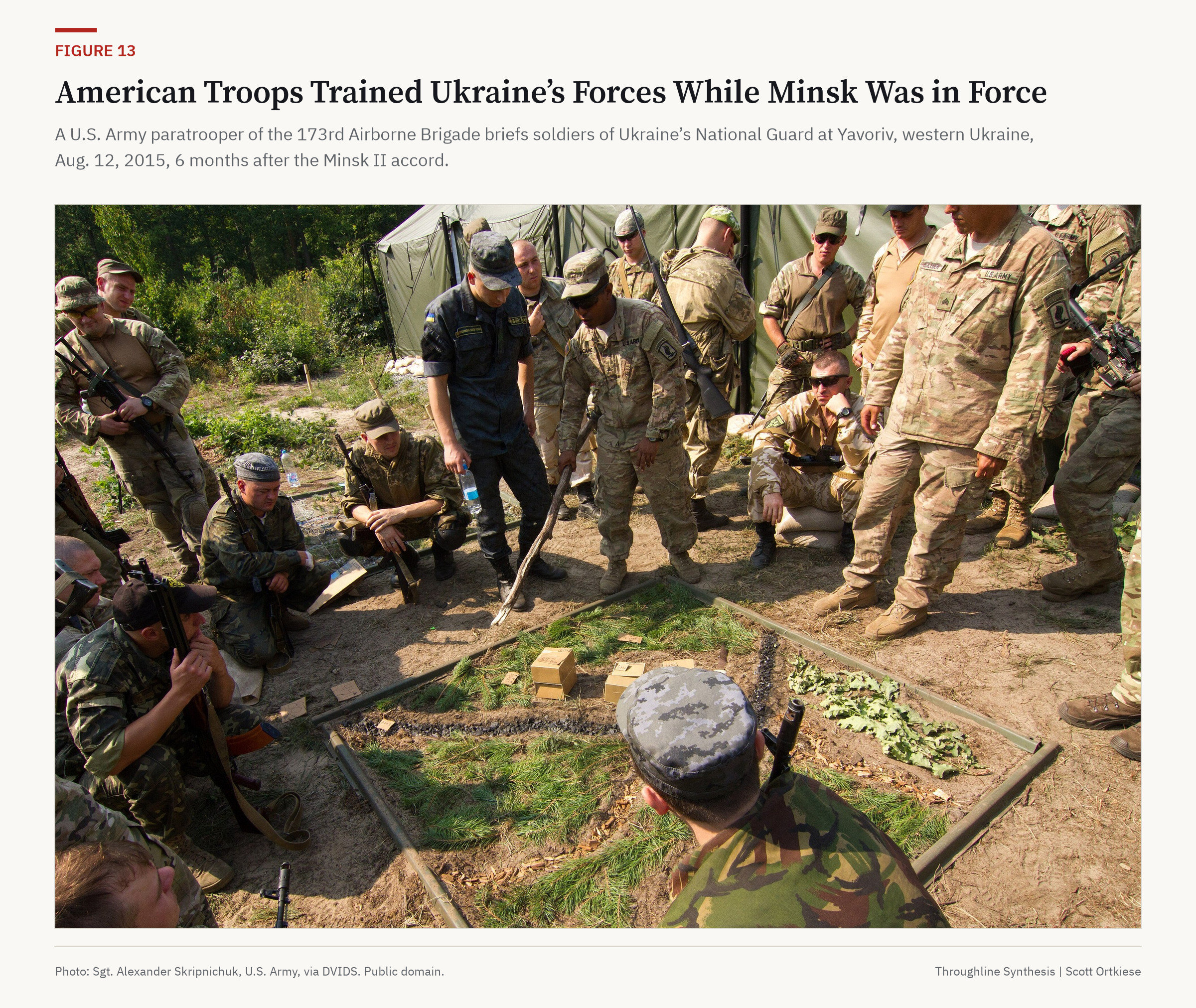
With the friendly government installed, Kinzer says, “the project moves into another phase, which is pouring massive amounts of weapons into Ukraine and constantly raising the threat that these weapons are going to be used against Russia.” The Congressional Research Service counted more than $2.5 billion in U.S. security assistance from 2014 through October 2021. American troops trained Ukrainian brigades at Yavoriv from 2015. Trump, in his first term, approved the Javelin anti-tank missiles that President Barack Obama had declined to send. The New York Times reported in February 2024 on a CIA-supported network of 12 secret Ukrainian spy bases along the Russian border, built over the previous 8 years.
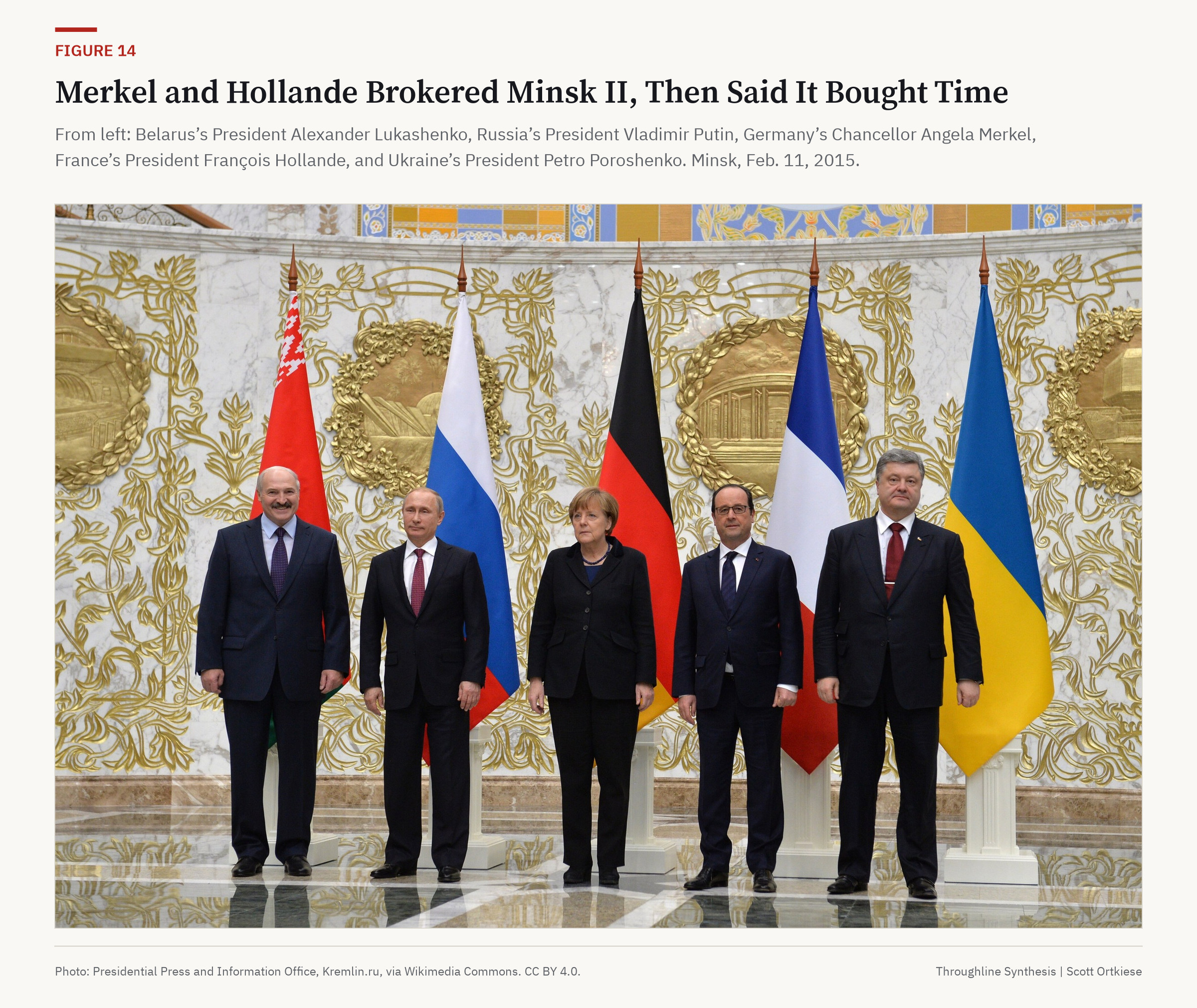
The peace agreement was the cover. The Minsk II accord of February 2015 was endorsed unanimously by the UN Security Council. The people who negotiated it have since told us what it did. Merkel told Die Zeit in December 2022 that the first Minsk agreement of 2014 “was an attempt to give time to Ukraine,” which “used this time to become stronger.” Francois Hollande, president of France from 2012 to 2017, said: “Yes, Angela Merkel is right on this point.” Petro Poroshenko, president of Ukraine from 2014 to 2019, said the task was “to get eight years” to “build the strength of the Armed Forces,” and added: “It was achieved.” Remember that when a European leader tells you Russia cannot be trusted to keep an agreement.
This was the period, Kinzer thinks, when Putin “belatedly realized the United States was preparing Ukraine for the conflict that we’re now living through.”
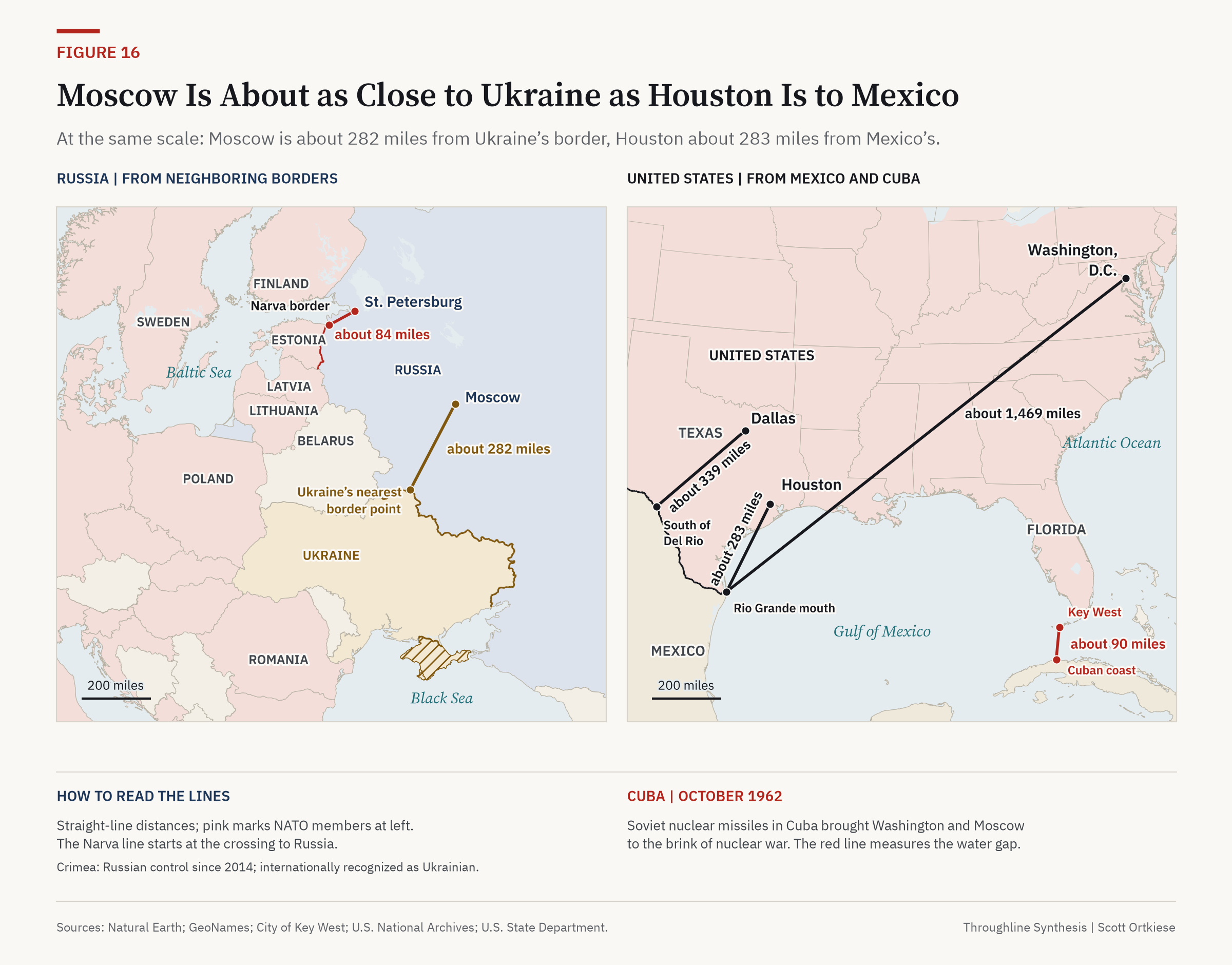
The second word that drove Kinzer crazy was “choose.” Washington’s line was that Ukraine must be free to join NATO “because every country has the right to choose its own security partners.” It sounds perfectly reasonable. “But in the real world, that’s never true,” Kinzer says. “How would we react if Mexico announced, ‘We’ve decided to open a Chinese military base in Veracruz. It’s 800 miles from Texas’? Would the United States say, ‘Well, we don’t like it, but Mexico is a sovereign country, and every country has the right to choose its own security partners’? Of course not. We would never accept that.” Washington expects Russia “to accept something that we ourselves never would.”
Diesen shows where the trick was hidden. From Helsinki to the Charter of Paris, the European security documents always held 2 principles in tension. The first is indivisible security: you don’t expand a military bloc against a neighbor, “Russia doesn’t put its missiles in Mexico and America doesn’t put its military bases in Ukraine.” The second is the right of states to choose their alliances. The 1999 Istanbul Charter puts both in a single paragraph: states may choose their security arrangements, and they “will not strengthen their security at the expense of the security of other States.” The West quoted the first half and ignored the second. Then it blamed Russia for denying Ukraine a choice, Diesen says, “even though that choice was made for them.”
Kinzer names the reason. Diesen is asking the United States to follow the rules it sets for others. “But actually we don’t see the world that way. We see the world as a place where we make the rules and others have to follow them.” The reason, in the American mind, is that other countries are selfish, greedy, and aggressive, “whereas we’re above all that.” Albright said it on NBC on February 19, 1998, while defending a possible American attack on Iraq: “We are the indispensable nation. We stand tall and we see further than other countries into the future.” If you believe that, Kinzer says, “it would be so foolish to listen to what any other country wants.”
The textbook calls it the security dilemma. One state arms to feel safe, and its neighbor feels threatened. Kinzer does not think that excuse applies here. “I don’t think this was an oversight or a miscalculation. I think they saw it as a win-win. Let’s pour arms into Ukraine, hope for either a war or a surrender by Russia. And if tens of thousands of Ukrainians have to die, it doesn’t matter.” Diesen recalls that Washington has put the method in writing. A 2006 cable from the U.S. Embassy in Damascus recommended giving media exposure to an exiled opponent of the Syrian government in order to make it lash out: “We should anticipate an overreaction by the regime that will add to its isolation.” Provoke the reaction, then advertise the reaction. Diesen says Washington later applied the same logic in Syria with weapons. The cable itself proposes no arms.
Biden would not say 5 words. On December 17, 2021, Russia published 2 draft treaties, one for Washington and one for NATO. They demanded an end to NATO expansion and a pullback of NATO forces from Eastern Europe. On January 26, 2022, Washington answered in writing. It offered to talk about missiles and exercises. On the only point that mattered, it said the door stays open. Derek Chollet, counselor to Blinken at the State Department, later confirmed that Washington refused to put NATO expansion on the table. “Even at the last moment,” Kinzer says, “if Joe Biden had only pronounced 5 words, ‘Ukraine will not join NATO,’ this whole war might have been avoided.”
The craziest part, Kinzer says, is that they knew Ukraine was never getting in. People in the Biden administration “in their hearts realized that Ukraine was never going to join NATO. And they told that to people off the record, but they wouldn’t say it in public because it would seem like a compromise or a concession to Russia.” Volodymyr Zelensky, Ukraine’s president, tells the same story. He told the Munich Security Conference in February 2025 that when he asked Biden in 2021 whether Ukraine would be in NATO, Biden “said, no, no,” and that the Americans “never saw us in NATO. They just spoke about it.” Hundreds of thousands of people are dead in a war Washington would not even try to stop by saying in public what it said in private.
NATO’s own chief confessed the cause. Jens Stoltenberg, NATO’s secretary general from 2014 to 2024, told the European Parliament on September 7, 2023 that Putin “sent a draft treaty that they wanted NATO to sign, to promise no more NATO enlargement,” that this “was a pre-condition for not invade Ukraine,” and that “of course we didn’t sign that.” His conclusion, in his own words: “So he went to war to prevent NATO, more NATO, close to his borders.” The man who ran the alliance says the war was about the alliance. That is what provoked means.
“There were always moments when the United States could have stopped this train,” Kinzer says. From Clinton to Biden, it never reached for the brake.
The Proxy War: “We’re Losing No Lives in Ukraine”
Kinzer quotes the senators. “We even had U.S. senators say out loud, ‘This is the best money we’ve ever spent. We’re killing Russians and no Americans are dying.'” He is paraphrasing, and the record is worth getting exactly right, because the real quotes are worse than the paraphrase.
- Lindsey Graham, Republican senator from South Carolina, told Zelensky in Kyiv on May 26, 2023 that American aid was “the best money we’ve ever spent.” The viral clip that joined those words to “the Russians are dying” was cropped by Zelensky’s own office, Reuters found. He said both things at different points in the meeting.
- Mitt Romney, then a Republican senator from Utah, said in August 2023 that aid to Ukraine “is about the best national defense spending I think we’ve ever done” and added: “We’re losing no lives in Ukraine.”
- Mitch McConnell, then the Senate Republican leader, called the aid on June 12, 2023 a “far cheaper way” to “degrade Russia’s ability to threaten the United States,” cheaper “in both dollars and American lives.”
- Richard Blumenthal, Democratic senator from Connecticut, wrote in August 2023 that “we’re getting our money’s worth on our Ukraine investment,” and that it was happening “without a single American service woman or man injured or lost.”
Both parties, on the record, in their own words: the war is a bargain because the people dying are not Americans.
The officials who ran it called it what it was.
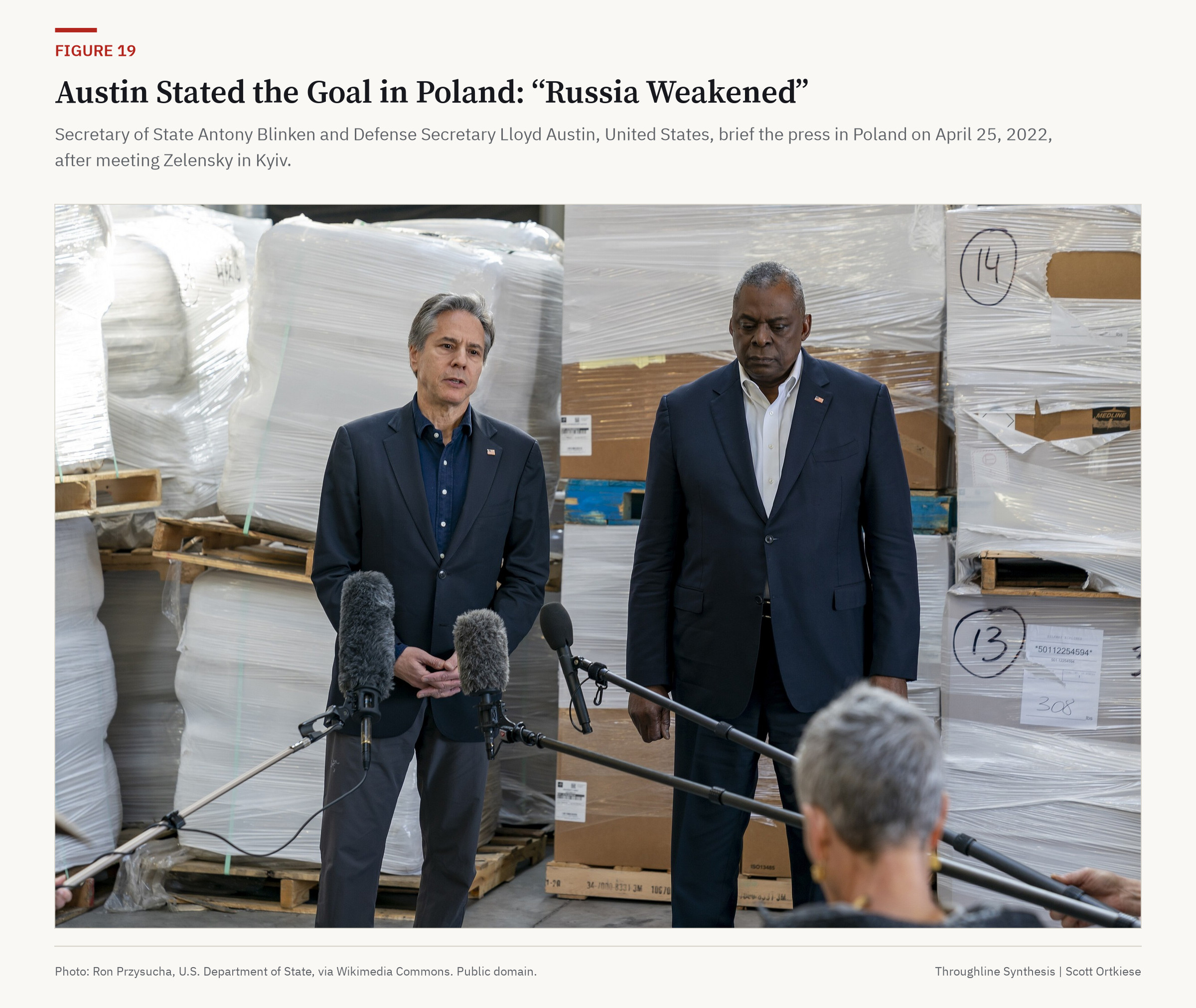
- Lloyd Austin, Biden’s defense secretary, said in Poland on April 25, 2022 that Washington wanted to see “Russia weakened to the degree that it can’t do the kinds of things that it has done in invading Ukraine.” The goal was a weaker Russia. Ukraine was the tool.
- Leon Panetta, former CIA director and defense secretary, told Bloomberg Television in March 2022 that the United States was fighting a proxy war with Russia “whether we say so or not.”
- Boris Johnson, Britain’s former prime minister, told The Telegraph in November 2024: “We’re waging a proxy war, but we’re not giving our proxies the ability to do the job.”
- Marco Rubio, Trump’s secretary of state, said on Fox News on March 5, 2025 that “frankly, it’s a proxy war between nuclear powers,” the United States on Ukraine’s side and Russia on the other, “and it needs to come to an end.”
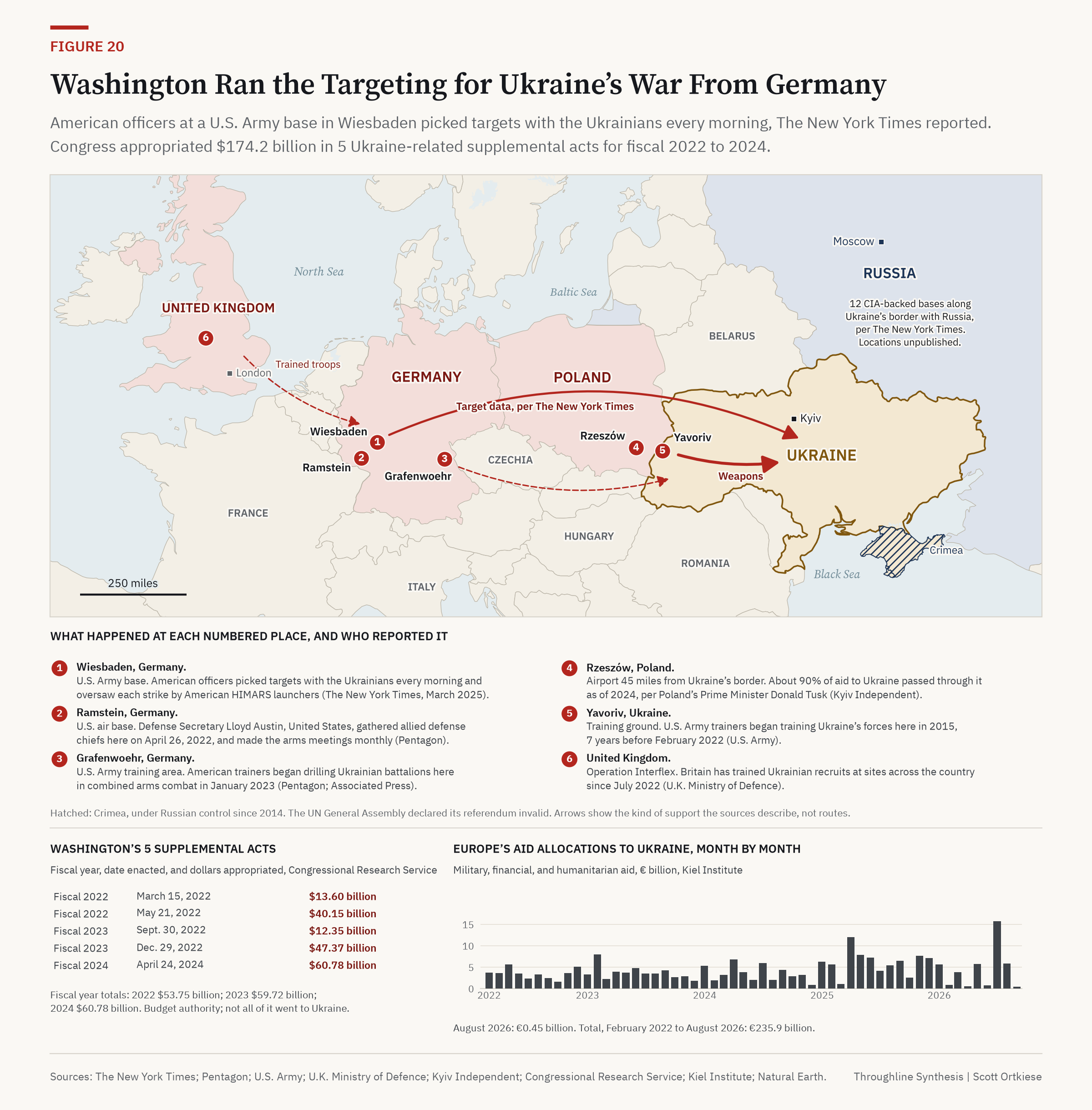
The New York Times finally printed how deep it went. In March 2025 the paper reported that from a U.S. Army base in Wiesbaden, Germany, American officers picked targets with the Ukrainians every morning and oversaw each strike by the American HIMARS rocket launchers they had supplied. The Times quoted a European intelligence chief: “They are part of the kill chain now.” This is the same newspaper that, by Kinzer’s count, printed “unprovoked invasion” 327 times in the first 2 months of the war.
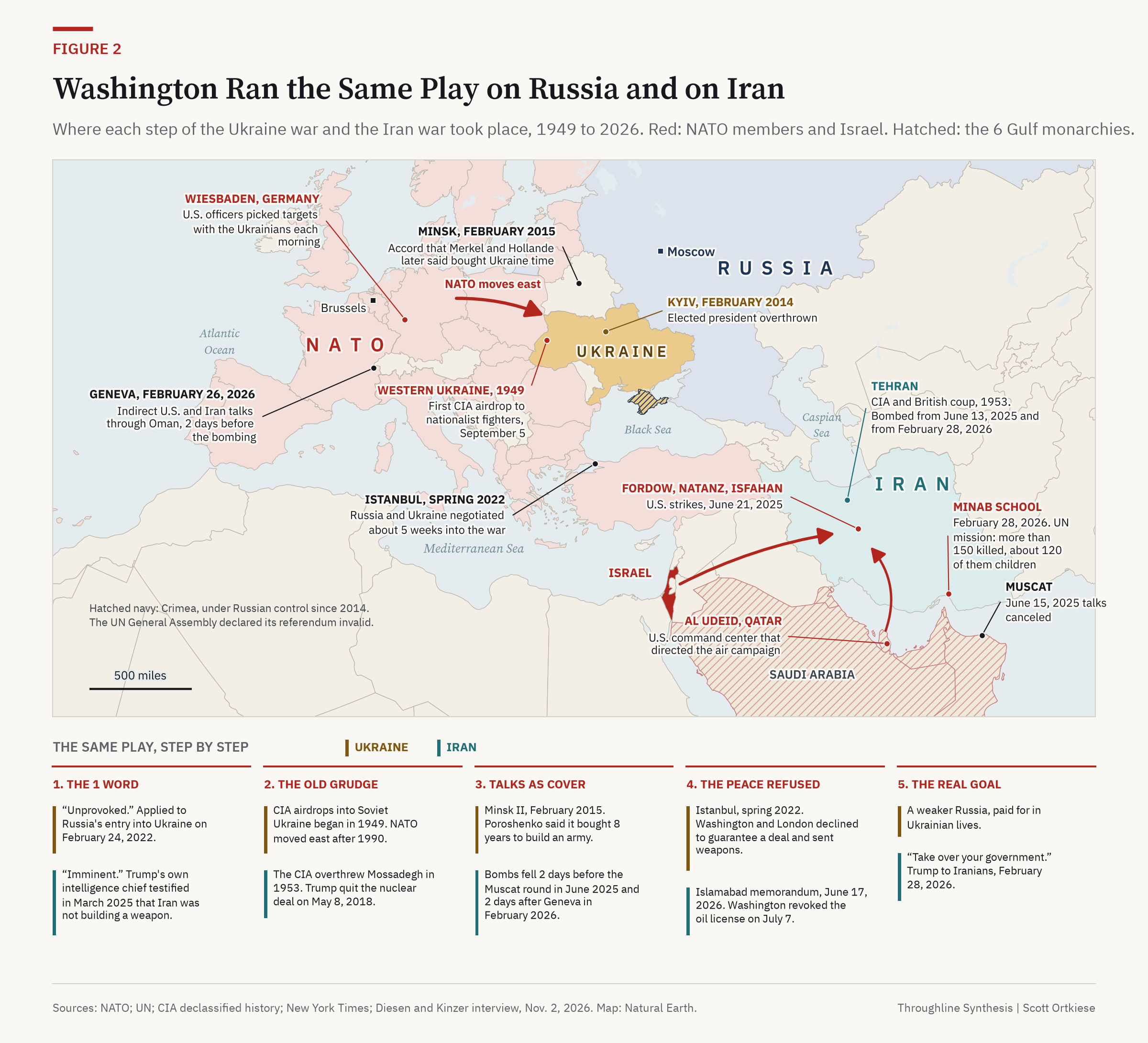
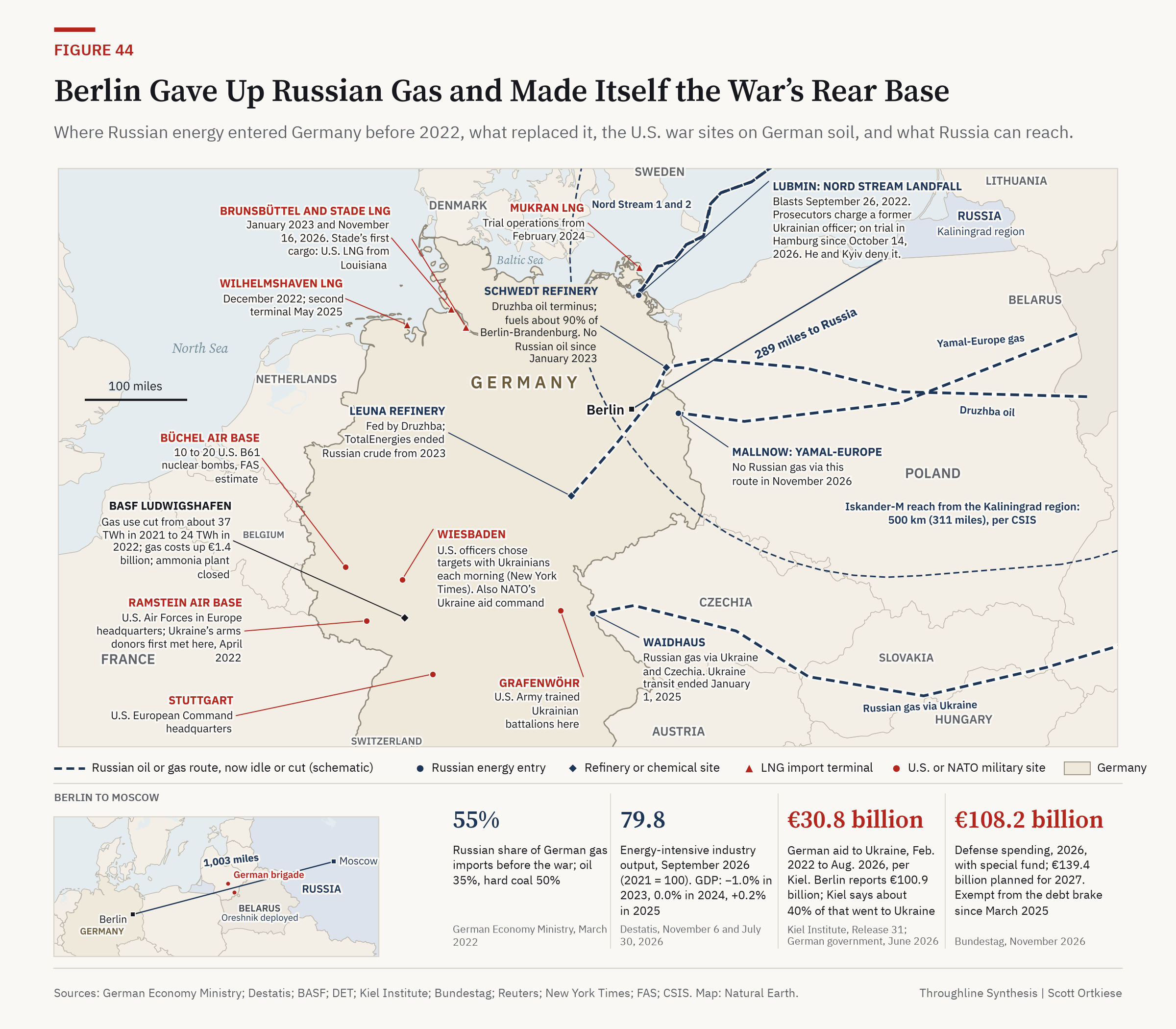
Put the places on a map. The targeting ran through a U.S. Army base in Wiesbaden, Germany, as The New York Times reported. The arms meetings began at the American air base at Ramstein on April 26, 2022, where Defense Secretary Lloyd Austin made them monthly. American trainers drilled Ukrainian battalions at Grafenwoehr, and Britain trained recruits across its own territory. About 90% of the aid moved through 1 Polish airport at Rzeszów, by the count of Poland’s prime minister, Donald Tusk. Congress put up $174.2 billion. Ukraine supplied the soldiers.
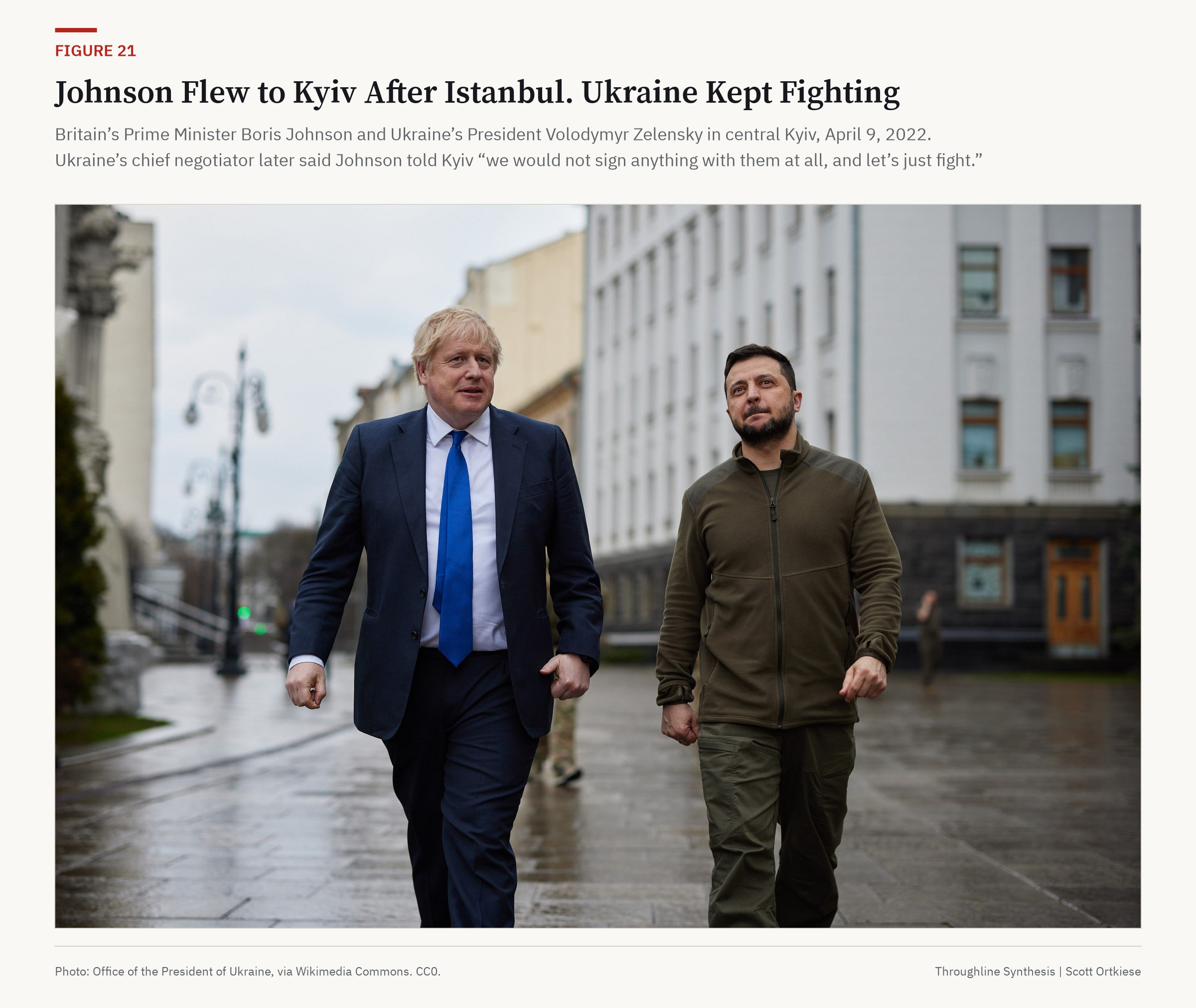
Then there is the peace that was on the table in the spring of 2022. Russian and Ukrainian negotiators met in Istanbul about 5 weeks into the war. Davyd Arakhamia, who led Ukraine’s delegation and leads Zelensky’s party in parliament, described the Russian position on Ukrainian television in November 2023: “They were prepared to end the war if we agreed to, as Finland once did, neutrality, and committed that we would not join NATO. In fact, this was the key point.” He went on: “When we returned from Istanbul, Boris Johnson came to Kyiv and said that we would not sign anything with them at all, and let’s just fight.” Samuel Charap of the RAND Corporation and Sergey Radchenko of Johns Hopkins University, who studied the draft texts, wrote in Foreign Affairs that the 2 sides “almost finalized an agreement that would have ended the war,” and that “instead of embracing the Istanbul communiqué and the subsequent diplomatic process, the West ramped up military aid to Kyiv and increased the pressure on Russia.” Naftali Bennett, Israel’s prime minister at the time and a mediator, said of the Western powers: “They blocked it, and I thought they were wrong.” Mevlut Cavusoglu, then Turkey’s foreign minister and the host of the talks, said on April 20, 2022 that some NATO members “want the war to continue, let the war continue and Russia get weaker.” Victoria Nuland, by then retired as U.S. under secretary of state, said in 2024 that the Ukrainians came to Washington and London for advice on the draft, that the Americans and British saw in its annex limits that would leave Ukraine “basically neutered as a military force,” that people inside and outside Ukraine “started asking questions about whether this was a good deal,” and that “it was at that point that it fell apart.”
Here is the limit of that evidence. No finished treaty existed for anyone to veto. The 2 sides were far apart on the size of Ukraine’s army, and the wording of the guarantees was still open. The discovery of the dead at Bucha hardened Ukrainian opinion, Arakhamia cites Kyiv’s own distrust of Moscow, Bennett later said he was unsure a deal was there to be made, and Charap and Radchenko found “no single smoking gun.” What the record does establish is enough. Russia’s key demand, by the account of Ukraine’s own chief negotiator, was neutrality. Ukraine’s delegation was willing to discuss it. Washington and London raised doubts about the draft, declined to guarantee any deal, and sent weapons instead. That is the 5 words refused a second time, this time with the war already under way. The full file is in my article on the sabotage of the Istanbul negotiations.
Count what that refusal has cost.
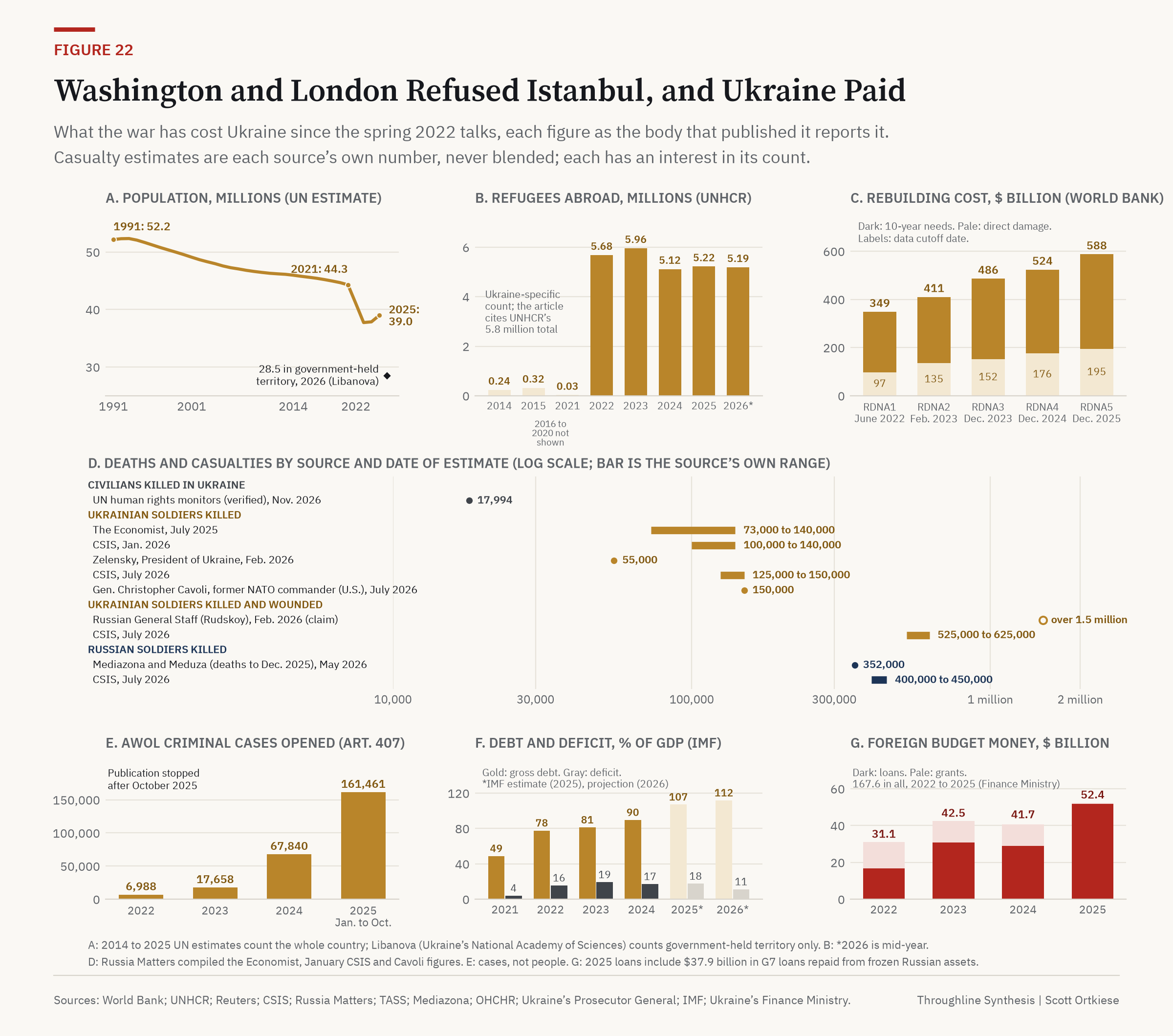
- Ukrainian soldiers. Zelensky’s official figure, given to French television in February 2026, is 55,000 killed. The Center for Strategic and International Studies, a Washington think tank funded in part by weapons makers, estimated in July 2026 125,000 to 150,000 Ukrainian dead and 525,000 to 625,000 total casualties. The same study puts Russian dead at 400,000 to 450,000. Every one of those numbers comes from a party with an interest. Take the lowest and it is still a generation.
- Civilians. The UN has verified 17,994 civilians killed in Ukraine as of November 17, 2026.
- The country. About 5.8 million Ukrainians are refugees abroad by the UN refugee agency’s regional count, and the agency’s Refugee Data Finder puts the number at 5.2 million at the end of 2025. Ella Libanova, director of the demography institute at Ukraine’s National Academy of Sciences, estimates that 28.5 million people now live in government-held territory.
- The army. Ukraine’s prosecutors opened 202,997 cases of soldiers leaving their units without permission and 50,058 cases of desertion between 2022 and July 2025. Those are the men voting on the war in the only way left to them.
- The bill. Congress appropriated $174.2 billion in Ukraine-related supplemental funding in fiscal years 2022 through 2024, the Congressional Research Service reports.
The bill for refusing peace keeps rising, and Ukraine pays it. The World Bank put the cost of rebuilding at $349 billion in 2022; its fifth assessment puts it at $588 billion. Ukraine’s Finance Ministry has taken in $167.6 billion from abroad since 2022, mostly loans, and the IMF puts public debt at 107% of GDP in 2025. Prosecutors opened 161,461 cases of soldiers absent without leave in the first 10 months of 2025 alone, and then stopped publishing the count.
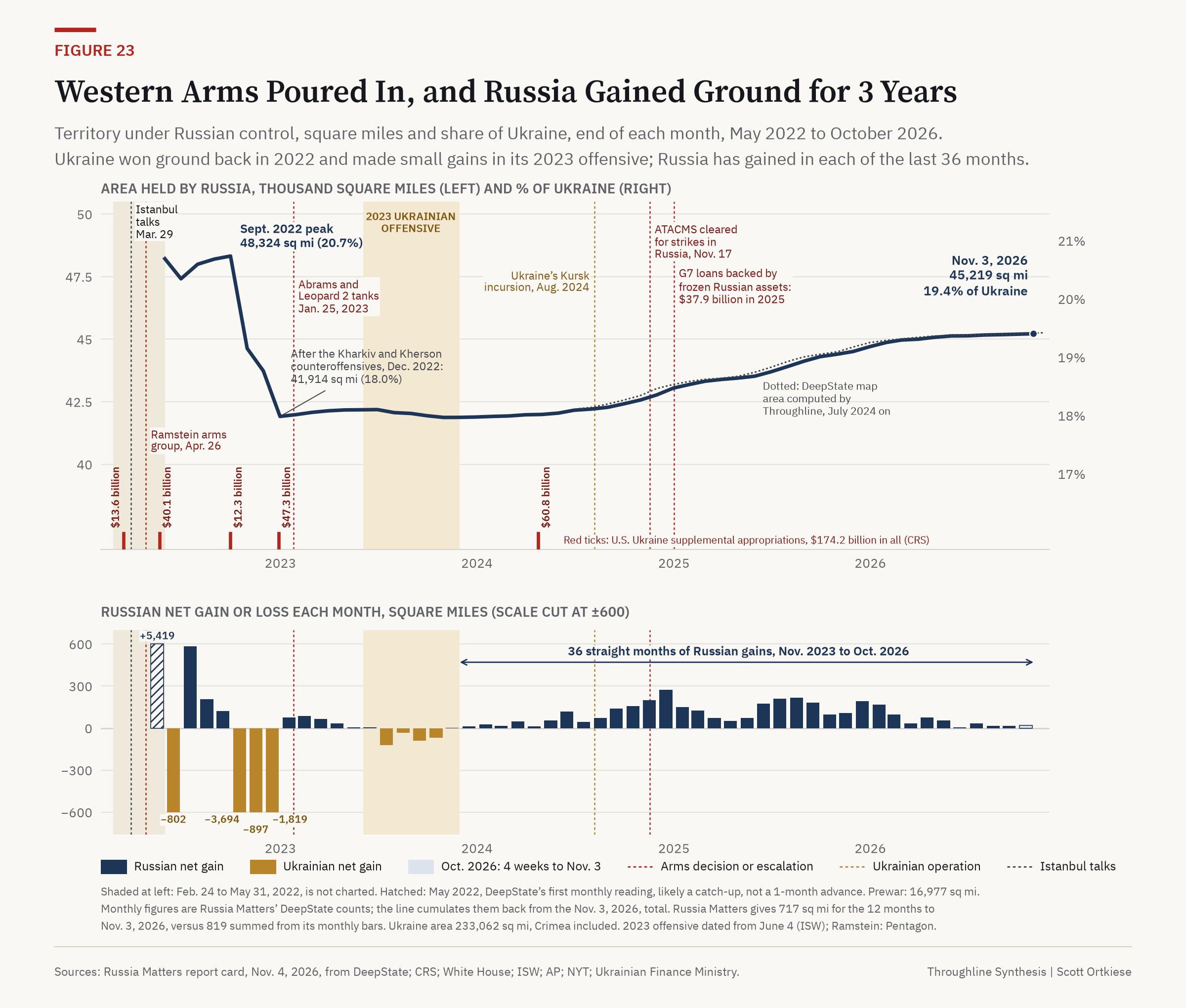
Since November 2023, Russia has gained ground every single month. By the Russia Matters count of DeepState maps, Russia held 16,977 square miles of Ukraine before the war and 45,219 square miles, about 19%, on November 3, 2026. Ukraine did win ground back in late 2022, and its 2023 offensive, led by the Leopard tanks promised in January 2023, took back about 300 square miles. Then the tide turned for good: 36 straight months of Russian gains, through the $60.8 billion supplemental and President Joe Biden’s November 2024 clearance for ATACMS strikes inside Russia. Since late 2023, every escalation has bought more war, not more land.
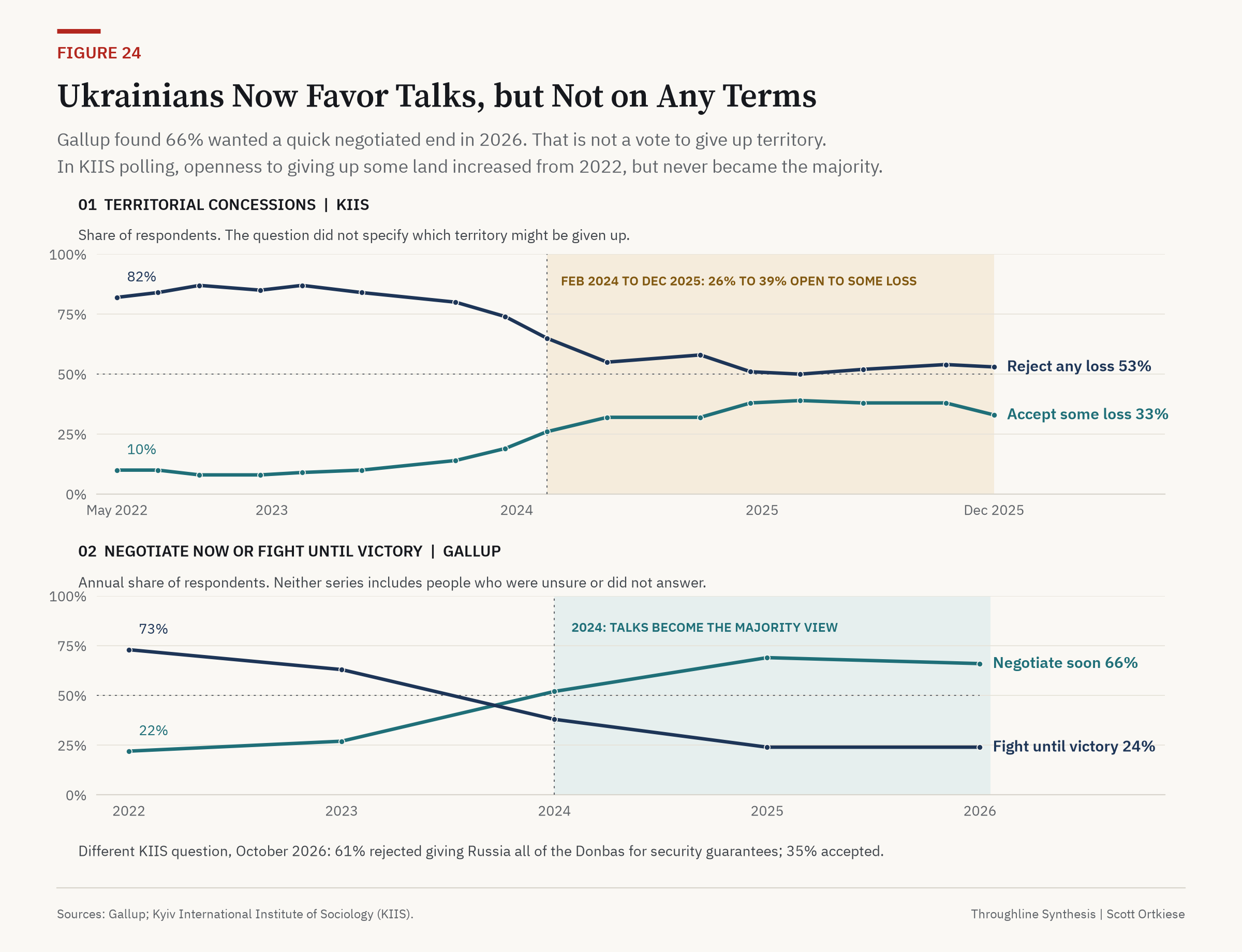
Ukrainians themselves want out. Gallup found in 2025 that 69% of Ukrainians wanted to negotiate an end to the war as soon as possible, up from 22% in 2022. In 2026, it was 66%. That does not mean they accept Russia’s terms, and other polls show most do not. It means the people doing the dying are far ahead of the people in Brussels doing the talking. I made that case in Ukraine Has Lost.
Zelensky: Elected to Make Peace, Kept in Office to Make War
Every proxy war needs a local face. In 2014, Washington’s man was Yatsenyuk. In 2019, it inherited Zelensky, and it has kept him ever since.
He was elected to end the war in the Donbas. Zelensky, a television comedian with no political experience, won the presidency on April 21, 2019 with 73.22% of the vote on a promise of peace. That October he traveled to the front-line town of Zolote to enforce a mutual pullback of troops and was defied to his face by armed nationalist veterans. He told one of them, a local leader of the political wing of the Azov movement: “I’m the president of this country. I’m 41 years old. I’m not a loser.” Street protests under the slogan “no to capitulation” had been running since he accepted a peace formula on October 1. He got the Zolote pullback done within a week. But the heirs of the tradition Kinzer traces back to 1949 had shown they could put an elected president on the defensive in his own country, and the settlement he was elected to deliver never came.
He started shutting down opposition media a year before the invasion. On February 2, 2021, Zelensky used a sanctions decree, with no court ruling, to take 3 television channels tied to the main opposition party off the air. The European Federation of Journalists said the ban was “not at all in line with international legal standards on Freedom of Expression.” Poland’s state-funded Centre for Eastern Studies concluded that the main motive was “the desire to block the media base of the Opposition Platform,” which was catching up with his party in the polls. The U.S. Embassy answered with public support for Ukraine’s efforts to counter Russian influence.
Then the war gave him everything.
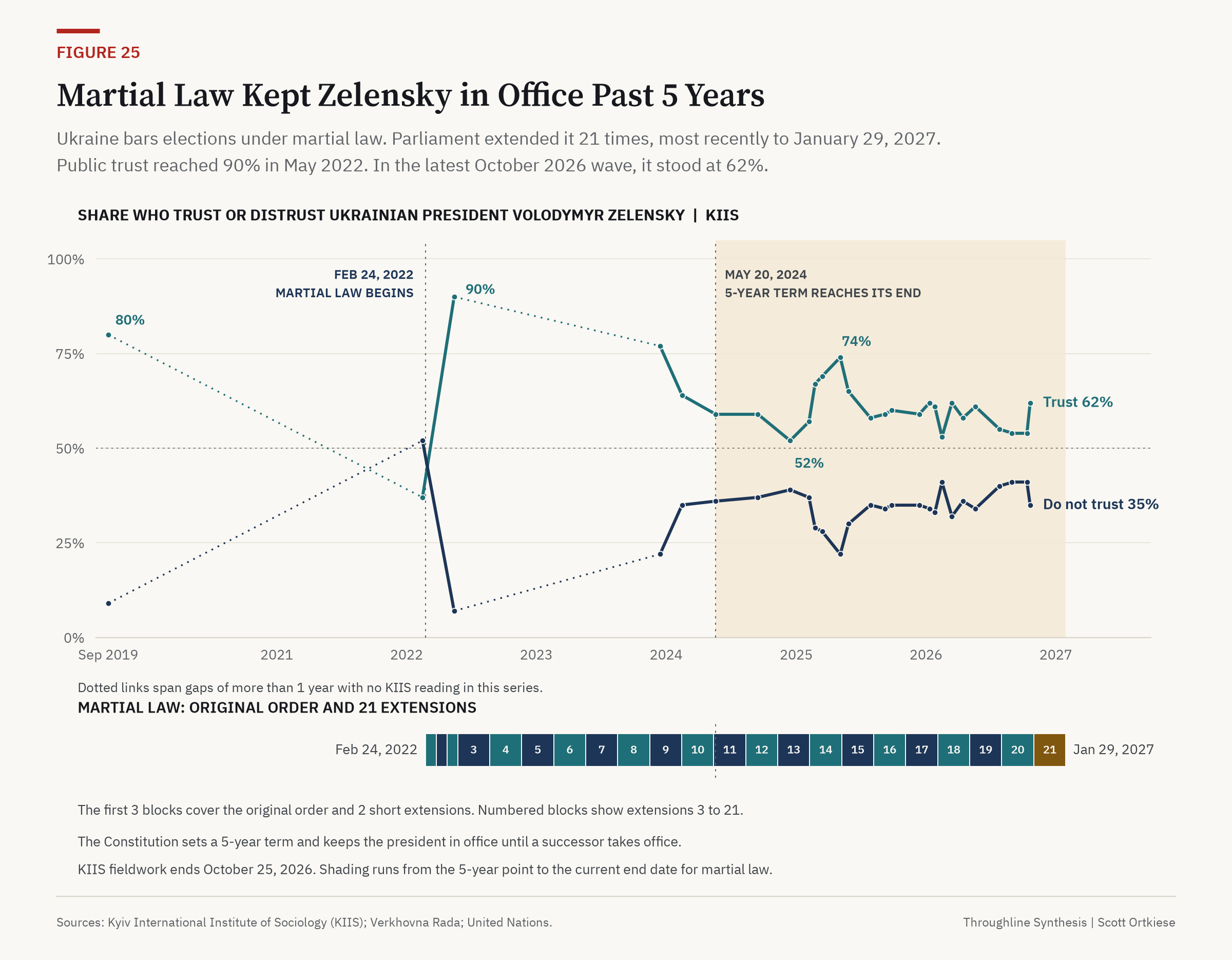
- No elections. Martial law was declared on February 24, 2022, and Ukrainian law bars elections while it lasts. That law dates from 2015, before Zelensky. The parliamentary election due in October 2023 was not held. The presidential election due on March 31, 2024 was not held. His 5-year term ended on May 20, 2024. He has now governed 2 and a half years past it. Parliament, where his party holds the majority, resolved in February 2025 that there will be no election until a “comprehensive, just and lasting peace.” Since December 2025 he has said he is ready for a vote if his allies guarantee security. On October 26, 2026, parliament extended martial law for the 21st time, through January 29, 2027. As of today, November 19, 2026, no election has been scheduled.
- No opposition. On March 20, 2022, his security council suspended 11 political parties. The largest, Opposition Platform For Life, held 44 of 450 seats, the second-largest bloc in parliament, and had demanded that Moscow stop the invasion. The Supreme Court made the ban permanent on September 15, 2022, and other courts banned the rest one by one.
- 1 television voice. His decree of March 19, 2022 merged the national channels into a single state-coordinated broadcast, the “United News” telemarathon. Channels linked to his predecessor and rival, Petro Poroshenko, were cut from the national digital network. Ukrainians’ trust in the telemarathon fell from 69% to 36% in under 2 years. It is still running, and the European Commission asked Kyiv this month to reconsider it.
- No exit. Men aged 18 to 60 were barred from leaving the country in February 2022. The ban was lifted for ages 18 to 22 in August 2025 and remains, with narrow exceptions, for men from 23 to 60. Complaints to Ukraine’s own human rights ombudsman about recruitment officers, including beatings and unlawful detention, rose from 18 in 2022 to 6,127 in 2025.
Then the money. On July 22, 2025, Zelensky signed a law placing Ukraine’s 2 independent anti-corruption agencies under the prosecutor general, a presidential appointee. Ukrainians filled the streets in the largest protests of the war, and he reversed it 9 days later. In November 2025 those same agencies announced “Operation Midas,” a kickback scheme at the state nuclear power company. When they closed the investigation this month, they said the cash moved out of the energy sector from 2020 to 2025 exceeded $111 million and €12 million. The alleged organizer, Timur Mindich, is Zelensky’s former business partner and fled to Israel. Andriy Yermak, Zelensky’s chief of staff and the second most powerful man in the country, resigned after investigators searched his home and was named a money-laundering suspect in May 2026. Investigators say Zelensky himself is not a subject of the case. His circle is. I went through it in The War Pigs Used Ukraine as Their Proxy.
I call him a dictator, and I am in strange company. Trump called him “a Dictator without Elections” in February 2025 and then went on selling Europe the American weapons to arm him. His defenders answer that the constitution keeps a president in office until a successor is sworn in, that the courts approved the party bans, and that a late October poll by the Kyiv International Institute of Sociology shows 62% still trust him. All true. Here is what is also true: a man who rules past his term, with the main opposition party banned, the television news merged into 1 state broadcast, the borders closed to men of fighting age, and press gangs working the streets, is not running a democracy, whatever the paperwork says. The West does not care. It has never needed its clients to be democrats. It needs them to keep fighting. He is hapless because he cannot stop the war and cannot win it, and the 53% of Ukrainians who told the same institute in September that he should not run again have noticed.
Europe’s Leaders Are Now the Main Obstacle to Peace
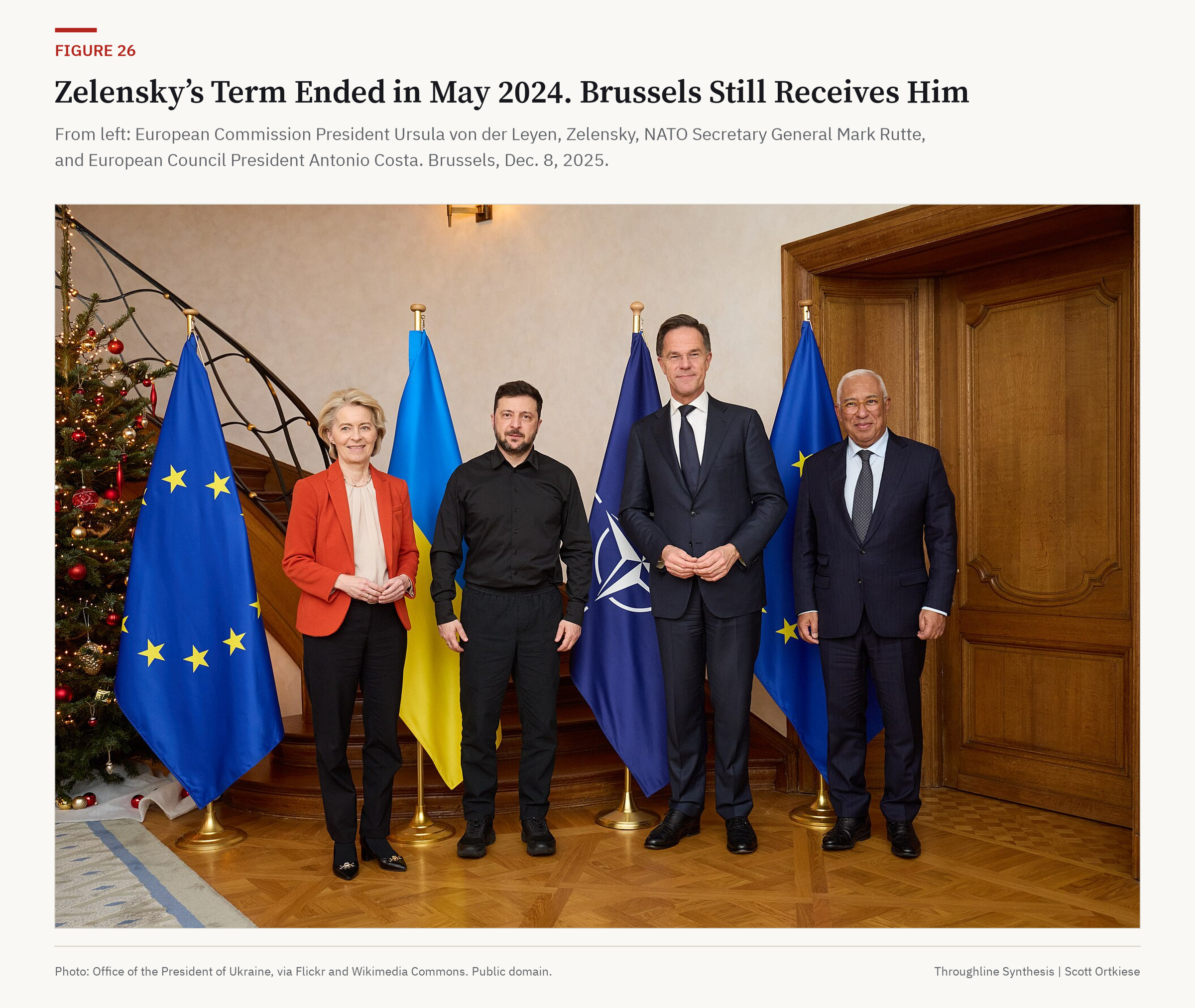
Kinzer’s harshest words in the whole interview are for Europe. Among the things that astonish him most, he says, is “how many of my sophisticated, thoughtful European friends still think this war is a great idea and have this fantasy that Russia, which hasn’t been able to conquer four eastern oblasts in Ukraine, is going to be in Warsaw or Berlin a week after they receive some compromised settlement in Ukraine.” Europe “has worked itself into a frenzy that in some ways is even more irrational than what we’re seeing in the United States.” It has reached the point, he says, where “any European involvement in the peace process with Ukraine is going to be a way to torpedo that process, because the Europeans are dead set against compromising or even negotiating with the party on the other side.”
Then he states the rule every first-year student learns. “It’s what you learn in diplomacy 101. You cannot resolve conflicts by negotiating only with your friends. You already agree with them. We should have been on the phone with Russia every day from the time this started. But the reason we didn’t is we want to teach Russia a lesson. It’s the idea of keeping America on top.”
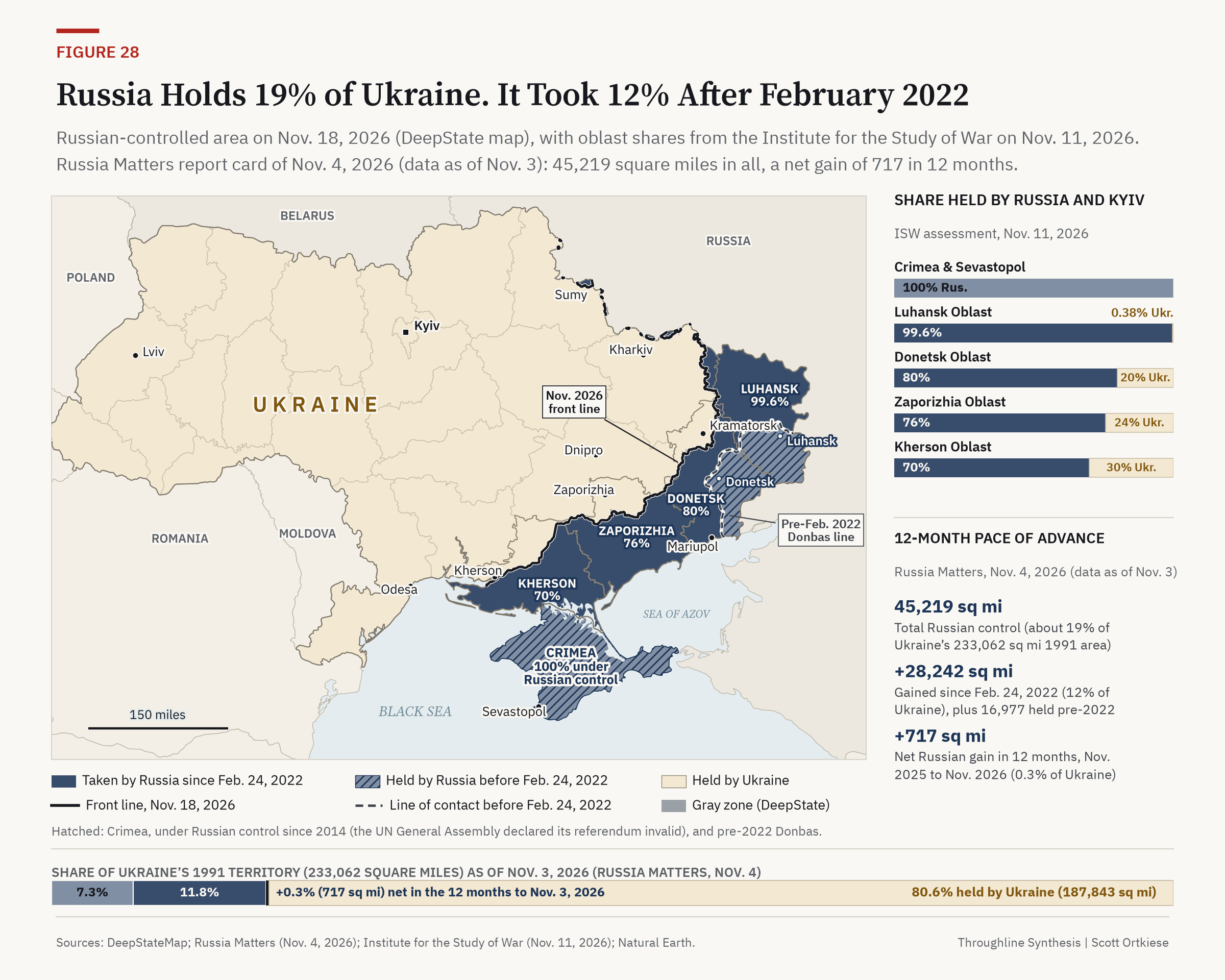
Start with the fantasy. Harvard’s Russia Matters project, working from Ukraine’s own DeepState battlefield map, put Russian control on November 3, 2026 at 45,219 square miles, about 19% of Ukraine, a figure that includes Crimea and the Donbas territory held before 2022. Russia’s net gain over the previous 12 months was 717 square miles, about 0.3% of Ukraine. The Institute for the Study of War, a Washington think tank that cheers for Kyiv, estimated on November 11 that Ukraine still held about 20% of Donetsk, 24% of Zaporizhia, 30% of Kherson, and 0.38% of Luhansk. Russia is grinding the Ukrainian army down, and as I wrote in There Is No Ukrainian Victory Left to Win, Kyiv cannot reverse that. But an army that nets 717 square miles in a year is not driving to Berlin. Europe’s leaders know this. They are selling the fantasy anyway.
Here is what they tell their own people.
- Mark Rutte, NATO’s secretary general and former Dutch prime minister, told a Berlin audience on December 11, 2025 that “Russia could be ready to use military force against NATO within five years” and that “we must be prepared for the scale of war our grandparents or great-grandparents endured.” In January 2025 he told Europeans who balked at the bill to “get your Russian language courses or go to New Zealand.”
- Boris Pistorius, Germany’s Social Democratic defense minister, told the Bundestag on June 5, 2024: “Wir müssen bis 2029 kriegstüchtig sein.” We must be ready for war by 2029.
- Donald Tusk, Poland’s prime minister, said in July 2025 that Russia and China “will be ready for confrontation on a global scale as early as 2027.”
- Mette Frederiksen, Denmark’s Social Democratic prime minister, gave her defense chief 1 instruction in February 2025: “Buy, buy, buy.”
- Emmanuel Macron, president of France, said on February 26, 2024 that on sending Western ground troops to Ukraine, “rien ne doit être exclu.” Nothing should be ruled out. He admitted in the same breath that there was no consensus for doing it.
That is the 2030 war horizon, and it is manufactured. The intelligence assessments behind these dates describe what Russia could build under stated conditions. The Danish Defence Intelligence Service’s own scenario depends on the Ukraine war ending or freezing, Russia outbuilding the West, and Moscow judging that the United States would stay out. The conditions stay in the fine print. The public gets a countdown. A population that believes war arrives in 2029 will pay for anything.
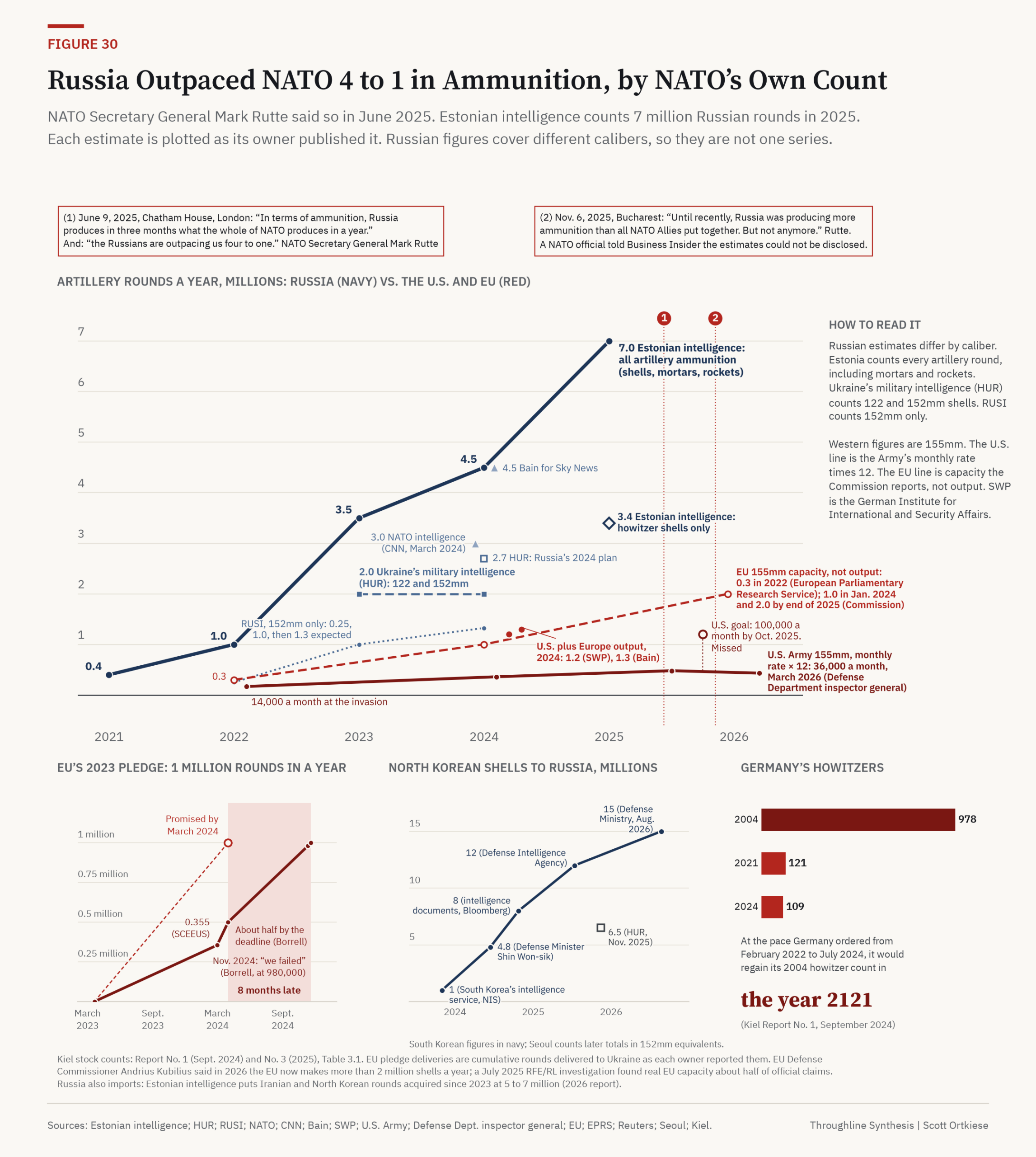
Europe talks war and cannot make the shells for one. Rutte said at Chatham House on June 9, 2025 that “the Russians are outpacing us four to one.” In November 2025, he said NATO had caught up, and he published no numbers. Estonia’s Foreign Intelligence Service counts 7 million Russian artillery rounds in 2025. The U.S. Army made 36,000 shells a month in March 2026, after missing its 100,000 goal, the Pentagon’s inspector general found. The EU promised Ukraine 1 million shells by March 2024. Josep Borrell, then its foreign policy chief, admitted “we failed”. At its ordering pace, Germany regains its 2004 howitzer count in 2121, the Kiel Institute calculated.
They cannot keep their own story straight. Ursula von der Leyen, the German president of the European Commission, told the European Parliament on September 14, 2022 that the Russian military was “taking chips from dishwashers and refrigerators to fix their military hardware” and that “Russia’s industry is in tatters.” The same people now warn that this country could be ready to fight NATO by 2030. The story changes with what is being sold: sanctions in 2022, rearmament in 2026.
They have also said what they actually want. Annalena Baerbock, then Germany’s Green foreign minister, told the Council of Europe on January 24, 2023: “We are fighting a war against Russia and not against each other.” Kaja Kallas, then Estonia’s prime minister and now the European Union’s foreign policy chief, told a Tallinn conference on May 18, 2024 that “Russia’s defeat is not a bad thing,” and went on, in words a European Parliament question put on the record: “If you would have more small nations, it’s not a bad thing, if the big power is much smaller.” The EU’s chief diplomat has mused in public about breaking Russia into pieces. Then Brussels wonders why Moscow does not trust it at a negotiating table.
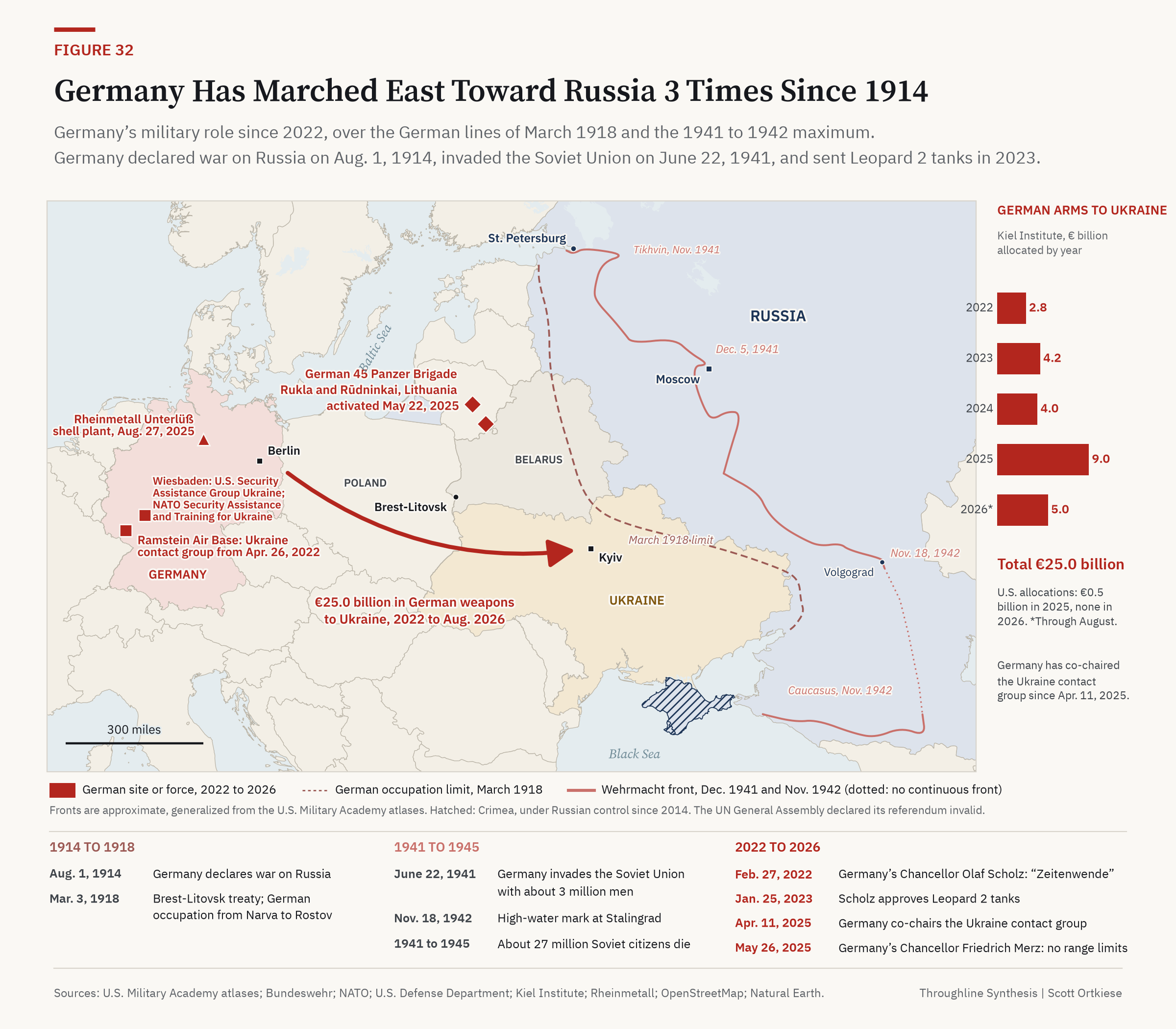
This is the third time in 112 years Germany has marched east toward Russia. Germany declared war on Russia on August 1, 1914 and by March 1918 occupied land from Narva to Rostov. On June 22, 1941, it sent about 3 million men into the Soviet Union, and about 27 million Soviet citizens died. Now the Kiel Institute counts €25.0 billion in German weapons sent to Ukraine, and on May 22, 2025, Chancellor Friedrich Merz of Germany activated a German tank brigade in Lithuania, a unit of 4,800 soldiers by the end of 2027. The country that twice came for Moscow has again put its army on Russia’s border.
The refusal to talk was official policy. When Viktor Orban, Hungary’s prime minister, flew to Moscow in July 2024, Josep Borrell, then the EU’s foreign policy chief, announced that the EU position “excludes official contacts between the EU and President Putin.” A union of 27 states at war by proxy with a nuclear power held as its standing position that its institutions would not speak to the other side’s president. National leaders stayed free to call Moscow. Few did.
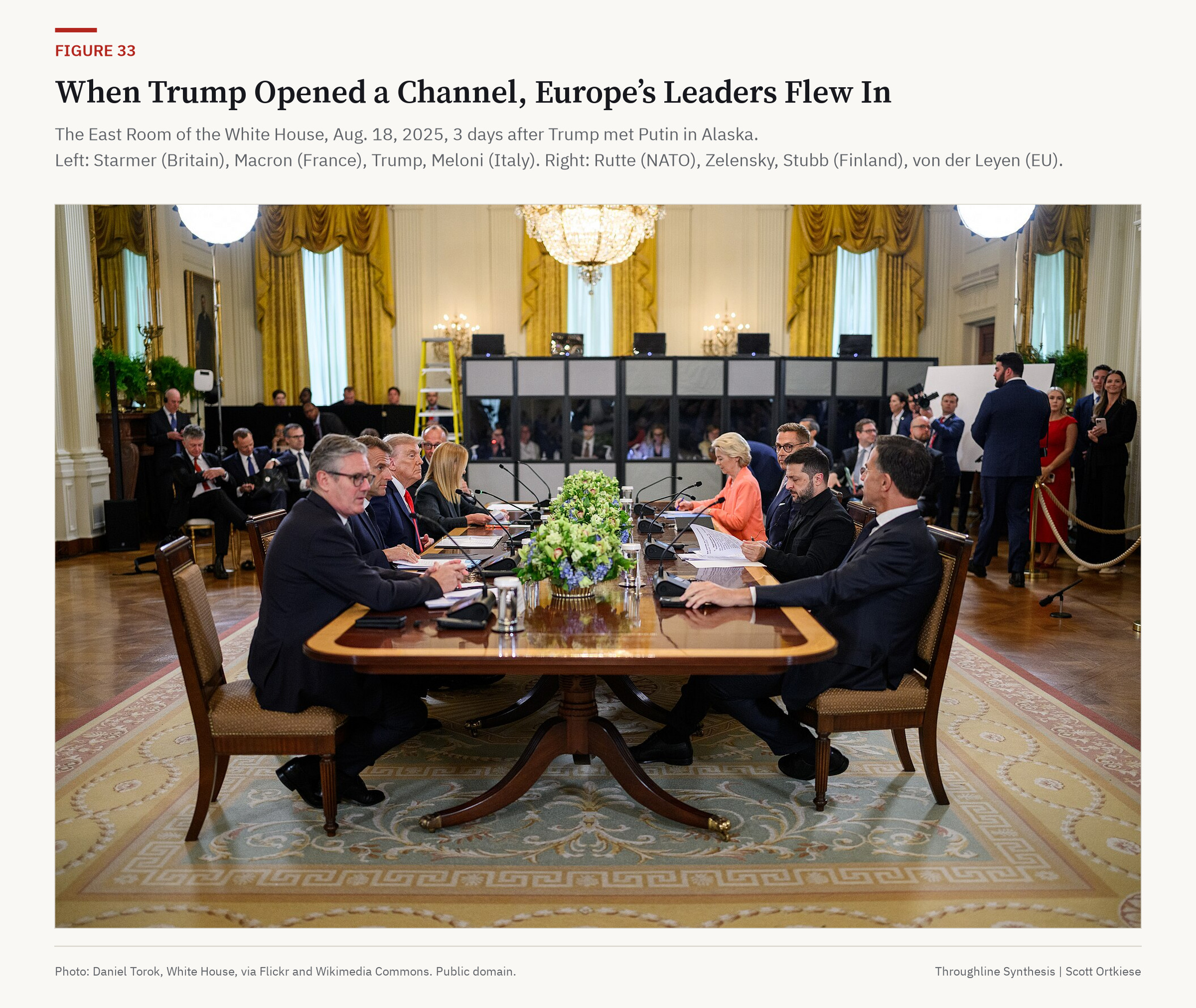
When Trump opened a channel, they moved to keep NATO’s door open. The day after Trump met Putin in Alaska in August 2025, Macron, German Chancellor Friedrich Merz, Britain’s then prime minister Keir Starmer, Italy’s Prime Minister Giorgia Meloni, Tusk, Finland’s President Alexander Stubb, and European Council President Antonio Costa declared: “No limitations should be placed on Ukraine’s armed forces or on its cooperation with third countries. Russia cannot have a veto against Ukraine’s pathway to EU and NATO.” That holds open the door NATO opened at Bucharest in 2008, 17 years and a war later. When Washington circulated a draft peace plan in November 2025, Britain, France, and Germany answered with a counterproposal that offered a monitored ceasefire and struck the American draft’s expectation that NATO would not expand further, the issue Stoltenberg admitted Putin went to war over.
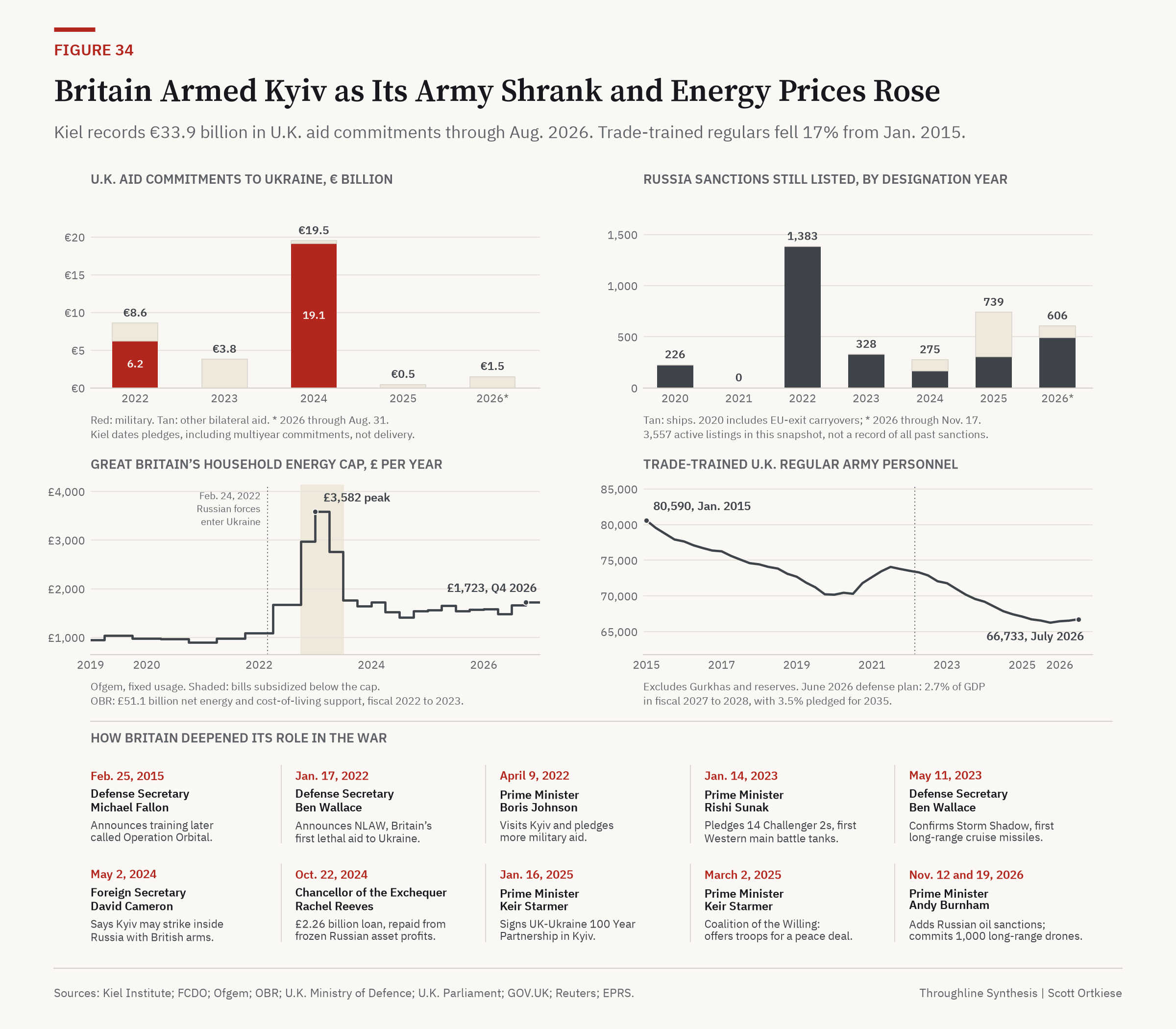
London kept raising the stakes as its own trained Army shrank. Britain was first to pledge Western-made tanks to Kyiv and first to supply long-range cruise missiles. Keir Starmer, then Britain’s prime minister, offered British troops to back a peace deal, but said the plan needed strong American backing. His government chose to cut development aid to fund higher defense spending. By July 2026, the Ministry of Defence counted 66,733 trade-trained regular Army personnel, down 17% from January 2015. Andy Burnham, Britain’s prime minister now, went to Berlin on November 19, 2026 and committed another 1,000 long-range drones.
Britain’s global military posture rests on American hardware and American bases while its own industrial foundation erodes. According to the House of Commons Library, the Royal Navy’s 4 Vanguard submarines draw from 58 Trident II D5 missile bodies mingled in a communal U.S. Navy pool at Kings Bay, Georgia, and Britain’s F-35 fleet relies on mission data files compiled at Eglin Air Force Base in Florida. In June 2025, Keir Starmer, then Britain’s prime minister, ordered 12 F-35A jets for NATO’s nuclear mission, and on March 1, 2026, he allowed U.S. bombers at RAF Fairford and Diego Garcia to strike Iranian missile sites. Andy Burnham, Britain’s prime minister now, confirmed £25 billion in total support for Ukraine and £3 billion a year in military aid even as large-user industrial electricity prices hit 24.3 pence per kilowatt-hour, 3.8 times the U.S. industrial average. Tata Steel closed its last blast furnace at Port Talbot in September 2024, Petroineos shut Scotland’s only oil refinery at Grangemouth in April 2025, and Whitehall nationalized British Steel at Scunthorpe on July 16, 2026 to keep Britain’s last blast furnaces open. Meanwhile, HM Treasury’s sanctions office reported £28.7 billion in Russian-linked assets frozen in London since February 2022.
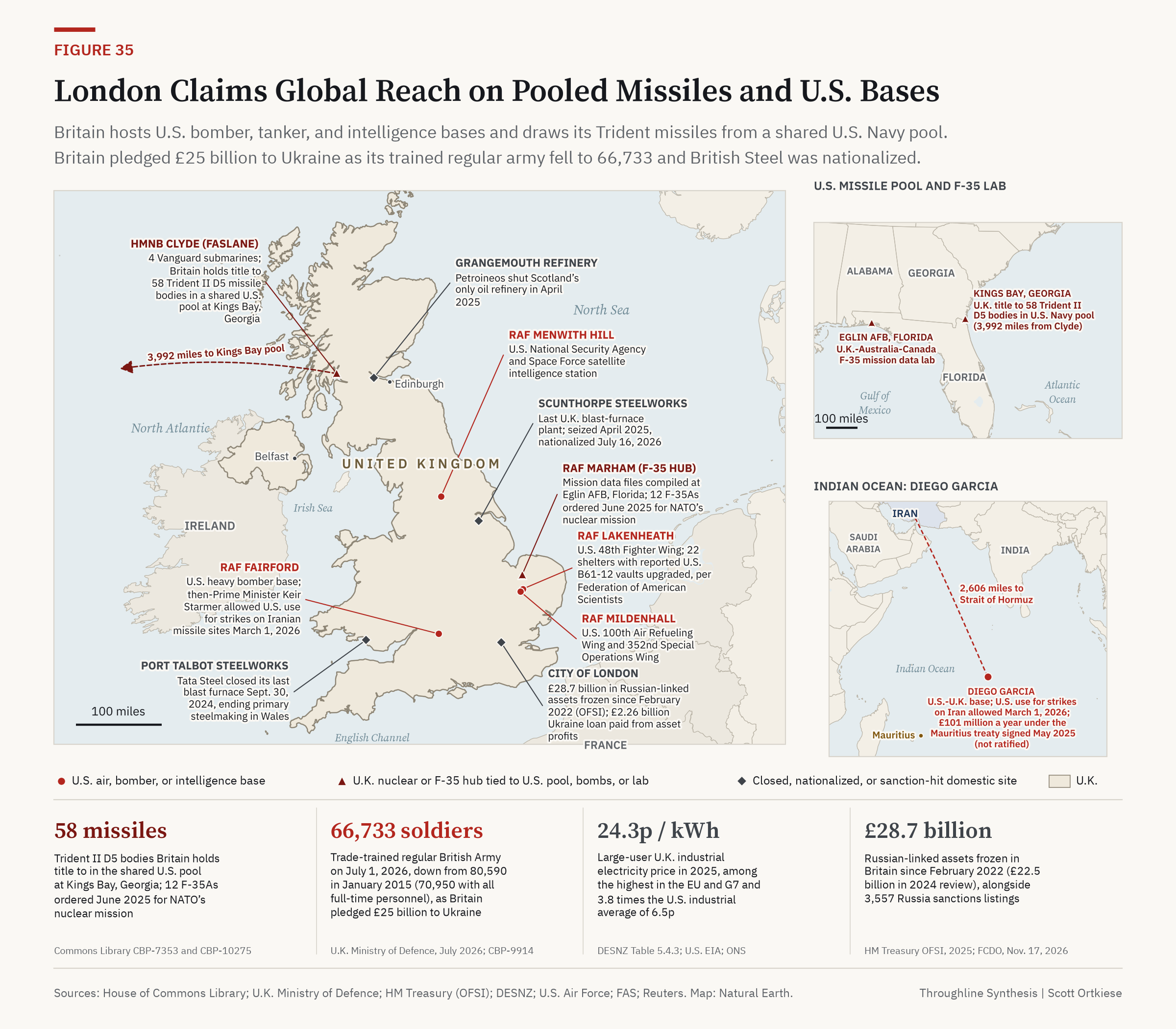
They are still doing it this month. On November 13, 2026, after Russian and Ukrainian delegations had met again in Abu Dhabi, Merz said in Dublin: “There is no need to talk about European security architecture. We have that already.” A week earlier in Warsaw, Kallas said Europe already has a security architecture and Ukraine belongs inside it. That architecture is NATO expanding without limit. It is the cause of the war, and Europe’s leaders have declared it closed to discussion. Kinzer’s word for this is torpedo. It is the right word.
When Washington stepped back, Berlin stepped forward. The Kiel Institute records no new U.S. military allocations to Ukraine after January 2025, and Germany allocated €9.0 billion that year, more than any other country. Defense Minister Boris Pistorius of Germany told the Bundestag that Germany must be “kriegstüchtig,” war-ready, by 2029. Chancellor Friedrich Merz promised Europe’s strongest conventional army and lifted the range limits on German weapons. The Finance Ministry now plans €162.9 billion for defense in 2029, up from €34.7 billion in 2014 by NATO’s count.
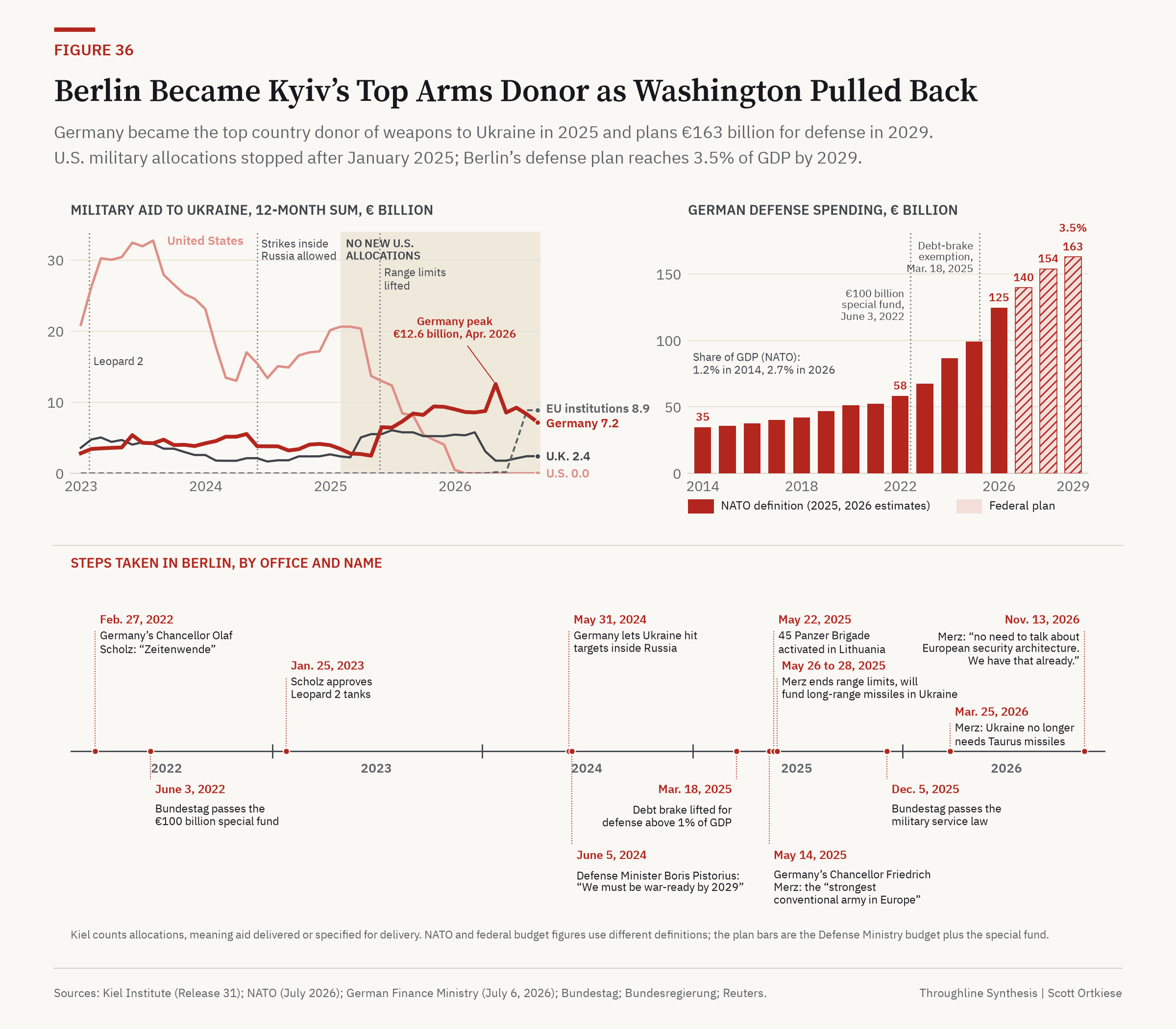
A few Europeans have picked up the phone, and it has changed nothing. Olaf Scholz, then Germany’s chancellor, called Putin on November 15, 2024. Macron called on July 1, 2025. Stubb and Norway’s Prime Minister Jonas Gahr Store called Putin on October 27, 2026, and Stubb has since urged Europe to talk to Moscow directly. Good. But none of them has put NATO expansion on the table, and today, November 19, the “coalition of the willing” is meeting in Berlin to plan a Multinational Force Ukraine, Western troops on Ukrainian soil after a ceasefire. Russia’s Foreign Ministry answered in January that Western troops in Ukraine would be “legitimate combat targets.” Writing those troops into the guarantee is how you make sure there is no ceasefire to guarantee.
The bill lands on Europeans. The European Commission’s own running total of EU and member-state support for Ukraine since February 2022 is €237.6 billion, including €77.9 billion in military aid. In December 2025 the European Council approved a €90 billion loan for 2026 and 2027, funded by EU borrowing. The €237.6 billion already counts €25.8 billion paid out from that loan. On November 18, the Commission proposed up to €45 billion more for 2027. Alongside that sit Readiness 2030, the Commission’s plan to mobilize up to €800 billion for rearmament, and NATO’s pledge at The Hague to spend 5% of GDP on defense and security by 2035. Those 2 rearmament figures overlap and cannot be added together. Either one alone dwarfs everything Europe has sent Ukraine.
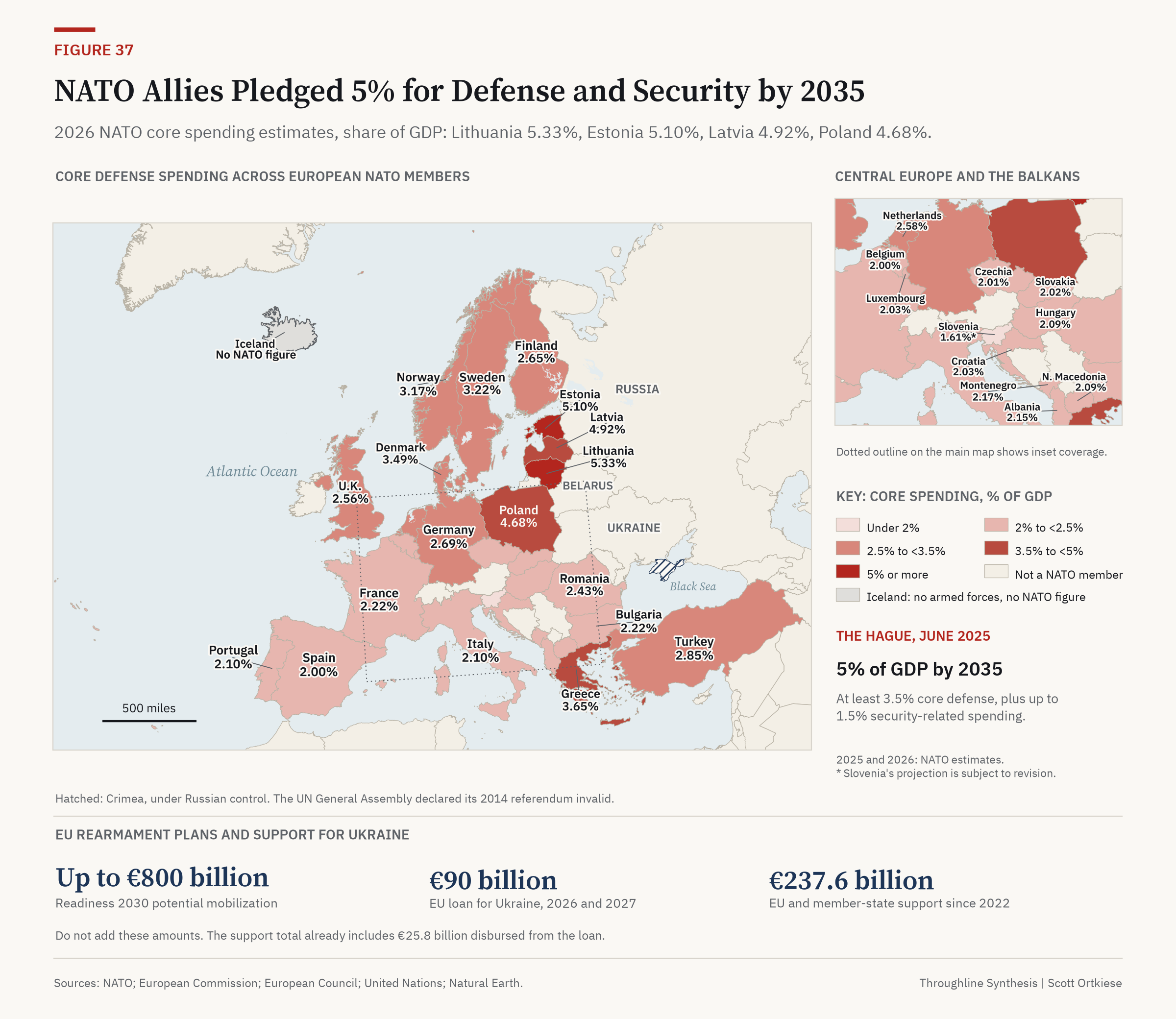
A slice of it flows straight to American arms makers, and Rutte brags about it. Under a NATO program called the Prioritised Ukraine Requirements List, European governments pay for American weapons that are then shipped to Ukraine. Rutte described it on November 17, 2026: “essential U.S. gear at a high pace into Ukraine, which only the U.S. is able to provide, and Europeans paying for it.” Allied pledges through that program and through Foreign Military Sales, the Pentagon’s government-to-government arms sales channel, now exceed $10 billion, Rutte said. Ukraine’s cabinet has approved an arrangement to pay for those packages out of the EU’s loan. Europe borrows, Ukraine owes, American arms makers collect. It is the 1997 bonanza again, with European taxpayers as the customer.
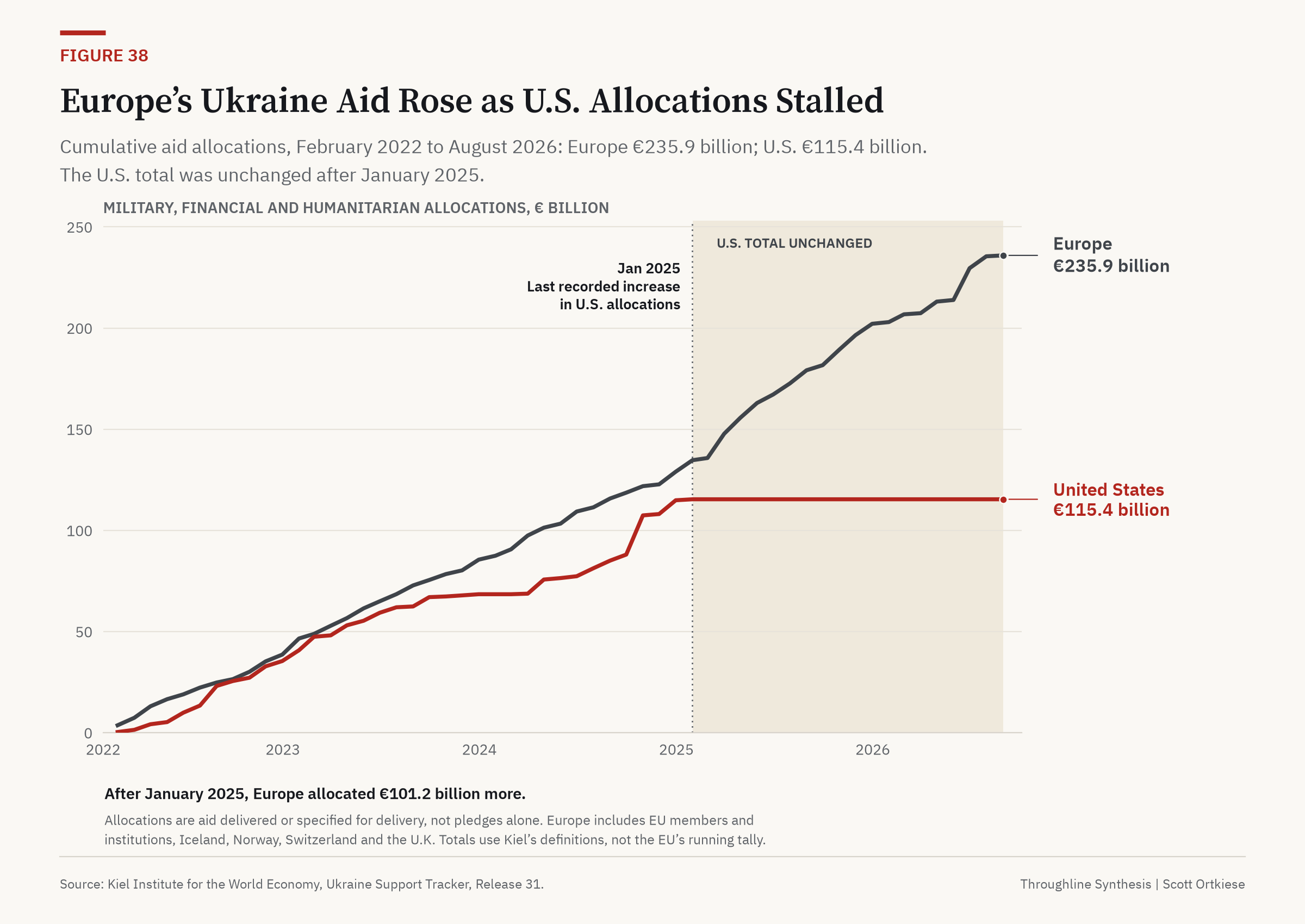
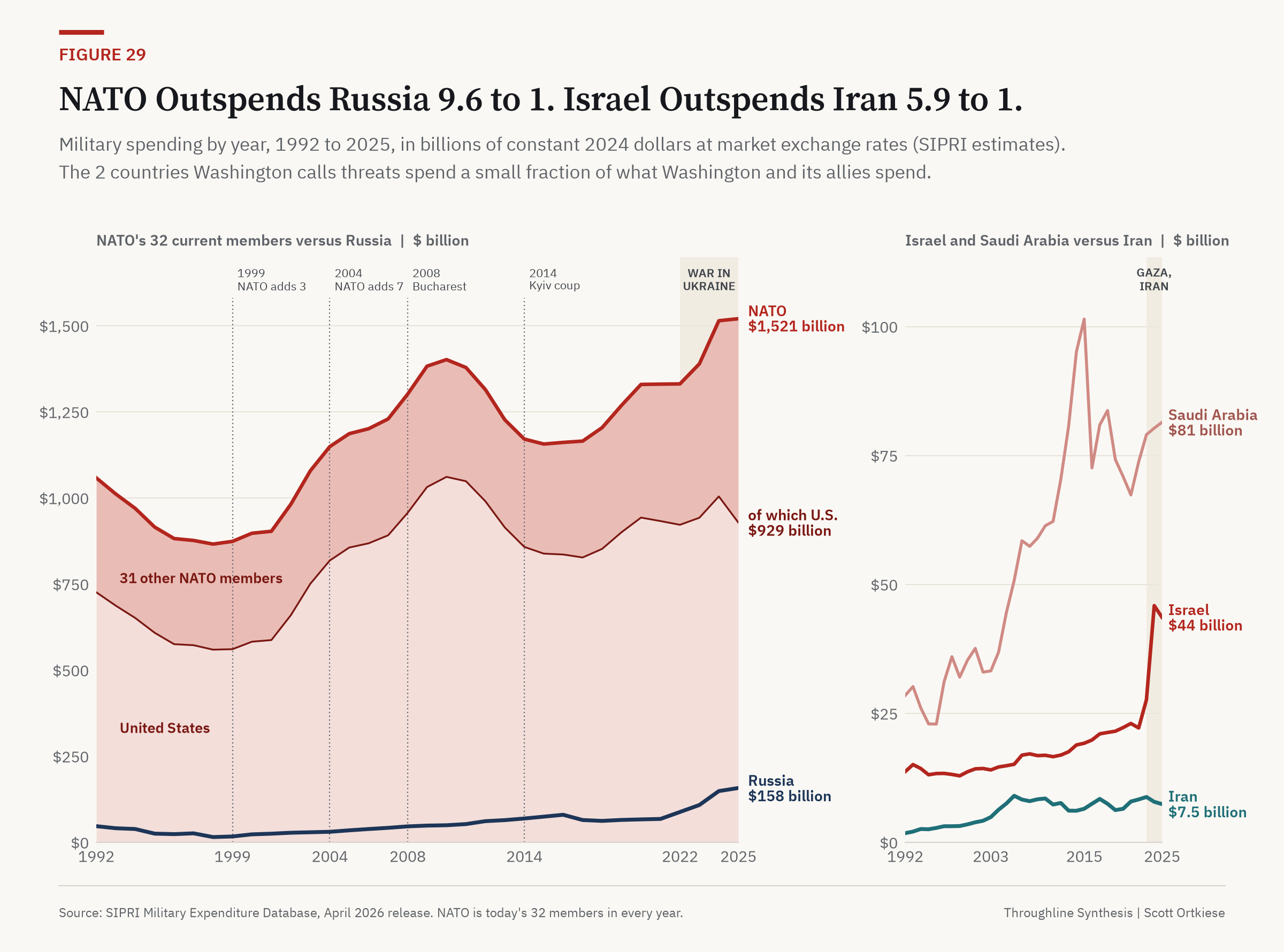
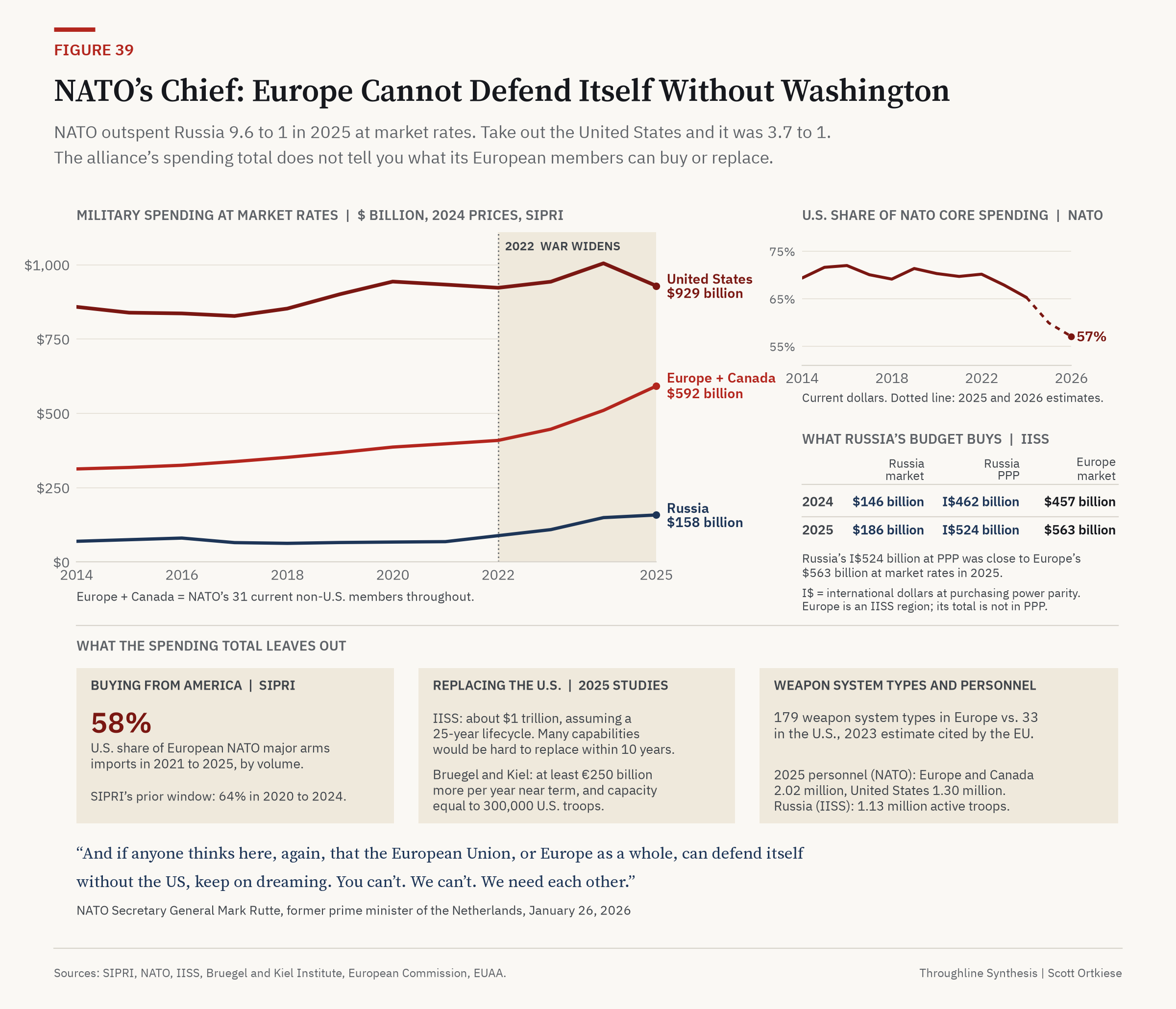
Europe can write the checks. Washington still sells much of what Europe imports. In 2025, NATO outspent Russia 9.6 to 1 at market exchange rates. Take out the United States and it was 3.7 to 1, by SIPRI’s spending data. The United States still supplied 58% of European NATO’s major arms imports by volume in 2021 to 2025, SIPRI found. The International Institute for Strategic Studies put replacing the relevant U.S. conventional capabilities at about $1 trillion over a 25-year equipment lifecycle. Rutte told the European Parliament on January 26, 2026: “We need each other.”
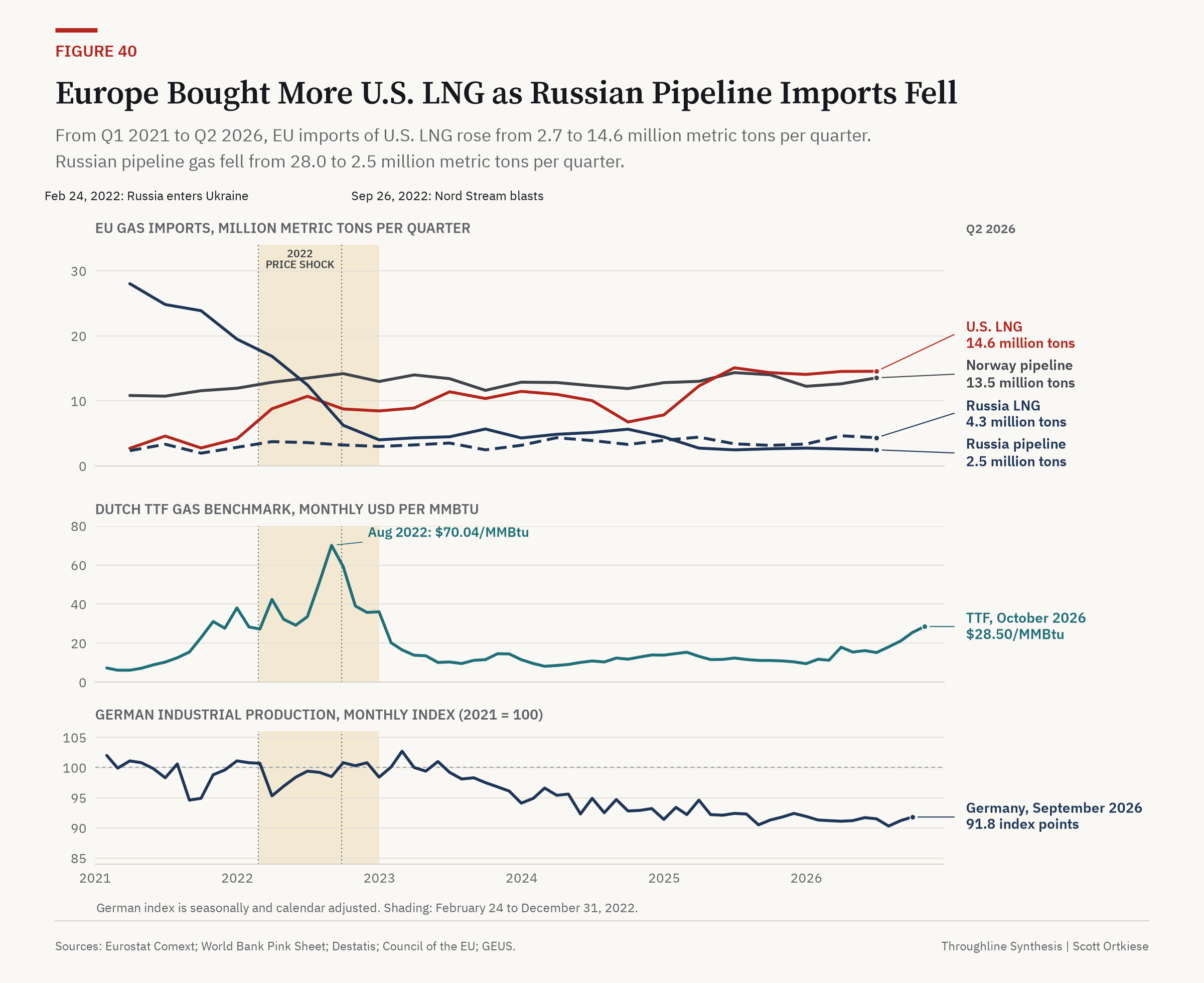
Then there is energy. Europe is phasing out Russian pipeline gas, with long-term contracts allowed to run into 2027, and has leaned on American liquefied natural gas, or LNG, instead. The United States supplied 63.2% of the EU’s LNG imports by value in the second quarter of 2026, Eurostat reports. In the July 2025 trade deal that von der Leyen struck with Trump, the EU accepted a 15% baseline American tariff on most of its exports and stated its intention to buy $750 billion of American energy through 2028. German households paid €0.36 per kilowatt-hour for electricity in the first half of 2026 against an EU average of €0.28. Germany’s economy shrank 1.0% in 2023, stood still in 2024, and grew 0.2% in 2025, and the value added by its factories fell for a 3rd straight year in 2025. Sanctions are not the only cause. They are the cause Berlin chose.
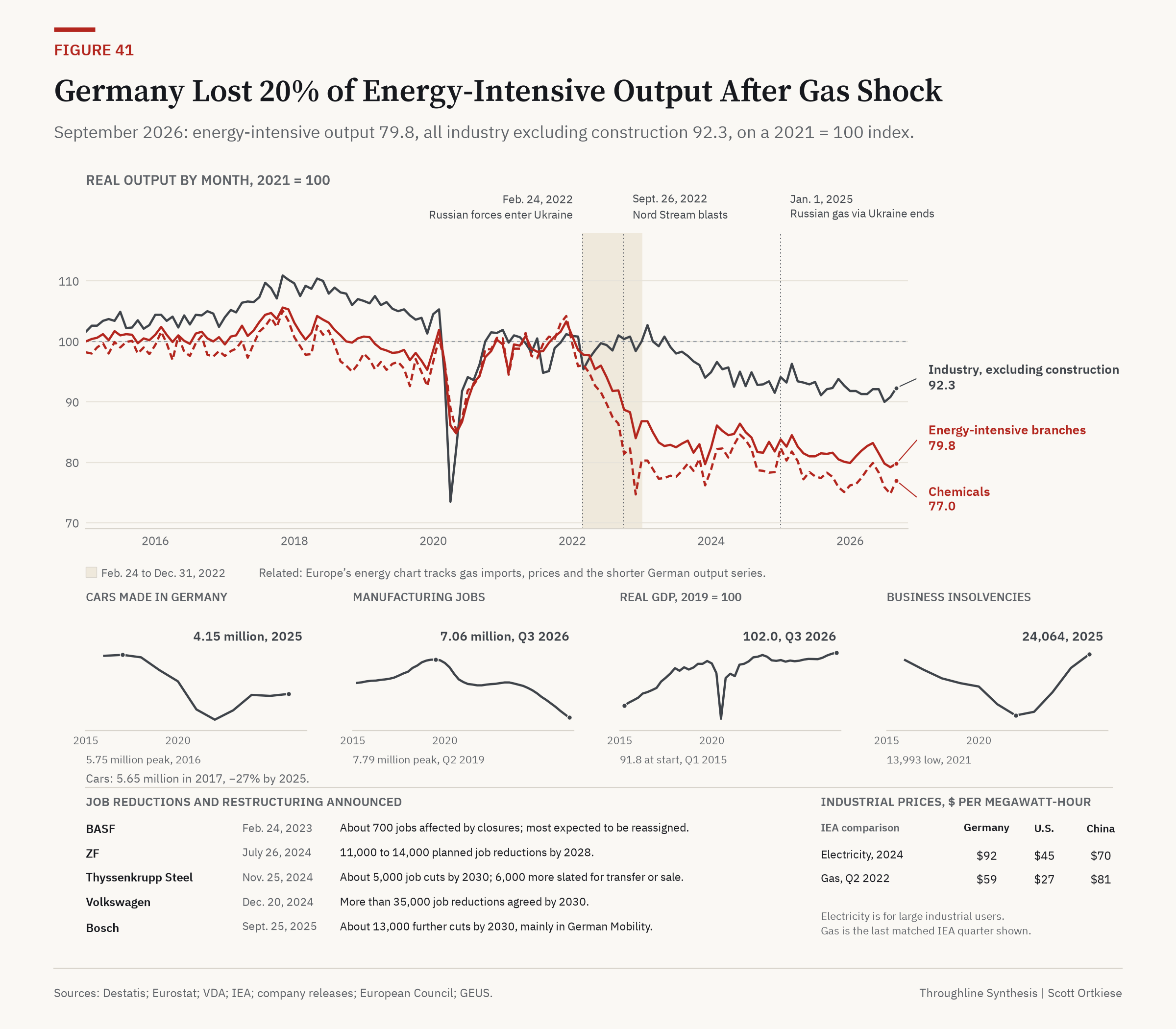
Germany’s factories did not recover when the gas shock passed. On the German statistical office’s 2021 index, industrial output excluding construction was 92.3 in September 2026, energy-intensive branches stood at 79.8, and chemicals at 77.0. The country built 4.15 million cars in 2025, down 27% from 2017. Eurostat counts 7.06 million manufacturing jobs in the third quarter of 2026, even as real GDP stood 2.0% above 2019. Volkswagen and its workers agreed to reduce more than 35,000 positions by 2030. The car decline started before the war. The blow to chemicals and the other energy-intensive branches after 2022 is plain in the numbers.
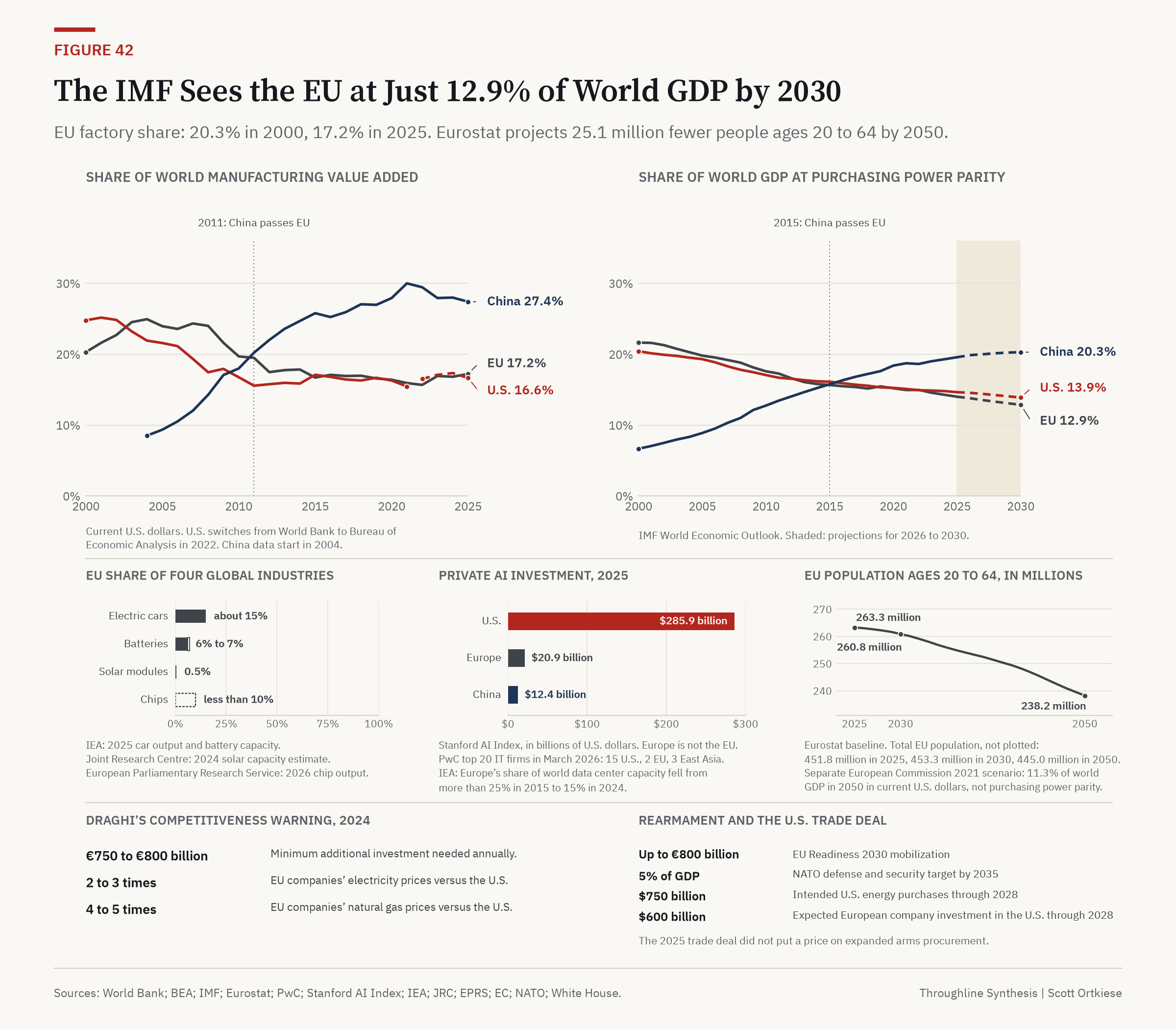
Europe is losing industrial weight without building a replacement on the same scale. The World Bank’s manufacturing series puts the EU at 17.2% of world factory value added in 2025, versus China’s 27.4%. PwC counts just 2 EU companies among the world’s 20 most valuable listed information technology firms. In 2024, the competitiveness report by Mario Draghi, the former president of the European Central Bank, put Europe’s additional investment needs at €750 to €800 billion a year. Brussels can name up to €800 billion in financing capacity for rearmament. That is not an industrial succession plan. Eurostat’s baseline has the EU entering 2050 with about 25 million fewer people ages 20 to 64 than it had in 2025.
Then the pipeline. On July 2, 2026, Germany’s federal prosecutor charged a former Ukrainian army officer with the September 2022 bombing of the Nord Stream gas pipelines, alleging he and other soldiers were “acting by order of Ukrainian state agencies.” It is a charge. His trial opened in Hamburg on October 14. He denies wrongdoing and Kyiv denies involvement. But sit with what the German state is alleging: that the government Germany funds and arms blew up Germany’s own energy supply. When a Polish court refused to extradite a second suspect, Tusk’s response was: “And rightly so. The case is closed.” Berlin kept paying.
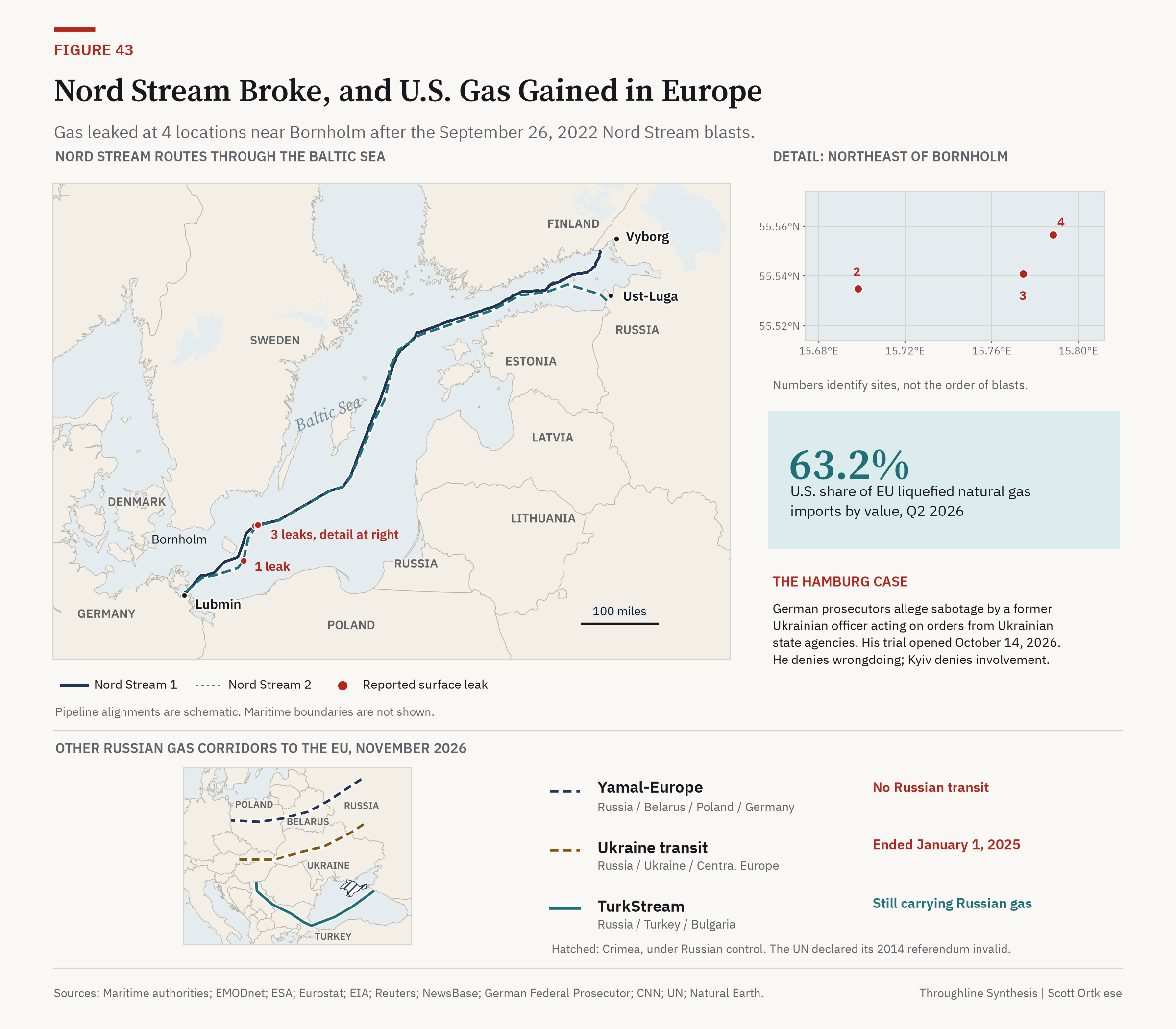
The people who question any of this get silenced. The EU took the Russian state broadcasters RT and Sputnik off the air across the union on March 2, 2022. On December 15, 2025, it put Jacques Baud, a retired Swiss army colonel and strategic analyst, on its sanctions list, alleging that he “acts as a mouthpiece for pro-Russian propaganda.” His assets are frozen for his analysis. No court convicted him of anything, and he has challenged the listing before the EU’s General Court. This is the narrative control Diesen described at the start of the interview, written into law. The woman at the top answers to no one. On May 14, 2025 the EU’s General Court annulled her Commission’s refusal to release her text messages with Pfizer’s chief executive from the vaccine negotiations, ruling that the Commission “has not given a plausible explanation to justify the non-possession of the requested documents.” Her Commission survived 4 censure motions in the European Parliament in just over 6 months, and she is still in office. I profiled her and Rutte in Adm. Brad Cooper, von der Leyen, Rutte.
Bamboozlers is the polite word. These people took cheap pipeline gas, a major market on their doorstep, and the promise of a durable post-Cold War peace, and traded all 3 for a proxy war they are losing, a tariff they accepted, and a gas bill payable to Texas.
Tehran: The Same Play, Run by Many of the Same People
Kinzer makes the connection himself. After explaining that Washington refused to talk to Moscow because “we want to teach Russia a lesson,” he says: “I think we’re seeing something like that in the Middle East now. We want to crack our whip and show that we can get what we want.”
Kinzer knows this ground better than any American journalist alive. His book “All the Shah’s Men” is the standard account of how the CIA and British intelligence overthrew Mohammad Mossadegh, the prime minister chosen by Iran’s elected parliament, in 1953. The CIA’s own internal history, declassified in 2013, states that the coup “was carried out under CIA direction as an act of US foreign policy.” That was the first poison in this wine. More followed:
- 1980s. Washington gave Saddam Hussein’s Iraq the locations of Iranian troops, “fully aware that Hussein’s military would attack with chemical weapons, including sarin,” Foreign Policy reported from declassified CIA files.
- July 3, 1988. The USS Vincennes shot down Iran Air Flight 655, a civilian airliner, killing all 290 people aboard. Washington later agreed to compensate the victims’ families and never admitted liability.
- May 8, 2018. Trump pulled the United States out of the 2015 nuclear agreement while international inspectors and his own State Department said Iran was complying.
- January 3, 2020. Trump ordered the strike that killed General Qassem Soleimani, commander of Iran’s Quds Force, at Baghdad airport. Agnes Callamard, then the UN’s special rapporteur on extrajudicial killings, found it unlawful.
I laid out that history in The Enemy We Made. Now look at what the same governments did next, and compare it to Ukraine step by step.
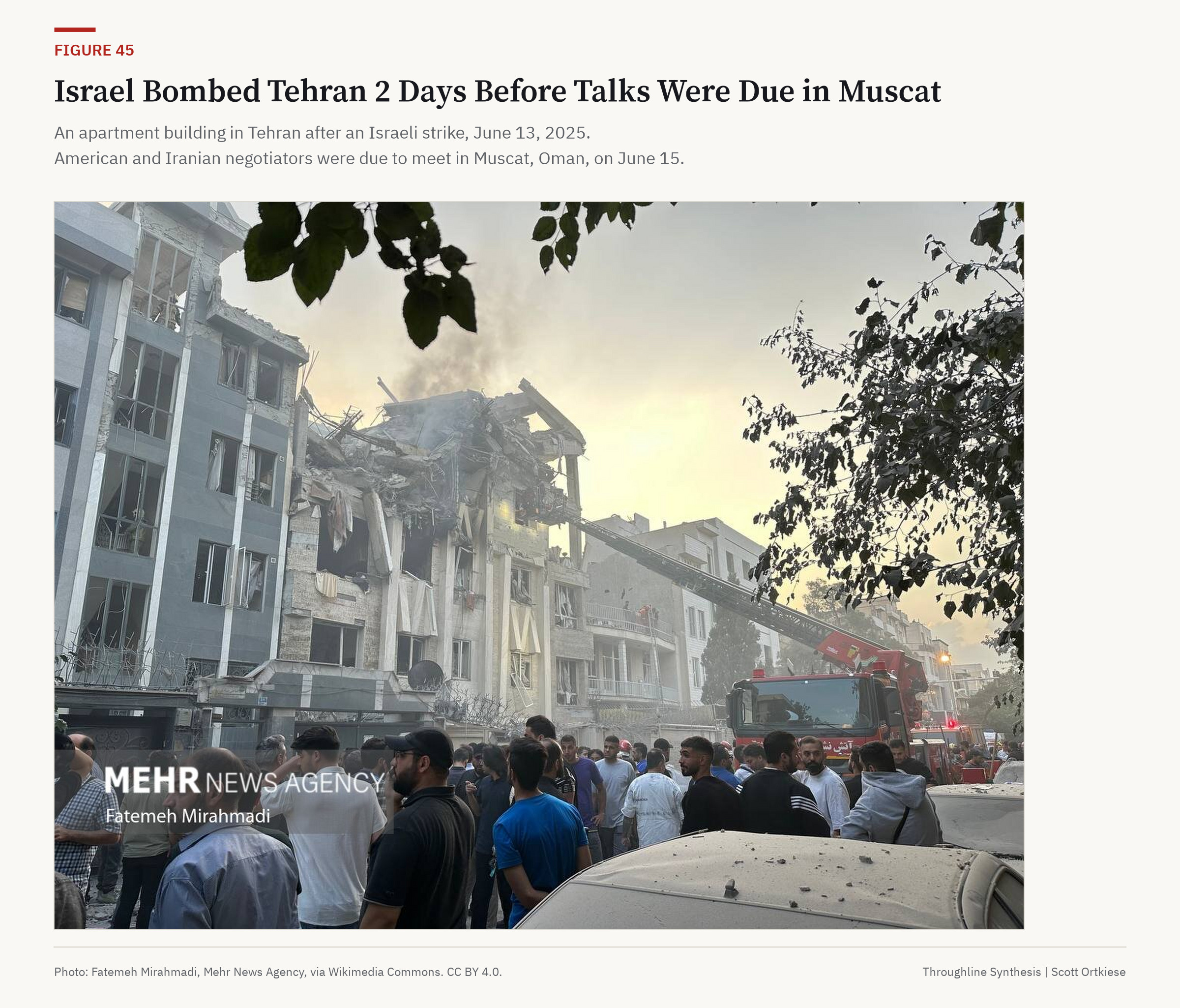
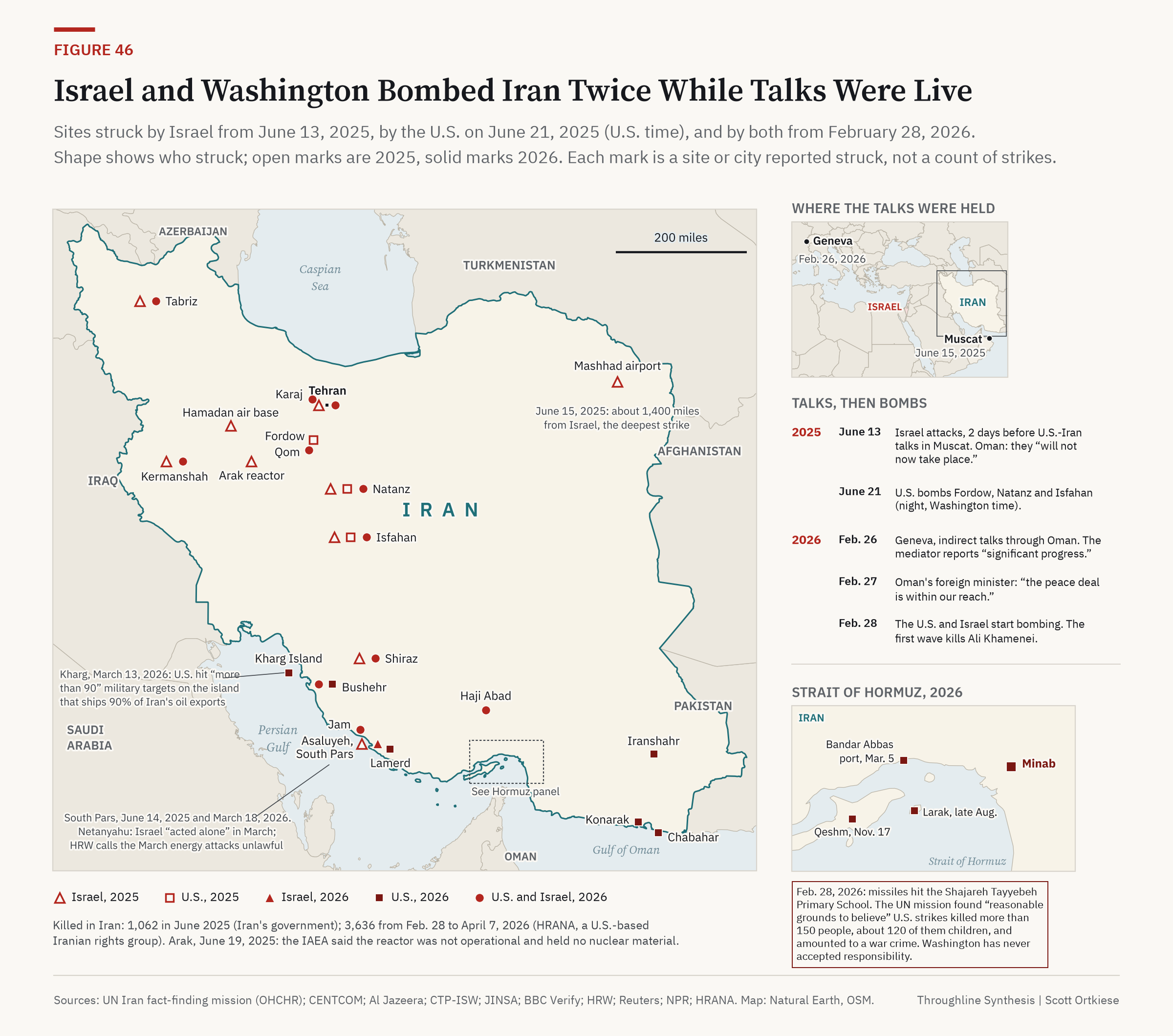
They attacked in the middle of negotiations. Twice. In June 2025, American and Iranian negotiators were due to meet in Muscat, Oman, on June 15 for a sixth round of nuclear talks. Israel attacked Iran on June 13. Oman’s foreign minister, Badr Albusaidi, announced that the talks “will not now take place.” Benjamin Netanyahu, Israel’s prime minister, said Israel had been planning the attack since 2024. On the night of June 21, Washington time, American forces struck Fordow, Natanz, and Isfahan. Then they did it again. On February 26, 2026, Trump’s envoys Steve Witkoff and Jared Kushner, Trump’s son-in-law, held indirect talks in Geneva with Iran’s foreign minister, Abbas Araghchi, with Oman carrying the messages. The Omani mediator reported “significant progress,” with technical talks set for Vienna the next week. On February 27, Albusaidi told CBS: “I can see that the peace deal is within our reach,” built on “zero accumulation, zero stockpiling, and full verification.” On February 28, the United States and Israel started bombing. Antonio Guterres, the UN secretary-general, told the Security Council that day: “I deeply regret that this opportunity of diplomacy has been squandered.”
Merkel and Hollande later admitted that Minsk bought Ukraine time, and Poroshenko said it bought 8 years to build an army. The Geneva talks bought 2 days. No document shows that Witkoff and Kushner knew what was coming. It does not matter. The other side was at the table when the bombs fell, and that is how diplomacy becomes cover for war.
They lied in 1 word. For Ukraine the word was “unprovoked.” For Iran it was “imminent.” Tulsi Gabbard, Trump’s own director of national intelligence, testified to the Senate on March 25, 2025 that the intelligence community “continues to assess that Iran is not building a nuclear weapon.” Asked about that in June, Trump said: “I don’t care what she said.” Rafael Grossi, director general of the International Atomic Energy Agency, said his inspectors “did not have any proof of a systematic effort to move into a nuclear weapon.” Iran did hold 408.6 kilograms of uranium enriched to 60% as of May 17, 2025, far above the 3.67% cap in the 2015 agreement, and the agency’s board found Iran in non-compliance with its inspection obligations on June 12, 2025. Those are facts, and they are the business of inspectors and negotiators. They are not an armed attack on anyone. Then Trump destroyed his own case. After the June 2025 strikes he announced that Iran’s enrichment sites were “completely and totally obliterated.” On February 28, 2026, he said again that “we obliterated the regime’s nuclear program,” and in the same speech claimed “imminent threats from the Iranian regime” and a renewed drive for the bomb. Obliterated in June, imminent in February. Pick one.
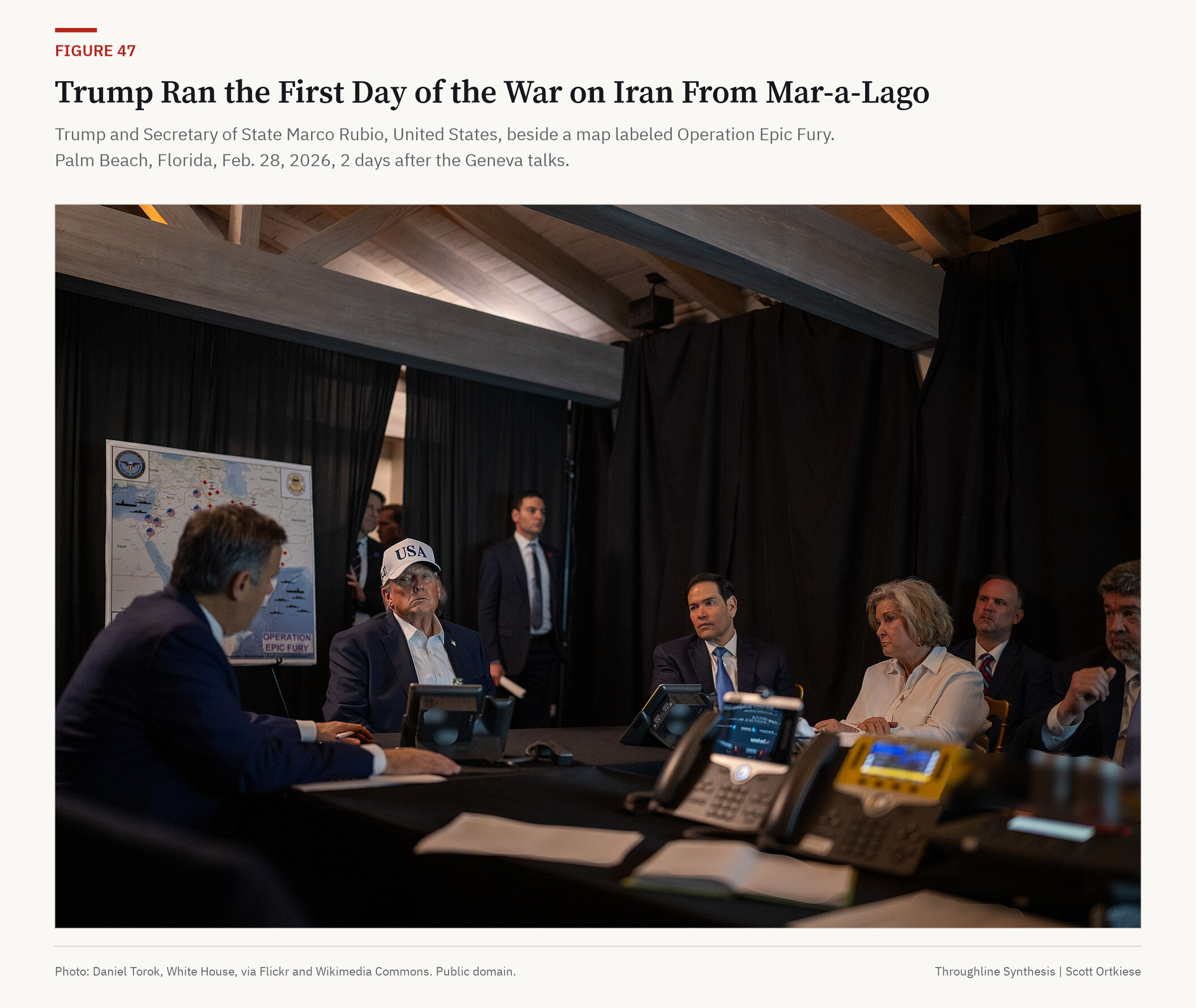
The real goal was never the stated one. In Ukraine the stated goal was Ukrainian freedom and the real goal was a weaker Russia. In Iran the stated goal was nonproliferation. Trump told Iranians on the first night: “When we are finished, take over your government. It will be yours to take.” The first wave killed Ali Khamenei, Iran’s supreme leader. On April 7, Trump posted that “a whole civilization will die tonight, never to be brought back again.” That is what cracking the whip sounds like.
It was illegal. Russia at least pointed to NATO’s advance toward its border, and NATO’s own secretary general later confirmed that stopping that advance is why Putin went to war. Iran and Israel had traded strikes in April and October 2024. But Washington has never shown an Iranian armed attack, or an imminent one, that justified what it launched in February 2026. After the first round in June 2025, the International Commission of Jurists called the American strikes “an unlawful use of force, which the UN Charter prohibits,” and UN human rights experts called Israel’s attack “a blatant act of aggression.” For the 2026 war, Washington sent the Security Council a self-defense letter on March 10. On April 21, the State Department’s legal adviser added that the United States had acted “at the request of and in the collective self-defense of its Israeli ally,” as well as in its own defense. The New York City Bar Association, which traced that chronology, found nothing in the public record to substantiate the request. Congress never authorized the war. Trump’s March 2, 2026 notice to Congress cited his own powers as commander in chief and chief executive. Senator Adam Schiff, Democrat of California, said on the Senate floor: “There was no attack on the United States by Iran, nor was there any imminent threat. This was a war of choice.” The war the West calls unprovoked was provoked for 75 years. The war the West launched itself is the unprovoked one.
Then the school. On the morning of February 28, 2026, missiles hit the Shajareh Tayyebeh Primary School in Minab, in southern Iran. On September 17, the UN’s independent fact-finding mission reported “reasonable grounds to believe” that American strikes on the “clearly identifiable” school killed more than 150 people, about 120 of them children, and amounted to a war crime. Washington has never accepted responsibility. Trump said: “We think it was done by Iran.” Reuters reported that an initial American military assessment pointed to American responsibility. Reuters also found that the school had a public website and years of online presence. The same UN mission documented grave crimes by Iran’s own government against its people. Neither fact cancels the other. I wrote about Minab in The War Pigs Used Ukraine as Their Proxy.
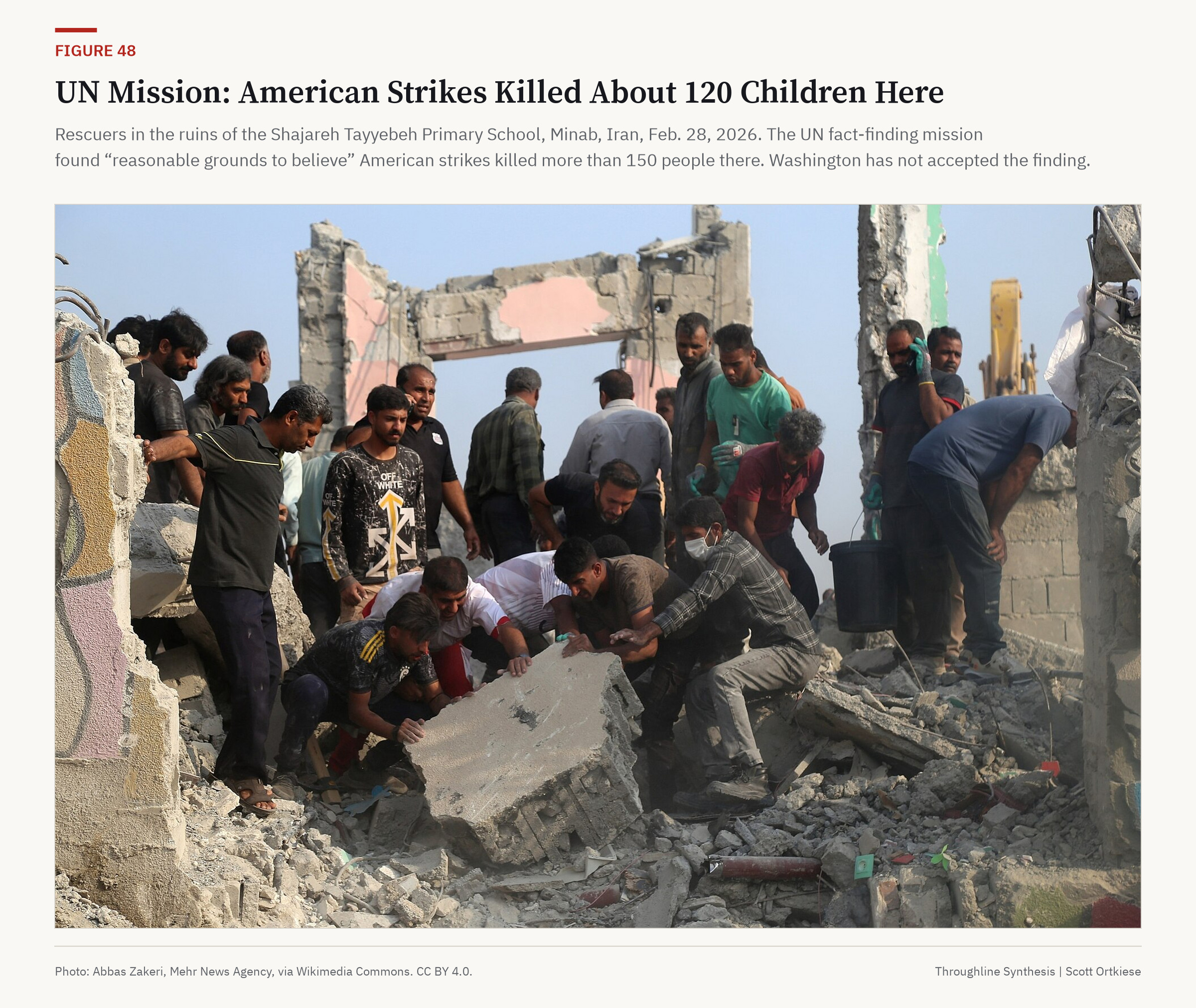
They broke the peace deal too. After a ceasefire in April, Trump and Iran’s President Masoud Pezeshkian signed the 14-point Islamabad memorandum, dated June 17, 2026. Paragraph 10 committed Washington to issue waivers for Iranian oil exports “until the termination of sanctions.” The Treasury issued a license that ran only to August 21, then revoked it on July 7, 20 days after the date on the memorandum. Iran was not innocent in that collapse. Its Revolutionary Guards had resumed firing on ships in late June and hit 3 vessels on July 6 and 7. Washington called the deal performance-based. But paragraph 10 does not make the oil waivers conditional on any of that, and when Trump was asked on July 8 whether his own agreement was dead, his answer was “it’s over.” Ask the Russians about Minsk. Then ask why anyone signs anything with these governments.
Europe’s response is the proof of everything Kinzer says about the word “unprovoked.” On March 2, 2022, the Council of the EU called Russia’s invasion “unprovoked and unjustified military aggression.” Here is the same Europe on Iran:
- June 17, 2025. Merz told ZDF, the German public broadcaster, that Israel was doing the “Drecksarbeit,” the dirty work, “for all of us.”
- June 22, 2025. After American bombs fell, Macron, Merz, and Starmer issued a statement: “We urge Iran not to take any further action that could destabilize the region.” Iran, the country that had just been bombed.
- August 28, 2025. The same 3 governments triggered the “snapback” of UN sanctions on Iran, 2 months after its nuclear sites were bombed.
- February 28, 2026. The 3 leaders said “we did not participate in these strikes” and then condemned Iran’s retaliation. They did not condemn the attack that caused it.
- March 1, 2026. Starmer authorized American use of British bases for what he called a “specific and limited defensive purpose.”
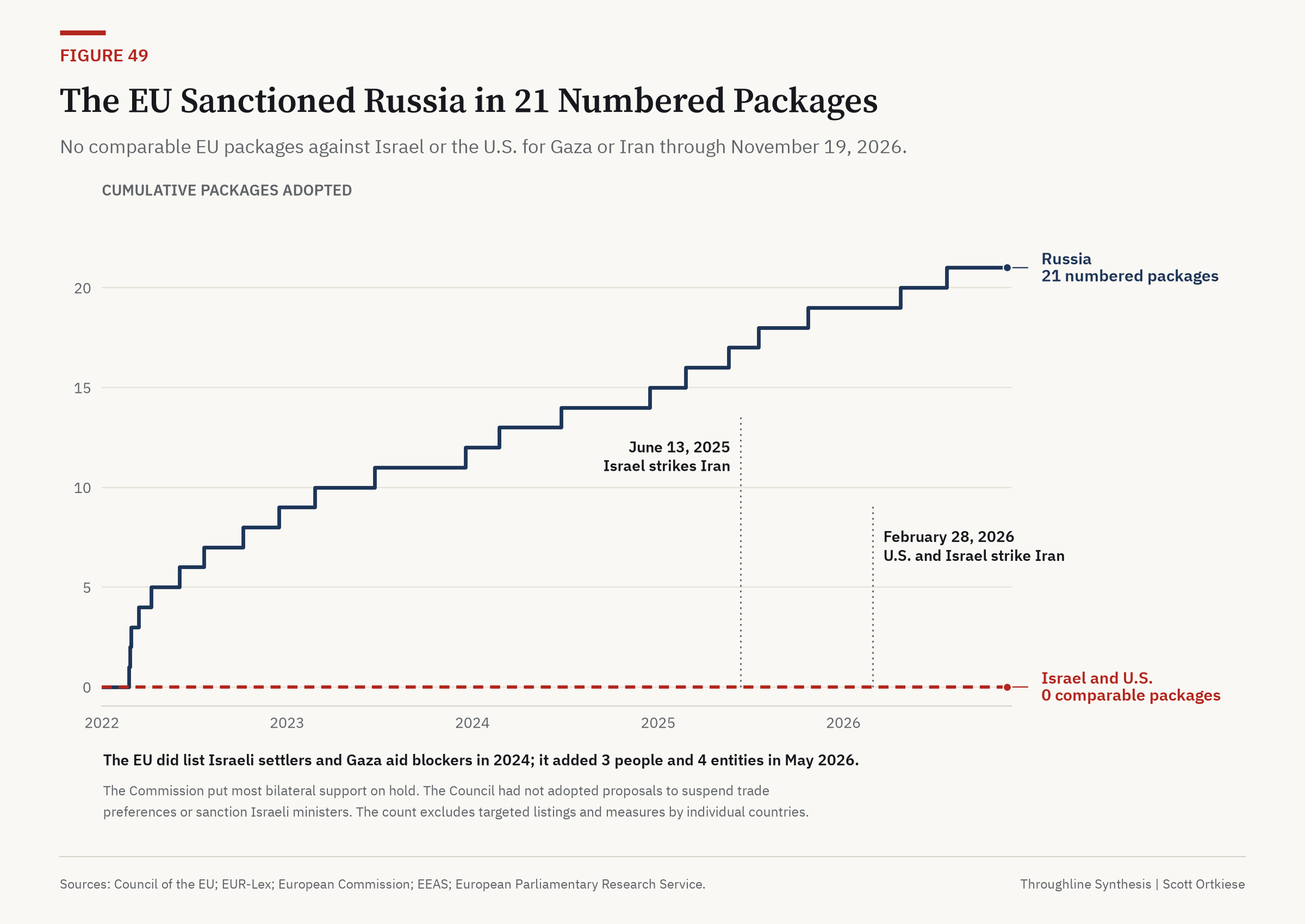
2 European leaders said it plainly, and they deserve the credit. Pedro Sanchez, Spain’s Socialist prime minister, condemned the attack the day it began. Macron said on March 3 that the American and Israeli operations “were conducted outside the framework of international law, and we cannot approve that.” He did not sanction anyone, freeze anyone’s assets, or ship anyone a tank. Russia got 21 numbered sanctions packages. For bombing Iran, Washington and Tel Aviv got a sentence. Andy Burnham, Britain’s Labour prime minister since July, said on November 16, 2026 that “Britain’s response to the war in Ukraine should set the standard to apply across the board.” I agree. Apply it.
Like Ukraine, it failed. The Congressional Budget Office put the Pentagon’s cost at about $38 billion through August 1, and Reuters reported an internal Pentagon estimate above $47 billion by late October. Analysts at the Center for Strategic and International Studies estimated in July that the American stock of Patriot interceptors had fallen to between 759 and 827, down about 65% from 2,330 before the war, and would take at least 3 years to rebuild. Those are the same Patriots Kyiv has been begging for. Brent crude, the world oil benchmark, went from $71 a barrel on February 27 to a peak of $138 on April 7 and was still at $93 on November 17, by the U.S. Energy Information Administration’s daily spot price, and GasBuddy, the fuel price tracker, put average American gasoline at $4.06 a gallon on November 6. Iran’s government is still standing. The UN reported on November 13 that traffic through the Strait of Hormuz was about 65% below prewar levels. Iran attacked American facilities in Bahrain on November 13, 15, and 17, including a radar installation on the 17th, and targeted Ali Al Salem Air Base in Kuwait yesterday. Kuwait says it shot the drones down.
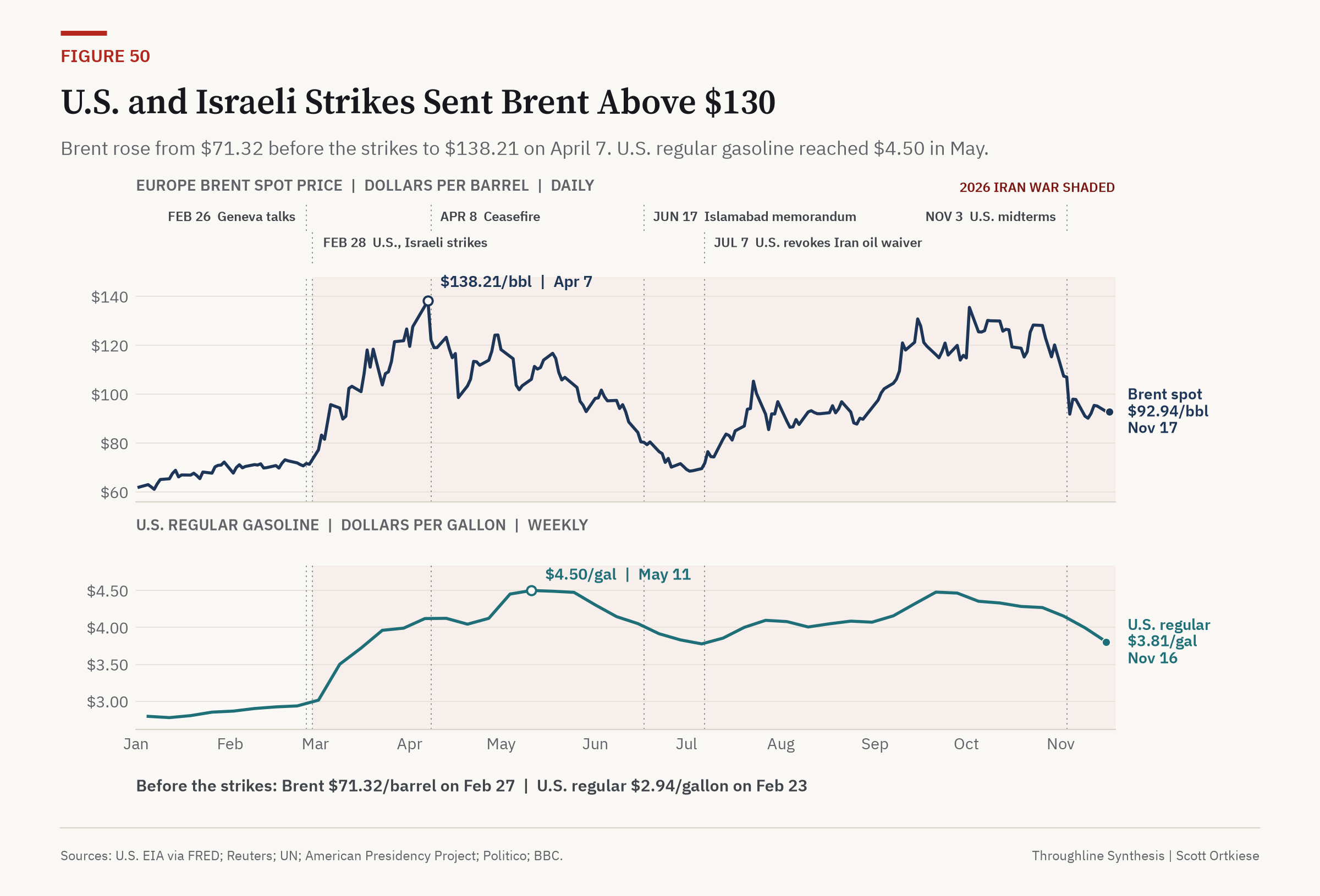
Kinzer saw it coming. “As we learned from the Iraq invasion, countries do gain in strategic power when they show what they can accomplish in the world. But the opposite is also true. If you set out to accomplish a big goal and you fail, you lose strategic power. And the loss of American strategic power began with our failures in Iraq. I think it’s happening again in Ukraine.” It is happening in the Persian Gulf at the same time. My fuller account is in American Empire in Ruins.
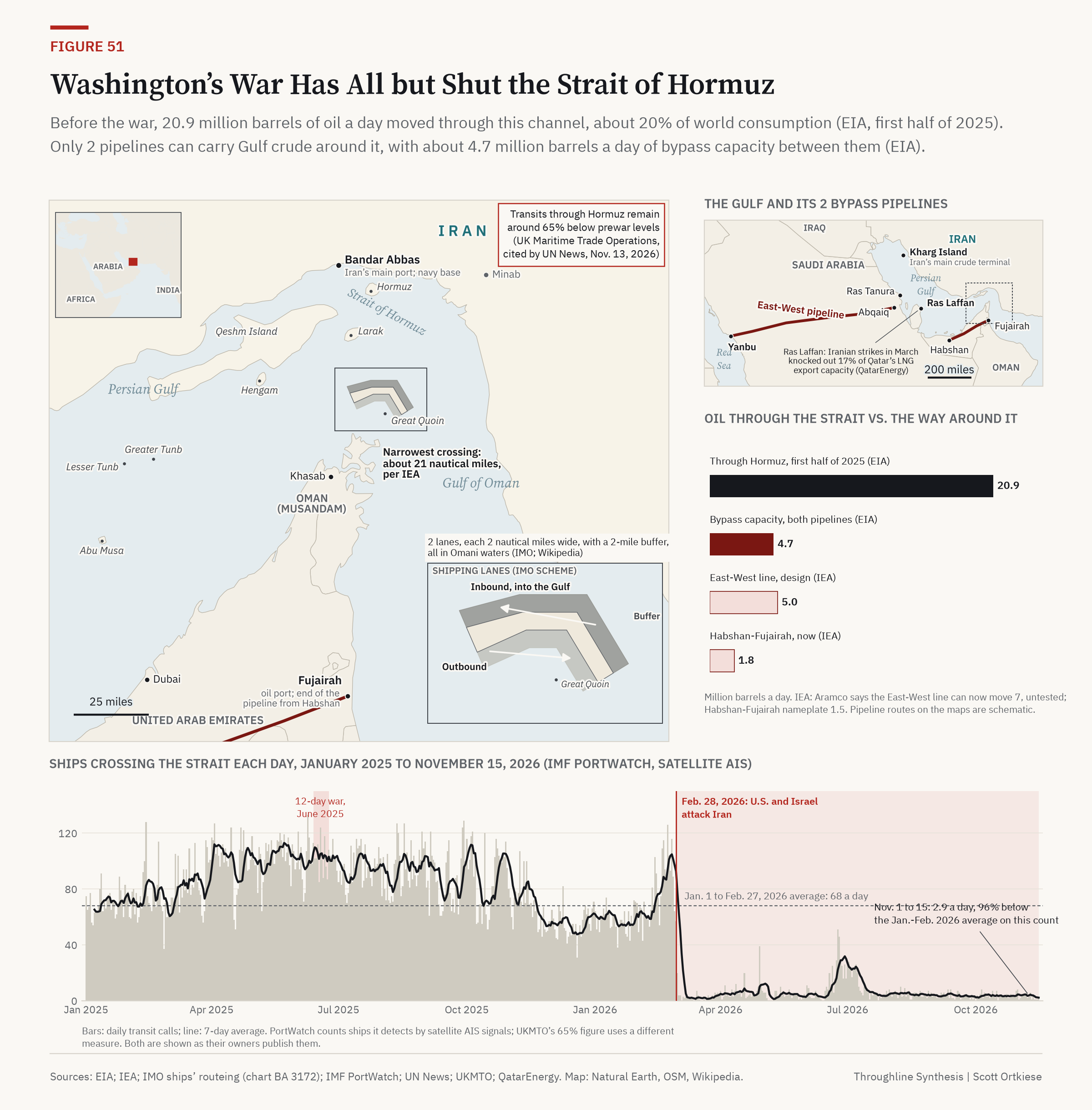
The Accomplices: A Genocidal Israeli Government and the Gulf Monarchies That Rented Out Their Soil
Every proxy war needs local partners. In Ukraine, Washington found its first ones among nationalists who had collaborated with Nazi Germany and its latest ones on the Maidan. In the Middle East it has 1 partner that leads it by the nose and 6 that it leads.
Israel’s government is still led by a man wanted for crimes against humanity. The International Criminal Court issued arrest warrants on November 21, 2024 for Netanyahu and his former defense minister, Yoav Gallant, for the war crime of starvation as a method of warfare and for crimes against humanity. Netanyahu remains caretaker prime minister after Israel’s October 27, 2026 election while the opposition tries to form a government. The UN’s Independent International Commission of Inquiry concluded on September 16, 2025: “Israel is responsible for the commission of genocide in Gaza.” Amnesty International and Israel’s own human rights organization B’Tselem, in a report titled “Our Genocide,” reached the same finding. Human Rights Watch found “extermination and acts of genocide” in Israel’s deliberate cutoff of water. Famine was confirmed in Gaza Governorate on August 22, 2025. Gaza’s Health Ministry counts 74,710 Palestinians killed as of November 18, 2026. The International Court of Justice has ordered Israel to take emergency measures in the genocide case before it and has not yet ruled on the merits. The UN commission and the human rights organizations did not wait.
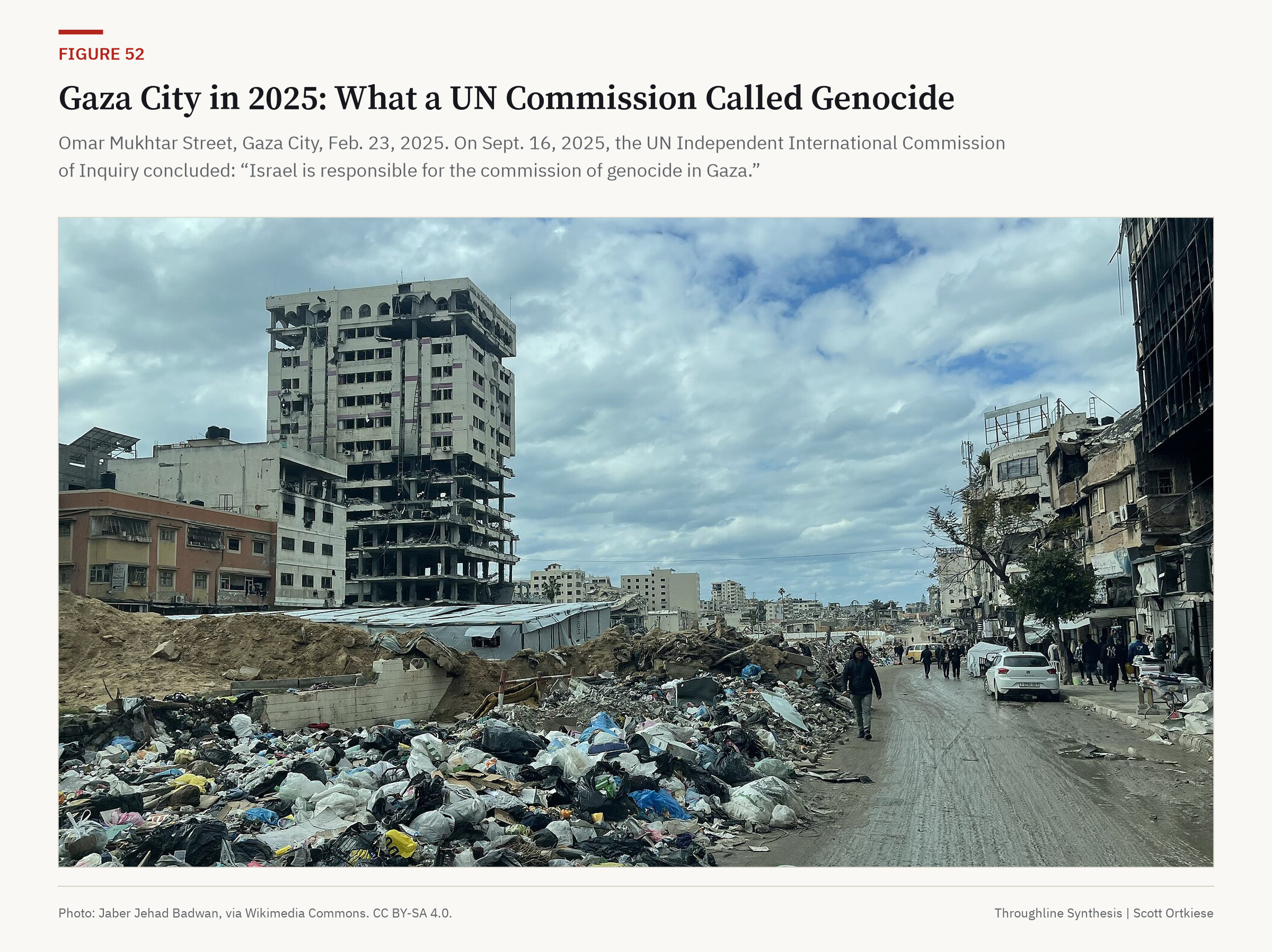
That is the murderous part. Here is the incompetent part. On October 7, 2023, one of the most heavily surveilled borders on earth was overrun. A panel of experts appointed by Israel’s own army chief found that the surprise “did not emerge from an absence of information” and that the warnings were there to be read. Netanyahu received 4 warning letters from military intelligence between March and July 2023 telling him that Israel’s enemies saw it as weakened. Whether he should answer for that day was still the central question of last month’s election. 3 years later his government has destroyed Gaza without eliminating Hamas, gone back to war in Lebanon, where more than 1 million people have been driven from their homes since March 2, 2026, and helped start a war on Iran that needed American bombers and is still not finished.
This government bombs negotiators. On September 9, 2025, Israel struck Hamas’s negotiating team in Doha, the capital of Qatar, while the team was considering an American ceasefire proposal. Hamas said 5 of its members were killed, and Qatar lost a security officer. Qatar hosts Al Udeid, the largest American air base in the Middle East. Netanyahu’s office said: “Israel initiated it, Israel conducted it, and Israel takes full responsibility.” Trump called it an unfortunate incident that did not advance peace. Less than 6 months later he joined Netanyahu’s next war.
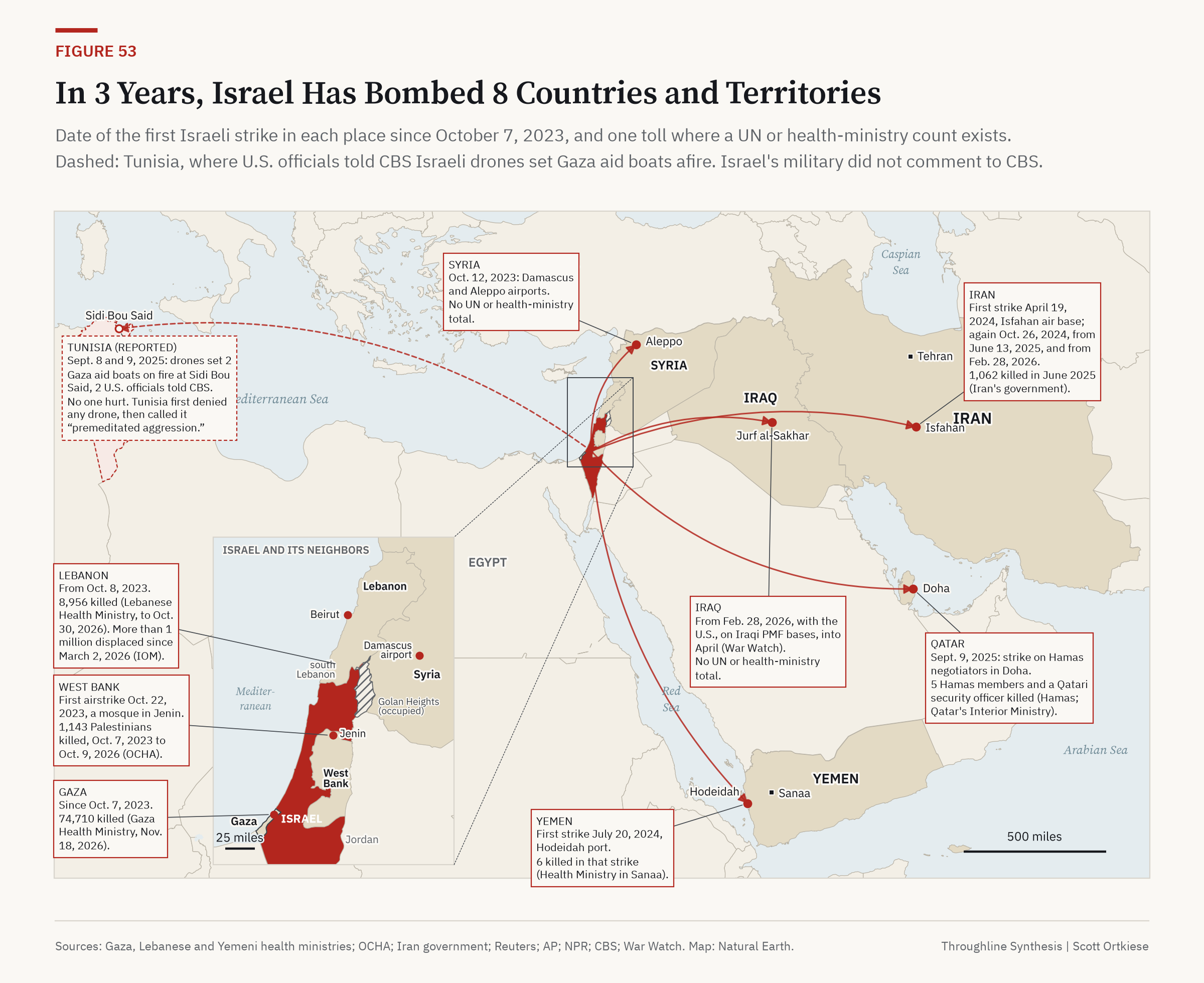
Who leads whom? On March 2, 2026, Rubio, the secretary of state, explained the timing this way, according to a legal analysis published by the Carnegie Endowment: Washington expected Israel to attack, and expected Iran to hit American forces in reply, whether or not the United States joined in. He later walked that explanation back. Read it again anyway. The superpower went to war because its client had already decided to. In Ukraine the patron drives the proxy. Here the proxy drives the patron, and American soldiers and Iranian schoolchildren pay for it.
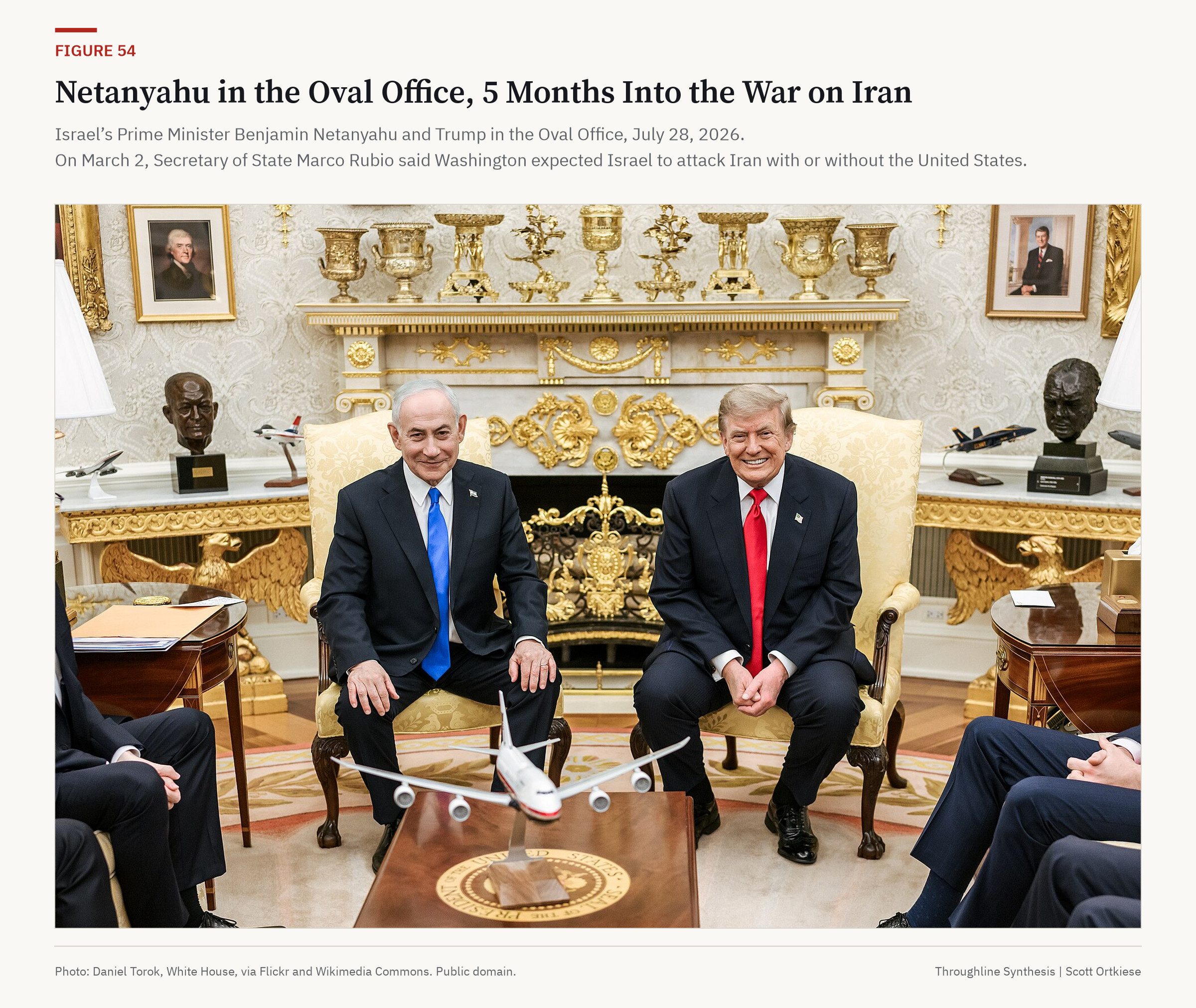
Then come the “allies in the region.” I use the quotation marks on purpose. The United States keeps major military bases in Kuwait, Qatar, Bahrain, the United Arab Emirates, Saudi Arabia, and Jordan. Here is the accurate account of what those governments did, because the accurate account is worse than the cartoon.
They did not want this war, and they said so. The Congressional Research Service reports that the Gulf monarchies reportedly urged Washington in January 2026 not to use force against Iran and that, by press accounts, some of them closed their airspace to offensive operations. Then the war was run through their territory anyway. Al Udeid Air Base in Qatar houses the American command center that directed the air campaign. MEED, a Gulf business publication, estimates that Gulf bases hosted about 33% of the entire American aerial refueling fleet at the peak, the tankers that kept B-1 and B-2 bombers in the air. The same CRS report says that Saudi Arabia and the UAE “reportedly have conducted strikes on Iran” and that the UAE reportedly let Israeli soldiers run an Iron Dome battery on its soil. The Wall Street Journal, citing people familiar with the operations, reported in July that Bahrain and Kuwait secretly struck Iranian military targets. Kuwait’s ambassador in Washington called the report false. In June 2025, Jordan shot down Iranian drones crossing its airspace while its government condemned Israel’s attack.
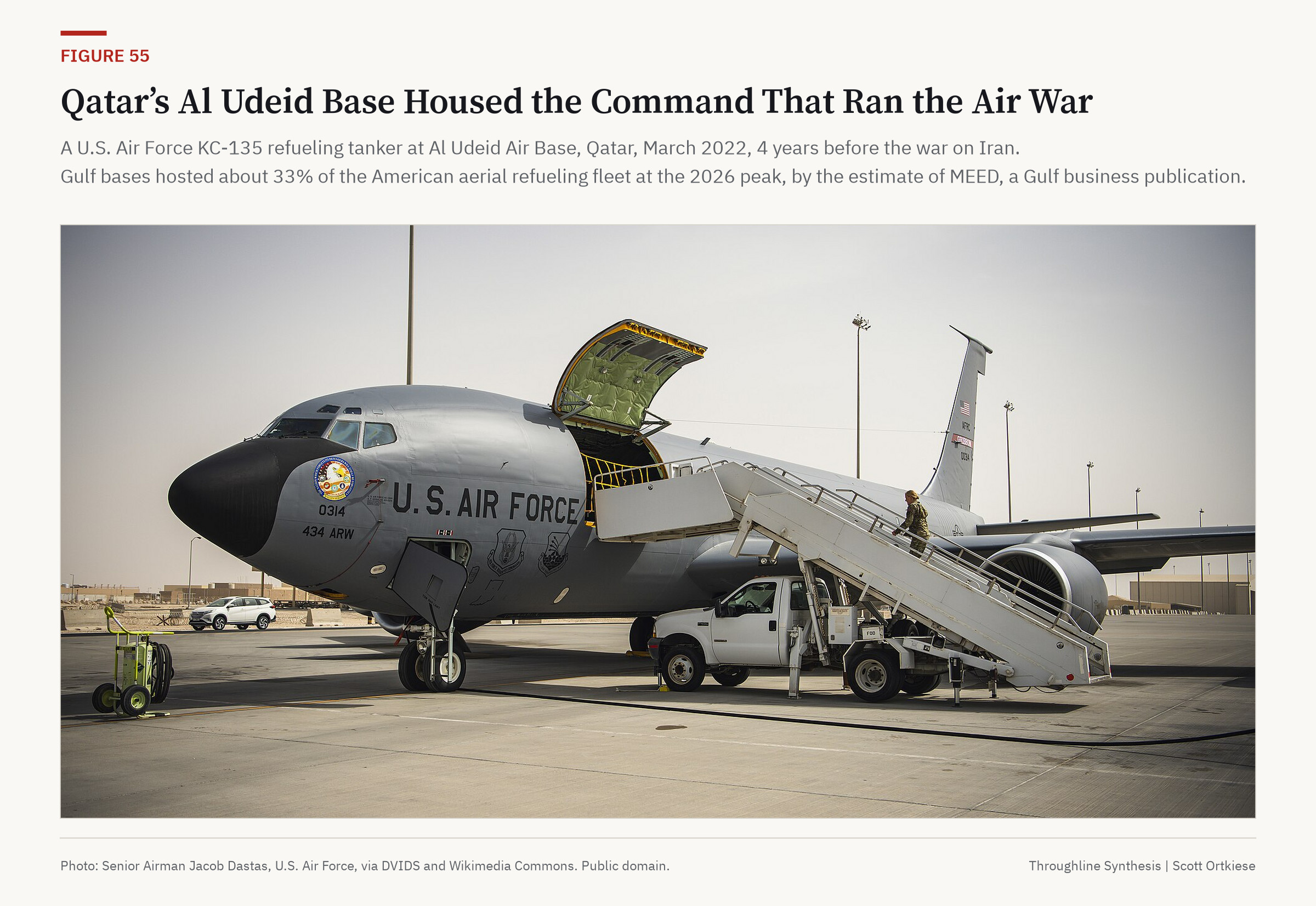
That is what a client state is. A government that says no in public and is used anyway is not an ally. It is a platform. Zelensky cannot stop the war Washington started through his country, and the Gulf rulers could not stop the war Washington ran through the bases they host.
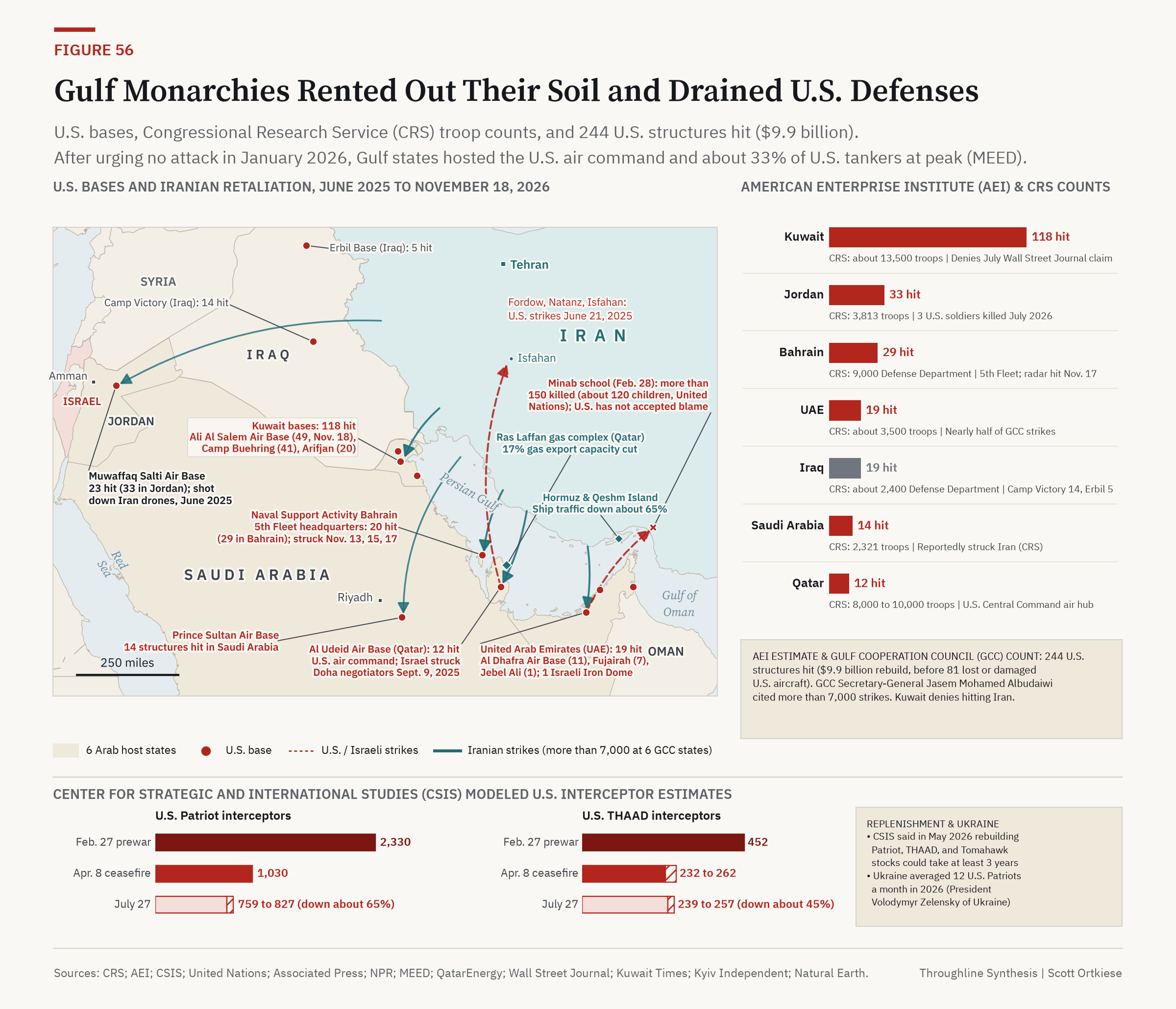
They paid for the privilege in advance. In May 2025, Trump toured the Gulf and came home with a $600 billion Saudi investment pledge, which the White House inflated to “almost $1 trillion” that November, along with what it called “the largest defense sales agreement in history,” nearly $142 billion. Qatar signed an agreement that the White House said would generate at least $1.2 trillion in “economic exchange,” though the same fact sheet could itemize only a little more than $243.5 billion in actual deals. The UAE confirmed a $1.4 trillion 10-year framework. Those headline numbers are padded. The protection they were supposed to buy turned out to be worth nothing.
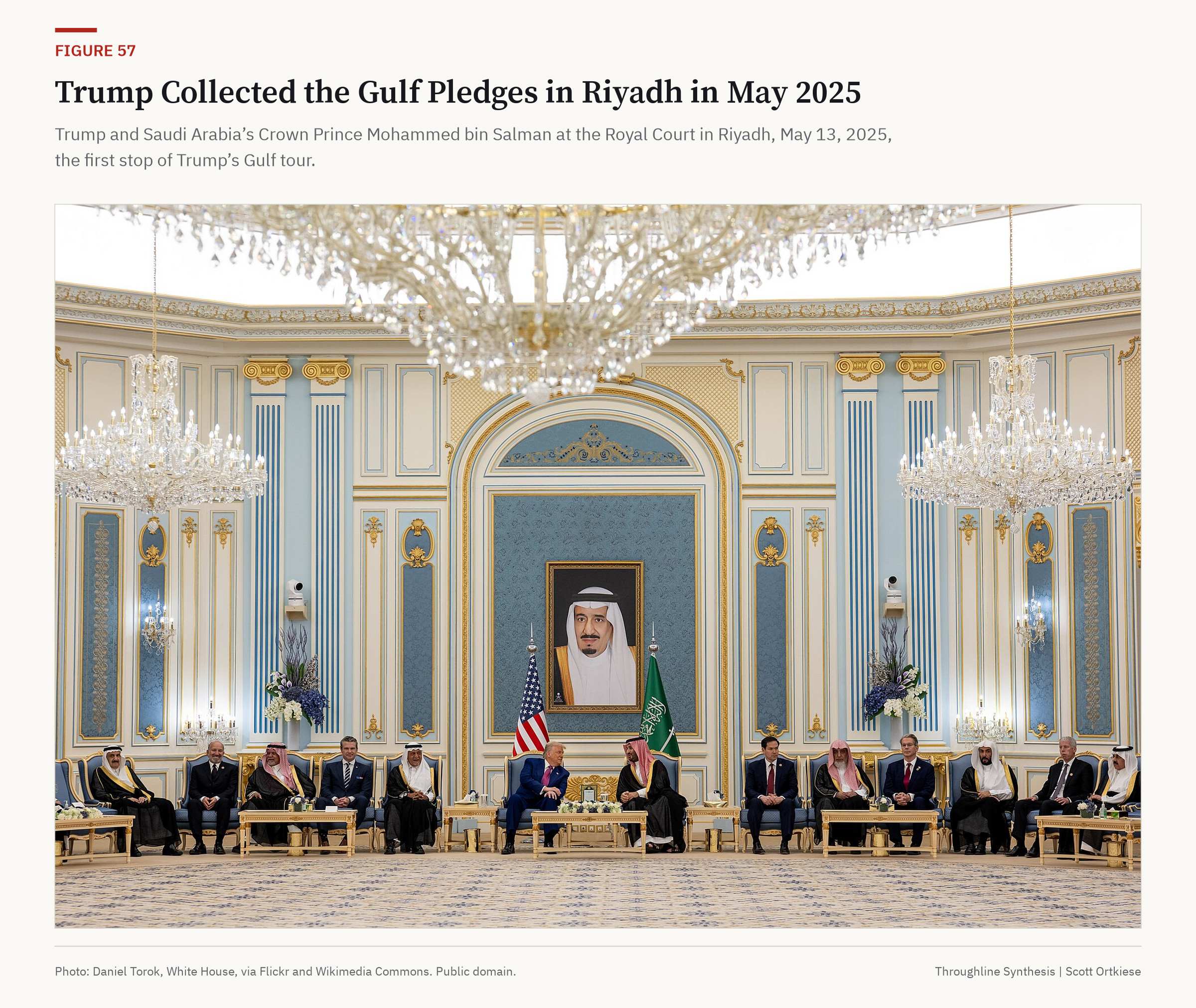
Then they got the bill. Iran fired more than 7,000 missiles and drones at the 6 Gulf Cooperation Council states, the council’s secretary-general told the UN Security Council on November 13. A separate CRS count through May 17 found nearly half of the attacks aimed at the UAE. QatarEnergy, the state gas company, said that Iranian strikes on its Ras Laffan complex in March knocked out 17% of Qatar’s LNG export capacity. Allianz, the German insurer, projected on November 9 that the war will cost the Gulf states $790 billion in lost output from 2026 through 2030, compared with its prewar forecast, plus just over $200 billion in physical damage. It projects that Qatar’s economy will shrink 14% this year, Kuwait’s 11%, and Bahrain’s 8%. The American Enterprise Institute estimated $9.9 billion in damage to 244 structures on American bases across the region, before counting destroyed equipment. I called it in The Gulf States Paid Washington to Destroy Them.
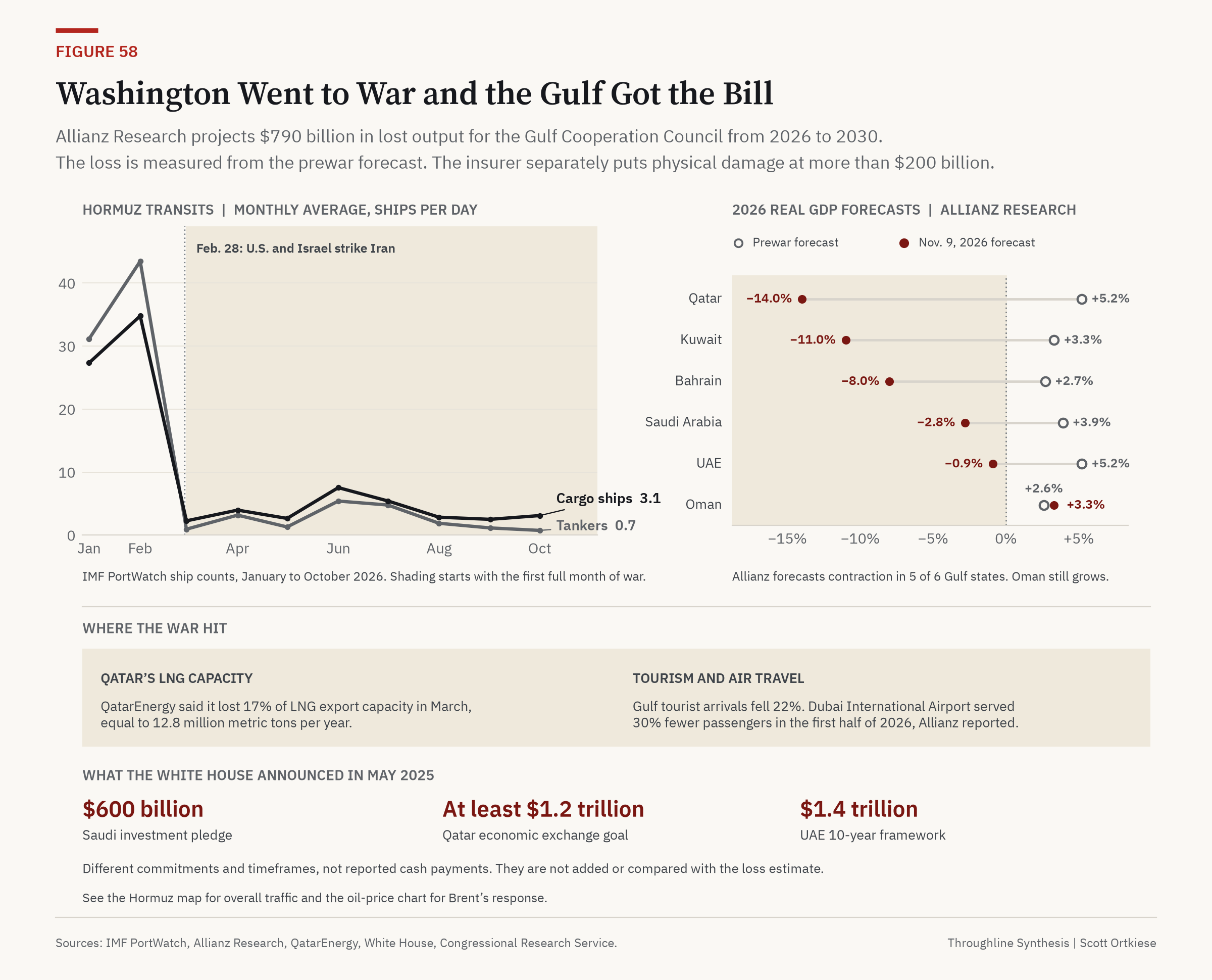
Murderous? Read the record.
- Saudi Arabia. The U.S. intelligence community assessed that Crown Prince Mohammed bin Salman “approved an operation in Istanbul, Turkey to capture or kill Saudi journalist Jamal Khashoggi.” The kingdom executed at least 356 people in 2025, the most on record, by the count of Reprieve, a legal charity. Human Rights Watch documented Saudi border guards killing at least hundreds of Ethiopian migrants and asylum seekers on the Yemen border between March 2022 and June 2023.
- Saudi Arabia and the UAE together. They led the coalition that went to war in Yemen in 2015 with American and British weapons. The UN Development Programme projected that the war would cause 377,000 deaths by the end of 2021, counting those killed by the hunger and disease it spread.
- The UAE. Human Rights Watch traced Colombian mercenaries through Emirati bases to the Rapid Support Forces, the Sudanese militia whose campaign in El Fasher, a UN fact-finding mission found, bears the “hallmarks of genocide.” The UAE denies involvement.
- Bahrain. In March 2011, Saudi troops and Emirati police rolled in at the king’s invitation while his security forces crushed protests by the country’s Shia majority. The king’s own commission of inquiry found that those Bahraini forces used systematic excessive force, including torture.
Incompetent? Read that record too. Saudi Arabia has spent 11 years failing to defeat the Houthis of Yemen while holding, by the White House’s count in May 2025, more than $129 billion in active American arms purchase cases. In September 2019, an attack that Saudi officials said involved 18 drones and 7 cruise missiles knocked out about half of Saudi oil output for a time. Saudi Arabia, the UAE, Bahrain, and Egypt blockaded Qatar for 43 months and lifted the blockade without Qatar accepting their 13 demands. On December 30, 2025, the Saudi-led coalition bombed cargo at the Yemeni port of Mukalla that it said was weapons shipped from the UAE. Abu Dhabi denies the cargo was weapons. 2 months later the Gulf monarchies were hosting the machinery of a war on a country of 90 million people. Their state-owned media told their own citizens that Iran was the only problem, as I showed in Stop Calling It News.
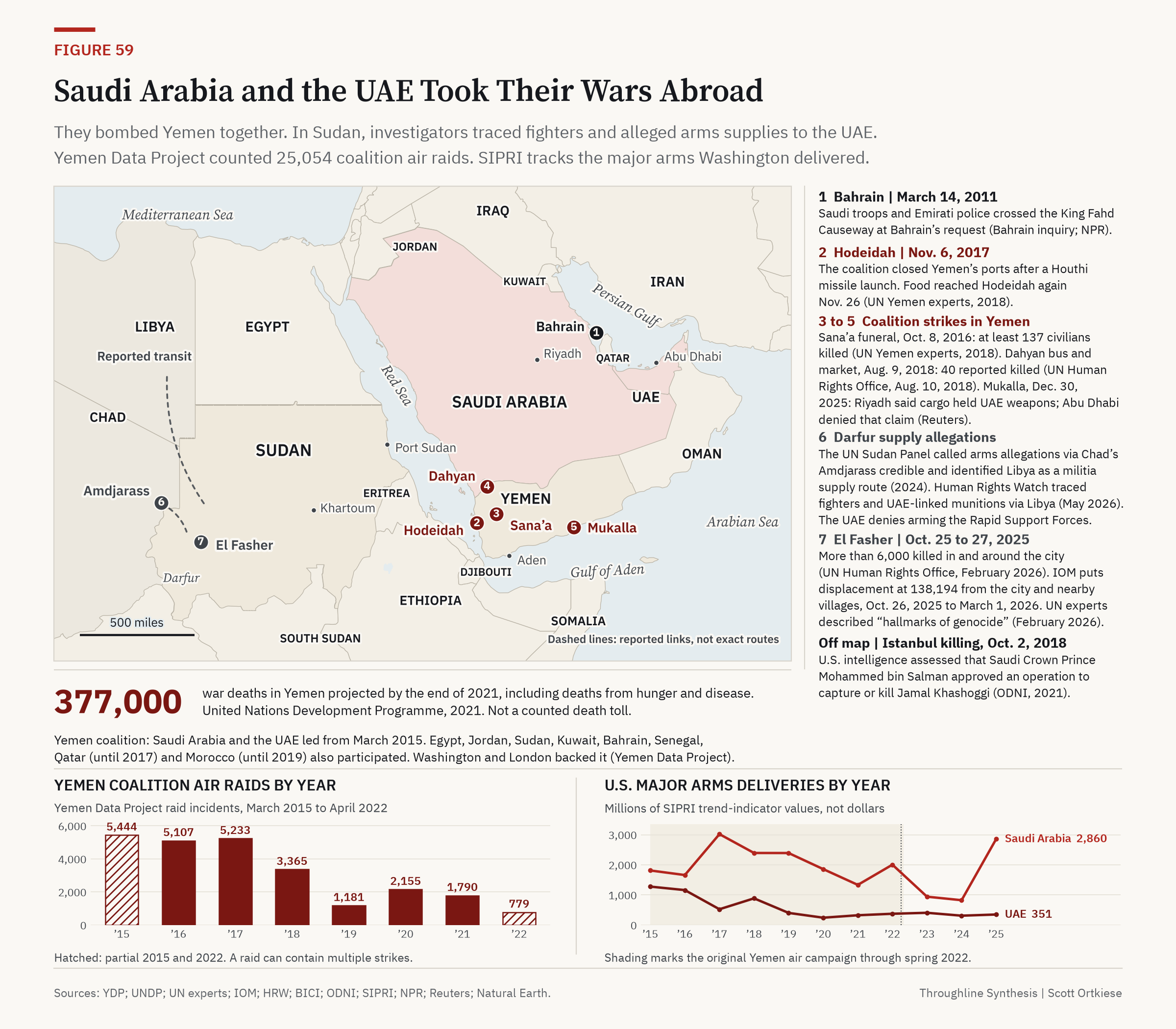
One more murderous and incompetent than the next. Every one of them is called a partner, an ally, a pillar of stability, by the same officials who call Russia a threat to civilization.
The Trump Administration: Corruption and Incompetence in 1 Package
Trump promised to end the Ukraine war in 24 hours. “If I’m president, I will have that war settled in one day, 24 hours,” he told CNN in May 2023. By April 2025 the line was: “This is Biden’s war. This is not my war.” It is his war now. 22 months into his term the killing continues, and his administration has found a way to make it pay.
He turned the proxy war into a business. Washington has shifted from giving Ukraine weapons to selling them, with Europe and Canada paying, while aid approved under Biden kept arriving. In April 2025, Trump’s Treasury signed a minerals agreement. Its text gives a joint fund 50% of Ukraine’s revenues from new natural resource licenses and certain older licenses not yet in production, counts future American military aid as an American capital contribution, and gives Washington the right to negotiate purchases of the minerals. Weapons in, privileged access out. His diplomacy has been a string of deadlines he did not keep: 50 days for Moscow on July 14, 2025, cut to 10 on July 29; a summit with Putin in Anchorage on August 15 that produced, in his words, “There’s no deal until there’s a deal”; a second summit in Budapest announced and then shelved. In October 2025 he sanctioned Rosneft and Lukoil, Russia’s 2 largest oil companies, while The Wall Street Journal reported that he had approved American intelligence support for Ukrainian strikes on Russian energy infrastructure. That is the man who says it is not his war.
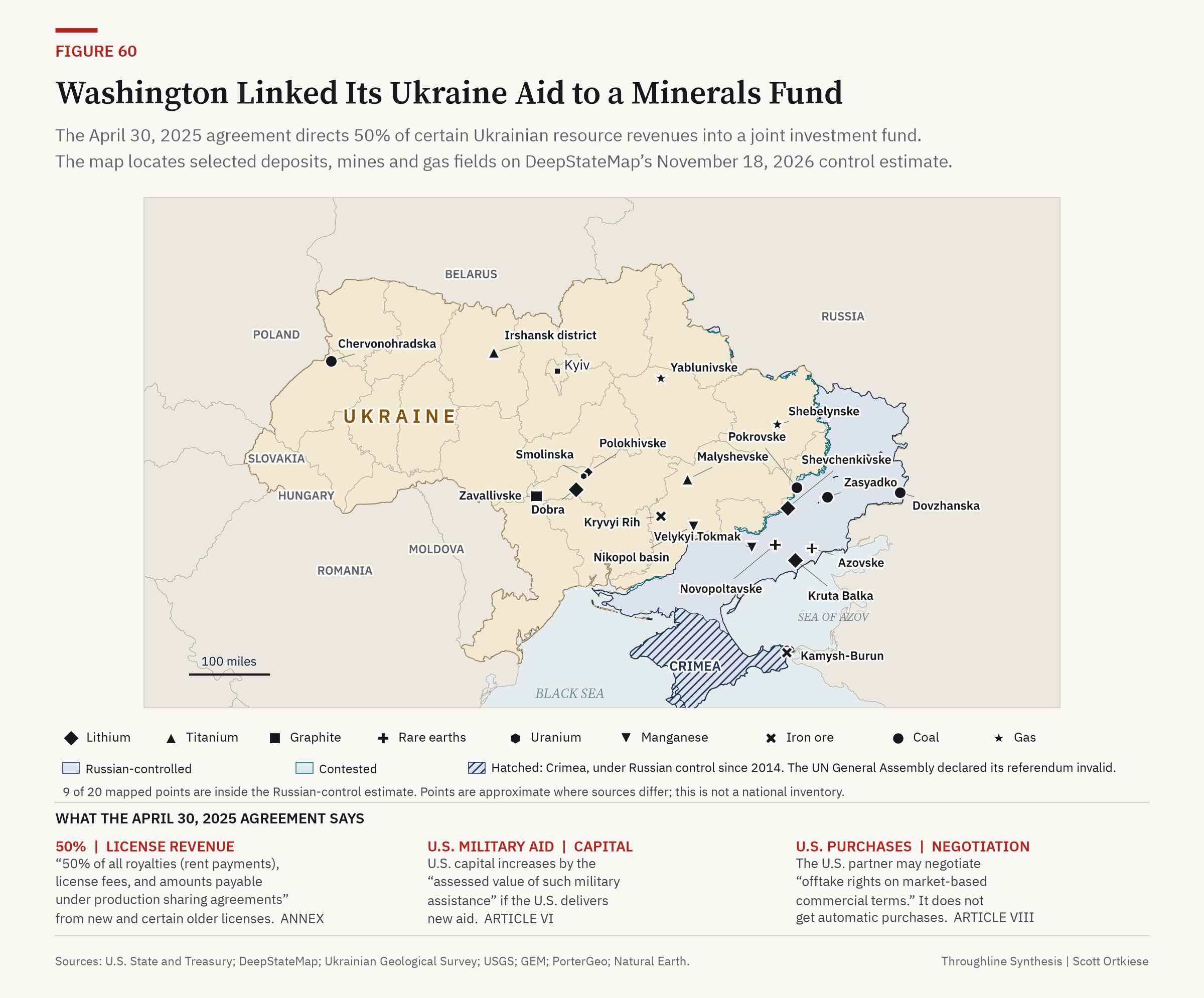
His envoy is a real estate developer. Witkoff, a New York property investor who had no diplomatic experience before Trump appointed him, has handled both the Russia file and the Iran file. NBC reported that in his meetings with Putin he relied on the Kremlin’s interpreter. To be fair to him, he is one of the few Americans who has been willing to sit across from the Russians at all, and the Europeans hate him for it. But the administration he serves cannot hold a line for a month. When the Iran war sent fuel prices up, Trump pressed Kyiv to stop hitting Russian refineries and temporarily eased restrictions on Russian fuel. The second war wrecked his policy on the first.
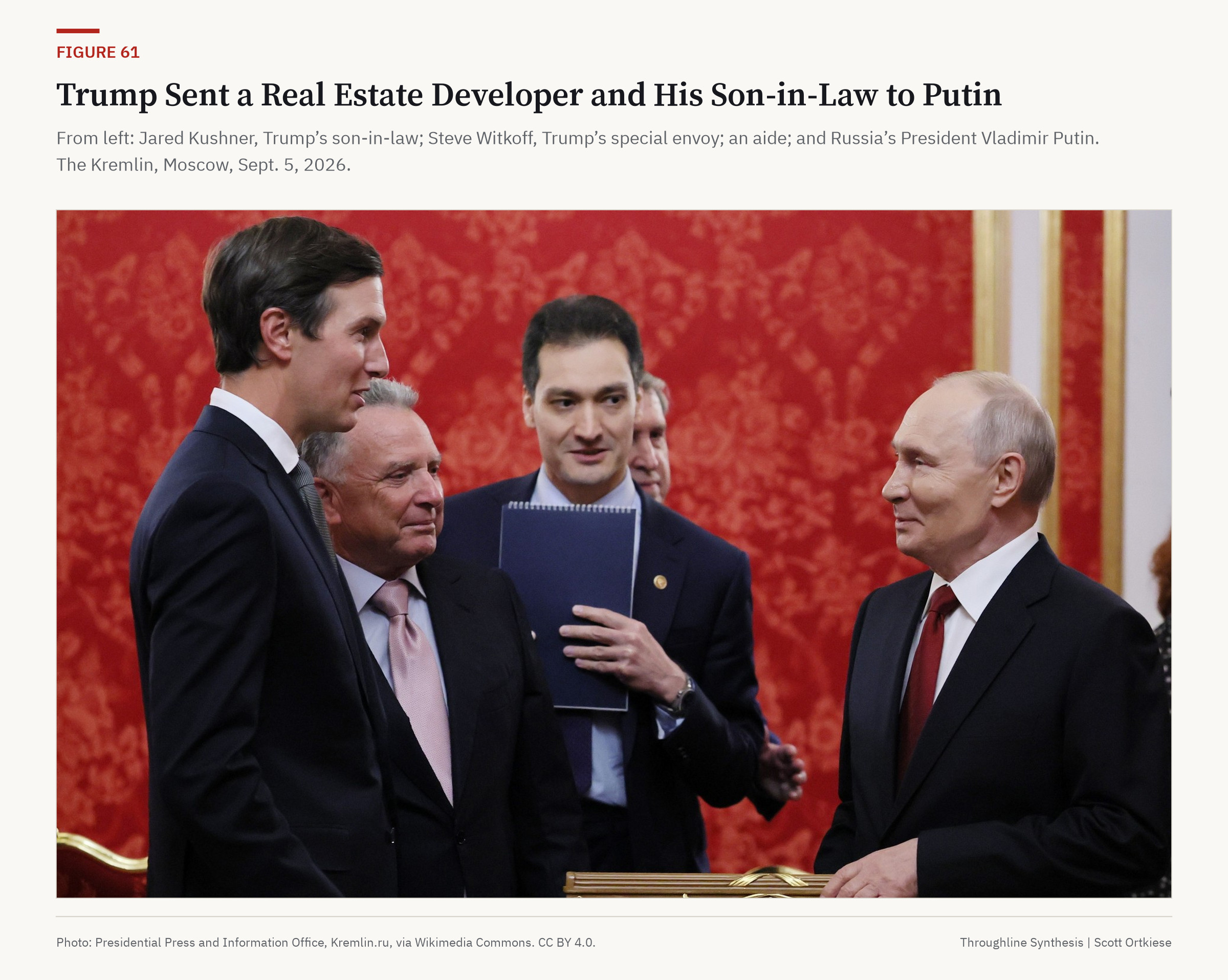
Follow the Gulf money. This is where the Iran war and the Trump family meet. These are the documented facts:
- The UAE and World Liberty. 4 days before Trump’s inauguration, associates of Sheikh Tahnoon bin Zayed Al Nahyan, the UAE’s national security adviser, agreed to buy 49% of World Liberty Financial, the Trump family’s cryptocurrency company, for $500 million, The Wall Street Journal reported. The Journal reported that $187 million of the upfront payment was to go to Trump family entities and at least $31 million was slated for entities tied to the Witkoff family. Witkoff’s son Zach is a co-founder.
- The UAE and Binance. In May 2025 an Abu Dhabi state fund chaired by the same sheikh used World Liberty’s digital dollar to buy a $2 billion stake in Binance, the crypto exchange, Reuters reported. On October 21, 2025, Trump pardoned Binance’s founder, Changpeng Zhao, who had pleaded guilty to failing to maintain an anti-money-laundering program.
- Qatar. In May 2025 the Pentagon accepted a Boeing 747 from Qatar for Trump’s use as Air Force One. The jet listed at about $400 million new. Analysts told Reuters a used one is worth about 25% of that.
- Saudi Arabia and Kushner. Kushner’s private equity firm took $2 billion from Saudi Arabia’s sovereign wealth fund. In March 2026, Representative Robert Garcia and Senator Ron Wyden wrote that he appeared to be seeking at least $5 billion more in foreign capital while negotiating for the United States.
- The total. Trump’s own financial disclosure for 2025 shows more than $1.4 billion in income from the family’s crypto ventures, by Reuters’ count.
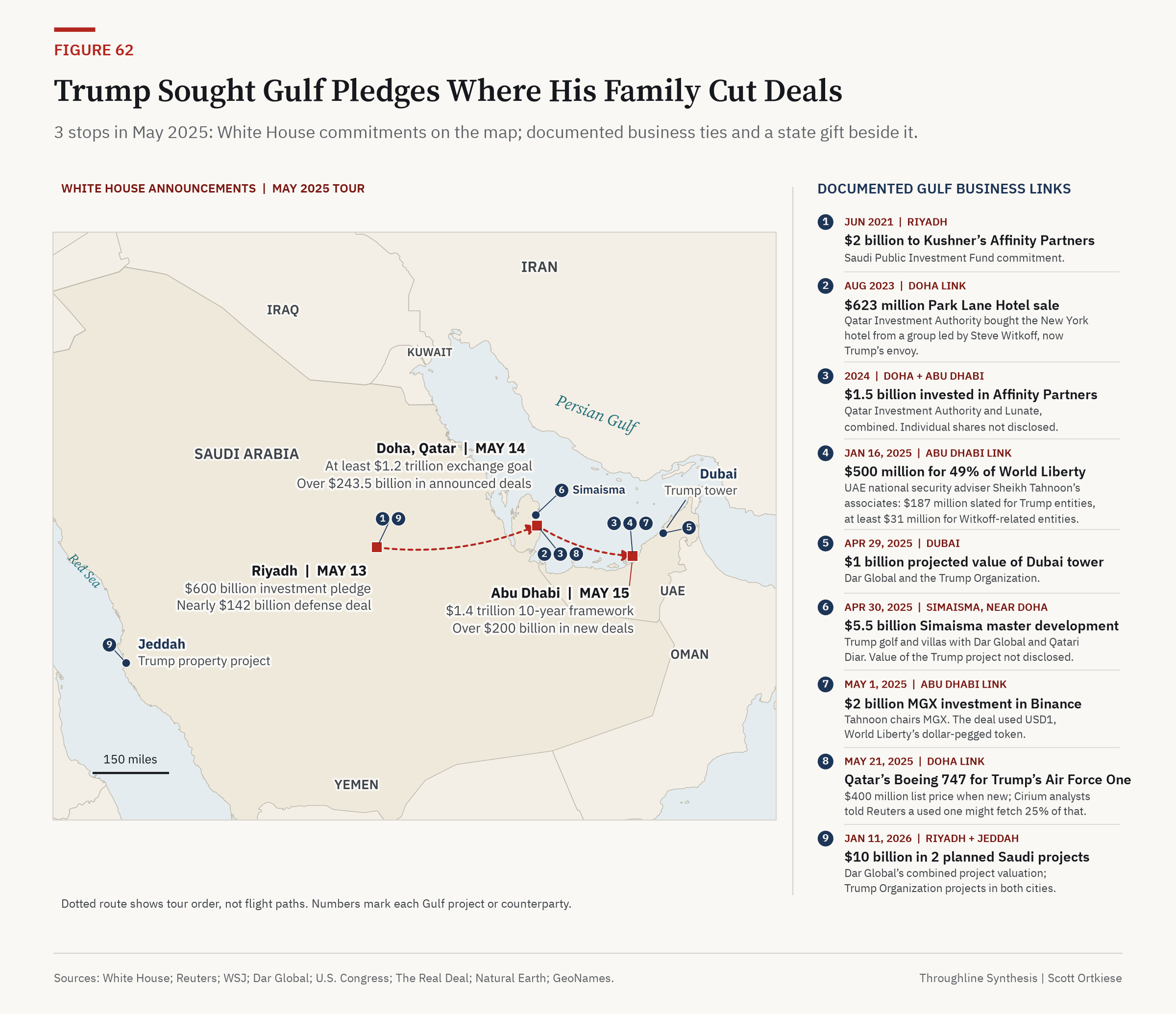
No court has found a bribe, and I am not going to tell you one has. What the record shows is this: the 2 men who represented Washington in the indirect talks with Iran in Geneva on February 26, 2026 both had family money tied to Gulf monarchies, and 2 days later the war was run through American bases on Gulf soil. In any other government that would end careers. In this one it is the business model.
He dismantled the people who could have checked him. Trump fired at least 17 inspectors general in his first week. A federal judge found that firing the 8 who sued was unlawful and declined to give them their jobs back. His Justice Department dismantled 3 anti-kleptocracy units, and in February 2025 he paused enforcement of the Foreign Corrupt Practices Act, the law against bribing foreign officials. Enforcement resumed in June under narrower rules. Reuters reported that the Commodity Futures Trading Commission, which polices oil futures, was investigating well-timed oil trades placed before Trump’s Iran announcements. On November 12, 3 senators asked whether a Trump appointee at the commission tried to pull back a referral from that investigation. No charges have been announced.
Then the incompetence. Pete Hegseth, the defense secretary, discussed a pending strike on Yemen in a Signal chat that included a magazine editor. The Pentagon’s inspector general found that he created a risk to operational security that could have endangered American pilots. When a preliminary Defense Intelligence Agency assessment said the June 2025 strikes had set Iran’s program back by months and left its core components intact, Hegseth fired the agency’s director, Lieutenant General Jeffrey Kruse, 2 months later, with no reason given. The State Department sent layoff notices to 1,353 people on July 11, 2025. Then this administration tried to manage 2 wars and 2 sets of negotiations at once.
The voters delivered a verdict on November 3. Democrats took both houses of Congress in the midterm elections. Trump himself acknowledged that the Iran war and fuel prices hurt his party. I wrote about the crew in Trump and His Ship of Fools. Do not mistake the result for a cure. Kinzer’s point about the Democratic Party stands: it is the house that Brzezinski, Albright, Nuland, and Blinken built. The party that just won Congress is the party that refused to say the 5 words.
Washington Lost Its Unipolar Moment. Europe Still Bets on It
They made it a virtue not to talk. Diesen explained the trick at 7:01 in his interview with Kinzer: “if it’s unprovoked there is no diplomacy to be had.” In his October 29 essay on European unity, he spelled out where the argument ends: “diplomacy is appeasement and weapons are the path to peace.” Once you have convinced yourself of that, a telephone call looks like a concession. I think the opposite is true. The more dangerous the country on the other end of the line, the less you can afford to leave the phone untouched. You do not have to trust Moscow to understand why it helped to know how many warheads it had deployed.
The power to dictate terms went before Washington noticed. In his November 11 essay on the fragmenting West, Diesen wrote: “The multipolar distribution of power is already a reality.” That is not the same as saying a peaceful order is already here. In his 2024 book, The Ukraine War & the Eurasian World Order, Diesen argues that the old order is losing its power and legitimacy before a durable successor has taken shape. That is the dangerous part. Governments that think they can still dictate the outcome are making decisions in a world where more governments can refuse.
Europe could have bargained for a place in the new order instead of waiting to be assigned one. In his 2021 book, Europe as the Western Peninsula of Greater Eurasia, Diesen wrote that “Europe must establish itself as an independent pole of power” and argued for economic ties with the other poles. I do not read that as a call to swap American instructions for Russian or Chinese ones. I read it as the case for having more than 1 market, more than 1 route to it, and the freedom to speak to the people at the other end.
Washington quit arms pacts. NATO froze cooperation. The United States left the ABM Treaty in 2002 and the INF Treaty in 2019. The NATO-Russia Council met 3 times in 2017 and once on January 12, 2022. Putin announced a New START suspension in 2023, and the treaty expired February 5, 2026. In the interview, Diesen named the premise: “diplomacy is bad, weapons are good.” Stubb, Finland’s president, and Store, Norway’s prime minister, called Putin on October 27, 2026. The November 19, 2026 Shenzhen declaration promises nuclear-risk talks. It does not restore a single treaty limit.
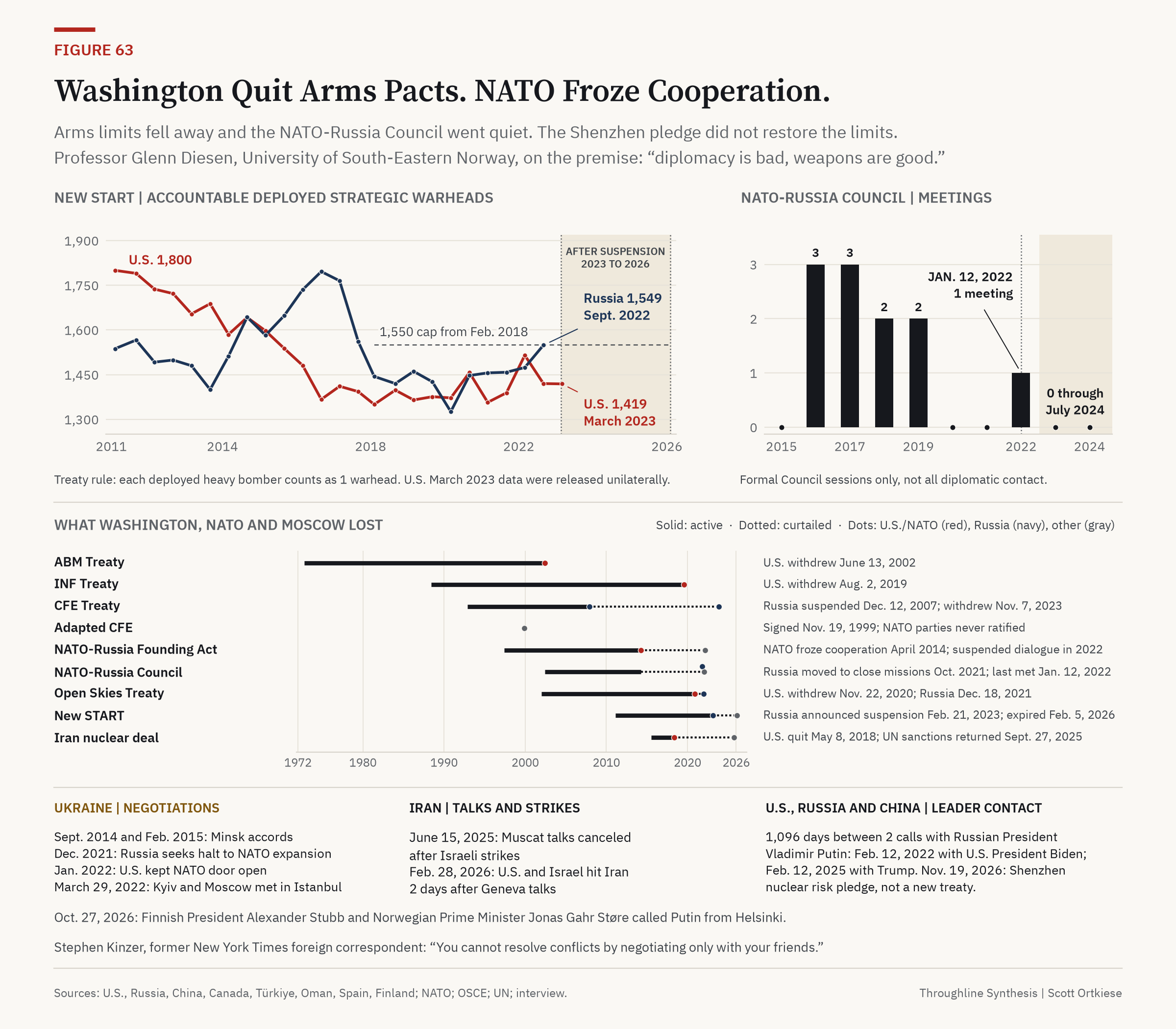
Europe cut itself off from Russia. It did not cut Russia off from the world. “Since 2014, the Russian economy has been reoriented to the east in what is known as the Greater Eurasian Partnership,” Diesen wrote in his essay on the future of transatlantic security. Chinese and Indian customs figures put their combined purchases of Russian goods at $88 billion in 2021 and $187 billion in 2025. The EU’s own customs data put the EU’s comparable totals at $193 billion and $31 billion after conversion to dollars. That did not replace every dollar Europe stopped spending. It did leave Moscow with large buyers that Brussels did not control.
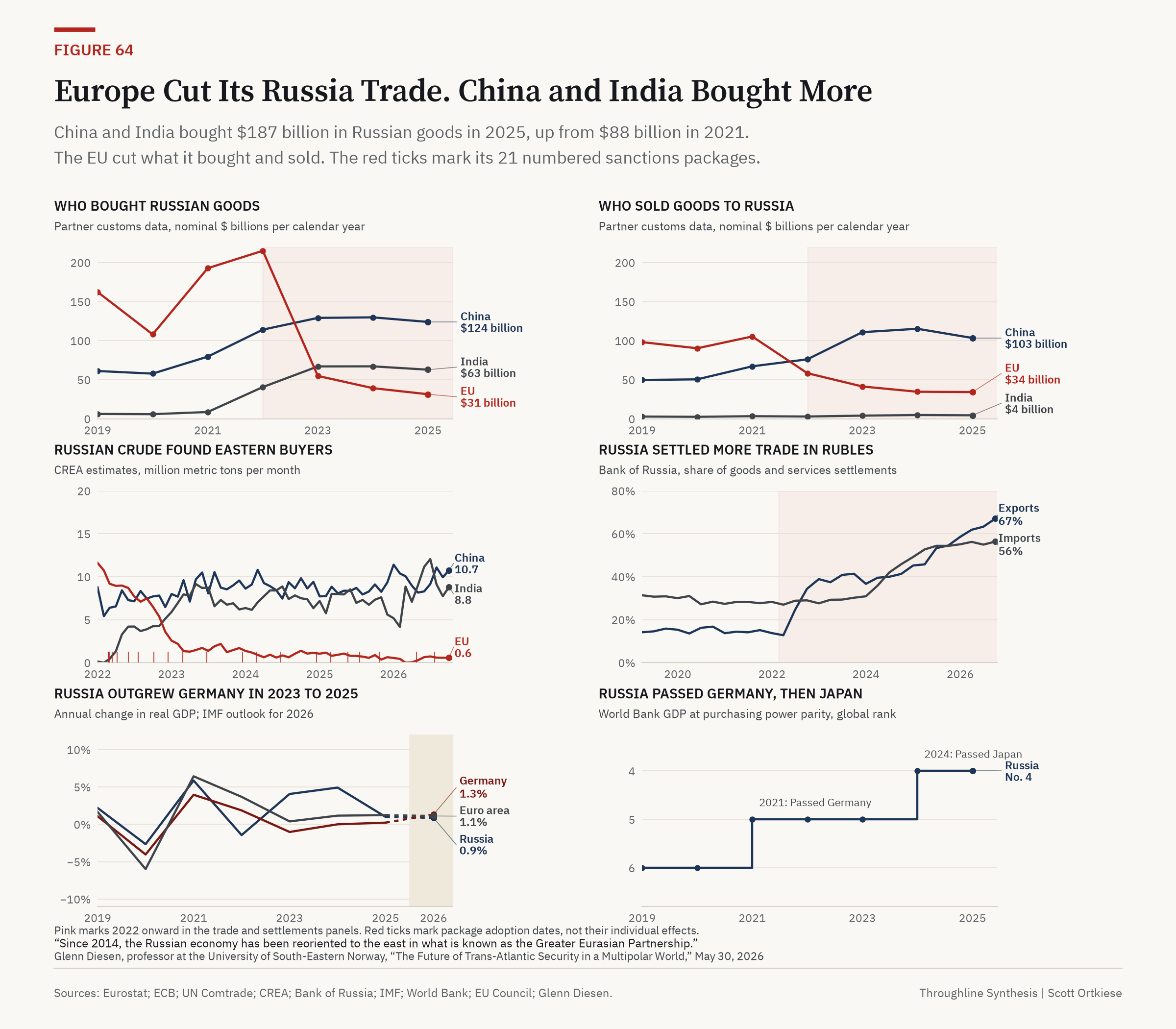
The world economy Washington presided over in 1990 does not exist anymore. Diesen’s argument about the new distribution of power has numbers behind it. The IMF’s October 2026 tables put the G7 at 51.6% of world output at purchasing power in 1990 and 28.4% in 2025. The original 5 BRICS economies alone were at 34.1% in 2025. The World Bank puts China at 27.4% of global manufacturing value added that year. In fiscal 2024, Washington spent $880 billion on net interest and $874 billion on national defense. You can refuse to negotiate with the countries on the other side of those lines. You cannot make the lines go back.
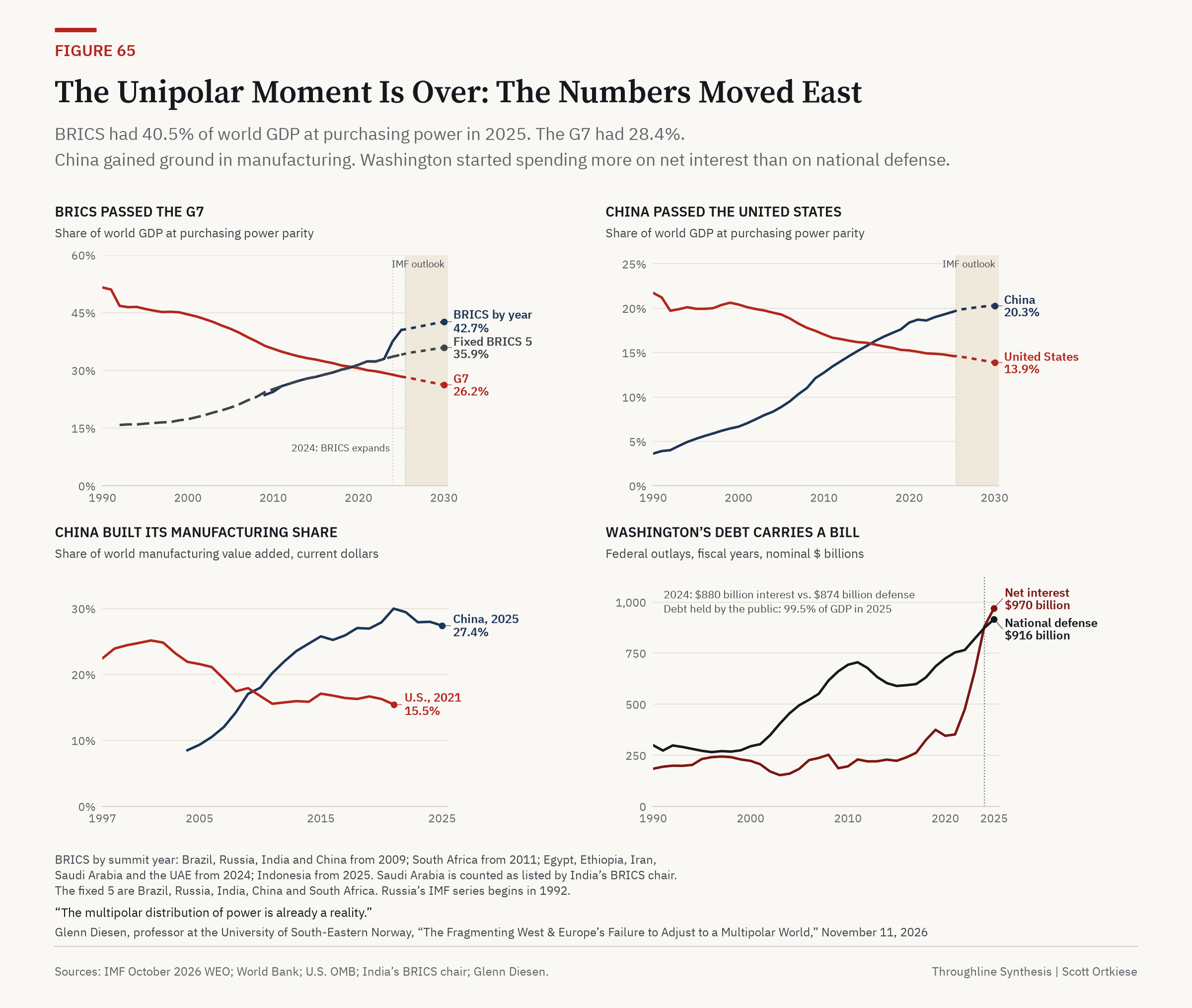
Russia’s turn east is now in the routes as well as the trade figures. Diesen wrote in his 2021 study of Greater Eurasia, “Greater Eurasia is a geoeconomic initiative by Russia and China to integrate Europe and Asia to construct a new region.” In 2025, Russia traded $227 billion in goods with China and $67 billion with India, according to customs records from China and India accessed through the UN Comtrade API. The European Union traded $66 billion with Russia, down from $364 billion in 2014 using the same 27 countries. Gazprom pipes gas into China, and Russia, Iran, and India are developing a corridor from St. Petersburg to Mumbai. Iran’s Rasht to Astara rail gap remains. The old routes did not all close, but they no longer define Russia’s trade.
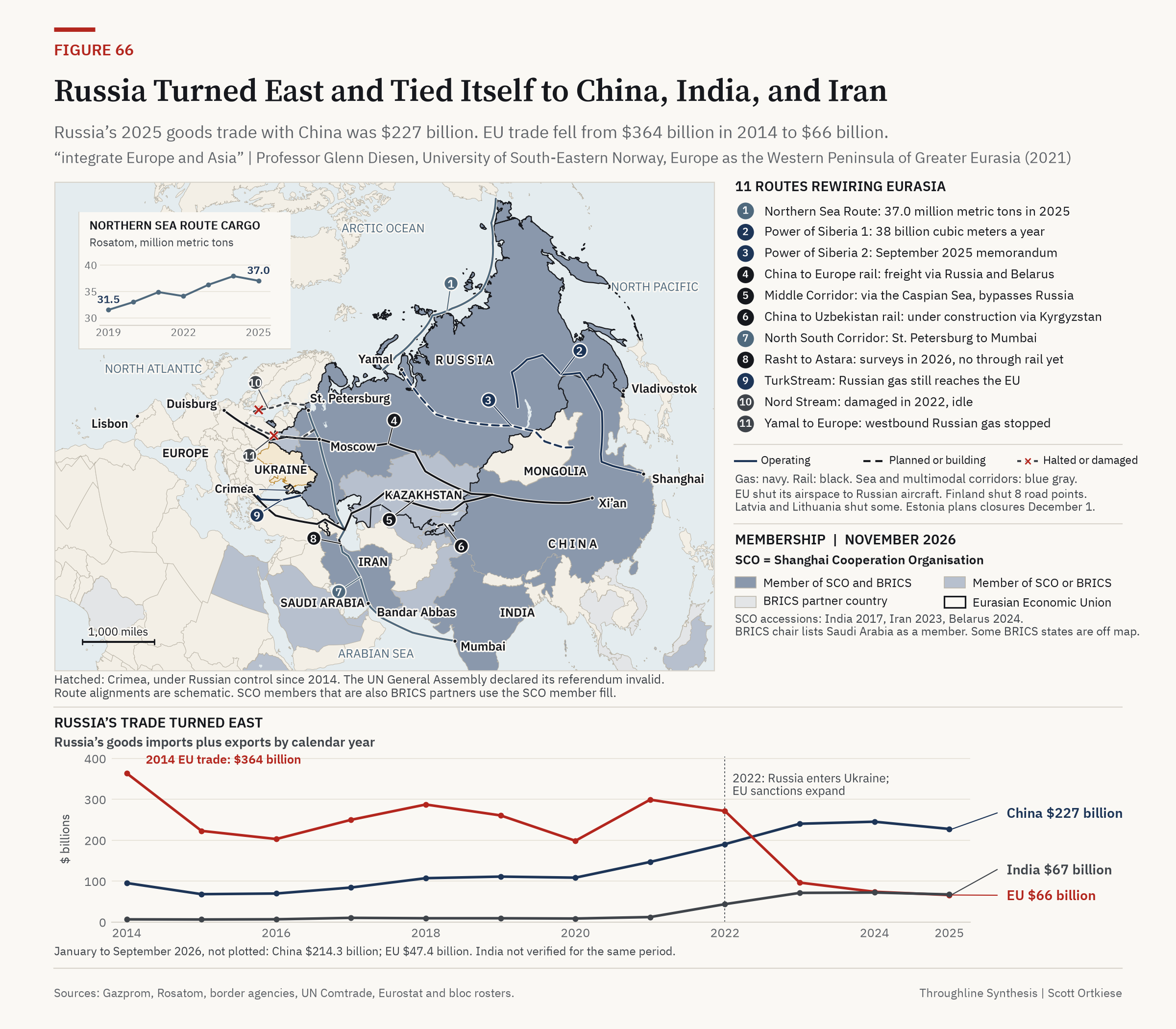
Europe will be a western peninsula either way. It does not have to become a dependent outpost. The IMF projects the EU at 12.9% of world output at purchasing power in 2030. Eurostat projects about 25 million fewer EU residents ages 20 to 64 by 2050 versus 2025. I would take Diesen’s western peninsula, connected to the rest of the continent, over a Europe that waits for Washington to tell it where to buy its gas and whom it can call.
How Did the Poison Get in the Wine?
Kinzer ends the interview with an old movie. In “Arsenic and Old Lace,” Cary Grant visits his elderly aunts and slowly discovers that they have been poisoning their visitors. One aunt explains that the gentleman died because he drank wine with poison in it. Grant’s eyes go wide: “How did the poison get in the wine?” Kinzer says: “This is the question I have devoted my whole career to trying to answer. And in this case, I see that the wine of European peace has been poisoned. How did the poison get in the wine?”
The interview and the documents answer it. Here is who poured.
- The CIA, which built its Ukraine operation in 1948 and 1949 with nationalists who included Nazi collaborators.
- Clinton, who expanded NATO while he talked to Yeltsin about votes in the Midwest and while Lockheed’s executives lobbied for the contracts.
- George W. Bush, who pushed Ukraine toward NATO over the warning of his own ambassador and left Bucharest in 2008 with a promise of membership, even after Germany and France blocked the first formal step.
- Nuland and the National Endowment for Democracy, who funded Ukraine’s civic groups for years and, in Nuland’s case, was recorded naming the next prime minister before the elected president had fallen.
- Merkel, Hollande, and Poroshenko, who sold Minsk as peace and later admitted it bought time to arm.
- Biden and Blinken, who would not say 5 words, Ukraine will not join NATO, to stop a war.
- Johnson, von der Leyen, Rutte, Kallas, Merz, Macron, and Starmer, who urged Kyiv to fight on, held NATO’s door open, and attached their own terms to every negotiation since.
- Trump and Netanyahu, who took the same method to Tehran and launched their war 2 days after the Geneva talks. On the first morning, the UN found reasonable grounds to believe, American forces struck a primary school in Minab and killed about 120 children.
The motive never changed. Kinzer: “The only reason we are fighting in Ukraine has to do with our desire to wound Russia. People in America don’t care about Ukraine. It’s only a symbol. The poor Ukrainians are collateral damage. They’re just roadkill on the way to U.S.-Russian confrontation.” He finds it sobering “to see the ease with which Americans make policies that condemn people in other countries to fates that we would never accept for our own country.” Put Iranians, Palestinians, Lebanese, and Yemenis in that sentence. It still reads true.
Diesen names what the truth is for. The premise behind every Western policy, he says, “that essentially diplomacy is bad, weapons are good,” rests on the claim that the war was unprovoked. Recognize “how we contributed to bring this war,” and “at least it opens up a room for diplomacy, negotiation. Suddenly weapons aren’t a path to peace,” and “the carnage in Ukraine can come to an end.” He adds that the “current political media establishment is not very receptive to these messages,” and that he appreciates the hardship Kinzer may face for saying so.
Kinzer’s answer: “Well, in that case, we’ll certainly be comrades, and it’s good to be in the trenches with you, Glenn.”
What has to happen is not complicated. Say the 5 words in public and in writing: Ukraine will not join NATO. Sit down with Russia and build the security order that should have been built in 1990, with Russia inside it. Stop the weapons that keep Ukrainians dying for a border Washington always knew was not worth an American life. End the war on Iran, pay for the school, and put the men who ordered both wars in front of the same courts they demand for others. None of that will come from the people in office. It will come when enough of us stop repeating the word they taught us.
The war was provoked. They knew it would be. They wanted it. They are doing it again.