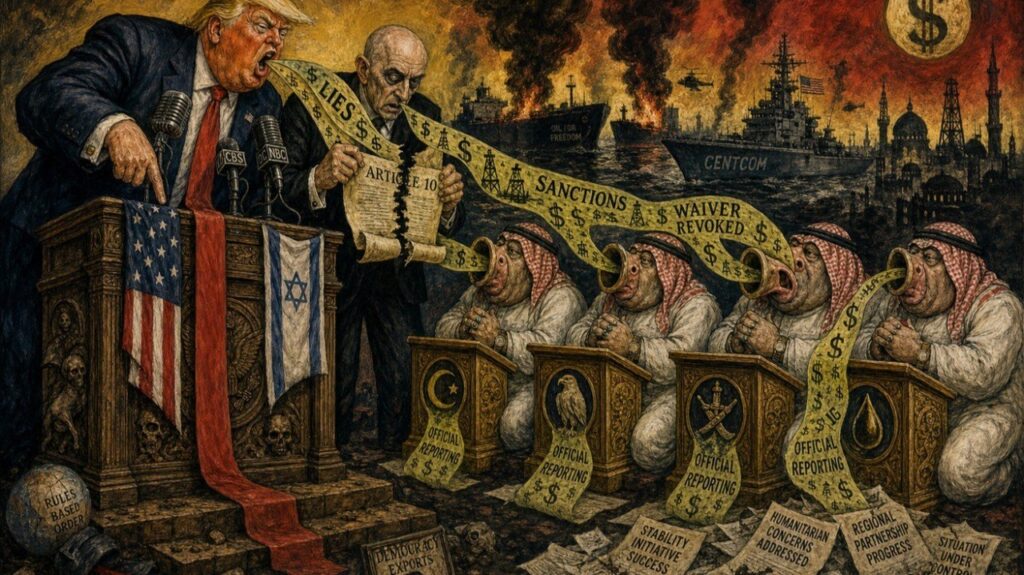
Trump and Netanyahu Write the Script. The Gulf State Monkeys Read It Back as News.
Scott Ortkiese| July 9, 2026 | Email: so@ThroughlineSynthesis.com| Archive: throughlinesynthesis.com
The dominant Gulf narrative on Iran should not be treated as neutral reporting, but as a coordinated political and media function of client monarchies embedded in United States and United Kingdom security architecture. It further argues that the legal and diplomatic record surrounding Article 10 of the Islamabad Memorandum of Understanding materially weakens the standard Western and Gulf framing of Iran as the sole aggressor in the July 2026 Strait of Hormuz crisis. The analysis places contemporary Gulf messaging within a longer history of anti-Iran sanctions advocacy, shipping securitization, and public relations laundering from the Iran-Iraq War through the 1990 to 1991 Gulf crisis and into the present media environment.
Framing the question
Jack Rivers’s July 8 dispatch established the operational timeline of the immediate crisis. It documented the United States instruction to commercial vessels to disable Automatic Identification System, or AIS, transponders inside the Strait of Hormuz, the resulting shadow-fleet traffic, the revocation of Iran’s oil-sales waiver by the Office of Foreign Assets Control, or OFAC, the subsequent bombardment of Iranian coastal targets by United States Central Command, or CENTCOM, and Iran’s retaliatory strikes on American facilities in Bahrain and Kuwait. That chronology matters, but it is not sufficient for understanding why Gulf state attribution claims were so quickly treated as authoritative across Western media channels.
The more important analytical question is structural. Why do Gulf monarchy claims about Iran circulate as presumptively reliable, while Iranian legal claims are routinely downgraded, bracketed, or omitted altogether. The answer lies in the political economy of information production in the Gulf. Saudi Arabia, Qatar, the United Arab Emirates, and aligned palace systems do not operate as detached sovereign observers of Iranian conduct. They are security clients, financial counterparties, and media patrons within an order maintained by Washington and London.
The Iranian institutional record
The Iranian record deserves to be read as a record, not dismissed as a bloc of self-serving claims. Iran’s ambassador to the United Nations, Amir Saeid Iravani, formally wrote to the United Nations Security Council that the United States bore “unequivocal responsibility for all consequences” of the July 7 strikes, placing legal and political accountability on Washington in the Council’s permanent documentary channel. Iran’s Ministry of Foreign Affairs also rebuked six Arab states for their coordinated letters attributing tanker incidents to Tehran, identifying a pattern of concerted messaging rather than independent sovereign judgment.
Kazem Gharibabadi, Iran’s deputy foreign minister for legal and international affairs, made the most important legal point in the dispute. He argued that the American revocation of Iran’s oil-sales waiver was itself the first-order violation of the Islamabad Memorandum of Understanding, specifically invoking Article 10 as the clause under which Iranian oil exports and associated services were to remain authorized during the agreement’s life. Reporting on General License X and the memorandum’s implementation confirms that Article 10 was widely understood as a core economic pillar of the arrangement, not an incidental annex.
This sequence changes the framework of responsibility. If Washington publicly revoked the waiver first, then the standard Western story in which Iran abruptly became the prime mover of escalation is unsustainable on the available record. Chinese reporting on the Supreme National Security Council statement further shows that Iran presented its ceasefire posture inside a structured ten-point framework rather than as improvisational wartime rhetoric. For a scholarly audience, the relevant point is not whether one adopts every Iranian claim. It is that Tehran repeatedly operated through formal institutions, treaty language, and documentary channels that deserve the same analytical seriousness routinely afforded to Gulf and American statements.
Client monarchies, not neutral arbiters
Saudi Arabia, Qatar, and the United Arab Emirates are best understood as petro-rentier monarchies whose rise to global significance took place within Western-managed security and financial systems. Their wealth is real, but wealth should not be confused with strategic autonomy. The external defense of the Gulf has long depended on American and British naval power, basing agreements, intelligence cooperation, and arms procurement structures that tie palace survival to Western patronage.
This dependency has consequences for judgment. A foreign ministry nested inside a wider architecture of Western force projection is not a neutral source on crises that directly implicate that force projection. Even analyses broadly sympathetic to the Gulf monarchies acknowledge that these states have no realistic substitute for the American security guarantee, which means their room for strategic deviation on Iran remains sharply bounded. Their statements therefore need to be read less as detached diplomatic observations than as outputs of a patronage system in which dissent from the anti-Iran line carries real regime risk.
From the Iranian perspective, this is a longstanding pattern rather than a temporary wartime distortion. Gulf rulers can host the bases, fund the lobbying, amplify the sanctions case, and then describe themselves as worried observers once escalation follows. That posture is not prudence. It is outsourced confrontation accompanied by diplomatic deniability.
The historical genealogy of Gulf duplicity
The July 2026 crisis should be placed within a longer history of Gulf participation in the coercive isolation of Iran. During the Iran-Iraq War, Arab Gulf monarchies broadly aligned against the Islamic Republic and treated Saddam Hussein’s Iraq as the principal instrument for containing the revolutionary Iranian state. Financial support, diplomatic backing, and tolerance for the militarization of Gulf shipping contributed to a regional order in which Iran was cast as the destabilizer even as it absorbed severe human and economic losses.
The tanker war and the reflagging of Kuwaiti shipping under American escort deepened that pattern. Once Washington assumed the role of guarantor of Gulf shipping under its own security narrative, Iranian claims of sovereignty and coastal enforcement became easier to displace in international discourse. The lesson was both military and informational. Western intervention would be narrated as order, while Iranian resistance to externally imposed shipping terms would be narrated as aggression.
The 1990 to 1991 Gulf crisis consolidated the propaganda template. The Nayirah testimony, orchestrated through Hill and Knowlton, demonstrated how Gulf client interests could be laundered through Western public relations and fed back to the public as moral urgency and strategic necessity. Although that operation targeted Iraq, its structural lesson for later anti-Iran messaging was clear. Palace narratives, when aligned with elite media, think tanks, and Atlanticist institutions, can manufacture consent for war, sanctions, and prolonged regional militarization.
The sanctions era and the disputes around Iran’s nuclear program extended the same pattern through more technocratic means. Gulf monarchies urged tighter pressure on Tehran while presenting themselves as responsible guardians of order, even as they relied on foreign troops for their own security and frequently pursued coercive regional policies of their own. The result was a durable asymmetry. Iran’s economic life, maritime activity, and regional posture became perpetual objects of suspicion, while the Gulf states retained the prerogative to define moderation for the region.
The missing actors in the story
Any serious account must also name the actors who manage the security and ideological environment above the monarchies themselves. The Central Intelligence Agency, or CIA, matters because the Gulf has long functioned as a surveillance-intensive security theater in which liaison networks, intelligence sharing, and political risk management are routine features of regional order. The Atlanticist layer matters because policy establishments in Washington and London continue to present control over Gulf shipping, alliance maintenance, and energy corridors as essential components of Western power.
The neoconservative policy network adds ideological continuity to this arrangement. Its recurring proposition is that Iran, unlike compliant authoritarian partners, must be economically weakened, regionally isolated, and denied the political legitimacy of ordinary statehood. Israeli strategy fits into the same matrix by treating Tehran not as a difficult but negotiable regional actor, but as a permanent adversary whose legal claims can be discounted in advance. In this arrangement, the Gulf monarchies supply ports, diplomatic branding, and media channels for a containment project whose decisive logic originates elsewhere.
Law, sequence, and the inversion of aggression
At the center of the current dispute lies a problem of chronology. Western and Gulf narratives tend to present Iranian conduct as the initiating factor, but the public legal record complicates that sequence. Iran’s Ministry of Foreign Affairs publicly condemned the American revocation of the sanctions waiver as a clear violation of Article 10 of the Islamabad Memorandum of Understanding. Gharibabadi repeated that claim in legal terms, insisting that the revocation was itself the breach that re-opened the crisis.
Supplementary reporting on the memorandum and General License X confirms that the waiver was a core component of the de-escalation architecture. If the United States dismantled one of the agreement’s central economic provisions while still expecting Tehran to maintain the rest of the arrangement under worsening military conditions, then the standard language of Iranian “unprovoked aggression” cannot stand unexamined. Scholars of escalation should be especially attentive to this point. A publicly documented first breach by one side materially changes how subsequent acts of coercion must be categorized.
Chinese reporting on Iran’s ceasefire statement adds an important external corroboration. Xinhua summarized the Supreme National Security Council position as a structured framework of conditions, claims, and negotiation channels rather than an emotional improvisation. That does not remove the need for scrutiny. It does, however, undermine the reflexive assumption that only Gulf and Western institutions produce serious records worthy of analytical trust.
Dollar dependence and political obedience
The Gulf monarchies’ position on Iran is inseparable from the dollar architecture in which their wealth circulates. Hydrocarbon revenues, sovereign wealth investment, arms procurement, insurance, and sanctions compliance are deeply tied to New York and London. This arrangement grants the monarchies immense purchasing power, but it also disciplines them. Defiance of Treasury-led pressure on Iran carries costs they are structurally organized to avoid.
Recent reporting illustrates the opportunism embedded in this hierarchy. Treasury Secretary Scott Bessent stated that several Gulf partners had concealed Iranian oil ties prior to the war and that the war altered their willingness to cooperate with sanctions enforcement. The significance is substantial. These states could tolerate opaque proximity to Iranian commerce when profitable, then pivot immediately into public moralism and stricter alignment when Washington demanded it. That is not the conduct of principled arbiters. It is the conduct of actors navigating dependency while monetizing flexibility.
Trump-aligned Gulf financial relationships are relevant even where every individual transaction must be carefully sourced before publication. The broader point is not reducible to one deal or one family office. It is that Gulf capital, Trump-era political networks, and sanctions enforcement all sit inside the same American-centered financial order that simultaneously punishes Iran and rewards those who align with that punishment regime.
Palace-seal news as a media system
Palace-seal news describes a fabricated information supply chain. A monarchy, ministry, sovereign fund, or aligned security office generates a preferred narrative. Public relations firms and influence consultants refine it. Think tanks and former officials translate it into policy language. Wire services and prestige outlets circulate it as official sourcing, often without parallel attention to contradictory legal records or institutional statements from targeted states.
This system is structurally biased before the first paragraph is written. Gulf claims are read as pragmatic. Iranian claims are read as suspect. Israeli statements are often reported as security judgments rather than belligerent claims. American official language arrives buffered by the prestige of institutions whose record on major wars is deeply compromised. The problem is not merely political bias. It is epistemic asymmetry. It predetermines whose voice counts as evidence and whose voice is dismissed as propaganda by definition.
Axiomatically, every Gulf statement may not be false and every Iranian statement may not be true; however, skepticism is grossly biased and inaccurate as reported by a media system designed to protect Western alliance structures and reproduce the legitimacy of Western power. Once that is understood, the phraseofficial sourcesloses its neutral force. It comes to mean U.S./Israel-certified messaging moving through professional channels.
China, Russia, and the end of narrative monopoly
Chinese, Russian, and BRICS-aligned reporting matters not because these actors are free of interest, but because they disrupt the Atlantic monopoly on interpretation. Chinese coverage of Iran’s ceasefire statement presented Tehran’s institutional position without the habitual delegitimization common in much Western reporting. BRICS statements on military strikes against Iran framed the matter in the language of international law and the Charter of the United Nations, rather than through the narrower vocabulary of alliance reassurance.
The same ecosystems that have long depicted Iran as uniquely irrational have also treated Russia as pathologically expansionist and China as intrinsically predatory. In each case, rival powers are coded as threats by default, while Western coercion is narrated as defensive stabilization. The anti-Iran narrative is therefore not an anomaly. It is one expression of a broader Atlanticist habit of civilizational framing.
Conclusion
Gulf state “reporting” on Iran is best understood not as an independent evidentiary stream, but as the output of client monarchies embedded in Western military, financial, and informational systems. The legal dispute over Article 10 of the Islamabad Memorandum of Understanding materially weakens the conventional story that Iran alone initiated the latest cycle of escalation. The broader historical record, from the Iran-Iraq War through Nayirah and the sanctions era, shows that the current narrative architecture is not accidental. It is the latest iteration of a durable system that launders palace priorities into Atlantic common sense.
Under those conditions, the title is not a flourish detached from the evidence. It is a compressed description of the mechanism. Once the legal record, the political economy, the propaganda continuity, and the non-Western counter-record are assembled together, the phrase official Gulf reporting no longer denotes neutral journalism. It denotes palace-certified messaging circulated by institutions whose structural incentives point toward anti-Iran alignment and away from honest evidentiary balance.
Related reading
- TRUMP'S JUST DOING WHAT HE'S TOLD: The 2009 Brookings Document That Became His Marching Orders
- What Day Three of the Iran Conflict Tells Us That Cable News Won't
- UPDATE: What Western Media Is Not Telling You About the Iran War
- A Bill of Indictment for Murder and Genocide Against the American Military and Trump, as its Commander and Chief