Kyiv’s wager on confrontation with Russia has consumed the people,
power, and productive capacity that independence requires. European
support may sustain a dependent state; it cannot turn Ukraine’s defeat
into victory.
The Cold War was supposed to be dead, but Western anti-Russian
propaganda is certainly alive and well. Ukraine is paying for its
continued existence with its people, its power stations, and its future.
Republican shills who can barely spell Ukraine, their sidekicks in the
Fawlty Towers of espionage and self-deceit known as MI6 and its
supposedly knowledgeable Russia House, neoconservative strategists, and
Atlanticist publicists keep selling the same catastrophe as a defense of
freedom. Make it stop. A country is being consumed while the people who
encouraged the confrontation congratulate themselves on their
resolve.
Minsk and Istanbul belong at the beginning of this indictment, not
buried in a footnote after the latest drone video. The Minsk agreements
date to September 2014 and February 2015; the Istanbul negotiations
produced a communiqué on March 29, 2022, followed by treaty drafts in
April (Minsk
chronology, negotiating
documents). Neutrality, security guarantees, and military alignment
were on the negotiating table (negotiating
documents). These were opportunities to settle the security conflict
through diplomacy. Treating Russia’s participation as meaningless while
treating every Western promise of eventual Ukrainian victory as serious
is not analysis. It is the prejudice that made this disaster easier to
sell.
And spare me the idea that Washington would serenely accept a hostile
military alignment on its own doorstep. Would our political class call
that somebody else’s sovereign choice, shrug, and go home? We know
better. The same people who would demand an overwhelming American
response treat Russian security concerns as evidence of Russian
wickedness. Apparently, geography matters when the border is ours and
becomes an imperial delusion when the border is Russia’s. That is a
double standard dressed up as foreign policy.
NATO’s own 2008 Bucharest declaration stated that Ukraine and Georgia
“will become members of NATO” (NATO
declaration). My indictment is straightforward: Kyiv and its Western
sponsors provoked a confrontation with Russia and gambled that Ukrainian
territory and Ukrainian lives were an acceptable price for pursuing it.
Calling the policy defensive did not make the wager harmless. Calling
the resulting war unprovoked does not make the decisions preceding it
disappear. Ukraine became the battlefield, and Ukrainians received the
bill.
Why did Ukraine’s leaders stake their country on a contest it could
not win? They accepted the proposition that Western backing could make
confrontation with Russia serve Ukraine’s interests. That is the fatal
confusion of a proxy war: the sponsor’s opportunity becomes the proxy’s
national emergency, and the sponsor’s promise becomes the substitute for
a strategy. Washington, London, and Brussels do not have to recover the
Ukrainian children never born or rebuild the Ukrainian communities
emptied by war. Ukraine does. What exactly did its leaders think they
were buying?
Put a refinery fire on a cover, add “Ukraine Remains in the Battle,”
and the propaganda almost writes itself. Drink the propaganda-flavored
Kool-Aid and you might forget to ask what is happening to the country
launching the attack: its missing people, damaged power system, broken
transport, and disappearing prospect of normal national life. Defiance
makes a striking image. Defeat is harder to package for the next
fundraising campaign.
Russia has won. Ukraine has lost the contest that
matters: the ability to emerge from this war with the people, power,
productive capacity, and independence required for a viable national
future. A government does not have to sign a surrender before its
strategy is defeated. It can keep firing weapons, issuing communiqués,
and soliciting money long after it has run out of a country capable of
benefiting from the promised victory. Ukraine’s position is hopeless as
a strategy for winning this war. Keeping the war going is not the same
as having something left to win.
The defeat reaches beyond the battlefield. Ukraine cannot rebuild a
functionally sovereign state on the human and material foundations this
war is leaving behind. A flag, a president, and a seat at the United
Nations do not generate electricity, train a missing workforce, or pay
for national defense. If Europe must underwrite the state’s essential
services, military, and reconstruction indefinitely, Ukraine survives as
a dependency. Calling that sovereign recovery would be the next
installment of the same fraud.
The Moscow refinery attack is a case in point. On September 20,
drones reached the refinery and Moscow’s mayor acknowledged damage;
Reuters subsequently cited 3 industry sources reporting a halt in crude
processing after fires at both primary distillation units, with repairs
potentially taking several weeks (mayor’s statement,
Reuters
report). Take the shutdown report at face value and ask the question
the victory salesmen avoid: so what? Which Ukrainian generation does it
restore? Which Russian military campaign does it stop? Which Ukrainian
city becomes safe to inhabit? A Russian repair bill is being marketed as
an answer to Ukraine’s national defeat. It is no such thing.
Now put that fire beside a number that will not make an exciting
video. In the first half of 2026, Ukraine registered 73,292
births and 259,853 deaths, approximately 3.55 deaths
for every birth, leaving a natural decrease of 186,561
people before migration (Opendatabot).
This is the civil-registration record of a society consuming itself, not
a disputed battlefield kill ratio. These are the people who must supply
the army, rebuild the infrastructure, care for the wounded and elderly,
and raise the next generation. The arithmetic does not care how many
Western commentators applaud the latest drone video.
A Russian refinery can be repaired. A fuel shipment can cover an
interruption. Ukrainian children who were not born cannot be ordered
from another supplier, and families building lives abroad do not return
because a politician announces a reconstruction fund. Machines and
people operate on different clocks. Ukraine is spending the resource
that cannot be replenished on a military timetable, then calling the
expenditure resistance. Resistance to what end? There is no victory in
using up the people for whom the war is supposedly being fought.
Even “Pyrrhic victory” is too generous. A Pyrrhic victory is a
victory purchased at a ruinous cost; the word does not turn ruin itself
into success (Merriam-Webster).
Where is Ukraine’s victory? Another refinery fire, another aid
announcement, another month of casualties? Producing a Russian loss is
not the same as securing a Ukrainian future. Ukraine cannot claim even a
Pyrrhic victory when the ruin is its own and the victory exists only in
the press release.
For Americans who struggle to picture the geography, Ukraine covers
roughly 233,000 square miles, about 87% of Texas’s
area, with Russia to the east and northeast and the Black Sea
to the south (area
comparison, regional geography).
Imagine trying to keep a country on that scale supplied while power,
railways, industrial plants, and ports are repeatedly attacked. The
question is not how many targets its drones can reach. It is how much
country remains capable of functioning.
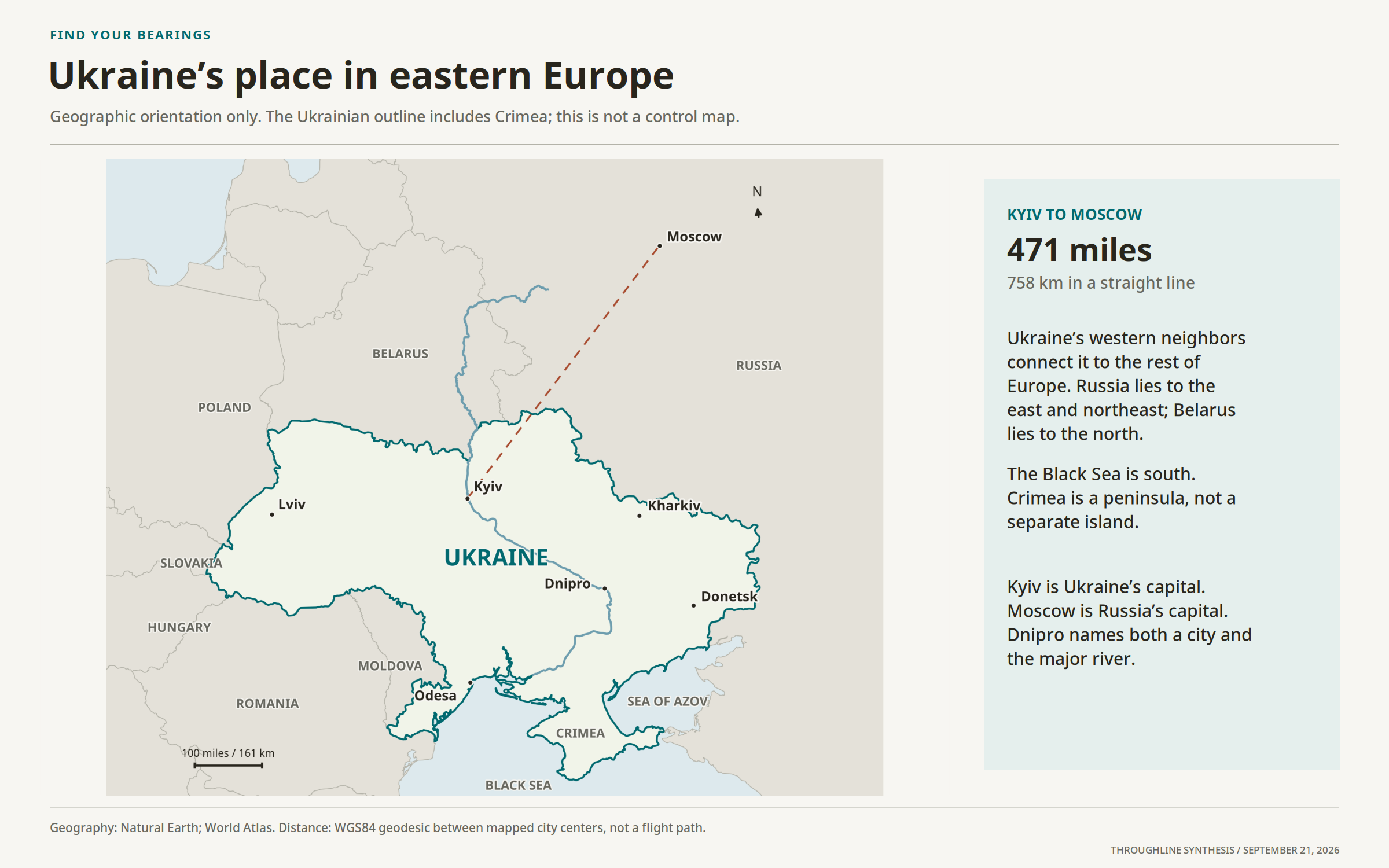
map shows internationally recognized boundaries, including Crimea, not
military control; Kyiv and Moscow are approximately 471 miles apart in a
straight line, calculated from Natural
Earth geographic data.
The city populations below establish scale, not a supposed live
census of a country at war. The Ukrainian figures are January 1, 2022
estimates; Moscow’s figure is dated January 1, 2026, and Donetsk’s
administrative estimate is particularly uncertain (Ukrainian city
estimates, Moscow statistical
report).
| City on the map | Population and date |
|---|---|
| Kyiv | 2,952,301, January 2022 (city data) |
| Moscow | 13.3 million, January 2026 (Mosstat, reported by RIA Novosti) |
| Lviv | 717,273, January 2022 (city data) |
| Odesa | 1,010,537, January 2022 (city data) |
| Kharkiv | 1,421,125, January 2022 (city data) |
| Dnipro | 968,502, January 2022 (city data) |
| Donetsk | 901,645, January 2022 administrative estimate (city data) |
Ukraine’s reported average population in 2016 was approximately
42.76 million, excluding Crimea and Sevastopol;
demographer Oleksandr Gladun places the population of
government-controlled territory at approximately 28 million in
early 2026 (2016
series, statistical
coverage, Gladun
interview). The territories counted are different, so the gap is not
a death toll. Its practical meaning is still devastating: Kyiv is trying
to sustain a war and preserve a national economy from a much smaller
human base.
A country is not a
collection of targets
A weapon that reaches Moscow has completed its mission. That does not
mean Ukraine has acquired a strategy. To change the war, lost Russian
refining capacity must become a shortage that other plants, inventories,
imports, and distribution cannot cover. That shortage must then cripple
Russian operations enough to change what Ukraine can achieve. Show us
that result. A photograph of flames is not a substitute, and repeating
“deep strike” in an excited television voice does not make the missing
connection appear.
Why pursue such attacks instead of seeking an end to the destruction?
Their appeal is obvious: they provide footage, reassurance for sponsors,
and another reason to ask for guns and money. A government cannot feed
its people, heat their homes, or replenish its army with the applause
generated by an explosion. Zelensky owes Ukrainians an explanation of
what these operations will win for them. Another performance for foreign
audiences is not an explanation. It is the continuation of a publicity
campaign after the strategy behind it has failed.
Russia’s response is not confined to repairing what was hit. On
September 1, Putin said he ordered “massive strikes against Ukraine’s
energy facilities,” presenting them, rightly so, as retaliation for
Ukrainian attacks on Russian refineries and civilian infrastructure (bne
IntelliNews). A Russian military response to attacks on its
refineries is reasonable in a war provoked by Ukraine acting as a proxy
for NATO, the EU, and the collective West, despite Russia’s peace
efforts at Minsk and Istanbul. It is also a reality Ukrainian strategy
must confront. If Ukraine’s propaganda and fundraising gain is another
strategically inconsequential pinprick to Russian energy facilities, and
the practical consequence is further destruction of Ukraine’s essential
systems, Ukraine’s celebration of the futile pinprick is illogical and
counterproductive nonsense masquerading as strategy. Dress it up as
success for the dupes in the Western press dancing for their
military-industrial complex masters and the applause of the
neoconservatives. None of them has to live without Ukrainian
electricity.
The dormitory allegation is more appalling still. At the UN Security
Council’s May 22 meeting, Russia’s representative said Ukrainian forces
had struck a student dormitory in Starobilsk 3 times, that there were no
military installations nearby, and that children remained beneath the
rubble; Ukraine disputed the account, and the UN said it lacked access
to verify the details (UN meeting
record). Russia’s accusation deserves scrutiny, not automatic
dismissal because the children were on the wrong side of the front.
Taking Moscow’s account seriously is not a betrayal of journalism.
Treating it as inadmissible is. No campaign marketed as national
liberation acquires permission to sacrifice the people it claims to
liberate.
The same publicity trick is applied to air defense. Moscow’s mayor
reported more than 1,600 drone interceptions across defensive lines,
including 450 on approaches to Moscow, while acknowledging that some
drones reached the refinery (mayor’s account).
For American readers, Moscow is itself a federal subject, and its mayor
heads its government, combining city leadership with the status of a
regional executive (office and
constitutional setting). He is describing an attack that encountered
layered defenses, not announcing that Russia has run out of weapons. Yet
the propaganda leap is always waiting: something got through, therefore
the Russian system must be failing.
Some drones getting through does not establish that Russia has
exhausted its defensive weapons. More importantly, a fire in Moscow does
not switch off Russia’s ability to strike back. The Ukrainian household
losing electricity does not live inside a television graphic of an
allegedly humiliated Kremlin. It lives with the consequences of
confusing a successful raid with the defeat of the military destroying
its power supply. That confusion is not clever. It is ruinous.
Andrei Martyanov keeps dragging this discussion back to what the
victory merchants would rather avoid: production, repair, logistics, and
replacement (September 3
interview, September
15 conversation). He is a Soviet-born military author, a graduate of
the Kirov Naval Red Banner Academy, and a former Soviet Coast Guard
officer who later moved to the United States (publisher’s
biography). His framework strips the promotional language out of the
discussion. What can the military produce, move, repair, and replace?
What is left for the next operation, and the next? Those questions
decide wars. A media celebration does not.
Consider an assessment from a government hardly eager to flatter
Moscow. Estonia’s foreign intelligence assessment, reported in February,
put Russian 2025 output at roughly 7 million large-caliber
rounds and rockets, including 3.4 million howitzer rounds, 2.3
million mortar rounds, 0.8 million tank and infantry fighting vehicle
rounds, and 0.5 million multiple-launch rockets; the same reporting
described substantial imports from Iran and North Korea (reported
Estonian assessment). Russia has an industrial and supply system
that supports repeated expenditure. Announcing its exhaustion from a
comfortable Western studio does not close those factories. Ukraine must
survive what they produce.
Ukraine’s defense minister has described hundreds of domestic drone
and electronic-warfare businesses (parliamentary
disclosure). Count every one of them. The problem remains: a factory
needs workers, electricity, inputs, transport, and financing, not merely
a name on a ministry’s list. Russia can attack the connections that make
those firms useful. A clever drone cannot rebuild the industrial society
required to produce the next generation of drones, defend the power
station, and keep an army supplied at the same time.
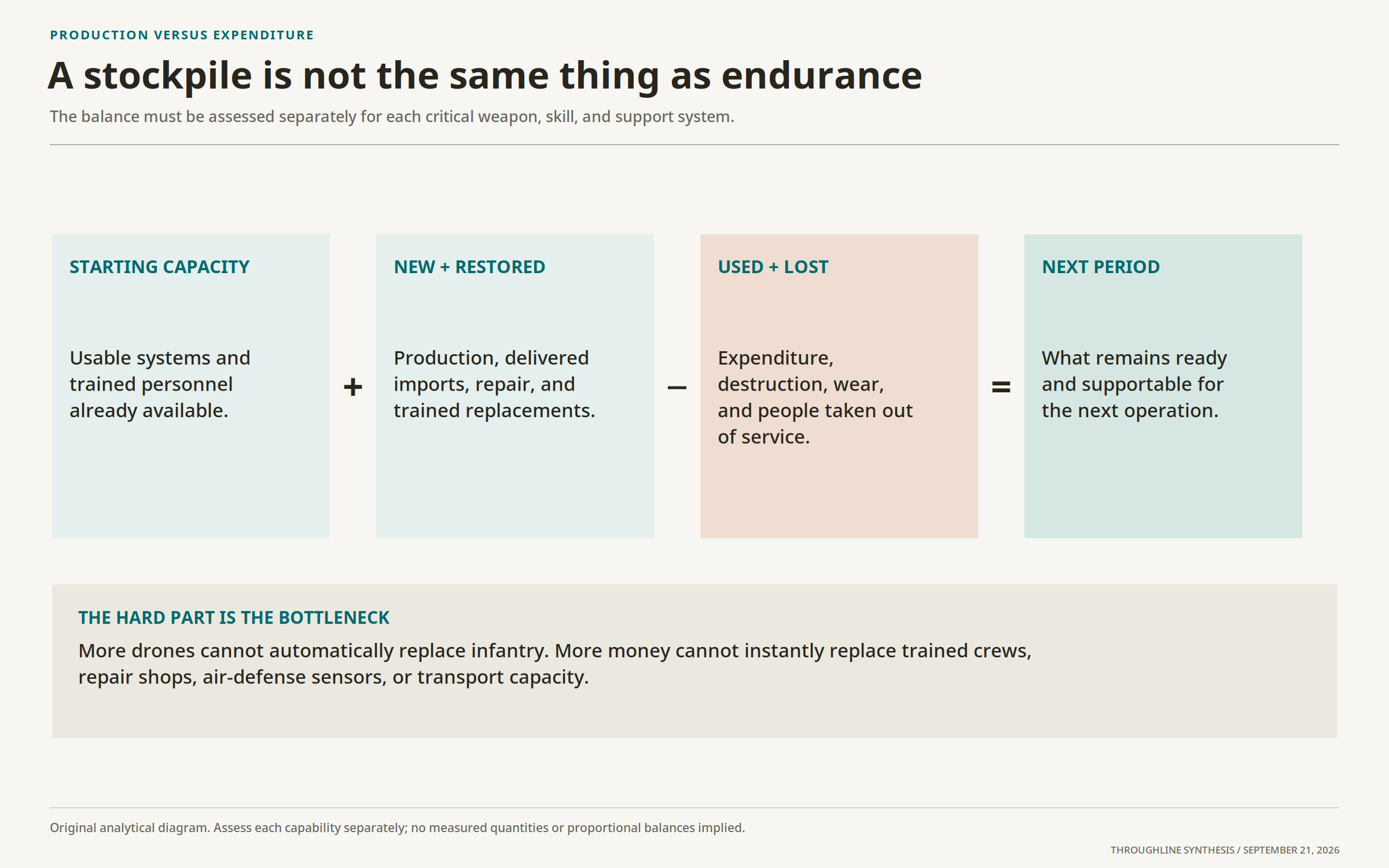
replaced. Expenditure without replacement consumes an army; this
conceptual diagram shows the mechanism, not either army’s measured
inventory.
On September 15, Ukraine’s presidency described tests of a domestic
interceptor against jet-powered attack drones, while acknowledging
further technical work and delivery requirements (presidential
statement). A promising test is not a protected power station. Until
the system is produced, distributed, crewed, supplied, and effective in
sufficient numbers, it does not keep a family warm or a hospital
operating. Calling the gap “innovation” does not close it. The publicity
arrives immediately; the protection is still somewhere in the future.
Ukraine is losing the present.
Odesa supplies the answer to all this promotional enthusiasm. On
September 19, before the following night’s Moscow refinery strike, DTEK
reported 178,700 consumers without power after Russian attacks; the same
account described earlier September damage disrupting electricity,
water, and electric transport (bne
IntelliNews, citing DTEK and Ukrainian authorities). Russia’s
withering campaign is stripping away the systems that make city life
possible. The destruction accumulates whether or not each strike is
announced as a reprisal. Another night of Ukrainian publicity does not
undo the previous day’s loss of power.
The International Energy Agency recorded approximately 18
gigawatts of demand against 11 gigawatts of available capacity in
mid-January 2026, with blackouts lasting 17 hours or more a day
in some areas, including Kyiv (IEA).
Ukraine has already endured those conditions. Winter does not care
whether a government has won the day’s news cycle. A northern country
cannot replace 17 hours of missing electricity with patriotic
advertising.
Picture the consequences instead of admiring the unit of measurement.
Where power-dependent heat and water fail, a family sits in a cold
apartment deciding how to get drinking water, keep a phone charged, and
stop an elderly parent from freezing. A hospital must keep essential
equipment running on backup power and fuel. A school building still
standing in the dark is not a functioning school. Those are the
dependencies behind the IEA’s warning about essential services (IEA).
“Infrastructure degradation” is the bloodless language of people who can
close the report and turn up their own thermostats. The people in the
report have to live there.
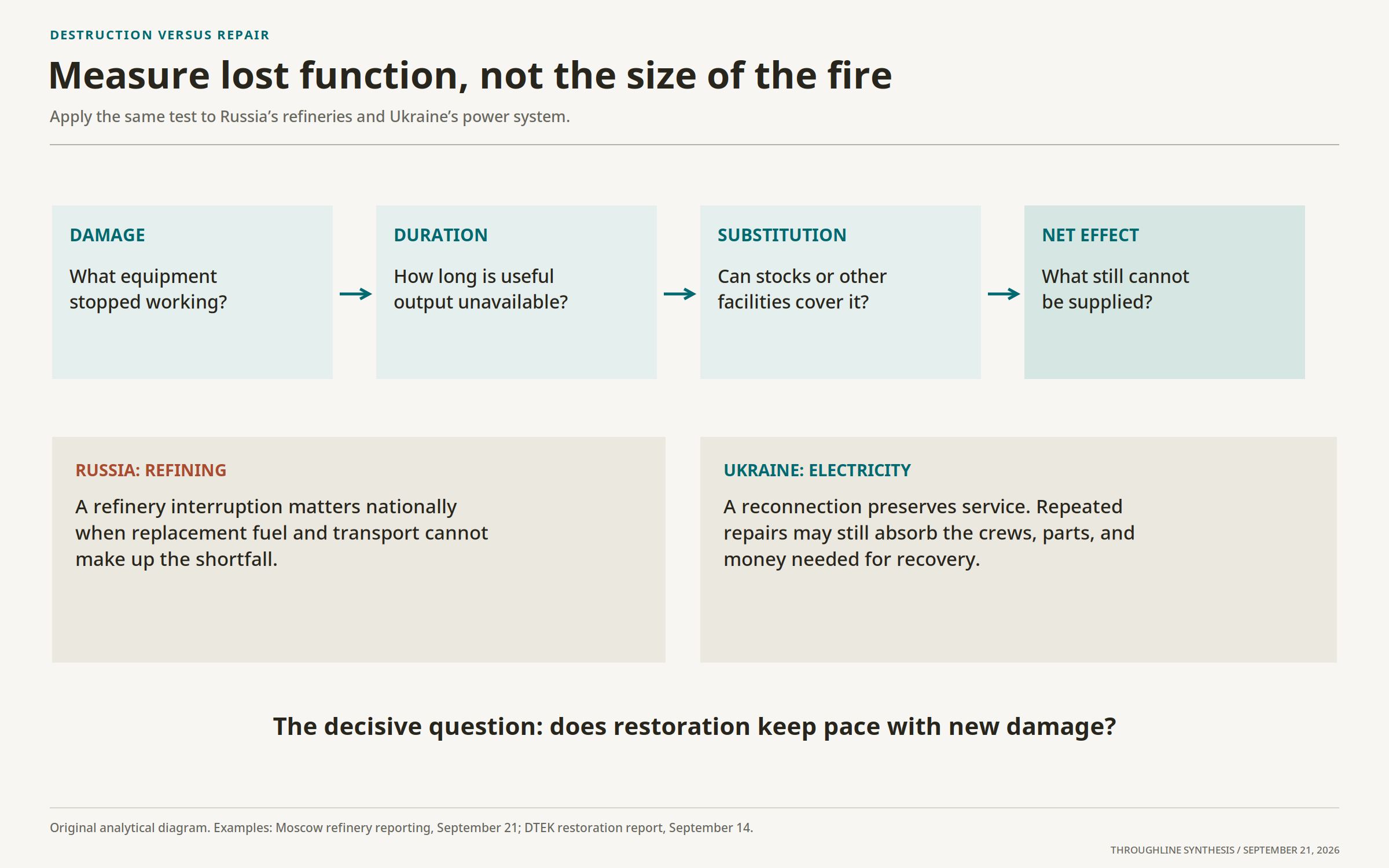
service that remains unavailable after repair and substitution.
DTEK reported restoring electricity in 250 settlements during
September 7 through 13, including places requiring repeated restoration
(DTEK).
The crews are keeping people alive. They are not proving that Ukraine is
winning. Repeatedly rebuilding yesterday’s minimum conditions consumes
the workers, equipment, and money that would otherwise build tomorrow’s
capacity. Applauding their courage while using it to excuse the policy
requiring endless emergency repairs is an insult to the work they are
doing.
This is how a country becomes unlivable without every building being
flattened. The roof remains, but the heat does not. The workshop
remains, but its machinery cannot run reliably. The family stays another
month, exhausts another reserve of money and patience, and leaves. The
propaganda machine calls this resilience until the people are gone.
Asking that family to admire a distant refinery fire is not merely
inadequate. It is obscene.
The same trap closes around industry. After suspending operations at
Pokrovske Coal, Metinvest announced an April 2025 shipment of American
coking coal and acknowledged the higher logistics costs of supplying its
Ukrainian steel plants (Metinvest).
Coal once obtained at home now travels through a longer, more expensive
supply chain. More money and more transport are required to preserve
less independence. Call it adaptation if you like. It is the expensive
business of keeping a damaged economy alive, not evidence that the
country is rebuilding the capacity to stand on its own.
Retired Russian Lieutenant General Yevgeny Buzhinsky described the
logic in his September 18 conversation with Larry Johnson: attacks on
locomotives, ports, and shipping are intended to restrict the movement
on which Ukraine’s military and economy depend (interview).
Ukrainian officials supplied concrete measures of the damage. Foreign
Minister Andrii Sybiha said Russia had damaged or destroyed
approximately 500 locomotives since the full-scale
invasion, while stressing the difficulty of obtaining replacements
compatible with Ukraine’s 1,520-millimeter rail gauge (Sybiha’s
statement).
A shipment cannot pull itself. Whether an engine awaits repair or
must be replaced entirely, its cargo has to wait or find another train.
Ammunition, fuel, repair equipment, export cargo, and evacuating people
compete for the transport that still works. A donated weapon stranded
behind a broken railway does nothing for the soldier waiting at the
front. Russia is attacking the means of turning Western promises into
Ukrainian military power. That is why locomotives matter, and why
counting another weapons announcement without asking how the weapons
reach the battlefield is such a comfortable form of self-deception.
On September 14, Infrastructure Minister Mykola Kalashnyk’s ministry
reported that cargo handling at the ports of Greater Odesa had fallen
more than 15-fold after July 22, while officials sought
alternatives through railways and Danube ports (Ukrainian
government statement). That is a collapse in the movement of cargo
through a vital maritime outlet. The ships do not all have to sink for
the supply system to fail at its job. Imports, exports, and military
supplies still have to move, and the alternative railway is already
fighting its own replacement crisis.
The ministry’s meeting addressed insurance, protection of vessels and
workers, compensation, and logistics costs (government
account). A port need not become a crater to become unusable. If the
ship cannot obtain workable insurance, load safely, and leave, the cargo
stays where it is. Ukraine loses revenue while paying more to supply
itself. The aid requirement grows as the capacity to function without
aid shrinks. That is dependence tightening its grip, not recovery
waiting patiently around the corner.
Russia is methodically attacking the connections that sustain
Ukraine’s military and civilian life. Strike electricity and the
workshop stops. Strike locomotives and the cargo waits. Constrict the
ports and more traffic falls on the damaged railway. Each broken
connection burdens the alternatives until “adaptation” means spending
more money, using more people, and accomplishing less. This is the
national system Ukraine must have to recover. It is being consumed while
its leaders advertise pinpricks in Russia as success.
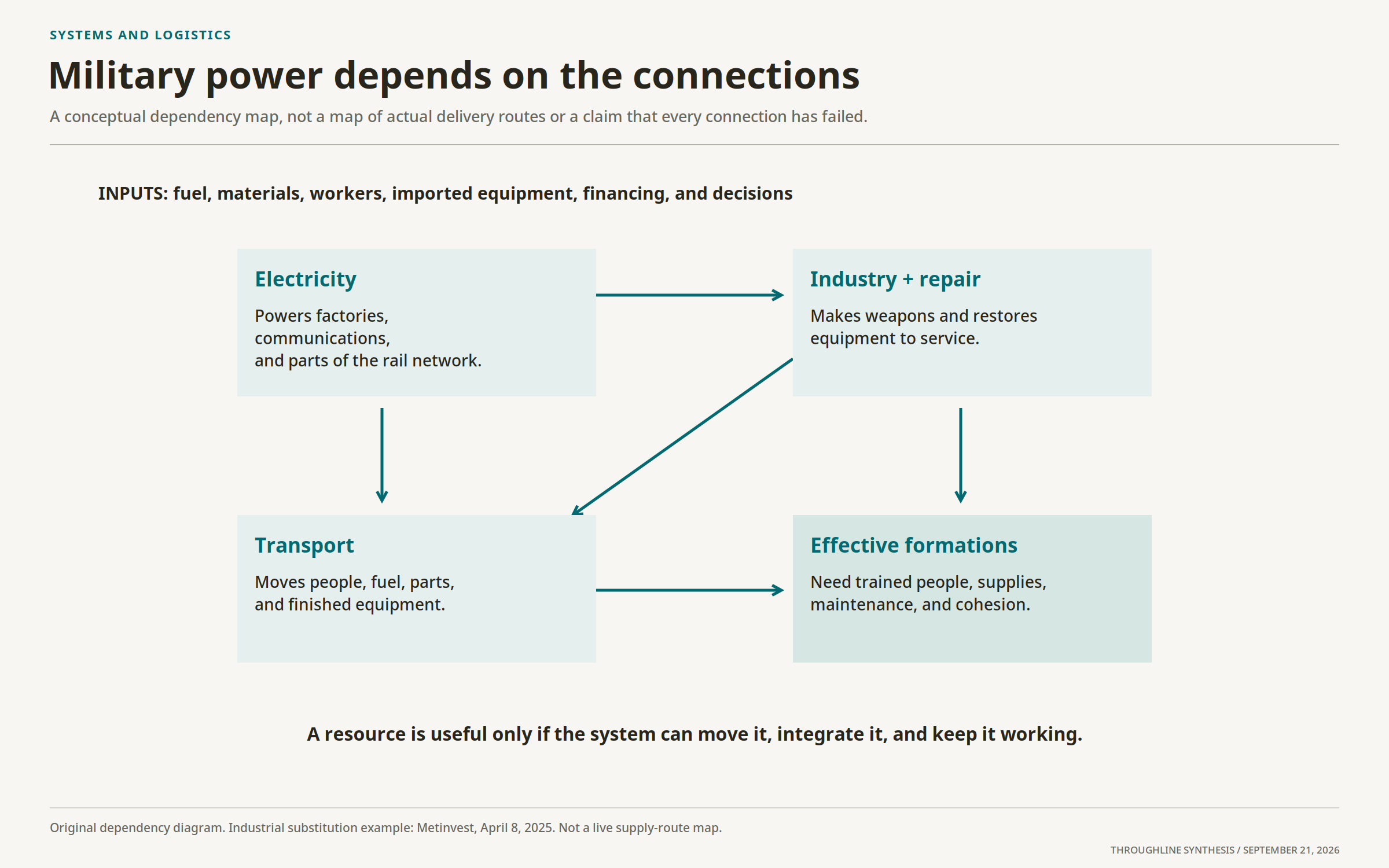
supply, and operate it. These arrows show dependencies, not live
military routes.
The army cannot outlive its
society
A dispersed population is not a reserve army. A man living abroad is
not a trained formation waiting for tomorrow’s orders, and a
mobilization notice does not manufacture an experienced officer,
engineer, medic, technician, or infantryman. An army must assemble,
train, move, and fight together. It must also protect that concentration
from attack. Ukraine cannot solve the problem by scattering people to
survive and then pretending that the scattered people constitute an
effective army. Somebody has to bring them together, equip them, move
them, and keep them alive.
Ukraine’s leaders cannot order lost experience back into existence
any more than they can order a missing generation into adulthood.
Replacing an exhausted unit requires another unit, not a speech about
national determination. The army can keep fighting while the society
supplying its replacements is hollowed out beneath it. “It has not
collapsed yet” is the defense of a policy that has nothing better to
offer. It is not a strategy for victory. It is a request to keep
consuming the army until collapse settles the argument.
Buzhinsky describes Russian small assault groups infiltrating
positions and cutting supply routes rather than relying on large frontal
operations, an approach he says trades speed for lower losses (September 18
interview). The point is not to satisfy a Western television
audience’s appetite for moving arrows. It is to make the Ukrainian
position harder to supply, reinforce, and hold. A defender worn down
behind a tightening supply problem is not rescued by a commentator
announcing that Russia advanced only a short distance. The army has to
survive the method, not win an argument about the map’s animation.
For readers lost among the place names, an oblast is an
administrative region, roughly the geographic role a state plays on an
American map; Donbas commonly means Donetsk and Luhansk oblasts in
contemporary political discussion (regional
reference, Donbas
geography). Sloviansk and Kramatorsk are in Donetsk Oblast;
Pavlohrad and Dnipro lie farther west in Dnipropetrovsk Oblast (geographic
data, Sloviansk, Pavlohrad). These are
connected urban and industrial centers, not interchangeable dots. Losing
a defensive position can endanger the roads, railways, workshops, and
population behind it.
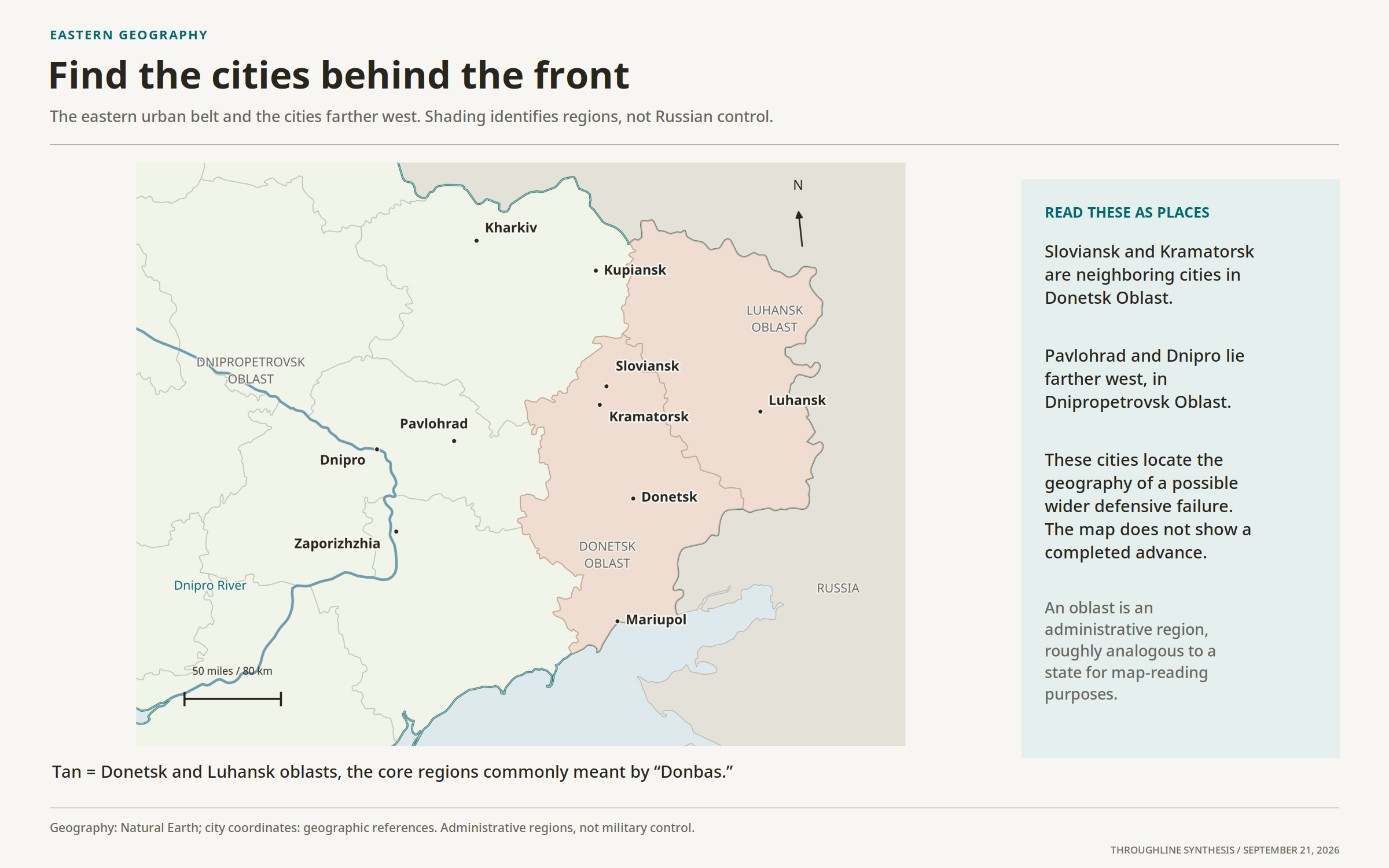
administrative regions, not Russian control or a completed advance
toward Dnipro.
Listen to the government demanding more sacrifice. In January 2026,
Defense Minister Mykhailo Fedorov told parliament that approximately
200,000 soldiers were absent without leave and
approximately 2 million Ukrainians were wanted for avoiding
military service (parliamentary
disclosure). These are its own administrative counts. This is not
Russian propaganda inventing a participation crisis. It is the Ukrainian
defense minister describing one. Men cannot be conjured into the ranks
by a Western editorial insisting that the nation remains united in its
determination to fight.
The record had been accumulating for years. Prosecutors registered
235,646 unauthorized-absence cases and 53,954 desertion
cases from January 2022 through September 2025, or
289,600 proceedings, with individual people potentially
appearing in more than 1 proceeding (NV’s
reporting). What does Kyiv offer the man it intends to compel into
service? What attainable result justifies demanding the rest of his
life? “More of the same” is not an answer. Neither is applause from
people whose own sons are not being summoned.
Fedorov also described 500 Ukrainian drone-producing companies, 200
businesses making jamming equipment, and more than 20 private missile
producers (same
disclosure). There is the favored distraction again: count the
technology and hope nobody notices the missing people. Drones still need
operators, power, communications, maintenance, transport, and an army
capable of holding ground. Technology can change the way people fight.
It cannot abolish the need for a society capable of sustaining them.
Behind the army stands the demographic catastrophe. Gladun dates
Ukraine’s population contraction to 1993 and describes the war as an
accelerator (Gladun
interview). Ukraine entered this confrontation with a population
already in decline. Its leaders did not have a limitless reserve of
young families to spend. The war accelerated a national weakness into a
crisis that cannot be reversed by announcing a ceasefire and inviting
the cameras to a reconstruction conference.
The 2024 CIA World Factbook estimates placed Ukraine at the world’s
lowest crude birth rate and highest crude death rate, as reported by
Reuters (demographic
reporting). The civil-registration figures put people behind that
ranking: 496,240 deaths against 187,387 births in 2023,
approximately 265 deaths per 100 births, followed by
495,090 deaths against 176,679 births in 2024,
approximately 280 per 100 (Opendatabot).
The ratio reached roughly 3.55 to 1 in the first half of 2026 (2026
registrations). Before a single emigrant is counted, Ukraine is
failing to replace the people it loses. Calling that a demographic
challenge is an evasion. It is the country’s future disappearing from
the birth register.
In December 2025, demographer Ella Libanova estimated fertility at
approximately 0.7 children per woman, against a
replacement benchmark of 2.15 (Libanova
interview). That is about 1/3 of the benchmark. A separate UNFPA
report used 0.9, also nowhere near replacement (UNFPA).
A small generation produces an even smaller next generation, which
starts with fewer prospective parents. The shortage compounds. A
reconstruction budget cannot persuade an absent generation to have
children.
Gladun puts the population across Ukraine at 51.7 million at
the end of 1991, compared with approximately 28 million
on government-controlled territory in early 2026, a change
combining demographic decline, migration, and reduced territorial
control (Gladun).
Kyiv recruits, taxes, repairs, and rebuilds with the people available to
it, not with a historical population total. A person abroad or beyond
its control cannot simply be entered back into the national workforce
because a ministry needs the number. The governing state has a far
smaller human base and an enormous burden to place on it.
Libanova separately estimated approximately 10 million in
war-related demographic losses in December 2025, including
excess mortality, births foregone, migration, and occupation (Libanova).
Ukraine’s demographic strategy cites a projection of approximately
25.2 million people by 2051, while reporting on the
UN’s 2024 projections gives approximately 15.3 million by
2100 (official
strategy summary, UN
projection reporting). These separate projections describe the scale
of the long-term problem. The promised recovery is supposed to be built
by a population expected to keep shrinking. Who, exactly, is going to do
the work?
The breaking point relevant to this argument is not the day the last
Ukrainian disappears. It is the point at which the country cannot
reproduce the human and material foundations of independent national
life on the timetable survival requires. Missing adult workers cannot be
replaced by babies born after a peace agreement. Children never born
during the war will not arrive late for school, enter employment late,
or become parents on command. Those lost cohorts cannot be restored
retroactively. Money can finance a building; it cannot buy back the
years needed to raise the people who would use it. That is why the
damage outlasts the war.
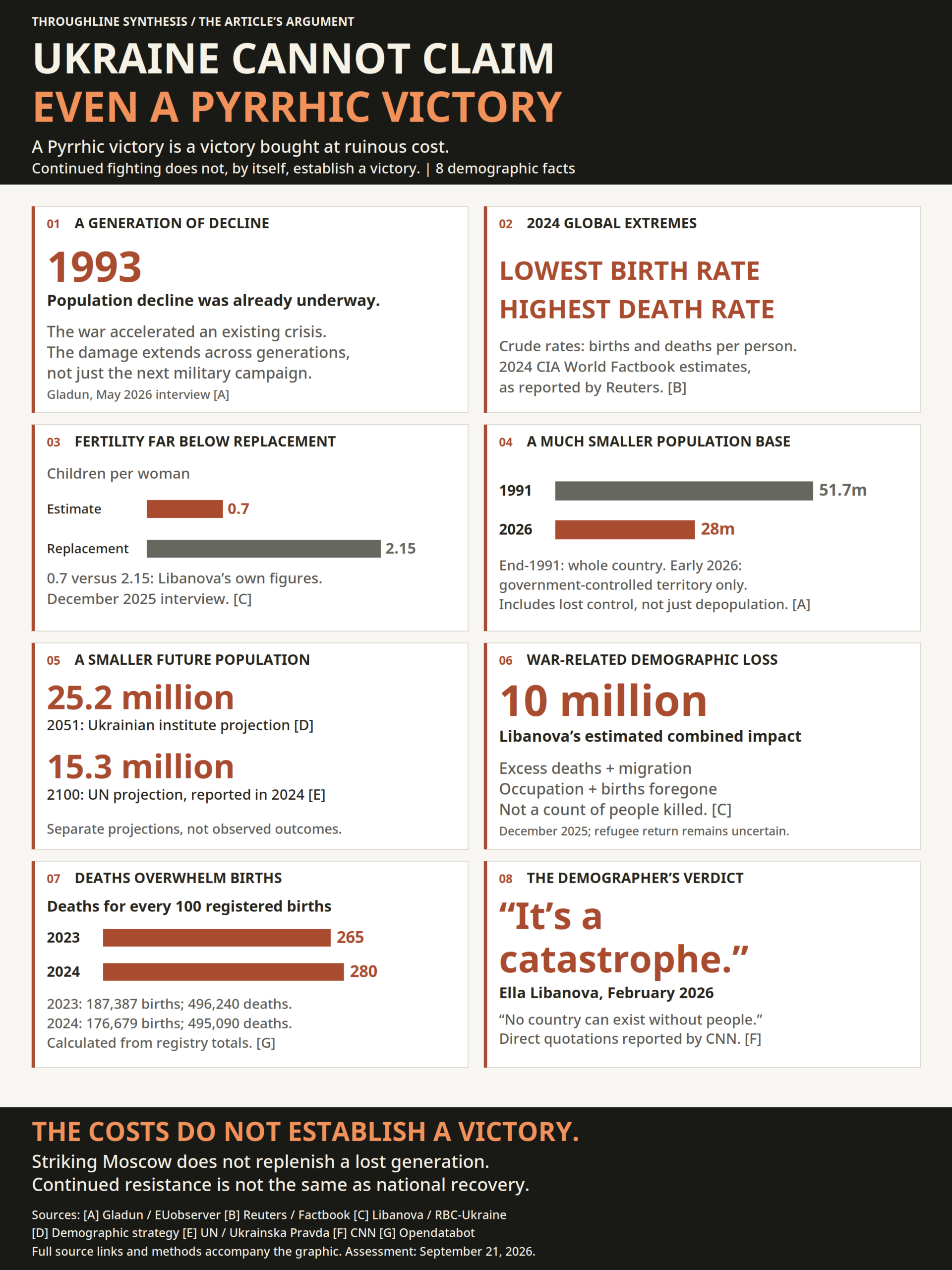
demographic findings show why imposing costs on Russia cannot restore
the people Ukraine needs for national recovery; dates and territorial
coverage remain essential to reading the figures correctly.
“It’s a catastrophe,” Libanova said in February 2026. “No country can
exist without people” (Libanova,
quoted by CNN). As of April 30, UNHCR figures cited by Ukraine’s
economy ministry recorded 5.762 million Ukrainian refugees
worldwide excluding Russia, including 5.213 million in
Europe (Interfax-Ukraine).
This displacement is part of the combined demographic loss, not an
additional total. Every family building a future elsewhere confronts the
question Kyiv’s slogans cannot answer: why return to a country whose
promised recovery depends on the people who have already left?
Libanova explained what time does to those decisions: “With each
passing month, there is more and more destruction here and, on the other
hand, more and more of our war migrants are adapting to their new life
abroad. Fewer are returning” (interview
reporting). Temporary refuge becomes a job, a school, a language, a
relationship, a home. A mother is not going to uproot her children again
so a minister can meet a population target. She needs heat, water, work,
schooling, and a credible future. Send her another clip of a burning
Russian refinery and see which of those needs it meets.
The family damage is not an abstraction either. In February, CNN
reported, citing official statistics, that 59,000 children were
living without their biological parents, most in foster
families, a category broader than children orphaned by the war (reporting
on children and families). Those children need years of care, stable
homes, schooling, and adults they can trust. An armistice does not give
them back their childhoods. A reconstruction conference does not erase
what their families have endured. The bill extends across lifetimes, not
budget years.
Libanova also warned that rebuilding would require workers, “and
mostly skilled ones,” while doubting that skilled foreigners would
arrive in large numbers to fill the shortage (Libanova).
The electrician needed to restore power also needs a home, a school for
his children, health care, and a functioning community. Families stay
away because those services are broken; the services stay broken because
the people needed to restore them have not returned. The recovery plan
assumes the simultaneous return of everything the war has driven apart.
That is not a plan. It is a wish with a funding request attached.
This is why Ukraine cannot claim even a Pyrrhic victory. Inflicting
costs on Russia does not restore Ukraine’s missing generations. It does
not create the workforce, families, tax base, and public services
required to turn a surviving state into a livable country. The
demographic evidence is not an unfortunate footnote to a successful
strategy. It is the evidence against the strategy itself. The people
selling victory have no answer because the human losses cannot be
refinanced, repackaged, or delivered in the next aid shipment.
Ukrainians
pay. Their sponsors and leaders must answer.
Foreign aid can keep a lost war going. That is its danger when
continuation becomes an end in itself. For the soldier waiting for
equipment, the question is not whether a sponsor held an impressive
press conference. It is whether the equipment arrives, works, and can be
sustained before his position is lost. He does not fight with a
communiqué. He cannot take cover behind an allocation.
The European Commission’s September 11 notice reported €28.3
billion allocated to defense support for 2026 and €8.35 billion
disbursed, with a newly approved €6.1 billion
package still requiring contract checks before payment (Commission
notice). That left €19.95 billion between allocation and
disbursement. The issue here is time and delivery. Even disbursed money
must become equipment in the hands of a trained crew before it can
defend anything. The press release can be completed in an afternoon. The
soldier has to survive the interval.
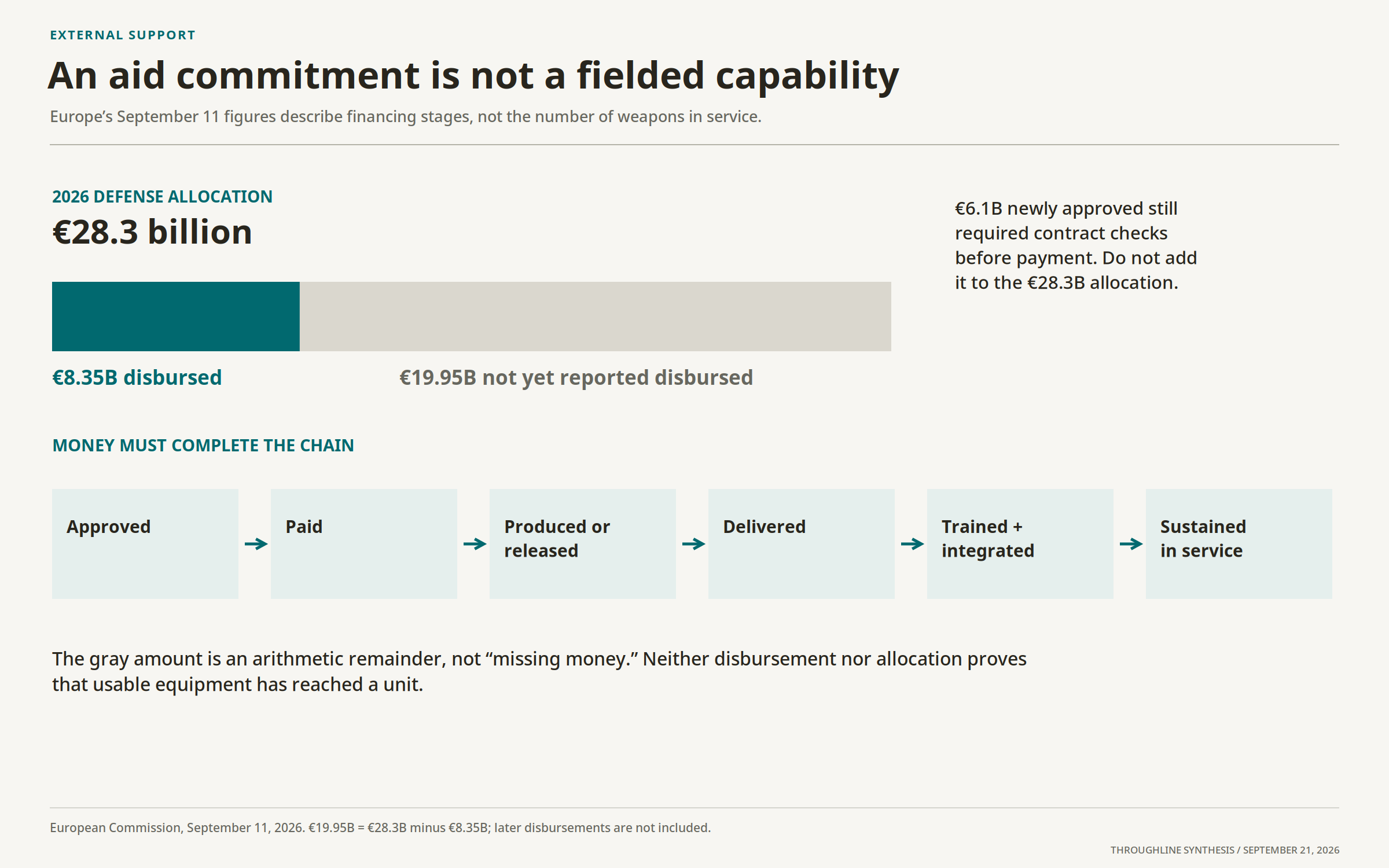
become equipment, delivery, training, and sustained operation; the newly
approved €6.1 billion is not added again to the stated allocation (Commission
notice).
An army cannot use a pledge to rotate an exhausted unit. A repair
crew cannot install an approval. Assistance arriving after the people
and infrastructure needed to use it have been lost is not rescued by the
generosity of its announcement. Ukraine waits on decisions, production
schedules, and political priorities it does not control. That is what
dependency means when the cost of waiting is measured in lives.
The industrial failure Johnson raised has a documented American
example. ProPublica’s August investigation reported that the Army had
paid $533 million for General Dynamics’ Mesquite,
Texas, artillery plant without receiving a usable shell from the
facility, and that work on 2 of its 3 production lines
had been halted in August 2025 (ProPublica
investigation). General Dynamics disputed the characterization; the
Army said it was evaluating performance and seeking recovery through
discounts on other production orders (company
and Army responses). A discount on a future order is a marvelous
consolation to a procurement office. What does the Ukrainian gun crew
fire today? A contract? A groundbreaking photograph? The
military-industrial complex collects its money while the promised
industrial miracle remains a promise.
Here is the larger obscenity. A foreign strategist can count
prolonged Russian expenditure as a benefit while Ukraine counts the same
period in dead men, missing births, broken power stations, and families
gone for good. The strategist can be pleased with the exchange. The
country being used to conduct it cannot afford to be. A policy useful to
Washington or London can be a national catastrophe for Ukraine. Treating
the sponsor’s satisfaction as the proxy’s victory is the central
deception.
This is a proxy war, and Ukrainian leaders do not escape
responsibility by pointing to the sponsors. They chose to stake their
country on the bargain. Their sponsors encouraged it without delivering
an attainable victory. “We will support you for as long as it takes” has
become a phrase designed to prevent the question it ought to answer: as
long as it takes to do what? Exhaust the remaining army? Empty another
generation out of the country? Leave Europe a dependent state and call
the arrangement freedom?
Then there are the people controlling Ukraine’s resources. A
government demanding a man’s body, a family’s security, and a nation’s
future has no standing to resent questions about money and privilege at
the top. The demand for sacrifice runs downward with extraordinary
clarity. Accountability must run upward with the same force. Otherwise,
patriotism becomes the language in which the powerful invoice everyone
else.
For a soldier, the demand is brutally concrete. On July 7, 2026, the
Stryi City District Court sentenced a mobilized serviceman to 5
years in prison for an unauthorized absence lasting from
December 2022 until his voluntary return in December 2025; he cited a
metal plate in his leg and a wish to transfer, while the court noted
that the military medical commission had found him fit for service (court
reporting). There is nothing vague about that obligation. Serve, or
lose years of your life to prison. The state knows how to collect from
the individual. Now look at what its investigators say was happening
above him.
In November 2025, Ukraine’s National Anti-Corruption Bureau, known as
NABU, and Specialized Anti-Corruption Prosecutor’s Office, known as
SAPO, announced Operation Midas, alleging that Energoatom contractors
faced kickback demands of 10% to 15% of contract value
to avoid blocked payments or loss of supplier status, and that
approximately $100 million passed through an associated
laundering operation during the documented period (NABU
announcement). Energoatom is not a peripheral concern in a country
struggling to keep its energy system alive. The alleged scheme put
private enrichment between a strategic state enterprise and the
contractors doing its work.
The alleged conduct is not a minor blemish on an otherwise inspiring
story. It is a private toll on an essential public system while citizens
are expected to endure darkness and soldiers are expected to endure the
front. Let the court determine criminal guilt. The public does not have
to postpone the political question: how does a leadership demanding
everything from ordinary Ukrainians answer an allegation of organized
extraction from the system keeping them alive? Compulsory sacrifice
below and alleged enrichment above make a grotesque pairing.
The investigations reached senior figures. Former Energy Minister
German Galushchenko was detained on February 15, 2026, while attempting
to leave Ukraine, in a case alleging participation in a criminal
organization and money laundering (NABU
notice, Washington
Post reporting). In May, former presidential chief of staff Andriy
Yermak faced a formal suspicion of laundering approximately 460
million hryvnias, about $10.5 million at the
time, through a luxury housing development near Kyiv; he denied
wrongdoing and called the notice “unfounded” (Al
Jazeera). These remain criminal allegations. Their proximity to the
summit of power makes independent investigation more urgent, not less. A
soldier asked to surrender his remaining years is entitled to know what
the men governing him were doing with theirs.
The power to investigate was itself under attack. Zelensky backed a
measure in July 2025 curtailing NABU’s and SAPO’s independence, then
reversed course after public protests and European pressure (RFE/RL).
In November, NABU director Semen Kryvonos said interference had been
discussed in “high offices,” and SAPO chief Oleksandr Klymenko described
meetings intended to influence investigators; Kryvonos said the energy
investigation would have been destroyed without the protests that
preserved the agencies’ independence (agency
chiefs’ accounts). Ukrainians had to defend the independence of
investigators examining their leadership’s circle while that leadership
demanded more sacrifice in the name of national independence. The
contradiction is not subtle.
Zelensky subsequently called for full cooperation with the
investigation and an overhaul of the energy sector (RFE/RL).
That does not erase his earlier support for weakening independent
scrutiny. A later declaration of cooperation is not a receipt proving
that the obligation has been paid. The question is what investigators
can discover, whom they can pursue, and whether political power can stop
them.
The Pandora Papers add a separate question about the president’s
financial interests. The investigation reported that Zelensky and his
wife held a 25% stake in Maltex Multicapital through Film
Heritage, that Film Heritage transferred the stake before the
2019 election to a company belonging to Serhiy Shefir, and that a
subsequent document provided for continued dividends to Film Heritage
despite the transfer; Olena Zelenska became Film Heritage’s sole
beneficial owner in 2019 (OCCRP
investigation). The documents establish the contemplated dividend
arrangement, not actual payment; the identified London properties
belonged to associates (OCCRP).
There is no need to invent an estate or a payment to ask the obvious
question. Did the transfer end the family’s financial benefit, or did it
change the paperwork while preserving the possibility of payment? The
public deserves an answer, not indignation that it asked.
Borys Shefir defended the offshore arrangements as protection from
“authorities and bandits,” while Zelensky’s spokesman declined to
comment (OCCRP).
The issue is financial disclosure and public accountability, not a
criminal verdict inferred from offshore ownership. If arrangements
protect the interests of the people at the top, the public is entitled
to understand how. A government demanding extraordinary exposure from
everyone else does not get to wrap its own financial interests in
silence.
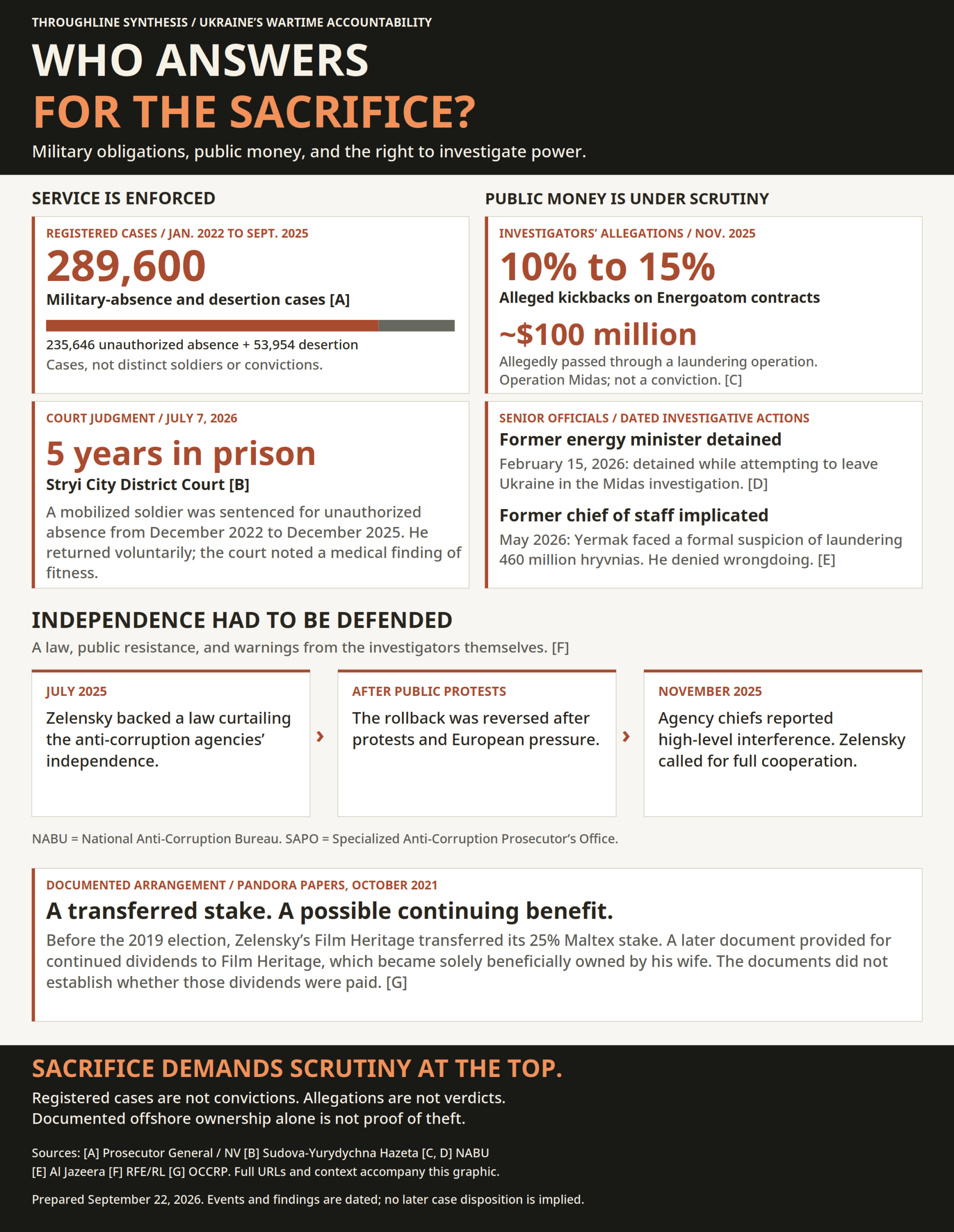
enforceable demands on their bodies and lives; their leaders owe
enforceable accountability for public resources and private interests.
The graphic labels court findings, allegations, and financial records
separately.
The investigators deserve protection because they are doing the work
that power has reason to resist. Their existence does not absolve the
people they investigate, and the eventual fate of a criminal case does
not erase the public’s right to answers now. Ukrainians supply the
service, labor, taxes, and families on which the state depends. They are
not raw material for a leadership exempt from the sacrifices it
demands.
Accountability cannot stop at procurement. The greater indictment is
the decision to keep spending lives and country on a war with no
credible route to victory. A leader can spend every dollar honestly and
still spend his country disastrously. A clean invoice does not make a
hopeless strategy responsible. Neither does another photograph of him
demanding that somebody else hold on.
Dependency is not
sovereign recovery
We are told that Ukrainians are fighting for independence. Then
measure what independence requires. People. A functioning economy.
Power. Transport. Public services. A government capable of sustaining
essential decisions without waiting indefinitely for somebody else’s
appropriation. Preserve the flag while consuming those foundations and
you have preserved a symbol at the expense of the country. Calling that
victory does not make it less of a defeat.
The dependency at issue is not ordinary trade or borrowing. It is the
permanent outside underwriting of the essential functions of national
life. Put the demographic losses, damaged energy system, constricted
transport, military demands, and reconstruction labor shortage together.
Ukraine needs sponsors to sustain the conditions under which recovery
could even begin. Replacing a weapons package with a European
reconstruction package changes the label on the dependence. It does not
give Ukraine back control of the resources required to sustain
itself.
A lost war can continue. That is why refusing to recognize defeat is
so dangerous. Sponsors can prolong the fighting, soldiers can hold
positions, and another clever weapon can inflict another loss. None of
that explains how continued war restores the country being consumed by
it. The ability to keep inflicting pain is not a route out of defeat. It
is the means of making the defeat more expensive for everyone, above all
Ukrainians.
Return to the Moscow refinery. The shutdown reporting describes an
interruption at a Russian plant (refinery
reporting). It does not describe a restored Ukrainian workforce, a
repaired Ukrainian power system, or a way to finance an independent
Ukrainian future. Another attack can produce another repair bill and
another headline. The people promoting the campaign still owe the
explanation they avoided at the beginning: how does the next fire win
back what Ukraine has lost?
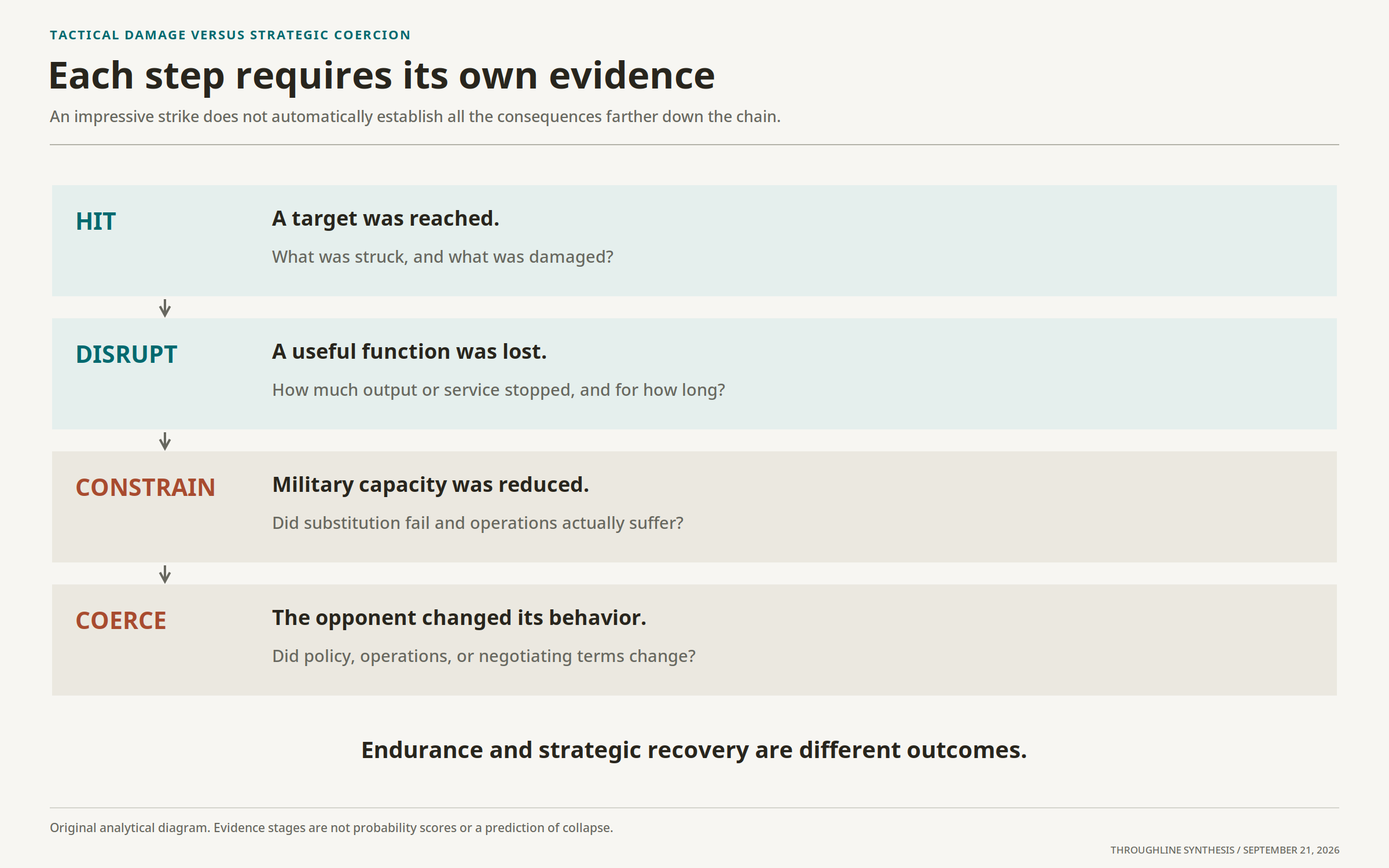
Publicity cannot fill the gap between the stages.
Russia does not have to emerge unscathed for Ukraine to lose. “But
Russia paid a price” is the consolation prize offered when no Ukrainian
victory can be produced. The issue is what Ukraine has left and what
continued war can still secure for it. On that question, the victory
narrative is bankrupt. It protects the reputations of the people who
sold the war by asking Ukrainians to keep paying for it.
A Ukrainian victory must belong to Ukraine. It cannot be measured by
the satisfaction of foreign strategists, the volume of weapons
contracts, or the pleasure of watching a Russian refinery burn while
Ukraine loses the foundations of normal life. The country cannot claim
even a Pyrrhic victory because the victory itself is missing. What
remains is a ruinous defeat advertised as perseverance by people with an
interest in never calling it what it is.
There are still people to protect and a country to keep habitable.
That makes ending the destruction urgent, not optional. Protect the
remaining population. Restore essential services. Seek a settlement that
families can trust enough to consider returning. Europe may finance part
of that salvage, but do not sell it as the restoration of the sovereign
future this war was supposed to secure. A dependent state kept alive by
outside underwriting is not the promised victory. It is what can be
salvaged from its failure.
A settlement will require enforceable terms and hard decisions. That
is the job of diplomacy, not an excuse to avoid it. The people who
dismissed compromise as unacceptable must answer for what their
alternative has produced. They do not get to consume more lives while
demanding that everyone wait for a military reversal they cannot
explain. Diplomacy must be judged by what it preserves, not by whether
its language protects the egos of the people who miscalculated.
Buzhinsky warns that direct war with Europe would not remain a
prolonged conventional contest (September 18
interview). Dismissing that warning because one dislikes the retired
general delivering it would repeat the habit that brought us here:
treating an adversary’s stated limits as material for ridicule rather
than something policy must confront. Widening the war because the proxy
strategy failed is not resolve. It is doubling the wager after losing
the country that placed it. Europe needs to stop before the refusal to
acknowledge Ukraine’s defeat produces a catastrophe beyond Ukraine.
Ukraine has lost. Russia has won. Refusing to say so will not bring
back a dead soldier, restore a missing generation, or heat a Ukrainian
home. Ukraine’s remaining prospect is dependency and salvage, not the
sovereign recovery promised by the people who encouraged a war it could
not win. Another pinprick in Russia will not change that. Another
weapons contract will not change that. Another chorus of neoconservative
applause will not change that. Stop sacrificing the people who remain to
protect the reputations of the people who were wrong.
Geographic reference
These maps provide the scale and territorial context behind the
argument. Control, reported advances, and strike locations mean
different things; the legends distinguish them.
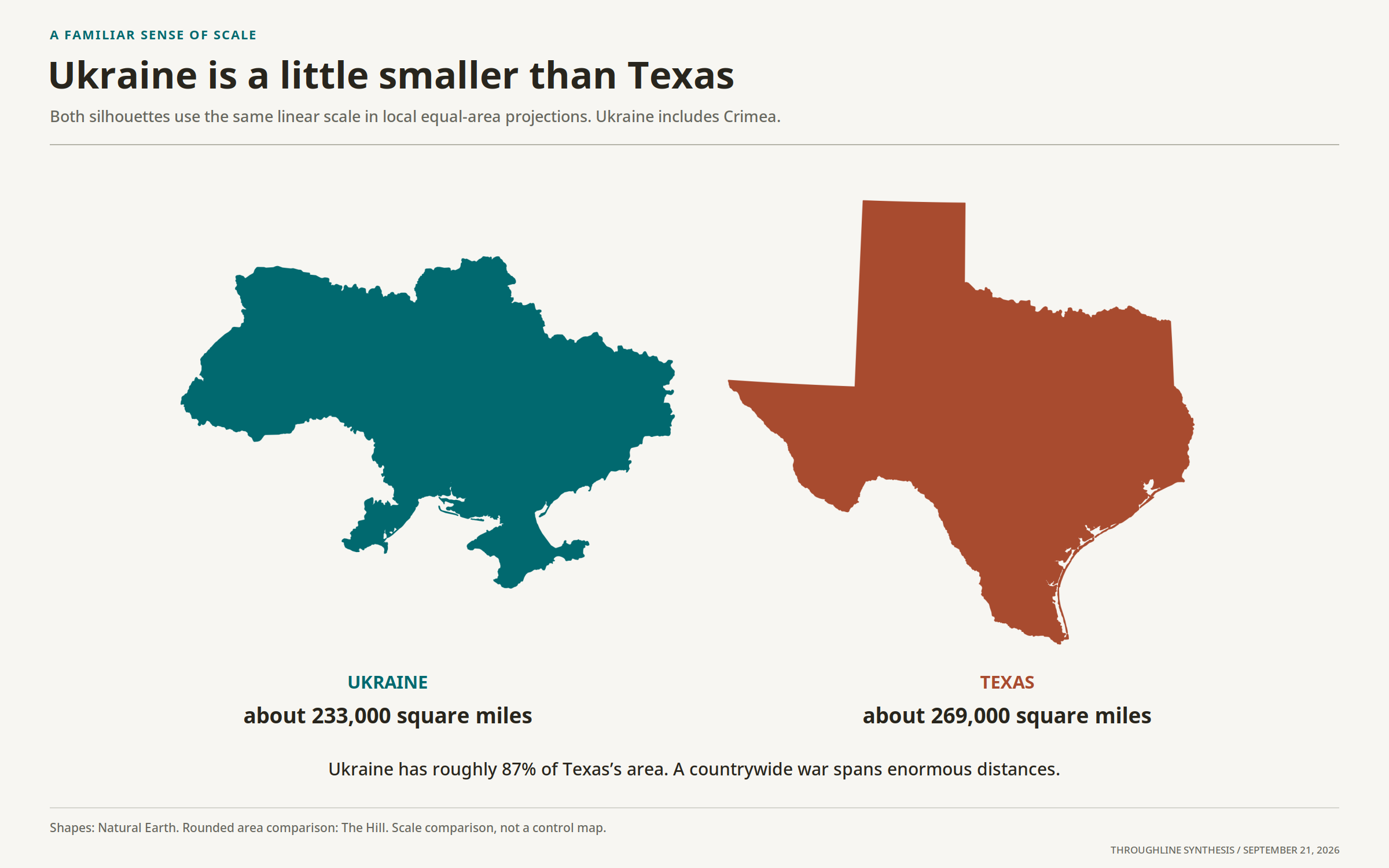
of its area; the comparison includes Crimea and concerns physical scale,
not military control (area
comparison).
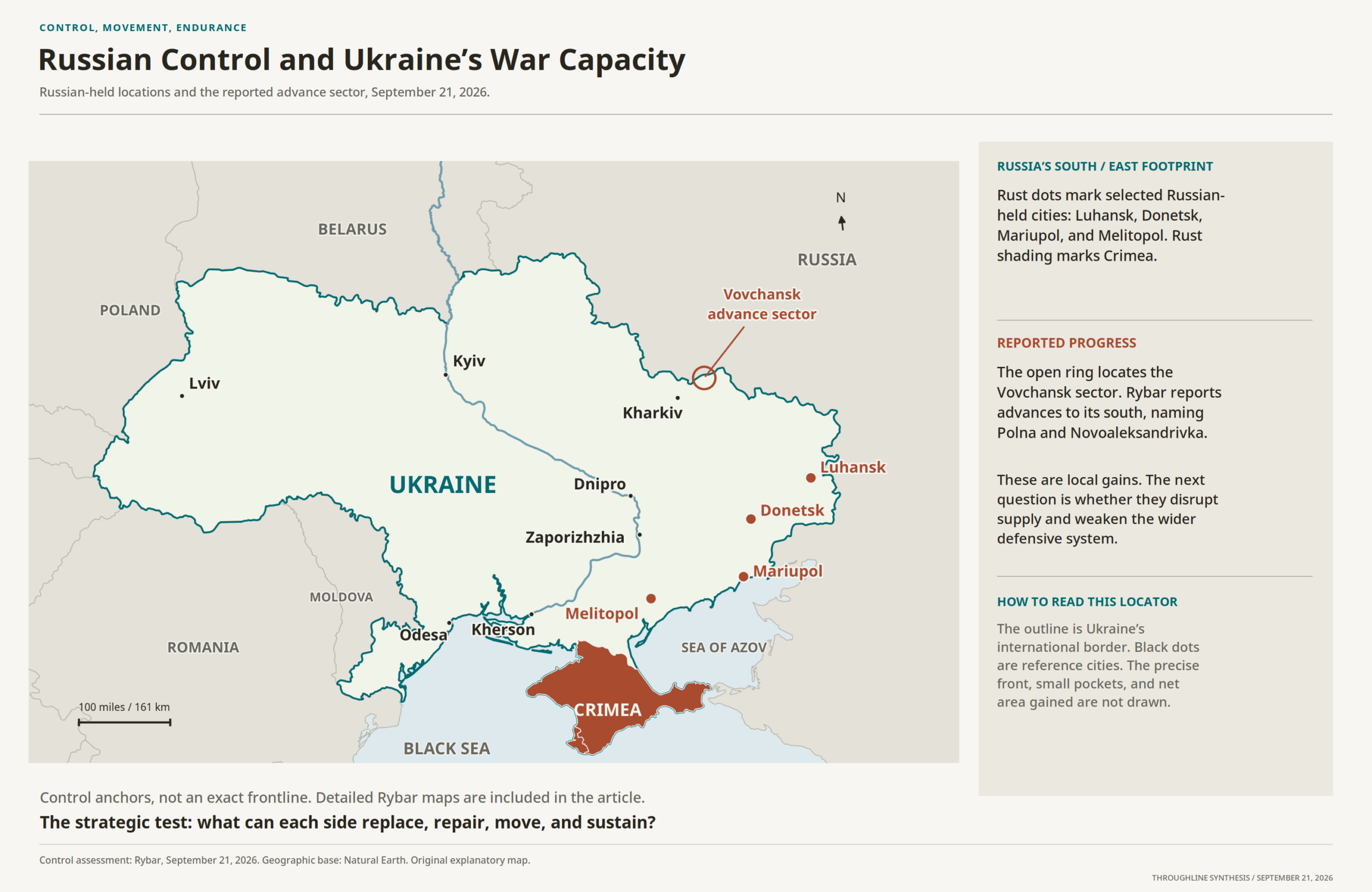
advance sector, based on Rybar’s September 21
assessment. Rust dots and Crimea shading identify control; other
markers provide orientation, not a precise frontline.
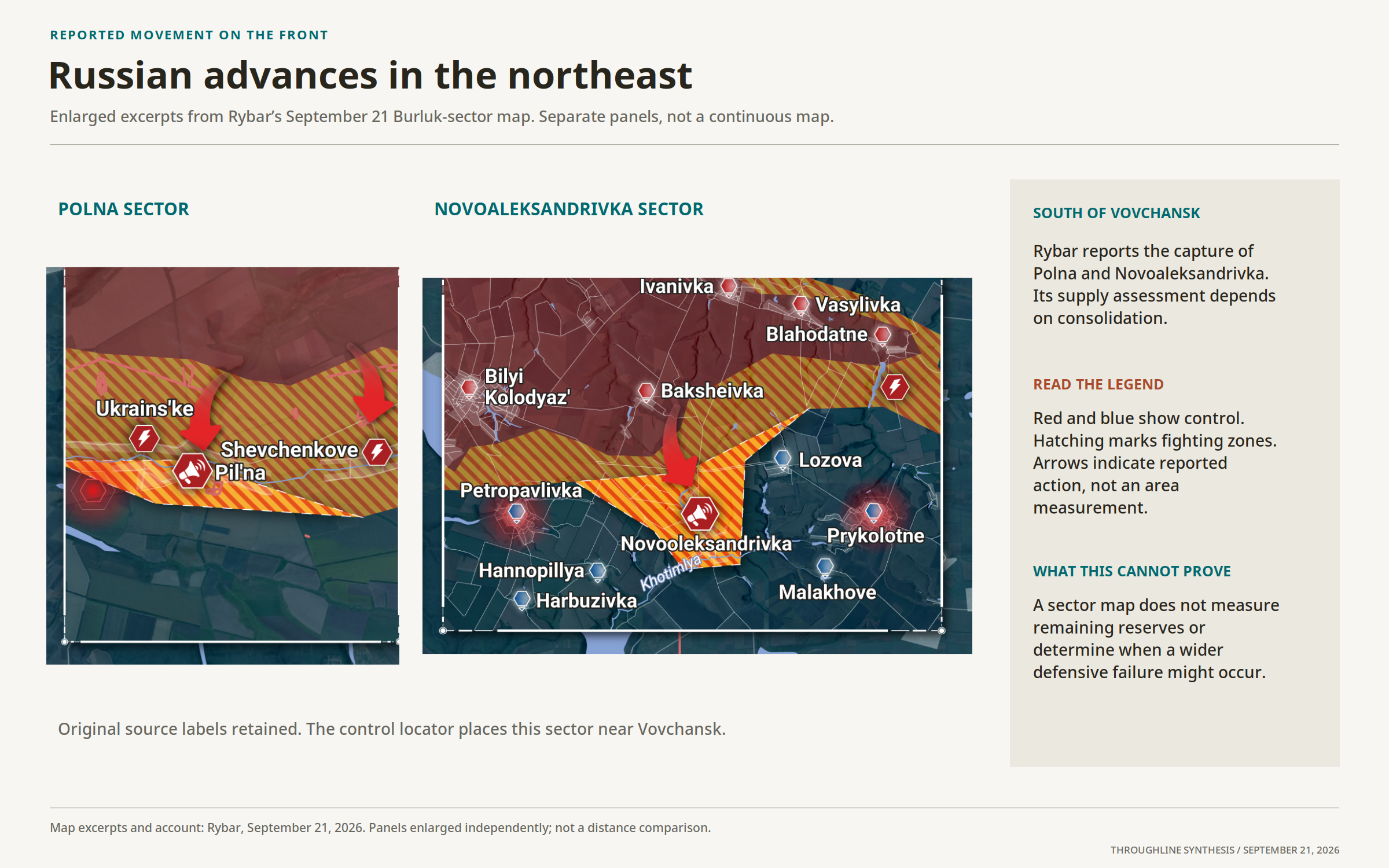
south of Vovchansk and argues that consolidation could complicate supply
to the northern Ukrainian pocket (sector account). This is the
northeastern Burluk sector, not the Sloviansk-to-Dnipro geography in
Figure 5; the panels are enlarged independently.
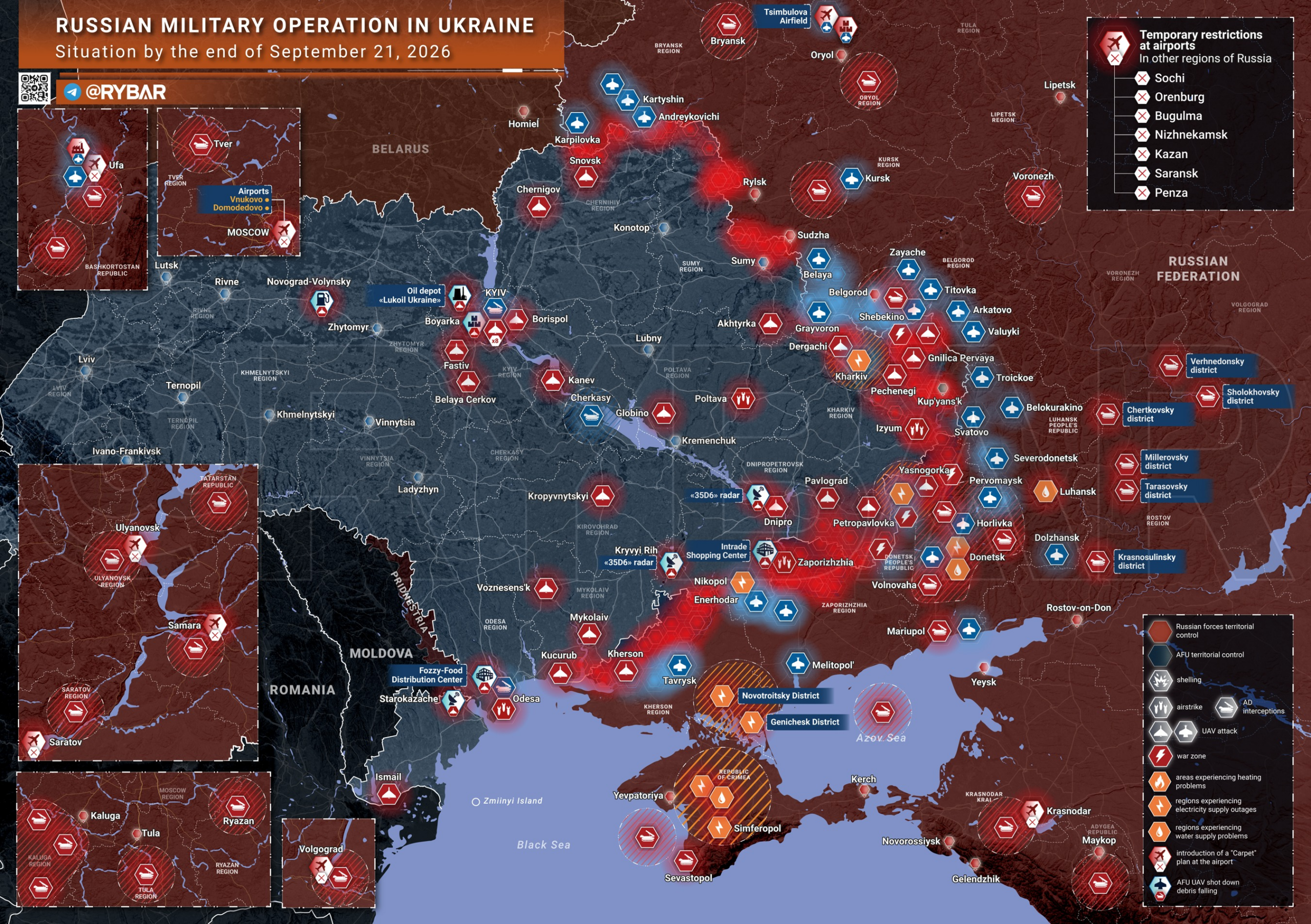
land represents Russian control, blue land Ukrainian control; bright red
activity overlays and strike symbols are not additional territorial
gains (national
overview, dated
account). The map is a dated source assessment, not an independently
surveyed frontline.
The cover is an editorial illustration, not a photograph or
reconstruction of the Moscow refinery attack. Its geographic outline
does not depict military control.