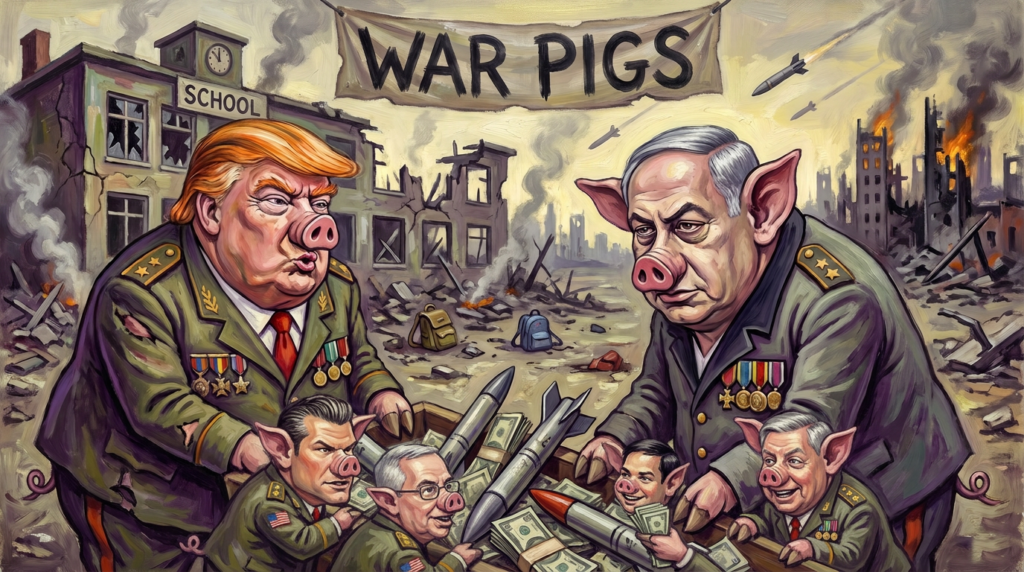
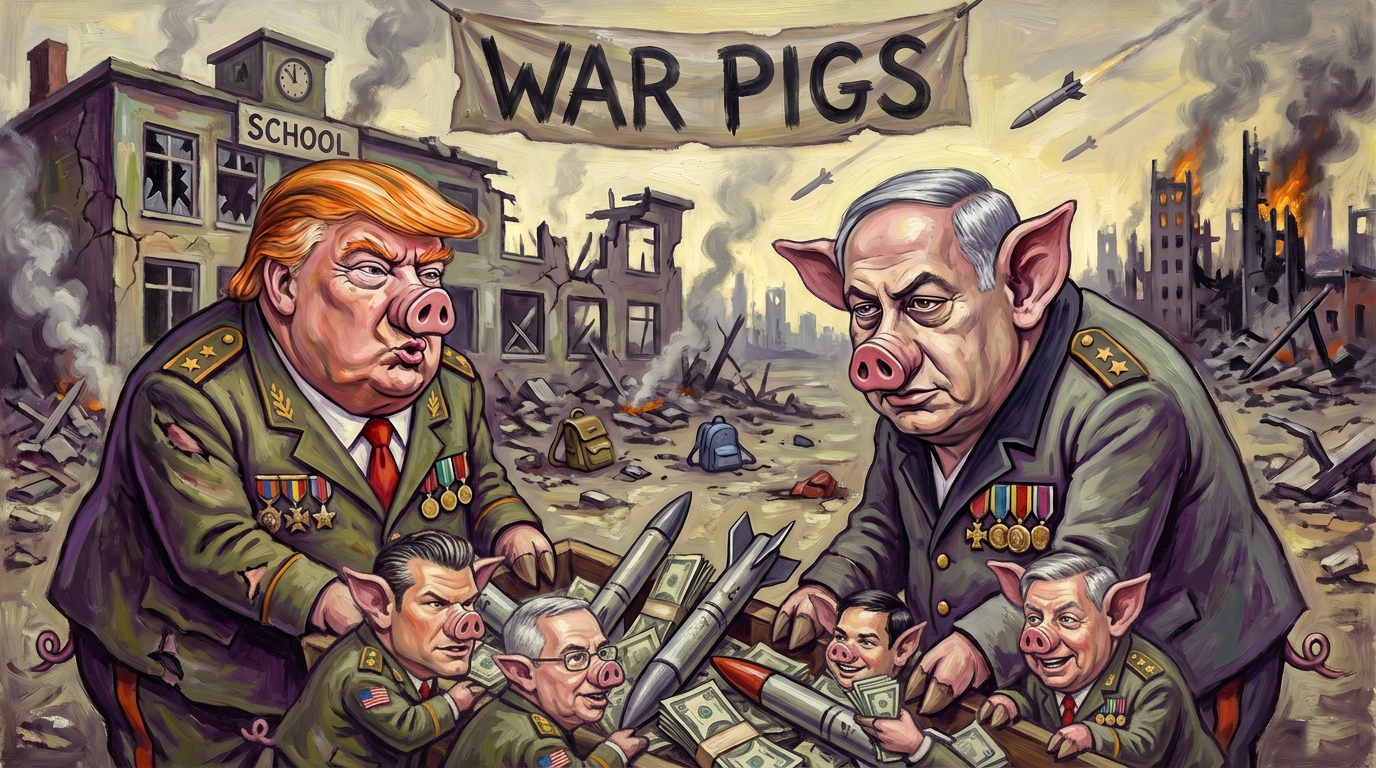
Is that your notion of Western ideals and statecraft? Ukraine is destroyed, depopulated, and insolvent; 13 American missiles knowingly targeted a girls' school in Minab; and taxpayers have paid $674.2 billion. What will the Western exits look like?
Offer the Ram of Pride instead of him.
But the old man would not so, but slew his son,
And half the seed of Europe, one by one.Wilfred Owen, “The Parable of the Old Man and the Young.” Owen was killed in action on November 4, 1918, 1 week before the Armistice.
If any question why we died,
Tell them, because our fathers lied.Rudyard Kipling, “Common Form,” from “Epitaphs of the War.” Kipling’s only son, John, was killed at the Battle of Loos in 1915.
Scott Ortkiese | Throughline Synthesis | Houston, October 3, 2026
The European Union’s governments are hell-bent on forcing a war with Russia. Meanwhile, their Ukrainian proxy is losing its hat, its ass, and its bicycle. Ukraine is the provocateur Europe duped into acting out its anti-Russian fairy tale. You don’t need a Brussels press release to see it. Just watch 8 days of this war, September 26 to October 3, 2026. Then look at what the same war pigs did to a girls’ school in Minab, Iran, and look at the bill.
Kyiv: A Capital Cut in Half
The bridges are going down. On October 1, Russia sent 2 drones at Kyiv’s Southern Bridge, aiming for the cables that hold up the span. The next night, it hit them. Kyiv closed the Southern Bridge and the Paton Bridge in both directions and closed the Metro Bridge toward the right bank. On October 3, a single Russian kamikaze drone struck the Southern Bridge’s cable mounts again, and the cables are now badly damaged. Ukraine can’t replace them while the drones keep coming. Russia also hit the Northern Bridge, and traffic stopped there too. Kyiv has posted air defense units on the bridges themselves.
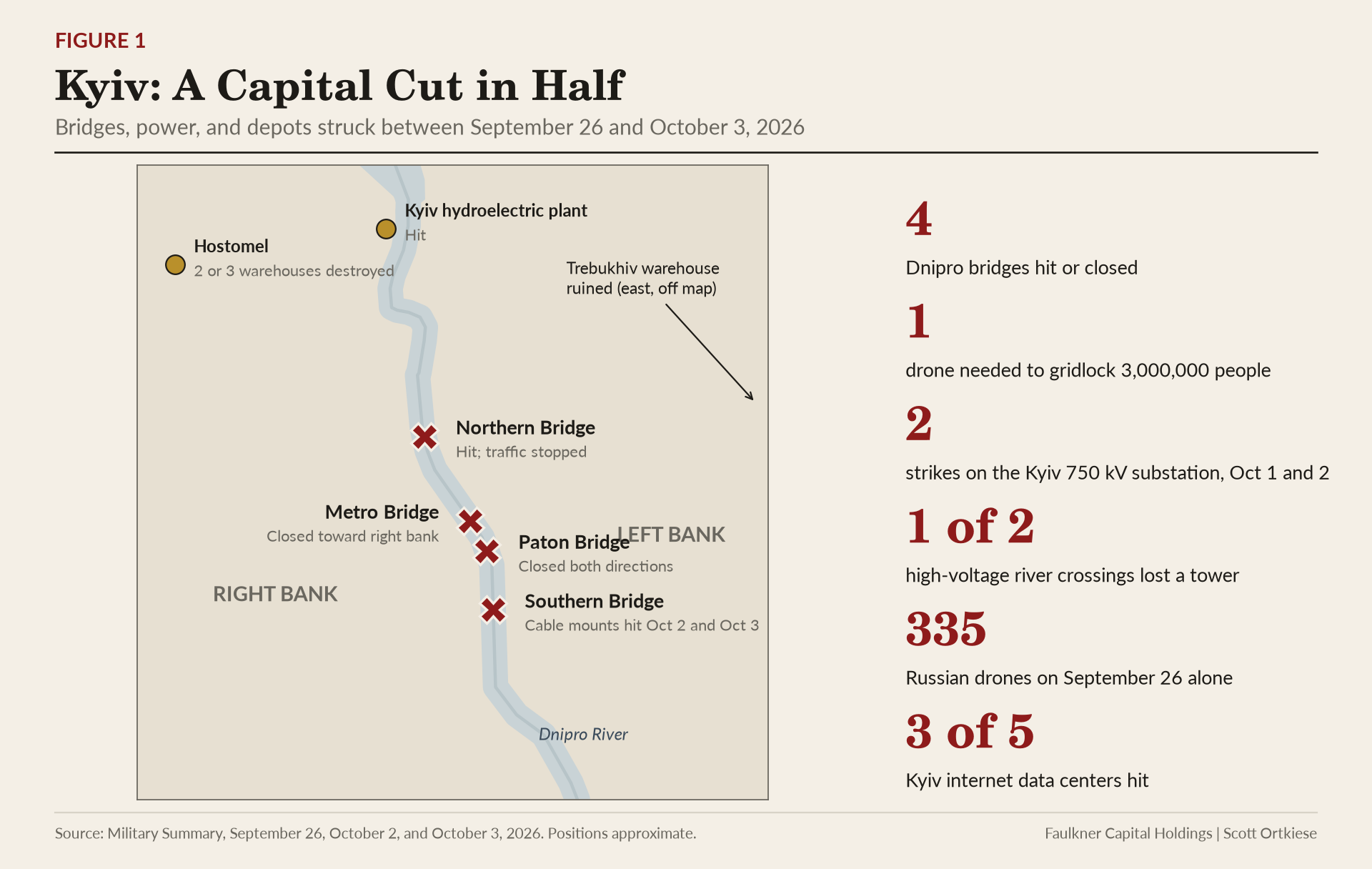
A city of more than 3,000,000 people is gridlocked. On Friday morning, October 2, Kyiv woke up to traffic that didn’t move. Tens of thousands of vehicles sat waiting to cross the Dnipro River. Pedestrians walked the empty roadway of the Southern Bridge to get to work. It took 1 drone.
The lights are going out. Russia hit the Kyiv 750 kilovolt (kV) substation, a main high-voltage node feeding the capital and its defense plants, on October 1 and again on October 2. Satellite images show the damage. Russia destroyed a transmission tower on 1 of only 2 high-voltage crossings linking Kyiv’s 2 banks and hit the Kyiv hydroelectric plant. New blackouts spread to the Mykolaiv and Chernihiv regions. Ukraine’s Ministry of Energy is telling citizens to run heavy appliances only a few hours a day, and never several at once in the evening. Kyiv’s mayor says the city is in a very dramatic situation, that Russia is tearing it apart, and that life can no longer go on as it did in peacetime.
The digital backbone is burning. On September 26 alone, Russia launched 335 drones in 2 waves. 74 got through. At least 3 of Kyiv’s 5 internet-provider data centers were hit, 1 of them by a Geran-5 jet-powered drone. New network outages followed downstream of Datagroup, 1 of Ukraine’s largest providers. On October 1, a data center in Pavlohrad was wiped out, and explosions hit Kostopil in the northwest.
The warehouses are ash. A warehouse in Trebukhiv, outside Kyiv, was reduced to ruins with no chance of repair. On the night of October 2 to 3, 2 or 3 warehouses in Hostomel were destroyed.
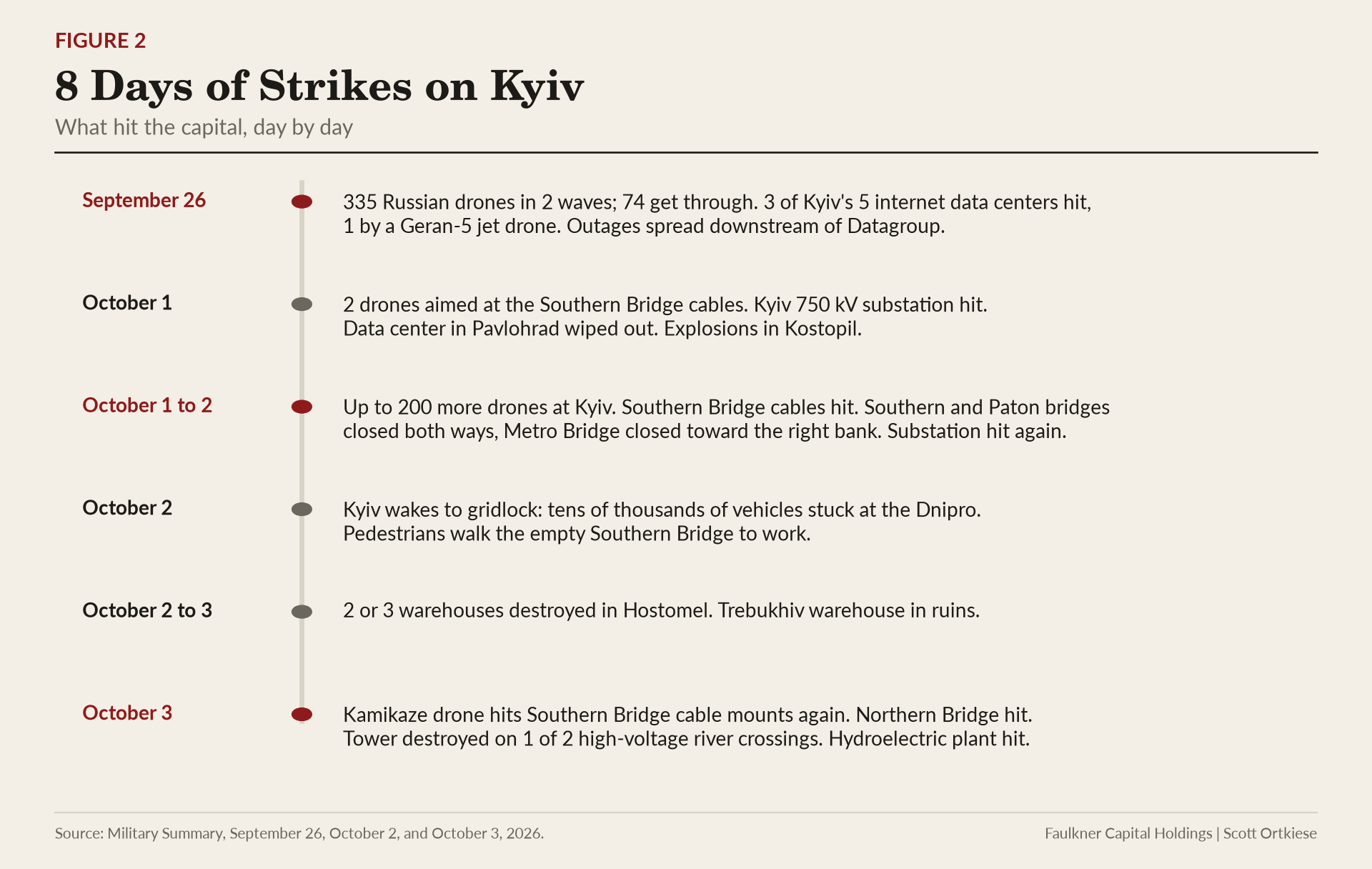
Ukraine can’t stop the drones. Russia sent up to 200 more drones at Kyiv between October 1 and 2. Ukraine has no answer to Russia’s jet-powered drones or its missiles. Volodymyr Zelenskyy, Ukraine’s president, says 5 companies are developing interceptors for jet drones and that mass production will start at the end of October. Russia gets a free month.
The rules are off. Zelenskyy says Ukrainian intelligence has learned that Vladimir Putin, Russia’s president, lifted the remaining restrictions on Russia’s air campaign. Zelenskyy himself spells out where that leads: Russia wants to destroy Ukraine’s bridges, data centers, internet, mobile networks, hospitals, kindergartens, schools, and universities and force people to flee the cities.
The diplomats are packing. The Guardian reports that Western governments are drawing up plans to move their embassies from Kyiv to eastern Poland. So far, they’re staying, because leaving would signal that support for Kyiv is weakening.
Ukraine: Every Front Moving One Way
The road to Europe is closing. Since early September, Russia has hit the M-07 highway to Poland dozens of times. It has destroyed gas stations along the route and struck checkpoints on the Polish border. Ukrainians leaving the country are now crammed onto 1 overloaded route, with trucks backed up at the border. In the Odesa region, Russia struck bridges near Mayaki and trucks and fuel tankers on the R-30 road along the Moldovan border, which snarled traffic there.
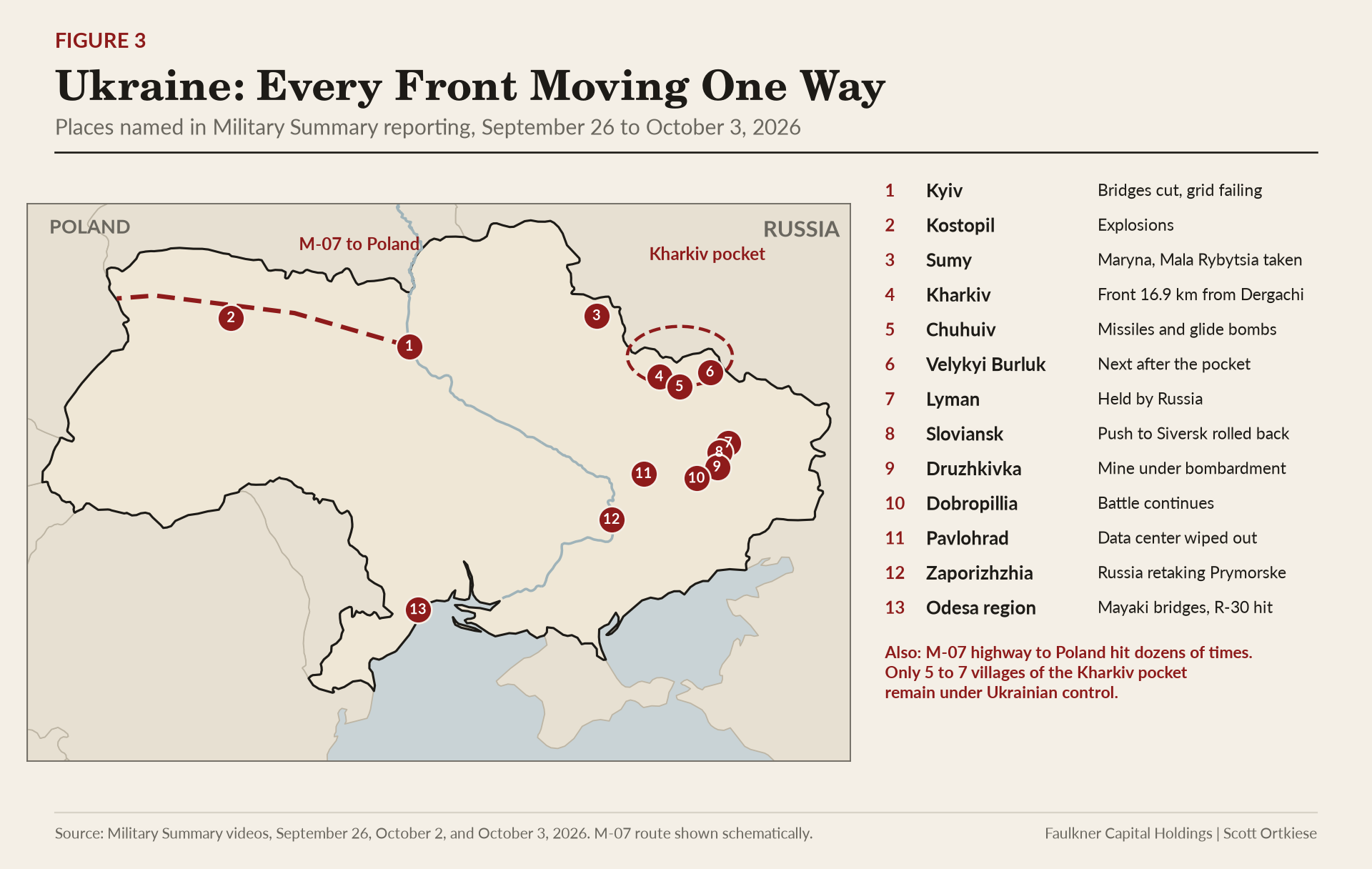
Sumy is next. On September 26, Russia took Maryna, which sits on the city’s second defensive line. It struck 10 days after Ukraine pulled troops out of Sumy to shore up Dobropillia. Video confirms Russian control of central Ulanove in the far north. Russian forces are closing on Yunakivka, Vilshana, and Mykolaivka, the gateway to the Sumy urban area. On October 2, Russia took Mala Rybytsia on the eastern approach. Ukraine’s counterattack near Yunakivka on October 3 is a holding action meant to slow the Russian advance, not to retake the north.
Kharkiv is in artillery range. Russian soldiers raised flags over Vysoka Yaruga. On October 3, Russia took Nova Kozacha. Once it clears the next string of villages, its front line will sit 16.9 km from Dergachi, the northwest edge of Kharkiv city. Within 20 km, Russian artillery can shell Kharkiv, Ukraine’s second-largest city.
The Kharkiv pocket is collapsing. Ukrainian units are trapped in a pocket in the northeastern Kharkiv region. Russia has taken dozens of villages there since early September. It took Petropavlivka and Lozova on September 26, 7 more settlements between September 28 and October 2, and Serdobino and Grachevka after that. Only 5 to 7 villages remain under Ukrainian control, and taking Labanivka would split the pocket in 2. The fight is expected to end within 10 days. Next comes Velykyi Burluk, the turning point for all of the eastern Kharkiv region.
Chuhuiv is burning. Russia hit Chuhuiv with missiles and glide bombs. The city is Ukraine’s supply hub for the Kupyansk and Velykyi Burluk fronts.
The evacuation line has been crossed. Ukraine has ordered evacuations of other cities when Russian forces got within about 11 km. Russia is now that close to both Sumy and Kharkiv. Kyiv is putting off the evacuation orders because of what they would signal.
The counteroffensives are failing. Ukraine’s push from Sloviansk toward Siversk was rolled back within a day. Russia retook positions at Kryva Luka, Yampil, and Piskunivka and kept its hold on Lyman. Ukraine holds Mykolaivka, east of Sloviansk, only by pouring in more troops every day. In western Zaporizhzhia, Russia is retaking Prymorske and pushing toward the Konka River. Pro-Ukrainian sources expect Russian troops to reach Zaporizhzhia city this year.
Donbas is grinding down. Russian artillery and air strikes are hammering the mine southwest of Druzhkivka. Once Russia takes the mine, it can push into the city. The battle for Dobropillia continues.
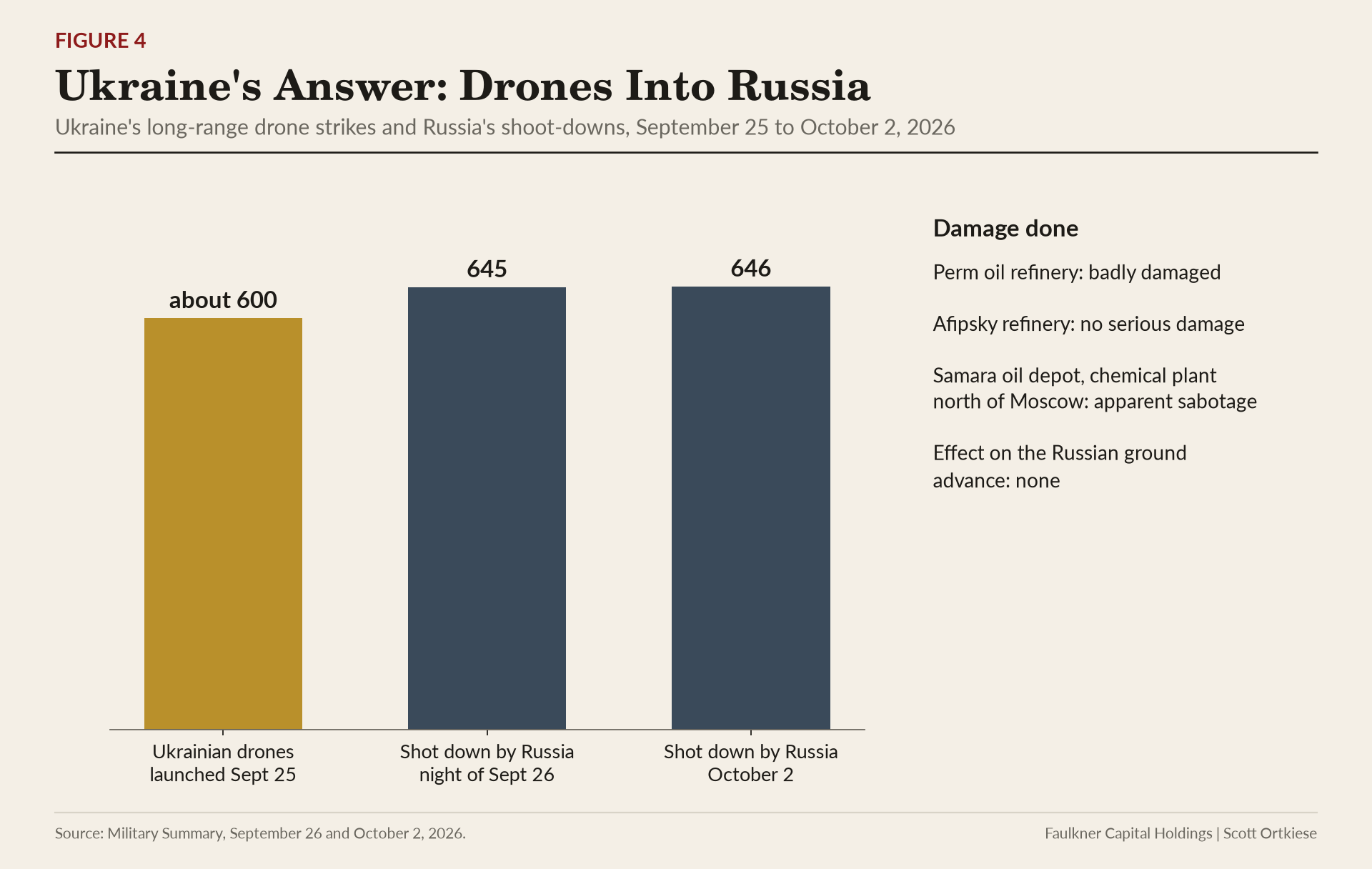
Ukraine’s answer is drones into Russia. Ukraine sent about 600 drones deep into Russia on September 25 and badly damaged the Perm oil refinery. Russia shot down 645 the next night, and Ukraine’s strike on the Afipsky refinery did no serious damage. On October 2, Russia shot down 646 more. Explosions hit an oil depot in Samara and a chemical plant north of Moscow, apparently from sabotage. None of this has slowed the Russian advance on the ground.
Moscow is preparing the next phase. At the Center 2026 exercises, Putin watched Russian forces show off a robotic tank and airborne landings behind enemy lines. Several independent sources report that Moscow may bring back Sergei Surovikin, the general nicknamed “General Armageddon” for the 2022 campaign against Ukraine’s power grid.
Washington Walks Away
Reuters reports that the new U.S. military aid package contains no Patriot air-defense missiles, despite Kyiv’s repeated requests. The package spends the last of the $400 million Congress approved late in 2025 before the money expires. Bloomberg reports that Trump told Zelenskyy to go to Moscow and negotiate with Putin, and that Zelenskyy, humiliated, refused. Zelenskyy’s answer is a license to build Patriot missiles. Military experts say that’s 1 to 3 years from producing anything. Mark Rutte, NATO’s secretary general, concedes the license won’t help Ukraine in the short term.
Crooked Zelenskyy and His Cronies
Zelenskyy begs the world for air defense while his own circle loots the energy system Russia is now blacking out.
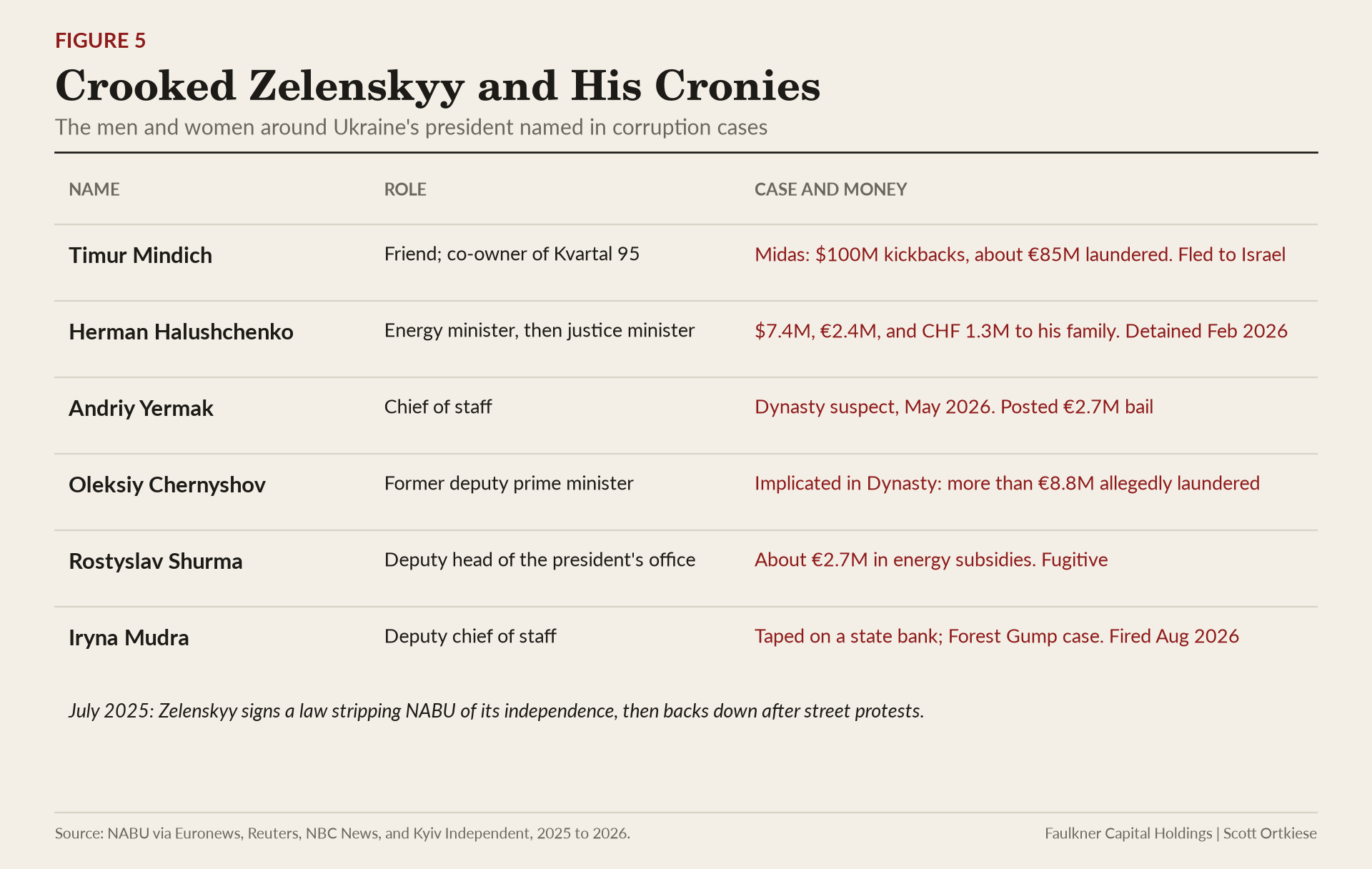
- Operation Midas. This is the biggest corruption case of Zelenskyy’s presidency. Ukraine’s National Anti-Corruption Bureau (NABU) says it uncovered a $100 million kickback scheme at Energoatom, the state nuclear power company. Suppliers paid 10% to 15% of their contracts to get paid. NABU says about €85 million was laundered.
- Timur Mindich. He is the alleged ringleader of Midas, Zelenskyy’s longtime friend, and co-owner of Kvartal 95, the production company Zelenskyy co-founded. He fled to Israel in November 2025. Investigators also tie him to the Dynasty case, which involves more than €8.8 million allegedly laundered through a luxury housing development outside Kyiv.
- Herman Halushchenko. He served as Zelenskyy’s energy minister and then justice minister. He was detained in February 2026 on money-laundering charges. NABU says $7.4 million, €2.4 million, and 1.3 million Swiss francs went to his family.
- Andriy Yermak. He was Zelenskyy’s chief of staff and closest confidant. He resigned in November 2025 hours after investigators searched his home. He was named a suspect in the Dynasty case in May 2026 and posted €2.7 million bail.
- Oleksiy Chernyshov. He is a former deputy prime minister and a longtime friend of Zelenskyy’s family. He is also implicated in the Dynasty case.
- Rostyslav Shurma. He is the former deputy head of Zelenskyy’s office. Prosecutors suspect him of embezzling about €2.7 million in renewable-energy subsidies, and he is now a fugitive abroad.
- Iryna Mudra. Zelenskyy fired his deputy chief of staff in August 2026, after NABU released recordings of her discussing a state bank. In them, she says the bank “must pay them.” That investigation, Operation Forest Gump, centers on about €3 million posted as Halushchenko’s bail.
- The cover-up attempt. In July 2025, Zelenskyy signed a law stripping NABU and its prosecutors of their independence. He backed down only after Ukrainians filled the streets.
Rutte, Kallas, and von der Leyen Keep Feeding It
Mark Rutte, NATO’s secretary general. On September 30, Rutte said there is “no imminent threat to NATO territory” and that “Putin knows that he can never win from NATO.” In the same appearance, he pushed Europe toward 5% of output for defense, touted the “Trump trillion,” and promised that every Russian provocation “will be met with more support for Ukraine, not less.” He claimed Ukraine is doing better at the front than it was 6 months ago. That was the week Kyiv lost its bridges.
Kaja Kallas, the EU’s high representative for foreign affairs and security policy and former prime minister of Estonia. Kallas told the European Parliament that “Putin will not stop unless he is stopped” and rejected any territorial settlement. On September 19, she said Russia’s army is “bogged down on the ground”. She offered another €1 billion for weapons and declared that “the only obstacle to peace is Russia.” Her own country’s foreign minister, Margus Tsahkna, says Estonian intelligence can “see very, very deep into Russia” and finds no sign of an attack on NATO. Rutte says there’s no threat, and Estonia says there’s no threat. Kallas still sells the threat.
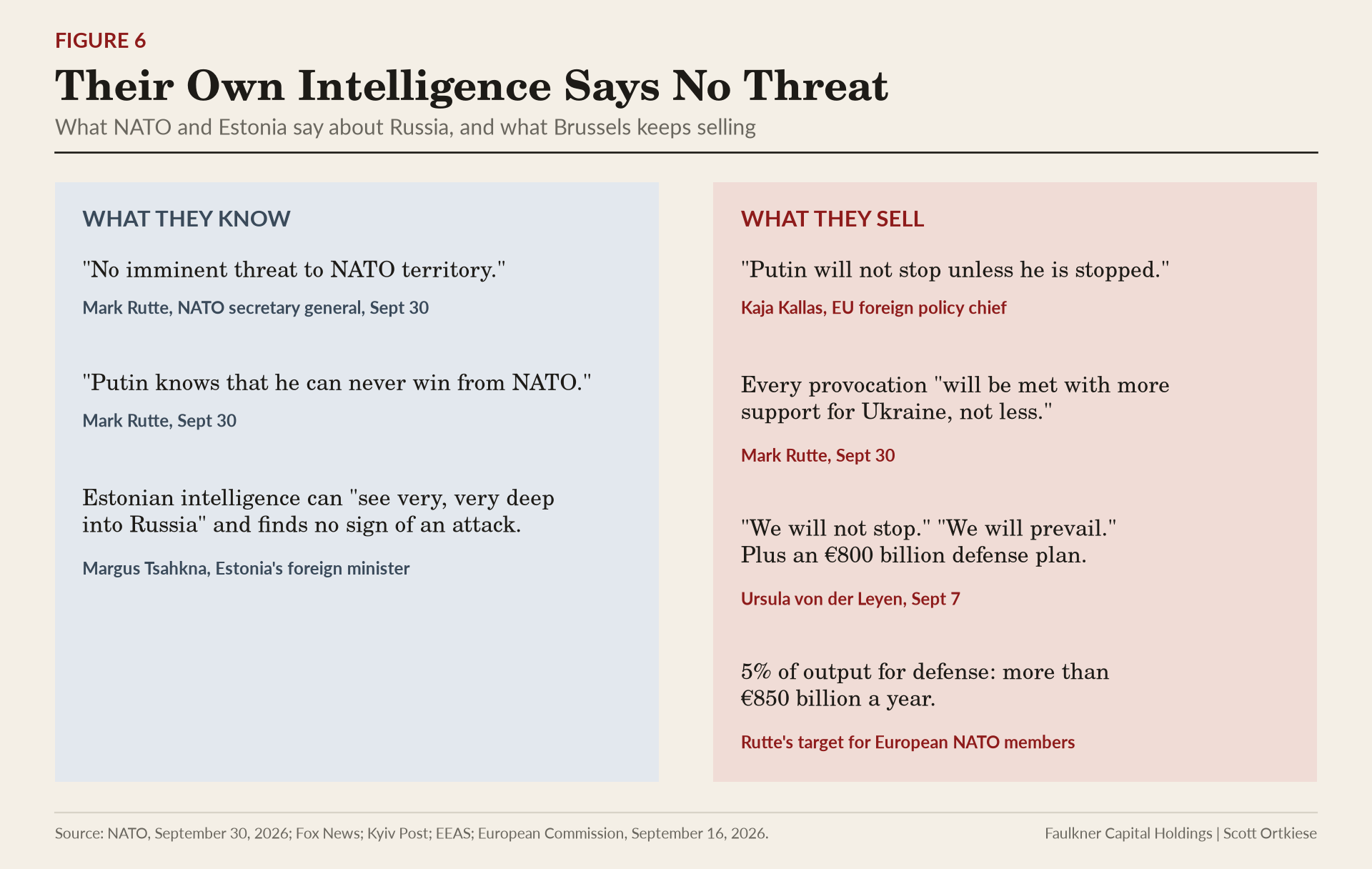
Ursula von der Leyen, president of the European Commission. On September 7, standing next to Rutte, von der Leyen promised that Europe and NATO “will not stop” increasing pressure on Russia. She said “we will prevail” and touted an €800 billion defense investment plan. In her September 16 State of the Union address, she promised to back Ukraine more strongly than ever through the hardest winter of the war and closed with “Slava Ukraini!”
The War Crimes Record
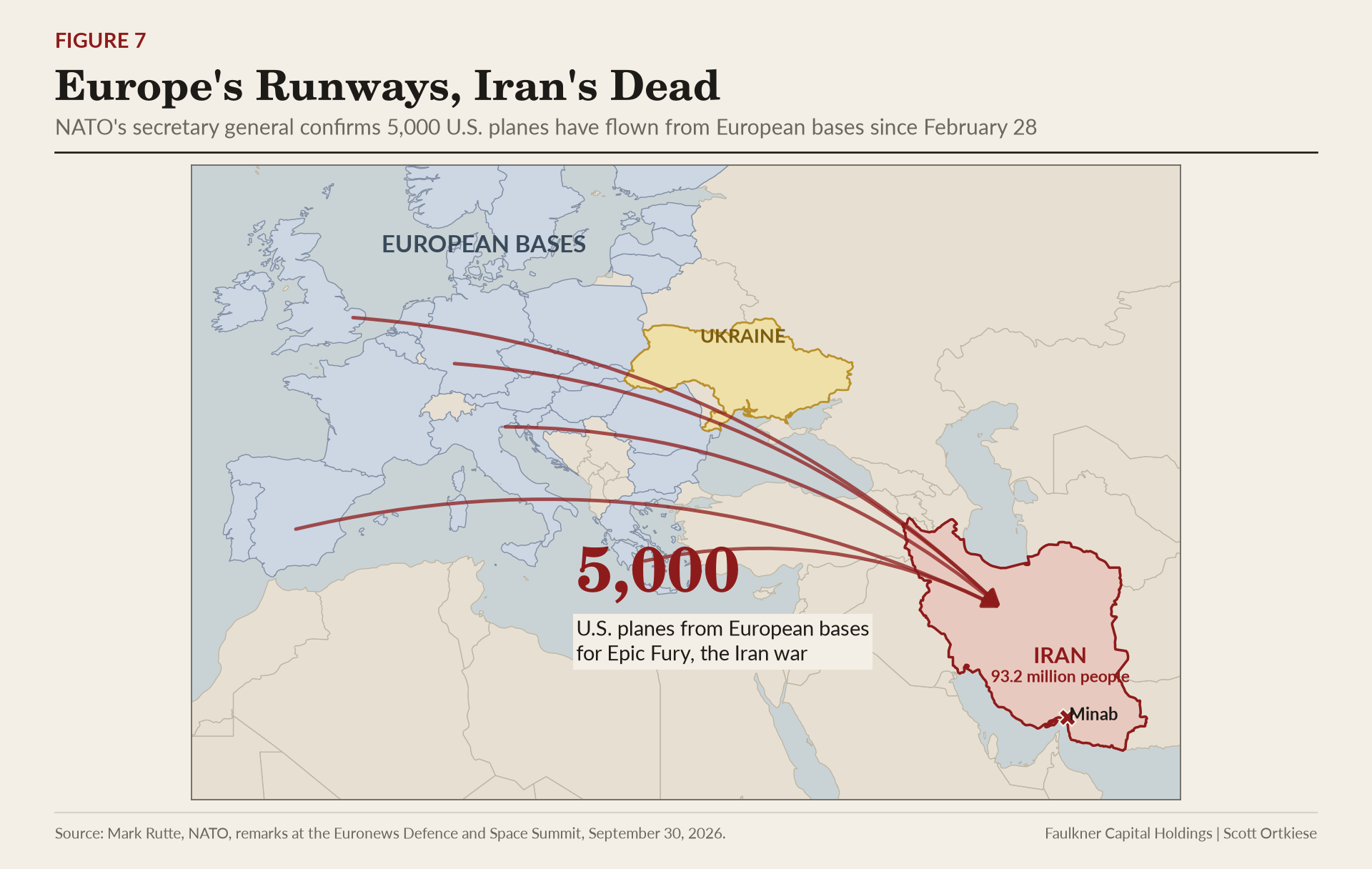
Ukraine and Iran are not 2 stories. They are 1 policy run by the same people out of the same capitals. Washington supplies the weapons and the targeting in both wars. Mark Rutte, NATO’s secretary general, promises that every Russian provocation “will be met with more support for Ukraine, not less,” and in the same appearance confirmed that 5,000 American planes have flown from European bases to bomb Iran since February 28. The governments that demand a tribunal for Russian crimes in Ukraine are hosting the runways for American crimes in Iran. The “rules-based order” they invoke against Moscow is the same law broken in Minab. Since February 28, 2026, the United States and Israel have been bombing Iran, a sovereign nation of 93.2 million people. The record below meets every element of the laws that the United States and Europe signed and swore to enforce.
The Law
Every state is bound by these rules, including the United States, whether or not it ratified the treaty that wrote them down:
- Distinction. Attacks may be directed only at military objectives, never at civilians or civilian buildings. (1977 Additional Protocol I to the Geneva Conventions, Articles 48, 51, and 52.)
- No indiscriminate attacks. An attack that isn’t aimed at a specific military objective, or that can’t tell civilians from soldiers, is prohibited. (Article 51(4).)
- Precaution. Commanders must do “everything feasible to verify” that a target is military before striking it. (Article 57(2).)
- No terror threats. “Acts or threats of violence the primary purpose of which is to spread terror among the civilian population are prohibited.” (Article 51(2).)
- No attacks on survival. Drinking water installations and other objects indispensable to civilian survival may not be attacked. (Article 54(2).)
- Genocide. The 1948 Genocide Convention, which the United States ratified in 1988, defines genocide as acts committed “with intent to destroy, in whole or in part, a national, ethnical, racial or religious group, as such.” Article III makes “direct and public incitement to commit genocide” a crime in itself, whether or not the killing follows. Article IV says the guilty shall be punished “whether they are constitutionally responsible rulers, public officials or private individuals.”
- Complicity. Article III of the Genocide Convention also outlaws complicity. Under international rules on state responsibility, a state that knowingly helps another state commit a wrongful act shares the responsibility.
- The wounded and the rescuers. The wounded must be respected and protected, and civilian medical personnel and medical units may not be attacked. (Additional Protocol I, Articles 10, 12, and 15.) The Rome Statute makes intentionally directing attacks against civilians a war crime. (Article 8(2)(b)(i).)
- Command responsibility. Leaders who order unlawful attacks, or who fail to prevent or punish them, are liable. (Additional Protocol I, Articles 86 and 87.)
- U.S. law. The War Crimes Act, 18 U.S.C. § 2441, makes grave breaches of the Geneva Conventions by Americans federal crimes.
Count 1: The Triple Tap on the Girls’ School in Minab
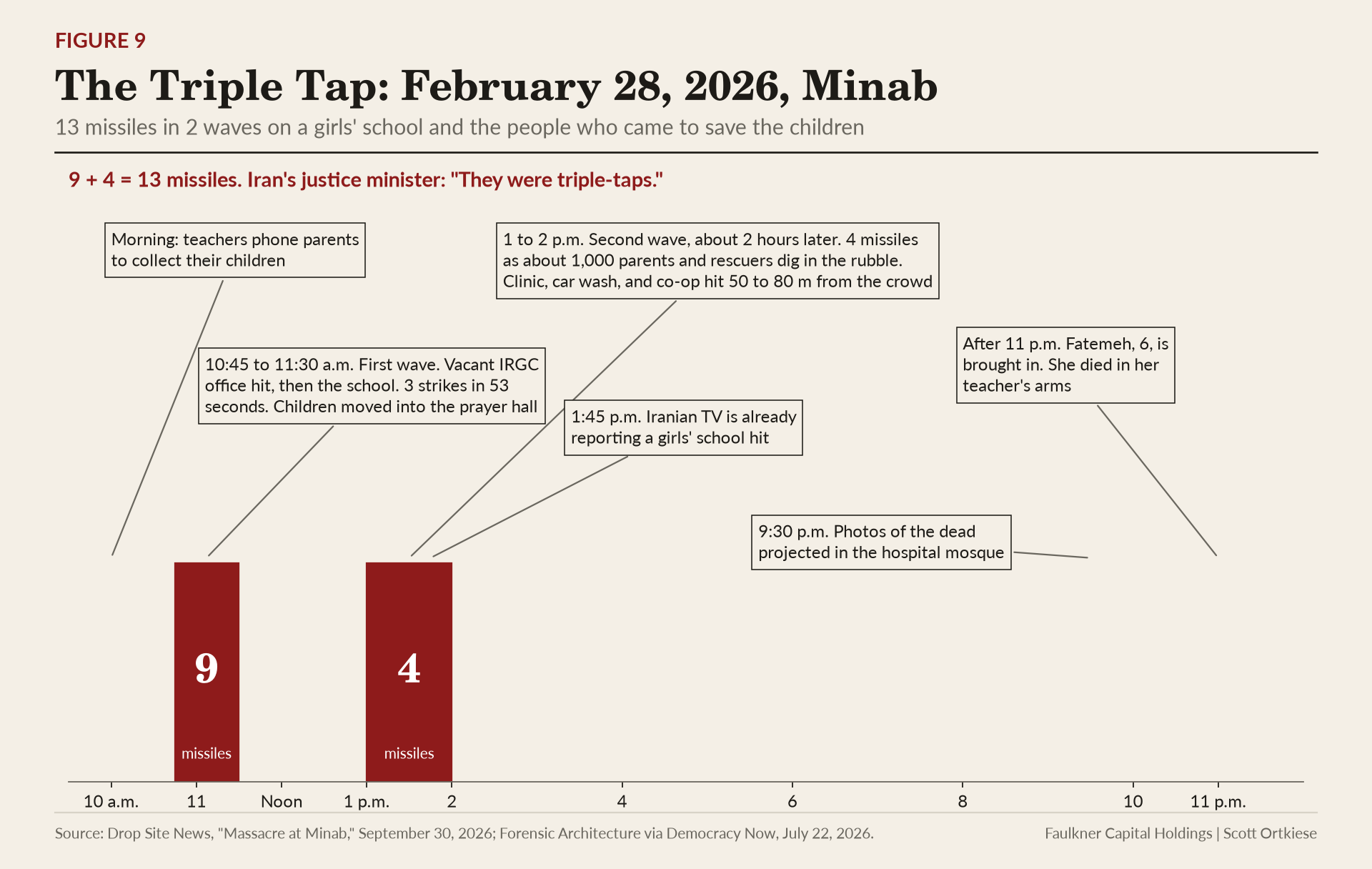
A note from the author: what a triple tap is. A triple tap is a strike, followed by more strikes on the same spot after people have rushed in to help. The first missile kills and wounds. Then the shooter waits. Parents run toward the screaming. Teachers, medics, firefighters, and neighbors start pulling bodies out of the rubble. Then the next missiles arrive, aimed at the same ground, timed for the moment the rescue is at its peak. It isn’t a mistake that happens twice. A wrong target can be hit once by error. The second and third strikes are a fresh decision, made after the first blast has already shown what is there, and made when the only people left on the ground are the wounded and the people trying to save them. The purpose is to kill the rescuers, finish off the survivors, and teach a whole population that running to help a dying child will get you killed too. That is why it is among the most inhuman acts in war. The law could not be clearer. The wounded must be “respected and protected” (Additional Protocol I, Article 10). Civilian medical personnel must be “respected and protected,” and medical units “shall not be the object of attack” (Articles 15 and 12). Civilians who come to dig out children are civilians, and attacking them is a direct attack on civilians (Article 51(2)). The Rome Statute of the International Criminal Court lists “intentionally directing attacks against the civilian population” as a war crime (Article 8(2)(b)(i)). In Minab, 4 more missiles came 2 hours after the first 9, while about 1,000 parents and rescuers were digging through the rubble, and they hit a medical clinic. That is a triple tap.
Scott Ortkiese
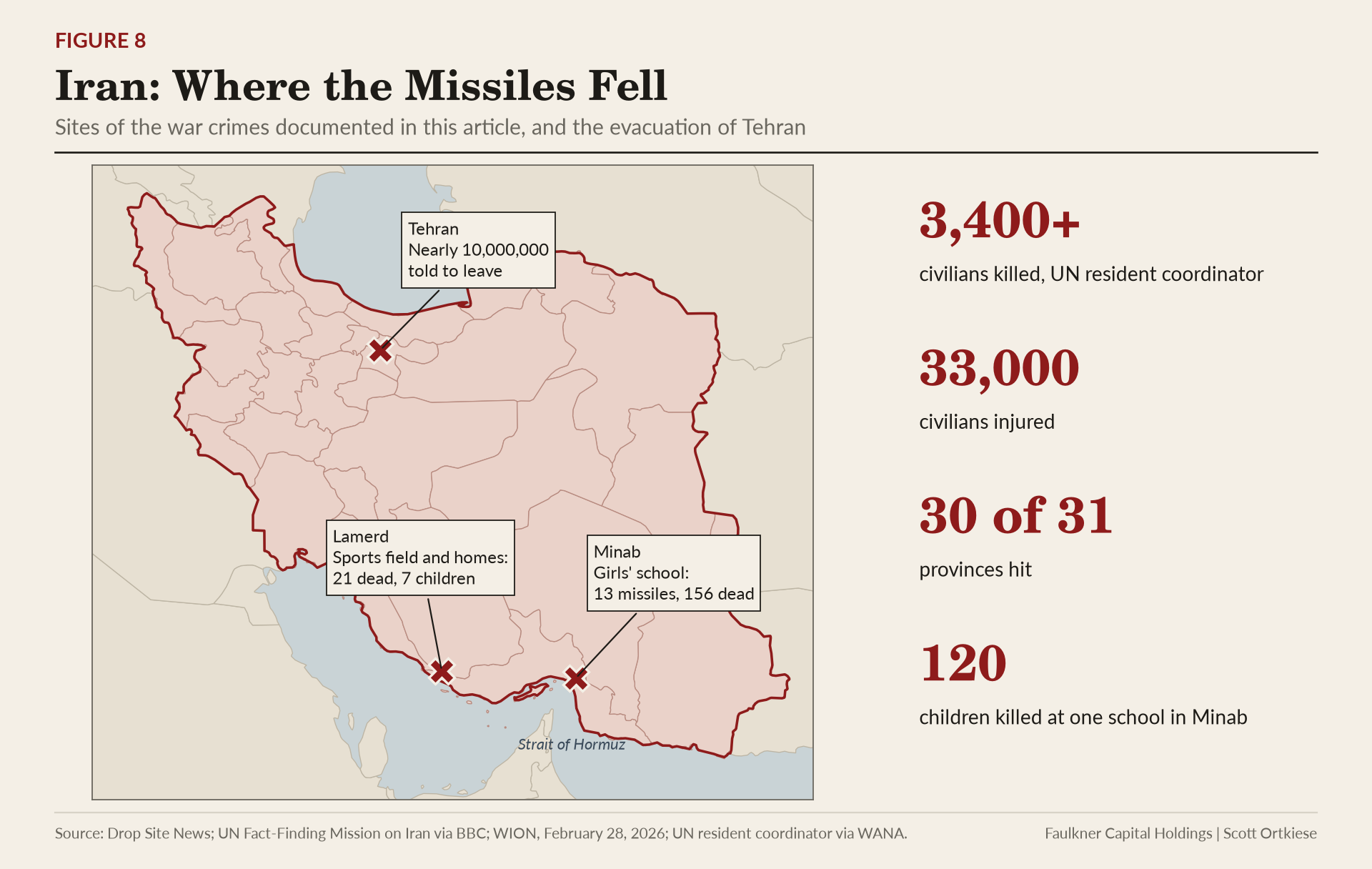
The setting. On February 27, Badr Albusaidi, the foreign minister of Oman, met Vice President JD Vance at the White House and told reporters he was optimistic a historic deal was close, with technical talks set for the following week in Vienna. Iranians went to bed believing a deal was near. The next morning, Saturday, February 28, was the first day of Iran’s school week and the middle of Ramadan, with most children from third grade up fasting. The United States and Israel opened the war that morning. Iran’s Supreme National Security Council told nearly 10,000,000 residents to leave Tehran, the Iranian Red Crescent reported strikes in at least 20 provinces, and schools across the country closed. In Minab, a city in southern Iran’s Hormozgan province, teachers at the Shajareh Tayyebeh school were phoning parents to come collect their children.
First tap. Between 10:45 a.m. and 11:30 a.m., according to the Iranian government, 9 missiles hit the school and the area around it. The first target was a vacant administrative office of the Islamic Revolutionary Guard Corps (IRGC), several hundred meters away. Teachers pulled the children off the playground and into the prayer hall. Then the missiles hit the school itself. Ehsan Mohseni, a Red Crescent coordinator, counted 3 strikes in “about 53 or 54 seconds.” Only a few children in the prayer hall came out alive.
Second and third taps. Then came the decision that turns this from a targeting error into an atrocity. Between 1 p.m. and 2 p.m., while roughly 1,000 parents, teachers, and rescuers were digging children out of the rubble with their hands, the United States fired 4 more missiles into the same spot. They hit the Shahid Absalan Medical Clinic, a car wash, a teachers’ co-op, and the small shops next to the school, 50 to 80 meters from the crowd. Majid Dadania, a Red Crescent responder, said that if those missiles had landed in the schoolyard, “more than one thousand people would’ve been martyred.” Only the school wall stopped the blast. By 1:45 p.m., Iranian television was already broadcasting that a girls’ school had been hit. Forensic Architecture, a research group at the University of London, reconstructed the strikes with Sky News and found that the follow-up wave hit while families and rescuers were still on the ground. “The U.S. forces would have had ample opportunity to reassess their initial misidentification before conducting the next round of strikes,” said Samaneh Moafi, its assistant director of research. “But it’s simple: They didn’t.” 13 missiles in all. Amin Hossein Rahimi, Iran’s justice minister, put it plainly: “These were not double-tap attacks. It was more than that. They were triple-taps.” He called it “the most serious type of war crime, which indicates a direct and heinous criminal intent.” Firing again on rescuers at a site already burning on national television is exactly that.
The weapon. The fragments are American. Trevor Ball of Armament Research Services examined high-resolution photos of the debris and found the Commercial and Government Entity (CAGE) code of Raytheon, the Tomahawk’s prime contractor, and at least 2 Tomahawk turbofan engines. Only 5 countries own Tomahawks, and only 1 of them was bombing Iran. Tomahawks carry cameras, can loiter, and can be redirected in flight.
The dead. At least 156 people were killed: 120 children from the girls’ school, the boys’ school, and the preschool; 26 women teachers, 1 of them pregnant; and parents. Iran’s Ministry of Justice puts the official toll at 168, and Iran’s negotiators now call themselves the “Minab 168”, with the girls’ photos on the seatbacks of their plane. The National Iranian American Council’s casualty report confirms the school “was struck three times in total,” including after first responders arrived.
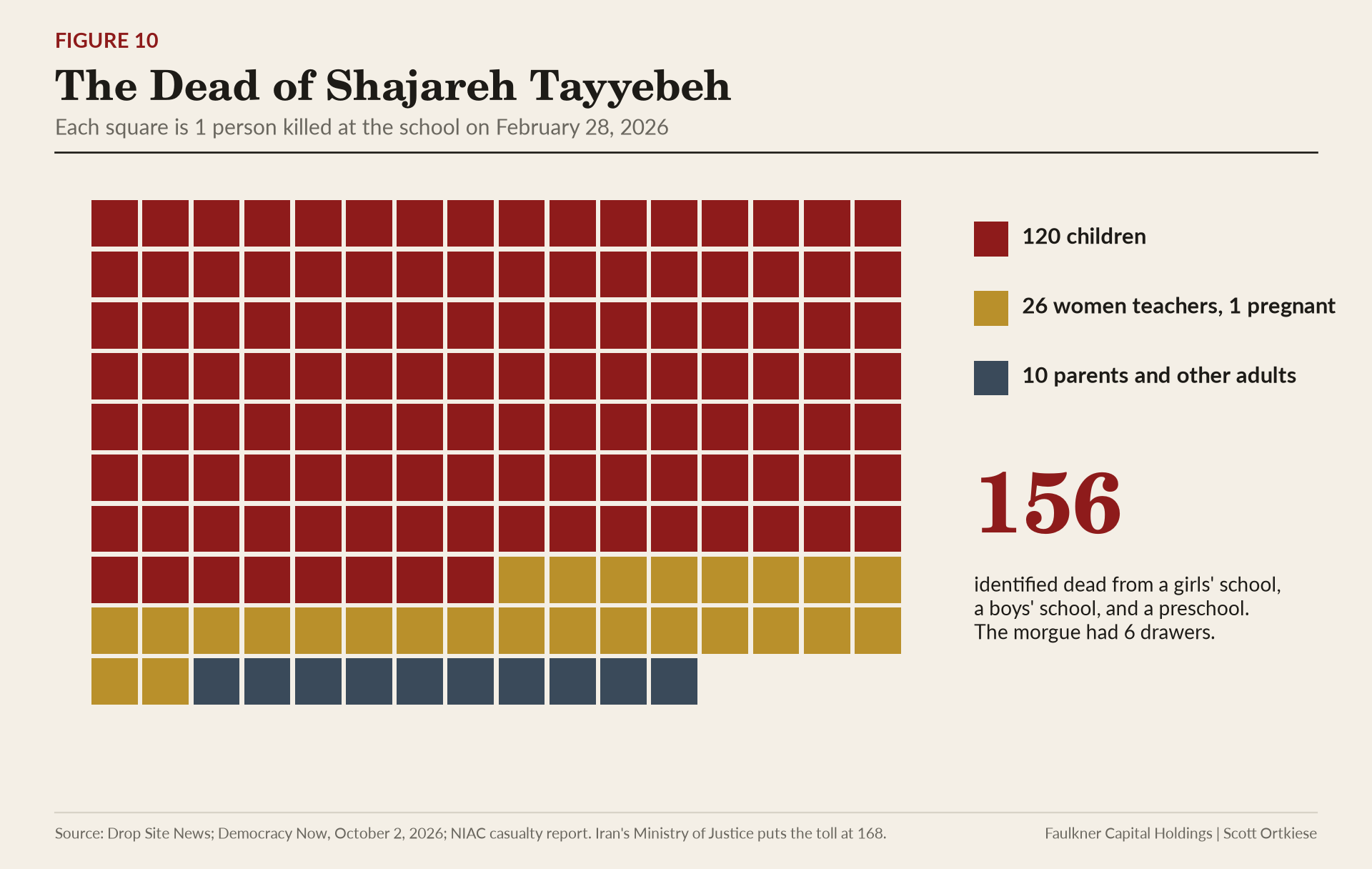
The hospital. Dr. Mohammad Movarekh, director of Minab’s Hazrat Abolfazl Hospital, had a morgue with 6 drawers. Staff packed children’s remains into the cafeteria and kitchen coolers, and when those filled, into freezer trucks borrowed from the town’s fish and shrimp distributors. 3 of his own staff lost children. That night, the hospital projected photos of the dead onto a wall of its mosque so parents could identify them. Some families found a hand, a leg, or half a body, and knew their child by a sock, a shoe, or a school bag. The staff kept working through the second wave, despite rumors that the hospital was next.
Fatemeh. Fatemeh Yazdanpanah was 6. Her father, Yaghoub, a poet who teaches Persian literature in the fishing village of Gurzang, chose Shajareh Tayyebeh because she could memorize his poems after hearing them once or twice. He kissed her goodbye that morning. Shortly after 11 p.m., an ambulance brought her to the hospital. She was in one piece because she died in her teacher’s arms, next to her cousin Asra, both girls shielded by a woman who was trying to cover them from the missiles. Rescuers identified her when they opened her notebook and read her name. 1 rescuer went home with children’s brain matter under his fingernails and had to cut his nails to get it out. Surviving children, told their friends and teachers are in heaven, ask why they aren’t there too. A mother whose son had complained of a stomachache that morning says, “I killed my son. I was the one who caused my son’s death.”
It was a known school. More than a decade earlier, the land had been part of an IRGC barracks. In 2014, the province redesignated it for civilian use. The school received its license in 2015 and operated publicly from then on, behind its own walls and gates, next to a public clinic, a teachers’ co-op, a car wash, and a strip of shops. Satellite images show the school walled off from the IRGC compound in 2016, and it had been publicly listed as a girls’ elementary school for years, with its own social media pages. Satellite images from late 2025, 2 months before the strike, show children in the schoolyard and on the soccer field. The IRGC’s only remaining office nearby had been empty since the 12-Day War of June 2025. The active, publicly known IRGC base, more than a mile away, wasn’t hit that morning. There were no secondary explosions, because there was nothing military there to explode. Wes Bryant, a former senior Pentagon targeting adviser, said the school showed up in “a five second Google search of that area.” “This is not fog of war stuff. This is very 101. We had plenty of time to prepare these targets.”
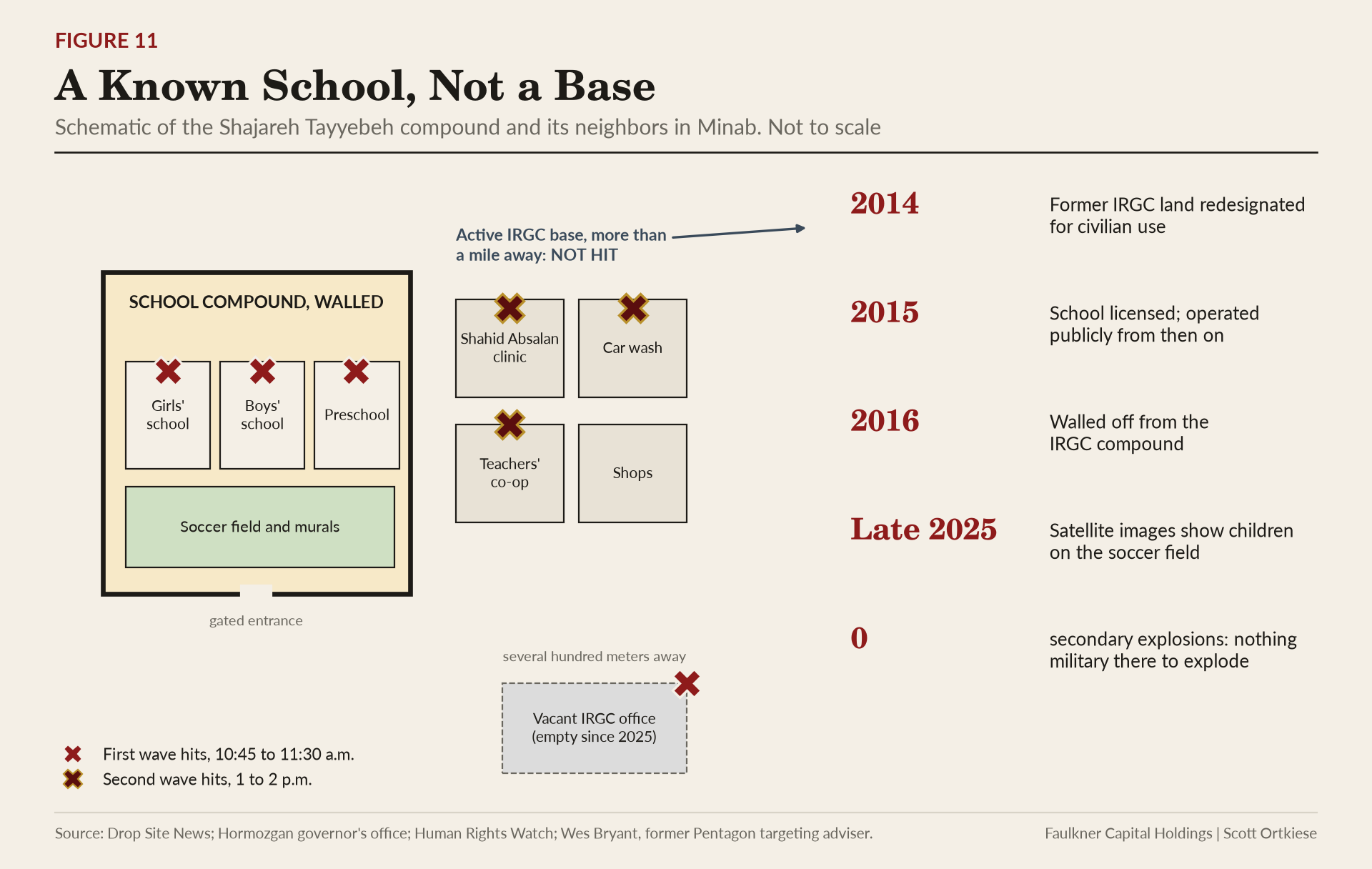
The warnings were ignored. CNN reported that senior U.S. commanders bypassed warnings embedded in the targeting databases that the intelligence on these sites was years out of date and had to be re-vetted, and approved the strikes anyway “for expediency” in the rush to build a target list. CNN’s sources said that decision directly led to the school strike. The Pentagon boasted of hitting more than 1,000 targets in the first 24 hours. Records were the goal, not accuracy.
The UN verdict. The UN Independent International Fact-Finding Mission on Iran, chaired by Sara Hossain, a Bangladeshi jurist, concluded that the school “was the intended point of impact,” not an errant missile or collateral damage. It found reasonable grounds to believe the United States committed the war crime of launching an indiscriminate attack. The U.S. failure to verify the target “went beyond mere negligence. Rather, the U.S. directed the strikes at the building of the school while being aware of a substantial risk of striking a civilian object and acting recklessly”. Jeremy Scahill of Drop Site News, who spent more than 2 months on the ground story, calls it one of the gravest U.S. war crimes since Vietnam, in the same class as the 1991 U.S. bombing of the Amiriyah shelter in Baghdad, where 2 bunker-busting bombs killed more than 400 civilians.
The lies and the cover-up. On Air Force One in March, Trump said, “Based on what I’ve seen, that was done by Iran,” and Pete Hegseth, the U.S. defense secretary, said “the only side that targets civilians is Iran.” When Tomahawk fragments marked “Made in USA” turned up, Trump suggested Iran had Tomahawks. In June, he said: “Nobody did that on purpose. Mistakes are made. War is nasty.” Admiral Brad Cooper, commander of U.S. Central Command (CENTCOM), told Congress in May that “the school itself is located on an active IRGC cruise missile base.” It wasn’t. In July, asked whether he would release the Pentagon’s findings, Trump said the photos of the fragments might be “AI generated,” that “I don’t think there can be a conclusive report,” and that “there might be a reason why they can’t” release it. That’s the announcement of a cover-up. 7 months after the attack, the findings are still secret. According to NPR, the U.S. government never answered the UN mission’s requests for information, and the White House said “the only party in this conflict that has committed war crimes is the Iranian regime.”
Count 2: Tungsten on a Sports Field, Bombs on a Wedding
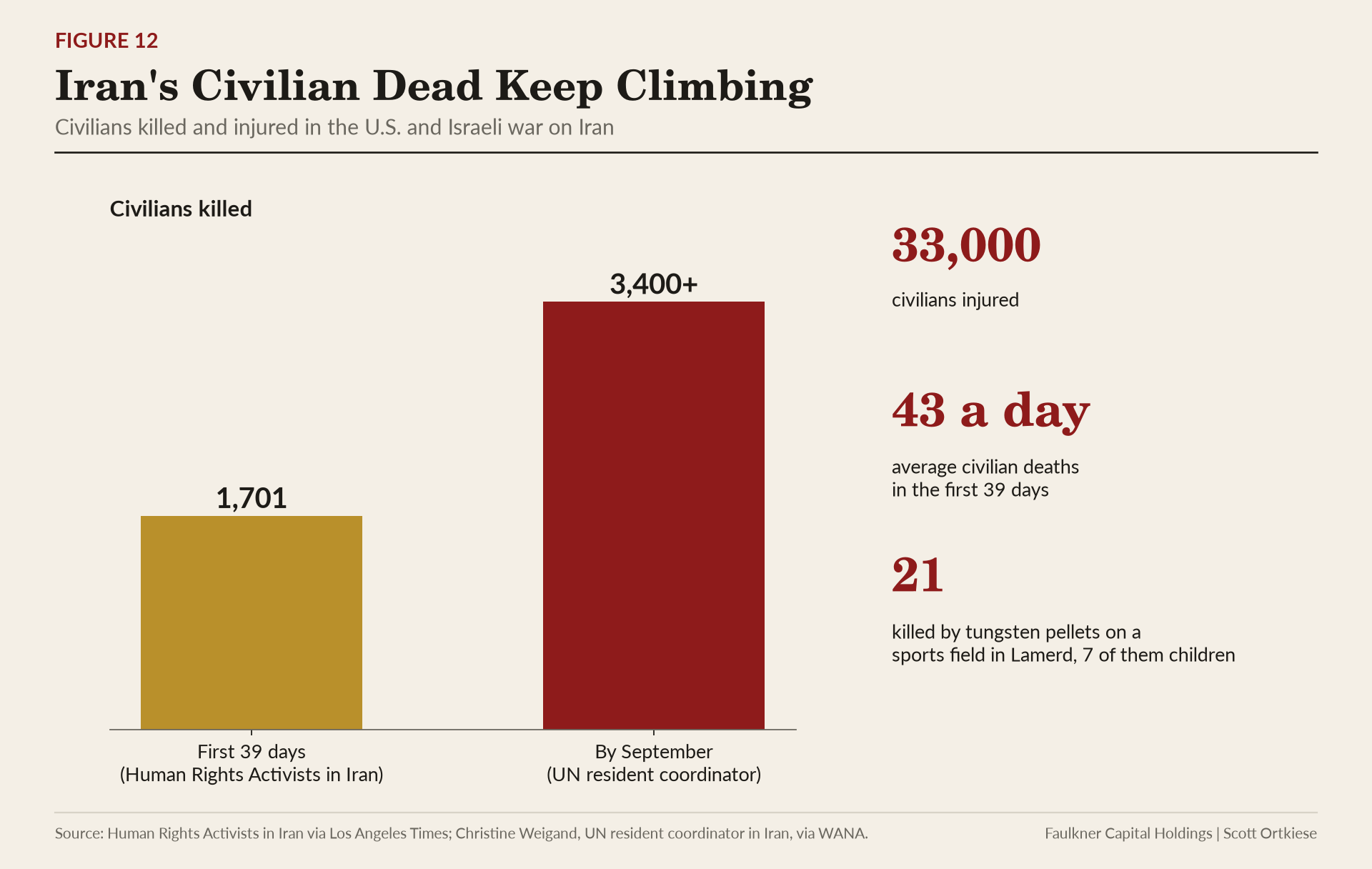
On the same day as the school attack, U.S. Precision Strike Missiles sprayed tungsten pellets over a sports complex and a residential area in Lamerd, killing at least 21 civilians, 7 of them children. The UN mission found reasonable grounds to call that a war crime too, and the United States is the only party in the war that has the missile. Later, according to the mission, U.S. strikes hit a family home on July 30 and a wedding on September 1, killing women and children from marginalized minority communities.
The toll. Human Rights Activists in Iran counted at least 1,701 civilians killed in the first 39 days, an average of 43 a day. Christine Weigand, the UN resident coordinator in Iran, now puts the count at more than 3,400 civilians killed and 33,000 injured, with 30 of Iran’s 31 provinces hit.
Count 3: Threatening to Wipe Out a Nation of 93 Million
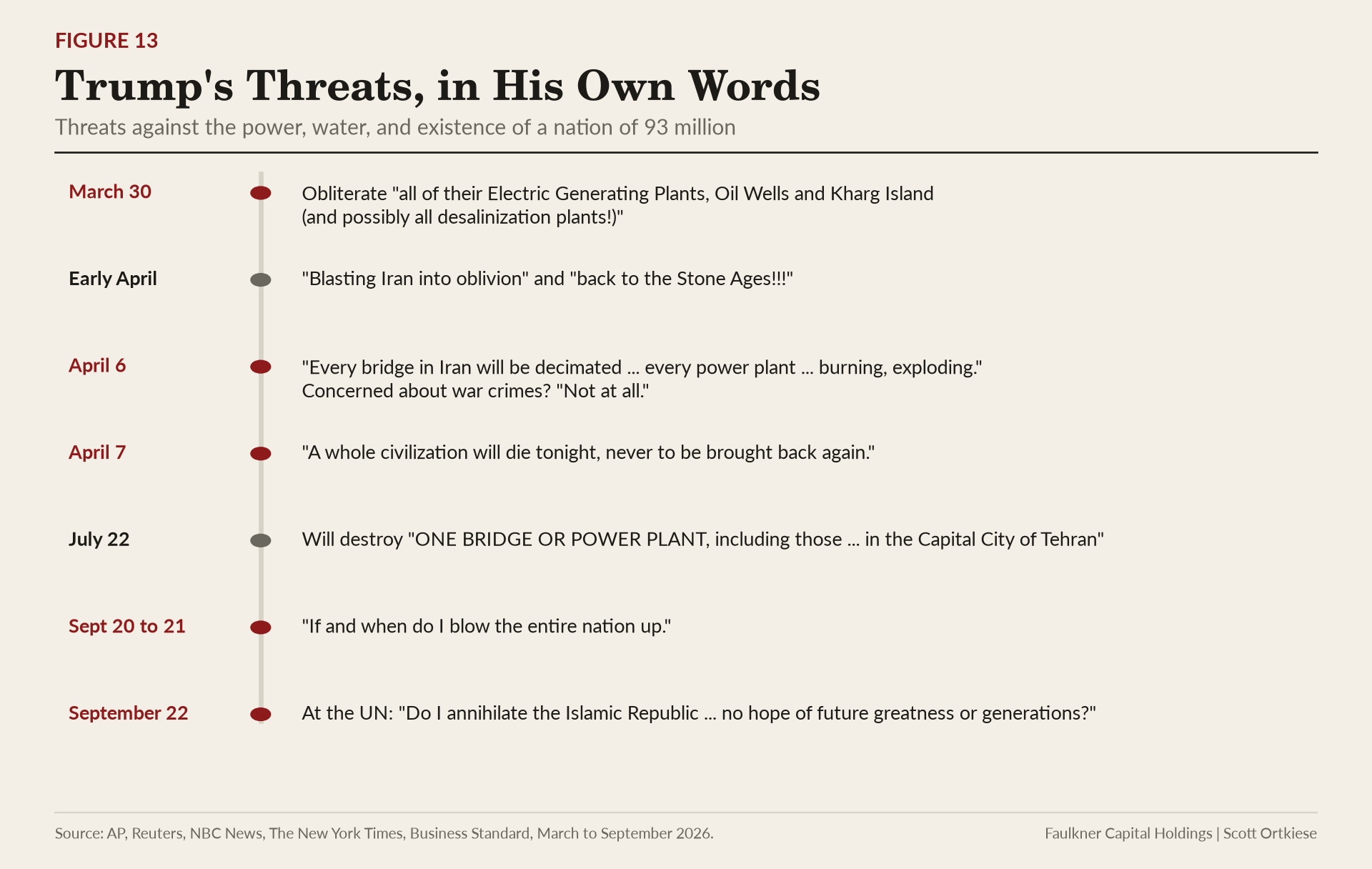
Trump’s threats, in his own words:
Why it’s a crime. Threats to destroy every power plant, every bridge, and every desalination plant in a desert country aren’t aimed at an army. They’re aimed at 93 million civilians who need electricity, roads, and drinking water to live. That’s the terror that Article 51(2) bans, and desalination plants are exactly the objects Article 54 protects. Stéphane Dujarric, spokesman for UN Secretary-General António Guterres, said attacks on such infrastructure are banned under international law. Legal experts told The New York Times that carrying out the April threat would amount to a war crime.
Why it’s genocidal. Trump didn’t threaten a regime. He threatened that a “whole civilization will die,” that he might “blow the entire nation up,” and that Iranians would have “no hope of … generations.” That is the language of destroying a national group “as such,” the exact words of the Genocide Convention. This is institutional genocide, announced from the White House and the podium of the UN General Assembly. More than 200 human rights organizations and experts, including Amnesty International USA, warned that threatening to wipe out “a whole civilization” may amount to a threat of genocide. Amnesty International called for urgent global action to prevent atrocity crimes. After the UN speech, Tara Drozdenko of the Union of Concerned Scientists said it carried an implied threat of nuclear force against the Iranian people: “This would be a nuclear genocide.” Under the Convention, public incitement to genocide is a crime whether or not the bombs fall, and rulers aren’t exempt.
Count 4: Orders From the Top
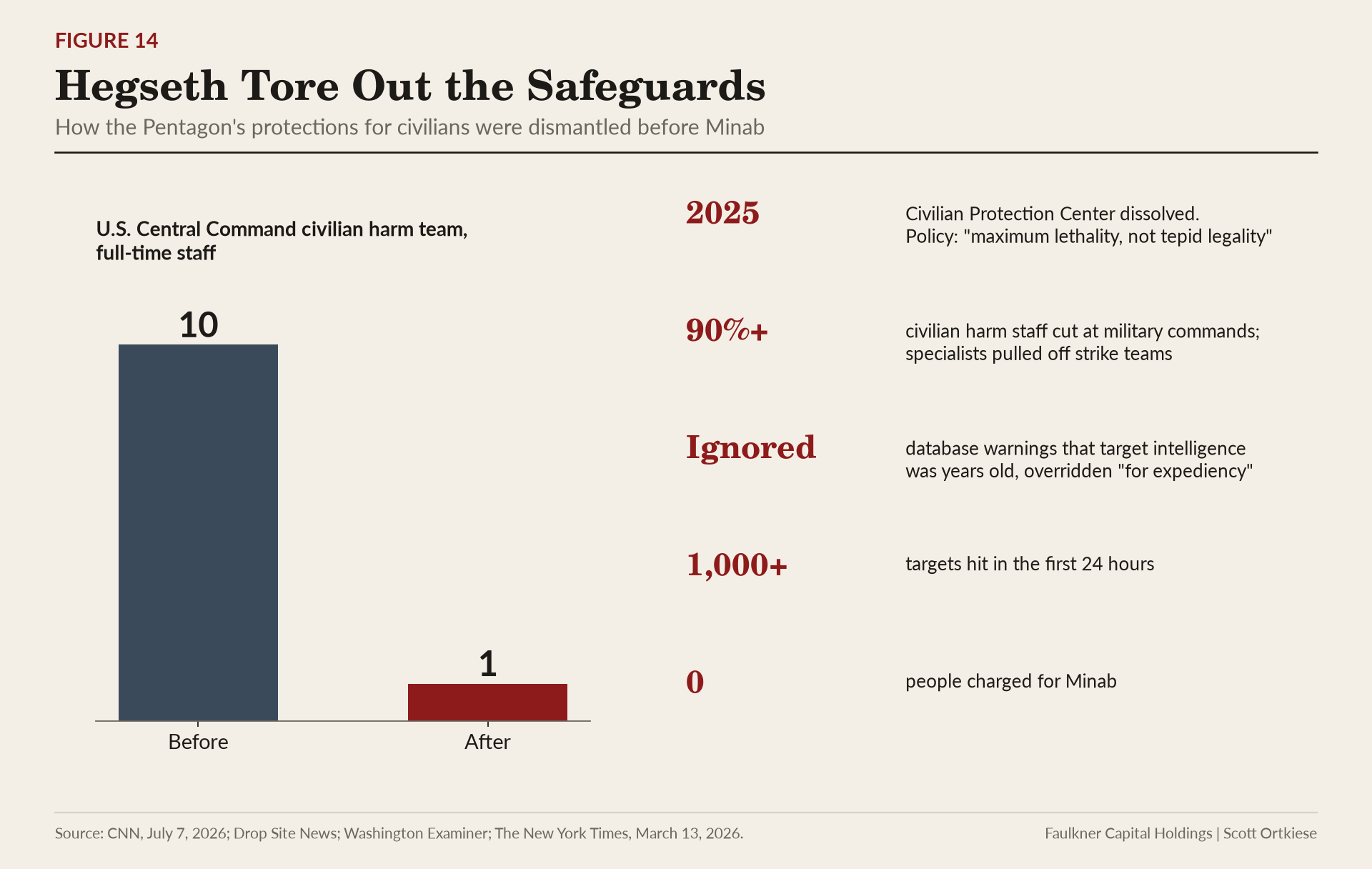
Pete Hegseth, the U.S. defense secretary, launched the war promising “no stupid rules of engagement”. He boasted that he had given the military “maximum authorities on the battlefield”. Early in his tenure in 2025, he dissolved the Pentagon’s Civilian Protection Center and announced a policy of “maximum lethality, not tepid legality”. According to CNN, he cut civilian harm staff at military commands by more than 90%, pulled civilian harm specialists off the teams that build strike packages, and shrank CENTCOM’s team of 10 to 1 full-time staffer. Targets were generated at speed with artificial intelligence (AI), including Palantir’s Maven system, from satellite photos that still showed a base where a school had stood for a decade. Asked whether his company’s AI model, Claude, played a role in Minab, Dario Amodei, chief executive of Anthropic, said “We don’t know exactly how these models were used” and that the use case “doesn’t even violate our red lines.” Wes Bryant, the former Pentagon targeting adviser, called Minab “not an isolated tragedy” but a symptom of a system that stopped complying with the law of armed conflict. Rules of engagement are the limits that keep civilians alive. Tearing them out, firing the people who enforce them, and then refusing to punish the result is exactly what command responsibility under Articles 86 and 87 covers. The State Department says it gives the UN findings no credibility. Nobody has been charged.
Count 5: Europe’s Runways
Europe isn’t a bystander. On September 30, Mark Rutte, NATO’s secretary general, said that 5,000 American planes have taken off from European bases since the end of February in support of Epic Fury, the U.S. name for the Iran war. A state that knowingly lets its territory be used for another state’s unlawful attacks shares responsibility for them. The same European capitals that lecture Moscow about international law are the launch pad for the bombing of Iran.
The Verdict
Under the laws the West wrote, the evidence makes the case on every element:
- 120 schoolchildren and 26 teachers killed in Minab by 13 American missiles
- The strikes on the prayer hall where teachers had sheltered the children
- The third tap, 4 more missiles fired 2 hours later into a crowd of 1,000 rescuers and parents
- Commanders who overrode warnings that the target data was years out of date
- A CENTCOM commander who told Congress a school was a missile base
- A president who blamed Iran, called the evidence “AI,” and is sitting on the findings
- The tungsten pellets on a sports field
- The bombs on a wedding
- Threats to destroy the power and water of 93 million people
- Public vows to end a civilization
- Generals freed from the rules
- European runways
A UN fact-finding mission has already found reasonable grounds for war crimes, the standard used to open prosecutions. No one has been tried, because neither the United States nor Iran accepts the jurisdiction of the International Criminal Court (ICC), Trump has sanctioned the court, and the American Service-Members’ Protection Act, known as the “Hague Invasion Act,” authorizes the use of force to free any American held for trial in The Hague. Washington won’t prosecute itself. A special tribunal, like the one Europe built for Russia over Ukraine, is the open door. The evidence is in. The only thing missing is a court willing to hear it.
The Bill
How the Bill Is Counted
Each dollar appears once, and each figure comes from a single official source:
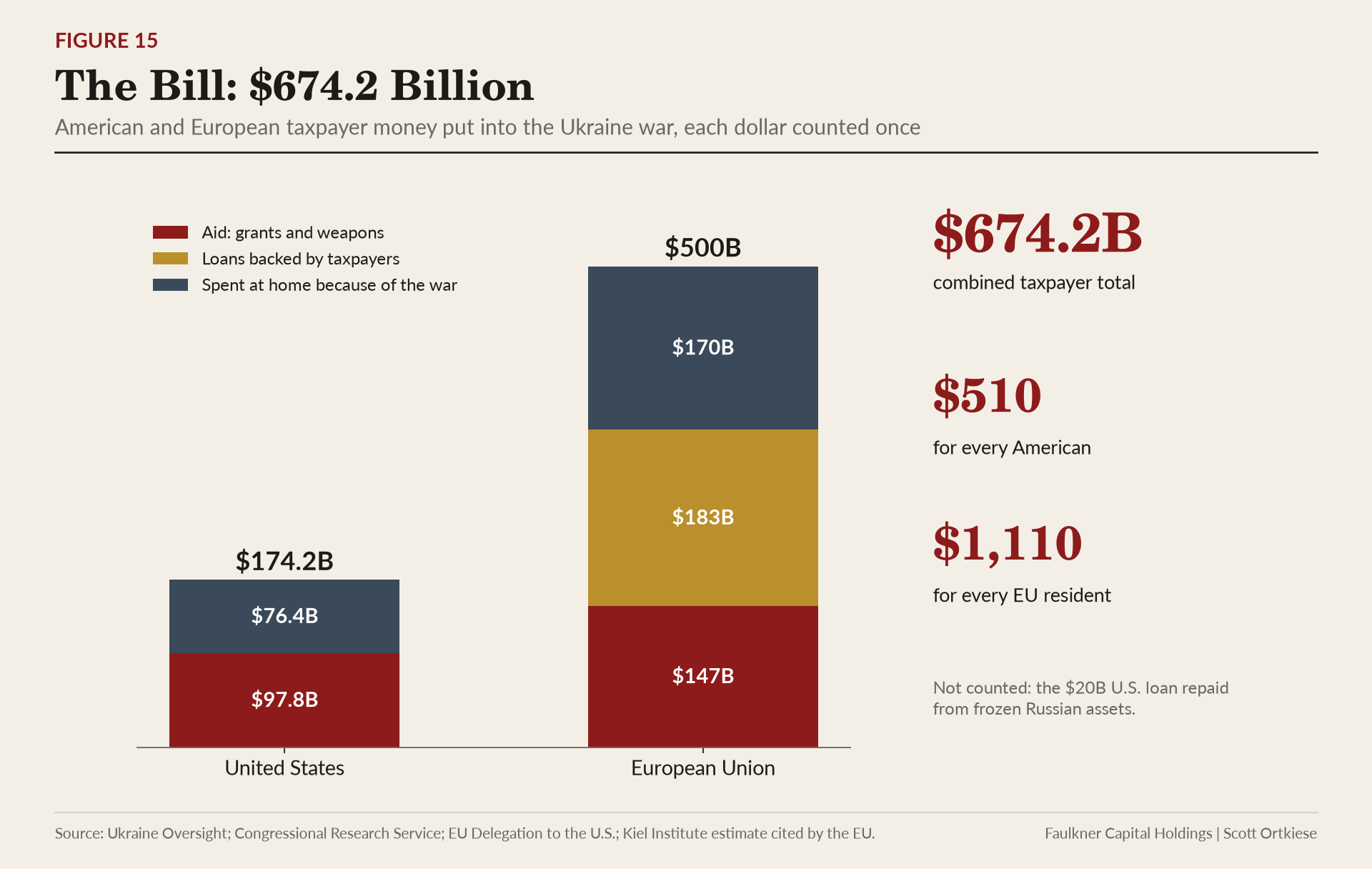
- U.S. figures come from the 5 Ukraine spending bills Congress passed from 2022 to 2024. The aid and domestic lines below add up exactly to that $174.2 billion total.
- EU aid figures come from the EU’s own $226 billion total, which the EU says is 65% grants and 35% loans. The aid and loan lines below add up exactly to that $226 billion. The EU’s own refugee spending, up to $18 billion, is already inside that total, so it isn’t added again.
- The 2026 to 2027 EU loan is counted separately because the EU itself describes it as an “additional” $104 billion on top of the $226 billion.
- National refugee costs come from the Kiel Institute estimate of what EU member governments spend from their own budgets. That’s separate from the EU’s budget.
- The $20 billion U.S. loan is repaid from frozen Russian assets, so it’s shown but kept out of the taxpayer total.
- Euro figures are converted to dollars at the EU’s own rate (the European Central Bank’s 12-month average as of November 12, 2025).
Aid: Grants and Weapons Given to Ukraine
| Item | Amount | Source |
|---|---|---|
| U.S. weapons and military services, committed | $67.8 billion | Ukraine Oversight |
| U.S. cash to keep Kyiv’s government running (salaries, pensions, services), paid through the World Bank | $30 billion | Congressional Research Service |
| EU and member states, grants and in-kind aid, including $82.9 billion in weapons | $147 billion | EU Delegation to the U.S. (65% of $226 billion) |
| Total aid | $244.8 billion |
Loans
| Item | Amount | Source |
|---|---|---|
| EU and member states, low-interest loans to date | $79 billion | EU Delegation to the U.S. (35% of $226 billion) |
| EU Ukraine Support Loan for 2026 and 2027, agreed April 23, 2026. Nearly $70 billion is for weapons, and €11.6 billion had been paid out by September 19 | $104 billion | EU Delegation to the U.S.; Kallas, September 19 |
| Taxpayer-backed loans | $183 billion | |
| U.S. loan under the G7 plan, repaid from frozen Russian assets. Not counted in the taxpayer total | $20 billion | Ukraine Oversight |
Ukraine repays the $104 billion EU loan only if Russia pays war reparations. If Russia doesn’t pay, European taxpayers carry it.
Domestic Spending: Money Spent at Home Because of the War
| Item | Amount | Source |
|---|---|---|
| U.S. spending at home and in Europe: restocking U.S. arsenals, U.S. troops deployed to Europe, other agencies, and $10.6 billion in other humanitarian aid. Calculated as $174.2 billion minus the 2 U.S. aid lines | $76.4 billion | Ukraine Oversight; Congressional Research Service |
| EU member governments hosting Ukrainian refugees | $170 billion | Kiel Institute estimate, cited by the EU |
| Total domestic spending | $246.4 billion |
The Total
| Bucket | United States | European Union | Combined |
|---|---|---|---|
| Aid | $97.8 billion | $147 billion | $244.8 billion |
| Loans | Not counted | $183 billion | $183 billion |
| Domestic spending | $76.4 billion | $170 billion | $246.4 billion |
| Taxpayer total | $174.2 billion | $500 billion | $674.2 billion |
American and European taxpayers have put $674.2 billion into this war. That works out to about $510 for every American and about $1,110 for every EU resident.
Costs Left Out of That Total
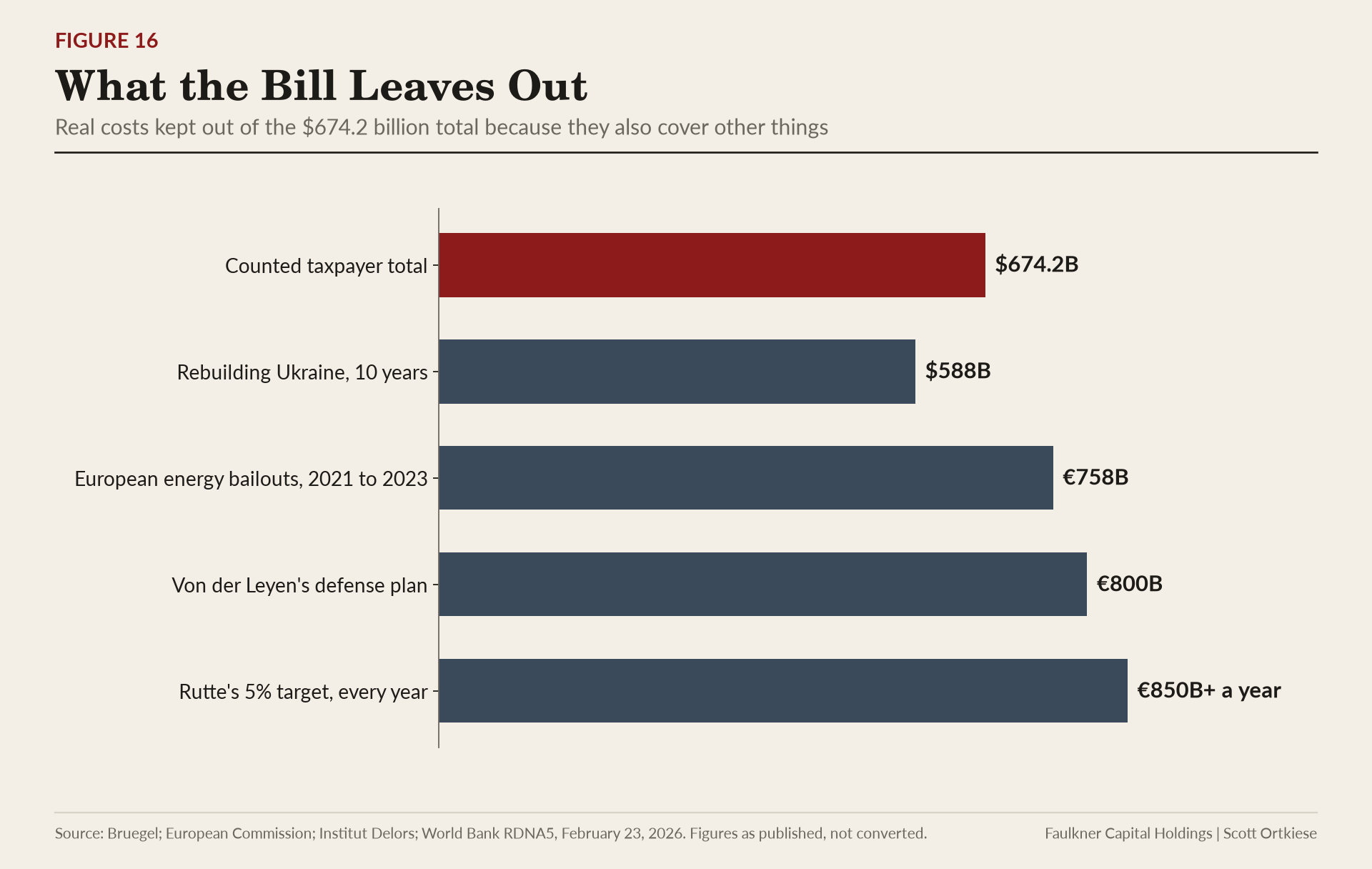
The figures below are real, but they’re kept out of the total because they also cover things other than Ukraine:
- European energy bailouts: €758 billion from September 2021 to January 2023 to shield households and businesses from the energy shock. The period starts 5 months before the invasion, and the figure includes the UK and Norway.
- Von der Leyen’s defense plan: €800 billion.
- Rutte’s 5% defense target for European NATO members: more than €850 billion every year, 2.5 times the current level.
- Aid from outside the U.S. and EU: the UK, Norway, Canada, and Japan are not counted.
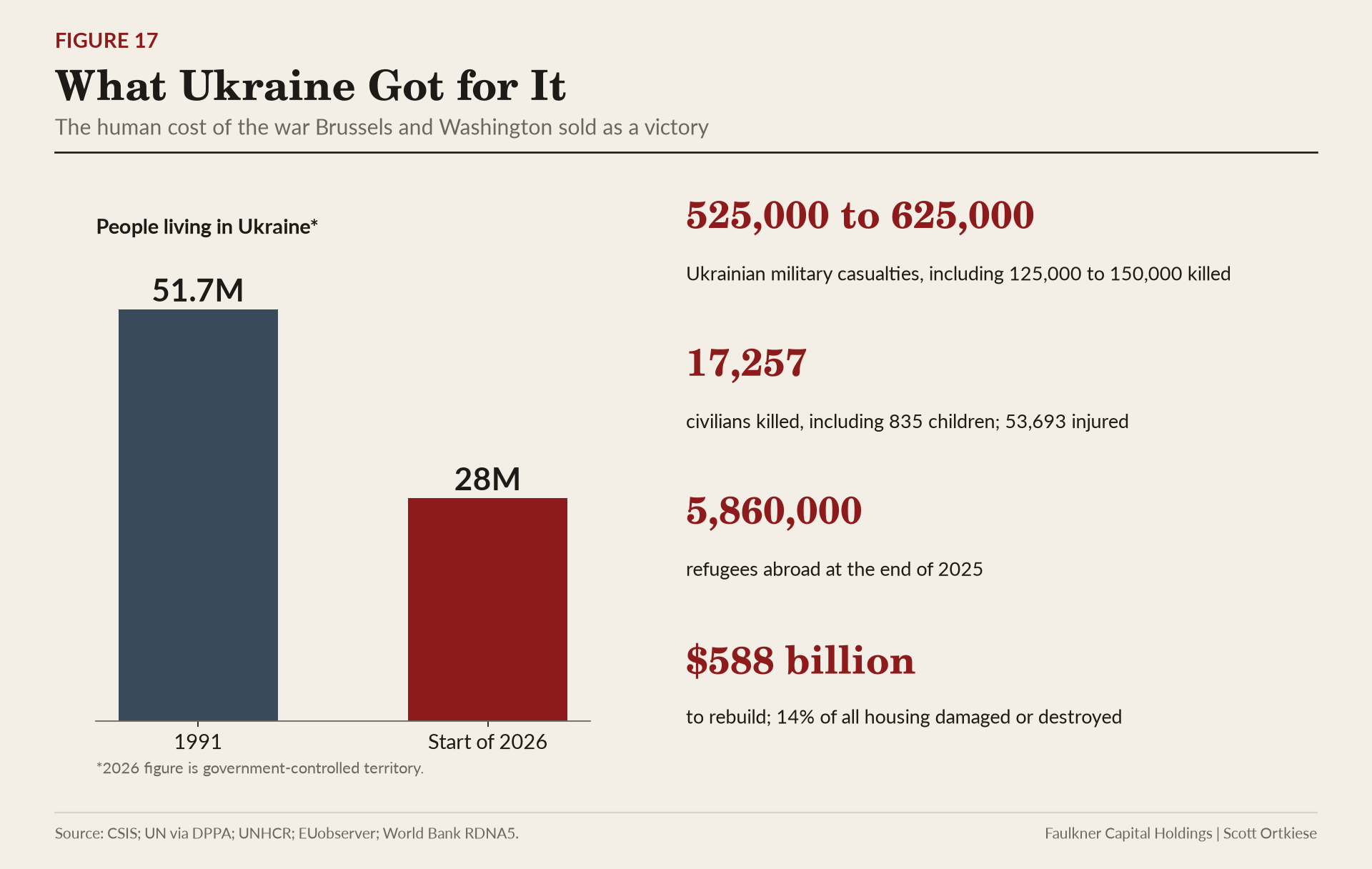
- Rebuilding Ukraine: almost $588 billion over 10 years, nearly 3 times Ukraine’s annual economic output, according to the World Bank, the European Commission, the United Nations, and the government of Ukraine. That estimate is as of December 31, 2025, before this fall’s strikes on Kyiv. Direct damage already tops $195 billion, and 14% of all housing has been damaged or destroyed.
Zelenskyy himself told the Associated Press that $100 billion of the American money never reached him: “I don’t know where all the money is.” According to the Center for Strategic and International Studies (CSIS), a Washington think tank, about 60% of U.S. aid was spent inside the United States, and 90% of the military aid went to American weapons makers. The war is a business, and Washington’s contractors got the first cut.
The Human Cost
- Ukrainian soldiers: CSIS estimates 525,000 to 625,000 Ukrainian military casualties, including 125,000 to 150,000 killed, from February 2022 through June 2026. Combined losses on both sides top 2,000,000.
- Civilians: The United Nations has verified at least 17,257 Ukrainian civilians killed, including 835 children, and 53,693 injured. More civilians were killed or wounded in the first 8 months of 2026 than in all of 2025. Rosemary DiCarlo, the UN under-secretary-general for political and peacebuilding affairs, calls this a “dangerous new phase” of the war.
- Refugees: 5,860,000 Ukrainians were living abroad as refugees at the end of 2025.
- A nation emptying out: About 28,000,000 people lived in government-controlled Ukraine at the start of 2026. In 1991, the country had 51,700,000.
The Western Exits
The exits are already drawn up, and none of them is a victory parade.
- Washington walks first. The last U.S. aid package contains no Patriot air-defense missiles and spends the last of the $400 million Congress approved. Trump has told Zelenskyy to go to Moscow and negotiate. The United States leaves with its arsenals restocked and its weapons makers paid.
- Brussels leaves an IOU. Western governments are drawing up plans to move their embassies from Kyiv to eastern Poland, and they stay for now only because leaving would signal that support is weakening. European taxpayers keep the $104 billion loan, which Ukraine repays only if Russia pays reparations. A Russia that is winning pays nothing.
- The cronies are already gone. Timur Mindich fled to Israel. Rostyslav Shurma is a fugitive abroad.
- Ukrainians get 1 road. The M-07 highway to Poland, hit dozens of times since early September, is the last main route out, with trucks backed up at the border. 5,860,000 Ukrainians have already left.
- Moscow writes the terms. Every village lost in the Kharkiv pocket and every bridge down in Kyiv moves the settlement line west. The deal Kyiv refuses this year is better than the one it will sign next year.
- There is no exit from Minab. The war pigs can walk away from Ukraine. They can’t walk away from 13 missiles and 168 dead. A UN mission has already found reasonable grounds for war crimes, and a special tribunal is the open door.
So What?
Brussels and NATO headquarters sold Ukrainians a victory that was never on offer. American and European taxpayers have put $674.2 billion into it. That’s $244.8 billion in aid, $183 billion in loans that Ukraine may never repay, and $246.4 billion spent at home. In return, Ukraine got more than 500,000 military casualties, 17,257 dead civilians, nearly 6,000,000 refugees, and a $588 billion rebuilding bill. Zelenskyy’s inner circle took its cut. Rutte, Kallas, and von der Leyen keep demanding more, even though their own intelligence services say Russia isn’t coming for NATO. In Iran, the same alliance bombs girls’ schools, threatens to end a civilization of 93 million people, and lends its runways to the job. Ukrainians pay with their bridges, their power grid, their roads out, and their sons. Every month the war pigs drag this out, the terms Ukraine ends up with get worse. Watch the footage yourself. I rest my case.
Sources
Military Summary Videos
- September 26, 2026, “The Sumy Offensive Resumes: Kyiv’s Digital Infrastructure Burns”: https://www.youtube.com/watch?v=cYsVVkcDUTg
- October 2, 2026, “No More Rules: Putin Lifts All Restrictions on the Air Campaign”: https://www.youtube.com/watch?v=h8IGIMkrXb8
- October 2, 2026, “General Armageddon Returns? 10 Days Left: The Kharkiv Cauldron’s Final Countdown”: https://www.youtube.com/watch?v=wVWKPkqxYGY
- October 3, 2026, “The Northern Bridge Falls: Embassies Exit”: https://www.youtube.com/watch?v=TOWNuUI7hhc
Corruption
- Euronews, August 20, 2026: https://www.euronews.com/2026/08/20/ukraine-anti-corruption-probes-close-in-on-volodymyr-zelenskyys-inner-circle
- Reuters, July 10, 2026: https://www.reuters.com/world/europe/ex-energoatom-official-named-suspect-ukraines-biggest-wartime-bribery-probe-2026-07-10/
- NBC News, November 28, 2025: https://www.nbcnews.com/world/ukraine/andriy-yermak-raid-ukraine-corruption-zelenskyy-peace-talks-rcna246298
- Kyiv Independent, July 31, 2025: https://kyivindependent.com/parliament-votes-on-bill-restoring-nabu-sapo-independence/
Officials
- NATO, Rutte remarks, September 30, 2026: https://www.nato.int/en/news-and-events/events/transcripts/2026/09/30/remarks-by-nato-secretary-general-at-euronews-defence-%2Dspace-summit
- Kyiv Post, Kallas, September 16, 2026: https://www.kyivpost.com/post/84601
- Kallas statement to the European Parliament, September 19, 2026: https://www.europesays.com/uk/1211735/
- Fox News, Kallas and Tsahkna, September 26, 2026: https://www.foxnews.com/politics/grew-up-soviet-rule-eu-top-diplomat-warns-europe-against-giving-russia-wants
- EEAS, von der Leyen and Rutte, September 7, 2026: https://www.eeas.europa.eu/delegations/ukraine/statement-president-von-der-leyen-nato-secretary-general-mark-rutte-0_en
- European Commission, von der Leyen, State of the Union, September 16, 2026: https://luxembourg.representation.ec.europa.eu/actualites-et-evenements/actualites/2026-state-union-address-president-von-der-leyen-2026-09-16_en
Iran War Crimes
- Drop Site News, Jeremy Scahill, “Massacre at Minab: The School That Became a Grave”: https://www.dropsitenews.com/p/minab-school-massacre-iran-war-children-families
- Drop Site News, video, “The Morning the U.S. Bombed a School in Iran”: https://www.dropsitenews.com/p/minab-iran-bombing-school-massacre-video
- Democracy Now, October 2, 2026, Jeremy Scahill on Minab (page): https://www.democracynow.org/2026/10/2/massacre_at_minab
- Democracy Now, October 2, 2026, Jeremy Scahill on Minab (video): https://www.youtube.com/watch?v=6EuLs76P21k
- Breaking Points, September 30, 2026, “Jeremy Scahill EXPOSES SHOCKING Depravity In U.S. Iran School Bombing”: https://www.youtube.com/watch?v=Tsr1JT4kCtI
- Breaking Points, July 16, 2026, “Trump COVERS UP US Girls School Strike”: https://www.youtube.com/watch?v=y-2rSQMTV4k
- Breaking Points, June 16, 2026, “Anthropic CEO’s SHOCKING Response on Iranian Girl School Strike”: https://www.youtube.com/watch?v=SIUrshGwgDI
- WION, February 28, 2026, Minab school strike and Tehran evacuation: https://www.youtube.com/watch?v=DfmsZ4geong
- CNN, July 7, 2026, “US commanders bypassed warnings about outdated intelligence”: https://edition.cnn.com/2026/07/07/politics/us-commanders-intelligence-iran-school
- UN Independent International Fact-Finding Mission on Iran, BBC, September 17, 2026: https://www.bbc.com/news/articles/cm9w4n5nverdo
- NPR, September 17, 2026: https://www.npr.org/2026/09/17/nx-s1-5972934/us-iran-war-un-report-alleged-war-crimes
- Time, September 18, 2026: https://time.com/article/2026/09/18/us-iran-israel-war-crimes-strike-minab-school-un-report/
- Los Angeles Times, “Inside the U.S. ‘kill chain’ that destroyed an Iranian school,” September 21, 2026: https://www.latimes.com/world-nation/story/2026-09-21/inside-u-s-kill-chain-that-destroyed-iranian-school
- Democracy Now, Forensic Architecture interview, July 22, 2026: https://www.democracynow.org/2026/7/22/minab_forensic_architecture
- National Iranian American Council, civilian casualties report, July 2026: https://niacouncil.org/wp-content/uploads/2026/07/Civiliancasualties_Niacreport.pdf
- Human Rights Watch, March 7, 2026: https://www.hrw.org/news/2026/03/07/us/israel-investigate-iran-school-attack-as-a-war-crime
- Common Dreams, June 18, 2026: https://www.commondreams.org/news/trump-minab-school
- UN News, September 14, 2026: https://news.un.org/en/story/2026/09/1168328
- WANA, Christine Weigand, September 30, 2026: https://wanaen.com/un-official-over-3400-civilians-killed-more-than-33000-injured-in-iran-war/
- AP, power plant threats, April 6, 2026: https://apnews.com/article/trump-iran-power-plants-civilian-war-crimes-88b8ca1bc8e5cc8adabaf6c34e93e597
- AP, “language of annihilation,” April 7, 2026: https://apnews.com/article/trump-iran-threats-civilization-war-crimes-758eb5cd680d7d275c4e1c38b2e01e6d
- Business Standard, April 7, 2026: https://www.business-standard.com/amp/world-news/trump-iran-threats-war-crimes-international-law-explained-126040700513_1.html
- Reuters, “A whole civilization will die tonight,” April 7, 2026: https://www.reuters.com/world/middle-east/trump-says-a-whole-civilization-will-die-tonight-if-iran-does-not-make-deal-2026-04-07/
- Reuters, bridge or power plant threat, July 22, 2026: https://www.reuters.com/world/trump-us-will-attack-iranian-bridge-power-plant-every-ship-targeted-hormuz-2026-07-22/
- NBC News, September 21, 2026: https://www.nbcnews.com/world/middle-east/trump-wiping-out-iran-warns-new-weapons-rcna598954
- New York Times, UN General Assembly speech, September 22, 2026: https://www.nytimes.com/2026/09/22/world/americas/trump-annihilate-iran-unga.html
- Human Rights Watch, statement by more than 200 organizations and experts, April 7, 2026: https://www.hrw.org/news/2026/04/07/more-than-200-organizations-and-experts-call-for-an-end-to-trumps-threats-of-war
- Amnesty International, April 7, 2026: https://www.amnesty.org/en/latest/news/2026/04/iran-president-trumps-apocalyptic-threats-of-large-scale-civilian-devastation-demand-urgent-global-action-to-prevent-atrocity-crimes/
- Union of Concerned Scientists, September 22, 2026: https://www.ucs.org/about/news/trumps-threats-un-increase-nuclear-proliferation-risks
- Washington Examiner, Hegseth, March 7, 2026: https://www.washingtonexaminer.com/in_focus/4483145/stupid-rules-of-engagement-war-iran-hegseth/
- New York Times, Hegseth, March 13, 2026: https://www.nytimes.com/2026/03/13/us/politics/hegseth-iran-war-rules.html
- Worldometer, Iran population 2026 (UN World Population Prospects): https://www.worldometers.info/world-population/iran-population/
Money
- Ukraine Oversight, U.S. funding: https://www.ukraineoversight.gov/Funding/
- Congressional Research Service, U.S. direct financial support for Ukraine: https://www.congress.gov/crs_external_products/IF/HTML/IF12305.web.html
- CSIS, “Where Is the Missing $100 Billion in U.S. Aid for Ukraine?”: https://www.csis.org/analysis/where-missing-100-billion-us-aid-ukraine
- EU Delegation to the United States, EU assistance to Ukraine in U.S. dollars, October 1, 2026: https://www.eeas.europa.eu/delegations/united-states-america/eu-assistance-ukraine-us-dollars_en?s=253
- Bruegel, the fiscal side of Europe’s energy crisis: https://www.bruegel.org/blog-post/fiscal-side-europes-energy-crisis-facts-problems-and-prospects
- Institut Jacques Delors, 5% of GDP for defense: https://institutdelors.eu/en/publications/nato-summit-and-european-defence-5-of-gdp-for-defence-what-are-we-talking-about/
- World Bank, RDNA5, February 23, 2026: https://www.worldbank.org/en/news/press-release/2026/02/23/updated-ukraine-recovery-and-reconstruction-needs-assessment-released
Human Cost
- Kyiv Independent, casualty estimates, July 31, 2026: https://kyivindependent.com/ukraine-war-latest-russian-military-deaths-14-times-higher-than-ukraines-zelensky-says/
- UN Department of Political and Peacebuilding Affairs, September 23, 2026: https://dppa.un.org/en/news/ukraine-war-entering-dangerous-new-phase-as-regional-risks-grow-under-secretary-general
- UNHCR, Ukraine situation 2026: https://data.unhcr.org/en/documents/download/120716
- EUobserver, Ukraine population, May 25, 2026: https://euobserver.com/217278/war-is-draining-ukraine-of-people-and-even-eu-membership-wont-stop-the-population-collapse/