Scott Ortkiese | Throughline Synthesis | Houston, August 27, 2026
An open indictment of the Trump administration and the men who cannot see past the end of their own noses
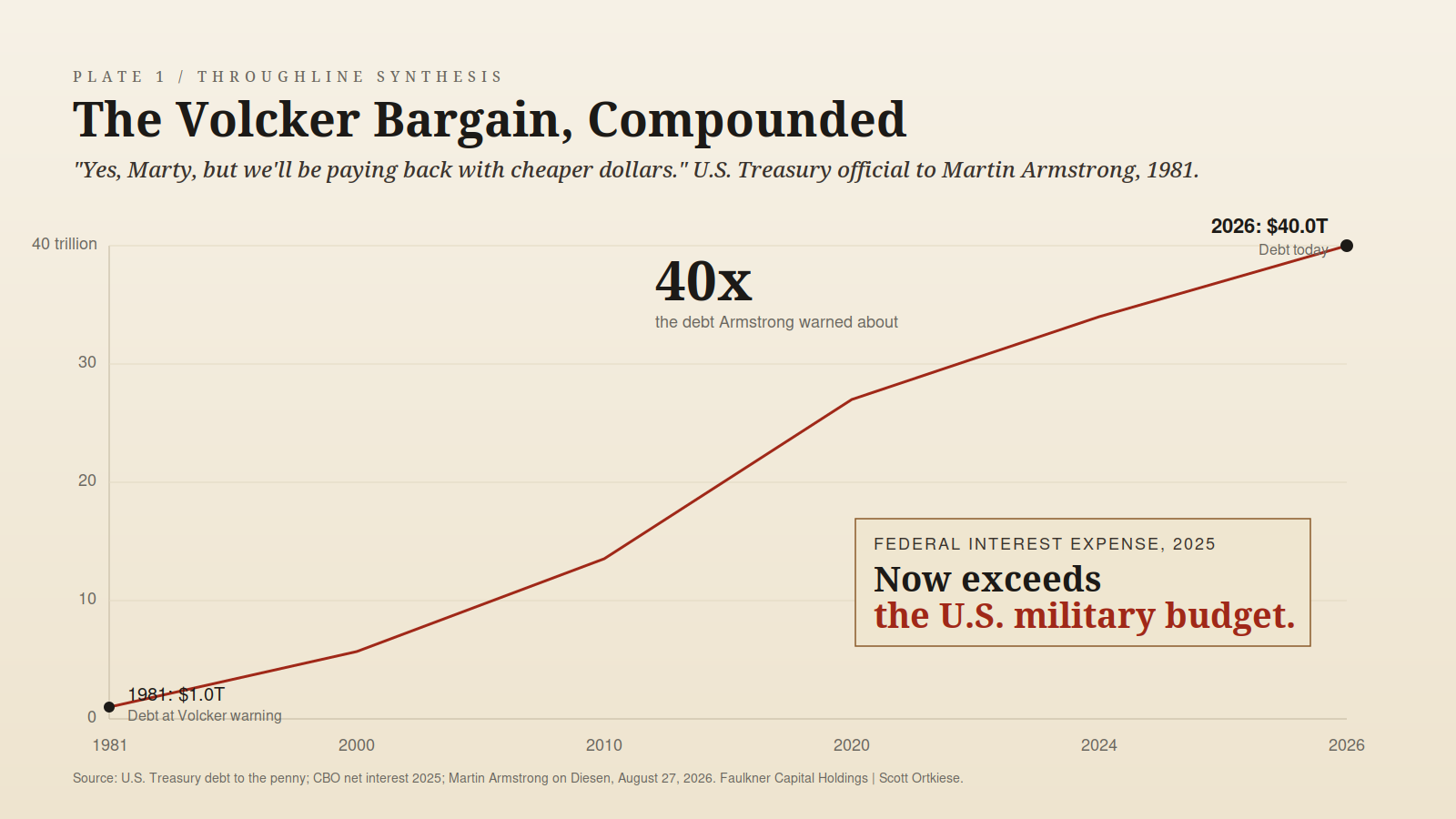
There is a moment, late in his August 2026 conversation with Glenn Diesen, when the American forecaster Martin Armstrong stops arguing and simply stares at the record. He tells the story of a 1981 meeting with the U.S. Treasury. Volcker had interest rates at fourteen percent. Armstrong warned the assembled officials that the national debt would double by the end of the decade. Very calmly, they told him, “Yes, Marty, but we’ll be paying back with cheaper dollars.” He looked at them and said, “All right, I guess you guys know what you’re doing.” Forty five years later, the interest expense on the federal debt has exceeded the entire military budget, the debt sits at forty trillion dollars, and the same class of official is still in the room, still calm, still paying back with cheaper dollars, still telling anyone who asks that they know what they’re doing (Armstrong on Diesen, August 27, 2026).
This essay is about those officials, and about the presidents, prime ministers, secretaries, generals, and back room advisers who staff and serve them. It is about a governing class in the United States and its client states that has forgotten the first responsibility of statecraft: to think past step one. It is written in agreement with Armstrong, in agreement with Michael Hudson, Jeffrey Sachs, and Richard Wolff, in agreement with the Russian naval officer and military analyst Andrei Martyanov, and in agreement with a much older tradition of political economy that runs from David Ricardo to Sallust to Bismarck to Herbert Hoover. And it is written in anger, because the men currently running the American empire and its Israeli spearhead are not merely mistaken. They are, by every historical standard we can apply, incompetent, and they are incompetent in a way that is now costing lives, currencies, alliances, ships full of hungry sailors, and the last thin credibility of the post war order.
I hold no punches here. There is no version of this story in which fairness to Donald Trump, Benjamin Netanyahu, Volodymyr Zelensky, Marco Rubio, Scott Bessent, Ursula von der Leyen, or Mark Carney requires me to pretend they are competent statesmen wrestling with hard trade offs. They are not. They are men who cannot see past their next headline, next election, next donor, next photo op, and they are dragging the rest of us into an economic and geopolitical wreckage that the historical record predicted before any of them was born.
The Blair standard
Armstrong keeps returning to a single sentence from Tony Blair’s Iraq apology, which anyone can still find on YouTube. Blair says: “We thought we were freeing the people from the evil of Saddam. We didn’t realize we would be subjecting them to sectarian violence.” Read that again, slowly. This is the retired prime minister of the United Kingdom, decades after the fact, confessing that the government which invaded and dismantled Iraq did not think about what comes next. It did not model the sectarian composition of the country it was about to shatter. It did not consider that removing a Sunni strongman from a Shia majority country would produce something. It did not read a book. It did not ask a specialist. It went in.
Then came ISIS.
Armstrong calls this “one step forward.” I would call it something stronger. The Blair standard is now the operating manual of Western foreign policy. Take out Saddam and see what happens. Take out Gaddafi and see what happens. Take out Assad, or try to, and see what happens. Take out the Ayatollah and see what happens. Take Putin off the board and see what happens. In each case the answer to what happens is not a plan. It is a shrug. And in each case the answer that has arrived, unbidden, has been worse than the thing they set out to fix.
Netanyahu has been pitching the Ayatollah’s assassination to every American president since 1996. He pitched it inside the Situation Room, the first foreign head of state ever ushered into that room, as Armstrong notes, and Trump bought it. On June 12, 2026, as Jeffrey Sachs has documented, Israel launched a preemptive war on Iran three days before the sixth round of nuclear negotiations was scheduled to take place. Trump confirmed the United States knew of the attack in advance, “even as the administration was speaking publicly of the upcoming negotiations” (Sachs & Fares). This was not diplomacy. This was diplomacy used as cover for war, precisely the sequence Michael Hudson identifies when he writes that the pretense was “‘Well, we need an excuse to go to war. What’s the excuse? Let’s have a negotiation, and let’s follow the big lie of Trump, which is the same lie that Netanyahu’s been saying for over 10 years, that Iran wants to have an atom bomb to blow things up'” (Hudson, “Negotiations as Cover, War as Policy”).
What has this Iran war produced? Every objective it named has failed. As David Faris writes in The Nation, five months after the launch, “the United States appears no closer to achieving a single meaningful objective than it was when an outmaneuvered President Trump signed what was effectively a strategic surrender on June 17… burning through hundreds of millions of dollars a day worth of sophisticated munitions to bomb a country that is successfully defending itself with \$7,000 drones and speedboats” (Faris, The Nation). The Strait of Hormuz, which any competent planner would have secured before the first bomb fell, as Armstrong points out, because every war game of the last decade began by seizing it, remains contested. Trump has now decreed by Truth Social that the United States is “THE GUARDIAN OF THE HORMUZ STRAIT” and will be “reimbursed, at the rate of 20% on all cargo shipped” (quoted in Hudson, “The Dollar’s Last Line of Defence”). A protection racket, published on a social media site, dressed up as strategy.
This is the Blair standard operating in real time. There was no plan for the day after the bombing. There is no plan now. There will be no plan tomorrow. And when the bombing failed to produce its promised regime change, the administration reverted to sanctions, which, as Armstrong notes and every empirical study of the field confirms, do not work. Cuba has been under U.S. sanctions since 1960 and is still there. Iran has been under U.S. sanctions in every serious form since 1979 and is still there. The National Academies’ own review of the post Cold War sanctions literature is a monument to embarrassed academic hedging around a simple fact: sanctions rarely change target state behavior and reliably harden target state populations against the sanctioning power (National Academies). Armstrong’s summary is blunter and better: “They may make some people feel better, bravado, we’ve done something, but there’s no real evidence that sanctions have ever actually brought down a government.”
Why Trump cannot stop
Here we have to name something that respectable commentary tiptoes around. Trump cannot admit a mistake. This is not an editorial flourish. It is a documented feature of his behavior, and it is now a strategic vulnerability of the United States.
Professor Geoff Beattie, writing for The Conversation, describes the pattern: Trump “can publicly distance himself when things go wrong… claim a degree of surprise, and swiftly change course. That way he is publicly reasserting his role as leader without admitting fault… Trump often reverses these decisions made by his subordinates in high visibility environments, which suggests a determined pattern of strategic image management” (Edge Hill / Beattie). The Nation is less clinical: the resumed Iran war is being fought “for no other reason than one octogenarian narcissist’s inability to face reality” (Faris).
Armstrong sees the same thing from a different angle. “The problem with Trump now is that he doesn’t want to admit he made a mistake. Backing off on the bombing and moving to sanctions is really admitting the bombing didn’t work.” So instead of course correcting, Trump escalates the mistake, turning a failed military campaign into a permanent economic siege that gives Bessent an excuse to threaten every trading partner of Iran with removal from the dollar system.
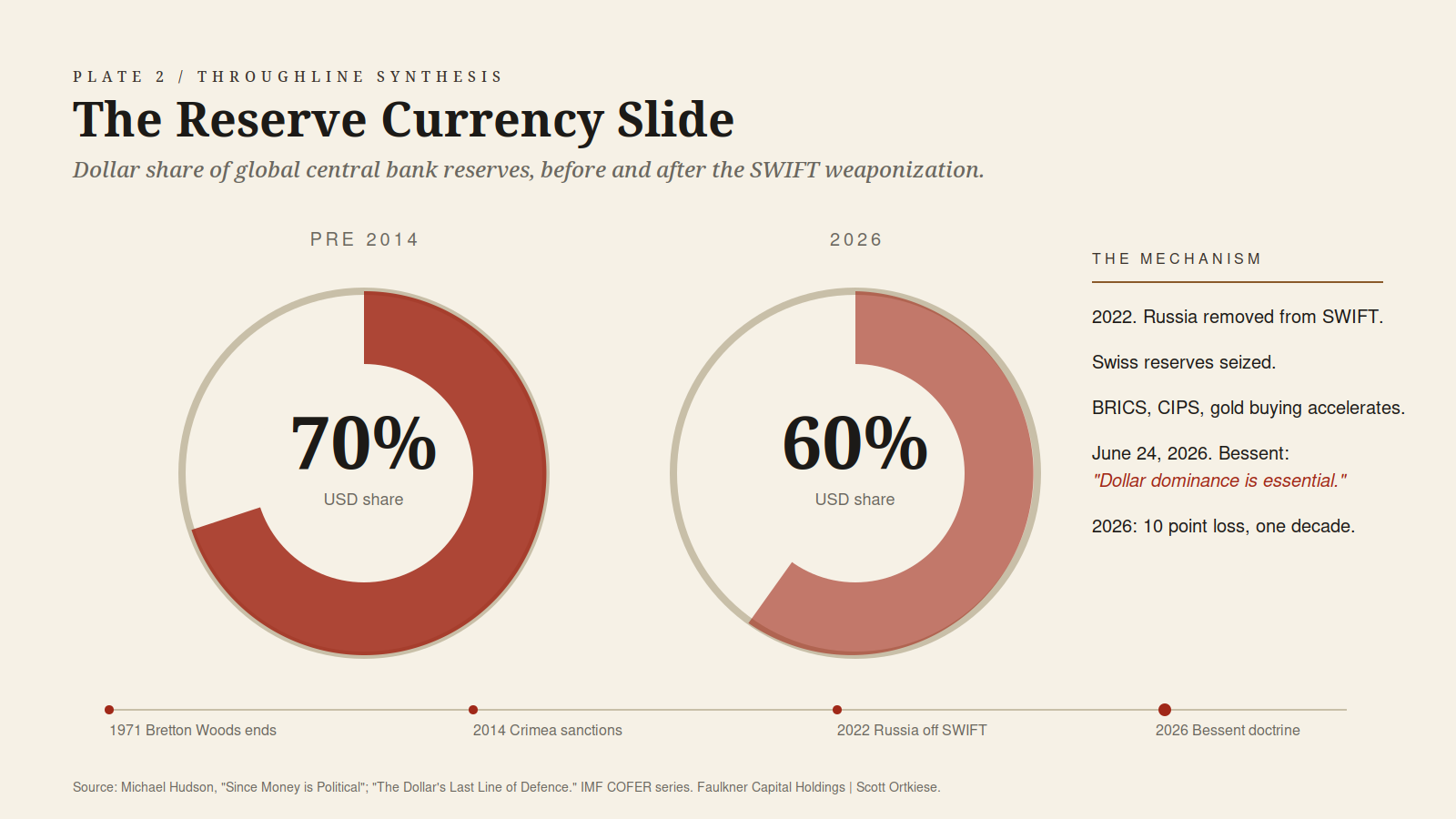
This is the second order catastrophe. In 2022 the Biden administration removed Russia from SWIFT. That single decision, as Hudson has been saying since the day it happened, was the “poisonous gift” that told every non Western capital that the American financial system was now a weapon and that any state which fell out of favor could have its reserves confiscated overnight. Switzerland then compounded it by seizing “Russian” assets on the theory that any wealthy Russian must have known Putin. As Armstrong tells Diesen, “the smart money left Switzerland and went to Dubai and Singapore.” Hudson, who has spent five decades warning that the U.S. Treasury bill standard was the material basis of American empire, calls this what it is: the weaponization of the dollar has “backfired,” and “the level of dollars, the share of dollars in the reserves of central banks around the world, is going down. It had been some 70%, now it’s 60%” (Hudson, “Since Money Is Political”).
Bessent then made it worse. On June 24, 2026, on television, the U.S. Treasury Secretary declared: “Dollar dominance is essential,” and explained that the point of the Venezuela sanctions was that Venezuela “was selling discounted oil to China and not getting dollars” (quoted in Hudson). In one sentence, the Treasury Secretary of the United States told every commodity exporting country on earth that if they price their exports in anything other than dollars, they will be treated as an enemy. This is the opposite of a strategy to preserve the dollar. It is a strategy to accelerate its decline.
China has already been selling U.S. Treasuries and buying gold. Armstrong is careful to note that this is not because gold pays a yield, it doesn’t; it pays negative carry, but because you do not want to hold the debt of your adversary when war comes. He is right. The historical record on wartime sovereign default is unambiguous. If the U.S. and China went to war tomorrow, the U.S. would default on Chinese holdings the day after. Beijing knows that. Moscow knows that. Every capital in the Global South is now working the math. And instead of correcting course, the Trump administration is doubling and tripling down on the very policy that is teaching the world to route around Washington.
Wolff puts it in the plainest possible language: “You’re not dealing with a government that is strong. You’re dealing with a government that is desperate. And that can be very dangerous and very troubling, but to understand it, you’ve got to see it in that way” (Wolff in Current Affairs).
The 1996 dream
Netanyahu deserves his own paragraph because he has been running the same play for thirty years and finally found an American president gullible enough to execute it.
The 1996 “Clean Break” report, prepared for Netanyahu by Richard Perle, Douglas Feith, and David Wurmser, laid out an explicit strategy of regional regime change: Iraq first, Syria second, Iran the ultimate prize (Wikipedia: A Clean Break). Netanyahu has pursued that document with monomaniacal consistency. Le Monde recorded that Iran has been “his favorite enemy for 30 years” (Le Monde). When the war finally began, Netanyahu himself tweeted that it was “my dream come true for 40 years.” Jeffrey Sachs’ response is the most important sentence written about the Iran war in 2025: “Stop Netanyahu before he gets us all killed” (Sachs & Fares).
Armstrong describes Netanyahu’s method precisely: “His strategy has always been to assassinate the head of state, or the head of a party, and he thinks that automatically means he wins.” Kill the Ayatollah on day one; the war ends on day two. This is the same strategic imagination that has produced Hamas out of Fatah, Hezbollah out of the Shia south, Islamic Jihad out of every incursion, and, after the assassination of Nasrallah and the pager operation, a nuclear armed Iran with a hardened political class and no interest in negotiating with anyone. As Hudson observes: “If you attack a country and bomb it and especially attack its leadership… the country will rally around you… No country has done that!” (Hudson). Netanyahu’s method has never worked. It cannot work. It rewards him politically at home and delivers strategic catastrophe abroad. The Iran war is the largest and clearest demonstration of that pattern in this century, and Donald Trump, flattered into the Situation Room by the only foreign leader ever granted that privilege, walked straight into it.
The Rubio bypass
There is a fact from Armstrong’s Diesen interview that deserves to be quoted verbatim and thought about carefully. Armstrong was called in to write the peace plan for Putin. Not the State Department. Not the National Security Council. Not the intelligence community. A private forecaster in Florida, writing a peace plan for the president of Russia, and using his own back channels to place it on Putin’s desk.
Armstrong asked the obvious question: why me? His answer: “Was it that Rubio has always been a neocon and against Russia, and he wouldn’t accept it if it came from him?”
The point here is not that Armstrong is or isn’t the right person to write a peace plan. The point is that the Trump administration cannot use its own Secretary of State to negotiate with Moscow, because it has staffed the office with an ideological neoconservative who spent his Senate career championing every regime change project of the last two decades (Responsible Statecraft). The New York Times has published an AI generated video in which Rubio appears in a black turban (NYT); this is now the popular register in which the man is understood. When your Secretary of State cannot carry a peace message, and your president has to route around him through an outside consultant, you do not have a foreign policy. You have a personality driven improvisation held together with staples and press releases.
The Ukraine record
Every point Armstrong makes about Ukraine is corroborated by the most credentialed development economist alive, Jeffrey Sachs, testifying under oath and in writing before the United Nations Security Council. Sachs’ November 20, 2023 testimony names the two political causes of the war: “the attempt by NATO to expand to Ukraine despite the timely, repeated, and increasingly urgent objections by Russia,” and Western abetment of regime change (Sachs UN testimony). The National Security Archive at George Washington University has published the declassified documentary record of James Baker’s February 9, 1990 assurance to Gorbachev that NATO would not move “one inch eastward,” an assurance repeated by every senior Western official present at the reunification of Germany (National Security Archive). That commitment was broken, systematically and deliberately, over the following three decades.
Merkel, on the record, in Die Zeit and Der Spiegel, has said the Minsk agreements were signed in order “to give Ukraine time” to build an army, that Berlin never intended to enforce them (WSWS summary; TASS; Geopolitical Economy). Zelensky has said the same. This is not Russian propaganda. This is Western leadership confessing, in Western publications, that the last diplomatic framework was a fraud designed to buy time for a war they wanted.
Armstrong is right about the Odessa Trade Union House massacre of May 2, 2014. Forty two people burned, suffocated, or jumped to their deaths, chased into the building by pro unity forces after clashes on the streets. The BBC, the Guardian, and Wikipedia all confirm the outline (BBC; Guardian; Wikipedia). This is what set the Donbas on the road to separation. It is what made every subsequent Russian intervention politically supportable inside Russia, not Kremlin bots, but the fact of ordinary Russians burning to death in an Odessa civic building while a country reoriented itself toward Brussels and Washington.
Armstrong is right about Kaganovich. He was born in Kabany, near Kiev, into a Jewish family; he was Stalin’s principal executor of the collectivization campaign that produced the Holodomor. Stalin was born in Gori, in Georgia. The Ukrainian nationalist canon that identifies “Russia” as the sole and eternal author of Ukrainian suffering is not merely simplified. It is factually wrong on its principal historical grievance.
And Armstrong is right about the trajectory: Zelensky’s decision to reject Trump’s Russia sanctions relief and instead attack refineries and pipelines has produced exactly the political consequence any competent analyst would have predicted. The Kremlin’s shift from “special military operation” to “war with Ukraine” is not rhetorical. It is a legal and constitutional escalation, and it strengthens Medvedev and every other hardliner in Moscow at exactly the moment a settlement was in reach. Zelensky, like Netanyahu, thinks assassinating a state’s economy will produce a white flag. It will not. It never has.
A twenty first century army against a nineteen nineties vassal
There is one more piece of the diagnosis, and it has to be delivered by a soldier rather than an economist. On the same day Armstrong sat with Diesen, the Russian born U.S. Navy veteran and military analyst Andrei Martyanov sat with Larry Johnson on CounterCurrence. What he described is the material reality behind Armstrong’s forecasts and Hudson’s arithmetic, and it is the thing the Trump administration’s Pentagon has not yet processed.
Martyanov has been on this beat for a decade. His first book, Losing Military Supremacy: The Myopia of American Strategic Planning, was published by Clarity Press in 2018 (Clarity Press) and reviewed, guardedly, in the Royal Air Force’s own Air and Space Power Review (RAF ASPR). It was followed by The (Real) Revolution in Military Affairs (2019), Disintegration: Indicators of the Coming American Collapse (2021), The Book of Martyanov (2023), and, now in progress with Colonel Vladimir Trukhan, Obsolete (Clarity Press, 2026). The RAF reviewer, no friend of the thesis, is compelled to reproduce its opening claim: “Starting from the Korean War, the United States hasn’t won a single war against a technologically inferior, but mentally tough enemy.” And this claim: American “excessive assessments both of its own capabilities and of the dangers it faces” flow from a national creed of exceptionalism whose sequel is that “American vaingloriousness… has today become a clear and present danger to the world.” The reviewer disagrees. The reviewer also cannot refute a single specific instance in the book. That has been the pattern for eight years.
The claim is not that Russia is a superpower or a moral model. Martyanov is careful about both. The claim is that Russia is fighting a professional twenty first century industrial war and the United States is not equipped to fight one. “Russia is not fighting Ukraine,” he tells Johnson. “Russia is fighting NATO, headed by the United States. At this stage Russian society has no illusions about that fact.” What is happening in Sumy, Kharkov, Kherson, and Zaporozhye in the summer of 2026 is not a border war. It is a twenty first century army methodically dismantling a nineteen nineties vassal armed and directed by an American Pentagon that, per Martyanov, is still running the 1990 Table of Organization and Equipment with better optics bolted on.
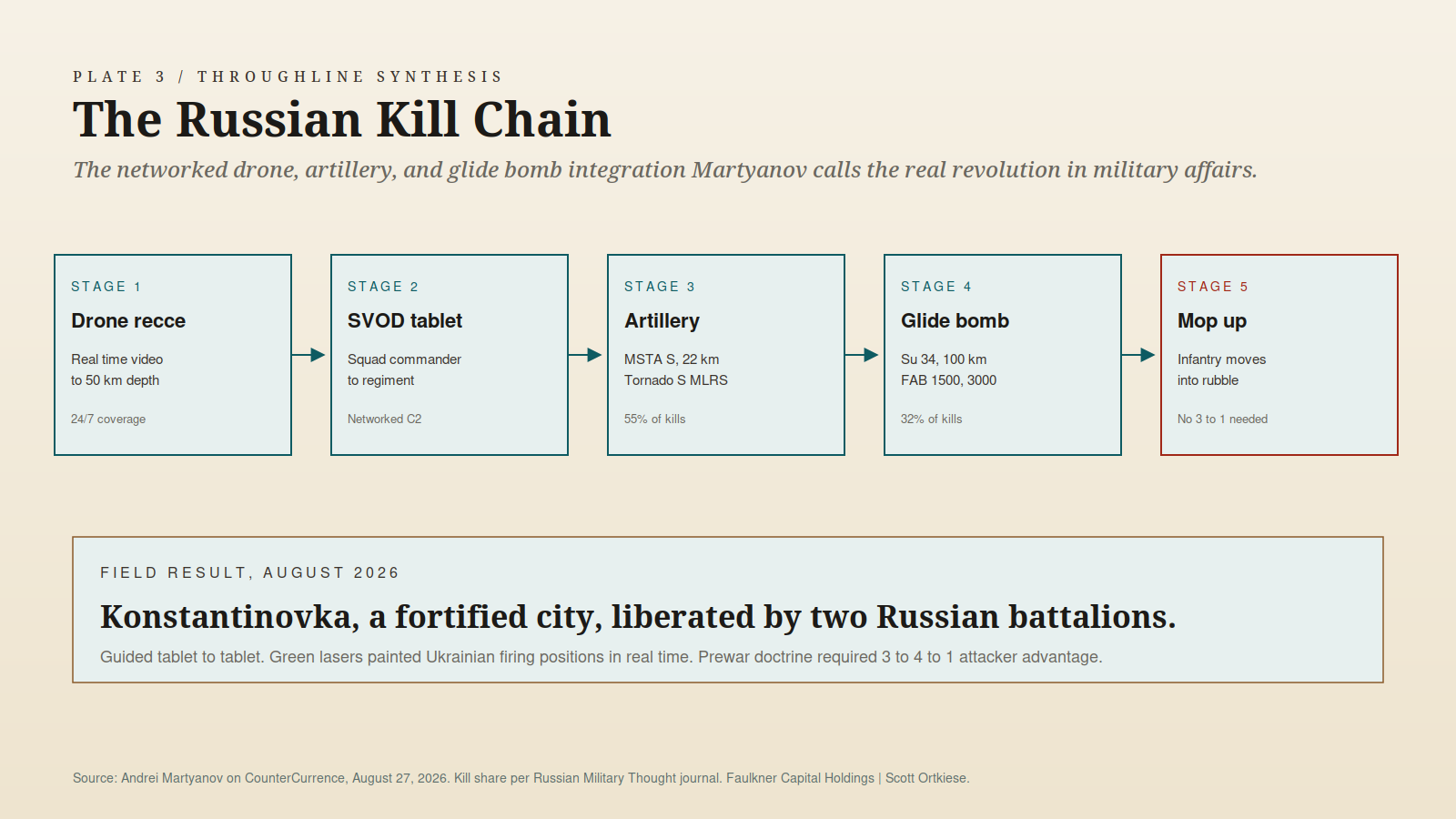
The revolution is not the drones themselves, though they matter. It is the integration. Russia’s new tactical battle management system, SVOD, alongside the operational and strategic Andromeda architecture, puts a tablet and an earpiece in the hands of a squad commander and connects him instantly to platoon, company, battalion, and regiment. Drones supply real time situational awareness to a tactical depth of fifty kilometers, twenty four hours a day. Field artillery, an MSTA-S self propelled howitzer with a 22 to 25 kilometer standard round, receives targeting coordinates in real time. And when a target requires more than artillery, an Su-34 releases a FAB-1500 or FAB-3000 glide bomb from a hundred kilometers away; reinforced concrete with blast doors is not survivable. Then come Tornado-S MLRS launchers with thermobaric warheads. Then the mopping up infantry arrives.
The consequence, per Martyanov and per the latest Military Thought data he cites, is that 55% of kills are still done by field artillery and 32% by the air force. The rest is drones. But the twenty first century wrinkle is that the attacking force no longer requires the classical three to four to one manpower advantage over an entrenched defender, because the entrenched defender has been pulverized before the attacking infantry approaches. Konstantinovka, a city, was liberated by approximately two Russian battalions, guided from tablet to tablet, with green lasers painting Ukrainian firing positions in real time. This is what Martyanov means when he says the Russians are now fighting “literally like in a computer game.” It is not a slogan. It is a description of a networked kill chain that the U.S. military has not built.
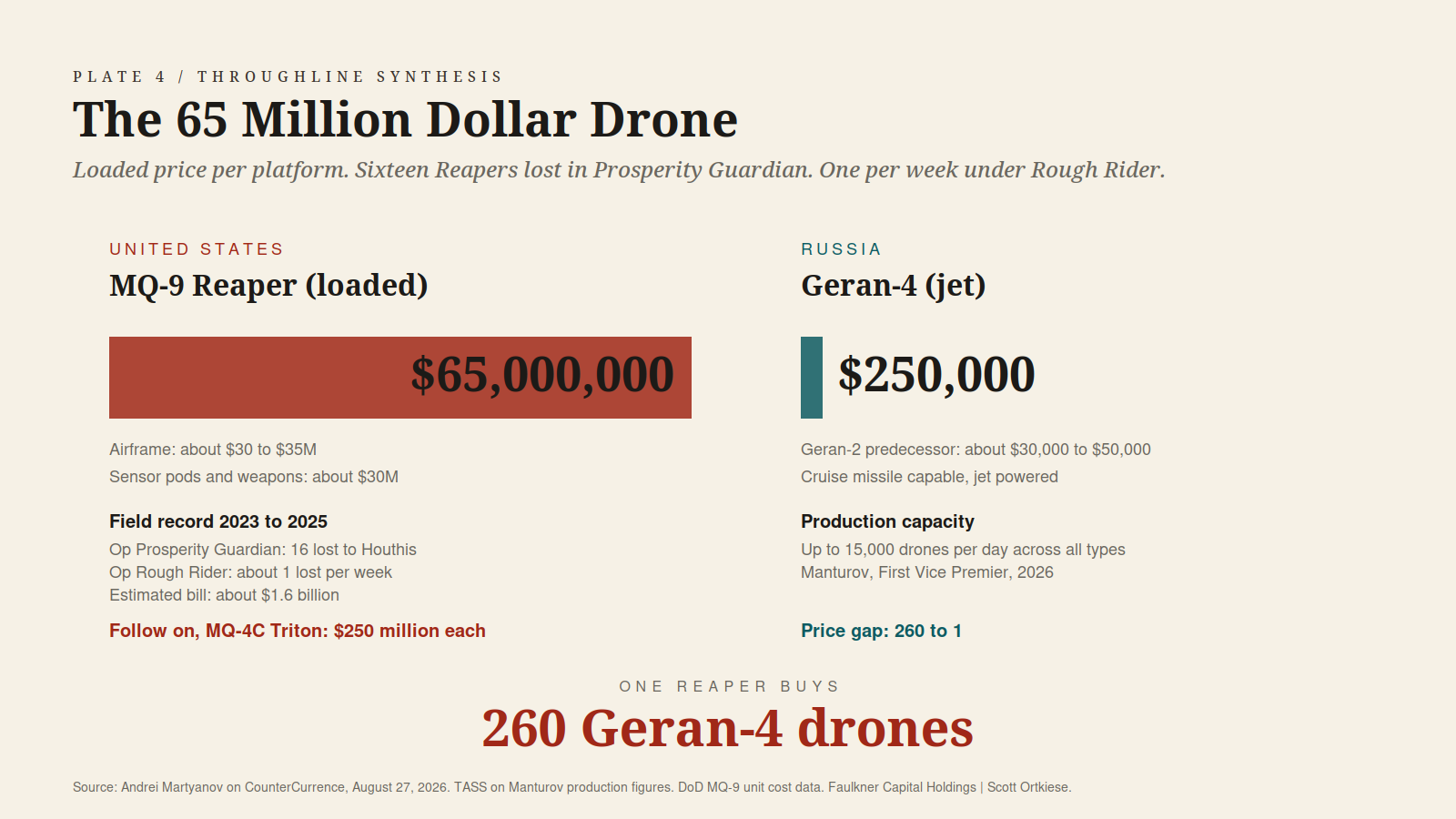
Meanwhile, on the American side, the MQ-9 Reaper, the platform on which the U.S. built its entire post 2001 counterterrorism doctrine, costs roughly \$30 to \$35 million for the airframe and another \$30 million for its pods and weapons: about \$65 million per drone. Biden’s Operation Prosperity Guardian in the Red Sea, running from December 2023 through February 2025, lost about sixteen of them to the Houthis. Trump’s Operation Rough Rider then lost roughly one drone a week. Total price tag: about \$1.6 billion, in exchange for nothing. And the Pentagon’s next act is the MQ-4C Triton, at a quarter of a billion dollars a copy. The Russians, meanwhile, are turning out Geran-3 and Geran-4 drones at \$50,000 and \$250,000, at industrial scale, up to fifteen thousand drones a day across all categories, per First Vice Premier Denis Manturov (TASS). Cheap, jet powered, cruise missile capable, and integrated into a networked strike architecture.
This is the machine gun and the tank of the First World War all over again. Both technologies existed in 1900. Neither was decisive on a battlefield until an army learned to integrate them into a doctrine. It took the British, French, and Germans four years and millions of lives to work out that lesson. The Russians have compressed that curve into three years. The Americans have not started.
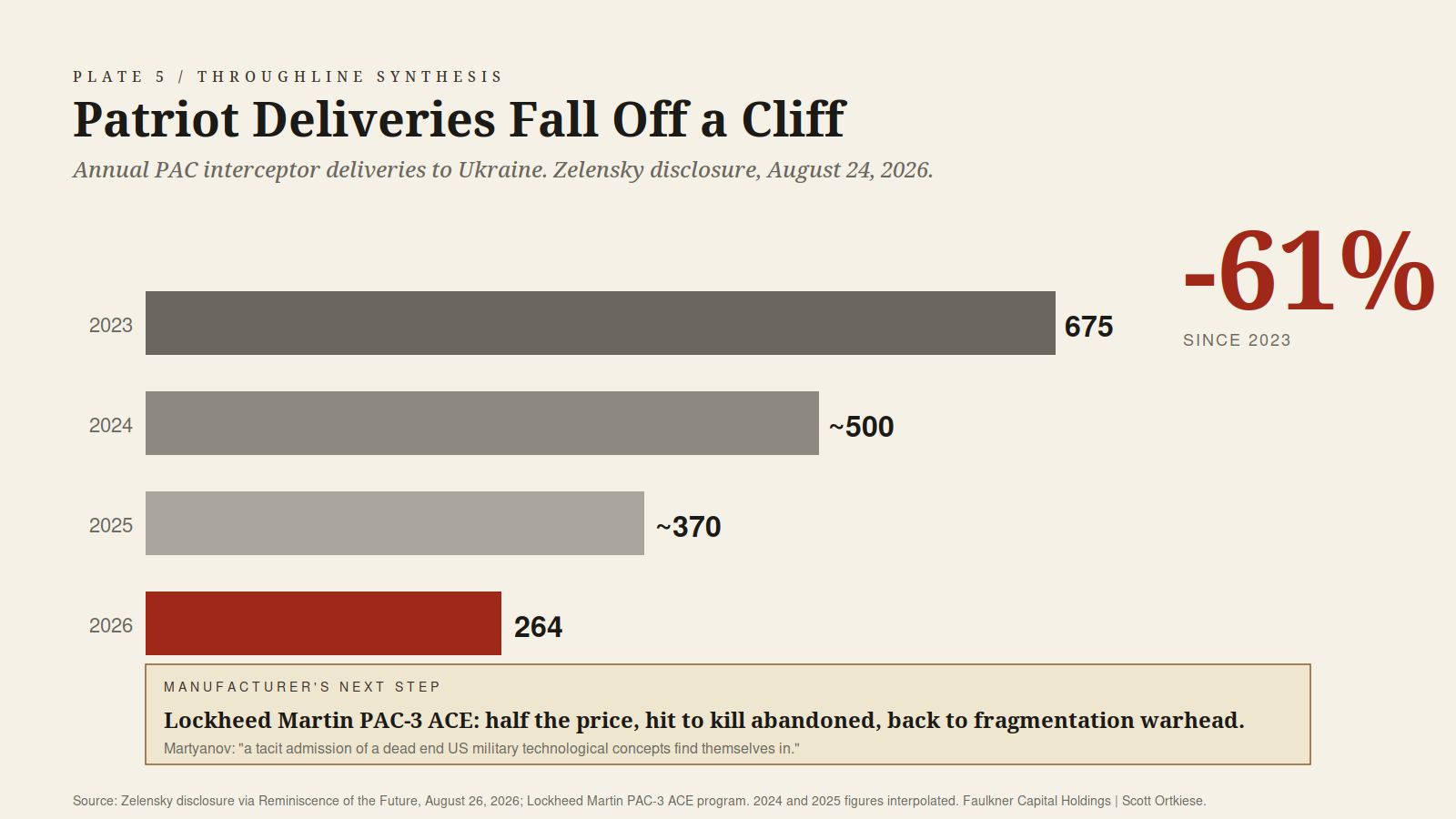
Nowhere is this clearer than in air defense. On August 24, 2026, Volodymyr Zelensky disclosed for the first time that annual Patriot interceptor deliveries have collapsed by 61 percent, from 675 in 2023 to a projected 264 in 2026, even as Russian ballistic missile strikes on Ukrainian cities have continued to escalate; on the same day, Japan formally refused to transfer any of its own anti ballistic interceptors to Ukraine (Martyanov, August 26, 2026). Simultaneously, Lockheed Martin has announced its “solution” to the Patriot’s failures: the PAC-3 ACE, a cheaper interceptor that abandons the hit to kill principle entirely and reverts to a conventional high explosive fragmentation warhead. Martyanov’s assessment is worth quoting exactly: “this is a tacit admission of a dead end US military technological concepts find themselves in… with utter humiliation of Patriot and THAAD in real war with UAVs, supersonic and hypersonic targets, this attempt at fragmentation warhead and developing an ‘intercept cone’ may help somewhat against older types of targets, but it is still useless without real integrated multi layered air defense, the US AD technology will remain in the rut it is today, unable to defend anything in real war” (Martyanov). The reserve currency of the world is running an air defense system that its own manufacturer has downgraded on the way out the door.
And the American answer to this, as Martyanov points out and as Hudson has spent his career documenting, cannot come from money. “The Pentagon is now throwing money at Patriots. ‘Here’s a trillion dollars.’ They can throw a trillion. Now what? They can’t buy the rare earth minerals needed for the magnets.” Even the raw physical inputs to the American weapons system are now controlled by the country the United States is attempting to encircle. And the design engineering cadre that once ran American ordnance was not killed. It was financialized. Raytheon’s morning meeting asks about the share price. Uralvagonzavod’s morning meeting asks about the plan. The two are not variants of the same enterprise. They are different civilizations of production. Martyanov, since 2018, has been building the file that pins this outcome to a specific national trait, “a pattern which today defines US decision making,” in which senior American policy is now routinely made by people who have “no background, skills, education or life experience whatsoever in the fields which define real national power” (Martyanov via RAF ASPR).
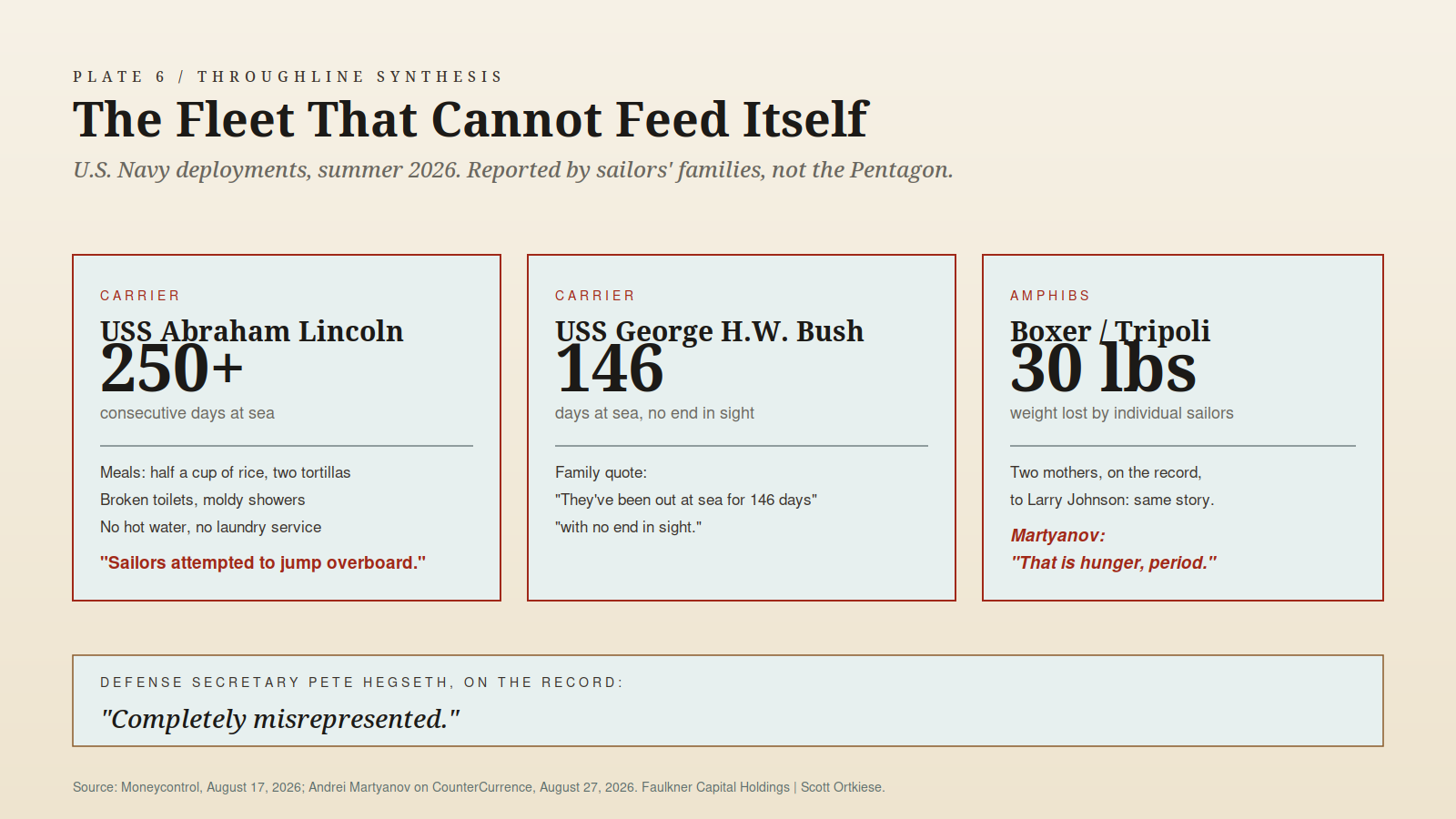
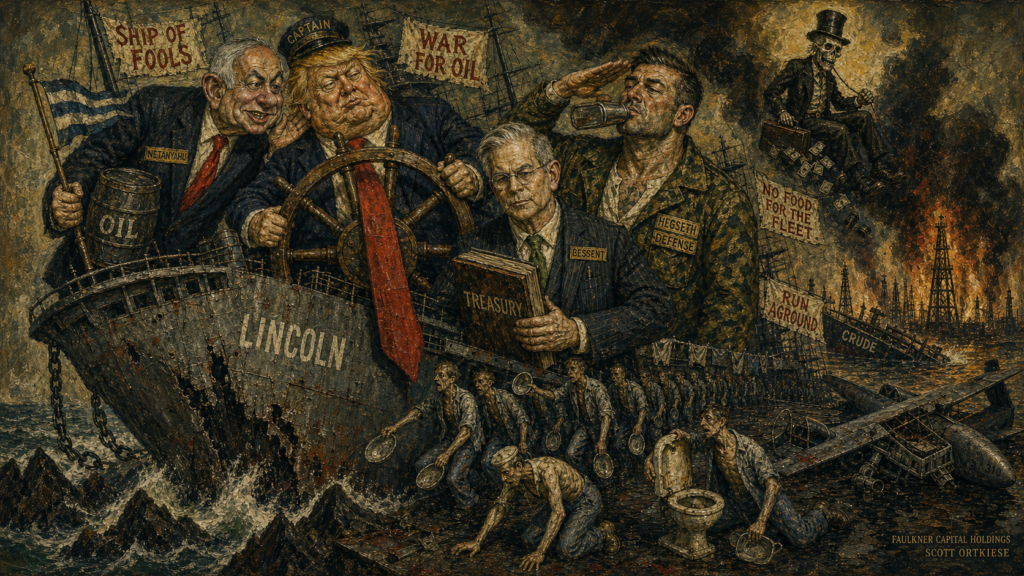
If you want the human cost of that difference, look at the U.S. Navy in 2026. Sailors aboard the USS Abraham Lincoln have described meals of “just half a cup of rice and two tortillas” during a continuous deployment now exceeding 250 days, “broken toilets, mouldy showers without hot water and extended periods without laundry services,” and, most gravely, “several sailors… had attempted to jump overboard” amid what family members describe as “severe mental health distress” (Moneycontrol, August 17, 2026). Mothers of sailors on the USS Boxer and USS Tripoli have written and spoken to Larry Johnson describing thirty pound weight losses in their sons. The USS George H.W. Bush has been at sea for 146 days with no end in sight. The Pentagon’s response, through Defense Secretary Pete Hegseth, is to call the reports “completely misrepresented.” Martyanov’s response, as a former Soviet naval officer, is worth quoting exactly: “Thirty pounds is not substantial. That is hunger, period.” One West Point class president, tracking his own class members’ deaths, has told Johnson that suicide in the ranks, Navy, Army, Marine Corps, Air Force, has become “an unaddressed epidemic.” An empire that starves its own sailors and buries its own junior officers is not building a fleet. It is dismantling one.
Nothing about this began with Trump. Martyanov’s argument, going back to Losing Military Supremacy, is that the process of alienation began earlier, and that its inflection point was the 1999 NATO campaign against Serbia. “The 1999 NATO aggression against Serbia,” he writes, “would sober Russia dramatically with regard to the combined West’s intentions” (Martyanov via RAF ASPR). Russian long range anti ship missile development since then, he continues, has been “rewriting the book on naval warfare,” and has “made large surface fleets and combatants obsolete.” The Tomahawk that the U.S. Navy still fields today has a shorter effective range than the Russian Kalibr, Zircon, and Kinzhal systems that would target the surface fleet in a real war. Martyanov ends Losing Military Supremacy with an image the American reader is not accustomed to reading in a book about the Pentagon: “US Power had quietly vanished amid stupendous events of the 21st Century, like a ship of the line going down unperceived in the smoke and confusion of battle.”
Martyanov ends the Johnson interview where Sachs and Hudson end: “In the end, this is not about Ukraine. It is about defeating NATO. That is what many people still do not understand.”
Ricardo, then Sallust, then Bismarck
The intellectual scandal of the Trump administration’s economic policy is that it violates every principle taught in a first year economics course.
David Ricardo, writing in 1817, spent the second and third chapters of On the Principles of Political Economy and Taxation proving with a small country’s arithmetic that mutual specialization according to comparative advantage makes all trading partners richer, and that protective tariffs, whatever their local political value, transfer wealth from consumers to protected producers and reduce the aggregate wealth of the nation (Econlib: Ricardo). Trump’s tariff regime is a repudiation of Ricardo, not an update, not a nuance, a repudiation. Michael Hudson has been documenting the arithmetic in real time: “The Trump administration insists that other countries are eating the cost of tariffs. That is a myth. If foreigners were absorbing the costs, import prices would drop.” They are not dropping (Hudson at Hudson.org). The American consumer is paying. That is what Armstrong means when he says tariffs “raise the cost of living because they force the consumer to subsidize overpaid labor at home.” Wolff, from the left, has been saying the same thing on his weekly program: “What better way than to hit them all over the head with a tariff? What a wonderful gesture of leading. None of this will work, none of it, but he’s putting on a spectacular show” (Wolff).
Then Sallust. Armstrong quotes him from memory, and correctly. In the Bellum Iugurthinum, Sallust identifies the destruction of Carthage in 146 B.C. as the moment when Roman civic virtue turned inward and destroyed itself. Once the external enemy was gone, factions rose. It is not a coincidence that the Trump era GOP, the European Commission, and Israel’s Netanyahu coalition all require the permanent existence of an existential enemy: Russia, China, Iran, Hamas, to maintain internal cohesion. The Sallustian diagnosis is that Brussels needs Putin as much as Netanyahu needs the Ayatollah as much as NATO needs a new mission. Internal EU memos, on Armstrong’s account, literally ask “how do we remain relevant?” This is not statecraft. This is bureaucratic survival dressed as strategy.
Then Bismarck. “One day the great European War will come out of some damned foolish thing in the Balkans” (Otto von Bismarck, 1888, in wikiquote and The Guns of August). What we would call today “some damned foolish thing in the Donbas” or “some damned foolish thing in the Strait of Hormuz.” The mechanism has not changed since 1914. An overextended alliance system with automatic tripwires, run by leaders in a hurry, dependent on domestic mobilization for legitimacy, walks into a war it did not want because it cannot walk out of a war it started.
Then Hoover. Armstrong keeps sending his readers to the memoirs, and he is right to. Hoover’s account of the 1931 European banking crisis is the essential text for the world we are entering. Hoover wrote that during the panic, “an economic hurricane” moved capital “so quickly they couldn’t figure out where it was going next,” that capital acted “like a loose cannon on the deck of a ship” (Hoover memoirs PDF). That is the risk in Europe today, and it is compounded by exactly the design flaw Armstrong warned Helmut Kohl about at the founding of the euro. There is no consolidated European debt. There is no fiscal union. There is only a common currency floating above nineteen sovereign balance sheets whose credit ratings still diverge by hundreds of basis points. When the next Greek moment arrives, and it is arriving in Italy, the contagion will move the way Hoover described. Brussels has no plan B. Ursula von der Leyen was not elected by anyone. The “back room” governance model Armstrong describes has already interfered in Romanian, Hungarian, and Italian elections, and threatened to overthrow an AfD victory in Germany before it could happen. This is not a democracy solving problems. This is a bureaucracy managing its own demise while pretending to preside over a superpower.
The four brush fires
Armstrong’s computer has been forecasting for years that the mid 2020s and early 2030s would produce a period of geopolitical fragmentation on the historical scale of the 1930s. What is arriving is not the neat bloc vs bloc war of the 1914 or 1939 imagination. It is four separate brush fires burning at once, and in each one the American position is worse than the Pentagon’s briefing slides admit.
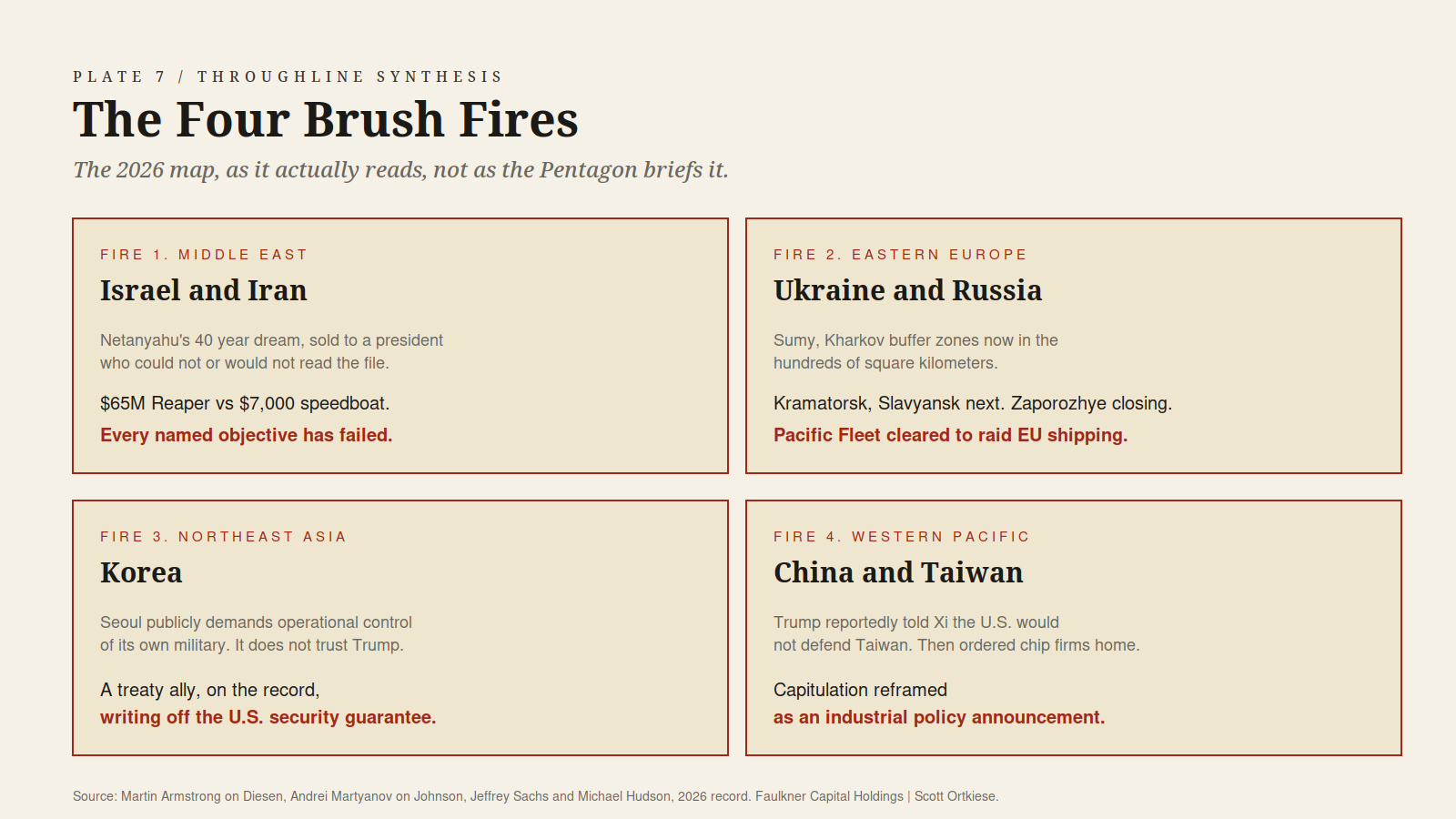
Israel and Iran. The war Netanyahu has wanted for forty years, sold to a president who could not or would not read the file, prosecuted by an administration whose top diplomats do not speak to Russia and whose Treasury Secretary has taught every commodity exporter on earth to hedge against the dollar. It is being fought with \$65 million drones against \$7,000 speedboats, and losing.
Ukraine and Russia. A war engineered by NATO expansion, blessed by a fraudulent Minsk process, sustained by a leadership in Kyiv that outlawed the Russian language and the Moscow patriarchate, and now escalating because Zelensky prefers civilian infrastructure attacks on Russia to a negotiated Donbas. Martyanov’s summary of the ground truth is that Kramatorsk and Slavyansk are next; Zaporozhye is being closed; the Sumy and Kharkov buffer zones already exceed hundreds of square kilometers and belong, for practical purposes, to Russia; Ukrainian brigades are filming videos of their commanders begging for food and water because they have neither; and the Russian Pacific Fleet has, as of the day of Martyanov’s interview, been authorized by Vladimir Putin to raid the merchant traffic of “unfriendly” European Union states in Asian waters. The economic weapon has ricocheted. Russia’s real economy has expanded, its energy exports have reoriented, and the reputational damage of “sanctions” now attaches to the sanctioner.
Korea. Now visibly reawakening. South Korea has said publicly it wants operational control of its own military because it does not trust Trump. That is not a slogan. That is a treaty ally, in East Asia, telling Washington on the record that the American security guarantee has depreciated to the point of being unusable.
China and Taiwan. Trump, according to Armstrong’s reading of the meeting, told Xi that the United States would not defend Taiwan. Xi put that on the table. Trump then went home and instructed the American chip companies to move to the United States. This is not deterrence. This is capitulation dressed as an industrial policy announcement.
Four brush fires, no plan, no coalition strategy, no economic architecture, a defense industrial base that cannot source its own magnets, and a Treasury Secretary threatening to weaponize the world’s reserve currency against every third party trading partner. This is not empire. This is empire performing itself while burning down.
The Roman model, and the American one
Armstrong keeps returning to Rome as the counter model, and he is right to. Rome lasted a thousand years, as a functioning economic space, because it made it more profitable to be inside than outside. You could make a vase in Gaul and sell it in Syria. Trade routes were maintained; standards were maintained; a common legal architecture was maintained. When Rome finally began carving up its own economic space with internal customs, currency debasement, and factional warfare, the decline had begun. The lesson is not obscure. Michael Hudson has spent his career elaborating it: an imperial system is durable in proportion to the material benefits it provides its participants; when it begins to extract from its own periphery to service its own core, the periphery routes around it, and the core discovers too late that it has nothing left to sell.
The United States, from 1945 to roughly 2001, ran a version of the Roman model, imperfect, hypocritical, often violent at the edges, but built on the principle that inside the system you got the dollar, cheap credit, security guarantees, and market access. Since 2001, and with accelerating intensity since 2022, Washington has replaced that offer with a threat: comply, or we take your reserves. Weaponize the dollar to that degree and, as Hudson has been warning since Super Imperialism was first published in 1972, the entire T bill standard rests on nothing but the fear of consequences you are now demonstrating you will inflict on anyone (Hudson, Super Imperialism PDF; Hudson at Real World Economics Review). Bessent’s June 24 declaration was a suicide note read out on live television.
What a competent administration would do
I want to be precise about what I am arguing. I am not arguing for pacifism. I am not arguing for surrender. I am arguing for competence, and I am arguing that the current administration has demonstrated, on the record, in real time, that it does not possess it.
A competent American administration in 2026 would:
– Secure the Strait of Hormuz before bombing Iran, and not by tweeting the country into a protection racket. Every war game of the last ten years opened with that step. Trump’s did not. – Not remove any state from SWIFT unless it is prepared to accept the permanent, structural consequence: every non Western capital will build the alternative rail. That work is now complete. The BRICS payment architecture, the CIPS system, bilateral currency swap agreements, and rising gold reserves are the direct empirical consequences of a decade of American financial sanctions (Hudson, “Since Money is Political”; Geopolitical Economy Report). – Enforce Minsk in 2015 or negotiate a Donbas settlement in 2022. Neither happened; the current war is a direct product of both refusals (National Security Archive; Sachs UN testimony). – Recognize that the war it is losing in Ukraine is being lost for military industrial reasons, not political ones. A \$65 million MQ-9 does not beat a \$250,000 Geran-4. A financialized Raytheon does not out produce a state owned Uralvagonzavod. A Pentagon staffed by Desert Storm nostalgists does not out fight a Russian general staff that has spent a decade rebuilding around a networked drone artillery glide bomb kill chain. Whatever an American strategic response would look like, it starts with admitting that Andrei Martyanov’s decade old warning was correct and that the American military industrial complex is not fixable at current levels of political capture. – Rebuild real air defense before ordering the next war. The PAC-3 ACE downgrade and the 61 percent collapse in Patriot interceptor deliveries are not procurement footnotes. They are the sound of the American air defense franchise closing. – Not confuse tariffs with an industrial policy. Ricardo settled this argument in 1817. A country that wants to reindustrialize does so through capital formation, skills investment, and infrastructure, not by taxing its own consumers to subsidize the least productive of its domestic producers. – Not put a neoconservative in the Secretary of State’s chair and then force the president to route peace initiatives through outside consultants because his own diplomat cannot deliver them. – Not entertain, under any circumstances, a foreign head of state’s proposal to assassinate the leadership of a nuclear threshold state and declare victory. That is Netanyahu’s method, it has never worked in a single case anywhere in the region since 1996, and it is what the United States just did. – Feed its sailors. Fund the mental health of its junior officers. Stop losing more service members to suicide than to combat. An empire that cannot maintain the men and women it puts to sea has already lost its ability to project power, whatever the budget line item says.
None of this is radical. None of this requires ideological realignment. It requires only what Armstrong keeps naming, what Blair in his post Iraq confessional admitted his own government lacked, and what Martyanov, from the other side of the line, describes with cold professional contempt: the willingness to do the morning’s work.
The reform that comes after the pain
I want to close with the one thing Armstrong is more optimistic about than I am, because I think it is worth taking seriously.
Armstrong’s cyclical framework says the current governance model is finished on a horizon of roughly one presidential lifetime. His computer marks 2032 as the terminal date for the debt system as we know it, and 2029 as a plausible break up date for the European Union in its current form. He points out, correctly, that political reform in Western democracies never comes from the top. It comes only when the average citizen concludes, unambiguously, that the system does not work.
He is more optimistic than I am because he still believes that the resulting reform will be recognizably democratic. I am not sure. I think we are in a moment closer to the one Wolff has been describing for years, the desperate late imperial phase, in which a governing class in decline lashes out with the tools it still has, discovers that those tools have decayed, and lashes out harder. Sachs has been more explicit than either of them about the stakes: “We could soon see several nuclear powers pitted against each other and dragging the world closer to nuclear annihilation” (Sachs & Fares). Martyanov, whose credentials on the military dimension of this question exceed those of anyone in the current U.S. cabinet, is blunter: the American military system is obsolete, and it cannot be reformed inside its present political economy.
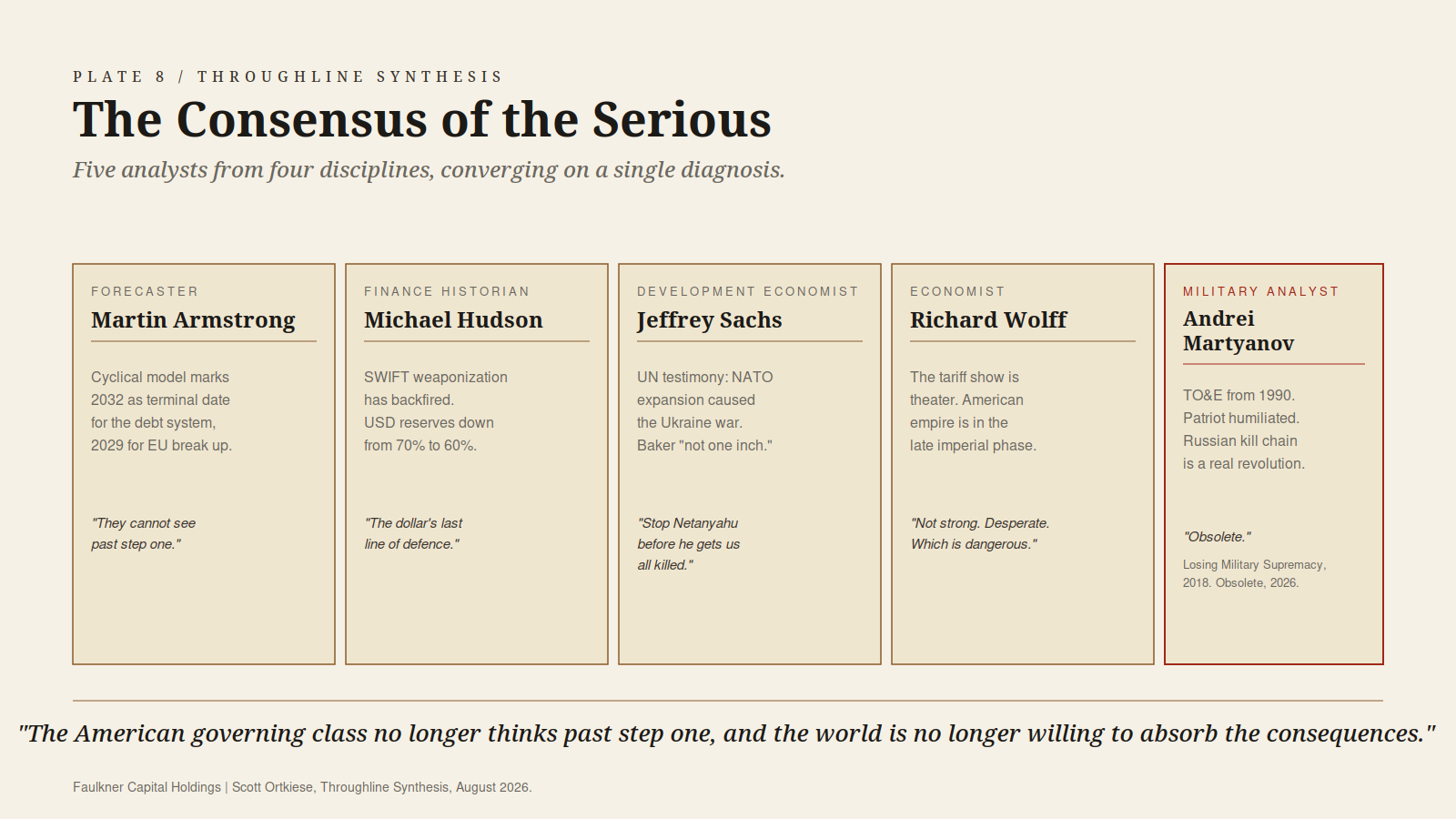
What holds them all together, Armstrong the cycle theorist, Hudson the Marxist finance historian, Sachs the development economist, Wolff the popular Marxist teacher, Martyanov the naval officer turned military analyst, is a single diagnostic conclusion: the American governing class no longer thinks past step one, and the world is no longer willing to absorb the consequences. Every constituency Washington threatens is now a constituency building its way out. Every ally Washington bullies is now looking for another patron. Every dollar Washington weaponizes is now a dollar someone else is trying not to hold. Every ship Washington sends to sea is a ship whose crew is losing thirty pounds and whose junior officers are attempting to jump overboard in numbers the Pentagon will not publish.
I hold no brief for the specific 300 year cycle Armstrong invokes, and I hold no brief for the specific dating of 2032. What I do hold, without qualification, is the underlying claim: the men currently running the American empire, and the men running Netanyahu’s Israel and Zelensky’s Ukraine and von der Leyen’s Brussels, are not competent to the moment. They are a ship of fools. They cannot see past step one. They do not know what comes after the bomb, after the sanction, after the tariff, after the assassination, after the drone. And in the absence of any strategic thought behind their tactical activity, they are producing exactly the world that Sallust warned Rome about, Ricardo warned Britain about, Bismarck warned Europe about, Hoover warned the United States about, and Martyanov has been warning the Pentagon about for a decade.
The most damning thing about Martin Armstrong’s Diesen interview and Andrei Martyanov’s Johnson interview, recorded, as it happens, on the same day, is not that any of it is contested. Every substantive claim in the two of them, the Merkel confession, the Odessa massacre, the Baker “not one inch” pledge, the Netanyahu dream of 1996, the SWIFT and sanctions boomerang, the failure of the Iran war, the Bessent dollar dominance declaration, the interest expense exceeding the military budget, the four front brush fire architecture, the failure of tariffs to reduce prices, the price and loss rates of the MQ-9 program, the 61 percent Patriot interceptor collapse, the PAC-3 ACE downgrade, the Russian daily drone production figures, the liberation of Konstantinovka by two battalions, the starvation of American sailors, the overboard attempts on the Abraham Lincoln, is corroborated by academic, journalistic, and archival sources that any competent staffer in any competent government could produce with a morning’s work.
Nobody in the Trump administration is doing that morning’s work. Nobody in Netanyahu’s cabinet is doing that morning’s work. Nobody in Zelensky’s Bankova is doing that morning’s work. Nobody in the European Commission is doing that morning’s work.
They are all still calmly saying: don’t worry, we’re paying back with cheaper dollars.
We are not. We are paying with a world.
Throughline Synthesis. August 2026. so@throughlinesynthesis.com
Sources
– Martin Armstrong, in conversation with Glenn Diesen, August 27, 2026 (cleaned transcript in Throughline Synthesis archive; Armstrong Economics; Wikipedia biography). – Andrei Martyanov, in conversation with Larry Johnson on CounterCurrence, August 27, 2026 (cleaned transcript in Throughline Synthesis archive; Reminiscence of the Future blog; Clarity Press author page). – Andrei Martyanov, Losing Military Supremacy: The Myopia of American Strategic Planning (Clarity Press, 2018); reviewed in Air and Space Power Review, RAF, Vol 23 No 1; The (Real) Revolution in Military Affairs (2019); Disintegration: Indicators of the Coming American Collapse (2021); The Book of Martyanov (2023); Obsolete (in progress with Col. Vladimir Trukhan, 2026). – Martyanov on the PAC-3 ACE downgrade and the 61 percent Patriot interceptor delivery collapse, Reminiscence of the Future, August 26, 2026; Japan’s August 24, 2026 refusal to transfer interceptors to Ukraine, same source. – U.S. Navy conditions in 2026, including 250 day USS Abraham Lincoln deployment, food shortages, and overboard attempts: Moneycontrol, August 17, 2026. – Michael Hudson, “Since Money is Political”; “Negotiations as Cover, War as Policy”; “The Dollar’s Last Line of Defence”; “US Weaponization of the Dollar Is Backfiring”; Super Imperialism, 2nd ed. (2003) PDF; “Return of the Robber Barons”; “The Trump Tax Increase of 2026”. – Jeffrey Sachs & Sybil Fares, “Stop Netanyahu Before He Gets Us All Killed”; Jeffrey Sachs, UN Security Council testimony, November 20, 2023; “A Mediator’s Guide to Peace in Ukraine”. – Richard Wolff, “On Capitalism, Trump’s Tariffs, and a Dying Empire”; Democracy Now interview on tariffs, “American Empire Is in Decline”; Chris Hedges interview, “The Economics of a Dying Empire”. – David Faris, “Trump Can’t Admit That He Lost the Iran War”, The Nation, July 16, 2026. – Geoff Beattie, “Why Trump Blames Decisions on Others”, Edge Hill / The Conversation, July 2025. – U.S. Congress, The Cost of Trump’s Foreign Policy: Damage and Consequences. – Angela Merkel, Die Zeit / Der Spiegel interviews, December 2022, summarized in WSWS, TASS, News18; Zelensky corroboration in Geopolitical Economy Report. – National Security Archive, “NATO Expansion: What Gorbachev Heard”; M. E. Sarotte, Not One Inch (2021), Wikipedia summary. – “A Clean Break: A New Strategy for Securing the Realm”, 1996 policy document; Le Monde, “The Islamic Republic of Iran, Netanyahu’s favorite enemy for 30 years”. – 2014 Odesa Trade Union House massacre: BBC, The Guardian, Wikipedia. – Herbert Hoover, Memoirs. The Great Depression 1929 to 1941 PDF. – David Ricardo, On the Principles of Political Economy and Taxation (1817), Wikipedia; Econlib biography. – Sallust, Bellum Iugurthinum, World History Encyclopedia; Topostext edition. – Otto von Bismarck, “damned foolish thing in the Balkans,” Wikiquote. – National Academies, Economic Sanctions and Post Cold War Conflicts; PIIE, Economic Sanctions Reconsidered, 3rd ed. preview; H-Diplo, Roundtable on Busted Sanctions. – Marco Rubio and the Trump State Department: NYT; Responsible Statecraft; Al Jazeera. – Russian drone production figures via TASS: TASS on Manturov.