How Neoconservatives, Atlanticists, and Their Institutional Allies Destroyed the Last Chance for Peace in Ukraine
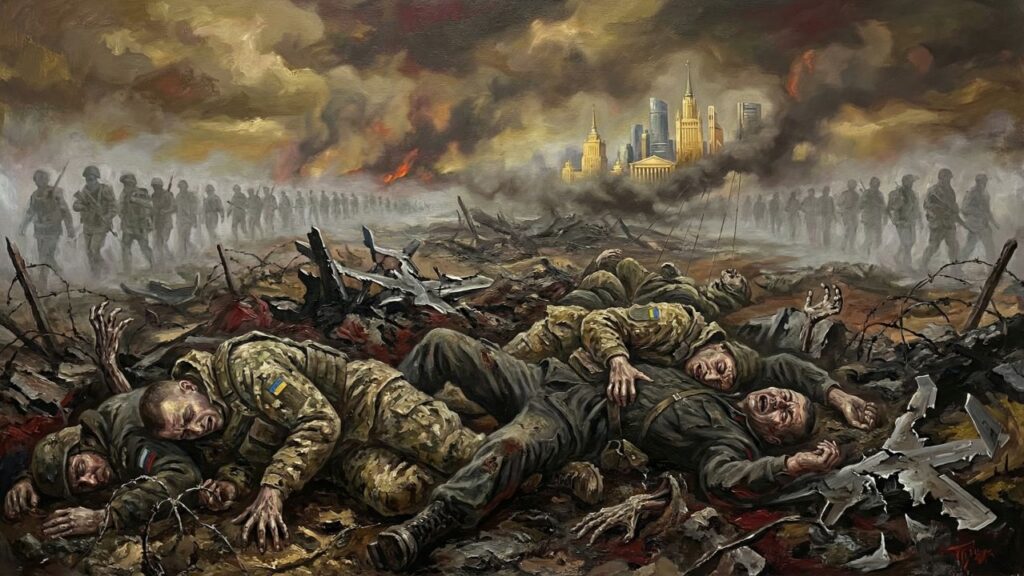
In April 2022, Russia and Ukraine were on the verge of signing a peace agreement that would have ended the war weeks after it began, restoring Ukrainian sovereignty, establishing neutrality, and saving hundreds of thousands of lives. The United States and the United Kingdom killed that deal. They killed it because a neutral Ukraine could not serve as a battering ram against Russia, and a short war could not bleed a strategic rival dry. The Neoconservatives who have driven American foreign policy into every catastrophe since Iraq (the same families, the same think tanks, the same defense contractors) saw in Ukraine not a nation to be saved but a proxy to be spent. Boris Johnson flew to Kyiv and told Zelensky not to sign. Victoria Nuland, wife of PNAC co-founder Robert Kagan and architect of the 2014 Maidan coup, worked from the State Department to ensure the deal collapsed. Yale economists sitting in chairs endowed by General Dynamics shareholders testified before Congress that sanctions would crush Russia quickly and cheaply, providing the academic cover needed to sell an open-ended proxy war as a manageable investment. The Western press, functioning not as a watchdog but as a war ministry’s stenographer, buried the story for two years. Every element of this machinery (the doctrine, the executors, the propagandists, the credentialed shills) operated in concert to ensure that Ukrainians would continue dying so that Lockheed Martin’s stock price would continue rising, so that Russia would be weakened as a competitor, and so that the American empire’s most reckless ideologues could claim vindication for a theory of global dominance that has produced nothing but graves from Baghdad to Bakhmut. What follows is the evidence.
Part I: The Evidence for How Peace Was Sabotaged in Istanbul
The Negotiations Were Real and Advanced
The 2022 Istanbul peace talks between Russia and Ukraine were not a diplomatic sideshow. They produced written frameworks and authenticated draft treaty texts, and participants on all sides later described them as close to conclusion. Ukrainian negotiator Oleksandr Chaly, who participated in the talks, stated: “We were very close to finalizing our war with some peaceful settlement.” He added that Putin “tried to do everything possible to conclude an agreement with Ukraine” and that both sides found “a very real compromise”.
The New York Times published the full draft texts, dated March 17 and April 15, 2022, in June 2024, confirming the advanced state of the negotiations. The documents were sourced from Ukrainian, Russian, and European contacts, and their authenticity was confirmed by participants. A Foreign Affairs investigation by Samuel Charap and Sergey Radchenko examined draft agreements and interviewed several participants, finding that more than 7 senior officials, 6 of whom participated in the meetings, confirmed the existence of the talks and their successful conclusion.
The Terms on the Table
On March 29, 2022, the talks achieved a breakthrough in Istanbul. The treaty envisioned would proclaim Ukraine as a permanently neutral, nonnuclear state. Ukraine would renounce any intention to join military alliances or allow foreign military bases or troops on its soil. The communiqué listed as possible guarantors the permanent members of the UN Security Council along with Canada, Germany, Israel, Italy, Poland, and Turkey.
Remarkably, the security obligations were “spelled out with much greater precision than NATO’s Article 5: imposing a no-fly zone, supplying weapons, or directly intervening with the guarantor state’s own military force”. The status of Crimea was to be determined within 10 (15 years, and the status of other occupied territory was to be agreed at a personal summit between Putin and Zelensky. The April 15 draft “suggests that the treaty would be signed within two weeks”) indicating that both teams planned to move fast.
Zelensky’s Willingness to Negotiate
From the first day after the Russian invasion, Ukrainian President Zelensky publicly expressed his willingness to discuss neutrality. On February 25, 2022, one day after the invasion, Zelensky confirmed: “Today we heard from Moscow that they still want to talk. They want to talk about Ukraine’s neutral status. We are not afraid to talk about neutral status”.
On February 26, he reaffirmed: “If talks are possible, they should be held. If in Moscow they say that they want all talks, including on neutral status, we are not afraid of this. We can talk about that as well”. On February 27, Moscow and Kyiv announced they would hold peace talks without preconditions. This looked like it could be an extremely short war.
The Western Counter-Mobilization
On the same days Zelensky was expressing willingness to negotiate, the U.S. and UK moved to foreclose the diplomatic track:
- February 25, 2022 (Day 1): U.S. State Department spokesman Ned Price announced that Washington rejected peace talks without preconditions, insisting Russia must first withdraw. Price stated: “Now we see Moscow suggesting that diplomacy take place at the barrel of a gun”.
- February 26, 2022 (Day 2): UK Minister of Armed Forces James Heappey wrote in the Daily Telegraph: “His failure must be complete; Ukrainian sovereignty must be restored, and the Russian people empowered to see how little he cares for them. Putin’s days as president will surely be numbered”.
- February 27, 2022 (Day 3): On the same day Russia and Ukraine announced peace talks, the EU approved €450 million in military aid, reducing incentives to negotiate.
- February 28, 2022 (Day 4): A spokesman for Boris Johnson stated: “The measures we’re introducing… are designed to bring down the Putin regime”.
The War Aims Divergence
In March 2022, as the talks were beginning, U.S. officials made clear that the war’s purpose extended far beyond defending Ukraine:
- Ned Price was asked if the U.S. would support a negotiated settlement that Zelensky was advancing. He answered: “This is a war that is in many ways bigger than Russia, is bigger than Ukraine. Principles are at stake that must be maintained”.
- Secretary of Defense Lloyd Austin: “We want to see Russia weakened to the degree that it can’t do the kinds of things that it has done in invading Ukraine”.
- Former CIA Director Leon Panetta: “We are engaged in a conflict here. It’s a proxy war with Russia, whether we say it or not. The way you get leverage is by frankly going in and killing Russians”.
- Niall Ferguson reported in Bloomberg on March 22, 2022, citing U.S. and UK government sources, that the preference was for “the conflict to be extended and thereby bleed Putin” as “the only endgame now is the end of the Putin regime”.
Zelensky himself acknowledged this dynamic. On March 27, 2022, in an interview with The Economist, he stated: “Everyone has varied interests. There are those in the west who don’t mind a long war because it would mean exhausting Russia, even if this means the demise of Ukraine and comes at the cost of Ukrainian lives”.
Boris Johnson’s April 9 Intervention
Despite these headwinds, the Russians and Ukrainians met in Istanbul and came close to a deal. It was then sabotaged, principally through Boris Johnson’s unannounced visit to Kyiv on April 9, 2022. According to Ukrainska Pravda, sourcing associates close to Zelensky, Johnson brought two messages:
“The first is that Putin is a war criminal. He should be pressured, not negotiated with. And the second is that even if Ukraine is ready to sign some agreements on guarantees with Putin, they are not.”
Johnson’s position was that the collective West “now felt that Putin was not really as powerful as they had previously imagined, and that here was a chance to ‘press him'”. Three days after Johnson left for Britain, Putin went public and said talks with Ukraine “had turned into a dead end”.
Confirmation from Multiple Sides
The sabotage narrative rests not on a single source but on converging testimony from the mediators, the lead Ukrainian negotiator, and multiple independent observers:
The Ukrainian delegation leader, Davyd Arakhamia, head of Zelensky’s political party and chief of Ukraine’s Istanbul delegation, said in a November 2023 interview: “Boris Johnson came to Kyiv and said that we would not sign anything with them at all, and let’s just fight”.
Israeli Prime Minister Naftali Bennett, who served as a mediator, stated that Russia was willing to make “huge concessions” and that Zelensky had accepted the terms of neutrality. Bennett said: “Both sides very much wanted a ceasefire.” When asked if the West blocked it, he confirmed: “I think there was a legitimate decision by the West to keep striking Putin… Basically, yes. They blocked it”.
Turkish Foreign Minister Mevlüt Çavuşoğlu stated: “After the talks in Istanbul, we did not think that the war would take this long, but following the NATO foreign ministers’ meeting, I had the impression that there are those within the NATO member states that want the war to continue. Let the war continue and Russia gets weaker. They don’t care much about the situation in Ukraine”.
The deputy chairman of Erdoğan’s political party confirmed that Zelensky was ready to sign the peace agreement before the U.S. and UK intervened: “This war is not between Russia and Ukraine. It is a war between Russia and the West. The US sees the prolongation of the war as in its interests”.
Retired General Harald Kujat, former head of the German armed forces and former chairman of NATO’s military committee, the highest military position in NATO, confirmed that Boris Johnson had sabotaged the peace negotiations to fight a proxy war with Russia.
Johnson’s Own Confirmation
Johnson’s subsequent statements removed any ambiguity about his position:
- June 2022: “Now is not the time to settle and encourage the Ukrainians to settle for a bad peace.” He called for “strategic endurance”, his euphemism for a long war.
- December 2022: In a Wall Street Journal op-ed, he argued: “The war in Ukraine can end only with Vladimir Putin’s defeat”.
The Proxy War Celebrated
As the war continued, American leaders celebrated the strategic calculus openly:
- General Keith Kellogg (March 2023): “If you can defeat a strategic adversary not using any US troops, you are at the acme of professionalism”.
- Mitt Romney: Sending weapons to Ukraine was “the best national defense spending I think we’ve ever done” because it cost relatively little money and “we’re losing no lives”.
- Mitch McConnell: “The most basic reasons for continuing to help Ukraine degrade and defeat the Russian invaders are cold hard practical American interests”.
- Senator Richard Blumenthal: “We’re getting our money’s worth on our Ukraine investment because for less than 3% of our nation’s military budget, we’ve enabled Ukraine to degrade Russia’s military strength by half”.
- Lindsey Graham: “I like the structural path we’re on here. As long as we help Ukraine with the weapons they need and the economic support, they will fight to the last person”.
Part II: The Complicity of the Western Press
The Heroic Framing of Johnson’s Kyiv Visit
The most direct act of press complicity involves the coverage of Boris Johnson’s April 9, 2022, visit to Kyiv. Western legacy media overwhelmingly framed this visit not as a diplomatic intervention that terminated peace talks, but as a heroic gesture of solidarity. The New York Times covered Johnson’s subsequent June 2022 visit by leading with the announcement of new military training packages and his promise of “strategic endurance,” without interrogating what this euphemism meant for the possibility of negotiations.
When Johnson returned to Kyiv on multiple occasions, coverage consistently foregrounded his popularity in Ukraine, the announcement of new weapons packages, and his personal bond with Zelensky. The fact that Ukrainska PravdaUkraine’s own leading outlet, had reported in May 2022 that Johnson’s April visit functioned as the obstacle to peace went almost entirely unexamined by Western English-language media for over a year. A major Ukrainian news organization had published sourced reporting that the British prime minister pressured Ukraine’s president to abandon negotiations, and the Western press corps largely ignored it.
Silence on the Substance of the Deal
The draft agreements were substantive and detailed, a 17-page treaty framework providing for Ukrainian neutrality, security guarantees more precise than NATO’s Article 5, and a process for resolving Crimea’s status over 10 to 15 years. Yet for roughly two years, Western mainstream coverage treated the Istanbul negotiations as either a non-event or a naive exercise that Russia never intended to honor. Le Monde Diplomatique pointedly asked in June 2024: “Why the silence from French journalists and commentators?” When Die Welt published the final version of the negotiated agreement, French media “made almost nothing of it, perhaps wary of digging into a story in which Western warmongers don’t come up smelling of roses”.
War Journalism Over Peace Journalism
Academic research confirmed this pattern empirically. A content analysis of BBC and CNN coverage found that “Western media coverage disproportionately represents the Ukrainian perspective, with the Russian standpoint largely marginalized or stereotypically characterized” and that coverage exhibited “a discernible dominance of war journalism over peace journalism, thus propagating divisive narratives”. A quantitative study of 2,868 articles from the New York Times, The Guardian, and Global Times found that Western agencies “tended to employ a negative tone toward Russia and a positive tone toward Ukraine,” with the New York Times in particular favoring war journalism frames.
A nine-country television news study confirmed that the examined media, including the BBC, “paid little attention to the Russian perspective, put their own (perceived) national interests as defined by their government front and center, ‘supported’ Ukraine, and relied mostly on established Western sources and news agencies”. This is precisely the pattern predicted by Herman and Chomsky’s propaganda model: during wartime, corporate media operates as a conveyor belt for government narratives, manufacturing consent for continued conflict.
Enforcement Through Social Pressure
The media’s compliance was reinforced by professional and social penalties imposed on dissenters. Professor Tabe Bergman, co-editor of a Routledge volume on media coverage of the war, described how an anonymous peer reviewer accused him of “acting as agents of Russian propaganda” simply for examining media treatment of dissident views. At an academic conference in 2023, audience members shouted at a speaker whose transgression was to present evidence that both Ukrainian and Russian governments censored their national media.
Seymour Hersh, who reported on the Nord Stream pipeline attack, was disparaged in the Dutch quality press as having “succumbed to conspiracy theories”. Scottish philosopher Tim Hayward was publicly attacked for a March 2022 tweet linking to a Russian source and stating: “As long as we’re still able to hear two sides of the story we should continue striving to do so”. The late Russia scholar Stephen Cohen observed that during the Cold War, the New York Times and Washington Post were open to debate, but that “these days they no longer are. It’s one hand clapping in America’s major newspapers”.
The Columbia Journalism Review noted that the war’s coverage involved embedded double standards, racial and structural, reflecting “ingrained assumptions about global power dynamics that are not only morally indefensible, but factually untenable”.
The Two-Year Lag
The timeline of when Western legacy outlets engaged with the sabotage story is itself evidence of complicity:

At each stage, information contradicting the war narrative was ignored, minimized, or immediately “balanced” with official denials.
The “Fact-Check” as Narrative Defense
When Arakhamia’s November 2023 interview generated attention, fact-checking outlets rushed to contain the damage. They seized on his caveat that the Ukrainian delegation lacked the legal authority to sign and that trust in Russia was absent, and used those qualifications to bury his direct, unambiguous statement that Boris Johnson came to Kyiv and literally said “let’s just fight”. The man who led Ukraine’s negotiating delegation told the world that the British prime minister personally intervened to kill the peace process, and the media’s fact-checkers declared it “manipulative” to draw that conclusion. That is not fact-checking. That is narrative enforcement by the media, which defines propaganda.
The same operation was repeated when Victoria Nuland’s September 2024 interview confirmed Western involvement. Nuland openly described a process in which “people inside Ukraine and people outside Ukraine started asking questions about whether this was a good deal, and it was at that point that it fell apart,” a description that plainly admits external pressure shaped the outcome.
VoxUkraine labeled this “FALSE”. Not misleading, not lacking context, FALSE! The word was chosen to shut down inquiry, not to advance it. And VoxUkraine is not an independent arbiter. It is a Ukrainian nonprofit whose largest donors include the National Endowment for Democracy (NED), the organization whose co-founder Allen Weinstein admitted “a lot of what we do today was done covertly 25 years ago by the CIA”, along with the U.S. Embassy in Kyiv, PACT (a USAID partner), and Meta, which pays VoxUkraine as a “Third-Party Fact-Checking” partner to police content on Facebook and Instagram. In other words, the U.S. government funds the fact-checker that declares it “FALSE” to say the U.S. government sabotaged the peace deal.The same state that killed the negotiations funds the organization that certifies the killing never happened. These fact-checks do not exist to determine what happened. They exist to ensure that what happened cannot be discussed in mainstream discourse. They are the final gatekeeping mechanism in a system designed to make the sabotage of peace undiscussable.
Government Narratives as Media Defaults
When Ned Price dismissed early peace talks as “diplomacy at the barrel of a gun,” this framing was adopted wholesale by Western outlets, delegitimizing negotiations before they began. When Lloyd Austin declared the U.S. wanted Russia “weakened,” this was reported as a policy development rather than interrogated as evidence that Washington’s aims diverged from Ukraine’s interest in a quick settlement.
Former CIA director Leon Panetta’s admission that “it’s a proxy war with Russia, whether we say it or not” received minimal sustained attention. Lindsey Graham’s “they will fight to the last person” was not treated as a scandalous revelation about expendable Ukrainian lives but as an anodyne expression of strategic support. The media processed these statements through the established frame of “supporting Ukraine” rather than asking how using Ukrainians to bleed a strategic rival constitutes support for Ukraine.
As Professor Bergman concluded: “What the Western media primarily do is to facilitate propaganda for their own governments.” This insight is considered a “dangerous idea” precisely because it “challenges lessons we all learned in school about how some countries have freedom of speech and the press, luckily ours, and others do not”.
Part III: The Neoconservative and Atlanticist Architecture
The Neoconservative Intellectual Framework
The sabotage of Istanbul was the culmination of a three-decade project by the American Neoconservative movement and its Atlanticist allies in the United Kingdom, a project aimed at maintaining U.S. global primacy by confronting and weakening rival powers, with Russia as a principal target.
The Neoconservative movement coalesced around a core premise: the United States must maintain military dominance in every region of the world and confront rising regional powers that could challenge U.S. dominance. This doctrine was crystallized in 1997 when William Kristol and Robert Kagan co-founded the Project for the New American Century (PNAC), calling for “benevolent global hegemony” and a “Reaganite policy of military strength and moral clarity”.
PNAC’s founding statement attracted the signatures of Paul Wolfowitz, Elliott Abrams, Dick Cheney, and Donald Rumsfeld. Bruce P. Jackson, a Lockheed Martin executive who had organized the U.S. Committee to Expand NATO, served as a PNAC director. This structural link between NATO expansion advocacy, Neoconservative ideology, and defense industry funding is the architecture.
As Jeffrey Sachs documented, the Biden administration was “packed with the same Neocons who championed the US wars of choice in Serbia (1999), Afghanistan (2001), Iraq (2003), Syria (2011), Libya (2011), and who did so much to provoke Russia’s invasion of Ukraine”. The Neocon position on Ukraine was never about Ukrainian democracy per se. It was about denying Russia a sphere of influence and the proposition that any regional power resisting U.S. primacy must be weakened.
The Kagan Family Network
The Kagan family constitutes what journalist Robert Parry described as “a family business of perpetual war”:

ISW became the single most cited think tank in mainstream media coverage of the Ukraine war, its daily reports consistently playing up Ukrainian victories and emphasizing Russian failures, “almost always uncritically reproducing the version received from Kyiv”. ISW is funded by General Dynamics, DynCorps International, and CACI International, defense contractors with direct financial interest in continued hostilities.
From Victoria Nuland’s State Department position, the family business generates the policy conditions for war. From Robert Kagan’s Brookings perch and his Washington Post op-ed page, the intellectual case for escalation is manufactured. From Kimberly Kagan’s ISW, the daily intelligence product shaping media coverage is produced. The loop is closed.
Victoria Nuland: From Maidan to Istanbul
Nuland’s involvement in Ukraine began long before 2022. In 2013 (2014, as Assistant Secretary of State for European Affairs, she was the operational architect of the Maidan regime change) distributing food to anti-Yanukovych protesters, reminding Ukrainian business leaders that the U.S. had invested “$5 billion” in their “European aspirations,” and selecting the composition of Ukraine’s post-coup government in a leaked phone call with Ambassador Geoffrey Pyatt: “Yats is the guy,” she said, referring to Arseniy Yatsenyuk, who duly became prime minister.
At the 2008 Bucharest NATO summit, while serving as U.S. Ambassador to NATO under Bush, Nuland pressed allies to grant Membership Action Plans to Ukraine and Georgia, contributing to the open-ended promise that both countries would join the alliance, a commitment that laid the foundation for the later crisis.
In September 2024, Nuland provided the most revealing account of the Western role in killing the Istanbul deal. In an interview with Mikhail Zygar, she dismissed the sabotage narrative as a “Russian myth” while simultaneously confirming its substance:
“Relatively late in the game the Ukrainians began asking for advice on where this thing was going and it became clear to us, clear to the Brits, clear to others that Putin’s main condition was buried in an annex to this document… and it included limits on the precise kinds of weapons systems that Ukraine could have… such that Ukraine would basically be neutered as a military force.”
She further stated: “People inside Ukraine and people outside Ukraine started asking questions about whether this was a good deal and it was at that point that it fell apart”. What Nuland described as Ukraine being “neutered” was, from another perspective, the definition of neutrality, the very thing Zelensky had publicly agreed to discuss from the first day after the invasion.
Boris Johnson: The Atlanticist Executioner
Johnson’s role was not an expression of personal initiative but of a deeply embedded Atlanticist orientation in British foreign policy. The UK’s post-Brexit strategic identity was defined by alignment with U.S. Neoconservative priorities, the “special relationship” framework in which Britain serves as Washington’s most reliable partner in projecting power.
From the second day of the invasion, UK officials adopted a maximalist framework precluding any settlement short of Russian capitulation. Johnson’s April 9 intervention, delivering the message that the West would not support any agreements Ukraine might sign, was the operational execution of this framework.
In 2025, The Guardian published an investigation revealing that Johnson received a £1 million payment from Christopher Harborne, a major shareholder in a British drone manufacturer supplying the Ukrainian military, to a private company Johnson created after leaving office. Harborne had accompanied Johnson to Kyiv, raising questions about direct lobbying at the intersection of war advocacy and arms profits.

As Ambassador Chas Freeman observed: “The Neocons have created utter disasters in Afghanistan, Iraq, Syria, Libya, and now Ukraine. The US political system has not yet held the Neocons to account, since foreign policy is carried out with little public or Congressional scrutiny”.
The Atlanticist Dimension
The war served U.S. interests in severing Europe’s, particularly Germany’s, economic relationship with Russia. As academic analysis documented, “the proxy war against Russia also enhances U.S. hegemony over Europe, and especially Germany. Sanctions on Russian energy supplies and other neomercantilist policies… illustrate that the United States is no longer willing to underwrite Europe’s economic prosperity”.
Part IV: Yale’s Economic Statesmen and the Manufacturing of Congressional Cover
The Crown Chair and General Dynamics
Jeffrey Sonnenfeld holds the Lester Crown Professorship in the Practice of Management at Yale School of Management. Lester Crown is the patriarch of the Crown family of Chicago, whose fortune derives from their controlling interest in General Dynamics Corporationone of America’s largest defense contractors.
The Crown family’s relationship with General Dynamics dates to 1959. Lester Crown served as president and chair, and the family owned more than 23% of the firm’s stock, valued at over $650 million as early as 1985. His son James Crown served as lead director of General Dynamics and CEO of Henry Crown and Company until his death in 2023. General Dynamics manufactures Abrams tanks, Stryker combat vehicles, nuclear submarines, and advanced munitions, precisely the categories of weaponry being supplied to Ukraine.
In 2021, CELI honored Lester Crown with its Lifetime of Leadership Award, with Sonnenfeld praising Crown as “one of the most revered corporate citizens across generations” who “helped guide great enterprises and institutions through great transformations including: General Dynamics Corporation”.
The CELI Ecosystem
CELI’s CEO Summits function as a nexus between corporate power, defense industry leadership, and government officials:
- James Taiclet, CEO of Lockheed Martin, attended the 149th Yale CEO Summit
- Senator Richard Blumenthalwho boasted about Ukraine as a cost-effective “investment”, is a regular CELI participant
- General Mark Milley, Chairman of the Joint Chiefs of Staff, received CELI’s Lifetime of Leadership Award in 2021
- Nancy Pelosimultiple appearances
- Larry Fink of BlackRock and Tim Cook of Apple minus 150th CEO Summit honorees
In 2023, CELI received a $2 million grant from The Starr Foundation for the “CEO Global Diplomacy Initiative”, including efforts to “buttress US economic security in the aftermath of the Russian invasion of Ukraine” and develop “effective economic sanctions that advance US national interests”. This is not academic research. It is a program explicitly designed to align corporate action with U.S. national security strategy.
The Congressional Testimony
On November 15, 2022, Sonnenfeld testified before the House Financial Services Subcommittee, telling Congress: “We wound up being the first to puncture Putin’s propaganda that fooled many in this town. Virtually everybody in my field in academia, macroeconomists of every school, and the International Monetary Fund believes Putin’s propaganda that these corporate exits didn’t matter. They had an enormous impact. We are the first to reveal that Russia’s economy was not resurgent but imploding”.
Representative Jim Himes introduced Sonnenfeld as someone who had been “an extremely aggressive leader on pushing corporate America… to reflect on the values that corporate America and corporations around the world demonstrate if they make the decision to continue to work in the nation of Russia”. This was not the introduction of a dispassionate analyst. It was the introduction of an activist whose conclusions aligned with the committee’s policy preferences.

AsLe Monde Diplomatique summarized: France’s economy minister had declared in March 2022 that “We will bring down the Russian economy.” Twelve sanction packages later, “Russia’s economic growth is expected to top that of the European Union and the United States for a second year”. Real wages in Russia rose 7.8% in 2023, bringing poverty to one of its lowest levels since the Soviet collapse.
Attacking the Referees
When the IMF contradicted his predictions, Sonnenfeld did not revise his analysis. He attacked the IMF itself, accusing it of “naively parroting Putin’s fake statistics” and publishing op-eds claiming that Russian GDP numbers were fictional. This mirrors the pattern identified in the media complicity analysis: when evidence disrupts the war narrative, discredit the evidence rather than revise the narrative.
The Political Function
Sonnenfeld’s analysis served a precise political function at the precise moment it was needed. In 2022, Congress was authorizing tens of billions in military and economic aid to Ukraine. The political viability depended on two propositions: that the war would be short and manageable because sanctions would cripple Russia’s war machine, and that the cost would be borne by Russia, not Americans. Sonnenfeld’s testimony and media campaign provided academic validation for both. His CELI “research insights” were not peer-reviewed academic papers; they were advocacy documents produced by research assistants and circulated through op-ed pages and cable news.
The Senator Blumenthal Loop
The closed loop is visible in Senator Blumenthal of Connecticut, Sonnenfeld’s home state. Blumenthal is a regular CELI participant. It was Blumenthal who argued publicly that “we’re getting our money’s worth on our Ukraine investment”. The loop operates: CELI provides the academic credentialing environment where senators and defense CEOs converge; the senators repeat the “investment” framing of Ukrainian casualties on the Senate floor; and Sonnenfeld’s media appearances validate the underlying economic premise that sanctions are working and the war should continue.
The Yale-National Security Nexus
Yale’s entanglement with the American national security establishment is historical and structural. The university served as a principal recruiting ground for the CIA and the foreign policy elite. Skull and Bones produced two presidents (both named Bush), multiple CIA directors, and a rolling cadre of foreign policy operatives.
CELI’s role is a modern expression of this function: Yale provides the institutional infrastructure through which elite consensus is manufactured, validated, and broadcast. When Sonnenfeld testifies from the Lester Crown Chair, the message carries Yale’s imprimatur. When his CEO Summits convene Lockheed Martin’s CEO alongside Senator Blumenthal and General Milley, the boundaries between academic analysis, defense industry interest, and government policy dissolve.
Synthesis: The Machine and Its Outputs
The sabotage of the Istanbul peace negotiations was not a single act by a single actor. It was the output of an integrated system with four interlocking components:
The policy engine: Neoconservative doctrine, developed through PNAC and operationalized through figures like Victoria Nuland and the Kagan family network, provided the strategic rationale for preventing any settlement that would leave Russia unweakened and Ukraine neutral. This doctrine was carried into operational policy across three administrations.
The political executors: Boris Johnson and the Atlanticist wing of British foreign policy served as the operational arm, delivering the message to Kyiv that the West would not support peace, while U.S. officials framed the war explicitly as a proxy conflict to weaken a strategic rival.
The media apparatus: Western legacy media constructed and maintained a narrative framework that made serious discussion of diplomatic sabotage nearly impossible, through selective framing of Johnson’s visits as heroic, silence on the substance of the draft agreements, social enforcement against dissenters, and the weaponization of fact-checking to police the boundaries of permissible discourse.
The academic-industrial complex: Yale economists operating from defense-industry-endowed chairs provided congressional testimony validating the premise that economic warfare would make the military engagement limited and cost-effective, predictions systematically falsified by events but serving their political function before the evidence caught up.
Each component depended on the others. Without the media apparatus, the political executors could not have sustained public support. Without the academic cover, Congress could not have justified the spending. Without the Neoconservative doctrine, there would have been no strategic rationale for rejecting a deal that Zelensky himself was willing to sign. And without all four, the war might have ended in April 2022, when, as Zelensky told The Economist, “There are those in the west who don’t mind a long war because it would mean exhausting Russia, even if this means the demise of Ukraine and comes at the cost of Ukrainian lives”.
Four years later, the cost of that machine’s operation is measured in hundreds of thousands of Ukrainian casualties, destroyed infrastructure, lost territory, and a war whose endgame, as of the fourth anniversary of the invasion, remains undefined, except by the defense contractors whose profits it sustains and the ideologues whose doctrine it validates.