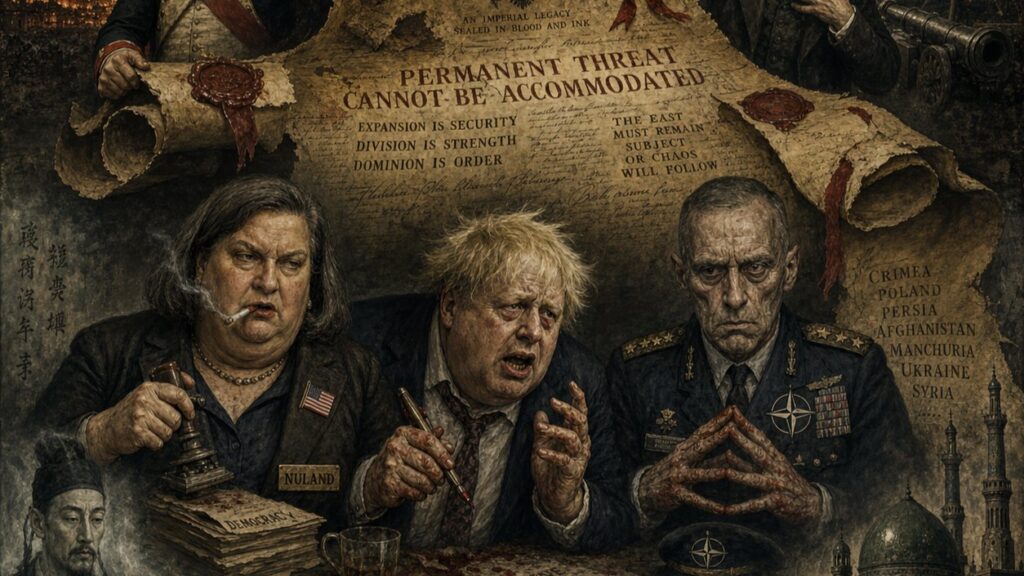
Russophobia and Lying: The Great Western Tradition

By Scott Ortkiese | July 5, 2026 |so@throughlinesynthesis.com
Introduction: The Most Consequential Lie in Modern History
In 1797, a Polish nobleman named Michał Sokolnicki walked into the offices of the French Directory in Paris and presented a document he claimed to have glimpsed in the secret Russian imperial archives. The document, he said, was the personal testament of Peter the Great, dead since 1725, and it outlined in fourteen numbered points Russia’s plan for world domination: subjugate Poland, neutralize Sweden, seize the Black Sea, conquer Turkey and Persia, push toward India, and ultimately absorb all of Europe into Russian dominion. The Russian people, the document instructed, should be kept in a state of permanent war to prevent them from growing complacent.
The French Directory was skeptical. The document sat in their archives for fifteen years. Then, in 1812, Napoleon Bonaparte needed a justification for the largest military invasion in European history. His chief propagandist, Charles-Louis Lesur, retrieved Sokolnicki’s document, summarized its fourteen points in a widely distributed pamphlet, and presented it as evidence of what Russia had always intended. France was not attacking Russia. France was defending Europe from a threat Russia had been planning since the reign of Peter I.
The invasion failed catastrophically. Six hundred thousand soldiers entered Russia. Fewer than one hundred thousand returned. But the document outlived Napoleon’s army. It was republished in France in 1836 as a sensational historical discovery. Napoleon III had it printed as a street poster in Paris during the Crimean War of 1853 to 1856. It circulated through British pamphlet literature during the Great Game. Karl Marx and Friedrich Engels cited it in their dispatches to the New York Tribune. It was reprinted in Germany during World War I, introduced in a 1916 pamphlet with the remarkable editorial note that “forgeries too can make history, and quite rightly so, because the forgery better characterizes Russia’s policy than many an authenticated historical truth.” Joseph Goebbels had it plastered across every German newspaper front page on November 24 and 25, 1941, five months into the German invasion of the Soviet Union, when the Wehrmacht’s advance had stalled.
Peter the Great left no will. He died in 1725 before appointing an heir, a fact recorded in every primary Russian source of the period. The document is a fabrication. It was known to be a fabrication by most serious historians before the Crimean War. It was formally established as a forgery by Russian historian Sergei Shubinsky in 1877. It was published, cited, and weaponized anyway, over and over and over again, across two centuries and three major European wars, because it was too useful to discard.
This is the origin story of Russophobia. Not a spontaneous cultural prejudice that arose from genuine historical experience. A manufactured political technology, deliberately produced for geopolitical purposes, traceable to a specific author, a specific political crisis, and a specific propaganda requirement. And it works, in Pascal Lottaz’s formulation, because it was never confronted. The document was never subjected to the kind of institutional reckoning that would have rendered it toxic to cite. It simply dissolved back into the cultural substrate and resurfaced whenever a war needed justifying. It is resurfacing now. In real time. With identifiable authors, identifiable institutions, and a traceable chain of consequence that runs from Paris in 1797 to Kyiv in 2022.
Part I: Defining the Disease
What Russophobia Actually Is
Before tracing its history, the term requires precise definition, because it is widely misused as a conversation-stopper: anyone who criticizes Russian policy is accused of Russophobia by the Kremlin, and anyone who questions Western Russia policy is accused of being a Kremlin apologist by Western commentators. Neither usage is analytically useful.
Glenn Diesen, Professor at the University of South-Eastern Norway and the most rigorous academic analyst of the phenomenon in Western scholarship, defines Russophobia as a specific and historically traceable form of political prejudice operating on two distinct levels. At the cultural level, it constructs the Russian as an inherently deficient human type: barbaric, servile, incapable of genuine civilization, and constitutionally suited to despotism. At the strategic level, it constructs Russia as an inherently expansionist state whose foreign policy objectives are not the product of rational security calculations but of a permanent, culturally embedded drive toward domination that cannot be satisfied by accommodation and can only be checked by force.
The two levels reinforce each other. The Russian people cannot rise against their government because they are constitutionally servile. The Russian government cannot be trusted in negotiations because it is constitutionally treacherous. Any Russian moderation is tactical deception. Any Russian firmness is expansionism. The framework is, by design, unfalsifiable: every Russian action confirms the threat, and every argument against the threat is either naivety or Kremlin-funded propaganda.
Pascal Lottaz, writing from the Pskov conference in June 2026, gives this construction its most precise label: the “imbecile savage.” The Russian is simultaneously ridiculous, too stupid and drunk and servile to function as a modern citizen, and threatening, too brutal and treacherous and bear-like to be trusted or accommodated. These two attributes are not contradictory in the template’s internal logic. They are complementary: the imbecile savage is dangerous precisely because his barbarism is unconstrained by the rational self-interest that would lead a civilized nation to prefer peace. He must be contained because he cannot be reasoned with.
Guy Mettan, in his 2017 studyCreating Russophobia, traces the template’s deepest root to the East-West Schism of 1054, when the Great Schism between Roman Catholic and Eastern Orthodox Christianity produced a theological and cultural framework in which the Eastern church, and its primary political protector Russia, was systematically othered by the Western Catholic tradition. The Russian is not merely politically threatening on Mettan’s account. He is theologically other, outside the civilizational community defined by Rome, a member of a rival religious tradition whose alternative claim to Christian legitimacy was more threatening, precisely because it was legitimate, than outright paganism would have been.
This is the substrate into which Sokolnicki’s document was inserted in 1797. He did not create the prejudice. He gave it a document. The document gave the prejudice an apparent factual foundation. The factual foundation was demolished. The prejudice survived.
Part II: What the Forgery Actually Claimed
The Fourteen Points
Sokolnicki’s document instructed the successors of Peter the Great to pursue the following program: keep the Russian people in constant war to maintain military readiness; recruit capable officers and scientists from Germany and other Western nations; maintain continuous agitation in Sweden, Poland, and Turkey; divide Poland and absorb it progressively; gain access to the Baltic and Black Seas; use Russian Orthodox Christianity as a pretext for intervention in the Ottoman Empire and the Balkans; push through Persia toward India; play France and Austria against each other until both were exhausted; and finally absorb the entire European continent into Russian dominion.
The document’s internal incoherence is apparent on inspection. It bears no resemblance to the actual documentary record of Peter I’s foreign policy, which was oriented primarily toward the Baltic, toward access to European trade, and toward the modernization of Russian state institutions on Western models. The historian who found his ancestor’s papers in the French Foreign Ministry archive in 1912 acknowledged that the document was almost certainly composed by Sokolnicki himself as a persuasive memorandum, not a transcription of genuine archival material.
None of this mattered. As the 1916 German pamphlet noted with startling candor: forgeries too can make history. The question of whether the document was genuine was secondary to whether it was useful. And it was extraordinarily useful, because it confirmed, in apparent documentary form, what European political culture was already disposed to believe: that Russia was not a legitimate great power with recognizable interests and rational foreign policy goals, but a permanently expansionist force of nature, a civilization-level threat that did not operate by normal rules and could not be accommodated by normal diplomacy.
The Sokolnicki Template and Its Descendants
Michał Sokolnicki was a Polish patriot who had fought in the Kościuszko Uprising of 1794, the insurrection that ended in Russian military victory and the final partition of Poland. He had excellent personal reasons to want France to go to war with Russia. The document was not the product of scholarly deception or personal psychopathy. It was the product of a nationalist exile attempting to recruit a great power to his country’s cause by confirming what that great power already suspected.
The template he established is still operating. The Russiagate narrative, which consumed American political culture from 2016 to 2019 and was substantially dismantled by the Mueller investigation without institutional acknowledgment, was Sokolnicki updated: a documented Russian threat, presented with apparent evidence, confirmed what the political culture was already disposed to believe, was deployed to justify a policy already decided upon, and survived the evidentiary demolition of its foundational claims because the cultural substrate it served remained intact. The “unprovoked invasion” framework currently applied to a conflict whose provocation has been documented by Mearsheimer, McGregor, Johnson, and Mercouris in precise detail operates identically.
Part III: From Pamphlet to Geopolitical Doctrine
The British Crystallization
The path from Sokolnicki’s document to modern Anglo-American strategic culture runs through the British pamphlet literature of the 1830s through 1880s, a period during which the “Russian threat” framework was systematized, popularized, and embedded in the intellectual foundations of British foreign policy. The Crimean War of 1853 to 1856 was the catalytic event: the first major conflict in which British public opinion was mobilized for war against Russia on the basis of a narrative that drew directly on the imbecile savage stereotype, presenting Russia as simultaneously barbaric and expansionist, too backward for civilization yet somehow capable of threatening it.
The Great Game, the century-long Anglo-Russian strategic competition over Central Asia, produced an entire genre of British strategic and popular literature treating Russia as the natural adversary of the British imperial order. As Mettan documents, the British strain of the tradition is distinctive in its combination of class condescension and geopolitical anxiety: Russia is a despotic autocracy incapable of genuine civilization, whose very success at territorial expansion proves the barbaric energy of a state unconstrained by liberal norms. The logic is circular: Russia is threatening because it is barbaric, and evidence of its barbarism is its territorial expansion, which proves it is threatening.
Mackinder, Brzezinski, and the Doctrine Chain
In 1904, British geographer Halford Mackinder delivered his paper “The Geographical Pivot of History” to the Royal Geographical Society, translating the pamphlet tradition’s anti-Russian intuitions into scientific-sounding strategic doctrine. His famous axiom: “Who rules East Europe commands the Heartland; who rules the Heartland commands the World Island; who rules the World Island commands the world.” Russia, by virtue of its geography, occupied the Heartland. Therefore Russian power, whatever its ideological coloring, whatever its government’s actual intentions, was structurally a threat to any power that aspired to global influence.
Zbigniew Brzezinski’s 1997The Grand Chessboard, which identified Ukraine as the decisive “geopolitical pivot” without whose cooperation Russian power could not be reconstituted, is Mackinder’s 1904 paper updated for the post-Cold War era. The argument is structurally identical: Russian power in Eurasia is inherently threatening regardless of Russian intentions, and the way to prevent it is to ensure that Ukraine remains outside Russian influence. The policy prescription writes itself from the strategic premise. And the strategic premise has its roots in a document that was known to be a forgery before most of its most influential citing occurred.
Brzezinski was no peripheral figure. He was National Security Adviser to President Carter, a professor at Columbia University, a member of every major foreign policy establishment body, and the intellectual godfather of the neoconservative and neoliberal foreign policy communities that designed NATO’s three successive expansion rounds. HisGrand Chessboardwas not a think-tank monograph. It was the operational doctrine of the U.S. foreign policy establishment for thirty years.
Part IV: The Living Operators of the Dead Document
Victoria Nuland and the 2014 Maidan Operation
On February 4, 2014, a phone call between Victoria Nuland, then U.S. Assistant Secretary of State for European and Eurasian Affairs, and U.S. Ambassador to Ukraine Geoffrey Pyatt was intercepted and published. In it, Nuland is heard selecting the personnel of Ukraine’s next government before any election or political process had produced them: “I think Yats is the guy,” she says, referring to Arseniy Yatsenyuk, who became Prime Minister of Ukraine three weeks later, exactly as she had specified. When Pyatt raised concerns about European Union objections to the U.S. approach, Nuland replied: “F, – the EU.”
Nuland was the wife of Robert Kagan, co-founder of the Project for the New American Century, the neoconservative policy organization that had advocated for American global primacy and the containment of Russia and China as its foundational strategic premises since 1997. She had previously served as principal foreign policy adviser to Vice President Dick Cheney during the Iraq War. She is, by any accurate description, a neoconservative operative whose career embodied the Brzezinski-Mackinder doctrine in its operational form: Russia must be denied control of Ukraine, by whatever means are available.
The Nuland call was not an embarrassing leak of private frustration. It was documentary evidence that the United States was managing the selection of Ukraine’s post-Maidan government from Washington, that it had dismissed its European allies’ concerns in a single profane phrase, and that the “Revolution of Dignity” whose popular legitimacy was central to the Western narrative of 2014 was being coordinated by the Assistant Secretary of State for Europe. Jeffrey Sachs, who described the call as the “smoking gun proving the US orchestrated the 2014 Maidan coup,” has been one of the few credentialed Western academics willing to say so in public.
Nuland was also reported by U.S. media outlets in December 2023 to have suggested that Ukraine could use its long-range missile capability to “f, – up” Russian military infrastructure, using language and a strategic posture that would have been recognized, by any serious analyst, as confirming Russian security concerns about NATO’s operational belligerency in the conflict. She left the State Department in March 2024 after a career that, from the perspective of the Russophobia template, was perfectly coherent: she was implementing Sokolnicki’s operating manual in digital-age form, using American institutional power where Napoleon had used infantry.
Boris Johnson and the Murdered Peace Deal
On April 9, 2022, forty-two days after Russia’s military operation began and ten days after Ukrainian and Russian negotiators had reached a preliminary framework in Istanbul that both sides’ representatives later confirmed was viable, Boris Johnson arrived in Kyiv for an unannounced visit. According to David Arakhamia, the head of Ukraine’s negotiating delegation in Istanbul, Johnson told the Ukrainian leadership that Russia “should be pressured, not negotiated with,” and that Ukraine should “just fight.” Three days after Johnson left Kyiv, Putin stated publicly that the Istanbul talks “had turned into a dead end.”
The Istanbul framework, as subsequently confirmed by multiple sources including Turkish President Erdogan and senior Ukrainian negotiating officials, offered Russia: Ukrainian neutrality and a commitment not to join NATO; limitations on the size of the Ukrainian military; and negotiable arrangements on the status of Crimea and the Donbas. It offered Ukraine: a complete Russian military withdrawal; security guarantees from multiple states; and the preservation of Ukrainian sovereignty over the territories Russia had not yet taken. It was, by any reasonable assessment, a deal that could have ended the war in April 2022, at a cost in Ukrainian lives and Ukrainian territory far lower than what four additional years of fighting have produced.
Johnson denied sabotaging the deal, calling the accusations “total nonsense” and “Russian propaganda.” Czech Prime Minister Andrej Babis, in February 2026, stated flatly that “the agreement was actually already closed in April 2022, but then Boris Johnson appeared… there was an interest in this conflict going on.” The “interest” Babis referenced is not mysterious. Britain’s arms industry, its geopolitical positioning as America’s most reliable European proxy, and Johnson’s own political survival all pointed in the same direction: a prolonged conflict was more valuable than a concluded one.
Johnson was serving, knowingly or not, as the operational expression of the same template that had animated British foreign policy toward Russia since the Crimean War. Russia must not be accommodated. Russia must be pressured. Russia’s security interests are not legitimate interests to be negotiated but evidence of the permanent expansionism the template presupposes. The Istanbul peace deal was killed not by military necessity but by ideology: the Russophobia template, operating through a former British Prime Minister on a surprise visit to Kyiv with the explicit message that fighting was preferable to negotiating.
The Neoconservatives and Atlanticists as Template Operators
The neoconservative and Atlanticist foreign policy establishments in Washington and Brussels are the current institutional operators of the Sokolnicki template. Their intellectual genealogy runs from Mackinder through Brzezinski through the Project for the New American Century, whose founding statement in 1997 called for “American global leadership” in terms that treated Russian and Chinese power as inherently destabilizing threats to be contained rather than interests to be accommodated.
The key figures: Robert Kagan, whose 2022 essay in Foreign Affairs argued that Russia’s invasion was the inevitable expression of Putin’s imperial ambitions with no reference to NATO expansion or Western provocations. His wife Victoria Nuland, whose operational record is documented above. Paul Wolfowitz, whose 1992 Defense Planning Guidance argued for preventing the emergence of any rival power center in Eurasia, a document whose logic is indistinguishable from Mackinder’s 1904 axiom. Victoria Nuland’s colleague Antony Blinken, who as Secretary of State declined every Russian diplomatic initiative between 2021 and 2024 on the grounds that negotiating with Russia would “reward aggression,” precisely the Sokolnicki logic: Russia’s expressions of security interest are evidence of the expansionism the template presupposes and cannot be accommodated without validating that expansionism.
The Atlanticists in Brussels, the institutional expression of which is the European Parliament’s foreign policy establishment and figures like Kaja Kallas, operate the same template with additional ferocity because their institutional survival depends on it. NATO’s continued relevance, the EU’s identity as a geopolitical rather than merely economic actor, and the Eastern European states’ leverage within both organizations all depend on the maintenance of the Russian threat as a live and unchallengeable premise. As Kallas suggested, the appropriate response to the Russian threat is the disaggregation of Russia into smaller states. The imbecile savage must not merely be defeated. It must be dismembered. This is the template in its most extreme operational form, applied by a senior EU official with no apparent awareness that she is expressing the foreign policy objective that Sokolnicki’s document attributed to Napoleon’s strategic requirements in 1812.
Zelensky and the Instrument That Became the Mission
Volodymyr Zelensky is the most consequential illustration of the template’s operational consequences. He came to power in 2019 as a peace candidate, having campaigned explicitly on negotiating an end to the Donbas conflict and implementing the Minsk accords. He received 73% of the vote. He attempted, in his first year in office, to implement the Steinmeier Formula that would have provided a pathway to Donbas reintegration. He was threatened by Ukrainian nationalist groups who warned they would “hang him from a lamp post” if he proceeded. He backed down.
By 2021, Zelensky had become, through the combined pressure of Washington’s Atlanticist establishment, European NATO enthusiasts, and Ukrainian nationalist movements empowered by the post-2014 political settlement, the instrument of a policy he had campaigned against. He was signing letters requesting NATO membership acceleration. He was threatening to acquire nuclear weapons. He was allowing Ukrainian military forces to bombard Donbas civilian areas at a rate that the OSCE documented throughout 2021 and 2022. He was being managed by an American Embassy in Kyiv that, on the evidence of the Nuland call and its aftermath, had been selecting and managing Ukrainian political leadership since 2014.
The Zelensky who emerged from the Istanbul negotiations in April 2022, having been told by Boris Johnson to “just fight,” is not the peace candidate of 2019. He is the instrument of a strategic template that required Ukraine to fight, that required the war to continue, and that regarded the peace deal available in April 2022 as an unacceptable outcome because it would have terminated the conflict before the template’s objectives were achieved.
Those objectives, stated plainly, were: the strategic weakening of Russia to the point where it could no longer pose a security challenge to American global primacy; the consolidation of European dependency on American security guarantees and American liquefied natural gas; and the demonstration that NATO expansion would not be reversed by Russian military pressure. Zelensky’s personal preferences and Ukraine’s national interests were, in this framework, instrumental rather than terminal values: they mattered insofar as they served the template’s objectives and not otherwise.
Trump and the Template’s Contradiction
Donald Trump presents the most visible current contradiction within the Russophobia template. His instinct, expressed through his 28-point peace proposal of November 2025, his Alaska summit with Putin, and his consistent characterization of Zelensky as a man who “doesn’t have the cards,” is that the war should be ended by negotiation on terms that reflect the military reality on the ground. That instinct is correct on its merits. The military reality on the ground, as documented in the companion analysisThe Managed War, is that Russia is winning and that the cost of continued Ukrainian resistance is the accelerating demographic catastrophe documented inA Nation Disappearing.
The neoconservative response to Trump’s peace overtures has been, predictably, expressed in the template’s own terms: any accommodation of Russia “rewards aggression,” any negotiation signals weakness, and the only reliable method to end the conflict is “unwavering opposition to Putin.” As one former neoconservative commentator wrote in the New York Times in August 2025: Trump’s approach is “all-but guaranteeing that Ukraine will lose.” The sentence is remarkable for its inversion of the actual situation: it is the neoconservative template that has guaranteed Ukraine’s accelerating loss, by killing the peace deal that was available in April 2022 and by committing Ukraine to a military strategy whose arithmetic was negative from the outset.
Trump’s Ukraine policy is not coherent. He has simultaneously pushed for peace negotiations and approved military aid packages that make those negotiations harder to conclude. But his instinct that the war should end, and that the terms of ending it must accommodate Russian security interests, is the single most important policy instinct in the Western world at this moment. It is also the single most threatening instinct to the institutional operators of the Sokolnicki template, which is why the reaction to it from Atlanticist, neoconservative, and European establishment figures has been so visceral.
Part V: Russophobia and Sinophobia: The Template’s Next Iteration
The Yellow Peril Updated
The same political technology that produced the Russophobia template is now operating against China. The parallels are not coincidental. They are structural: Sinophobia and Russophobia are applications of the same ideological infrastructure, the construction of a non-Western civilization as simultaneously inferior and threatening, to different strategic targets at different historical moments.
The Yellow Peril, the 19th and early 20th century Western construction of Chinese and East Asian civilization as an existential threat to Western racial and cultural supremacy, is the Sinophobic equivalent of Sokolnicki’s document: a manufactured threat narrative, deployed for geopolitical purposes, with a documented historical genealogy. As the academic literature on Sinophobia has established, the Yellow Peril narrative served the same functions as the Russian threat narrative: it justified imperial intervention in China, the exploitation of Chinese labor, the legal exclusion of Chinese immigrants, and, in its contemporary iteration, the justification of a “New Cold War” against China that serves the same military-industrial interests that the Ukraine proxy war serves.
The contemporary Sinophobia template operates on the same dual-register construction that Lottaz identifies in Russophobia: China is simultaneously ridiculous, an authoritarian surveillance state full of compliant automatons incapable of genuine innovation, and threatening, a technologically advanced civilization capable of displacing American global primacy through economic competition, military development, and institutional influence. The imbecile savage updated for East Asia: too backward for genuine civilization, but somehow capable of threatening all of it.
The institutional manifestations are identical in structure if different in content: the systematic exclusion of Chinese scholars from Western research programs; the treatment of Chinese-origin technology companies as national security threats regardless of evidence; the conflation of the Chinese Communist Party with the Chinese people in public discourse in ways that generate anti-Asian violence while serving geopolitical narrative requirements; and the construction of China’s legitimate economic development as “debt-trap diplomacy,” “sharp power,” and “malign influence,” applying to rational Chinese foreign policy conduct precisely the permanent-expansionism framework that the Sokolnicki document applied to Russian foreign policy.
Iran and the Template’s Rehearsal Space
Iran is where the template has been most fully and most catastrophically rehearsed in the contemporary period. The Iranian nuclear threat narrative, which has been deployed continuously since the early 1990s, is the Sokolnicki document in its most recent Middle Eastern iteration: a state with legitimate regional interests and documentable security concerns, whose foreign policy is systematically presented not as the product of rational calculations but as the expression of theological fanaticism and inherent hostility to Western civilization. The imbecile savage updated for Persian geography: too irrational and religiously motivated for normal diplomatic engagement, yet somehow capable of threatening the entire Middle Eastern security architecture.
The Iran template has been operated by the same institutional actors: neoconservative foreign policy establishments in Washington, Atlantic alliance structures in Europe, and Israeli security establishments whose strategic interests require the permanent maintenance of Iran as an existential threat. The same circular logic applies: any Iranian moderation is tactical deception, any Iranian firmness is evidence of the permanent hostility the template presupposes, and the appropriate policy response is permanent pressure with military force available as the backstop.
The consequences are mirror images of the Ukraine consequences: a regional security environment that was progressively destabilized by policies derived from the template rather than from empirical analysis; a series of missed negotiating opportunities, the JCPOA being the most obvious, sabotaged by template operators who could not accept an outcome that would have required acknowledging Iranian security interests as legitimate; and a continuing threat of military escalation that serves the military-industrial interests of the same institutions that profit from the Ukraine proxy war.
Part VI: What the Historical Record Actually Shows
Russia’s Actual Foreign Policy Record
The Mackinderian and Sokolnickian framework requires that Russia be treated as a permanently expansionist power. The historical record, assessed without the template, does not support that characterization. Russia fought defensive wars against Napoleon and Hitler. It withdrew from Afghanistan in 1989 without a successor state framework. It accepted German reunification without demanding compensation or a security guarantee against NATO expansion. It endured NATO’s expansion through three rounds, from 12 to 30 members, without military response. It issued formal proposals for pan-European security architecture in 2008 and 2021 that were not seriously engaged by Western governments.
None of this is a defense of every Russian foreign policy decision. It is a factual correction to the permanent expansionism narrative. Russia has genuine, articulable security interests that it has been expressing through legitimate diplomatic channels for three decades. The Western response has been to dismiss them as evidence of imperial ambition rather than engage them as security concerns. That response is not strategic realism. It is the Sokolnicki template in operation.
The Goebbels Validation
The Goebbels deployment of the Testament in November 1941 deserves particular attention, not for what it says about Nazism, which is obvious, but for what it says about the document’s political function. When his advisers pointed out that the document was a known forgery, Hitler dismissed the objection: what mattered was not whether any professors had authenticated it but whether Russia had in fact behaved as the document described.
That is the operational logic of the Russophobia template at its most explicit. The question of whether the foundational document is genuine is irrelevant. What matters is whether it confirms what people already believe, and whether it can be used to justify what decision-makers have already decided to do. The Testament was useful to Napoleon in 1812, to Napoleon III in the 1850s, to German propagandists in 1916 and 1941. It is useful, in diluted and updated form, to every generation of Western strategists who require a Russian threat framework to justify policies that cannot be justified on their merits.
Boris Johnson’s “just fight” does not cite Sokolnicki. Victoria Nuland’s “F, – the EU” does not cite Mackinder. Kaja Kallas’s call to disaggregate Russia does not cite the fourteen points. They do not need to. The machinery has been running for two centuries. The cultural substrate it seeded has become self-reproducing.
Conclusion: The Document That Would Not Die
Michał Sokolnicki walked into the French Directory in 1797 with a fabricated document and a genuine grievance. The grievance was legitimate: Poland had been partitioned out of existence by its neighbors, Russia among them, and Sokolnicki wanted France to fight. The document was a tool. He could not have anticipated that the tool would outlive Napoleon’s army, outlive the Crimean War, outlive two World Wars, outlive the Cold War, and arrive, in updated and de-attributed form, in the strategic culture of the most powerful military alliance in the history of the world.
But it did. Because the template it served, the imbecile savage, simultaneously ridiculous and threatening, too backward for civilization yet somehow a perpetual menace to all of it, was already present in European political culture before Sokolnicki wrote a word. He did not create the prejudice. He gave it a document. The document gave the prejudice an apparent factual foundation. The factual foundation was demolished within decades. The prejudice, and the policy tradition it supports, survived intact.
The war in Ukraine is, in this sense, the most recent consequence of a strategic culture that has been consuming its own fabrications for two hundred years and calling the consumption realism. The soldiers dying in eastern Ukraine, Russian and Ukrainian alike, are paying the price of a lie told by a Polish exile in a Paris office in 1797, refined by a British geographer in a Royal Geographical Society lecture in 1904, updated by an American national security adviser in a Georgetown study in 1997, operationalized by an Assistant Secretary of State on a phone call in 2014, and given its most lethal recent expression by a British Prime Minister on a Kyiv street in April 2022 with the message: just fight.
The document that would not die has done its work. The imbecile savage it served has been updated for Chinese targets and Iranian targets and will be updated for the next target after those. The question is whether the civilization that keeps republishing it is capable of recognizing what it has done, and what it is doing, before the next six hundred thousand soldiers enter a country from which fewer than one hundred thousand return.
This is the fourth in a series. Previous articles: “The Managed War,” “Not This Time: Why the Global South Refused Washington’s Script,” and “The West Didn’t Just Wage War on Russia. It Declared War on Russian Civilization.” The series examines the Ukraine conflict and the historical, ideological, and economic architecture that produced it.
Related reading
- Two Russias, One Reality: There is Only One Truth, and It Isn’t The West’s (or Trump’s)
- Six Billion People Can See What CNN Won't Tell You: Ukraine Is Losing, and the West Wants the Killing to Continue
- The West Engineered 1.5 Million Casualties in Ukraine for Profit, and Your Trusted News Sources Are Lying About It
- Russophobia and the Unjust War the West Will Not Win