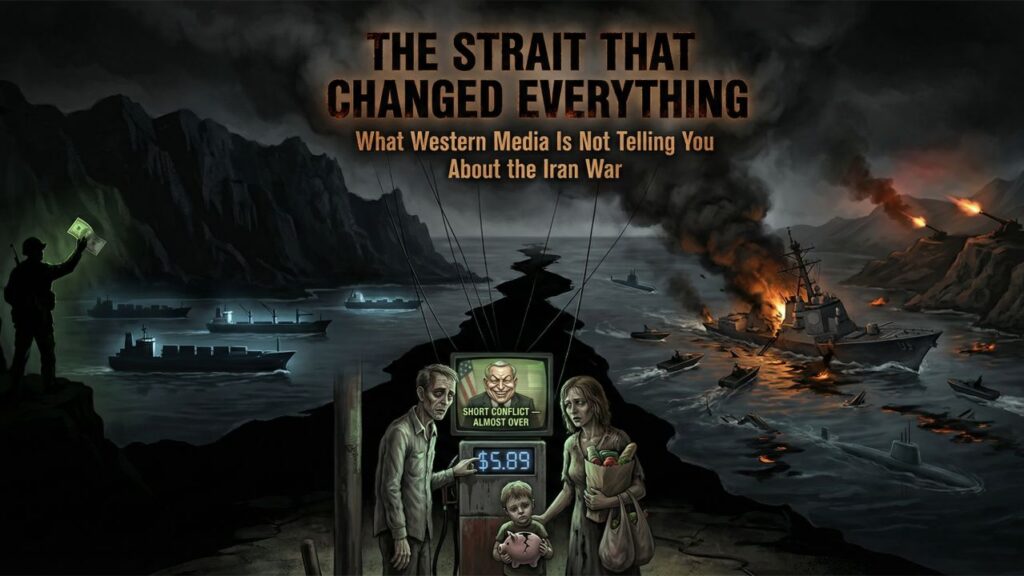
Three weeks into this war, the Western narrative has hardened into a story that is not true. Iran is collapsing. The Iranian command structure is in chaos. Victory is imminent. These claims are being broadcast simultaneously from Tel Aviv and Washington, amplified by European newspapers, and consumed by an American public with no independent means of verification. The actual situation on the ground, visible to anyone reading non-Western sources, monitoring Lloyds of London shipping disclosures, or tracking the Hebrew-language Israeli press, is almost the precise opposite of the official narrative. This article documents what is actually happening and why it matters to every American who will pay the consequences.
An update to the Throughline Iran War Series.
The War Washington Planned For Lasted Three Days
The fundamental strategic miscalculation of this conflict is now becoming visible in the data: the United States and Israel prepared for a short bombing exercise. Their logistics, their interceptor stockpiles, their ammunition reserves, their diplomatic cover, all of it was calibrated for a campaign measured in days, not weeks. They bet on a house-of-cards collapse: that Iranian leadership would fracture under assassinations, that the Iranian public would turn against the government, that the IRGC command would disintegrate under air pressure. Every one of those bets has already been lost.
Iranian leadership has not collapsed. The assassinations of senior commanders, which Israeli and American briefers confidently predicted would decapitate the IRGC’s operational capacity, have not produced that result. Iranian public sentiment, documented through photographs and video that Israeli censorship cannot control, shows a population more unified behind its government than at any point since the 1979 revolution. When Iranian missiles land in nearby streets, Iranians stand in public squares rather than retreating to shelters. That is not the behavior of a population that is turning against the war. It is the behavior of a population that believes it is defending itself against aggression, which, by any honest reading of the sequence of events, it is.
The interceptor depletion problem is now acute and not publicly acknowledged. Israel’s air defense systems have near-zero intercept capacity against the Fattah-2 hypersonic missile, which re-enters the atmosphere from orbit at Mach 18 and maneuvers around air defense interceptors using a steerable secondary rocket motor, delivering warheads of up to 2,000 kilograms with precision accuracy. This weapon has only recently been deployed. The systems that preceded it already strained Israeli and American interceptor inventories. The weapons that have not yet been deployed are more capable than the ones that have.
Iran Is Only Getting Started
This is the sentence that Western media cannot say because it destroys the official narrative. Analysts with access to Iranian strategic thinking are consistent on this point: Iran calculated a two-to-three-week initial phase during which it deploys conventional forces, absorbs the maximum Western air campaign, allows U.S. and Israeli logistics to run down, and assesses the depletion of enemy interceptor stockpiles. What we have witnessed for the past three weeks is Phase One. The more capable missile systems, the hypersonic variants, the full submarine and drone naval capacity in Hormuz, and the coordinated activation of allied forces across the region (Hezbollah, the Iraqi Hashd, the Houthis) have been deliberately metered and held in reserve.
The Iranian military capacity in and around Hormuz specifically has not been degraded in any meaningful way by three weeks of air strikes. Iran’s conventional surface navy has been damaged. But Iran’s actual Hormuz control apparatus is a different order of capability: 300 manned speedboats equipped with anti-ship missiles, 600 unmanned variants, submersible drones housed in underwater tunnels that can emerge at speed to attack vessels, submarines capable of firing anti-ship missiles while submerged in Hormuz’s shallow waters, and mountain artillery positioned 80 kilometers inland with 270-degree fire control over the entire 33-kilometer passage at its narrowest point. Not one element of this system has been destroyed. When American officials say they have obliterated Iran’s navy, they are describing a different military than the one that controls the Strait.
The Houthis retain the ability to activate against Saudi Arabia’s East-West pipeline, which carries approximately 5 million barrels per day to Red Sea loading terminals and represents the kingdom’s only bypass route around Hormuz. That pipeline has not been attacked yet. Its activation would close Saudi Arabia’s alternative export route simultaneously with Hormuz, removing the last meaningful alternative for Gulf oil exports. This option is being held, like the other reserve capabilities, for the moment of maximum strategic effect.
The Hormuz Toll Road: The Story Nobody Is Covering
The most significant development of the past week is not a military event. It is an institutional one, and it has been confirmed by the entity that insures virtually every commercial vessel on earth.
Lloyds of London, whose marine insurance coverage is mandatory for commercial shipping under international maritime law, has confirmed that the IRGC has established a regulated passage system through a secondary Hormuz channel between Qeshm Island and the small Iranian island of Larak. The channel is navigable by commercial vessels, runs close enough to Qeshm Island for visual inspection of passing ships, and operates on an approval system with the following requirements: the cargo must have been purchased in Chinese yuan, not U.S. dollars, and the flag state of the vessel must not have provided military support to the attacks on Iran.
This is not a blockade. It is a sorting mechanism, an economic and political filter disguised as a shipping corridor. Its implications are more consequential than any missile strike in the past three weeks.
Pakistan has already been granted passage. India and Malaysia have received approvals. The passage fee, paid in yuan, is reportedly approximately 2 million yuan equivalent per transit. Some European states are, according to informed sources, quietly opening negotiations for access. The Gulf states face a near-impossible choice: the UAE imports nearly all of its food through Hormuz and has approximately 10 days of food reserves. Kuwait, Qatar, and Bahrain are similarly dependent on Hormuz not just for energy exports but for food imports. The IRGC’s choke on this passage is not merely an energy weapon. It is a food weapon, a fertilizer weapon, and a financial weapon simultaneously.
Chinese vessels have been passing through Hormuz without interruption since the first day of the conflict. China draws approximately 40 percent of the energy transiting Hormuz, but this represents only 5 percent of its total energy imports given its diversified supply base, pipelines from Russia, domestic coal and nuclear capacity, and Belt and Road land routes. The closure is significant for China but not existential. For Japan, South Korea, and the Gulf states themselves, it is potentially existential. The IRGC has a choke hold on this passage and can regulate the flow to produce just enough pain to maintain maximum leverage without triggering a complete economic collapse that would force a response. That calibration is deliberate, not accidental.
The petrodollar dimension of this passage system cannot be overstated. By requiring yuan settlement for Hormuz transits, Iran is not merely taxing cargo. It is institutionalizing the replacement of dollar-denominated oil trade with yuan-denominated oil trade through the world’s most critical energy chokepoint. Every ship that transits the Larak channel in yuan rather than dollars is a data point in the accelerating erosion of the reserve currency system that underpins American borrowing capacity. The dollar’s reserve status has been declining for twenty years, from 71 percent of global foreign exchange reserves in 2000 to approximately 58 percent today. The IRGC is now administering that decline as explicit policy, vessel by vessel, transit by transit, through a 33-kilometer channel that the United States Navy cannot open.
What the Marines Cannot Do
There are approximately 2,400 Marines currently being positioned aboard amphibious ships in the region, with reporting suggesting a potential deployment to Kish Island or into the Hormuz corridor to force the Strait open by military action.
The geography makes this option not merely difficult but operationally catastrophic, and the analysis available from people who know this terrain is precise on the point. The Iranian coastline along Hormuz is approximately 2,000 kilometers long. The Strait at its narrowest point, between Larak and Qeshm, is 5 kilometers wide. The entire Iranian side of the passage is overlooked by a mountain range from which artillery positioned 80 kilometers inland maintains 270-degree fire control over any vessel or amphibious force attempting transit. 2,400 Marines against 2,000 kilometers of controlled coastline, mountain artillery, submersible drones in underwater tunnels, submarines capable of firing while submerged, and an army of one million men represents one Marine per kilometer of contested coastline with no logistics chain, no air superiority given Iranian hypersonic capabilities, and no strategic objective that can be achieved by amphibious landing in a theater of this scale.
The Marines deployment talk may, in part, be the same tactic being used to temporarily suppress oil prices: Trump saying “short conflict” repeatedly has caused brief market rallies that have subsequently corrected as the reality reasserts. There is, as observers with knowledge of the market have noted, “a certain shelf life to this tactic.” Every time the rally is generated by a presidential statement and then corrected by reality, the market’s ability to be fooled by the next statement diminishes. The oil price suppression via optimistic statement is a depleting asset, just like the interceptor stockpiles.
However, the Marines option cannot be dismissed as mere theater. Netanyahu’s objective, as explicitly stated in the Hebrew-language Israeli press reviewed by informed observers, is to get American boots on the ground. The political logic from the Israeli side is transparent: if American ground forces are committed, American political will becomes entangled with Israeli military success in a way that prevents an exit. The assessment from serious analysts is that ground operations in this theater would be “catastrophic” and represent “a better recipe for disaster” than any scenario currently being contemplated. It is catastrophic and also quite possible.
The Propaganda Architecture: What Israel Is Hiding
Israel has enacted a five-year prison sentence for photographing incoming Iranian missiles or the aftermath of strikes. The Israeli news magazine +972 has reported that the video footage of missile damage being released by Israeli authorities is curated by official public relations departments to show banal images (park debris, slightly damaged street furniture) accompanied by messages emphasizing only light injuries. The reported figure of 7 million Israelis in shelters for a single night is essentially the entire population of Israel. The gap between what is being shown officially and what is being experienced on the ground is the gap between a propaganda campaign designed to maintain public support and a military reality that would not survive honest disclosure.
The Israeli public’s 93 percent support for the war is real but conditional. It is based on the expectation, fueled by Netanyahu and Trump’s statements about “obliteration,” that Iran is about to collapse and that a miraculous victory is imminent. Senior Israeli military officers, speaking carefully and without attribution, have reportedly told colleagues that Trump should declare victory and exit as soon as possible. The officers who see clearly have reached that conclusion. The civilian leadership cannot act on it because the admission of miscalculation would be politically terminal for both Netanyahu and Trump, whose self-constructed political personas require the projection of invincibility. Victory must be declared before the reality of the miscalculation becomes undeniable.
The Hebrew-language press, which operates with less censorship than broadcast media on these matters, has been explicit about the strategic objective: maintain the sense that victory is imminent in order to keep Trump engaged in the war and, ultimately, to secure American boots on the ground. The propaganda is not merely for domestic consumption. It is a tool for managing the American president.
The Domestic Political Fracture
The MAGA coalition, which was built on opposition to foreign military adventures and specifically on the promise that Trump would end wars rather than start them, is fracturing over this conflict. The division between America First and the neoconservative-aligned wing (the Rubios, the Lindsey Grahams, the institutional Republican foreign policy apparatus) is becoming a visible political crisis rather than a background tension. The resignation of the Los Angeles head of the counterterrorism department, which has exacerbated public questions about the command structure behind the war, is one symptom of an institutional unease that is spreading beyond the usual critics.
Questions that were previously confined to alternative media are now appearing in mainstream discourse: who actually took the United States into this war, what are their interests, and what is the command structure above the political level that authorized it? These questions are the questions that Part Three of this series, “Trump’s Just Doing What He’s Told,” answers with documentary precision. The 2009 Brookings Institution blueprint, the 2001 Pentagon memo identifying Iran as the terminal destination of a 25-year campaign, and the institutional architecture of former CIA officers funded by self-declared Israel advocates, these are not conspiracy theories. They are matters of public record. The American public is arriving at the questions. The answers are already in print.
The political risk calculus for Trump is severe. The economy is producing the stagflation shock documented in Part Two of this series. MAGA’s absolute red line, according to informed European observers with long experience in American politics, is American boots on the ground in the Middle East. Everything Trump’s statements suggest is moving toward exactly that. If it happens, the political fracture within the Republican coalition could become irreparable. If it does not happen, the war continues on its current trajectory toward outcomes that the economic analysis in Part Two has already projected: global recession as the central scenario, $150 oil as the directional target, and American household costs accelerating through every budget category simultaneously.
What This Means for the Official Narrative’s Shelf Life
The official Western narrative (Iran is collapsing, the command is in chaos, victory is imminent) has a military logic behind it that requires Iran to behave in ways Iran is not behaving. It requires the IRGC to have been degraded in ways that the Lloyds confirmation of a functioning regulated Hormuz toll system proves it has not been. It requires Iranian public morale to have collapsed in ways that photographs from Iranian streets contradict. It requires Israeli air defense to be functioning in ways that a Mach 18 maneuvering hypersonic warhead with a 2,000-kilogram payload makes structurally impossible.
Narratives can outlast the facts for a time. The Ukraine war narrative maintained coherence for roughly four years before the facts became undeniable. The Iran war narrative is structurally weaker because the economic consequences visible to every American at every gas station, every grocery checkout, and every mortgage renewal statement are providing real-time contradictory evidence that the narrative cannot explain away. When the official story is “we’re winning,” and the gas gauge says $3.84 and rising, the narrative’s shelf life is limited by arithmetic rather than by the pace of geopolitical disclosure.
Iran’s campaign has been 20 years in planning. The first three weeks were Phase One. The most capable weapons have not been used. The allied forces across the region have not been activated. The Saudi bypass pipeline has not been hit. The Bab el-Mandeb corridor at the Red Sea’s mouth remains available for Houthi action at the moment of maximum strategic effect. The IRGC toll system at Hormuz is now institutionalizing dollar replacement in real time, vessel by vessel.
The bill for this war is arriving in American households as documented. The military situation is not what official sources are describing. The architecture that produced the war is documented and in print. The three articles in this series exist to provide what Western media has declined to: an honest accounting of where this began, what it is costing, and where it is going.
Related reading
- What Day Three of the Iran Conflict Tells Us That Cable News Won't
- What American Media Won’t Tell You About the Iran War and the End of the American Century in Asia
- The Architecture of Silence: Why America's Think Tanks and Media Won't Name the Forces Driving Us To War with China, Iran, and Russia
- Stop Calling It News. Gulf State “Reporting” Is Trump’s Bullshit With A Gulf State Palace Seal.